The White House

Office of the Press Secretary

Readout of the President's Call with Prime Minister Netanyahu of Israel

Today, as a part of their regular communication and cooperation on bilateral and regional issues, President  Obama spoke with Prime Minister Netanyahu of Israel.  They reviewed the recent meetings between Israeli and Palestinian negotiators in Amman and the President reaffirmed his commitment to the goal of a comprehensive and lasting peace in the region.  The two leaders also discussed recent Iran-related developments, including the international community’s efforts to hold Iran accountable for its failures to meet its international obligations.  The President reiterated his unshakable commitment to Israel’s security, and the President and the Prime Minister promised to stay in touch in the coming weeks on these and other issues of mutual concern.

The 2011 NBA Champion Dallas Mavericks visit the White House

January 12, 2012 | 1:34 | Public Domain

The White House welcomed the NBA Champion Dallas Mavericks to the White House to honor the team and their 2011 NBA Championship victory. The President also recognized the Mavericks’ ongoing support to the men and women who serve in our military and their families, and the Dallas Mavericks met some of these hero's during the visit.

Download mp4 (37MB)

The White House

Office of the Press Secretary

Remarks by the President at a Campaign Event

Private Residence
Chicago, Illinois

7:30 P.M. CST

THE PRESIDENT:  It is wonderful to be back home!  (Applause.)  It is great to see so many friends that I haven't seen in too long -- and some folks who visited me in my new residence.  But let me begin by just thanking Fred for opening up this extraordinary home to us.  (Applause.)  And thank everybody else who helped put this together.  I particularly want to thank Sonia and Eric for all that they did -- (Applause.)

I want to acknowledge some outstanding public servants who are here -- my former seat mate in Springfield, the Attorney General of Illinois -- (applause.)  My former teacher of the ways of the Senate and one of the finest public servants that we know -- Dick Durbin.  (Applause.)  The outstanding governor of Illinois, Pat Quinn, is in the house.  (Applause.)  And finally, we have sort of a carpetbagger here -- (laughter) -- I just love her so whenever I have an excuse to see her I'm happy, and she is a fellow Midwesterner, the Senator from Missouri -- Claire McCaskill.  (Applause.) 

So I'm going to make my opening remarks very, very brief because, Fred and I were talking, particularly a crowd like this that knows me, I want to spend as much time as possible answering questions. 

I was talking about a meeting I had this morning with companies from all across the country, some of them very large corporations -- Intel and Siemens; some medium-sized companies and some very small companies.  The common theme was that they were all insourcing.  They were bringing jobs back to America.  Many of them had located plants in China, located plants in Mexico, and because of the extraordinary growth in productivity in the United States over the last several years, because wages are going up pretty rapidly in places like China, because of energy costs and transportation costs and a whole range of other factors, we're getting to this point where when you account for everything, that America is fully competitive in manufacturing and more than competitive in services with any other country in the world.  Those are a good news story. 

But I asked them, what is it that's going to make the biggest difference in accelerating this trend so you start seeing more and more companies decide let's move back into the United States -- let's move our plants back?  And some of them mentioned education.  They said the single most important reason for us to move back here is because they're more highly skilled workers here, and as long as we're investing in K through 12 and our community colleges, and have enough engineers and scientists, then that's going to be a reason for us to locate here.

And a number of them said the fact that we've got the most innovative research taking place in the United States, that's what's going to make a difference.  And another one said, well, logistically -- I think this was maybe Otis Elevators -- he said it's kind of hard to move elevators around -- (laughter) -- and so making sure we've got the best infrastructure in the world is going to be what is the determining factor in whether or not we locate a plant here in the United States.

And as I listened to each one of these companies I was reminded that everything we've done over the last three years -- but more importantly, everything we have to do over the next five years -- has to be designed to making sure that this economy is once again one that is built on a solid foundation, one that is not done with bubbles, one that is not based on simply shuffling paper, but one that's based on making things and selling things and one in which everybody -- business, workers, communities -- all feel invested in each other. 

And that's what we've been trying to do over the last three years as we've dug ourselves out of the worst recession since the Great Depression.  That's why it's been so important for us to invest in education like never before, and that's why it's been so important for us to make sure -- with the help of folks like Claire and Dick -- that we continue to invest in research.  That's why we pushed so hard to make sure that we're rebuilding not just our roads and our bridges but also high-speed rail lines and a faster Internet all across the country.

And I make this point because as important as 2008 was, I actually think 2012 is more important, because what we're seeing developing, what we're seeing over the last two years but I think what we're going to see this year in a pretty decisive way is a decision about contrasting visions about where the country should go. 

You've got one theory that says if we slash our education, our research and our infrastructure budgets, and weaken our social safety net, and make sure that unions aren’t out there operating, and we essentially eliminate EPA -- and I'm not exaggerating -- there are candidates and members of Congress who've called for that -- that somehow we're going to be able to win this competition in the 21st century.  And that's one vision, and it is being starkly stated.

And I have a different vision.  Most of the people in this room have a fundamentally different vision about how this country was formed.  Our vision is based on the notion that everybody deserves a fair shot, everybody has to do their fair share, and everybody has got to play by the same set of rules and America succeeds best when we're all in it together, we're all rising together.  And that big, inclusive, generous, bold, ambitious vision of America is what's at stake, is what we're fighting for.

But I guess in these initial remarks what I just want to say is that many of you got involved in my campaign back in 2008, many of you got involved in my Senate campaign back in 2004, some of you got involved in my state Senate campaign back in -- (laughter) -- I don't remember when that was.  (Laughter.)  I think that the reason we were successful was not because I was a flawless candidate or I ran a flawless campaign, but it was because together we were able to give voice to this shared vision of what America should be.  And I want you to know that I have kept faith with that vision all these years and that's not wavered. 

And whether it's making a decision about getting all of our troops out of Iraq, or it was making a decision about ending "don't ask, don't tell," or it was making a decision about expanding Pell grants so more people have access to college, or it's trying to present a balanced approach to deficit reduction, what animates me continues to be the same vision that you guys helped me realize way back when.

This will be my last campaign.  A friend of many of us, Ab Mikva, used to say that being friends with a politician is like permanently having a child in college.  (Laughter.)  Every year there's another tuition check.  (Laughter.)  But I'm finally graduating.  (Laughter.)  And I'm confident that as difficult as these last three years have been, as challenging as they've been -- not so much for me but for Americans all across the country who lost their jobs or have seen their home values decline or been worrying about their retirement and their 401Ks -- I absolutely believe that the American people still have confidence and faith in this country and there's a core decency and strength and resilience to be tapped, and that most of the time the better angels of our nature win out.  I think that's what's going to happen this time as well.  But we're going to have to work hard to get it done.  (Applause.)

END                   
7:44 P.M. CST

The White House

Office of the Press Secretary

Remarks by the President at a Campaign Event

Private Residence
Chicago, Illinois

9:00 P.M. CST

THE PRESIDENT:  Hello, everybody!  (Applause.)  Oh, it is good to be home.  And it is -- you are right, Stuart, I see so many familiar faces.  But first of all, obviously, I’ve got to thank the Taylor family for their wonderful hospitality.  (Applause.)  To all the folks who helped make this evening possible, I appreciate you.  I just see all my neighbors.  (Applause.)  Is somebody mowing the grass in front of my house?  (Laughter.)  I’m going to go over there and check.  (Laughter.)  Because I don’t want you guys talking about me.  “He’s a good President, but nobody’s mowing the lawn.”  (Laughter.)  “Bringing down property values.”  (Laughter.)

A couple of people I want to acknowledge who are here.  Oops, that’s the wrong one.  (Laughter.)  Hold on a second, because these folks -- there we go.  First of all, somebody who has been a great friend of mine, one of the finest public servants in the land, our senior senator Dick Durbin is in the house.  (Applause.)  Dick is around here somewhere.  Somebody who I knew before she got into politics as an extraordinary advocate for youth, continues to do great work -- Heather Steans is here.  (Applause.) 

We’ve got Alderman Willie Cochran is here.  Where’s Alderman?  (Applause.)  He’s over there.  Hey, Willie.  And then I’ve got another alderman who used to work for me -- (laughter) -- and in my first state senate campaign was basically my only staff person.  (Laughter.)  And now he is a big shot, but I will always remember the fact that he was there back when nobody could pronounce my name -- Will Burns is in the house.  (Applause.)  Where’s Will?  There he is.  Will Burns.  It’s good to see you.

And then all of you are here.  (Laughter.)  And I’m looking around, I see folks who first hired me for -- as a summer associate.  Between Eden and Tom, they can take -- and John -- they can take responsibility for me meeting Michelle.  (Applause.)  If it had not been for them, it would not have happened.

I’ve got Allison and folks who stole me from Sidley, so you can blame them if -- (laughter) -- but I’ve got folks here who watched our kids grow up, who we played basketball together, we worked out together, we saw each other at various functions and events.  And friends who, if it weren’t for you, could have never gone on this extraordinary journey that I’ve gone on.

And it’s interesting, Michelle and I, we’re always reflecting on the nature of the work at the White House and -- woops.  That’s okay.  You all right?  Hope that didn’t break.  And we could not be more privileged to be able to serve the American people, and couldn’t be more grateful for the opportunity they’ve given us.  And every day is just this remarkable adventure.  But I will tell you, we’re not shy about saying the one thing we miss is we don’t get to see our friends as much.  And as I look around this room, it’s a reminder that you guys do have our backs, have continued to have our backs, and we’re grateful for you and couldn’t be more appreciative of everything that you’ve done.

Now, I mentioned at a previous event, a friend of mine and a friend of some of yours, Ab Mikva, once said that having a friend who’s a politician is like permanently having a child in college.  (Laughter and applause.)  And basically every few months a tuition check comes, and you keep on thinking, haven’t they graduated yet?  (Laughter.)  Golly.  I’m still working -- (laughter) -- I want to remodel the kitchen and basement. 

Here’s the good news, is we’re about to graduate.  (Applause.)  This is -- this will be the last campaign.  (Laughter.)  And you know, when you think about what’s at stake, I hope you end up feeling that there hasn’t been a more important investment to make than the one that needs to be made this year, not just in terms of money but in terms of time and energy and effort and enthusiasm. 

Back in 2008, when we first got started, I think we all had a shared vision, a common vision, of a country that came together to try to solve problems that had been put off for decades, whether it was fixing a health care system that was broken, making sure that our education system was functioning for this extraordinarily competitive 21st century, making sure that our foreign policy reflected the best of our values, dealing with energy in a way that was smart and intelligent and not only improved our economy but also helped our environment and made sure that we could leave a planet for the next generation, an America that was inclusive and made sure that everybody had a chance to succeed.

And that vision that we had, there were specific policies attached to it, but what it really came down to was this belief in an America where everybody gets a fair shot, everybody does their fair share, everybody is playing by the same set of rules, that all of us are invested in hard work and responsibility, and we’re all in it together.  That we don’t have a country in which some people are consigned to poverty because of circumstances, that if they’re willing to work hard, they can do it, and we all have a responsibility to make that happen.

That’s what 2008 was about, and that’s what the excitement was about, and that was the essence of the “hope, change” message, was this belief that in America, it’s just different from other countries in the sense that it’s diverse and everybody has a stake. 

And we didn’t know at the time that we were going to go through the worst economic crisis since the Great Depression.  We didn’t know that we were going to go through this extraordinary financial crisis.  And so a lot of the last three years had been just dealing with emergencies.

And they’ve been dealt with.  And sometimes it wasn’t popular.  Sometimes it was risky.  But we’ve now had an auto industry that has come surging back.  We have seen private sector job growth for 22 months in a row.  We are seeing the return of manufacturing to America; for two years in a row now, some of the strongest manufacturing growth in a decade.

And so there’s reason to believe that we’re now getting past the worst of what was a very difficult situation. 

But what was important to me over these last three years was that we also didn’t lose sight of the things that had gotten me into this race in the first place, that we still worked on some of those long-term challenges.

And so we fought for health care.  Because unless we could honestly say that nobody in this country is going bankrupt because they get sick, unless we could say that if you’re working hard and you’re carrying out your responsibilities, you shouldn’t have to worry about whether an insurance company drops you, or whether as a young person getting started off in life, that you’re going to have some assurance that you’ve got health care coverage, that we’re not living up to that vision that got us -- that got me into this race.  And so we got it done.

The first bill I signed -- a bill that said that we’re going to have equal pay for equal work because I want my daughters treated the same way as my sons.  (Applause.)  We got that done. 

Making sure that college was accessible.  We made sure that we took $60 billion that were going through banks as a pass-through for student loan programs, and we said, let’s use that $60 billion and expand Pell Grants and make student loans more accessible so that millions of young people have opportunity all across the country.

And if we’re going to deal seriously with energy, we’ve got to get started now, even though we still have an economic crisis -- especially because we’ve got an economic crisis.  So we doubled fuel efficiency standards on cars and on trucks.  And we made sure that we didn’t have any more regulations than were necessary to keep our air clean and our water clean, but we were going to enforce those laws to make sure that we’re leaving a planet behind for our kids and grandkids that is at least as clean as the one that we inherited. 

And we said that we’re going to have to end this war in Iraq, and we did.  (Applause.)  And we said that there are certain values that we’re not going to back off of, like making sure that if you want to serve this country that you love, you don’t have to answer for who you love.  And we ended “don’t ask, don’t tell.”  (Applause.)

And so there were just -- there were a series of things that met a lot of resistance, lot of the lobbyists opposed, that at times caused controversy.  But three years into it, we can honestly say that the vision that motivated me to run, the vision that motivated you to work so hard, that we’ve been true to that vision.

Now, we still have a lot more work to do.  We’ve got a lot more unfinished business.  I was mentioning at a previous event -- I was at -- I had a forum this morning with CEOs, some from very large companies like Intel, some from medium-sized companies, some from very small companies.  The common theme was they were all bringing jobs back from China and Mexico.  They decided to relocate back in the United States.  (Applause.)

Now they were making this not out of a charitable decision.  (Laughter.)  They were making this decision because American workers continue to be the most productive in the world, and their productivity has shot up even in the midst of this recession; that our research and our innovation remains unparalleled around the world.  And they started figuring out, you know what, it might actually be cheaper for us and more productive for us to create jobs here in the United States. 

The interesting thing, though, was -- is that when you asked them what more can we do to encourage this trend, every one of them said we still have to have a better education system; we need to make an investment in that.  (Applause.)   Every one of them said we’ve got to make sure we’ve got the best infrastructure in the world, and we’ve been falling behind.  (Applause.)  Every one of them said that we’ve got to have a smart energy policy.

Every one of them said that we’ve got to maintain our primacy in research and science and technology.  And that was gratifying, because I said, well, that’s my agenda.  (Laughter.)  That’s what I’ve been fighting for.  And that’s what this year’s debate is going to be about.  It’s going to be about not only consolidating the extraordinary achievements that we’ve been able to get done thanks to you over the last three years making sure that health care reform is implemented and financial regulatory reform is implemented and we don’t have a rollback of our environmental protections.  Those are all important things.

But what we’re also going to be debating is are we going to pursue a vision that says our only way to compete in this world is to slash spending on education and slash spending on research and development and not upgrade our infrastructure and take away worker protections and just kind of see how we do in a race to the bottom.  Or are we going to pursue a vision that says we’re going to continue to have the best scientists and universities, but we’re also going to get down into K-12 and community colleges and we’re going to train our young people, and we’re going to invest in human capital, and we’re going to have the best infrastructure.  And there’s no conflict between environment and economics because we’re going to continue to make sure that we’re at the cutting edge on advanced vehicles and electric cars. 

That vision of a future that is inclusive and forward looking, that’s what we’re fighting for.  Now, we’ve still got a difficult economy, and that’s why this is still going to be a close race.  I’ve got to tell you that if we weren’t coming out of this extraordinary recession, I think the American people would make their decision very quickly.

But we’ve gone through three tough years.  And the other side has been able to just sit on the sidelines and say no to everything, not cooperate and then simply try to point the finger and say that somehow this should have been fixed.  And I understand that -- that’s politics.  That’s how Washington generally works.  And so this is going to be a tough battle and I’m going to need all of you just as much now, more now than I needed you in 2008.

But the main message I’ve got is that if you guys are willing to invest the same kind of blood, sweat and tears as we invested in 2008, I’m confident we’re going to win.  (Applause.)  And the reason I’m confident -- the reason I’m confident is that common vision of ours is one that’s shared all across the country.  I rose to national prominence by a speech that said there is no red -- there are no red states and no blue states; it was the United States of America.  Now, sometimes people say, ah, well, you learned, didn’t you?  (Laughter.)  You go to Washington and you’ll find out.
 
But that’s Washington.  That’s not America.  And when I travel around the country -- I don’t care whether I’m going to a tiny town or a big city, I don’t care whether I’m talking to black people or white people or Latinos or Native Americans or Asian Americans.  Wherever I go, I still hear and see on display that core decency and common sense and confidence in the future and belief in community that I was talking about way back when.  Making that real, translating that into policy, getting it through Congress, signing these things into laws -- that’s tough.  It’s not easy. 

But the animating spirit?  That’s still there.  And I am just as determined as I ever was -- more determined with all that I’ve seen over the last several years -- more determined than ever to make sure that we’ve got a government that is reflective of those values.  That’s what we’re fighting for. 

And if you guys stand with me, if you guys have my back as you guys have had my back for all these years, I guarantee you that we are going to win this election.  We will deliver for the American people.  And I won’t be back here in that house for another five years.  (Laughter and applause.)

All right?  Thank you very much, everybody.  God bless you.  Thank you.  (Applause.) 

END
9:20 P.M. CST

The White House

Office of the Press Secretary

Remarks by the President at a Campaign Event

UIC Forum
Chicago, Illinois

5:49 P.M. CST

THE PRESIDENT:  Hello, Chicago!  (Applause.)  Thank you!  Thank you so much.  Thank you.  Hello!  (Applause.) Oh, it’s good to be -- it’s good to be home.  It is good to be home.  (Applause.)  No place like it.

It is great to see so many old friends.  I don’t mean in years, although you guys are getting older, some of you.  I’ll be honest with you, I wouldn’t mind popping over to the United Center.  I think the Bulls are playing tonight.  (Applause.)  They are off to a fine start.  You might have heard the Dallas Mavericks came to the White House on Monday to celebrate their championship, and I told them, enjoy it, because the Bulls will be here next year.  (Applause.)  That’s what I said.

I want to thank Jessica for sharing her extraordinary story.  And Jessica is so representative of all the folks who did so much four years ago and are doing so much now.  So give her a big round of applause.  We are appreciative of her.  (Applause.)

I want to thank Janelle Monáe for her wonderful performance.  (Applause.)  Her whole crew is here.  We had them at the state dinner, and the Korean President and his whole family, they were moving around and -- (laughter) -- do you remember that?  Oh, they loved it.  So music is the universal language, and Janelle and her team are incredibly talented. 

I want to thank my dear friend.  He and I went to law school together; he decided to make something of his life.  (Laughter.)  You see him on TV all the time -- Hill Harper is in the house.  Thank you, Hill.  (Applause.)

One of the finest public servants and one of the finest senators in the land, Dick Durbin is here.  Thank you, Dick.  (Applause.)  Two of the finest members of Congress in the land, and great friends -- Danny Davis and Jan Schakowsky.  (Applause.)  And we’ve got Cook County Board President Tony Preckwinkle who is here as well.  (Applause.)

Now, I also want to say a special word about a friend of ours, a man who’s done extraordinary work for me and performed extraordinary service for our country over the past year, and that is Bill Daley.  (Applause.)  Now, first of all, Bill and I, we got off the plane, and we said, is it really 45 degrees in January?  (Laughter.)  So we were a little confused, thought we had landed in the wrong place.  (Laughter.)  But when Bill first told me it was time for him to return to our hometown, I asked him to take a couple days to reconsider.  But it is tough to resist the greatest city in the world.  And as much as I will miss him in the White House, he’s going to be an extraordinary asset to our campaign.  He’s going to be helping us win in 2012.  So I just want to publicly say how much I appreciate him.

Now, I also want to say how much I appreciate you.

AUDIENCE MEMBER:  I love you!

THE PRESIDENT:  I love you.  I love you, too.  (Applause.)

AUDIENCE MEMBER:  I love you!

THE PRESIDENT:  I love you back, man.  (Laughter.)  You know, I’m here not just because I need your help.  But I’m also here because the country needs your help.  There was a reason why so many people like Jessica worked your hearts out in our 2008 campaign.  And it wasn’t because you thought it was going to be easy.  When you support a guy named Barack Hussein Obama -- (laughter) -- for President of the United States, you’ve got to assume that the odds may not be in your favor.  (Laughter.)  You didn’t need a poll to know that it wasn’t a sure thing.

But what you understood was that the campaign was not about me.  It was about our common vision for America.  It wasn’t a cramped, narrow vision of an America where everybody is left to fend for themselves and the most powerful are able to play by their own rules. 

It was a vision of a big and compassionate and ambitious and bold America where everybody has a chance to get ahead -- everybody, not just those who are advantaged.  A vision that says we’re greater together than we are on our own.  A vision where everybody gets a fair shot and everybody does their fair share, and there’s a sense of fair play; that the rules apply to everybody. 

That’s the vision we shared.  That’s the change we believed in.  And we knew it wouldn’t come easy, and we knew it wouldn’t come quickly.  But I’m here to tell you that three years later, because of what you did in 2008, we’ve begun to see what change looks like.  (Applause.)  

Change -- we’ve begun to see -- and sometimes, because things are moving so fast and the media moves from thing to thing to thing, we don’t take time to step back and ask ourselves what happened because of the work you did in 2008.

Change is the first bill I signed into law -– a law that says an equal day’s work should mean an equal day’s pay, because our daughters should be treated the same and have the same opportunities as our sons.  That’s what change is.  (Applause.)

Change is the decision we made -- that was unpopular at the time -- to go in and help the auto industry retool, prevent its collapse, even when you had a lot of folks who said we should just let Detroit go bankrupt.  And as a consequence, we saved 1 million jobs, and local businesses are picking up again, and fuel efficient cars are rolling off the assembly line stamped with three proud words, “Made in America,” and the automakers are back and folks are working.  That’s because of you.  (Applause.)

Change is the decision we made to stop waiting for Congress to do something about our oil addiction and go ahead and raise fuel efficiency standards on cars.  And by the next decade, we’ll be driving cars that get 55 miles to a gallon.  That’s what change is.  (Applause.)  Save us billions of barrels of oil, and save consumers billions of dollars from their pocketbooks, and it means that we’ll have a better chance of making sure that we leave the planet a little big cleaner and a little bit better off for our kids.

And change is the fight we had, and the fight we won, to stop handing out $60 billion in taxpayer subsidies to banks that issue student loans and give that money directly to students so that millions of more young people are able to get the kind of education that they need in this 21st century economy.  (Applause.)  That’s what change is. 

And as Jessica pointed out, change is finally, after a century of talking about it, passing health care reform that ensures that in the United States of America nobody goes bankrupt because they get sick.  And 2.5 million young people already have health insurance because they can stay on their parents’ plan.  And nobody is denied coverage or dropped by their insurance company when they need it most.  That’s what change is.  (Applause.)

Change is the fact that for the first time in our history, you don’t have to hide who you love in order to serve the country you love.  That’s what change is.  “Don’t ask, don’t tell” is over.  (Applause.) 

And change is keeping one of the first promises I made back in 2008, and that is ending the war in Iraq and bringing our troops home so we can focus our attention on rebuilding America.  (Applause.)

Focus our attention on rebuilding America, but also focusing our efforts on the terrorists who actually attacked us on 9/11.  And thanks to the brave men and women in uniform, al Qaeda is weaker than it has ever been, and Osama bin Laden will never walk this Earth again.  (Applause.)

Now, these changes weren’t easy.  Some were risky.  Almost all of them came in the face of fierce opposition, powerful lobbyists, special interests who spent millions trying to maintain the status quo.  And not all the steps we took were politically popular at the time, certainly not politically popular with the crowd in Washington. 

But you know what kept me going is you.  See, I remembered all the work you put in.  I remembered your hopes and your dreams.  And I knew that on every one of these fights, you guys were out there making your voices heard, knocking on doors, making phone calls, keeping up the fight for change long after the election was over. 

And that should make you proud.  It should make you hopeful.  It shouldn’t make you complacent.  It shouldn’t make you satisfied, because everything that we fought for is now at stake in this election.  The very core of what this country stands for is on the line -- the basic promise that no matter who you are, where you come from, this is a place where you can make it if you try.  That’s at stake in this election.  

The crisis that struck in the months before I took office put more Americans out of work than at any time since the Great Depression.  But it was also a culmination of a decade of neglect, a decade where the middle class fell further behind and more good jobs in manufacturing left our shores.  And suddenly, our prosperity was built on risky financial deals and homes that we couldn’t afford.  And we racked up greater debt.  And even as incomes fell, wages flatlined, the cost of everything from college and health care kept on going through the roof. 

And those problems built up over a decade, in some cases more.  They didn’t happen overnight.  We knew we couldn’t solve them overnight.  It’s going to take more than a few years to meet the challenges that have been decades in the making.  And the American people understand that. 

What they don’t understand are leaders who refuse to take action.  (Applause.)  What they’re sick and tired of is watching people who are supposed to represent them put their party ahead of the country, put the next election ahead of the next generation.  That’s what they don’t understand.  (Applause.)

President Kennedy used to say that after he took office, what surprised him most about Washington was it was just as bad as he had said it was.  (Laughter.) 

I can relate to that.  (Laughter.)  When you’ve got the top Republican saying his number-one priority isn’t creating more jobs, isn’t solving the health care problems, isn’t making sure that we’re competitive in the 21st century, but is to beat me, then you know things aren’t on the level.  That’s how you end up with Republicans in Congress voting against all kinds of proposals that they -- even proposals they supported in the past -- tax cuts for workers; tax cuts for small businesses; rebuilding roads, bridges; putting cops and teachers back to work.  Suddenly they’re opposed. 

They’ll fight with their last breath to protect tax cuts for the most fortunate of Americans, but they’ll play political games with tax cuts for the middle class.  I guess they thought it was a smart political strategy, but it’s sure not a strategy to create jobs.  It’s not a strategy to strengthen the middle class or help people who are trying to get into the middle class to get there.  It’s not a strategy to help America succeed.

So we’ve got a clear choice this year.  The question is not whether people are still hurting, the economy is still recovering.  Of course folks are still hurting.  We’ve got a long way to go.  The question is what are we going to do about it, where are we going to go, what direction does this country move towards. 

The Republicans in Congress, the presidential candidates who are running, they’ve got a very specific idea about where they want to take this country.  I mean, they’ve said it.  They said they want to reduce the deficit by gutting our investments in education and gutting our investments in research and technology, letting our infrastructure further deteriorate.  

Now, my attitude is, I’ve already signed a trillion dollars’ worth of spending cuts; I proposed even more.  It’s time, when we’re talking about reducing the deficit, to also ask people like me to pay our fair share in taxes.  We can do that.  (Applause.)  We can have a system in which folks who have been incredibly blessed by this nation do a little bit more so that the next generation is able to get on the ladder of success.

The Republicans in Congress and on the campaign trail, they want to make Medicare a form of private insurance, where seniors have to shop with a voucher, and it may not cover all their costs.  I think we can lower the cost of Medicare but still guarantee the dignified retirement that our seniors have earned.  They’ve earned it.  (Applause.)  They’ve earned it.

When I hear some of them talk about, oh, this is just an entitlement -- these folks earned it.  They worked hard.  They paid into it.

AUDIENCE:  Yes!  

THE PRESIDENT:  This crowd, they think the best way for America to compete for new jobs and businesses is to follow other countries in a race to the bottom.  They figure, well, since China pays really low wages, let’s roll back the minimum wage here and bust unions; since some of these other countries allow corporations to pollute as much as they want, let’s get rid of protections that help make sure our air is clean and our water is safe. 

AUDIENCE MEMBER:  Go, EPA! 

THE PRESIDENT:  Now, I don’t think we should have any more regulations than what are necessary for our health and safety.  And we’ve made reforms that will make sure that businesses save billions of dollars.  We want government that is smart and efficient and lean.  And by the way, we’ve issued fewer regulations than the Bush administration.  They’ve been better regulations.  (Laughter and applause.)

But I don’t believe in a race to the bottom.  I think we should be in a race to the top.  (Applause.)  We should be competing to make sure we’ve got the best schools.  We should be competing to make sure we’ve got the most highly trained workers.  We should make sure that a college education is within reach for everybody.  (Applause.)

We should be in a race to make sure our businesses have the best access to the fastest Internet, the fastest railroads, the best airports.  I want a race where we continue to have the best scientists and researchers, making the next breakthroughs in medicine and clean energy.  I want to make sure that happens right here in America.  That’s the race we can win.

We should be in a race to make sure the next generation of manufacturing takes root not in Asia, not in Europe, but right here in Chicago, in Detroit, in Pittsburgh, in Cleveland, in Charlotte, in Nashville.  (Applause.) 

I don’t want this -- I don’t want this nation to be known for what we buy, what we consume.  I want us to be known for building and selling products all around the world.  (Applause.) 

And you know it’s possible.  I had a meeting this morning with CEOs from -- some of them very big companies like Intel, some of them small manufacturers.  They’re starting to bring jobs back to the United States.  They’ve started to figure out -- they’ve started to figure out that, yes, some of these countries may have lower wages, but when you factor in all the costs and quality and the productivity of American workers, that it actually makes sense to build plants here.  And they’re moving plants back from China and plants back from Mexico, because they know that businesses who succeed here will succeed anywhere.

But what they also said was we can only come here if we know that we’ve got the best workers.  And that means the education system has to work.  (Applause.)  We can’t come here if we don’t think that the Internet and our roads and our transportation infrastructure is the best in the world. 

The competition for new jobs, for businesses, for middle-class security, that’s a race I know we can win.  But America is not going to win if we give in to those who think that we can only respond to our challenges with the same tired, old tune -- just hand out more tax cuts to folks who don’t need them and weren’t even asking for them, let companies do whatever they want, hope that prosperity somehow trickles down on everybody else’s head.   

It doesn’t work.  It didn’t work when it was tried in the decade before the Great Depression.  It’s not what led to the incredible post-war boom in the ‘50s and the ‘60s.  It didn’t work when we tried it under the previous President, and it’s not going to work now.

We cannot go back to this brand of you’re-on-your-own economics.  We believe that everybody has a stake in each other, and that if we attract an outstanding teacher to the profession by giving her the pay and training and support that she needs, she’ll go out and educate the next Steve Jobs.  (Applause.)  And suddenly, a whole new industry will blossom. 

And we believe that if you provide faster Internet to some little town out in rural America, that store owner now suddenly has a whole world marketplace.  And if we build a new bridge that saves a shipping company time and money, then workers and customers all over the country are going to do better.  And if we invest in basic science and research, that the next new thing will be invented. 

And so, instead of listening to Janelle on the iPod -- who knows what the next thing is, but it will be because we have invested in the innovation that makes us the greatest nation on Earth. 

Now, this has never been a Democratic idea or a Republican idea.  This isn’t a partisan idea.  It was a Republican President from Illinois named Abraham Lincoln who launched the transcontinental railroad and the National Academy of Sciences and the first land grant colleges.  Teddy Roosevelt called for a progressive income tax -- he was a Republican.  Dwight Eisenhower built the Interstate Highway System, invested in boosting our science and math and engineering education here in this country.  It was with the help of Republicans that FDR helped millions of people -- returning heroes, including my grandfather -- get a chance to go college on the GI Bill.  This should not be a partisan idea.  

And that same spirit of common purpose, it still exists today.  It may not exist in Washington.  But out in America, when you talk to people on main streets and in town halls, they’ll tell you, we still believe in those values.  Our political parties may be divided, but most Americans, they understand we’re in this together.  We rise and fall together as one nation, as one people.  (Applause.)

That’s what’s at stake right now.  That’s what this election is about.  So, Chicago, yes, it has been three tough years.  There are times where the changes we want didn’t come as fast as we wanted.  And after all the noise in Washington, I know it’s tempting to believe sometimes that, gosh, maybe -- maybe change isn’t possible. 

But remember -- remember what we said during the last campaign:  Yes, we can.

AUDIENCE:  Yes, we can!  (Applause.)

THE PRESIDENT:  We said real change and big change isn’t easy.  I warned you it was going to take time.  I said it was going to take more than a year, maybe more than one term.  Some of it is going to take more than one President.  It takes ordinary citizens who keep fighting, keep pushing, keep inching this country closer and closer and closer to our ideals.

That’s how the Greatest Generation overcame a decade of Depression and ended up building the largest middle class in the history of the world.  That’s how young people beat back billy clubs and fire hoses and ensured that their kids could grow up in a country where you can be anything, including the President of the United States.  (Applause.)

Change is hard, but it is possible.  I’ve seen it.  You’ve seen it.  We have lived it.  And if you want to end the cynicism and stop the game playing that passes for politics these days and you want to send a message about what is possible, then you can’t back down.  Not now. 

We won’t give up.  Not now.

AUDIENCE:  No!

THE PRESIDENT:  You’ve got to send a message.  We are going to keep pushing and fighting for the change that we believe in. 

AUDIENCE:  Yes!

THE PRESIDENT:  I’ve said before, I’m not a perfect man.  I’m not a perfect President.  But I’ve promised you this, and I’ve kept this promise:  I will always tell you what I believe, I will always tell you where I stand.  I will wake up every single day thinking about how I can make this country better, and I will spend every ounce of energy that I have fighting for you.

AUDIENCE:  Yes!  (Applause.)

THE PRESIDENT:  So if you’ve still got that energy, if you’re still fired up -- (applause) -- if you are not weary, if you’re ready to put on your walking shoes and get to work, and knock on some doors, and make some phone calls, and talk to your friends and talk to your neighbors, and push through all the obstacles, and keep reaching for that vision that you hold in your hearts, I promise you change will come.  (Applause.) 

If you’re willing to work even harder in this election than you did in that last election, I promise you change will come.  If you stick with me, we’re going to finish what we started in 2008.  (Applause.)  We will remind this country and we will remind the world just why we are the greatest nation on Earth. 

God bless you, Chicago.  I love you.  (Applause.)  God bless the United States of America.  (Applause.)

Thank you.  Thank you.

END  
6:15 P.M. CST

President Obama Speaks about Insourcing American Jobs

January 11, 2012 | 16:03 | Public Domain

President Obama welcomes to the White House business leaders whose companies are creating jobs in America.

Download mp4 (153MB) | mp3 (15MB)

Read the Transcript

Remarks by the President on Insourcing American Jobs

East Room

12:51 P.M. EST

THE PRESIDENT:  Thank you.  Thank you, everybody.  Please, please have a seat.  Thank you.  Well, welcome to the White House, everybody.  And Tim, thank you for that introduction.

I could not have enjoyed more the meeting that I had this morning, because what these companies represent is a source of optimism and enormous potential for the future of America.  What they have in common is that they’re part of a hopeful trend:  They are bringing jobs back to America.

You’ve heard of outsourcing.  Well, these companies are insourcing.  These companies are choosing to invest in the one country with the most productive workers, the best universities, and the most creative and innovative entrepreneurs in the world, and that is the United States of America.  (Applause.)  That’s worth applause.

That’s exactly the kind of commitment to country that we need -- especially right now, when we’re in a make-or-break moment for the middle class and those aspiring to get in the middle class here in the United States.

All across this country, I meet folks who grew up with a faith that in America, hard work paid off and responsibility was rewarded, and anybody could make it if they tried -- no matter where you came from, no matter what you looked like, no matter how you started out.  Those are the values that my grandparents and my mother taught me.  Those are the values that built the best products and the strongest economy and the largest middle class that the world has ever known.

I think we understand that over the last few decades, that bargain has eroded for too many Americans.  The economy has changed rapidly.  And for many, that change has been painful.  Factories where people thought they would retire packed up and went overseas, where labor costs were cheaper.

At the same time, we live in a global economy, and as other countries grow and develop middle classes of their own, of course global companies are going to pursue those markets and employ workers and make investments all over the world.

But right now, we’re at a unique moment, a inflection point, a period where we’ve got the opportunity for those jobs to come back.  And the business leaders in this room, they’re ahead of the curve, they recognize it.  I’ll give you just a few examples.  After shedding jobs for more than a decade, American manufacturers have now added jobs for two years in a row.  That’s good news.  But when a lot of folks are still looking for work, now is the time for us to step on the gas. 

So that’s why I pushed Congress to extend the payroll tax cut this year, so that 160 million working Americans weren’t hit with a tax hike.  Now is the time to extend that middle class tax hike for -- tax cut for all of this year.  It’s the right thing to do, and we need to get that done.

But we’re going to have to do more.  And that’s why, in the next few weeks, we’re also going to put forward new tax proposals that reward companies that choose to bring jobs home and invest in America.  And we’re going to eliminate tax breaks for companies that are moving jobs overseas.

Because there is an opportunity to be had right here and right now.  There are workers ready to work, right now.  That’s why I set a goal of doubling our exports of goods and services by 2014 –- and it’s a goal, by the way, that we’re on track to meet; in fact, we’re a little ahead of schedule in meeting that goal. 

That’s why, with the help of our outstanding USTR, I was able to sign trade agreements with Korea and Colombia and Panama so our businesses can sell more goods to those markets.  That’s why I’ve fought for investments in schools and community colleges, so that our workers remain the best you’ll find anywhere, and investments in our transportation and communication networks, so that your businesses have more opportunities to take root and grow. 

I don’t want America to be a nation that’s primarily known for financial speculation and racking up debt buying stuff from other nations.  I want us to be known for making and selling products all over the world stamped with three proud words:  “Made in America.”  And we can make that happen.  (Applause.)

I don’t want the next generation of manufacturing jobs taking root in countries like China or Germany.  I want them taking root in places like Michigan and Ohio and Virginia and North Carolina.  And that’s a race that America can win.  That’s the race businesses like these will help us win.

These are CEOs who take pride in hiring people here in America, not just because it’s increasingly the right thing to do for their bottom line, but also because it’s the right thing to do for their workers and for our communities and for our country.  And they’re leading by example.  I’m proud of that, as an American.  But as President, I also want to make sure they get some credit for it.

Just three years ago, for example, we almost lost the American auto industry.  Today, the Big Three automakers are turning a profit and manufacturing the next generation of fuel-efficient cars that the rest of the world wants to buy.  (Applause.)  Ford Motor Company -- that’s represented by workers and management on this stage -- has committed to investing $16 billion in the United States by 2015, $16 billion.  (Applause.)  And that includes bringing back about 2,000 jobs and shifting production from countries like Japan, Mexico and China to states like Michigan and Ohio and Missouri.

Master Lock -- iconic company.  When Master Lock looked at their numbers, they saw that union workers in America could do the same job at competitive costs as non-union workers in China.  In fact, Master Lock is now exporting their products from the United States to China and Europe.  (Applause.)  And today, for the first time in 15 years -- today, for the first time in 15 years, Master Lock’s Milwaukee complex is running at full capacity.

But you don’t have be a big manufacturer to insource jobs.  Bruce Cochrane’s family had manufactured furniture in North Carolina for five generations.  But in 1966 -- 1996, rather, as jobs began shifting to Asia, the family sold their business and Bruce spent time in China and Vietnam as a consultant for American furniture makers who had shifted their production.  While he was there, though, he noticed something he didn’t expect:  Their customers actually wanted to buy things made in America.  So he came home and started a new company, Lincolnton Furniture, which operates out of the old family factories that had been shut down.  He’s even re-hired many of the former workers from his family business.

You also don’t have to be a manufacturer to insource jobs.  You just heard Tim, CEO of a health care IT company in New Jersey called GalaxE Solutions.  They’ve already hired 150 workers with their “Outsource to Detroit” program, and they plan on hiring up to 500.  And Tim was quoted as saying, “There are some really talented people in Detroit, and we’re putting them back to work.”

Whether you’re a small business that are -- some of which are represented here -- or a large manufacturing corporation, or a technology company; whether you’re a historic brand or a brand-new startup, insourcing jobs is a smart strategy right now.  We live in a global economy with opportunities for global investment.  But we heard from several experts this morning and business leaders that we’re at this point in time where factors like incredibly rising American productivity and increasingly competitive costs mean the economic case to invest in America and bring jobs back home is strong -- and it’s getting stronger.

Labor costs are going up in places like China.  We have become much more productive.  We continue to be the largest market in the world.  And so we have this outstanding opportunity if everybody is partnering and getting together.  That’s the economic case.

I believe there’s also a moral case.  Andy Grove, the former CEO of Intel, said it well.  He said, “Those of us in business have two obligations.  One that’s undebatable is that we have a fiduciary responsibility to the shareholders who put us in our place.”  But he also said, “There’s another obligation that I feel personally, given that everything I’ve achieved in my career and a lot of what Intel has achieved in its career were made possible by a climate of democracy, an economic climate and investment climate provided by our domicile –- the United States.”

All these folks onstage, they are businesspeople first, and they’re looking at the bottom line.  But they also feel good about the fact that they’re restoring hope and creating jobs here in the United States.  And that’s part of the responsibility that comes with being a leader in America –- a responsibility not just to the shareholders or the stakeholders, but to the country that made all this incredible wealth and opportunity possible.  That’s a responsibility that we all have to live up to –- whether we’re in the private sector or the public sector; whether we’re in Washington or we’re on Wall Street.  Because the more Americans who succeed, the more America succeeds.

So my message to business leaders today is simple:  Ask yourselves what you can do to bring jobs back to the country that made our success possible.  And I’m going to do everything in my power to help you do it.  We’re going to have to seize this moment.  American workers are the most productive and competitive in the world right now.  When you factor in all the costs, we have a outstanding market; we have the most innovative entrepreneurs, the best research universities.  And part of what our session this morning was all about was just helping people to take a look at what this moment is and where we’re going to be five years from now.  Because when people take a second look, it turns out that the potential for job growth and American manufacturing and the service industry is incredible.

I said in a speech a while back, this moment is perfectly suited for our advantages.  It’s perfectly suited for who we are.  The global marketplace is becoming more innovative, more creative, more transparent, faster, more adaptable -- that’s who we are.  That’s our strength.  We’ve got to take advantage of it. 

And if we’ve got leadership of the sort that we’re seeing on this stage, I’m absolutely confident that not only can it make a difference for our middle class and folks who are working their way into the middle class, it also gives us an incredible opportunity to assure the future for our children and our grandchildren.  And that’s my central goal and focus as President.  That should be our central goal as a country -- how we rebuild an economy where hard work pays off, responsibility is rewarded -- a nation where those values continue for generations to come.

So thanks to all the people on this stage for being such a great example.  For all the press who are here, I hope you get a chance to hear their stories, because it’s exciting, and it gives you a sense of why I’m incredibly optimistic about our prospects. 

Thank you very much, everybody.  (Applause.)

END               
1:05 P.M. EST

Close Transcript

President Obama at the Insourcing American Jobs Forum

President Obama speaks at the Insourcing American Jobs forum (20120111)

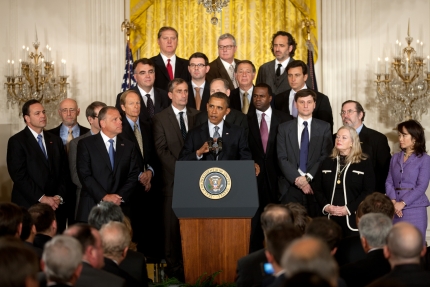
President Barack Obama, joined by 19 business leaders, delivers remarks to leaders from the private sector and the government at the “Insourcing American Jobs” forum in the East Room of the White House, Jan. 11, 2012. President Obama said the insourcing by these leaders was "exciting" and one reason "why I'm incredibly optimistic about our prospects." (Official White House Photo by Lawrence Jackson)

At today's "Insourcing American Jobs" forum, President Obama talked about his hope for the future:

I don’t want America to be a nation that’s primarily known for financial speculation and racking up debt buying stuff from other nations. I want us to be known for making and selling products all over the world stamped with three proud words:  “Made in America.”  And we can make that happen.

I don’t want the next generation of manufacturing jobs taking root in countries like China or Germany. I want them taking root in places like Michigan and Ohio and Virginia and North Carolina. And that’s a race that America can win. 

There are signs that the country might be moving closer to that vision, and the President is hard at work to help deliver it.

"[My] message to business leaders today is simple: ask yourselves what you can do to bring jobs back to the country that made our success possible," the President said.  "And I'm going to do everything in my power to help you do it. We're going to have to seize this moment."


Learn more:

  • Read a new White House report on building an economy that lasts in America.
  • Check out a fact sheet that outlines steps the President has already taken to support insourcing.

The White House

Office of the Press Secretary

Remarks by the President on Insourcing American Jobs

East Room

12:51 P.M. EST

THE PRESIDENT:  Thank you.  Thank you, everybody.  Please, please have a seat.  Thank you.  Well, welcome to the White House, everybody.  And Tim, thank you for that introduction.

I could not have enjoyed more the meeting that I had this morning, because what these companies represent is a source of optimism and enormous potential for the future of America.  What they have in common is that they’re part of a hopeful trend:  They are bringing jobs back to America.

You’ve heard of outsourcing.  Well, these companies are insourcing.  These companies are choosing to invest in the one country with the most productive workers, the best universities, and the most creative and innovative entrepreneurs in the world, and that is the United States of America.  (Applause.)  That’s worth applause.

That’s exactly the kind of commitment to country that we need -- especially right now, when we’re in a make-or-break moment for the middle class and those aspiring to get in the middle class here in the United States.

All across this country, I meet folks who grew up with a faith that in America, hard work paid off and responsibility was rewarded, and anybody could make it if they tried -- no matter where you came from, no matter what you looked like, no matter how you started out.  Those are the values that my grandparents and my mother taught me.  Those are the values that built the best products and the strongest economy and the largest middle class that the world has ever known.

I think we understand that over the last few decades, that bargain has eroded for too many Americans.  The economy has changed rapidly.  And for many, that change has been painful.  Factories where people thought they would retire packed up and went overseas, where labor costs were cheaper.

At the same time, we live in a global economy, and as other countries grow and develop middle classes of their own, of course global companies are going to pursue those markets and employ workers and make investments all over the world.

But right now, we’re at a unique moment, a inflection point, a period where we’ve got the opportunity for those jobs to come back.  And the business leaders in this room, they’re ahead of the curve, they recognize it.  I’ll give you just a few examples.  After shedding jobs for more than a decade, American manufacturers have now added jobs for two years in a row.  That’s good news.  But when a lot of folks are still looking for work, now is the time for us to step on the gas. 

So that’s why I pushed Congress to extend the payroll tax cut this year, so that 160 million working Americans weren’t hit with a tax hike.  Now is the time to extend that middle class tax hike for -- tax cut for all of this year.  It’s the right thing to do, and we need to get that done.

But we’re going to have to do more.  And that’s why, in the next few weeks, we’re also going to put forward new tax proposals that reward companies that choose to bring jobs home and invest in America.  And we’re going to eliminate tax breaks for companies that are moving jobs overseas.

Because there is an opportunity to be had right here and right now.  There are workers ready to work, right now.  That’s why I set a goal of doubling our exports of goods and services by 2014 –- and it’s a goal, by the way, that we’re on track to meet; in fact, we’re a little ahead of schedule in meeting that goal. 

That’s why, with the help of our outstanding USTR, I was able to sign trade agreements with Korea and Colombia and Panama so our businesses can sell more goods to those markets.  That’s why I’ve fought for investments in schools and community colleges, so that our workers remain the best you’ll find anywhere, and investments in our transportation and communication networks, so that your businesses have more opportunities to take root and grow. 

I don’t want America to be a nation that’s primarily known for financial speculation and racking up debt buying stuff from other nations.  I want us to be known for making and selling products all over the world stamped with three proud words:  “Made in America.”  And we can make that happen.  (Applause.)

I don’t want the next generation of manufacturing jobs taking root in countries like China or Germany.  I want them taking root in places like Michigan and Ohio and Virginia and North Carolina.  And that’s a race that America can win.  That’s the race businesses like these will help us win.

These are CEOs who take pride in hiring people here in America, not just because it’s increasingly the right thing to do for their bottom line, but also because it’s the right thing to do for their workers and for our communities and for our country.  And they’re leading by example.  I’m proud of that, as an American.  But as President, I also want to make sure they get some credit for it.

Just three years ago, for example, we almost lost the American auto industry.  Today, the Big Three automakers are turning a profit and manufacturing the next generation of fuel-efficient cars that the rest of the world wants to buy.  (Applause.)  Ford Motor Company -- that’s represented by workers and management on this stage -- has committed to investing $16 billion in the United States by 2015, $16 billion.  (Applause.)  And that includes bringing back about 2,000 jobs and shifting production from countries like Japan, Mexico and China to states like Michigan and Ohio and Missouri.

Master Lock -- iconic company.  When Master Lock looked at their numbers, they saw that union workers in America could do the same job at competitive costs as non-union workers in China.  In fact, Master Lock is now exporting their products from the United States to China and Europe.  (Applause.)  And today, for the first time in 15 years -- today, for the first time in 15 years, Master Lock’s Milwaukee complex is running at full capacity.

But you don’t have be a big manufacturer to insource jobs.  Bruce Cochrane’s family had manufactured furniture in North Carolina for five generations.  But in 1966 -- 1996, rather, as jobs began shifting to Asia, the family sold their business and Bruce spent time in China and Vietnam as a consultant for American furniture makers who had shifted their production.  While he was there, though, he noticed something he didn’t expect:  Their customers actually wanted to buy things made in America.  So he came home and started a new company, Lincolnton Furniture, which operates out of the old family factories that had been shut down.  He’s even re-hired many of the former workers from his family business.

You also don’t have to be a manufacturer to insource jobs.  You just heard Tim, CEO of a health care IT company in New Jersey called GalaxE Solutions.  They’ve already hired 150 workers with their “Outsource to Detroit” program, and they plan on hiring up to 500.  And Tim was quoted as saying, “There are some really talented people in Detroit, and we’re putting them back to work.”

Whether you’re a small business that are -- some of which are represented here -- or a large manufacturing corporation, or a technology company; whether you’re a historic brand or a brand-new startup, insourcing jobs is a smart strategy right now.  We live in a global economy with opportunities for global investment.  But we heard from several experts this morning and business leaders that we’re at this point in time where factors like incredibly rising American productivity and increasingly competitive costs mean the economic case to invest in America and bring jobs back home is strong -- and it’s getting stronger.

Labor costs are going up in places like China.  We have become much more productive.  We continue to be the largest market in the world.  And so we have this outstanding opportunity if everybody is partnering and getting together.  That’s the economic case.

I believe there’s also a moral case.  Andy Grove, the former CEO of Intel, said it well.  He said, “Those of us in business have two obligations.  One that’s undebatable is that we have a fiduciary responsibility to the shareholders who put us in our place.”  But he also said, “There’s another obligation that I feel personally, given that everything I’ve achieved in my career and a lot of what Intel has achieved in its career were made possible by a climate of democracy, an economic climate and investment climate provided by our domicile –- the United States.”

All these folks onstage, they are businesspeople first, and they’re looking at the bottom line.  But they also feel good about the fact that they’re restoring hope and creating jobs here in the United States.  And that’s part of the responsibility that comes with being a leader in America –- a responsibility not just to the shareholders or the stakeholders, but to the country that made all this incredible wealth and opportunity possible.  That’s a responsibility that we all have to live up to –- whether we’re in the private sector or the public sector; whether we’re in Washington or we’re on Wall Street.  Because the more Americans who succeed, the more America succeeds.

So my message to business leaders today is simple:  Ask yourselves what you can do to bring jobs back to the country that made our success possible.  And I’m going to do everything in my power to help you do it.  We’re going to have to seize this moment.  American workers are the most productive and competitive in the world right now.  When you factor in all the costs, we have a outstanding market; we have the most innovative entrepreneurs, the best research universities.  And part of what our session this morning was all about was just helping people to take a look at what this moment is and where we’re going to be five years from now.  Because when people take a second look, it turns out that the potential for job growth and American manufacturing and the service industry is incredible.

I said in a speech a while back, this moment is perfectly suited for our advantages.  It’s perfectly suited for who we are.  The global marketplace is becoming more innovative, more creative, more transparent, faster, more adaptable -- that’s who we are.  That’s our strength.  We’ve got to take advantage of it. 

And if we’ve got leadership of the sort that we’re seeing on this stage, I’m absolutely confident that not only can it make a difference for our middle class and folks who are working their way into the middle class, it also gives us an incredible opportunity to assure the future for our children and our grandchildren.  And that’s my central goal and focus as President.  That should be our central goal as a country -- how we rebuild an economy where hard work pays off, responsibility is rewarded -- a nation where those values continue for generations to come.

So thanks to all the people on this stage for being such a great example.  For all the press who are here, I hope you get a chance to hear their stories, because it’s exciting, and it gives you a sense of why I’m incredibly optimistic about our prospects. 

Thank you very much, everybody.  (Applause.)

END               
1:05 P.M. EST

The White House

Office of the Press Secretary

President Obama Issues Call to Action to Invest in America at White House "Insourcing American Jobs" Forum

WASHINGTON, DC -- Today, President Obama will call on companies across the nation to invest in America at an “Insourcing American Jobs” forum at the White House.  The forum will focus on the increasing trend of insourcing – where companies are bringing jobs back to the United States and making additional investments here in America.  The President, Vice President, members of the Cabinet and other Senior Administration Officials will lead a discussion on ways to encourage companies across the country to insource American jobs and help rebuild our economy for the future.

In the coming weeks, the President will put forward new ways to encourage American companies to seize this opportunity to increase investment here at home and bring jobs back to America.  In the coming weeks, the President will put forward new tax proposals to reward companies that choose to invest or bring back jobs to the United States, and to eliminate tax advantages for companies moving jobs overseas.

In prepared remarks, President Obama will say, “Today I am meeting with companies choosing to invest in the one country with the most productive workers, best universities, and most creative and innovative entrepreneurs in the world: the United States of America.  That’s exactly the kind of commitment to country we need – especially now, at this make-or-break moment for the middle class.  And I’m calling on those businesses that haven’t brought jobs back to take this opportunity to get the American people back to work.  That’s how we’ll rebuild an economy where hard work pays off and responsibility is rewarded – and a nation where those values live on.”

“Since day one, this Administration has been focused on encouraging investment and job creation here at home,” Vice President Biden added. “The business leaders coming here from across the country today have looked at the facts and concluded what the President and I have been saying all along: that America is the best place in the world to do business and create jobs.  We’re calling on other companies to follow their lead and bring jobs back to America—jobs that provide middle-class families not just with a paycheck, but with a fundamental sense of dignity.”

In conjunction with the forum, the White House today released a report that details the emerging trend of “insourcing” and how companies are increasingly choosing to invest in the United States.  For example, real business fixed investment has grown by about 18% since the end of 2009. In the past two years, 334,000 manufacturing jobs have been created, while manufacturing production has increased by about 5.7 percent on an annualized basis since its low in June of 2009, its fastest pace in a decade. In addition, continued productivity growth has – as several outside analysts have noted – made the United States more competitive in attracting businesses to invest and create jobs by reducing the relative cost of doing business compared to other countries. The full report can be found HERE.
            
While other countries often advocate at the national level for business investment, the United States has historically left this activity to the states.  The President launched the SelectUSA program in 2011 to address this critical gap, creating the first federal program to promote and facilitate U.S. investment in partnership with our states.  To build on early success, the President will be proposing, in his FY13 Budget, $12 million in new resources to increase SelectUSA to 35 full-time employees.  An expanded SelectUSA will:

• Build a comprehensive worldwide foreign direct investment promotion program: SelectUSA will be fully resourced to engage and assist potential investors to the U.S. from all major global markets.

 Support more than 300 investment cases per year:  SelectUSA will build a case management team to oversee ombudsman and advocacy cases, enabling SelectUSA’s and its multi-agency investment team to work with states and cities to address issues that impede business investment. 

• Host a SelectUSA Conference in Washington D.C. to boost investment in the U.S.:  The Administration will host a two day investment conference with all levels of government and businesses from around the world to attract companies to our shores, address issues companies face in choosing to invest in the U.S., and providing relevant information from federal agencies to support investment and insourcing jobs. 

As a part of the administration’s ongoing We Can’t Wait efforts, the administration also announced several common-sense steps it has taken to incentivize insourcing:

 Building use of SBA’s International Trade Loan program to support small businesses seeking to insource. The Small Business Administration will launch an effort using its existing authority to educate businesses about opportunities to access insourcing loans through the SBAs International Trade Loan program, which provides generous loan support (loans up to $5 million and a guarantee up to 90 percent) for small businesses that are trying to access foreign markets or are adversely impacted by imports. While many small businesses that are insourcing are eligible for these loans, few have taken advantage of the program.  SBA will expand outreach efforts around this product by informing small businesses across the country of their eligibility for this opportunity and helping them apply for loans to bring production back home. 

 Launching a partnership between Commerce and the State Department to promote investment in 10 priority countries through the Foreign Commercial Service supported by the U.S. Embassies. This pilot effort will dedicate resources from Commerce’s Foreign Commercial Service (FCS) to investment promotion in 10 pilot countries representing 30% of foreign direct investment in the United States, expanding to cover 25 countries in 2013 representing roughly 90% of FDI.  U.S. Ambassadors will lead these efforts, engaging officials from State and other in country officials to assist investment promotion through business outreach, hosting ‘investment missions’ with governors and mayors, and connecting foreign firms to Select USA services.

 Increasing support for states’ efforts to promote investment through federal officials in Export Assistance Centers (USEACs) in more than 100 cities. Officials will serve as a local link for state economic development officials and Select USA services to ensure federal advocacy for state efforts and address any federal issues requiring rapid resolution.

These efforts build on previous actions by the administration to support efforts by businesses to create jobs and invest in the United States.  A fact sheet providing additional background on administration efforts to support increased investments in America can be found HERE.

A full list of attendees at the event today is below:

Members of the Cabinet and administration officials in attendance include Secretary John Bryson, Secretary Hilda Solis, Administrator Karen Mills, Ambassador Ron Kirk, Chair Fred Hochberg, NEC Director Gene Sperling, Chief of Staff Bill Daley, CEA Chairman Alan Krueger, Senior Adviser Valerie Jarrett, and Deputy Chief of Staff for Policy Nancy-Ann DeParle.

In addition, Governor John Kitzhaber, State of Oregon, Mayor Kasim Reed, City of Atlanta, Bob King, President, United Auto Workers, Leo Gerard, President, United Steelworkers, Hal Sirkin, Boston Consulting Group, Harold Moser, Founder, The Reshoring Initiative, James Manyika, Director, McKinsey Global Institute and Senior Partner, McKinsey & Company, and Brad Jensen, Professor, Georgetown University will also be in attendance.

Below are the representatives from the companies in attendance at forum who have brought jobs back or decided to make significant investments in the United States:

Ford (Mark Fields, President of the Americas)
Ford's competitive labor agreement with its UAW partners is making it possible to build small cars profitably in the U.S., invest $16 billion here at home, and add 12,000 jobs in U.S. plants by 2015.   In fact, Ford is insourcing jobs from China, Japan and Mexico.  Instead of adding production for the Fusion in Mexico, Ford is planning to bring that additional work to its Flat Rock plant in Michigan. This insourcing effort will ensure the viability of a key assembly plant in the U.S. and add over 1,200 new jobs. Also, Ford has committed to in-source the production of F-650 and F-750 commercial trucks from a joint venture in Mexico to Ohio Assembly Plant in Avon Lake, Ohio.  This will make Ford the first auto manufacturer to produce Class 6 and Class 7 trucks in the U.S. and help retain nearly 2,000 jobs in that plant.

DuPont (Mark Vergnano, Executive Vice President)
As part of broad investments the company is making across its portfolio, DuPont started up a new $500 million plant last year to produce Kevlar anti-ballistic fiber near Charleston, South Carolina, that created over 500 construction and 135 full time jobs.  The company has made a recent $150 million investment in an expansion of its photovolatic film production in Circleville, Ohio creating over 70 jobs, and is investing some $150 million to expand agricultural research in Iowa, Pennsylvania, and Delaware creating over 500 jobs.

Otis Elevator Company (Randy Wilcox, President, North America)
Otis, a unit of United Technologies Corporation, is the world’s largest manufacturer and maintainer of elevators, escalators and moving walkways.  Otis has invested in a major new plant in South Carolina that co-locates multiple functions from various geographic locations, including Mexico, into one highly efficient, state-of-the-art facility that will produce energy-efficient elevators for US and Canadian customers.  The facility will result in 360 new jobs in South Carolina and will enable close cooperation between our engineering, design, manufacturing and supply chain teams, which will promote innovation and achieve future cost savings in serving our customers throughout North America. Hiring for the plant will begin in the next few weeks.

Intel (Brian Krzanich, Senior Vice President, General Manager, Manufacturing and Supply Chain)
From 2002 to 2010, Intel spent $68 billion on U.S. operations, manufacturing and R&D.  75% of the company’s product manufacturing is conducted in the United States while 80% of its revenue is earned abroad.  The company employs 44,000 individuals in high tech high wage jobs across America and is the leading private sector employer in Oregon, Arizona and New Mexico.  Most recently, in September 2011, Intel announced it was partnering with IBM and other companies as part of a $4.4 billion investment over five years to create a semiconductor research and development hub in New York to develop next-generation chip technology.  This combined investment will create about 4,400 jobs and result in the retention of another 2,500 existing jobs in upstate New York.

Siemens (Eric Spiegel, President and CEO, Siemens USA)
Siemens, a global integrated technology company operating in the industry, infrastructure, energy and healthcare sectors, employs more than 60,000 people and has 100 manufacturing sites across the United States.  The company has invested nearly half a billion dollars in the United States over the past four years.  It has chosen to invest in the United States because of the proximity it provides to its customers, the ability to locate near highly skilled workers, access to infrastructure to power its plants, transport components, and move products to market and the ability to co-locate manufacturing and R&D.  Siemens invests nearly $50 million annually in training its U.S. workforce. Today, the Ex-Im Bank announced approval of export financing for power generation equipment supporting 825 jobs at Siemens’ North Carolina plant.  Ex-Im Bank financing helped Siemens win the sale against competition from Japan, Germany and Korea.

ThyssenKrupp (Christian Konig, President, ThyssenKrupp North America)
The new steel and stainless steel manufacturing and processing plant in Alabama opened by Germany-based ThyssenKrupp AG in December 2010 represents one of the biggest ever business investments in the USA by a foreign-domiciled company. ThyssenKrupp invested approximately $5 billion dollars in the overall complex, $3.6 billion of which went to facilities that will manufacture premium carbon steel and $1.4 billion of which toward stainless steel production.  Construction of the 3,700 acre site, approximately four times larger than New York’s Central Park, generated thousands of new construction jobs and close to $100 million in wages from the time it began in November 2007 until the plant’s opening in 2010.  The facility will employ 2,700 individuals and produce 5.1 million metric tons of premium carbon and stainless steel products per year when fully operational. In fiscal year 2010/2011, ThyssenKrupp USA subsidiaries employed approximately 19,100 individuals, an increase of nearly 2,000 employees compared to the year prior.

Rolls Royce (James Guyette, President and CEO, Rolls-Royce North America)
Last year, Rolls-Royce dedicated its Crosspointe, Virginia plant, the company’s newest facility in the world and its first facility in the U.S. built from the ground up.  The Crosspointe plant produces aero engine discs for both Boeing and Airbus aircraft and will result in a $500 million dollar investment and 500 jobs.  Rolls-Royce also recently held a hiring event at the company’s Indianapolis facilities to fill 87 openings for skilled machinists, jobs that are the result of insourcing work and a new contract with the United Auto Workers. 

Master Lock (John Heppner, CEO)
Master Lock is the world's largest manufacturer of padlocks and related security products.  Since mid-2010, Master Lock has returned approximately 100 jobs back to Milwaukee, Wisconsin that had previously been off-shored.  The decision to bring these jobs back was partially motivated by economic reasons related to increasingly higher labor and logistics costs in Asia, and further, ongoing labor availability challenges especially in the coastal areas of China, which have negatively impacted continuity in supply to its key customers.  Master Lock plans to continue bringing jobs back to Wisconsin, citing a more competitive overall cost structure, greater control, and the ability to provide better service to its customers.

Lincolnton Furniture (Bruce Cochrane, President and CEO)
Lincolnton Furniture, a small specialty furniture maker opening in North Carolina, is adding 130 new jobs and re-starting operations at a once vacant plant.  Bruce Cochrane, the current owner and CEO, comes from a family that manufacturer furniture in North Carolina.  The family business was sold and eventually the new owners moved manufacturing to China.  Bruce worked as a consultant in Asia for twelve years, importing furniture to the US.  Two years ago, he decided the time was right to start his own furniture company back in the US, in North Carolina, in the same plant his family once ran.  He recently opened operations and is adding 130 jobs to the area.

GalaxE. Solutions (Tim Bryan, Chairman and CEO)
GalaxE Solutions was established in 1990 and specialized in custom software application development for Fortune 50 corporations, with a particular focus on health care.  A little over a year ago the company created the "Outsource to Detroit" program that is a model for repatriating jobs back to the United States.  Key benefits include complex, quality solutions, geographic proximity to U.S. customers, cost efficiencies, and elimination of linguistic issues.  GalaxE. Solutions opened operations in Detroit in 2010 and, with 150 professionals on board, is well on its way to its goal of hiring 500 IT specialists.  The firm is also working with the area's universities and community colleges to train and retrain professionals for the future.

AGS (Joe LoParco, Co-President)
Canadian company AGS Automotive Systems was recently awarded a significant contract for the manufacture of automotive components.  Working with the Michigan Economic Development Corporation, and other local Michigan agencies, AGS recently elected to make an investment in excess of $20 million to add new manufacturing capabilities to permit it to manufacture a portion of the bumper impact assemblies in Michigan.  The new business will likely represent in excess of $100 million in annual sales over the next 5 years and will enable AGS to retain approximately 50 jobs and create over 100 new jobs in Michigan.  Coordination between the company and local officials in Michigan was facilitated by SelectUSA, a Department of Commerce program that promotes business investment in the United States and launched by President Obama in June 2011.

KEEN (James Curleigh, CEO)
KEEN manufactures original hybrid outdoor and casual products, including footwear, bags and socks. In 2010, KEEN decided to build a factory near their headquarters in Portland, Oregon to create competitive advantages in the market,  including production capacity and agility, quality and delivery assurance, duty and transportation reduction, costing and commodity expertise, training and development, and intellectual and innovation protection.  The modern factory relies on skilled labor and improved automation to design, test, and manufacture the best of ‘built in America’ Footwear.  The company has created 20 jobs initially and can increase capacity by adding more jobs and shifts based on increased demand.  They have also used this factory to launch a new category of work boots – built in America for American workers – called KEEN Utility.

Chesapeake Bay Candle (Mei Xu, Co-Owner and President)
Chesapeake Bay Candle is in the process of hiring 100 workers to staff its new 117,000 square foot plant in Maryland that will produce the company’s signature candles.  The plant represents the company's first expansion in the United States in 16 years and will supplement existing facilities in China and Vietnam.  Mei Xu, the Co-Owner and President of the company, has said that she believes consumers both in the United States and abroad are willing to pay a premium for products manufactured in America.

NOVO 1 (Mary Murcott, CEO)
Since 1987, NOVO 1 has been dedicated to tailoring contact center solutions to support clients’ business goals in building customer relationships and growing their brands. NOVO 1’s Smart Desktop Solutions and Customer Obsession Program, incorporate game-changing technology and top 1% industry best- practices to design customized solutions to provide ideal customer experiences.  Last year, NOVO 1 officials announced they were opening a 30,000 square foot customer contact facility in the Eisenhower Business Center in Denison, Texas. They will employ up to 300 people over the next three years and are operational as of September.  They also opened a new office in 2010 in Holland, Michigan, where 300 people are currently employed.

The White House

Office of the Press Secretary

President Obama Announces More Key Administration Posts

WASHINGTON, DC – Today, President Barack Obama announced his intent to appoint the following individuals to key Administration posts:

  • Nancy E. Soderberg – Chairperson, Public Interest Declassification Board
  • Elizabeth Rindskopf Parker – Member, Public Interest Declassification Board
  • Peter H. Bell – Member, President’s Committee for People with Intellectual Disabilities
  • Jack Martin Brandt – Member, President’s Committee for People with Intellectual Disabilities

President Obama said, “I am honored that these talented individuals have decided to join this Administration and serve our country.  I look forward to working with them in the months and years to come.”

President Obama announced his intent to appoint the following individuals to key Administration posts:

Ambassador Nancy E. Soderberg, Appointee for Chairperson, Public Interest Declassification Board
Ambassador Nancy E. Soderberg is the President of the Connect U.S. Fund, a non-profit organization that focuses on promoting U.S. global engagement.  In addition, she is a Distinguished Visiting Scholar at the University of North Florida and the President and CEO of Soderberg Global Solutions.  Ambassador Soderberg served as Vice President of the International Crisis Group from 2001 until 2005.  She was the U.S. Representative for Special Political Affairs at the United Nations from 1997 to 2001, with the rank of Ambassador, and Staff Director of the National Security Council and Deputy Assistant to the President from 1993 until 1997.  From 1985 to 1992, she served as a Foreign Policy Advisor to Senator Edward M. Kennedy.  Ambassador Soderberg has written The Superpower Myth: The Use and Misuse of American Might and co-authored, with Brian Katulis, The Prosperity Agenda: What the World Wants from America - and What We Need in Return.  She is a member of the Council on Foreign Relations.  She earned a B.A. from Vanderbilt University and an M.S. from Georgetown University's School of Foreign Service.

Elizabeth Rindskopf Parker, Appointee for Member, Public Interest Declassification Board
Elizabeth Rindskopf Parker has served as the Dean of the McGeorge School of Law at the University of the Pacific since 2002.  She served as General Counsel for the University of Wisconsin system from 1999 to 2002 and General Counsel for the Central Intelligence Agency from 1990 until 1995.  Prior to joining the Central Intelligence Agency, Ms. Parker was the Principal Deputy Legal Adviser for the U.S. Department of State from 1989 to 1990 and the General Counsel for the National Security Agency from 1984 until 1989.  Earlier in her career, Ms. Parker practiced civil rights law for a decade with the NAACP Legal Defense and Education Fund, Inc., the Lawyers Committee for Civil Rights Under Law, and later was counsel to the law firms of Bryan Cave, LLP and Surrey and Morse, LLP.  Ms. Parker was first appointed to the Public Interest Declassification Board in 2004.  She received a B.A. and J.D. from the University of Michigan.

Peter H. Bell, Appointee for Member, President’s Committee for People with Intellectual Disabilities
Peter H. Bell is the Executive Vice President for Programs & Services at Autism Speaks, a position he has held since 2007.  From 2004 to 2007, Mr. Bell was the President and Chief Executive Officer of Cure Autism Now, where he helped to establish the Autism Treatment Network.  Prior to his work at Cure Autism Now, Mr. Bell held a number of marketing positions at McNeil Consumer Healthcare from 1992 to 2004.  Mr. Bell serves on numerous boards and commissions, including as Co-Founder and President of Advancing Futures for Adults with Autism and chair of the Community Advisory Committee for the International Society for Autism Research.  Previously, in 2007, he served as Chair of the Integration Panel of the Department of Defense Congressionally Directed Medical Research Programs for autism research.  He is also the father of a child with autism.  Mr. Bell received a B.S. from Cornell University and an M.B.A. from the J.L. Kellogg Graduate School of Management at Northwestern University.

Jack Martin Brandt, Appointee for Member, President’s Committee for People with Intellectual Disabilities
Jack Martin Brandt is the Disability Policy Specialist for the Partnership for People with Disabilities at Virginia Commonwealth University, a position he has held since 2010.  In this role, Mr. Brandt’s work focuses on developing and promoting evidence-based and person-centered practices to improve outcomes in self-advocacy for people with intellectual and development disabilities.  Previously, Mr. Brandt was the Disability Rights Advocate at the Virginia Office for Protection & Advocacy from 2008 to 2010, a Disability Policy Consultant for the State of Virginia from 2006 to 2008, a Virginia Governor’s Fellow at the Office of Community Integration for People with Disabilities in 2006, and a Congressional Intern for the U.S. Senate Health, Education, Labor and Pension Committee in 2005.  Mr. Brandt serves on the Virginia Community Integration Advisory Commission and the Virginia Statewide Independent Living Council.  In 2006, Mr. Brandt received the Jackie Crews Award for Excellence in Leadership from the Virginia Board for People with Disabilities.  Mr. Brandt received a B.A. from James Madison University and is pursuing a Master of Science degree in Rehabilitation Counseling from Virginia Commonwealth University.