The White House

Office of the Press Secretary

Statement by the Press Secretary on the Visit of Prime Minister Rutte of the Netherlands

President Obama will host Prime Minister Mark Rutte of the Netherlands for a meeting in the Oval Office on Tuesday, November 29.  The United States and the Netherlands have a close economic relationship that supports jobs in both countries.  The Netherlands is the ninth largest destination for U.S. exports, as well as the third largest direct investor in the United States.  The President and Prime Minister will discuss the importance of these trade and investment ties, as well as the current situation in the eurozone.  The President also looks forward to consulting with Prime Minister Rutte about preparations for the 2012 NATO Summit that the U.S. will host in Chicago; the United States and the Netherlands are founding members of NATO.

The White House

Office of the Press Secretary

Statement by the Press Secretary on the President's Call with Greek Prime Minister Papademos

President Obama spoke with Greek Prime Minster Lukas Papademos today to congratulate him on his appointment, to thank him for taking on such a significant responsibility at a critical moment, and to express U.S. support for Greece’s efforts to implement its commitments under its EU-IMF program.  President Obama reiterated that the United States will stand steadfastly with Greece, a friend and ally, through these difficult times.

President Obama: "Hire a Veteran"

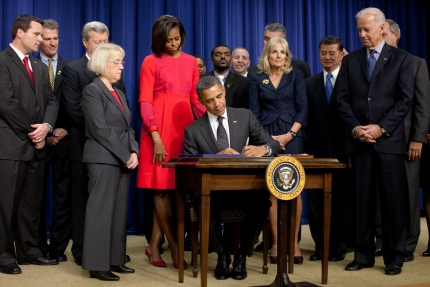
20111121 POTUS Signing

President Barack Obama signs the Veterans Opportunity to Work to Hire Heroes Act of 2011 (VOW to Hire Heroes Act), that will provide tax credits to help put veterans back to work. First Lady Michelle Obama, Vice President Joe Biden and Dr. Jill Biden attend the ceremony in the Eisenhower Executive Office Building South Court Auditorium, Nov. 21, 2011. (Official White House Photo by Pete Souza)

This morning, President Obama signed the "VOW to Hire Heroes Act" into law, telling those in attendance:

Back in September, I sent Congress a jobs bill. And in it, I proposed a tax credit for any business that hires a veteran who’s been unemployed for at least four weeks. I proposed an even bigger tax break if a business hires a veteran who’s been unemployed for at least six months. And if a business hires an unemployed veteran with a disability related to their service, I proposed doubling the tax break that we already have in place.

Today, because Democrats and Republicans came together, I’m proud to sign those proposals into law. And I urge every business owner out there who’s hiring to hire a veteran right away.

The is just one of the initiatives the President has enacted in order to ensure that the country fulfills its obligation to our servicemembers and their families.

And it's just one part of the President's plan to put the American people back to work. At the bill signing, he told lawmakers that families all over the country are demanding the same kind of bold, bipartisan action.

"My message to every member of Congress is keep going," President Obama said, "Keep working."


Read more:

  • Tax credits for employers who hire unemployed veterans and veterans with service-connected disabilities are just one important part of the Obama Administration's plan to to help veterans translate their military skills for the civilian workforce. New online tools are available to aid their search for jobs, and the Administration has partnered with the Chamber of Commerce and the private sector to make it easier to connect our veterans with companies that want to hire them.
  • Read the story of Jason Hansman, who managed hundreds of reconstruction projects that totaled millions of dollars while serving in Iraq, but receieved only one job offer, to fill a night mall cop position. 
  • Read the story of Navy veteran Eric Smith, who has more than five years experience as a military medic, but works today as a hospital janitor.
  • Read the story of Maria Canales, an Army veteran who spent nearly four years looking for a job because she had trouble communicating how the skills she learned in the military prepared her to be an excellent employee in the civilian workforce.
Related Topics: Economy, Veterans

The White House

Office of the Press Secretary

Statement by the President on the Announcement of Additional Sanctions on Iran

Today, my Administration has taken yet another step to further isolate and penalize Iran for its refusal to live up to its international obligations regarding its nuclear program.  For years, the Iranian government has failed to abide by its obligations under the Nuclear Non-Proliferation Treaty. It has violated repeated UN Security Council resolutions, as well as its commitments to the International Atomic Energy Agency.  In the face of this intransigence, the world has spoken with one voice —at the IAEA, at the UN, and in capitals - making it clear that Iranian actions jeopardize international peace and stability, and will only further isolate the Iranian regime. 

Today, my Administration has taken action to impose an additional cost on Iran for its actions.  New sanctions target for the first time Iran’s petrochemical sector, prohibiting the provision of goods, services, and technology to this sector and authorizing penalties against any person or entity that engages in such activity.  They expand energy sanctions, making it more difficult for Iran to operate, maintain, and modernize its oil and gas sector.  They also designate 11 individuals and entities for their role in assisting Iran’s prohibited nuclear programs, including its enrichment and heavy water programs.  And today we have taken the next significant step to escalate the pressure by acting under Section 311 of the USA PATRIOT Act, identifying for the first time, the entire Iranian banking sector – including the Central Bank of Iran – as a threat to governments or financial institutions that do business with Iranian banks.  We are joined in this action by the United Kingdom and Canada, who have also acted to cut off Iran from their financial systems today.  I welcome these steps and encourage all of our partners to do the same.

As President one of my highest national security priorities is to prevent the spread of nuclear weapons, including to the Iranian government. Since taking office, I have made it clear that the United States is prepared to begin a new chapter with the Islamic Republic of Iran, offering the Iranian government a clear choice.  It can fulfill its international obligations and reap the benefits of greater economic and political integration with countries around the world, or it can continue to defy its responsibilities and face even more pressure and isolation.  Iran has chosen the path of international isolation.  As long as Iran continues down this dangerous path, the United States will continue to find ways, both in concert with our partners and through our own actions to isolate and increase the pressure upon the Iranian regime.

The White House

Office of the Press Secretary

Message to Congress -- Iran Sanctions

TO THE CONGRESS OF THE UNITED STATES:

Pursuant to the International Emergency Economic Powers Act (50 U.S.C. 1701 et seq.) (IEEPA), I hereby report that I have issued an Executive Order (the "order") that takes additional steps with respect to the national emergency declared in Executive Order 12957 of March 15, 1995.

In Executive Order 12957, the President found that the actions and policies of the Government of Iran threaten the national security, foreign policy, and economy of the United States.  To deal with that threat, the President in Executive Order 12957 declared a national emergency and imposed prohibitions on certain transactions with respect to the development of Iranian petroleum resources.  To further respond to that threat, Executive Order 12959 of May 6, 1995, imposed comprehensive trade and financial sanctions on Iran.  Executive Order 13059 of August 19, 1997, consolidated and clarified the previous orders.

In the Comprehensive Iran Sanctions, Accountability, and Divestment Act of 2010 (Public Law 111-195) (22 U.S.C. 8501 et seq.) (CISADA), which I signed into law on July 1, 2010, the Congress found that the illicit nuclear activities of the Government of Iran, along with its development of unconventional weapons and ballistic missiles and its support for international terrorism, threaten the security of the United States.  The Congress also found in CISADA that economic sanctions imposed pursuant to the provisions of CISADA, the Iran Sanctions Act of 1996 (Public Law 104-172) (50 U.S.C. 1701 note) (ISA), and IEEPA, and other authorities available to the United States to prevent Iran from developing nuclear weapons, are necessary to protect the essential security interests of the United States.  To take additional steps with respect to the national emergency declared in Executive Order 12957 and to implement section 105(a) of CISADA (22 U.S.C. 8514(a)), I issued Executive Order 13553 on September 28, 2010, to impose sanctions on officials of the Government of Iran and other persons acting on behalf of the Government of Iran determined to be responsible for or complicit in certain serious human rights abuses.  To take additional steps with respect to the threat posed by Iran and to provide implementing authority for a number of the sanctions set forth in ISA, as amended by, inter alia, CISADA, I issued Executive Order 13574 on May 23, 2011, to authorize the Secretary of the Treasury to implement certain sanctions imposed pursuant to ISA by the Secretary of State.

This order expands upon actions taken pursuant to ISA, as amended by, inter alia, CISADA.  The ISA requires that, absent a waiver, the President impose at least three of nine possible forms of sanctions on persons determined to have made certain investments in Iran's energy sector.  The CISADA expanded ISA to, inter alia, require the same treatment of persons determined to have provided refined petroleum to Iran above specified monetary thresholds or have provided certain goods, services, technology, information, or support to Iran related to the importation or development of refined petroleum.  This order authorizes the Secretary of State to impose similar sanctions on persons determined to have provided certain goods, services, technology, or support that contributes to either Iran's development of petroleum resources or to Iran's production of petrochemicals, two sectors that continue to fund Iran's illicit nuclear activities and that could serve as conduits for Iran to obtain proliferation sensitive technology.  Because CISADA has impeded Iran's ability to develop its domestic refining capacity, Iran has tried to compensate by using its petrochemical facilities to refine petroleum.  These new authorities will allow the United States to target directly Iran's attempts to subvert U.S. sanctions.

This order authorizes the Secretary of State, in consultation with the Secretary of the Treasury, the Secretary of Commerce, and the United States Trade Representative, and with the President of the Export-Import Bank, the Chairman of the Board of Governors of the Federal Reserve System, and other agencies and officials as appropriate, to impose sanctions on a person upon determining that the person:

  • knowingly, on or after the effective date of the order, sells, leases, or provides to Iran goods, services, technology, or support that has a fair market value of $1,000,000 or more or that, during a 12-month period, has an aggregate fair market value of $5,000,000 or more, and that could directly and significantly contribute to the maintenance or enhancement of Iran's ability to develop petroleum resources located in Iran;
  • knowingly, on or after the effective date of this order, sells, leases, or provides to Iran goods, services, technology, or support that has a fair market value of $250,000 or more or that, during a 12-month period, has an aggregate fair market value of $1,000,000 or more, and that could directly and significantly contribute to the maintenance or expansion of Iran's domestic production of petrochemical products;
  • is a successor entity to a person that engaged in a provision of goods, services, technology, or support for which sanctions may be imposed pursuant to this new order;
  • owns or controls a person that engaged in provision of goods, services, technology, or support for which sanctions may be imposed pursuant to this new order and had actual knowledge or should have known that the person engaged in the activities; or
  • is owned or controlled by, or under common ownership or control with, a person that engaged in the provision of goods, services, technology, or support for which sanctions may be imposed pursuant to this new order, and knowingly participated in the provision of such goods, services, technology, or support.

The following sanctions may be selected for imposition on a person that the Secretary of State determines to meet any of the above criteria:

  • the Board of Directors of the Export-Import Bank shall deny approval of the issuance of any guarantee, insurance, extension of credit, or participation in an extension of credit in connection with the export of any goods or services to the sanctioned person;
  • agencies shall not issue any specific license or grant any other specific permission or authority under any statute that requires the prior review and approval of the United States Government as a condition for the export or reexport of goods or technology to the sanctioned person;
  • with respect to a sanctioned person that is a financial institution, the Chairman of the Board of Governors of the Federal Reserve System and the President of the Federal Reserve Bank of New York shall take such actions as they deem appropriate, including denying designation, or terminating the continuation of any prior designation of, the sanctioned person as a primary dealer in United States Government debt instruments; or agencies shall prevent the sanctioned person from serving as an agent of the United States Government or serving as a repository for United States Government funds;
  • agencies shall not procure, or enter into a contract for the procurement of, any goods or services from the sanctioned person;
  • the Secretary of the Treasury shall prohibit any United States financial institution from making loans or providing credits to the sanctioned person totaling more than $10,000,000 in any 12-month period unless such person is engaged in activities to relieve human suffering and the loans or credits are provided for such activities;
  • the Secretary of the Treasury shall prohibit any transactions in foreign exchange that are subject to the jurisdiction of the United States and in which the sanctioned person has any interest;
  • the Secretary of the Treasury shall prohibit any transfers of credit or payments between financial institutions or by, through, or to any financial institution, to the extent that such transfers or payments are subject to the jurisdiction of the United States and involve any interest of the sanctioned person;
  • the Secretary of the Treasury shall block all property and interests in property that are in the United States, that come within the United States, or that are or come within the possession or control of any United States person, including any foreign branch, of the sanctioned person, and provide that such property and interests in property may not be transferred, paid, exported, withdrawn, or otherwise dealt in; or
  • the Secretary of the Treasury shall restrict or prohibit imports of goods, technology, or services, directly or indirectly, into the United States from the sanctioned person.

I have delegated to the Secretary of the Treasury the authority, in consultation with the Secretary of State, to take such actions, including the promulgation of rules and regulations, and to employ all powers granted to the President by IEEPA as may be necessary to carry out the purposes of section 3 of the order.  All agencies of the United States Government are directed to take all appropriate measures within their authority to carry out the provisions of the order.

I am enclosing a copy of the Executive Order I have issued.

BARACK OBAMA

THE WHITE HOUSE,
         November 20, 2011.

The White House

Office of the Press Secretary

Executive Order 13590 -- Iran Sanctions

AUTHORIZING THE IMPOSITION OF CERTAIN SANCTIONS WITH RESPECT TO THE PROVISION OF GOODS, SERVICES, TECHNOLOGY, OR SUPPORT FOR IRAN'S ENERGY AND PETROCHEMICAL SECTORS

By the authority vested in me as President by the Constitution and the laws of the United States of America, including the International Emergency Economic Powers Act (50 U.S.C. 1701 et seq.) (IEEPA), the National Emergencies Act (50 U.S.C. 1601 et seq.), and section 301 of title 3, United States Code, and in order to take additional steps with respect to the national emergency declared in Executive Order 12957 of March 15, 1995,

 I, BARACK OBAMA, President of the United States of America, hereby order:

Section 1.  The Secretary of State, in consultation with the Secretary of the Treasury, the Secretary of Commerce, and the United States Trade Representative, and with the President of the Export-Import Bank, the Chairman of the Board of Governors of the Federal Reserve System, and other agencies and officials as appropriate, is hereby authorized to impose on a person any of the sanctions described in section 2 or 3 of this order upon determining that the person:

(a)  knowingly, on or after the effective date of this order, sells, leases, or provides to Iran goods, services, technology, or support that has a fair market value of $1,000,000 or more or that, during a 12-month period, has an aggregate fair market value of $5,000,000 or more, and that could directly and significantly contribute to the maintenance or enhancement of Iran's ability to develop petroleum resources located in Iran;

(b)  knowingly, on or after the effective date of this order, sells, leases, or provides to Iran goods, services, technology, or support that has a fair market value of $250,000 or more or that, during a 12-month period, has an aggregate fair market value of $1,000,000 or more, and that could directly and significantly contribute to the maintenance or expansion of Iran's domestic production of petrochemical products;

(c)  is a successor entity to a person referred to in subsection (a) or (b) of this section;

(d)  owns or controls a person referred to in subsection (a) or (b) of this section, and had actual knowledge or should have known that the person engaged in the activities referred to in that subsection; or

(e)  is owned or controlled by, or under common ownership or control with, a person referred to in subsection (a) or (b) of this section, and knowingly participated in the activities referred to in that subsection.

Sec. 2.  When the Secretary of State, in accordance with the terms of section 1 of this order, has determined that a person meets any of the criteria described in section 1 and has selected any of the sanctions set forth below to impose on that person, the heads of relevant agencies, in consultation with the Secretary of State, shall take the following actions where necessary to implement the sanctions imposed by the Secretary of State:

(a)  the Board of Directors of the Export-Import Bank shall deny approval of the issuance of any guarantee, insurance, extension of credit, or participation in an extension of credit in connection with the export of any goods or services to the sanctioned person;

(b)  agencies shall not issue any specific license or grant any other specific permission or authority under any statute that requires the prior review and approval of the United States Government as a condition for the export or reexport of goods or technology to the sanctioned person;

(c)  with respect to a sanctioned person that is a financial institution:

(i)   the Chairman of the Board of Governors of the Federal Reserve System and the President of the Federal Reserve Bank of New York shall take such actions as they deem appropriate, including denying designation, or terminating the continuation of any prior designation of, the sanctioned person as a primary dealer in United States Government debt instruments; or

(ii)  agencies shall prevent the sanctioned person from serving as an agent of the United States Government or serving as a repository for United States Government funds; or

(d)  agencies shall not procure, or enter into a contract for the procurement of, any goods or services from the sanctioned person.

(e)  The prohibitions in subsections (a)-(d) of this section apply except to the extent provided by statutes, or in regulations, orders, directives, or licenses that may be issued pursuant to this order, and notwithstanding any contract entered into or any license or permit granted prior to the effective date of this order.

Sec. 3.  (a)  When the Secretary of State, in accordance with the terms of section 1 of this order, has determined that a person has engaged in the activities described in section 1 and has selected any of the sanctions set forth below to impose on that person, the Secretary of the Treasury, in consultation with the Secretary of State, shall take the following actions where necessary to implement the sanctions imposed by the Secretary of State:

(i)  prohibit any United States financial institution from making loans or providing credits to the sanctioned person totaling more than $10,000,000 in any 12-month period unless such person is engaged in activities to relieve human suffering and the loans or credits are provided for such activities;

(ii)  prohibit any transactions in foreign exchange that are subject to the jurisdiction of the United States and in which the sanctioned person has any interest;

(iii)  prohibit any transfers of credit or payments between financial institutions or by, through, or to any financial institution, to the extent that such transfers or payments are subject to the jurisdiction of the United States and involve any interest of the sanctioned person;

(iv)  block all property and interests in property that are in the United States, that come within the United States, or that are or come within the possession or control of any United States person, including any foreign branch, of the sanctioned person, and provide that such property and interests in property may not be transferred, paid, exported, withdrawn, or otherwise dealt in; or

(v)  restrict or prohibit imports of goods, technology, or services, directly or indirectly, into the United States from the sanctioned person.

(b)  I hereby determine that, to the extent section 203(b)(2) of IEEPA (50 U.S.C. 1702(b)(2)) may apply, the making of donations of the type of articles specified in such section by, to, or for the benefit of any sanctioned person whose property and interests in property are blocked pursuant to subsection (a)(iv) of this section would seriously impair my ability to deal with the national emergency declared in Executive Order 12957, and I hereby prohibit such donations as provided by subsection (a)(iv) of this section.

(c)  The prohibitions in subsection (a)(iv) of this section include, but are not limited to:

(i)   the making of any contribution or provision of funds, goods, or services by, to, or for the benefit of any sanctioned person whose property and interests in property are blocked pursuant to this order; and

(ii)  the receipt of any contribution or provision of funds, goods, or services from any such sanctioned person.

(d)  The prohibitions in subsection (a) of this section apply except to the extent provided by statutes, or in regulations, orders, directives, or licenses that may be issued pursuant to this order, and notwithstanding any contract entered into or any license or permit granted prior to the effective date of this order.

Sec. 4.  (a)  Any transaction by a United States person or within the United States that evades or avoids, has the purpose of evading or avoiding, causes a violation of, or attempts to violate any of the prohibitions set forth in this order is prohibited.

(b)  Any conspiracy formed to violate any of the prohibitions set forth in this order is prohibited.

Sec. 5.  For the purposes of this order:

(a)  the term "person" means an individual or entity;

(b)  the term "entity" means a partnership, association, trust, joint venture, corporation, group, subgroup, or other organization;

(c)  the term "United States person" means any United States citizen, permanent resident alien, entity organized under the laws of the United States or any jurisdiction within the United States (including foreign branches), or any person in the United States;

(d)  the term "financial institution" includes (i) a depository institution (as defined in section 3(c)(1) of the Federal Deposit Insurance Act) (12 U.S.C. 1813(c)(1)), including a branch or agency of a foreign bank (as defined in section 1(b)(7) of the International Banking Act of 1978) (12 U.S.C. 3101(7)); (ii) a credit union; (iii) a securities firm, including a broker or dealer; (iv) an insurance company, including an agency or underwriter; and (v) any other company that provides financial services;

(e)  the term "United States financial institution" means a financial institution (including its foreign branches) organized under the laws of the United States or any jurisdiction within the United States or located in the United States;

(f)  the term "sanctioned person" means a person on whom the Secretary of State, in accordance with the terms of section 1 of this order, has determined to impose sanctions pursuant to section 1;

(g)  the term "to develop" petroleum resources means to explore for, or to extract, refine, or transport by pipeline, petroleum resources;

(h)  the term "Iran" means the Government of Iran and the territory of Iran and any other territory or marine area, including the exclusive economic zone and continental shelf, over which the Government of Iran claims sovereignty, sovereign rights, or jurisdiction, provided that the Government of Iran exercises partial or total de facto control over the area or derives a benefit from economic activity in the area pursuant to international arrangements;

(i)  the term "Government of Iran" includes the Government of Iran, any political subdivision, agency, or instrumentality thereof, and any person owned or controlled by, or acting for or on behalf of, the Government of Iran;

(j)  the term "knowingly," with respect to a conduct, a circumstance, or a result, means that the person has actual knowledge, or should have known, of the conduct, the circumstance, or the result;

(k)  the term "petroleum resources" includes petroleum, oil, natural gas, liquefied natural gas, and refined petroleum products;

(l)  the term "refined petroleum products" means diesel, gasoline, jet fuel (including naptha-type and kerosene-type jet fuel), and aviation gasoline; and

(m)  the term "petrochemical products" includes any aromatic, olefin, and synthesis gas, and any of their derivatives, including ethylene, propylene, butadiene, benzene, toluene, xylene, ammonia, methanol, and urea.

Sec. 6.  For those persons whose property and interests in property are blocked pursuant to this order who might have a constitutional presence in the United States, I find that because of the ability to transfer funds or other assets instantaneously, prior notice to such persons of measures to be taken pursuant to section 3(a)(iv) of this order would render those measures ineffectual.  I therefore determine that for these measures to be effective in addressing the national emergency declared in Executive Order 12957, there need be no prior notice of an action taken pursuant to section 3(a)(iv) of this order.

Sec. 7.  The Secretary of the Treasury, in consultation with the Secretary of State, is hereby authorized to take such actions, including the promulgation of rules and regulations, and to employ all powers granted to the President by IEEPA as may be necessary to carry out the purposes of section 3 of this order.  The Secretary of the Treasury may redelegate any of these functions to other officers and agencies of the United States Government consistent with applicable law.  All agencies of the United States Government are hereby directed to take all appropriate measures within their authority to carry out the provisions of this order.

Sec. 8.  This order is not intended to, and does not, create any right or benefit, substantive or procedural, enforceable at law or in equity by any party against the United States, its departments, agencies, or entities, its officers, employees, or agents, or any other person.

Sec. 9.  The measures taken pursuant to this order are in response to actions of the Government of Iran occurring after the conclusion of the 1981 Algiers Accords, and are intended solely as a response to those later actions.

Sec. 10.  This order is effective at 12:01 a.m. eastern standard time on November 21, 2011.

BARACK OBAMA

THE WHITE HOUSE,
         November 20, 2011.

The White House

Office of the Press Secretary

Press Briefing by Press Secretary Jay Carney, 11/21/2011

12:41 P.M. EST

MR. CARNEY:  Good afternoon, ladies and gentlemen.  How are you all today?  Thanks for coming.  It's good to be back, after a long but very successful trip to the Asia Pacific region with the President.  Those of you who were on that trip know the substantial accomplishments that came out of it, including broadly making clear that the United States will be all in when it comes to Asia, and the importance of the Asia Pacific region economically to this country's future.

I have a couple of things to announce, and then we can take your questions.  First of all, President Obama spoke earlier today with Italian Prime Minister Mario Monti, to congratulate him on his appointment and to thank him for taking on such a significant responsibility at a critical time.  The President expressed his full confidence in Italy's strength and vibrancy, and underscored America's support for the steps that Italy is taking to advance its economic reform program.  The President also reaffirmed the close alliance and friendship between the United States and Italy. 

I'd also like to draw your attention to the fact that tomorrow, in New Hampshire, the President will meet with a family and make remarks urging Congress to act to extend and expand the payroll tax cut that has given tax breaks to millions of families across this country.  If Congress fails to act to extend the current payroll tax cut, a typical family making $50,000 a year would see their taxes rise by $1,000 at the beginning of next year, at a time when families are struggling to make ends meet.

In the American Jobs Act, the President proposed to expand that tax cut by cutting payroll taxes in half, so a typical family would get an even larger tax cut next year.  The typical family making $50,000 a year would get a tax cut of $1,500 if Congress acts.

The President also proposed a full payroll tax holiday on any increase in payroll for firms that hire new workers, providing millions of businesses an incentive to create new jobs. With the holiday season approaching, the Congress -- the President, rather, will urge Congress to act not just to ensure that taxes don't go up on middle-class families at the beginning of the year, but also to pass tax breaks for families and small businesses in the American Jobs Act to help strengthen the recovery and create jobs now.

Those are my announcements.  Mr. Kuhnhenn.

Q    Thank you, Jay.  Welcome back to gridlock.  (Laughter.)  The supper committee -- (laughter) -- the super committee --  (laughter.)  The super committee is expected and poised to announce failure today.  And without a deal on deficits, $1.2 trillion in cuts are triggered in 2013.  You've called those from the podium "onerous" cuts.  Secretary Panetta has said that they would be devastating and would create a hollow force.  What's the White House reaction to this failure, congressional failure?  And given the dire consequences, why did the White House not become more engaged kind of to the degree that the President did with Speaker Boehner back in the summer?

MR. CARNEY:  First of all, Jim, I will wait for members of that committee to make an announcement as to their success or failure.  To the end of your question, the President of the United States, as you noted, throughout the summer was engaged directly and personally in extensive negotiations with Congress, with the Speaker of the House, on what would have been a broad and balanced and substantial proposal to reduce our deficit and debts over the long term.  The Vice President also was engaged, as you know, with House Majority Leader Eric Cantor. 

And those efforts, unfortunately, despite the willingness of the President to take extraordinary steps and to bring his party along with him in their willingness to go along with the kind of balanced approach that he felt was necessary and right for the country, in the end Republicans walked away from that deal.

The President, at the beginning of the process, at the beginning of the super committee process, a committee established by an act of Congress, put forward a comprehensive proposal that went well beyond the $1.2 trillion mandated by that act and was a balanced approach to deficit reduction and getting our long-term debt under control.  That has been available to the committee since it first started meeting, and is available today, with the waning hours left to it to act, as a road map to how you achieve the kind of balanced approach that Americans demand. 

This committee was established by an act of Congress.  It was comprised of members of Congress.  Instead of pointing fingers and playing the blame game, Congress should act, fulfill its responsibility.  As for the sequester, it was designed, again, in this act of Congress, voted on by members of both parties and signed into law by this President, specifically to be onerous, to hold Congress's feet to the fire.  It was designed so that it never came to pass, because Congress, understanding the consequences of failure, understanding the consequences of inaction, the consequences of being unwilling to take a balanced approach, were so dire.

Now, let me just say that Congress still has it within its capacity to be responsible and act.  As you noted, the sequester doesn’t take effect for a year.  Congress could still act and has plenty of time to act.  And we call on Congress to fulfill its responsibility.

Q    Well, does the President agree, first, with Secretary Panetta that it would hollow out our military?

MR. CARNEY:  We made no -- we made clear that the cuts in the sequester are not the best approach to achieving the kind of deficit reduction that we need, and that the defense cuts are much deeper than we think are wise, as Secretary Panetta and the President and others have made clear -- which is why Congress needs to fulfill its responsibility.  It needs to hold itself to account, and also, should not then try to undo the consequences of their own failure, the consequences that they themselves passed into law.  They should do the right thing and come together.

It's important to remember, however, that because of the Budget Control Act, the $1.2 trillion that the super committee was supposed to achieve in deficit reduction will happen regardless.  That was the purpose of the law.  It's Congress's responsibility to achieve that in the right way and a better way and a balanced way.  And again, the President has weighed in in great detail with what he thinks is the right approach -- an approach that's supported overwhelmingly by the American people; overwhelmingly, not just by Democrats and independents, but by Republicans. 

And unfortunately, we've come to a point where -- and it really is -- there's a lot of complexity that is loaded on to this process unnecessarily.  In the end, it comes down to a decision by Republicans that they are unwilling to do what the American people say they believe should be done, which is ask the very wealthiest Americans, millionaires and billionaires, to pay a little bit extra so that we can achieve the kind of deficit reduction and long-term debt control that we need.  Short of that willingness, it’s hard to see how we get to an answer.

Q    So you’re saying the responsibility ultimately lies with Republicans who you don’t think are able to --

MR. CARNEY:  I think that, as everyone can see, from where we’ve been through this process, the bipartisan proposals put forward by the Rivlin-Domenici Commission, by the Simpson-Bowles Commission, by the President -- the proposals he worked on with the Speaker of the House and the proposal he put forward for everyone to see in September -- requires -- everyone who looks at this responsibly says you have to do in a balanced way.  You have to have revenue, as well as discretionary cuts, as well as defense cuts, as well as entitlement reforms.  The President has always approached this in that balanced way.  Bipartisan commissions have approached it in the balanced way that the President has. 

So far, Republicans in the Congress have not approached it in a balanced way that is really the only way to get this done that’s fair.  Otherwise, as we saw from the Ryan budget, if you don’t do it in a balanced way, if you protect the wealthiest Americans from having to pay their fair share -- not just protect them from having to pay more, but actually, in many cases, give them more tax cuts -- then the burden falls on senior citizens, who see their Medicare bills skyrocket, and then families with children who are disabled and others who are vulnerable in our society.  That’s the approach -- that’s the alternative if you don’t do it in a balanced way.

Q    On another subject -- Egypt.  Bloody, deadly rioting there.  Does the President have a message for the Supreme Council there?  They’ve been fairly vague as to when they might hold presidential elections, which is part of the cause behind the rioting in the streets.

MR. CARNEY:  We are deeply concerned about the violence that has led to a tragic loss of life over the weekend in Egypt.  And we call for restraint on all sides, so that Egyptians can move forward together to forge a strong and united Egypt.

We don’t -- as this process moves forward and as the Egyptian people shape their future, the United States continues to believe that the tragic events -- that these tragic events, rather, should not stand in the way of elections and a continued transition to democracy that is timely, peaceful, just and inclusive. 

It’s important to step back and remember how far Egypt has traveled this year.  And it’s important that Egypt continues to move to make that transition to the democracy that the people of Egypt demanded, and as a result of their demands, they ended a multi-decade dictatorship.  So we urge, again, restraint on all sides and for the process towards the transition to continue.

Q    Should the generals specify when those presidential elections --

MR. CARNEY:  I don't want to dictate specifics to Egypt, but we do believe that the process needs to move forward.

Yes.

Q    You mentioned that the President had spoken to the new Italian Prime Minister.  Europe’s debt crisis plus expectations of a failure by the super committee are driving the markets down very sharply today.  What if anything can the President do to reassure the markets that the U.S. -- that he’s putting the U.S. on a path to fiscal soundness?  And is the President satisfied with the speed at which the European leaders are now tackling their debt crisis?

MR. CARNEY:  On the first point, I’ll briefly reiterate what I said to Jim, which is that the President put forward a comprehensive plan.  He believes Congress could take up that -- the committee could take up that plan and pass it out with its remaining hours if that kind of compromise were something that all sides would want.

It is important to remember in terms of the deficit reduction that is embedded within the Budget Control Act that that will go forward, that the $1.2 trillion as a minimum will happen as prescribed by law.  Again, not in the way that we want; not in the way that Congress should want -- which is why Congress should take the opportunity to act and deal with this in a balanced way, in a fair way, in a responsible way.  But the deficit reduction will happen regardless.

As for Europe, we remain in a position where we are urging Europe to rapidly implement the proposals that they put forward, the plan that they put forward.  They need to -- they have the capacity to act, as you know.  They have the resources to act, and we continue to urge them to do that.

Q    In the past, the President has said that the Europeans are not acting as quickly and as aggressively as they need to to deal with the situation and prevent the headwinds from hitting the U.S.  And are they acting fast enough and aggressively enough now?

MR. CARNEY:  Well, I think by making it clear that we believe they need to move forward on rapid, decisive implementation, that we believe that rapidity and decisiveness is needed here.  Obviously, we have new governments in place in Italy, Greece, and now Spain, and that makes it even more critical that Europe move forward with that implementation.

To their credit, the Europeans laid a foundation for acting and they have all the elements they need for success here to create an enhanced rescue facility, to strengthen European banks, to chart a sustainable path for Greece, and to confront the structural issues that are at the heart of the current crisis. 

As you know, Matt, with the President and Tim Geithner -- Secretary of Treasury -- and others have been very engaged with their European counterparts on this issue, offering advice because we have a certain amount of experience in dealing with this kind of crisis.  And we urge them to move forward rapidly.

Jake.
 
Q    I just want to get some reaction from the White House about the information networks in Lebanon and Iran that have been discovered.  I'm wondering if there will be a demand for accountability, a review of CIA procedures, and how much the White House is concerned that this will affect the attempts to monitor Iran’s efforts to get a nuclear weapon?

MR. CARNEY:  Well, I’m not going to comment on intelligence matters from here, Jake, so maybe if you have a more specific question on this issue.

Q    Well, this is something that is making news all over the world.  It’s not a secret anymore.  There has been a -- I assume you know what I’m talking about.  Is there no reaction from the White House at all?  Is there no concern that this information network has been discovered and there’s people who are serving from the United States -- may have even been executed?

MR. CARNEY:  Well, again, I’m not going to get into a matter of information networks regarding intelligence.  If you’re talking about Iranian behavior in general, I’m happy to comment on that, but not on that specific.

Q    Would you care to comment on Iranian behavior in general?  (Laughter.)

MR. CARNEY:  Look, Iranians are -- the Iranian regime is isolated for a reason; because of its constant flouting of its international obligations.  And the interests that we have undertaken to further isolate Iran with our international partners we believe will continue to pressure the regime and drive it to the conclusion that it needs to get right with the world. 

So Iranian misbehavior is certainly not a new thing or a new problem.  We continue to work with our partners to deal with it.

Q    I just want to follow up on some of those super committee questions.  When asked about the fact that the White House took a hands-off approach, you said that the White House did not take a hands-off approach throughout the summer.  So the decision to take a hands-off approach this time, was that because the previous attempts failed and the President wanted to see how it would work without him playing a role?  Could you explain the decision-making process?

MR. CARNEY:  I disagree --

Q    A direct role in negotiating.

MR. CARNEY:  Yes, a couple of things.  First of all, in the summer, the President, as President, had to deal with a potential disaster that would have befallen this country and the global economy had those who seemed determined to push this process over the edge by allowing us to default on our obligations succeeded. So there was an urgency at the time that required his direct involvement. 

But let me now argue with the premise, which is that he's been disengaged.  That is simply false.

Q    I didn't say that.

MR. CARNEY:  Okay, but the premise is that he has been less engaged.  What happened --

Q    He was in Hawaii.  I mean, one assumes he was --

MR. CARNEY:  The super committee has been in existence now for a long time.  And at the beginning of the process -- now, remember, during the summer there were lots of calls for, where is the President's plan?  Where is his ideas on paper?  Where are they?  And as you know, now, we were involved in intensive negotiations -- the President was -- with the Speaker of the House.  And by design, and by request by the parties to those negotiations, the process was kept relatively quiet and paper was not made public. 

There was a hope that that process would lead to the grand bargain; that the Speaker would reach an agreement in which balance was achieved, that revenues were included, and some tough decisions on entitlement reforms were also included.

At the beginning of this process, the committee created by Congress, the President, preemptively if you will, put forward his ideas, his plans, in detail.  And those have been available. It's never been a mystery for the members of the committee what the President thinks or what his preferences are in this process. What we have seen, unfortunately, is that very early on in the process, I believe it was the Speaker who announced that revenue was off the table, basically declaring that the vast majority of the American people, their ideas for how this should be done were irrelevant.

Q    But we know that that's not what happened, that Senator Toomey did make an offer and --

MR. CARNEY:  Right -- well, there was an offer, as we've seen reported, that involved some revenues while it then provided even additional tax cuts for the wealthiest Americans.  And it wasn't the kind of balanced plan that the public supports, the President called for, the bipartisan commissions both demanded, and that, ultimately, is the only way that we can get to the kind of sweeping deficit reduction and debt control that we need.

So we made clear from the beginning what the President's position was.  The committee was established by an act of Congress, with members on the committee who are all legislators in Congress.  And what their mandate was was quite clear, and the path to a compromise was always quite clear.  But there had to be willingness on both sides -- there has to be willingness on both sides to want the kind of balance that the American people demand.

Q    But the President did make a decision to not be as involved in this as you had been in the summer.

MR. CARNEY:  Well, they're entirely different circumstances.

But I don't disagree that he wasn’t having one-on-one conversations with the Speaker of the House here in the White House on this.  But we were in a different place.  That was working out an approach with the Speaker that then became very well known to the public, the willingness of this President to make tough decisions, do hard things for Democrats, his commitment to bringing Democrats along in that process.  And what his position then became I think has been clear to everyone since then.

Q    Now that we agree on the premise, was that a mistake?

MR. CARNEY:  Was it a mistake that the President put forward a detailed comprehensive proposal?  No.

Q    Was it a mistake for him not to have been as involved?

MR. CARNEY:  Absolutely not.

Q    For him to have been as involved?

MR. CARNEY:  Of course not.

Q    Okay.

MR. CARNEY:  No.  He has been, from the beginning of this process, directly engaged in it, providing ideas, proposals, specifics.  And what the Congress needs to do to get this done is apparent to everyone who writes about this, who reports on it for television, who pays attention at all.  And there is just a remarkable unwillingness among Republicans, unfortunately, to accept the fact that the only way to get from here to there is to do it in a balanced way.  That's the only fair way to do it.  And we hope that Congress will eventually act accordingly.

Jessica, and then I’m going to move in the back.  Yes.

Q    Two quick questions.  First on Iran.  The U.K. today has announced they're sanctioning the Central Bank, but the U.S. is not following suit or sanctioning -- this is in the wake of the IAEA report.  We’re sanctioning -- the U.S. is sanctioning some companies, but not the Central Bank.  Why has the U.S. made this decision?

MR. CARNEY:  Well, first of all, we are, as we said we would do, increasing sanctions, ratcheting up pressure on Iran, and we continue to look at all options going forward.  So we are in this place with Iran, the isolation that it feels and the pressure that it feels, because of leadership from here, by this President and this administration, working unilaterally and together with our partners and allies around the globe, including the UK.

So -- and specifically with regards to the Central Bank, we continue to look at all options and will consult with Congress on that.  But you should be clear about the actions that we are taking and that we have taken.

Q    So sanctioning the Central Bank remains an option?

MR. CARNEY:  Everything is always on the table.

Q    On the super committee, the President in the past has said that he has -- does not regret not taking Simpson-Bowles to the American people.  But given what we’re looking at today, is it not clear that that was not his best shot at getting some sort of debt reduction plan through Congress?

MR. CARNEY:  I know that’s a question and not a statement of what you believe -- because here we are in a position where I believe the last proposal put forward by a leader in the House was the $3 billion in revenue.  And a suggestion that revenue twice the size of what the President put forward would somehow be agreeable to Republicans, I find pretty interesting.  And twice the defense cuts, too.  That’s what Simpson-Bowles called for.

So let’s be clear.  And the approach that Simpson-Bowles took is one that the President adopted.  Many provisions of Simpson-Bowles are reflected in the positions he took over the summer and in the plan that he put forward in September.  But the idea that somehow, if we just put a different name on it, Republicans in Congress will be willing to --

Q    Prior to --

MR. CARNEY:  Well, there are some who are saying they should vote on it now.  I mean, but let’s be realistic about what Simpson-Bowles calls for in terms of the extent of revenue and the extent of defense cuts, as well as many other provisions.  The overall approach that Simpson-Bowles took in the commission the President set up is one that he has adopted and his proposals mirror quite closely.

Q    Wasn’t there less acrimony in Washington at that time, and it was --

MR. CARNEY:  Do you really think so?  (Laughter.)  I’m not sure.

Q    Prior to the debt commission -- prior to the debt deal, the debt talks?

MR. CARNEY:  Well, I suppose everybody’s memories are a little gauzy about golden eras that existed in the past, but not that I’m aware of.  And, again, it’s --

Q    -- starting the conversation earlier than --

MR. CARNEY:  If you’re telling me that Republicans in Congress are suddenly now willing to embrace the kind of broad, balanced approach, and would vote for a broad, balanced approach -- which, again, is what the President has put forward -- I think that would be great and welcome news.  There has not been evidence of that all year long, unfortunately.

Q    Is there any way in which the White House takes any responsibility for the failure of these debt negotiations to go anywhere?

MR. CARNEY:  Congress assigned itself a task, wrote a law, voted for it; the President signed it.  They have to hold themselves accountable.  They have to do the things that American families do every day, which is live within their means and take responsibility for their own actions.

There's a committee that they established that was assigned a task that, again, isn't all that complicated and isn't all that difficult if there's a willingness to compromise.  So we continue to urge Congress to act.  There is an opportunity here for Congress to act going forward, and to deal with these problems.

Let me go in the back.  Yes, German press.  Yes.

Q    Thank you.  Thank you, Jay.  I was also traveling, just the other direction.  I was a week in Germany, and from there, the default and the financial state of the international health looking different.  So people are really amazed how this country -- I know it's not the government; you have a democracy, but first and foremost, it's the parliamentary responsibility, not government responsibility -- how this country deals with the debt crisis. 

The U.S., as far as I know, has a worse debt-to-GDP ratio than the whole eurozone, and we are talking about the eurozone, not about the United States and that Congress can't get its act together.  So from the European perspective, it seems that this country is in a bigger mess than Europe.  We are not proud where we are.  We know that it's slow and not bold, and so on, but at least they are doing something; they are deciding something, they're trying to pull that through.  And here, nothing is happening -- third time this year. 

MR. CARNEY:  I don't think it's helpful to get into which side of the Atlantic handles its problems better or worse.  I think each side needs to -- we need to act and the Congress needs to act, this country needs to act.  And obviously, as I just discussed in answer to a question earlier, the Europeans need to move forward with rapid implementation of their plans. 

And there is an urgent need in Europe to establish an enhanced firewall and to control this crisis.  And there is the capacity in Europe to do it.  There is certainly the capacity here and the road map here for what Congress needs to do.  And as I've been discussing now in answer to these earlier questions, we hope that Congress will move forward. 

What remains true, because of the Budget Control Act that both parties voted for and the President signed into law, is that an additional $1.2 trillion in deficit reduction remains the law and will happen.  It should not happen the way that -- through the sequester.  That's not the optimum outcome, by any means.  That was the design, purposefully.  But it's still the law, and that deficit reduction can and should happen.

We urge Congress to do it in a balanced way, and to do it in the way the President did, which was to do it -- to go much further than the $1.2 trillion.  The President's proposal, if you combine it with the savings and discretionary spending through the Budget Control Act, is $4 trillion.  And that's the kind of approach that, again, if the committee and Congress took his proposals, passed them now, and the President signed them into law, would have enormously positive effects on the American economy and the global economy.

Q    I have just one question.  Do you have understanding -- the feeling in the eurozone, I said, it’s not really a time where the U.S. is in a position to give advice to Europe --

MR. CARNEY:  Again, I don't --there's no benefit in -- I think we've been clear about our view on Europe's capacity and what it needs to do.  We worked very closely with Chancellor Merkel and President Sarkozy and others in Europe on this.  The President, as you know, as I just said, spoke with the new Prime Minister of Italy, and we continue to work on those issues and to offer our counsel and advice.  And we obviously are very focused on the issues we have here at home.

Q    It's obvious, from the question, we live now in a borderless global economy.  Has the President made any attempt to reach some of the leaders in the eurozone, or have any of them made an attempt to reach the President, over this latest issue of the super committee?

MR. CARNEY:  I think I just read out to you a call the President made to the new Prime Minister.  I'm not aware of any discussions he's having about the super committee with European leaders.

Bill.

Q    You've said three times that the $1.2 trillion in cuts will happen.  What makes you so sure that there aren't enough people in Congress even to override a veto?  They're already talking about changing the balance of the cuts so that they don't so deeply affect defense.

MR. CARNEY:  I think that the American people expect Congress to be accountable and to abide by the law that they passed.  And we -- I think that it's pretty clear that we don't support rewriting that provision or making changes to it.  It was designed with a specific purpose in mind, which was to hold Congress's feet to the fire, which is what everybody said at the time would be the effect of the provision.  And that remains the case going forward.

Yes.

Q    Senator Murray was here earlier today for the bill signing.  Did the President pull her aside and try and take the temperature of the super committee?

MR. CARNEY:  As you know, the President spoke with Senator Murray as well as Congressman Hensarling at the beginning of his trip to the Asia Pacific region, and urged them to work diligently to reach a compromise.  I'm not aware --

Q    That was before they had reached an impasse.

MR. CARNEY:  Again, I'm not aware of any conversation that the President had with Senator Murray along those lines today.  I'm not ruling it out.  I'm just not aware that he did.

Q    Why not? 

MR. CARNEY:  Wendell, I think I’ve made clear what our position is.  I think, again, the problem here isn’t a lack of presidential proposals.  That proposal -- I meant to bring out my prop again, which is the President’s comprehensive, detailed and lengthy proposal for getting our deficit and debt under control.

Senator Murray knows that proposal well, as does every member of Congress, certainly every member of the super committee -- although some members of the media occasionally forget that it’s out there.

What Congress needs to do here has been and remains very clear.  They need to do their job.  They need to fulfill the responsibilities that they set for themselves.  And there’s one way out of this, which is a willingness to take a balanced approach, the approach that Americans of every political persuasion support.  If they do that, we can get something done significantly -- something significant done for this country.

Q    And on Iran, Senator Mark Kirk has an amendment that he says would effectively collapse Iran’s Central Bank, basically blacklisting dealings with countries that do business with Iran. Why is that a bad idea?

MR. CARNEY:  Well, again, I think I got this question or a variation of it from Jessica.  When it comes to Iran, we have leveled already unprecedented levels of sanctions.  We have, both unilaterally and working with our partners around the world.  We continue to look for ways to add to the pressure that Iran feels. And with regards to the specific question of the Central Bank, we’re not -- we’re continuing to look at all options. 

And this is an ongoing effort that, again, has isolated Iran to a degree that has never before been the case, that is having a direct effect on the Iranian economy, as Iranian leaders have conceded, and that we will continue in order to pressure the Iranian regime to get right with the world, to live up to its international obligations and to deal with the fact that the international community is united in its assessment of Iranian behavior.

I mean, let’s look at what’s happened since the IAEA report came out.  We’ve had a vote by the Board of Governors that was overwhelmingly in favor of pressuring Iran and criticizing Iran for its behavior.  Then we had a vote in the United Nations General Assembly about the Iranian plot to assassinate the Saudi ambassador to the United States -- again, overwhelming support, including from Arab nations condemning that behavior.  Iran has never been this isolated.  And we will continue to put the pressure on it.

Q    Are you saying its not yet time to put the kind of pressure on Iran that Senator Kirk is talking about?

MR. CARNEY:  I’m just saying that I’m not -- that we did not take options off the table.  And with regard to the specific one that you mentioned, we continue to look at options and consult with Congress, including those who have a particular interest in the subject.

All right, fellow traveler. 

Q    How concerned is the White House that this super committee standoff could lead to another credit rating downgrade, and has the White House been in touch with the credit rating agencies to try to avert that from happening?

MR. CARNEY:  I’m not aware of any contact.  I just know one way or the other the -- I'll just go back to something I said earlier about the Budget Control Act made law a level of deficit -- further deficit reduction that either the committee would achieve or would happen through the sequester.  That has not changed. 

It is unfortunate if predictions of the super committee’s failure prove true, but the law has not changed.  And the Congress still has within its power the ability to act, to do the right thing, to take up a balanced approach to have Democrats and Republicans vote for it, and to get it to the White House so he can sign it into law.

Q    But the way the downgrade happened before was so messy with this last-minute back-and-forth with the Treasury.  Is there some interest in starting a dialogue early so that that doesn't happen again?

MR. CARNEY:  Again, you might want to ask Treasury if they’ve had any of those conversations.  I’m not aware of any.

Alexis.

Q    There are some that are pointing out that if Congress and the President don't do another thing through 2013, that they, by default, landed in the big deal, in the sense that they’ve already done a trillion -- they’ve got $1.2 trillion of sequestration that kicks in, and if the Bush tax cuts expire, as they’re supposed to at the end of 2012, you’ve got revenues going up maybe $5 trillion.  So if the President and Congress don't do another thing, the Bush tax cuts expire, the sequestration kicks in -- is that a level of balance?  Because you’re up to about $7 trillion in deficit reduction right there.

MR. CARNEY:  Well, let me just make this point on the sequester -- that is not the preferred option here.  The sequester was designed to be onerous and undesirable, and it remains our view that that is not the way to go, because Congress needs to do this in a responsible way -- not abdicate its responsibility, not refuse to -- and alternatively, not refuse to accept the consequences of its inability to compromise, but refocus their efforts on finding a solution here.

The position of the President is well known on the kind of approach that we need to take.  It happens to reflect the position that most Americans believe is the right way to go.  And what happens next year, there are too many variables for me to get into predicting.  But what we know now is that Congress has all the incentive, as well as the desire of the American people behind moving towards compromise.  So we would hope that Congress would do that.

Q    So I just want to get at the idea of balance.  You’re talking about balance in another way.  You’re talking about the approach to the middle class.  Is that what you mean?

MR. CARNEY:  When we talk about balance -- I mean, one of the things that -- what we’re talking about here -- because what’s lacking in terms of balance in some of the other proposals we’ve seen or some of the proposals we’ve seen from the Republicans is any effort to ask the wealthiest Americans -- Americans, who, by reports we’ve now seen, have done extraordinarily well over the last decade, the last three decades, as middle-class families have seen their income stagnate or decline -- asking them to just pay a little bit more, so that all of the pressure, all of the burden is not borne by the middle class, by seniors, by parents of disabled children.

So revenue is an essential part of balance.  Entitlement reform is a part of balance.  Discretionary cuts are a part of balance.  And defense cuts are a part of balance. 

Now, you need to do this is in a responsible way so that you make -- when you’re making your cuts, you’re making choices that allow -- that are the least painful and that allow the economy to grow.  And one of the reasons why the President is so committed to investments in education and innovation is because those are so essential for our future economic growth. 

So the kinds of blind across-the-board cuts that might occur through the sequester can be harmful, in the case that we’ve been discussing, to our national security budget.  The preferred approach is one that’s done eyes wide open, where decisions are made, tough choices are made, and they’re done -- and they’re made in the spirit of compromise and in the spirit of taking a balanced approach, so that everybody shares in the prosperity and everybody bears some of the burden.

Q    One other quick question.  The President is going to pursue the extension of unemployment at the end of this year.  Is that right?

MR. CARNEY:  It’s certainly a key element of the American Jobs Act, yes.

Q    And would he support having it paid for?

MR. CARNEY:  Well, the President’s proposal, as you know, is very clear.  It’s paid for in the way that I’ve been discussing, as are all the provisions of the American Jobs Act.  We certainly expect the Senate to put forward a proposal on the payroll tax cut and the extension of UI that reflects those principles.  And beyond that, I’m not going to speculate.

Yes, Kristen.

Q    Thanks, Jay.  Turning to Syria, Secretary Clinton said last week that there could be a civil war with a very determined and well-armed and eventually well-financed opposition.  And in reaction to that, the Syrian foreign minister said that those comments were really wishful thinking.  Does the administration stand by those comments by Secretary Clinton?

MR. CARNEY:  Well, certainly Secretary Clinton’s comments are accurate in terms of what we’re seeing happen in Syria.  What is clear is that President Assad has lost his legitimacy to lead. He has taken brutal action against his own people.  And we call on that regime to cease the kinds of violent acts that we continue to see against innocent Syrians.  Again, we’re seeing broad isolation of Syria because of that behavior of the regime, and our position has not changed on that.

Q    Would the administration consider reaching out to the opposition if you thought that it had crossed into civil war, as we did in Libya, for example?

MR. CARNEY:  I think that's getting ahead of the matter.  Our position is that the violence has to stop and Assad has lost his legitimacy to lead. 

Q    President Obama heads to New Hampshire tomorrow.  Given the political importance of this state, is this a sign that the President is sort of officially wading into the 2012 waters?

MR. CARNEY:  I confidently -- I can predict with all confidence that the President will win the New Hampshire primary in the Democratic Party.  (Laughter.)  And beyond that -- no.  He travels all over the country, to different parts of the country, to speak about his ideas for getting this economy growing again. I mean, I think it’s very significant that tomorrow he is going to New Hampshire to talk specifically about the need to extend and expand the payroll tax cut, a tax cut that would go to every working American family, and -- in answer to an earlier question -- that he believes should be paid for by asking millionaires and billionaires to pay a little bit extra. 

It also -- his proposal also includes a payroll tax cut for businesses.  And these are the kinds of measures that -- I think it’s important just to -- the existing payroll tax cut, the one that was put into law last December, almost a year ago, and that has been in place this whole year, by independent economists' analysis added at least a half a percent and maybe as much as 1 percent to gross domestic product this year, to GDP, to the growth of this economy. 

We need to ensure that that is in place for next year because Americans are struggling and they deserve this tax break. And we certainly would be shocked if Congress did not go along, if Republicans, as some have said, did not support a tax cut for working Americans.  To not support that, but then to demand protecting tax cuts for the wealthiest among us, and even extending them, is, to me, I would think an untenable position politically, even if it doesn't weigh on your conscience.

Carol.

Q    I just want to clarify two things.  One, why does the White House think the super committee failed?  And the second is you said that he’s -- the President wants to pay for the payroll tax cut extension through raising taxes on millionaires and billionaires.  Is that specifically what he supports?  Or do you mean that --

MR. CARNEY:  Well, I would refer --

Q    -- that Senator Reid had put forward before?  And if so, what makes you guys think that that's going to pass Congress?

MR. CARNEY:  Well, the whole American Jobs Act, including the payroll tax cut extension and expansion, is paid for that way, through revenues drawn from asking the wealthiest Americans to pay a little extra.

Now, in terms of what -- now that we’re in a situation where we’re not voting on the entire American Jobs Act but elements of it, and the Senate has -- Senate Democrats have put forward these provisions and paid for them so far by asking for a little extra from millionaires and billionaires, and if they -- that would be an approach that this President supports because it meets the principles that guided him when he designed the American Jobs Act.

As for the super committee, if, in fact, predictions of its demise prove true, I think there was a -- there has been in the end an unwillingness to -- by Republicans to go along with the kind of balanced approach that not just this President, not just Democrats, but independents and Republicans out in the country believe is the right way to go.

I certainly hope that Republicans in the future or going forward now would entertain the idea of taking that balanced approach, again the approach that was embodied in the Simpson-Bowles Commission report, embodied in the Rivlin-Domenici proposal and embodies in the negotiations that the Speaker of the House and the President engaged in this summer, embodied again in the President’s proposal in September. 

There aren’t that many ways to skin this cat.  And the best way is evident and clear to everyone who looks at it, and we hope the Congress would act on that.

Yes.

Q    Jay, when was the President first briefed on the lone wolf in New York City?  What’s his level of involvement been since then?

MR. CARNEY:  Well, it’s a law enforcement matter at the local level, so I refer you to local officials on that.  The President I’m sure was -- I don't know this because I haven’t asked, but I’m sure he was made aware of it this morning, if not yesterday.

Q    And earlier you referred to the President’s proposal that you kind of held up I think three times in the last briefing, which was 12 days ago, as a prop.  Since the President issued that proposal, in the intervening months since then, what -- can you describe his day-to-day involvement in the actions of the super committee, including during the Pacific trip?

MR. CARNEY:  Well, as you know, the President called at the beginning of his trip Senator Murray and Congressman Hensarling, discussed the progress of the super committee, urged the two co-chairmen to move forward and try to reach a deal. 

I can describe very clearly to you that the President put forward in that proposal -- and I called it a prop because I know you all had reported on it and read it in detail prior to me bringing it out almost two months after it had come forward -- what his ideas were for the committee to adopt.

Q    -- a proposal and two phone calls?

MR. CARNEY:  We’ve been through this a number of times.  The membership of the committee is made up by -- is comprised entirely of members of Congress with a mandate passed into law by Congress, majorities of both parties -- or members of both parties.  And there wasn’t a seat at that table that I’m aware of for a member of the administration. 

Now, we were, all fall, in contact with members of Congress through various liaisons here at the White House, in contact with members of the committee.  But let’s be clear about it.  Congress assigned itself a job, assigned 12 of its own members a task, a task that wasn’t really that difficult to achieve if there was a willingness to compromise, if there was a willingness to take a balanced approach, an approach that is supported by a majority of the American people.

Congress needs to meet its responsibilities.  Congress needs to take action.  This committee had the opportunity to adopt a proposal that was very balanced.  And unfortunately, because of an unwillingness of one side to do what the American people say is the right thing to do in this case, it looks like they may not achieve that goal.

Q    Back on the proposal --

MR. CARNEY:  Again, I feel like I’ve answered this question probably a dozen times over the past couple months.

Last one, Roger.

Q    The super committee is supposed to announce its results later today.  Are we going to hear from the President after that?

MR. CARNEY:  I don't have any scheduling announcements to make at this time.  Thanks.

Q    Thank you.

END  
1:36 P.M. EST

The White House

Office of the Press Secretary

Remarks by the First Lady at a Country Music Student Workshop

State Dining Room

2:10 P.M. EST

MRS. OBAMA:  Hey, what’s going on?  It’s good to see you guys!  Well, hello, and welcome.  Pretty cool, huh?

AUDIENCE:  Yes!

MRS. OBAMA:  Yes, pretty cool.  Well, I can’t stay, because I have to go out to the garden and do a bunch of other stuff.  But this is one of my favorite parts of the day, when we have Music Series and inviting you guys all here, so you get a little taste of it.

And today, in the latest edition of the White House Music Series, we are celebrating the great American art of country music.  And this is our second time doing country music, and it’s one of our favorite art forms.

And I want to start by just thanking a few people before I turn it over.  We have a trio of amazing stars, men who are gorgeous and talented and awesome and giving -- yes, yes.  Lyle Lovett, Darius Rucker, and of course Kris Kristofferson, who are here with us, and Bob Santelli, who has been just a huge support for these events that we have.  He’s from the GRAMMY Museum, and he helps to put all this stuff together, and oftentimes works to get young people here for these series.  So I want to thank them for being here. 

So in a little bit, you’re going to have an opportunity to hear from them.  They’re going to tell you some stories, answer some questions, and sing.  (Laughter.)  They’re prepared, they’re all ready.  But first, I want you guys to get a better sense of why we put on these workshops, because I want you to know why these are important to us and why we’re so excited to have students from Anacostia.  Right?  We got some Anacostia students!  (Applause.)  We’ve got teachers firing it up -- firing it up.  Woodrow Wilson High School is here!  (Applause.)  Fired up, fired up.  And Newport Middle School!  (Applause.)  So you’re excited.  You’re excited.

Well, we are excited to have you all here.  We’ve invited you here because I want to make sure that the White House lives up to the name “The People’s House.”  That’s what everybody calls it, what we call it.  And I want to be sure that it’s not just a place for senators and diplomats and CEOs who have a chance to come here, but it’s a place for all Americans, especially young people. 

And so I want you to all have a chance to come into the State Dining Room and sit in these chairs, just like every head of state comes into this room when we have a State Dinner; this is where they sit, this is where they eat.  I want you guys to walk around these halls and look at the artwork, and to imagine the history that has been made here.  I want you to see up close just how talented folks like Darius, Lyle and Kris are, and to hear their music, but more importantly, to understand their stories.

But here’s the important part:  I don’t want you to come here and simply just sit back in awe.  And you guys seem like not a shy bunch, so that’s good, that’s a good start.  So don’t be shy.  I want you all to realize, as you sit here, that you belong here.  That’s one of the reasons we do this.  You have to see yourself here in these seats, sitting up here on this stage one day, because Kris, Darius and Lyle might be country music stars today, but they were once just young people like you with their own dreams.  Kris grew up in Texas, the son of a military officer.  Lyle grew up outside of Houston, and joined a band when he was in the 9th grade, and because he liked playing the guitar so much, he’d ride around and -- you’d take lessons an hour away from where you lived?  Is that true?  Do I have my facts right?

MR. LOVETT:  That’s exactly right.

MRS. OBAMA:  So you’d drive for an hour for lessons.  And Darius once lived in a house with his mom, two aunts, his grandmother, and 14 kids.  (Laughter.)  That’s some character building right there.  He always wanted to be a singer, so he’d walk around singing songs, using a broomstick as a guitar.  So that was your first instrument, the broomstick.  (Laughter.)

But as each of them got older, they kept chasing their passion for music, but none of them took a straight road to the top.  It wasn’t automatic.  It took a little bit.  For a while, Lyle tried to be a journalist -- that’s something I didn’t know.  Really?

MR. LOVETT:  I took it in -- I took journalism in school.  But nobody ever hired me.  (Laughter.)

MRS. OBAMA:  That’s probably okay.  (Laughter.)  But as he put it, “Making up songs,” he thought, “wasn’t a real job.”  And I know a lot of people think that -- that the things they really like to do, if you really like it, then obviously you can’t get paid for it.  But they always came back to music, each of them, no matter how they diverted their careers.  They started playing in small clubs, then the clubs got bigger, and they kept working and working.  And now, years later, they’re able to do what they love every single day. 

And that is really my biggest hope for all of you, is that as you sit here and you listen to these fine gentlemen, that you figure out how you can turn something that you love into one of those real jobs, right?  I mean, think about the things that really drive you and give you passion.  And it might not be music.  It might be business, it might be technology, it might be teaching or medicine, or anything else.  For me it was working with young people that gave me passion.  But no matter what sparks your imagination, I want you to take that energy and then follow it.  Follow it with every little piece of energy that you have, because whatever you do, it does take work.  And that’s the one thing you have to get in your mind, that even when you love something, if you’re going to be good at it and get good enough at it, you have to invest in it.

And I also want you all to imagine yourselves coming back to the White House maybe years from now, sitting up on this stage and hearing from some future First Lady or future President.  And I want you to be thinking about telling your story to the next generation of young people.  And you have to be able to see yourselves in these places to begin to imagine and to dream and to work towards those dreams.

You can tell your story; you’ll be telling them how you grew up in Washington or maybe in Rockville, how you worked hard, how you kept chasing your dreams, how you got invited to the White House one day and sat and listened to some of the finest artists in the country and that made you go back and work a little harder and focus a little more.

I want you, every single one of you, to believe that something like that is possible for you, because if I’m standing here as the First Lady of the United States, having grown up on the South Side of Chicago, with a father who was a stationary fireman and a mother who stayed at home, parents who didn’t go to college -- if I’m here, then you can be here, right?  You can be here.  But it’s only if you believe in that.  You’ve got to start out, first of all, believing in that for yourselves.  And it only happens if you’re willing to work for it.

So today, I want you to use this as an opportunity.  So don’t feel shy or bashful.  Use these gentlemen as resources.  Poke them, prod them, ask questions; get all the information that you can.  Ignore the media, pretend like you’re here all by yourselves, and make the most of this opportunity. 

Will you promise me that?  You I don’t worry about.  (Laughter.)  You.  Yes, yes, I think you’re going to be plenty ready to talk.  (Laughter.)

So you all enjoy yourselves, right?  Keep working hard.  Keep staying positive.  Listen to your teachers, listen to your parents.  Eat your vegetables.  (Laughter.)  Have to say it.

And with that, I will turn it over to you guys.  Thank you all.  Have fun.  (Applause.)

END
2:18 P.M. EST

The White House

Office of the Press Secretary

Remarks by the President and the First Lady at Bill Signing

South Court Auditorium

11:15 A.M. EST

MRS. OBAMA:  Thank you all.  Thanks so much.  Well, good morning, everyone.  Please, rest, rest.  I am thrilled to be here today, alongside the Vice President and my favorite person here, Jill Biden -- (laughter) -- oh, yes, you, too, honey.  (Laughter.)  Secretary Shinseki, members of Congress, representatives of veteran service organizations, and some of our veterans, as our nation reaffirms its commitment to the men and women who have served this country so bravely.

Over the past few years I’ve had the privilege of meeting with so many of our troops, veterans and military families.  And every time I visit with them at a base, every time I sit with them at a hospital bed, every time I talk to their kids at a barbeque or a baseball game, I walk away inspired.  Their strength, resilience, and commitment to this country is simply unmatched. 

They leave home for months at a time, go to some of the most dangerous places on Earth and risk it all for the country they love.  That courage, that unwavering dedication to a higher calling really sticks with me.  It stays in my heart.  And more importantly, it moves me to act.  And that’s why Jill and I started our Joining Forces campaign -- because Jill and I wanted to give something back.

So we have been traveling around the country, from city to city, talking with business executive, nonprofit leaders, school administrators, clergy members -- pretty much anyone who will listen.  And we’ve been asking them to find new ways to honor and support our veterans and their families.

And the really wonderful thing that we found is that people are actually listening.  Americans are standing up to show their appreciation.  Businesses have already hired more than 18,000 veterans and military families, and they’ve made commitments to hire at least 135,000 more.  Schools are working with nonprofits and tech companies to improve the experience of our military children.  Entertainment executives are making public service announcements.  Community groups are gathering donations and putting together thousands of care packages.  And truly, the list goes on and on and on.

And what I’ve been most struck by is how excited people are to get involved, and that’s what we want our military members and their families to know.  People want to do something.  This is something that Americans want to do.  We want to give something back.  We want our veterans to know that we are humbled by their sacrifice and we’re awed by their service.  But sometimes, we just have to be asked.  And sometimes, we need a little nudge.

And I am about to introduce my favorite man -- (laughter) -- who is someone who’s not afraid to ask for the support for our veterans.  He has been standing up for veterans since before he was President.  And since he took office, he’s been working hard to strengthen our nation’s sacred trust with our veterans -- not just with words, but with actions.

He’s helped send more than half a million veterans and military family members to college through the Post-9/11 G.I. Bill.  He’s building a 21st century VA to fully support our veterans throughout their lives.  He’s taken unprecedented steps to improve mental health care and expand care for our women veterans and wounded warriors.  And he’s working to put an end, once and for all, to the outrage of veteran homelessness.

Today, with this bill, that story continues.  So I am truly proud to introduce you to the man who is the favorite man in my life -- (laughter) -- our President, Barack Obama.  (Applause.)

THE PRESIDENT:  Thank you.  (Applause.)  It is wonderful to see all of you.  Thank you for being here.  Thank you, Mich, who is a pretty good speaker, so I try not to follow her.  But given the incredible work that she and Jill Biden have done in advocating for our veterans, I could not be more honored to be with them.  And I know Joe shares my feeling -- we could not be proud of their efforts on this front. 

Over the past three years, they have visited so many of our troops.  They have thanked them for their service.  They have comforted their spouses.  They have given voice to their struggles.  And they've challenged all of us at a national, state and local level, to do more for our veterans. 

Joe Biden has been a champion for veterans for decades now. It is his birthday, so we speak in terms of decades.  (Laughter.) It was actually -- (laughter) -- actually yesterday was his birthday.  I won't say the number.  You can ask Jill if you want. But for a man who cares as deeply about our troops as Joe does, this bill, I imagine, is a pretty good birthday gift.

Secretary Shinseki is here -- where's Ric?  There he is.  Ric has been doing an outstanding job leading our Department of Veterans Affairs.  And I'm also proud to say that we are joined by some of the nation's leading veterans service organizations and members of Congress who helped make this bill possible.

I have often said that the most humbling part of my job is serving as Commander-in-Chief to the world's finest military.  Not a day goes by when I'm not awed by our troops, by the strength of their character, and by the depth of their commitment and the incredible sacrifices that they and their families make on behalf of our nation's freedom and security.  The men and women of our military don't just fight for each other, they don't just fight for their units or for their commanders; they fight for every single American, for the millions of fellow citizens who they have never met and who they will likely never know.

And just as they fight for us on the battlefield, it's up to us to fight for our troops and their families when they come home.  And that's why today is such a wonderful day, because today a deeply grateful nation is doing right by our military and paying back just a little bit of what we owe to our veterans. 

Today, the message is simple:  For businesses out there, if you are hiring, hire a veteran.  It's the right thing to do for you, it's the right thing to do for them, and it's the right thing to do for our economy. 

While we've added more than 350,000 private sector jobs over the last three months, we've got 850,000 veterans who can't find work.  And even though the overall unemployment rate came down just a little bit last month, unemployment for veterans of Iraq and Afghanistan continued to rise.  And that isn’t right.  These men and women are the best that America has to offer.  They are some of the most highly trained, highly educated, highly skilled workers that we have.  If they can save lives on the battlefield, then they can save a life in an ambulance.  If they can manage convoys moving tons of equipment over dangerous terrain, they can manage a company’s supply chain.  If they can track millions of dollars of assets in Iraq, they can balance the books of any company here in the United States.

Our country has benefited enormously from our veterans’ services overseas.  And we will benefit just the same from their service here at home.  And that’s why, under my direction, the federal government has already hired more than 120,000 veterans. Thanks to the work that Jill and Michelle mentioned, some of our most patriotic businesses have pledged to hire 135,000 more veterans and military spouses.  And today, we’re giving those businesses just one more reason to give veterans a job.

Back in September, I sent Congress a jobs bill.  And in it, I proposed a tax credit for any business that hires a veteran who’s been unemployed for at least four weeks.  I proposed an even bigger tax break if a business hires a veteran who’s been unemployed for at least six months.  And if a business hires an unemployed veteran with a disability related to their service, I proposed doubling the tax break that we already have in place.

Today, because Democrats and Republicans came together, I’m proud to sign those proposals into law.  And I urge every business owner out there who’s hiring to hire a veteran right away. 

Now, over the past decade, nearly 3 million service members have transitioned back to civilian life, joining millions who have served through the decades.  And as we end the war in Iraq and we wind down the war in Afghanistan, over a million more will join them over the next five years.  This bill is an important step towards helping those veterans transition into the workforce.  And beyond the tax breaks that I mentioned, it also contains a number of other reforms -- from education and training to career counseling, to job search assistance. 

We're still going to need to do more.  And that’s why I’ve also announced a series of executive actions to help our veterans back to work.  We’ve set up a Veteran Gold Card -- this is a card that post-9/11 veterans can download today, and it gives you access to a suite of career services, including six months of personalized counseling at the roughly 3,000 one-stop career centers located across the country.

We’ve launched an easy-to-use online tool called My Next Move that allows veterans to enter information about the skills they've acquired during their service, and then matches that information with the civilian careers that will best put that unique experience to use.

And we’ve created a new online service called Veterans Job Bank, a partnership with leading search engines that directly connects unemployed veterans to job openings.  So all of these initiatives are up and running right now and you can find them at whitehouse.gov/vets.  That's whitehouse.gov/vets.

So to our veterans, know that we will stand with you as long as it takes for you to find a job.  And to our businesses, let me say again, if you are hiring, hire a veteran.  Hire a veteran today.  They will make you proud, just as they've made this nation proud.

Now, I’m pleased that both parties came together to make this happen.  So once again, I want to thank all members of Congress who are involved.  It is important to note that in addition to our veterans, there are millions of other Americans who are still looking for work right now.  They deserve the same kind of bold, bipartisan action that we’ve seen here today.  That's what people have sent us here to do.  So my message to every member of Congress is:  Keep going.  Keep working.  Keep finding more ways to put partisanship aside and put more Americans back to work. 

Tomorrow, I'm heading to New Hampshire to talk about another proposal in the American Jobs Act, and that's a tax cut for nearly every worker and small business owner in America.  Democrats and Republicans have traditionally supported these kinds of tax cuts.  Independent economists from across the political spectrum have said this proposal is one of the best ways to boost our economy and spur hiring.  It's going to be easier for us to hire our vets if the overall economy is going strong.  So there's no reason not to vote for these tax cuts.

And if Congress doesn’t act by the end of the year, then the typical family’s taxes is going to go up by roughly $1,000. That’s the last thing our middle class and our economy needs right now.  It is the last thing that our veterans need right now.

So let’s keep at it.  No politics.  No delays.  No excuses. Let’s keep doing everything we can to get America back to work. And on that note, it is my great pleasure to do my job and sign this bill into law.  Thank you.  (Applause.) 

(The bill is signed.)  (Applause.)

END
11:28 A.M. EST

The White House

Office of the Press Secretary

Statement by the Press Secretary on the President's Call with Prime Minister Monti of Italy

President Obama spoke with Italian Prime Minster Mario Monti today to congratulate him on his appointment and to thank him for taking on such a significant responsibility at a critical time.  The President expressed his full confidence in Italy’s strength and vibrancy and underscored America’s support for the steps that Italy is taking to advance its economic reform program. The President also reaffirmed the close alliance and friendship between the United States and Italy.