President Obama Signs a Bill Offering Tax Credits to Business that Hire Veterans

November 21, 2011 | 15:09 | Public Domain

The President signs into law two tax credits that encourage businesses to hire veterans. Both the Returning Heroes and Wounded Warrior tax credits were proposed in the American Jobs Act.

Download mp4 (145MB) | mp3 (14MB)

Read the Transcript

Remarks by the President and the First Lady at Bill Signing

South Court Auditorium

11:15 A.M. EST

MRS. OBAMA:  Thank you all.  Thanks so much.  Well, good morning, everyone.  Please, rest, rest.  I am thrilled to be here today, alongside the Vice President and my favorite person here, Jill Biden -- (laughter) -- oh, yes, you, too, honey.  (Laughter.)  Secretary Shinseki, members of Congress, representatives of veteran service organizations, and some of our veterans, as our nation reaffirms its commitment to the men and women who have served this country so bravely.

Over the past few years I’ve had the privilege of meeting with so many of our troops, veterans and military families.  And every time I visit with them at a base, every time I sit with them at a hospital bed, every time I talk to their kids at a barbeque or a baseball game, I walk away inspired.  Their strength, resilience, and commitment to this country is simply unmatched. 

They leave home for months at a time, go to some of the most dangerous places on Earth and risk it all for the country they love.  That courage, that unwavering dedication to a higher calling really sticks with me.  It stays in my heart.  And more importantly, it moves me to act.  And that’s why Jill and I started our Joining Forces campaign -- because Jill and I wanted to give something back.

So we have been traveling around the country, from city to city, talking with business executive, nonprofit leaders, school administrators, clergy members -- pretty much anyone who will listen.  And we’ve been asking them to find new ways to honor and support our veterans and their families.

And the really wonderful thing that we found is that people are actually listening.  Americans are standing up to show their appreciation.  Businesses have already hired more than 18,000 veterans and military families, and they’ve made commitments to hire at least 135,000 more.  Schools are working with nonprofits and tech companies to improve the experience of our military children.  Entertainment executives are making public service announcements.  Community groups are gathering donations and putting together thousands of care packages.  And truly, the list goes on and on and on.

And what I’ve been most struck by is how excited people are to get involved, and that’s what we want our military members and their families to know.  People want to do something.  This is something that Americans want to do.  We want to give something back.  We want our veterans to know that we are humbled by their sacrifice and we’re awed by their service.  But sometimes, we just have to be asked.  And sometimes, we need a little nudge.

And I am about to introduce my favorite man -- (laughter) -- who is someone who’s not afraid to ask for the support for our veterans.  He has been standing up for veterans since before he was President.  And since he took office, he’s been working hard to strengthen our nation’s sacred trust with our veterans -- not just with words, but with actions.

He’s helped send more than half a million veterans and military family members to college through the Post-9/11 G.I. Bill.  He’s building a 21st century VA to fully support our veterans throughout their lives.  He’s taken unprecedented steps to improve mental health care and expand care for our women veterans and wounded warriors.  And he’s working to put an end, once and for all, to the outrage of veteran homelessness.

Today, with this bill, that story continues.  So I am truly proud to introduce you to the man who is the favorite man in my life -- (laughter) -- our President, Barack Obama.  (Applause.)

THE PRESIDENT:  Thank you.  (Applause.)  It is wonderful to see all of you.  Thank you for being here.  Thank you, Mich, who is a pretty good speaker, so I try not to follow her.  But given the incredible work that she and Jill Biden have done in advocating for our veterans, I could not be more honored to be with them.  And I know Joe shares my feeling -- we could not be proud of their efforts on this front. 

Over the past three years, they have visited so many of our troops.  They have thanked them for their service.  They have comforted their spouses.  They have given voice to their struggles.  And they've challenged all of us at a national, state and local level, to do more for our veterans. 

Joe Biden has been a champion for veterans for decades now. It is his birthday, so we speak in terms of decades.  (Laughter.) It was actually -- (laughter) -- actually yesterday was his birthday.  I won't say the number.  You can ask Jill if you want. But for a man who cares as deeply about our troops as Joe does, this bill, I imagine, is a pretty good birthday gift.

Secretary Shinseki is here -- where's Ric?  There he is.  Ric has been doing an outstanding job leading our Department of Veterans Affairs.  And I'm also proud to say that we are joined by some of the nation's leading veterans service organizations and members of Congress who helped make this bill possible.

I have often said that the most humbling part of my job is serving as Commander-in-Chief to the world's finest military.  Not a day goes by when I'm not awed by our troops, by the strength of their character, and by the depth of their commitment and the incredible sacrifices that they and their families make on behalf of our nation's freedom and security.  The men and women of our military don't just fight for each other, they don't just fight for their units or for their commanders; they fight for every single American, for the millions of fellow citizens who they have never met and who they will likely never know.

And just as they fight for us on the battlefield, it's up to us to fight for our troops and their families when they come home.  And that's why today is such a wonderful day, because today a deeply grateful nation is doing right by our military and paying back just a little bit of what we owe to our veterans. 

Today, the message is simple:  For businesses out there, if you are hiring, hire a veteran.  It's the right thing to do for you, it's the right thing to do for them, and it's the right thing to do for our economy. 

While we've added more than 350,000 private sector jobs over the last three months, we've got 850,000 veterans who can't find work.  And even though the overall unemployment rate came down just a little bit last month, unemployment for veterans of Iraq and Afghanistan continued to rise.  And that isn’t right.  These men and women are the best that America has to offer.  They are some of the most highly trained, highly educated, highly skilled workers that we have.  If they can save lives on the battlefield, then they can save a life in an ambulance.  If they can manage convoys moving tons of equipment over dangerous terrain, they can manage a company’s supply chain.  If they can track millions of dollars of assets in Iraq, they can balance the books of any company here in the United States.

Our country has benefited enormously from our veterans’ services overseas.  And we will benefit just the same from their service here at home.  And that’s why, under my direction, the federal government has already hired more than 120,000 veterans. Thanks to the work that Jill and Michelle mentioned, some of our most patriotic businesses have pledged to hire 135,000 more veterans and military spouses.  And today, we’re giving those businesses just one more reason to give veterans a job.

Back in September, I sent Congress a jobs bill.  And in it, I proposed a tax credit for any business that hires a veteran who’s been unemployed for at least four weeks.  I proposed an even bigger tax break if a business hires a veteran who’s been unemployed for at least six months.  And if a business hires an unemployed veteran with a disability related to their service, I proposed doubling the tax break that we already have in place.

Today, because Democrats and Republicans came together, I’m proud to sign those proposals into law.  And I urge every business owner out there who’s hiring to hire a veteran right away. 

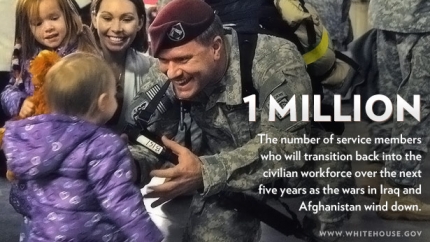
Now, over the past decade, nearly 3 million service members have transitioned back to civilian life, joining millions who have served through the decades.  And as we end the war in Iraq and we wind down the war in Afghanistan, over a million more will join them over the next five years.  This bill is an important step towards helping those veterans transition into the workforce.  And beyond the tax breaks that I mentioned, it also contains a number of other reforms -- from education and training to career counseling, to job search assistance. 

We're still going to need to do more.  And that’s why I’ve also announced a series of executive actions to help our veterans back to work.  We’ve set up a Veteran Gold Card -- this is a card that post-9/11 veterans can download today, and it gives you access to a suite of career services, including six months of personalized counseling at the roughly 3,000 one-stop career centers located across the country.

We’ve launched an easy-to-use online tool called My Next Move that allows veterans to enter information about the skills they've acquired during their service, and then matches that information with the civilian careers that will best put that unique experience to use.

And we’ve created a new online service called Veterans Job Bank, a partnership with leading search engines that directly connects unemployed veterans to job openings.  So all of these initiatives are up and running right now and you can find them at whitehouse.gov/vets.  That's whitehouse.gov/vets.

So to our veterans, know that we will stand with you as long as it takes for you to find a job.  And to our businesses, let me say again, if you are hiring, hire a veteran.  Hire a veteran today.  They will make you proud, just as they've made this nation proud.

Now, I’m pleased that both parties came together to make this happen.  So once again, I want to thank all members of Congress who are involved.  It is important to note that in addition to our veterans, there are millions of other Americans who are still looking for work right now.  They deserve the same kind of bold, bipartisan action that we’ve seen here today.  That's what people have sent us here to do.  So my message to every member of Congress is:  Keep going.  Keep working.  Keep finding more ways to put partisanship aside and put more Americans back to work. 

Tomorrow, I'm heading to New Hampshire to talk about another proposal in the American Jobs Act, and that's a tax cut for nearly every worker and small business owner in America.  Democrats and Republicans have traditionally supported these kinds of tax cuts.  Independent economists from across the political spectrum have said this proposal is one of the best ways to boost our economy and spur hiring.  It's going to be easier for us to hire our vets if the overall economy is going strong.  So there's no reason not to vote for these tax cuts.

And if Congress doesn’t act by the end of the year, then the typical family’s taxes is going to go up by roughly $1,000. That’s the last thing our middle class and our economy needs right now.  It is the last thing that our veterans need right now.

So let’s keep at it.  No politics.  No delays.  No excuses. Let’s keep doing everything we can to get America back to work. And on that note, it is my great pleasure to do my job and sign this bill into law.  Thank you.  (Applause.) 

(The bill is signed.)  (Applause.)

END
11:28 A.M. EST

Close Transcript

The White House

Office of the Press Secretary

Fact Sheet: Returning Heroes and Wounded Warrior Tax Credits

In August, President Obama called on Congress to enact tax credits that will help get veterans back to work. The Returning Heroes Tax Credit provides businesses that hire unemployed veterans with a maximum credit of $5,600 per veteran, and the Wounded Warriors Tax Credit offers businesses that hire veterans with service-connected disabilities with a maximum credit of $9,600 per veteran. 

These tax credits were included in the American Jobs Act and were signed into law by President Obama on November 21, 2011. 

Returning Heroes and Wounded Warrior Tax Credits

Under the Recovery Act, employers who hired certain unemployed veterans were eligible for a tax credit of up to 40 percent of the first $6,000 of wages, for a maximum credit of $2,400. This credit expired at the end of 2010.

On November 21, 2011, the President signed into law two new tax credits:

  • The Returning Heroes Tax Credit is a new hiring tax credit that will provide an incentive for businesses to hire unemployed veterans.
    • Short-term unemployed: A new credit of 40 percent of the first $6,000 of wages (up to $2,400) for employers who hire veterans who have been unemployed at least 4 weeks.
    • Long-term unemployed: A new credit of 40 percent of the first $14,000 of wages (up to $5,600) for employers who hire veterans who have been unemployed longer than 6 months.
  • The Wounded Warrior Tax Credit will double the existing tax credit for long-term unemployed veterans with service-connected disabilities.
    • Maintain the existing Work Opportunity Tax Credit for veterans with service-connected disabilities (currently the maximum is $4,800).
    • A new credit of 40 percent of the first $24,000 of wages (up to $9,600) for firms that hire veterans with service-connected disabilities who have been unemployed longer than 6 months.

Executive Actions to Get Veterans Back to Work

Earlier this year, the President also announced a series of executive actions to help get veterans back to work.

These initiatives include:

Veteran Gold Card: Post-9/11 veterans can now download the Veteran Gold Card, which entitles them to enhanced services including six months of personalized case management, assessments and counseling, at the roughly 3,000 One-Stop Career Centers located across the country.  This could help serve the more than 200,000 unemployed Post-9/11 veterans.  The President directed the Department of Labor to launch this initiative in his August 5, 2011 speech at the Navy Yard.

My Next Move for Veterans: The Department of Labor has launched My Next Move for Veterans, a new online resource that allows veterans to enter their military occupation code and discover civilian occupations for which they are well qualified. The site also includes information about salaries, apprenticeships, and other related education and training programs.

Creating a Veterans Job Bank: The Administration launched the Veterans Job Bank, at National Resource Directory, an easy to use tool to help veterans find job postings from companies looking to hire them. It already searches over one million job postings and is growing. In a few easy steps, companies can make sure the job postings on their own websites are part of this Veterans Job Bank. These resources can be accessed at www.whitehouse.gov/vets

Joining Forces: In August, the President challenged the private sector to hire or train 100,000 veterans or military spouses by the end of 2013.  The President also asked First Lady Michelle Obama and Dr. Jill Biden to lead these efforts with the private sector as part of their Joining Forces initiative. In just over 100 days, more than 1,500 private sector companies have stepped up and already employed more than 18,000 veterans and spouses.  In addition, these private sector companies have committed to hiring 135,000 veterans and spouses by the end of 2013, exceeding the President's challenge. Also included in these private sector employment efforts is a dedicated commitment to hire 5,000 wounded warriors.

Challenging Community Health Centers to Hire 8,000 Veterans in Three Years: The Obama Administration challenged Community Health Centers to hire 8,000 veterans – approximately one veteran per health center site – over the next three years. The health reform law provides funding for community health centers to serve more Americans and hire more workers.  The National Association of Community Health Centers will also contribute to this effort and joined the Administration in announcing this Community Health Center Veterans Hiring Challenge.

Helping Veterans Become Physician Assistants: To fast-track medics into jobs in community health centers and other parts of the health care system, the Health Resources and Services Administration (HRSA) pledged to open up career-paths beyond nursing and expand opportunities for veterans to become physician assistants.  Through this initiative, HRSA will begin to give priority in physician assistant grant awards to universities and colleges that help train veterans for careers as physician assistants. 

Together, these initiatives and the tax credits will lower veteran unemployment through increased hiring, improve resources for veterans to translate their military skills for the civilian workforce, and provide veterans with new tools to aid their search for jobs.

Standing by America's Heroes

1 million

Through the course of the past decade, nearly 3 million veterans have transitioned back to civilian life. As the wars in Iraq and Afghanistan draw to a close, more than a million more service members will join them.

Each of these individuals is highly-trained, highly-skilled, and motivated. They represent some of the best America has to offer.

As a nation, we owe an obligation to these heroes, and it's easy to see how we'll benefit as much from their contributions to the civilian workforce as we have from their service in the military.

That's why creating jobs for veterans has been a major priority for President Obama.

Under his direction, the federal government has hired more than 120,000 vets. Joining Forces, led by the First Lady and Dr. Jill Biden, has organized an initative through which private businesses have pledged to hire an additional 135,000 servicemembers and military spouses. And the Obama administration has set up a series reforms and programs to help veterans get back to work -- you can learn more by visting whitehouse.gov/vets.

Today, President Obama will take another step to help fulfill our obligation to those who wear the uniform of the United States when he signs legislation to create a pair of tax credits for businesses that hire veterans.

Throughout the day, we'll share stories of veterans who will benefit from these measures. Be sure to check it out.

Related Topics: Economy, Veterans

The White House

Office of the Press Secretary

Fact Sheet: ASEAN-United States Leaders Meeting

On November 18, 2011, President Obama met with the leaders of the 10 member states of the Association of Southeast Asia Nations to review our cooperation on building greater economic, security, and people-to-people ties with an important region and a key Asian multilateral organization. With a  population of approximately 580 million and a combined GDP of $1.5 trillion, ASEAN is the United States’ fourth largest export market, includes two treaty allies, one of our closest security partners, and several emerging regional powers, and sits astride some of the world’s most important trading routes and sea lines of communication.

Leaders adopted the Five-year ASEAN-United States Plan of Action, a roadmap for expanding our strategic cooperation. The Plan of Action includes collaborative projects in three main areas—political and security, economic and trade, and socio-cultural cooperation. 

Going forward, the United States will work with ASEAN through the US-ASEAN Trade and Investment Framework Work Plan to build on existing work on trade facilitation and ongoing dialogues on trade and environment and trade finance by introducing new initiatives on digital connectivity and trade and investment in healthcare services, agribusiness, and consumer goods. 

The United States and Brunei announced the United States Partnership with ASEAN on English Language Education. This ambitious, five-year, $25 million initiative, supported by the governments of Brunei and Singapore with the East-West Center in Hawaii as an implementing coordinator, reflects a commitment to help unify the diverse members of ASEAN, improve English language capacity, and advance educational and teaching opportunities in the region.

The United States is supporting the launch of the ASEAN youth volunteers program and sponsorship a visit by the Volunteers and the ASEAN Commission on Women and Children the U.S. next April to connect with U.S. civil society groups on best practices.

The United States, under President Obama’s global Feed the Future initiative and through the ASEAN Secretariat, will support a program to promote the role of the private sector and public-private dialogue on food security policies and solutions.

The United States announced plans to launch an initiative enabling US Trade and Development Agency to bring the best of U.S. business to ASEAN in a first, major commercial outreach to discuss upcoming connectivity infrastructure projects and the role for U.S. business.

The United States proposed the creation a Southeast Asia Maritime Partnership (SAMP), which will provide a multi-agency approach to cooperation and capacity building on maritime awareness, management and security.

The United States and ASEAN will work together to launch the “ASEAN Single Window” pilot program, a trade facilitation project to expedite cargo clearance. When fully operational, this will be the world’s first regional integrated cargo-clearance system.

ASEAN leaders, supported by the United States as an Asian Development Bank (ADB) member, will create an ASEAN Infrastructure Fund. ASEAN governments, supported by ADB members, will contribute to the fund to help underwrite infrastructure projects in the region. The initial fund of $600 million will support infrastructure projects aimed at creating an integrated ASEAN community, and will provide expanded opportunities for U.S. businesses to participate in ASEAN infrastructure projects in the energy, transportations, and information and communications technology sectors.

President Obama announced the three U.S. members of the U.S.-ASEAN Eminent Persons Group: Stapleton Roy, Charlene Barshefsky, and Muhtar Kent, fulfilling a commitment he made with ASEAN leaders in 2009.  The group will deliver recommendations to the Leaders ahead of the next ASEAN-US Leaders Meeting.

Leaders welcomed the successful conclusion of negotiations to enable the United States, United Kingdom, Russia, France and China to accede to the Southeast Asia Nuclear Weapons Free Zone Treaty (SEANWFZ) protocol, and agreed to take the necessary steps to enable the signing of the protocol and its entry into force by these states at the earliest opportunity.

The ten ASEAN Leaders are Sultan Hassanal of Brunei, President Thein Sein of Burma (Myanmar), Prime Minister Hun Sen of Cambodia, President Yudhoyono of Indonesia, Prime Minister Thongsing of Laos, Prime Minister Najib of Malaysia, President Aquino of the Philippines, Prime Minister Lee of Singapore, Prime Minister Yingluck of Thailand, and Prime Minister Dung of Vietnam, as well as ASEAN Secretary General Surin.

Press Briefing

November 19, 2011 | 40:45 | Public Domain

Press Secretary Jay Carney, National Security Advisor Tom Donilon, and Deputy National Security Advisor for Strategic Communications Ben Rhodes discuss President Obama's trip to the Asia Pacific region.

Download mp4 (389MB) | mp3 (37MB)

Read the Transcript

Press Briefing by Press Secretary Jay Carney, National Security Advisor Tom Donilon, and Deputy National Security Advisor for Strategic Communications Ben Rhodes

Press Filing Center
W Hotel Seminyak
Bali, Indonesia

12:15 P.M. WITA

MR. CARNEY:  Good afternoon, everyone.  Thanks for being here.  Love your hotel.  I have with me today the National Security Advisor, Tom Donilon, who's here -- he can take your questions, give you a brief summary.  First he'll give you a summary of the trip and its accomplishments, and then take your questions.  Ben Rhodes and I will be here, too, if you have questions that we can take that Tom wants to defer to us on.

And with that, and no further ado, Tom Donilon.

MR. DONILON:  Thank you, Jay.  Good to see everybody.  First of all, let me say thanks for the commitment of your news organizations to cover this trip.  I know it's expensive and it takes a lot of commitment on your part as well, and it's much appreciated -- because this trip has obviously had a tremendous amount of coverage and thoughtful commentary.  And it's just appreciated.  I know in this day and age, it's a lot to do.  And it's a lot to do for you and your families as well.  It's much appreciated, as I said.

I was just going to make four observations about the trip.  You've heard a lot from Ben and the area substance folks on our trip during the course of it and I think you're familiar with the general laydown.  But I thought it might be useful for me to just take a few minutes to make four or five observations about the trip.  And then I'll be glad to take your questions on the trip or anything else that you want to talk about.

Observation number one, on strategy:  What we've seen in this trip is the implementation of a substantial and important reorientation in American global strategy.  That is the rebalancing of our efforts towards the challenges and opportunities in Asia on the part of the United States.  Now -- and the President, I think, best summarized this in his Canberra speech before the Australian parliament, when he said the United States is all in.  And I think that's what you've seen during the course of this trip. 

This has been an effort that we've had underway, as many of you know, since our transition into office.  During that transition, we had the opportunity to ask ourselves the following questions:  Where are the opportunities of the future?  Where are we currently, as the President comes into office, underweighted and overweighted with respect to U.S. effort? 

And the conclusion that we reached, among others, is that we were substantially underweighted in terms of our engagement and resource allocation and attention to Asia.  And we have been about a three-year effort to address that.  And we call this rebalancing -- strategic rebalancing, which I've talked to a number of you about over the course of the last three years, as we've laid this out and implemented this during the course of the President's three trips to Asia and many things in between, obviously.

Again, it was born of the observation that we were underweighted in Asia, given the importance of the region, given the economic dynamism in the region, and the strategic dynamics in the region.  And we set about, through three lines of quite specific work, to address that underweighting.  And they were these:  First and foremost, to strengthen our alliances and security partnerships in the region. 

Alliances are critical for the United States around the world.  Alliances are an essential strategic asset for the United States around the world.  They are very different than coalitions of the willing.  And they are to be valued by the United States  -- and we do that, and we've done that in Europe, and we've done that in Asia.  Indeed, over the last two weeks the United States has -- the President has met face-to-face with each of our Asia treaty allies, and engaged in really the continuing work to strengthen those alliances. 

No other nation in the world has the alliance system that the United States has around the world, and it is, I said, a strategic asset of the United States, and one that in this region and around the world we have undertaken to strengthen. 

Our alliances in Asia today are as strong as they have ever been.  And if you look through the state visit that President Lee and the South Koreans had in the United States, if you look through our work with Japan over the last three years, and you look at the comments from the Japanese government -- if you look at the demand signal for American leadership in the region, I think it's pretty clear that the alliances are in good shape in the region -- I think in the best shape they've been in in a long time -- and the demand signal for U.S. leadership in the region is very high right now, for a variety of reasons that we can discuss.

The second line of work we undertook with respect to strategy in Asia was to engage intensively with the emerging power centers in the region -- like China and India and Indonesia.  We have been intensively engaged with these nations, and you saw that during the course of this trip.  The President had has 10th face-to-face meeting -- that's hard to say -- the President had his 10th face-to-face meeting with President Hu Jintao in Hawaii this past week.  We had, yesterday, a bilateral meeting with Prime Minister Singh of India, following up on, really, the historic three-day trip that the President had a year ago this month in India.  And of course, we’re hosted here by the Indonesians. 

The frequency, the depth of these engagements I think have really paid off.  And, again, it’s the United States presence in this region, the United States with an affirmative agenda in this region that is critical.  And I think the level of engagement, really, with the emerging powers in this region is unprecedented.

The third aspect of the strategy -- and you all have heard me talk about it a lot -- is to participate actively and, indeed, help form up the regional multilateral institutions -- the architecture, if you will -- to be all in, as the President said, with respect to building up this architecture -- economic, diplomatic, and security architecture in the region in order to pursue our interest, but the interest of the region as well. 

And you can go through this week and have a sense of our vision for the architecture and the development of the architecture, beginning with APEC, where the President hosted 21 economies in Hawaii; the TPP, nine participating, in what we hope will be a fundamental, high-quality trade arrangement in this region, to which other countries will be attracted -- and we’ve already seen, as you know, expressions of interest in coming and consulting and joining the TPP by substantial economies in the world; ASEAN -- the 10 ASEAN countries, the ASEAN-United States Summit, which is the third time the President has done this since he came into office; and then, of course, the fundamental decision of the President of the United States to participate at the leader level at the East Asia Summit.

We had a debate in the administration about whether to do this.  And this goes back to the first thing I said at the briefing.  You can sit back and say, well, is the agenda what we want it to be?  Is it really moving in the direction that we think would be most useful for the region?  And you could ask those questions and never come in.  Or you can decide to be all in, and to come at the summit level and help shape the agenda, and help transform this institution, we hope, into the premier institution in Asia for addressing diplomatic security and other issues in this region.

And that’s what the President did.  That’s what he led on.  And that was the genesis of the decision and why we are here at this meeting -- and the East Asia Summit is 18 countries.

So I can talk for a long time, as a lot of you know, about the strategy here.  We’ve been on this from the first day we came into office, and I’ll be glad to take any questions on it.

The second thing I wanted to comment on, though, is the scale of the trip.  I think that’s important to note as well.  As I said, APEC, 21 countries, at the meeting chaired by the President; the ASEAN, 10 countries, and obviously, a fast-growing part of the world; TPP, nine countries; the East Asia Summit, 18 countries all in -- the President worked with during the course of this week, some 25 nations in the fastest-growing economic region in the world, had formal bilateral meetings with 10 countries.  So the scale of this trip, I think, it is notable.  The President’s direct activity, direct encounter with the leaders of this region on behalf of the United States, I think is notable.

The third thing I wanted to make an observation about is the President's comments on resources and the really critical statements that he made in the Canberra speech about resources.  It's one thing to make a declaration on a policy basis that the United States is going to be reengaging in Asia as part of our rebalancing effort -- and by the way, the rebalancing effort has other aspects to it as well -- refocusing on the economy, tightening up our counterterrorism efforts to really focus on the real threats, but critically, here, in terms of regions coming into Asia -- but without the resource dedication, those are just words.  And without the activity of the President and the activity of the diplomatic corps and programs, those are just words.  And the President went well beyond that during the course of this trip.

Indeed, in the Canberra speech, he announced that in the context of our reviewing our budget on the security side for the next 10 years, which is what we're doing now under the Budget Control Act -- we're looking at the Defense Department budget and the deductions that need to be made under the Budget Control Act. And as you all know, that has a security side and a non-security side.  The security side is the side that I work on.  And as the President said in his Canberra speech, he has given clear guidance -- one of the first decisions that he has made with respect to the defense budget over the next 10 years is a strategic decision, and that is that we will allocate the resources necessary to maintain a strong military, security presence in Asia.

And there are different ways to go about these projects of something of that scale.  Essentially what we're looking at here is a $489 billion reduction over a 10-year period.  You can take a percentage cut across the board, or you can engage in a deep strategic look.  And the President chose the latter -- to say, we're just not going to have reductions across the board on everything; we're going to make choices and we're going to decide to do the things we're going to do well.  And with Asia, that means being all in, and doing the things that are required here with the resources that are necessary.

So that was my third observation.  Jay told me I could only have four.  I had 12 -- (laughter.)  He looked out -- he said, based on looking out the window here, if you get past four you're going to be lucky.  (Laughter.)  So I'll try my best to contain myself about these things.  They keep me away from you, you know, almost physically, during the course of these trips.  (Laughter.) 
The fourth comment or observation I wanted to make is with respect to trade and the economy.  You saw really in direct, concrete terms yesterday the kinds of opportunities that are going to exist in Asia with the announcement of the commercial transactions that the President announced yesterday.  We've also had a very important stretch here, notable stretch here, for trade policy generally.  If you take it from the Korean U.S. Free Trade Agreement through the WTO accession for Russia, through the APEC conference, through the TPP announcement, and the announcement of a number of countries who want to come in to the TPP, it's been an extraordinary stretch in terms of trade policy -- and focused on high-quality trade agreements that focus on the sectors of the future and that are fair and really models.  And that's what I wanted to comment on with respect to that.  There really is tremendous economic opportunity here.  But you have to have an affirmative agenda and lead and put together the kinds of architectures and structures here that you've seen.

So, stopping at four points and, in sum, I think that we have seen implementation here of a critical strategic reorientation in policy by the United States, a rebalancing, if you will -- all in, in Asia, for the United States.  The region has been looking to it.  It has a lot of elements that we can talk about in the question-and-answer period, but nonetheless, from our perspective, we've been able to positively advance each of the key goals that we had for the course of this trip.  And I think that's been in the U.S. interest.

And with that -- Jay -- I'll take questions. 

Q    Thank you for doing this.  How do you think China is looking at this rebalancing?

MR. DONILON:  Well, I'd say -- the question was how China is -- how do we think China is looking at this.  We look at this from a perspective of our overall Asia policy.  And I'll get to your question in just a second.  And as I said, our view here is that it's quite important for our interest and it's important for the interest of this region for the United States to put the resources in place, to continue to provide what it's provided for the last 60-plus years, which is the foundation, the platform on which you've seen this tremendous rise in economies here and social development.

And the Chinese know that.  Put simply, the United States has done more with respect to the security platform that it has put in place in Asia over the last six decades -- it has done more to contribute to the economic rise here than any other country.  And the Chinese know that.  And I think if you look at their official statements, they recognize, obviously, the United States is a principal Pacific power here.

We've also been quite direct with the Chinese about our strategy here, and I think they understand and appreciate that we are going to meet our obligations here, that we are going to meet our commitments to partners and allies, and that we think it's in the United States' interest, obviously, but it's also in the interest of the region -- including, ultimately, China's interest in terms of us having a solid, stable, peaceful region that allows the kind of development I think that's China's top priority right now.

Now, are partners and allies look to us for that reassurance.  They want to know that the United States is going to play the role it's played with respect to security and reassurance and balancing and stability here.  But they also expect that the United States would engage, as another part of its multidimensional responsibilities in the region, to engage in a productive and constructive relationship with the Chinese.  And they look to us to do that, which is why we have had -- in parallel and as part of our overall Asia strategy -- a deep engagement strategy with the Chinese to manage a range of issues. We have a very complicated and quite substantial relationship with China across the board.

So I think that they understand it in that context.  I think that our relationship with China has, in the main, been productive and constructive.  We have had economic issues with the Chinese -- and, again, I don't, by the way, want to in any way discount the range of issues that we have worked on constructively with the Chinese because they are substantial and -- well, in my area, and I spend as much time with the senior Chinese leadership and policymakers than anyone in our administration -- and we have done a lot of work together with the Chinese.

We do have economic issues.  And the President has raised them directly with President Hu.  You've been briefed on the conversations that we have, and they are around the appropriate contribution that China needs to make to global growth.  And that goes to currency and other kinds of policies -- and the specific areas beyond currency that impair the fair access of the United States and other countries into the Chinese economy.

I think the bottom line is I think they understand our strategy.  I think that they understand the importance of it for the region.  We are, as I've said, just to be totally straight with you, we are in a important conversation with them about economics, which we think is important for the region and important for the United States.

The last think I'll say is this.  The other priority that we've been pressing during the course of this week and leading up to this week has been one around rules and norms.  And that's been an important conversation to have.  And that goes not just in the economic area, but also in a conversation we've been having about the South China Sea and the necessity of having any disputes there really settled peaceably -- peacefully -- and in accord with international norms and rules.

Q    Following on China -- could you read out the President's meeting with the Premier today --

MR. DONILON:  Sure, I'd be glad to do that.  The meeting that the President had with Premier Wen today was a follow-on to a conversation that they began at dinner last night.  And Premier Wen asked for a few more minutes today to continue that conversation.  That's the backdrop to it. 

They had an informal meeting this morning, and the principal focus of the meeting was on economics.  And the President went through a number of the points that he had made to President Hu Jintao in Hawaii in the earlier part of the week.  And they're as I described -- the importance of China's currency policy to the world and the appropriate contribution that it needs to make in terms of a fairly valued currency policy; some of the specific issues around business practices -- if you will, currency-plus, in terms of the discussion that they had today.  It was a good engagement. 

Again, the President set it out as directly as he did with President Hu.  It was important, I think, to continue that conversation, because, as you know, Premier Wen is the principal economic manager in China.  They briefly talked about the South China Sea and the East Asia Summit at the end of that -- because it was a short meeting.  And the President indicated that they would have a further conversation about it in the context of the East Asia Summit leaders’ retreat this afternoon. 

That, by the way, follows on the discussion that the President had with the ASEAN leaders yesterday about the South China Sea.  And a number of those countries yesterday raised that issue.  And, again, the U.S. position here is a principled position.  The United States is a Pacific power; it’s a trading power; it’s a maritime power.  The United States has an interest in the freedom of navigation, the free flow of commerce, the peaceful resolution of disputes.  We don’t have a claim.  We don’t take sides in the claims.  But we do, as a global maritime power, have an interest in seeing these principles applied broadly.  But the conversation today, to be just totally straight with you, was a short conversation, principally focused again on economics.

Yes, hi.

Q    Hang on now, I just lost my question.  Here it is.  I wanted to ask you a follow-on on China and the South China Sea, and then a military one, if I could.

MR. DONILON:  Sure.

Q    With regard to the South China Sea, what evidence does the U.S. have that China is actually a threat to the freedom of navigation or commercial access?  And are there some incidents in the sea that have been increasing?  Can you put a measure on it? And I’ll ask for the second after.

MR. DONILON:  Sure, I’ll be glad to address that.  It really isn’t about, from our perspective, about specific instances, although, there have been tensions that have risen.  And you see that in the comments and the concerns that are raised by a number of ASEAN countries. 

But, again, just to be totally straightforward about this -- the United States interest here is in the freedom of flow in commerce.  We have a big interest in it here.  We have an interest in these principles around the world.  So we don’t have an interest, we don’t have a claim.  We don’t have -- we don’t -- as I said earlier, we don’t take sides in any of these claims.  But we do believe that there should be developed a collaborative diplomatic process for the resolution of these claims.  We do believe that they should be resolved peacefully.  The United States has an interest in that, obviously.  And we do believe that they should be resolved in accordance with international norm and international law.

And the United States has made this -- this has been the position we have taken on this for a period of time.  And it’s a position that we’ve taken directly with the Chinese.  And it’s a position I said that is rooted in our global application of these principles.  It’s a set of positions that I’ve actually, with the Chinese, said directly, that as they -- that they should be interested in seeing applied globally as well. 

And so that’s a -- but again, you’ve seen the questions raised.  I think that -- again, I don’t want to quantify or comment on the specifics of any claim.  But you have seen the comments from other countries about concerns that they have.  And, again, the United States interest is not in taking side in any specific claim.  The United States doesn’t have an interest in any specific claim.  But the United States has an interest in the peaceful settlement of these kinds of issues.  The United States has an interest in the freedom of navigation, and not being upset by disputes, and certainly not being upset by disputes that aren’t settled peacefully.

Q    So the military question I wanted to ask you is a follow-on to the Australia partnership that was announced.  Are there any plans to expand that?  You know the way the TPP is kind of an aspirational thing for other countries to join -- is there any thought that the U.S. would start rotating assets into maybe Vietnam or some other friendly Asia Pacific partnering nations?

MR. DONILON:  There's certainly no decisions made along those lines.  But the Australian decision I think is important again to undergird some of the things I said at the outset.  It really is deepening that alliance.  And what it involves for us  -- and obviously it’s going to take place at a very measured pace, as you know, in terms of our participation on the Australian bases and building up to working on joint exercises and engaging in some regional work.

What we’re doing here, though, again, kind of -- I talked at the top about our global rebalancing -- that is turning our attention to Asia and resources to Asia, mindshare, if you will, and policy attention to Asia.  It’s notable, even from the outside of the administration, by the way -- I should have mentioned this -- that Secretary Clinton’s first trip was to Asia.  That’s the first that a Secretary of State has taken his or her first trip to Asia since Dean Rusk in 1961.  And that was, I think, an important signal of where we were going on this.  This has been three years of work that we’ve talked to you all about in an hour, implementing here.

But within Asia, Margaret, what we’re doing also is looking at where we have our resources.  And we believe that we were underweighted, as you went south, given the importance of those sea lanes, given, by the way, the important contribution we make to things like disaster relief.  So that is part of kind of an internal rebalancing within Asia that the United States is making in order to be effective, efficient, cost-effective, and able to take on the challenges that we face.

But there’s no -- I don’t have anything for you on any further basing announcements.

Q    (Inaudible.)

MR. DONILON:  Well, I don’t really want to discuss things loosely on Canberra here.  So I’ll take a pass on that. 

Okay, Ed.

Q    -- quick ones.  One, as important s this trip is, obviously back in Washington you're trying to keep an eye on the super committee -- most of the reports are pretty grim, that they're not going to get a deal at this point.  Obviously there's still time.  What is the White House’s latest on whether they're close to a deal or whether they're close to triggering the defense cuts?

MR. DONILON:  That's substantially outside my lane.  I don't know if you want to hold that or you want to do it now, Jay.  I mean, what I can comment on is what we're doing within the current context of the Budget Control Act with respect to security, and what the United States' priorities are.  But I really can't comment on the -- I don't know anything about that.

MR. CARNEY:  I'll just do this real quick.  Ed, our position on this is what it has been.  We very much hope that the super committee will fulfill its mandate, produce a proposal that is balanced and fair, that doesn't ask any sector of society to bear the burden of reducing our deficits and getting our fiscal house in order. 

The President, as you know, from the very beginning of this process put forward a very detailed proposal.  Somehow, someway, there are some people out there who still claim it doesn't exist. I can give you the website if you'd like, but I know you know it exists.  And it is really a road map for the kind of outcome that the President believes -- and not incidentally, the American people believe -- this is the right way to resolve this.  So we hope that in the coming days the committee will produce something that meets the principles the President laid out in his proposal. 
Back to Tom.

Q    I haven't had a chance to ask you about the story on Pakistan, "memogate" -- and I think retired Admiral Mullen has confirmed that he at least received this memo, and it's really kind of threatened the whole Pakistani government right now.  And I guess two parts:  One, what do you think about the state of the Pakistani government right now, whether President Zardari may step down?  But also, was anyone at the White House ever involved in these conversations with the Pakistani ambassador who's now been recalled?

MR. DONILON:  Ed, I don't have a way to comment from this distance.  I just don't have a way to comment on that from this distance at this point.  We have obviously a critically important relationship with Pakistan.  We have a critically important counterterrorism relationship with the Pakistanis that we work on every single day.  We have, obviously, the support that we need for our efforts in Afghanistan that we work on each day with the Pakistanis.  We work with both the civilian government and with the military, depending on the issue.  But I don't have a way, from this distance, to comment on the question that you raise.

Yes, Laura.

Q    Thank you.  This is sort of a two-part question that relates:  One is, you've talked about how you've pivoted to Asia on this trip.  What do you see as the next steps going forward?  When do you anticipate the President returning to the region?  And what are the concrete things that you think come next to make this a reality?  And I'll just ask you a second part, too, because it relates, which is, you're pivoting away from the old problems, but the old problems still have a way of raising their hands for attention, such as the situation with Pakistan; obviously the war in Afghanistan is ongoing; the Middle East peace process hasn't gone away.  I mean, all of these old-school problems are still there.  So if you could talk about how you deal with that even as you say you're rebalancing, and what specifically is to come.

MR. DONILON:  Sure, I'm glad to do that.  With respect to the first question, there's a tremendous work stream, I think, that comes out of this trip, beginning on the economic side. We'll need to continue to work through the arrangements that we put out for implementation at APEC in terms of economic integration.  Very importantly, TPP.  We announced that we had agreement on a framework, but we set the goal of getting the actual agreement negotiated during 2012.  And that's a very important -- obviously a very important piece of follow-up coming out here.  Because, again, it really is a significant event -- the United States participating in an effort here to put together a high-quality open-trade agreement, to which other countries have been attracted.  And so there will be several lines of work -- Taking the framework and making that into a real agreement, but also on the consultative side, consulting with the nations who want to join the TPP going forward.

With respect to alliances, we have a tremendous amount of work that we're doing all the time with our allies in the region. I can't announce at this point when the President's next trip back is to Asia.  I'd have to go back and look at the calendar and look at the dates that are assigned to various events.

The second question was with the respect to the other challenges that we have.  This doesn't mean that we don’t, obviously, have intensive engagement on the other challenges.  Now, we have engaged in a number of strategies here that have allowed, I think, in terms of policy attention, resources for us to turn to a number of these other challenges. 

We have drawn down our troops in Iraq, and by December 31st, 2011, we'll complete that drawdown.  We are engaged in a very -- a much tighter and quite aggressive effort with respect to counterterrorism.  We are on track to complete our drawdown of the surge forces in Afghanistan by September of next year.  We'll have 10,000 that had drawn down during the course of 2011, and then another 23,000 that we'll draw down by the end of the summer -- next year sometime -- in September, and headed towards a more sustainable long-term relationship there.

But this doesn't -- this is really a statement here about having been underweighted and bringing new energy, resources and attention here.  It obviously doesn't mean that we don't have a range of other issues that we're dealing with every day.  Although, as the President said, as the tide of the wars recede, we will shift our attention to those challenges that we think are critical for the coming century.  And that's what we're in the process of doing. 

And I think we've been pretty successful at it, frankly.  It takes a -- it does take, obviously, the President setting out the strategy and then our implementing it.  But I think we've been pretty successful of accomplishing the goals that we set out for ourselves, and enabling us to engage, as I said, here with respect to Asia in an "all in" way on those priorities that we think needed more attention and are important for the future.

Chuck.

Q    Does the IAEA Board of Governors' statement mean China and Russia actually believe the IAEA report now?  Do you believe they believe it?

MR. DONILON:  Well, I can't speak for the Chinese and Russian governments.  I can just tell you what the facts are.  The facts are, in the last two days that two events have taken place which I think are notable.  The first is, with respect to the IAEA report, which after tremendous amount of work by the professional technical staff at the IAEA, found that in fact up to 2003 the Iranians were pursuing nuclear aspects of their nuclear efforts -- weapon aspects of their nuclear efforts and that some of those elements continued after 2003.  It was a thorough, professional and impartial report. 

And yesterday, as you know, 32 countries voted a resolution asking the Iranians to meet their obligations.  These votes took place after the President had talked directly, as you know, to President Medvedev and to President Hu.  Russia, China and the United States, I can tell you, share a similar goal, and that is not seeing the Iranians move towards the development of nuclear weapons.  And we share the goal of having the IAEA be an effective organization.  With respect to every paragraph in the report, you'd have to talk to the Russians and the Chinese about that.  But the vote yesterday was 32 yes, 2 no's -- Cuba and Ecuador. 

The other thing that happened yesterday was this -- is that there was a United Nations General Assembly resolution put forth, principally sponsored by the Saudis but joined in, I think, by about 40 other countries, Ben, if I'm not mistaken, and passed yesterday deploring the assassination plot to kill the Saudi ambassador to the United States in Washington, D.C.  That vote yesterday was 106 to nine, and notably -- and this, I think, is critical -- there wasn't one Arab or Muslim country that voted with the Iranians. 

It indicates, I think, the isolation that Iran is undergoing right now with respect to the choices they’ve made on the nuclear program.  And the degree of isolation really is unprecedented, Chuck, when you think about it.  Again, 32 to 2 at the IAEA -- that's a stronger vote than in the last IAEA resolution -- and 106 to 9, without a single Arab or Muslim country voting against it. 

And of course, the principle at stake at the U.N. was really important, and that is the safety and security of diplomats around the world, and countries meeting what is an absolutely fundamental diplomatic obligation -- and that is to respect the privileges and immunities and safety of the diplomats around the world from civilized countries.  This is a -- so it's a notable set of events.

Q    Can you speak to the fact that the Russians and the Chinese in the bilats that you participated in, in Hawaii seem to not have the same sense of urgency that they had two years ago?

MR. DONILON:  Well, we have been united on this effort for three years now.  And we're always going to have conversations about tactics, Chuck, with respect to how to how they go about this.  But I think we share this --

Q    -- not disagreements over the report itself?

MR. DONILON:  Well, again, you'd have to ask -- I'm not going to speak for the Chinese and the Russians with respect to every paragraph in the report.  What I can tell you is that the Russians and the Chinese, along with 30 other countries yesterday, at the IAEA voted for a resolution calling on Iran to meet its obligations, and commending the Secretary to the IAEA for the report.

MR. RHODES:  Tom, I'd just add one thing --

MR. DONILON:  Yes.

MR. RHODES:  Chuck, you were asking me about this the other day and I'd just remind you that one of the points that the President made in both of those bilateral meetings was the importance to demonstrate international unity in support of Iran meeting its obligations in the context of the IAEA report.  And the President specifically raised in both meetings the Board of Governors meeting as an important opportunity for the P5-plus-1 to continue to show that unity. 

So both meetings with the Russians and the Chinese, the President specifically raised the importance of this upcoming vote and the need to show that unity, and there was good follow-through on that.

MR. DONILON:  Yes, and I think -- and that's a very important point, Ben.  And that unity is absolutely important.  There is, among almost the entire world, a unified view that Iran should not go down the path towards developing nuclear weapons.  And we have had, from the outset of this administration, through a lot of work -- working with great powers and others around the world -- a high degree of unity on this.  And I think as the Iranians look out this morning, Chuck, they see themselves really wholly isolated here.  Again, 32 to 2, with the Cubans and the Ecuadorians, and then the United Nations deploring an assassination plot -- 106 to 9.  Those are significant events with respect to Iran.

If you look, by the way, at Iran's place in the wake of the Arab Spring and the cost that they've paid for the choices and decisions their leaders have made here, not being able to assure the world that they're engaged in peaceful nuclear activities, it's been substantial -- with respect to their economy, with respect to their political isolation.  But that's a longer discussion.

MR. CARNEY:  Tom's got time for two more.

MR. DONILON:  Okay, please.

Q    The President has sort of publicly given the Chinese quite a lot to think about on this trip.  How would you expect them to respond in the long term?  And do you think any of the sharpened U.S. tone in this rebalancing of forces could sort of have an effect on domestic Chinese politics?  Could, like, sources in the PLA say to the leadership, "see, we told you all along -- the U.S. is trying to isolate us and contain us"? 

MR. DONILON:  Of course, the -- but let's go through what the President said this week as well.  This has nothing to do with isolating or containing anybody.  The President has publicly welcomed, as a matter of United States policy, China's peaceful rise and success.  That's in the United States' interest.  The President has said in his Canberra speech, and I said again here today, that the United States’ goal in the region is to have a stable, peaceful, economically prosperous region, and that’s in the interest of everyone in the region, including the Chinese.

We have been very direct with the Chinese about our plans here.  And, again, if you look at the public statements of the Chinese, they have welcomes the United States presence in the region.  I do think one of the things that we’ve been working on here is important to note, which is we have been working on trying to deepen military-to-military conversations so that we can even have more transparency on both sides with respect to military plans and intentions.

Third, I think that you’ve seen in China a debate that’s been quite public over the last year or so, about the extent to which China should pursue a more aggressive foreign policy.  I think the current leadership has really come down squarely in the camp of not pursuing, with respect to the United States, a confrontational policy because it wouldn’t be in the interest of China.

If you look at the peaceful rise paper that was put out I think this past September -- if you look at Dai Bingguo’s paper that was published a year ago, December, and public statements, you can see there is a debate, as you point out.  But this leadership team I think sees it in the interest of China to continue to engage in a cooperative and positive and constructive relationship with the United States. 

MR. CARNEY:  Last one.

Q    Thank you very much.  From much of the 2000s, the focus of U.S. foreign policy seemed to be the terrorist threat -- of terrorists.  We haven’t heard very much about terrorism on this trip.  Bali has been the scene of some terrible terrorist attacks.  Have we more or less achieved many of our goals in combating terrorism to a point where we can now sort of pivot to and focus -- refocus our attention on other things, like the importance of Asia?

MR. DONILON:  That’s a broad question and let me address it. We work on addressing the terrorist threat every single day.  And we have made progress.  Indeed, we believe, as of the end of 2010 -- and we said this publicly, I think, Ben -- that in fact  al Qaeda was in the worse shape it had been in since 2001.  We obviously dealt a strategic blow to al Qaeda with the operation against Osama bin Laden in May of this year.  And we have had an aggressive continuation of pressure on al Qaeda and associated entities that threaten the United States. 

We work on this every single day in a targeted way.  One of the most important things I think that President Obama has done is to be very clear about what the threat is, what the target is. And I think that’s enabled the United States to address it very effectively. 

Is a terrorist threat defeated?  No.  Have we made a lot of progress?  I think we have, frankly, in the last three years.  But it is a priority every single day of the week for all of us in the national security team and for the President, absolutely.

Q    Can I ask just one follow on Iran?  Because there is a report out saying that the U.S. plans to sanction Iran’s petrochemical industry.  Can you confirm that?

MR. DONILON:  I can't confirm that.

MR. CARNEY:  Thanks, guys.

MR. DONILON:  Thank you all.  I really appreciate it.

MR. CARNEY:  As Tom is walking, I’ll take one on the super committee.  Yes.

Q    On the super committee, has the President been doing any calls lately?

MR. CARNEY:  We have -- the President has obviously been engaged in numerous bilateral meetings and group meetings here.  He has not made any other calls to leaders of Congress.  But he is obviously in regular contact with his staff in Washington, including those who are monitoring the super committee’s progress and engaging with Congress on that issue.

Thanks, all.

END
12:55 P.M. WITA.

Close Transcript

President Obama and Prime Minster Yingluck Speak Before Bilateral Meeting

November 19, 2011 | 2:12 | Public Domain

President Obama and Prime Minister Yingluck of Thailand talk about the relationship between their two countries before a bilateral meeting in Bali.

Download mp4 (21MB) | mp3 (2MB)

Read the Transcript

Remarks by President Obama and Prime Minister Yingluck of Thailand Before Bilateral Meeting

Grand Hyatt
Bali, Indonesia

11:14 A.M. WITA

PRESIDENT OBAMA:  Well, I just want to extend my congratulations to Prime Minister Yingluck for her leadership.  Obviously, she had an inspirational election.  She's know been dealing with an extraordinary tragedy -- the flooding that’s been taking place in Thailand.  I called her and extended our condolences, but also our assurances that we would provide any assistance that we can in dealing with this natural disaster.

The United States and Thailand are two of the oldest of allies.  We have established a great friendship over the years.  We have a wide range of areas of common interest and cooperation. And I’m confident that under the Prime Minister’s leadership we will continue to build on that relationship for many years to come.

So we look forward to speaking with her on a whole range of bilateral and multilateral issues.  And, Madam Prime Minister, please extend our heartfelt condolences to those who have lost loved ones in the floods, and know that you have a strong friend in the United States.

PRIME MINISTER YINGLUCK:  Mr. President, on behalf of Thai government and Thai people, we are very appreciative for the condolence from the U.S. and all the support from the U.S. you give as heartfelt to Thailand.  And also, from our dialogue from Mr. President and visiting with Secretary Clinton to Thailand -- that’s really impacted Thailand to have the better relationship between Thailand and U.S.

And thank you, again, and our congratulations for the success in APEC.  But for me, very regret that I missed this great opportunity.  Hopefully, I can go to U.S. some day.

PRESIDENT OBAMA:  Well, you definitely want to visit Hawaii whenever you get a chance.  (Laughter.)

Thank you so much.  Thank you, everybody.

PRIME MINISTER YINGLUCK:  Thank you.

END 
11:16 A.M. WITA

Close Transcript

The White House

Office of the Press Secretary

Remarks by President Obama and Prime Minister Yingluck of Thailand Before Bilateral Meeting

Grand Hyatt
Bali, Indonesia

11:14 A.M. WITA

PRESIDENT OBAMA:  Well, I just want to extend my congratulations to Prime Minister Yingluck for her leadership.  Obviously, she had an inspirational election.  She's know been dealing with an extraordinary tragedy -- the flooding that’s been taking place in Thailand.  I called her and extended our condolences, but also our assurances that we would provide any assistance that we can in dealing with this natural disaster.

The United States and Thailand are two of the oldest of allies.  We have established a great friendship over the years.  We have a wide range of areas of common interest and cooperation. And I’m confident that under the Prime Minister’s leadership we will continue to build on that relationship for many years to come.

So we look forward to speaking with her on a whole range of bilateral and multilateral issues.  And, Madam Prime Minister, please extend our heartfelt condolences to those who have lost loved ones in the floods, and know that you have a strong friend in the United States.

PRIME MINISTER YINGLUCK:  Mr. President, on behalf of Thai government and Thai people, we are very appreciative for the condolence from the U.S. and all the support from the U.S. you give as heartfelt to Thailand.  And also, from our dialogue from Mr. President and visiting with Secretary Clinton to Thailand -- that’s really impacted Thailand to have the better relationship between Thailand and U.S.

And thank you, again, and our congratulations for the success in APEC.  But for me, very regret that I missed this great opportunity.  Hopefully, I can go to U.S. some day.

PRESIDENT OBAMA:  Well, you definitely want to visit Hawaii whenever you get a chance.  (Laughter.)

Thank you so much.  Thank you, everybody.

PRIME MINISTER YINGLUCK:  Thank you.

END 
11:16 A.M. WITA

The White House

Office of the Press Secretary

Background Briefing by a Senior Administration Official on the President's Meetings at Asean and East Asia Summit

Aboard Air Force One
En Route Anderson Air Force Base, Guam

5:10 P.M. WITA

SENIOR ADMINISTRATION OFFICIAL:  The two moving parts to the East Asia Summit were the plenary session, which was a fairly scripted discussion of the five somewhat arcane areas of focus, historical, from the beginning of the EAS six years ago, including things like avian flu and so on, where each leader -- intervention, and the leaders retreat, which was private, just the leaders plus one, with no separate -- no sound, anyway, in a note-taking room.  So it really was a more intimate discussion.

Apart from the ritualistic recitation of some of the ASEAN steps on the specific historical agenda, the bulk of the plenary discussion focused on disaster relief and some of the initiatives that have been taken by member countries, including the U.S. proposal for a disaster relief mechanism that would allow for quick response by pre-cooking access agreements in advance of an emergency.

By far the most interesting element in the East Asia Summit was the leaders retreat, which followed a social lunch and lasted for just under two hours.  Thereto, there were a number of ASEAN-specific issues that were touched on by many of the leaders, including as related to economic integration, free trade, education, continued discussion on disaster response and so on.

But the bulk of the discussions were a very robust conversation on maritime security and the South China Sea.  By my reckoning, 16 of the 18 leaders addressed maritime security in varying levels of specificity.  And most of them talked specifically about the South China Sea.  The early speakers were -- included ASEAN members Singapore, Philippines, Vietnam, Malaysia, Thailand, as well as Australia and India. 

All of those countries spoke directly to the South China Sea.  The only two countries that didn’t mention the maritime security issue were Cambodia and Burma.  So I think that gives you a sense of how the conversation shaped up.

There was clearly widespread consensus on a number of principles.  Not every leader invoked every single principle, but certainly the earlier speakers were more extensive and more fulsome.  And as the sequence of speakers unspooled, increasingly leaders referred to previous comments and associated themselves with what other leaders had said rather than going through an explication.

But the principles, beginning with the initial speakers -- Singapore, Philippines and Vietnam -- included the importance of protecting freedom of navigation in the maritime domain in general and in the South China Sea in particular; the importance of adherence to the rule of law in approaching and settling disputes; the applicability of the U.N. Convention on the Law of the Sea and the importance for all nations to abide by its terms.

Nearly all of the speakers invoked the importance of a peaceful resolution and they also talked about the need to make progress on a code of conduct, something that ASEAN and China had agreed in 2002 in principle to pursue, but towards which there had been very little movement, if any, certainly for the first eight years, and really only since the ARF meeting in Hanoi in July of 2010 has there been progress in developing and implementing guidelines on the declaration of conduct and an increased push to try to make progress on, first, elements, and then an actual code of conduct itself.

Several speakers stressed the importance of protecting legitimate commerce in the maritime domain and particularly in the South China Sea, and a number also called for a multilateral resolution of the conflicting territorial claims by the parties themselves.

I think, frankly, the best single presentation, with the exception of President Obama, was by the Malaysian Prime Minister Najib who began by noting that he had had the same presentation of principles in his intervention at an internal ASEAN leaders retreat and described near consensus among the ASEANs.  And he was speaking -- he made a similar comment in the ASEAN-U.S. meeting the day before.

And he went through principles that are very similar to what the U.S. has also articulated with respect to the need to resolve the issue peacefully through dialogue, the need to make progress on a code of conduct, the principle of respect for international law, the applicability of UNCLOS, the need for a multilateral process to resolve these territorial disputes among parties, and adherence by all to the guiding principles.

I would describe the overall discussion as constructive.  It was neither acrimonious, nor was it averse to -- was it indirect.  The leaders were not equivocating; they were not speaking ambiguously.

Several leaders, including the Russian Foreign Minister, and most importantly the Chairman of the EAS, President Yudhoyono of Indonesia, pointedly said that they thought that maritime security issues were appropriate and important issues for the EAS to discuss.  After all -- after 16 of the 18 leaders had spoken -- and there were other -- obviously other security issues that they discussed, which I'll come back to -- President Obama made his intervention. 

I won't go through it in detail unless there's a strong desire, because it was a principled outline of the position that the United States has frequently articulated -- consistently articulated, namely that while we are not a claimant in the South China Sea dispute, and while we do not take sides, we have a powerful stake in maritime security in general, and in the resolution of the South China Sea issue specifically -- as a resident Pacific power, as a maritime nation, as a trading nation, and as a guarantor of security in the Asia Pacific region.  He articulated the U.S. position that there should be a clarification of claims on the basis of international law, and that claims to -- claims should be based on geographic land features.

After the President made his statement, Premier Wen Jiabao asked for the floor.  I would say that even though he started off maybe a little bit grouchy, by and large it was very measured and interesting -- I would say a positive intervention.  Positive in the sense that he was not on a tirade, and he did not use many of the more assertive formulas that we frequently hear from the Chinese, particularly in public.  So to be more specific, he said -- he began by saying that he did not -- China didn't think that the EAS was an appropriate forum for a discussion of this issue.

Now, that was not an assertion that carried a great deal of force in the wake of the statements by others, including the chairman, that it was an appropriate subject for the EAS.  He said that he had not wanted the subject of South China Sea to be raised, but that since it had been, he would respond.  He then went on to say that China shares the desire articulated by the ASEAN countries, for a cooperative process to reach a code of conduct on the South China Sea. 

Now, what struck me about that statement is not what he said, but what he didn't say.  Typically, the Chinese public posture has been to be vaguely positive about the idea of reaching a code of conduct, but then to qualify it by saying, at an appropriate time and when the circumstances are propitious.  He conspicuously omitted both of those caveats.

Now, far be it from me to say where the Chinese actually are, or what they're going to say in the future, but it --

Q    What was the second -- "at the appropriate time" -- what was the other?

SENIOR ADMINISTRATION OFFICIAL:  When circumstances are right or at the appropriate -- in the appropriate time and appropriate circumstances.  I don't think anyone, including the ASEANs, ever knew what "appropriate circumstances" or "propitious circumstances" meant.  In any event, that seems to have -- at least in the context of the discussion today, which was, after all, the highest level, broadest strategic discussion of the South China Sea anywhere to date -- those qualifiers and caveats were conspicuously absent.

Another thing -- another dog that didn't bark was when he went on to say that China believed that the disputes should be resolved between the states or the interested parties directly.  What he didn't say, and that -- what we invariably have heard from the Chinese, was the word "bilaterally."  Now, here, too, I can't say that the Chinese have abandoned their position that the South China Sea competing claims need to be resolved one-on-one, "mano a mano," China versus each one of the small other claimants.  They may not be abandoning that position, but he didn't say it.  And he made his statement on the heels of the repeated point by other leaders, that there needed to be a process among -- a peaceful -- among the claimants for a peaceful resolution.

He affirmed that China wants this issue resolved peacefully, and volunteered that China had committed to that in the original declaration of conduct.  He then went on to say, as we've heard the Chinese say before in the ASEAN regional forum and elsewhere, that there really isn't a problem because China, after all, protects the sea lanes in the South China Sea; that China goes to great pains to ensure that the shipping lanes are safe and free. 

But, in sum, he made clear that he wanted to -- China wants to make progress. 

Following that, the Indonesian president, as chair, again took the microphone and he said, "I would characterize the discussion today" -- "we all discussed the South China Sea in a very constructive fashion," and he said he thought that the leaders had demonstrated that it's possible for the East Asia Summit to make progress on the code of conduct.

So, in sum, I think that, from the U.S. point of view, we certainly hit the mark, not by -- no confrontation; this was not "Showdown at the O.K. Corral."  This was a clear manifestation of an overwhelming consensus among ASEAN and the other participants in the East Asia Summit about the principles that President Obama has articulated throughout.  This was spontaneous combustion, and not artifice.  These leaders were speaking openly and on their own behalf.  I think it was constructive, and one has to believe that the Chinese premier will go back to Beijing with the sense that the center of gravity in the Asia Pacific area is around the adherence to the principle of the rule of law, peaceful resolution, and a constructive, rules-based approach to the resolution of territorial disputes.

The last thing I'll mention is that President Obama also spoke about nonproliferation.  He welcomed the agreement between the ASEAN countries and the Perm-5 to move ahead towards signing a protocol on what's called SEANWFZ -- the Southeast Asia Nuclear-Weapons-Free Zone.  He welcomed some of the steps towards either agreeing to or ratifying the IAEA additional protocol among the members.  And he, along with a number of other leaders, referenced North Korea and the importance of the countries in the region ensuring that North Korea is not allowed to proliferate or to violate the U.N. Security Council resolutions; that they continue to make nonproliferation a priority, in order to protect the infrastructure of international trade and commerce and several other -- I didn’t count them up, but a number of other countries also made reference to the importance of denuclearization of the Korea Peninsula, and in a moderate and constructive way called on North Korea to take the necessary steps that will permit a resumption of the six-party talks.

So, I’ll stop there.

Q    So based on the subtle differences that you’ve heard in these last engagements with the Chinese, are you willing to say -- does it appear to you that their position on South China Sea is evolving, and I guess I should say evolving in a positive way?

SENIOR ADMINISTRATION OFFICIAL:  I can’t make a characterization beyond describing how Prime Minister Wen spoke in this meeting and how he approached it.  But what I heard is consistent with the proposition that the Chinese will come away from the meeting believing that a heavy-handed approach on the South China Sea will backfire badly and that there is a genuine consensus on the importance of a constructive process to find a peaceful way forward.

I would be watching from this point on for signs that China is engaging directly and seriously with the ASEANs on elements that could constitute a code of conduct.  This is not going to be a quick set of steps.  No one who knows the issue is under any illusions that there will be a quick fix.  It’s a long process.  But the content of the interventions today, including the Chinese intervention, were quite positive.

Q    Can you talk about the omission of certain phrases that Premier Wen used?  Was there surprise in it -- was the President surprised, were other leaders surprised that he didn’t use the language that he had used in the past?

SENIOR ADMINISTRATION OFFICIAL:  I don’t have any way of judging the reactions of other leaders, and it may be that because this is my day job, I’m several orders of detail more alert to some of the nuances than one would expect a President or a Prime Minister.

No, I wouldn’t use the word “surprise,” simply that I noticed and accorded some significance to it, but it’s still very early days.  The Chinese positions don’t shift radically or quickly.  One should be alert for gradual indications of an evolution in their position.

If these sorts of indications are reliable bellwethers to the direction that China is moving, it would be a positive thing.

Q    Can I ask you, so far throughout the entire week, probably, there’s been quite a lot of discussion about sort of what the U.S. asked of China in terms of a more flexible currency rate and intellectual property respect and South China Sea -- abide by international norms.  What did China ask of the U.S.?  And specifically today, was there discussion of the military troop buildup or -- I don’t know if that’s the right term -- but putting the troops in Australia?  Did the Prime Minister ask you anything about that, you know, the President?

SENIOR ADMINISTRATION OFFICIAL:  In the meeting that I participated in, there was no reference by Premier Wen to the U.S. force posture announcements or, frankly, the U.S. military presence in Asia.

The President, however, has said directly to his Chinese interlocutors, and in fact restated to Premier Wen Jiabao this morning, that we would speak to the issue of the South China Sea in the East Asia Summit and that we would make clear our view about the guiding principles that should govern China and the other claimants.  He made clear that this is, in our view, a legitimate topic for discussion and that he would approach it on the basis of principles and in a constructive way.

Q    But just -- I mean, just broadly, also at the bilateral meeting in Hawaii, was there specific things that the Chinese asked of you or even a tone-downed rhetoric and anything like that?  I mean, was there any sort of message they were trying to deliver in an active way or more active way?

SENIOR ADMINISTRATION OFFICIAL:  The thrust of the Chinese comments to President Obama, both particularly in Hawaii but also here in Bali, were that China places great importance on U.S.-China relations and on U.S.-China cooperation on global issues as well as regional issues in the Asia Pacific, and that they see it important, particularly in light of the global financial challenges, for the U.S. and China to find constructive ways to engage.

Q    I assume it wasn’t any coincidence that 16 out of the 18 members spoke on the maritime security.  How much pre, or advance -- how much does the U.S. and the President’s work ahead of time account for that?

SENIOR ADMINISTRATION OFFICIAL:  Well, I don’t know to what degree foreign governments and foreign leaders are persuaded by the logic of what the President has said clearly and publicly about the principles that should guide approaches to the South China Sea and to resolving the territorial conflicts and how much stems from their own assessments, their own approaches and their own values.

The President didn’t lobby other governments to say one thing or another, or to say anything at all.  In his bilateral meetings -- and by the way, he didn’t meet all 16 of the leaders who spoke out on maritime security -- he told them what he would say, and he made clear that he thought it was important to have a constructive discussion and not an acrimonious confrontation.

Q    Can I just ask a question -- at the dinner last night, on TV you could see the President and Prime Minister Wen talking a lot.  Can you describe the tone of the conversation, and did South China Sea come up in that conversation at the dinner?

SENIOR ADMINISTRATION OFFICIAL:  I could not hear the conversation, so I can’t describe the tone.

I am unaware of the South China Sea coming up in that discussion at dinner last night.  I know that they spoke about economic and trade issues.  I do know that the President raised it this morning in his conversation with Premier Wen Jiabao, as I said earlier.

Q    On Burma, given that the next ASEAN is to be hosted by Burma, is there any concern that the -- what’s that?

SENIOR ADMINISTRATION OFFICIAL:  Cambodia is next.

Q    Cambodia is next?

SENIOR ADMINISTRATION OFFICIAL:  Yes, then Burma.

Q    Then Burma?

SENIOR ADMINISTRATION OFFICIAL:  No, Cambodia is next, then Brunei, then Burma.  So the ASEANs made a decision to designate Burma as the ASEAN chairman for the year 2014.  So Cambodia takes over for the year of 2012, and Brunei takes over for 2013.

Q    Thank you very much.
   
END
5:41 P.M. WITA

The White House

Office of the Press Secretary

WEEKLY ADDRESS: Creating an Economy Built to Last

WASHINGTON—In this week’s address, President Obama spoke from Indonesia and told the American people that during his trip to the Asia Pacific, he has made progress opening up markets to support thousands of American jobs and keep us on track to double American exports by 2014.  The President’s trip underscores his belief that our businesses will always be successful competing around the world and that he will continue to do everything possible to create jobs for the American people.

Remarks of President Barack Obama
Weekly Address
Bali, Indonesia
Saturday, November 19, 2011

Today, I’m speaking to you from Indonesia as I finish up my trip to the Asia Pacific – the region where we do most of our trade and sell most of our exports.  And over the past week, the progress we’ve made in opening markets and boosting exports here will help create more jobs and more growth in the United States. 

Here in Indonesia, I was proud to join leaders from some of our nation’s top companies as they announced trade deals that will support nearly 130,000 American jobs and potentially increase U.S. exports by up to $39 billion.  Boeing, for example, will sell more than 200 planes to Indonesia that are built with parts from suppliers in more than 40 states.  And a deal to export GE engines will support jobs at plants in Ohio and North Carolina. 

These agreements will help us reach my goal of doubling American exports by 2014 – a goal we’re on pace to meet.  And they’re powerful examples of how we can rebuild an economy that’s focused on what our country has always done best – making and selling products all over the world that are stamped with three proud words:  “Made In America.” 

This is important, because over the last decade, we became a country that relied too much on what we bought and consumed.  We racked up a lot of debt, but we didn’t create many jobs at all.

If we want an economy that’s built to last and built to compete, we have to change that.  We have to restore America’s manufacturing might, which is what helped us build the largest middle-class in history.  That’s why we chose to pull the auto industry back from the brink, saving hundreds of thousands of jobs in the process.  And that’s why we’re investing in the next generation of high-tech, American manufacturing. 

But building an economy that lasts isn’t just about making things – it’s about opening new markets for people to buy them.  After all, 95% of the world’s consumers live outside our borders.  And as the fastest-growing region in the world, no market is more important to our economic future than the Asia Pacific – a region where our exports already support five million American jobs.

This is why we recently signed a landmark trade agreement with South Korea that will support tens of thousands of American jobs.  And it’s why I traveled here this week.  In Hawaii, I hosted leaders from across the Asia Pacific, and we agreed to make it easier for American companies to do business overseas.  I also worked with President Medvedev of Russia to pursue trade that would increase exports and jobs for American manufacturers and farmers.  And working with other leaders, we made progress toward our most ambitious trade agreement yet – a partnership with Pacific nations that holds the potential for more exports and more jobs in a region of nearly three billion consumers. 

We may be going through tough times, but as I’ve said time and time again, the United States still has the world’s most dynamic economy, the finest universities, the most innovative companies, and the hardest-working people on Earth.  We can compete against anybody – and we can win.  As President, I intend to make sure that happens by doing everything I can to give American workers and businesses the chance to succeed.

Weekly Address: Creating an Economy Built to Last

November 19, 2011 | 3:17 | Public Domain

From Indonesia, President Obama talks about his administration's work opening up markets to support thousands of American jobs and keep us on track to double American exports by 2014.

Download mp4 (116MB) | mp3 (3MB)

Read the Transcript

WEEKLY ADDRESS: Creating an Economy Built to Last

WASHINGTON—In this week’s address, President Obama spoke from Indonesia and told the American people that during his trip to the Asia Pacific, he has made progress opening up markets to support thousands of American jobs and keep us on track to double American exports by 2014.  The President’s trip underscores his belief that our businesses will always be successful competing around the world and that he will continue to do everything possible to create jobs for the American people.

Remarks of President Barack Obama
Weekly Address
Bali, Indonesia
Saturday, November 19, 2011

Today, I’m speaking to you from Indonesia as I finish up my trip to the Asia Pacific – the region where we do most of our trade and sell most of our exports.  And over the past week, the progress we’ve made in opening markets and boosting exports here will help create more jobs and more growth in the United States. 

Here in Indonesia, I was proud to join leaders from some of our nation’s top companies as they announced trade deals that will support nearly 130,000 American jobs and potentially increase U.S. exports by up to $39 billion.  Boeing, for example, will sell more than 200 planes to Indonesia that are built with parts from suppliers in more than 40 states.  And a deal to export GE engines will support jobs at plants in Ohio and North Carolina. 

These agreements will help us reach my goal of doubling American exports by 2014 – a goal we’re on pace to meet.  And they’re powerful examples of how we can rebuild an economy that’s focused on what our country has always done best – making and selling products all over the world that are stamped with three proud words:  “Made In America.” 

This is important, because over the last decade, we became a country that relied too much on what we bought and consumed.  We racked up a lot of debt, but we didn’t create many jobs at all.

If we want an economy that’s built to last and built to compete, we have to change that.  We have to restore America’s manufacturing might, which is what helped us build the largest middle-class in history.  That’s why we chose to pull the auto industry back from the brink, saving hundreds of thousands of jobs in the process.  And that’s why we’re investing in the next generation of high-tech, American manufacturing. 

But building an economy that lasts isn’t just about making things – it’s about opening new markets for people to buy them.  After all, 95% of the world’s consumers live outside our borders.  And as the fastest-growing region in the world, no market is more important to our economic future than the Asia Pacific – a region where our exports already support five million American jobs.

This is why we recently signed a landmark trade agreement with South Korea that will support tens of thousands of American jobs.  And it’s why I traveled here this week.  In Hawaii, I hosted leaders from across the Asia Pacific, and we agreed to make it easier for American companies to do business overseas.  I also worked with President Medvedev of Russia to pursue trade that would increase exports and jobs for American manufacturers and farmers.  And working with other leaders, we made progress toward our most ambitious trade agreement yet – a partnership with Pacific nations that holds the potential for more exports and more jobs in a region of nearly three billion consumers. 

We may be going through tough times, but as I’ve said time and time again, the United States still has the world’s most dynamic economy, the finest universities, the most innovative companies, and the hardest-working people on Earth.  We can compete against anybody – and we can win.  As President, I intend to make sure that happens by doing everything I can to give American workers and businesses the chance to succeed.

Close Transcript