The White House

Office of the Press Secretary

President Obama Nominates Judge Gershwin A. Drain to Serve on the US District Court

WASHINGTON, DC - Today, President Obama nominated Judge Gershwin A. Drain to serve on the United States District Court for the Eastern District of Michigan.

“Judge Gershwin A. Drain will bring an unwavering commitment to fairness and judicial integrity to the federal bench,” President Obama said.  “His impressive legal career is a testament to the kind of thoughtful and diligent judge he will be on the U.S. District Court.  I am honored to nominate him today.”

Judge Gershwin A. Drain:  Nominee for the United States District Court for the Eastern District of Michigan
Judge Gershwin A. Drain has been a Judge on Michigan’s Third Circuit Court, based in Wayne County, since 1997 and has served in both the civil and criminal divisions of the court.  From 1987 to 1997, Judge Drain was a judge on the Recorder’s Court for the City of Detroit, which, before merging with the Third Circuit in 1997, had jurisdiction over felony prosecutions.  Judge Drain previously served, from 1986 to 1987, as a Judge on the 36th District Court for the City of Detroit.  Prior to joining the bench, Judge Drain worked as an attorney in the Federal Defender Office for the Eastern District of Michigan from 1974 to 1986.  He also worked as counsel for the City of Detroit Department of Transportation from 1973 to 1974 and as a law clerk for the Third Circuit Court from 1972 to 1973.  Judge Drain received his J.D. in 1972 from the University of Michigan Law School, and his B.S. in 1970 from Western Michigan University.

The White House

Office of the Press Secretary

President Obama Nominates Roy Wallace McLeese III to Serve on the District of Columbia Court of Appeals

WASHINGTON, DC - Today, President Obama nominated Roy Wallace McLeese III to serve on the District of Columbia Court of Appeals.

“Throughout his career, Roy Wallace McLeese III has shown unwavering integrity and an outstanding commitment to public service,” said President Obama.  “I am proud to nominate him to serve on the District of Columbia Court of Appeals.”

Roy Wallace McLeese III:  Nominee for the District of Columbia Court of Appeals
Roy Wallace McLeese III is the Chief of the Appellate Division in the United States Attorney’s Office for the District of Columbia, having served as a Deputy Chief from 1990 to 2005. In this capacity, he supervises criminal appellate litigation in the District of Columbia Court of Appeals and the United States Court of Appeals for the District of Columbia Circuit. Mr. McLeese also served in the Office of the Solicitor General of the United States from 1997 to 1999 as an Assistant to the Solicitor General, and temporarily served as Acting Deputy Solicitor General, supervising the criminal appellate litigation of the United States in the Supreme Court of the United States.  Mr. McLeese has a Bachelor of Arts degree in Philosophy cum laude from Harvard University and earned his law degree cum laude from New York University School of Law, where he was Editor-in-Chief of the New York University Law Review. Following law school, Mr. McLeese served as a law clerk for then-Judge Antonin Scalia of the United States Court of Appeals for the District of Columbia Circuit, and then for Associate Justice Antonin Scalia on the Supreme Court of the United States.

President Obama Speaks to U.S. and Australian Service Members

November 17, 2011 | 13:52 | Public Domain

President Obama celebrates the past and future of the security alliance between the United States and Australia.

Download mp4 (133MB) | mp3 (13MB)

Read the Transcript

Remarks by President Obama to U.S. and Australian Service Members

Royal Army Air Force Base
Darwin, Australia

4:55 P.M. ACST

PRESIDENT OBAMA:  Thank you!  (Applause.)  Hello, everybody!

AUDIENCE:  Hello!

PRESIDENT OBAMA:  How are you doing?  I know that you all have a great Australian cheer.  I want to hear it.  So let me say -- first -- Auzzy, Auzzy, Auzzy!

AUDIENCE:  Auzzy, Auzzy, Auzzy!

PRESIDENT OBAMA:  I enjoyed that.  (Laughter.)  It is great to be here at RAAF Darwin -- I mean, Dah-win.  (Laughter.)  I'm learning to speak "Strine."  (Laughter.)  The Prime Minister said that she wanted to show me Australia at its best.  And she’s right -- you all are all true blue.  So thank you, Julia, for bringing us together today, for being such a great friend and champion of our alliance, and for this visit to Australia, which I will remember forever.

It is good to be here in the Top End.  I thank the people of Darwin for the incredibly warm welcome.  And I’m proud to be the first U.S. President ever to visit the Northern Territory.  (Applause.)

I want to begin by respectfully acknowledging the Traditional Owners of this Land and their elders, past and present.  You are one of the world’s oldest continuous cultures.  And I want you to know that your strength, your dignity is an inspiration to me and people all around the world.

I’m not going to give a big speech.  It’s a little hot.  (Laughter.)  I already gave a big speech.  What I really want to do is spend a little time shaking some hands.

AUDIENCE MEMBER:  Yes!  (Applause.)

PRESIDENT OBAMA:  I'm not sure I'm going to be able to reach all the way back there.  (Laughter.) 

As the Prime Minister said, we’re celebrating the 60th anniversary of our great alliance.  And we couldn’t think of a better group to do it with than you.  All of you are the backbone of our alliance.  It’s an honor to be here with Australia’s legendary Diggers.  You are some of the toughest warriors in the world.  And so are another group of folks here today -- our extraordinary United States Marines.

MARINES:  Ooh-rah!  (Applause.)

Aussies and Americans like you have stood together since World War I, the war in which so much of your national character was born -- your incredible ANZAC Spirit.

But, in a sense, it was here, in Darwin, where our alliance was born -- during "Australia’s Pearl Harbor."  Against overwhelming odds, our forces fought back, with honor and with courage.  The Prime Minister and I just paid our respects at the memorial to one of the ships lost that day -- the USS Peary.  And we looked out at those beautiful blue waters, where so many Australians and Americans rest where they fell, together. 

The days after Darwin were tough.  Some thought Australia might fall.  But we dusted ourselves off.  We picked ourselves up.  We rebuilt.  And thanks to the extraordinary generation of troops, we went on to victory -- in the Coral Sea and at Midway and at Milne Bay. 

When that war was won, and as another raged in Korea, our countries forged a new alliance.  We pledged our "collective defense for the preservation of peace and security."  And that’s a promise we’ve kept ever since. 

As I said in Parliament earlier today, our alliance is rooted in the bonds between our people, and the democratic values that we share and our commitment to stand with each other through thick and through thin, no matter what.

That includes Afghanistan.  I know many of you served there, including proud members of the 1st Brigade.  Like generations before you, you’ve lived and served alongside your American colleagues -- day in and day out.  You work together so well, it’s often said you can’t tell where our guys end and you guys begin.  Today, I want to say thank you.  Thank you for a job well done.  Thank you for your incredible sacrifices.  Thank you for your families' sacrifices.  And welcome home.  (Applause.)  

Others among you served in Iraq, and on dangerous missions around the globe.  Among us today are families whose loved ones made the ultimate sacrifice in today’s wars.  This morning, the Prime Minister and I paid our respects at the Australian War Memorial. 

And in that magnificent space I saw the Roll of Honor, with the names of your fallen heroes, including those from Afghanistan.  And to their families, I say -- no words are sufficient for the depth of your sacrifice.  But we will honor your loved ones by completing their mission, by making sure Afghanistan is never again used to attack our people.  And I am confident that we are going to succeed.

Now, here in Darwin and Northern Australia, we'll write the next proud chapter in our alliance.  As the Prime Minister and I announced yesterday, some of our Marines will begin rotating through these parts to train and exercise with you, and to work as partners across the region for the security we all want.

Today, on behalf of the American people, I want to thank the people of this community for welcoming our men and women in uniform.  We are grateful for your friendship and we are grateful for your hospitality.

So we’re deepening our alliance -- and this is the perfect place to do it.  I know the training conditions around here are tough -- at least that’s what I’ve heard.  Big, open spaces.  Harsh weather.  Mozzies.  (Laughter.)  Snakes.  Crocs.  (Laughter.)  In fact, I was just presented with the most unique gift I’ve ever received as President -- crocodile insurance.  (Laughter.)  My wife, Michelle, will be relieved.  (Laughter.)  I have to admit that when we reformed health care in America, crocodile insurance is one thing we left out.  (Laughter.)  

But there’s another reason we’re deepening our alliance here.  This region has some of the busiest sea lanes in the world, which are critical to all our economies.  And in times of crisis -- from the Bali bombings to East Timor to relief after a tsunami -- Darwin has been a hub, moving out aid, caring for victims, making sure that we do right by the people of this region.  And that’s what we’re going to keep doing, together.

Going forward, our purpose is the same as it was 60 years ago -- "the preservation of peace and security."  And in a larger sense, you’re answering the question once posed by the great Banjo Paterson.  Of Australia, he wrote, "Hath she the strength for the burden laid upon her, hath she the power to protect and guard her own?"

Well, generations of Australians -- and you, its men and women in uniform -- have given your answer.  And America has been honored to stand with you, as allies with an enduring commitment to human freedom. 

On this 60th anniversary, we are saying together, proudly:  Yes, we have the strength for the burden laid upon us, and we have the power to protect and guard our own, here in the Asia Pacific and all around the world.

So thank you all for your extraordinary service.  And thank you for representing the very best of our two countries.  God bless Australia.  God bless America.  And God bless the great alliance between our two peoples.  Thank you very much.  (Applause.)

END               
5:05 P.M. ACST

Close Transcript

Tree Dedication Ceremony

November 17, 2011 | 2:31 | Public Domain

President Obama joined by Ambassador Jeffrey L. Bleich dedicated a white oak, the Illinois state tree, at the Embassy of the United States in Canberra, Australia on November 17, 2011.

Download mp4 (24MB) | mp3 (2MB)

President Obama Speaks to Australian High School Students

November 17, 2011 | 4:19 | Public Domain

President Obama answers student questions on a visit to an Australian high school.

Download mp4 (41MB) | mp3 (4MB)

Read the Transcript

Remarks by President Obama in a School Visit

Campbell High School
Canberra, Australia

11:53 A.M. AEST

PRESIDENT OBAMA:  Well, thank you for taking the time.  Part of the reason I wanted to come by was when Julia came to Washington, D.C., we had a visit with some high school students there.  And I didn’t want to miss out on the fun when I came to Australia.  So I wanted to get a chance to find out what’s going on and see if you guys had any questions.

I had a wonderful time here.  On the way here, your Prime Minister was telling me about all the deadly animals that could kill you if they bite you.  (Laughter.)  There seems to be a surplus of those here in Australia. 

But part of the reason that I love meeting with students is because so much of what we do together, your Prime Minister and I, is focused on your future, how we can make sure you’ve got good careers, have opportunity, and the world is safe and we’re taking care of our environment in a serious way.  And I’m always inspired when I meet with young people because you’re not stuck in some of the old stodgy ideas that the rest of us are sometimes.

So who wants to start first?  Somebody have a question or a comment?

Yes, what’s your name?

Q    My name is Emily, and my question is directed to you, Mr. President.  What directions will the American education system be taking for the future?

PRESIDENT OBAMA:  Well, it’s a great question.  You know, the United States historically became an economic superpower in part because we were ahead of the curve when it came to education -- establishing compulsory public high schools, using the G.I. Bill to help veterans coming home go to college.  And we still have some outstanding schools in the United States.  But we also have some schools that just aren’t doing the job, and a sizeable number of our young people who aren’t getting the kind of support they need.

So one of my biggest priorities when I came in was, how do we reform the system overall?  A lot of it starts with early childhood education.  A lot of poor children don’t get the support that they need when they’re very young, so by the time they get to grammar school, they’re already behind.  They don’t know their numbers, people haven’t read to them, et cetera.  So working with programs that are geared to young people -- or very young children, when they’re toddlers and infants, to give them a head start, that’s pretty important.  We’re focusing a lot on math and science education, where I think we’ve fallen behind. 

The most important thing for every grade level is the quality of the teachers.  So we’re spending a lot of time thinking about how do we train teachers more effectively, how do we pay them more so that they have fewer worries about supporting themselves and can really focus on the work that they do. 

And making sure that they are up to snuff when it comes to the subject matter that they teach.  And we’ve seen studies that show that the biggest correlation, other than the parents, about how well a student does is the quality of their teacher.

So we’re going to be spending a lot of time focusing on those issues over the next several years.

PRIME MINISTER GILLARD:  Aussie influence.

PRESIDENT OBAMA:  Absolutely.

PRIME MINISTER GILLARD:  Secretary Duncan, who is the equivalent in the U.S. of the federal Education Minister, played basketball in Australia.

PRESIDENT OBAMA:  He was a professional basketball player here in Australia, and is married to a Tasmanian wife.  (Laughter.)  So he obviously was inspired while he was here by the excellent schools.

Who’s next?

Q    Thank you, Mr. President.  I’m Meg.  Have you ever thought about teaming up with a high-profile celebrity such as Justin Bieber to appeal to more people?  (Laughter.) 

THE PRESIDENT:  You know, that’s an interesting question.  I interact a lot with celebrities.  They end up coming to the White House for a pet cause, or some of them were very supportive of me during my campaign.  But generally speaking, hopefully if I’m going to be successful, it’s going to be because of the ideas I put forward and not because I’m hanging out with Justin Bieber.  (Laughter.)  Although he is a very nice young man, and I’ll tell him you said hi.

END
12:00 P.M. AEST

Close Transcript

President Obama Addresses the Australian Parliament

20111117 POTUS at Parliament

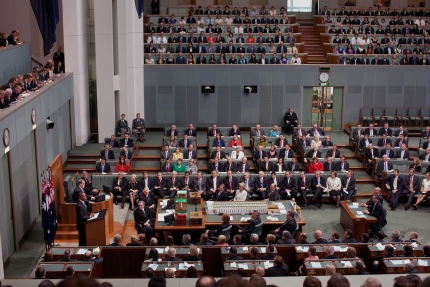
President Barack Obama addresses the Australian Parliament in the House of Representatives at Parliament House in Canberra, Australia, Nov.17, 2011. (Official White House Photo by Pete Souza)

Even as President Obama works to end the wars in Iraq and Afghanistan, he's laying the groundwork to prepare America for the decades ahead.

And yesterday afternoon, he told Australian lawmakers that means shifting our attention to the Pacific:

Here, we see the future. As the world’s fastest-growing region -- and home to more than half the global economy -- the Asia Pacific is critical to achieving my highest priority, and that's creating jobs and opportunity for the American people. With most of the world’s nuclear power and some half of humanity, Asia will largely define whether the century ahead will be marked by conflict or cooperation, needless suffering or human progress.
 
As President, I have, therefore, made a deliberate and strategic decision -- as a Pacific nation, the United States will play a larger and long-term role in shaping this region and its future, by upholding core principles and in close partnership with our allies and friends.

The President outlined a framework through which American military strength helps to guarantee security in the region, where growing economic ties help to deliver a shared prosperity, and where renewed diplomatic relationships promote human rights and freedom.

"History is on the side of the free -- free societies, free governments, free economies, free people," President Obama said in Canberra. "And the future belongs to those who stand firm for those ideals, in this region and around the world."

Read the full remarks here.

See more: Check out a slideshow from the President’s trip to Australia.

President Obama: Congratulations to Everyone Taking Part in Today's Great American Smokeout

Today, Americans from across the country are making plans to quit smoking as part of the American Cancer Society’s Great American Smokeout. And this morning, we released a video from President Obama congratulating everyone who is participating in this important event and underscoring our Administration’s commitment to fighting tobacco use:

Watch President Obama's full remarks here.

President Obama and his Administration are committed to doing all we can to stop kids from smoking and reducing the number of Americans who smoke. And for those of you who are making the commitment to quit, you are not alone and we have resources to help you succeed. You can visit HHS.gov today to connect with a smoking cessation expert via IM or phone, use the online step-by-step quit guide, or sign up for SmokefreeTXT a texted based smoking cessation program. And under the Affordable Care Act insurance companies are required to cover recommended preventive services, including tobacco cessation counseling without charging you an extra penny out of your own pocket.

We are also continuing our efforts to protect young people from starting smoking in the first place. 

President Obama was proud to sign the Family Smoking Prevention and Tobacco Control Act which gives us new tools to help young people stop smoking before they start. New prevention efforts include addressing marketing practices aimed at children like banning fruit and candy flavored cigarettes and working with states to keep tobacco out of the hands of kids by increasing enforcement at the retail level.  And the law calls for graphic warning labels that make the danger of smoking abundantly clear. Big tobacco companies are trying to stand in the way of these commonsense measures to protect our kids, but we’re confident their attempts will ultimately fail. 

Sadly, we’ve seen too many friends, families and communities suffer needlessly, and suffer tremendously, from tobacco-related death, disease and disability. We have a clear path to ending the tobacco epidemic and it is a battle we can – and must - win. The prosperity and health of our country depends on it.

Join me today at 12:45p ET as I talk with iVillage reporter, Kelly Wallace, for a live web chat about tobacco cessation and prevention.  To watch live, go to iVillage.com or www.hhs.gov/live. You can submit a question in advance here, or ask a question live during the chat on iVillage’s Twitter or Facebook page.

Kathleen Sebelius is the Secretary of Health and Human Services
Related Topics: Health Care

The White House

Office of the Press Secretary

Remarks by President Obama to U.S. and Australian Service Members

Royal Army Air Force Base
Darwin, Australia

4:55 P.M. ACST

PRESIDENT OBAMA:  Thank you!  (Applause.)  Hello, everybody!

AUDIENCE:  Hello!

PRESIDENT OBAMA:  How are you doing?  I know that you all have a great Australian cheer.  I want to hear it.  So let me say -- first -- Auzzy, Auzzy, Auzzy!

AUDIENCE:  Auzzy, Auzzy, Auzzy!

PRESIDENT OBAMA:  I enjoyed that.  (Laughter.)  It is great to be here at RAAF Darwin -- I mean, Dah-win.  (Laughter.)  I'm learning to speak "Strine."  (Laughter.)  The Prime Minister said that she wanted to show me Australia at its best.  And she’s right -- you all are all true blue.  So thank you, Julia, for bringing us together today, for being such a great friend and champion of our alliance, and for this visit to Australia, which I will remember forever.

It is good to be here in the Top End.  I thank the people of Darwin for the incredibly warm welcome.  And I’m proud to be the first U.S. President ever to visit the Northern Territory.  (Applause.)

I want to begin by respectfully acknowledging the Traditional Owners of this Land and their elders, past and present.  You are one of the world’s oldest continuous cultures.  And I want you to know that your strength, your dignity is an inspiration to me and people all around the world.

I’m not going to give a big speech.  It’s a little hot.  (Laughter.)  I already gave a big speech.  What I really want to do is spend a little time shaking some hands.

AUDIENCE MEMBER:  Yes!  (Applause.)

PRESIDENT OBAMA:  I'm not sure I'm going to be able to reach all the way back there.  (Laughter.) 

As the Prime Minister said, we’re celebrating the 60th anniversary of our great alliance.  And we couldn’t think of a better group to do it with than you.  All of you are the backbone of our alliance.  It’s an honor to be here with Australia’s legendary Diggers.  You are some of the toughest warriors in the world.  And so are another group of folks here today -- our extraordinary United States Marines.

MARINES:  Ooh-rah!  (Applause.)

Aussies and Americans like you have stood together since World War I, the war in which so much of your national character was born -- your incredible ANZAC Spirit.

But, in a sense, it was here, in Darwin, where our alliance was born -- during "Australia’s Pearl Harbor."  Against overwhelming odds, our forces fought back, with honor and with courage.  The Prime Minister and I just paid our respects at the memorial to one of the ships lost that day -- the USS Peary.  And we looked out at those beautiful blue waters, where so many Australians and Americans rest where they fell, together. 

The days after Darwin were tough.  Some thought Australia might fall.  But we dusted ourselves off.  We picked ourselves up.  We rebuilt.  And thanks to the extraordinary generation of troops, we went on to victory -- in the Coral Sea and at Midway and at Milne Bay. 

When that war was won, and as another raged in Korea, our countries forged a new alliance.  We pledged our "collective defense for the preservation of peace and security."  And that’s a promise we’ve kept ever since. 

As I said in Parliament earlier today, our alliance is rooted in the bonds between our people, and the democratic values that we share and our commitment to stand with each other through thick and through thin, no matter what.

That includes Afghanistan.  I know many of you served there, including proud members of the 1st Brigade.  Like generations before you, you’ve lived and served alongside your American colleagues -- day in and day out.  You work together so well, it’s often said you can’t tell where our guys end and you guys begin.  Today, I want to say thank you.  Thank you for a job well done.  Thank you for your incredible sacrifices.  Thank you for your families' sacrifices.  And welcome home.  (Applause.)  

Others among you served in Iraq, and on dangerous missions around the globe.  Among us today are families whose loved ones made the ultimate sacrifice in today’s wars.  This morning, the Prime Minister and I paid our respects at the Australian War Memorial. 

And in that magnificent space I saw the Roll of Honor, with the names of your fallen heroes, including those from Afghanistan.  And to their families, I say -- no words are sufficient for the depth of your sacrifice.  But we will honor your loved ones by completing their mission, by making sure Afghanistan is never again used to attack our people.  And I am confident that we are going to succeed.

Now, here in Darwin and Northern Australia, we'll write the next proud chapter in our alliance.  As the Prime Minister and I announced yesterday, some of our Marines will begin rotating through these parts to train and exercise with you, and to work as partners across the region for the security we all want.

Today, on behalf of the American people, I want to thank the people of this community for welcoming our men and women in uniform.  We are grateful for your friendship and we are grateful for your hospitality.

So we’re deepening our alliance -- and this is the perfect place to do it.  I know the training conditions around here are tough -- at least that’s what I’ve heard.  Big, open spaces.  Harsh weather.  Mozzies.  (Laughter.)  Snakes.  Crocs.  (Laughter.)  In fact, I was just presented with the most unique gift I’ve ever received as President -- crocodile insurance.  (Laughter.)  My wife, Michelle, will be relieved.  (Laughter.)  I have to admit that when we reformed health care in America, crocodile insurance is one thing we left out.  (Laughter.)  

But there’s another reason we’re deepening our alliance here.  This region has some of the busiest sea lanes in the world, which are critical to all our economies.  And in times of crisis -- from the Bali bombings to East Timor to relief after a tsunami -- Darwin has been a hub, moving out aid, caring for victims, making sure that we do right by the people of this region.  And that’s what we’re going to keep doing, together.

Going forward, our purpose is the same as it was 60 years ago -- "the preservation of peace and security."  And in a larger sense, you’re answering the question once posed by the great Banjo Paterson.  Of Australia, he wrote, "Hath she the strength for the burden laid upon her, hath she the power to protect and guard her own?"

Well, generations of Australians -- and you, its men and women in uniform -- have given your answer.  And America has been honored to stand with you, as allies with an enduring commitment to human freedom. 

On this 60th anniversary, we are saying together, proudly:  Yes, we have the strength for the burden laid upon us, and we have the power to protect and guard our own, here in the Asia Pacific and all around the world.

So thank you all for your extraordinary service.  And thank you for representing the very best of our two countries.  God bless Australia.  God bless America.  And God bless the great alliance between our two peoples.  Thank you very much.  (Applause.)

END               
5:05 P.M. ACST

The White House

Office of the Press Secretary

Remarks by President Obama in a School Visit

Campbell High School
Canberra, Australia

11:53 A.M. AEST

PRESIDENT OBAMA:  Well, thank you for taking the time.  Part of the reason I wanted to come by was when Julia came to Washington, D.C., we had a visit with some high school students there.  And I didn’t want to miss out on the fun when I came to Australia.  So I wanted to get a chance to find out what’s going on and see if you guys had any questions.

I had a wonderful time here.  On the way here, your Prime Minister was telling me about all the deadly animals that could kill you if they bite you.  (Laughter.)  There seems to be a surplus of those here in Australia. 

But part of the reason that I love meeting with students is because so much of what we do together, your Prime Minister and I, is focused on your future, how we can make sure you’ve got good careers, have opportunity, and the world is safe and we’re taking care of our environment in a serious way.  And I’m always inspired when I meet with young people because you’re not stuck in some of the old stodgy ideas that the rest of us are sometimes.

So who wants to start first?  Somebody have a question or a comment?

Yes, what’s your name?

Q    My name is Emily, and my question is directed to you, Mr. President.  What directions will the American education system be taking for the future?

PRESIDENT OBAMA:  Well, it’s a great question.  You know, the United States historically became an economic superpower in part because we were ahead of the curve when it came to education -- establishing compulsory public high schools, using the G.I. Bill to help veterans coming home go to college.  And we still have some outstanding schools in the United States.  But we also have some schools that just aren’t doing the job, and a sizeable number of our young people who aren’t getting the kind of support they need.

So one of my biggest priorities when I came in was, how do we reform the system overall?  A lot of it starts with early childhood education.  A lot of poor children don’t get the support that they need when they’re very young, so by the time they get to grammar school, they’re already behind.  They don’t know their numbers, people haven’t read to them, et cetera.  So working with programs that are geared to young people -- or very young children, when they’re toddlers and infants, to give them a head start, that’s pretty important.  We’re focusing a lot on math and science education, where I think we’ve fallen behind. 

The most important thing for every grade level is the quality of the teachers.  So we’re spending a lot of time thinking about how do we train teachers more effectively, how do we pay them more so that they have fewer worries about supporting themselves and can really focus on the work that they do. 

And making sure that they are up to snuff when it comes to the subject matter that they teach.  And we’ve seen studies that show that the biggest correlation, other than the parents, about how well a student does is the quality of their teacher.

So we’re going to be spending a lot of time focusing on those issues over the next several years.

PRIME MINISTER GILLARD:  Aussie influence.

PRESIDENT OBAMA:  Absolutely.

PRIME MINISTER GILLARD:  Secretary Duncan, who is the equivalent in the U.S. of the federal Education Minister, played basketball in Australia.

PRESIDENT OBAMA:  He was a professional basketball player here in Australia, and is married to a Tasmanian wife.  (Laughter.)  So he obviously was inspired while he was here by the excellent schools.

Who’s next?

Q    Thank you, Mr. President.  I’m Meg.  Have you ever thought about teaming up with a high-profile celebrity such as Justin Bieber to appeal to more people?  (Laughter.) 

THE PRESIDENT:  You know, that’s an interesting question.  I interact a lot with celebrities.  They end up coming to the White House for a pet cause, or some of them were very supportive of me during my campaign.  But generally speaking, hopefully if I’m going to be successful, it’s going to be because of the ideas I put forward and not because I’m hanging out with Justin Bieber.  (Laughter.)  Although he is a very nice young man, and I’ll tell him you said hi.

END
12:00 P.M. AEST

The White House

Office of the Press Secretary

Remarks By President Obama to the Australian Parliament

Parliament House
Canberra, Australia

10:42 A.M. AEST

PRESIDENT OBAMA:  Prime Minister Gillard, Leader Abbott, thank you both for your very warm welcome.  Mr. Speaker, Mr. President, members of the House and Senate, ladies and gentlemen, I thank you for the honor of standing in this great chamber to reaffirm the bonds between the United States and the Commonwealth of Australia, two of the world’s oldest democracies and two of the world's oldest friends.

To you and the people of Australia, thank you for your extraordinary hospitality.  And here, in this city -- this ancient “meeting place” -- I want to acknowledge the original inhabitants of this land, and one of the world’s oldest continuous cultures, the First Australians.

I first came to Australia as a child, traveling between my birthplace of Hawaii, and Indonesia, where I would live for four years.  As an eight-year-old, I couldn’t always understand your foreign language.  (Laughter.)  Last night I did try to talk some "Strine."  (Laughter.)  Today I don’t want to subject you to any earbashing.  I really do love that one and I will be introducing that into the vernacular in Washington.  (Laughter.)

But to a young American boy, Australia and its people -- your optimism, your easy-going ways, your irreverent sense of humor -- all felt so familiar.  It felt like home.  I’ve always wanted to return.  I tried last year -- twice.  But this is a Lucky Country, and today I feel lucky to be here as we mark the 60th anniversary of our unbreakable alliance.

The bonds between us run deep.  In each other’s story we see so much of ourselves.  Ancestors who crossed vast oceans -- some by choice, some in chains.  Settlers who pushed west across sweeping plains.  Dreamers who toiled with hearts and hands to lay railroads and to build cities.  Generations of immigrants who, with each new arrival, add a new thread to the brilliant tapestry of our nations.  And we are citizens who live by a common creed -- no matter who you are, no matter what you look like, everyone deserves a fair chance; everyone deserves a fair go.

Of course, progress in our society has not always come without tensions, or struggles to overcome a painful past.  But we are countries with a willingness to face our imperfections, and to keep reaching for our ideals.  That’s the spirit we saw in this chamber three years ago, as this nation inspired the world with a historic gesture of reconciliation with Indigenous Australians.  It’s the spirit of progress, in America, which allows me to stand before you today, as President of the United States.  And it’s the spirit I’ll see later today when I become the first U.S. President to visit the Northern Territory, where I’ll meet the Traditional Owners of the Land.

Nor has our progress come without great sacrifice.  This morning, I was humbled and deeply moved by a visit to your war memorial to pay my respects to Australia’s fallen sons and daughters.  Later today, in Darwin, I’ll join the Prime Minister in saluting our brave men and women in uniform.  And it will be a reminder that -- from the trenches of the First World War to the mountains of Afghanistan -- Aussies and Americans have stood together, we have fought together, we have given lives together in every single major conflict of the past hundred years.  Every single one.

This solidarity has sustained us through a difficult decade. We will never forget the attacks of 9/11, that took the lives not only of Americans, but people from many nations, including Australia.  In the United States, we will never forget how Australia invoked the ANZUS Treaty -- for the first time ever -- showing that our two nations stood as one.  And none of us will ever forget those we’ve lost to al Qaeda’s terror in the years since, including innocent Australians.

And that’s why, as both the Prime Minister and the Opposition Leader indicated, we are determined to succeed in Afghanistan.  It is why I salute Australia -- outside of NATO, the largest contributor of troops to this vital mission.  And it’s why we honor all those who have served there for our security, including 32 Australian patriots who gave their lives, among them Captain Bryce Duffy, Corporal Ashley Birt, and Lance Corporal Luke Gavin.  We will honor their sacrifice by making sure that Afghanistan is never again used as a source for attacks against our people.  Never again. 

As two global partners, we stand up for the security and the dignity of people around the world.  We see it when our rescue workers rush to help others in times of fire and drought and flooding rains.  We see it when we partner to keep the peace -- from East Timor to the Balkans -- and when we pursue our shared vision:  a world without nuclear weapons.  We see it in the development that lifts up a child in Africa; the assistance that saves a family from famine; and when we extend our support to the people of the Middle East and North Africa, who deserve the same liberty that allows us to gather in this great hall of democracy.

This is the alliance we reaffirm today -- rooted in our values; renewed by every generation.  This is the partnership we worked to deepen over the past three years.  And today I can stand before you and say with confidence that the alliance between the United States and Australia has never been stronger. It has been to our past; our alliance continues to be indispensable to our future.  So here, among close friends, I’d like to address the larger purpose of my visit to this region -- our efforts to advance security, prosperity and human dignity across the Asia Pacific.

For the United States, this reflects a broader shift.  After a decade in which we fought two wars that cost us dearly, in blood and treasure, the United States is turning our attention to the vast potential of the Asia Pacific region.  In just a few weeks, after nearly nine years, the last American troops will leave Iraq and our war there will be over.  In Afghanistan, we’ve begun a transition -- a responsible transition -- so Afghans can take responsibility for their future and so coalition forces can begin to draw down.  And with partners like Australia, we’ve struck major blows against al Qaeda and put that terrorist organization on the path to defeat, including delivering justice to Osama bin Laden.

So make no mistake, the tide of war is receding, and America is looking ahead to the future that we must build.  From Europe to the Americas, we've strengthened alliances and partnerships.  At home, we’re investing in the sources of our long-term economic strength -- the education of our children, the training of our workers, the infrastructure that fuels commerce, the science and the research that leads to new breakthroughs.  We’ve made hard decisions to cut our deficit and put our fiscal house in order -- and we will continue to do more.  Because our economic strength at home is the foundation of our leadership in the world, including here in the Asia Pacific.  

Our new focus on this region reflects a fundamental truth -- the United States has been, and always will be, a Pacific nation. Asian immigrants helped build America, and millions of American families, including my own, cherish our ties to this region.  From the bombing of Darwin to the liberation of Pacific islands, from the rice paddies of Southeast Asia to a cold Korean Peninsula, generations of Americans have served here, and died here -- so democracies could take root; so economic miracles could lift hundreds of millions to prosperity.  Americans have bled with you for this progress, and we will not allow it -- we will never allow it to be reversed.

Here, we see the future.  As the world’s fastest-growing region -- and home to more than half the global economy -- the Asia Pacific is critical to achieving my highest priority, and that's creating jobs and opportunity for the American people.  With most of the world’s nuclear power and some half of humanity, Asia will largely define whether the century ahead will be marked by conflict or cooperation, needless suffering or human progress. 

As President, I have, therefore, made a deliberate and strategic decision -- as a Pacific nation, the United States will play a larger and long-term role in shaping this region and its future, by upholding core principles and in close partnership with our allies and friends.

Let me tell you what this means.  First, we seek security, which is the foundation of peace and prosperity.  We stand for an international order in which the rights and responsibilities of all nations and all people are upheld.  Where international law and norms are enforced.  Where commerce and freedom of navigation are not impeded.  Where emerging powers contribute to regional security, and where disagreements are resolved peacefully.  That's the future that we seek.

Now, I know that some in this region have wondered about America’s commitment to upholding these principles.  So let me address this directly.  As the United States puts our fiscal house in order, we are reducing our spending.  And, yes, after a decade of extraordinary growth in our military budgets -- and as we definitively end the war in Iraq, and begin to wind down the war in Afghanistan -- we will make some reductions in defense spending.

As we consider the future of our armed forces, we've begun a review that will identify our most important strategic interests and guide our defense priorities and spending over the coming decade.  So here is what this region must know.  As we end today’s wars, I have directed my national security team to make our presence and mission in the Asia Pacific a top priority.  As a result, reductions in U.S. defense spending will not -- I repeat, will not -- come at the expense of the Asia Pacific. 

My guidance is clear.  As we plan and budget for the future, we will allocate the resources necessary to maintain our strong military presence in this region.  We will preserve our unique ability to project power and deter threats to peace.  We will keep our commitments, including our treaty obligations to allies like Australia.  And we will constantly strengthen our capabilities to meet the needs of the 21st century.  Our enduring interests in the region demand our enduring presence in the region.  The United States is a Pacific power, and we are here to stay.

Indeed, we are already modernizing America’s defense posture across the Asia Pacific.  It will be more broadly distributed -- maintaining our strong presence in Japan and the Korean Peninsula, while enhancing our presence in Southeast Asia.  Our posture will be more flexible -- with new capabilities to ensure that our forces can operate freely.  And our posture will be more sustainable, by helping allies and partners build their capacity, with more training and exercises.

We see our new posture here in Australia.  The initiatives that the Prime Minister and I announced yesterday will bring our two militaries even closer together.  We’ll have new opportunities to train with other allies and partners, from the Pacific to the Indian Ocean.  And it will allow us to respond faster to the full range of challenges, including humanitarian crises and disaster relief.

Since World War II, Australians have warmly welcomed American service members who've passed through.  On behalf of the American people, I thank you for welcoming those who will come next, as they ensure that our alliance stays strong and ready for the tests of our time.

We see America’s enhanced presence in the alliance that we’ve strengthened:  In Japan, where our alliance remains a cornerstone of regional security.  In Thailand, where we’re partnering for disaster relief.  In the Philippines, where we’re increasing ship visits and training.  And in South Korea, where our commitment to the security of the Republic of Korea will never waver.  Indeed, we also reiterate our resolve to act firmly against any proliferation activities by North Korea.  The transfer of nuclear materials or material by North Korea to states or non-state entities would be considered a grave threat to the United States and our allies, and we would hold North Korea fully accountable for the consequences of such action.

We see America’s enhanced presence across Southeast Asia -- in our partnership with Indonesia against piracy and violent extremism, and in our work with Malaysia to prevent proliferation; in the ships we’ll deploy to Singapore, and in our closer cooperation with Vietnam and Cambodia; and in our welcome of India as it “looks east” and plays a larger role as an Asian power.

At the same time, we’ll reengage with our regional organizations.  Our work in Bali this week will mark my third meeting with ASEAN leaders, and I’ll be proud to be the first American President to attend the East Asia Summit.  And together, I believe we can address shared challenges, such as proliferation and maritime security, including cooperation in the South China Sea.

Meanwhile, the United States will continue our effort to build a cooperative relationship with China.  All of our nations -- Australia, the United States -- all of our nations have a profound interest in the rise of a peaceful and prosperous China. That's why the United States welcomes it.  We’ve seen that China can be a partner from reducing tensions on the Korean Peninsula to preventing proliferation.  And we’ll seek more opportunities for cooperation with Beijing, including greater communication between our militaries to promote understanding and avoid miscalculation.  We will do this, even as we continue to speak candidly to Beijing about the importance of upholding international norms and respecting the universal human rights of the Chinese people.

A secure and peaceful Asia is the foundation for the second area in which America is leading again, and that's advancing our shared prosperity.  History teaches us the greatest force the world has ever known for creating wealth and opportunity is free markets.  So we seek economies that are open and transparent.  We seek trade that is free and fair.  And we seek an open international economic system, where rules are clear and every nation plays by them.

In Australia and America, we understand these principles.  We’re among the most open economies on Earth.  Six years into our landmark trade agreement, commerce between us has soared.  Our workers are creating new partnerships and new products, like the advanced aircraft technologies we build together in Victoria.  We’re the leading investor in Australia, and you invest more in America than you do in any other nation, creating good jobs in both countries.

We recognize that economic partnerships can’t just be about one nation extracting another’s resources.  We understand that no long-term strategy for growth can be imposed from above.  Real prosperity -- prosperity that fosters innovation, and prosperity that endures -- comes from unleashing our greatest economic resource, and that’s the entrepreneurial spirit, the talents of our people.

So even as America competes aggressively in Asian markets, we’re forging the economic partnerships that create opportunity for all.  Building on our historic trade agreement with South Korea, we’re working with Australia and our other APEC partners to create a seamless regional economy.  And with Australia and other partners, we’re on track to achieve our most ambitious trade agreement yet, and a potential model for the entire region -- the Trans-Pacific Partnership.

The United States remains the world’s largest and most dynamic economy.  But in an interconnected world, we all rise and fall together.  That’s why I pushed so hard to put the G20 at the front and center of global economic decision-making -- to give more nations a leadership role in managing the international economy, including Australia.  And together, we saved the world economy from a depression.  And now, our urgent challenge is to create the growth that puts people to work.

We need growth that is fair, where every nation plays by the rules; where workers rights are respected, and our businesses can compete on a level playing field; where the intellectual property and new technologies that fuel innovation are protected; and where currencies are market driven so no nation has an unfair advantage.

We also need growth that is broad -- not just for the few, but for the many -- with reforms that protect consumers from abuse and a global commitment to end the corruption that stifles growth.  We need growth that is balanced, because we will all prosper more when countries with large surpluses take action to boost demand at home.

And we need growth that is sustainable.  This includes the clean energy that creates green jobs and combats climate change, which cannot be denied.  We see it in the stronger fires, the devastating floods, the Pacific islands confronting rising seas. And as countries with large carbon footprints, the United States and Australia have a special responsibility to lead.

Every nation will contribute to the solution in its own way -- and I know this issue is not without controversy, in both our countries.  But what we can do -- and what we are doing -- is to work together to make unprecedented investments in clean energy, to increase energy efficiency, and to meet the commitments we made at Copenhagen and Cancun.  We can do this, and we will.

As we grow our economies, we’ll also remember the link between growth and good governance -- the rule of law, transparent institutions, the equal administration of justice.  Because history shows that, over the long run, democracy and economic growth go hand in hand.  And prosperity without freedom is just another form of poverty.

And this brings me to the final area where we are leading -- our support for the fundamental rights of every human being.  Every nation will chart its own course.  Yet it is also true that certain rights are universal; among them, freedom of speech, freedom of the press, freedom of assembly, freedom of religion, and the freedom of citizens to choose their own leaders.

These are not American rights, or Australian rights, or Western rights.  These are human rights.  They stir in every soul, as we’ve seen in the democracies that have succeeded here in Asia.  Other models have been tried and they have failed -- fascism and communism, rule by one man and rule by committee.  And they failed for the same simple reason:  They ignore the ultimate source of power and legitimacy -- the will of the people.  Yes, democracy can be messy and rough -- I understand you mix it up quite well during Question Time.  (Laughter.)  But whatever our differences of party or of ideology, we know in our democracies we are blessed with the greatest form of government ever known to man.

So as two great democracies, we speak up for those freedoms when they are threatened.  We partner with emerging democracies, like Indonesia, to help strengthen the institutions upon which good governance depends.  We encourage open government, because democracies depend on an informed and active citizenry.  We help strengthen civil societies, because they empower our citizens to hold their governments accountable.  And we advance the rights of all people -- women, minorities and indigenous cultures -- because when societies harness the potential of all their citizens, these societies are more successful, they are more prosperous and they are more just.

These principles have guided our approach to Burma, with a combination of sanctions and engagement.  And today, Aung San Suu Kyi is free from house arrest.  Some political prisoners have been released, and the government has begun a dialogue.  Still, violations of human rights persist.  So we will continue to speak clearly about the steps that must be taken for the government of Burma to have a better relationship with the United States.

This is the future we seek in the Asia Pacific -- security, prosperity and dignity for all.  That’s what we stand for.  That’s who we are.  That’s the future we will pursue, in partnership with allies and friends, and with every element of American power.  So let there be no doubt:  In the Asia Pacific in the 21st century, the United States of America is all in.

Still, in times of great change and uncertainty, the future can seem unsettling.  Across a vast ocean, it’s impossible to know what lies beyond the horizon.  But if this vast region and its people teach us anything, it’s the yearning for liberty and progress will not be denied.

It’s why women in this country demanded that their voices be heard, making Australia the first nation to let women vote and run for parliament and, one day, become Prime Minister.  It’s why the people took to the streets -- from Delhi to Seoul, from Manila to Jakarta -- to throw off colonialism and dictatorship and build some of the world’s largest democracies.

It’s why a soldier in a watchtower along the DMZ defends a free people in the South, and why a man from the North risks his life to escape across the border.  Why soldiers in blue helmets keep the peace in a new nation.  And why women of courage go into brothels to save young girls from modern-day slavery, which must come to an end.

It’s why men of peace in saffron robes faced beatings and bullets, and why every day -- from some of the world’s largest cities to dusty rural towns, in small acts of courage the world may never see -- a student posts a blog; a citizen signs a charter; an activist remains unbowed, imprisoned in his home, just to have the same rights that we cherish here today.

Men and women like these know what the world must never forget.  The currents of history may ebb and flow, but over time they move -- decidedly, decisively -- in a single direction.  History is on the side of the free -- free societies, free governments, free economies, free people.  And the future belongs to those who stand firm for those ideals, in this region and around the world.

This is the story of the alliance we celebrate today.  This is the essence of America’s leadership; it is the essence of our partnership.  This is the work we will carry on together, for the security and prosperity and dignity of all people. 

So God bless Australia.  God bless America.  And God bless the friendship between our two peoples.

Thank you very much.  (Applause.)

END
11:10 A.M. AEST