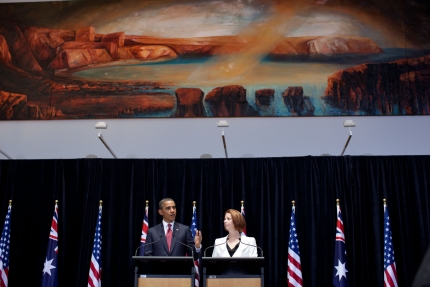
President Obama on the Relationship Between Australia and the United States

November 16, 2011 | 16:23 | Public Domain

President Obama speaks to the Australian Parliament after a Parliamentary Dinner.

Download mp4 (156MB) | mp3 (15MB)

Read the Transcript

After Dinner Remarks by President Obama at Parliamentary Dinner

Parliament House
Canberra, Australia

9:09 P.M. AEST

PRESIDENT OBAMA:  Well, Prime Minister Gillard and Leader Abbot, thank you both for your wonderfully warm words.  And I thank you for showing that in Canberra, as in Washington, people may not always see eye-to-eye, but on this we are all united:  There are no better friends than the United States and Australia. (Applause.) 

Mr. Speaker, Mr. President, and distinguished guests, ladies and gentlemen, I am going to be brief, for we have had a busy day.  I am not sure what day it is.  (Laughter.)  Am I’m going to subject you to a very long speech tomorrow. 

But I do want to express my deep appreciation for the way you’ve welcomed me here today.  I know that I am not the first guy from Chicago to come to these parts.  A century ago, Walter Burley Griffin came here with a vision for this city.  He said, “I have planned a city that is not like any other in the world.” And tonight, I want to thank all of you -- and the people of Australia -- for the hospitality that is unlike any other in the world.

Our toasts earlier tonight reminded me of a story.  It’s from our troops -- this is true story -- our troops serving together in Afghanistan.  Our guys, the Americans, couldn’t figure out why your guys were always talking about cheese.  All day long.  Morning, noon and night.  Why are the Aussies always talking about cheese?  And then, finally, they realized -- it was their Australian friends just saying hello, just saying “cheers.” (Laughter.)

So we Americans and Australians, we may not always speak the same way, or use the same words, but I think it’s pretty clear, especially from the spirit of this visit, and our time together this evening, that we understand each other.  And we see the world in the same way -- even if we do have to disagree on the merits of vegemite.  (Laughter.)

As many of you know, I first came to Australia as a child.  But despite my visits, I have to admit I never did learn to talk "Strine."  I know there is some concern here that your Australian language is being Americanized.  So perhaps it’s time for us to reverse the trend.  Tonight, with your permission, I’d like to give it a burl.  (Laughter and applause.) 

I want to thank the Prime Minister for a very productive meeting that we had today.  I think she’ll agree it was a real chinwag.  (Laughter.)  When Julia and I meet, we listen to each other, we learn from each other.  It’s not just a lot of earbashing.  (Laughter.)  That's a good one -- earbashing.  (Laughter.)  I can use that in Washington.  (Laughter.)  Because there's a lot of earbashing sometimes.  (Laughter.)

That’s been the story of our two nations.  Through a century of progress and struggle, we have stood together, in good times and in bad.  We’ve faced our share of sticky wickets.  (Laughter.)  In some of our darkest moments -- when our countries have been threatened, when we needed a friend to count on -- we’ve always been there for each other.  At Darwin.  At Midway.  After 9/11 and after Bali. 

It’s that moment, in the midst of battle -- when the bullets are flying and the outcome is uncertain -- when Americans and Aussies look over at each other, knowing that we’ve got each other’s backs, knowing in our hearts -- no worries, she'll be right.  (Laughter and applause.)

And so tonight -- as we mark 60 years of this remarkable alliance, through war and peace, hardship and prosperity -- we gather together, among so many friends who sustain the bonds between us, and we can say with confidence and with pride:  The alliance between the United States and Australia is deeper and stronger than it has ever been -- spot on -- (laughter) -- cracker-jack -- (laughter) -- in top nick.  (Laughter.)

Thank you very much, everybody.  (Applause.)

END
9:15 P.M. AEST

Close Transcript

President Obama’s News Conference with Prime Minister Gillard of Australia

November 16, 2011 | 35:35 | Public Domain

President Obama and Prime Minister Julia Gillard of Australia speak about new developments in the U.S-Australia security alliance.

Download mp4 (340MB) | mp3 (33MB)

Read the Transcript

Remarks by President Obama and Prime Minister Gillard of Australia in Joint Press Conference

Parliament House
Canberra, Australia

6:10 P.M. AEST

PRIME MINISTER GILLARD:  Good evening, one and all.  I take this opportunity to very warmly welcome President Obama to Australia for his first visit as President.  President Obama is no stranger to our shores, having visited Australia before.  But it is a special delight to have him here for his first visit as President.  And it comes at an important time in our nation's history and in the history of our region.

We will be looking back during this visit -- we'll be looking back at 60 years of the ANZUS alliance.  We'll be looking back 10 years to the dreadful day of 9/11, a day we all remember with great sorrow.  And we will be reflecting on those events.  But we will be looking forward. 

We live in the growing region of the world where its global -- contribution to global growth is a profound one.  We live in a region which is changing, changing in important ways.  And as a result of those changes, President Obama and I have been discussing the best way of our militaries cooperating for the future.

So I'm very pleased to be able to announce with President Obama that we've agreed joint initiatives to enhance our alliance -- 60 years old and being kept robust for tomorrow.  It is a new agreement to expand the existing collaboration between the Australian Defence Force and the U.S. Marine Corps and the U.S. Air Force.  What this means in very practical detail is from mid-2012, Australia will welcome deployments of a company-size rotation of 200 to 250 Marines in the Northern Territory for around six months at a time.

Over a number of years, we intend to build on this relationship in a staged way to a full force of around 2,500 personnel -- that is a four Marine Air Ground Task Force.

A second component of these initiatives which we have agreed is greater access by U.S. military aircraft to the Royal Australian Air Force facilities in our country’s north.  This will involve more frequent movements of U.S. military aircraft into and out of northern Australia.  Now, taken together, these two initiatives make our alliance stronger, they strengthen our cooperation in our region. 

We are a region that is growing economically.  But stability is important for economic growth, too.  And our alliance has been a bedrock of stability in our region.  So building on our alliance through this new initiative is about stability.  It will be good for our Australian Defence Force to increase their capabilities by joint training, combined training, with the U.S. Marines and personnel.  It will mean that we are postured to better respond together, along with other partners in the Asia Pacific, to any regional contingency, including the provision of humanitarian assistance and dealing with natural disasters.

In addition to discussing this global force posture review by the United States and these new initiatives in our alliance, the President of the United States and I have had an opportunity to reflect on a number of other issues -- to reflect on circumstances in the global economy; to reflect on a clean energy future for our nations and for our planet; to reflect on the forthcoming East Asia Summit.  President Obama will proceed from Australia to that summit in Indonesia, where he spent time growing up.

We’ve had a comprehensive discussion.  I very much welcome President Obama to Australia.  I think he’s already seen that the welcome he’s getting from Australians, including Australian schoolchildren, is a very warm one.  And I know that that is going to be sustained during tonight’s events and the events of tomorrow.

President Obama, over to you.

PRESIDENT OBAMA:  Good day, everybody.  And thank you, Madam Prime Minister, for your generous welcome, your friendship and your partnership.  I am thrilled to be Down Under. 

As you may know, this is not my first visit to Australia.  In fact, I first visited Australia as a boy.  And I’ve never forgotten the warmth and kindness that the Australian people extended to me when I was six and eight.  And I can see that the Australian people have lost none of that warmth.

I very much wanted to take this trip last year, and although events back home prevented me from doing so, I was determined to come for a simple reason:  The United States of America has no stronger ally than Australia.  We are bound by common values, the rights and the freedoms that we cherish.  And for nearly a century, we’ve stood together in defense of these freedoms.  And I'm very happy to be here as we celebrate the 60th anniversary of our alliance, and as we work together to strengthen it for the future. 

We are two Pacific nations, and with my visit to the region I am making it clear that the United States is stepping up its commitment to the entire Asia Pacific.  In this work, we're deeply grateful for our alliance with Australia and the leadership role that it plays.  As it has been for six decades, our alliance is going to be indispensable to our shared future, the security we need and the prosperity that we seek not only in this region but around the world.

I'm also very grateful for my partnership with Prime Minister Gillard.  We've worked quite a bit together lately --

PRIME MINISTER GILLARD:  You bet.

PRESIDENT OBAMA:  -- spanning time zones -- the G20 in Cannes, APEC, and TPP in Hawaii, now here in Australia, and next onto Bali for the East Asia Summit.  And this speaks to how closely our countries work together on a wide range of issues.  And in my friend, Julia, I see the quality that we Americans admire most in our Australian friends:  somebody who's down to earth, easy to talk to, and who says it like it is -- straight up.  And that's why we achieved so much today. 

We agreed to push ahead with our efforts to create jobs for our people by bringing our economies and those of the region even closer together.  Building on our progress at APEC, we're going to keep striving for a seamless regional economy.  And as the two largest economies in the Trans-Pacific Partnership, Australia and the United States are helping to lead the way to a new model for trade across the region.  And along with our G20 partners, we agreed that we have to stay focused on the growth that creates jobs, and that every nation needs to play by the same economic rules of the road.

As two global partners, we discussed the whole range of challenges where we stand shoulder to shoulder, including Afghanistan.  Obviously, this has not been an easy mission for either of our countries, and our hearts go out to the families that were affected on October 29th.  But we both understand what's at stake -- what happens when al Qaeda has safe havens.  We've seen the awful loss of life -- from 9/11 to Bali.

So I thanked the Prime Minister for Australia's strong commitment to this mission.  I salute the extraordinary sacrifices of our forces who serve together, including your Australian troops who've shown that no job is too tough for your "Diggers."  Today, the Prime Minister and I reaffirmed the way forward.  The transition has begun.  Afghans are stepping into the lead.  As they do, our troops -- American and Australian -- will draw down responsibly together so that we preserve the progress that we've made, and by 2014, Afghans will take full responsibility for security in their country.

But our focus today, as the Prime Minister said, was on preparing our alliance for the future.  And so I am very pleased that we are able to make these announcements here together on Australian soil.  Because of these initiatives that are the result of our countries working very closely together as partners, we're going to be in a position to more effectively strengthen the security of both of our nations and this region. 

As Julia described, we are increasing our cooperation -- and I'd add, America's commitment to this region.  Our U.S. Marines will begin rotating through Darwin for joint training and exercises.  Our Air Force will rotate additional aircraft through more airfields in Northern Australia.  And these rotations, which are going to be taking place on Australian bases, will bring our militaries even closer and make them even more effective.  We'll enhance our ability to train, exercise, and operate with allies and partners across the region, and that, in turn, will allow us to work with these nations to respond even faster to a wide range of challenges, including humanitarian crises and disaster relief, as well as promoting security cooperation across the region.

And this commitment builds upon the best traditions of our alliance.  For decades, Australians have welcomed our service members as they've come here to work, train, and exercise together.  And I'm looking forward to joining the Prime Minister in Darwin tomorrow to thank our troops -- Australians and Americans -- for the incredible work that they are doing.

Finally, as I'll discuss more in my speech to Parliament tomorrow, this deepening of our alliance sends a clear message of our commitment to this region, a commitment that is enduring and unwavering.  It's a commitment that I'll reaffirm in Bali as the United States joins the East Asia Summit.  And I want to thank our Australian friends who supported our membership so strongly and have worked to make sure that the EAS addresses regional challenges that affect all of us like proliferation and maritime security.

So, again, I'm very pleased that we're able to make these important announcements during my visit.  Madam Prime Minister, I thank you for being such a strong partner and a champion of our alliance. 

And once again, I want to thank the Australian people for the kindness they showed me about 40 years ago, and the kindness that they're showing me during my visit today.  It's that friendship and that solidarity that makes and keeps our alliance one of the strongest in the world.

PRIME MINISTER GILLARD:  Thank you.

We'll turn to taking some questions.  I think we'll probably take one from the Australian media first.  Phil Hudson.

Q    Philip Hudson from the Melbourne Herald Sun.  Mr. President, welcome back to Australia.

PRESIDENT OBAMA:  Thank you very much.

Q    You and Prime Minister Gillard have outlined what is for us a significant new U.S. troop buildup.  How much of this is because you're (inaudible) of China?  And as of today's deal, U.S. Marines will be for the first time conducting exercises by themselves on Australian soil.  Why is that, and what will they be doing? 

And, Mr. President, you also mentioned in your remarks that Afghanistan is not an easy mission.  In the past few months there have been three cases for Australia where our troops have been shot at by the Afghan soldiers who have been training and, sadly, four of our soldiers have died and many others have been injured. Australian public opinion is strongly against our involvement continuing.  You've outlined the -- just then, the drawdown.  What can you say to the Australian people who don't want to wait, who want to leave immediately? 

PRESIDENT OBAMA:  Well, first, with respect to these new initiatives, this rotational deployment is significant because what it allows us to do is to not only build capacity and cooperation between our two countries, but it also allows us to meet the demands of a lot of partners in the region that want to feel that they're getting the training, they're getting the exercises, and that we have the presence that's necessary to maintain the security architecture in the region.

And so, as Julia mentioned, this is a region that’s becoming increasingly important.  The economy in this area is going to be the engine for world economic growth for some time to come.  The lines of commerce and trade are constantly expanding.  And it’s appropriate then for us to make sure that not only our alliance but the security architecture of the region is updated for the 21st century, and this initiative is going to allow us to do that.

It also allows us to respond to a whole host of challenges, like humanitarian or disaster relief, that, frankly, given how large the Asia Pacific region is, it can sometimes be difficult to do, and this will allow us to be able to respond in a more timely fashion and also equip a lot of countries, smaller countries who may not have the same capacity, it allows us to equip them so that they can respond more quickly as well.

And I guess the last part of your question, with respect to China, I’ve said repeatedly and I will say again today that we welcome a rising, peaceful China.  What they’ve been able to achieve in terms of lifting hundreds of millions of people out of poverty over the last two decades has been nothing short of remarkable.  And that is good not just for China, but it’s potentially good for the region.  And I know Australia’s economy, obviously, has benefitted by the increased demand that you’re seeing in China.

The main message that I’ve said not only publicly but also privately to the Chinese is that with their rise comes increased responsibilities.  It’s important for them to play by the rules of the road and, in fact, help underwrite the rules that have allowed so much remarkable economic progress to be made over the last several decades.  And that’s going to be true on a whole host of issues.

So where China is playing by those rules, recognizing its new role, I think this is a win-win situation.  There are going to be times where they’re not, and we will send a clear message to them that we think that they need to be on track in terms of accepting the rules and responsibilities that come with being a world power.

With respect to Afghanistan, the impact of any loss of life among our troops is heartbreaking.  And obviously, as President of the United States, there's no greater responsibility and nothing more difficult than putting our troops in harm’s way.  I think Prime Minister Gillard feels the same way that I do, which is we would not be sending our young men and women into harm’s way unless we thought it was absolutely necessary for the security of our country.

What we have established is a transition process that allows Afghans to build up their capacity and take on a greater security role over the next two years.  But it’s important that we do it right.  As some of you are aware, I just announced that all remaining troops in Iraq will be removed.  It would have been tempting, given that I have been opposed to the Iraq war from the start, when I came into office, to say, we’re going to get you all out right away.  But what I recognized was that if we weren’t thoughtful about how we proceed, then the enormous sacrifices that had been made by our men and women in the previous years might be for naught.

And what I’d say to the Australian people at this point is, given the enormous investment that’s been made and the signs that we can, in fact, leave behind a country that’s not perfect, but one that is more stable, more secure, and does not provide safe haven for terrorists, it's appropriate for us to finish the job and do it right.

PRIME MINISTER GILLARD:  If I could just add to that and say, every time I have met President Obama and we've talked about our alliance, we've talked about our work in Afghanistan, and in our meetings, both formal and informal, the President has shown the greatest possible concern for our troops in the field.  The meetings we've had over the last few weeks at various international events have coincided with some of the most bitter and difficult news that we've had from Afghanistan, and every step of the way the President has gone out of his way to convey to me his condolences for the Australian people and particularly for the families that have suffered such a grievous loss.

PRESIDENT OBAMA:  Laura MacInnis, Reuters.

Q    Thank you, Mr. President.  Chancellor Merkel said this week that Europe is in its toughest hour since World War II.  Markets are now showing some anxiety about the possibility of instability spreading to France as well.  Are you worried that the steps European leaders are taking are too incremental so far? Do you think something bolder or a more difficult set of decisions need to be taken to fully (inaudible) that crisis? 

I have a question for Prime Minister Gillard as well.  Are you concerned that the fiscal pressures the United States is under at the moment may compromise its ability to sustain its plans for the region, including the initiatives announced today? Do you have to take those with something of a grain of salt until the super committee process is concluded?

PRESIDENT OBAMA:  With respect to Europe, I'm deeply concerned, have been deeply concerned, I suspect we'll be deeply concerned tomorrow and next week and the week after that.  Until we put in place a concrete plan and structure that sends a clear signal to the markets that Europe is standing behind the euro and will do what it takes, we're going to continue to see the kinds of turmoil that we saw in the markets today -- or was it yesterday?  I'm trying to figure out what -- (laughter) -- what time zone I'm in here. 

PRIME MINISTER GILLARD:  It's all of the time.

PRESIDENT OBAMA:  All of the -- right.  (Laughter.)  We have consulted very closely with our European friends.  I think that there is a genuine desire, on the part of leaders like President Sarkozy and Chancellor Merkel, to solve this crisis.  But they've got a complicated political structure.

The problem right now is a problem of political will; it's not a technical problem.  We saw some progress with Italy and Greece both putting forward essentially unity governments that can implement some significant reforms that need to take place in those countries.  But at this point, the larger European community has to stand behind the European project.  And for those American readers or listeners, and those Australian readers or listeners, I think we all understand at this point we've got an integrated world economy and what happens in Europe will have an impact on us.

So we are going to continue to advise European leaders on what options we think would meet the threshold where markets would settle down.  It is going to require some tough decisions on their part.  They have made some progress on some fronts -- like their efforts to recapitalize the banks.  But ultimately what they're going to need is a firewall that sends a clear signal:  "We stand behind the European project, and we stand behind the euro."  And those members of the eurozone, they are going to have the liquidity they need to service their debt.  So there's more work to do on that front. 

And just -- I don't want to steal your question, but I do want to just say, with respect to our budget, there's a reason why I'm spending this time out here in Asia and out here in the Pacific region.  First and foremost, because this is the fastest-growing economic region in the world, and I want to create jobs in the United States, which means we've got to sell products here and invest here and have a robust trading relationship here, and Australia happens to be one of our strongest trading partners.

But the second message I'm trying to send is that we are here to stay.  This is a region of huge strategic importance to us.  And I've made very clear, and I'll amplify in my speech to Parliament tomorrow, that even as we make a whole host of important fiscal decisions back home, this is right up there at the top of my priority list.  And we're going to make sure that we are able to fulfill our leadership role in the Asia Pacific region.

PRIME MINISTER GILLARD:  And I was just going to make what I think is the common-sense point -- I'm not going to issue words of advice about the fiscal position in the United States -- but the common-sense point from the point of view of the leader is, ultimately, budgets are about choices and there are hard choices about the things you value.  And I think, by President Obama being here, he is saying he values the role of the United States in this region and our alliance, and that's what the announcement we've made today is all about.

We've got a question from Mark Riley from the Australian media.

Q    Thanks, Prime Minister.  Mark Riley from 7News, Australia.  Mr. President, I wanted to ask you about the other rising giant of our region -- India -- and the Prime Minister might like to add some comments.  How significant is it for the U.S. that Australia is now considering selling uranium to India? And could you clear up for us what influence or encouragement your administration gave Australia as it made that decision?  And also, the decision is so India can produce clean energy.  In that regard, you're aware that our Parliament has passed a new bill, pricing carbon -- a carbon tax, if you like.  But we're intrigued about where America is going on this issue.

And countries like Australia don’t see a carbon trading system in the world working unless America is a big part of it.  Can you tell us, is it your wish that American will have an emissions trading scheme across the nation within the next five years or so?  How heavily do you want to see America involved in an emissions trading scheme globally, or has this become too politically hard for you?

PRESIDENT OBAMA:  Well, first of all, with respect to India, we have not had any influence, I suspect, on Australia’s decision to explore what its relationship in terms of the peaceful use of nuclear energy in India might be.  I suspect that you’ve got some pretty smart government officials here who figured out that India is a big player, and that the Australia-India relationship is one that should be cultivated.  So I don’t think Julia or anybody else needs my advice in figuring that out.  This is part of your neighborhood, and you are going to make bilateral decisions about how to move forward. 

I think without wading into the details, the discussions that are currently taking place here in Australia around that relationship and the nuclear issue with India are ones that are compatible with international law, compatible with decisions that were made in the NPT.  And I will watch with interest what’s determined.  But this is not something between the United States and Australia; this is something between India and Australia.

With respect to carbon emissions, I share the view of your Prime Minister and most scientists in the world that climate change is a real problem and that human activity is contributing to it, and that we all have a responsibility to find ways to reduce our carbon emissions.

Each country is trying to figure out how to do that most effectively.  Here in Australia, under the leadership of the Prime Minister, you’ve moved forward with a bold strategy.  In the United States, although we haven’t passed what we call a cap-and-trade system, an exchange, what we have done is, for example, taken steps to double fuel efficiency standard on cars, which will have an enormous impact on removing carbon from the atmosphere.

We’ve invested heavily in clean energy research.  We believe very strongly that we’ve improved efficiencies and a whole step range of steps that we can meet and the commitments that we made in Copenhagen and Cancun.  And as we move forward over the next several years, my hope is, is that the United States, as one of several countries with a big carbon footprint, can find further ways to reduce our carbon emissions.  I think that’s good for the world.  I actually think, over the long term, it’s good for our economies as well, because it’s my strong belief that industries, utilities, individual consumers -- we’re all going to have to adapt how we use energy and how we think about carbon.

Now, another belief that I think the Prime Minister and I share is that the advanced economies can’t do this alone.  So part of our insistence when we are in multilateral forum -- and I will continue to insist on this when we go to Durban -- is that if we are taking a series of step, then it’s important that emerging economies like China and India are also part of the bargain.  That doesn’t mean that they have to do exactly what we do.  We understand that in terms of per capita carbon emissions, they’ve got a long way to go before they catch up to us.  But it does mean that they’ve got to take seriously their responsibilities as well.

And so, ultimately, what we want is a mechanism whereby all countries are making an effort.  And it’s going to be a tough slog, particularly at a time when the economies are -- a lot of economies are still struggling.  But I think it’s actually one that, over the long term, can be beneficial.

Jackie Calmes.

Q    Thank you, Mr. President.  Thank you, Prime Minister Gillard.  I wanted to double back to the topic of China.  It seems there’s a bit of a schizophrenic aspect to this week of summitry in the Asian Pacific, where China is participating from Hawaii to Indonesia, but then you have all the rest of you who are talking about, on one hand, a trade bloc that excludes China, and now this -- and an increased military presence for the United States, which is symbolized most by this agreement the two of you have made for a permanent U.S. presence in Australia.

What is it everyone fears so much from China?  And isn’t there some risk that you would increase tensions in a way that would take some of the -- China might take some of the very actions you fear?

PRIME MINISTER GILLARD:  I’m happy to start with that and then go to the President.  I don’t -- I think there’s actually a theme throughout the work we’ve been involved with at APEC, some of the discussion here and what we will take to the East Asia Summit.  We may be on a journey from saying “aloha” to “good day” to "Bali hai*” or something like that.  But I actually think in terms of a strategic outlook, it remains the same -- which is both of our nations deeply engaged with China as it rises and we want to see China rise into the global rules-based order.

That’s our aspiration.  I understand it to be the aspiration of the United States.  It’s something that we pursue bilaterally with China.  It’s something that we pursue multilaterally in the various forums that we work in. 

This East Asia Summit will have a particular significance, coming for the first time with the President of the United States there and of course Russia represented around the table, so all of the players with the right mandate to discuss strategic, political and economic questions for our region.

So I actually believe there’s a continuity here:  APEC fundamentally focused on trade and economic liberalization; here in Australia, longtime allies, talking about the future of their alliance and building for that future, as you would expect, but also preparing for a set of discussions in Bali, which will bring us together again with our friends across the region.

PRESIDENT OBAMA:  Just to pick up on this theme, Jackie, I think the notion that we fear China is mistaken.  The notion that we are looking to exclude China is mistaken.  And I’ll take TPP as a perfect example of this.  We haven’t excluded China from the TPP.  What we have said is the future of this region depends on robust trade and commerce, and the only way we're going to grow that trade is if we have a high-standards trade agreement where everybody is playing by the same rules; where if one set of markets is open then there's reciprocity among the other trading partners; where there are certain rules that we abide by in terms of intellectual property rights protection or how we deal with government procurement -- in addition to the traditional areas like tariffs. 

And what we saw in Honolulu, in APEC, was that a number of countries that weren't part of the initial discussions -- like Japan, Canada, Mexico -- all expressed an interest in beginning the consultations to be part of this high-standard trade agreement that could potentially be a model for the entire region. 

Now, if China says, we want to consult with you about being part of this as well, we welcome that.  It will require China to rethink some of its approaches to trade, just as every other country that's been involved in the consultations for the TPP have had to think through, all right, what kinds of adjustments are we willing to make? 

And so that's the consistent theme here.  This is a growing region.  It is a vital region.  The United States is going to be a huge participant in both economic and security issues in the Asia Pacific region, and our overriding desire is that we have a clear set of principles that all of us can abide by so that all of us can succeed.  And I think it's going to be important for China to be a part of that.  I think that's good for us. 

But it's going to require China, just like all the rest of us, to align our existing policies and what we've done in the past with what's needed for a brighter future. 

PRIME MINISTER GILLARD:  Thank you very much.

PRESIDENT OBAMA:  Thank you very much, everybody.

PRIME MINISTER GILLARD:  Thank you.

END
6:43 P.M. AEST

Close Transcript

The White House

Office of the Press Secretary

Presidential Proclamation -- Thanksgiving Day, 2011

THANKSGIVING DAY, 2011

- - - - - - -

BY THE PRESIDENT OF THE UNITED STATES OF AMERICA

A PROCLAMATION
 

     One of our Nation's oldest and most cherished traditions, Thanksgiving Day brings us closer to our loved ones and invites us to reflect on the blessings that enrich our lives.  The observance recalls the celebration of an autumn harvest centuries ago, when the Wampanoag tribe joined the Pilgrims at Plymouth Colony to share in the fruits of a bountiful season.  The feast honored the Wampanoag for generously extending their knowledge of local game and agriculture to the Pilgrims, and today we renew our gratitude to all American Indians and Alaska Natives.  We take this time to remember the ways that the First Americans have enriched our Nation's heritage, from their generosity centuries ago to the everyday contributions they make to all facets of American life.  As we come together with friends, family, and neighbors to celebrate, let us set aside our daily concerns and give thanks for the providence bestowed upon us.

     Though our traditions have evolved, the spirit of grace and humility at the heart of Thanksgiving has persisted through every chapter of our story.  When President George Washington proclaimed our country's first Thanksgiving, he praised a generous and knowing God for shepherding our young Republic through its uncertain beginnings.  Decades later, President Abraham Lincoln looked to the divine to protect those who had known the worst of civil war, and to restore the Nation "to the full enjoyment of peace, harmony, tranquility, and union."

     In times of adversity and times of plenty, we have lifted our hearts by giving humble thanks for the blessings we have received and for those who bring meaning to our lives.  Today, let us offer gratitude to our men and women in uniform for their many sacrifices, and keep in our thoughts the families who save an empty seat at the table for a loved one stationed in harm's way.  And as members of our American family make do with less, let us rededicate ourselves to our friends and fellow citizens in need of a helping hand.

     As we gather in our communities and in our homes, around the table or near the hearth, we give thanks to each other and to God for the many kindnesses and comforts that grace our lives.  Let us pause to recount the simple gifts that sustain us, and resolve to pay them forward in the year to come.

     NOW, THEREFORE, I, BARACK OBAMA, President of the United States of America, by virtue of the authority vested in me by the Constitution and the laws of the United States, do hereby proclaim Thursday, November 24, 2011, as a National Day of Thanksgiving.  I encourage the people of the United States to come together    whether in our homes, places of worship, community centers, or any place of fellowship for friends and neighbors    to give thanks for all we have received in the past year, to express appreciation to those whose lives enrich our own, and to share our bounty with others.

     IN WITNESS WHEREOF, I have hereunto set my hand this sixteenth day of November, in the year of our Lord two thousand eleven, and of the Independence of the United States of America the two hundred and thirty-sixth.

BARACK OBAMA

President Obama Speaks about Startup America

November 16, 2011 | 1:53 | Public Domain

Startup America will help entrepreneurs get loans, cut through red tape, speed up innovation, and get their businesses off the ground faster.

Download mp4 (18MB) | mp3 (2MB)

Expanded Military Ties in Australia

20111116 POTUS PM Gillard

President Barack Obama holds a joint press conference with Prime Minister Julia Gillard of Australia at Parliament House in Canberra, Australia, Nov. 16, 2011. (Official White House Photo by Pete Souza)

When President Obama met with Australian Prime Minister Julia Gillard on Wednesday, they announced plans for the first sustained American military presence in Australia.

By the end of 2012, 250 Marines will begin six month rotations, and in the years ahead, that force will build out to 2,500. They'll train alongside Australian troops and live on Australian bases. In addition, the U.S. Air Force will have additional access to Australian airfields.

At the news conference with the Prime Minister, President Obama said:

The United States of America has no stronger ally than Australia. We are bound by common values, the rights and the freedoms that we cherish. And for nearly a century, we’ve stood together in defense of these freedoms. And I'm very happy to be here as we celebrate the 60th anniversary of our alliance, and as we work together to strengthen it for the future.

Read the full remarks here.

See more: Check out a slideshow from the President’s trip to Australia.

The White House

Office of the Press Secretary

We Can't Wait: Obama Administration Proposes Historic Fuel Economy Standards to Reduce Dependence on Oil, Save Consumers Money at the Pump

Next phase in national program for light-duty vehicles will save consumers thousands of dollars at the pump while saving billions of barrels of oil, curbing pollution, enabling long-term planning for automakers

WASHINGTON, DC – Building on President Obama’s historic national program, the U.S. Environmental Protection Agency (EPA) and the U.S. Department of Transportation (DOT) today formally unveiled their joint proposal to set stronger fuel economy and greenhouse gas pollution standards for Model Year 2017-2025 passenger cars and light trucks.  Cars, SUVs, minivans, and pickup trucks are currently responsible for nearly 60 percent of U.S. transportation-related petroleum use and greenhouse gas emissions.

Today’s announcement is the latest in a series of executive actions the Obama Administration is taking to strengthen the economy and move the country forward because we can’t wait for Congressional Republicans to act.   When combined with other historic steps this administration has taken to increase energy efficiency, this proposal will save Americans over $1.7 trillion at the pump, more than $8,000 per vehicle by 2025.  These combined actions also will reduce America’s dependence on oil by an estimated 12 billion barrels, and, by 2025, reduce oil consumption by 2.2 million barrels per day – enough to offset almost a quarter of the current level of our foreign oil imports.  Taken together, these actions will also slash 6 billion metric tons in greenhouse gas emissions over the life of the programs. 

Today’s proposed standards alone will slash oil consumption by 4 billion barrels and cut 2 billion metric tons of greenhouse gas pollution over the lifetimes of the vehicles sold in those years.

“These unprecedented standards are a remarkable leap forward in improving fuel efficiency, strengthening national security by reducing our dependence on oil, and protecting our climate for generations to come. We expect this program will not only save consumers money, it will ensure automakers have the regulatory certainty they need to make key decisions that create jobs and invest in the future,” said U.S. Transportation Secretary Ray LaHood. “We are pleased that we’ve been able to work with the auto industry, the states, and leaders in the environmental and labor communities to move toward even tougher standards for the second phase of the President’s national program to improve fuel economy and reduce pollution.”

"By setting a course for steady improvements in fuel economy over the long term, the Obama administration is ensuring that American car buyers have their choice of the most efficient vehicles ever produced in our country. That will save them money, reduce our nation's oil consumption and cut harmful emissions in the air we breathe," said EPA Administrator Lisa P. Jackson. "This is an important addition to the landmark clean cars program that President Obama initiated to establish fuel economy standards more than two years ago. The progress we made with the help of the auto industry, the environmental community, consumer groups and others will be expanded upon in the years to come -- benefitting the health, the environment and the economy for the American people."

The proposed program for MY 2017-2025 passenger cars and trucks is expected to require increases in fuel efficiency equivalent to 54.5 mpg if all reductions were made through fuel economy improvements.  These improvements would save consumers an average of up to $6,600 in fuel costs over the lifetime of a MY 2025 vehicle for a net lifetime savings of up to $4,400 after factoring in related increases in vehicle cost.  Overall, the net benefit to society from this rule would total more than $420 billion over the lifetime of the vehicles sold in MY 2017-2025.

Today’s action builds on the success of the first phase of the Obama Administration’s national program (2012-2016), which will raise fuel efficiency equivalent to 35.5 mpg by 2016 and result in an average light vehicle tailpipe CO2 level of 250 grams per mile.  These standards are already in effect and saving consumers money at the pump now.  Combined with 2011 fuel economy standards and the standards in effect  for 2012-2016, today’s proposal represents the most significant federal action ever taken to reduce greenhouse gas emissions and improve fuel economy.  Taken together, these actions would reduce greenhouse gas emissions by half and result in model year 2025 light-duty vehicles with nearly double the fuel economy of model year 2010 vehicles. 

The national policy on fuel economy standards and greenhouse gas emissions created by DOT and EPA provides regulatory certainty and flexibility that reduces the cost of compliance for auto manufacturers while reducing oil consumption and harmful air pollution.  By continuing the national program developed for MY 2012-2016 vehicles, EPA and DOT have designed a proposal that allows manufacturers to keep producing a single, national fleet of passenger cars and light trucks that satisfies all federal and California standards.  It also ensures that consumers will continue to enjoy a full range of vehicle choices with performance, utility and safety features that meet their individual needs. 

The standards will rely on innovative technologies that are expected to spur economic growth and create high-quality jobs across the country.  Major auto manufacturers are already heavily invested in developing advanced technologies that can significantly reduce fuel use and greenhouse gas emissions beyond the existing model year 2012-2016 standards. In addition, a wide range of technologies are currently available for automakers to meet the new standards, including advanced gasoline engines and transmissions, vehicle weight reduction, lower tire rolling resistance, improvements in aerodynamics, diesel engines, more efficient accessories, and improvements in air conditioning systems.  The standards should also spur manufacturers to increasingly explore electric technologies such as start/stop, hybrids, plug-in hybrids, and electric vehicles.  The MY 2017-2025 proposal includes a number of incentive programs to encourage early adoption and introduction of “game changing” advanced technologies, such as hybridiation for pickup trucks.

The proposal released today follows President Obama’s announcement in July that the Administration and 13 major automakers representing more than 90 percent of all vehicles sold in the U.S. have agreed to build on the first phase of the national vehicle program.  EPA and DOT worked closely with a broad range of stakeholders to develop the proposal—including manufacturers, the United Auto Workers, the State of California, and consumer and environmental groups.

There will be an opportunity for the public to comment on the proposal for 60 days after it is published in the Federal Register.  In addition, DOT and EPA plan to hold several public hearings around the country to allow further public input. California plans to issue its proposal for model year 2017-2025 vehicle greenhouse gas standards on December 7 and will finalize its standards in January.

To view NHTSA and EPA’s Notice of Proposed Rulemaking, visit http://www.nhtsa.gov/fuel-economy.

For more information, visit http://www.epa.gov/otaq/climate/regulations.htm or http://www.nhtsa.gov/fuel-economy.

The White House

Office of the Press Secretary

FACT SHEET: Memorandum of Understanding between U.S. and Australia on Enhancing Cooperation in Preventing and Combating Crime

The Memorandum of Understanding between the Government of the United States of America and the Government of Australia on Enhancing Cooperation in Preventing and Combating Crime can be viewed HERE.

The White House

Office of the Press Secretary

After Dinner Remarks by President Obama at Parliamentary Dinner

Parliament House
Canberra, Australia

9:09 P.M. AEST

PRESIDENT OBAMA:  Well, Prime Minister Gillard and Leader Abbot, thank you both for your wonderfully warm words.  And I thank you for showing that in Canberra, as in Washington, people may not always see eye-to-eye, but on this we are all united:  There are no better friends than the United States and Australia. (Applause.) 

Mr. Speaker, Mr. President, and distinguished guests, ladies and gentlemen, I am going to be brief, for we have had a busy day.  I am not sure what day it is.  (Laughter.)  Am I’m going to subject you to a very long speech tomorrow. 

But I do want to express my deep appreciation for the way you’ve welcomed me here today.  I know that I am not the first guy from Chicago to come to these parts.  A century ago, Walter Burley Griffin came here with a vision for this city.  He said, “I have planned a city that is not like any other in the world.” And tonight, I want to thank all of you -- and the people of Australia -- for the hospitality that is unlike any other in the world.

Our toasts earlier tonight reminded me of a story.  It’s from our troops -- this is true story -- our troops serving together in Afghanistan.  Our guys, the Americans, couldn’t figure out why your guys were always talking about cheese.  All day long.  Morning, noon and night.  Why are the Aussies always talking about cheese?  And then, finally, they realized -- it was their Australian friends just saying hello, just saying “cheers.” (Laughter.)

So we Americans and Australians, we may not always speak the same way, or use the same words, but I think it’s pretty clear, especially from the spirit of this visit, and our time together this evening, that we understand each other.  And we see the world in the same way -- even if we do have to disagree on the merits of vegemite.  (Laughter.)

As many of you know, I first came to Australia as a child.  But despite my visits, I have to admit I never did learn to talk "Strine."  I know there is some concern here that your Australian language is being Americanized.  So perhaps it’s time for us to reverse the trend.  Tonight, with your permission, I’d like to give it a burl.  (Laughter and applause.) 

I want to thank the Prime Minister for a very productive meeting that we had today.  I think she’ll agree it was a real chinwag.  (Laughter.)  When Julia and I meet, we listen to each other, we learn from each other.  It’s not just a lot of earbashing.  (Laughter.)  That's a good one -- earbashing.  (Laughter.)  I can use that in Washington.  (Laughter.)  Because there's a lot of earbashing sometimes.  (Laughter.)

That’s been the story of our two nations.  Through a century of progress and struggle, we have stood together, in good times and in bad.  We’ve faced our share of sticky wickets.  (Laughter.)  In some of our darkest moments -- when our countries have been threatened, when we needed a friend to count on -- we’ve always been there for each other.  At Darwin.  At Midway.  After 9/11 and after Bali. 

It’s that moment, in the midst of battle -- when the bullets are flying and the outcome is uncertain -- when Americans and Aussies look over at each other, knowing that we’ve got each other’s backs, knowing in our hearts -- no worries, she'll be right.  (Laughter and applause.)

And so tonight -- as we mark 60 years of this remarkable alliance, through war and peace, hardship and prosperity -- we gather together, among so many friends who sustain the bonds between us, and we can say with confidence and with pride:  The alliance between the United States and Australia is deeper and stronger than it has ever been -- spot on -- (laughter) -- cracker-jack -- (laughter) -- in top nick.  (Laughter.)

Thank you very much, everybody.  (Applause.)

END
9:15 P.M. AEST

The White House

Office of the Press Secretary

Press Briefing by Press Secretary Jay Carney, Deptuy National Security Advisor for Strategic Communications Ben Rhodes and NSC Senior Director for Asia Danny Russel

Parliament House
Canberra, Australia 

7:00 P.M. AEST

MR. CARNEY:  Good evening, my friends.  Thanks for being here.  We're going to have a slightly unusual briefing.  I have with me Ben Rhodes, Deputy National Security Advisor for Strategic Communications; and Danny Russel, Senior Director at the NSC for Asia.  Ben is going to start the briefing with an embargoed discussion of the speech tomorrow.  And if you have questions about the speech, ask them right away and we will just embargo that section.  We were going to embargo the whole briefing, but that doesn't make sense, so once we get through the speech, if you have other questions on other subjects that would be fine and that would be usable right away.  Make sense? 

Q    Embargoed until he starts speaking?

MR. CARNEY:  Yes, until he speaks. 

Q    And will you have excerpts?

MR. CARNEY:  We're working on that. 

MR. RHODES:  Yes, we're working on getting you some excerpts tonight. 

MR. CARNEY:  And those would be embargoed as well.

Q    So he speaks East Coast time or Australia time?  (Laughter.)  Sorry, I'm confused.

MR. CARNEY:  Yes, you are. 

And with that, here is Ben Rhodes.

MR. RHODES:  And just to reiterate, I'll walk through some of the points in the speech.  We'll have excerpts on some of the key issues; take some questions on that particular content.  Obviously, there's overlap with other issues, so we can discuss those in the context of your other questions.

But as I mentioned earlier, this is a speech that will be both an opportunity to highlight the alliance between the U.S. and Australia and its importance, while also having the President lay out a vision of the U.S. role in the Asia Pacific region more broadly going forward. 

So he will begin the speech with a strong reaffirmation of the alliance between the U.S. and Australia.  He will underscore the fact that that's been rooted in shared interest and shared values -- that in many respects America and Australia share common characteristics among our peoples, just as we share a common experience.  And we've, of course, been together in every major war, and in that context, he'll speak about the sacrifices we're making in Afghanistan, as well as the work that we do together on a range of priorities around the world.

After that, he'll focus on the Asia Pacific more broadly.  I think he will underscore I think what is a core message of this entire trip, which is that as we end the wars in Iraq and Afghanistan we are refocusing our attention in a substantial way on the Asia Pacific region.  We see this very much as a rebalancing of the U.S. commitment and footprint in the world, manifested in our diplomatic efforts, our security efforts, and our economic efforts.  And so the context for this speech is very much this pivot that we've been undertaking since the beginning of this administration, really, to turn our attention to the

Asia Pacific region across a range of areas.

Now, the speech will hit upon three major areas:  security, the global economy, and democracy and human rights. 

On the security section, the President will underscore the fact that he has made a strategic decision that the United States is going to play a larger role and a long-term role in shaping the future of the region.  Associated with that -- and you heard the President speak to this a little bit just now -- he will discuss the ongoing review of our defense budgetary priorities that have been taking place in discussions that the President has had, of course, with his national security team.  And he will address directly the question that was posed today, actually, about the role of the United States in the context of reduced budgets. 

We also see it in the context of ending the wars, because the U.S. essentially has a force that has been focused overwhelmingly on Iraq and Afghanistan for the last 10 years, so even as we make these budgetary choices we're also making choices about priorities going forward and about capabilities that are needed to meet those priorities.

In that vein, he will make it clear that he has directed his national security team to make our presence and our missions in the Asia Pacific a top priority, that reductions in defense spending will not come at the expense of the Asia Pacific region. So he'll be sending a message about the prioritization of this region in the context of those defense budget cuts and decisions. And that will be, I think, as robust a statement as the President has made about his view of the future of defense spending to date.

Associated with that, he will discuss the various ways in which we are going to be focused on allocating our resources to maintain our presence in the region.  We'll want to preserve our unique capability to project power in the Asia Pacific region.  We will of course have to keep our commitments, including all of our treaty obligations to allies like Australia.  We will be strengthening new capabilities to meet the challenges of the 21st century, whether it's through joint exercises with our partners, the ability to train and partner with a range of nations, and the ability to respond quickly to contingencies, and the ability, of course, of the United States to continue to be the anchor of security in the Asia Pacific region that we've discussed throughout this trip.

And so the bottom line is he will be making a strong statement that the United States is a Pacific power, and we intend very much to maintain our presence here and to build upon it going forward.  And you, of course, heard today a very important announcement associated with that, with the Marine Air and Ground Task Force that will be positioned here in Australia in the coming years as emblematic of that effort.

I think he'll be speaking about the need, again, to also maintain our strong presence in Japan, on the Korean Peninsula, while we are also enhancing our presence in Southeast Asia.  And I think you heard Admiral Willard speak to this the other day -- our presence in the Asia Pacific has very much been weighted in Northeast Asia.  Given the importance of this part of theAsia Pacific region, we want to make sure we're enhancing our presence in Southeast Asia and the South Pacific.  Today's announcement was a part of that, and we'll continue to, of course, build on those capabilities going forward.

We'll also, of course, be talking about how we're going to help our allies and partners build their capacity.  We do that in a range of ways, from port calls to training to joint exercises.

He'll also discuss a range of the security challenges in the region.  He'll reiterate America's policy on North Korea as it relates to their proliferation activities and their international obligations.  He'll discuss a range of security commitments the U.S. has in the region, very much in line with what Admiral Willard talked to you about the other day.  And then he'll also look forward to the East Asia Summit, particularly underscoring our focus on shared challenges, such as proliferation and maritime security, to include cooperation in the South China Sea. 

Then we will discuss the second area, being economic issues. I think there you will see him very much build on the message he’s had throughout this trip, that we are seeking to take advantage of the enormous growth that’s taking place here in the region, that we conduce* in a way that produces win-win outcomes for nations and businesses and workers; that we’re invested in a future where economies are open and transparent, trade is free and fair, and there’s an international economic system where there are clear rules of the road that everybody plays by.

As a part of that, of course, he’ll hold up and underscore the importance of the Trans-Pacific Partnership as an ambitious trade agreement that does set these types of high standards.  He’ll talk about, again, the types of core commitments that are necessary to sustain the type of trade we’d like to see:  trade where workers’ rights are respected; businesses compete on a level playing field; intellectual property and new technologies are protected; currencies are market driven; growth is broad and sustained.  And also, he’ll touch upon the importance of clean energy in the context of both combating climate change and fueling economic growth.

Beyond that, then he will talk about the third broad category of the U.S. commitment to the region, and that is our support for democracy and human rights.  Of course, we share these values with Australia.  And I think he’ll very much underscore the importance of the U.S. speaking up for these rights, where we feel that they are threatened; empowering and supporting emerging democracies -- and we have models of emerging democracies across the region, including in South East Asia; strengthening civil society and open government, which has been a key priority of our administration; advancing the rights of women and minorities and indigenous cultures going forward.  And here, of course, he’ll welcome the steps that Australia has taken in recent years -- historic steps to recognize the rights and importance of their indigenous population.

In that context, I think he’ll also be able to touch upon some issues in the region, such as Burma, where we of course have had extraordinary concerns about the human rights situation within that country -- although, we have seen some positive steps taken in recent days.  And he’ll underscore the importance of the Burmese government continuing to go down that path to pursue a better relationship with the United States. 

So that’s a broad overview, again.  It really covers the core areas of concern on this trip and the core areas of concern that we have in the Asia Pacific region, and lays out a very broad and robust role for the United States going forward in shaping an economic architecture of cooperation, shaping a security environment that is conducive to the interest and rights and responsibilities of all nations; and, of course, being a force on behalf of democracy and human rights.

We see our engagement in these regional organizations, like APEC, East Asia Summit, and our engagement at ASEAN as a critical way of advancing those interests.  So this speech, again, will frame our approach throughout this trip and our approach going forward.

So I’ll take any questions on the speech and then we can pivot to other issues.

Yes.

Q    Ben, you mentioned that in a time of budget cuts, the President will make clear that this region -- it’s not going to come at the expense of this region, which raises the question of we’ll lose.  I mean, is it -- it is kind of a zero-sum with less money to work with.  Are you contending that the Afghan and Iraq drawdowns will be enough?  Or are we looking at potential cuts in places like Europe?

MR. RHODES:  I’d say a couple of things.  First of all, the Afghan and Iraq drawdowns are part of this picture, but they’re not the complete picture.  And we’ve acknowledged that there are going to have to be defense cuts that go beyond simply the savings that are gained from the wars.

And as a part of that, the military leadership and civilian leadership of our national security team is looking at the broad array of defense priorities that the United States has.  We recognize that that involves choices and prioritization.  And I think what the President is doing is laying down a marker about a core priority and a top priority, as he said, of the United States being an Asia Pacific region.

I wouldn’t -- I think that leadership at the Pentagon is going to have to continue to speak to this going forward about where other cuts will come from.  They’ve already, of course, identified a significant number, but are in the process of identifying more.  Certainly that means there are going to be cuts in other places, so I wouldn't get ahead of that and identify precisely where they're going to end up other than to say that the President has laid down a marker that it's going to be a priority to preserve our role in the Asia Pacific region and to build upon that role going forward.

Q    -- troops that are going to be in the Northern Territories, is that not sending a message to China?

MR. RHODES:  It's about sending a message to the entire region about the U.S. commitment to be present in a robust way in the South Pacific and Southeast area, as well as Northeast Asia, where we have a significant presence.

So in terms of specific capabilities, that will allow us to work cooperatively with the Australians.  It will also allow us to work with and conduct doing exercises with and training exercises with a host of nations in this part of the Asia Pacific region to strengthen their capabilities.  It gives us a more rapid deployment response capability to different contingencies. It could run the gamut from humanitarian to disaster relief, to any other challenge that may emerge in this part of the world. 

So it’s a part of the U.S. sending a signal that we’re going to be present, that we’re going to continue to play the role of underpinning security in this part of the region.  Part of that context is a rising China.  That’s one part of the context for the future of this region.  But either way, the United States is going to stay present and it’s going to be able to, again, I think assure the nations of the Asia Pacific that we’re going to be a guarantor of security for our allies, and we’re going to be a force on behalf of international standards and norms, like the President spoke about today.

Laura.

Q    Back to the prioritization of this area in terms of budget, two questions:  One, are you saying that essentially the military spending for Asia Pacific will not be cut as the Pentagon makes these tough choices and, in fact, will be increased?  And how much money are we talking about?  I mean, I’m not really clear on how much it costs to put 250 Marines in Darwin and ramping up to 2,500.  I mean, just -- since you’ve kind of put on the table the idea that in tough budgets this is the priority, could you kind of address both of those?

MR. RHODES:  Well, they’re separate issues.  I think in terms of the tough -- in terms of the budgetary priority, I think what you’re going to see is a number of choices are going to have to be made about where to find more savings in the defense budget -- where we can cut spending in the defense budget, and the involves setting priorities.

And this is a statement of priority by the President in the first, I think, significant statement that he’s made in that context since he -- these discussions began, and with his national security team.  So I don’t think we’re at a stage where we can set a dollar amount on it because they’re still working through the full range of budgetary choices.

But I think what he is saying is our ability to conduct the roles that we play in the Asia Pacific, and our ability to develop the capabilities that we need going forward are going to be prioritized and protected in the context of those budgetary choices.  So it’s a statement of prioritization and principle --

Q    You’re not saying that the budget will be cut for Asia Pacific?  You’re just saying maybe it won’t be cut as much as someone else’s.  

MR. RHODES:  Well, again, I can’t put a dollar amount on it at this point.  But we can say that this region and the capabilities we have in it are going to be prioritized in the context of our defense budgetary review. 

Q    -- a top priority?  Or, I mean, just prioritize?  I mean, you listen to government people talk sometimes and everything is a priority.  So it’s hard to understand what that means.

MR. RHODES:  I think this -- the President said himself that this is a top priority.  And that’s a very clear signal to the region and also to his own government about the fact that as we review a range of choices that the Asia Pacific is going to be a focal point of our efforts going forward.

Part of that is that the spending and capabilities are recovered by ending the wars.  But part of that is going to be the broader defense choices that we’re going to be making going forward.

Q    You can’t say, though, whether total spending will rise, stay the same, or fall?

MR. RHODES:  I can’t give you an exact number because they still have to work through entire defense budget for the coming years in a very -- which involves obviously very significant expenditures.  But, again, I can tell you that this is the first statement that he’s made of this nature about what his priorities are, and the fact that he sees this region as a focal point for U.S. efforts going forward.

Q    And about the cost of the Darwin --

MR. RHODES:  Yes, the Darwin -- so first of all -- and you guys should be getting the joint statement we had with Australians, and the Prime Minister described it, 250 Marines going up to 2,500.  This will be a Marine Air Ground Task Force at Darwin.  It will also include increased rotations of U.S. aircraft.

Q    This part is probably not embargoed, right?

MR. RHODES:  No, this isn’t -- no, no.  The stuff that’s not in the speech is -- also includes U.S. aircraft rotating into northern Australia.  These are coming out of our global force deployments.  So this in and of itself is not in -- and this question was asked before by Jackie -- is not new money.  This is actually money within the global force deployment that the Marines have, and they’re prioritizing it to Darwin.

But, Danny, do you want to say anything about the Darwin functions and capabilities?

MR. RUSSEL:  Sure.  Well, let me start, if I could, with a more general point, which is the President has been working hard to invest in all of our alliances in Asia.  And that was evident both in the state visit by President Lee of South Korea, the work that the President did in Honolulu with Prime Minister Noda, but particularly the fact that here in Australia he chose to demonstrate that we are, as Ben Rhodes said the other day, we are all in, in Asia. 

The President came to Australia with a message with regard to this forward rotational force posture that we are investing, we are not liquidating, our security presence in Asia -- number one.

Number two, as the President said earlier, Southeast Asia is coming into its own.  We’re rebalancing not only in the global sense, but within Asia as well.  We are maintaining our security capabilities and our alliances in Northeast Asia, and we are enhancing in Southeast Asia.

As the region grows and changes, so, too, does our security and defense posture.  So there's great significance to the announcement today that's not denominated in the number of Marines that it begins with, and not denominated in the dollars spent to fund them. 

This is a new step forward in the U.S.-Australia alliance.  We have Marines who will be operating and training jointly with their Australian colleagues, on Australian soil, and who will be rotating both jointly and unilaterally to cooperate with other security partners, allies and friends throughout Southeast Asia. These are countries who want to have U.S. and Australian help in developing their own capacity, and increasing their capacity to deal with contingencies and to deal with disasters benefits us and benefits the entire region.

Q    How will the President be talking about China in his speech?  Will he be singling out China when he talks about intellectual property, currency, and then balancing?  Or will he just sort of be speaking more generally?

MR. RHODES:  I think it will be quite similar to what he said today and what he's said throughout this trip, which is that what we are doing with our strength and influence in the

Asia Pacific is empowering positive models with clear rules of the road that benefit everybody.  On the economic side, it's high standards of trade.  On the security side, again, it's clear rules of the road to deal with issues like maritime security.  On the regional architecture side, it's developing institutions where everybody can work cooperatively to resolve challenges.

That is a standard that applies to every nation.  Now, China -- so China is not singled out by the fact that we are empowering international rules of the road in these areas.  China is welcome to be a part of these initiatives.  At the same time, again, that means that they're going to have to be adhering to rules and standards that all nations themselves need to abide by in order for the international system to work, in order for this region to continue its positive trajectory.

So I think there's -- the basic message of this entire trip is we are investing the focus of the United States and the resources of the United States in positive models.  All nations, again, are welcome to join with us in that effort.  It doesn't come at the expense of any one nation, but, again, there's a single standard that everybody needs to meet in order for the economic future and the security future of the region to be as positive as it should be.

Q    Will he be mentioning China?

MR. RHODES:  Yes, he'll certainly mention China, and he'll do it in that context of welcoming the progress that they've made while making it clear that, in that context, we would like to see all nations adhering to clear rules of the road. 

MR. CARNEY:  I want to say, we only have a few more minutes because we have to go to this dinner. 

Q    Jay, could you just analyze just a little bit, with a little bit more specificity, this military preference -- 200 to 250 Marines by mid-2012, ramping up to 2,500 -- when and who?  She said, that's Marine, air and ground.  So where does "ground" come in --

MR. RHODES:  It's a Marine Air and Ground Task Force.  It's called a MAGTF.  And the initial deployment starts at 250, and then the military will be building up from that to a full complement of 2,500 Marines, which is the normal complement for a Marine Air and Ground Task Force.  So that will begin next year, and it will ramp up steadily in the coming years with the, again, 2,500 being the full complement of the MAGTF.  And then --

Q    When?

MR. RHODES:  We don't have a specific date on that, but it will be a steady buildup from the initial complement of 250 up to 2,500.

Q    That does not include the U.S. Air Force --

MR. RHODES:  No, then the second joint -- that's one joint initiative.  The second joint initiative is the air piece.

And, Danny, do you want to talk about that a little bit?

MR. RUSSEL:  The second piece to the announcement the President made is the decision to expand the number and the frequency of aircraft coming to Australian bases, and widen the number of bases on which they operate in the northern part of Australia.  The benefit to the United States from this initiative is, among other things, in terms of increased interoperability between the U.S. and the Australian air forces. 

This is a program that enhances our flexibility and the versatility of U.S. forces.  I think that's true also with respect to the MAGTF, because as U.S. and Australian Marines train together, operate together, and mentor third countries together, we'll be standardizing operating procedures, we'll be increasing familiarity with technical aspects of security cooperation.  And as Ben said, we'll be setting standards that others can live up to that will be of tremendous benefit in response to the range of contingencies, including natural disaster and humanitarian response, which is a high priority for Australia, for the U.S. and for the region.

Forward-deployed forces are one of the key tools also that the U.S. military uses to engage friends and with allies.  In addition to building partner capacity, our ability to conduct exercises throughout the region increases our familiarity with them and their familiarity with us, so that when there is a crisis, we're able to be there quickly, know what to expect, and our partners are able to know how to cooperate with us from the get-go. 

Q    -- the U.S. Air Force can already use some Australian Air Force facilities, this is just expanding that?

MR. RUSSEL:  Correct.  This is a significant expansion --

Q    From what to what?  How many bases?

MR. RUSSEL:  It's not decided as an absolute number, but it is a ramping up of the program that will see a significant increase in both the number of airfields and in the quantity of U.S. aircraft.

Q    So you can't give numbers?

Q    What type of aircraft?

MR. RUSSEL:  I don't have -- a variety of aircraft.

Q    Planes?  There's no sea element to this, more ships rotating through or anything?

MR. RUSSEL:  This particular initiative doesn't involve a ramping up of ship visits or naval cooperation.  However, you should remember that this decision is the byproduct of a series of meetings at a high level both between the President and the Australian Prime Minister, but also the annual meetings of the U.S. and the Australian defense and foreign ministers.  These were the initiatives that were worked out by the AUSMIN, as it's called, in September of this year.  But they were the product and were two of a variety of options that were developed at the initiative of the President and the Prime Minister more than a year ago, as we conducted our respective force posture reviews and completed the first year of a joint U.S.-Australia force posture review.  So there may be more to come.

MR. RHODES:  Jake, I'd just say, the way to think about this also is as a force multiplier, right?  Because these are Marines that will be based here, but also deploying out, training, partnering with other militaries in the region -- Australia and others -- therefore, increasing capacity across the region.

So we see it as an essential platform going forward for our U.S.-Australian alliance, but also the ability to build out capacity among partner nations in Southeast Asia.

Q    -- agree to rotate through, or --

MR. RHODES:  Yes.

Q    -- they won't be permanently attached.

MR. RHODES:  There will be a constant rotation, so there will be -- this will be a regular presence of the U.S. Marines in Australia.  They will be deployed for different periods of time as a part of that.

MR. CARNEY:  We've got about five more minutes.

Q    There's an AFP alert that just crossed, and it says that China says increased U.S.-Australia military cooperation may not be quite appropriate.  I was just wondering if there's any reaction that you have to this.

MR. RHODES:  Well, we think it's perfectly appropriate, and I'd highlight two things.  First of all, this is one of our closest allies in the world, and we're doing this initiative with them.  As Prime Minister Gillard said in the bilateral meeting and in the joint press conference, this is a big deal and a significant step for them, to take this relationship to the next level through this deployment of Marines and increased aircraft.

Secondly, it's in response to demand from within the region. As we've said, the nations of the region have signaled they want the U.S. to be present; would like, again, in many respects and instances, increased partnership with the United States.  The ability of the United States to help respond to contingencies is something that has been welcomed in recent years, whether, again, it was work that we're doing in the Philippines to counter violent extremism, work that we're doing to counter piracy in the region, the response to the tsunami in Indonesia. 

So in other words, there's a demand signal from the nations of the region, and this is something that we're doing in concert with one of our closest allies.  So we believe it's not just entirely appropriate, but an important step to dealing with the challenges of the future of the Asia Pacific region.

Q    Can we have that not embargoed, that response?

MR. RHODES:  Yes, anything about the Marine contingent is -- that's announced, so you can take all that.

Q    When the President came here three years ago, he was talking about China in a way that he wanted to cooperate across a broad range of areas.  Has the experience since then -- in currency, geopolitics and everything else -- convince you that China really is a genuine strategic competitor of the U.S. and that's the way it's going to be from now on?

MR. RHODES:  No, we believe there are elements that are cooperative and elements that are competitive.  On the economic side, we've had some progress with the Chinese in rebalancing global demand and having them strengthen demand in their economy and having them work with us to sustain the global economic recovery.  On security challenges, we've worked with them on proliferation issues, whether it was the sanctions put in place on Iran, our continued efforts to denuclearize the Korean Peninsula.

So we've been able to work with the Chinese on a set of issues.  Then there are other issues where we have not -- where we've had differences, and the President has enumerated, I think, particularly the economic differences on issues like currency, intellectual property, that are of concern to us.  And similarly, on the security side, again, what we want to see is a clear structure where nations in this part of the world are playing by the rules of the road.  We believe China can be a part of that. 

But there are elements of the relationship that are going to be cooperative; there are elements that are going to be competitive.  Our preference, again, is a China that rises peacefully, successfully, and that is able to partner with the United States and other nations in the region, provided it's in the context of clear rules of the road.

Q    Thank you.  Just real quickly -- can you clarify whether you consider either of these new initiatives to constitute a permanent U.S. presence?

MR. RHODES:  Well, it's going to be a -- what I'd say is it's going to be a sustained U.S. presence going forward.  It's going to be the presence of U.S. Marines and aircraft on Australian bases.  So it's a slight distinction in that it's a regular deployment that is envisioned to be ongoing and sustained, but it's Australian facilities versus, say, bases that we have built in countries like South Korea, for instance.

So, again, we envision it as sustained going forward, but making clear that, as the President said, these are Australian facilities that will be hosting U.S. Marines.

Q    Do you envision permanent bases here?  Could it lead to that?

MR. RHODES:  No, I don't think -- again, the Australians have a robust capability, obviously, through their own military forces.  What this is about is enhancing our ability to partner with them and to partner with other countries in the region.  Therefore, it can be a deployment of U.S. Marines, a deployment of U.S. aircraft onto Australian facilities, rather than the United States having to come in and develop some separate infrastructure.  So this is something that we're perfectly -- we believe that the appropriate and best way to do this is, is how it's designed, which is U.S. forces coming to Australian facilities, partnering with Australian forces, and then being able to be more forward-deployed in the region.

I'll take one more in the back there.

Q    Thank you.  What kind of impact do you expect to Marines in Okinawa, Japan as a result of this initiative?

MR. RHODES:  We see this as distinct from that issue.  In other words, that this is not a substitute for the ongoing presence that we have in Japan, in Northeast Asia.  It doesn’t affect our commitment to move forward with our agreements with the Japanese government on issues like Futenma. 

So this is a separate and additional U.S. step that’s being taken in concert with the Australians.  And it doesn’t impact any of our other basing agreements that are existing in the region.

Q    Can I just touch on the democracy part?  Are there any other countries besides Burma that will be mentioned in that section?

MR. RHODES:  Well, I think the President will focus on Burma in that section.  And I think he’ll mention in the context of our relationship with China that we raise human rights issues in that context as well.  And then I think he’ll be mentioning also the positive models that they’re -- countries like, for instance, Indonesia, where we’re going, where you’ve seen the emergence of a strong democracy that its gone through many challenges but provides -- as the President said last year when he went to Indonesia -- an inspiring model that you can have strong economic development and a thriving democracy, even in a very diverse and dynamic country like Indonesia.

Thanks, everybody.  So basically, any -- the speech stuff, I think you can disaggregate from the other stuff.  But anything on the Marines and Darwin is all open news now.

END
7:38 P.M. AEST

The White House

Office of the Press Secretary

Remarks by President Obama and Prime Minister Gillard of Australia in Joint Press Conference

Parliament House
Canberra, Australia

6:10 P.M. AEST

PRIME MINISTER GILLARD:  Good evening, one and all.  I take this opportunity to very warmly welcome President Obama to Australia for his first visit as President.  President Obama is no stranger to our shores, having visited Australia before.  But it is a special delight to have him here for his first visit as President.  And it comes at an important time in our nation's history and in the history of our region.

We will be looking back during this visit -- we'll be looking back at 60 years of the ANZUS alliance.  We'll be looking back 10 years to the dreadful day of 9/11, a day we all remember with great sorrow.  And we will be reflecting on those events.  But we will be looking forward. 

We live in the growing region of the world where its global -- contribution to global growth is a profound one.  We live in a region which is changing, changing in important ways.  And as a result of those changes, President Obama and I have been discussing the best way of our militaries cooperating for the future.

So I'm very pleased to be able to announce with President Obama that we've agreed joint initiatives to enhance our alliance -- 60 years old and being kept robust for tomorrow.  It is a new agreement to expand the existing collaboration between the Australian Defence Force and the U.S. Marine Corps and the U.S. Air Force.  What this means in very practical detail is from mid-2012, Australia will welcome deployments of a company-size rotation of 200 to 250 Marines in the Northern Territory for around six months at a time.

Over a number of years, we intend to build on this relationship in a staged way to a full force of around 2,500 personnel -- that is a four Marine Air Ground Task Force.

A second component of these initiatives which we have agreed is greater access by U.S. military aircraft to the Royal Australian Air Force facilities in our country’s north.  This will involve more frequent movements of U.S. military aircraft into and out of northern Australia.  Now, taken together, these two initiatives make our alliance stronger, they strengthen our cooperation in our region. 

We are a region that is growing economically.  But stability is important for economic growth, too.  And our alliance has been a bedrock of stability in our region.  So building on our alliance through this new initiative is about stability.  It will be good for our Australian Defence Force to increase their capabilities by joint training, combined training, with the U.S. Marines and personnel.  It will mean that we are postured to better respond together, along with other partners in the Asia Pacific, to any regional contingency, including the provision of humanitarian assistance and dealing with natural disasters.

In addition to discussing this global force posture review by the United States and these new initiatives in our alliance, the President of the United States and I have had an opportunity to reflect on a number of other issues -- to reflect on circumstances in the global economy; to reflect on a clean energy future for our nations and for our planet; to reflect on the forthcoming East Asia Summit.  President Obama will proceed from Australia to that summit in Indonesia, where he spent time growing up.

We’ve had a comprehensive discussion.  I very much welcome President Obama to Australia.  I think he’s already seen that the welcome he’s getting from Australians, including Australian schoolchildren, is a very warm one.  And I know that that is going to be sustained during tonight’s events and the events of tomorrow.

President Obama, over to you.

PRESIDENT OBAMA:  Good day, everybody.  And thank you, Madam Prime Minister, for your generous welcome, your friendship and your partnership.  I am thrilled to be Down Under. 

As you may know, this is not my first visit to Australia.  In fact, I first visited Australia as a boy.  And I’ve never forgotten the warmth and kindness that the Australian people extended to me when I was six and eight.  And I can see that the Australian people have lost none of that warmth.

I very much wanted to take this trip last year, and although events back home prevented me from doing so, I was determined to come for a simple reason:  The United States of America has no stronger ally than Australia.  We are bound by common values, the rights and the freedoms that we cherish.  And for nearly a century, we’ve stood together in defense of these freedoms.  And I'm very happy to be here as we celebrate the 60th anniversary of our alliance, and as we work together to strengthen it for the future. 

We are two Pacific nations, and with my visit to the region I am making it clear that the United States is stepping up its commitment to the entire Asia Pacific.  In this work, we're deeply grateful for our alliance with Australia and the leadership role that it plays.  As it has been for six decades, our alliance is going to be indispensable to our shared future, the security we need and the prosperity that we seek not only in this region but around the world.

I'm also very grateful for my partnership with Prime Minister Gillard.  We've worked quite a bit together lately --

PRIME MINISTER GILLARD:  You bet.

PRESIDENT OBAMA:  -- spanning time zones -- the G20 in Cannes, APEC, and TPP in Hawaii, now here in Australia, and next onto Bali for the East Asia Summit.  And this speaks to how closely our countries work together on a wide range of issues.  And in my friend, Julia, I see the quality that we Americans admire most in our Australian friends:  somebody who's down to earth, easy to talk to, and who says it like it is -- straight up.  And that's why we achieved so much today. 

We agreed to push ahead with our efforts to create jobs for our people by bringing our economies and those of the region even closer together.  Building on our progress at APEC, we're going to keep striving for a seamless regional economy.  And as the two largest economies in the Trans-Pacific Partnership, Australia and the United States are helping to lead the way to a new model for trade across the region.  And along with our G20 partners, we agreed that we have to stay focused on the growth that creates jobs, and that every nation needs to play by the same economic rules of the road.

As two global partners, we discussed the whole range of challenges where we stand shoulder to shoulder, including Afghanistan.  Obviously, this has not been an easy mission for either of our countries, and our hearts go out to the families that were affected on October 29th.  But we both understand what's at stake -- what happens when al Qaeda has safe havens.  We've seen the awful loss of life -- from 9/11 to Bali.

So I thanked the Prime Minister for Australia's strong commitment to this mission.  I salute the extraordinary sacrifices of our forces who serve together, including your Australian troops who've shown that no job is too tough for your "Diggers."  Today, the Prime Minister and I reaffirmed the way forward.  The transition has begun.  Afghans are stepping into the lead.  As they do, our troops -- American and Australian -- will draw down responsibly together so that we preserve the progress that we've made, and by 2014, Afghans will take full responsibility for security in their country.

But our focus today, as the Prime Minister said, was on preparing our alliance for the future.  And so I am very pleased that we are able to make these announcements here together on Australian soil.  Because of these initiatives that are the result of our countries working very closely together as partners, we're going to be in a position to more effectively strengthen the security of both of our nations and this region. 

As Julia described, we are increasing our cooperation -- and I'd add, America's commitment to this region.  Our U.S. Marines will begin rotating through Darwin for joint training and exercises.  Our Air Force will rotate additional aircraft through more airfields in Northern Australia.  And these rotations, which are going to be taking place on Australian bases, will bring our militaries even closer and make them even more effective.  We'll enhance our ability to train, exercise, and operate with allies and partners across the region, and that, in turn, will allow us to work with these nations to respond even faster to a wide range of challenges, including humanitarian crises and disaster relief, as well as promoting security cooperation across the region.

And this commitment builds upon the best traditions of our alliance.  For decades, Australians have welcomed our service members as they've come here to work, train, and exercise together.  And I'm looking forward to joining the Prime Minister in Darwin tomorrow to thank our troops -- Australians and Americans -- for the incredible work that they are doing.

Finally, as I'll discuss more in my speech to Parliament tomorrow, this deepening of our alliance sends a clear message of our commitment to this region, a commitment that is enduring and unwavering.  It's a commitment that I'll reaffirm in Bali as the United States joins the East Asia Summit.  And I want to thank our Australian friends who supported our membership so strongly and have worked to make sure that the EAS addresses regional challenges that affect all of us like proliferation and maritime security.

So, again, I'm very pleased that we're able to make these important announcements during my visit.  Madam Prime Minister, I thank you for being such a strong partner and a champion of our alliance. 

And once again, I want to thank the Australian people for the kindness they showed me about 40 years ago, and the kindness that they're showing me during my visit today.  It's that friendship and that solidarity that makes and keeps our alliance one of the strongest in the world.

PRIME MINISTER GILLARD:  Thank you.

We'll turn to taking some questions.  I think we'll probably take one from the Australian media first.  Phil Hudson.

Q    Philip Hudson from the Melbourne Herald Sun.  Mr. President, welcome back to Australia.

PRESIDENT OBAMA:  Thank you very much.

Q    You and Prime Minister Gillard have outlined what is for us a significant new U.S. troop buildup.  How much of this is because you're (inaudible) of China?  And as of today's deal, U.S. Marines will be for the first time conducting exercises by themselves on Australian soil.  Why is that, and what will they be doing? 

And, Mr. President, you also mentioned in your remarks that Afghanistan is not an easy mission.  In the past few months there have been three cases for Australia where our troops have been shot at by the Afghan soldiers who have been training and, sadly, four of our soldiers have died and many others have been injured. Australian public opinion is strongly against our involvement continuing.  You've outlined the -- just then, the drawdown.  What can you say to the Australian people who don't want to wait, who want to leave immediately? 

PRESIDENT OBAMA:  Well, first, with respect to these new initiatives, this rotational deployment is significant because what it allows us to do is to not only build capacity and cooperation between our two countries, but it also allows us to meet the demands of a lot of partners in the region that want to feel that they're getting the training, they're getting the exercises, and that we have the presence that's necessary to maintain the security architecture in the region.

And so, as Julia mentioned, this is a region that’s becoming increasingly important.  The economy in this area is going to be the engine for world economic growth for some time to come.  The lines of commerce and trade are constantly expanding.  And it’s appropriate then for us to make sure that not only our alliance but the security architecture of the region is updated for the 21st century, and this initiative is going to allow us to do that.

It also allows us to respond to a whole host of challenges, like humanitarian or disaster relief, that, frankly, given how large the Asia Pacific region is, it can sometimes be difficult to do, and this will allow us to be able to respond in a more timely fashion and also equip a lot of countries, smaller countries who may not have the same capacity, it allows us to equip them so that they can respond more quickly as well.

And I guess the last part of your question, with respect to China, I’ve said repeatedly and I will say again today that we welcome a rising, peaceful China.  What they’ve been able to achieve in terms of lifting hundreds of millions of people out of poverty over the last two decades has been nothing short of remarkable.  And that is good not just for China, but it’s potentially good for the region.  And I know Australia’s economy, obviously, has benefitted by the increased demand that you’re seeing in China.

The main message that I’ve said not only publicly but also privately to the Chinese is that with their rise comes increased responsibilities.  It’s important for them to play by the rules of the road and, in fact, help underwrite the rules that have allowed so much remarkable economic progress to be made over the last several decades.  And that’s going to be true on a whole host of issues.

So where China is playing by those rules, recognizing its new role, I think this is a win-win situation.  There are going to be times where they’re not, and we will send a clear message to them that we think that they need to be on track in terms of accepting the rules and responsibilities that come with being a world power.

With respect to Afghanistan, the impact of any loss of life among our troops is heartbreaking.  And obviously, as President of the United States, there's no greater responsibility and nothing more difficult than putting our troops in harm’s way.  I think Prime Minister Gillard feels the same way that I do, which is we would not be sending our young men and women into harm’s way unless we thought it was absolutely necessary for the security of our country.

What we have established is a transition process that allows Afghans to build up their capacity and take on a greater security role over the next two years.  But it’s important that we do it right.  As some of you are aware, I just announced that all remaining troops in Iraq will be removed.  It would have been tempting, given that I have been opposed to the Iraq war from the start, when I came into office, to say, we’re going to get you all out right away.  But what I recognized was that if we weren’t thoughtful about how we proceed, then the enormous sacrifices that had been made by our men and women in the previous years might be for naught.

And what I’d say to the Australian people at this point is, given the enormous investment that’s been made and the signs that we can, in fact, leave behind a country that’s not perfect, but one that is more stable, more secure, and does not provide safe haven for terrorists, it's appropriate for us to finish the job and do it right.

PRIME MINISTER GILLARD:  If I could just add to that and say, every time I have met President Obama and we've talked about our alliance, we've talked about our work in Afghanistan, and in our meetings, both formal and informal, the President has shown the greatest possible concern for our troops in the field.  The meetings we've had over the last few weeks at various international events have coincided with some of the most bitter and difficult news that we've had from Afghanistan, and every step of the way the President has gone out of his way to convey to me his condolences for the Australian people and particularly for the families that have suffered such a grievous loss.

PRESIDENT OBAMA:  Laura MacInnis, Reuters.

Q    Thank you, Mr. President.  Chancellor Merkel said this week that Europe is in its toughest hour since World War II.  Markets are now showing some anxiety about the possibility of instability spreading to France as well.  Are you worried that the steps European leaders are taking are too incremental so far? Do you think something bolder or a more difficult set of decisions need to be taken to fully (inaudible) that crisis? 

I have a question for Prime Minister Gillard as well.  Are you concerned that the fiscal pressures the United States is under at the moment may compromise its ability to sustain its plans for the region, including the initiatives announced today? Do you have to take those with something of a grain of salt until the super committee process is concluded?

PRESIDENT OBAMA:  With respect to Europe, I'm deeply concerned, have been deeply concerned, I suspect we'll be deeply concerned tomorrow and next week and the week after that.  Until we put in place a concrete plan and structure that sends a clear signal to the markets that Europe is standing behind the euro and will do what it takes, we're going to continue to see the kinds of turmoil that we saw in the markets today -- or was it yesterday?  I'm trying to figure out what -- (laughter) -- what time zone I'm in here. 

PRIME MINISTER GILLARD:  It's all of the time.

PRESIDENT OBAMA:  All of the -- right.  (Laughter.)  We have consulted very closely with our European friends.  I think that there is a genuine desire, on the part of leaders like President Sarkozy and Chancellor Merkel, to solve this crisis.  But they've got a complicated political structure.

The problem right now is a problem of political will; it's not a technical problem.  We saw some progress with Italy and Greece both putting forward essentially unity governments that can implement some significant reforms that need to take place in those countries.  But at this point, the larger European community has to stand behind the European project.  And for those American readers or listeners, and those Australian readers or listeners, I think we all understand at this point we've got an integrated world economy and what happens in Europe will have an impact on us.

So we are going to continue to advise European leaders on what options we think would meet the threshold where markets would settle down.  It is going to require some tough decisions on their part.  They have made some progress on some fronts -- like their efforts to recapitalize the banks.  But ultimately what they're going to need is a firewall that sends a clear signal:  "We stand behind the European project, and we stand behind the euro."  And those members of the eurozone, they are going to have the liquidity they need to service their debt.  So there's more work to do on that front. 

And just -- I don't want to steal your question, but I do want to just say, with respect to our budget, there's a reason why I'm spending this time out here in Asia and out here in the Pacific region.  First and foremost, because this is the fastest-growing economic region in the world, and I want to create jobs in the United States, which means we've got to sell products here and invest here and have a robust trading relationship here, and Australia happens to be one of our strongest trading partners.

But the second message I'm trying to send is that we are here to stay.  This is a region of huge strategic importance to us.  And I've made very clear, and I'll amplify in my speech to Parliament tomorrow, that even as we make a whole host of important fiscal decisions back home, this is right up there at the top of my priority list.  And we're going to make sure that we are able to fulfill our leadership role in the Asia Pacific region.

PRIME MINISTER GILLARD:  And I was just going to make what I think is the common-sense point -- I'm not going to issue words of advice about the fiscal position in the United States -- but the common-sense point from the point of view of the leader is, ultimately, budgets are about choices and there are hard choices about the things you value.  And I think, by President Obama being here, he is saying he values the role of the United States in this region and our alliance, and that's what the announcement we've made today is all about.

We've got a question from Mark Riley from the Australian media.

Q    Thanks, Prime Minister.  Mark Riley from 7News, Australia.  Mr. President, I wanted to ask you about the other rising giant of our region -- India -- and the Prime Minister might like to add some comments.  How significant is it for the U.S. that Australia is now considering selling uranium to India? And could you clear up for us what influence or encouragement your administration gave Australia as it made that decision?  And also, the decision is so India can produce clean energy.  In that regard, you're aware that our Parliament has passed a new bill, pricing carbon -- a carbon tax, if you like.  But we're intrigued about where America is going on this issue.

And countries like Australia don’t see a carbon trading system in the world working unless America is a big part of it.  Can you tell us, is it your wish that American will have an emissions trading scheme across the nation within the next five years or so?  How heavily do you want to see America involved in an emissions trading scheme globally, or has this become too politically hard for you?

PRESIDENT OBAMA:  Well, first of all, with respect to India, we have not had any influence, I suspect, on Australia’s decision to explore what its relationship in terms of the peaceful use of nuclear energy in India might be.  I suspect that you’ve got some pretty smart government officials here who figured out that India is a big player, and that the Australia-India relationship is one that should be cultivated.  So I don’t think Julia or anybody else needs my advice in figuring that out.  This is part of your neighborhood, and you are going to make bilateral decisions about how to move forward. 

I think without wading into the details, the discussions that are currently taking place here in Australia around that relationship and the nuclear issue with India are ones that are compatible with international law, compatible with decisions that were made in the NPT.  And I will watch with interest what’s determined.  But this is not something between the United States and Australia; this is something between India and Australia.

With respect to carbon emissions, I share the view of your Prime Minister and most scientists in the world that climate change is a real problem and that human activity is contributing to it, and that we all have a responsibility to find ways to reduce our carbon emissions.

Each country is trying to figure out how to do that most effectively.  Here in Australia, under the leadership of the Prime Minister, you’ve moved forward with a bold strategy.  In the United States, although we haven’t passed what we call a cap-and-trade system, an exchange, what we have done is, for example, taken steps to double fuel efficiency standard on cars, which will have an enormous impact on removing carbon from the atmosphere.

We’ve invested heavily in clean energy research.  We believe very strongly that we’ve improved efficiencies and a whole step range of steps that we can meet and the commitments that we made in Copenhagen and Cancun.  And as we move forward over the next several years, my hope is, is that the United States, as one of several countries with a big carbon footprint, can find further ways to reduce our carbon emissions.  I think that’s good for the world.  I actually think, over the long term, it’s good for our economies as well, because it’s my strong belief that industries, utilities, individual consumers -- we’re all going to have to adapt how we use energy and how we think about carbon.

Now, another belief that I think the Prime Minister and I share is that the advanced economies can’t do this alone.  So part of our insistence when we are in multilateral forum -- and I will continue to insist on this when we go to Durban -- is that if we are taking a series of step, then it’s important that emerging economies like China and India are also part of the bargain.  That doesn’t mean that they have to do exactly what we do.  We understand that in terms of per capita carbon emissions, they’ve got a long way to go before they catch up to us.  But it does mean that they’ve got to take seriously their responsibilities as well.

And so, ultimately, what we want is a mechanism whereby all countries are making an effort.  And it’s going to be a tough slog, particularly at a time when the economies are -- a lot of economies are still struggling.  But I think it’s actually one that, over the long term, can be beneficial.

Jackie Calmes.

Q    Thank you, Mr. President.  Thank you, Prime Minister Gillard.  I wanted to double back to the topic of China.  It seems there’s a bit of a schizophrenic aspect to this week of summitry in the Asian Pacific, where China is participating from Hawaii to Indonesia, but then you have all the rest of you who are talking about, on one hand, a trade bloc that excludes China, and now this -- and an increased military presence for the United States, which is symbolized most by this agreement the two of you have made for a permanent U.S. presence in Australia.

What is it everyone fears so much from China?  And isn’t there some risk that you would increase tensions in a way that would take some of the -- China might take some of the very actions you fear?

PRIME MINISTER GILLARD:  I’m happy to start with that and then go to the President.  I don’t -- I think there’s actually a theme throughout the work we’ve been involved with at APEC, some of the discussion here and what we will take to the East Asia Summit.  We may be on a journey from saying “aloha” to “good day” to "Bali hai*” or something like that.  But I actually think in terms of a strategic outlook, it remains the same -- which is both of our nations deeply engaged with China as it rises and we want to see China rise into the global rules-based order.

That’s our aspiration.  I understand it to be the aspiration of the United States.  It’s something that we pursue bilaterally with China.  It’s something that we pursue multilaterally in the various forums that we work in. 

This East Asia Summit will have a particular significance, coming for the first time with the President of the United States there and of course Russia represented around the table, so all of the players with the right mandate to discuss strategic, political and economic questions for our region.

So I actually believe there’s a continuity here:  APEC fundamentally focused on trade and economic liberalization; here in Australia, longtime allies, talking about the future of their alliance and building for that future, as you would expect, but also preparing for a set of discussions in Bali, which will bring us together again with our friends across the region.

PRESIDENT OBAMA:  Just to pick up on this theme, Jackie, I think the notion that we fear China is mistaken.  The notion that we are looking to exclude China is mistaken.  And I’ll take TPP as a perfect example of this.  We haven’t excluded China from the TPP.  What we have said is the future of this region depends on robust trade and commerce, and the only way we're going to grow that trade is if we have a high-standards trade agreement where everybody is playing by the same rules; where if one set of markets is open then there's reciprocity among the other trading partners; where there are certain rules that we abide by in terms of intellectual property rights protection or how we deal with government procurement -- in addition to the traditional areas like tariffs. 

And what we saw in Honolulu, in APEC, was that a number of countries that weren't part of the initial discussions -- like Japan, Canada, Mexico -- all expressed an interest in beginning the consultations to be part of this high-standard trade agreement that could potentially be a model for the entire region. 

Now, if China says, we want to consult with you about being part of this as well, we welcome that.  It will require China to rethink some of its approaches to trade, just as every other country that's been involved in the consultations for the TPP have had to think through, all right, what kinds of adjustments are we willing to make? 

And so that's the consistent theme here.  This is a growing region.  It is a vital region.  The United States is going to be a huge participant in both economic and security issues in the Asia Pacific region, and our overriding desire is that we have a clear set of principles that all of us can abide by so that all of us can succeed.  And I think it's going to be important for China to be a part of that.  I think that's good for us. 

But it's going to require China, just like all the rest of us, to align our existing policies and what we've done in the past with what's needed for a brighter future. 

PRIME MINISTER GILLARD:  Thank you very much.

PRESIDENT OBAMA:  Thank you very much, everybody.

PRIME MINISTER GILLARD:  Thank you.

END
6:43 P.M. AEST