Remarks by President Obama at APEC CEO Business Summit Q&A
Sheraton Hotel
Honolulu, Hawaii
10:12 A.M. HAST
MR. McNERNEY: Mr. President, few forums are watched more closely by those of us in the business community than APEC -- testimony to the extraordinary opportunity it represents for both sides of the Pacific Rim.
As you know, APEC accounts for 55 percent of global GDP and is growing faster than the global average -- significantly faster. It represents 2.7 billion consumers, and purchases 58 percent of U.S. exports. So I’m honored, very honored, to represent many of the wide-ranging interests of the business community on stage with you today.
Unlocking the growth potential that exists within APEC is a huge opportunity for job creation here in the United States and for our economic partners. Secretary Clinton spoke about that yesterday within the context of greater engagement of women and small business, for example. (Applause.)
Given that you represent -- and I’m working my way up to a question here. Given that you represent the largest economy in the group, your views on subjects pertinent to that growth potential are vital, and that’s what I’d like to explore with you here this morning.
Just to start at 50,000 feet, you just participated in the G20 meeting last week, where global growth was a -- and threats thereof was a central topic of discussion. With the benefit of the viewpoints exchanged at the G20 session, what now is your outlook for the global economy, and maybe with just an eye toward its impact on the APEC economies?
PRESIDENT OBAMA: Well, first of all, Jim, thank you for having me here. Thanks to all the business leaders who are participating. I understand that there have been some terrific conversations over the last couple of days.
I want to thank our Hawaiian hosts for the great hospitality. (Applause.) As many of you know, this is my birthplace. I know that was contested for a while -- (laughter and applause) -- but I can actually show you the hospital if you want to go down there. (Laughter.) And I also have to make mention, first of all, that in all my years of living in Hawaii and visiting Hawaii, this is the first time that I’ve ever worn a suit. (Laughter.) So it feels a little odd.
Obviously we have just gone through the worst financial crisis and the worst economic crisis since the 1930s. And one of the differences between now and the ‘30s is that the global economy is more integrated than ever, and so what happens in Asia has an impact here in the United States; what happens in Europe has an impact on Asia and the United States.
At the G20 meeting, our most immediate task was looking at what’s happening in the eurozone. And if you trace what’s happened over the last two to three years, we were able to stabilize the world economy after the crisis with Lehman's and get the world financial system working again. We were able to get the economy growing again. But it has not been growing as robustly as it needs to in order to put people back to work. And my number-one priority has been to not only grow the economy but also make sure that that translates into opportunities for ordinary people. And I think leaders from around the world are thinking the same way.
I was pleased to see that European leaders were taking seriously the need to not just solve the Greek crisis, but also to solve the broader eurozone crisis. There have been some positive developments over the last week: a new potential government in Italy, a new government in Greece -- both committed to applying the sort internal structural reform that can give markets more confidence.
There is still work to be done in the broader European community, to provide markets a strong assurance that countries like Italy will be able to finance their debt. These are economies that are large. They are economies that are strong. But they have some issues that the markets are concerned about. And that has to be addressed inside of Italy, but it’s not going to be addressed overnight. So it’s important that Europe as a whole stands behind its eurozone members. And we have tried to be as supportive as we can, providing them some advice and technical assistance.
I think that we’re not going to see massive growth out of Europe until the problem is resolved. And that will have a dampening effect on the overall global economy. But if we can at least contain the crisis, then one of the great opportunities we have is to see the Asia Pacific region as an extraordinary engine for growth.
And part of the reason that we’re here at APEC is to concentrate on what you just identified as about half of the world’s trade, half of the world’s GDP, and a growing share. And so the whole goal of APEC is to ensure that we are reducing barriers to trade and investment that can translate into concrete jobs here in the United States and all around the world.
If we’re going to grow it’s going to be because of exports; it’s going to be because of the great work that companies like Boeing is doing; it’s going to be because we’ve got high standard trade agreements that are creating win-win situations for countries, the way we were able to do bilaterally with South Korea just recently. And if we can stay on that trajectory, letting this region of the world know that America is a Pacific power and we intend to be here, actively engaged in trying to boost the economy worldwide and for our respective countries, then I am cautiously optimistic that we'll get through this current crisis and will come out stronger over the next couple of years.
MR. McNERNEY: Fixing Europe obviously a priority, but the growth is here for now. Although as I've traveled around the Asia Pacific region, I and others have detected a slight sense of unease and uncertainty among government and business leaders around whether the U.S. intends to maintain its role in helping to ensure the political, economic stability of this region, other forms of stability, including the free flow of communication and commerce. I do know that Secretary of State Clinton and Secretary Panetta recently delivered some very reassuring remarks, which I'm sure didn’t happen by accident. But I think your view on that, on this subject, is of great interest not only to the business community but to the community at large here in the region.
And so, how does Asia fit as a priority for our country? And where is its place -- in a multifaceted way, not just business -- in the Asia Pacific region?
PRESIDENT OBAMA: The United States is a Pacific power and we are here to stay. And one of the messages that Secretary Clinton, Secretary Panetta have been delivering, but I am personally here to deliver over the next week, is that there's no region in the world that we consider more vital than the Asia Pacific region, and we want, on a whole range of issues, to be working with our partner countries around the Pacific Rim in order to enhance job growth, economic growth, prosperity and security for all of us.
And let me just give you a couple of examples. The APEC conference that we're hosting here is going to have some very concrete deliverables around issues like regulatory convergence, which permits countries to all think about whether our regulations are as efficient, as effective as they can be, or where are they standing in the way of smart trade.
I'll be traveling to Australia to celebrate the 60th year of the American-Australian alliance, and that will signify the security infrastructure that allows for the free flow of trade and commerce throughout the region.
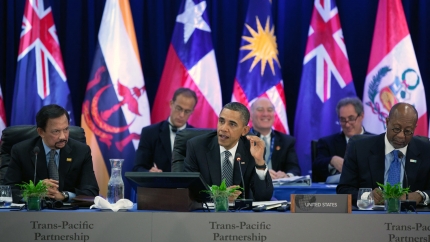
The TPP -- the Trans-Pacific Partnership agreement that I just met with the countries who are involved, we're doing some outstanding work trying to create a high-level trade agreement that could potentially be a model not just for countries in the Pacific region but for the world generally.
And so, across the board, whether it's on security architecture, whether it's on trade, whether it's on commerce, we are going to continue to prioritize this region. And one of the gratifying things is that, as we talk to our partners in the region, they welcome U.S. reengagement. I think we spent a decade in which, understandably, after 9/11, we were very focused on security issues, particularly in the Middle East region. And those continue to be important. But we've turned our attention back to the Asia Pacific region, and I think that it's paying off immediately in a whole range of improved relations with countries, and businesses are starting to see more opportunities as a consequence.
MR. McNERNEY: You know, I don't think the business community has fully understood the comprehensiveness of your approach out here, and I think -- because it all does link together -- security, business environment, bilateral trade facilitation -- all these things really do link together. And I think Secretary Clinton has made a very comprehensive case for it -- we've seen in some of her published work and some of her speeches. So this looks like --I wouldn't say a major new direction, but it is something that is a major priority for you over the next number of years, is -- am I capturing it right?
PRESIDENT OBAMA: There's no doubt. It is a reaffirmation of how important we consider this region. It has a range of components. Now, some of those are grounded in decade-long alliances. The alliance we have with Japan and South Korea, the alliance we have with Australia -- the security architecture of the region is something that we pay a lot of attention to. And we're going to be going through some tough fiscal decisions back home, but nevertheless, what I've said when it comes to prioritizing our security posture here in this region, this has to continue to remain a top priority.
And on the business side, this is where the action is going to be. If we're going to not just double our exports but make sure that good jobs are created here in the United States, then we're going to have to continue to expand our trade opportunities and economic integration with the fastest-growing region in the world.
And that means, in some cases, some hard negotiations and some tough work, as we went through in South Korea. I think that was a great model of prioritizing trade with a key partner. It wasn’t easy. I said at the outset that I wanted -- I had no problem seeing Hyundais and Kias here in the United States, but I wanted to see some Chevrolets and Fords in Seoul. And after a lot of work and some dedicated attention from President Lee, we were able to get a deal that for the first time was endorsed not just by the business community but also was endorsed by the United Auto Workers and a number of labor leaders. And that shows how we can build a bipartisan support for job creation in the United States and trade agreements that make sense. (Applause.)
MR. McNERNEY: You referenced Korea and Colombia, Panama -- big, strong, pro-trade votes. I mean, it was a major legislative accomplishment. And the momentum that Ambassador Kirk talks about flowing into the Trans-Pacific Partnership -- just let's spend a minute on that. You raised it earlier. Do you see other APEC countries joining -- the obvious question is Japan? And how significant is the TPP for this region of the world and for the United States? Is there anything else you'd like to say about it?
PRESIDENT OBAMA: Well, keep in mind that almost two decades ago when APEC was formed, the notion was to create a trans-Pacific free trade agreement. Obviously the membership of APEC is extraordinarily diverse. It reflects countries with different levels of development. And so for many years that vision, that dream I think seemed very far off in the distance.
What happened was, is a group, a subset of APEC countries came together and said let's see if we can create a high-standard agreement that is dealing with tariffs and non-tariff barriers to trade, but let's also incorporate a whole range of new trade issues that are going to be coming up in the future -- innovation, regulatory convergence, how we're thinking about the Internet and intellectual property.
And so what we've seen -- and we just came from a meeting in which the TPP members affirmed a basic outline and our goal is, by next year, to get the legal text for a full agreement. The idea here is to have a trade agreement that deals not just with past issues but also future issues. And if we're successful, then I think it becomes the seed of a broader set of agreements. And what's been really interesting is how, because of the success of these first few countries joining together, we're now seeing others like Japan expressing an interest in joining. And I'll have a meeting with Prime Minister Noda later this afternoon and I'll get a sense from him about the degree to which Japan wants to go through the difficult process involved.
And I don't underestimate the difficulties of this because each member country has particular sensitivities, political barriers. It requires adjustments within these countries where certain industries or certain producers may push back. For Japan, for example, in the agricultural sector, that's going to be a tough issue for them.
But we're not going to delay. Our goal is to try to get something done by next year. And our hope is, is that if we can model this kind of outstanding trade agreement, then, potentially, you see a lot of others joining in.
MR. McNERNEY: Sounds like real momentum.
PRESIDENT OBAMA: Yes.
MR. McNERNEY: Sounds like real momentum.
You know, another issue, just shifting gears slightly, same kind of subject -- Russia, pending ascension to the WTO. And as you know, Russia will host APEC in 2012. Assuming that the WTO process is successfully concluded, what kind of opportunities do you see as they try to integrate further into the global economy, become more Asia-facing themselves in the process? I mean, there is a clear agenda there for them as they’ve try to upgrade their economy. But there is a reason that you’re making this happen, that you’re going after WTO. And so maybe give us a few words on the benefits of it all.
PRESIDENT OBAMA: Well, first of all, we’ve had a excellent working relationship with President Medvedev. The United States and Russia obviously have a whole range of differences on a whole range of issues, but we also have some common interests. And I believe it is very much in the United States' interest to see Russia in the WTO. Not only will it provide greater opportunities for U.S. businesses in Russia, but it also will create a even stronger incentive for Russia to proceed down a course of reforms that will be good for the Russian people, but will also integrate them with the world economy.
For the United States, I think a message that applies not only to the TPP but also to Russia, is the U.S. will do well if everybody is playing by the rules. I believe we’ve got some of the best entrepreneurs, businesses, universities. We have a system that has some flaws, but overall we have extraordinary transparency. We have a legal system that protects intellectual property. We are at the cutting edge of the information technology boom. And so if we can create a system in which everybody is playing by a common set of rules, everybody knows what those rules are, then I think U.S. workers and U.S. businesses are going to excel.
There’s not reason why globalization should be something we fear. It’s something that we should be able to excel at as long as everybody is in agreement about how we proceed. And so, whether it’s in the WTO, whether it’s in the TPP, whether it’s in forums like APEC, my message to all our trading partners, to other countries, is: If you are playing by the rules, then America is ready to do business. And we will remain open; we will fight against protectionist measures. But we are also going to be pushing hard to make sure that you are not engaging in gaming the system. And we want strong enforcement of these international norms and rules. We think that will be to everybody’s benefit over the long term.
MR. McNERNEY: Agree. And many of us have, I should say, benefited from the steadfastness that many in your Cabinet have shown in supporting this, the enforcement side of the WTO. We appreciate it.
China. You will be meeting here with China’s senior leadership, and many of us in the business world face a common dilemma with China that perhaps you do at your level. We see a world where our interests lay in both competing with China, on one hand, in global markets and within their marketplace, and also engaging with China for access to its market, on the other. Yet, challenges abound, and you alluded to a lot of them just a minute ago -- intellectual property protections, adherence to the WTO, rules you mentioned, currency debate, drilling rights, et cetera. There’s a long list.
But against the backdrop, will you be getting into specifics this week in your discussions? And how would you assess the U.S.-China relationship when voices now, on both the left and the right, are calling for a harder line from your administration? Tough to navigate.
PRESIDENT OBAMA: Well, first of all, I think that we have created a frank dialogue with the Chinese over the last two years that has benefited both countries. And my general view is that there can be a friendly and constructive competition between the United States and China, and a whole range of areas where we share common interests and we should be able to cooperate.
We should be rooting for China to grow, because not only does that then present an enormous marketplace for American businesses and American exports, but to see so many millions of people, hundreds of millions of people, lifted out of poverty is a remarkable achievement. And so whether it’s China, whether it’s India, these emerging countries, what they’re accomplishing in a few short decades -- alleviating poverty, helping ordinary people all around the world get access to opportunity -- that’s a wonderful thing that we should be rooting for. And those are potential customers for us in the future.
But what I’ve said since I first came into office, and what we’ve exhibited in terms of our interactions with the Chinese, is we want you to play by the rules. And currency is probably a good example. There are very few economists who do not believe that the RMB is not undervalued. And that makes exports to China more expensive, and it makes exports from China cheaper. That disadvantages American business; it disadvantages American workers.
And we have said to them that this is something that has to change -- and, by the way, it would actually be good for China’s economy if they refocused on their domestic market, that that kind of appreciation of their currency would help the overall balance of payments globally and it would increase growth in China and increase growth here in the United States.
Intellectual property. I don’t think it’s any secret -- Jim, you talked to a lot of CEOs and probably a lot of folks in this room -- for an economy like the United States, where our biggest competitive advantage is our knowledge, our innovation, our patents, our copyrights -- for us not to get the kind of protection that we need in a large marketplace like China is not acceptable.
Government procurement -- if we are allowing foreign countries to bid on projects in the United States of America, we want reciprocity. State-owned enterprises, how they work -- all these issues I think have to be resolved. Some of them can be resolved in multilateral forums. Some of them will have to be resolved bilaterally. I am sympathetic to the fact that there are a lot of people in China who are still impoverished and there’s a rapid pace of urbanization that’s taking place there that Chinese leaders have to work through. But the bottom line is, is that the United States can’t be expected to stand by if there’s not the kind reciprocity in our trade relations and our economic relationships that we need.
So this is an issue that I've brought up with President Hu in the past. We will continue to bring it up. There is no reason why it inevitably leads to sharp conflict. I think there is a win-win opportunity there, but we’ve got to keep on working diligently to get there. And in the meantime, where we see rules being broken, we’ll speak out and, in some cases, we will take action.
We’ve brought more enforcement actions against China over the last couple of years than had taken place in many of the preceding years, not because we’re looking for conflict, but simply because we want to make sure that the interests of American workers and American businesses are protected.
MR. McNERNEY: I think one related question, looking at the world from the Chinese side, is what they would characterize as impediments to investment in the United States. And so that discussion I’m sure will be part of whatever dialogue you have. And so how are you thinking about that?
PRESIDENT OBAMA: Well, this is an issue, generally. I think it’s important to remember that the United States is still the largest recipient of foreign investment in the world. And there are a lot of things that make foreign investors see the U.S. as a great opportunity -- our stability, our openness, our innovative free market culture.
But we’ve been a little bit lazy, I think, over the last couple of decades. We’ve kind of taken for granted -- well, people will want to come here and we aren’t out there hungry, selling America and trying to attract new business into America. And so one of things that my administration has done is set up something called SelectUSA that organizes all the government agencies to work with state and local governments where they’re seeking assistance from us, to go out there and make it easier for foreign investors to build a plant in the United States and put outstanding U.S. workers back to work in the United States of America.
And we think that we can do much better than we’re doing right now. Because of our federalist system, sometimes a foreign investor comes in and they’ve got to navigate not only federal rules, but they’ve also got to navigate state and local governments that may have their own sets of interests. Being able to create if not a one-stop shop, then at least no more than a couple of stops for people to be able to come into the United States and make investments, that’s something that we want to encourage.
MR. McNERNEY: And I’m old enough to remember this process around Japanese automotive companies, 20 or 30 years ago. And the process moved slowly then, it had some of the similar dynamics, but some of those companies are very, very fine “American companies,” and have contributed a lot to our economy.
PRESIDENT OBAMA: And, look, these companies can put people back to work. They can have a terrific impact. And it's important for us to make sure that, since we want American companies to be able to invest in other countries, that we also show some openness to their investments here.
One thing I want to mention, Jim, that I think is important -- I mentioned that we're on track to double our exports, a goal that I set when I first came into office. Part of the reason for that is because of some terrific work that's been done by our Export/Import Bank. We've substantially increased the amount of financing that we're providing to companies. I think Boeing appreciates the good work that --
MR. McNERNEY: Upon occasion, we're at the teller window. (Laughter.)
PRESIDENT OBAMA: On occasion, yes. But one of the things that I wanted to mention is we're starting to focus on how we can get small and medium-sized businesses plugged into the global economy as well.
Somebody mentioned earlier that I think Secretary Clinton had talked about women-owned businesses. Well, a lot of women-owned businesses are smaller businesses and medium-sized businesses. And they may have great products, but they may not have the infrastructure to be able to navigate a whole bunch of other countries' customs and regulatory impediments. And so for us to be a champion not only of financing but also making it easier for them to enter into the global marketplace is something that we want to focus on.
MR. McNERNEY: That program is a big deal. And I see it from a Boeing perspective -- a lot of our suppliers are tapping into it, and it's going to make a difference.
Speaking of exports, as chairman of your Export Council, I've had the privilege of working with you and members of your Cabinet to pave the way to meet your goal of doubling exports. Priorities have been FTAs, intellectual property rights protection, export credit financing, technology release -- which you haven't commented on, but you've made some progress on -- and business and tourist visa processes -- and you know the list.
What's your assessment of how we're doing?
PRESIDENT OBAMA: You guys are doing great. And I want to thank all the members of the Export Council. They've been giving us some terrific ideas. Some of them are modest, but they make a difference. Backstage before we came out, I just signed a piece of legislation that was voted on unanimously out of Congress that essentially sets up a APEC business gold card, a travel card that allows businesses to be able to -- (applause.) Everybody here appreciates it because they're not going to have to wait in line as long at the airport. (Laughter.) So that generated a lot of popularity.
But that's an idea that came out of the Business Council that we've been able to execute. And we're going to keep on trying to pursue every avenue that we have to see how we can ease and smooth the ability of doing business with the United States and U.S. businesses being able to operate overseas.
And some of that has to do with us changing our own internal operations. For the business leaders who are here, there's been a lot of commentary about regulations and my administration's approach to regulations. And, frankly, there have been some misconceptions, particularly in the business press. And so let me just comment on this.
I make no apologies for wanting to make sure that we've got regulations that protect consumers from unfair practices or shoddy products, that protect the help of our kids here in the U.S., that make sure that our air and water is clean. (Applause.) But I think it’s really important to know that over the first two years of the Obama administration, we’ve actually issued fewer new regulations than the previous two administrations; that we've applied, for the most part, a rigorous cost benefit, and we have seen a lot more benefit for every dollar that our regulations cost than previous administrations.
And this is where it’s relevant to the export issue -- one of the things we’re also doing is engaging in what we call a regulatory look-back, where we’ve asked all the agencies that are under the Executive Branch control, but also independent agencies that voluntarily been willing to look at every regulation that’s on the book, with a simple question: Is this helping to grow the economy, create jobs, and is it doing a good job in this 21st century of protecting the health and welfare of the public and consumers?
And if a rule isn’t working anymore, we want to get rid of it. If a rule could be done cheaper and faster, then we want to hear about it. And our relationship with the Business Council is a great example of where you’ve given us some suggestions where you said, you know what, this rule -- we understand what you were trying to do, but it’s actually creating a lot of unnecessary costs, and here’s a way to do it that would meet your objective but do it in a much more efficient, effective way. We are eager for that kind of input, and that’s the kind of relationship with the business community we want to establish.
MR. McNERNEY: And we will respond to that, and I appreciate those comments.
Another place is export controls, where your administration -- at least as someone who deals in that world a lot, particularly in this region, where it becomes much more of a sticking point doing commerce than you’d imagine if you have any technology in your products -- where I think your administration has made more of an effort than any administration in recent memory. And can you give us an update on that?
PRESIDENT OBAMA: Yes.
MR. McNERNEY: Because there’s been some progress recently.
PRESIDENT OBAMA: For those of you who may not be fully familiar with this issue -- because we have such a terrific advantage in high-technology areas -- in cutting-edge advance manufacturing or the work that we’ve been doing in information systems and so forth -- traditionally, there has been a security element to U.S. export policy where we’ve said there are certain products that could be weaponized, could have military applications, in which we are not going to permit an easy time of exporting those products.
And under the leadership of Bob Gates, my former Secretary of Defense, he actually recommended that we reexamine this whole issue of export controls to make sure that it was up to date and that we were not unnecessarily inhibiting U.S. companies from taking advantage of their biggest competitive advantage, and going out there and selling high-value products made by high-wage workers that create a lot of opportunity for American workers and American businesses.
So we’ve gone through a very systematic process. We are I think starting to see that process bear fruit. We’re going to need some cooperation from Congress, but there's some things we can do on the executive side. And essentially, the goal of the reform is to clear away impediments for export of those things that really at this point don’t have a military application, or are first-generation stuff that everybody else has already caught up on, so that we can actually focus more on those very narrow sets of technologies where there really is a significant security component.
And we feel optimistic that over the next couple of years we’re going to start being able to make progress. That will help contribute to American businesses being able to make sales, and American workers and American jobs being created here in the United States.
MR. McNERNEY: It will be a big deal for our customers out here, broadly speaking.
We have time for one more question, Mr. President. And as you mentioned earlier, following this meeting you’re headed down to Australia -- I just came from Australia -- they can’t wait -- for a state visit, and then to Indonesia for two regional meetings, the East Asia Summit and the U.S.-ASEAN Summit. As you approach those, what are the issues? What do you hope to accomplish?
PRESIDENT OBAMA: In Australia, we’re going to be focusing a lot on the security alliance between our two countries, but that obviously has broader implications for U.S. presence in the Pacific.
When we get to Bali for the ASEAN meeting and the East Asia Summit, we’re going to be speaking, again, about how can we, a great Pacific power, work with our partners to ensure stability, to ensure free flows of commerce, to ensure that maritime rules, drilling, a whole host of issues are managed in a open and fair way.
And one of the things that I’m very encouraged about is the eagerness of countries to see the U.S. reengaged in this region. I think back here in the United States, there are times where we question our influence around the world. And obviously, having gone through a couple of tough years, having been engaged in a decade of war, we recognize all the challenges that are out there for the United States and the reforms and changes that we’re going to have to make to ensure that we are competitive in this 21st century global economy.
But the news I have to deliver for the American people is American leadership is still welcome. It’s welcomed in this region. It’s welcomed in the transatlantic region. And the reason it’s welcomed I think is because we have shown that we are willing to not just look after our own interests, but try to set up a set of rules and norms in the international arena that everybody can follow and everybody can prosper from. And people appreciate that.
And so I am very proud of the leadership that America obviously has shown in the past. But I also don’t want people to underestimate the leadership that we’re showing now -- whether it’s on trade agreements like TPP, or the security issues that face the Pacific. We are I think poised to work in a spirit of mutual interest and mutual respect with countries around the world, but we continue to be a country that people are looking to for active engagement.
MR. McNERNEY: All very welcomed news. Mr. President, thank you very much. Your perspectives were very much appreciated. (Applause.)
PRESIDENT OBAMA: Thank you very much. (Applause.) Enjoy the good weather.
END
10:55 A.M. HAST