The White House

Office of the Press Secretary

Executive Order 13591 -- Continuance of Certain Federal Advisory Committees

CONTINUANCE OF
CERTAIN FEDERAL ADVISORY COMMITTEES

By the authority vested in me as President by the Constitution and the laws of the United States of America, and consistent with the provisions of the Federal Advisory Committee Act, as amended (5 U.S.C. App.), it is hereby ordered as follows:

Section 1. Each advisory committee listed below is continued until September 30, 2013.

(a) Presidential Commission for the Study of Bioethical Issues; Executive Order 13521 (Department of Health and Human Services).

(b) National Council on Federal Labor-Management Relations; Executive Order 13522 (Office of Personnel Management).

(c) President's Board of Advisors on Historically Black Colleges and Universities; Executive Order 13532 (Department of Education).

(d) President's Management Advisory Board; Executive Order 13538 (General Services Administration).

(e) President's Council of Advisors on Science and Technology; Executive Order 13539 (Office of Science and Technology Policy).

(f) Interagency Task Force on Veterans Small Business Development; Executive Order 13540 (Small Business Administration).

(g) State, Local, Tribal, and Private Sector (SLTPS) Policy Advisory Committee; Executive Order 13549, as amended (National Archives and Records Administration).

Sec. 2. The following advisory committee is continued until September 30, 2012: Advisory Group on Prevention, Health Promotion, and Integrative and Public Health; Executive Order 13544 (Department of Health and Human Services).


Sec. 3. Section 6 of Executive Order 13530 of January 29, 2010 (President's Advisory Council on Financial Capability), is amended to read as follows: "Unless extended by the President, the Council shall terminate on January 29, 2013."

Sec. 4. Notwithstanding the provisions of any other Executive Order, the functions of the President under the Federal Advisory Committee Act that are applicable to the committees listed in sections 1 and 2 of this order shall be performed by the head of the department or agency designated after each committee, in accordance with the guidelines and procedures established by the Administrator of General Services.

BARACK OBAMA

THE WHITE HOUSE,
November 23, 2011.

President Obama Pardons Peace & Liberty (the Turkeys)

President Obama Pardons Liberty

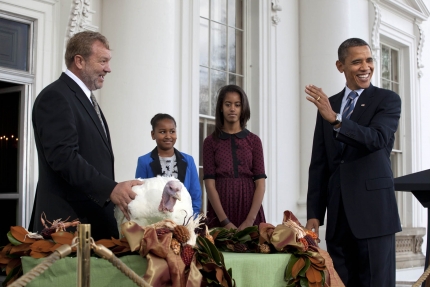
President Barack Obama, with daughters, Malia and Sasha, pardons 'Liberty', the National Thanksgiving Turkey, in a ceremony on the North Portico of the White House, Nov. 23, 2011. At left is National Turkey Federation Chairman Richard Huisinga. (Official White House Photo by Chuck Kennedy)

As promised, this morning, President Obama pardoned two more turkeys -- Liberty and Peace. The ceremony was held on the North Portico of the White House, and the president received a bit of help of his daughters, Sasha and Malia.

This year's turkeys are both 19-weeks old and weigh 45 pounds. They were raised by a group of students from Willmar High School in Minnesota.

To kick off the pardon, President Obama said:

Tomorrow is one of the best days of the year to be an American. It’s a day to count our blessings, spend time with the ones we love, and enjoy some good food and some great company. But it’s also one of the worst days of the year to be a turkey. They don’t have it so good.

The rare exception, of course, are the two birds who’ve joined me today. Now, is Peace here, or just Liberty? Just Liberty is here, but Peace is back here somewhere. Some of you may know that recently I’ve been taking a series of executive actions that don’t require Congressional approval. Well, here’s another one. We can’t wait to pardon these turkeys. Literally. Otherwise they’d end up next to the mashed potatoes and stuffing.

He also remarked on the special training provided to these birds for their big moment:

Now, I’m told that in order to prepare Liberty and Peace for their big day, the students exposed them to loud noises and flash bulbs so that they’d be ready to face the White House press corps. This is actually true. They also received the most important part of their media training, which involves learning how to gobble without really saying anything.

So Liberty is ready for his turn in the spotlight. And after he finishes a round of cable hits and a few Sunday shows, he’s going to retire to a life of leisure at Mount Vernon -- the same place where George Washington spent his golden years.

Want to know more about turkey pardons? Don't miss our definitive history.

Related Topics: Additional Issues, Minnesota

The White House

Office of the Press Secretary

Remarks by the President at the Pardoning of the National Thanksgiving Turkey

North Portico

10:40 A.M. EST

THE PRESIDENT:  Hello, everybody!  Well, it is wonderful to see all of you here today.  Happy Thanksgiving, and welcome to the White House. 

Tomorrow is one of the best days of the year to be an American.  It’s a day to count our blessings, spend time with the ones we love, and enjoy some good food and some great company.  But it’s also one of the worst days of the year to be a turkey.  (Laughter.)  They don’t have it so good.

The rare exception, of course, are the two birds who’ve joined me today.  Now, is Peace here, or just Liberty?  Just Liberty is here, but Peace is back here somewhere.  Some of you may know that recently I’ve been taking a series of executive actions that don’t require Congressional approval.  (Laughter.)  Well, here’s another one.  We can’t wait to pardon these turkeys.  (Laughter.)  Literally.  Otherwise they’d end up next to the mashed potatoes and stuffing.

I want to thank Richard Huisinga, the Chairman of the National Turkey Federation, and his wonderful family for donating this year’s turkey from his farm in Willmar, Minnesota.  The turkey’s name is Liberty -- there he is -- and along with his understudy named Peace, he has the distinction of being the luckiest bird on the face of the Earth.  Right now, he’s also probably one of the most confused.  (Laughter.)

Liberty was chosen from a flock of about 30 other contestants for the honor of being here today.  And for the first time in history, these two turkeys were raised by four students from nearby Willmar High School.

Now, I’m told that in order to prepare Liberty and Peace for their big day, the students exposed them to loud noises and flash bulbs so that they’d be ready to face the White House press corps.  This is actually true.  They also received the most important part of their media training, which involves learning how to gobble without really saying anything.  (Laughter.)

So Liberty is ready for his turn in the spotlight.  And after he finishes a round of cable hits and a few Sunday shows, he’s going to retire to a life of leisure at Mount Vernon -- the same place where George Washington spent his golden years. 

And later today, Michelle, Malia, Sasha and I will also be taking two unnamed turkeys, who weren’t so lucky, to a local food bank here in D.C. that helps those in need.  And I want to thank the folks at Jaindl’s Turkey Farm in Orefield, Pennsylvania, for donating these dressed birds for the third year in a row.

A great writer once called Thanksgiving the “one day that is ours … the one day that is purely American.” 

When we gather around our tables tomorrow to share the fruits of our blessings, let’s remember what that means.  Let’s be grateful for what we have.  Let’s be mindful of those who have less.  Let’s appreciate those who hold a special place in our lives, and make sure that they know it.  And let’s think about those who can’t spend the holiday with their loved ones –- especially the members of our military serving overseas.  I’d like to thank all our men and women in uniform and their families for their incredible service and devotion. 

And that’s what being an American is all about.  Even when times are tough, we look out for each other.  We lift each other up.  And we remind ourselves just how lucky we are here, together, in the greatest country on Earth.  

So from our family to yours, I want to wish everybody a wonderful and happy and healthy Thanksgiving. 

And now, since Liberty and Peace have been so patient, it is my privilege to grant them the official pardon.  And I’m going to -- I’ve got to give them a little symbol.  (Laughter.)

(The turkeys are pardoned.)

THE PRESIDENT:  All right, you are hereby pardoned.  (Laughter.)  Give them a round of applause.  (Applause.)

END
10:45 A.M. EST

The White House

Office of the Press Secretary

Background on the Pardoning of the National Thanksgiving Turkey

WASHINGTON – On Wednesday, November 23, 2011, President Obama will pardon the National Thanksgiving Turkey in a ceremony in the Rose Garden.  The President will celebrate the 64th anniversary of the National Thanksgiving Turkey presentation, reflect upon the time-honored traditions of Thanksgiving, and wish American families a warm, safe, and healthy holiday.

The President will pardon Liberty and its alternate Peace, both 19-week old, 45-pound turkeys. The names of the turkeys were chosen from over 100 submissions to the Minnesota Turkey Growers Association’s web site that highlighted the National Thanksgiving Turkey. Many of the submissions came from Minneapolis and St. Paul school children who learned this year about the importance of agriculture to the world food supply and to our local economies.

After the pardoning, the turkeys will be driven to George Washington’s Mount Vernon Estate and Gardens.  The National Thanksgiving Turkey will be on display for visitors during “Christmas at Mount Vernon,” a special program through January 6.  After the holidays, the National Thanksgiving Turkey and its alternate will live in a custom-made enclosure at Mount Vernon’s nationally recognized livestock facility.

Both birds were raised in Willmar, Minnesota under the supervision of National Turkey Federation Chairman Richard Huisinga.

Jaindl’s Turkey Farm in Orefield, Pennsylvania, gave President Obama’s family two dressed turkeys that will be donated to a local area food bank.

The Definitive History of the Presidential Turkey Pardon

Watch President Obama grant pardon to 'Apple', the National Thanksgiving Turkey here.

Each Thanksgiving, the President “pardons” a hand-selected turkey, sparing the bird from someone’s dinner table and ensuring the rest of its days are spent roaming on a farm, doing whatever it is turkeys love to do. Twenty-two turkeys have been pardoned, and today, President Obama will pardon one more. 

You’re probably wondering: Where did this very serious business of the Presidential turkey pardon come from anyway? 

Americans have been sending the President turkeys for the holidays since at least the 19th century. Beginning in 1873 during Grant’s presidency, a Rhode Island man named Horace Vose was responsible for “selecting with the utmost care” the “noblest gobbler in all that little state” for the President’s Thanksgiving dinner, a tradition he carried out for more than 25 years according to The New York Times. In 1947, the National Turkey Federation took on the role of official turkey supplier to the President, delivering a 47-pound bird in time for the Christmas holiday.

That year, the White House also began holding a turkey receiving ceremony, usually in the Rose Garden, providing a photo op that many confuse with the beginning of the pardoning tradition. Back then, however, birds were more likely to be destined for the White House dining table than the easy life on a farm. In 1948, President Truman said he would take the gifted turkey home to Independence, Missouri, where his 25 relatives “require a lot.”

So then when did the pardoning start? Here’s where it gets tricky. Tales of spared turkeys date back to the Lincoln days. According to one story, Lincoln’s son Tad begged his father to write out a presidential pardon for the bird meant for the family’s Christmas table, arguing it had as much a right to live as anyone. Lincoln acquiesced and the turkey lived.

In 1963, President Kennedy decided to send that year’s gift from the National Turkey Federation back to the farm where it came from. “We’ll just let this one grow,” he said. Sometime around the Nixon administration, the President began sending the turkey to a petting farm near Washington after holding the traditional receiving ceremony and photo op, although no formal pardon was given. 

President George H.W. Bush was the first to actually offer a turkey pardon. On November 14, 1989, he announced that year’s bird had “been granted a presidential pardon as of right now.” He sent the turkey on his way to the perhaps unfortunately named Frying Pan Park in Herndon, Virginia, and with that, a tradition was born.

Since taking office, President Obama has pardoned two turkeys, although in 2009, he admitted Courage, that year’s top turkey, came dangerously close to gracing the White House table. “Thanks to the intervention of Malia and Sasha – because I was ready to eat this sucker – Courage will also be spared this terrible and delicious fate."

"I'm told Presidents Eisenhower and Johnson actually ate their turkeys," Obama said. "You can't fault them for that; that's a good-looking bird."

President Obama on Tax Cuts for the Middle Class

November 22, 2011 | 30:06 | Public Domain

President Obama is in New Hampshire to discuss how Congressional inaction on the American Jobs Act will result in rising payroll taxes for 160 million American workers.

Download mp4 (288MB) | mp3 (28MB)

Read the Transcript

Remarks by the President on the American Jobs Act

Manchester Central High School
Manchester, New Hampshire

12:20 P.M. EST

THE PRESIDENT:  Hello, New Hampshire!  (Applause.)  It is good to be back.  Hello, Little Green!  (Applause.)  It is good to be back in New Hampshire, although I have to say that I feel a little winter coming on around here.  (Laughter.)  This is what happens when you fly north.

It is wonderful to be here.  I had a chance to see backstage Principal Mailhot, and he reminded me of what I said to him four years ago almost to the day that I was here.  It was snowing that day; we were -- surprising enough, there was a snowstorm in New Hampshire.  (Laughter.)  And we ended up having to leave a little bit early.  And we weren’t able to do everything that we wanted, talking to some of the students.  And we were worried that folks were going to be disappointed, and I promised him that I would be back.  I just want to point out, we’re keeping our promise -- we are back.  (Applause.)  We are back.

In addition to Principal Mailhot, I want to acknowledge the Superintendent, Tom Brennan, who is here with his lovely wife Wendy.  Please give them a big round of applause.  (Applause.)

Happy Thanksgiving a little bit early, everybody.  To the -- I understand we got the senior class here at Central High.  (Applause.)

STUDENTS:  Seniors!  Seniors!  Seniors!  (Applause.)

THE PRESIDENT:  All right.  You guys are pretty excited about being seniors, aren’t you?  (Applause.)  I want to thank also somebody who is doing outstanding work each and every day, was doing it up here as a wonderful governor, is now one of your most outstanding senators in the country -- Jeanne Shaheen is in the house.  (Applause.) 

So before I came to school today, I had coffee --

(Audience interruption.)

THE PRESIDENT:  That’s okay.  All right, okay, guys. 

STUDENTS:  Obama!  Obama!  Obama!

THE PRESIDENT:  Okay, it’s okay.  That’s all right.  Listen, I’m going to be talking about a whole range of things today, and I appreciate you guys making your point.  Let me go ahead and make mine, all right?  And I’ll listen to you, you listen to me.  All right? 

Now, what I was saying was, I was having some coffee with some of your neighbors.  And one of them was the Corkerys.  You may know, as Mr. Corkery just said, that he’s a math teacher here at Central High.  And even though a visit from me tends to disrupt things a little bit -- (laughter) -- he did want me to remind all his students you still have homework to do.  (Laughter.)

But as Chris said, he’s also a colonel, recently retired after 26 years in the military; tours of duty in Iraq, in Kuwait, in Haiti.  And I couldn’t thank him enough for his service, because obviously we know our service members, our veterans, they’re the ones who keep us safe, they’re the ones who are preserving our freedom -- at enormous sacrifice to themselves and their families.  (Applause.)  And in fact, this holiday season is going to be a season of homecomings for folks all across America, because by the end of next month, all of our troops will be out of Iraq.  (Applause.)

Now, over coffee, we were joined by Chris’s wife of 16 years, Kathy, who owns part of a local business.  And they’ve got two sons; they’re trying to save for their sons’ college education.  And like millions of families all across the country, they’re doing the best that they can in some tough times.

And families like the Corkerys, families like yours, young people like the ones here today, including the ones who were just chanting at me, you’re the reason I ran for office in the first place.  (Applause.)  Because it’s folks like you who are why I spent so much time up here in the dead of winter four years ago.  Because even then, we were going through a difficult decade for the middle class -- more good jobs in manufacturing that was leaving our shores.  More of our prosperity was built on risky financial deals and homes that weren’t properly financed.  And families watched their incomes fall, and wages flatline, and the cost of everything from college to health care kept on going up.  And then the financial crisis hit in the closing weeks of the campaign -- and that made things even tougher. 

Today, many Americans have spent months looking for work, and others are doing the best they can to get by.  There are a lot of folks out there who are giving nights up -- nights out, they just can’t do that anymore because they’ve got to save on gas or make the mortgage.  There are families who are putting off retirement to make sure their kids can go to college.  And then there are young people who have gone to college, gotten a whole bunch of debt, and find themselves unable to find opportunity. 

So a lot of the folks who have been down in New York and all across the country, in the Occupy movement, there is a profound sense of frustration -- (applause) -- there is a profound sense of frustration about the fact that the essence of the American Dream -- which is if you work hard, if you stick to it, that you can make it -- feels like that’s slipping away.  And it’s not the way things are supposed to be.  Not here.  Not in America.  (Applause.)

This is a place where your hard work and your responsibility is supposed to pay off.  It’s supposed to be a big, compassionate country where everybody who works hard should have a chance to get ahead -– not just the person who owns the factory, but the men and women who work on the factory floor.  (Applause.) 

This is a place that’s always prospered most when we stay fundamental -- we stay true to a fundamental idea -– the idea that we’re all in this together.

That’s what we’re fighting for.  That’s what is at stake right now. 

So we’ve been weathering some hard years.  We’ve been taking some tough punches.  But one thing I know about folks in Manchester and folks in New Hampshire and folks all across the country is we’re tough.  We’re fighting back.  We are moving forward.  And we are going to get this right so that every single American has opportunity in this country.  (Applause.)  We are not going to have an America in which only a sliver of folks have opportunity.  We’re going to have an America where everybody has opportunity.  And that’s going to take some time, because our economic problems weren’t caused overnight and they won’t be solved overnight. 

It’s going to take time to rebuild an economy where hard work is valued and responsibility is rewarded.  It’s going to take time to rebuild an economy that restores security for the middle class and renews opportunity for folks trying to reach the middle class.  It’s going to take time to rebuild an economy that’s not based on outsourcing or tax loopholes or risky financial deals, but one that is built to last, where we invest in education and small business and manufacturing and making things that the rest of the world is willing to buy.  (Applause.)

And we’re going to get it done.  We’re going to get there.  And right now, we’ve got to do everything we can to put our friends and neighbors back to work and help families like the Corkerys get ahead and give the economy the jolt that it needs.

And that’s why two months ago I sent Congress the American Jobs Act.  It’s a jobs bill that will put more Americans to work, put more money back into the pockets of working Americans.  It’s full of the kinds of ideas that in the past have been supported by Democrats and Republicans.  And it’s paid for by asking our wealthiest citizens to pay their fair share.  (Applause.)  Independent economists said it would create nearly 2 million jobs, grow the economy by an extra 2 percent.  That’s not my opinion, that’s not my team’s opinion; that’s the opinion of folks who evaluate these things for a living.  But you know what?  Some folks in Washington don’t seem to get the message that people care right now about putting folks back to work and giving young people opportunity. 

So when this bill came up for a vote, Republicans in the Senate got together and blocked it.  They refused to even debate it.  A hundred percent of Republicans opposed it, even though almost two-thirds of Americans supported the ideas in this bill -– Democrats, Republicans and independents alike.  Not one Republican in Washington was willing to say it was the right thing to do.  Not one. 

Now, what we’ve done is we’ve refused to quit.  So I said I will do everything in my power to act on behalf of the American people –- with or without Congress.  (Applause.)  So over the past several weeks, we’ve taken steps on our own to give working Americans a leg up in a tough economy. 

We announced -- on our own -- a new policy that will help families refinance their mortgages and save thousands of dollars.  A lot of the young people who are in New York and around the country, they’re worrying about student loans.  On our own, without Congress, we reformed the student loan process to make it easier for more young people to pay off their debt.  (Applause.)  By the way, that was building on top of legislation we passed a year ago that said instead of sending $60 billion to banks to manage the student loan program, let’s give it directly to students so that millions more young people can afford a college education.  (Applause.) 

We enacted several new initiatives to help our returning veterans find new jobs and get trained for those jobs.  (Applause.)  The kind of outstanding young men and women that Chris was talking about, who come home -- I was up in Minnesota, met a young man who had been an emergency medic Iraq, saving lives under the most severe circumstances.  He came home and he was having to take nursing classes all over again, even though for the last two years he had been saving lives in the field.  Didn’t get any credit for it.  So we’re starting to make changes to say if you’re qualified to save a life on the battlefield, you can save a life in an ambulance.  (Applause.)

And yesterday, I signed into law two new tax breaks for businesses that hire America’s vets –- because nobody who fights for America overseas should have to fight for a job when they come home.  (Applause.)  Now, I proposed these tax breaks back in September as part of my jobs bill, and thanks to folks like Jeanne Shaheen -- and some Republicans -- we actually got this part of the bill passed.  We finally got them to say “yes” to taking action that will create jobs and boost this economy.

But there is a lot more that we’ve got to do if we’re going to get folks back to work and rebuild an economy that works for everybody.  And next week, Congress is going to have another chance to do the right thing.  Congress is going to have another chance to say “yes” to helping working families like the Corkerys.

You see, last year, both parties came together to cut payroll taxes for the typical household by $1,000 this year.  That’s been showing up in your paychecks each week.  You may not know it, but it’s been showing up because of the action that we took.  Which reminds me, by the way, the next time you hear one of these folks from the other side coming in talking about raising your taxes, you just remind them that ever since I’ve gotten into office, I’ve lowered your taxes, haven’t raised them.  That’s worth reminding them.  (Applause.)  But this payroll tax is set to expire at the end of next month.  End of next month, end of the year, this tax cut ends.  And if we allow that to happen -– if Congress refuses to act -– then middle-class families are going to get hit with a tax increase at the worst possible time.  For the average family, your taxes will go up $1,000 if Congress does not act by the end of the month.

Now, we can’t let that happen.  Not right now.  It would be bad for the economy.  It would be bad for employment.  That’s why my jobs bill extends that tax cut.  In fact, it does it one better -– it expands the tax cut.  Instead of a $1,000-a-year tax cut next year, the average working family would get a tax cut of more than $1,500.  (Applause.)  And that’s $1,500 that would have been taken out of your paycheck, would instead be going into your pocket.  And that means you’d be spending in small businesses, and that would increase their business, which means they would potentially hire more people.

The American Jobs Act would also cut payroll taxes in half for small business owners.  Say you have 50 employees making $50,000 apiece.  You’d get a tax cut of nearly $80,000.  That is real money that you can use to hire new workers or buy new equipment.

Now, the Republicans in the Senate voted “no” on my jobs bill and those tax cuts.  But in the spirit of Thanksgiving -- (laughter) -- we are going to give them another chance.  (Laughter and applause.)  Absolutely.  Next week, they’re going to get to take a simple vote.

If they vote “no” again, the typical family’s taxes will go up $1,000 next year.  If they vote “yes,” the typical working family will get a $1,500 tax cut.  All right?  So I just wanted to be clear for everybody:  “No” –- your taxes go up.  “Yes” -– you get a tax cut.  Which way do you think Congress should vote?

AUDIENCE:  Yes!

THE PRESIDENT:  Pretty simple.  And we set up a straightforward tax calculator on whitehouse.gov -- that’s our website -- so you can see what each vote would mean for your bottom line.

Now, I know Republicans like to talk about we’re the party of tax cuts.  A lot of them have sworn an oath -- we’re never going to raise taxes on anybody for as long as we live –- even though they have already voted against these middle-class tax cuts once.  But the question they’ll have to answer when they get back from Thanksgiving is this:  Are they really willing to break their oath to never raise taxes, and raise taxes on the middle class just to play politics?

I sure hope not.  This isn’t about who wins or loses in Washington.  This is about delivering a win for the American people.  (Applause.)  Now, a $1,500 tax cut for middle-class families -- that isn’t a Band-Aid.  That is a big deal for people.  How many business owners could stand to see their customers taking $1,000 less next year?   That’s $1,000 less that they can spend at a small business. 

Now, how many of you could use an extra $1,000?  (Applause.)  An extra $1,500 in your pocket?  It makes a big difference for families here in New Hampshire and all across America.  And keep in mind, we’re going to do it responsibly -- because unlike several tax cuts that were instituted over the past several years, we’re going to make sure that it doesn’t add to our deficit.  We’re asking the wealthiest Americans -– the folks who got the biggest tax cuts over the past decade, the folks who made it through the recession better than most, folks who have seen their incomes go up much more quickly than anybody else over the last three decades, exponentially -– we’re asking them to contribute a little bit more to get our economy working for everybody.  (Applause.)  We’re asking people like me to pay our fair share so middle-class families can get a tax cut.  And I believe that most Americans are willing to do their part.

The truth of the matter is, I can’t tell you how many well-to-do Americans that I meet say to me, look, I want to do more because I know that the only reason I’m doing well is because somewhere along the line, somebody gave me a good education; somewhere along the line, somebody gave me a college scholarship; somewhere along the line, somebody gave me a chance.  And I want to do the same thing for the young people who are coming up now.  (Applause.)  That is what America is all about.  (Applause.)

So Congress has a very simple choice next week:  Do you want to cut taxes for the middle class and those who are trying to get into the middle class?  Or do you want to protect massive tax breaks for millionaires and billionaires, many of whom want to actually help?  Do you want to help working families get back on solid ground and grow this economy for all of us?  Or do you really want to vote to raise taxes on nearly 160 million Americans during the holidays?  When push comes to shove, are you willing to fight as hard for working families as you are for the wealthiest Americans?  What’s it going to be?  That’s the choice.

As I look around this room and I see these young people, but I also see their parents, I’m thinking, folks in Manchester, you guys work hard.  You play by the rules.  You’re meeting your responsibilities.  (Applause.)  And if you’re working hard and you’re meeting your responsibilities, at the very least you should expect Congress to do the same.  They should be doing everything in their power to make our economy stronger, not weaker.  They should be doing everything they can to protect the middle class from tax hikes -- not hike your taxes.

And this is where you can help.  Now, your members of Congress, they work for you.  You’ve got an outstanding senator here.  She’s already on the program.  (Applause.)  But to everyone who’s here or watching at home or online -- if your members of Congress aren’t delivering, you’ve got to send them a message.  Make sure they’re listening. 

Tell them, “Don’t be a Grinch.”  (Laughter.)  Don’t vote to raise taxes on working Americans during the holidays.  Put the country before party.  Put money back in the pockets of working families.  Do your job.  Pass our jobs bill.

The American people are with us on this.  And it’s time for the folks who are running around spending all their time talking about what’s wrong with America to spend some time rolling up their sleeves to help us rebuild America and rebuild our middle class and give young people opportunity.  (Applause.)  There is nothing wrong with this country that we can’t fix.
 
I was just traveling in Asia over the last week, and let me tell you, this is the fastest-growing region in the world.  But what was amazing was how everybody still looked to America.  They did a poll in Asia.  They said, what do you think about America compared to China?  Eight out of nine countries in Asia, they said, America is the country that we look to. 

They understand that this experiment in democracy -- this belief that everybody can make it if they try; this belief in a broad middle class that lifts everybody up, not just some -- they know that that idea of America is more powerful than anything else.

But we’ve got to have folks in Washington who have that same belief; that same sense that when this economy is going well it’s going well because it’s going well for everybody, and when it goes well for everybody, it’s good for folks at the top as well as folks at the bottom.  And it’s certainly good for folks in the middle. (Applause.)

So those values that built this country, those values that all of you represent, that’s what we’re fighting for.  That’s what the American Jobs Act is all about, that’s what the debates in Washington are all about.  And we’ve got to constantly remind ourselves of who we are and what we believe in. 

We are Americans.  And our story has never been about doing things easy.  It’s been about rising to the moment when the moment is hard.  It’s about doing what’s right.  It’s about making sure that everybody has a chance, not just a few. 

So let’s do the right thing.  Let’s meet the moment.  Let’s prove once again that the best days of the United States of America are still ahead of us.

Thank you.  God bless you.  God bless the United States of America.  (Applause.)

END
12:46 P.M. EST

Close Transcript

President Obama's Record on Taxes

20111122 POTUS coffee table

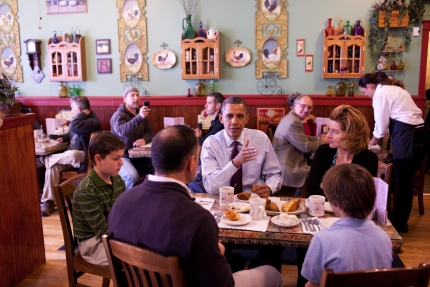
President Barack Obama makes a local stop at Julien's Corner Kichen in Manchester, New Hampshire, Nov. 22, 2011, to sit-down with the Corkery family to discuss the importance of extending and expanding the payroll tax cut. Chris Corkery is a retired colonel, having served 26 years in the United States Army. Chris has been a math teacher at Manchester Central High School for the past 12 years. His wife, Kathy, a small business owner, and their two sons, Andrew and Nicholas attended. (Official White House Photo by Pete Souza)

Right now, President Obama is going all out to extend the payroll tax cut for the middle class -- and expand it for 2012.

And that effort underscores an important fact: This President has proposed and enacted thousands of dollars of tax relief for American families and small businesses.

In his first year in office, President Obama cut taxes for 95 percent of working families through the Recovery Act with the Making Work Pay tax cut.

With that same piece of legislation, he created the American Opportunity Tax Credit -- which is currently helping more than 9 million families afford the cost of college.

The Recovery Act also lowered the threshold for refunds through the Child Tax Credit -- providing a tax cut to 11.8 million working families.

The President also expanded the Earned Income Tax Credit for families with three or more children -- giving them a tax cut of up to $640 this year.

President Obama has passed tax cuts for small businesses 17 times. These measures range from allowing corporation to expense 100 percent of their new investments until the end of 2011 to creating a new deduction for health care costs for the self-employed.

And just this week, the President also signed legislation to create tax credits for businesses that hire veterans.

If Congress passes the American Jobs Act, a typical family of four would see their taxes decrease an additional $2,325 -- bringing their total tax relief to about $5,425 for the President’s first term.

That number goes up if the family is helping their kids pay college tuition.

This lower tax rate hasn't come about through happenstance. It's a product of hard work from President Obama. Those of us in the middle class have more money in our pockets because the President made it a priority.

And it's going to take more hard work between now and the end of the year to keep things that way.

Related Topics: Taxes, New Hampshire

President Obama Talks Taxes

20111122 POTUS NH Podium

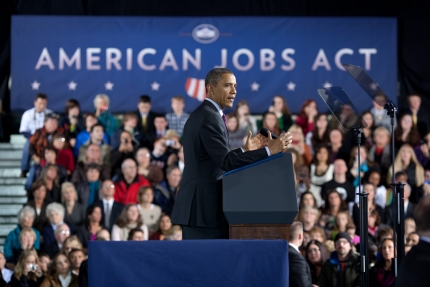
President Barack Obama delivers remarks on the American Jobs Act at Manchester Central High School, Manchester, New Hampshire, Nov. 22, 2011. (Official White House Photo by Pete Souza)

In 40 days, our taxes will go up -- unless Congress steps in to change that. And speaking from New Hampshire today, President Obama talked about that situation:

[Last] year, both parties came together to cut payroll taxes for the typical household by $1,000 this year. That’s been showing up in your paychecks each week. You may not know it, but it’s been showing up because of the action that we took. Which reminds me, by the way, the next time you hear one of these folks from the other side coming in talking about raising your taxes, you just remind them that ever since I’ve gotten into office, I’ve lowered your taxes, haven’t raised them. That’s worth reminding them. But this payroll tax is set to expire at the end of next month. End of next month, end of the year, this tax cut ends. And if we allow that to happen -– if Congress refuses to act -– then middle-class families are going to get hit with a tax increase at the worst possible time. For the average family, your taxes will go up $1,000 if Congress does not act by the end of the month.

Now, we can’t let that happen. Not right now. It would be bad for the economy. It would be bad for employment.

The American Jobs Act, the President said, actually does one better. It expands expands the tax cut for individuals and cuts payroll taxes for small business owners:

Instead of a $1,000-a-year tax cut next year, the average working family would get a tax cut of more than $1,500. And that’s $1,500 that would have been taken out of your paycheck, would instead be going into your pocket. And that means you’d be spending in small businesses, and that would increase their business, which means they would potentially hire more people.

The American Jobs Act would also cut payroll taxes in half for small business owners.  Say you have 50 employees making $50,000 apiece. You’d get a tax cut of nearly $80,000. That is real money that you can use to hire new workers or buy new equipment.

When Congress takes up this issue after the holiday, the President said, lawmakers have a choice:

Do you want to cut taxes for the middle class and those who are trying to get into the middle class?  Or do you want to protect massive tax breaks for millionaires and billionaires, many of whom want to actually help?  Do you want to help working families get back on solid ground and grow this economy for all of us?  Or do you really want to vote to raise taxes on nearly 160 million Americans during the holidays?  When push comes to shove, are you willing to fight as hard for working families as you are for the wealthiest Americans?  What’s it going to be?  That’s the choice.

Read the full remarks here.  Or check out our calculator to learn what Congressional inaction means for your family.

Related Topics: Economy, Taxes, New Hampshire

The White House

Office of the Press Secretary

President Obama to Travel to Scranton, Pennslyvania

WASHINGTON, DC – On Wednesday, November 30th, President Obama will travel to Scranton, Pennsylvania where he will discuss the American Jobs Act. In the evening, the President will travel to New York City where he will attend campaign events. More details will be released when they become available.

The White House

Office of the Press Secretary

Remarks by the President on the American Jobs Act

Manchester Central High School
Manchester, New Hampshire

12:20 P.M. EST

THE PRESIDENT:  Hello, New Hampshire!  (Applause.)  It is good to be back.  Hello, Little Green!  (Applause.)  It is good to be back in New Hampshire, although I have to say that I feel a little winter coming on around here.  (Laughter.)  This is what happens when you fly north.

It is wonderful to be here.  I had a chance to see backstage Principal Mailhot, and he reminded me of what I said to him four years ago almost to the day that I was here.  It was snowing that day; we were -- surprising enough, there was a snowstorm in New Hampshire.  (Laughter.)  And we ended up having to leave a little bit early.  And we weren’t able to do everything that we wanted, talking to some of the students.  And we were worried that folks were going to be disappointed, and I promised him that I would be back.  I just want to point out, we’re keeping our promise -- we are back.  (Applause.)  We are back.

In addition to Principal Mailhot, I want to acknowledge the Superintendent, Tom Brennan, who is here with his lovely wife Wendy.  Please give them a big round of applause.  (Applause.)

Happy Thanksgiving a little bit early, everybody.  To the -- I understand we got the senior class here at Central High.  (Applause.)

STUDENTS:  Seniors!  Seniors!  Seniors!  (Applause.)

THE PRESIDENT:  All right.  You guys are pretty excited about being seniors, aren’t you?  (Applause.)  I want to thank also somebody who is doing outstanding work each and every day, was doing it up here as a wonderful governor, is now one of your most outstanding senators in the country -- Jeanne Shaheen is in the house.  (Applause.) 

So before I came to school today, I had coffee --

(Audience interruption.)

THE PRESIDENT:  That’s okay.  All right, okay, guys. 

STUDENTS:  Obama!  Obama!  Obama!

THE PRESIDENT:  Okay, it’s okay.  That’s all right.  Listen, I’m going to be talking about a whole range of things today, and I appreciate you guys making your point.  Let me go ahead and make mine, all right?  And I’ll listen to you, you listen to me.  All right? 

Now, what I was saying was, I was having some coffee with some of your neighbors.  And one of them was the Corkerys.  You may know, as Mr. Corkery just said, that he’s a math teacher here at Central High.  And even though a visit from me tends to disrupt things a little bit -- (laughter) -- he did want me to remind all his students you still have homework to do.  (Laughter.)

But as Chris said, he’s also a colonel, recently retired after 26 years in the military; tours of duty in Iraq, in Kuwait, in Haiti.  And I couldn’t thank him enough for his service, because obviously we know our service members, our veterans, they’re the ones who keep us safe, they’re the ones who are preserving our freedom -- at enormous sacrifice to themselves and their families.  (Applause.)  And in fact, this holiday season is going to be a season of homecomings for folks all across America, because by the end of next month, all of our troops will be out of Iraq.  (Applause.)

Now, over coffee, we were joined by Chris’s wife of 16 years, Kathy, who owns part of a local business.  And they’ve got two sons; they’re trying to save for their sons’ college education.  And like millions of families all across the country, they’re doing the best that they can in some tough times.

And families like the Corkerys, families like yours, young people like the ones here today, including the ones who were just chanting at me, you’re the reason I ran for office in the first place.  (Applause.)  Because it’s folks like you who are why I spent so much time up here in the dead of winter four years ago.  Because even then, we were going through a difficult decade for the middle class -- more good jobs in manufacturing that was leaving our shores.  More of our prosperity was built on risky financial deals and homes that weren’t properly financed.  And families watched their incomes fall, and wages flatline, and the cost of everything from college to health care kept on going up.  And then the financial crisis hit in the closing weeks of the campaign -- and that made things even tougher. 

Today, many Americans have spent months looking for work, and others are doing the best they can to get by.  There are a lot of folks out there who are giving nights up -- nights out, they just can’t do that anymore because they’ve got to save on gas or make the mortgage.  There are families who are putting off retirement to make sure their kids can go to college.  And then there are young people who have gone to college, gotten a whole bunch of debt, and find themselves unable to find opportunity. 

So a lot of the folks who have been down in New York and all across the country, in the Occupy movement, there is a profound sense of frustration -- (applause) -- there is a profound sense of frustration about the fact that the essence of the American Dream -- which is if you work hard, if you stick to it, that you can make it -- feels like that’s slipping away.  And it’s not the way things are supposed to be.  Not here.  Not in America.  (Applause.)

This is a place where your hard work and your responsibility is supposed to pay off.  It’s supposed to be a big, compassionate country where everybody who works hard should have a chance to get ahead -– not just the person who owns the factory, but the men and women who work on the factory floor.  (Applause.) 

This is a place that’s always prospered most when we stay fundamental -- we stay true to a fundamental idea -– the idea that we’re all in this together.

That’s what we’re fighting for.  That’s what is at stake right now. 

So we’ve been weathering some hard years.  We’ve been taking some tough punches.  But one thing I know about folks in Manchester and folks in New Hampshire and folks all across the country is we’re tough.  We’re fighting back.  We are moving forward.  And we are going to get this right so that every single American has opportunity in this country.  (Applause.)  We are not going to have an America in which only a sliver of folks have opportunity.  We’re going to have an America where everybody has opportunity.  And that’s going to take some time, because our economic problems weren’t caused overnight and they won’t be solved overnight. 

It’s going to take time to rebuild an economy where hard work is valued and responsibility is rewarded.  It’s going to take time to rebuild an economy that restores security for the middle class and renews opportunity for folks trying to reach the middle class.  It’s going to take time to rebuild an economy that’s not based on outsourcing or tax loopholes or risky financial deals, but one that is built to last, where we invest in education and small business and manufacturing and making things that the rest of the world is willing to buy.  (Applause.)

And we’re going to get it done.  We’re going to get there.  And right now, we’ve got to do everything we can to put our friends and neighbors back to work and help families like the Corkerys get ahead and give the economy the jolt that it needs.

And that’s why two months ago I sent Congress the American Jobs Act.  It’s a jobs bill that will put more Americans to work, put more money back into the pockets of working Americans.  It’s full of the kinds of ideas that in the past have been supported by Democrats and Republicans.  And it’s paid for by asking our wealthiest citizens to pay their fair share.  (Applause.)  Independent economists said it would create nearly 2 million jobs, grow the economy by an extra 2 percent.  That’s not my opinion, that’s not my team’s opinion; that’s the opinion of folks who evaluate these things for a living.  But you know what?  Some folks in Washington don’t seem to get the message that people care right now about putting folks back to work and giving young people opportunity. 

So when this bill came up for a vote, Republicans in the Senate got together and blocked it.  They refused to even debate it.  A hundred percent of Republicans opposed it, even though almost two-thirds of Americans supported the ideas in this bill -– Democrats, Republicans and independents alike.  Not one Republican in Washington was willing to say it was the right thing to do.  Not one. 

Now, what we’ve done is we’ve refused to quit.  So I said I will do everything in my power to act on behalf of the American people –- with or without Congress.  (Applause.)  So over the past several weeks, we’ve taken steps on our own to give working Americans a leg up in a tough economy. 

We announced -- on our own -- a new policy that will help families refinance their mortgages and save thousands of dollars.  A lot of the young people who are in New York and around the country, they’re worrying about student loans.  On our own, without Congress, we reformed the student loan process to make it easier for more young people to pay off their debt.  (Applause.)  By the way, that was building on top of legislation we passed a year ago that said instead of sending $60 billion to banks to manage the student loan program, let’s give it directly to students so that millions more young people can afford a college education.  (Applause.) 

We enacted several new initiatives to help our returning veterans find new jobs and get trained for those jobs.  (Applause.)  The kind of outstanding young men and women that Chris was talking about, who come home -- I was up in Minnesota, met a young man who had been an emergency medic Iraq, saving lives under the most severe circumstances.  He came home and he was having to take nursing classes all over again, even though for the last two years he had been saving lives in the field.  Didn’t get any credit for it.  So we’re starting to make changes to say if you’re qualified to save a life on the battlefield, you can save a life in an ambulance.  (Applause.)

And yesterday, I signed into law two new tax breaks for businesses that hire America’s vets –- because nobody who fights for America overseas should have to fight for a job when they come home.  (Applause.)  Now, I proposed these tax breaks back in September as part of my jobs bill, and thanks to folks like Jeanne Shaheen -- and some Republicans -- we actually got this part of the bill passed.  We finally got them to say “yes” to taking action that will create jobs and boost this economy.

But there is a lot more that we’ve got to do if we’re going to get folks back to work and rebuild an economy that works for everybody.  And next week, Congress is going to have another chance to do the right thing.  Congress is going to have another chance to say “yes” to helping working families like the Corkerys.

You see, last year, both parties came together to cut payroll taxes for the typical household by $1,000 this year.  That’s been showing up in your paychecks each week.  You may not know it, but it’s been showing up because of the action that we took.  Which reminds me, by the way, the next time you hear one of these folks from the other side coming in talking about raising your taxes, you just remind them that ever since I’ve gotten into office, I’ve lowered your taxes, haven’t raised them.  That’s worth reminding them.  (Applause.)  But this payroll tax is set to expire at the end of next month.  End of next month, end of the year, this tax cut ends.  And if we allow that to happen -– if Congress refuses to act -– then middle-class families are going to get hit with a tax increase at the worst possible time.  For the average family, your taxes will go up $1,000 if Congress does not act by the end of the month.

Now, we can’t let that happen.  Not right now.  It would be bad for the economy.  It would be bad for employment.  That’s why my jobs bill extends that tax cut.  In fact, it does it one better -– it expands the tax cut.  Instead of a $1,000-a-year tax cut next year, the average working family would get a tax cut of more than $1,500.  (Applause.)  And that’s $1,500 that would have been taken out of your paycheck, would instead be going into your pocket.  And that means you’d be spending in small businesses, and that would increase their business, which means they would potentially hire more people.

The American Jobs Act would also cut payroll taxes in half for small business owners.  Say you have 50 employees making $50,000 apiece.  You’d get a tax cut of nearly $80,000.  That is real money that you can use to hire new workers or buy new equipment.

Now, the Republicans in the Senate voted “no” on my jobs bill and those tax cuts.  But in the spirit of Thanksgiving -- (laughter) -- we are going to give them another chance.  (Laughter and applause.)  Absolutely.  Next week, they’re going to get to take a simple vote.

If they vote “no” again, the typical family’s taxes will go up $1,000 next year.  If they vote “yes,” the typical working family will get a $1,500 tax cut.  All right?  So I just wanted to be clear for everybody:  “No” –- your taxes go up.  “Yes” -– you get a tax cut.  Which way do you think Congress should vote?

AUDIENCE:  Yes!

THE PRESIDENT:  Pretty simple.  And we set up a straightforward tax calculator on whitehouse.gov -- that’s our website -- so you can see what each vote would mean for your bottom line.

Now, I know Republicans like to talk about we’re the party of tax cuts.  A lot of them have sworn an oath -- we’re never going to raise taxes on anybody for as long as we live –- even though they have already voted against these middle-class tax cuts once.  But the question they’ll have to answer when they get back from Thanksgiving is this:  Are they really willing to break their oath to never raise taxes, and raise taxes on the middle class just to play politics?

I sure hope not.  This isn’t about who wins or loses in Washington.  This is about delivering a win for the American people.  (Applause.)  Now, a $1,500 tax cut for middle-class families -- that isn’t a Band-Aid.  That is a big deal for people.  How many business owners could stand to see their customers taking $1,000 less next year?   That’s $1,000 less that they can spend at a small business. 

Now, how many of you could use an extra $1,000?  (Applause.)  An extra $1,500 in your pocket?  It makes a big difference for families here in New Hampshire and all across America.  And keep in mind, we’re going to do it responsibly -- because unlike several tax cuts that were instituted over the past several years, we’re going to make sure that it doesn’t add to our deficit.  We’re asking the wealthiest Americans -– the folks who got the biggest tax cuts over the past decade, the folks who made it through the recession better than most, folks who have seen their incomes go up much more quickly than anybody else over the last three decades, exponentially -– we’re asking them to contribute a little bit more to get our economy working for everybody.  (Applause.)  We’re asking people like me to pay our fair share so middle-class families can get a tax cut.  And I believe that most Americans are willing to do their part.

The truth of the matter is, I can’t tell you how many well-to-do Americans that I meet say to me, look, I want to do more because I know that the only reason I’m doing well is because somewhere along the line, somebody gave me a good education; somewhere along the line, somebody gave me a college scholarship; somewhere along the line, somebody gave me a chance.  And I want to do the same thing for the young people who are coming up now.  (Applause.)  That is what America is all about.  (Applause.)

So Congress has a very simple choice next week:  Do you want to cut taxes for the middle class and those who are trying to get into the middle class?  Or do you want to protect massive tax breaks for millionaires and billionaires, many of whom want to actually help?  Do you want to help working families get back on solid ground and grow this economy for all of us?  Or do you really want to vote to raise taxes on nearly 160 million Americans during the holidays?  When push comes to shove, are you willing to fight as hard for working families as you are for the wealthiest Americans?  What’s it going to be?  That’s the choice.

As I look around this room and I see these young people, but I also see their parents, I’m thinking, folks in Manchester, you guys work hard.  You play by the rules.  You’re meeting your responsibilities.  (Applause.)  And if you’re working hard and you’re meeting your responsibilities, at the very least you should expect Congress to do the same.  They should be doing everything in their power to make our economy stronger, not weaker.  They should be doing everything they can to protect the middle class from tax hikes -- not hike your taxes.

And this is where you can help.  Now, your members of Congress, they work for you.  You’ve got an outstanding senator here.  She’s already on the program.  (Applause.)  But to everyone who’s here or watching at home or online -- if your members of Congress aren’t delivering, you’ve got to send them a message.  Make sure they’re listening. 

Tell them, “Don’t be a Grinch.”  (Laughter.)  Don’t vote to raise taxes on working Americans during the holidays.  Put the country before party.  Put money back in the pockets of working families.  Do your job.  Pass our jobs bill.

The American people are with us on this.  And it’s time for the folks who are running around spending all their time talking about what’s wrong with America to spend some time rolling up their sleeves to help us rebuild America and rebuild our middle class and give young people opportunity.  (Applause.)  There is nothing wrong with this country that we can’t fix.
 
I was just traveling in Asia over the last week, and let me tell you, this is the fastest-growing region in the world.  But what was amazing was how everybody still looked to America.  They did a poll in Asia.  They said, what do you think about America compared to China?  Eight out of nine countries in Asia, they said, America is the country that we look to. 

They understand that this experiment in democracy -- this belief that everybody can make it if they try; this belief in a broad middle class that lifts everybody up, not just some -- they know that that idea of America is more powerful than anything else.

But we’ve got to have folks in Washington who have that same belief; that same sense that when this economy is going well it’s going well because it’s going well for everybody, and when it goes well for everybody, it’s good for folks at the top as well as folks at the bottom.  And it’s certainly good for folks in the middle. (Applause.)

So those values that built this country, those values that all of you represent, that’s what we’re fighting for.  That’s what the American Jobs Act is all about, that’s what the debates in Washington are all about.  And we’ve got to constantly remind ourselves of who we are and what we believe in. 

We are Americans.  And our story has never been about doing things easy.  It’s been about rising to the moment when the moment is hard.  It’s about doing what’s right.  It’s about making sure that everybody has a chance, not just a few. 

So let’s do the right thing.  Let’s meet the moment.  Let’s prove once again that the best days of the United States of America are still ahead of us.

Thank you.  God bless you.  God bless the United States of America.  (Applause.)

END
12:46 P.M. EST