President Obama on the American Jobs Act in Scranton, Pennsylvania

November 30, 2011 | 26:44 | Public Domain

In his speech at Scranton High School, President Obama said, "There is nothing wrong with this country that we can’t fix.  We’re Americans, and our story has never been about things coming easy to us.  That’s not what Scranton has been about.  That’s not what Pennsylvania, that’s not what America is about.  It’s been about rising to the moment, and meeting the moment when things are hard.  It’s about doing what’s right."

Download mp4 (255MB) | mp3 (25MB)

Read the Transcript

Remarks by the President on the American Jobs Act

Scranton High School
Scranton, Pennsylvania

2:37 P.M. EST

THE PRESIDENT:  Hello, Scranton!  Thank you.  (Applause.)  It is good to be back in Scranton.  Go, Knights!  (Applause.)  It is good to be here.  Thank you, Principal Schaeffer, for letting us hold this little assembly here at the high school.  (Laughter.)  The principal was bragging about both the basketball team and the football team.  I understand they’re -- (applause) -- right up there?  All right. 

Thank you, Donna, for the wonderful invitation.  We had a chance to visit in the Festas’ living room, and just a wonderful family, and their kids are doing great.  So I’m really, really proud to be with all of you.

AUDIENCE MEMBER:  Can you come to my house?  (Laughter.) 

THE PRESIDENT:  What did she say?  You want -- next time, your house.  (Laughter.)  All right?  (Applause.)

Now, I will say, Donna put out some really good cookies.  So -- (laughter) -- I’m just saying.  (Laughter.)  All right.

Now, I also want to bring greetings from somebody you guys know pretty well -– a guy named Joe Biden.  (Applause.)  Joe is in Iraq as we speak, and he’s visiting with our brave men and women in uniform, thanking them for their service.  (Applause.)  And part of the reason he’s going now is because, pretty soon, we’ll all get a chance to say thank you.  This holiday season is going to be a season of homecomings, because by the end of December, all of our troops are going to be out of Iraq.  They’re going to be back home.  (Applause.)

Now, I mention Joe, first of all, because he loves Scranton.  (Applause.)  He was born here in Scranton.  He spent his early years here in Scranton.  This town helped make him who he is.  This is a town where he and so many of you grew up with a faith in an America where hard work matters.  Where responsibility matters.  Where if you stay true to those things, you can get ahead.  Where no matter who you are, no matter what you look like -– whether you own a factory or you work on the factory floor –- America is a place where you can make it if you try.  (Applause.)

That’s why Joe and I ran for this office.  You are why we spent so much time in this state a few years ago.  Because even then, those ideas -– the idea that’s at the very heart of the American Dream –- felt like it was slipping away for a lot of people.  It was wonderful visiting with Patrick and Donna, and we were talking about the fact that Patrick has been -- Patrick Festa has been teaching in the school system for 25 years now; Donna has been a graphic artist.  But they’re still worried about if the washer/dryer goes out, or if they have to do a car repair.  Things are tight.  And they’re pretty lucky that they’ve got a good job, steady jobs.  For a lot of folks, it’s a lot tougher. 

And we’ve gone through a difficult decade for middle-class Americans.  More good jobs in manufacturing left our shores over the last decade.  More of our prosperity was built on risky financial deals and homes that a lot of folks couldn’t afford.  And a lot of you watched your incomes fall or your wages flatline.  Meanwhile, the costs of everything from college to health care were all going up.  And then, after all that, the financial crisis hit because of the irresponsibility of some on Wall Street.  (Applause.)  And that made things a whole lot tougher. 

Today, we all know folks who’ve spent months looking for work.  We all know families making deep sacrifices just to get by.  We all know young people who have gone to college, they’ve taken on a bunch of debt.  Now they’re finding that the opportunity that they worked so hard to find is getting harder and harder to come by.  So there’s a sense of deep frustration among people who’ve done the right thing, but don’t see that hard work and that responsibility pay off.  And that’s not the way things are supposed to be, not here in America.

But here today with all of you, I’m thinking about something that is probably Joe’s favorite expression.  And some of you know Joe’s story.  He went through some tough times when he was a kid.  And his father used to tell him, Champ, when you get knocked down, you get up.  You get up.   
And Scranton, we’ve taken some punches these last few years.  But there’s one thing I know about people here in Scranton, people in Pennsylvania, and people all across America:  We are tougher than the times.  We are America.  We get back up.  We fight back.  We move forward.  (Applause.)  We don’t give up.  We get back up.  (Applause.)

And even though our economic problems weren’t caused overnight and so they’re not going to be solved overnight -- even though it’s going to take a few more years to meet all the  challenges that were decades in the making -- we’re fighting to make things right again.  We’re fighting to make sure that if you are working hard and you are carrying out your responsibilities and you’re looking out for your family, that you can live a good, solid, middle-class life.  That is what America is all about.  And we are going to be fighting for that every day, every week, every month and every year that we’re in office.  (Applause.) 

We want an America where hard work is valued and responsibility is rewarded.  We’re fighting to rebuild an economy that restores security for the middle class and renews opportunity for folks that are trying to get into the middle class.  We’re fighting to build an economy that’s not based on outsourcing and tax loopholes and risky financial schemes, but one that’s built to last -- one where we invest in things like education and small businesses -- (applause) -- an economy that’s built on manufacturing and building things again and selling them all around the world.  (Applause.) 

And we’re going to keep fighting to make our economy stronger and put our friends and neighbors back to work, to give our young people opportunities greater than the opportunities that we had.  (Applause.)  That’s what we’ve been doing for the last three years. 

But two months ago, I sent a particular piece of legislation to Congress called the American Jobs Act.  (Applause.)  This is a jobs bill that will put more Americans to work, put more money back in the pockets of working families. It’s contains ideas that historically have been supported by Democrats and Republicans.  It’s paid for by asking our wealthiest citizens to pay their fair share.  (Applause.)  And independent economists said that it would create up to 2 million jobs, and grow the economy by as much as 2 percent.  And that’s what we need right now. 

Now, here’s the problem -- there is a problem.  Folks in Washington don’t seem to be getting the message.  When this jobs bill came to a vote, Republicans in the Senate got together and they blocked it.  They refused to even debate it.  Even though polls showed that two-thirds of Americans of all political stripes supported the ideas in this bill, not one single Republican stepped up to say, this is the right thing to do. 

AUDIENCE:  Booo!

THE PRESIDENT:  Not one.  But here’s the good news, Scranton.  Just like you don’t quit, I don’t quit.  (Applause.)  I don’t quit.  So I said, look, I’m going to do everything that I can do without Congress to get things done.  (Applause.)

So let’s just take a look over the past several weeks.  We said, we can’t wait.  We just went ahead and started taking some steps on our own to give working Americans a leg up in a tough economy.  For homeowners, I announced a new policy that will help families refinance their mortgages and save thousands of dollars.  (Applause.)  For all the young people out here -- (applause) -- we reformed our student loan process to make it easier for more students to pay off their debts earlier.  (Applause.)  For our veterans out here -- and I see some veterans in the crowd -- (applause) -- we ordered several new initiatives to help our returning heroes find new jobs and get trained for those jobs.  (Applause.)  Because you shouldn’t have to fight for a job when you come home after fighting for America -- you shouldn’t have to do that.  (Applause.)

And in fact, last week I was able to sign into law two new tax breaks for businesses that hire veterans, because nobody out here who is a veteran should -- we have to make sure that they are getting the help that they need.

AUDIENCE MEMBER:  Thank you, Mr. President!

THE PRESIDENT:  And by the way, I think we’re starting to get, maybe, to the Republicans a little bit, because they actually voted for this veterans bill.  I was glad to see that.  (Applause.)  I was glad that Democrats and Republicans got together with this bipartisan legislation. 

Now, there’s a lot more to do, though, if we’re going to get every American back to work who wants to work, and to rebuild an economy that works for every American, which is why we’re going to give Congress another chance to do the right thing with the American Job Act.  We’re going to give them another chance to help working families like yours.  (Applause.)

Last year, both parties came together to cut payroll taxes for the typical household by $1,000.  Now, that’s been showing up in your paychecks each week.  You may not be aware of it, because times are tight.  But you actually got a tax cut of $1,000 this year.  Now, I know you hear a lot of folks on cable TV claiming that I’m this big tax-and-spend liberal.  Next time you hear that, you just remind the people who are saying it that since I’ve taken office, I’ve cut your taxes.  (Applause.)

Your taxes today -- the average middle-class family, your taxes today are lower than when I took office, just remember that.  (Applause.)  We have cut taxes for small businesses not once, not twice, but 17 times.  The average family’s tax burden is among the lowest it’s been in the last 60 years.

So the problem is not that we’ve been raising taxes.  We’ve actually been trying to give families a break during these tough times.  But here’s the thing:  That payroll tax cut that we passed in December of last year, it’s set to expire at the end of this year, one month from now.  If that happens -- if Congress doesn’t act to extend this tax cut -- then most of you, the typical middle-class family, is going to see your taxes go up by $1,000 at the worst possible time.  A young lady just said she can’t afford that.  It would be tough for you.  It would also be a massive blow for the economy, because we’re not fully out of the recession yet.  Don’t take my word for it; this is what every independent economist says.  We can’t let this tax cut lapse right now. 

And that’s why my jobs bill -- part of the American Jobs Act was to extend this tax cut for another year.  In fact, it does one better.  It says, let’s expand that tax cut.  Instead of a $1,000 tax cut next year, the typical working family under my plan would get a tax cut of $1,500.  (Applause.)  Instead of it coming out of your paycheck, it would be going into your pocket.  Now, that’s money that you can spend on a small business right here in Scranton.  If you’re a small business owner, my jobs bill will cut your payroll taxes in half.  So if you’ve got 50 employees making $50,000 each, you’d get a tax cut of nearly $80,000.  That’s money that you can then use to hire some more workers and get this economy moving again.  That’s a good thing.  (Applause.)

Now, this really should not be controversial.  A lot of Republicans have agreed with this tax cut in the past.  The Republican leader in the Senate said it would -- I’m quoting here -- it would “put a lot of money back in the hands of business and in the hands of individuals.”  That’s what he said.  Another Republican leader said it would help small business owners create jobs and help their employees spend more money, creating even more jobs.  One Republican even called it a “conservative approach to help put our economy back on track.”  So what’s the problem?

The bad news is some of those same Republicans voted “no” on my jobs bill and those tax cuts.  I don’t know whether it’s just because I proposed it.  I don’t know.  They said “no” to cutting taxes for small business owners and working families.  One of them said just two years ago that this kind of tax cut would boost job creation, and now that I’m proposing it, he said we should let it expire.  I mean, what happened? 

Republicans say they’re the party of tax cuts.  That’s what they say.  A lot of them have sworn an oath to never raise taxes on anybody as long as they live.  That doesn’t square with their vote against these tax cuts.  I mean, how is it that they can break their oath when it comes to raising your taxes, but not break their oath when it comes to raising taxes for wealthy people?  That doesn’t make any sense.  (Applause.)  I mean, I hope that they don’t want to just score political points.  I hope that they want to help the economy.

This cannot be about who wins and loses in Washington.  This is about delivering a win for the American people.  That’s what this is about.  (Applause.)  You know, $1,500 -- that’s not a Band-Aid for middle-class families, that’s a big deal.  How many people here could use an extra $1,500?  (Applause.)  Yes, I thought so. 

So I’ll tell you what, Scranton.  They may have voted “no” on these tax cuts once.  But I’m already filled with the Christmas spirit.  There’s kind of some chill in the air.  I saw some Christmas decorations at the Festas.  So I’m in a Christmas spirit.  I want to give them another chance.  I want to give them a chance to redeem themselves.  We’re going to give them another chance. 

So as early as Friday, this Friday, in a couple of days, we’re going to give them a chance to take a simple vote on these tax cuts.  If they vote “no,” then the typical family’s taxes will go up by $1,000 next year.  If they vote “yes,” then the typical family will have an extra $1,500 in their pocket.  (Applause.)  So let’s just be clear:  If they vote “no,” your taxes go up; vote “yes,” you get a tax cut.  Which way do you think Congress should vote?  They should vote “yes,” it’s pretty simple. 

Now, if you want to see what this vote will mean for your bottom line, we have this spiffy new tax calculator on our Internet site, WhiteHouse.gov.  So you can go on there and you can punch in your numbers and figure out what it would mean to your family.  But this is real money that would go into the economy at a time it needs it. 

Now, I really do think your voices are already getting
through, because some of the folks in Congress are starting to say, well, maybe we’re open to this thing.  Maybe we’ll be open to these tax cuts.  And that’s good news.  But I want to make sure that we do this responsibly.  So what I’ve said is, to pay for this tax cut, we need to ask wealthy Americans to pay their fair share.  (Applause.)

We’re asking -- what we’ve said is let’s ask the folks who’ve seen their incomes rise fastest, who’ve gotten bigger tax breaks under Bush, let’s ask them to help out a little bit, because they made it better through the recession than most of us.  Let’s ask them to contribute a little bit more to get the economy going again. 

And I just want to point out I’ve done pretty well over these last few years.  So I’ve said, let me pay a little bit more.  I promise you, I can afford it.  (Laughter.)  I really can.  We’re asking people like me to sacrifice just a little bit so that you guys have a little bit of a leg up.

And by the way, let me say this:  When you talk to most folks who are making a million dollars a year, they are willing to do more if they’re asked.  Warren Buffett is a good example.  They’re willing to do more if they’re asked.  (Applause.)

Now, I mean, I don’t want to exaggerate.  It’s not like they’re volunteering.  (Laughter.)  But if they’re asked, if they feel like it’s going to help middle-class families, help grow the economy, help to reduce the deficit, they’re willing to help.  I can’t tell you how many well-to-do folks I meet who say, look, America gave me a chance to succeed.  Somewhere along the line, somebody gave me a good education.  Somewhere along the line, somebody gave me a college scholarship.  Somewhere along the line, somebody built the information and transportation networks that have helped my business grow.  Somewhere along the line, somebody gave me a shot.  And so now it’s my turn to do the next generation that same good thing.  I’ve got to give something back to them as well.  (Applause.) 

Because, Scranton, this is something everybody in this audience understands.  When you think about the history of Scranton and the immigrants who came here and worked hard, each successive generation doing a little bit better -- you guys know that what America is about is that we’re all in this together; that each of us has to do our own individual part, but we also have to be looking out for one another.

And that’s the very simple choice that’s facing Congress right now:  Are you going to cut taxes for the middle class and those who are trying to get into the middle class?  Or are you going to protect massive tax breaks for millionaires and billionaires, many of whom don’t even want those tax breaks?  Are you going to ask a few hundred thousand people who have done very, very well to do their fair share?  Or are you going to raise taxes for hundreds of millions of people across the country -- 160 million Americans?  Are you willing to fight as hard for middle-class families as you do for those who are most fortunate?  What’s it going to be? 

That’s the choice in front of Congress.  And I hope members of Congress think hard about this, because their actions lately don’t reflect who we are as a people.  What does it say about our priorities when we’d rather protect a few really well-to-do people than fight for the jobs of teachers and firefighters?  (Applause.)  What does it say when we -- about our values when we’d rather fight for corporate tax breaks than put construction workers back on the job rebuilding our roads and our bridges and our schools?  (Applause.)  What does it say about us if we’re willing to cut taxes for the people who don’t need them, and raise them on folks who do need a tax break?

We are better than that.  America is better than that.  We celebrate individual achievement, we expect everybody to work hard, but we don’t believe in every person for themselves; we believe that out of many, we come together as one.  (Applause.)  We’re a people who reach for our own success, but we also reach back for the people -- to bring somebody up.  Reach back to help others earn their own success as well.  (Applause.)  And we believe that if the folks at the bottom and the folks in the middle succeed, then American succeeds, and the folks at the top succeed as well.  (Applause.)

The decisions we make today are going to determine whether or not our kids grow up in a country where those values still thrive.  And Scranton, I don’t know about you, but I want our kids to grow up -- I want Malia and Sasha and all your kids, I want them to come into a country that is built on those big, generous values -- (applause) -- an America that reflects the values that we inherited from our parents and our grandparents.

So if you agree with me, I need you to tell Congress where your priorities lie.  Members of Congress, they work for you.  Scranton, you’ve got a great senator in Senator Casey.  I love Senator Casey.  (Applause.) 

So I want you to know, Casey is already on the program.  (Applause.)  But to everybody who is here, everybody who is watching, send your Senate a message -- send your senators a message.  Tell them, “Don’t be a Grinch.”  (Laughter.)  “Don’t be a Grinch.”  Don’t vote to raise taxes on working Americans during the holidays.  Make sure to renew unemployment insurance during the holidays.  (Applause.)  Stop saying “no” to steps that would make our economy stronger.  Put our country before party.  Put money back into the pockets of working Americans.  Do your job.  Pass this bill.  (Applause.)

Scranton, the American people are with us on this.  It is time for folks to stop running around spending all their time talking about what’s wrong with America.  Spend some time, roll up your sleeves, and help us rebuild America.  That’s what we need to do.  (Applause.)

There is nothing wrong with this country that we can’t fix.  We’re Americans, and our story has never been about things coming easy to us.  That’s not what Scranton has been about.  That’s not what Pennsylvania, that’s not what America is about.  It’s been about rising to the moment, and meeting the moment when things are hard.  It’s about doing what’s right. 

So let’s do what’s right.  Let’s prove that the best days of America are still ahead of us. 

God bless you, and God bless the United States of America.  (Applause.) 

END
3:03 P.M. EST

Close Transcript

President Obama’s Bilateral Meeting with Prime Minister Rutte of the Netherlands

November 29, 2011 | 5:48 | Public Domain

President Obama and Prime Minister Mark Rutte of the Netherlands make a statement after their bilateral meeting.

Download mp4 (55MB) | mp3 (5MB)

Read the Transcript

Remarks by President Obama and Prime Minister Rutte of the Netherlands Before Bilateral Meeting

Oval Office

2:33 P.M. EST

PRESIDENT OBAMA:  Hello, everybody.  It is wonderful to welcome Prime Minister Rutte and his delegation to the White House. 

Part of the reason we wanted to make this meeting happen is because we have no stronger ally than the Netherlands.  They consistently punch above their weight on a whole range of issues related to global security.  Prime Minister Rutte has been a strong supporter of NATO, as was his predecessor, and we've been able to work together on a whole host of issues.  They've made an enormous contribution to Afghanistan; they made a very important contribution to Libya; on anti-piracy.  On a whole host of issues, the Netherlands consistently is supportive of efforts for our joint security, and we're very grateful for that.

In addition, despite the fact that the Netherlands doesn't have a huge population, they are one of our most important trading partners.  The economic relationship between our two countries is deep; it is broad.  We are one of the largest investors in the Netherlands.  The Netherlands, in turn, is one of the largest investors in the United States.  And so, given both of our interests in promoting commerce, growth and jobs, it is very important that we coordinate with the Netherlands.

On that score, obviously, we're both concerned about the situation in the eurozone, in which the Netherlands has a very significant voice.  And I'm going to be interested in hearing from Mark his views in terms of how this issue gets resolved.  Because, as I said yesterday during my meeting with Presidents Van Rompuy and Barroso, we have a very deep interest here in the United States in making sure that that process is resolved, so that we can continue to grow our economy and put people back to work here at home.

In addition, we're going to be talking about a wide range of global issues, from the Middle East to the situation in Iran, where we both share a deep commitment to making sure that Iran abides by its international obligations, including in the nuclear area. 

On that score, I think it's important for me to just note that all of us, I think, are deeply disturbed by the crashing of the English embassy -- the embassy of the United Kingdom in Iran.  That kind of behavior is not acceptable.  And I strongly urge the Iranian government to hold those who are responsible to task.  They have a responsibility to protect diplomatic outposts.  That is a basic international obligation that all countries need to observe.  And for rioters, essentially, to be able to overrun the embassy and set it on fire is an indication that the Iranian government is not taking its international obligations seriously. 

And so, obviously, we're deeply concerned about that situation and we expect to see some sort of definitive action sometime very quickly.

Overall, though, I'm pleased to say that the relationship between our two countries is extremely strong, as reflected not only in the relationship between our governments but also the people-to-people contacts.  And I'm hoping that I have an opportunity at some point during my presidency to visit the Netherlands, because --

PRIME MINISTER RUTTE:  Yes, yes.  (Laughter.)

PRESIDENT OBAMA:  -- because all reports are that it is beautiful, and the people are wonderful, and I look forward to enjoying some Dutch hospitality sometime soon.

So, Mr. Prime Minister.

PRIME MINISTER RUTTE:  Yes.  Well, thank you so much.  I'm glad to be here and to meet once again with you, Barack Obama.  And I hope very much to welcome you to the Netherlands.  That would be a great honor and a great opportunity.

The relationship between our countries is very strong.  It goes back a long time.  And I came to the United States basically to discuss three issues:  jobs, jobs, and jobs.

PRESIDENT OBAMA:  Those are good issues to discuss.

PRIME MINISTER RUTTE:  These are the main issues at the moment. 

And, first of all, of course, our excellent economic ties  -- bilateral economic ties:  625,000 Americans are at work today because of our direct investment in the U.S. and, of course, our trade relationship.  And the total investment of the U.S. in the Netherlands is more than the U.S. investment in Brazil, Russia, India and China combined.  And I believe we can work very hard to have this job engine grow even more powerful.

Secondly, we'll discuss, no doubt, the eurozone.  It's the intention of my government to keep the eurozone intact, to keep the euro intact, to fight the debt crisis, and at the same time, get growth and job growth going again in the European Union, which is vital for our own -- for our future. 

And thirdly, we will discuss, I have no doubt, the upcoming NATO Summit, in your hometown, in Chicago --

PRESIDENT OBAMA:  It will be a wonderful visit.

PRIME MINISTER RUTTE:  -- next year, and our transatlantic alliance and its stability, and, of course, the situation in the Arab region, where we pull on the same side, where we are working on progress and democracy in the Arab region and in the Middle East.

PRESIDENT OBAMA:  Good. 

Thank you very much, everybody.

END
2:39 P.M. EST

Close Transcript

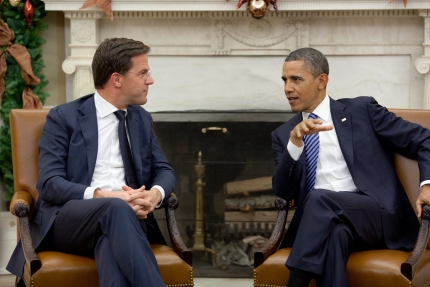
Meeting with Dutch Prime Minister Mark Rutte

 
20111129 Dutch Bilat

President Barack Obama holds a bilateral meeting with Prime Minister Mark Rutte of the Netherlands, in the Oval Office, Nov. 29, 2011. (Official White House Photo by Pete Souza)

President Obama continues to meet with European leaders in an effort to help find a solution to the Eurozone crisis.

Today, Dutch Prime Minister Mark Rutte was at the White House to discuss his government's commitment to keeping the euro intact -- as well as a range of additional issues.

The President told reporters that the United States has "no stronger ally" than the Netherlands -- and discussed why the nation is such an important economic partner:

[Despite] the fact that the Netherlands doesn't have a huge population, they are one of our most important trading partners. The economic relationship between our two countries is deep; it is broad. We are one of the largest investors in the Netherlands. The Netherlands, in turn, is one of the largest investors in the United States. And so, given both of our interests in promoting commerce, growth and jobs, it is very important that we coordinate with the Netherlands.

Read the full remarks from the President and Prime Minister here.

Related Topics: Economy, Foreign Policy

The White House

Office of the Press Secretary

Remarks by President Obama and Prime Minister Rutte of the Netherlands Before Bilateral Meeting

Oval Office

2:33 P.M. EST

PRESIDENT OBAMA:  Hello, everybody.  It is wonderful to welcome Prime Minister Rutte and his delegation to the White House. 

Part of the reason we wanted to make this meeting happen is because we have no stronger ally than the Netherlands.  They consistently punch above their weight on a whole range of issues related to global security.  Prime Minister Rutte has been a strong supporter of NATO, as was his predecessor, and we've been able to work together on a whole host of issues.  They've made an enormous contribution to Afghanistan; they made a very important contribution to Libya; on anti-piracy.  On a whole host of issues, the Netherlands consistently is supportive of efforts for our joint security, and we're very grateful for that.

In addition, despite the fact that the Netherlands doesn't have a huge population, they are one of our most important trading partners.  The economic relationship between our two countries is deep; it is broad.  We are one of the largest investors in the Netherlands.  The Netherlands, in turn, is one of the largest investors in the United States.  And so, given both of our interests in promoting commerce, growth and jobs, it is very important that we coordinate with the Netherlands.

On that score, obviously, we're both concerned about the situation in the eurozone, in which the Netherlands has a very significant voice.  And I'm going to be interested in hearing from Mark his views in terms of how this issue gets resolved.  Because, as I said yesterday during my meeting with Presidents Van Rompuy and Barroso, we have a very deep interest here in the United States in making sure that that process is resolved, so that we can continue to grow our economy and put people back to work here at home.

In addition, we're going to be talking about a wide range of global issues, from the Middle East to the situation in Iran, where we both share a deep commitment to making sure that Iran abides by its international obligations, including in the nuclear area. 

On that score, I think it's important for me to just note that all of us, I think, are deeply disturbed by the crashing of the English embassy -- the embassy of the United Kingdom in Iran.  That kind of behavior is not acceptable.  And I strongly urge the Iranian government to hold those who are responsible to task.  They have a responsibility to protect diplomatic outposts.  That is a basic international obligation that all countries need to observe.  And for rioters, essentially, to be able to overrun the embassy and set it on fire is an indication that the Iranian government is not taking its international obligations seriously. 

And so, obviously, we're deeply concerned about that situation and we expect to see some sort of definitive action sometime very quickly.

Overall, though, I'm pleased to say that the relationship between our two countries is extremely strong, as reflected not only in the relationship between our governments but also the people-to-people contacts.  And I'm hoping that I have an opportunity at some point during my presidency to visit the Netherlands, because --

PRIME MINISTER RUTTE:  Yes, yes.  (Laughter.)

PRESIDENT OBAMA:  -- because all reports are that it is beautiful, and the people are wonderful, and I look forward to enjoying some Dutch hospitality sometime soon.

So, Mr. Prime Minister.

PRIME MINISTER RUTTE:  Yes.  Well, thank you so much.  I'm glad to be here and to meet once again with you, Barack Obama.  And I hope very much to welcome you to the Netherlands.  That would be a great honor and a great opportunity.

The relationship between our countries is very strong.  It goes back a long time.  And I came to the United States basically to discuss three issues:  jobs, jobs, and jobs.

PRESIDENT OBAMA:  Those are good issues to discuss.

PRIME MINISTER RUTTE:  These are the main issues at the moment. 

And, first of all, of course, our excellent economic ties  -- bilateral economic ties:  625,000 Americans are at work today because of our direct investment in the U.S. and, of course, our trade relationship.  And the total investment of the U.S. in the Netherlands is more than the U.S. investment in Brazil, Russia, India and China combined.  And I believe we can work very hard to have this job engine grow even more powerful.

Secondly, we'll discuss, no doubt, the eurozone.  It's the intention of my government to keep the eurozone intact, to keep the euro intact, to fight the debt crisis, and at the same time, get growth and job growth going again in the European Union, which is vital for our own -- for our future. 

And thirdly, we will discuss, I have no doubt, the upcoming NATO Summit, in your hometown, in Chicago --

PRESIDENT OBAMA:  It will be a wonderful visit.

PRIME MINISTER RUTTE:  -- next year, and our transatlantic alliance and its stability, and, of course, the situation in the Arab region, where we pull on the same side, where we are working on progress and democracy in the Arab region and in the Middle East.

PRESIDENT OBAMA:  Good. 

Thank you very much, everybody.

END
2:39 P.M. EST

The White House

Office of the Press Secretary

President Obama Announces More Key Administration Posts

WASHINGTON, DC – Today, President Barack Obama announced his intent to nominate the following individuals to key Administration posts:

• Frederick “Rick” Barton – Assistant Secretary for Conflict and Stabilization Operations and Coordinator for Reconstruction and Stabilization, Department of State
• Arun Majumdar – Under Secretary of Energy, Department of Energy
• Marie F. Smith – Member, Social Security Advisory Board

The President also announced his intent to appoint the following individuals to key administration posts:

• Barbara K. Rimer – Chairman, President’s Cancer Panel
• Owen N. Witte – Member, President’s Cancer Panel

President Obama said, “These men and women have demonstrated knowledge and dedication throughout their careers.  I am grateful they have chosen to take on these important roles, and I look forward to working with them in the months and years to come.”

President Obama announced his intent to nominate the following individuals to key Administration posts:

Frederick "Rick" Barton, Nominee for Assistant Secretary for Conflict and Stabilization Operations and Coordinator for Reconstruction and Stabilization, Department of State
Frederick “Rick” Barton currently serves as a Senior Advisor to the Secretary of State.   From December 2009 to October 2011, he served as the U.S. Representative to the Economic and Social Council of the United Nations in New York with the rank of Ambassador.  Prior to this role, Mr. Barton was a Senior Adviser and Co-Director of the Post Conflict Reconstruction Project at the Center for Strategic and International Studies.  He was also Co-Chair of a working group on Stabilization and Reconstruction at the United States Institute of Peace, Co-Chair of the Princeton Project on National Security’s Working Group on Reconstruction and Development and an expert adviser to the Iraq Study Group and the Task Force on the United Nations.  From 1999 to 2001, he served as the United Nations Deputy High Commissioner for Refugees in Geneva.  Mr. Barton was the founding Director of the Office of Transition Initiatives at the U.S. Agency for International Development, serving from 1994 to 1999.  Prior to this, Mr. Barton was President of Barton & Gingold, a strategy and public relations firm in Portland, Maine from 1983 to 1994.  He served as New England Director of Public Affairs for the U.S. Department of Health and Human Services from 1978 to 1981.  A graduate of Harvard College, Mr. Barton earned a Master’s in Business Administration from Boston University, with an emphasis on Public Management.

Dr. Arun Majumdar, Nominee for Under Secretary of Energy, Department of Energy
Dr. Arun Majumdar has served as the Director of the Advanced Research Projects Agency-Energy (ARPA-E) since 2009. Previously, he was Associate Laboratory Director for Energy and Environment at Lawrence Berkeley National Laboratory and a professor of mechanical engineering and materials science and engineering at the University of California, Berkeley. His research career has focused on the science and engineering of energy conversion, transport, and storage, ranging from the molecular and nanoscale level to large energy systems. He has served on the advisory committee of the National Science Foundation's engineering directorate and the President's Council of Advisors on Science and Technology. Dr. Majumdar was elected a member of the National Academy of Engineering in 2005. He received his Bachelor’s degree in Mechanical Engineering from the Indian Institute of Technology, Bombay in 1985 and his Ph.D. in 1989 from the University of California, Berkeley.

Marie F. Smith, Nominee for Member, Social Security Advisory Board
Marie F. Smith was the President and Spokeswoman for the AARP, formerly the American Association for Retired Persons, between 2004 and 2006. She was elected and served as President-elect of the AARP in 2002 until 2004, and previously served as Treasurer of the AARP Foundation Board of Directors, Chair of the AARP National Legislative Council, and a Spokesperson for the AARP’s Women’s Initiative Program. Before her time at the AARP, Ms. Smith spent twenty-five years with the Social Security Administration (SSA), holding several senior positions there, including Director of Manpower Management. She began at the SSA as a claims representative. Ms. Smith earned a B.S. from Fisk University.

President Obama announced his intent to appoint the following individuals to  key Administration posts:

Dr. Barbara K. Rimer, Appointee for Chairman, President’s Cancer Panel
Dr. Barbara K. Rimer is the Dean and Alumni Distinguished Professor at the Gillings School of Global Public Health, University of North Carolina (UNC) at Chapel Hill, positions she has held since 2005 and 2003, respectively.  She is also a member of the Lineberger Comprehensive Cancer Center at UNC.  From 1997 to 2002, Dr. Rimer served as Director of the Division of Cancer Control and Population Sciences at the National Cancer Institute.  Previously, she held leadership positions at Duke University Medical Center in Durham, NC and the Fox Chase Cancer Center in Philadelphia, PA.  Dr. Rimer has served on a number of boards, including the Task Force on Community Preventive Services, AFLAC’s board of directors, and as the first woman to chair the National Cancer Institute’s National Cancer Advisory Board.  Dr. Rimer is a recipient of the Director's Award from the National Institutes of Health and the American Cancer Society’s Distinguished Service Award.  She was elected to the Institute of Medicine in 2008.  Dr. Rimer holds a B.A. and M.P.H. from the University of Michigan and a Dr.PH. from the Johns Hopkins Bloomberg School of Public Health.

Dr. Owen N. Witte, Appointee for Member, President’s Cancer Panel
Dr. Owen N. Witte has been Director of the Eli and Edythe Broad Center of Regenerative Medicine and Stem Cell Research at the University of California at Los Angeles (UCLA) since 2007.  From 2005 to 2007, he served as the Founding Director of the Institute for Stem Cell Biology and Medicine at UCLA.  Dr. Witte first joined the faculty of UCLA in 1980, becoming the David Saxon Presidential Chair in Developmental Immunology in 1989, and a Distinguished Professor in 2004.  In addition, Dr. Witte has been an Investigator at the Howard Hughes Medical Institute since 1986.  Dr. Witte has served on a number of boards, including the American Association for Cancer Research.  He is also a member of the National Academy of Sciences, the American Academy of Arts and Sciences, and the Institute of Medicine.  Dr. Witte holds a B.S. in Microbiology from Cornell University and an M.D. from Stanford University School of Medicine.

The White House

Office of the Press Secretary

President Obama Announces Presidential Delegation to the Kyrgyz Republic to Attend the Inauguration of His Excellency Almazbek Atambayev

President Barack Obama today announced the designation of a Presidential Delegation to the Kyrgyz Republic to attend the Inauguration of His Excellency Almazbek Atambayev on December 1, 2011.

The Honorable Pamela L. Spratlen, United States Ambassador to the Kyrgyz Republic, Department of State, will lead the delegation.

Member of the Presidential Delegation:

The Honorable Robert O. Blake, Jr., Assistant Secretary of State for South and Central Asian Affairs, Department of State

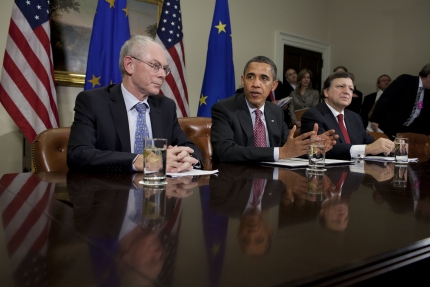
President Obama Speaks on US-EU Summit with Herman Van Rompuy and President José Manuel Barroso

November 28, 2011 | 17:11 | Public Domain

President Obama, European Council President Herman Van Rompuy, and European Commission President José Manuel Barroso deliver statements on the US-EU Summit.

Download mp4 (164MB) | mp3 (16MB)

Read the Transcript

Statements by President Obama, European Council President Herman Van Rompuy, and European Commission President Jose Manuel Barroso after meeting

Roosevelt Room

2:01 P.M. EST

PRESIDENT OBAMA:  Good afternoon, everybody.  I am very pleased to welcome Presidents Van Rompuy and Barroso to the White House.  We have had several occasions to meet over the last year, but this is the first formal U.S.-EU summit that we’ve had an opportunity to have since the Lisbon summit last year.

Of course, much has changed over the last year.  We’ve seen the incredible transformations that have been taking place throughout North Africa and the Middle East.  What hasn’t changed, though, is the fundamental bonds that exist between the European Union and the United States.  Our common values, our common belief in the rule of law, in democracy, in freedom, in a free market system -- all those things bind us together, as do the extraordinary economic and commercial relationships that we have and the people-to-people relationships that we have. 

And so this is an extraordinarily important relationship.  These aren’t always the most dramatic meetings because we agree on so much that sometimes it’s hard to make news.  As the world’s two largest economies and as each other’s most important trading partners, we spent a lot of time focusing on how we can continue to grow our economies and create good jobs on both sides of the Atlantic.  A large part of that conversation obviously revolved around the eurozone crisis, and Presidents Van Rompuy and Barroso have been very actively engaged with the heads of government and heads of state in Europe to try to resolve this crisis.  I communicated to them that the United States stands ready to do our part to help them resolve this issue.  This is of huge importance to our own economy.  If Europe is contracting or if Europe is having difficulties, then it’s much more difficult for us to create good jobs here at home because we send so many of our products and services to Europe; it is such an important trading partner for us.

And so we’ve got a stake in their success, and we will continue to work in a constructive way to try to resolve this issue in the near future.  And I appreciate the leadership of both these gentlemen in trying to address this in a clear and forthright way.

With regard to security cooperation, we agreed to make sure that we continue to place pressure on the Iranian regime to stand down when it comes to the development of nuclear weapons, emphasizing that we continue to hope for a diplomatic resolution that allows them to use peaceful nuclear energy in a way that’s consistent with their international obligations. 

We have a shared stake in continued progress in Afghanistan, where the EU serves as a leading donor, and next week’s Bonn conference will be an opportunity to make sure our security and development agenda is sustainable.

Meanwhile, with respect to aviation security, the EU has been extraordinarily cooperative, and in particular, thanks to the leadership of President Barroso and President Van Rompuy, we’ve been able to make progress in exchanging intelligence information that can keep our passengers safe and assure that we are preventing any kind of terrorist activity from taking place.

Finally, as global partners in support of universal values, we spent a lot of time discussing how we can be supportive of the best elements of what’s taking place in North Africa and the Middle East, continuing to encourage democracy, continuing to encourage transparency, continuing to encourage economic development because we’ve both agreed that the aspirations that were expressed in Egypt and Tunisia and in Libya are not simply political issues but they’re also economic issues, and that we have to do everything we can to support increased opportunity for young people.  These are very young populations, and if they have a sense of a future for themselves where they can work hard and use their skills and talents to develop themselves and support their families, then the likelihood of a successful political transition will exist as well.

Of course, these problems don’t only exist in the Middle East and North Africa.  We discussed, for example, the situation in Belarus, where we stand shoulder to shoulder in wanting to see a return to the rule of law and the flowering of democratic practices there; in the Ukraine, where we agree that we want Ukraine to continue down a reform path, and we want to do everything we can to encourage that.

And so both on security issues, as well as on economic issues, we could not have a closer partner than the European Union.  There are many issues that don’t get a lot of attention -- for example, our cooperation on clean energy and green jobs; our continued exploration of ways where we can get increased regulatory cooperation that can facilitate increased commercial ties -- a whole range of work that’s done by both the European Council and the European Commission that benefits our peoples directly in a multitude of ways.

And so I’m very much appreciative of the partnership that I’ve formed with these two gentlemen.  I hope they have a good visit.  I understand they’re going to be going to Capitol Hill, and I’m sure they’ll receive a warm reception from the Senate Majority Leader.  And I hope that they have a good, albeit brief, visit. 

So thank you.

PRESIDENT VAN ROMPUY:  Thank you.  Let me first thank you, Mr. President, for your hospitality you have extended to us at this time of Thanksgiving.  I very much appreciated our discussions we had here in the White House today.

Let me make two points, one on the economy and one on the international issues.  First, on the economy:  We, the European Union and the United States, have the strongest trade and economic relationship in the world.  And we therefore both need to take strong action to address the near-term growth concerns, as well as fiscal and financial vulnerabilities in order to strengthen the world economy.  It is no secret the European Union is going through a difficult period.  It is confronted with a confidence crisis, aggravated by the slowdown in global economic growth. 

The Union has done a lot over the last 18 months, and we have taken decisions that were unthinkable just a year ago in the fields of economic governance, on budgets and imbalances, financial support, and financial regulation.  All member states of the Union are all engaged in policies of fiscal consolidation and strengthening competitiveness via comprehensive reforms.  But we have to do more.

We are therefore working hard on three fronts:  dealing with the immediate crisis, the medium term, while also establishing a sound perspective for the longer term.  The 9th of December I will present to the heads of state and government a roadmap on how to strengthen the economic union of the euro area commensurate with our monetary union.  We are aiming for binding rules to ensure strong fiscal and economic discipline in all countries, to go hand in hand with fiscal and economic integration -- not only discipline, but also integration in the euro area as a whole.

Improving fiscal sustainability is essential, but it’s not enough.  Promoting growth and employment is a challenge we share with the United States.  The European Union is following a two-track approach on growth:  We want to strengthen fiscal sustainability, while at the same time stimulating economic growth and employment by launching reforms, raising competitiveness, and deepening the Union’s single market, the largest in the world. 

But slower global growth is not only due to the problems in the eurozone.  Others have to do their part of the job, too -- for instance, on exchange rates and on implementing the commitments made in Cannes, at the G20, earlier this month. 

My second point regards international challenges.  Not since the end of the Cold War has the world seen such a degree of transformation in global affairs.  And I’m happy to say that during the last two decades, the world is going in our direction -- towards market economy and democracy.  In Europe, in Latin America, in Africa, in Asia and now in the Arab world, sudden events and slow-moving trends bring us into a new world -- in the Pacific and in the Mediterranean -- and we welcome the new global governments in the G20, reflecting the growing influence of emerging countries as well as their new responsibilities.

As the President said, Europe’s relationship with the United States is built on shared fundamental values.  These will continue to provide the basis for our cooperation and our alliance.  Since the end of the Cold War, there is no East anymore, but there is still a West.  The EU’s priority is its neighbors, to the south and to the east. 

On the south:  We worked together with the United States in supporting the economic and political transition process in the Arab world in the wake of the Arab Spring.  In Libya, European action was given full support by NATO and by the United States.  We both welcomed the democratic elections in Tunisia and in Morocco.  In Egypt, we call for a peaceful, democratic and successful transition to civilian rule.  The unacceptable situation in Syria has prompted the European Union to call on the international community to join its efforts in imposing additional sanctions.

And on the east side:  The EU and the U.S. worked hard to make Russia’s accession to the WTO possible.  I believe this will promote world trade and support Russia’s modernization.  And we also agree on the need to remain actively engaged with our Eastern partners in Europe, and to advance their political association and their economic integration with the European Union.  We, however, share the strong concern about the latest signs of politicized justice in Ukraine.  The democratic aspiration of Belarusian people also needs to be met.

A word on the Western Balkans:  These countries belong in the European Union.  We are making progress.  And the EU will sign the Accession Treaty with Croatia next month.

On Iran, we need to step up pressure.  The Union is preparing new restrictive measures, and in Afghanistan, we reaffirm that the Union is engaged in the long term, even after 2014. 

Mr. President, let me conclude:  Europe and the United States remain partners of first and last resort.  Our entente cordiale was a mainstay in the past, and it will remain so in the future.

PRESIDENT OBAMA:  Thank you.

PRESIDENT BARROSO:  Thank you very much.  First of all, I’d like to thank President Obama for a very useful, substantive and rewarding meeting.  The European Union and the U.S. are longstanding partners and staunch allies to the Atlantic relationship.  It’s indispensable to tackle the common challenges that we face.  We have just reaffirmed our determination to work closely together for the stability of the global economy and for the benefit of our people.

I want to reassure President Obama, and also I want to reassure the Americans:  Europe is going through rough times, yes, but we are determined to overcome the current difficulties.  I have full confidence in the determination of the European leaders.  We have the member states of the European institutions to tackle this crisis.  We are absolutely serious about the magnitude of the challenge, we understand the challenge, but you have to understand that sometimes some decisions take time.  But we are in that direction, and we are in fact taking strong measures for unprecedented situations. 

Indeed, problems in Europe are, to some extent, part of a wider picture.  The world economy has not yet been able to absorb and overcome all the effects of the 2008 financial crisis.  We face the common challenge of bringing debt under control while re-launching growth and creating new jobs.  We all know this is not an easy task. 

In Europe, we have come a long way in addressing the causes and some symptoms of this crisis.  We are now strengthening economic governance of the European Union and the euro area with more robust roles -- rules to ensure sound budgetary policies, and tackle imbalances.  These new rules will enter into force in just a few weeks’ time, but we want to go further.  Just last week, I have put forward new proposals to further strengthen budgetary surveillance and fiscal discipline. 

At the same time, we have an ambitious agenda for growth, both on far-reaching structural reforms.  And today, the way forward in Europe is for more interest.  This is a point I would like to underline to our American friends:  No one in Europe is speaking about coming back.  Everybody is speaking, how can we further deepen integration?  In fact, I believe that we are now living one of those moments of the acceleration of history.  We are seeing that in many parts of the world, in large measure because of the globalization. 

And Europe also is feeling this acceleration of history.  That’s why we have to anticipate some steps in our integration -- integration through discipline, of course, but also integration through more convergence, responsibility and solidarity. 

And if there is a silver lining to all of this, it is perhaps that it has shown just how interdependent our economies now are.  As President Obama just said, it is a fundamental interest of all of us in the world to solve these euro area problems.  Therefore, we need to work ever more closely together.  The European Union and the U.S. have the largest bilateral economic relationship in the world.  Together, our economies account for around 50 percent of the world’s GDP, and one-third of total world trade.

European Union and U.S. trade and investment generates 15 million jobs on both sides of the Atlantic.  In addition, Europe accounts for approximately 70 percent of foreign direct investment in the U.S., and U.S. investment is three times larger in Europe than in Asia.

So to help ensure that the transatlantic economy can be an engine for the recovery of the world economy, the European Union and the U.S. have today decided to gather a high-level working group for jobs and growth.  On the European side it will be shared by commissioner for trade; on the American side, U.S. trade representative.  These groups will examine how to strengthen the European Union/U.S. trade and investment relationship, and in so doing, boost growth and job creation.

This is indeed the first priority:  growth and jobs.  We have to solve the other issues so that we can re-launch growth and jobs in Europe.  I believe this will allow us to further benefit from the untapped potential of our existing strong economic ties.  We know that today’s world is not just about economy, it is also about values and standards.  The European Union and the U.S. share a firm belief in freedom, democracy, human rights -- they are the hallmarks of all societies and what binds us together.  And the sweeping transformations that are now taking place in the Middle East and North Africa confirm that the values we share are, indeed, universal.

When given a choice, people everywhere choose freedom over oppression, democracy over tyranny.  It is in the basis of these values that I believe our relationship will go forward.  And today’s meeting was a very important, substantive meeting in that direction.  I thank you very much.

PRESIDENT OBAMA:  Thank you very much, everybody.

END
2:18 P.M. EST

Close Transcript

The White House

Office of the Press Secretary

Press Briefing by Press Secretary Jay Carney, 11/28/2011

James S. Brady Press Briefing Room

12:36 P.M. EST

MR. CARNEY:  Good afternoon, ladies and gentlemen.  Welcome back.  I hope everyone here had a fantastic Thanksgiving, had a chance to spend some time with family, and is well rested and ready to get back to work, as I am.  (Laughter.)

Q    Psych yourself up.  (Laughter.)

MR. CARNEY:  Not wanting to overtax myself on this day back, I do not have any announcements to make at the top, so I'll go straight to your questions.

Ben Feller.

Q    Thanks, Jay.  Two topics.  First on Europe.  There's a growing fear that the euro is in a particularly perilous state, perhaps poised to collapse within days.  Is that the White House view?

MR. CARNEY:  Well, Ben, our position is and has been that it's critical for Europe to move with force and decisiveness now, particularly with new governments coming into place in Italy, Greece and Spain.  We continue to believe that this is a European issue, that Europe has the resources and capacity to deal with it, and that they need to act decisively and conclusively to resolve this problem.

We obviously have a great deal of expertise and experience in these matters, and we have been in regular consultation with our counterparts from various European governments, consulting with them, offering the advice and expertise that we have to assist them.  But we continue to believe that Europe has the capacity to deal with this, and that they will, conclusively. 

Q    What kind of commitments, if any, is the President seeking today on this issue from the European leaders?  And is he confident that they have the requisite sense of urgency?

MR. CARNEY:  Well, as you know, the President has been and will continue to be in regular contact with Chancellor Merkel and President Sarkozy, as well as others.  The meeting today is a regular summit, an annual summit, with the EU.  It was held here two years ago, was held in Lisbon last year -- it rotates.  And this will be -- obviously, the global economic situation and, in particular, the situation in Europe will be one of the topics of conversation.  There will be other issues. 

And the President will reflect in his conversations in the meeting today what I've just said to you here, which is that the United States believes that Europe needs to take decisive action, conclusive action, to handle this problem, and that it has the capacity to do so.

Q    One question for you on Pakistan.  Can you tell us what the President's personal reaction was upon learning of the NATO strikes that apparently killed 24 Pakistani soldiers, and also whether the White House is fearful that this will harm the U.S.-Pakistani relationship, as many people outside the building have been saying?

MR. CARNEY:  Well, the President's reaction is all of our reaction, which is that the events that took those lives -- the event, rather, was a tragedy.  The loss of Pakistani life was a tragedy.  We mourn the brave Pakistani service members who lost their lives.  And our sympathies go out to their families and go out to Pakistan.

We take this matter very seriously.  I believe my colleague over at the Pentagon, George Little, announced earlier today that in addition to ISAF looking into this, at the request of General Allen, CENTCOM will be investigating this matter.  And we’re obviously very keen on finding out exactly what happened.

As for our relationship with Pakistan, it continues to be an important, cooperative relationship that is also very complicated.  And we have been -- senior U.S. officials have been in contact with the Pakistani government, with their counterparts in Pakistan, including Secretaries Panetta and Clinton, Chairman Dempsey, General Allen, Ambassador Munter.  And those contacts will continue.

It is very much in America’s national security interest to maintain a cooperative relationship with Pakistan, because we have shared interests in the fight against terrorism.  And so we will continue to work on that relationship.

Yes, Reuters.

Q    Just to follow up on Pakistan, have any senior White House officials been in touch with people in Pakistan?  Has the President reached out to anybody?

MR. CARNEY:  I have no contacts at the presidential level to report and I don’t believe anybody in the White House has been.  But as I said, some of the most senior members on the national security team for this administration have been, and I’m sure those contacts will continue.

Q    I guess a lot of people are fearing that this is at crisis levels, the tensions between the United States and Pakistan over this incident.  And I’m wondering how you would characterize it in terms of --

MR. CARNEY:  Well, we take it very seriously.  And there are challenges to this relationship, and we’ve discussed them here this year.  This is obviously a significant issue that we take seriously, and that’s why we, through CENTCOM, will be investigating to find out exactly what happened.  And our condolences go out to the families of those who lost their lives, and to the Pakistani people overall, for this tragedy. 

We continue to believe that it will be in not just the United States’ interest, but Pakistan’s interest, to work with us cooperatively on our shared goals.  Don’t forget that Pakistan and the Pakistani people have been primary victims of terrorism and terrorists, and that we work with them and that cooperative relationship has borne fruit for the United States and for our national security interests.

Q    And on Europe, how worried is the President about the impact on the U.S. economy as this crisis fully intensifies and as people predict maybe only days left to save the euro?

MR. CARNEY:  Well, the President is concerned, as he’s expressed, about the fact that we -- this is a global economy and that the events in Europe obviously have an impact on our economy.  It’s created a headwind for much of the year, and continues to create that headwind.  And that’s why we believe it’s in the United States' interest, but, most obviously, in Europe’s interest to act decisively to deal with this profound challenge.

It does remind all of us that we need to take decisive action on the things that we can control.  And one of those things we can do is take action on measures that can grow the economy and create jobs.  As you know, the Senate this week is going to take up a provision that the President put forward to expand -- to rather extend and expand the payroll tax cut for  160 million Americans, and extend it to small businesses up to a certain level of payroll.  And he believes very strongly that we need to take that action; that Congress needs to act to do the right thing by the American people and the American economy.

Let me move around a little bit.  Yes.  Tell me again --

Q    Julia Edwards, National Journal.

MR. CARNEY:  All right, Julia.  Thank you.

Q    I just wanted to ask what the administration’s plan was to see that unemployment insurance was extended to the end of the year.  I hear a lot of focus on payroll tax cuts.  Is that because it’s more politically advantageous to be talking about what you can do for working Americans versus something that may be construed as welfare?

MR. CARNEY:  Extending unemployment insurance has been very much a part of the President’s plan.  It was part of the American Jobs Act as something that has enjoyed bipartisan support in the past, and should, we hope, enjoy bipartisan support this year. 

In addition to being vital to those who have found themselves unemployed and are unemployed for a substantial period of time, unemployment insurance has been recognized by outside economists and by members of both parties as vital assistance to an economy to help it grow and create jobs.  It is a direct injection, if you will, into the bloodstream of the economy.  And so we very much support extension of unemployment insurance.

If we do not do that, approximately 6 million Americans will lose their benefits over the course of next year, and that will obviously have very negative impact on their lives, but a negative impact on the economy.

Q    -- forward then would be most likely to be combining unemployment insurance in a package at the end of the year, if Congress doesn't take action on it?

MR. CARNEY:  Well, I don't want to speculate about how this will play out.  What the President is focused on, and what you’ll hear him talk about in Scranton on Wednesday, is the need for Congress to take action, for the Senate to vote yes to the extension and expansion of the payroll tax cut and to the extension of the payroll tax cut to small businesses.

And this is something that outside economists have made clear -- just this year alone, the 2 percent payroll tax cut that 160 million Americans have gotten this year that that has resulted in $1,000 on average in every recipient’s wallet this year, has caused up to 1 percent in GDP growth.  Take that away and you’re going to shrink the economy and you’re going to cause the economy to shrink -- to grow less, and you’re going to do a lot of harm to 160 million working Americans. 

Q    That’s payroll tax cuts --
 
MR. CARNEY:  Right.

Q    On unemployment insurance, is that something we can expect to hear him talk about this week?

MR. CARNEY:  You will hear us talk about it because we think it’s vitally important to extend it and to assist those Americans who are unemployed, and to -- through the unemployment insurance, to assist the economy.

Yes.  Jake.

Q    Just to follow on a couple questions that have already been asked.  On Pakistan -- the President is not making any conclusions about what happened.  It may, in fact, be that the Pakistanis fired first.  The President is keeping an open mind about what may have happened?

MR. CARNEY:  Well, we want to -- obviously we want to wait to see what the investigation discovers, yes.

Q    Okay.  And then in terms of what's going on in Europe, you said that this is a European issue, Europe has the resources and capacity to deal with it.  But President Obama said recently that this is a problem of political will.  And I guess I wonder, you didn't say Europe has the political will to deal with this.  Do you --

MR. CARNEY:  Well, the President has been very clear both publicly and in his conversations with European leaders that they need to demonstrate the will to deal with this very challenging problem.  We recognize that this is difficult.  We experienced similar difficulties in tackling the challenges that we faced in this country as we were in freefall, economically, in the beginning of 2009, shedding jobs at a terrible pace, and where the prospect of global economic collapse was out there.  And so the President fully understands the challenges here, both political and substantive.  But he believes this is a moment that requires that kind of decisive action.  And, yes, that requires political will as well as the financial resources necessary.

Q    What is he doing, other than these occasional conversations with European leaders?

MR. CARNEY:  Well, I would just say they're not occasional. I mean, if there are the two leaders he's spoken with more often than Chancellor Merkel and President Sarkozy in recent weeks and months, I don't know who they are.  I mean, they're regular.  We read them out regularly.  He's in consultation, obviously, with other European allies.  Tim Geithner, the Secretary of the Treasury, is in regular contact and has traveled frequently to Europe, and other counterparts have been involved as well.

So we're very engaged in this.  We have, because of our experience, our unique experience, I think, some very constructive help that we can offer and advice that we can offer. But we also recognize, and I think Europeans feel strongly about this, that this is something that they need to solve and that they have the capacity to solve -- both the financial capacity and political will.

Q    Lastly, I wanted to get your feedback on a study that the Wall Street Journal wrote about today, based on -- my understanding, based at least partly on numbers tabulated by our unofficial statistician, Mr. Norwick, which is that President Obama seems to have traveled to battleground states more so than any other President before him.  And I'm wondering if you could respond to this.  It looks like the President is campaigning on the taxpayer dime more than any other President has done.

MR. CARNEY:  Well, I reject the premise of that precisely because what happened in 2008 was Barack Obama, then-Senator Obama, expanded the political map dramatically.  And what is included in this article, and in this chart, is Virginia, for example. 

Now, every President who's occupied the Oval Office, just a few short minutes across the river from Virginia, travels to Virginia frequently to hold events.  When you look at George W. Bush's travel as President, that's not included on this list as a swing state or a battleground state because it was not perceived to be possible that a Democrat could win it.  But Barack Obama won that state, and he's made numerous visits to Virginia, just as most Presidents prior to Barack Obama have made numerous visits to Virginia.

North Carolina is another example.  It's not included in George W. Bush's tabulation because it was not perceived to be a swing state.  Barack Obama won it -- very narrowly, but he won it in 2008.  And if you take away those two states, and you look at, for example, Bush traveled more frequently in the same time period to Ohio, Wisconsin, New Mexico, Florida, President Obama has actually traveled less to the overlay battleground states than his immediate predecessor.

So I just think that, if you took off the map and said, the President of the United States can't travel to states that are perceived to be battleground states, you would severely limit the capacity of this President and any of his successors to travel anywhere.  Because the fact is, we live in a country that is very close, politically, in terms of which way states could go in any given presidential election.  And increasingly, we've seen that more and more states find themselves on the political map as potential battleground states and swing states. 

And if every President, whether it's President Obama or his successor, or any successor after that, were to simply say, oh, I can't travel to any state that might be contested in the next election, then the President would have to spend most of his time here in Washington, D.C.  And I don't think that any President should do that.  Presidents should travel, and they should be able to get out and speak to the American people about their substantive agendas, and that's what this President has been doing.

Q    He sure seems to spend a lot of time in states, though, that he's going to be --

MR. CARNEY:  He spends a lot of time in a lot of states.  And some of them, red, blue; some of them were declared red forever and ended up not being -- they're purple now; and states that maybe are considered blue or were considered blue but Republicans might think they have a chance of winning next year. I mean, I just think that it's a guessing game to suggest that we know what states are battleground states, necessarily. 

And if -- again, I think the salient point is, then-Senator Obama and his presidential campaign expanded the map dramatically, made states battleground states that had not been for a very, very long time.  And to then say that he can't travel to those states because he won them and made them competitive I think would severely restrict this President's ability to travel, and any future President's ability to travel, which I don't think is a good idea.

Q    Follow-up, Jay?

MR. CARNEY:  You earned the right.  Yes, sir, Mr. Knoller.  (Laughter.)

Q    Can you tell us how it's decided where events, like the President going to Scranton on Wednesday, how is that decided that's where he would go?  I mean, Pennsylvania is a state that seems to me would be indispensable to his reelection, wouldn’t you say?

MR. CARNEY:  Well, Mark, I think as you know probably better than, or as well as anybody in this room, a lot of factors go into presidential travel.  Proximity has a lot to do with it.  I mean, there is a concentration of travel in states like Virginia and Pennsylvania because they’re close by.  And if the President is trying to get out of Washington and communicate with the American voter, he can’t -- or the American people, rather -- he can’t always go to the mountain states or the plain states or the West Coast.  And so I think you do see a concentration in this time zone.

And I’m very confident -- I’ll offer my opinion -- that President Obama is going to win Pennsylvania.  He’s also going to win the election.  I think he won Pennsylvania by double digits, but that’s now, I guess by your estimation or whoever put together this list, a battleground state.  Maybe it is, maybe it isn’t.  We don’t take anything for granted.

The point is, is that these are subjective assessments, and again, if you decided that every state that was close or could be close were ruled out as a potential place for a President to travel, you would make it really, really difficult for any President to go anywhere in the country eventually.

Q    But you’re not saying that politics played no role in the decision, are you?

MR. CARNEY:  I’m saying that -- I mean, there are a lot of decisions that go into -- a lot of factors that go into the decisions.  And official events are made for official reasons.  And they’re made because we find places where the President can talk about the policy proposals he’s put forward that makes sense for a variety of reasons -- logistical reasons, as well as location in terms of schools or sites that if we’re highlighting his infrastructure proposals, then near a bridge, for example, or highlighting his proposals to help veterans, something that would involve veterans, or schools.  I mean, all of those factors go into deciding where the President travels.

All the way in the back, yes.

Q    On the payroll tax cut and the risk to the jobs package, given that the Republicans are going to block any tax increases, is the President open to negotiating additional long-term spending cuts in return for that short-term stimulus?

MR. CARNEY:  The President is very interested in making sure that 160 million Americans, working Americans who get a paycheck don’t have their taxes raised next year because Congress won’t act.  The fact of the matter is, is that a payroll tax cut has been supported by not just Democrats, not just this President, but by Republicans in the not-too-distant past, including some who came out against it yesterday.

So we believe that there is substantial support out in the country among not just Democrats and independents, but Republicans, for an extension and expansion of the payroll tax cut as well as an extension to small businesses, and that there is broad support for paying for it in the way that the President put forward in his principles, in his plan, and that the Senate is going to put forward later this week.

Again, if Republicans are going to vote against this, they have to explain why.  They have so energetically fought to protect tax cuts for millionaires and billionaires -- protected millionaires and billionaires rather than funding a program that would have sent teachers back to work, protected millionaires and billionaires rather than funding a program as part of the American Jobs Act that would have put construction workers on the job to rebuild bridges and highways and schools, protected millionaires and billionaires rather than pass the entire American Jobs Act.  Now, they did that with great passion.  But they don't seem to have -- show a lot of passion when it comes to extending a tax break for average Americans.  And I think there needs to be some questioning about why that is.

Q    But they do want spending cuts.  The things that they want are spending cuts and they want to change the defense sequester, which you've said is off the table, I guess, for these negotiations.  Is spending cuts something that you would be willing to negotiate --

MR. CARNEY:  I'm not going to negotiate an outcome that we don't believe should come to pass.  We believe that Congress should respond to the will of the people, which overwhelmingly supports the President's proposal for a payroll tax cut extension and expansion and the means by which both the President and Senate Democrats believe it should be paid for.  So rather than get ahead of a vote that we believe will happen later this week, I'd like to see everybody in the Senate held accountable in voting one way or the other on this proposal.

Q    Jay, Pakistan's prime minister tells CNN that there will be "no more business as usual" in Pakistan-U.S. relations.  And I'm just wondering what do you take that to mean and how much stock do you put in what sounds like a threat?

MR. CARNEY:  Well, we take the matter very seriously, as I've said earlier, and we understand the concern that members of the Pakistani government as well as the Pakistani people have about this incident.  And that's why we're very interested in having it investigated and finding out exactly what happened.  We mourn, as I said, the loss of life and we extend our condolences to the Pakistani people for it.  So we take it very seriously.

Q    But "no more business as usual" is obviously an indication of things souring--

MR. CARNEY:  We understand that this is a serious issue.  We take it seriously.  We have a relationship with Pakistan that has been complicated for a long time, but it’s also an important relationship and one that we need to work hard on because that cooperation is in the interest of the United States.

Q    And the calls for Justices Thomas and Kagan to recuse themselves from overseeing the health care challenge, any response to that?

MR. CARNEY:  Well, I would just say that I believe -- my understanding of how this works is that it's up to each justice to decide whether he or she should be recused.  Just speaking of Justice Kagan, because obviously this President nominated her and that confirmation process occurred just last year and we all either participated in it or witnessed it, these issues were raised just a year ago in an expansive confirmation hearing, and they were -- these questions were asked and answered both in the hearing itself and in written questions that were responded to in writing.  It's a mystery to me how this can suddenly be an issue a year later and they want to revisit what they just visited not that long ago.

Q    Justice Kagan has said --

MR. CARNEY:  Again, as I just said, all this stuff was examined, all of it was -- questions were asked, she answered it, and she responded in writing to this.  So I think it sure sounds like a political thing to try to revisit it just a year later.

Q    But the information that was in the email was not available during the confirmation hearings.

MR. CARNEY:  Norah.

Q    On the payroll tax cut extension, will the President sign an extension that does not include a tax on millionaires to pay for it?

MR. CARNEY:  The President looks forward to the Senate voting on the bill that Senate Democrats are putting forward that pays for an extension and expansion of the payroll tax cut in a way that Senate Democrats support, the President supports, Democrats, independents and Republicans support around the country -- Republicans support everywhere, apparently, except on Capitol Hill.

Q    But just to move that conversation along --

MR. CARNEY:  Well, I don't want to --

Q    -- Republicans will likely vote against it --

MR. CARNEY:  I’m not going to negotiate --

Q    -- and it’s going to fail, and so it will likely end up in an omnibus --

MR. CARNEY:  Well, before we --

Q    -- or continuing resolution.   So is the President going to back down and sign an extension of the payroll tax cut extension without --

MR. CARNEY:  Well, I’m not going to negotiate an endgame here before this vote has even happened.  And I think it’s not fair to the American people to sort of just say, oh, well, they’re going to vote against it, let’s ignore that and move on and see what they might vote for.  Because here’s what Senator McConnell said about the payroll tax cut in early 2009.  He suggested that we should have a two-year elimination of the payroll tax.  “It put a lot of money back in the hands of businesses and in the hands of individuals, both of whom pay the payroll tax cut.”

Senator John Kyl, who had something else to say about it yesterday, said, in late 2009, “You can do some things to stimulate job creation, and certainly something like reducing the payroll tax cut, which has been written about recently, would accomplish that” -- job creation.  That must be a good thing, right?

Senator Hutchison: “I think the payroll tax cut does help some.  It helps the individual who is working, and the employer.” Senator Alexander, in late 2010, said, “If you’re a small businessperson in Tennessee, what this means is that you won’t be paying tens of thousands of dollars, perhaps more, in taxes.  And you can use that to create a job.  It also means that your employees who work there will get a one-third reduction in their payroll tax payments every two weeks, and maybe they’ll spend some -- more money creating more jobs.”  We couldn't have said it better.

Senator Hatch called it a “conservative approach to help put our economy back on track; a targeted, reasonable way to get employers hiring again.”  This is a conservative approach, as I said. 

Now, obviously these Republican senators believe that a pay roll tax cut is a good thing -- at least they did.  But what they seem not to believe is that millionaires and billionaires ought to pay a little extra in order to ensure that middle-class Americans get a payroll tax cut.  So they’re more -- forced to choose here.  They’re siding with those who -- as the CBO study showed and others have showed -- have done exceptionally well in the last 10 years, even 30 years, while middle-class Americans have seen their income stagnate.  We just don't think that’s the right position.  We don't think the American people support that position.

And before senators are forced to vote on that matter, as they will later this week, and explain why they’d rather see taxes go up on regular Americans than see millionaires and billionaires pay a little bit more -- before we get beyond that, I want to see that vote happen.

Q    And then just a quick question on Pakistan.  Did the President make any calls on Pakistan?

MR. CARNEY:  I have no calls to report out to you.

Q    And if NATO forces or American forces are fired on from Pakistani military bases, are they allowed to defend themselves?

MR. CARNEY:  I think that’s a question best directed towards ISAF and to the Pentagon.  I would say, if it’s a question about this incident, that we are just beginning an investigation into what happened.

Q    Jay, the President’s travel.  I thought -- I didn't think the criticism was that the President should stop traveling -- obviously he’s entitled to travel.  But as you make a fair point, that he’s expanded the electoral map, isn’t the criticism that the campaign and not the taxpayers should pay for it?

MR. CARNEY:  Well, no, but the suggestion is that he can’t make official travel to any state that’s considered contested or close.  And we just utterly reject that, because the President has a responsibility, as the President, as Commander-in-Chief, as well as the leader of the country on domestic matters, to go out and meet with Americans, to have events in different states across the country, and to express his --

Q    -- four or five states --

MR. CARNEY:  But what you’re saying he -- again, you’re saying he shouldn’t go there because it’s close, and it was only close because --

Q    He can go there, but maybe the campaign picks up the tab at some point.

MR. CARNEY:  I see.  And, again, take away those states that he happened to win against all odds and probably against the predictions of various new organizations, that he then -- it was okay for previous Presidents to go there, but not for him because he won so convincingly in 2008.  That just doesn’t make any sense.

Q    So why does he go to North Carolina so many more times than he goes to Tennessee.  Why does he go to Pennsylvania so many more times than he goes to Georgia?

MR. CARNEY:  Jake, there are a variety of reasons -- of the decisions are made about where he goes -- and he goes to red states, he goes to blue states, he goes to states that are considered battleground states -- and those decisions are made for substantive reasons based on the policy issue that we’re putting -- that he’s addressing.

My point was that if you -- that the whole construct of the article was built around the idea that he’s done it more than his predecessors.  And if you take off states that weren’t considered battlegrounds when Bush visited them and they turned out to be battlegrounds because Barack Obama won them -- his predecessor, George W. Bush, traveled to these states significantly more than President Obama has. 

So the whole point being, Presidents need to be able to travel.  When he travels on -- when it’s political travel, political events, those are paid for by the book according to the rules that exist.  And when he does official events, those are paid for in the manner that official events are paid for.

Q    Last thing on the euro -- one quick one on the euro.

MR. CARNEY:  On which one?  Sorry.

Q    The euro.  The Organization for Economic Cooperation and Development -- the U.S. is part of that research group -- essentially put out a report today saying that the euro contagion can spread and that their concern is that the policies in Europe but also in the U.S. are behind the curve.  Speaking about the U.S. side, since the President is talking to European leaders today about their debt issues, after the super committee failure it seems like both parties have said, look, we’re going to fight these issues out on taxes and everything in the election.  Is the President --

MR. CARNEY:  Well, we haven’t said that.

Q    Okay.  So between now and the election, will the President campaign for his $3 trillion deficit plan?  Or is he just -- because he mostly goes out on the road and campaigns for the jobs bill, but we don’t really hear him campaigning on the deficit plan.  So will he push that now?

MR. CARNEY:  Well, there is an urgent need to take action to grow the economy and create jobs.  That is certainly his number-one priority.  He put forward a detailed plan.  He talks about it a lot and he will talk about it again in the future.  And it remains available to Congress to take up and act on it at any time.  It is unfortunate that the super committee -- because, again, it refused to deal with or consider the Bush tax cuts or revenue in any substantial way -- that the super committee failed, because it allowed for a mechanism by which Congress could have acted more efficiently and quickly to deal with this long-term deficit and debt challenge.

But there is nothing that prevents Congress from doing the right thing and taking up a balanced approach, the likes of which the President put forward in a 80-plus-page plan, and acting on it; and acting on it if not this month then next month, or January or February or March.  It doesn’t have to wait until the election. 

It shouldn’t wait, because it’s a high priority, and the President -- it’s funny, if you look at sort of the assessments that are made by outside observers and columnists and commentators and economists, they always say, what we really need, what this economy really needs is near-term -- measures to have a positive impact on the economy in the near term, to grow it and create jobs in the near term, and measures that deal with our medium- and long-term deficit and debt problems.  Well, the President has put forward proposals to deal with both.  And he certainly hopes that in addition to acting on the payroll tax cut and extension of UI, that Congress will see fit to continue to act on other measures, provisions within the jobs act, and he certainly hoped that Congress will take up his deficit and debt reduction plan.

Q    Back on Europe.  On Friday, Germany, Finland and the Netherlands called on the IMF to take a bigger role in the European debt crisis.  The United States is the largest shareholder in the IMF.  Does the administration support this idea?

MR. CARNEY:  I think I would just refer you to the things we said about -- questions about the IMF's role coming out of the G20, and that hasn’t changed, which is IMF has substantial resources; it can play a role on the side, if you will, or a part of this.  But the issue here is a European issue and Europe needs to act.  What we've also said is that we do not in any way believe that additional resources are required from the United States, from American taxpayers.

Yes, Chris.

Q    Today Representative Barney Frank is currently announcing his retirement from Congress.  As the longest-serving LGBT member of Congress and also a senior Democrat, what does the White House and the President think that this says both to the advancement of LGBT issues in Congress and also to the Democrats’ obvious desire to take back the House in 2012?

MR. CARNEY:  Well, I don't have any official reaction yet, but Congressman Frank has served for a very long time and he's served very effectively representing his district, and I know that we appreciate his service.  And his prominence as an openly LGBT member of Congress obviously had I think a very positive impact in terms of general acceptance.  But I don't know if it has larger implications.  Members of Congress who've served a long time decide not to run again all the time.  And I'm not sure about the political implications of that seat at all, but we certainly are very grateful for Congressman Frank's service.

Q    Jay, in the coming year, in the interest of transparency, would the President be willing to have each of the trips he takes domestically broken out for their cost that is covered by the White House and what parts are covered by the DNC?

MR. CARNEY:  I can refer you to -- I can get back to you on who -- the DNC or how these things -- I know that we do this by the book the way it's supposed to be done.  We do it very carefully.  I'm not going to stand here and announce a whole new administrative burden or agree to a whole new administrative burden.  I would refer you to the folks who handle this, especially at the DNC.

Q    But no one has done that before.  Would he be willing to consider being the first?

MR. CARNEY:  Well, again, I'm not -- I can take the question but we do this absolutely by the book and are very assiduous in making sure that we follow the rules.

Q    Do you use the same rules that President Bush did?

MR. CARNEY:  Again, I'll have to take that.  We use whatever rules exist and --

Q    So you didn’t change the rules?

MR. CARNEY:  Not that I'm aware of, no.

Q    Going back to the payroll tax cut just briefly, the House Republicans have suggested a willingness to work on this.  Is the President going to sit down with them and try to figure out a pay-for that could work to get the payroll tax cut extension done?

MR. CARNEY:  Again, I think the nature of these questions basically assume and let off the hook those members of Congress who aren’t willing to say yes to a payroll tax cut for 160 million Americans because they refuse to ask the wealthiest Americans, those who have benefited enormously over the past 10, 20 and 30 years while the middle class has not benefited very much -- or as much -- to pay a little extra. 

So let's not presuppose that this vote will fail.  Maybe members of the Senate, in this case, will hear from their constituents, will recognize what all the data shows, which is that by large majorities the American people support this proposal and support the way the President believes it ought to be paid for, and the way Democrats believe it ought to be paid for, and enough of them will vote yes to overcome the usual filibuster because of parliamentary tactics and get it out of the Senate.  And then the House will have to decide where it stands on this issue, which side the House is on and individual members of the House are on. 

Beyond that, I don't want to negotiate an endgame that presupposes a failure that we hope won't happen.  We have put forward a means to pay for this payroll tax cut extension and expansion, as well as unemployment insurance -- the President has.  The Senate Democrats have done it as well.  We think that Congress ought to act on that before we start negotiating an endgame that shouldn’t necessarily come to pass.

Q    And on the Egyptian elections, is there any concern, even though they are just getting started today -- is there any concern about an Islamic takeover at the top and how the White House will work with a federal government headed by Islamists?

MR. CARNEY:  Well, I'll say a couple things.  One is, thus far -- and this is a long process, as you know -- it's my understanding that the elections have gone well, and we welcome that development.  The fact of the matter is the democratic process is what's important.  Principles matter to this President, not parties.  And we hold whatever party prevails or is represented in the outcome of an election like this, whether it's in Egypt or elsewhere -- our standards have to do with respect for human rights, respect for the democratic process, denunciation of violence, and inclusion of and respect for minorities in the process. 

And I think it is in some ways unfair to assume that any party that has a religious affiliation cannot adhere to democratic principles.  It's simply not the case and hasn’t been borne out by the facts.  So before we judge the disposition of a government -- or a parliament that's just beginning to take shape through elections that have started today, I think we need to let the process run its course, continue to espouse our firm support for democratic principles and for civilian control of the government, and then judge the outcome by the actions of those who prevail. 

Margaret.

Q    Thanks.  Quick follow-up on both Scranton and today's EU summit.  Dan Pfeiffer had tweeted earlier today that there would be more "We Can't Wait" stuff this week.  When will that be rolled out?  In Scranton, or is the Scranton message purely on the payroll tax cut extension?  And if the former, can you put some meat on the bone?  And then with regard to the summit today, just to clarify -- is the President asking these EU leaders for anything explicit that he hasn't already spoken with Merkel and Sarkozy about?

MR. CARNEY:  This meeting is going on now, so I don't want to say what happened before it's happened.  I think, generally, the description of the President's message that I gave is going to be the message that he delivers in this meeting.  I think it certainly is the case in the current crisis that Chancellor Merkel and President Sarkozy and other leaders of European countries are key to the process, and that's why the President has had so many direct conversations with them, and will continue to.  And obviously this meeting with the EU is important in that regard, too, but it will also discuss other issues.

The President, on Wednesday, will focus on the payroll tax cut.  And I don't have any announcements beyond Dan's tweet to make about further executive actions. 

Tom.

Q    Jay, Senator Kyl said yesterday that the reason that the payroll tax should not be extended and sweetened, as the President wants, is that that's millions of dollars more that won't go into the Social Security trust fund, therefore, it might conceivably endanger the stability of Social Security.  How do you all react to that?

MR. CARNEY:  Well, a couple of things.  One, that's simply not the case, because it would -- it presupposes the idea that U.S. treasuries are not the most rock-solid investment in the world, which they remain to be -- which they remain even as we speak.  So, secondly, it's not a position that Senator Kyl took in the past. 

And the fact of the matter is, we need to take measures to grow this economy.  We need to take measures to create jobs.  And what we should not be doing is asking 160 million hardworking Americans, middle-class Americans most of them, to have their taxes raised next year by a thousand bucks on average, just so millionaires and billionaires don't see their taxes raised just a little bit.  It just doesn't seem fair to this President or to Americans of every political persuasion across the country.  So we believe very firmly that the Senate ought to act on a vote and ought to say yes to a payroll tax cut extension later this week.

Victoria.

Q    Jay, a U.N. report out today says Syrian security forces have committed gross violations of human rights since the crackdown, including killing hundreds of children and sexually abusing boys.  And even with the sanctions imposed by the Arab League, is it time for the U.N. Security Council to get involved?

MR. CARNEY:  Well, I haven’t seen the report that you referenced, but we have very strongly condemned the violence perpetrated by the Assad regime, the gross violations of human rights perpetrated by the Assad regime.  We have worked very hard to isolate that regime and, as you know, we took action, and we have since seen the EU take action, the Turkish government take action, the Arab League take action, to further isolate the Assad regime because of its refusal to cease and desist from the kind of violence that it’s perpetrating, and the kind of violence you just referenced.

So we believe that’s the right action.  We believe that the fact that it’s the right action is demonstrated by the support for that approach that we’ve seen now, not just among Western nations, European nations, but also by the Arab League.  And we will continue to work to isolate the Assad regime because he’s clearly lost his legitimacy to lead.

Q    But my question is that is it time, perhaps, for the next step?

MR. CARNEY:  Well, we’ll continue to work with international organizations.  We believe that the approach that we’ve taken is the right approach and that it is most effective when we have this kind of concerted, broad effort, as demonstrated most recently by the Arab League’s action.

Q    Jay, Iran followed the President through the Asia trip. Are there any concrete steps that you can report or talk about now regarding China and Russia?  Efforts to come about with a unified approach to prevent --

MR. CARNEY:  Well, I think you know from the Board of Governors vote that there is great unity in the international community in condemning Iran’s refusal to live up to its international obligations.  That vote coincided, as I think Tom Donilon mentioned when he briefed in Indonesia, with a U.N. vote condemning the attempted assassination of the Saudi ambassador to the United States -- overwhelming votes, including Arab states and other states around the country, with very few opposing. 

And I think that demonstrates the approach that we’ve taken here that has unified the world in isolating and pressuring Iran because of its behavior, whereas in the past we had a situation where Iran did not face the same kind of pressure because there was disunity in the international community about what action to take, and some folks were blaming the United States, when in fact that wasn’t true.  The action that we’ve taken has demonstrated that the bad behavior is being perpetrated by the Iranian regime.

Q    Nothing to move us past the point where we were --

MR. CARNEY:  Look, I think you saw some new sanctions that we put forward.  You saw some other sanctions that others have put forward.  And that will continue to put pressure on the Iranian regime.  And the fact that that pressure is having an impact has I think been validated by a lot of outside sources and validated in fact by the President of Iran.  So that pressure continues.  And we'll ratchet it up in a variety of ways.

Yes.

Q    Thank you, Jay.  On the newest move by the Arab League against Syria, there are a couple of countries that came out, one of them being Iraq, that said that they won't impose these -- or, I guess, enact these sanctions or act on them.  What do you say to countries like that that are partners of the United States?

MR. CARNEY:  Well, again, I think the significant fact here is the action that the Arab League took, which reflects the action that the EU took, the United States took, that Turkey took.  And that's our focus, is that there is a remarkable amount of agreement, internationally, among not just Western states but states in the region about how reprehensible the actions that the Syrian regime has taken are.  And we believe that that kind of isolation will have an effect and that it is the right thing to do.

Q    There's no discussion with U.S. partners that are --

MR. CARNEY:  Well, I would refer you perhaps to the State Department for specific conversations that may be taking place, or might take place with other countries that have a different view.  But again, I think the story here, and I think it's a pretty remarkable story, is the broad consensus that we've seen in isolating Syrian for its behavior.

Sam.

Q    Thanks, Jay.

MR. CARNEY:  Last one.

Q    Yesterday, Senator Toomey said he saw wiggle room in the President's veto threat for the sequester, specifically to defense, arguing that the President be comfortable with the size of the cuts but he could take some from defense and apply them elsewhere.  Can you address that specifically?  And also, has the President talked with Secretary Panetta about his concerns over the defense trigger?

MR. CARNEY:  Well, I'm sure the President and Secretary Panetta, because they speak all the time, have spoken about this. Let me be very clear:  The President said there are no easy off-ramps here.  Congress voted to impose the sequester on it to hold its own feet to the fire, to get it to act.  To then tell -- it's the kind of behavior -- to suggest that they should undo what they did just a few months ago, to declare to the world, as they did when the held this vote, the Budget Control Act, that we're going to hold ourselves responsible, and then a few months later say, never mind -- that's not acceptable.

Q    That's not undoing it, it's just -- the same amount of money would be cut.

MR. CARNEY:  Changing it is undoing it.  The whole purpose of the design of the sequester was to make it so onerous for everybody that it would never come to pass.  To change it so that it's not so onerous only relieves pressure on Congress.  And obviously Congress needs an immense amount of pressure to get positive things done.  

Q    So to clarify, a veto threat -- sorry, he would veto a threat to change the amount of defense cuts --

MR. CARNEY:  The President made clear that the sequester should stay in place and that Congress should act.  Because Congress passed a law holding itself responsible, and holding itself accountable and they should do the right thing and get it done.  So there's no wiggle room, to use your phrase, as I think I said in a briefing either here or on Air Force One last week.

Thanks, guys.

Q    Thank you.

END
1:25 P.M. EST

The White House

Office of the Press Secretary

Statements by President Obama, European Council President Herman Van Rompuy, and European Commission President Jose Manuel Barroso after meeting

Roosevelt Room

2:01 P.M. EST

PRESIDENT OBAMA:  Good afternoon, everybody.  I am very pleased to welcome Presidents Van Rompuy and Barroso to the White House.  We have had several occasions to meet over the last year, but this is the first formal U.S.-EU summit that we’ve had an opportunity to have since the Lisbon summit last year.

Of course, much has changed over the last year.  We’ve seen the incredible transformations that have been taking place throughout North Africa and the Middle East.  What hasn’t changed, though, is the fundamental bonds that exist between the European Union and the United States.  Our common values, our common belief in the rule of law, in democracy, in freedom, in a free market system -- all those things bind us together, as do the extraordinary economic and commercial relationships that we have and the people-to-people relationships that we have. 

And so this is an extraordinarily important relationship.  These aren’t always the most dramatic meetings because we agree on so much that sometimes it’s hard to make news.  As the world’s two largest economies and as each other’s most important trading partners, we spent a lot of time focusing on how we can continue to grow our economies and create good jobs on both sides of the Atlantic.  A large part of that conversation obviously revolved around the eurozone crisis, and Presidents Van Rompuy and Barroso have been very actively engaged with the heads of government and heads of state in Europe to try to resolve this crisis.  I communicated to them that the United States stands ready to do our part to help them resolve this issue.  This is of huge importance to our own economy.  If Europe is contracting or if Europe is having difficulties, then it’s much more difficult for us to create good jobs here at home because we send so many of our products and services to Europe; it is such an important trading partner for us.

And so we’ve got a stake in their success, and we will continue to work in a constructive way to try to resolve this issue in the near future.  And I appreciate the leadership of both these gentlemen in trying to address this in a clear and forthright way.

With regard to security cooperation, we agreed to make sure that we continue to place pressure on the Iranian regime to stand down when it comes to the development of nuclear weapons, emphasizing that we continue to hope for a diplomatic resolution that allows them to use peaceful nuclear energy in a way that’s consistent with their international obligations. 

We have a shared stake in continued progress in Afghanistan, where the EU serves as a leading donor, and next week’s Bonn conference will be an opportunity to make sure our security and development agenda is sustainable.

Meanwhile, with respect to aviation security, the EU has been extraordinarily cooperative, and in particular, thanks to the leadership of President Barroso and President Van Rompuy, we’ve been able to make progress in exchanging intelligence information that can keep our passengers safe and assure that we are preventing any kind of terrorist activity from taking place.

Finally, as global partners in support of universal values, we spent a lot of time discussing how we can be supportive of the best elements of what’s taking place in North Africa and the Middle East, continuing to encourage democracy, continuing to encourage transparency, continuing to encourage economic development because we’ve both agreed that the aspirations that were expressed in Egypt and Tunisia and in Libya are not simply political issues but they’re also economic issues, and that we have to do everything we can to support increased opportunity for young people.  These are very young populations, and if they have a sense of a future for themselves where they can work hard and use their skills and talents to develop themselves and support their families, then the likelihood of a successful political transition will exist as well.

Of course, these problems don’t only exist in the Middle East and North Africa.  We discussed, for example, the situation in Belarus, where we stand shoulder to shoulder in wanting to see a return to the rule of law and the flowering of democratic practices there; in the Ukraine, where we agree that we want Ukraine to continue down a reform path, and we want to do everything we can to encourage that.

And so both on security issues, as well as on economic issues, we could not have a closer partner than the European Union.  There are many issues that don’t get a lot of attention -- for example, our cooperation on clean energy and green jobs; our continued exploration of ways where we can get increased regulatory cooperation that can facilitate increased commercial ties -- a whole range of work that’s done by both the European Council and the European Commission that benefits our peoples directly in a multitude of ways.

And so I’m very much appreciative of the partnership that I’ve formed with these two gentlemen.  I hope they have a good visit.  I understand they’re going to be going to Capitol Hill, and I’m sure they’ll receive a warm reception from the Senate Majority Leader.  And I hope that they have a good, albeit brief, visit. 

So thank you.

PRESIDENT VAN ROMPUY:  Thank you.  Let me first thank you, Mr. President, for your hospitality you have extended to us at this time of Thanksgiving.  I very much appreciated our discussions we had here in the White House today.

Let me make two points, one on the economy and one on the international issues.  First, on the economy:  We, the European Union and the United States, have the strongest trade and economic relationship in the world.  And we therefore both need to take strong action to address the near-term growth concerns, as well as fiscal and financial vulnerabilities in order to strengthen the world economy.  It is no secret the European Union is going through a difficult period.  It is confronted with a confidence crisis, aggravated by the slowdown in global economic growth. 

The Union has done a lot over the last 18 months, and we have taken decisions that were unthinkable just a year ago in the fields of economic governance, on budgets and imbalances, financial support, and financial regulation.  All member states of the Union are all engaged in policies of fiscal consolidation and strengthening competitiveness via comprehensive reforms.  But we have to do more.

We are therefore working hard on three fronts:  dealing with the immediate crisis, the medium term, while also establishing a sound perspective for the longer term.  The 9th of December I will present to the heads of state and government a roadmap on how to strengthen the economic union of the euro area commensurate with our monetary union.  We are aiming for binding rules to ensure strong fiscal and economic discipline in all countries, to go hand in hand with fiscal and economic integration -- not only discipline, but also integration in the euro area as a whole.

Improving fiscal sustainability is essential, but it’s not enough.  Promoting growth and employment is a challenge we share with the United States.  The European Union is following a two-track approach on growth:  We want to strengthen fiscal sustainability, while at the same time stimulating economic growth and employment by launching reforms, raising competitiveness, and deepening the Union’s single market, the largest in the world. 

But slower global growth is not only due to the problems in the eurozone.  Others have to do their part of the job, too -- for instance, on exchange rates and on implementing the commitments made in Cannes, at the G20, earlier this month. 

My second point regards international challenges.  Not since the end of the Cold War has the world seen such a degree of transformation in global affairs.  And I’m happy to say that during the last two decades, the world is going in our direction -- towards market economy and democracy.  In Europe, in Latin America, in Africa, in Asia and now in the Arab world, sudden events and slow-moving trends bring us into a new world -- in the Pacific and in the Mediterranean -- and we welcome the new global governments in the G20, reflecting the growing influence of emerging countries as well as their new responsibilities.

As the President said, Europe’s relationship with the United States is built on shared fundamental values.  These will continue to provide the basis for our cooperation and our alliance.  Since the end of the Cold War, there is no East anymore, but there is still a West.  The EU’s priority is its neighbors, to the south and to the east. 

On the south:  We worked together with the United States in supporting the economic and political transition process in the Arab world in the wake of the Arab Spring.  In Libya, European action was given full support by NATO and by the United States.  We both welcomed the democratic elections in Tunisia and in Morocco.  In Egypt, we call for a peaceful, democratic and successful transition to civilian rule.  The unacceptable situation in Syria has prompted the European Union to call on the international community to join its efforts in imposing additional sanctions.

And on the east side:  The EU and the U.S. worked hard to make Russia’s accession to the WTO possible.  I believe this will promote world trade and support Russia’s modernization.  And we also agree on the need to remain actively engaged with our Eastern partners in Europe, and to advance their political association and their economic integration with the European Union.  We, however, share the strong concern about the latest signs of politicized justice in Ukraine.  The democratic aspiration of Belarusian people also needs to be met.

A word on the Western Balkans:  These countries belong in the European Union.  We are making progress.  And the EU will sign the Accession Treaty with Croatia next month.

On Iran, we need to step up pressure.  The Union is preparing new restrictive measures, and in Afghanistan, we reaffirm that the Union is engaged in the long term, even after 2014. 

Mr. President, let me conclude:  Europe and the United States remain partners of first and last resort.  Our entente cordiale was a mainstay in the past, and it will remain so in the future.

PRESIDENT OBAMA:  Thank you.

PRESIDENT BARROSO:  Thank you very much.  First of all, I’d like to thank President Obama for a very useful, substantive and rewarding meeting.  The European Union and the U.S. are longstanding partners and staunch allies to the Atlantic relationship.  It’s indispensable to tackle the common challenges that we face.  We have just reaffirmed our determination to work closely together for the stability of the global economy and for the benefit of our people.

I want to reassure President Obama, and also I want to reassure the Americans:  Europe is going through rough times, yes, but we are determined to overcome the current difficulties.  I have full confidence in the determination of the European leaders.  We have the member states of the European institutions to tackle this crisis.  We are absolutely serious about the magnitude of the challenge, we understand the challenge, but you have to understand that sometimes some decisions take time.  But we are in that direction, and we are in fact taking strong measures for unprecedented situations. 

Indeed, problems in Europe are, to some extent, part of a wider picture.  The world economy has not yet been able to absorb and overcome all the effects of the 2008 financial crisis.  We face the common challenge of bringing debt under control while re-launching growth and creating new jobs.  We all know this is not an easy task. 

In Europe, we have come a long way in addressing the causes and some symptoms of this crisis.  We are now strengthening economic governance of the European Union and the euro area with more robust roles -- rules to ensure sound budgetary policies, and tackle imbalances.  These new rules will enter into force in just a few weeks’ time, but we want to go further.  Just last week, I have put forward new proposals to further strengthen budgetary surveillance and fiscal discipline. 

At the same time, we have an ambitious agenda for growth, both on far-reaching structural reforms.  And today, the way forward in Europe is for more interest.  This is a point I would like to underline to our American friends:  No one in Europe is speaking about coming back.  Everybody is speaking, how can we further deepen integration?  In fact, I believe that we are now living one of those moments of the acceleration of history.  We are seeing that in many parts of the world, in large measure because of the globalization. 

And Europe also is feeling this acceleration of history.  That’s why we have to anticipate some steps in our integration -- integration through discipline, of course, but also integration through more convergence, responsibility and solidarity. 

And if there is a silver lining to all of this, it is perhaps that it has shown just how interdependent our economies now are.  As President Obama just said, it is a fundamental interest of all of us in the world to solve these euro area problems.  Therefore, we need to work ever more closely together.  The European Union and the U.S. have the largest bilateral economic relationship in the world.  Together, our economies account for around 50 percent of the world’s GDP, and one-third of total world trade.

European Union and U.S. trade and investment generates 15 million jobs on both sides of the Atlantic.  In addition, Europe accounts for approximately 70 percent of foreign direct investment in the U.S., and U.S. investment is three times larger in Europe than in Asia.

So to help ensure that the transatlantic economy can be an engine for the recovery of the world economy, the European Union and the U.S. have today decided to gather a high-level working group for jobs and growth.  On the European side it will be shared by commissioner for trade; on the American side, U.S. trade representative.  These groups will examine how to strengthen the European Union/U.S. trade and investment relationship, and in so doing, boost growth and job creation.

This is indeed the first priority:  growth and jobs.  We have to solve the other issues so that we can re-launch growth and jobs in Europe.  I believe this will allow us to further benefit from the untapped potential of our existing strong economic ties.  We know that today’s world is not just about economy, it is also about values and standards.  The European Union and the U.S. share a firm belief in freedom, democracy, human rights -- they are the hallmarks of all societies and what binds us together.  And the sweeping transformations that are now taking place in the Middle East and North Africa confirm that the values we share are, indeed, universal.

When given a choice, people everywhere choose freedom over oppression, democracy over tyranny.  It is in the basis of these values that I believe our relationship will go forward.  And today’s meeting was a very important, substantive meeting in that direction.  I thank you very much.

PRESIDENT OBAMA:  Thank you very much, everybody.

END
2:18 P.M. EST

An EU Summit at the White House

20111128 EU Summit

President Barack Obama, Herman Van Rompuy, President of the European Council, left, and José Manuel Barroso, President of the European Commission, right, deliver statements to the media following the EU Summit in the Roosevelt Room of the White House, Nov. 28, 2011. (Official White House Photo by Pete Souza)

Today at the White House, President Obama met with a group of senior officials from the European Union.

The focus of their talks was the global economy -- though they also touched on the political transformation in the Middle East, Iran's nuclear program, and steps necessary to ensure success in Afghanistan.

After the meetings, the President, European Council President Herman Van Rompuy, and European Commission President José Manuel Barroso spoke briefly to reporters. President Obama said:

As the world’s two largest economies and as each other’s most important trading partners, we spent a lot of time focusing on how we can continue to grow our economies and create good jobs on both sides of the Atlantic. A large part of that conversation obviously revolved around the eurozone crisis, and Presidents Van Rompuy and Barroso have been very actively engaged with the heads of government and heads of state in Europe to try to resolve this crisis. I communicated to them that the United States stands ready to do our part to help them resolve this issue. 

The leaders also issued a joint statement, describing their shared commitment to create jobs and ensure financial stability.

Even as the EU Summit unfolded today in Washington, European leaders continue to meet to discuss a solution to the eurozone debt crisis. In his remarks to the press, the President spoke about the "huge importance" of reaching that resolution.

Related Topics: Economy, Foreign Policy