The White House

Office of the Press Secretary

Remarks by the President at a DNC Event

Private Residence
St. Louis, Missouri

7:35 P.M. CDT

THE PRESIDENT:  It is good to be back in the Midwest.  (Applause.)  There is a lot of foolishness going on on the East Coast.  (Laughter.)  So I had to get back to my roots.

It is wonderful to be with all of you.  Bob, thanks for everything that you’ve done, including, by the way, fixing some of the lighting in the White House.  (Laughter.)  Which we very much appreciate.

To the Carnahans, thank you for the incredible hospitality.  What a wonderful greeting. 

I have a soft spot for anybody who’s got daughters.  (Laughter.)  So -- and you guys have your hands full.  (Laughter.)  But they are gorgeous.

To all of you who helped to pull this evening together, I’m extraordinarily grateful.

I’m going to be very brief at the top, because I want to spend most of the time just in conversation.  We’ve got a lot of friends here, people who I’ve known for a long time who have been great supporters for a long time.

We’re obviously at a critical junction in our country’s history.  You guys helped to propel me into office in 2008.  We didn’t fully understand at that point how deep this crisis was going to be.  And we now know that in that final quarter of 2008, when we were still campaigning, that the economy actually shrank by 9 percent.  It was the deepest, toughest economic crisis that we’ve had since the Great Depression.

So we had to go in and move quickly.  And we did.  And because we moved quickly, by the end of 2010, the economy was growing again.  Because we moved quickly, the auto industry was safe.  Because we moved quickly and effectively, we were able to stem some of the job loss.  And in the meantime, we were able to keep a bunch of promises that we’d talked about during the campaign, whether it was getting our troops from Iraq and making sure that we ended “don’t ask, don’t tell,” to being able to finally pass health care reform and make sure that not only were we bringing down costs over the long term but also making sure that people who didn’t have health insurance could actually have access to coverage.

So I am extraordinarily proud of the track record that we’ve established over the last two and a half years.  But people are still hurting out there, and times are still tough.  And it’s not just here in the United States; it’s global.

The United States, for all our challenges, is still looked upon around the world as somebody who has to help guide this incredible rapid change that’s taking place in this 21st century global economy.  But we’re not going to be able to lead as effectively as we need to unless we make sure that we get things here at home fixed.

So our immediate task, the thing that’s most urgent, in my mind and I’m sure in a lot of other people’s minds, is putting people back to work, putting America back to work.
    
And we’ve spent the last month talking about this American Jobs Act -- principles, by the way, and proposals that had historically been supported by Democrats and Republicans.  I don’t know when Republicans decided they don’t believe in building roads and bridges.  (Laughter.)  I don’t know when they decided they don’t like tax cuts for small businesses.  I don’t know when they decided that it didn’t make sense for us to put teachers back in the classroom.  And I’m hoping that when they reflect upon it a little bit, they’ll realize that these are all proposals they’ve supported in the past.

And we’ve also put forward a way to pay for it that not only puts Americans back to work, helps avert a potential – another dip in our (inaudible) but also brings down our deficit and debt in a sustainable way.  And it’s paid for by combining tough cuts -- some of which I wouldn’t be making if we weren’t in such a tough fiscal situation -- with making sure that people like us in this room, who have been incredibly blessed, pay a little bit more and do our fair share, which is basically the formula for deficit reduction that every single expert out there who’s looked at it says is the right way to go.

So that’s our immediate task.  The election is 13 months away; the American people can’t wait for the next 13 months.  They need help right now.  And I’m going to urge everybody who’s here to help us in mounting this campaign to make sure Congress acts.  And I know you guys have a little pull, at least with one congressman.  (Laughter.) 
    
But beyond that, this election is actually going to be even more fundamental, because it represents a stark, contrasting vision of where we want to take the country.  Do we want a country that has the best education system in the world?  Then we’re going to have to reform it, but we’re also going to have to invest in it.  Do we want to make sure that we have the best infrastructure in the world that helped to make us an economic superpower?  That means roads and bridges, ports and dams and locks.  But it also means making sure that we’ve got the best broadband and wireless in the world.  It also means high-speed rail.  It also means having a new-generation aviation system that can help airlines save on fuel and help move products and services more quickly around the country.  Or do we just say we’re going to try to live off the investments that were made a generation ago, or two generations ago, or three generations ago; that we’ve stopped thinking big about what we can do as a country?

Are we going to continue to make investments in science and technology and basic medical research?  Or are we going to starve that thing that’s been most vital to our technological ascendancy?  Are we going to continue to have a safety net that is real for the poor and the vulnerable, but also for middle-class families all across the country -- a retirement system that works, Social Security that’s solvent, a Medicare system that provides care for our seniors?

Internationally, are we going to lead not just with our military, but are we also going to lead with our diplomacy and our vision and the power of our example?  Are we -- do we think that the only way to compete is to strip away regulations that keep our air and water clean, that make sure that our workers have safe work environments?  Or do we think that those are things that we owe to our children and our grandchildren?

So these are fundamental choices that we’re going to be making, and they’ll be shaped by who gets appointed to the Supreme Court.  They’ll be shaped by what kind of legislation emerges from Congress.  It’s going to be shaped by how our national conversation goes about the way forward.

Now, I’m confident that we are going to be able to win that debate, but I can only win it with all of you.  2008 was sort of this weird convergence of everything happening in a way that was exciting and hopeful.  This one -- this election is going to be much more just grinding it out.  We’re going to have to work really hard.  I’m a little grayer.  We’ve been around the block a few times.  And the American people are tired, and they just want things to go ahead and get better.

So, in that kind of environment, we’re going to have to provide even more effort than we did in 2008.  I hope you guys are ready for it, because if you are, then we’re going to win.  And I don’t think we have a choice.  I think it’s that important that we make sure that America is on a trajectory where middle-class families in this country can continue to believe in the American Dream and they can continue to believe that if they work hard they are rewarded, and that being responsible is rewarded, and that regardless of their circumstances, they can see a path to a better life. 

That’s been the essence of America.  I don’t want that to go away.  We’ve got to fight for it.  And I hope you’re willing to join me.

Thank you very much, everybody.  (Applause.) 

END
7:45 P.M. CDT

The White House

Office of the Press Secretary

Remarks by the President at a DNC Event

Renaissance Hotel
St. Louis, Missouri

6:39 P.M. CDT

THE PRESIDENT:  Hello, hello, hello!  (Applause.)  It’s good to be back in St. Louis.  It’s close to home.  This is close to home.  It’s good to be back in the Midwest.  Good to be --

AUDIENCE MEMBER:  We love you!

THE PRESIDENT:  I love you, too.  (Applause.)  It’s good to be back in Missouri.  I know that the Cardinals game is going on right now.  (Applause.)  I see some of you checking your phones for the score.  (Laughter.)  So I’m going to try to be brief, see if I can get you out of here by --

AUDIENCE MEMBER:  (Inaudible.)

THE PRESIDENT:  No, no, no.  You’ve got the ninth inning coming up.  A couple of people I just want to acknowledge.  First of all, you have one of the finest governors in the country, somebody who is thinking about the families of Missouri every single day, Jay Nixon.  (Applause.)  Please give him a big round of applause.  I want to acknowledge the outstanding mayor of St. Louis, Francis Slay.  (Applause.)  Congressman Russ Carnahan in the house.  (Applause.)  St. Louis County Executive Charlie Dooley.  (Applause.)  Missouri Attorney General Chris Koster.  (Applause.)  Two people who are not here, but who are great friends, great supporters, I just want to acknowledge them -- first of all, somebody who’s been a outstanding friend since I started this incredible journey, Claire McCaskill, you’re a great senator -- (applause) -- as well as Congressman William Lacy Clay, who are both in D.C. but doing great work.  (Applause.)  We are proud of them.

Now, I’ve come here today because I need your help. 

AUDIENCE MEMBER:  Okay.  (Laughter.)

THE PRESIDENT:  I need your help -- I need your help to finish what we started in 2008.  Back then, we started this campaign not because we thought it was going to be a cakewalk.  I mean, after all, your candidate’s name was Barack Obama.  (Laughter.)  So we knew that was going to be hard.  We didn’t need a poll for that.  But we forged ahead, because we believed that the essence of this country is that no matter where you come from, no matter what you look like, that if you’re willing to work hard, if you’re willing to make an effort, you can make it here.  You can make it if you try. 

Most of us come from families -- parents, grandparents -- who had this inherent faith in America, that if you did the right thing, worked hard, showed up at work, put your all into it, that you could end up living a good, comfortable life.  You could be in the middle class.  You could make sure that your kids went to college.  You could have a retirement that was comfortable and secure.  You could go on a vacation once in a while.  Decent salary, good benefits -- that was the essence of the American Dream.

And over the last decade, that faith that we’ve had has been shaken for a lot of people.  It felt like the rules changed.  The deck got stacked against middle-class Americans.  The divide between haves and have-nots grew wider.  Folks in the middle got squeezed.  No one in Washington seemed willing or able to do anything about it, and that’s why we launched this campaign.  Because we had seen a failed philosophy that just let problems pile up, put more and more burden on ordinary folks, and in 2007, all of this culminated in a once-in-a-lifetime crisis -- the biggest financial crisis we’ve had since the Great Depression, followed by the worst recession we’ve had since the Great Depression.  And that crisis has been much worse and much longer than your average recession. 

And from the time I took office, we knew that because we didn’t get into this crisis overnight, we weren’t going to get out of it overnight, and we were going to have to work hard and plug away slow and steady -- (applause) -- to make sure that all those piled-up problems, that we started just dealing with them.  It was going to take a few years for us to fully recover, but we never lost faith that we could.

So the question now that we face in 2011 is not whether people are still hurting -- of course they are.  I get emails, I get letters every night from people all across the country who are struggling, and their stories are heartbreaking.  Families that -- where somebody has lost a job and they’re having trouble making the mortgage; maybe they lost their home.  Small businesses who had to close, even though they’ve been in families for generations.  Folks having to cross off items off the grocery list so that they can fill up the gas tank and get to work.  Parents who are postponing retirement so they can still send their kids to college.  I mean, this is tough stuff.  And the question is not whether this country is going through tough times -- we are.  The question is, where are we going next?  What’s the direction that we’re charting for not just ourselves, but for our kids and our grandkids?

And we can --

AUDIENCE MEMBER:  Will you stop the pipeline?

THE PRESIDENT:  We’ll be happy to -- we can either go back to the ideas that we tried in the last decade where corporations get to write their own rules, and wealthy folks get to keep all their tax breaks, or we can build the kind of America that we talked about.

AUDIENCE MEMBER:  God bless you.                         

THE PRESIDENT:  An America where everybody gets a fair shake.  (Applause.)  And everybody does their fair share.  (Applause.) 

And that’s what this election is about.  That’s what we’ve been fighting for in Washington.  When I wanted to save the auto industry from bankruptcy, there were a whole bunch of Republicans in Congress who fought us tooth and nail.  Said it was a waste of time, waste of money.  You know what?  We did it anyway.  We saved hundreds of thousands of American jobs.  (Applause.)  Taxpayers got their money back.  (Applause.)  Taxpayers got their money back and today the American auto industry is stronger -- is stronger than it’s been in years.  In fact, Ford just announced its plans to add 12,000 new jobs in its U.S. manufacturing plants over the next few years.  A lot of those jobs are right here in Missouri.  (Applause.)  Jobs making cars stamped with three proud words:  Made in America.  (Applause.) 

And we’ve got a couple people here who are concerned about the environment?  In the process, by the way, we doubled fuel-efficiency standards on cars, on trucks, on heavy trucks, getting carbon out of the environment.  (Applause.)  That’s the choice we face.  Because we got resistance every step of the way. 

When we wanted to pass Wall Street reform to make sure a crisis like this never happens again, we had lobbyists and special interests spend millions to make sure we didn’t succeed.  And you know what?  We did it anyway.  We passed the toughest reforms in a generation.  (Applause.)  And those reforms ensure that consumers won’t get ripped off by mortgage lenders or credit card companies.  And no more hidden fees.  No more unfair rate hikes.  No more deception. 

When we looked and said, you know what, we have to make sure that college is accessible because we want to, once again, be number one when it comes to college graduation rates, we were able to cut $60 billion in taxpayer subsidies to big banks, use those savings to make college more affordable for millions of kids around the country. 

AUDIENCE MEMBER:  Hear, hear, Mr. President.

THE PRESIDENT:  By the way, most Republicans voted against that. 

Instead of giving more tax breaks to the biggest corporations, we cut taxes for small businesses and middle-class families.  First law I signed -- first bill I signed into law made sure that women earn equal pay for equal work.  I want to make sure my daughters have the same chances as our sons.  (Applause.)

And to make sure that those laws are upheld, we appointed two brilliant women to the Supreme Court.  (Applause.)  We repealed “don’t ask, don’t tell” so that every single American can serve their country, regardless of who they love.  (Applause.)  And, yes, we passed health care reform because no one in America should go bankrupt because somebody in their family gets sick.  (Applause.)

Insurance companies can’t drop your coverage for no good reason.  They won’t be able to deny your coverage because of preexisting conditions.  Think about what that means for families all across America.  Think about what it means for women. 

AUDIENCE MEMBER:  Birth control --

THE PRESIDENT:  Absolutely.  You’re stealing my line.  (Applause.)  Breast cancer, cervical cancer are no longer preexisting conditions.  No longer can insurance companies discriminate against women just because you guys are the ones who have to give birth.  (Laughter.)

AUDIENCE MEMBER:  Darn right!

THE PRESIDENT:  Darn tooting.  (Laughter.)  They have to cover things like mammograms and contraception as preventive care, no more out-of-pocket costs.  And while it will take a couple of years for all the reforms to fully take place, already we’ve got seniors all across the country who have gotten $250 to help them pay for their prescription drug benefit.  And nearly 1 million young adults already have health insurance because of it -- 1 million more young people.  That’s an incredible achievement.  The Affordable Care Act is working.  (Applause.)

They call it Obamacare.  I do care, that’s right.  (Applause.)  The question is, why don’t you care?  The question is, why don’t you care?  You should care, too.  Some of these folks making central to their campaign pledge to make sure that 30 million people don’t have health insurance.  What kind of inspiring message is that?  (Laughter.) 

Now, all these were tough fights in Congress.  There are a lot more we still have to win.  We’ve got a long way to go to make sure that everyone in this country gets a fair shake, that everybody has a chance to get ahead.  And that’s where I need your help.

Now, three weeks ago I sent to Congress a bill called the American Jobs Act.  (Applause.)  Everything in this bill has been supported by Democrats and Republicans in the past -- nothing radical about this.  Everything in it will be paid for.  It will put people back to work.  It will put money back into the pockets of working families.  And Congress should pass this bill -- right away.  (Applause.)

Think about it.  Think about it.  Right now we’ve got millions of construction workers out of work -- folks in Missouri, folks in St. Louis, who are desperate to get back to work.  This bill says, why don’t we put those men and women back to work rebuilding our roads and our bridges and our airports and our schools?  (Applause.)  I don’t want the newest airports built in China.  I don’t want the best railroads built in Europe.  I want them built right here in the United States of America.  (Applause.)  I want them built in Missouri, with American labor.  (Applause.)

I don’t want our kids studying in crumbling schools.  I want the best schools for our kids.  (Applause.)  There is work to be done.  There are workers to do it.  Tell Congress:  Pass this bill right away.  We don’t have the luxury of sitting back.  (Applause.)

This bill puts teachers back in the classroom.  We know that the most important thing, in order for us to compete as a country, is going to be the quality of education.  In places like South Korea, they are hiring teachers in droves.  Here in the United States, we’re laying them off.  It makes no sense.  We’ve got to be able to compete in a global economy.  And it’s unfair to our kids for us to be shortchanging them because we’re not putting teachers in the classroom.  It undermines our kids.  It undermines our future.  If we pass this bill, we will see tens of thousands of teachers back in the classroom where they belong.  (Applause.)  That’s why I need your help.  Push them to pass this bill.  (Applause.)

This bill gives tax credits to hire veterans -- men and women who served our country with incredible honor, put their lives on hold, left their careers, left their families, risked their lives.  They shouldn’t have to fight to get a job when they come home.  This jobs bill helps veterans.  This jobs bill helps every single small business owner in America.  Almost every worker in America, they get an extra tax cut if they hire more workers, if they raise workers’ wages.  Republicans like to talk about job creators; they should actually help job creators.  (Applause.)  Let’s get this jobs bill passed and they’ll actually get some relief.

Now, the excuse that a lot of folks have been using for why they haven’t passed this thing yet -- you know I’m ready to sign it, I’ve got the pens all ready -- (laughter) -- “Well, we can’t support any new spending that’s not paid for.”  Well, I think the deficit is important.  We worked hard on that.  So recently I laid out a plan that says, not only will this pay for the jobs act, but it will also reduce our deficit and debt even more.  Building on the trillion dollars in cuts that we’ve already made, it makes some tough choices.  It says we can’t spend on every single thing that we want to.  We’ve got to make some decisions; we’ve got to make some choices.  Cut back on things we don’t need to invest in the things that we do.  It’s one of the biggest spending cuts in history, but that alone doesn’t do the job.  That alone doesn’t put people back to work.  It’s not enough.

So what we’ve said is if you are serious about putting people back to work and also closing this deficit, then we’ve got to make sure that the wealthiest among us -- people like me, the biggest, most profitable corporations -- they’ve got to pay their fair share of taxes.  (Applause.)  We should be reforming our tax code based on a very simple principle:  Middle-class families shouldn’t pay higher tax rates than millionaires or billionaires.  (Applause.)  Warren Buffett’s secretary shouldn’t pay a higher tax rate than Warren Buffett.  (Applause.)  A nurse or a construction worker, a plumber making $50,000 a year, they shouldn’t pay higher tax rates than somebody pulling down $50 million.  That’s not fair.  It’s not right. 

And it needs to change.  (Applause.)  Not because we want to punish success in America; America is the land of opportunity.  You know what?  Go out there with a business idea, with a new product, a new service.  Make millions of dollars, make billions of dollars -- that’s great.  But understand you didn’t do it on your own.  (Applause.)  You did it because somebody invested in your school.  Maybe somebody gave you a scholarship to go to college.  (Applause.)  You’re using roads we all built. 

You know, everybody can make it if they try but we don’t do it by ourselves.  We don’t do it by ourselves.  Nobody makes it on their own.  The reason Michelle and I have been able to be successful is because a previous generation made that investment.  (Applause.)  We’ve got to be willing to make that same investment for the next generation.  And those of us who have benefited the most from this great country of ours, we can afford to do our fair share.  We can afford it.  (Applause.) 

Some Republicans lately have been saying, well, that’s class warfare.  (Laughter.)  But it’s interesting, some of you may have caught -- there’s been a clip floating around lately on television talking about this radical guy who made the simple point that a bus driver should be paying lower tax rates than a millionaire.  And this rabble-rouser was named Ronald Reagan.  (Applause.)

So you know what?  The next time you’re talking to somebody that says that’s class warfare, you say, I’m just with Ronald Reagan here.  (Laughter.)  That’s all I’m saying.  (Applause.) 

People forget -- these issues did not used to be partisan issues.  They don’t have to be.  The truth of the matter is, is that our first Republican President -- pretty good President -- a guy named Lincoln, in the middle of the Civil War built the Transcontinental Railroad, invested in land grant colleges, started the National Academy of Sciences.  Did all these things with an eye towards the future saying, you know what?  We can’t afford not to invest. 

Eisenhower built the Interstate Highway System.  Previous generations built the Hoover Dam.  Our researchers developed the Internet.  These people didn’t make it on their own who are now in Silicon Valley.  The reason they’re successful is not only because of their extraordinary work, but it’s because they’re building on the collective effort of America. 

Nobody makes it on their own.  That’s what this country is about.  We have always been a land of opportunity and self-reliance and rugged individualism, but we’ve also looked after each other.  We’ve also said we’re in it together.  And that’s the choice that we face right now.  We’ve got a choice.  And so -- I would love to be able to say, we can do everything we need to make ourselves competitive, and sharp and successful in this 21st century economy, and nobody has to do anything.  It will just happen.  (Laughter.) 

But that’s not how the world works.  We’ve got to make choices.  So the question is, do we want to maintain special tax breaks for oil companies?  Or do we make a decision that we’d rather use some of that money to make sure that we’re rebuilding America?  Do we want to make sure that I keep a tax break that I don’t need and wasn’t even asking for?  Or do we want to put teachers back in the classroom?  (Applause.)

Those are choices we have to make, and they reflect our values.  They reflect who we are as a people.

And I so deeply believe in the American people.  We make tough choices when times are tough.  We pull together and help each other.  It’s not always easy.  And this is a democracy and there are going to be fierce debates going on.  But I’m absolutely positive that we will make the right decisions for our children and our grandchildren.

But in order to do that, I need your help.  All right?  (Applause.)  So I’m going to need you to go out there and I want you to email and fax and tweet and visit and write an old-fashioned letter.  (Laughter.)  Tell your members of Congress:  Pass this bill.  Let’s put people back to work.  (Applause.)  Let’s put construction workers on the job.  Let’s put teachers in the classroom.  Let’s give small businesses a tax break.  Let’s help our veterans.  Pass this bill.  Let’s meet our responsibilities.  Do your job.  Do your job.  (Applause.)

We had a couple of Republicans quoted in D.C. saying, well, even if we agreed with this stuff we probably don’t want to do it, because it might give Obama a win.  (Laughter.)  Now, let me tell you something.  There’s going to be an election, and I’m looking forward to that election.  (Applause.)  I’m looking forward to the debate.  I think we’ve got better ideas.  (Applause.) 

But the election is 13 months away, and people are hurting right now.  There are folks living paycheck to paycheck, day to day.  They can’t afford to wait 13 months.  So we need to pass this bill now.  (Applause.)  And if the American people see Washington putting their needs first, putting country before party, thinking about their constituencies, that’s going to give people confidence.  That’s going to restore a sense of hope.  People will remember that we’ve been through tougher times before and we’ve come through it. 

But they need to see their leaders thinking about them for a change, not thinking about how will this affect their polls, how will this affect the next election.  They need to feel a sense of urgency about this. 

Which brings me back to what we did in 2008.  We surprised a lot of people.  (Applause.)  And, yes, I had less gray hair.  (Laughter.)  And I know it was exciting to be for the underdog and --

AUDIENCE MEMBER:  You still look good.

THE PRESIDENT:  Oh, I appreciate it.  (Applause.)  Thank you.  That’s what Michelle says.  (Applause.)  But this election wasn’t about -- this election wasn’t about me, it wasn’t about one person.  It was about us.  It was about what we could do together.  We’ve got to have that same sense of urgency this time.  And if we do have that same sense of urgency, then, for all the things we’ve done, we can finish what we started.  We can put people back to work.  We can have an energy policy in this country that actually makes sense and protects our environment.  We can make sure that we’re dealing with issues like immigration in a serious way, not just to try to demagogue it.  We can make sure that we are moving manufacturing back here to the United States of America -- (applause) -- putting people back to work making things; not just importing things from other countries, but selling them to other countries.

We can do all those things.  But we’ve got to have a sense of urgency about it.  This is going to be harder than it was last time, and it wasn’t easy last time.  But I have confidence in you.  And I have confidence in the commitments you’ve made to each other.  And if all of you are willing to keep on going, and knock on doors, and make phone calls, and don’t get weary, I’m going to be with you every step of the way.  And I promise you, we will get through these difficult times.  We will fix our politics.  And we will remind everybody just why the United States of America is the greatest country on Earth. 

Thank you very much, everybody.  God bless you.  (Applause.)

END
7:05 P.M. CDT

President Obama: American Jobs Act Will Prevent Up to 280,000 Teachers from Losing their Jobs

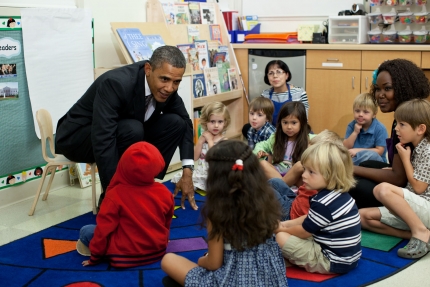
President Barack Obama at the Lab School in Mesquite, Texas

President Barack Obama tours the Lab School at Eastfield College in Mesquite, Texas, Oct. 4, 2011. (Official White House Photo by Pete Souza)

The White House today released a report that outlines the devastating impact the recession has had on schools and students across the country. Teacher Jobs at Risk highlights the significant cuts in education spending that have resulted from state budget shortfalls since 2008, including the loss of nearly 300,000 teaching jobs across the country (see chart below).

And in the coming school year, without additional support, many school districts will have to make another round of difficult decisions. As a result of state and local funding cuts, as many as 280,000 teacher jobs could be at risk. Unless they receive federal assistance, many school districts will be forced to reduce the number of teachers in their classrooms, or turn to other measures such as shortening the school year or cutting spending on schoolbooks and supplies.

President Obama, speaking today in Texas, compared the situation here with South Korea, where their President said they can’t hire teachers fast enough:

“They call them “nation builders” -- that’s what they call teachers in Korea, “nation builders,” because they know that educating their children is the best way to make sure their economy is growing, make sure that good jobs are locating there, making sure they’ve got the scientists and the engineers and the technicians who can build things and ship them all around the world. That’s what he understands. And the whole country supports him. Here in America, we’re laying off teachers in droves. It makes no sense. It has to stop. It has to stop.”

The President was at Eastfield Community College, in Mesquite, Texas where he toured a pre-school before talking about the impact the American Jobs Act will have on schools, and on teachers, across the country. He told the crowd there that the stakes for addressing this situation are high, with “nothing less than our ability to compete in this 21st century economy” at risk.

This is why one of the central components of the American Jobs Act, which the President introduced last month at a Joint Session of Congress, is funding to avoid and reverse teacher layoffs now, and to provide support for the re-hiring and hiring of educators.

Specifically, the American Jobs Act will invest $30 billion to support state and local efforts to retain, rehire, and hire early childhood, elementary, and secondary educators. If enacted, these teacher stabilization funds would help prevent layoffs and support the hiring or re-hiring of nearly 400,000 educators, includ¬ing teachers, guidance counselors, classroom assistants, afterschool personnel, tutors, and literacy and math coaches. These funds will ensure that schools are able to keep teachers in the classroom, preserve or extend the regular school day and school year, and maintain important afterschool activities.

The White House

Office of the Press Secretary

President Obama Announces More Key Administration Posts

WASHINGTON – Today, President Barack Obama announced his intent to nominate the following individuals to key Administration posts:

  • Adam Gamoran - Member, Board of Directors of the National Board for Education Sciences
  • Judith D. Singer - Member, Board of Directors of the National Board for Education Sciences
  • James Timberlake – Member, Board of Directors of the National Institute of Building Sciences

President Obama said, “These men and women have demonstrated knowledge and dedications throughout their careers.  I am grateful they have chosen to take on these important roles, and I look forward to working with them in the months and years to come.”

President Obama announced his intent to nominate the following individuals to key Administration posts:

Adam Gamoran, Nominee for Member, Board of Directors of the National Board for Education Sciences
Adam Gamoran is the John D. MacArthur Professor of Sociology and Educational Policy Studies, Director of the Wisconsin Center for Education Research, and Associate Dean for Research in the School of Education at the University of Wisconsin-Madison. He has been on the faculty of the University of Wisconsin-Madison since 1984.  Dr. Gamoran served as interim dean of the School of Education from 2008 to 2009, and from 2001 to 2004, he served as chair of the department of sociology. Dr. Gamoran is an elected member of the National Academy of Education, and he has served on several committees of the National Research Council, including the Board on Science Education.  He chairs the Independent Advisory Panel of the National Assessment of Career and Technical Education for the U.S. Department of Education, and he was appointed to the National Board for Education Sciences in 2010.  Dr. Gamoran received his B.A., M.A., and Ph.D. from the University of Chicago.

Judith D. Singer, Nominee for Member, Board of Directors of the National Board for Education Sciences
Judith D. Singer is Senior Vice Provost for Faculty Development and Diversity and James Bryant Conant Professor of Education at Harvard University. She has been a member of the Harvard University faculty since 1984.  From 1999 to 2004, she was Academic Dean of the Harvard Graduate School of Education, and was its Acting Dean from 2001 to 2002.  Ms. Singer’s scholarship focuses on improving the quantitative methods used in social, educational, and behavioral research.  Ms. Singer is an elected member of the National Academy of Education and a founding Board member of the Society for Research on Educational Effectiveness.  She has also been honored with a fellowship at the Center for Advanced Study in the Behavioral Sciences and elected to the initial class of Fellows of the American Educational Research Association.  Ms. Singer holds a B.A. in Mathematics from the State University of New York at Albany and an A.M and Ph.D. in Statistics from Harvard University.

James Timerlake, Nominee for Member, Board of Directors of the National Institute of Building Sciences
James Timberlake is a founding partner of the KieranTimberlake architecture firm.  He is the co-author of five books on architecture, including refabricating ARCHITECTURE.  In addition to his architectural practice, Mr. Timberlake teaches at the University of Pennsylvania’s School of Design, where he leads a Design Research Laboratory that works across the disciplines of architecture, material science, and construction industries.  KieranTimberlake has received the 2008 Architecture Firm Award from the American Institute of Architects (AIA) and the 2010 Cooper-Hewitt National Design Award from the Smithsonian Institution.  Mr. Timberlake also was awarded the Benjamin Latrobe Fellowship for architectural design research from the AIA College of Fellows in 2001 and the Rome Prize from the American Academy in Rome in 1982.  Mr. Timberlake received a Bachelor of Environmental Science degree from the University of Detroit, and a Master of Architecture degree from the University of Pennsylvania.

The White House

Office of the Press Secretary

Statement by the President on Congressman Jerry Costello's Retirement

“For over two decades, Jerry Costello has proudly represented the people of southwestern and southern Illinois. Born and raised in the state he now serves, Jerry has distinguished himself as a fierce advocate for improving our nation’s transportation infrastructure to ensure Illinois and the entire country are prepared to lead the way in a 21st century economy. Michelle and I want to join the people of Illinois in thanking Congressman Costello for his service, and we wish him and his family well in the future.”

The White House

Office of the Press Secretary

Remarks by the President at a DNC Event

Sheraton Hotel
Dallas, Texas

1:08 P.M. CDT

THE PRESIDENT: Thank you, everybody. (Applause.) Well, it is wonderful to see all of you. I’m not going to be long. I want to make a few brief remarks, and then just have a conversation with all of you.

A lot of folks in this room I know. A lot of you have been there for me in the past. Some of you supported me when I was running for the United States Senate. Downstairs, I was telling the story about Ron Kirk and I -- and I think you were with us, Lisa, right? Flying down from Dallas to Houston, and it was about 100 degrees, and Ron had a thick wool suit. (Laughter.) And we got out on that tarmac, and he was -- (laughter) -- dripping from head to toe. And I think on that same trip we went to Austin, and we were in somebody’s back yard, and it wasn’t that big a yard, and there were about 400 people; they had expected 50. (Laughter.) And they had to put the sprinklers on to make sure that people didn’t pass out. (Laughter.)

So I’ve got a lot of fond memories and a lot of great friends here in Texas. I want to thank Naomi and everybody who helped put this together on short notice. But I think that -- I suspect the reason we were able to do it on short notice is not only do we have relationships and friendships and common experiences to draw upon, but I think everybody here understands that the stakes are enormous in this upcoming election. They were big in 2008. I actually think they’re bigger now.

Because in 2008, we recognized that there were a series of issues that had been building up over decades, and that nobody had taken on. We hadn’t gotten a smart energy policy. We hadn’t been dealing with an education system that was inadequate. Our health care system was broken. Most importantly, middle-class families were seeing their wages and their incomes flatline even though the costs of everything were going up. And the society was becoming more unequal, and the paths for middle-class families to either stay in the middle class or get into the middle class were becoming blocked.

And what we’ve done over the last two and a half years has been to lay the foundation to take on those issues, first and foremost by making sure that we didn’t plunge into a second Great Depression, making sure that the auto industry didn’t collapse, making certain that the financial system didn’t melt down. We passed health care reform, something I’m incredibly proud of, to lay the foundation for starting to reduce costs and increase affordability for families all across the country. We put in place financial reform. But all that work that we did, we now have to implement it. We have to make sure that it’s done right.

And in the midst of this recession, you’ve got the other side that’s presenting a very different vision about where America should be. I mean, rather than acknowledge that their theories didn’t work, they doubled down. So we thought the problem with the financial system was there wasn’t enough regulation of these practices; they think we should roll back regulations and let Wall Street do whatever it wants. We thought that one of the problems that we were facing in health care was that we have 30 million people uninsured; they’re now running on the idea of making sure that 30 million people don’t have health insurance.

And because people are scared and anxious about the future, how this election shakes out is going to help determine the course of this country for a very long time. So we’ve got a lot at stake, and not just for us but for our children and our grandchildren, in terms of this election. And I’m confident that we can win, despite all the strong headwinds that are coming at us. But we’re only going to win if everybody here -- your friends, your co-workers, your neighbors, folks who are living across the country -- all of you feel the same sense of urgency that we had in 2008.

In 2008, we were running against something in part and that got a lot of people excited. It was easier to mobilize, in some ways. Now we’re running for something. We’re running for a vision of America in which middle-class families can find good jobs; in which industries are locating here and not just overseas; that we’re not just importing goods to consume, but we’re producing goods to sell all across the country.

We’re fighting for an education system that works for every child. I know the mayor is fighting for making sure that we’ve got the best infrastructure in the world; that the airports and the roads and the bridges and the broadband lines and the wireless and -- whatever it takes for us to compete in the 21st century, that that’s happening here in Dallas and that’s happening all across the country.

We’re fighting to make sure that we’ve got a tax code that is fair and just. And we want to make sure that we are closing this deficit and this debt in a responsible way, and that means everybody is chipping in. You’ve got the other side saying the big problem with the tax code right now is that poor people aren’t paying enough. That’s their argument. They’re doubling down.

And so we’ve got to make sure that we feel the same urgency in this election as we did back in 2008. Now, it won’t be as sexy as in 2008. Back then, I didn’t have any gray hair -- (laughter) -- and was all kind of fresh and new. And now I’m dinged up. (Laughter.) Gone through some battles.

But I tell you, the vision that propelled me to get into this campaign in the first place, that vision is still strong. And my enthusiasm and faith in America -- that’s unabated. I am absolutely confident that we can get through this difficult time, make the changes that are necessary, and deliver to our kids an America that is stronger and more unified and more just and more equal; where opportunity is available for everybody; where we are competitive with any country on Earth. I’m confident we can do it, but we’ve got to get this election right.

So I thank you for your support. But understand this is just the beginning. This is not the end. We’ll be coming back here. And even when I’m not here, I’m going to need you guys working. Somebody -- I think Ron was introducing Emmitt Smith and reminding everybody he holds the record for most rushing yards in the history of the NFL. And I don’t see that record being broken anytime soon.

Now, Emmitt had some spectacular runs. But I think Emmitt will be the first one to acknowledge that a whole lot of those yards, he was just grinding it out. A whole bunch of those yards, you were just -- there wasn’t anything fancy about it. You were going between tackle and guard, and there was a block, and you got four. Sometimes you got three. And sometimes it hurt going through that line. Sometimes you got one. (Laughter.) You took your knocks. But it was his persistence and his strength that allowed him to achieve that record.

Well, that’s what this campaign is going to be like. We may not be throwing the long bomb each and every time. We’re just going to have to plug away and stay at it. But if, in our hearts, we believe what we say we believe about a country that gives everybody a fair shake and asks for a fair share from everybody, if that’s really who we are, then we won’t be tired, we won’t be deterred, we won’t be weary. We’ll stick at it, and we’ll stick with it.

So I know you guys are going to be there with me. I’m grateful for you. And with that, let me just open it up for some questions and conversation. All right?

END
1:19 P.M. CDT

The White House

Office of the Press Secretary

Remarks by the President at a DNC Event

Sheraton Hotel
Dallas, Texas

12:28 P.M. CDT

THE PRESIDENT: Hello, Dallas. Thank you. Thank you, everybody. (Applause.) Thank you so much. Thank you so much, everybody. Thank you. (Applause.) Everybody please have a seat. It’s good to be back in Texas. (Applause.)

First of all, I just want to say thank you to Emmitt Smith, who the first time we had a big rally here in Dallas -- some of you may remember, it was a big auditorium -- and he had just won “Dancing with the Stars” -- (laughter) -- and he gets up there and he starts preaching. And the crowd is roaring, and he is -- and I’m thinking, is there something this guy cannot do? (Laughter.) But he was a great friend then, at a time when the campaign was still very much in doubt. He is a great friend now, and obviously one of not only the greatest athletes of all time but also just a great citizen to Dallas. So give Emmitt Smith a big round of applause. (Applause.) We are grateful to him.

It is great to be here. We made sure to schedule this game before the Rangers game. (Laughter.) I will try to wrap up before the first pitch. In addition, Emmitt, I want to thank you for sending me Ron Kirk. You guys trained him well, because he is doing a great job -- (applause) -- on behalf of all the American people, making sure that we’ve got free trade and fair trade. And he could not be a better negotiator and a better advocate.

I want to acknowledge your outstanding new mayor here in Dallas. Mike Rawlings is here. Give him a big round of applause. (Applause.) I did not say anything about the Cowboys when we landed. (Laughter.)

And I also want to acknowledge Texas Democratic state chair, Boyd Richie is here. So give Boyd a big round of applause. (Applause.)

So I’ve come here today because I need your help. I’ve come here today because we have to finish what we started in 2008.

Back then -- we began this campaign not because we thought it would be a cakewalk. Ron and I were remembering -- reminiscing a little bit about when I was still a senator, traveling with Ron, and most of the time I was flying Southwest or American. And Ron got this private plane for us to fly down to Houston. And it was about 100 degrees in July, and it turned out to be a prop plane, and we were bouncing all over the place. (Laughter.) And Ron was sweating all -- as he is prone to do sometimes. (Laughter.)

We knew that running for President was not going to be easy. You knew it. You knew it wasn’t going to be a cakewalk. After all, you supported a candidate named Barack Hussein Obama. (Laughter.) That requires a leap of faith. (Applause.) You didn’t need a poll to know that that might be challenging. (Laughter.) But we forged ahead, because we had an idea about what this country is, and what it can be.

Many of you -- many of our parents, many of our grandparents -- we grew up with a faith in an America where hard work and responsibility paid off; where if you stepped up, you did your job, you were loyal to your company, that loyalty would be rewarded with a decent salary and good benefits, a vacation once in a while, a raise, a secure retirement.

But over the last decade, that faith has been shaken. The rules changed. The deck kept being stacked up against middle-class Americans. And the truth is, nobody in Washington seemed to be willing or able to do anything about it.

And so in 2007, all this culminated in a once-in-a-lifetime economic crisis -- crisis that’s been much worse and much longer than your average recession. This is something we have not seen in our lifetimes before.

And from the moment I took office, we knew that because this crisis had been building for years, it would take years for us to fully recover. And the question is not today whether people are still hurting. Of course they’re still hurting. Every night I get letters and emails from families who are struggling. Every time I travel on the road I hear from folks who are worried. And some of the stories are heartbreaking -- men and women who had to close down a small business that’s been in a family for generations; folks who are crossing items off their grocery list so that they can fill up their gas tank and get to work; parents who are postponing their retirement so their children can go to college; and obviously folks who are looking for work, sending out resumé after resumé for month after month, and not getting a response back. And that’s scary. And it’s hard. A lot of folks are worn down out there.

So the question is not whether this country is going through tough times. You don’t need economists, you don’t need pundits, you don’t need politicians to tell you that. The question is, where are we going next? What does our future look like? Because we’re going to have a choice -- we have a choice now; we’re going to have a choice next year. We can either go back to the same tired, worn-out ideas that held sway over the last decade -- ideas that got us into this mess in the first place, ideas that corporations can write their own rules; wealthy folks, like a lot of us, get to keep all our tax breaks, and everybody else is on their own. That’s one philosophy.

Or we can decide to build the America we talked about in 2008. An America where everybody gets a fair shake and everybody does their fair share. An America where we’re thinking about how we can get ahead and how we can move forward, but also how the guy next to us, or the gal over here, can also succeed. Because we have confidence that if all of us are pulling in the same direction, then all of us are going to do better.

That’s what this election is about. That’s what we’ve been fighting for in Washington. And it has been a contest of ideas in Washington. Because the other side -- even in the midst of this crisis -- their primary answer has been no. When we wanted to save the auto industry from bankruptcy, there were a whole lot of Republicans in Congress who fought us tooth and nail; said it was a waste of time, waste of money. “Let them liquidate.”

Well, you know what? We did it anyway. And we saved hundreds of thousands of American jobs and the taxpayers paid us back. (Applause.) The taxpayers got their money back, and today the American auto industry is stronger than it’s been in years. Today they’re making fuel-efficient cars stamped with three proud words: Made in America. Because we didn’t say no, we said yes -- (applause) -- we can move forward together.

When we wanted to pass Wall Street reform to make sure a crisis like this never happens again, lobbyists and special interests spent millions to make sure we didn’t succeed. A whole bunch of Republicans said no -- despite the fact that we had just gone through the worst financial crisis in our history; despite the obvious irresponsibility that had led to a near meltdown. You know what? They said no, but we did it anyway. We passed the toughest reform in generations, reform that prevents consumers from getting ripped off by mortgage lenders and credit card companies. And today, there are no more hidden credit card fees, no more unfair rate hikes, no more deceptions from banks. (Applause.)

We decided if we’re going to be successful, we’ve got to make sure we got the best educated workforce in the world. We said, we’ve got to figure out how young people can get more access to college. Most Republicans said no. But we were able to cut $60 billion in taxpayer subsidies that were going to the big banks and use those savings to make college more affordable for millions of kids who want to go. Instead of more tax breaks for some of the biggest corporations, we cut taxes for small businesses, and for middle-class families.

The first law I signed was a bill to make sure that women got equal pay for equal work, because I want our daughters to have the same opportunities as our sons do. (Applause.) We appointed two brilliant women to the Supreme Court. (Applause.) We repealed “don’t ask, don’t tell,” so that we are not preventing people from serving this country because of who they love. (Applause.)

And, yes, we passed health care reform, because nobody in this country should go broke because they get sick. (Applause.) Millions of working folks in Texas who don’t have health insurance are going to have the opportunity to get affordable options because of what we did. And for folks who do have health insurance, your care will be stronger. Insurance companies can’t drop your coverage for no good reason. Going forward, they won’t be able to deny you coverage because of a preexisting condition.

Think about what that means. Think about what that means for a low-wage worker, who right now is worried, “If my kid gets sick, if my spouse gets sick, I may go bankrupt, I may lose everything I’ve worked for.” Now they’ve got some protection. Think about what that means for women -- breast cancer, cervical cancer, no longer preexisting conditions that can prevent you from getting insurance. They can’t discriminate you and charge higher rates just because you women are the ones who go through childbirth. They now have to cover things like mammograms and contraceptions as preventive care. No more out-of-pocket costs. (Applause.)

Insurance companies all across the country, they now have to spend 80 percent of your premium on your care, not just on profits and bonuses and advertising. (Applause.) And if they don’t do it, you’ll get a rebate. And while it will take a couple years for this reform to fully take effect, nearly 1 million young adults already have health insurance because of this bill -- 1 million more young people. That’s already happening right now. (Applause.) The Affordable Care Act is working.

And so when you -- when folks go around saying, oh, Obamacare -- that’s right, I care. I don’t know about you, but I care. (Applause.) This is the right thing to do.

I don’t know how the other side goes around running against helping 30 million people have health insurance who didn’t have it. Why is that -- why is that a -- (laughter) -- that’s your main agenda? (Laughter.) That’s your plank? Is making sure 30 million people don’t have health insurance?

Now, all of these were tough fights in Congress. And there are a lot more that we still have to win. We have a long way to go to make sure that everyone in this country gets a fair shake; that every American has the chance to get ahead. That’s why I need your help. We’ve still got to have a smarter energy policy in this country; free ourselves from dependence on foreign oil. We still have to have comprehensive immigration reform in this country. (Applause.) We’ve got to make sure that we are protecting our borders, but we’re also providing a means for people to get out of the shadows.

And, most importantly, we’ve still got to put America back to work. We’ve got to put America back to work. (Applause.) Three weeks ago, I sent Congress a bill called the American Jobs Act -- some of you might have heard of it. (Laughter.) Everything in it is the kind of proposal that’s been supported by Democrats and Republicans in the past -- everything in it. Everything in it will be paid for so it won’t add to our deficit -- ideas that have traditionally been bipartisan. It will put people back to work. It will put money back in the pockets of working people. And Congress should pass this bill right away. (Applause.)

Emmitt is a small business man working construction. We’ve got millions of construction workers who don’t have jobs right now. This bill says, let’s put these men and women to work rebuilding our roads, our bridges, modernizing our schools. I don’t want the newest airports, the fastest railroads being built in China. I want them built right here in the United States of America. (Applause.) I want them built here in Dallas, Texas. (Applause.) I don’t want our kids studying in crumbling schools. I want our kids studying in the best schools. (Applause.)

So there is work to be done. There are workers ready to do it. There are companies lined up, ready to go. Let’s tell Congress, pass this jobs bill right away. Pass this jobs bill, and we can start doing more for the education of our kids. In places like South Korea, they can’t hire teachers fast enough. I had lunch with the President of South Korea; I asked him what’s his biggest challenge. He says, man, these parents are so demanding. They want all our kids to be learning English when they’re in first grade so I’m hiring teachers -- I’m importing teachers from overseas, that’s how important this is to us. Because we know if we’re investing in the future, our kids will win the race, the 21st century.

They know that we are now competing in a global economy. So that’s what South Korea is doing. Here, we’re laying teachers off in droves. It’s unfair to our kids. It undermines our future. But if we pass this jobs bill, thousands of teachers in every state will go back to the classroom where they belong. (Applause.) We need them teaching our children. Let’s put them back to work.

Congress passes this jobs bill, companies will get tax credits for hiring America’s veterans. We ask these men and women to leave their careers, their families, to risk their lives for our country. The last thing they should have to do is fight to get a job when they come home. (Applause.)

And the American Jobs Act will cut taxes for almost every worker and every small business owner in America. It will give an extra tax cut to small businesses that are hiring additional workers, or raising their wages. We’ve got a whole bunch of folks in Congress -- a bunch of Republicans -- who say, well, we’re all about helping America’s job creators. Well don’t just talk about it. You should actually do something. Pass this jobs bill, and give those job creators a break. (Applause.)

Now, some folks in Congress have said they’re not going to support it. They can’t support a bill unless it’s paid for. And I think that is important. We’ve got a serious challenge in terms of dialing down the debt and deficits that have accumulated, not just because of this recession but because of two wars and because a prescription drug plan and tax cuts that weren’t paid for.

So I recently laid out a plan that says not only can we pay for the jobs act, we can also bring down our debt over time. This plan adds to the $1 trillion in spending cuts that I signed this summer. So this will make it one of the biggest spending cuts in history, but we do it gradually over a 10-year period and we say alongside it, let’s put people to work right now.

And what we say is in addition to spending cuts, if we want to actually close this deficit instead of just playing politics, then we’ve got to ask the wealthiest Americans, the biggest corporations to pay their fair share. (Applause.) Now, this is a pretty straightforward proposition. (Applause.)

The principle we put forward is very simple: Middle-class families shouldn’t pay higher tax rates than a billionaire. Warren Buffett’s secretary shouldn’t be paying a higher tax rate than Warren Buffett. (Applause.) In the United States of America, a nurse or a teacher or a construction worker making $50,000 shouldn’t pay higher tax rates than somebody pulling in $50 million. That’s not fair. It’s not right. It’s got to change. We’ve got a chance to change it. (Applause.)

Nobody wants to punish success in America. What’s great about our country, what’s great about Dallas, what’s great about Texas is our belief that anybody can make it if they’re working hard, if they’re trying hard; the idea that any one of us can open up a business, have a new product, a new service that can make us millions, maybe billions. That’s great. This is the land of opportunity. But we have to remember none of us succeed on our own. If we have that great idea, maybe it was planted there by that public school teacher. So we’ve got to make sure that that teacher is there for the next child. (Applause.)

We’ve got to make sure that we’ve got infrastructure that allows us to move our products and services all across the country. And in order to make sure that that opportunity is there for the next generation, those of us who have done well -- and that includes most of the people in this room -- we should pay our fair share in taxes to contribute to the nation that made our success possible. (Applause.) And you know what? I think most wealthy Americans would agree with that if it helps us grow the economy and it helps to bring down our deficits.

Now, this notion that folks are inherently selfish, that’s just not true. But you’ve got to ask them, right? (Laughter.) People don’t voluntarily pay taxes. But if you ask, most wealthy folks here in Dallas or around the country, they’ll tell you, you know what, I want to make sure that I’m doing my share for America to succeed. But somebody has got to ask.

Now, some Republicans in Congress, they’re already dusting off the old -- their old records. “That’s class warfare.” Let me tell you something, 26 years ago -- some of you may have seen this on television, clips have been circulating -- 26 years ago, another President said that some of these tax loopholes, and I quote, “made it possible for millionaires to pay nothing while a bus driver was paying 10 percent of his salary, and that’s crazy. It’s time we stopped it.” That was 26 years ago. You know the name of that President? Ronald Reagan. (Laughter.)

So was that class warfare? By the way, taxes are much lower now than they ever were when Ronald Reagan was President. I know a lot of folks have short memories, but I don’t remember Republicans accusing Ronald Reagan of being a socialist -- (laughter) -- or engaging in class warfare, because he thought that everybody should do their fair share. (Applause.)

Things have just gotten out of whack. (Laughter.) I’ll tell you what, if asking a billionaire to pay the same tax rate as a plumber or a teacher or a bus driver makes me a warrior for the middle class, I will wear that charge with honor. (Applause.) Because the only warfare I’ve seen is the battle waged against middle-class Americans for a decade now. And they’re hurting and they need some help.

This is about priorities. It’s about choices. If we want to put people back to work and close this deficit and invest in our future, then the money has got to come from somewhere. So you’ve got a choice. Would you rather keep tax loopholes for oil companies that are doing just fine? I know I’m in Texas. I know there’s a lot of oil here. (Laughter.) But they’re doing fine. They don’t need a loophole that nobody else gets. Or do you want to put our construction workers and teachers back to work?

Would you rather keep tax rates for millionaires and billionaires or do you want to invest in education and medical research and new technologies that can help create a whole new set of businesses out there for the future? Should we be asking seniors to pay thousands of dollars more in Medicare or should we ask the biggest corporations to pay their fair share? That’s what this debate is about. That’s what’s at stake right now.

This notion that the only thing we should be doing to restore prosperity is to strip away anti-pollution laws and strip away regulations on Wall Street and give tax breaks to the wealthiest few and tell everybody else, you’re on your own, good luck -- that’s not who we are. That’s not how America got built. Yes, we are rugged individualists. We are self-reliant. We value our liberty and we won’t sacrifice it merely for security. I understand that. That’s part of our DNA and it’s been the drive and initiative of our workers and our entrepreneurs that made this economy the engine and the envy of the world.

But there’s always been another thread running throughout our history, a belief that we’re all connected, that I am my brother’s keeper and my sister’s keeper, that there are some things that we can only do together as a nation. We understand that when it comes to our defense. We understand that when it comes to fire and police protection. But it’s also true when it comes to building an economy that works. That’s why Republican Presidents like Lincoln and Eisenhower, they invested in railways and highways and science and technology. That’s why this country gave millions of returning heroes, including my grandfather, the chance to go to college on the GI Bill. That’s why Michelle and I had a chance to succeed beyond our wildest dreams, because our parents, who weren’t wealthy, who weren’t famous, they lived in a country where we, together, said, you know what? Every child should have opportunity.

It’s why Michelle and I succeeded. A lot of other countries, that wouldn’t have happened. I mean, we worked hard, but -- and we were lucky -- but a lot of it had to do with the fact that the country made an investment in us. And there are a whole bunch of kids out there who are just as talented as we are -- maybe more talented -- have just as much drive, just as much ambition. Are we going to be there for them?

No single individual built America on their own. We built it together. Don’t believe the hype. Don’t believe some of the chatter that you hear, that somehow government had no role to play. We built this thing together. We are one nation under God, indivisible, with liberty and justice for all. But we are also a nation that has responsibilities to ourselves and to one another. And it’s time for us to meet those responsibilities right now.

And maybe some people in Congress would rather wait until the election to settle our differences, and I promise you, I will be ready for that election. I will be ready for that debate. (Applause.) I am happy to have a debate before the American people, because I believe that the American people understand that we’re in this together.

So I’m eager to have that debate. But the next election is 13 months away. The American people don’t have the luxury of waiting that long. A lot of folks are living week to week, paycheck to paycheck, day to day. They need action, and they need it now.

So I appreciate all of you coming here in support of the campaign, but I need you to speak out now. I need you to lift up your voices and help us out. I’m asking you to put some pressure on Congress, and let them know that we’ve got work to do. (Applause.) And join me in finishing what we started in 2008; let’s keep building an America that we believe in -- a place where everybody has a fair shake and everybody does their fair share.

Dallas, we are not a nation that just sits back and waits for things to happen to us. We make things happen. We’re Americans. We are tough and we are resilient, and I am absolutely confident about our future, because I believe we are tougher than the times we live in and we are bigger than the politics that we’ve been seeing.

But we’ve got to get out there and work. We’ve got to shape our own destiny. It is fully within our power, but I’m going to need your help.

So let’s seize this moment. Let’s get to work. Let’s show them why the United States of America is the greatest country on Earth.

Thank you, everybody. God bless you. Thank you. (Applause.)

END
12:58 P.M. CDT

The White House

Office of the Press Secretary

Presidential Memorandum -- Child Soldiers Prevention Act of 2008

Presidential Determination
No. 2012-01

MEMORANDUM FOR THE SECRETARY OF STATE

SUBJECT: Certification and Determination with Respect to the Child Soldiers Prevention Act of 2008

Pursuant to section 404 of the Child Soldiers Prevention Act of 2008 (CSPA) (title IV, Public Law 110-457), I hereby: certify that the Government of Chad has implemented measures that include an action plan and actual steps to come into compliance with the standards outlined in the CSPA, and has implemented policies and mechanisms to prohibit and prevent future government or government-supported use of child soldiers and to ensure that no children are recruited, conscripted,or otherwise compelled to serve as child soldiers.

I hereby determine that it is in the national interest of the United States to waive the application of the prohibition in section 404(a) of the CSPA with respect to Yemen; and further determine that it is in the national interest of the United States to waive in part the application of the prohibition in section 404(a) of the CSPA with respect to the Democratic Republic of the Congo, to allow for continued provision of International Military Education and Training and non-lethal Excess Defense Articles, and issuance of licenses for direct commercial sales of military equipment; and I hereby waive such provisions accordingly.

You are authorized and directed to submit this determination to the Congress, along with the accompanying Memorandum of Justification, and to publish the determination in the Federal Register.

BARACK OBAMA

President Obama on Retaining Teachers and the American Jobs Act

October 04, 2011 | 30:22 | Public Domain

While touring a Texas Community College the President discusses the devastating effect state budget cuts have had on schools across the country.

Download mp4 (290MB) | mp3 (28MB)

Read the Transcript

Remarks by the President on the American Jobs Act

Eastfield College
Mesquite, Texas

2:47 P.M. CDT

THE PRESIDENT:  Hello, Dallas!  Thank you so much.  Thank you, everybody.  Please have a seat, have a seat.  (Applause.)  Thank you.

It’s good to be back in Texas.  (Applause.)  It is good to be back in Texas.  I am thrilled to have the opportunity to be with all of you.

I want to thank a couple of people.  First of all, the mayor of Mesquite, John Monaco is here.  (Applause.)  And the mayor of Dallas, Mike Rawlings is in the house.  (Applause.)  And I want to thank the former mayor of Dallas, who I stole from you to be one of the best trade representatives this country has ever had -- my dear friend Ron Kirk is in the house.  (Applause.)

I also want to thank -- I want to thank the folks over at the Children’s Lab School, who gave me a tour, and I want to especially thank Kim Russell for sharing her story.  Thank you, Kim.  (Applause.)

Now, teachers like Kim are why I came here today.  Teachers like Kim and her former students.  That’s why I’ve been traveling all across this country for the last few weeks.  These are the toughest times we’ve been through since the Great Depression.  And because the problems that led to the recession weren’t caused overnight, they won’t be solved overnight.  That’s the hard truth.  It took us a decade to see the culmination of some of the bad ideas that had been put into place -- the lack of regulation on Wall Street, middle-class folks struggling.

So we’re not going to solve all those problems overnight.  But that doesn’t mean we have to sit back and do nothing about this economy.  There are steps we can take right now to put people back to work.  There are steps we can take right now to put money in the pockets of working Americans.  There are things we can do right now to restore some of the security and fairness that has always defined this great country of ours.  And that’s what will happen if this Congress will finally get its act together and pass the American Jobs Act.  (Applause.)

It has now been three weeks since I sent this bill to Congress.  It’s a detailed plan to get this economy moving.  It’s the kind of proposals that, in the past, Democrats and Republicans have supported.  There’s nothing radical in this proposal.  These are the kinds of things that in the past we’ve had bipartisan support for.  It’s fully paid for.  And that’s why I need you to help me convince the people you sent to Washington that it’s time to pass this jobs bill and get America working again.  (Applause.)

Now, you just heard Kim’s story.  There are teachers and educators like Kim all over the country.  I met a first-grade teacher from Minnesota at the White House who was laid off after having been named the Teacher of the Year in her school district.  Her peers, students, determined she was the best teacher in her school district -- she got laid off.  There’s a teacher over in Grand Prairie, Texas, who actually chose to resign in order to protect the job of a single mom who also taught at the school.  Think about that.  Here in Dallas, all across the state of Texas, you’ve seen too many teachers lose their jobs because of budget cuts.  And thousands more could be at risk in the coming year.

Now, understand, this doesn’t just hurt these teachers.  It doesn’t just hurt them and their families.  It hurts our children.  It undermines our future as a nation.  If you’ve got Kim, an AP teacher, not in the classroom, those kids aren’t going to have the same opportunities.  And I want everybody to understand that what is at stake is nothing less than our ability to compete in this 21st century economy.

I told the story -- a while back I was visiting South Korea and had lunch with the President there.  And I asked the President, I said, what’s your biggest challenge right now?  He said, well, my biggest challenge is our parents are way too demanding.  He said, they want their kid to learn English when they’re in first grade.  So in addition to all the science and all the math classes, I’m now having to ship in teachers from outside the country just to teach our kids English, starting in elementary school.  This is what the President of South Korea said. 

They can’t hire teachers fast enough.  They call them “nation builders” -- that’s what they call teachers in Korea, “nation builders,” because they know that educating their children is the best way to make sure their economy is growing, make sure that good jobs are locating there, making sure they’ve got the scientists and the engineers and the technicians who can build things and ship them all around the world.  That’s what he understands.  And the whole country supports him.  Here in America, we’re laying off teachers in droves.  It makes no sense.  It has to stop.  It has to stop.  (Applause.) 

Now, this bill will prevent up to 280,000 teachers from losing their jobs.  (Applause.)  This bill will support almost 40,000 jobs right here in the great state of Texas.  (Applause.)  So here’s what I need you to do:  Tell Congress to pass this bill and put teachers back in the classroom where they belong.  (Applause.) 

It’s not just teachers.  Tell Congress to pass the American Jobs Act, and there also will be funding to save the jobs of firefighters and police officers and first responders who risk their lives to keep us safe.  That’s what happens if they pass this bill.  (Applause.) 

Pass this jobs bill, and hundreds of thousands of unemployed construction workers will get back on the job rebuilding our schools, rebuilding our roads, rebuilding our bridges, rebuilding our ports, rebuilding our airports.  The other day I visited a busy bridge in Ohio -- actually it’s between Ohio and Kentucky.  Speaker Boehner, he’s from Ohio; Republican Leader McConnell is from Kentucky.  I thought it would be a good place to have an event.  (Laughter.)  This bridge is classified as functionally obsolete.  That’s a fancy way of saying it’s old and needs to be fixed.  (Laughter.) 

There’s a public transit project in Houston that would help clear up one of the worst areas of traffic in the country.  There are schools all over this country that are literally falling apart -- roof crumbling, rain dripping in, too hot in the summer, too cold in the winter, science labs all worn out, got a couple of beakers and that’s it, built back in the ‘50s before the Internet was invented.  (Laughter.)  

That’s an outrage.  Understand, America became an economic superpower in part because we had the best infrastructure.  We built the transcontinental railroad, the Interstate Highway System, the Hoover Dam, Grand Central Station.  How can we sit back and now we’re seeing China build better airports than us, Europe build better railroads than us, Korea more broadband access than us -- at a time when millions of unemployed construction workers could be building all that stuff right here in the United States of America.  (Applause.) 

My question to Congress is, what are you waiting for?  The work is there to be done.  There are workers ready to do it.  Contractors, they’re begging for work.  They’ll come in on time, under budget.  Interest rates have never been lower.  It is time for us to put those folks back to work.  It’s time for them to pass the American Jobs Act.  Pass this bill.  (Applause.)

If Congress passes this jobs bill, new companies will get new tax credits for hiring America’s veterans.  Think about it.  We ask these men and women to leave their families, disrupt their careers, risk their lives for our nation.  The last thing they should have to do is to fight for a job when they come home.  (Applause.)  

Tell Congress pass this bill so we can help the people who create most of the new jobs in this country:  America’s small businesses.  Folks in the other party, they like to talk a good game about helping America’s job creators.  “Let’s help America’s job creators.”  Okay, let’s do that.  This jobs bill provides tax cuts for nearly every small business in America.  If you hire new employees, or raise your workers’ wages, you get an extra tax cut.  (Applause.)  So my message to Congress is, don’t just talk about helping job creators; actually help some job creators by passing this bill.  (Applause.)

Here’s another reason why they need to pass this bill.  On January 1st, if nothing is done, everybody here is going to get a tax hike. 

AUDIENCE:  Booo!  (Laughter.) 

THE PRESIDENT:  That’s right.  See, back in December, I got an agreement with the Republicans to lower the payroll tax so that there would be more money in folks’ pockets and we could protect ourselves against recession.  Now, since that time, we’ve had a tsunami in Japan; we’ve had the Arab Spring, which shot up gas prices.  We’ve had problems in Europe.  And so the economy has gotten weaker.

That tax cut is scheduled to expire by the end of this year.  But if the American Jobs Act passes, the typical working family in Texas will have an extra $1,400 in their pockets.  (Applause.)  Now, if the bill doesn’t pass, virtually every worker in America will see their taxes go up -- at the worst possible time.

So I’m not about to let that happen, Texas.  (Applause.)  Look, Republicans say they’re the party of tax cuts.  Tell them to prove it.  Tell them to fight just as hard for tax cuts for working Americans as they do for the wealthiest Americans.  (Applause.)  Pass this bill.

Now, what you’ll hear from some of these folks is, well, we’re not going to support any new spending that’s not paid for.  All right, I agree with that.  I think that’s important.  So I laid out a plan to pay for the American Jobs Act, and then some -- a plan that not only pays for the bill to put folks back to work to raise our growth rate, but to also pay down more of our debt over time.  It builds on the $1 trillion in spending cuts that I already signed this summer, making it one of the biggest spending cuts in history.

So, look, I believe we’ve got to make cuts in programs that don’t work and things that aren’t helping the economy grow so we can pay for the things that are.  Right?  (Applause.)  We all believe that a government needs to live within its means.  We all agree with that.  But we also believe that how you bring down the deficit is important.  If we want to actually close the deficit -- not just talk about closing the deficit, not just using it for a campaign slogan, not just playing politics -- if we want to actually close the deficit, then you’ve got to combine the tough cuts with a strategy to ask the wealthiest Americans and the biggest corporations to do their part, to pay their fair share.  (Applause.) 

Look, I’m not telling you anything you don’t know.  Do you really think the tax code is written for you?

AUDIENCE:  No!

THE PRESIDENT:  You think the tax code -- maybe you’ve got a bunch of lobbyists in Washington.  Maybe you’ve got a bunch of special interests in there in the back rooms trying to carve something out -- I don’t know.  But most folks don’t.  So the tax code, the way it’s structured, is not fair.  And so what we’ve said is, let’s reform our tax code based on a very simple principle, and it will raise more money without hurting working families.  Here’s the principle:  Middle-class families, working families, should not pay higher tax rates than millionaires or billionaires.  (Applause.)  I don’t know how you argue against that; seems pretty straightforward to me.  Warren Buffett’s secretary shouldn’t pay a higher tax rate than Warren Buffett.  (Applause.) 

Now, when I point this out -- it seems very logical to me, but when I point this out, some of the Republicans in Congress, they say, oh, you’re engaging in class warfare.  Class warfare?  Let me tell you something.  Years ago, a great American had a different view.  All right?  I’m going to get the quote just so you know I’m not making this up.  (Laughter.)  Great American, said that he thought it was “crazy” that certain tax loopholes made it possible for millionaires to pay nothing, while a bus driver was paying 10 percent of his salary.  All right?

You know who this guy was?  Wasn’t a Democrat.  Wasn’t some crazy socialist.  It was Ronald Reagan.  (Applause.)  It was Ronald Reagan.  Last time I checked, Republicans all thought Reagan made some sense.  (Laughter.)  So the next time you hear one of those Republicans in Congress accusing you of class warfare, you just tell them, I’m with Ronald Reagan.  (Laughter.)  I agree with Ronald Reagan that it’s crazy that a bus driver pays a higher tax rate than a millionaire because of some loophole in the tax code.  (Applause.)  

And by the way, I don’t mind being called a warrior for the working class.  You guys need somebody fighting for you.  (Applause.)  The only warfare I’ve been seeing is the war against middle-class families and their ability to get ahead in this economy. 

And let me make one last point, because you’ll hear this argument made:  This is not about trying to punish success.  This is the land of opportunity.  And what’s great about our country is our belief that anybody can succeed.  You’ve got a good idea?  Go out there and start a new business.  You’ve got a great product?  You invented something?  I hope you make millions of dollars.  We want to see more Steve Jobs and more Bill Gates -- creating value, creating jobs.  That’s great.

Your current mayor did great work in the private sector creating jobs, creating value.  That’s important.  But remember, nobody got there on their own.  I’m standing here today, Michelle is standing here today -- or Michelle’s not standing here today -- (laughter) -- but I know you wish she was.  I’m standing here today, Michelle -- we always remind ourselves, the reason we’ve had this extraordinary opportunity is because somewhere along the line, some teacher helped us.  Somewhere along the line, we got a student loan.  We lived in a country that could move products and services everywhere.  We lived in a country where if there’s a fire, somebody comes and puts out the fire.  If you’re burglarized, somebody is coming to try to solve the crime.  I’m sure the mayor of Dallas feels the same way.  We’re here because somebody laid the foundation for success.  So the question is, are we going to maintain that foundation and strengthen that foundation for the next generation?

And this is all about priorities.  This is about choices.  If we want to actually lower the deficit and put people back to work -- if we want to invest in our future, if we want to have the best science, the best technology, the best research, we want to continue to be inventing new drugs to solve cancer and making sure that the new cars of the future that are running on electricity are made here in America -- if we want to do all those things, then the money has got to come from somewhere.  I wish I could do it all for free.  I wish I could say to all of you, you don’t have to pay any taxes and companies can keep all their stuff and rich people don’t have to do anything, and somehow it all works out.  

But you know what, we tried it and it didn’t work.  So now you’ve got a choice.  Would you rather keep tax loopholes for big corporations that don’t need it?  Or would you rather put construction workers back to work rebuilding our schools and our roads and our bridges?  (Applause.)  Would you rather I keep a tax break that I don’t need and wasn’t looking for, didn’t ask for and if I don’t have it, I won’t miss it?  Or do you want to put teachers like Kim back to work and help small businesses and cut taxes for middle-class families?  (Applause.)  This is a choice that we’ve got to make. 

And I believe, and I think you believe, it’s time we build an economy that creates good, solid, middle-class jobs in this country.  It’s time to build an economy that values the -- that honors the values of hard work and responsibility.  It’s time for us to build an economy that lasts, that’s not just based on speculation and financial shenanigans, but rather is based on us making stuff and selling things to other people around the world instead of just importing from all around the world.  (Applause.)  That’s the America I believe in.  That’s the America you believe in. 

And, Dallas, that starts now.  That starts with your help.  Yesterday, the Republican Majority Leader in Congress, Eric Cantor, said that right now he won’t even let this jobs bill have a vote in the House of Representatives. 

AUDIENCE:  Booo!

THE PRESIDENT:  This is what he said.  Won’t even let it be debated.  Won’t even give it a chance to be debated on the floor of the House of Representatives.  Think about that.  I mean, what’s the problem?  Do they not have the time?  (Laughter.)  They just had a week off.  (Laughter.)  Is it inconvenient? 

Look, I’d like Mr. Cantor to come down here to Dallas and explain what exactly in this jobs bill does he not believe in.  What exactly is he opposed to? 

Does he not believe in rebuilding America’s roads and bridges?  Does he not believe in tax breaks for small businesses, or efforts to help our veterans? 

Mr. Cantor should come down to Dallas and look Kim Russell in the eye and tell her why she doesn’t deserve to be back in the classroom doing what she loves, helping our kids.  Come tell her students why they don’t deserve to have their teacher back.

Come tell Dallas construction workers why they should be sitting idle instead of out there on the job.

Tell small business owners and workers in this community why you’d rather defend tax breaks for folks who don’t need them -- for millionaires -- rather than tax cuts for middle-class families.

And if you won’t do that, at least put this jobs bill up for a vote so that the entire country knows exactly where members of Congress stand.  (Applause.) 
Put your cards on the table.  I realize that some Republicans in Washington are resistant, partly because I proposed it.  (Laughter and applause.)  I mean, they -- if I took their party platform and proposed it, they’d suddenly be against it.  (Laughter.)

We’ve had folks in Congress who have said they shouldn’t pass this bill because it would give me a win.  So they’re thinking about the next election.  They’re not thinking about folks who are hurting right now.  They’re thinking, well, how is that going to play in the next election?

Give me a win?  Give me a break!  (Laughter.)  That’s why folks are fed up with Washington.  (Applause.)  This isn’t about giving me a win.  This isn’t about giving Democrats or Republicans a win.  This is about giving people who are hurting a win.  (Applause.)  This is about giving small business owners a win, and entrepreneurs a win, and students a win, and working families a win.  This is about giving America a win.  (Applause.)

Dallas, the next election is 13 months away.  The American people don’t have the luxury of waiting 13 months.  A lot of folks are living week to week; some are living paycheck to paycheck; some folks are living day to day.  (Applause.)  They need action on jobs, and they need it now.  They want Congress to do what they were elected to do.  They want Congress to do their job.  Do your job, Congress!  (Applause.)

I need you all to lift your voice -- (applause)  –-  not just here in Dallas, but anyone watching, anyone listening, everybody following online.  I need you to call and tweet and fax and visit and email your congressperson and tell them the time for gridlock and games is over.  The time for action is now.  (Applause.)

Tell them that if you want to create jobs -- pass this bill.  (Applause.)

If you want to put teachers back in the classroom -- pass this bill.  (Applause.)

If you want construction workers back on the job -- pass this bill.  (Applause.)

If you want tax cuts for the middle class and small business owners -- pass this bill. 

You want to help some veterans?  Pass this bill.  (Applause.)

Now is the time to act.  We are not people who sit back in tough times.  We step up in tough times.  We make things happen in tough times.  (Applause.)  We’ve been through tougher times before, and we got through them.  We’re going to get through these to a brighter day, but we’re going to have to act.  God helps those who help themselves.  We need to help ourselves right now. 

Let’s get together.  Let’s get to work.  Let’s get busy.  Let’s pass this bill.  Let’s make sure that we are shaping a destiny for our children that we are proud of, and let’s remind the entire world why the United States of America is the greatest nation on the planet.  (Applause.) 

God bless you.  God bless the United States of America.  (Applause.)

                   END                 3:18 P.M. CDT

Close Transcript

The White House

Office of the Press Secretary

Message from the President to Congress Regarding the District of Columbia's 2012 Budget Request Act

TO THE CONGRESS OF THE UNITED STATES:

Pursuant to my constitutional authority and as contemplated by section 446 of the District of Columbia Self-Government and Governmental Reorganization Act as amended in 1989, I am transmitting the District of Columbia's 2012 Budget Request Act. This transmittal does not represent an endorsement of the contents of the D.C. government's requests.

The proposed 2012 Budget Request Act reflects the major programmatic objectives of the Mayor and the Council of the District of Columbia. For 2012, the District estimates total revenues and expenditures of $10.9 billion.

BARACK OBAMA

THE WHITE HOUSE,
October 3, 2011.