The White House

Office of the Press Secretary

Memorandum from the President Regarding the Provision of Aviation Insurance Coverage for Commercial Air Carrier Service in Domestic and International Operations

MEMORANDUM FOR THE SECRETARY OF TRANSPORTATION

SUBJECT: Provision of Aviation Insurance Coverage for Commercial Air Carrier Service in Domestic and International Operations

By the authority vested in me as President by the Constitution and the laws of the United States, including 49 U.S.C. 44301 – 44310, I hereby:

1. Determine that the continuation of U.S. commercial air transportation is necessary in the interest of air commerce, national security, and the foreign policy of the United States.

2. Approve the provision by the Secretary of Transportation of insurance or reinsurance to U.S. air carriers against loss or damage arising out of any risk from the operation of an aircraft in the manner and to the extent provided in chapter 443 of title 49 of the U.S. Code until September 30, 2012, when he determines such insurance or reinsurance cannot be obtained on reasonable terms and conditions from any company authorized to conduct an insurance business in a State of the United States.

You are directed to bring this determination immediately to the attention of all air carriers, as defined in 49 U.S.C. 40102(a)(2), and to arrange for its publication in the Federal Register.

BARACK OBAMA

President Obama’s Third Annual Back to School Speech

September 28, 2011 | 22:09 | Public Domain

Tells America’s High School Students that They Are America’s Future.

Download mp4 (212MB) | mp3 (20MB)

Read the Transcript

Remarks by the President in Back-to-School Speech

Benjamin Banneker High School
Washington, D.C.

1:48 P.M. EDT

THE PRESIDENT:  Thank you.  (Applause.)  Thank you very much.  Everybody, please have a seat.  Well, Madam President, that was an outstanding introduction.  (Laughter.)  We are so proud of Donae for representing this school so well. 

And in addition, I also want to acknowledge your outstanding principal, who has been here for 20 years -- first as a teacher, now as an outstanding principal -- Anita Berger.  Please give her a big round of applause.  (Applause.)  I want to acknowledge, as well, Mayor Gray is here -- the mayor of Washington, D.C. is here.  Please give him a big round of applause.  (Applause.)  And I also want to thank somebody who is going to go down in history as one of the finest Secretaries of Education that we’ve ever had -- Arne Duncan is here.  (Applause.)   

Now, it is great to be here at Benjamin Banneker High School, one of the best high schools not only in Washington, D.C., but one of the best high schools in the country.  (Applause.)  But we’ve also got students tuning in from all across America.  And so I want to welcome you all to the new school year, although I know that many of you already have been in school for a while.  I know that here at Banneker, you’ve been back at school for a few weeks now.  So everything is starting to settle in, just like for all your peers all across the country.  The fall sports season is underway.  Musicals and marching band routines are starting to shape up, I believe.  And your first big tests and projects are probably just around the corner.  

I know that you’ve also got a great deal going on outside of school.  Your circle of friends might be changing a little bit.  Issues that used to stay confined to hallways or locker rooms are now finding their way onto Facebook and Twitter.  (Laughter.)  Some of your families might also be feeling the strain of the economy.  As many of you know, we’re going through one of the toughest economic times that we’ve gone through in our lifetime -- in my lifetime.  Your lifetime hasn’t been that long.  And so, as a consequence, you might have to pick up an after-school job to help out your family, or maybe you’re babysitting for a younger sibling because mom or dad is working an extra shift. 

So all of you have a lot on your plates.  You guys are growing up faster and interacting with a wider world in a way that old folks like me, frankly, just didn’t have to.  So today, I don’t want to be just another adult who stands up and lectures you like you’re just kids -- because you’re not just kids.  You’re this country’s future.  You’re young leaders.  And whether we fall behind or race ahead as a nation is going to depend in large part on you.  So I want to talk to you a little bit about meeting that responsibility. 

It starts, obviously, with being the best student that you can be.  Now, that doesn’t always mean that you have to have a perfect score on every assignment.  It doesn’t mean that you’ve got to get straight As all the time -- although that’s not a bad goal to have.  It means that you have to stay at it.  You have to be determined and you have to persevere.  It means you’ve got to work as hard as you know how to work.  And it means that you’ve got to take some risks once in a while.  You can’t avoid the class that you think might be hard because you’re worried about getting the best grade if that’s a subject that you think you need to prepare you for your future.  You’ve got to wonder.  You’ve got to question.  You’ve got to explore.  And every once in a while, you need to color outside of the lines. 

That’s what school is for:  discovering new passions, acquiring new skills, making use of this incredible time that you have to prepare yourself and give yourself the skills that you’re going to need to pursue the kind of careers that you want.  And that’s why when you’re still a student you can explore a wide range of possibilities.  One hour you can be an artist; the next, an author; the next, a scientist, or a historian, or a carpenter.  This is the time where you can try out new interests and test new ideas.  And the more you do, the sooner you’ll figure out what makes you come alive, what stirs you, what makes you excited -- the career that you want to pursue. 

Now, if you promise not to tell anybody, I will let you in on a little secret:  I was not always the very best student that I could be when I was in high school, and certainly not when I was in middle school.  I did not love every class I took.  I wasn’t always paying attention the way I should have.  I remember when I was in 8th grade I had to take a class called ethics.  Now, ethics is about right and wrong, but if you’d ask me what my favorite subject was back in 8th grade, it was basketball.  I don’t think ethics would have made it on the list. 

But here’s the interesting thing.  I still remember that ethics class, all these years later.  I remember the way it made me think.  I remember being asked questions like:  What matters in life?  Or, what does it mean to treat other people with dignity and respect?  What does it mean to live in a diverse nation, where not everybody looks like you do, or thinks like you do, or comes from the same neighborhood as you do?  How do we figure out how to get along? 

Each of these questions led to new questions.  And I didn’t always know the right answers, but those discussions and that process of discovery -- those things have lasted.  Those things are still with me today.  Every day, I’m thinking about those same issues as I try to lead this nation.  I’m asking the same kinds of questions about, how do we as a diverse nation come together to achieve what we need to achieve?  How do we make sure that every single person is treated with dignity and respect?  What responsibilities do we have to people who are less fortunate than we are?  How do we make sure that everybody is included in this family of Americans?

Those are all questions that date back to this class that I took back in 8th grade.  And here’s the thing:  I still don’t always know the answers to all these questions.  But if I’d have just tuned out because the class sounded boring, I might have missed out on something that not only did I turn out enjoying, but has ended up serving me in good stead for the rest of my life.

So that’s a big part of your responsibility, is to test things out.  Take risks.  Try new things.  Work hard.  Don’t be embarrassed if you’re not good at something right away.  You’re not supposed to be good at everything right away.  That’s why you’re in school.  The idea, though, is, is that you keep on expanding your horizons and your sense of possibility.  Now is the time for you to do that.  And those are also, by the way, the things that will make school more fun.

Down the road, those will be the traits that will help you succeed, as well -- the traits that will lead you to invent a device that makes an iPad look like a stone tablet.  Or what will help you figure out a way to use the sun and the wind to power a city and give us new energy sources that are less polluting.  Or maybe you’ll write the next great American novel. 

Now, to do almost any of those things, you have to not only graduate from high school, -- and I know I’m just -- I’m in the "amen" corner with Principal Berger here -- not only do you have to graduate from high school, but you’re going to have to continue education after you leave.  You have to not only graduate, but you’ve got to keep going after you graduate. 

That might mean, for many of you, a four-year university.  I was just talking to Donae, and she wants to be an architect, and she’s interning with a architectural firm, and she’s already got her sights set on what school she wants to go to.  But it might, for some other folks, be a community college, or professional credentialing or training.  But the fact of the matter is, is that more than 60 percent of the jobs in the next decade will require more than a high school diploma -- more than 60 percent.  That’s the world you’re walking into.

So I want all of you to set a goal to continue your education after you graduate.  And if that means college for you, just getting into college is not enough.  You also have to graduate.  One of the biggest challenges we have right now is that too many of our young people enroll in college but don’t actually end up getting their degree, and as a consequence -- our country used to have the world’s highest proportion of young people with a college degree; we now rank 16th.  I don't like being 16th.  I like being number one.  That’s not good enough.  So we’ve got to use -- we’ve got to make sure your generation gets us back to the top of having the most college graduates relative to the population of any country on Earth.

If we do that, you guys will have a brighter future.  And so will America.  We’ll be able to make sure the newest inventions and the latest breakthroughs happen right here in the United States of America.  It will mean better jobs, and more fulfilling lives, and greater opportunities not only for you, but also for your kids. 

So I don’t want anybody who’s listening here today to think that you’re done once you finish high school.  You are not done learning.  In fact, what’s happening in today’s economy is -- it’s all about lifelong learning.  You have to constantly upgrade your skills and find new ways of doing things.  Even if college isn't for you, even if a four-year college isn't for you, you’re still going to have to get more education after you get out of high school.  You’ve got to start expecting big things from yourself right now.

I know that may sound a little intimidating.  And some of you may be wondering how you can pay for college, or you might not know what you want to do with your life yet.  And that’s okay.  Nobody expects you to have your entire future mapped out at this point.  And we don't expect you to have to make it on your own.  First of all, you’ve got wonderful parents who love you to death and want you to have a lot more opportunity than they ever had -- which, by the way, means don’t give them a hard time when they ask you to turn off the video games, turn off the TV and do some homework.  You need to be listening to them.  I speak from experience because that’s what I’ve been telling Malia and Sasha.  Don’t be mad about it, because we’re thinking about your future.

You’ve also got people all across this country -- including myself and Arne and people at every level of government -- who are working on your behalf.  We’re taking every step we can to ensure that you’re getting an educational system that is worthy of your potential.  We’re working to make sure that you have the most up-to-date schools with the latest tools of learning.  We’re making sure that this country’s colleges and universities are affordable and accessible to you.  We’re working to get the best class -- teachers into the classroom as well, so they can help you prepare for college and a future career.     

Let me say something about teachers, by the way.  Teachers are the men and women who might be working harder than just about anybody these days.  (Applause.)  Whether you go to a big school or a small one, whether you attend a public or a private or charter school –- your teachers are giving up their weekends; they’re waking up at dawn; they’re cramming their days full of classes and extra-curricular activities.   And then they’re going home, eating some dinner, and then they’ve got to stay up sometimes past midnight, grading your papers and correcting your grammar, and making sure you got that algebra formula properly.

And they don’t do it for a fancy office.  They don’t -- they sure don’t do it for the big salary.  They do it for you.  They do it because nothing gives them more satisfaction than seeing you learn.  They live for those moments when something clicks; when you amaze them with your intellect or your vocabulary, or they see what kind of person you’re becoming.  And they’re proud of you.  And they say, I had something to do with that, that wonderful young person who is going to succeed.  They have confidence in you that you will be citizens and leaders who take us into tomorrow.  They know you’re our future.  So your teachers are pouring everything they got into you, and they’re not alone. 

But I also want to emphasize this:  With all the challenges that our country is facing right now, we don’t just need you for the future; we actually need you now.  America needs young people’s passion and their ideas.  We need your energy right now.  I know you’re up to it because I’ve seen it.  Nothing inspires me more than knowing that young people all across the country are already making their marks.  They’re not waiting.  They’re making a difference now. 

There are students like Will Kim from Fremont, California, who launched a nonprofit that gives loans to students from low-income schools who want to start their own business.  Think about that.  So he’s giving loans to other students.  He set up a non-for-profit.  He’s raising the money doing what he loves -- through dodgeball tournaments and capture-the-flag games.  But he’s creative.  He took initiative.  And now he’s helping other young people be able to afford the schooling that they need.

There is a young man, Jake Bernstein, 17 years old, from a military family in St. Louis, worked with his sister to launch a website devoted to community service for young people.  And they’ve held volunteer fairs and put up an online database, and helped thousands of families to find volunteer opportunities ranging from maintaining nature trails to serving at local hospitals.

And then last year, I met a young woman named Amy Chyao from Richardson, Texas.  She’s 16 years old, so she’s the age of some of you here.  During the summer, I think because somebody in her family had an illness, she decided that she was interested in cancer research.  She hadn’t taken chemistry yet, so she taught herself chemistry during the summer.  And then she applied what she had learned and discovered a breakthrough process that uses light to kill cancer cells.  Sixteen years old.  It’s incredible.  And she's been approached by some doctors and researchers who want to work with her to help her with her discovery. 

The point is you don’t have to wait to make a difference.  You’re first obligation is to do well in school.  You’re first obligation is to make sure that you’re preparing yourself for college and career.  But you can also start making your mark right now.  A lot of times young people may have better ideas than us old people do anyway.  We just need those ideas out in the open, in and out of the classroom. 

When I meet young people like yourselves, when I sat and talk to Donae, I have no doubt that America’s best days are still ahead of us, because I know the potential that lies in each of you.  Soon enough, you will be the ones leading our businesses and leading our government.  You will be the one who are making sure that the next generation gets what they need to succeed.  You will be the ones that are charting the course of our unwritten history.  And all that starts right now -- starts this year. 

So I want all of you who are listening, as well as everybody here at Banneker, I want you to make the most of the year that’s ahead of you.  I want you to think of this time as one in which you are just loading up with information and skills, and you’re trying new things and you’re practicing, and you’re honing -- all those things that you’re going to need to do great things when you get out of school. 

Your country is depending on you.  So set your sights high.  Have a great school year.  Let’s get to work.

Thank you very much, everybody.  God bless you.  God bless the United States of America.  (Applause.) 

END
2:06 P.M. EDT

Close Transcript

Open for Questions with President Obama

September 28, 2011 | 50:58 | Public Domain

President Obama participates in an "Open for Questions" roundtable responding to questions from readers of Yahoo!, MSN Latino, AOL Latino and HuffPost LatinoVoices on issues that matter most to the Hispanic community and all Americans.

Download mp4 (486MB) | mp3 (47MB)

Read the Transcript

Remarks by the President in an "Open for Questions" Roundtable

Map Room

11:40 A.M. EDT

MR. SIADE:  Ladies and gentlemen, señores y señoras, welcome to "Open for Questions with President Obama."  I'm Jose Siade from Yahoo Español -- your host today, coming to you from the White House.  I'm honored to be joined by industry colleagues Karine Medina from MSN Latino, and Gabriel Lerner from AOL Latino and Huff-Post Latino Voices.

And sitting next to me, a man that needs no introduction, President Barack Obama.

THE PRESIDENT:  Thank you so much, Jose.  Thank you for having me.

MR. SIADE:  Thank you very much, sir, for sitting down with us today.  We received hundreds of questions from our audience -- from our U.S. Hispanic audience across the country.  And we've brought some of those questions in today so you can address them.

THE PRESIDENT:  Excellent.  Look forward to it.

MR. SIADE:  Very well.  Let's jump into the first question  -- from Claudia in California:  President Obama, there are many illegal aliens currently in the U.S. that can contribute much to the country and cannot do so because of their status.  What are you currently doing and what still needs to be done in order to reform immigration laws and solve this issue?

THE PRESIDENT:  Well, I appreciate this, Jose.  Obviously this is an issue that I've been working on for years.  When I was in the U.S. Senate, I was a cosponsor of comprehensive immigration reform.  I have voted for comprehensive immigration reform.  And our administration consistently has supported the basic concept that we are a nation of laws but we're also a nation of immigrants, and that immigrants continually have strengthened America's economy, America's culture, and that we have to create a system that works for all of us.

The way to do that is to be serious about border security -- and we have been.  We've put more resources in border security than anything that's been done in previous administrations.  But what we've also said is, is that for those persons who are here, we have to make sure that we provide a pathway to earning a legal status in this country.  They have broken the immigration laws, so they may have to pay a fine, learn English, take other steps. But to create a pathway so that they can get out of the shadows and contribute to society in a more effective way is something that I consider to be a top priority.  And we can do it in a way that is compatible with our tradition of everybody being responsible and following the law.

Now, to do that, we've got to get legislation through Congress.  And in the past we've seen bipartisan support for comprehensive immigration reform.  Unfortunately, over the last several years what you’ve seen is the Republican Party move away from support of comprehensive immigration reform. 

It used to be that we had a lot of Republican sponsors for the DREAM Act, which would allow young people who have grown up here as Americans and did not break laws themselves but rather were brought here by their parents, they should be studying, serving our military, contributing to our society, starting businesses.  We used to have Republican cosponsors for the DREAM Act; now we don't.

So our biggest challenge right now -- the vast majority of Democrats are supportive of comprehensive immigration reform, but given that the Republicans control the House of Representatives and that we need 60 votes in the Senate, our key approach is trying to push Republicans to get back to where they were only a few years ago.  In the meantime, what we’re trying to do is to manage the enforcement of our inadequate immigration laws in a way that is humane and just. 

So we’ve tried to emphasize making sure that we’re focusing on violent criminals, people who are a threat to society and a threat to our communities, for deportation, and sending a clear signal that our enforcement priority is not to chase down young people who are going to school and who are following all the other laws and are trying to make a contribution to society.  But until we get an actual comprehensive immigration law passed through Congress, we’re going to continue to have some of the problems that we’ve been seeing.

MR. LERNER:  Just to follow up, Mr. President, you just mentioned enforcement of immigration laws in the subject of deportations, and you said that many of those -- or it’s aimed at criminals.  But until now, and until recently, it hadn’t been just criminals, or a majority of criminals, those that have been deported.  And also, you have been deporting much more immigrants than the previous administration did in eight years.  So laws didn’t change; enforcement was done even then.  Why that emphasis on deportation during your administration?

THE PRESIDENT:  Actually, what happened, if you look at the statistics, two things happened:  Number one is, is that there was a much greater emphasis on criminals rather than non-criminals.  And there's been a huge shift in terms of enforcement, and that began as soon as I came into office.  That change has taken place.

Secondly, the statistics are actually a little deceptive because what we’ve been doing is with the stronger border enforcement we’ve been apprehending folks at the borders and sending them back.  That is counted as a deportation, even though they may have only been held for a day or 48 hours, sent back -- that’s counted as a deportation.  So we’ve been much more effective on the borders.  But we have not been more aggressive when it comes to dealing, for example, with DREAM Act kids.  That’s just not the case. 

So what we’ve tried to do is within the constraints of the laws on the books, we’ve tried to be as fair, humane, just as we can, recognizing, though, that the laws themselves need to be changed.  And I’ve been unwavering in my support of changing the laws so that we’re strong on border security, we’re going after companies that are taking advantage of undocumented workers -- paying them sub-minimum wages and not respecting workplace safety laws -- but also saying that we’ve got to have a pathway to citizenship and for legal status for those who are already here and have put roots down here and are part of the fabric of our community, because we actually believe that they can contribute to our economy in an effective way.

The other thing that we want to emphasize is, for those who have an ambition to start a business, entrepreneurs, young people who have gotten college degrees or advanced degrees -- for us to train them here in the United States and then send them back to start businesses elsewhere makes absolutely no sense.  The history of many of our biggest businesses is they were started by immigrants who came here seeking opportunity.  And we want to make sure that, both in terms of people who are here doing jobs that other folks may not want to do, but also people who have extraordinary training and can create jobs for all Americans, that we are giving both of those folks opportunities.

MS. MEDINA:  So my first question:  Mr. President, your proposed jobs bill addresses tax breaks for small businesses and the repair of infrastructure like roads and bridges.  But that seems like a short-term solution to a much larger problem.  With the unemployment rate among Latinos at 11.3 percent across the nation, what do you plan to do for the remainder of your term, and if reelected, to ensure that large factories and Fortune 1000 companies begin hiring again?

THE PRESIDENT:  Well, obviously we’re going through the worst financial crisis and recession since the Great Depression. It has been a worldwide phenomenon -- it’s not just here in the United States.  And some of the challenges that we’ve had over the last several months actually have to do with the fact that in Europe we haven’t seen them deal with their banking system and their financial system as effectively as they needed to; the changes that have taken place in the Middle East sent oil prices up, and that gave a shock to the world economy.  So there are a lot of forces at work here that we have to address. 

But my main goal has consistently been to get the economy growing again and putting people back to work.  Now, we’ve created more than 2 million jobs over the last 18 months in the private sector.  The problem is we lost so many during the recession back in 2007, 2008, that we still haven’t gotten back to where we need to be, and unemployment is still far too high.

What the jobs act does is a couple of things.  Number one, it, yes, puts people back to work rebuilding roads, bridges, schools.  Those infrastructure projects could employ a lot of construction workers -- including a lot of Latino construction workers -- who were laid off after the housing bubble burst.  And so that could significantly reduce unemployment in that sector.

It says that we’re going to rehire teachers.  And the Latino community obviously is deeply concerned about education.  A lot of schools are understaffed in Latino communities where the young population, the youth population is growing rapidly.  Putting teachers back to work is not only good for employment, but it’s also good for training our young people.

The tax breaks that we give -- there are 250,000 Latino small businesses.  They hire a lot of people.  And if they are getting significant tax breaks, that gives them more capital; it allows them to expand their businesses, grow, and potentially hire more workers.  And the bill also addresses summer jobs for disadvantaged youth.  It also provides unemployment insurance for those who are still looking for work. 

So this is not a small piece of business.  It’s estimated that if we pass the jobs bill, we would expand the Gross Domestic Product by about 2 percent, and you would see 1.9 million people, potentially, find jobs as a consequence of this bill.  So it would significantly reduce the unemployment rate.

You’re right, though, that the long-term challenge is how do we create an economy that is more competitive, more productive, and is employing more people.  And to do that, we’ve got to improve our education system -- which is why we place such a big emphasis on reform, particularly targeting those schools that are under-performing.  And disproportionately Latino and African American youth are dropping out of high school at a time when it’s very hard to find a job if you don't have not only a high school degree, but also some advanced training.  So that’s been a big emphasis.

Because of the work that we did to change how the student loan program worked -- instead of going through banks, it’s now going directly to students -- we’ve freed up about $60 billion that we’re going to be able to provide for Pell Grants and scholarships.  And as a consequence, we’ve actually seen the Latino college enrollment rate go up significantly over the last couple of years.

We’re still going to have to rebuild our infrastructure.  Even though what we’ve slated is just what we can do over the next year, year and a half, we probably have a 10-year project of rebuilding our roads, bridges, airports, schools.  And a sustained effort at investing in our infrastructure could put a lot of people back to work and make us more competitive over the long term.

And then we have to continue to emphasize exports.  The United States historically was a manufacturing base -- we made things here and we sold them elsewhere.  Over the last 15 years, we have been consuming, importing from China and other places, but the manufacturing has been done there.  And what we need to do is start moving manufacturing back here to the United States. Particularly in cutting-edge areas like, for example, advanced vehicles, more efficient cars that are built here based on electric technology, for example, that’s going to be a growth industry; we need to develop those.

So there’s not going to be one single silver bullet.  We’re going to have to keep on investing in research and development, making sure technology is developed here.  We’ve got to emphasize exports, infrastructure.  The most important thing we can do, though, is make sure that our young people are trained, because companies today are going to be locating where there’s the most skilled workforce -- and making sure that Latino students, who are going to be the largest-growing group in the United States, they’re the ones who are going to be the workforce of the future, along with African Americans and Asian Americans, as well as white Americans -- all making sure that every single one of those young people is trained and equipped for this economy of the future.  That’s the most important thing we can do to get companies to locate here and hire here.

MR. LERNER:  Mr. President, this is a great opportunity for Latinos to ask you questions directly, and this type of question has come repeatedly.  So just to complete the subject -- and you mentioned border security as a thought.  Mr. Hugo Sanchez -- and I’m sure that’s his name -- he says:  Mr. President, I'm a naturalized American citizen, and as such, an immigrant.  What happened to the investigation of the many violations and challenges to the federal government by Sheriff Joe Arpaio in Maricopa, Arizona?  Let me just add that this investigation started March 2009.  It is high time to have maybe a resolution on that.

THE PRESIDENT:  Well, I have to be careful about commenting on individual cases.  That’s handled typically by the Department of Justice or these other agencies.  What I will say is this:  that the approach that’s been taken to immigration in Arizona I think has not always been as productive as it’s been. 

As you know, we challenged the Arizona law that was supported by the sheriff because we thought that there was a great danger that naturalized citizens, individuals with Latino surnames, potentially could be vulnerable to questioning; the laws could be potentially abused in ways that were not fair to Latino citizens in Arizona.

So rather than comment on the individual case, what I would say is this:  that we can’t have a patchwork of 50 states with 50 different immigration laws.  We can’t have a situation in which individual counties are trying to enforce their own immigration laws rather than having a national approach.  We think it is very important for the federal government to be serious about border security, to go after companies that are taking advantage of undocumented workers, and to provide a pathway for legal status for immigrants.  That is a comprehensive approach that needs to be taken.  We are going to push hard for it.  I have been pushing hard for it, and I’m going to keep pushing hard for it.

The most important thing for your viewers and listeners and readers to understand is that in order to change our laws, we’ve got to get it through the House of Representatives, which is currently controlled by Republicans, and we’ve got to get 60 votes in the Senate.  And right now we have not gotten that kind of support -- sadly, because only a few years ago, as I said, you had some Republicans who were willing to recognize that we needed to fix our immigration system.  George Bush, to his credit, recognized that we needed to fix our immigration system.  Ronald Reagan understood that immigration was an important part of the American experience.  Right now you have not that kind of leadership coming from the Republican Party.  We want a partner in a bipartisan way to get this problem solved, and I’m going to keep on pushing to get it done.

MR. SIADE:  This question comes from Florida:  Since bullying is increasing in an alarming way in the U.S., what can be done to avoid further discrimination or bullying within various racial groups, particularly for Hispanic kids in school?

THE PRESIDENT:  I think it's a really important question.  We actually had the first-ever conference on bullying here in the White House -- because for young people it’s hard enough growing up without also then being subject to constant harassment.  And the kind of bullying that we’re seeing now, including using the Internet and new media, can be very oppressive on young people.

So what we’ve tried to do is to provide information and tools to parents, to schools, to communities to push back and fight against these kinds of trends.  And a lot of the best work has actually been done by young people themselves who start anti-bullying campaigns in their schools, showing how you have to respect everyone, regardless of race, regardless of religion, regardless of sexual orientation.  And when you get a school environment in which that’s not accepted by young people themselves, where they say we’re not going to tolerate that kind of bullying, that usually ends up making the biggest difference, because kids react to their peer group more than sometimes they do adults. 

And what we need to do is make sure that we’re providing tools to schools and to young people to help combat against bullying, and it’s something that we'll continue to work on with local communities and local school districts as well.

MR. LERNER:  So you’re going to have a conference on bullying in the White House?

THE PRESIDENT:  We already did.  We had it -- it was probably four or five months ago.  And we brought in non-profit groups, religious leadership, schools, students themselves.  And they have now organized conferences regionally, around the country, so that we can prevent this kind of bullying from taking place.

MS. MEDINA:  So the next question comes from California and was asked by Mike:  Is there anything the United States can do to strengthen the Mexican economy?  Could we form a stronger partnership with Mexico that would result in less illegal immigration and lowered expense of Border Patrol?

THE PRESIDENT:  Well, I think it's very important to recognize, as the question recognizes, that if we can strengthen the Mexican economy then people have less incentive to look for work in the United States.  We welcome immigration, but obviously a lot of people in Mexico would love to stay home and create businesses and find jobs that allowed them to support their family if they could, but the Mexican economy has not always been able to generate all the jobs that it needs.

This is a long-term challenge.  The Mexican economy is very integrated to the world economy and the U.S. economy, so they were affected by the recession very badly themselves.  I have a great relationship with President Calderón and we have looked for a whole range of ways that we can improve cross-border trade.  For example, we've been focused on how we can change the borders infrastructure so that goods are flowing more easily back and forth. 

Ultimately, though, the Mexican economy is going to depend also on changing some of the structures internally to increase productivity, to train the workforce there, so education in Mexico is going to be also very important.  Part of what's happened in Mexico is, is that a lot of people have been displaced from the agricultural sector and they've moved to the cities; they don't have the skills necessarily for the higher-skilled jobs that exist in urban areas.  And so an education agenda in Mexico is also important, just as it is here in the United States.

But we very much want to work with Mexico around their development agenda because the more they are able to generate industry and businesses in Mexico, to some extent that's probably going to be one of the best solutions for the immigration pressures that we've been seeing over the last decade or so.

MR. LERNER:  Mr. President, on the Defense of Marriage Act, also called DOMA, this comes from Kevin in North Carolina.  He says:  I'm a gay American who fell in love with a foreigner.  As you know, due to DOMA, I'm not permitted to sponsor my foreign-born partner for residency.  And as a result, we are stuck between a rock and an impossible situation.  How do you intend to fix this?  Waiting for DOMA to be repealed or struck down in the courts will potentially take years.  What do binational couples do in the meantime?

THE PRESIDENT:  Well, we made a decision that was a very significant decision, based on my assessment of the Constitution, that this administration would not defend DOMA in the federal courts.  It's not going to be years before this issue is settled. This is going to be settled fairly soon, because right now we have cases pending in the federal courts. 

Administratively, we can't ignore the law.  DOMA is still on the books.  What we have said is even as we enforce it, we don't support it, we think it's unconstitutional.  The position that my administration has taken I think will have a significant influence on the court as it examines the constitutionality of this law.  And once that law is struck down -- and I don't know what the ruling will be -- then addressing these binational issues could flow from that decision, potentially.

I can't comment on where the case is going to go.  I can only say what I believe, and that is that DOMA doesn't make sense; it’s unfair; I don't think that it meets the demands of our Constitution.  And in the meantime, if -- I’ve already said that I’m also supportive of Congress repealing DOMA on it’s own and not waiting for the courts.  The likelihood of us being able to get the votes in the House of Representatives for DOMA repeal are very low at this point so, truthfully, the recourse to the courts is probably going to be the best approach.

MR. LERNER:  Me again.  On the DREAM Act that you mentioned before, and this is like a statement from New York City:  Mr. President, I am an undocumented law graduate from New York City. I’m just writing to say that your message that you do not have a dance partner is not a message of hope.  A real dancer goes out on the dance floor and picks out his or her dance partner.  You’re just waiting.  You have the facts, numbers, dollars and votes on the side of granting administrative relief for DREAMers. We are doing our part.  It is time to do yours, Mr. President.

THE PRESIDENT:  I just have to continue to say this notion that somehow I can just change the laws unilaterally is just not true.  We are doing everything we can administratively.  But the fact of the matter is there are laws on the books that I have to enforce.  And I think there’s been a great disservice done to the cause of getting the DREAM Act passed and getting comprehensive immigration passed by perpetrating the notion that somehow, by myself, I can go and do these things.  It’s just not true.

Now, what we can do is to prioritize enforcement, since there are limited enforcement resources, and say we’re not going to go chasing after this young man or anybody else who’s been acting responsibly and would otherwise qualify for legal status if the DREAM Act passed. 

But we live in a democracy.  You have to pass bills through the legislature, and then I can sign it.  And if all the attention is focused away from the legislative process, then that is going to lead to a constant dead-end.  We have to recognize how the system works, and then apply pressure to those places where votes can be gotten and, ultimately, we can get this thing solved.  And nobody will be a stronger advocate for making that happen than me.

MS. MEDINA:  This next question is about Cuba, and it comes from Florida:  What is your position regarding Cuba and the embargo?  What should the Cuban people expect from you and your government during the remainder of your term, and in the future if you’re reelected?

THE PRESIDENT:  Well, what we did with respect to Cuba was recognize that the Cuban people now have not enjoyed freedom for 50 years, and everywhere else in the world you’ve been seeing a democratization movement that has been pressing forward.  Throughout Latin America, democracies have emerged from previously authoritarian regimes.  The time has come for the same thing to happen in Cuba. 

Now, what we’ve tried to do is to send a signal that we are open to a new relationship with Cuba if the Cuban government starts taking the proper steps to open up its own country and its own -- and provide the space and the respect for human rights that would allow the Cuban people to determine their own destiny.

I changed the remittance laws so that family members could more easily send money back to Cuba, because that would give them more power and it would create a economic space for them to prosper.  Within Cuba we have changed the family travel laws so that they can travel more frequently, as well as laws that relate to educational travel. 

And so we’ve made these modifications that send a signal that we’re prepared to show flexibility and not be stuck in a Cold War mentality dating back to when I was born.  On the other hand, we have to see a signal back from the Cuban government that it is following through on releasing political prisoners, on providing people their basic human rights, in order for us to be fully engaged with them.  And so far, at least, what we haven’t seen is the kind of genuine spirit of transformation inside of Cuba that would justify us eliminating the embargo.

I don’t know what will happen over the next year, but we are prepared to see what happens in Cuba.  If we see positive movement we will respond in a positive way.  Hopefully, over the next five years, we will see Cuba looking around the world and saying, we need to catch up with history.  And as long as I’m President I will always be prepared to change our Cuba policy if and when we start seeing a serious intention on the part of the Cuban government to provide liberty for its people.  But that’s always my watchword, is are we seeing freedom for the Cuban people to live lives of opportunity and prosperity.  If we are, then we’ll be supportive of them.

MR. LERNER:  Those conditions will suffice -- human rights, free political prisoners?  No demand for a change in the economic structure, for example?

THE PRESIDENT:  Well, it’s very hard to separate liberty from some economic reforms.  If people have no way to eat other than through the government, then the government ends up having very strict control over them, and they can be punished in all sorts of ways for expressing their own opinions.  That’s not to say that a condition for us releasing the embargo would be that they have a perfect market system, because obviously we have trade and exchanges with a number of countries that fall short of a liberal democracy.

But there is a basic, I think, recognition of people’s human rights that includes their right to work, to change jobs, to get an education, to start a business.  So some elements of freedom are included in how an economic system works.  And right now, we haven’t seen any of that.

But let me just say this.  Obviously if we saw a release of political prisoners, the ability for people to express their opinions and to petition their government, if we saw even those steps those would be very significant, and we would pay attention and we would undoubtedly reexamine our overall approach to Cuba if we saw a serious movement in that direction.

MR. SIADE:  Mr. President, this question comes from Karina in Ohio:  Mr. President, what is your strategy to stop the flow of weapons bought with drug money in the U.S. and then sent to Mexico, especially after what happened in Operation Fast and Furious?

THE PRESIDENT:  Well, this is a great challenge, and I’ve been the first one to admit -- I’ve said this publicly in  bilateral meetings with President Calderón that there's a two-way street in terms of the problems of transnational drug operations. The Mexican government I think has been very courageous in taking on these cartels, at great cost, obviously, with respect to violence in Mexico.  That's the right thing to do.

We have to be a more effective partner in both reducing demand for drugs here in the United States and for stemming the flow of weapons and cash that help to finance and facilitate these cartels.  So we're working very hard to have a much more effective interdiction effort of south to north -- or north to south traffic than we have in the past, so we are checking southbound transit to try to capture illegal guns, illegal cash transfers to drug cartels.  It is something that we have been building over the last couple of years; it's not yet finished.

And there's going to be more work to do.

Part of the issue here, obviously, is budgetary.  At a time when the federal government is looking for ways to save money, we're going to have to figure out ways to operate smarter and more effective in our investigations without a huge expansion of resources because those resources aren’t there.

MR. SIADE:  And in terms of the demand here in the U.S., what kind of efforts --

THE PRESIDENT:  With respect to the demand in the U.S., our drug czar here in the United States I think has done a very good job working with schools and local communities, working with local law enforcement to try and continue to reduce drug demand. One of the things that I've always believed is that -- and this is reflective in my administration's policy -- is that we can't just think about this as a law enforcement issue; we also have to think of it as a public health issue.

If you think about the enormous changes that have been made in terms of people's use of tobacco, for example, that wasn’t because they were arrested.  It was also because young people were taught that smoking was bad for your health, it didn’t make you cool -- public service announcements.  So I think taking a comprehensive approach that includes interdiction and law enforcement, but also takes into account public health strategies, treatment. 

A lot of cities around the country, if you decide that you want to rid yourself of drugs, you may have to wait three months, six months, to get into a local treatment program.  Well, that's not going to be particularly effective.  So what we've been trying to see is can we get more resources into treatment, more resources into a public health approach, even as we continue to target the cartels, the drug kingpins, those who are really responsible for perpetrating the drug trade in communities across the country.

MS. MEDINA:  From Jose, from here, Washington, D.C.:  President Obama, what do you believe is the greatest challenge that the Hispanic community faces in this country, and what can we do better to prepare our children to take full advantage of the great opportunities this country offers?

THE PRESIDENT:  I think the biggest challenge for all of us, but this is especially true in the Latino community, is improving our education system.  And part of that is the effort we're making in schools.  So, for example, we have a program called Race to the Top, where we've been saying we'll give extra money to states and school districts that are improving teacher training and making schools more accountable.  It's resulted in over 40 states changing their laws to adopt to best practices in education.

We put forward an additional $4 billion that is being used to target those schools that have a severe dropout problem or the worst-performing schools -- a lot of them are Latino or African American.  And for example, I was in a school in Miami where they completely -- they changed their principal, they changed a third of their staff, they changed the curriculum.  They had a complete makeover -- "extreme makeover."  And now graduation rates have gone way up.  More kids are taking AP classes and college prep classes.   

So a lot of the work has to be done in terms of reforming how education is delivered.  We need to improve the construction of schools.  My jobs bill included building and repairing schools.  And especially in the Latino community where there's a large youth population, you're seeing overcrowded schools, kids learning in trailers.  That's not sending a good signal to people about the importance of education.  So passing this jobs bill can be very important in terms of improving the school, the physical plant, but also putting teachers back in the classroom.

But finally, so much of school performance also has to do with attitudes at home with parents and in the community.  And a strong message that I send to all students, but especially Latino and African American students, who tend to drop out at higher rates or fall behind faster, is the day is gone when without an education you can somehow get a job that supports you.  Even if you're not going to a four-year college, needing to get some advanced training at a community college -- even if you want to work in a factory today you now have to know computers, you have to have math skills, you have to be able to communicate effectively. 

So telling our children, you have to turn off the TV, stop playing the video games, do your homework, aspiring to excellence in education -- that's the issue that probably we have to work on.  And there's no quick fix there.  I mean, that's a 10-year, 20-year project.  It's not a six-month project.  But if we can make significant changes there, then I think that the future prospects for our kids are going to be very strong.

MR. LERNER:  Mr. President, your opinion on the state of immigration of Latinos in our political life, this question comes anonymous.  I'm sure it's not from the person they are talking about:  With the prospect now of a Romney-Rubio ticket, or a Rick Perry-Rubio ticket, or a Bachmann-Rubio ticket, do you think it’s time for an Hispanic vice president, and maybe president after that?

THE PRESIDENT:  I am absolutely certain that within my lifetime we will have a Latino candidate for President who is very competitive and may win.  You just look at the demographics. The Latino population is growing faster than any other population.  You look at a state like Texas where it will, within my lifetime, be majority Latino.  With numbers comes political power.

Now, the challenge, I think, politically, for Latinos across the country is, are folks registering?  Are they voting?  And we still have not seen the kinds of participation levels that are necessary to match up the numbers with actual political power.  And my hope is, is that in 2012, in 2016, in 2020, you continually see participation rates increase more and more for Latinos, and that will inevitably lead to both parties I think being more responsive to Latino issues.

If you’re voting at a low rate, then you are giving up some of your power.  If you’re voting at a high rate, then you’re going to have more influence.  And that’s true of every single group.  The political system tends to be more responsive to the needs of seniors than it is to the needs of youth.  And there’s just one reason for that:  Because seniors vote at much higher rates than young people do.  And the same is going to be true with respect to Latino voters.  If they are voting at high rates, then not only will you elect more Latino officials, but non-Latino officials will also be more responsive.

MR. SIADE:  Mr. President, this question is from Florida:  How do you propose to improve health care in the U.S. and ensure that all Hispanics have affordable access to it?

THE PRESIDENT:  Well, I don’t just propose, we’ve actually done.  I mean, the Affordable Care Act, the health care reform that we passed in 2010, is going to provide 30 million people who didn’t have health insurance access to health insurance.  A disproportionate number of those people will be Latinos, who are the most likely to not have health insurance.  So this is hugely important to the Latino community. 

Even now, already, even though the law will not be fully implemented until 2013, you already have evidence that over a million young people are now having health insurance through their parent's coverage and so their insurance levels have increased.  People with preexisting conditions in various states are able to access health care for the first time.

But ultimately, what we’re going to be doing is setting up by 2013 -- so in the next year and a half, two years -- we are going to be having exchanges where everybody who doesn’t have health insurance will be able to buy the same kind of health insurance that members of Congress get.  And if they can’t afford it, the premiums, then they will get subsidies, they will get help from the government in order to be able to purchase that insurance.  And that will make a huge difference in the Latino community.

And if you have insurance, then you are less likely to develop preventable diseases.  The rates of diabetes and heart disease and other preventable diseases in the Latino community are way too high, so having regular check-ups, preventive care, all that can actually, over the long term, reduce our costs of care because people don’t show up at the emergency room; they’ve actually been able to treat their potential illnesses much earlier.

MS. MEDINA:  So this is probably the last question because we are running out of time.  So it comes from Jose and it’s about Puerto Rico:  Mr. President, during your visit to Puerto Rico you mentioned that the Congress will consider action on the island status as soon as there is a clear winner from the voters.  What percentage of votes or what other requirements are needed in order to establish a clear winner from a referendum?

THE PRESIDENT:  Well, I don’t have a particular number in mind.  I think that the key here is that the status of Puerto Rico should be decided by the residents of Puerto Rico.  And so the issue for us is if the plebiscite, if the referendum that takes place in Puerto Rico indicates that there's a strong preference from a majority of the Puerto Rican people, I think that will influence how Congress approaches any actions that might be taken to address status issues. 

If it's spread down the middle, 50-50, or 51-49, then I think Congress's inclination is going to be not to change but to maintain the status quo until there's a greater indication that there is support for change.  But what the task force that I put forward did I think was to examine all the arguments on every side, to do so in a fair way, unbiased way, not trying to put the thumb on the scale, and say that a well-structured plebiscite, a well-structured referendum in Puerto Rico could help determine this.

And I think what we've also recommended -- although this has not yet been adopted -- is that if it's inconclusive, then we can set up a process here in Congress that would lead to further examination of what our options would be.  But for now, the most important thing I think is to see if there's a clear sense of direction from the Puerto Rican people themselves.  If they continue to be divided, it's hard to imagine that Congress is going to be wanting to impose a single solution on the island.

MR. LERNER:  Mr. President, this question came repeatedly -- on Social Security, from New York:  I would ask mi presidente, because he's my presidente, when are you going to give us a stimulus on our retired person's check?  And from Piney Creek, North Carolina adds:  We have not received anything additional in two years, but everything we buy or need keeps increasing really fast.

THE PRESIDENT:  This is a question that I always get from Social Security recipients as well.  The way Social Security is set up is each year there's a cost-of-living adjustment.  But over the last two years, because of the recession, inflation didn’t really exist in the aggregate.  So even though one particular good or gas prices might have gone up a little bit, when you looked at the basket of goods there wasn’t a lot of inflation over the last two years.  That's why the cost-of-living adjustment did not kick in.

And I think people think that this was a decision somehow that was made by us.  It's actually something that just happens automatically.  We expect that people will be getting a cost-of-living adjustment this year because there has been some significant inflation, particularly in food and fuel prices.  So the expectation is that this year you'll get it.  You didn’t get it in the last two years, not because I didn’t want to give it to you, but because the law said that if there's no inflation, then you don't get it.

We had actually proposed in Congress to provide a $250 one-time check to seniors to help accommodate the difficult times that they were having, but we couldn't get it passed through Congress. 

MR. SIADE:  Mr. President, that's all the time that we have with you here today. 

For everyone watching at home, if you missed part of the conversation you can go online later on today and watch the on-demand version of the conversation.

From everyone here at the table, and on behalf of everyone who sent in their questions online, I'd like to thank you,     Mr. President, for spending the last hour with us. 

And, everyone watching online, muchas gracias y hasta pronto.

END
12:33 P.M. EDT 

Close Transcript

The White House

Office of the Press Secretary

Remarks by the President in Back-to-School Speech

Benjamin Banneker High School
Washington, D.C.

1:48 P.M. EDT

THE PRESIDENT:  Thank you.  (Applause.)  Thank you very much.  Everybody, please have a seat.  Well, Madam President, that was an outstanding introduction.  (Laughter.)  We are so proud of Donae for representing this school so well. 

And in addition, I also want to acknowledge your outstanding principal, who has been here for 20 years -- first as a teacher, now as an outstanding principal -- Anita Berger.  Please give her a big round of applause.  (Applause.)  I want to acknowledge, as well, Mayor Gray is here -- the mayor of Washington, D.C. is here.  Please give him a big round of applause.  (Applause.)  And I also want to thank somebody who is going to go down in history as one of the finest Secretaries of Education that we’ve ever had -- Arne Duncan is here.  (Applause.)   

Now, it is great to be here at Benjamin Banneker High School, one of the best high schools not only in Washington, D.C., but one of the best high schools in the country.  (Applause.)  But we’ve also got students tuning in from all across America.  And so I want to welcome you all to the new school year, although I know that many of you already have been in school for a while.  I know that here at Banneker, you’ve been back at school for a few weeks now.  So everything is starting to settle in, just like for all your peers all across the country.  The fall sports season is underway.  Musicals and marching band routines are starting to shape up, I believe.  And your first big tests and projects are probably just around the corner.  

I know that you’ve also got a great deal going on outside of school.  Your circle of friends might be changing a little bit.  Issues that used to stay confined to hallways or locker rooms are now finding their way onto Facebook and Twitter.  (Laughter.)  Some of your families might also be feeling the strain of the economy.  As many of you know, we’re going through one of the toughest economic times that we’ve gone through in our lifetime -- in my lifetime.  Your lifetime hasn’t been that long.  And so, as a consequence, you might have to pick up an after-school job to help out your family, or maybe you’re babysitting for a younger sibling because mom or dad is working an extra shift. 

So all of you have a lot on your plates.  You guys are growing up faster and interacting with a wider world in a way that old folks like me, frankly, just didn’t have to.  So today, I don’t want to be just another adult who stands up and lectures you like you’re just kids -- because you’re not just kids.  You’re this country’s future.  You’re young leaders.  And whether we fall behind or race ahead as a nation is going to depend in large part on you.  So I want to talk to you a little bit about meeting that responsibility. 

It starts, obviously, with being the best student that you can be.  Now, that doesn’t always mean that you have to have a perfect score on every assignment.  It doesn’t mean that you’ve got to get straight As all the time -- although that’s not a bad goal to have.  It means that you have to stay at it.  You have to be determined and you have to persevere.  It means you’ve got to work as hard as you know how to work.  And it means that you’ve got to take some risks once in a while.  You can’t avoid the class that you think might be hard because you’re worried about getting the best grade if that’s a subject that you think you need to prepare you for your future.  You’ve got to wonder.  You’ve got to question.  You’ve got to explore.  And every once in a while, you need to color outside of the lines. 

That’s what school is for:  discovering new passions, acquiring new skills, making use of this incredible time that you have to prepare yourself and give yourself the skills that you’re going to need to pursue the kind of careers that you want.  And that’s why when you’re still a student you can explore a wide range of possibilities.  One hour you can be an artist; the next, an author; the next, a scientist, or a historian, or a carpenter.  This is the time where you can try out new interests and test new ideas.  And the more you do, the sooner you’ll figure out what makes you come alive, what stirs you, what makes you excited -- the career that you want to pursue. 

Now, if you promise not to tell anybody, I will let you in on a little secret:  I was not always the very best student that I could be when I was in high school, and certainly not when I was in middle school.  I did not love every class I took.  I wasn’t always paying attention the way I should have.  I remember when I was in 8th grade I had to take a class called ethics.  Now, ethics is about right and wrong, but if you’d ask me what my favorite subject was back in 8th grade, it was basketball.  I don’t think ethics would have made it on the list. 

But here’s the interesting thing.  I still remember that ethics class, all these years later.  I remember the way it made me think.  I remember being asked questions like:  What matters in life?  Or, what does it mean to treat other people with dignity and respect?  What does it mean to live in a diverse nation, where not everybody looks like you do, or thinks like you do, or comes from the same neighborhood as you do?  How do we figure out how to get along? 

Each of these questions led to new questions.  And I didn’t always know the right answers, but those discussions and that process of discovery -- those things have lasted.  Those things are still with me today.  Every day, I’m thinking about those same issues as I try to lead this nation.  I’m asking the same kinds of questions about, how do we as a diverse nation come together to achieve what we need to achieve?  How do we make sure that every single person is treated with dignity and respect?  What responsibilities do we have to people who are less fortunate than we are?  How do we make sure that everybody is included in this family of Americans?

Those are all questions that date back to this class that I took back in 8th grade.  And here’s the thing:  I still don’t always know the answers to all these questions.  But if I’d have just tuned out because the class sounded boring, I might have missed out on something that not only did I turn out enjoying, but has ended up serving me in good stead for the rest of my life.

So that’s a big part of your responsibility, is to test things out.  Take risks.  Try new things.  Work hard.  Don’t be embarrassed if you’re not good at something right away.  You’re not supposed to be good at everything right away.  That’s why you’re in school.  The idea, though, is, is that you keep on expanding your horizons and your sense of possibility.  Now is the time for you to do that.  And those are also, by the way, the things that will make school more fun.

Down the road, those will be the traits that will help you succeed, as well -- the traits that will lead you to invent a device that makes an iPad look like a stone tablet.  Or what will help you figure out a way to use the sun and the wind to power a city and give us new energy sources that are less polluting.  Or maybe you’ll write the next great American novel. 

Now, to do almost any of those things, you have to not only graduate from high school, -- and I know I’m just -- I’m in the "amen" corner with Principal Berger here -- not only do you have to graduate from high school, but you’re going to have to continue education after you leave.  You have to not only graduate, but you’ve got to keep going after you graduate. 

That might mean, for many of you, a four-year university.  I was just talking to Donae, and she wants to be an architect, and she’s interning with a architectural firm, and she’s already got her sights set on what school she wants to go to.  But it might, for some other folks, be a community college, or professional credentialing or training.  But the fact of the matter is, is that more than 60 percent of the jobs in the next decade will require more than a high school diploma -- more than 60 percent.  That’s the world you’re walking into.

So I want all of you to set a goal to continue your education after you graduate.  And if that means college for you, just getting into college is not enough.  You also have to graduate.  One of the biggest challenges we have right now is that too many of our young people enroll in college but don’t actually end up getting their degree, and as a consequence -- our country used to have the world’s highest proportion of young people with a college degree; we now rank 16th.  I don't like being 16th.  I like being number one.  That’s not good enough.  So we’ve got to use -- we’ve got to make sure your generation gets us back to the top of having the most college graduates relative to the population of any country on Earth.

If we do that, you guys will have a brighter future.  And so will America.  We’ll be able to make sure the newest inventions and the latest breakthroughs happen right here in the United States of America.  It will mean better jobs, and more fulfilling lives, and greater opportunities not only for you, but also for your kids. 

So I don’t want anybody who’s listening here today to think that you’re done once you finish high school.  You are not done learning.  In fact, what’s happening in today’s economy is -- it’s all about lifelong learning.  You have to constantly upgrade your skills and find new ways of doing things.  Even if college isn't for you, even if a four-year college isn't for you, you’re still going to have to get more education after you get out of high school.  You’ve got to start expecting big things from yourself right now.

I know that may sound a little intimidating.  And some of you may be wondering how you can pay for college, or you might not know what you want to do with your life yet.  And that’s okay.  Nobody expects you to have your entire future mapped out at this point.  And we don't expect you to have to make it on your own.  First of all, you’ve got wonderful parents who love you to death and want you to have a lot more opportunity than they ever had -- which, by the way, means don’t give them a hard time when they ask you to turn off the video games, turn off the TV and do some homework.  You need to be listening to them.  I speak from experience because that’s what I’ve been telling Malia and Sasha.  Don’t be mad about it, because we’re thinking about your future.

You’ve also got people all across this country -- including myself and Arne and people at every level of government -- who are working on your behalf.  We’re taking every step we can to ensure that you’re getting an educational system that is worthy of your potential.  We’re working to make sure that you have the most up-to-date schools with the latest tools of learning.  We’re making sure that this country’s colleges and universities are affordable and accessible to you.  We’re working to get the best class -- teachers into the classroom as well, so they can help you prepare for college and a future career.     

Let me say something about teachers, by the way.  Teachers are the men and women who might be working harder than just about anybody these days.  (Applause.)  Whether you go to a big school or a small one, whether you attend a public or a private or charter school –- your teachers are giving up their weekends; they’re waking up at dawn; they’re cramming their days full of classes and extra-curricular activities.   And then they’re going home, eating some dinner, and then they’ve got to stay up sometimes past midnight, grading your papers and correcting your grammar, and making sure you got that algebra formula properly.

And they don’t do it for a fancy office.  They don’t -- they sure don’t do it for the big salary.  They do it for you.  They do it because nothing gives them more satisfaction than seeing you learn.  They live for those moments when something clicks; when you amaze them with your intellect or your vocabulary, or they see what kind of person you’re becoming.  And they’re proud of you.  And they say, I had something to do with that, that wonderful young person who is going to succeed.  They have confidence in you that you will be citizens and leaders who take us into tomorrow.  They know you’re our future.  So your teachers are pouring everything they got into you, and they’re not alone. 

But I also want to emphasize this:  With all the challenges that our country is facing right now, we don’t just need you for the future; we actually need you now.  America needs young people’s passion and their ideas.  We need your energy right now.  I know you’re up to it because I’ve seen it.  Nothing inspires me more than knowing that young people all across the country are already making their marks.  They’re not waiting.  They’re making a difference now. 

There are students like Will Kim from Fremont, California, who launched a nonprofit that gives loans to students from low-income schools who want to start their own business.  Think about that.  So he’s giving loans to other students.  He set up a non-for-profit.  He’s raising the money doing what he loves -- through dodgeball tournaments and capture-the-flag games.  But he’s creative.  He took initiative.  And now he’s helping other young people be able to afford the schooling that they need.

There is a young man, Jake Bernstein, 17 years old, from a military family in St. Louis, worked with his sister to launch a website devoted to community service for young people.  And they’ve held volunteer fairs and put up an online database, and helped thousands of families to find volunteer opportunities ranging from maintaining nature trails to serving at local hospitals.

And then last year, I met a young woman named Amy Chyao from Richardson, Texas.  She’s 16 years old, so she’s the age of some of you here.  During the summer, I think because somebody in her family had an illness, she decided that she was interested in cancer research.  She hadn’t taken chemistry yet, so she taught herself chemistry during the summer.  And then she applied what she had learned and discovered a breakthrough process that uses light to kill cancer cells.  Sixteen years old.  It’s incredible.  And she's been approached by some doctors and researchers who want to work with her to help her with her discovery. 

The point is you don’t have to wait to make a difference.  You’re first obligation is to do well in school.  You’re first obligation is to make sure that you’re preparing yourself for college and career.  But you can also start making your mark right now.  A lot of times young people may have better ideas than us old people do anyway.  We just need those ideas out in the open, in and out of the classroom. 

When I meet young people like yourselves, when I sat and talk to Donae, I have no doubt that America’s best days are still ahead of us, because I know the potential that lies in each of you.  Soon enough, you will be the ones leading our businesses and leading our government.  You will be the one who are making sure that the next generation gets what they need to succeed.  You will be the ones that are charting the course of our unwritten history.  And all that starts right now -- starts this year. 

So I want all of you who are listening, as well as everybody here at Banneker, I want you to make the most of the year that’s ahead of you.  I want you to think of this time as one in which you are just loading up with information and skills, and you’re trying new things and you’re practicing, and you’re honing -- all those things that you’re going to need to do great things when you get out of school. 

Your country is depending on you.  So set your sights high.  Have a great school year.  Let’s get to work.

Thank you very much, everybody.  God bless you.  God bless the United States of America.  (Applause.) 

END
2:06 P.M. EDT

The White House

Office of the Press Secretary

Remarks by the President in an "Open for Questions" Roundtable

Map Room

11:40 A.M. EDT

MR. SIADE:  Ladies and gentlemen, señores y señoras, welcome to "Open for Questions with President Obama."  I'm Jose Siade from Yahoo Español -- your host today, coming to you from the White House.  I'm honored to be joined by industry colleagues Karine Medina from MSN Latino, and Gabriel Lerner from AOL Latino and Huff-Post Latino Voices.

And sitting next to me, a man that needs no introduction, President Barack Obama.

THE PRESIDENT:  Thank you so much, Jose.  Thank you for having me.

MR. SIADE:  Thank you very much, sir, for sitting down with us today.  We received hundreds of questions from our audience -- from our U.S. Hispanic audience across the country.  And we've brought some of those questions in today so you can address them.

THE PRESIDENT:  Excellent.  Look forward to it.

MR. SIADE:  Very well.  Let's jump into the first question  -- from Claudia in California:  President Obama, there are many illegal aliens currently in the U.S. that can contribute much to the country and cannot do so because of their status.  What are you currently doing and what still needs to be done in order to reform immigration laws and solve this issue?

THE PRESIDENT:  Well, I appreciate this, Jose.  Obviously this is an issue that I've been working on for years.  When I was in the U.S. Senate, I was a cosponsor of comprehensive immigration reform.  I have voted for comprehensive immigration reform.  And our administration consistently has supported the basic concept that we are a nation of laws but we're also a nation of immigrants, and that immigrants continually have strengthened America's economy, America's culture, and that we have to create a system that works for all of us.

The way to do that is to be serious about border security -- and we have been.  We've put more resources in border security than anything that's been done in previous administrations.  But what we've also said is, is that for those persons who are here, we have to make sure that we provide a pathway to earning a legal status in this country.  They have broken the immigration laws, so they may have to pay a fine, learn English, take other steps. But to create a pathway so that they can get out of the shadows and contribute to society in a more effective way is something that I consider to be a top priority.  And we can do it in a way that is compatible with our tradition of everybody being responsible and following the law.

Now, to do that, we've got to get legislation through Congress.  And in the past we've seen bipartisan support for comprehensive immigration reform.  Unfortunately, over the last several years what you’ve seen is the Republican Party move away from support of comprehensive immigration reform. 

It used to be that we had a lot of Republican sponsors for the DREAM Act, which would allow young people who have grown up here as Americans and did not break laws themselves but rather were brought here by their parents, they should be studying, serving our military, contributing to our society, starting businesses.  We used to have Republican cosponsors for the DREAM Act; now we don't.

So our biggest challenge right now -- the vast majority of Democrats are supportive of comprehensive immigration reform, but given that the Republicans control the House of Representatives and that we need 60 votes in the Senate, our key approach is trying to push Republicans to get back to where they were only a few years ago.  In the meantime, what we’re trying to do is to manage the enforcement of our inadequate immigration laws in a way that is humane and just. 

So we’ve tried to emphasize making sure that we’re focusing on violent criminals, people who are a threat to society and a threat to our communities, for deportation, and sending a clear signal that our enforcement priority is not to chase down young people who are going to school and who are following all the other laws and are trying to make a contribution to society.  But until we get an actual comprehensive immigration law passed through Congress, we’re going to continue to have some of the problems that we’ve been seeing.

MR. LERNER:  Just to follow up, Mr. President, you just mentioned enforcement of immigration laws in the subject of deportations, and you said that many of those -- or it’s aimed at criminals.  But until now, and until recently, it hadn’t been just criminals, or a majority of criminals, those that have been deported.  And also, you have been deporting much more immigrants than the previous administration did in eight years.  So laws didn’t change; enforcement was done even then.  Why that emphasis on deportation during your administration?

THE PRESIDENT:  Actually, what happened, if you look at the statistics, two things happened:  Number one is, is that there was a much greater emphasis on criminals rather than non-criminals.  And there's been a huge shift in terms of enforcement, and that began as soon as I came into office.  That change has taken place.

Secondly, the statistics are actually a little deceptive because what we’ve been doing is with the stronger border enforcement we’ve been apprehending folks at the borders and sending them back.  That is counted as a deportation, even though they may have only been held for a day or 48 hours, sent back -- that’s counted as a deportation.  So we’ve been much more effective on the borders.  But we have not been more aggressive when it comes to dealing, for example, with DREAM Act kids.  That’s just not the case. 

So what we’ve tried to do is within the constraints of the laws on the books, we’ve tried to be as fair, humane, just as we can, recognizing, though, that the laws themselves need to be changed.  And I’ve been unwavering in my support of changing the laws so that we’re strong on border security, we’re going after companies that are taking advantage of undocumented workers -- paying them sub-minimum wages and not respecting workplace safety laws -- but also saying that we’ve got to have a pathway to citizenship and for legal status for those who are already here and have put roots down here and are part of the fabric of our community, because we actually believe that they can contribute to our economy in an effective way.

The other thing that we want to emphasize is, for those who have an ambition to start a business, entrepreneurs, young people who have gotten college degrees or advanced degrees -- for us to train them here in the United States and then send them back to start businesses elsewhere makes absolutely no sense.  The history of many of our biggest businesses is they were started by immigrants who came here seeking opportunity.  And we want to make sure that, both in terms of people who are here doing jobs that other folks may not want to do, but also people who have extraordinary training and can create jobs for all Americans, that we are giving both of those folks opportunities.

MS. MEDINA:  So my first question:  Mr. President, your proposed jobs bill addresses tax breaks for small businesses and the repair of infrastructure like roads and bridges.  But that seems like a short-term solution to a much larger problem.  With the unemployment rate among Latinos at 11.3 percent across the nation, what do you plan to do for the remainder of your term, and if reelected, to ensure that large factories and Fortune 1000 companies begin hiring again?

THE PRESIDENT:  Well, obviously we’re going through the worst financial crisis and recession since the Great Depression. It has been a worldwide phenomenon -- it’s not just here in the United States.  And some of the challenges that we’ve had over the last several months actually have to do with the fact that in Europe we haven’t seen them deal with their banking system and their financial system as effectively as they needed to; the changes that have taken place in the Middle East sent oil prices up, and that gave a shock to the world economy.  So there are a lot of forces at work here that we have to address. 

But my main goal has consistently been to get the economy growing again and putting people back to work.  Now, we’ve created more than 2 million jobs over the last 18 months in the private sector.  The problem is we lost so many during the recession back in 2007, 2008, that we still haven’t gotten back to where we need to be, and unemployment is still far too high.

What the jobs act does is a couple of things.  Number one, it, yes, puts people back to work rebuilding roads, bridges, schools.  Those infrastructure projects could employ a lot of construction workers -- including a lot of Latino construction workers -- who were laid off after the housing bubble burst.  And so that could significantly reduce unemployment in that sector.

It says that we’re going to rehire teachers.  And the Latino community obviously is deeply concerned about education.  A lot of schools are understaffed in Latino communities where the young population, the youth population is growing rapidly.  Putting teachers back to work is not only good for employment, but it’s also good for training our young people.

The tax breaks that we give -- there are 250,000 Latino small businesses.  They hire a lot of people.  And if they are getting significant tax breaks, that gives them more capital; it allows them to expand their businesses, grow, and potentially hire more workers.  And the bill also addresses summer jobs for disadvantaged youth.  It also provides unemployment insurance for those who are still looking for work. 

So this is not a small piece of business.  It’s estimated that if we pass the jobs bill, we would expand the Gross Domestic Product by about 2 percent, and you would see 1.9 million people, potentially, find jobs as a consequence of this bill.  So it would significantly reduce the unemployment rate.

You’re right, though, that the long-term challenge is how do we create an economy that is more competitive, more productive, and is employing more people.  And to do that, we’ve got to improve our education system -- which is why we place such a big emphasis on reform, particularly targeting those schools that are under-performing.  And disproportionately Latino and African American youth are dropping out of high school at a time when it’s very hard to find a job if you don't have not only a high school degree, but also some advanced training.  So that’s been a big emphasis.

Because of the work that we did to change how the student loan program worked -- instead of going through banks, it’s now going directly to students -- we’ve freed up about $60 billion that we’re going to be able to provide for Pell Grants and scholarships.  And as a consequence, we’ve actually seen the Latino college enrollment rate go up significantly over the last couple of years.

We’re still going to have to rebuild our infrastructure.  Even though what we’ve slated is just what we can do over the next year, year and a half, we probably have a 10-year project of rebuilding our roads, bridges, airports, schools.  And a sustained effort at investing in our infrastructure could put a lot of people back to work and make us more competitive over the long term.

And then we have to continue to emphasize exports.  The United States historically was a manufacturing base -- we made things here and we sold them elsewhere.  Over the last 15 years, we have been consuming, importing from China and other places, but the manufacturing has been done there.  And what we need to do is start moving manufacturing back here to the United States. Particularly in cutting-edge areas like, for example, advanced vehicles, more efficient cars that are built here based on electric technology, for example, that’s going to be a growth industry; we need to develop those.

So there’s not going to be one single silver bullet.  We’re going to have to keep on investing in research and development, making sure technology is developed here.  We’ve got to emphasize exports, infrastructure.  The most important thing we can do, though, is make sure that our young people are trained, because companies today are going to be locating where there’s the most skilled workforce -- and making sure that Latino students, who are going to be the largest-growing group in the United States, they’re the ones who are going to be the workforce of the future, along with African Americans and Asian Americans, as well as white Americans -- all making sure that every single one of those young people is trained and equipped for this economy of the future.  That’s the most important thing we can do to get companies to locate here and hire here.

MR. LERNER:  Mr. President, this is a great opportunity for Latinos to ask you questions directly, and this type of question has come repeatedly.  So just to complete the subject -- and you mentioned border security as a thought.  Mr. Hugo Sanchez -- and I’m sure that’s his name -- he says:  Mr. President, I'm a naturalized American citizen, and as such, an immigrant.  What happened to the investigation of the many violations and challenges to the federal government by Sheriff Joe Arpaio in Maricopa, Arizona?  Let me just add that this investigation started March 2009.  It is high time to have maybe a resolution on that.

THE PRESIDENT:  Well, I have to be careful about commenting on individual cases.  That’s handled typically by the Department of Justice or these other agencies.  What I will say is this:  that the approach that’s been taken to immigration in Arizona I think has not always been as productive as it’s been. 

As you know, we challenged the Arizona law that was supported by the sheriff because we thought that there was a great danger that naturalized citizens, individuals with Latino surnames, potentially could be vulnerable to questioning; the laws could be potentially abused in ways that were not fair to Latino citizens in Arizona.

So rather than comment on the individual case, what I would say is this:  that we can’t have a patchwork of 50 states with 50 different immigration laws.  We can’t have a situation in which individual counties are trying to enforce their own immigration laws rather than having a national approach.  We think it is very important for the federal government to be serious about border security, to go after companies that are taking advantage of undocumented workers, and to provide a pathway for legal status for immigrants.  That is a comprehensive approach that needs to be taken.  We are going to push hard for it.  I have been pushing hard for it, and I’m going to keep pushing hard for it.

The most important thing for your viewers and listeners and readers to understand is that in order to change our laws, we’ve got to get it through the House of Representatives, which is currently controlled by Republicans, and we’ve got to get 60 votes in the Senate.  And right now we have not gotten that kind of support -- sadly, because only a few years ago, as I said, you had some Republicans who were willing to recognize that we needed to fix our immigration system.  George Bush, to his credit, recognized that we needed to fix our immigration system.  Ronald Reagan understood that immigration was an important part of the American experience.  Right now you have not that kind of leadership coming from the Republican Party.  We want a partner in a bipartisan way to get this problem solved, and I’m going to keep on pushing to get it done.

MR. SIADE:  This question comes from Florida:  Since bullying is increasing in an alarming way in the U.S., what can be done to avoid further discrimination or bullying within various racial groups, particularly for Hispanic kids in school?

THE PRESIDENT:  I think it's a really important question.  We actually had the first-ever conference on bullying here in the White House -- because for young people it’s hard enough growing up without also then being subject to constant harassment.  And the kind of bullying that we’re seeing now, including using the Internet and new media, can be very oppressive on young people.

So what we’ve tried to do is to provide information and tools to parents, to schools, to communities to push back and fight against these kinds of trends.  And a lot of the best work has actually been done by young people themselves who start anti-bullying campaigns in their schools, showing how you have to respect everyone, regardless of race, regardless of religion, regardless of sexual orientation.  And when you get a school environment in which that’s not accepted by young people themselves, where they say we’re not going to tolerate that kind of bullying, that usually ends up making the biggest difference, because kids react to their peer group more than sometimes they do adults. 

And what we need to do is make sure that we’re providing tools to schools and to young people to help combat against bullying, and it’s something that we'll continue to work on with local communities and local school districts as well.

MR. LERNER:  So you’re going to have a conference on bullying in the White House?

THE PRESIDENT:  We already did.  We had it -- it was probably four or five months ago.  And we brought in non-profit groups, religious leadership, schools, students themselves.  And they have now organized conferences regionally, around the country, so that we can prevent this kind of bullying from taking place.

MS. MEDINA:  So the next question comes from California and was asked by Mike:  Is there anything the United States can do to strengthen the Mexican economy?  Could we form a stronger partnership with Mexico that would result in less illegal immigration and lowered expense of Border Patrol?

THE PRESIDENT:  Well, I think it's very important to recognize, as the question recognizes, that if we can strengthen the Mexican economy then people have less incentive to look for work in the United States.  We welcome immigration, but obviously a lot of people in Mexico would love to stay home and create businesses and find jobs that allowed them to support their family if they could, but the Mexican economy has not always been able to generate all the jobs that it needs.

This is a long-term challenge.  The Mexican economy is very integrated to the world economy and the U.S. economy, so they were affected by the recession very badly themselves.  I have a great relationship with President Calderón and we have looked for a whole range of ways that we can improve cross-border trade.  For example, we've been focused on how we can change the borders infrastructure so that goods are flowing more easily back and forth. 

Ultimately, though, the Mexican economy is going to depend also on changing some of the structures internally to increase productivity, to train the workforce there, so education in Mexico is going to be also very important.  Part of what's happened in Mexico is, is that a lot of people have been displaced from the agricultural sector and they've moved to the cities; they don't have the skills necessarily for the higher-skilled jobs that exist in urban areas.  And so an education agenda in Mexico is also important, just as it is here in the United States.

But we very much want to work with Mexico around their development agenda because the more they are able to generate industry and businesses in Mexico, to some extent that's probably going to be one of the best solutions for the immigration pressures that we've been seeing over the last decade or so.

MR. LERNER:  Mr. President, on the Defense of Marriage Act, also called DOMA, this comes from Kevin in North Carolina.  He says:  I'm a gay American who fell in love with a foreigner.  As you know, due to DOMA, I'm not permitted to sponsor my foreign-born partner for residency.  And as a result, we are stuck between a rock and an impossible situation.  How do you intend to fix this?  Waiting for DOMA to be repealed or struck down in the courts will potentially take years.  What do binational couples do in the meantime?

THE PRESIDENT:  Well, we made a decision that was a very significant decision, based on my assessment of the Constitution, that this administration would not defend DOMA in the federal courts.  It's not going to be years before this issue is settled. This is going to be settled fairly soon, because right now we have cases pending in the federal courts. 

Administratively, we can't ignore the law.  DOMA is still on the books.  What we have said is even as we enforce it, we don't support it, we think it's unconstitutional.  The position that my administration has taken I think will have a significant influence on the court as it examines the constitutionality of this law.  And once that law is struck down -- and I don't know what the ruling will be -- then addressing these binational issues could flow from that decision, potentially.

I can't comment on where the case is going to go.  I can only say what I believe, and that is that DOMA doesn't make sense; it’s unfair; I don't think that it meets the demands of our Constitution.  And in the meantime, if -- I’ve already said that I’m also supportive of Congress repealing DOMA on it’s own and not waiting for the courts.  The likelihood of us being able to get the votes in the House of Representatives for DOMA repeal are very low at this point so, truthfully, the recourse to the courts is probably going to be the best approach.

MR. LERNER:  Me again.  On the DREAM Act that you mentioned before, and this is like a statement from New York City:  Mr. President, I am an undocumented law graduate from New York City. I’m just writing to say that your message that you do not have a dance partner is not a message of hope.  A real dancer goes out on the dance floor and picks out his or her dance partner.  You’re just waiting.  You have the facts, numbers, dollars and votes on the side of granting administrative relief for DREAMers. We are doing our part.  It is time to do yours, Mr. President.

THE PRESIDENT:  I just have to continue to say this notion that somehow I can just change the laws unilaterally is just not true.  We are doing everything we can administratively.  But the fact of the matter is there are laws on the books that I have to enforce.  And I think there’s been a great disservice done to the cause of getting the DREAM Act passed and getting comprehensive immigration passed by perpetrating the notion that somehow, by myself, I can go and do these things.  It’s just not true.

Now, what we can do is to prioritize enforcement, since there are limited enforcement resources, and say we’re not going to go chasing after this young man or anybody else who’s been acting responsibly and would otherwise qualify for legal status if the DREAM Act passed. 

But we live in a democracy.  You have to pass bills through the legislature, and then I can sign it.  And if all the attention is focused away from the legislative process, then that is going to lead to a constant dead-end.  We have to recognize how the system works, and then apply pressure to those places where votes can be gotten and, ultimately, we can get this thing solved.  And nobody will be a stronger advocate for making that happen than me.

MS. MEDINA:  This next question is about Cuba, and it comes from Florida:  What is your position regarding Cuba and the embargo?  What should the Cuban people expect from you and your government during the remainder of your term, and in the future if you’re reelected?

THE PRESIDENT:  Well, what we did with respect to Cuba was recognize that the Cuban people now have not enjoyed freedom for 50 years, and everywhere else in the world you’ve been seeing a democratization movement that has been pressing forward.  Throughout Latin America, democracies have emerged from previously authoritarian regimes.  The time has come for the same thing to happen in Cuba. 

Now, what we’ve tried to do is to send a signal that we are open to a new relationship with Cuba if the Cuban government starts taking the proper steps to open up its own country and its own -- and provide the space and the respect for human rights that would allow the Cuban people to determine their own destiny.

I changed the remittance laws so that family members could more easily send money back to Cuba, because that would give them more power and it would create a economic space for them to prosper.  Within Cuba we have changed the family travel laws so that they can travel more frequently, as well as laws that relate to educational travel. 

And so we’ve made these modifications that send a signal that we’re prepared to show flexibility and not be stuck in a Cold War mentality dating back to when I was born.  On the other hand, we have to see a signal back from the Cuban government that it is following through on releasing political prisoners, on providing people their basic human rights, in order for us to be fully engaged with them.  And so far, at least, what we haven’t seen is the kind of genuine spirit of transformation inside of Cuba that would justify us eliminating the embargo.

I don’t know what will happen over the next year, but we are prepared to see what happens in Cuba.  If we see positive movement we will respond in a positive way.  Hopefully, over the next five years, we will see Cuba looking around the world and saying, we need to catch up with history.  And as long as I’m President I will always be prepared to change our Cuba policy if and when we start seeing a serious intention on the part of the Cuban government to provide liberty for its people.  But that’s always my watchword, is are we seeing freedom for the Cuban people to live lives of opportunity and prosperity.  If we are, then we’ll be supportive of them.

MR. LERNER:  Those conditions will suffice -- human rights, free political prisoners?  No demand for a change in the economic structure, for example?

THE PRESIDENT:  Well, it’s very hard to separate liberty from some economic reforms.  If people have no way to eat other than through the government, then the government ends up having very strict control over them, and they can be punished in all sorts of ways for expressing their own opinions.  That’s not to say that a condition for us releasing the embargo would be that they have a perfect market system, because obviously we have trade and exchanges with a number of countries that fall short of a liberal democracy.

But there is a basic, I think, recognition of people’s human rights that includes their right to work, to change jobs, to get an education, to start a business.  So some elements of freedom are included in how an economic system works.  And right now, we haven’t seen any of that.

But let me just say this.  Obviously if we saw a release of political prisoners, the ability for people to express their opinions and to petition their government, if we saw even those steps those would be very significant, and we would pay attention and we would undoubtedly reexamine our overall approach to Cuba if we saw a serious movement in that direction.

MR. SIADE:  Mr. President, this question comes from Karina in Ohio:  Mr. President, what is your strategy to stop the flow of weapons bought with drug money in the U.S. and then sent to Mexico, especially after what happened in Operation Fast and Furious?

THE PRESIDENT:  Well, this is a great challenge, and I’ve been the first one to admit -- I’ve said this publicly in  bilateral meetings with President Calderón that there's a two-way street in terms of the problems of transnational drug operations. The Mexican government I think has been very courageous in taking on these cartels, at great cost, obviously, with respect to violence in Mexico.  That's the right thing to do.

We have to be a more effective partner in both reducing demand for drugs here in the United States and for stemming the flow of weapons and cash that help to finance and facilitate these cartels.  So we're working very hard to have a much more effective interdiction effort of south to north -- or north to south traffic than we have in the past, so we are checking southbound transit to try to capture illegal guns, illegal cash transfers to drug cartels.  It is something that we have been building over the last couple of years; it's not yet finished.

And there's going to be more work to do.

Part of the issue here, obviously, is budgetary.  At a time when the federal government is looking for ways to save money, we're going to have to figure out ways to operate smarter and more effective in our investigations without a huge expansion of resources because those resources aren’t there.

MR. SIADE:  And in terms of the demand here in the U.S., what kind of efforts --

THE PRESIDENT:  With respect to the demand in the U.S., our drug czar here in the United States I think has done a very good job working with schools and local communities, working with local law enforcement to try and continue to reduce drug demand. One of the things that I've always believed is that -- and this is reflective in my administration's policy -- is that we can't just think about this as a law enforcement issue; we also have to think of it as a public health issue.

If you think about the enormous changes that have been made in terms of people's use of tobacco, for example, that wasn’t because they were arrested.  It was also because young people were taught that smoking was bad for your health, it didn’t make you cool -- public service announcements.  So I think taking a comprehensive approach that includes interdiction and law enforcement, but also takes into account public health strategies, treatment. 

A lot of cities around the country, if you decide that you want to rid yourself of drugs, you may have to wait three months, six months, to get into a local treatment program.  Well, that's not going to be particularly effective.  So what we've been trying to see is can we get more resources into treatment, more resources into a public health approach, even as we continue to target the cartels, the drug kingpins, those who are really responsible for perpetrating the drug trade in communities across the country.

MS. MEDINA:  From Jose, from here, Washington, D.C.:  President Obama, what do you believe is the greatest challenge that the Hispanic community faces in this country, and what can we do better to prepare our children to take full advantage of the great opportunities this country offers?

THE PRESIDENT:  I think the biggest challenge for all of us, but this is especially true in the Latino community, is improving our education system.  And part of that is the effort we're making in schools.  So, for example, we have a program called Race to the Top, where we've been saying we'll give extra money to states and school districts that are improving teacher training and making schools more accountable.  It's resulted in over 40 states changing their laws to adopt to best practices in education.

We put forward an additional $4 billion that is being used to target those schools that have a severe dropout problem or the worst-performing schools -- a lot of them are Latino or African American.  And for example, I was in a school in Miami where they completely -- they changed their principal, they changed a third of their staff, they changed the curriculum.  They had a complete makeover -- "extreme makeover."  And now graduation rates have gone way up.  More kids are taking AP classes and college prep classes.   

So a lot of the work has to be done in terms of reforming how education is delivered.  We need to improve the construction of schools.  My jobs bill included building and repairing schools.  And especially in the Latino community where there's a large youth population, you're seeing overcrowded schools, kids learning in trailers.  That's not sending a good signal to people about the importance of education.  So passing this jobs bill can be very important in terms of improving the school, the physical plant, but also putting teachers back in the classroom.

But finally, so much of school performance also has to do with attitudes at home with parents and in the community.  And a strong message that I send to all students, but especially Latino and African American students, who tend to drop out at higher rates or fall behind faster, is the day is gone when without an education you can somehow get a job that supports you.  Even if you're not going to a four-year college, needing to get some advanced training at a community college -- even if you want to work in a factory today you now have to know computers, you have to have math skills, you have to be able to communicate effectively. 

So telling our children, you have to turn off the TV, stop playing the video games, do your homework, aspiring to excellence in education -- that's the issue that probably we have to work on.  And there's no quick fix there.  I mean, that's a 10-year, 20-year project.  It's not a six-month project.  But if we can make significant changes there, then I think that the future prospects for our kids are going to be very strong.

MR. LERNER:  Mr. President, your opinion on the state of immigration of Latinos in our political life, this question comes anonymous.  I'm sure it's not from the person they are talking about:  With the prospect now of a Romney-Rubio ticket, or a Rick Perry-Rubio ticket, or a Bachmann-Rubio ticket, do you think it’s time for an Hispanic vice president, and maybe president after that?

THE PRESIDENT:  I am absolutely certain that within my lifetime we will have a Latino candidate for President who is very competitive and may win.  You just look at the demographics. The Latino population is growing faster than any other population.  You look at a state like Texas where it will, within my lifetime, be majority Latino.  With numbers comes political power.

Now, the challenge, I think, politically, for Latinos across the country is, are folks registering?  Are they voting?  And we still have not seen the kinds of participation levels that are necessary to match up the numbers with actual political power.  And my hope is, is that in 2012, in 2016, in 2020, you continually see participation rates increase more and more for Latinos, and that will inevitably lead to both parties I think being more responsive to Latino issues.

If you’re voting at a low rate, then you are giving up some of your power.  If you’re voting at a high rate, then you’re going to have more influence.  And that’s true of every single group.  The political system tends to be more responsive to the needs of seniors than it is to the needs of youth.  And there’s just one reason for that:  Because seniors vote at much higher rates than young people do.  And the same is going to be true with respect to Latino voters.  If they are voting at high rates, then not only will you elect more Latino officials, but non-Latino officials will also be more responsive.

MR. SIADE:  Mr. President, this question is from Florida:  How do you propose to improve health care in the U.S. and ensure that all Hispanics have affordable access to it?

THE PRESIDENT:  Well, I don’t just propose, we’ve actually done.  I mean, the Affordable Care Act, the health care reform that we passed in 2010, is going to provide 30 million people who didn’t have health insurance access to health insurance.  A disproportionate number of those people will be Latinos, who are the most likely to not have health insurance.  So this is hugely important to the Latino community. 

Even now, already, even though the law will not be fully implemented until 2013, you already have evidence that over a million young people are now having health insurance through their parent's coverage and so their insurance levels have increased.  People with preexisting conditions in various states are able to access health care for the first time.

But ultimately, what we’re going to be doing is setting up by 2013 -- so in the next year and a half, two years -- we are going to be having exchanges where everybody who doesn’t have health insurance will be able to buy the same kind of health insurance that members of Congress get.  And if they can’t afford it, the premiums, then they will get subsidies, they will get help from the government in order to be able to purchase that insurance.  And that will make a huge difference in the Latino community.

And if you have insurance, then you are less likely to develop preventable diseases.  The rates of diabetes and heart disease and other preventable diseases in the Latino community are way too high, so having regular check-ups, preventive care, all that can actually, over the long term, reduce our costs of care because people don’t show up at the emergency room; they’ve actually been able to treat their potential illnesses much earlier.

MS. MEDINA:  So this is probably the last question because we are running out of time.  So it comes from Jose and it’s about Puerto Rico:  Mr. President, during your visit to Puerto Rico you mentioned that the Congress will consider action on the island status as soon as there is a clear winner from the voters.  What percentage of votes or what other requirements are needed in order to establish a clear winner from a referendum?

THE PRESIDENT:  Well, I don’t have a particular number in mind.  I think that the key here is that the status of Puerto Rico should be decided by the residents of Puerto Rico.  And so the issue for us is if the plebiscite, if the referendum that takes place in Puerto Rico indicates that there's a strong preference from a majority of the Puerto Rican people, I think that will influence how Congress approaches any actions that might be taken to address status issues. 

If it's spread down the middle, 50-50, or 51-49, then I think Congress's inclination is going to be not to change but to maintain the status quo until there's a greater indication that there is support for change.  But what the task force that I put forward did I think was to examine all the arguments on every side, to do so in a fair way, unbiased way, not trying to put the thumb on the scale, and say that a well-structured plebiscite, a well-structured referendum in Puerto Rico could help determine this.

And I think what we've also recommended -- although this has not yet been adopted -- is that if it's inconclusive, then we can set up a process here in Congress that would lead to further examination of what our options would be.  But for now, the most important thing I think is to see if there's a clear sense of direction from the Puerto Rican people themselves.  If they continue to be divided, it's hard to imagine that Congress is going to be wanting to impose a single solution on the island.

MR. LERNER:  Mr. President, this question came repeatedly -- on Social Security, from New York:  I would ask mi presidente, because he's my presidente, when are you going to give us a stimulus on our retired person's check?  And from Piney Creek, North Carolina adds:  We have not received anything additional in two years, but everything we buy or need keeps increasing really fast.

THE PRESIDENT:  This is a question that I always get from Social Security recipients as well.  The way Social Security is set up is each year there's a cost-of-living adjustment.  But over the last two years, because of the recession, inflation didn’t really exist in the aggregate.  So even though one particular good or gas prices might have gone up a little bit, when you looked at the basket of goods there wasn’t a lot of inflation over the last two years.  That's why the cost-of-living adjustment did not kick in.

And I think people think that this was a decision somehow that was made by us.  It's actually something that just happens automatically.  We expect that people will be getting a cost-of-living adjustment this year because there has been some significant inflation, particularly in food and fuel prices.  So the expectation is that this year you'll get it.  You didn’t get it in the last two years, not because I didn’t want to give it to you, but because the law said that if there's no inflation, then you don't get it.

We had actually proposed in Congress to provide a $250 one-time check to seniors to help accommodate the difficult times that they were having, but we couldn't get it passed through Congress. 

MR. SIADE:  Mr. President, that's all the time that we have with you here today. 

For everyone watching at home, if you missed part of the conversation you can go online later on today and watch the on-demand version of the conversation.

From everyone here at the table, and on behalf of everyone who sent in their questions online, I'd like to thank you,     Mr. President, for spending the last hour with us. 

And, everyone watching online, muchas gracias y hasta pronto.

END
12:33 P.M. EDT 
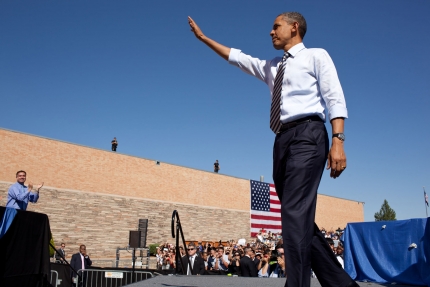
The White House

Office of the Press Secretary

President Obama Signs District of Columbia Disaster Declaration

The President today declared a major disaster exists in the District of Columbia and ordered Federal aid to supplement state and local recovery efforts in the area affected by Hurricane Irene during the period of August 26 to September 1, 2011.

Federal funding is available to district and eligible local governments and certain private nonprofit organizations on a cost-sharing basis for emergency work and the repair or replacement of facilities damaged by Hurricane Irene in the District of Columbia.

Federal funding is also available on a cost-sharing basis for hazard mitigation measures in the District of Columbia.

W. Craig Fugate, Administrator, Federal Emergency Management Agency (FEMA), Department of Homeland Security, named Kim R. Kadesch as the Federal Coordinating Officer for federal recovery operations in the affected area. 

FEMA said additional designations may be made at a later date if requested by the district and warranted by the results of further damage assessments.

FOR FURTHER INFORMATION MEDIA SHOULD CONTACT:  FEMA NEWS DESK AT (202) 646-3272 OR FEMA-NEWS-DESK@DHS.GOV  

Watch Live: President Obama’s Open for Questions Roundtable

Over the last week, Yahoo!, MSN Latino, AOL Latino and HuffPost LatinoVoices have been collecting your questions for President Obama on issues like the economy, job creation, education and fixing our immigration system to meet our 21st century economic and security needs.

Today, President Obama will hear from you in a special Open for Question roundtable addressing questions that you submitted to Yahoo!, MSN Latino, AOL Latino and HuffPost LatinoVoices. The roundtable will be available in both English and Spanish.

Tune in to the discussion live at 11:25 a.m. EDT at WhiteHouse.gov/live and learn more about President Obama’s commitment to increasing opportunity for the Hispanic community and all Americans.

The White House

Office of the Press Secretary

Remarks by the President on the American Jobs Act in Denver, Colorado

Abraham Lincoln High School
Denver, Colorado

2:20 P.M. MDT

THE PRESIDENT:  Hello, Denver!  (Applause.)  What a beautiful day.  Thank you so much.  How’s it going, Lancers?  (Applause.)  I hear the Lancers have a pretty good ball team.  That’s the story I’ve heard.  (Applause.)

Well, listen, there are a couple of people here I want to acknowledge who are just outstanding public servants.  First of all, a hometown hero who is now one of the best Secretaries of the Interior that we’ve ever had, Ken Salazar.  (Applause.)  One of the best governors in the country, John Hickenlooper.  (Applause.)  Two outstanding senators, Mark Udall -- (applause) -- and Michael Bennet.  (Applause.)  Congresswoman Diana DeGette.  (Applause.)  Congressman Ed Perlmutter.  (Applause.)  Your own hometown mayor, Michael Hancock.  (Applause.)  And former friend and -- or current friend, former mayor -- (laughter) -- and one of the finest public servants in Colorado history, Federico Peña.  (Applause.) 

So it is good to be back in Colorado, especially on a gorgeous day like this.  (Applause.)  It’s always like this in late September, isn’t it?  (Applause.)  Absolutely. 

It’s an honor to be here at Lincoln High School.  (Applause.)  And I want to give a special thank you to Amelia for that wonderful introduction.  (Applause.)  I was just talking to Amelia.  She’s a senior this year.  And she’s planning to go to college and planning to be a doctor, and I am absolutely certain she is going to succeed in everything that she does.  And she’s an example, a great example, of how smarter courses and better technology can help guarantee our kids the foundation that they need to graduate and compete in this new global economy.

So we couldn’t be prouder of Amelia and we couldn’t be prouder of all the students here at Lincoln.  (Applause.) 

Now, I came here today to talk about the economy.  I came to talk about how we can get to a place where we’re creating good middle-class jobs again -- (applause) -- jobs that pay well and jobs that offer security.

We’ve got a lot to do to make sure that everyone in this country gets a fair shake and a fair shot and a chance to get ahead.  And that’s the number-one thing that I think about each and every day.  Your lives, your opportunities -- that should be the number-one thing that every public servant in Washington is thinking about. 

There’s so much that we could accomplish together if Washington can finally start acting on behalf of the people.  (Applause.)  We’ve got to get that city to stop worrying so much about their jobs and their careers and start worrying about your jobs and your careers.  (Applause.)

And that’s why I sent Congress the American Jobs Act.  Now, I know it’s kind of thick, but it boils down to two things:  putting people back to work and putting more money in the pockets of working Americans.  Every single thing in the American Jobs Act is the kind of proposal that’s been supported by Democrats and Republicans in the past.  Everything in it will be paid for. 

It’s been two weeks since I sent it to Congress; now I want it back.  (Applause.)  I want it back, passed, so I can sign this bill and start putting people back to work.  (Applause.)  I’ve already got the pens all ready, all lined up on my desk, ready to sign the bill.  And every one of you can help make it happen by sending a message to Congress, a simple message:  Pass this jobs bill.  (Applause.) 

Look, pass this jobs bill, and right here in Colorado, thousands of construction workers will have a job again.  (Applause.)  This is one of the most common-sense ideas out there.  All over the country there are roads and bridges and schools just like Lincoln that are in need of repair.  (Applause.)  One of the reasons we came here was this is the fastest-growing school in one of the fastest-growing school districts in Colorado.  (Applause.)

So Lincoln has been adding new AP courses and new language courses, and the wonderful principal and administrators here have been making sure -- and the teachers here have been making sure that kids have upgraded computers and learning software that’s necessary to prepare all of you students for the jobs and the economy of the future.  But you know what?  Things like science labs take money to upgrade.  The science labs here at Lincoln High were built decades ago, back in the ‘60s.  I don’t know if you’ve noticed, but science and technology has changed a little bit since the 1960s.  The world has changed a little bit since the 1960s.  So we need to do everything we can to prepare our kids to compete.  We need to do everything we can to make sure our students can compete with any students, anywhere in the world.  And every child deserves a great school -- and we can give it to them.   (Applause.)

We can rebuild our schools for the 21st century, with faster Internet, and smarter labs, and cutting-edge technology.  And that won’t just create a better learning environment for students -- it will create good jobs for local construction workers right here in Denver, and all across Colorado, and all across the country.  There are schools all throughout Colorado in need of renovation. 

But it’s not just in this state.  Last week, I visited a bridge in Cincinnati that connected Ohio to Kentucky.  Bridges need renovations.  Roads need renovations.  We need to lay broadband lines in rural areas.  There are construction projects like these all across this country just waiting to get started, and there are millions of unemployed construction workers ready to do the job. 

So my question to Congress is:  What on Earth are you waiting for?  Let’s get to work.  (Applause.)  Let’s get to work.  Let’s get to work.

Why should our children be allowed to study in crumbling, outdated schools?  How does that give them a sense that education is important?  We should build them the best schools.  That’s what I want for my kids; that’s what you want for your kids.  That’s what I want for every kid in America.  (Applause.)

Why should we let China build the newest airports, the fastest railroads?  We should build them right here in America, right here in Denver, right here in Colorado.  (Applause.)  There is work to be done.  There are workers ready to do it.  So tell Congress:  Pass this jobs bill right away.  (Applause.)  

Let’s pass this jobs bill and put teachers back in the classroom where they belong.  (Applause.)  Places like South Korea, they’re adding teachers in droves to prepare their kids for the global economy.  We’re laying off our teachers left and right.  All across the country, budget cuts are forcing superintendents to make choices they don’t want to make. 

I can tell you the last thing a governor like John Hickenlooper wants to do is to lose teachers.  It’s unfair to our kids.  It undermines our future.  It has to stop.  You tell Congress:  Pass the American Jobs Act, and there will be funding to save jobs of thousands of Colorado teachers and cops and firefighters.  It’s the right thing to do.  Pass the bill.  (Applause.)

If Congress passes this jobs bill, companies will get new tax credits for hiring America’s veterans.  Think about it -- these men and women, they leave their careers, they leave their families.  They are protecting us and our freedom.  And the last thing they should have to do is fight for a job when they come home.  (Applause.)  That’s why Congress needs to pass this bill -- to make it easier for businesses to hire our veterans and use the skills that they’ve developed protecting us.  (Applause.)  

Pass this bill, and it will help hundreds of thousands of young people find summer jobs next year to help them build skills.  (Applause.)  It provides a $4,000 tax credit for companies that hire anybody who’s spent more than six months looking for a job.  It extends unemployment insurance, but it also says if you’re collecting benefits, you’ll get connected to temporary work as a way to build your skills while you’re looking for a permanent job.  Congress needs to pass this bill.  (Applause.) 

Congress needs to pass this bill so we can help the people who create most of the new jobs in this country -- America’s small business owners.  It’s all terrific that corporate profits have come roaring back, but small companies haven’t come roaring back.  Let’s give them a boost.  Pass this bill, and every small business owner in America gets a tax cut.  (Applause.)  If they hire new employees, or they raise their employees’ salaries, they get another tax cut.  (Applause.)

There are some Republicans in Congress who like to talk about being the friends of America’s job creators.  Well, you know what, if you actually care about America’s job creators, then you should actually help America’s job creators with a tax cut by passing this bill.  (Applause.)  Right away. 

Now finally, if we get Congress to pass this bill, the typical working family in Colorado will get more than $1,700 in tax cuts next year; $1,700 that would have been taken out of your paycheck now goes right back in your pocket.  (Applause.)

If Congress doesn’t act -- if Congress fails to pass this bill -- middle-class families will get hit with a tax increase at the worst possible time.  We can’t let that happen.  Republicans say they’re the party of tax cuts.  Well, let them prove it.  Tell them to fight just as hard for tax cuts for working Americans as they fight for the wealthiest Americans.  (Applause.)  Tell them to pass this jobs bill right now.  (Applause.)  

So let me summarize here.  The American Jobs Act will lead to new jobs for construction workers, jobs for teachers, jobs for veterans, jobs for young people, jobs for the unemployed.  It will provide tax relief for every worker and small business in America.  And by the way, it will not add to the deficit.  It will be paid for.  (Applause.)    

Last week, I laid out a plan that would not only pay for the jobs bill but would begin to actually reduce our debt over time.  It’s a plan that says if we want to create jobs and close the deficit, then we’ve got to not only make some of the cuts that we’ve made -- tough cuts that, with the help of Mark and Michael, we were able to get done -- but we’ve also got to ask the wealthiest Americans and biggest corporations to pay their fair share.  (Applause.) 

Look, we need to reform our tax code based on a simple principle:  Middle-class families shouldn’t pay higher tax rates than millionaires and billionaires.  (Applause.)  Warren Buffett’s secretary shouldn’t pay a higher tax rate than Warren Buffett.  A teacher or a nurse or a construction worker making $50,000 a year shouldn’t pay higher tax rates than somebody making $50 million.  That’s just common sense.  (Applause.)

And keep in mind I’m not saying this because we should be punishing success.  This is the Land of Opportunity.  What’s great about this country is that any of these young people here, if they’ve got a good idea, if they go out there and they’re willing to work hard, they can start a business, they can create value, great products, great services.  They can make millions, make billions.  That’s great.  That’s what America is all about.  Anybody can make it if they try.

But what’s also a quintessentially American idea is that those of us who’ve done well should pay our fair share to contribute to the upkeep of the nation that made our success possible -- (applause) -- because nobody -- nobody did well on their own.  A teacher somewhere helped to give you the skills to succeed.  (Applause.)

Firefighters and police officers are protecting your property.  You’re moving your goods and products and services on roads that somebody built.  That’s how we all do well together.  We got here because somebody else invested in us, and we’ve got to make sure this generation of students can go to college on student aid or scholarships like I did.  We’ve got to make sure that we keep investing in the kind of government research that helped to create the Internet, which countless private sector companies then used to create tens of millions of jobs.

And you know what?  I’m positive -- I’ve talked to them, most wealthy Americans agree with this.  Of course, the Republicans in Congress, they call this class warfare.  You know what?  If asking a millionaire to pay the same tax rate as a plumber makes me a class warrior, a warrior for the working class, I will accept that.  I will wear that charge as a badge of honor.  (Applause.) 

The only warfare I’ve seen is the battle that’s been waged against middle-class families in this country for a decade now. 

Ultimately, Colorado, this comes down to choices and it comes down to priorities.  If we want to pay for this jobs plan, put people back to work, close this deficit, invest in our future, then the money has got to come from somewhere.  And so my question is:  Would you rather keep tax loopholes for oil companies?  Or do you want construction workers to have a job rebuilding our schools and our roads and our bridges?  (Applause.)

Would you rather keep tax breaks for billionaires that they don’t need?  Or would you rather put teachers back to work, and help small businesses, and cut taxes, and reduce our deficit?  (Applause.)    

It’s time to build an economy that creates good middle-class jobs in this country.  It’s time to build an economy that honors the values of hard work and responsibility.  It’s time to build an economy that lasts. 

And, Denver, that starts now.  And I need your help to make it happen.  (Applause.)  I just want you to -- just remember, Republicans and Democrats in the past have supported every kind of proposal that’s in here.  There’s no reason not to pass it just because I proposed it.  We need to tell them it’s time to support these proposals right now.

There are some Republicans in Washington who have said that some of this might have to wait until the next election.

AUDIENCE:  No!

THE PRESIDENT:  Maybe we should just stretch this out rather than work together right now.  Some even said that if they agree with the proposals in the American Jobs Act, they still shouldn’t pass it because it might give me a win.  Think about that.  Give me a win?  Give me a break!   That’s why folks in Washington -- that’s why folks are fed up with Washington.  (Applause.)

There are some folks in Washington who don’t get it.  This isn’t about giving me a win.  This is about giving Democrats and Republicans a chance to do something for the American people.  It’s about giving people who are hurting a win.  That’s what this is about.  (Applause.)

It’s about giving small business owners a win, and entrepreneurs a win, and students a win, and working families a win.  (Applause.)  Giving all of us a win.  (Applause.)

The next election is nearly 14 months away.  The American people don’t have the luxury of waiting that long.  There are folks here in Colorado who are living paycheck to paycheck, week to week.  They need action and they need it now. 

So I’m asking all of you, I need you to lift up your voices.  Not just here in Denver, but anyone watching, anybody listening, anybody following online -- I need you to call, email, tweet, fax, visit -- tell your congressperson, unless the congressperson is here, because they’re already on board -- tell them you are tired of gridlock, you are tired of the games.  Tell them the time for action is now.  Tell them you want to create jobs now.  Tell them to pass the bill.  (Applause.)   

If you want construction workers on the job, pass the bill.  (Applause.)  If you want teachers back in the classroom, pass the bill.  (Applause.)  If you want a tax cut for small business owners, pass the bill.  (Applause.)  If you want to help our veterans share in the opportunity that they defended, pass the bill.  (Applause.) 

It is time to act.  We are not a people who sit back and wait for things to happen.  We make things happen.  We’re Americans.  We are tougher than the times that we live in, and we are bigger than the politics we’ve been seeing out of Washington.  We write our own destiny.  It is in our power to do so once more.  So let’s meet this moment and let’s get to work, and let’s show the world once again why the United States of America is the greatest nation on Earth. 

Thank you.  God bless you.  God bless the United States of America.  Go Lancers!  (Applause.) 

END
2:40 P.M. MDT

The White House

Office of the Press Secretary

President Obama Announces More Key Administration Posts

WASHINGTON – Today, President Barack Obama announced his intent to nominate the following individuals to key Administration posts:

  • Earl W. Gast – Assistant Administrator for Africa, United States Agency for International Development
  • Roberta S. Jacobson – Assistant Secretary for Western Hemisphere Affairs, Department of State
  • Michael T. Scuse – Under Secretary for Farm and Foreign Agricultural Services, Department of Agriculture

President Obama also announced his intent to appoint the following individual to a key administration post:

  • Glen F. Post III – Member, President's National Security Telecommunications Advisory Committee

President Obama said, “It gives me great confidence that such dedicated and capable individuals have agreed to join this Administration to serve the American people.  I look forward to working with them in the months and years to come.”

President Obama announced his intent to nominate the following individuals to  key Administration posts:

Earl W. Gast, Nominee for Assistant Administrator for Africa, United States Agency for International Development
Earl W. Gast served as USAID Mission Director to Afghanistan from June 2010 to June 2011.  In 2009, he was Acting Assistant Administrator for the USAID Africa Bureau, and he served as Senior Deputy Assistant Administrator for Africa in 2008.  From 2005 to 2008, Mr. Gast was Regional Mission Director for Ukraine, Belarus, and Moldova.  In 2004, he served as the USAID representative to UN agencies in Rome.  From 2003 to 2004, he was Mission Deputy Director in Iraq, a role he previously held in Kosovo from 2002 to 2003.  He has also worked for USAID in Georgia, Russia, and the Philippines.  Prior to joining USAID, Mr. Gast served in the Air Force and was a Navy reserve officer.  He holds a B.A. from the University of Maryland and a Master’s degree from George Washington University.

Roberta S. Jacobson, Nominee for Assistant Secretary for Western Hemisphere Affairs, Department of State
Roberta S. Jacobson currently serves as Acting Assistant Secretary and Principal Deputy Secretary of the Bureau of Western Hemisphere Affairs (WHA) at the Department of State.   Previously, Ms. Jacobson served as Deputy Assistant Secretary for Canada, Mexico and NAFTA issues (2007-2010), Director of the Office of Mexican Affairs (2003-2007), and Deputy Chief of Mission at the U.S. Embassy in Lima (2000-2002).  From 1996 to 2000, Ms. Jacobson served as Director of the Office of Policy Planning and Coordination in WHA.  She began her career at the Department of State as a Presidential Management Intern (PMI).  Ms. Jacobson received a B.A. from Brown University and an M.A. from the Fletcher School of Law and Diplomacy.

Michael T. Scuse, Nominee for Under Secretary for Farm and Foreign Agricultural Services, Department of Agriculture
Michael T. Scuse has been the Deputy Under Secretary for Farm and Foreign Agricultural Services (FFAS) since 2009, where he has primary responsibility over domestic programs including the Farm Services Agency and the Risk Management Agency.  In January 2011, Mr. Scuse was designated the Acting Under Secretary for FFAS. Before joining the USDA, Mr. Scuse was chief of staff to then Governor Ruth Ann Minor. Prior to that, he served as Secretary of Agriculture for the State of Delaware from May 2001 until September 2008. From 1996 to 2001, Mr. Scuse served as both chairman of the Kent County (Delaware) Regional Planning Commission and chairman of the USDA Farm Services Agency’s Delaware State Committee.  From 1986 to 1994, he served as the Kent County Recorder of Deeds.  He also previously served as both president and vice president of the Northeast Association of State Departments of Agriculture. Mr. Scuse attended Salem College.

President Obama also announced his intent to appoint the following individual to a key Administration post:

Glen F. Post III, Appointee for Member, President’s National Security Telecommunications Advisory Committee
Glen Post III is currently the Chief Executive Officer and President of CenturyLink, a Louisiana-based telecommunications company.  Mr. Post began his career with CenturyLink in 1976 and has held a number of leadership positions over the years including Chairman of the Board, Chief Operating Officer, Executive Vice President, Senior Vice President, Treasurer, and Vice President.  He holds a Bachelor’s degree and an M.B.A. from Louisiana Tech University. 

President Obama: We Need to Do Everything We Can to Prepare Our Kids for the Future

President Obama on the American Jobs Act in Denver

President Barack Obama waves to the crowd after addressing Abraham Lincoln High School, Denver, Colorado, Sept. 27, 2011. (Official White House Photo by Pete Souza)

Today, President Obama visited the Abraham Lincoln High School in Denver, Colorado to talk about how the American Jobs Act will help modernize schools like Lincoln High all across the country. The President is proposing a $25 billion investment in school infrastructure to repair and upgrade at least 35,000 public schools because, as he said today, “Every child deserves a great school – and we can give it to them. We can rebuild our schools for the 21st century, with faster internet, smarter labs and cutting-edge technology.” 

The American Society of Civil Engineers (ASCE) awarded the United States a ‘D’ for the condition of our public school infrastructure and the statistics are grim. The average public school building in the United States is over 40 years old, and many are much older. Schools spend over $6 billion annually on their energy bills, more than they spend on computers and textbooks combined.  Forty three states reported that one-third or more of their schools do not meet all of the functional requirements necessary to effectively teach laboratory science, knowledge that is critical if we are to prepare our children for the jobs of the future. The Job Act’s school infrastructure funds can be used for a range of much needed emergency projects, including greening and energy efficiency upgrades, asbestos removal and modernization efforts to build new science and computer labs and upgrade the technology infrastructure in our schools. The President’s goal is to create a better, safer learning environment for all students: 

Related Topics: Economy, Education, Colorado, Kentucky, Ohio