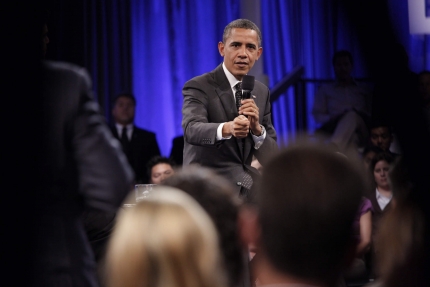
President Obama Highlights the American Jobs Act

September 27, 2011 | 22:50 | Public Domain

At Abraham Lincoln High School In Denver, Co, President Obama highlights his American Jobs Act proposal to put workers back on the job by rebuilding and modernizing schools across the country. The American Jobs Act proposes a $25 billion investment in school infrastructure that will modernize at least 35,000 public schools – investments that will create jobs while improving classrooms and upgrading our schools to meet 21st century needs. Read the bill at http://obamawhitehouse.archives.gov/jobsact.

Download mp4 (218MB) | mp3 (21MB)

Read the Transcript

Remarks by the President on the American Jobs Act in Denver, Colorado

Abraham Lincoln High School
Denver, Colorado

2:20 P.M. MDT

THE PRESIDENT:  Hello, Denver!  (Applause.)  What a beautiful day.  Thank you so much.  How’s it going, Lancers?  (Applause.)  I hear the Lancers have a pretty good ball team.  That’s the story I’ve heard.  (Applause.)

Well, listen, there are a couple of people here I want to acknowledge who are just outstanding public servants.  First of all, a hometown hero who is now one of the best Secretaries of the Interior that we’ve ever had, Ken Salazar.  (Applause.)  One of the best governors in the country, John Hickenlooper.  (Applause.)  Two outstanding senators, Mark Udall -- (applause) -- and Michael Bennet.  (Applause.)  Congresswoman Diana DeGette.  (Applause.)  Congressman Ed Perlmutter.  (Applause.)  Your own hometown mayor, Michael Hancock.  (Applause.)  And former friend and -- or current friend, former mayor -- (laughter) -- and one of the finest public servants in Colorado history, Federico Peña.  (Applause.) 

So it is good to be back in Colorado, especially on a gorgeous day like this.  (Applause.)  It’s always like this in late September, isn’t it?  (Applause.)  Absolutely. 

It’s an honor to be here at Lincoln High School.  (Applause.)  And I want to give a special thank you to Amelia for that wonderful introduction.  (Applause.)  I was just talking to Amelia.  She’s a senior this year.  And she’s planning to go to college and planning to be a doctor, and I am absolutely certain she is going to succeed in everything that she does.  And she’s an example, a great example, of how smarter courses and better technology can help guarantee our kids the foundation that they need to graduate and compete in this new global economy.

So we couldn’t be prouder of Amelia and we couldn’t be prouder of all the students here at Lincoln.  (Applause.) 

Now, I came here today to talk about the economy.  I came to talk about how we can get to a place where we’re creating good middle-class jobs again -- (applause) -- jobs that pay well and jobs that offer security.

We’ve got a lot to do to make sure that everyone in this country gets a fair shake and a fair shot and a chance to get ahead.  And that’s the number-one thing that I think about each and every day.  Your lives, your opportunities -- that should be the number-one thing that every public servant in Washington is thinking about. 

There’s so much that we could accomplish together if Washington can finally start acting on behalf of the people.  (Applause.)  We’ve got to get that city to stop worrying so much about their jobs and their careers and start worrying about your jobs and your careers.  (Applause.)

And that’s why I sent Congress the American Jobs Act.  Now, I know it’s kind of thick, but it boils down to two things:  putting people back to work and putting more money in the pockets of working Americans.  Every single thing in the American Jobs Act is the kind of proposal that’s been supported by Democrats and Republicans in the past.  Everything in it will be paid for. 

It’s been two weeks since I sent it to Congress; now I want it back.  (Applause.)  I want it back, passed, so I can sign this bill and start putting people back to work.  (Applause.)  I’ve already got the pens all ready, all lined up on my desk, ready to sign the bill.  And every one of you can help make it happen by sending a message to Congress, a simple message:  Pass this jobs bill.  (Applause.) 

Look, pass this jobs bill, and right here in Colorado, thousands of construction workers will have a job again.  (Applause.)  This is one of the most common-sense ideas out there.  All over the country there are roads and bridges and schools just like Lincoln that are in need of repair.  (Applause.)  One of the reasons we came here was this is the fastest-growing school in one of the fastest-growing school districts in Colorado.  (Applause.)

So Lincoln has been adding new AP courses and new language courses, and the wonderful principal and administrators here have been making sure -- and the teachers here have been making sure that kids have upgraded computers and learning software that’s necessary to prepare all of you students for the jobs and the economy of the future.  But you know what?  Things like science labs take money to upgrade.  The science labs here at Lincoln High were built decades ago, back in the ‘60s.  I don’t know if you’ve noticed, but science and technology has changed a little bit since the 1960s.  The world has changed a little bit since the 1960s.  So we need to do everything we can to prepare our kids to compete.  We need to do everything we can to make sure our students can compete with any students, anywhere in the world.  And every child deserves a great school -- and we can give it to them.   (Applause.)

We can rebuild our schools for the 21st century, with faster Internet, and smarter labs, and cutting-edge technology.  And that won’t just create a better learning environment for students -- it will create good jobs for local construction workers right here in Denver, and all across Colorado, and all across the country.  There are schools all throughout Colorado in need of renovation. 

But it’s not just in this state.  Last week, I visited a bridge in Cincinnati that connected Ohio to Kentucky.  Bridges need renovations.  Roads need renovations.  We need to lay broadband lines in rural areas.  There are construction projects like these all across this country just waiting to get started, and there are millions of unemployed construction workers ready to do the job. 

So my question to Congress is:  What on Earth are you waiting for?  Let’s get to work.  (Applause.)  Let’s get to work.  Let’s get to work.

Why should our children be allowed to study in crumbling, outdated schools?  How does that give them a sense that education is important?  We should build them the best schools.  That’s what I want for my kids; that’s what you want for your kids.  That’s what I want for every kid in America.  (Applause.)

Why should we let China build the newest airports, the fastest railroads?  We should build them right here in America, right here in Denver, right here in Colorado.  (Applause.)  There is work to be done.  There are workers ready to do it.  So tell Congress:  Pass this jobs bill right away.  (Applause.)  

Let’s pass this jobs bill and put teachers back in the classroom where they belong.  (Applause.)  Places like South Korea, they’re adding teachers in droves to prepare their kids for the global economy.  We’re laying off our teachers left and right.  All across the country, budget cuts are forcing superintendents to make choices they don’t want to make. 

I can tell you the last thing a governor like John Hickenlooper wants to do is to lose teachers.  It’s unfair to our kids.  It undermines our future.  It has to stop.  You tell Congress:  Pass the American Jobs Act, and there will be funding to save jobs of thousands of Colorado teachers and cops and firefighters.  It’s the right thing to do.  Pass the bill.  (Applause.)

If Congress passes this jobs bill, companies will get new tax credits for hiring America’s veterans.  Think about it -- these men and women, they leave their careers, they leave their families.  They are protecting us and our freedom.  And the last thing they should have to do is fight for a job when they come home.  (Applause.)  That’s why Congress needs to pass this bill -- to make it easier for businesses to hire our veterans and use the skills that they’ve developed protecting us.  (Applause.)  

Pass this bill, and it will help hundreds of thousands of young people find summer jobs next year to help them build skills.  (Applause.)  It provides a $4,000 tax credit for companies that hire anybody who’s spent more than six months looking for a job.  It extends unemployment insurance, but it also says if you’re collecting benefits, you’ll get connected to temporary work as a way to build your skills while you’re looking for a permanent job.  Congress needs to pass this bill.  (Applause.) 

Congress needs to pass this bill so we can help the people who create most of the new jobs in this country -- America’s small business owners.  It’s all terrific that corporate profits have come roaring back, but small companies haven’t come roaring back.  Let’s give them a boost.  Pass this bill, and every small business owner in America gets a tax cut.  (Applause.)  If they hire new employees, or they raise their employees’ salaries, they get another tax cut.  (Applause.)

There are some Republicans in Congress who like to talk about being the friends of America’s job creators.  Well, you know what, if you actually care about America’s job creators, then you should actually help America’s job creators with a tax cut by passing this bill.  (Applause.)  Right away. 

Now finally, if we get Congress to pass this bill, the typical working family in Colorado will get more than $1,700 in tax cuts next year; $1,700 that would have been taken out of your paycheck now goes right back in your pocket.  (Applause.)

If Congress doesn’t act -- if Congress fails to pass this bill -- middle-class families will get hit with a tax increase at the worst possible time.  We can’t let that happen.  Republicans say they’re the party of tax cuts.  Well, let them prove it.  Tell them to fight just as hard for tax cuts for working Americans as they fight for the wealthiest Americans.  (Applause.)  Tell them to pass this jobs bill right now.  (Applause.)  

So let me summarize here.  The American Jobs Act will lead to new jobs for construction workers, jobs for teachers, jobs for veterans, jobs for young people, jobs for the unemployed.  It will provide tax relief for every worker and small business in America.  And by the way, it will not add to the deficit.  It will be paid for.  (Applause.)    

Last week, I laid out a plan that would not only pay for the jobs bill but would begin to actually reduce our debt over time.  It’s a plan that says if we want to create jobs and close the deficit, then we’ve got to not only make some of the cuts that we’ve made -- tough cuts that, with the help of Mark and Michael, we were able to get done -- but we’ve also got to ask the wealthiest Americans and biggest corporations to pay their fair share.  (Applause.) 

Look, we need to reform our tax code based on a simple principle:  Middle-class families shouldn’t pay higher tax rates than millionaires and billionaires.  (Applause.)  Warren Buffett’s secretary shouldn’t pay a higher tax rate than Warren Buffett.  A teacher or a nurse or a construction worker making $50,000 a year shouldn’t pay higher tax rates than somebody making $50 million.  That’s just common sense.  (Applause.)

And keep in mind I’m not saying this because we should be punishing success.  This is the Land of Opportunity.  What’s great about this country is that any of these young people here, if they’ve got a good idea, if they go out there and they’re willing to work hard, they can start a business, they can create value, great products, great services.  They can make millions, make billions.  That’s great.  That’s what America is all about.  Anybody can make it if they try.

But what’s also a quintessentially American idea is that those of us who’ve done well should pay our fair share to contribute to the upkeep of the nation that made our success possible -- (applause) -- because nobody -- nobody did well on their own.  A teacher somewhere helped to give you the skills to succeed.  (Applause.)

Firefighters and police officers are protecting your property.  You’re moving your goods and products and services on roads that somebody built.  That’s how we all do well together.  We got here because somebody else invested in us, and we’ve got to make sure this generation of students can go to college on student aid or scholarships like I did.  We’ve got to make sure that we keep investing in the kind of government research that helped to create the Internet, which countless private sector companies then used to create tens of millions of jobs.

And you know what?  I’m positive -- I’ve talked to them, most wealthy Americans agree with this.  Of course, the Republicans in Congress, they call this class warfare.  You know what?  If asking a millionaire to pay the same tax rate as a plumber makes me a class warrior, a warrior for the working class, I will accept that.  I will wear that charge as a badge of honor.  (Applause.) 

The only warfare I’ve seen is the battle that’s been waged against middle-class families in this country for a decade now. 

Ultimately, Colorado, this comes down to choices and it comes down to priorities.  If we want to pay for this jobs plan, put people back to work, close this deficit, invest in our future, then the money has got to come from somewhere.  And so my question is:  Would you rather keep tax loopholes for oil companies?  Or do you want construction workers to have a job rebuilding our schools and our roads and our bridges?  (Applause.)

Would you rather keep tax breaks for billionaires that they don’t need?  Or would you rather put teachers back to work, and help small businesses, and cut taxes, and reduce our deficit?  (Applause.)    

It’s time to build an economy that creates good middle-class jobs in this country.  It’s time to build an economy that honors the values of hard work and responsibility.  It’s time to build an economy that lasts. 

And, Denver, that starts now.  And I need your help to make it happen.  (Applause.)  I just want you to -- just remember, Republicans and Democrats in the past have supported every kind of proposal that’s in here.  There’s no reason not to pass it just because I proposed it.  We need to tell them it’s time to support these proposals right now.

There are some Republicans in Washington who have said that some of this might have to wait until the next election.

AUDIENCE:  No!

THE PRESIDENT:  Maybe we should just stretch this out rather than work together right now.  Some even said that if they agree with the proposals in the American Jobs Act, they still shouldn’t pass it because it might give me a win.  Think about that.  Give me a win?  Give me a break!   That’s why folks in Washington -- that’s why folks are fed up with Washington.  (Applause.)

There are some folks in Washington who don’t get it.  This isn’t about giving me a win.  This is about giving Democrats and Republicans a chance to do something for the American people.  It’s about giving people who are hurting a win.  That’s what this is about.  (Applause.)

It’s about giving small business owners a win, and entrepreneurs a win, and students a win, and working families a win.  (Applause.)  Giving all of us a win.  (Applause.)

The next election is nearly 14 months away.  The American people don’t have the luxury of waiting that long.  There are folks here in Colorado who are living paycheck to paycheck, week to week.  They need action and they need it now. 

So I’m asking all of you, I need you to lift up your voices.  Not just here in Denver, but anyone watching, anybody listening, anybody following online -- I need you to call, email, tweet, fax, visit -- tell your congressperson, unless the congressperson is here, because they’re already on board -- tell them you are tired of gridlock, you are tired of the games.  Tell them the time for action is now.  Tell them you want to create jobs now.  Tell them to pass the bill.  (Applause.)   

If you want construction workers on the job, pass the bill.  (Applause.)  If you want teachers back in the classroom, pass the bill.  (Applause.)  If you want a tax cut for small business owners, pass the bill.  (Applause.)  If you want to help our veterans share in the opportunity that they defended, pass the bill.  (Applause.) 

It is time to act.  We are not a people who sit back and wait for things to happen.  We make things happen.  We’re Americans.  We are tougher than the times that we live in, and we are bigger than the politics we’ve been seeing out of Washington.  We write our own destiny.  It is in our power to do so once more.  So let’s meet this moment and let’s get to work, and let’s show the world once again why the United States of America is the greatest nation on Earth. 

Thank you.  God bless you.  God bless the United States of America.  Go Lancers!  (Applause.) 

END
2:40 P.M. MDT

Close Transcript

The White House

Office of the Press Secretary

Remarks by the President on the Occasion of Rosh Hashanah

Below is a transcript of the President’s videotaped remarks on the occasion of Rosh Hashanah. You can view the blog post and video HERE. To download the .mp4 format of the video, click HERE.

Hello, everybody.  Shana Tova.

The days between Rosh Hashanah and Yom Kippur are a time for repentance and reflection.  An opportunity to reaffirm our friendships, renew our commitments, and reflect on the values we cherish.

As the High Holidays begin, we look back on all the moments during the past year that give us reason to hope.  Around the world, a new generation is reaching for their universal rights.  Here in the United States, we’ve responded to our challenges by focusing on the things that really matter – friendship, family, and community.

But this last year was also one of hardship for people around the world.  Too many of our friends and neighbors continue to struggle in the wake of a terrible economic recession.  And beyond our borders, many of our closest allies – including the State of Israel – face the uncertainties of an unpredictable age.

That is why my Administration is doing everything we can to promote prosperity here at home and security and peace throughout the world – and that includes reaffirming our commitment to the State of Israel.  While we cannot know all that the New Year will bring, we do know this: the United States will continue to stand with Israel, because the bond between our two nations is unshakable.

As Jewish tradition teaches us, we may not complete the work, but that must never keep us from trying.  In that spirit, Michelle and I wish you and your families and all who celebrate Rosh Hashanah a sweet year full of health, happiness, and peace.

Thank you.

The White House

Office of the Press Secretary

Repairing and Modernizing America's Schools

Today, the President will visit the Abraham Lincoln High School in Denver, Colorado to highlight his proposal to put workers back on the job by rebuilding and modernizing schools across the country.  The President is proposing a $25 billion investment in school infrastructure that will modernize at least 35,000 public schools.  This investment will create jobs, while improving classrooms and upgrading our schools to meet 21st century needs. Funds can be used for a range of emergency repair and renovation projects, greening and energy efficiency upgrades, asbestos abatement and removal, and modernization efforts to build new science and computer labs and to upgrade the technology infrastructure in our schools. The President is also proposing a $5 billion investment in modernizing community colleges (including tribal colleges), bolstering their infrastructure in this time of need while ensuring their ability to serve future generations of students and communities.

COLORADO SNAPSHOT

  • Under the American Jobs Act Colorado could receive up to $265,100,000 in funding for K-12 schools to support as many as 3,400 jobs. Included in this amount are direct funds for Colorado’s largest school district.
    • The Denver County School District could receive up to $75.5 million in funds
  • In addition Colorado could receive $57,500,000 in funding in the next fiscal year for its community colleges. 

**See tables below for the complete state by state breakdown of the President’s school construction jobs plan.**  

How the American Jobs Act Will Rebuild and Modernize America’s Schools

The President is proposing that we invest $30 billion in enhancing the condition of our nation’s public schools and community colleges.  This money would fund a range of critical repairs and needed renovation projects that would put hundreds of thousands of Americans – construction workers, engineers, maintenance staff, boiler repair, and electrical workers – back to work.  And it will help modernize at least 35,000 public schools – from science labs and internet-ready classroom upgrades to renovated facilities. 

The American Society of Civil Engineers (ASCE) awarded the United States a ‘D’ for the condition of its public school infrastructure.  The average public school building in the United States is over 40 years old, and many are much older.  Schools spend over $6 billion annually on their energy bills, more than they spend on computers and textbooks combined.  Hands-on STEM education is critical for our children to be prepared for the jobs of the future, and yet 43 states reported that one-third or more of their schools do not meet all of the functional requirements necessary to effectively teach laboratory science.   

The cost of maintaining nearly 100,000 public schools and facilities in good repair is substantial for already overstretched districts.  The accumulated backlog of deferred maintenance and repair amounts to at least $270 billion.  For children in the nation’s poorest districts, these deferred projects too often mean schools with crumbling ceilings, overcrowded classrooms, and classrooms without basic wiring infrastructure for technology needed for students to master 21st century skills. 

The President’s plan calls for substantial investments in our school infrastructure, modernizing at least 35,000 of America’s public schools to meet 21st-century needs and supporting repairs and upgrades in the nation’s community colleges.  

  • $25 billion in funds will be used to upgrade existing public school facilities. 10 billion of the funds will be directed toward 100 largest high-need public school districts. 15 billion of the funds will be directed to the states. Funds cannot be used for new construction. The President’s plan also proposes $5 billion of investments for facilities modernization needs at community colleges. 
  • Safer, Healthier, and Technologically Advanced Schools of the Future.   Permissible uses of funds would include a range of emergency repair and renovation projects, greening and energy efficiency upgrades, asbestos abatement and removal, and modernization efforts to build new science and computer labs and to upgrade technology infrastructure in our schools.   Local districts will also be able to put these funds to work to invest in upgrades to allow schools to continue to serve as centers of the community –including upgrades to shared spaces for adult vocational and job development centers.  These efforts will not only make our schools safer and healthier learning environments, but also ensure that our schools are fully equipped to teach 21st century skills in math, science, and other technical fields and to serve as effective centers for workforce training and development. 
  • Maximum flexibility to the states and funding for small repairs and large-scale maintenance and upgrade projects. Funds could be used for a range of projects, including greening and energy-efficiency upgrades; asbestos abatement and removal; improvements to after-school facilities and community spaces; and modifications to comply with the Americans with Disabilities Act. 
  • To ensure that schools in the most disrepair will be able to make necessary enhancements, almost 40 percent of the funds will be directed toward the 100 largest high-need public school districts.   Each of the 100 Local Educational Agencies (LEAs) with the largest numbers of children living in poverty would receive a formula amount proportionate to its Elementary and Secondary Education Act Title I Part A allocation within 60 days of enactment. 
  • The remaining approximately 60 percent will be given to states to allocate, and states would have flexibility to direct those funds to additional high-need districts, including schools in rural areasFunding would be allocated to states on the basis of their Title I shares. States would be required to obligate those funds by September 30, 2012, and outstanding balances would be reallocated to other states. States would direct half the funding to local school districts on a formula basis, and the other half through an application process in the most high-need districts, with a priority for rural districts. A portion of the funding would be set-aside for Bureau of Indian Education schools (0.5 percent) and for the Outlying Areas (0.5 percent). 
  • Funds will be put to work quickly.  For formula grants, states would be required to get funds to districts within 3 to 6 months of enactment and the districts would have to expend the funds within 24 months of enactment.  The selection criteria would prioritize projects that would be completed quickly, while affording grantees more time flexibility for their bigger projects.  To reduce the risk that districts will allow projects to stall, the American Jobs Act requires the funds be spent by September 30, 2012.  
  • Community Colleges are also in serious need of upgrades to ensure that facilities are equipped meet the demands of the 21st century workforce.  America’s community college system was built up over 40 years ago to support education and training activities of that time.  Deferred maintenance at community colleges is estimated to be $100 billion. The President’s plan proposes $5 billion of investments for facilities modernization needs at community colleges. Investment in modernizing community colleges fills a key resource gap, and ensures these institutions have the facilities and equipment to address current workforce demands in today’s highly technical and growing fields.  Funds would only be used for the repair, renovation, or modernization of facilities used primarily for instruction and research, including facilities housing programs that prepare students for in-demand jobs. 

What The American Jobs Act Means For Each State’s Ability to Modernize and Rebuild Their Schools 

The President’s plan will invest $30 billion in enhancing the condition of our nation’s public schools – with $25 billion going to K-12 schools, including a priority for rural schools and dedicated funding for Bureau of Indian Education funded schools, and $5 billion to community colleges (including tribal colleges). The range of critical repairs and needed construction projects would put hundreds of thousands of Americans – construction workers, engineers, maintenance staff, boiler repairmen, and electrical workers – back to work. 

American Jobs Act - Rebuilding and Modernizing America's Schools


Amount of Funds Each State is Eligible for to Invest in K-12 School Infrastructure


Number of Jobs these K-12 School Infrastructure Funds have the Potential to Support


Amount of Funds State is Eligible for to invest in facilities modernization needs at community colleges

Alabama


$ 390.3M


5100


$ 67.5M

Alaska


$ 62.0M


800


$ 2.5M

Arizona


$ 544.4M


7100


$ 116.6M

Arkansas


$ 270.7M


3500


$ 42.4M

California


$ 2812.6M


36600


$ 1131.1M

Colorado


$ 265.1M


3400


$ 57.5M

Connecticut


$ 185.0M


2400


$ 38.0M

Delaware


$ 73.3M


1000


$ 11.6M

D.C.


$ 84.7M


1100


$ 2.5M

Florida


$ 1280.3M


16600


$ 288.4M

Georgia


$ 909.5M


11800


$ 140.6M

Hawaii


$ 82.2M


1100


$ 18.9M

Idaho


$ 93.6M


1200


$ 11.2M

Illinois


$ 1111.6M


14500


$ 212.7M

Indiana


$ 443.4M


5800


$ 79.8M

Iowa


$ 132.6M


1700


$ 56.7M

Kansas


$ 191.4M


2500


$ 45.3M

Kentucky


$ 390.9M


5100


$ 54.7M

Louisiana


$ 516.8M


6700


$ 40.7M

Maine


$ 90.7M


1200


$ 12.8M

Maryland


$ 315.8M


4100


$ 93.9M

Massachusetts


$ 378.6M


4900


$ 68.8M

Michigan


$ 926.3M


12000


$ 157.7M

Minnesota


$ 274.5M


3600


$ 87.8M

Mississippi


$ 335.2M


4400


$ 63.1M

Missouri


$ 422.2M


5500


$ 69.1M

Montana


$ 77.1M


1000


$ 5.7M

Nebraska


$ 106.7M


1400


$ 21.4M

Nevada


$ 168.4M


2200


$ 39.1M

New Hampshire


$ 70.1M


900


$ 8.7M

New Jersey


$ 518.6M


6700


$ 123.8M

New Mexico


$ 196.8M


2600


$ 49.2M

New York


$ 2020.0M


26300


$ 235.3M

North Carolina


$ 675.7M


8800


$ 163.1M

North Dakota


$ 58.9M


800


$ 6.5M

Ohio


$ 985.5M


12800


$ 148.3M

Oklahoma


$ 267.4M


3500


$ 57.5M

Oregon


$ 253.2M


3300


$ 71.2M

Pennsylvania


$ 944.0M


12300


$ 113.2M

Puerto Rico


$  899.6M


6700


$7.9M

Rhode Island


$ 85.6M


1100


$ 12.7M

South Carolina


$ 381.4M


5000


$ 70.8M

South Dakota


$ 75.6M


1000


$ 4.7M

Tennessee


$ 474.7M


6200


$ 61.8M

Texas


$ 2332.1M


30300


$ 458.4M

Utah


$ 138.7M


1800


$ 37.1M

Vermont


$ 57.5M


700


$ 5.3M

Virginia


$ 425.3M


5500


$ 110.1M

Washington


$ 365.1M


4700


$ 83.9M

West Virginia


$ 161.2M


2100


$ 15.4M

Wisconsin


$ 368.7M


4800


$ 79.9M

Wyoming


$ 56.3M


700


$ 11.7M

Other Territories*


$125M


N/A


$12.5M


*Disaggregated data for U.S. Territories is forthcoming

President Obama's Rosh Hashanah Message

September 27, 2011 | 1:44 | Public Domain

Download mp4 (47.5MB)

The White House

Office of the Press Secretary

Statement by the Press Secretary on the Visit of Prime Minister Essebsi of Tunisia

President Obama will host Prime Minister Beji Caid Essebsi of Tunisia at the White House on Friday, October 7. During his meeting with the Prime Minister, the President looks forward to discussing America’s strong support for Tunisia’s historic transition to democracy, as well as a broad range of bilateral and regional issues of mutual interest. The President also welcomes the opportunity to highlight the strong bonds of friendship between the American and Tunisian people.

The White House

Office of the Press Secretary

Remarks by the President at a DNC Event--Los Angeles, CA

Los Angeles, California

September 26, 2011
8:16 P.M. PDT

THE PRESIDENT: Thank you, everybody. Thank you. (Applause.) Everybody, please have a seat. So let me begin by thanking Jeffrey and the entire host committee for helping to organize this. It is a remarkable group. There are a lot of friends here who have been with us since the beginning. John remembers me when I had no gray hair --

AUDIENCE MEMBER: You don't have gray hair. (Laughter.)

THE PRESIDENT: Well, come on. A lot of people here have just been dear, dear friends. And so I'm grateful for everything that you've done. And Jeffrey has been remarkable over the last couple of years, helping us consistently move an agenda forward that creates a more just and fair and more competitive America. So I really appreciate that.

I want to spend most of my time actually in dialogue as opposed to monologue. So I'm just going to make some brief comments at the top and then I just want to open it up for questions, comments, suggestions, complaints, whatever the case may be. But before I do, I just want to acknowledge that you've got an outstanding public servant who is working every single day on behalf of Californians, to make sure that this state continues to be a hallmark of the future for America -- and that's Governor Jerry Brown. (Applause.) And I'm noticing Jerry is smart because he's sitting next to Eva. (Laughter.) Nice going. How did you get that seat? (Laughter.)

We've gone through an unprecedented time in our history. We have not seen anything like this in our lifetimes -- a financial crisis that is as bad as anything since the Great Depression, followed by a recession that is deep and lasting and has hurt a lot of people. And my first job when I came to office was to make sure that we didn’t tip into a depression, to save the auto industry, to make sure that we stabilized a financial system that was teetering on the brink of meltdown.

But what got me involved in this presidential business, the reason that all of you supported me back in 2008, wasn’t just to solve the crisis. It was a recognition that for decades the American people felt as if the rules had somehow changed on them; that there was an idea that if you worked hard, if you did the right thing -- if you looked after your family, if you dedicated yourself to your business or your job, if you were a contributing member of your community -- then you could achieve some measure of success. Not necessarily the kind of success that's reflected in this room. I think all of us would acknowledge that some of that has to do with luck and being in the right place at the right time. But you knew that you could have a home and secure a family and send your kids to college. There was this compact that said anybody in America could make it if they tried. You'd struggle sometimes, but you could make it.

And somewhere along the line people felt as if that compact got broken. And that happened long before this financial crisis hit. There are a lot of people all across the country who have done the right thing -- they're having an incredibly difficult time. And the crisis compounded. In some ways, the crisis -- the financial crisis, the recession laid bare problems that had been building up for decades -- whether it was an education system that wasn’t teaching our children what they need to learn to be competitive in the 21st century; whether it was a health care system that was inefficient and left too many people exposed to potential bankruptcy if they got sick; whether it was an energy policy that made us dependent on the most unstable parts of the world and left our economy vulnerable to the spot oil market and was helping to destroy our environment in the process.

Whether it was a crumbling infrastructure, a system in Washington for keeping the books that involved a lot of money going out oftentimes to the best connected, folks with the lobbyists, the special interests, but also meant that those folks who were most powerful and best able to do it weren’t having to pay their fair share of taxes.

People understood across the board that something wasn’t right. And so what we did in 2008 was capture a moment in time where people said, we can do better than this. Now, for the last two years we've done an awful lot. Sometimes -- I've still got a list in my pocket of campaign promises I made. (Laughter.) And I keep on checking things off the list. Equal pay for equal work -- first bill I signed. Ending "don’t ask, don't tell" -- done. (Applause.) Health care that's affordable and accessible for every single American -- made it happen. And already you've got -- (applause) -- even though it's not fully implemented yet, we already have -- there was just a report last week over a million young people could now have health insurance that didn’t have it before, in part because they can stay on their parent's health care policy. They can actually afford it.

Ending the war in Iraq -- 100,000 out, there will be all out by the end of this year -- (applause) -- a sense of respect around the world that we don't just project our power through our military, but also through our diplomacy, also through our values, through the power of our example.

So, an awful lot of stuff we got done. But here’s the challenge, is restoring that compact, restoring that sense that we’re all in it together and everybody is doing their fair share where we’ve got shared sacrifice and shared opportunity -- that project is not yet complete. It’s not finished.
 
And that’s why we’ve got to work just as hard in the coming years as we did back in 2007, 2008. If anything, we’ve got to work harder. If anything, we've got to work harder -- in part because it’s not going to be as sexy. It’s not going to be as new. I’m grayer, I'm all dinged up. (Laughter.) And those old posters everybody has got in their closet -- (laughter) -- they’re all dog-eared and faded. (Laughter.)

But mainly it’s going to be hard because people are just tired. They’re worn out. Jeffrey used the analogy of the ship. We’ve been driving through a storm. We had to try to keep this boat afloat through something that we haven’t seen in our lifetimes. And people are weary and hurt. And so the energy of 2008 is going to have to be generated in a different way.

It has to be a clear contrast of where we want to take the country and where the other folks want to take the country. Because right now obviously a lot of folks are hurting. But if we can give them a sense of possibility that, as hard as it is, we can still get there, to a place where every kid in this country has a decent education and is equipped for the 21st century economy, a global economy; if we can try to move forward and say we’re going to have an immigration system that makes sense, so that we’re not sending incredibly talented kids back instead of having them invest in creating new businesses here in America, which has been always part of the American Dream, part of our history; if we can say, down the road, we’re not going to wean ourselves completely off of fossil fuels, but if we’re smart and we pursue energy efficiency and we put people back to work on clean-energy projects, we can do a lot better than we’re doing right now, and, over time, if we’re investing in technology and we have faith in science, there’s no reason why we can’t help lead the world to a more sustainable place.

If we stay with it, there’s no reason why we can’t continue to help usher in democracy around the world in a way that is good for America, but also good for all those millions of young people out there who have finally said, enough, we don’t want to live under the yoke of dictatorship and we want opportunity, we want to have a life of possibility.

So there’s a vision out there to be had, and we’re going to have to drive towards it. Now, short term, what we need to do is just put people back to work. And that’s why a couple of weeks ago, I said, pass this jobs bill now. We can put people to work rebuilding America, rebuilding our schools and our roads and our bridges. Construction workers are out of work. Contractors are begging for work -- they’re able to come on and finish a project on time and under budget. The interest rates are low. Now is the time to do it.

Let’s put teachers back in the classroom. We’ve created over 2 million jobs over the last 18 months in the private sector. But in the public sector, because of budgets that Jerry knows a lot about, we’re seeing layoffs of teachers and firefighters. Let’s put those folks back to work doing those services that are vital to America’s long-term success.

And we pay for it. And the way we pay for it is swallowing some very tough cuts that are necessary but aren’t endangering our economy right now because they’re spread out over 10 years -- that’s what we agreed to this summer -- but also saying that we’ve got to have some revenue and that revenue is going to have to come from us.
 
The fact of the matter is that Warren Buffett’s secretary should not pay a higher tax rate than Warren Buffett. The fact is, is that we made it in part because somebody was paying for decent schools and somebody was paying for -- somebody was paying for the research that went into DARPA that created the Internet that created the opportunity for Jeffrey to make a deal with Netflix. (Laughter.) Somebody made those investments. And now it’s our turn. We should be doing the same thing. And that’s not class warfare, that’s common sense.

Now, the other side has a very different idea about where to take this country. I urge all of you to watch some of these Republican debates. There’s a different vision about who we are and what we stand for. And I think the American people want a big, optimistic, bold, generous vision of America, not a cramped vision that says, you’re on your own.

But as hard as things have been over these last two and a half years, we’re going to have to fight for it. We’re going to have to fight for our vision. And I’m going to need your help, so don’t get tired on me now. (Laughter.)

This is when we’re tested. We’re in Hollywood right now, so think about the movies, the arc of the story. If things were just smooth the whole way through, not only is it a pretty dull movie but it doesn’t reflect our experience. It doesn’t reflect life. Character is tested when things are hard. This country is being tested, but I have complete faith in its character. That’s what this election is about. It’s about values. It’s about character. It’s about who we are.
 
And if you’re willing to fight with me for that, then I’m confident we’re going to come out on the other side doing just fine. (Applause.)

Thank you.

END
8:32 P.M. PDT

The White House

Office of the Press Secretary

Remarks by the President at DNC Event--West Hollywood, CA

West Hollywood, California

September 26, 2011
6:19 P.M. PDT

THE PRESIDENT: Hello, LA! Thank you. Thank you, everybody.
 
AUDIENCE: Four more years! Four more years!

THE PRESIDENT: Thank you. It’s good to be back in sunny California. It is wonderful to be with all of you.

I’ve got a few people I just want to introduce real quick.
First of all, thank you, Jesse, for the wonderful introduction. I was telling him Michelle and the girls love them some “Modern Family.” (Applause.) They love that show. In addition, we’ve got the outstanding Lieutenant Governor of California, Gavin Newsom in the house. (Applause.) West Hollywood Mayor John Duran is here. (Applause.) We’ve got -- we must have some members of Congress here. There you go. Dennis -- where? Hey, how are you? (Laughter.) I want to thank --

AUDIENCE MEMBER: The Christian God is the only true living God, the Creator of the heavens and the universe --
 
AUDIENCE: Booo -- Four more years! Four more years! Four more years! Four more years!

THE PRESIDENT: Is that his jacket? Is that his jacket? Is that his jacket?
 
First of all, I agree Jesus Christ is the Lord. I believe in that. I do have a question, though. I think the young man may have left his jacket. (Laughter.) So make sure that he gets his jacket.
 
AUDIENCE MEMBER: That’s mine.

THE PRESIDENT: Oh, that’s yours? Hold on, hold on. It’s hers. (Laughter.) And I think somebody’s car keys are in there, too. See, we’re having all kinds of confusion here. Oh, goodness gracious. There you go. All right, I wasn’t sure. Don’t leave your jacket around like that. (Laughter.)

Well, listen, all right, where was I? It is good to be back in LA. (Applause.) Now, here’s the reason I’m here --

AUDIENCE MEMBER: We love you!

THE PRESIDENT: I love you back. That’s one good reason. (Laughter and applause.) But the other reason is I think back to 2008 and that night in Grant Park, you would have thought it was LA. I mean, it was November, but it was warm and it was gorgeous. And people were full of hope.

And I said to you then something I want to remind you of. I said, this is not the end, this is just the beginning. I said that we were going to have some steep hills to climb. We had a lot of work to do, because the challenges that we are facing are ones that had been building up for decades and culminated in 2007 and 2008 in the worst financial crisis that we’ve seen in our lifetimes.
¬
Now, we didn’t know how deep that recession was going to be. But we understood then that there was something different going on here -- that for ordinary people all across America, for working families all across America, for the middle class all across America, we had grown up with the belief that if you worked hard,¬ if you met your responsibilities, if you looked after your family, if you did a good job, if you were a responsible member of your community, then you could get ahead. That America was a place -- that the idea of America was captured by this notion that if you tried hard here, you could always make it; that you were only bound by the size of your dreams and that if you did the right thing, there was no reason why you couldn’t afford to have a home and have health care that protected you in case you got sick; that you could send your kids to college so they can do even better than you did; that you would be able to retire with some dignity and some respect, maybe take a vacation once in awhile.
 
And for the last decade, it felt like that compact, that bond, that contract that we made with each other had been broken and that too many people were not being treated fairly, that the rules had changed, that the deck kept being stacked against ordinary Americans. And what made it worse was nobody in Washington seemed to care. Nobody in Washington seemed to be doing anything about it.

And this all culminated in the crisis of 2007 and 2008. And we knew that because this crisis had taken years to build up, it was going to take some years to fix. So the question we have to face now is not whether people are hurting. Everybody knows that America has gone through a very difficult time and there are folks all across California and all across the country that are still struggling -- our friends, our neighbors, maybe some people in this audience.
 
I get letters every day from people all across the country who have lost their job, lost their homes, maybe they’re having to defer retirement so they can keep their kid in college. And they’re worried about the future. It’s not just the short term they’re worried about. They’re worried about whether we can come together and make tough decisions to solve our problems so that we are setting a foundation for years to come, for the next generation; so that we can return to that notion that anybody here, no matter where you come from, no matter what you look like -- you can make it if you try. That is what we’ve been fighting for. (Applause.)

So, yes, we’re going through tough times. But the question is where are we going to go next? We can go back to the old, worn-out ideas that the other side has been talking about --
 
AUDIENCE: No! Booo --

THE PRESIDENT: -- where you basically let corporations write their own rules, and we dismantle environmental regulations and we dismantle labor regulations, and we cut taxes for folks who don’t need it and weren’t even asking for it, and then we say to you, you’re on your own -- good luck, because you’re not going to get any help. Nobody is going to give you a hand up. Nobody is going to help kids who have the talent and the will and the drive to do well but maybe just haven’t had the opportunity yet.
That’s one vision of America. But that’s not the vision that we fought for in 2008. That’s not the vision you believe in. It’s not the vision I believe in. And I am confident that is not the vision that America believes in. And that’s what this campaign is going to be all about. (Applause.)

What this election is about is whether everybody gets a fair shake and everybody does their fair share. And that’s what I’ve been fighting for since I got to Washington.

AUDIENCE MEMBER: Thank you!

THE PRESIDENT: And, by the way, we have not been getting any help from the other side. When we wanted to save the U.S. auto industry from collapse -- a million jobs might have been lost, iconic companies gone, our manufacturing base eroded -- you had a whole bunch of other folks who said that it was going to be a waste of time and a waste of money.
 
Well, you know what we did? We did it anyway. We fixed it anyway and we saved those jobs. (Applause.) And we made sure taxpayers got their money back. And today, the American auto industry is stronger than ever, and turning a profit, and they’re making fuel-efficient cars that can help save our environment. (Applause.) That’s a fight that is worth -- (applause) -- that is a fight that is worth it.

 When we wanted to pass Wall Street reform to make sure that we didn’t go through the same kind of crisis that we went through in 2007, 2008, and make sure that consumers finally get some protection so you’re not cheated when you apply for a mortgage, and you’re not having hidden fees in your credit cards, the lobbyists and the special interests, they rounded up millions of dollars to fight us. But you know what? We did it anyway, because it was the right thing to do. (Applause.) And today you don’t have to suffer from hidden fees and unfair rate hikes, because we knew that we were on the right side of that fight.

Most Republicans voted against it, but we were able to cut $60 billion -- $60 billion -- that previously was going to banks as middlemen for the student loan program. And we said, why do we need a middleman? Let’s take that $60 billion and let’s give that to young people -- (applause) -- in the form of Pell Grants and scholarships and student loans that are cheaper, so that they’re not loaded up with debt and they’ve got opportunity. And as a consequence, right now, all across the country, there are millions of young people that are benefiting. And we could not have done it if you guys hadn’t helped to put me into office. That’s a fact. (Applause.)

First bill I signed -- very simple principle. First bill I signed, it says, you know what -- an equal day’s pay for an equal day’s work. Because I don’t want my daughters treated any different than somebody else’s sons. I want them to be treated equally in this country. (Applause.) And while we were at it, we appointed two brilliant Supreme Court justices -- (applause) -- who happen to be women, because we thought they’d do a pretty good job -- and they have. (Laughter.)

See, not only did we fight for a vision of an economy that was fair, but also a society that was fair. And that’s the reason we fought so hard and finally were able to repeal “don’t ask, don’t tell.” (Applause.) Because we don’t think that you should not be able to serve the country you love just because of the person that you love. (Applause.)

And along the way, we happened to also pass health care reform -- (applause) -- so that nobody in America goes broke because they get sick. So insurance companies can’t drop your coverage for no good reason, and going forward, they won’t be able to deny you coverage because of a preexisting condition. (Applause.) Think about what that means for women -- breast cancer, cervical cancer, no longer a prohibition on you getting insurance because of a preexisting condition. No longer can they charge you higher rates just because you’re the one who has to go through childbirth. (Applause.)

And while it will take a couple of years for us to fully reform the health care system, right now, almost 1 million young adults across the country have health insurance because they’re able to stay on their parent's plan because of the health care reform bill that we passed. (Applause.) The Affordable Care Act is working, and it’s working because you guys helped it to pass Congress.

Now, LA, all of these were tough fights.

AUDIENCE MEMBER: Don’t forget medical marijuana! (Applause.)

THE PRESIDENT: Thank you for that. (Laughter.)

Now, listen, we’ve still got a long way to go. We’ve got a lot of work to do to make sure that every American has a shot at success. And that's where I need your help. We’ve got some short-term stuff we’ve got to do, and we’ve got some longer-term stuff we’ve got to do.

In the short term -- a couple of weeks ago, I introduced the American Jobs Act. (Applause.) Now, we all know that even though we may have averted a depression, for a lot of folks out there who have been looking for work for three months, for six months, for nine months, it feels like a depression, and they need help.

And so what we said was, look, let us, right now, focus on putting Americans to work doing the work that America needs done. Let’s make sure that construction workers who have been laid off, let’s put them back to work rebuilding our roads and our bridges and our schools. (Applause.) America used to have the best infrastructure. That's what made us an economic superpower. And right now we’ve got millions of folks who are out of work and ready to get on the job, let’s put them back to work right now rebuilding America. Pass the jobs bill. I need your help to tell Congress to pass this jobs bill right now. (Applause.)

AUDIENCE: Pass the bill! Pass the bill! Pass the bill!

THE PRESIDENT: And by the way -- by the way, these are ideas that are traditionally Republican and Democratic ideas. Republicans used to love to build stuff. (Laughter.) I don't know why suddenly they decide that's a Democratic idea. (Laughter.)

I don't want the newest airports, the newest high-speed rail lines built in China and Singapore and Europe. Let’s build them right here in America. Let’s build them right here in America. (Applause.)

But the jobs bill doesn't just talk about building stuff. Look, in South Korea right now they are hiring teachers in droves because they understand that if we’re going to be successful in a 21st century economy, then we’ve got to make sure our kids are trained. And yet, here in America, we’re laying off teachers in droves right here in California. It doesn't make any sense. It’s unfair to our kids. It is unfair to our future. And if we pass this jobs bill, we can put teachers back in the classroom where they belong. Pass this jobs bill! (Applause.)

Tell Congress to pass this bill so companies are getting tax credits for hiring our veterans. The idea that they suspend their careers, leave their families, are over there putting themselves in harm’s way for our safety and security, and they’ve got to come back here and fight to get a job -- it’s wrong. It’s got to change. And passing this bill will help change it. Pass this bill! (Applause.)

The American Jobs Act cuts taxes for virtually every worker in America. It cuts taxes for small businesses all across America. It gives an extra tax credit if small businesses hire a new worker or give a worker a raise. Congress and the Republicans are always talking about how much they love job creators. Do something for job creators. Pass this bill and give them the tax breaks that will help them grow their business and hire more workers. (Applause.)

Now, when you -- as I said, these are ideas that in the past have been supported by Democrats and Republicans. So when you ask Republicans, well, why not pass it, they say, well, we think it’s got to be paid for. Well, I agree. It’s true. We’ve got a deficit. We’ve got debt. We’ve got to pay for it -- which is why I put forward a very clear plan to pay for it. I said, look, we have already made cuts of a trillion dollars this summer, spread out over 10 years. We can get rid of programs that don't work. There is some waste in government that we have identified and eliminated. We’re proposing an additional half billion -- half a trillion dollars in cuts, but we can't just cut our way out of this problem. We’ve got to have some revenue. And the question is, how do we do that?

AUDIENCE MEMBER: Pass the bill! (Laughter.)

THE PRESIDENT: I’ve got a very simple principle, if we reform our tax code, we can make sure everybody pays their fair share. (Applause.) And the principle that we should be putting forward is Warren Buffett’s secretary shouldn’t pay a higher tax rate than Warren Buffett. And by the way, Warren Buffett agrees with me. (Applause.)

I’ve been incredibly blessed. I shouldn’t be paying a lower effective rate than a teacher, or a firefighter, or a construction worker. And they sure shouldn’t be paying a higher tax rate than somebody pulling in $50 million a year. It’s not fair, and it’s not right. And it’s got to change. (Applause.)

Now, let me be clear, nobody wants to punish success. Part of what makes America great is you have a great idea, you have this extraordinary talent, you start a business, you provide a service, and it works out and you do well. That is good. That is exactly what America is all about. We want to promote that all across the country.

But remember, your success didn't come on your own. There was a teacher somewhere out there who helped to provide you the knowledge you needed to learn. (Applause.) We’re in this together. And the question is how do we make sure that we’re going to be creating the same kind of America that allows the next generation to succeed. And so we’ve got to make some choices, and we’ve got to decide what are we willing to pay for and make sure that those of us who have benefitted the most, that we’re giving something back -- a fair share for everybody.

That's not class warfare. Republicans are going around talking about, well, that's class warfare. You know what, if asking a billionaire to pay the same tax rate as a plumber is tax warfare, then sign me up. (Applause.) Sign me up. I’ll wear that charge as a badge of honor. (Applause.)

The only warfare I’ve seen waged is against the middle class and ordinary families. (Applause.) So this is about priorities. It’s about choices. Are we going to keep tax breaks and loopholes for oil companies that are making record profits?

AUDIENCE: No!

THE PRESIDENT: Or are we going to put teachers back in the classroom?

AUDIENCE: Yes!

THE PRESIDENT: Are we going to ask millionaires and billionaires to pay a little bit more of their fair share in order to make sure that we’re rebuilding America -- which, by the way, they benefit from, and businesses benefit from, and makes us more competitive? Or are we going to ask seniors who are barely getting by to pay thousands of dollars more in Medicare?

AUDIENCE: No!

THE PRESIDENT: Or are we going to ask a corporation that’s made record profits and is getting tax breaks that some small business isn’t getting, do your fair share. (Applause.)

So this is about who we are as a nation. This is about our values. This is about our priorities. And that’s what this debate is about right now. That’s what’s at stake right now. This notion that the only way that we can restore prosperity is if we strip away all these regulations, and have dirtier air, and eliminate consumer safety laws, and let the banks do whatever they want, and somehow that’s going to create jobs. We tried that, do you remember? We tried that for 10 years. It didn’t work.

So we’ve got a different vision about how we go forward, and it’s a vision that’s grounded in the history and the story of America. Yes, we’re rugged individualists. Yes, we are self-reliant. We’re not looking for a handout. We know we’ve got to work hard. We know we’ve got to instill in our kids a sense of responsibility and hard work and achievement. That’s how the American Dream is built. But we also know that we’ve always been a nation that looks out for one another -- a belief that we’re all connected, that there are some things we can only do as a nation. That is not a Democratic or a Republican idea. It’s the idea of Abraham Lincoln when he built the interstate -- or the Intercontinental Railroad. It was the idea of Dwight Eisenhower when he helped to build the Interstate Highway System. When those two Republican Presidents invested in land grant colleges or the space program -- there are some things we can’t do on our own. There are some things we do together.

And that’s why this country gave millions of returning heroes, including my grandfather, the opportunity to study on the G.I. Bill. Because they understood, you know what, if they succeed, then everybody succeeds. (Applause.) If ordinary folks have an education, if they’ve got a shot, then everybody has got a shot. Businesses will do well. The wealthy will do well. People will rise out of poverty. That’s the story of America. That’s what we’re fighting for. (Applause.)

Los Angeles, we built this nation together; this nation, indivisible, with liberty and justice for all -- and responsibilities to each other. And we’ve got to meet our responsibilities now.

Some people in Congress may think that the only way to settle our differences is wait till the next election. I’ve got news for them. The next election is 14 months away, and a lot of folks out there can’t wait. A lot of people out there can’t wait. They’re living paycheck to paycheck, day to day. They need help now. And that’s why we need to pass this jobs bill now. And I’m going to need your help. (Applause.) I’m going to need your help. (Applause.)

We need to work short term and we’re going to need to work long term. Because, after we pass this jobs bill, we’re still going to have work to do. We’re still going to have to reform our education system. (Applause.) We’re still going to have to make sure that we’ve got an immigration system in this country that is fair -- (applause) -- and, yes, secures our borders, but also makes sure that folks who are here aren’t living in the shadows. (Applause.) We’ve still got to make sure that we have an energy policy that is smart for our pocketbooks and frees ourselves from dependence on foreign oil -- (applause) -- and make sure that we’re doing something about climate change. (Applause.)

So we’ve got a lot more work to do, and I can’t do it without you. I know that, over the last two and a half years, sometimes you’ve gotten tired. I know sometimes you’ve gotten discouraged. I know that. I know it’s been tough. But --

AUDIENCE MEMBER: Thank you for my Social Security check!

THE PRESIDENT: You’re welcome. (Laughter and applause.) But, look, here’s the thing: I never promised you easy. If you wanted easy, you wouldn’t have campaigned for Barack Hussein Obama. (Laughter and applause.) What I promised was that there was a vision of America out there that we believed in. (Applause.) What I promised was that if we worked hard, we could achieve that vision. What I promised was that I would wake up every single day fighting for you, and thinking about you, and thinking about how we can expand opportunity and make America more competitive. And there were going to be setbacks, and there were going to be challenges. And there were going to be some folks who are fighting us every inch of the way. And trying to change how Washington works, given the bad habits it’s gotten into, was going to be more than a notion. But what I said was if you're willing to stick with me, if you're willing to hang in there, then I was positive that we could achieve our dreams.

Because America has been through tougher times. We have been through tougher times, and we have always been able to get through them when we work together. When we remind ourselves that America and its idea is not a given, it’s something that we have to fight for, we have to work for, we have to strive for. When we remember that, and when we turn to the person next to us and we say, you know what, that, too, is something that’s not out of reach; that if you and I are willing to work together, we can make it happen. That's what our campaign in 2008 was about. That's what the campaign in 2012 will be about.

And so if all of you are in, if all of you are in, if all of you are in, if all of you are in, if all of you are in -- (applause) -- if all of you are willing to press on with me, I promise you -- I promise you, we will remind the world why America is the greatest nation on Earth.

God bless you. And God bless the United States of America. (Applause.) Thank you. Thank you. (Applause.)

END
6:47 P.M. PDT

The White House

Office of the Press Secretary

President Obama Honors Nation’s Top Scientists and Innovators

President Obama today named seven eminent researchers as recipients of the National Medal of Science and five inventors as recipients of the National Medal of Technology and Innovation, the highest honors bestowed by the United States government on scientists, engineers, and inventors. The recipients will receive their awards at a White House ceremony later this year.

“Each of these extraordinary scientists, engineers, and inventors is guided by a passion for innovation, a fearlessness even as they explore the very frontiers of human knowledge, and a desire to make the world a better place,” President Obama said.  “Their ingenuity inspires us all to reach higher and try harder, no matter how difficult the challenges we face.”

The National Medal of Science was created by statute in 1959 and is administered for the White House by the National Science Foundation. Awarded annually, the Medal recognizes individuals who have made outstanding contributions to science and engineering. Nominees are selected by a committee of Presidential appointees based on their extraordinary knowledge in and contributions to chemistry, engineering, computing, mathematics, and the biological, behavioral/social, and physical sciences.

The National Medal of Technology and Innovation was created by statute in 1980 and is administered for the White House by the U.S. Department of Commerce’s Patent and Trademark Office. The award recognizes those who have made lasting contributions to America’s competitiveness and quality of life and helped strengthen the Nation’s technological workforce. Nominees are selected by a distinguished independent committee representing the private and public sectors.

This year’s recipients are listed below.

National Medal of Science

Jacqueline K. Barton
California Institute of Technology
For discovery of a new property of the DNA helix, long-range electron transfer, and for showing that electron transfer depends upon stacking of the base pairs and DNA dynamics.  Her experiments reveal a strategy for how DNA repair proteins locate DNA lesions and demonstrate a biological role for DNA-mediated charge transfer.

Ralph L. Brinster
University of Pennsylvania
For his fundamental contributions to the development and use of transgenic mice.  His research has provided experimental foundations and inspiration for progress in germline genetic modification in a range of species, which has generated a revolution in biology, medicine, and agriculture.

Shu Chien
University of California, San Diego
For pioneering work in cardiovascular physiology and bioengineering, which has had tremendous impact in the fields of microcirculation, blood rheology and mechanotransduction in human health and disease.

Rudolf Jaenisch
Whitehead Institute for Biomedical Research and Massachusetts Institute of Technology
For improving our understanding of epigenetic regulation of gene expression: the biological mechanisms that affect how genetic information is variably expressed.  His work has led to major advances in our understanding of mammalian cloning and embryonic stem cells.

Peter J. Stang
University of Utah
For his creative contributions to the development of organic supramolecular chemistry and for his outstanding and unique record of public service.

Richard A. Tapia
Rice University
For his pioneering and fundamental contributions in optimization theory and numerical analysis and for his dedication and sustained efforts in fostering diversity and excellence in mathematics and science education.

Srinivasa S.R. Varadhan
New York University
For his work in probability theory, especially his work on large deviations from expected random behavior, which has revolutionized this field of study during the second half of the twentieth century and become a cornerstone of both pure and applied probability.  The mathematical insights he developed have been applied in diverse fields including quantum field theory, population dynamics, finance, econometrics, and traffic engineering.

National Medal of Technology and Innovation

Rakesh Agrawal
Purdue University
For an extraordinary record of innovations in improving the energy efficiency and reducing the cost of gas liquefaction and separation. These innovations have had significant positive impacts on electronic device manufacturing, liquefied gas production, and the supply of industrial gases for diverse industries.

B. Jayant Baliga
North Carolina State University
For development and commercialization of the Insulated Gate Bipolar Transistor and other power semiconductor devices that are extensively used in transportation, lighting, medicine, defense, and renewable energy generation systems.

C. Donald Bateman
Honeywell
For developing and championing critical flight-safety sensors now used by aircraft worldwide, including ground proximity warning systems and wind-shear detection systems.

Yvonne C. Brill
RCA Astro Electronics (Retired)
For innovation in rocket propulsion systems for geosynchronous and low earth orbit communication satellites, which greatly improved the effectiveness of space propulsion systems.

Michael F. Tompsett
TheraManager
For pioneering work in materials and electronic technologies including the design and development of the first charge-coupled device (CCD) imagers.

The White House

Office of the Press Secretary

Remarks by the President at DNC Event -- San Diego, CA

Private Residence
San Diego, California

2:42 P.M. PDT

THE PRESIDENT: It’s wonderful to see you all. Please, have a seat. To Liz and Mason, thank you so much for the wonderful introduction. Along with the Phelps, I have to acknowledge my dear, dear friend, Christine Forester, who has just been -- I was just reminded by our staff this was actually the first fundraiser that I did in this home after I announced in Springfield, Illinois. (Applause.)

So these are some early, early supporters -- back when a lot of folks still could not pronounce my name. (Laughter.) And they have been there ever since, and I could not be more grateful to them. And I could not be more grateful to you. In fact, some of you were in that first fundraiser, weren’t you? (Applause.)

AUDIENCE MEMBER: Yes!

THE PRESIDENT: You will recall that I had no gray hair then. (Laughter.) Do you remember that? Michelle says otherwise I've held up pretty well. (Laughter.)

In addition to Liz and Mason and Christine, I just want to acknowledge we’ve got a couple of wonderful members of Congress here. First of all, Jared Polis is here. Where is Jared? (Applause.) And I’m not sure if he’s made it yet from the airport --

AUDIENCE MEMBER: Yes!

THE PRESIDENT: Has he? Bob Filner is in the house. (Applause.) Where is Bob? There he is. Thank you. (Applause.)

Well, I want this mostly to be a conversation rather than a monologue, so I’m going to make some very brief remarks at the top and then I just want to open it up for questions and conversation.

The last two and a half years have honestly been as tough for America as any two and a half years that we’ve seen in our lifetimes -- the worst financial crisis since the Great Depression, a withering recession that followed. And a lot of folks here in San Diego, here in California, and all across the country, are still struggling, still having a very tough time. And I see it every day. I get letters from people all across the country. I meet people at events and they’ve lost their homes or they’ve lost their jobs, or they are trying to figure out whether they have to defer retirement in order to make sure that their kids can go to college. And some of these stories are heartbreaking.

But what we’ve said from the start, what you committed to back in 2008, was a belief that there's nothing that can stop America when we are working together, when we're willing to share opportunity and share sacrifice; when we're willing to think beyond the short term to the kind of America that we’re passing on to the next generation -- we cannot be stopped. We’ve been through tougher times before, and we always emerged stronger and more unified.

And I believe that we are in one of those moments that are testing out character, that are testing our unity -- but if we make good decisions, there is no reason why we won’t emerge stronger from this moment as well.

Now, during the past two and a half years obviously we’ve had a lot to do. We had to yank the country out of a potential depression. We had to stabilize a world financial system. And along the way, what we've tried to do is to keep the commitments and the promises that we made back in 2007, 2008.

So whether it was the first bill that I signed -- the Lilly Ledbetter bill to make sure that women are getting paid the same for the same day's work -- (applause) -- or making sure that we’re expanding college opportunities by cutting out the middleman and putting an extra $60 billion into the student loan and the Pell Grant programs; or making sure that in a country as wealthy as ours, nobody should go bankrupt because they get sick, and passing health care reform so that 30 million Americans are going to be able to get health care, and everybody is going to be treated properly by their insurance companies -- (applause) -- or passing tough financial regulations to make sure we don’t have the kind of meltdown we saw on Wall Street again, and that consumers are protected; ending “don’t ask, don’t tell,” so that anybody can serve your country regardless of who they love; -- (applause) -- bringing 100,000 troops back from Iraq and ending that war. (Applause.)

Over the last two and a half years, even as we’ve been grappling with this economy, even as we’ve been saving the auto industry and making sure that we’ve got an energy policy that makes sense, we've still have been trying to make sure that we’re also dealing with some of the long-term problems that have been building up for decades. And we’ve got more work to do. We’re not yet finished.

Obviously, the economy is first and foremost in everybody’s minds. And a couple of weeks back, I put forward what we call the American Jobs Act, that says at a time when because of all sorts of headwinds -- Europe, and high gas prices because of what happened in the Arab Spring -- we’ve got to redouble our efforts to people back to work.

And so this American Jobs Act says, at a time when we have to rebuild our infrastructure to be competitive in the 21st century and we’ve got all these construction workers who are out of work, let’s put them to work rebuilding our roads and our bridges and our schools, and laying our broadband lines, and making sure that -- (applause.) Let’s put teachers back in the classroom at a time when we know that nothing is more important for lasting employment than an education. (Applause.) Let’s give businesses more incentives to hire our veterans and long-term unemployed. And let’s keep taxes low for small businesses, and let’s make sure that taxes don’t go up for middle-class families at a time when they’re still very strained and very stressed.

And we pay for it, because -- (phone rings) -- who’s that calling? (Laughter.) That may be Boehner calling. (Laughter.)

AUDIENCE MEMBER: Hang up! (Laughter.)

THE PRESIDENT: Because even as we have to restart our economic engines -- and the most important thing we can do for our deficit is growing the economy and putting folks back to work. But what is also true is for decades Washington was not living within its means. We were making a series of irresponsible decisions about how we spend money and how we raise revenue.

And so what I said was not only will we put a jobs act that puts a couple million people back to work, and it’s estimated it will raise our GDP by a couple of percent, but we can also pay for it in a responsible way -- building off the work we did this summer, which is, we made some judicious cuts spread out over 10 years so it doesn’t impact our recovery, but we’ve cut a trillion dollars from the budget. We’re proposing that we can actually find an additional half a billion dollars in savings, making some modest modifications to Medicare and Medicaid to bend the cost curve, but not in a way that hurts beneficiaries. And once we’ve done that we’ve also got to make sure that we’ve got a tax code that is fair and in which everybody does their fair share.

Now, the other side has already taken out the playbook and said, oh, that’s class warfare. What I’ve said is this is a very simple principle that everybody should understand: Warren Buffett’s secretary shouldn’t pay a lower [sic] tax rate than Warren Buffett. A teacher making $50,000 a year, or a firefighter making $50,000 a year or $60,000, shouldn’t be paying a higher tax rate than somebody making $50 million a year. And that basic principle of fairness, if applied to our tax code, could raise enough money that not only do we pay for our jobs bill, but we also stabilize our debt and deficits for the next decade. And as I said when I made the announcement, this is not politics; this is math. (Laughter.)

Now, the challenge we face in the short term is trying to get Congress to act. So when you leave here today I want you out there advocating for us putting people back to work and paying for it in a responsible way. But more is at stake in 2012 than just the short term. What's also at stake is the long term. For all the good work that we’ve done over the last two and a half years, we still have a lot of work to do to make sure that this is an economy in which middle-class folks, if they are working, they can make it, and that people who aspire to be in the middle class are going to be able to succeed.

That means we have to build on the education reforms that we’ve already initiated to make college more affordable. We still have not done enough to have an energy policy that frees ourselves from dependence on foreign oil. We’ve done a lot. We’ve doubled fuel efficiency standards on cars -- probably the biggest impact in environmental action over the last 30 years. But we’re still wasting too much energy that we can’t afford to waste in this new environment.

We still have to implement health care reform, and we’ve got a whole bunch of folks who would like to see it reversed, because it has been an ideological litmus test, not because it’s not working. Already we’ve got a couple million young people who have health insurance who didn’t have it before, and we haven’t even fully implemented it yet, because part of our health care reform was allowing the young people to stay on their parent’s health insurance. And it has made a huge difference -- (applause.)

Internationally, we have to continue to bring our troops home from Afghanistan. We’ve got to make sure that we are leading not just with our military but with diplomacy and with the power of our example. (Applause.) We still have to reform our immigration system in a sensible way so that young people who are studying here and want to start a business here -- we’re not training them and then just sending them back home to their home countries. We want them to stay here and start those businesses. (Applause.) We still have to make investments in basic research and science.

And so a lot is at stake in this election, even more than in 2008. Now, this is going to be a tough election because the economy is tough, and people are frustrated. And so we’ve got to understand what’s at stake. There are two contrasting visions of where America needs to go. And one vision says that we’ve got to pull and abandon our commitments to the aging and the vulnerable, and we can’t afford to invest in education the way we historically have, and we can’t afford to rebuild our infrastructure -- we’re destined to having a smaller vision of what we can do together. And the other is a big, ambitious, bold, optimistic vision of an America in which we are investing in the future, we’re investing in our people. We’re making certain that we’re making the tough decisions to be competitive in the 21st century, and we’re doing it in a way that is fair, that everybody shares in opportunity and everybody shares in responsibility. That’s what’s at stake.

Now, I’m absolutely confident that we’re going to win because I think that’s -- I think the vision that we’re putting forward is the one that ultimately America believes in. But they’ve got to be convinced. They’ve got to be persuaded. And I can’t do it alone. You guys are my ambassadors. You guys are my advocates and my shock troops out there. (Laughter.) And so I hope you are ready. If you show the same enthusiasm that you showed a little over three years ago, then I'm absolutely confident that America’s future is bright.

Thank you very much, everybody
THE PRESIDENT: . (Applause.)

END
2:55 P.M. PDT

President Obama's Town Hall with LinkedIn: "We are in this thing Together"

President Barack Obama answers a question during a Town Hall sponsored by LinkedIn

President Barack Obama answers an audience member's question during a Town Hall meeting sponsored by LinkedIn at the Computer History Museum in Mountain View, California, Sept. 26, 2011. (Official White House Photo by Samantha Appleton)

Today, President Obama was at the Computer History Museum in Mountain View, California for a discussion on putting America back to work with members of LinkedIn, the world's largest professional network with more than 120 million users worldwide. LinkedIn members from Gainesville, Florida to Phoenix, Arizona submitted their questions on the economy and jobs for the President to answer during the live Town Hall.

LinkedIn CEO Jeff Weiner kicked off the Town Hall, noting the role of passing the American Jobs Act in putting the country back to work:

There's one number you may be less familiar with, and that's 3.2 million, the number of available jobs in this country -- 3.2 million.  We have everything we need to begin to put this country back to work -- the raw materials, the basic building blocks and, perhaps most importantly, the will of a nation.  What we need is the way.  With the American Jobs Act, our President is leading the way.

Then he turned it over to President Obama to say a few words before diving into questions:

As you mentioned, I put forward a proposal, the American Jobs Act, that would put thousands of teachers back into the classrooms who have been laid off due to downturns in state and local budgets; that would make sure that we are rebuilding our infrastructure -- taking extraordinary numbers of construction workers who have been laid off when the housing bubbles went bust and putting them to work rebuilding our roads and our airports and our schools, and laying broadband lines -- all the things that help us make a success; and also make sure that we’re providing small businesses the kinds of tax incentives that will allow them to hire and allow them to succeed.