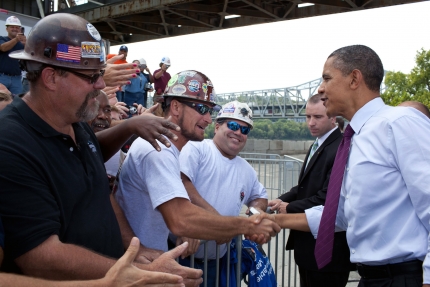
President Obama at the Brent Spence Bridge

September 22, 2011 | 21:18 | Public Domain

The American Jobs Act will invest $50 billion in infrastructure updates.

Download mp4 (203MB) | mp3 (20MB)

Read the Transcript

President Obama stands up for the American Jobs Act at the Ohio River's Brent Spence Bridge

Ed. Note: Cross-posted from Fast Lane, the blog of the Secretary of Transportation.

Two weeks ago, President Obama presented his American Jobs Act to a joint session of Congress and to the people of America.  Today, I was pleased to join him at the Brent Spence Bridge across the Ohio River, a functionally obsolete crossing on one of North America's busiest trucking routes. Replacing this bridge is exactly the kind of project that the American Jobs Act could support. 

And the Brent Spence Bridge from Cincinnati, Ohio to Covington, Kentucky is just one example.  As the President said, "The same is true in cities and towns all across America.  It’s not safe.  It lengthens the commute to work.  It costs our businesses billions when they can’t ship parts or products as quickly as possible."

[[nid:79843]]

We were joined beside the bridge by ironworkers, laborers, and carpenters from the area, some of whom have been out of work for months on end.  They would be happy to get back on the job rebuilding the Brent Spence or any of the tens of thousands of bridges in America that need repair, replacement, or modernization.  If only Congress would pass the American Jobs Act.

Carpenter Ronnie King--who has been mostly unemployed since 2007--told us today, "Roads and bridges desperately need work, and there are a lot of people out there who desperately need work."

Well, as soon as Congress passes the American Jobs Act, we can get people like Ronnie back to work.  But we need Congress to act soon, and it's not clear that they will.  As laborer Johnnie Jacobs, who was also with us today, said, "This is supposed to be the land of plenty, but people are too busy bickering to help the people who are really suffering here.”

I hope that's not the case.

Built in 1963 to handle up to 85,000 vehicles a day, the Brent Spence Bridge now carries nearly twice that number of vehicles each day.  Commuters regularly face backups of nearly three miles on both sides of the bridge.

These backups also affect all of us because the bridge is on I-75, a primary highway for America's truckers.  Three percent of the nation's gross domestic product crosses the Brent Spence Bridge each year.  Shipping companies try to have their trucks avoid the bridge, but that only ends up costing them--and the rest of us--more money.

If Congress passes the American Jobs Act, we can speed up the environmental and other approvals necessary and get shovels in the ground for the Brent Spence Bridge by 2013--that's more than a full year ahead of schedule.

And there are tens of thousands of other bridges like this across America waiting for immediate attention.  Just down the river from Cincinnati is the Sherman Minton Bridge, where I'll visit tomorrow.  Two weeks ago, this bridge that carries 75,000 vehicles a day on I-64 had to be shut down indefinitely by the governors of Indiana and Kentucky because it's no longer safe.

When can we begin replacing the Sherman Minton Bridge?  When can we begin modernizing the Brent Spence Bridge?  When can we begin to put America's construction workers back on job sites rebuilding roads, rails, and runways across the country?

As soon as Congress passes the American Jobs Act.

Ray LaHood is Secretary of Transportation.

Close Transcript

The White House

Office of the Press Secretary

Presidential Nominations Sent to the Senate

NOMINATIONS SENT TO THE SENATE:

Michael A. Hughes, of the District of Columbia, to be United States Marshal for the Superior Court of the District of Columbia for the term of four years, vice Stephen Thomas Conboy, resigned.

Jacqueline H. Nguyen, of California, to be United States Circuit Judge for the Ninth Circuit, vice a new position created by Public Law 110-177, approved January 7, 2008.

Brian C. Wimes, of Missouri, to be United States District Judge for the Eastern and Western Districts of Missouri, vice Nanette K. Laughrey, retired.

The White House

Office of the Press Secretary

President Obama Nominates Judge Jacqueline H. Nguyen to Serve on the United States Court of Appeals

WASHINGTON – Today, President Obama nominated Judge Jacqueline H. Nguyen to the United States Court of Appeals for the Ninth Circuit. 

“Judge Nguyen has been a trailblazer, displaying an outstanding commitment to public service throughout her career,” President Obama said. “I am honored to nominate her today for a seat on the United States Court of Appeals and confident she will serve the American people with fairness and integrity.”  

Judge Jacqueline H. Nguyen: Nominee for the United States Court of Appeals for the Ninth Circuit

Judge Jacqueline H. Nguyen has served as a United States District Judge in the Central District of California in Los Angeles since 2009.  Judge Nguyen was born in Dalat, Vietnam, and in 1975, she fled the country as a girl along with her family as Saigon was in the process of falling during the latter stages of the Vietnam War.  Her family was placed at a refugee camp in Camp Pendleton, California, where they lived in a tent city for over one month before settling in the Los Angeles area.  She received her A.B. from Occidental College in 1987, and her J.D. from UCLA School of Law in 1991.  Judge Nguyen began her legal career at the law firm of Musick, Peeler & Garrett LLP, where she was a litigation associate from 1991 to 1994.  In 1995, she joined the United States Attorney’s Office in the Central District of California, serving as an Assistant United States Attorney in the criminal division.  There, she worked as a federal prosecutor in both the General Crimes and Public Corruption and Government Fraud sections, and was a member of the office’s Organized Crime Strike Force from 1999 to 2000.  She served as Deputy Chief of the General Crimes section from 2000 to 2002.  Judge Nguyen was appointed to the state bench as Judge of the Superior Court of the County of Los Angeles in 2002 and remained a judge on that court until she was appointed to the federal bench in 2009.

The White House

Office of the Press Secretary

President Obama Nominates Judge Brian C. Wimes to Serve on the United States District Court

WASHINGTON – Today, President Obama nominated Judge Brian C. Wimes to the United States District Court bench for the Eastern and Western District of Missouri. 

“I am proud to nominate this outstanding candidate to serve on the United States District Court bench,” said President Obama.  “Judge Wimes has a long and distinguished record of service, and I am confident he will serve on the federal bench with distinction.” 

Judge Brian C. Wimes: Nominee for the United States District Court for the Eastern and Western District of Missouri

Judge Brian C. Wimes is a judge on the 16th Judicial Circuit Court of Missouri, where he has served since 2007.  Prior to his appointment to the circuit court, Judge Wimes served Jackson County as a Drug Court Commissioner from 2001 to 2007 and as an Assistant Prosecuting Attorney in the Jackson County Prosecutor’s Office from 1995 to 2001.  From 1994 to 1995, he worked as an attorney advisor in the litigation branch of the Bureau of Prisons, a position he entered through the Department of Justice Honors Program.  Judge Wimes received his J.D. in 1994 from the Thurgood Marshall School of Law at Texas Southern University and his B.G.S. in 1990 from the University of Kansas.

The White House

Office of the Press Secretary

Presidential Proclamation -- National Public Lands Day

National Public Lands Day, 2011

- - - - - - -

By the President of the United States of America

A Proclamation

     At the dawn of the 20th century, President Theodore Roosevelt embarked on a tour of the American West that forever changed our Nation's relationship with the outdoors.  His visits to Yellowstone, Yosemite, the Grand Canyon, and other natural wonders instilled in him a commitment to conservation, and they motivated him to designate millions of acres of protected land.  Today, our public lands system is a model of conservation and an important resource for clean energy, grazing, and recreation ‑‑ vital economic engines in both rural and urban communities.

     On National Public Lands Day, we take time to appreciate our parks, national forests, wildlife refuges, and other public spaces, and we recommit to protecting and restoring them for future generations.  This year, thousands of dedicated volunteers will continue a proud American tradition by conserving and restoring our public lands with local projects across our Nation.  Americans will restore hiking trails, remove invasive plant species, clean lakes, and pick up litter in city parks.  Through their service, families and children will find opportunities for outdoor activity on the millions of acres of national forests, parks, and trails.

     To maintain our environmental heritage and build a responsive conservation and recreation agenda, my Administration launched the America's Great Outdoors Initiative last year.  We met with thousands of Americans in listening sessions across our country, and compiled the results of this national conversation in the report, America's Great Outdoors:  A Promise to Future Generations.  To act on these findings, we are undertaking projects in collaboration with State, local, and tribal governments to responsibly steward the lands that belong to all Americans.  First Lady Michelle Obama also joined in support of getting Americans outside when the Let's Move! initiative, in coordination with the Department of the Interior, launched Let's Move Outside! to help families exercise in the great outdoors.

     Countless Americans have experienced the same awe and wonder that President Roosevelt felt on his westward journey.  By joining in this legacy of conservation, Americans young and old protect not only our lands, but also the promise that future generations will be able to carry forward the spirit of adventure that lies at the heart of our Nation.

     NOW, THEREFORE, I, BARACK OBAMA, President of the United States of America, by virtue of the authority vested in me by the Constitution and the laws of the United States, do hereby proclaim September 24, 2011, as National Public Lands Day.  I encourage all Americans to participate in a day of public service for our lands.

     IN WITNESS WHEREOF, I have hereunto set my hand this twenty‑second day of September, in the year of our Lord two thousand eleven, and of the Independence of the United States of America the two hundred and thirty-sixth.


BARACK OBAMA

The White House

Office of the Press Secretary

President Obama Nominates Michael A. Hughes to Serve as a U.S. Marshal

WASHINGTON- Today, President Obama nominated Michael A. Hughes to serve as a U.S. Marshal for the Superior Court for the District of Columbia. 

“I am pleased to nominate this outstanding public servant to serve as a U.S. Marshal,” said President Obama.  “Throughout his career, Michael has demonstrated an unwavering commitment to justice.  I am grateful for his continued willingness to serve and protect the American people.”

Michael A. Hughes to be United States Marshal for the Superior Court for the District of Columbia

Michael A. Hughes has spent his entire law enforcement career with the United States Marshals Service.  He began his tenure in 1991, and has held various posts within the Marshals Service, including a stint with the Witness Security Division and an assignment to the protection detail of the Deputy Attorney General.  He currently serves as the Chief of the Office of Crisis Services within the U.S. Marshal Service’s Tactical Operations Division.  From 2003 to 2004, Hughes was detailed by the U.S. Marshals Service to the Washington, DC office of Senator Frank Lautenberg.  Hughes graduated from Montclair State University in New Jersey in 1990 with a bachelor’s degree and received a Master of Public Administration degree from American University in 2007.  He currently resides in Washington, DC.

The White House

Office of the Press Secretary

Remarks by the President on the American Jobs Act -- Cincinnati, OH

Hilltop Basic Resources-River Terminal, Cincinnati, Ohio

2:55 P.M. EDT

        THE PRESIDENT:  Hello, Cincinnati!  (Applause.)  Well, it is good to see all of you.  It is good to be back in Cincinnati.  (Applause.)  I have to say I drove by the Bengals’ practice -- (laughter.)  And I was scouting out some plays in case they play the Bears -- (laughter.)  Did I hear somebody boo the Bears?

        AUDIENCE:  Booo!  (Laughter.)  

        THE PRESIDENT:  We've got some folks I just want to make sure are acknowledged here today.  First of all, the Secretary of Transportation, Ray LaHood, is in the house.  Give him a round of applause.  (Applause.)  We've got the mayor of the great city of Cincinnati -- Mark Mallory is here.  (Applause.)  We've got the mayor of Covington, Mayor Denny Bowman.  (Applause.)  Senator Rand Paul is here.  

        AUDIENCE:  Booo --

        THE PRESIDENT:  Rand is going to be supporting bridges, so we've got to -- (applause.)  And we've got Congressman John Yarmuth in the house.  (Applause.)  

        Now, it is good to be back.  I was just in Columbus a little while ago, and I figured I couldn't get away with not giving     Cincinnati a little bit of love.  (Applause.)

        I want to thank the good folks at Hilltop Concrete for having us here today.  I especially want to thank Ron for his introduction.    

        Companies like Hilltop, construction companies, have been hit harder by this economic crisis than almost any other industry in America.  And there are millions of construction workers who are still out there looking for a job.  They're ready to work, but things have been a little tough.  That doesn’t mean that there is not plenty of construction waiting to get done in this country.  

        Behind us stands the Brent Spence Bridge.  It’s located on one of the busiest trucking routes in North America.  It sees about 150,000 vehicles every single day.  And it’s in such poor condition that it's been labeled "functionally obsolete."  Think about that -- functionally obsolete.  That doesn’t sound good, does it?  

        AUDIENCE:  Nooo!

        THE PRESIDENT:  It’s safe to --

        AUDIENCE MEMBER:  Kind of like John Boehner.  (Laughter.)  

        THE PRESIDENT:  It's safe to drive on, but it was not designed to accommodate today’s traffic, which can stretch out for a mile.  Shipping companies try to have their trucks avoid the bridge.  Of course, that only ends up costing them more money as well.  

        The thing is there are bridges and roads and highways like that throughout the region.  A major bridge that connects Kentucky and Indiana just closed down for safety reasons.  Another aging bridge that crosses over the Ohio River in Ironton could be replaced right now.  There are rail stations in Cleveland and Toledo in desperate need of repair.  And the same is true in cities and towns all across America.  It makes your commute longer.  It costs our businesses billions of dollars -- they could be moving products faster if they had better transportation routes.  And in some cases, it’s not safe.

        Now, we used to have the best infrastructure in the world here in America.  We’re the country that built the Intercontinental Railroad, the Interstate Highway System.  (Applause.)  We built the Hoover Dam.  We built the Grand Central Station.  (Applause.)  So how can we now sit back and let China build the best railroads?  And let Europe build the best highways?  And have Singapore build a nicer airport?  At a time when we've got millions of unemployed construction workers out there just ready to get on the job, ready to do the work to rebuilding America.  (Applause.)

        So, Cincinnati, we are better than that.  We're smarter than that.  And that’s why I sent Congress the American Jobs Act 10 days ago.  (Applause.)  This bill is not that complicated.  It's a bill that would put people back to work rebuilding America -- repairing our roads, repairing our bridges, repairing our schools.  It would lead to jobs for concrete workers like the ones here at Hilltop; jobs for construction workers and masons, carpenters, plumbers, electricians, architects, engineers, ironworkers -- put folks back to work.  (Applause.)   

        There is work to be done, and there are workers ready to do it.  So let’s tell Congress to pass this jobs bill right away.  (Applause.)

        AUDIENCE:  Pass this bill!  Pass this bill!  Pass this bill!

        THE PRESIDENT:  Pass this bill!  (Laughter.)  Pass the bill!

        Tell them to pass the jobs bill, and not only will we start rebuilding America, but we can also put thousands of teachers back to work.  (Applause.)   

        I was with the President of South Korea -- I was up at the United Nations.  We were doing a bunch of stuff.  And he's told me in the past -- I've asked him, I said, what's your biggest challenge?  He says, oh, education.  I said, well, what are you dealing with?  He said, well, you know what, we're hiring so many teachers we can barely keep up, because we know that if we're going to compete in the future we've got to have the best teachers.  (Applause.)  And we've got to have our kids in school longer.  And we've got to make sure that they're learning math and science.

        Well, while they're hiring teachers in droves, what are we doing?  We're laying off teachers.  It makes no sense in this new global economy where our young people's success is going to depend on the kind of education that they get.  So for us to be laying off teachers doesn’t make sense for our kids, it doesn’t make sense for us, it doesn’t make sense for our economy.  

        Pass this jobs bill and put teachers back in the classroom where they belong.  (Applause.)

        AUDIENCE:  Pass this bill!  Pass this bill!  Pass this bill!

        THE PRESIDENT:  They need to go and pass it.  

        Tell Congress to pass this jobs bill, and companies will get tax credit for hiring America’s veterans.  (Applause.)  We've been through a decade of war now.  Almost 2 million people have served.  And think about it.  They're suspending their careers; they're leaving their families; they're putting themselves in harm way -- all to protect us.  The last thing they should have to do is fight for a job when they come home.  (Applause.)  And if we pass this jobs bill it makes it easier for employers to hire those veterans.  That’s why we need to tell Congress to do what?  To pass the bill.

        AUDIENCE:  Pass this bill!  Pass this bill!  Pass this bill!

        THE PRESIDENT:  The American Jobs Act will cut taxes for the typical working family by $1,500 next year.  It will cut taxes for every small business in America.  It will give an extra tax cut to every small business owner who either hires more workers or raises those workers’ wages.  How many people here would like a raise?  (Applause.)

        And we know that most small businesses are the creators of new jobs.  We’ve got a lot of folks in Congress who love to say how they’re behind America’s job creators.  Well, if that’s the case, then you should be passing this bill, because that’s what this bill is all about, is helping small businesses all across America.

        Everything in this jobs bill has been supported in the past by Republicans and Democrats.  Everything in this jobs bill is paid for.  The idea for a big boost in construction is supported by the AFL-CIO, but it’s also supported by the Chamber of Commerce.  Those two don't get along on much, but they agree we should rebuild America.  (Applause.)

        And, by the way, thanks to the reforms that we’ve put into place, when we start rebuilding America we’re going to change how business is done.  No more earmarks.  No more boondoggles.  No more bridges to nowhere.  We’re going to cut the red tape that prevents some of these construction projects from getting started as quickly as possible.  And we’ll set up an independent fund to attract private dollars and issue loans based on two criteria:  how badly is a construction project needed, and how much good will it do for the community.  Those are the only things we should be thinking about.  Not politics.  (Applause.)  And, by the way, that’s an idea that’s supported by a Massachusetts Democrat and a Texas Republican.  It’s a good idea.   

        So my question is, what's Congress waiting for?  Why is it taking so long?  Now, the bridge behind us just happens to connect the state that’s home to the Speaker of the House --

        AUDIENCE:  Booo --

        THE PRESIDENT:  -- with the home state of the Republican leader in the Senate.

        AUDIENCE:  Booo --

        THE PRESIDENT:  Now, that’s just a coincidence.  (Laughter.) Purely accidental that that happened.  (Laughter.)  But part of the reason I came here is because Mr. Boehner and Mr. McConnell, those are the two most powerful Republicans in government.  They can either kill this jobs bill, or they can help pass this jobs bill.  (Applause.)  And I know these men care about their states. They care about businesses; they care about workers here.  I can’t imagine that the Speaker wants to represent a state where nearly one in four bridges are classified as substandard -- one in four.  I know that when Senator McConnell visited the closed bridge in Kentucky, he said that, “Roads and bridges are not partisan in Washington.”  That’s great.  I know that Paul Ryan, the Republican in charge of the budget process, recently said that "you can’t deny that infrastructure does creates jobs."  That's what he said.  

        Well, if that’s the case, there’s no reason for Republicans in Congress to stand in the way of more construction projects.  There’s no reason to stand in the way of more jobs.  

        Mr. Boehner, Mr. McConnell, help us rebuild this bridge.  (Applause.)  Help us rebuild America.  Help us put construction workers back to work.  (Applause.)  Pass this bill.  

        AUDIENCE:  Pass this bill!  Pass this bill!  Pass this bill!  Pass this bill!

        THE PRESIDENT:  Let’s pass the bill.

        AUDIENCE:  Pass this bill!  Pass this bill!  Pass this bill!

        THE PRESIDENT:  Now, some folks in Congress, they say, well, we don’t like how it’s paid for.  Well, it’s paid for as part of my larger plan to pay down our debt.  And that's why I make some additional cuts in spending.  We already cut a trillion dollars in spending.  This makes an additional hundreds of billions of dollars in cuts in spending, but it also asks the wealthiest Americans and the biggest corporations to pay their fair share of taxes.  (Applause.)

        Now, that should not be too much to ask.  And by the way, it wouldn’t kick in until 2013.  So when you hear folks say, oh, we shouldn’t be raising taxes right now -- nobody is talking about raising taxes right now.  We’re talking about cutting taxes right now.  But it does mean that there’s a long-term plan, and part of it involves everybody doing their fair share.  (Applause.)

        THE PRESIDENT:  Now, this isn’t to punish success.  What’s great about this country is our belief that anybody can make it. If you’re willing to put in the sweat, if you’re willing to roll up your sleeves, if you’re willing to work hard, you’ve got a good idea, you’re out there taking a risk -- God bless you.  You can make millions, you can make billions of dollars in America.  This is the land of opportunity.  (Applause.)  That’s great.  All I’m saying is, if you’ve done well -- I’ve done well -- then you should do a little something to give something back.  (Applause.) You should want to see the country that provided you with this opportunity to be successful, and be able to provide opportunity for the young people who are going to be coming up behind you.  (Applause.)

        And all I’m saying is that everything should be fair.  You know, you learn the idea of fairness when you’re two, three years old.  Right?  You’re in the sandbox and you don’t want to let somebody play with your truck -- (laughter) -- and your mom or your daddy go up and they say, “No, hon, that’s not fair, you’ve got to share.”  Isn’t that what they say?  Things have to be fair.  So all I’m saying is that Warren Buffett’s secretary should not be paying a lower [sic] tax rate on her income than Warren Buffett.  (Applause.)  That doesn’t make any sense.  A construction worker who’s making 50 or 60 grand a year shouldn’t be paying higher tax rates than the guy who’s making $50 million a year.  (Applause.)  And that’s how it’s working right now.  Because they get all these loopholes and tax breaks that you don’t get.

        So for me to say, let’s close those loopholes, let’s eliminate those tax breaks, and let’s make sure that everybody is paying their fair share -- there’s nothing wrong with that.  (Applause.)  

        Now, this is about priorities.  It’s about making choices.  If we just had all kinds of money and everybody was working, and we hadn’t gone through the worst financial crisis since the Great Depression, then maybe we wouldn’t have to make choices.  But right now we’ve got to make some choices.  We’ve got to decide what our priorities are.  If we want to pay for this jobs plan, and close the deficit, and invest in our infrastructure, and make sure we’ve got the best education system in the world, the money has got to come from some place.  Would you rather that the oil companies get to keep their tax loopholes?  

        AUDIENCE:  No!

        THE PRESIDENT:  Or would you rather make sure that we’re hiring thousands of construction workers to rebuild America?  (Applause.)  Would you rather keep in place special tax breaks for millionaires and billionaires?   

        AUDIENCE:  No!

        THE PRESIDENT:  Or would you say, let’s get teachers back in the classroom so our children can learn?  (Applause.)   

        Now, the Republicans, when I talked about this earlier in the week, they said, well, this is class warfare.  You know what, if asking a billionaire to pay their fair share of taxes, to pay the same tax rate as a plumber or a teacher is class warfare, then you know what, I’m a warrior for the middle class.  (Applause.)  I’m happy to fight for the middle class.  I’m happy to fight for working people.  (Applause.)  Because the only warfare I've seen is the battle against the middle class over the last 10, 15 years.

        It’s time to build an economy that creates good, middle-class jobs in this country.  It’s time to build an economy that honors the values of hard work and responsibility.  It’s time to build an economy that lasts.  And, Cincinnati, that starts right now.  That starts with your help.  (Applause.)  Maybe some of the people in Congress would rather settle their differences at the ballot box than work together right now.  In fact, a while back, Senator McConnell said that his “top priority” -- number-one priority -- was “to defeat the President.”  That was his top priority.

        AUDIENCE:  Booo --

        THE PRESIDENT:  Not jobs, not putting people back to work, not rebuilding America.  Beating me.  Well, I’ve got news for him, and every other member of Congress who feels the same way.  The next election is 14 months away, and I’ll be happy to tangle sometime down the road.  But the American people right now don’t have the luxury of waiting to solve our problems for another 14 months.  (Applause.)  A lot of folks are living paycheck to paycheck.  A lot of folks are just barely getting by.  They need us to get to work right now.  They need us to pass this bill.  (Applause.)

        So I’m asking all of you -- I need everybody here to lift your voices -- not just in Cincinnati, but anybody who's watching TV, or anybody who's within the range of my voice -- I want everybody to lift up their voices.  I want you to call.  I want you to email.  I want you to tweet.  I want you to fax.  I want you to visit.  If you want, write a letter -- it’s been a while. (Laughter.)  I want you to tell your congressperson that the time for gridlock and games-playing is over.  Tell them you want to create jobs, so pass this bill.  (Applause.)  

        If you want construction workers rebuilding America -- pass this bill.  (Applause.)  If you want teachers back in the classrooms -- pass this bill.

        AUDIENCE:  Pass this bill!

        THE PRESIDENT:  If you want to cut taxes for middle-class families -- pass this bill.

        AUDIENCE:  Pass this bill!

        THE PRESIDENT:  If you want to help small businesses, what do you do?

        THE AUDIENCE:  Pass this bill!  

        THE PRESIDENT:  If you want veterans to share in the opportunities of this country, what should you do?

        THE AUDIENCE:  Pass this bill!

        THE PRESIDENT:  Now is the time to act.  Because we are not a people that just sit back and wait for things to happen.  We go ahead and make things happen.  We’re tougher than the times we live in.  We are bigger than the politics that we’ve been seeing these last few months.  Let’s meet this moment.  Let’s get back to work.  Let’s show the world once again why America is the greatest nation on Earth.  

        God bless you.  And God bless the United States of America.  (Applause.)

END 3:12 P.M. EDT

President Obama: "It's Time to Build an Economy that Lasts"

Watch President Obama at Brent Spence Bridge here.

President Obama was in Cincinnati, Ohio today to talk about the urgent need to improve America’s infrastructure. The American Jobs Act includes a $50 billion investment in much needed infrastructure enhancements which will put people to work rebuilding America.

The President was speaking in front of the Brent Spence Bridge, which connects Ohio with Kentucky, and has been classified as “functionally obsolete.” While it is safe to drive on, the Brent Spence wasn’t designed to accommodate today’s traffic, which can stretch for a mile. Cincinnati’s mayor has said it needs to be rebuilt. And so do substandard roads and bridges all across America. As the President said today, America can do better:

We used to have the best infrastructure in the world here in America. We’re the country that built the Intercontinental Railroad, the Interstate Highway System. We built the Hoover Dam. We built the Grand Central Station. So how can we now sit back and let China build the best railroads?  And let Europe build the best highways?  And have Singapore build a nicer airport?  At a time when we've got millions of unemployed construction workers out there just ready to get on the job, ready to do the work to rebuilding America.  

So, Cincinnati, we are better than that. We're smarter than that. And that’s why I sent Congress the American Jobs Act 10 days ago. This bill is not that complicated. It's a bill that would put people back to work rebuilding America -- repairing our roads, repairing our bridges, repairing our schools. It would lead to jobs for concrete workers like the ones here at Hilltop; jobs for construction workers and masons, carpenters, plumbers, electricians, architects, engineers, ironworkers -- put folks back to work. 

Related Topics: Economy, Kentucky, Ohio

President Obama stands up for the American Jobs Act at the Ohio River's Brent Spence Bridge

Ed. Note: Cross-posted from Fast Lane, the blog of the Secretary of Transportation.

Two weeks ago, President Obama presented his American Jobs Act to a joint session of Congress and to the people of America.  Today, I was pleased to join him at the Brent Spence Bridge across the Ohio River, a functionally obsolete crossing on one of North America's busiest trucking routes. Replacing this bridge is exactly the kind of project that the American Jobs Act could support. 

And the Brent Spence Bridge from Cincinnati, Ohio to Covington, Kentucky is just one example.  As the President said, "The same is true in cities and towns all across America.  It’s not safe.  It lengthens the commute to work.  It costs our businesses billions when they can’t ship parts or products as quickly as possible."

President Barack Obama shakes hands with Construction Workers

President Barack Obama shakes hands with construction workers after delivering remarks on the American Jobs Act at the Brent Spence Bridge, that spans the Ohio River between Cincinnati, Ohio and Covington, Ky., Sept. 22, 2011. (Official White House Photo by Pete Souza)

We were joined beside the bridge by ironworkers, laborers, and carpenters from the area, some of whom have been out of work for months on end.  They would be happy to get back on the job rebuilding the Brent Spence or any of the tens of thousands of bridges in America that need repair, replacement, or modernization.  If only Congress would pass the American Jobs Act.

Related Topics: Economy, Indiana, Kentucky, Ohio

Patent Reform with the America Invents Act

September 22, 2011 | 2:15 | Public Domain

President Obama is joined by CEO's and Entreprenuers as he signs the America Invents Act into law. The bill invests in America's future by streamlining the patent process, allowing start-ups and small business owners to turn their innovative ideas into products three times faster than they can today. Learn more at http://obamawhitehouse.archives.gov

Download mp4 (70MB)