President Obama at Clinton Global Initiative

September 21, 2011 | 18:31 | Public Domain

President Obama said the Clinton Global Initiative reflects the American spirit, which is big and bold and generous, and doesn’t shy away from challenges.

Download (177MB)

Read the Transcript

Remarks by President Obama and President Clinton at Clinton Global Initiative

Sheraton New York Hotel and Towers

New York, New York 

2:43 P.M. EDT

PRESIDENT CLINTON:  For three years, now, and every year he has been in the White House, President Obama has come to CGI.  He believes in what we're trying to do.  In his former life, he was a walking NGO.  (Laughter.)  He also is one of those Americans who believes climate change is real and deserves a real response. (Applause.)

And he recently proposed to Congress a plan that even the Republican analysts who looked at the evidence, as opposed to the rhetoric, say will add between 1.5 and 2 percent to our GDP and help us to get out of this mess we're in and enable America to help the world again.

So I'm gratified that he found the time to come here.  I appreciate the work that he's involved with at the United Nations.  I think he has a brilliant Secretary of State.  (Laughter and applause.)  And I am profoundly gratified that he is here with us today. 

Ladies and gentlemen, President Obama.  (Applause.) 

PRESIDENT OBAMA: Thank you very much.  Thank you.  (Applause.) It is wonderful to be here today.  It is wonderful to see so many do-gooders all in one room.  (Laughter.)  And our do-gooder-in-chief, Bill Clinton, thank you for not only the gracious introduction, but the extraordinary work that he has been doing each and every day.  You are tireless, and we are proud of what you've been doing.  (Applause.)

I want to thank the outstanding team here at CGI:  CEO Bob Harrison, Deputy Director Ed Hughes, all the dedicated staff.  And although she is not part of CGI, she's certainly part of what makes Bill so successful -- someone who he does not get to see enough because of me -- (laughter) -- but I'm grateful that he's not bitter about it.  (Laughter.)  She's one of the best Secretaries of State that we've ever had -- Hillary Clinton.  (Applause.)

Now, this is the third time that I’ve been here.  Last year, I was the warm-up act for Michelle.  (Laughter.)  I just gave a big speech at the U.N. this morning, and so I will not subject you to another one.  I wanted to stop by for two reasons. 

First, I want to express my appreciation for the extraordinary work that has been done by CGI.  It’s been said that “no power on Earth can stop an idea whose time has come.” And as you know, when Bill Clinton sees an idea out there, there’s no stopping him.  CGI was an idea whose time had come.  And thanks to his relentless determination -- but also, I think he'd agree, thanks to, most importantly, your commitments -- you’ve created new hope and opportunity for hundreds of millions of people in nearly 200 countries.  Think about that -- hundreds of millions of people have been touched by what you've done.  That doesn’t happen very often.

That’s the other thing I want to talk about.  Around the world, people are still reeling from the financial crisis that unfolded three years ago and the economic pain that followed.  And this morning at the United Nations, I talked about the concerted action that the world needs to take right now to right our economic ship.

But we have to remember America is still the biggest economy in the world.  So the single most important thing we could do for the global economy is to get our own economy moving again.  When America is growing the world is more likely to grow.  And obviously that's the number-one issue on the minds of every American that I meet.  If they haven’t been out of work since the recession began, odds are they know somebody who has.  They feel as if the decks have been stacked against them.  They don't feel as if hard work and responsibility pay off anymore, and they don't see that hard work and responsibility reflected either in Washington or, all too often, on Wall Street.  They just want to know that their leaders are willing to step up and do something about it.

So, as President Clinton mentioned, that’s why I put forward the American Jobs Act.  Not as a silver bullet that will solve all our problems, but it will put more people back to work.  It will put more money into the pockets of working people.  And that’s what our economy needs right now.

It hires teachers, and puts them back in the classroom.  It hires construction workers, puts them out rebuilding an infrastructure that has deteriorated, and we know that that’s part of our economic success historically.  It puts our veterans back to work -- after having served overseas, then coming home and not being able to find a job, when they sacrificed immeasurably on behalf of our security? 

That’s what we need right now -- we need more good teachers in front of our kids.  I was just having lunch over at the General Assembly with the President of South Korea.  And I still remember the first time I met him, in South Korea, and I asked him, “Well, what are your biggest challenges right now?”  He says, “Education -- it’s a big challenge.”  I said, “Well, I understand.  We’ve got a big challenge in the United States, as well.”  He said, “No, you have to understand, my big challenge is, the parents are too demanding.”  (Laughter.)  “They’re coming into my office, they’re saying, our children have to learn English in first grade.  So we’re having to import teachers from other countries and pay them a premium to meet the educational demands that parents are placing on us, because they know that if their children are to succeed in the 21st century economy, they’d better know some foreign languages.”  Well, think about that.  That’s what’s happening in South Korea.  Here, we’re laying off teachers in droves? 

Now is the time to upgrade our roads and our bridges and our schools.  We used to have the best airports, the best roads, the best bridges, the best ports.  I’ve been asking people recently  -- I've taken a poll in New York -- how do you find LaGuardia compared to the Beijing airport?  (Laughter.)  We laugh, but that says something.  That’s not inevitable; that’s a choice that we’re making. 

We talk about climate change -- something that, obviously, people here are deeply concerned about.  Talking to the CEO of Southwest Airlines, they estimate that if we put in the new generation of GPS air traffic control, we would save 15 percent in fuel costs.  “Reduce fuel consumption by 15 percent, Mr. President.”  And think about what that would do, not only to potentially lower the cost of a ticket -- maybe they could start giving out peanuts again.  (Laughter .)  But think what it would do in terms of taking those pollutants out of our air. 

So we know what to do.  We know that an American should -- who puts his life on the line, her life on the line, should never have to fight for a job when they come home.  We know that.  We know what our values are. 

So this jobs bill addresses the terrible toll that unemployment inflicts on people.  It helps long-term unemployed keep their skills sharp.  It says to young people who are underprivileged, we’re going to give you a chance at a summer job that helps to establish the kind of work habits that carry on for generations.  Because part of what happens in this kind of recession environment -- the disadvantage of this generation coming in and not being able to get fully employed, that lingers for a lifetime.  It affects their lifetime earnings.  That’s contrary to our values.

This jobs bill cuts taxes for every working family and every small business owner in America to boost demand and to boost hiring.  And if you’re a small business owner who hires a new worker or raises workers’ wages, you get an extra tax cut.

So this bill answers the urgent need to create jobs right away.  And I appreciate President Clinton’s strong support of this plan over the weekend.  And the reason that that’s important is because he knows a good jobs plan when he sees it.  He created more jobs in his tenure than just about anybody.  And I’m fighting hard to make sure that we get this bill passed through Congress. 

As President Clinton said, every idea in there has been supported in the past by both parties, and everything is paid for.  There’s no reason why we shouldn’t pass it right away.  And for those of you who are concerned about the international economy and development, keep this in mind:  If the economy is not growing, if Americans aren’t getting back to work, it becomes that much harder for us to sustain the critical development assistance and the partnerships that help to undergird development strategies that you care dearly about all across the world.

So this is important, again, not just to the United States; this is important to the world.  It will help determine how well we can support what you are doing in the non-for-profit sector.  I’m going to be doing everything I can, everything in my power, to get this economy moving again that requires congressional support but also those things that don't require congressional support. 

Consider one of the ideas that we’re working on together.  Earlier this year, I announced a Better Buildings Initiative to rehire construction workers to make our buildings more energy-efficient.  And I asked President Clinton and my Jobs Council to challenge private companies to join us.  In June, at CGI America, we announced a commitment to upgrade 300 million square feet of space, from military housing to college campuses.  Some of these projects are breaking ground this month, putting people to work right now.  Later this year, we’ll announce more commitments that will create jobs, while saving billions for businesses on energy bills and cutting down on our pollution. 

And it’s a good example of what CGI is all about:  Everybody working together -- government, business, the non-for-profit sector -- to create opportunities today, while ensuring those opportunities for the future.  We just need that kind of cooperation in Washington. 

I have to say that I do envy President Clinton because when you’re out of Washington, it turns out that you’re just dealing with people who are reasonable all the time.  (Laughter and applause.)  Nobody is looking to score points.  Nobody is looking at the polls on any particular issue.  You’re just trying to solve problems.  And that’s the ethic that people are looking for in Washington.

We’ve got enough challenges.  It is technically difficult to figure out how we are going to deal with climate change -- not impossible, but difficult.  There are technical challenges to making sure that we’re providing enough safe drinking water around the world, or making sure that preventable diseases are eradicated in countries that don’t yet have a public health infrastructure.  These things are all tough stuff.  But they’re solvable, if everybody’s attitude is that we’re working together, as opposed to trying to work at odds with each other. 

And our future depends on fighting this downturn with everything that we’ve got right now.  And it demands that we invest in ourselves, even as we’re making commitments in investments around the world.  It demands we invest in research and technology, so the great ideas of tomorrow are born in our labs and our classrooms.  It demands we invest in faster transportation and communications networks, so that our businesses can compete.  It demands that we give every child the skills and education they need to succeed. 

And I thank you for the commitment that you’ve made to recruit and train tens of thousands of new science, technology, engineering and math teachers.  Nothing could be more important.

We can do all this.  We can create jobs now and invest in our future, and still tackle our long-term debt problems.  Don’t tell Bill Clinton it can’t be done.  He did it.  When he was President, he did not cut our way out of prosperity; he grew our way to prosperity.  We didn’t shortchange essential investments, or balance the budget on the backs of the middle class or the poor.  We were able to live within our means, invest in our future, and ask everyone to pay their fair share. 

And what happened?  The private sector thrived.  The rich got richer.  The middle class grew.  Millions rose out of poverty.  America ran a surplus that was on track to be debt-free by next year.  We were a nation firing on all cylinders. 

That’s the kind of nation that we’ve got to work to build again.  It will take time after the kind of crisis that we’ve endured.  And this is a once-in-a-generation crisis.  But we can get through it.  But our politics right now is not doing us any favors. 

Nevertheless, I believe we can and we will get there, by remembering what made us great -- by building an economy where innovation is encouraged, education is a national mission, new jobs and businesses choose to take root right here in the United States.  And that’s what CGI reflects.  It reflects the American spirit, which is big and bold and generous, and doesn’t shy away from challenges, and says that we’re all in it together. 

And when I think about the contributions that all of you have made, that makes me confident.  Those of us who have been most blessed by this nation, we are ready to give back.  But we’ve got to be asked.  And that’s what I’m hoping members of Congress recognize.  I don’t want a small, cramped vision of what America can be.  We want a big and generous vision of what America can be.  And the world is inspired when we have that vision.

And, by the way, that vision is not a Democratic vision or a Republican idea.  These are not ideas that belong to one political party or another.  They are the things a rising nation does, and the thing that retreating nations don’t do.  And we are not a retreating nation. 

So despite the many challenges we face right now, I believe America must continue to be a rising nation, with rising fortunes.  And that makes -- that means making sure that everybody is participating and everybody is getting a shot, because when all of our people do well, America does well.  And when America does well, that’s good for the rest of the world.  That’s what President Clinton has always understood. 

So, Mr. President, thank you for all the opportunities that you help to create every day.  Thank you to all of you who are participating in CGI.  You are doing the Lord’s work.  And I can assure you that you will continue to have a partner in the Obama administration for what I expect to be years to come. 

Thank you very much.  (Applause.)

END
2:57 P.M. EDT
Close Transcript

President Obama's Bilateral Meeting with President Sarkozy of France

September 21, 2011 | 8:03 | Public Domain

President Obama and President Sarkozy of France meet during the U.N. General Assembly.

Download mp4 (77MB) | mp3 (8MB)

Read the Transcript

Remarks by President Obama and President Sarkozy of France

Waldorf Astoria Hotel
New York, New York

4:53 P.M. EDT

PRESIDENT OBAMA:  On the anniversary of September 11th, President Sarkozy gave a speech at our embassy in Paris, and he reminded the people of France, but also the world, of the extraordinary friendship that had developed, in part, because of the great sacrifices that our men and women in uniform have made over the decades to preserve freedom and democracy.  And so, not only am I grateful for the expression of deep friendship that President Sarkozy expressed, but I want to affirm the mutuality of feeling that we have towards the French people.

That partnership has been evidenced by the extraordinary work that we've done together in Libya.  And I want to thank President Sarkozy for his leadership, as a coalition helped the Libyan people achieve the kind of freedom and opportunity that they're looking for.  That partnership is evidenced in the work we did together in Côte d'Ivoire to ensure that the rightfully elected leader of that country was put in place.  And our partnership and our mutual leadership will be required to deal with a range of international issues that have been discussed here at the United Nations and are going to be critical in the months and years to come, including trying to find a resolution to the Israeli-Palestinian conflict, but also trying to find a coordinated world strategy, global strategy, to deal with a economy that is still far too fragile.

And, of course, we still have the joint project to bring stability and transition to Afghan governance.  And we are extraordinarily grateful for the sacrifices that the men and women in uniform from France have made in that effort. 

On a personal note, I consider Nicolas a friend as well as a colleague.  Thank you for your leadership.  Welcome.  And I look forward to a very productive discussion.

PRESIDENT SARKOZY:  (As translated.)  I should like to say just how delighted we are to be here in the United States, in New York, alongside Barack Obama. 

Now, for we, the people of France, I must say, it’s actually easy to work with Barack Obama.  Whatever the crises we’ve had to face together, whatever the initiatives we have taken jointly, on every single occasion we have found a listening, open-minded attitude on the part of our friend, Barack Obama.  In particular, when tackling the crisis, which is still upon us today, the leadership that President Obama has shown, and showed at the time, have been of a special value to us all.

There is still much to do, in particular in paving the way to the G20 summit in Cannes.  This is our priority; our number-one priority -- let me make this very clear -- is to find the path to growth worldwide. 

Lastly, I wish to say to what extent I am sensitive to the boldness, the courage, the intelligence, and the sensitivity of President Obama, my friend.  I liked him before his election; I liked him once he was elected; and I especially appreciate him now, when the tough times are upon us. 

And there’s one thing I want to say, perhaps on a more personal note, and that I really mean from the bottom of my heart.  When things are as tough as they are right now, when the going gets as tough as it is right now, it is especially precious and important to be able to speak to what is the world’s number-one power -- to someone who listens; someone who is sensitive to others; someone who is respectful and aware of other people’s redlines and prepared to take them into account, especially at a time when, as I said, we are facing fresh difficulties, and we really need, together, to go forward.

(Speaking in English.)  She speaks like me.  (Laughter.)

PRESIDENT OBAMA:  Thank you very much.

END
5:02 P.M. EDT

Close Transcript

President Obama's Bilateral Meeting with Prime Minister Cameron of the United Kingdom

September 21, 2011 | 2:30 | Public Domain

President Obama and Prime Minister Cameron of the United Kingdom meet during the U.N. General Assembly.

Download mp4 (24MB) | mp3 (2MB)

Read the Transcript

Remarks by President Obama and Prime Minister Cameron of the United Kingdom

Waldorf Astoria Hotel
New York, New York


3:55 P.M. EDT

PRESIDENT OBAMA:  Let me welcome Prime Minister Cameron to the United States and New York.  Obviously, there is an extraordinary special relationship between the United States and the United Kingdom, and I am very fortunate that over the last year or two, David and I have been able to, I think, establish an excellent friendship as well. 

And that’s part of what makes the alliance between the United States and the United Kingdom so important, is that it’s grounded not only in shared values and broad-based agreement on policy, but it’s also based on the individual relationships that we have and the friendships and joint traditions that we have.

We’ve got a lot to talk about.  We have worked closely together to help bring about freedom and peace in Libya.  We are coordinating closely in managing a very difficult time for the global economy.  We are keenly interested in finding a resolution to the Israeli-Palestinian conflict.  On all these issues, I’ve always found Prime Minister Cameron to be an outstanding partner.

And so I’m very grateful for his friendship, his hard work, and his dedication and his leadership on the global stage, and I look forward to a very productive discussion today.

 Welcome.

PRIME MINISTER CAMERON:  Thank you.  If I may say thank you, Barack, for that warm welcome.  It’s great to be back -- great to be back in New York, and particularly on this, the 10th anniversary of 9/11, a reminder of how our countries always work together in defeating terror and trying to make our world a safer place.

As you say, we worked very closely together on Libya, and I think we’re getting to a good conclusion there, with a real chance of freedom and democracy for those people.  We’re working closely together on Afghanistan; also the Middle East peace process, where we're desperate to get that moving again.  And I’m looking forward to discussions on the world economy, which we will follow up in Cannes at the G20, where we’ve got to get the world economy moving. 

So these are very important times.  I think the relationship is as strong as it’s ever been, and it’s been a pleasure working with you these last 16 months.

PRESIDENT OBAMA:  Excellent.  Thank you very much, everybody.

Q: Can you give us your reaction to the hikers being released?

PRESIDENT OBAMA:  We are thrilled that the hikers were released, and we are thrilled for the families.  It was the right thing to do.  They shouldn’t have been held in the first place, but we’re glad they’re now home.

END
3:58 P.M. EDT

Close Transcript

U.N. Secretary General's Luncheon

September 21, 2011 | 9:16 | Public Domain

Salutes the U.N workers who risk their lives so people can live in peace and dignity.

Download mp4 (89MB) | mp3 (9MB)

Read the Transcript

Remarks by President Obama and U.N. Secretary General Ban Ki-Moon in Luncheon Toasts

1:54 P.M. EDT

SECRETARY GENERAL BAN:  President Obama, Excellencies, distinguished heads of state and government, Your Highnesses, Your Majesties, distinguished ministers, ladies and gentlemen: Welcome to the United Nations. Welcome to our common house.  

We are off to a flying start today, I must say. Thank you, President Obama, for your inspiring oratory, and more, for its vital importance. 

As ever, we thank the United States and its generous people for hosting United Nations during last 66 years. This is the 66th session. Let me offer a special word of thanks to New Yorkers. In the last month, they have faced an earthquake, then a hurricane, now a perfect storm of the world’s leaders, creating a lot of traffic jams. And we are very much grateful for their patience. 

Let me say straight off, this is my fifth lunch with the distinguished leaders of the world, and I’m very much grateful for your strong support.  In that regard, I am very glad that it is not my last lunch, and we will have five more lunches in the coming five years. (Applause.) Thank you very much. Taking this opportunity, I would like to really sincerely express my appreciation and thanks to all of the heads of state and government for your strong support. You can count on me. And it’s a great and extraordinary honor to serve this great organization.

Mr. President, 50 years ago this week, your predecessor, President John F. Kennedy, addressed the General Assembly. He came, he said to join with other world leaders -- and I quote, “to look across this world of threats to a world of peace.” Looking out upon the world we see no shortages of threats.  And closer to home, wherever we might live, we see the familiar struggles of political life -- left versus right, rich versus poor, and up versus down.  Seldom, however, has the debate been more emotional or strident; yet, seldom has the need for unity been greater.  

We know the challenges. I won’t reprise my speech except to say that we do, indeed, have a rare and generational opportunity to make a lasting difference in people’s lives. If there is a theme in all that has been said today by the leaders, it would be the imperative of unity, solidarity, in realizing that opportunity. We must act together. There is no opt-out clause for global problem-solving.  Every country has something to give in and to gain. 

Excellencies, let me close with a question. By any chance, do you ever feel that you have become a slave, you have become a slave to this machine?  (Laughter.) Somehow, I sense that I’m not alone.  I have seen so many leaders having, and speaking over the phone, even while at the summit meetings. Thanks to device like this, the world has been more connected. But let us not misunderstand that with being united and being connected depends on technology. Being united depends on us -- on leaders, on institutions, and on the decisions you make.  

We have come a long way since last year. Outside this building, the new flags of Southern Sudan and Libya proudly wave in the September breeze. And today I am very pleased to recognize the President of Southern Sudan -- his Excellency Salva Kiir -- who came to New York for the first time after their independence; and President of National Transitional Council of Libya, his Excellency Abdul Jalil -- who received very strong support yesterday.  And they will continue to receive such support. Let us give them a big applause.  (Applause.)  

We can be proud of the firm stand we took for freedom and democracy in Côte d’Ivoire, North Africa, and elsewhere. We can be proud of the many lives we saved, the hungry people we fed, the children we helped to grow up healthy and strong. And we can do more to make the Arab Spring a season of hope for all, to put the sustainable back into development, to prevent the crises before they explode.  

And so, distinguished heads of state and government, Excellencies, Your Majesties, let us raise a glass to clarity of vision, to unity of purpose, to a common resolve for action, to the United Nations, and to continued success of each and every heads of state and government present here.

Thank you very much. Cheers. (Applause.) Cheers. Thank you. Cheers. (Applause.)

 (A toast is offered.)

THE PRESIDENT:  Good afternoon, everyone. These lunches come right after my remarks to the General Assembly, so I’ve already spoken too long.  (Laughter.)  As the host of the United Nations, I want to welcome all of you. In particular, though, I want to cite Secretary General Ban for his extraordinary leadership. As you begin your second term, I want to take this opportunity to thank you -- not just for your leadership, but also for your lessons in life.  

As we all know, the Secretary General is a very modest man, but he’s led a remarkable life. Born into World War II, as a young boy in the middle of the Korean War, having to flee the fighting with his family -- just as his home country has risen, so he has risen to leadership on the world stage.  

A lot of us are envious of him, because, in running for a second term, he ran unopposed -- (laughter) -- and he won, unanimously. (Laughter.) I’m still trying to learn what his trick is.  (Laughter.) 

But, Secretary General, that fact reflects the high esteem with which all of us hold you and your leadership.  And I want to quote something that you said when you began your new term: “We live in a new era where no country can solve all challenges and where every country could be part of the solution.”  I could not agree more. Today, we see the difference you’ve made in Cote d’Ivoire, in Sudan, in Libya, in confronting climate change and nuclear safety, in peacekeeping missions that save lives every single day.  

So we want to salute you. We want to salute those who serve in U.N. missions around the world, at times at great risk to themselves.  We give them their mandate, but it is they who risk their lives -- and give their lives -- so people can live in peace and dignity.

So I want to propose a toast. To the leader who, every day, has to work hard to try to unite nations, and to all the men and women who sustain it, especially those brave humanitarians in blue helmets. In an era of great tumult and great change, let all of us be part of the solution. Cheers. (Applause.)

(A toast is offered.)

 END                                                 2:03 P.M. EDT      

Close Transcript

President Obama's Bilateral Meeting with Prime Minister Noda of Japan

September 21, 2011 | 7:09 | Public Domain

Leaders discuss Japan's tsunami recovery progress and the global economy.

Download mp4 (68.3MB) | mp3 (7MB)

President Obama's Bilateral Meeting with Prime Minister Netanyahu of Israel

September 21, 2011 | 4:08 | Public Domain

Leaders discuss hopes for peace in the region during the UN General Assembly.

Download (40MB) | mp3 (4MB)

The White House

Office of the Press Secretary

Remarks by President Obama and U.N. Secretary General Ban Ki-Moon in Luncheon Toasts

United Nations Headquarters, New York, NY

1:54 P.M. EDT

SECRETARY GENERAL BAN:  President Obama, Excellencies, distinguished heads of state and government, Your Highnesses, Your Majesties, distinguished ministers, ladies and gentlemen: Welcome to the United Nations. Welcome to our common house.  

We are off to a flying start today, I must say. Thank you, President Obama, for your inspiring oratory, and more, for its vital importance. 

As ever, we thank the United States and its generous people for hosting United Nations during last 66 years. This is the 66th session. Let me offer a special word of thanks to New Yorkers. In the last month, they have faced an earthquake, then a hurricane, now a perfect storm of the world’s leaders, creating a lot of traffic jams. And we are very much grateful for their patience. 

Let me say straight off, this is my fifth lunch with the distinguished leaders of the world, and I’m very much grateful for your strong support.  In that regard, I am very glad that it is not my last lunch, and we will have five more lunches in the coming five years. (Applause.) Thank you very much. Taking this opportunity, I would like to really sincerely express my appreciation and thanks to all of the heads of state and government for your strong support. You can count on me. And it’s a great and extraordinary honor to serve this great organization.

Mr. President, 50 years ago this week, your predecessor, President John F. Kennedy, addressed the General Assembly. He came, he said to join with other world leaders -- and I quote, “to look across this world of threats to a world of peace.” Looking out upon the world we see no shortages of threats.  And closer to home, wherever we might live, we see the familiar struggles of political life -- left versus right, rich versus poor, and up versus down.  Seldom, however, has the debate been more emotional or strident; yet, seldom has the need for unity been greater.  

We know the challenges. I won’t reprise my speech except to say that we do, indeed, have a rare and generational opportunity to make a lasting difference in people’s lives. If there is a theme in all that has been said today by the leaders, it would be the imperative of unity, solidarity, in realizing that opportunity. We must act together. There is no opt-out clause for global problem-solving.  Every country has something to give in and to gain. 

Excellencies, let me close with a question. By any chance, do you ever feel that you have become a slave, you have become a slave to this machine?  (Laughter.) Somehow, I sense that I’m not alone.  I have seen so many leaders having, and speaking over the phone, even while at the summit meetings. Thanks to device like this, the world has been more connected. But let us not misunderstand that with being united and being connected depends on technology. Being united depends on us -- on leaders, on institutions, and on the decisions you make.  

We have come a long way since last year. Outside this building, the new flags of Southern Sudan and Libya proudly wave in the September breeze. And today I am very pleased to recognize the President of Southern Sudan -- his Excellency Salva Kiir -- who came to New York for the first time after their independence; and President of National Transitional Council of Libya, his Excellency Abdul Jalil -- who received very strong support yesterday.  And they will continue to receive such support. Let us give them a big applause.  (Applause.)  

We can be proud of the firm stand we took for freedom and democracy in Côte d’Ivoire, North Africa, and elsewhere. We can be proud of the many lives we saved, the hungry people we fed, the children we helped to grow up healthy and strong. And we can do more to make the Arab Spring a season of hope for all, to put the sustainable back into development, to prevent the crises before they explode.  

And so, distinguished heads of state and government, Excellencies, Your Majesties, let us raise a glass to clarity of vision, to unity of purpose, to a common resolve for action, to the United Nations, and to continued success of each and every heads of state and government present here.

Thank you very much. Cheers. (Applause.) Cheers. Thank you. Cheers. (Applause.)

 (A toast is offered.)

THE PRESIDENT:  Good afternoon, everyone. These lunches come right after my remarks to the General Assembly, so I’ve already spoken too long.  (Laughter.)  As the host of the United Nations, I want to welcome all of you. In particular, though, I want to cite Secretary General Ban for his extraordinary leadership. As you begin your second term, I want to take this opportunity to thank you -- not just for your leadership, but also for your lessons in life.  

As we all know, the Secretary General is a very modest man, but he’s led a remarkable life. Born into World War II, as a young boy in the middle of the Korean War, having to flee the fighting with his family -- just as his home country has risen, so he has risen to leadership on the world stage.  

A lot of us are envious of him, because, in running for a second term, he ran unopposed -- (laughter) -- and he won, unanimously. (Laughter.) I’m still trying to learn what his trick is.  (Laughter.) 

But, Secretary General, that fact reflects the high esteem with which all of us hold you and your leadership.  And I want to quote something that you said when you began your new term: “We live in a new era where no country can solve all challenges and where every country could be part of the solution.”  I could not agree more. Today, we see the difference you’ve made in Cote d’Ivoire, in Sudan, in Libya, in confronting climate change and nuclear safety, in peacekeeping missions that save lives every single day.  

So we want to salute you. We want to salute those who serve in U.N. missions around the world, at times at great risk to themselves.  We give them their mandate, but it is they who risk their lives -- and give their lives -- so people can live in peace and dignity.

So I want to propose a toast. To the leader who, every day, has to work hard to try to unite nations, and to all the men and women who sustain it, especially those brave humanitarians in blue helmets. In an era of great tumult and great change, let all of us be part of the solution. Cheers. (Applause.)

(A toast is offered.)

 END                                                 2:03 P.M. EDT      

President Obama Meets with World Leaders on Day Two at the U.N General Assembly

UNGA: potus shakes hands with Clinton at Global Initiative

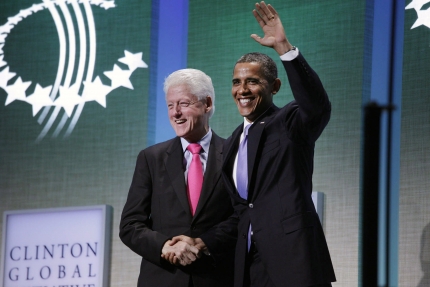
President Barack Obama shakes hands with former President Bill Clinton after speaking at the Clinton Global Initiative at the Sheraton New York Hotel and Towers in New York, N.Y., Sept. 21, 2011. (Official White House Photo by Samantha Appleton)

President Obama marked the 19th anniversary of the International Day of Peace with a series of meetings and events as he participated in the 66th session of the United Nations General Assembly in New York City. The President began his day with an address to the General Assembly, where he spoke about the remarkable changes that have occurred throughout the world since the last gathering of this group:

This year has been a time of extraordinary transformation. More nations have stepped forward to maintain international peace and security. And more individuals are claiming their universal right to live in freedom and dignity.

Following the address, President Obama met with Prime Minister Netanyahu of Israel and pledged America’s commitment to the pursuit of peace in the Middle East. The Prime Minister agreed with President Obama's assertion that direct negotiations between Israel and Palestine are the only way to achieve that goal:

I think the Palestinians want to achieve a state through the international community, but they’re not prepared yet to give peace to Israel in return.  And my hope is that there will be other leaders in the world, responsible leaders, who will heed your call, Mr. President, and oppose this effort to shortcut peace negotiations -- in fact, to avoid them. Because I think that avoiding these negotiations is bad for Israel, bad for the Palestinians, and bad for peace.

President Obama at Clinton Global Initiative

September 21, 2011 | 18:31 | Public Domain

President Obama said the Clinton Global Initiative reflects the American spirit, which is big and bold and generous, and doesn’t shy away from challenges.

Download mp4 (177MB) | mp3 (17MB)

Read the Transcript

Remarks by President Obama and President Clinton at Clinton Global Initiative

Sheraton New York Hotel and Towers

New York, New York 

2:43 P.M. EDT

PRESIDENT CLINTON:  For three years, now, and every year he has been in the White House, President Obama has come to CGI.  He believes in what we're trying to do.  In his former life, he was a walking NGO.  (Laughter.)  He also is one of those Americans who believes climate change is real and deserves a real response. (Applause.)

And he recently proposed to Congress a plan that even the Republican analysts who looked at the evidence, as opposed to the rhetoric, say will add between 1.5 and 2 percent to our GDP and help us to get out of this mess we're in and enable America to help the world again.

So I'm gratified that he found the time to come here.  I appreciate the work that he's involved with at the United Nations.  I think he has a brilliant Secretary of State.  (Laughter and applause.)  And I am profoundly gratified that he is here with us today. 

Ladies and gentlemen, President Obama.  (Applause.) 

PRESIDENT OBAMA: Thank you very much.  Thank you.  (Applause.) It is wonderful to be here today.  It is wonderful to see so many do-gooders all in one room.  (Laughter.)  And our do-gooder-in-chief, Bill Clinton, thank you for not only the gracious introduction, but the extraordinary work that he has been doing each and every day.  You are tireless, and we are proud of what you've been doing.  (Applause.)

I want to thank the outstanding team here at CGI:  CEO Bob Harrison, Deputy Director Ed Hughes, all the dedicated staff.  And although she is not part of CGI, she's certainly part of what makes Bill so successful -- someone who he does not get to see enough because of me -- (laughter) -- but I'm grateful that he's not bitter about it.  (Laughter.)  She's one of the best Secretaries of State that we've ever had -- Hillary Clinton.  (Applause.)

Now, this is the third time that I’ve been here.  Last year, I was the warm-up act for Michelle.  (Laughter.)  I just gave a big speech at the U.N. this morning, and so I will not subject you to another one.  I wanted to stop by for two reasons. 

First, I want to express my appreciation for the extraordinary work that has been done by CGI.  It’s been said that “no power on Earth can stop an idea whose time has come.” And as you know, when Bill Clinton sees an idea out there, there’s no stopping him.  CGI was an idea whose time had come.  And thanks to his relentless determination -- but also, I think he'd agree, thanks to, most importantly, your commitments -- you’ve created new hope and opportunity for hundreds of millions of people in nearly 200 countries.  Think about that -- hundreds of millions of people have been touched by what you've done.  That doesn’t happen very often.

That’s the other thing I want to talk about.  Around the world, people are still reeling from the financial crisis that unfolded three years ago and the economic pain that followed.  And this morning at the United Nations, I talked about the concerted action that the world needs to take right now to right our economic ship.

But we have to remember America is still the biggest economy in the world.  So the single most important thing we could do for the global economy is to get our own economy moving again.  When America is growing the world is more likely to grow.  And obviously that's the number-one issue on the minds of every American that I meet.  If they haven’t been out of work since the recession began, odds are they know somebody who has.  They feel as if the decks have been stacked against them.  They don't feel as if hard work and responsibility pay off anymore, and they don't see that hard work and responsibility reflected either in Washington or, all too often, on Wall Street.  They just want to know that their leaders are willing to step up and do something about it.

So, as President Clinton mentioned, that’s why I put forward the American Jobs Act.  Not as a silver bullet that will solve all our problems, but it will put more people back to work.  It will put more money into the pockets of working people.  And that’s what our economy needs right now.

It hires teachers, and puts them back in the classroom.  It hires construction workers, puts them out rebuilding an infrastructure that has deteriorated, and we know that that’s part of our economic success historically.  It puts our veterans back to work -- after having served overseas, then coming home and not being able to find a job, when they sacrificed immeasurably on behalf of our security? 

That’s what we need right now -- we need more good teachers in front of our kids.  I was just having lunch over at the General Assembly with the President of South Korea.  And I still remember the first time I met him, in South Korea, and I asked him, “Well, what are your biggest challenges right now?”  He says, “Education -- it’s a big challenge.”  I said, “Well, I understand.  We’ve got a big challenge in the United States, as well.”  He said, “No, you have to understand, my big challenge is, the parents are too demanding.”  (Laughter.)  “They’re coming into my office, they’re saying, our children have to learn English in first grade.  So we’re having to import teachers from other countries and pay them a premium to meet the educational demands that parents are placing on us, because they know that if their children are to succeed in the 21st century economy, they’d better know some foreign languages.”  Well, think about that.  That’s what’s happening in South Korea.  Here, we’re laying off teachers in droves? 

Now is the time to upgrade our roads and our bridges and our schools.  We used to have the best airports, the best roads, the best bridges, the best ports.  I’ve been asking people recently  -- I've taken a poll in New York -- how do you find LaGuardia compared to the Beijing airport?  (Laughter.)  We laugh, but that says something.  That’s not inevitable; that’s a choice that we’re making. 

We talk about climate change -- something that, obviously, people here are deeply concerned about.  Talking to the CEO of Southwest Airlines, they estimate that if we put in the new generation of GPS air traffic control, we would save 15 percent in fuel costs.  “Reduce fuel consumption by 15 percent, Mr. President.”  And think about what that would do, not only to potentially lower the cost of a ticket -- maybe they could start giving out peanuts again.  (Laughter .)  But think what it would do in terms of taking those pollutants out of our air. 

So we know what to do.  We know that an American should -- who puts his life on the line, her life on the line, should never have to fight for a job when they come home.  We know that.  We know what our values are. 

So this jobs bill addresses the terrible toll that unemployment inflicts on people.  It helps long-term unemployed keep their skills sharp.  It says to young people who are underprivileged, we’re going to give you a chance at a summer job that helps to establish the kind of work habits that carry on for generations.  Because part of what happens in this kind of recession environment -- the disadvantage of this generation coming in and not being able to get fully employed, that lingers for a lifetime.  It affects their lifetime earnings.  That’s contrary to our values.

This jobs bill cuts taxes for every working family and every small business owner in America to boost demand and to boost hiring.  And if you’re a small business owner who hires a new worker or raises workers’ wages, you get an extra tax cut.

So this bill answers the urgent need to create jobs right away.  And I appreciate President Clinton’s strong support of this plan over the weekend.  And the reason that that’s important is because he knows a good jobs plan when he sees it.  He created more jobs in his tenure than just about anybody.  And I’m fighting hard to make sure that we get this bill passed through Congress. 

As President Clinton said, every idea in there has been supported in the past by both parties, and everything is paid for.  There’s no reason why we shouldn’t pass it right away.  And for those of you who are concerned about the international economy and development, keep this in mind:  If the economy is not growing, if Americans aren’t getting back to work, it becomes that much harder for us to sustain the critical development assistance and the partnerships that help to undergird development strategies that you care dearly about all across the world.

So this is important, again, not just to the United States; this is important to the world.  It will help determine how well we can support what you are doing in the non-for-profit sector.  I’m going to be doing everything I can, everything in my power, to get this economy moving again that requires congressional support but also those things that don't require congressional support. 

Consider one of the ideas that we’re working on together.  Earlier this year, I announced a Better Buildings Initiative to rehire construction workers to make our buildings more energy-efficient.  And I asked President Clinton and my Jobs Council to challenge private companies to join us.  In June, at CGI America, we announced a commitment to upgrade 300 million square feet of space, from military housing to college campuses.  Some of these projects are breaking ground this month, putting people to work right now.  Later this year, we’ll announce more commitments that will create jobs, while saving billions for businesses on energy bills and cutting down on our pollution. 

And it’s a good example of what CGI is all about:  Everybody working together -- government, business, the non-for-profit sector -- to create opportunities today, while ensuring those opportunities for the future.  We just need that kind of cooperation in Washington. 

I have to say that I do envy President Clinton because when you’re out of Washington, it turns out that you’re just dealing with people who are reasonable all the time.  (Laughter and applause.)  Nobody is looking to score points.  Nobody is looking at the polls on any particular issue.  You’re just trying to solve problems.  And that’s the ethic that people are looking for in Washington.

We’ve got enough challenges.  It is technically difficult to figure out how we are going to deal with climate change -- not impossible, but difficult.  There are technical challenges to making sure that we’re providing enough safe drinking water around the world, or making sure that preventable diseases are eradicated in countries that don’t yet have a public health infrastructure.  These things are all tough stuff.  But they’re solvable, if everybody’s attitude is that we’re working together, as opposed to trying to work at odds with each other. 

And our future depends on fighting this downturn with everything that we’ve got right now.  And it demands that we invest in ourselves, even as we’re making commitments in investments around the world.  It demands we invest in research and technology, so the great ideas of tomorrow are born in our labs and our classrooms.  It demands we invest in faster transportation and communications networks, so that our businesses can compete.  It demands that we give every child the skills and education they need to succeed. 

And I thank you for the commitment that you’ve made to recruit and train tens of thousands of new science, technology, engineering and math teachers.  Nothing could be more important.

We can do all this.  We can create jobs now and invest in our future, and still tackle our long-term debt problems.  Don’t tell Bill Clinton it can’t be done.  He did it.  When he was President, he did not cut our way out of prosperity; he grew our way to prosperity.  We didn’t shortchange essential investments, or balance the budget on the backs of the middle class or the poor.  We were able to live within our means, invest in our future, and ask everyone to pay their fair share. 

And what happened?  The private sector thrived.  The rich got richer.  The middle class grew.  Millions rose out of poverty.  America ran a surplus that was on track to be debt-free by next year.  We were a nation firing on all cylinders. 

That’s the kind of nation that we’ve got to work to build again.  It will take time after the kind of crisis that we’ve endured.  And this is a once-in-a-generation crisis.  But we can get through it.  But our politics right now is not doing us any favors. 

Nevertheless, I believe we can and we will get there, by remembering what made us great -- by building an economy where innovation is encouraged, education is a national mission, new jobs and businesses choose to take root right here in the United States.  And that’s what CGI reflects.  It reflects the American spirit, which is big and bold and generous, and doesn’t shy away from challenges, and says that we’re all in it together. 

And when I think about the contributions that all of you have made, that makes me confident.  Those of us who have been most blessed by this nation, we are ready to give back.  But we’ve got to be asked.  And that’s what I’m hoping members of Congress recognize.  I don’t want a small, cramped vision of what America can be.  We want a big and generous vision of what America can be.  And the world is inspired when we have that vision.

And, by the way, that vision is not a Democratic vision or a Republican idea.  These are not ideas that belong to one political party or another.  They are the things a rising nation does, and the thing that retreating nations don’t do.  And we are not a retreating nation. 

So despite the many challenges we face right now, I believe America must continue to be a rising nation, with rising fortunes.  And that makes -- that means making sure that everybody is participating and everybody is getting a shot, because when all of our people do well, America does well.  And when America does well, that’s good for the rest of the world.  That’s what President Clinton has always understood. 

So, Mr. President, thank you for all the opportunities that you help to create every day.  Thank you to all of you who are participating in CGI.  You are doing the Lord’s work.  And I can assure you that you will continue to have a partner in the Obama administration for what I expect to be years to come. 

Thank you very much.  (Applause.)

END
2:57 P.M. EDT

Close Transcript

President Obama Addresses the UN General Assembly

September 21, 2011 | 36:16 | Public Domain

After a difficult decade of war, the President says we stand at a crossroads of history with the chance to move decisively in the direction of peace.

Download mp4 (346MB) | mp3 (33MB)

Read the Transcript

President Obama to the U.N. General Assembly: "Peace Is Hard, but We Know that It Is Possible"

Watch President Obama address the U.N. General Assembly here.

Today President Obama struck a hopeful note in his address to the United Nations General Assembly on overcoming the numerous challenges that stand in the way of a lasting peace. He advocated for peace defined by more than the absence of war, saying: “a lasting peace -- for nations and for individuals -- depends on a sense of justice and opportunity, of dignity and freedom.”

The President reminded the General Assembly of the progress the United States has made towards a new direction of peace: 

The tide of war is receding. When I took office, roughly 180,000 Americans were serving in Iraq and Afghanistan. By the end of this year, that number will be cut in half, and it will continue to decline. This is critical for the sovereignty of Iraq and Afghanistan. It’s also critical to the strength of the United States as we build our nation at home.

Moreover, we are poised to end these wars from a position of strength. Ten years ago, there was an open wound and twisted steel, a broken heart in the center of this city. Today, as a new tower is rising at Ground Zero, it symbolizes New York’s renewal, even as al Qaeda is under more pressure than ever before. Its leadership has been degraded. And Osama bin Laden, a man who murdered thousands of people from dozens of countries, will never endanger the peace of the world again.
 
So, yes, this has been a difficult decade. But today, we stand at a crossroads of history with the chance to move decisively in the direction of peace.  To do so, we must return to the wisdom of those who created this institution. The United Nations’ Founding Charter calls upon us, “to unite our strength to maintain international peace and security.”  And Article 1 of this General Assembly’s Universal Declaration of Human Rights reminds us that, “All human beings are born free and equal in dignity and in rights.” Those bedrock beliefs -- in the responsibility of states, and the rights of men and women -- must be our guide.
 
And in that effort, we have reason to hope. This year has been a time of extraordinary transformation.  More nations have stepped forward to maintain international peace and security. And more individuals are claiming their universal right to live in freedom and dignity.

 The President also addressed the conflict between the Israelis and the Palestinians:

One year ago, I stood at this podium and I called for an independent Palestine. I believed then, and I believe now, that the Palestinian people deserve a state of their own. But what I also said is that a genuine peace can only be realized between the Israelis and the Palestinians themselves.

[[nid:79171]]

The President closed his speech by affirming the United States' dedication to partnering with the United Nations to continue finding new paths to peace:

I know there’s no straight line to that progress, no single path to success. We come from different cultures, and carry with us different histories. But let us never forget that even as we gather here as heads of different governments, we represent citizens who share the same basic aspirations -- to live with dignity and freedom; to get an education and pursue opportunity; to love our families, and love and worship our God; to live in the kind of peace that makes life worth living.

It is the nature of our imperfect world that we are forced to learn these lessons over and over again.  Conflict and repression will endure so long as some people refuse to do unto others as we would have them do unto us.  Yet that is precisely why we have built institutions like this -- to bind our fates together, to help us recognize ourselves in each other -- because those who came before us believed that peace is preferable to war, and freedom is preferable to suppression, and prosperity is preferable to poverty. That’s the message that comes not from capitals, but from citizens, from our people.

And when the cornerstone of this very building was put in place, President Truman came here to New York and said, “The United Nations is essentially an expression of the moral nature of man’s aspirations.” The moral nature of man’s aspirations.  As we live in a world that is changing at a breathtaking pace, that’s a lesson that we must never forget.

Peace is hard, but we know that it is possible. So, together, let us be resolved to see that it is defined by our hopes and not by our fears. Together, let us make peace, but a peace, most importantly, that will last.

Close Transcript