President Obama: Washington Has to Live within its Means

President Obama announces his Plan for Economic Growth and Deficit Reduction

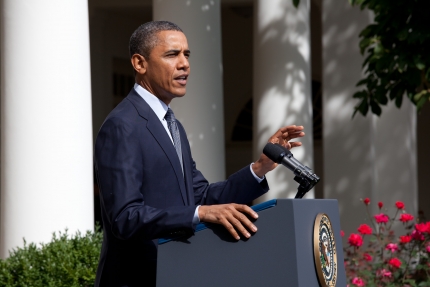
President Barack Obama delivers a statement announcing his Plan for Economic Growth and Deficit Reduction, in the Rose Garden of the White House, Sept. 19, 2011.(Official White House Photo by Pete Souza)

President Obama today unveiled a plan for economic growth and deficit reduction that details how to pay for the American Jobs Act while also paying down our debt over time. The plan, which is being sent to the Congressional Joint Committee on Deficit Reduction, offers a balanced approach to further reduce our nation’s deficit and get our fiscal house in order, based on the values of shared responsibility and shared sacrifice. 

The President’s plan lays out a blueprint that will enable Washington to live within its means, something Americans across the country have been doing for years. And the balanced approach means that no one group has to bear the burden alone. It means that everyone – including millionaires and billionaires – has to pay their fair share.

Related Topics: Economy

The White House

Office of the Press Secretary

Remarks by the President on Economic Growth and Deficit Reduction

Rose Garden

10:56 A.M. EDT

THE PRESIDENT:  Good morning, everybody.  Please have a seat.

A week ago today, I sent Congress the American Jobs Act.  It’s a plan that will lead to new jobs for teachers, for construction workers, for veterans, and for the unemployed.  It will cut taxes for every small business owner and virtually every working man and woman in America.  And the proposals in this jobs bill are the kinds that have been supported by Democrats and Republicans in the past.  So there shouldn’t be any reason for Congress to drag its feet.  They should pass it right away.  I'm ready to sign a bill.  I've got the pens all ready.

Now, as I said before, Congress should pass this bill knowing that every proposal is fully paid for.  The American Jobs Act will not add to our nation’s debt.  And today, I’m releasing a plan that details how to pay for the jobs bill while also paying down our debt over time. 

And this is important, because the health of our economy depends in part on what we do right now to create the conditions where businesses can hire and middle-class families can feel a basic measure of economic security.  But in the long run, our prosperity also depends on our ability to pay down the massive debt we’ve accumulated over the past decade in a way that allows us to meet our responsibilities to each other and to the future.

During this past decade, profligate spending in Washington, tax cuts for multi-millionaires and billionaires, the cost of two wars, and the recession turned a record surplus into a yawning deficit, and that left us with a big pile of IOUs.  If we don’t act, that burden will ultimately fall on our children’s shoulders.  If we don’t act, the growing debt will eventually crowd out everything else, preventing us from investing in things like education, or sustaining programs like Medicare. 

So Washington has to live within its means.  The government has to do what families across this country have been doing for years.  We have to cut what we can’t afford to pay for what really matters.  We need to invest in what will promote hiring and economic growth now while still providing the confidence that will come with a plan that reduces our deficits over the long-term.
 
These principles were at the heart of the deficit framework that I put forward in April.  It was an approach to shrink the deficit as a share of the economy, but not to do so so abruptly with spending cuts that would hamper growth or prevent us from helping small businesses and middle-class families get back on their feet.

It was an approach that said we need to go through the budget line-by-line looking for waste, without shortchanging education and basic scientific research and road construction, because those things are essential to our future.  And it was an approach that said we shouldn't balance the budget on the backs of the poor and the middle class; that for us to solve this problem, everybody, including the wealthiest Americans and biggest corporations, have to pay their fair share. 

Now, during the debt ceiling debate, I had hoped to negotiate a compromise with the Speaker of the House that fulfilled these principles and achieved the $4 trillion in deficit reduction that leaders in both parties have agreed we need -- a grand bargain that would have strengthened our economy, instead of weakened it.  Unfortunately, the Speaker walked away from a balanced package.  What we agreed to instead wasn’t all that grand.  But it was a start -- roughly $1 trillion in cuts to domestic spending and defense spending.

Everyone knows we have to do more, and a special joint committee of Congress is assigned to find more deficit reduction. So, today, I’m laying out a set of specific proposals to finish what we started this summer -- proposals that live up to the principles I’ve talked about from the beginning.  It’s a plan that reduces our debt by more than $4 trillion, and achieves these savings in a way that is fair -- by asking everybody to do their part so that no one has to bear too much of the burden on their own.

All told, this plan cuts $2 in spending for every dollar in new revenues.  In addition to the $1 trillion in spending that we’ve already cut from the budget, our plan makes additional spending cuts that need to happen if we’re to solve this problem. We reform agricultural subsidies -- subsidies that a lot of times pay large farms for crops that they don't grow.  We make modest adjustments to federal retirement programs.  We reduce by tens of billions of dollars the tax money that goes to Fannie Mae and Freddie Mac.  We also ask the largest financial firms -- companies saved by tax dollars during the financial crisis -- to repay the American people for every dime that we spent.  And we save an additional $1 trillion as we end the wars in Iraq and Afghanistan.

These savings are not only counted as part of our plan, but as part of the budget plan that nearly every Republican on the House voted for. 

Finally, this plan includes structural reforms to reduce the cost of health care in programs like Medicare and Medicaid.  Keep in mind we've already included a number of reforms in the health care law, which will go a long way towards controlling these costs.  But we're going to have to do a little more.  This plan reduces wasteful subsidies and erroneous payments while changing some incentives that often lead to excessive health care costs.  It makes prescriptions more affordable through faster approval of generic drugs.  We’ll work with governors to make Medicaid more efficient and more accountable.  And we’ll change the way we pay for health care.  Instead of just paying for procedures, providers will be paid more when they improve results -- and such steps will save money and improve care. 

These changes are phased in slowly to strengthen Medicare and Medicaid over time.  Because while we do need to reduce health care costs, I’m not going to allow that to be an excuse for turning Medicare into a voucher program that leaves seniors at the mercy of the insurance industry.  And I'm not going to stand for balancing the budget by denying or reducing health care for poor children or those with disabilities.  So we will reform Medicare and Medicaid, but we will not abandon the fundamental commitment that this country has kept for generations. 

And by the way, that includes our commitment to Social Security.  I've said before, Social Security is not the primary cause of our deficits, but it does face long-term challenges as our country grows older.  And both parties are going to need to work together on a separate track to strengthen Social Security for our children and our grandchildren.

So this is how we can reduce spending:  by scouring the budget for every dime of waste and inefficiency, by reforming government spending, and by making modest adjustments to Medicare and Medicaid.  But all these reductions in spending, by themselves, will not solve our fiscal problems.  We can’t just cut our way out of this hole.  It’s going to take a balanced approach.  If we’re going to make spending cuts -- many of which we wouldn’t make if we weren’t facing such large budget deficits -- then it’s only right that we ask everyone to pay their fair share.

You know, last week, Speaker of the House John Boehner gave a speech about the economy.  And to his credit, he made the point that we can’t afford the kind of politics that says it’s “my way or the highway.”  I was encouraged by that.  Here’s the problem: In that same speech, he also came out against any plan to cut the deficit that includes any additional revenues whatsoever.  He said -- I'm quoting him -- there is “only one option.”  And that option and only option relies entirely on cuts.  That means slashing education, surrendering the research necessary to keep America’s technological edge in the 21st century, and allowing our critical public assets like highways and bridges and airports to get worse.  It would cripple our competiveness and our ability to win the jobs of the future.  And it would also mean asking sacrifice of seniors and the middle class and the poor, while asking nothing of the wealthiest Americans and biggest corporations.
 
So the Speaker says we can’t have it "my way or the highway," and then basically says, my way -- or the highway.  (Laughter.)  That’s not smart.  It’s not right.  If we’re going to meet our responsibilities, we have to do it together. 

Now, I’m proposing real, serious cuts in spending.  When you include the $1 trillion in cuts I’ve already signed into law, these would be among the biggest cuts in spending in our history. But they’ve got to be part of a larger plan that’s balanced –- a plan that asks the most fortunate among us to pay their fair share, just like everybody else.

And that’s why this plan eliminates tax loopholes that primarily go to the wealthiest taxpayers and biggest corporations –- tax breaks that small businesses and middle-class families don’t get.  And if tax reform doesn't get done, this plan asks the wealthiest Americans to go back to paying the same rates that they paid during the 1990s, before the Bush tax cuts.

I promise it’s not because anybody looks forward to the prospects of raising taxes or paying more taxes.  I don’t.  In fact, I’ve cut taxes for the middle class and for small businesses, and through the American Jobs Act, we’d cut taxes again to promote hiring and put more money into the pockets of people.  But we can’t afford these special lower rates for the wealthy -– rates, by the way, that were meant to be temporary.  Back when these first -- these tax cuts, back in 2001, 2003, were being talked about, they were talked about temporary measures.  We can’t afford them when we’re running these big deficits.

Now, I am also ready to work with Democrats and Republicans to reform our entire tax code, to get rid of the decades of accumulated loopholes, special interest carve-outs, and other tax expenditures that stack the deck against small business owners and ordinary families who can’t afford Washington lobbyists or fancy accountants.  Our tax code is more than 10,000 pages long. If you stack up all the volumes, they’re almost five feet tall.  That means that how much you pay often depends less on what you make and more on how well you can game the system, and that's especially true of the corporate tax code.

We’ve got one of the highest corporate tax rates in the world, but it’s riddled with exceptions and special interest loopholes.  So some companies get out paying a lot of taxes, while the rest of them end up having to foot the bill.  And this makes our entire economy less competitive and our country a less desirable place to do business. 

That has to change.  Our tax code shouldn’t give an advantage to companies with the best-connected lobbyists.  It should give an advantage to companies that invest in the United States of America and create jobs in the United States of America.  And we can lower the corporate rate if we get rid of all these special deals.

So I am ready, I am eager, to work with Democrats and Republicans to reform the tax code to make it simpler, make it fairer, and make America more competitive.  But any reform plan will have to raise revenue to help close our deficit.  That has to be part of the formula.  And any reform should follow another simple principle:  Middle-class families shouldn’t pay higher taxes than millionaires and billionaires.  That’s pretty straightforward.  It’s hard to argue against that.  Warren Buffett’s secretary shouldn’t pay a higher tax rate than Warren Buffett.  There is no justification for it. 

It is wrong that in the United States of America, a teacher or a nurse or a construction worker who earns $50,000 should pay higher tax rates than somebody pulling in $50 million.  Anybody who says we can’t change the tax code to correct that, anyone who has signed some pledge to protect every single tax loophole so long as they live, they should be called out.  They should have to defend that unfairness -- explain why somebody who's making  $50 million a year in the financial markets should be paying 15 percent on their taxes, when a teacher making $50,000 a year is paying more than that -- paying a higher rate.  They ought to have to answer for it.  And if they’re pledged to keep that kind of unfairness in place, they should remember, the last time I checked the only pledge that really matters is the pledge we take to uphold the Constitution. 

Now, we’re already hearing the usual defenders of these kinds of loopholes saying this is just “class warfare.”  I reject the idea that asking a hedge fund manager to pay the same tax rate as a plumber or a teacher is class warfare.  I think it’s just the right the thing to do.  I believe the American middle class, who've been pressured relentlessly for decades, believe it’s time that they were fought for as hard as the lobbyists and some lawmakers have fought to protect special treatment for billionaires and big corporations.

Nobody wants to punish success in America.  What’s great about this country is our belief that anyone can make it and everybody should be able to try -– the idea that any one of us can open a business or have an idea and make us millionaires or billionaires.  This is the land of opportunity.  That’s great.  All I’m saying is that those who have done well, including me, should pay our fair share in taxes to contribute to the nation that made our success possible.  We shouldn’t get a better deal than ordinary families get.  And I think most wealthy Americans would agree if they knew this would help us grow the economy and deal with the debt that threatens our future.

It comes down to this:  We have to prioritize.  Both parties agree that we need to reduce the deficit by the same amount -- by $4 trillion.  So what choices are we going to make to reach that goal?  Either we ask the wealthiest Americans to pay their fair share in taxes, or we’re going to have to ask seniors to pay more for Medicare.  We can’t afford to do both. 

Either we gut education and medical research, or we’ve got to reform the tax code so that the most profitable corporations have to give up tax loopholes that other companies don’t get.  We can’t afford to do both. 

This is not class warfare.  It’s math.  (Laughter.)  The money is going to have to come from someplace.  And if we’re not willing to ask those who've done extraordinarily well to help America close the deficit and we are trying to reach that same target of $4 trillion, then the logic, the math says everybody else has to do a whole lot more:  We’ve got to put the entire burden on the middle class and the poor.  We’ve got to scale back on the investments that have always helped our economy grow.  We’ve got to settle for second-rate roads and second-rate bridges and second-rate airports, and schools that are crumbling. 

That’s unacceptable to me.  That’s unacceptable to the American people.  And it will not happen on my watch.  I will not support -- I will not support -- any plan that puts all the burden for closing our deficit on ordinary Americans.  And I will veto any bill that changes benefits for those who rely on Medicare but does not raise serious revenues by asking the wealthiest Americans or biggest corporations to pay their fair share.  We are not going to have a one-sided deal that hurts the folks who are most vulnerable. 

None of the changes I’m proposing are easy or politically convenient.  It’s always more popular to promise the moon and leave the bill for after the next election or the election after that.  That’s been true since our founding.  George Washington grappled with this problem.  He said, “Towards the payment of debts, there must be revenue; that to have revenue there must be taxes; [and] no taxes can be devised which are not more or less inconvenient and unpleasant.”  He understood that dealing with the debt is -- these are his words -- “always a choice of difficulties.”  But he also knew that public servants weren’t elected to do what was easy; they weren’t elected to do what was politically advantageous.  It’s our responsibility to put country before party.  It’s our responsibility to do what’s right for the future.

And that’s what this debate is about.  It’s not about numbers on a ledger; it’s not about figures on a spreadsheet.  It’s about the economic future of this country, and it’s about whether we will do what it takes to create jobs and growth and opportunity while facing up to the legacy of debt that threatens everything we’ve built over generations.

And it’s also about fairness.  It’s about whether we are, in fact, in this together, and we’re looking out for one another.  We know what’s right.  It’s time to do what’s right. 

Thank you very much.  (Applause.)

END
11:16 A.M. EDT 

The White House

Office of the Press Secretary

Presidential Memorandum--President’s Plan for Economic Growth and Deficit Reduction

TO THE CONGRESS OF THE UNITED STATES:

This continues to be a time of challenge for our country. We face an economic crisis that has left millions of our neighbors jobless, and a political crisis that has made things worse. Millions of Americans are looking for work. Across our country, families are doing their best just to scrape by -- giving up nights out with the family to save on gas or make the mortgage, or postponing retirement to send a child to college.

These men and women grew up with faith in an America where hard work and responsibility paid off. They believed in a country where everyone gets a fair shake and does their fair share; they believed that if you worked hard and played by the rules, you would be rewarded with a decent salary and good benefits. If you did the right thing, you could make it in America.

For decades now, Americans have watched that compact erode. They have seen the decks too often stacked against them. And they know that Washington has not always put their interests first. Too often, our Nation's capital has been consumed by partisanship. Too often, the needs of special interests or politics have been put ahead of what is best for the country.

That is what must change. The American people work hard to meet their responsibilities. Now, as the Nation faces an economy that is not growing and creating jobs as it should, so must its leaders. While the continued recovery of our economy will be driven by the businesses and workers across our land, policymakers in Washington can take steps to help Americans right now and set the most favorable conditions we can for growth and job creation for years to come. We can live within our means and invest for the future.

That is why last week I presented to the Congress and the American people the American Jobs Act, to provide a jolt to the economy and give companies confidence that if they invest and hire, there will be customers for their products and services. This jobs bill will put more people back to work and more money in the pockets of those who are working. It will create more jobs for construction workers, more jobs for teachers, more jobs for veterans, and more jobs for the long-term unemployed. It will provide a tax break for companies that hire new workers, and it will cut payroll taxes in half for every working American and every small business. It will create jobs for people to rebuild our aging infrastructure and repair and modernize at least 35,000 schools. Moreover, the proposals in the American Jobs Act are the kind of proposals that have been supported by Democrats and Republicans in the past.

I am committed to paying for this jobs bill. The Budget Control Act that I signed into law last month will cut annual Government spending by about $1 trillion over the next 10 years. It also charges the Joint Select Committee on Deficit Reduction with finding an additional $1.5 trillion in savings. As part of this jobs bill, I am asking the Congress to increase that amount so that it covers the full cost of the American Jobs Act. In addition, I believe that the Congress should seize the opportunity that this new Committee presents and do much more so that we can put the country on a sustainable fiscal path, which is critical for our long-term economic growth and competitiveness.

For this reason, I am sending to the Congress this detailed plan to pay for this jobs bill and realize more than $3 trillion in net deficit reduction over the next 10 years. Combined with the approximately $1 trillion in savings from the first part of the Budget Control Act, this would generate more than $4 trillion in deficit reduction over the next decade. This would bring the Nation to the point where current spending is no longer adding to our debt and where our debt is no longer increasing as a share of our economy -- an important milestone on the way to restoring fiscal discipline and moving us toward balance.

This plan is a balanced one that asks everyone to do their part. It includes nearly $580 billion in cuts and reforms to mandatory programs of which $320 billion is savings from Federal health programs such as Medicare and Medicaid. These changes are necessary to maintain the promise of Medicare as we know it.

The plan also realizes more than $1 trillion in savings over the next 10 years from our drawdowns in Afghanistan and Iraq. And the plan calls for the Congress to undertake comprehensive tax reform that lowers tax rates, closes loopholes, boosts job creation here at home, cuts the deficit by $1.5 trillion, and observes the Buffett Rule -- that people making more than $1 million a year should not pay a smaller share of their income in taxes than middle-class families pay.

To assist the Committee in its work, I also included specific tax loophole closers and measures to broaden the tax base. Together with the expiration of the high-income tax cuts from 2001 and 2003, these measures would be more than enough to reach this $1.5 trillion target. They include cutting tax preferences for high-income households, eliminating tax breaks for oil and gas companies, closing the carried interest loophole for investment fund managers, and eliminating benefits for those who use corporate jets.

In sum, the plan I am sending to the Congress today is a blueprint for how we can reduce this deficit, pay down our debt, and pay for the American Jobs Act in the process. I have little doubt that some of these proposals will not be popular with those who benefit from these affected programs. And some of these changes are ones that we would not make if it were not for our fiscal situation. But we are all in this together, and all of us must contribute to getting our economy moving again and on a firm fiscal footing.

After all, we are all connected. No single individual built America on his or her own. We built it together. We have been, and always will be, "one Nation, under God, indivisible, with liberty and justice for all." We have always been a people with responsibilities to ourselves and with responsibilities to one another. This means that as Americans work hard to find a job, keep their businesses afloat and grow, and provide for their kids, their representatives in Washington must meet their responsibilities and make the tough choices needed to get our economy back on track.

This plan lives up to a simple idea: as a Nation, we can live within our means while still making the investments we need to prosper. It follows a balanced approach: asking everyone to do their part, so no one has to bear all the burden. And it says that everyone -- including millionaires and billionaires -- has to pay their fair share.

These may be tough times for our country, but I have a deep faith in the American spirit, and we are tougher than the times we live in and bigger than the politics we have recently seen. If we all put partisanship aside and roll up our sleeves, I have no doubt that we can meet the challenges of the moment and show the world once again why the United States of America remains the greatest country on Earth.

BARACK OBAMA

THE WHITE HOUSE,
         September 19, 2011.

The White House

Office of the Press Secretary

Living Within Our Means and Investing in the Future: The President’s Plan for Economic Growth and Deficit Reduction

Attached is a message from the President to the Congress of the United States. The President’s Plan for Economic Growth and Deficit Reduction is now available here.

The White House

Office of the Press Secretary

Fact Sheet: Living Within Our Means and Investing in the Future - The President’s Plan for Economic Growth and Deficit Reduction

Overview

The health of our economy depends on what we do right now to create the conditions where businesses can hire and middle-class families can feel a basic measure of economic security. In the long run, our prosperity also depends on our ability to pay down the massive debt the federal government has accumulated over the past decade. Today, the President sent to the Joint Committee his plan to jumpstart economic growth and job creation now – and to lay the foundation for it continue for years to come.

The President’s Plan for Economic Growth and Deficit Reduction lives up to a simple idea: as a Nation, we can live within our means while still making the investments we need to prosper – from a jobs bill that is needed right now to long-term investments in education, innovation, and infrastructure. It follows a balanced approach: asking everyone to do their part, so no one has to bear all the burden.  And it says that everyone – including millionaires and billionaires – has to pay their fair share. Overall, it pays for the President’s jobs bill and produces net savings of more than $3 trillion over the next decade, on top of the roughly $1 trillion in spending cuts that the President already signed into law in the Budget Control Act – for a total savings of more than $4 trillion over the next decade. This would bring the country to a place, by 2017, where current spending is no longer adding to our debt, debt is falling as a share of the economy, and deficits are at a sustainable level.

The American Jobs Act

  • Tax cuts to help businesses hire and grow
    • Cutting the payroll tax in half on the first $5 million in payroll, targeting the benefit to the 98 percent of firms with payroll below this threshold.
    • A complete payroll tax holiday for added workers or increased wages up to $50 million
    • Extending 100 percent expensing into 2012
    • Reforms and regulatory reductions to help entrepreneurs and small businesses access capital 
  • Putting workers back on the job while rebuilding and modernizing America
    • A “Returning Heroes” hiring tax credit for veterans
    • Preventing up to 280,000 teacher layoffs, while keeping cops and firefighters on the job
    • Immediate investments in infrastructure, school buildings, and neighborhoods as well as a bipartisan National Infrastructure Bank 
  • Pathways back to work for Americans looking for jobs
    • The most innovative reform to the unemployment insurance program in 40 years and extension of emergency unemployment insurance preventing  6 million Americans looking for work from losing benefits
    • A $4,000 tax credit to employers for hiring the long-term unemployed
    • Prohibiting employers from discriminating against unemployed workers when hiring
    • Expanding job opportunities for low-income youth and adults 
  • Tax relief for every American worker and family
    • Cutting payroll taxes in half for 160 million workers next year
    • Allowing more Americans to refinance their mortgages 
  • Fully paid for as part of the President’s long-term deficit reduction plan 

Paying for Our Investments and Reducing the Deficit

  • The plan produces approximately $4.4 trillion in deficit reduction net the cost of the American Jobs Act.
    • $1.2 trillion from the discretionary cuts enacted in the Budget Control Act.
    • $580 billion in cuts and reforms to a wide range of mandatory programs;
    • $1.1 trillion from the drawdown of troops in Afghanistan and transition from a military to a civilian-led mission in Iraq
    • $1.5 trillion from tax reform
    • $430 billion in additional interest savings
  • To spur economic growth and job creation, the plan includes one-time investment and relief in the American Jobs Act.  That adds to the deficit in 2012 but is fully paid for over 10 years, and deficit reduction phases in starting in 2013, as the economy grows stronger.
  • Deficit reduction is achieved in a balanced approach, with a spending cut to revenue ratio for the entire plan (including discretionary cuts) of 2 to 1.  

Deficits and Debt

  • The Joint Committee plan significantly reduces deficits and puts the country on a fiscally sustainable path by 2017.
    • The deficit is projected to fall to 2.3 percent of GDP in 2021. By comparison, if we did nothing, the deficit would be 5.5 percent of GDP in 2021.
    • Reaches “primary balance”-- where our current spending is no longer adding to our debt -- in 2017. At that point, current spending is no longer adding to our debt, debt is falling as a share of the economy, and deficits are at a sustainable level. 
  • The President’s plan would reduce the national debt as a share of economy.
    • Stable or falling debt as a share of the economy is a key metric of fiscal sustainability.
    • If we did nothing, the national debt would rise to 90.7 percent of GDP in 2021.  By contrast, under the President’s plan, the national debt would fall to 73.0 percent of GDP in 2021 -- or an improvement of almost 18 percentage points. 

Health Savings

  • The plan includes $320 billion in health savings that build on the Affordable Care Act to strengthen Medicare and Medicaid by reducing wasteful spending and erroneous payments, and supporting reforms that boost the quality of care. It accomplishes this in a way that does not shift significant risks onto the individuals they serve; slash benefits; or undermine the fundamental compact they represent to our Nation’s seniors, people with disabilities, and low-income families. 
  • The plan includes $248 billion in savings from Medicare.
    • Within this total, 90 percent of the savings, or $224 billion, comes from reducing overpayments in Medicare.
    • Any savings that affect beneficiaries do not begin until 2017.
    • The plan does not propose to change the eligibility age for Medicare benefits. 
  • Other health and Medicaid savings amount to $72 billion. 
  • Because of the structural nature of these reforms, health savings grow to over $1 trillion in the second decade. 
  • The President will veto any bill that takes one dime from the Medicare benefits seniors rely on without asking the wealthiest Americans and biggest corporations to pay their fair share.

Other Mandatory

  • The plan includes $250 billion in savings from other mandatory programs. 
  • Included within these savings are:
    • $33 billion insavings from agriculture subsidies, payments, and programs
    • $42.5 billion in reforms to Federal employee benefit programs, including programs for civilian employees and military personnel.
    • $4.1 billion from the disposal of unused government assets.
    • $92.2 billion from restructuring government operations and reducing government liabilities.
    • $77.6 billion from improving Federal program management and reducing waste and abuse.

Revenues

  • The President calls on the Committee to undertake comprehensive tax reform, and lays out five principles for it to follow: 1) lower tax rates; 2) cut wasteful loopholes and tax breaks; 3) reduce the deficit by $1.5 trillion; 4) boost job creation and growth; and 5) comport with the “Buffett Rule” that people making more than $1 million a year should not pay a smaller share of their income in taxes than middle-class families pay.
    • Tax reform should draw on the specific proposals the President has put forward, together with elimination of additional inefficient tax breaks. If the Joint Committee is unable to undertake comprehensive tax reform, the President believes the discrete measures he has proposed should be enacted on a standalone basis. Their enactment as a standalone package still would significantly improve the country’s fiscal standing, represent an important step toward more fundamentally transforming our tax code, and serve as a strong foundation for economic growth and job creation. 
    • To advance this debate, the President is offering a detailed set of specific tax loophole closers and measures to broaden the tax base that, together with the expiration of the high-income tax cuts, would be more than sufficient to hit the $1.5 trillion target. These include:
      • Allowing the 2001 and 2003 tax cuts for upper income earners to expire ($866 billion)
      • Limiting deductions and exclusions for those making more than $250,000 a year ($410 billion)
      • Closing loopholes and eliminating special interest tax breaks (approximately $300 billion)

The White House

Office of the Press Secretary

Weekly Address: Passing the American Jobs Act

WASHINGTON—In this week’s address, President Obama urged Congress to pass the American Jobs Act without delay so that businesses will be able to hire more workers and every American who wants a job will be able to find one.  The President’s jobs bill keeps cops on the streets and teachers in the classrooms, cuts taxes for small businesses, and puts construction workers back to work without adding to the deficit.  All Americans who agree with the President’s plan should call their elected officials and tell them that it’s time to pass the jobs bill, which will ensure that everyone pays their fair share and that we live within our means as we help the economy continue to grow.

Remarks of President Barack Obama
Weekly Address
The White House
September 17, 2011

I’ve spent some time lately traveling the country and talking with folks outside of Washington.  And the number one issue for the people I meet is how we can get back to a place where we’re creating good, middle-class jobs that pay well and offer some security.

That’s the idea behind the American Jobs Act.  It’s a jobs bill that does two simple things: put more people back to work, and more money back in the pockets of people who are working.

This jobs bill puts construction workers back to work rebuilding our roads and bridges and modernizing our schools.

This jobs bill puts teachers back in the classroom, and keeps cops and firefighters on our streets.

This jobs bill gives tax credits to companies that hire our veterans, because if you sign up to fight for our country, the last thing you should have to do is fight for a job when you come home. 

This jobs bill connects the long-term unemployed to temporary work to keep their skills sharp while they look for a job, and it gives hundreds of thousands of young people the hope of a job next summer.

This jobs bill cuts taxes for every small business owner in America.  It cuts them even more for small business owners that hire new workers and raise workers’ salaries.  And it cuts taxes for every working family in America so that you’ll have more money in your pockets, and businesses know they’ll have customers to buy what they sell.

That’s the American Jobs Act, and you can check it out for yourself on WhiteHouse.gov. 

It will create new jobs.  It will cut taxes for every worker and small business in the country.  And it will not add to the deficit.  It will be paid for.

On Monday, I’ll lay out my plan for how we’ll do that – how we’ll pay for this plan and pay down our debt by following some basic principles: making sure we live within our means and asking everyone to pay their fair share.

But right now, we’ve got to get Congress to pass this jobs bill.  Everything in the American Jobs Act is the kind of idea that’s been supported by Democrats and Republicans before.  And if they’re ideas you agree with, too, every one of you can help make it happen by telling your congressperson to pass this jobs bill right away.

I know some of them would rather wait another year to wage another election than work together right now.  But most Americans don’t have the luxury of waiting.  It was three years ago this week that a financial crisis on Wall Street made things much more difficult for working folks on Main Street.  And too many are still hurting as a result.

So the time for action is now.  No more games or gridlock.  No more division or delay.  It’s time for the people you sent to Washington to put country before party – to stop worrying so much about their jobs and start worrying more about yours.

It’s time to get to work and show the world once again why the United States of America remains the greatest nation on Earth.

Thank you.

Weekly Address: Passing the American Jobs Act

President Obama discusses the need for Congress to pass the American Jobs Act to put more people back to work, and more money back in the pockets of people who are working. Read the jobs bill.

Transcript | Download mp4 | Download mp3

Related Topics: Economy

Weekly Address: Passing the American Jobs Act

September 17, 2011 | 3:01 | Public Domain

President Obama discusses the need for Congress to pass the American Jobs Act to put more people back to work, and more money back in the pockets of people who are working.

Download mp4 (107MB) | mp3 (3MB)

Read the Transcript

Weekly Address: Passing the American Jobs Act

WASHINGTON—In this week’s address, President Obama urged Congress to pass the American Jobs Act without delay so that businesses will be able to hire more workers and every American who wants a job will be able to find one.  The President’s jobs bill keeps cops on the streets and teachers in the classrooms, cuts taxes for small businesses, and puts construction workers back to work without adding to the deficit.  All Americans who agree with the President’s plan should call their elected officials and tell them that it’s time to pass the jobs bill, which will ensure that everyone pays their fair share and that we live within our means as we help the economy continue to grow.

Remarks of President Barack Obama
Weekly Address
The White House
September 17, 2011

I’ve spent some time lately traveling the country and talking with folks outside of Washington.  And the number one issue for the people I meet is how we can get back to a place where we’re creating good, middle-class jobs that pay well and offer some security.

That’s the idea behind the American Jobs Act.  It’s a jobs bill that does two simple things: put more people back to work, and more money back in the pockets of people who are working.

This jobs bill puts construction workers back to work rebuilding our roads and bridges and modernizing our schools.

This jobs bill puts teachers back in the classroom, and keeps cops and firefighters on our streets.

This jobs bill gives tax credits to companies that hire our veterans, because if you sign up to fight for our country, the last thing you should have to do is fight for a job when you come home. 

This jobs bill connects the long-term unemployed to temporary work to keep their skills sharp while they look for a job, and it gives hundreds of thousands of young people the hope of a job next summer.

This jobs bill cuts taxes for every small business owner in America.  It cuts them even more for small business owners that hire new workers and raise workers’ salaries.  And it cuts taxes for every working family in America so that you’ll have more money in your pockets, and businesses know they’ll have customers to buy what they sell.

That’s the American Jobs Act, and you can check it out for yourself on WhiteHouse.gov. 

It will create new jobs.  It will cut taxes for every worker and small business in the country.  And it will not add to the deficit.  It will be paid for.

On Monday, I’ll lay out my plan for how we’ll do that – how we’ll pay for this plan and pay down our debt by following some basic principles: making sure we live within our means and asking everyone to pay their fair share.

But right now, we’ve got to get Congress to pass this jobs bill.  Everything in the American Jobs Act is the kind of idea that’s been supported by Democrats and Republicans before.  And if they’re ideas you agree with, too, every one of you can help make it happen by telling your congressperson to pass this jobs bill right away.

I know some of them would rather wait another year to wage another election than work together right now.  But most Americans don’t have the luxury of waiting.  It was three years ago this week that a financial crisis on Wall Street made things much more difficult for working folks on Main Street.  And too many are still hurting as a result.

So the time for action is now.  No more games or gridlock.  No more division or delay.  It’s time for the people you sent to Washington to put country before party – to stop worrying so much about their jobs and start worrying more about yours.

It’s time to get to work and show the world once again why the United States of America remains the greatest nation on Earth.

Thank you.

Close Transcript

The White House

Office of the Press Secretary

Presidential Proclamation -- National Employer Support of the Guard and Reserve Week, 2011

NATIONAL EMPLOYER SUPPORT OF THE GUARD AND RESERVE WEEK, 2011

- - - - - - -

BY THE PRESIDENT OF THE UNITED STATES OF AMERICA

A PROCLAMATION

Since September 11, 2001, the 9/11 Generation has borne the burden of war with courage and valor, continuing the legacy of the brave men and women who served before them.  More than five million volunteers have worn our country's uniform over the past 10 years, and thousands have given their lives in Iraq and Afghanistan.  Making up nearly half of our military power, the National Guard and Reserve are vital to our operations at home and abroad.

During America's struggle for independence, ordinary individuals in small towns across the colonies banded together to confront an empire.  Today, their spirit lives on in the Guard and Reserve.  The members of our National Guard and Reserve demonstrate the dignity and selflessness that are at the core of the American spirit.  These patriots serve not only in combat, but also when disaster strikes at home, offering a strong hand to victims of floods, tornadoes, and fires across America.

The employers who provide jobs to our Guard and Reserve members when they are home are also vital to our success.  Many of these businesses go above and beyond, offering tremendous support to service members and their families during deployments.  We are deeply grateful for their work, and this week, we celebrate not only our service members, veterans, and military families, but also their devoted employers.

The extraordinary service of our Guard and Reserve members would not be possible without the unwavering support and care provided by their families and civilian employers.  To help connect our service members, veterans, and their families to the opportunities they deserve, the First Lady and Dr. Jill Biden announced Joining Forces, a comprehensive national initiative to support and honor these patriots.  As part of this initiative, we issued a challenge to private sector employers to hire or train 100,000 unemployed veterans or their spouses.  We have also proposed tax credits for businesses that hire our returning heroes -- they fought for our country, and the last thing they should have to do is fight for a job when they come home.

This week, we remember our obligations to each other, and we pay tribute to the employers of our Guardsmen and Reservists whose support and flexibility is vital to the strength of our military.  The United States is at its strongest when we live up to our sacred duty to honor and care for our service members when they come home.  The support of employers across our country reflects the best of the American spirit -- the understanding that we are bound together to serve and protect our Nation.

NOW, THEREFORE, I, BARACK OBAMA, President of the United States of America, by virtue of the authority vested in me by the Constitution and the laws of the United States, do hereby proclaim September 18 through September 24, 2011, as National Employer Support of the Guard and Reserve Week.  I call upon all Americans to join me in expressing our heartfelt thanks to the members of the National Guard and Reserve and their civilian employers.  I also call on State and local officials, private organizations, and all military commanders, to observe this week with appropriate ceremonies and activities.

IN WITNESS WHEREOF, I have hereunto set my hand this
sixteenth day of September, in the year of our Lord two thousand eleven, and of the Independence of the United States of America the two hundred and thirty-sixth.

BARACK OBAMA

The White House

Office of the Press Secretary

Presidential Proclamation -- Constitution Day and Citizenship Day, Constitution Week, 2011

CONSTITUTION DAY AND CITIZENSHIP DAY, CONSTITUTION WEEK, 2011

- - - - - - -

BY THE PRESIDENT OF THE UNITED STATES OF AMERICA

A PROCLAMATION

In the summer of 1787, delegates from the States gathered in Philadelphia to build a new framework for our young republic.  Our Constitution's Framers represented diverse backgrounds, and on key issues, they were divided.  Yet despite their differences, they courageously joined together in common purpose to create "a more perfect Union."  After 4 months of fierce debate and hard-fought compromise, the delegates signed the Constitution of the United States.

For more than two centuries, the Constitution has presided as the supreme law of the land, keeping our leaders true to America's highest ideals and guaranteeing the fundamental rights that make our country a beacon of hope to all peoples seeking freedom and justice.  Together with the Bill of Rights, our Constitution is the backbone of our government and the basis of our liberties.  Even while retaining its structure, our founding document has grown with our Nation's conscience, amended over the years to extend America's promise to citizens of every race, gender, and creed.

Americans are defined not by bloodlines or allegiance to any one leader or faith, but by our shared ideals of liberty, equality, and justice under the law.  We are a Nation of immigrants, built and sustained by people who have brought their talents, drive, and entrepreneurial spirit to our shores.  Generations of newcomers have journeyed to this land because they believed in what our country stands for.

Every year, thousands of candidates for citizenship commemorate Constitution Day and Citizenship Day by becoming American citizens.  These men and women have respected our laws and learned our history, and some have served in our military.  Today, we invite them to join us in writing the next great chapter of the American story.

In signing the Constitution, the Framers provided a model of American leadership for generations to come.  Through controversy and division, they built a lasting structure of government that began with the words, "We the People."  This week, as we celebrate our Founders' timeless vision, we resolve to stay true to their spirit of patriotism and unity.

In remembrance of the signing of the Constitution and in recognition of the Americans who strive to uphold the duties and responsibilities of citizenship, the Congress, by joint resolution of February 29, 1952 (36 U.S.C. 106), designated September 17 as "Constitution Day and Citizenship Day," and by joint resolution of August 2, 1956 (36 U.S.C. 108), requested that the President proclaim the week beginning September 17 and ending September 23 of each year as "Constitution Week."

NOW, THEREFORE, I, BARACK OBAMA, President of the United States of America, do hereby proclaim September 17, 2011, as Constitution Day and Citizenship Day, and September 17 through September 23, 2011, as Constitution Week.  I encourage Federal, State, and local officials, as well as leaders of civic, social, and educational organizations, to conduct ceremonies and programs that bring together community members to reflect on the importance of active citizenship, recognize the enduring strength of our Constitution, and reaffirm our commitment to the rights and obligations of citizenship in this great Nation.

IN WITNESS WHEREOF, I have hereunto set my hand this sixteenth day of September, in the year of our Lord two thousand eleven, and of the Independence of the United States of America the two hundred and thirty-sixth.

BARACK OBAMA