The White House

Office of the Press Secretary

President Obama Announces More Key Administration Posts

WASHINGTON – Today, President Barack Obama announced his intent to nominate the following individuals to key Administration posts:

  • Brad Carson – General Counsel of the Army, Department of Defense
  • Alastair Fitzpayne - Assistant Secretary for Legislative Affairs, Department of the Treasury
  • Michael A. McFaul - Ambassador to the Russian Federation, Department of State
  • Kevin A. Ohlson - Judge, United States Court of Appeals for the Armed Forces

The President also announced his intent to appoint the following individuals to key Administration posts:

  • H. Fisk Johnson - Member, Advisory Committee for Trade Policy and Negotiations
  • Thomas L. McKiernan - Member, Board of Visitors to the United States Air Force Academy

President Obamasaid, “I am pleased to announce that these experienced and committed individuals have agreed to join this Administration, and I look forward to working with them in the months and years ahead.”

President Obama announced his intent to nominate the following individuals to key Administration posts:

Brad Carson, Nominee for General Counsel of the Army, Department of Defense

Brad Carsonis an associate professor of business law at the University of Tulsa, where he is also Director of the National Energy Policy Institute.  From 2009 to 2010, Mr. Carson served in Iraq on active military duty, for which he was awarded the Bronze Star.  Prior to his deployment, Mr. Carson was the President, CEO and Business Development Director for Cherokee Nation Businesses, L.L.C. (CNB)  He joined CNB in 2005, following a one year fellowship at the Harvard University Institute of Politics.  Mr. Carson served as the U.S. Representative for the 2nd District of Oklahoma during the 107th and 108th Congresses.  From 1997 to 1998, Mr. Carson was a White House Fellow and worked as a Special Assistant to the Secretary of Defense for Special Projects at the Department of Defense.  Mr. Carson’s legal career began in 1994 at Crowe & Dunlevy where he worked as an antitrust attorney.  Mr. Carson is a Rhodes Scholar and an Officer in the United States Navy Reserve.  He holds a B.A. from Baylor University, an M.A. from Trinity College at Oxford University, and a J.D. from University of Oklahoma College of Law.

Alastair Fitzpayne, Nominee for Assistant Secretary for Legislative Affairs, Department of the Treasury

Alastair MacLennan Fitzpayne has served as the Department of the Treasury's Deputy Chief of Staff since January 2009.  He has also served as the Department’s Executive Secretary since April 2010.  Prior to joining the Department of the Treasury, Mr. Fitzpayne spent 8 years working on Capitol Hill in the U.S. Senate and the House of Representatives.  From 2001 to 2006, Mr. Fitzpayne served as legislative assistant for Sen. Evan Bayh advising him on tax and budget, small business, and technology issues.  From 2007 through 2009, Mr. Fitzpayne served as senior policy advisor for Representative Rahm Emanuel and advised him on tax, budget, and financial services issues in his capacity as Democratic Caucus Chair and member of the Ways and Means Committee. Prior to his service on Capitol Hill, Mr. Fitzpayne worked as a Presidential Management Intern at the Office of Management and Budget. Mr. Fitzpayne holds a B.A. from Vassar College and Masters of Public Policy from the University of California-Berkeley.   

Michael A. McFaul, Nominee for Ambassador of the United States to the Russian Federation, Department of State

Michael A. McFaul is a Special Assistant to the President and Senior Director, Russia and Eurasia Affairs for the White House National Security Staff.  Previously, McFaul was a professor in the Political Science Department at Stanford University, a position he held from 1995 to 2009. While at Stanford, McFaul served from 2003 to 2009 as the Peter and Helen Bing Senior Fellow at the Hoover Institution and the co-director of the Iran Democracy Project at the Institution. He was also a Senior Fellow at the Freeman Spogli Institute for International Studies, serving as the Deputy Director of the Institute from 2006 to 2009. From 2005-2009, he also was the director of Stanford’s Center on Democracy, Development, and Rule of Law.  From 1994 to 2009, McFaul was a Senior Associate at the Carnegie Endowment for International Peace and served as the Director of the Russian Domestic Politics Program. He holds a B.A. in International Relations and Slavic Languages and an M.A. in Russian and East European Studies, both from Stanford University.  McFaul received a Ph.D. in International Relations from Oxford in 1991, where he was a Rhodes Scholar. 

Kevin A. Ohlson, Nominee for Judge, United States Court of Appeals for the Armed Forces

Kevin A. Ohlson is the Chief of the Professional Misconduct Review Unit in the Department of Justice.  From 2009 to January 2011, he was Chief of Staff and Counselor to United States Attorney General Eric Holder.  From 2007 to 2009, he was the Director of the Executive Office for Immigration Review (EOIR), where he had previously served as Deputy Director from 2002 to 2007.  From 2001 to 2002, he was a member of the Board of Immigration Appeals.  From 1997 to 2001, Mr. Ohlson was Chief of Staff to the Deputy Attorney General.  Prior to that, he served as an Assistant U.S. Attorney for the District of Columbia.  In 1990, while serving as an Assistant U.S. Attorney, he was recalled to active duty service in the United States Army and was awarded the Bronze Star for his actions during the Persian Gulf War.  At the conclusion of his military service, Mr. Ohlson resumed his duties as an Assistant U.S. Attorney.  Mr. Ohlson was commissioned as an officer in the United States Army in 1986 and served as a judge advocate and paratrooper.  He holds a B.A. from Washington and Jefferson College and a J.D. from the University of Virginia School of Law.

President Obama announced his intent to appoint the following individuals to  key Administration posts:

H. Fisk Johnson, Appointee for Member, Advisory Committee on Trade Policy and Negotiations

H. Fisk Johnson is Chairman of the Board, Chairman, and Chief Executive Officer of S. C. Johnson & Son, Inc.  He was first appointed to the President’s Advisory Committee for Trade Policy and Negotiation in 2002.   Dr. Johnson is a Director of The Consumer Goods Forum, and Trustee Emeritus of Cornell University.   In addition, he has served as a member of the World Business Council for Sustainable Development, and a Director of Conservation International.  Dr. Johnson holds a Bachelor degree in Chemistry and Physics, a Masters degree in Engineering,an M.S. and Ph.D. in Applied Physics, and a Masters in Business Administration, all from Cornell University.

Thomas L. McKiernan, Appointee forMember, Board of Visitors to the United States Air Force Academy

Dr. Thomas L. McKiernan is a professor of medicine in cardiology at Loyola University Chicago’s Stritch School of Medicine and an alumnus of the United States Air Force Academy.  At Loyola, he is also the Director of the Cardiac Care Unit and the Medical Director of the Center for Heart and Vascular Medicine.  Earlier in his career, Dr. McKiernan was the Director of the Cardiac Care Unit at Foster McGaw Hospital.  He served for 14 years in the Air Force, including periods as Chief of Internal Medicine at Scott United States Air Force (USAF) Medical Center and Chief of Cardiology at Keesler USAF Medical Center.  Dr. McKiernan resigned from the Air Force in 1984 as a Lieutenant Colonel.  He was a member of the Board of Directors of Loyola University Physicians Foundation from 1989 until 2003 and served on the Board of Directors of the Chicago American Heart Association from 1996 to 1997.  Dr. McKiernan has a B.S. from the United States Air Force Academy and a M.D. from the Stritch School of Medicine at the Loyola University Chicago.

The White House

Office of the Press Secretary

President Obama Nominates Judge David Campos Guaderrama to the United States District Court

WASHINGTON- Today, President Obama nominated Judge David Campos Guaderrama to serve on the United States District Court bench for the Western District of Texas. 

“Throughout his career, Judge David Campos Guaderrama has displayed exceptional integrity and an unwavering commitment to justice,” President Obama said.  “He will be an esteemed addition to the federal bench for the people of Texas.  I am grateful for his dedication to public service.” 

Judge David Campos Guaderrama:  Nominee for the United States District Court for the Western District of Texas


Judge David Campos Guaderrama has been a United States Magistrate Judge in the Western District of Texas since October 2010.  From 1995 to 2010, Judge Guaderrama served as a District Judge for the 243rd District Court of Texas in El Paso.  Prior to serving as a judge, Judge Guaderrama spent seven years working as El Paso County’s first Chief Public Defender, from 1987 to 1994.  Judge Guaderrama began his legal career in 1979 as a sole practitioner and from 1980 to 1986 was a partner with the firm of Guaderrama and Guaderrama.  Judge Guaderrama received his J.D. in 1979 from the University of Notre Dame Law School and his B.A. in 1975 from New Mexico State University. 

The White House

Office of the Press Secretary

Background on the President's Remarks at the Congressional Hispanic Caucus Institute's 34th Annual Awards Gala

WASHINGTON – The President and the First Lady will attend the Congressional Hispanic Caucus Institute’s (CHCI) 34th Annual Awards Gala tonight, where the President will deliver remarks.  These remarks will be streamed LIVE on http://wh.gov/live.

In addition to the President’s remarks, the Chairman of the Congressional Hispanic Caucus will present the 2011 CHCI Chair's Award to the Honorable Hilda Solis, Secretary of Labor, and the Honorable Ken Salazar, Secretary of Interior.  For more information on the awards gala, visit the CHCI website by clicking HERE.

Administration officials are also participating in a series of panels and events as part of the Congressional Hispanic Institute Conference taking place from September 12th – 15th at the Walter E. Washington Convention Center. In his remarks, the President will address the impact the American Jobs Act will have on the Hispanic community and all Americans, as soon as Congress acts. The following is a report on how the American Jobs Act builds on progress to increase the pace of job creation in America: 

The American Jobs Act: Building on Progress for Hispanic Americans

Since the beginning of his Administration, President Obama has committed to progress for Hispanic Americans, who are an integral and increasingly important part of our nation’s economic future. Hispanic families, who will account for 65 percent of the Nation’s population growth between 2010 and 2050, will help form the backbone of America’s labor force in the coming decades. In recent years, Hispanic-owned businesses expanded rapidly, at a faster rate than other demographic groups. At the end of last year, President Obama signed crucial tax cuts for working Hispanic families, and he has expanded access to capital for Hispanic small businesses through the Small Business Administration, and expanded Pell grants to an additional 150,000 Hispanic students to help them realize the American dream.

Despite progress for Hispanic families, businesses, and students – and an economic future that increasingly relies upon them – the recession took a significant toll. According to the Pew Research Center, these same families also experienced a 66 percent decline in median wealth from 2005 to 2009.  With unemployment among Hispanics at an unacceptably high rate of 11.3 percent – and nearly 1 million Hispanic Americans out of work for six months or more – the President believes that we must take action to support the hard-working families that drive our nation’s prosperity and growth. That’s why the President is putting forward a plan to increase the pace of job creation in America, and why he is urging   Congress to act on this plan and pass it into law.

The American Jobs Act reflects a commitment to strengthen the recovery and help increase access to jobs for all Americans, and builds on the President’s commitment to a secure economic future for the Hispanic families, workers, and students. 

THE AMERICAN JOBS ACT AND HISPANIC FAMILIES, WORKERS, AND STUDENTS

  • The President is proposing to extend and expand the payroll tax cut passed last December, increasing it to 3.1 percent for 2012.  In total, this will help an estimated 25 million Hispanic workers who pay payroll taxes.
  • In recent years, Hispanic-owned businesses outpaced the growth of other minority-owned firms, expanding employment at a faster rate. The President’s plan will cut payroll taxes for around 250,000 Hispanic-owned businesses, helping them continue to grow.
  • The American Jobs Act will help put construction workers who lost their jobs back to workrevitalizing schools and our nation’s infrastructure. There were 344,000 fewer Hispanics employed in carpentry or construction labor after the recession.
  • Ten of the largest school districts with the highest percentage of Hispanic students will receive billions of dollars to revitalize their public school facilities.

How the American Jobs Act Will invest in Infrastructure and construction

In 2007, before the recession hit, Hispanics made up 14 percent of the labor force. However, they took up nearly 30 percent of the nation’s 10 million construction and extraction jobs, such as operating engineers and carpenters. There were 344,000 fewer Hispanics employed in carpentry or construction labor after the recession. These jobs were among those hit the hardest in a recession that followed an historic decline in housing.

As described in a Pew Research Center Report in 2011, “The geography of the housing downturn had an especially strong impact on Hispanics.” The report explains that in 2005, more than two in five of the nation’s Hispanic and households resided in Arizona, California, Florida, Michigan and Nevada, “the five states with the steepest declines in home prices. By contrast, only about one in five of the nation’s white or black households resided in these states.”

The President’s plan would help put construction workers back on the job revitalizing our infrastructure and housing markets, while making key investments in neighborhoods, schools and infrastructure across the country.

  • Project Rebuild: Putting People Back to Work Rehabilitating Homes, Businesses and Communities. The President is proposing to invest $15 billion in a national effort to put construction workers on the job rehabilitating and refurbishing hundreds of thousands of vacant and foreclosed homes and businesses. Building on proven approaches to stabilizing neighborhoods with high concentrations of foreclosures, Project Rebuild will bring in expertise and capital from the private sector, focus on commercial and residential property improvements, and expand innovative property solutions like land banks. This approach will not only create construction jobs but will help reduce blight and crime and stabilize housing prices in areas hardest hit by the housing crisis.

What Others Have Said About Rehabilitating Communities:

  • The National Council of La Raza:“Put people to work revitalizing their communities… Provide resources for local government and nonprofit organizations to hire workers to carry out neighborhood revitalization in areas devastated by foreclosures” (2011).
  • Putting Construction Workers Back on the Job By Modernizing Infrastructure – With a Focus on Expanding Access to These Jobs:In order to jump start critical infrastructure projects and create hundreds of thousands of jobs, the President’s plan includes $50 billion in immediate investments for highway, highway safety, transit, passenger rail, and aviation activities – with one fifth of the funding advancing a transformation of how we finance transportation infrastructure and what we finance. To ensure that the employment benefits of these projects can be broadly shared, the President’s plan would invest an additional $50 million in 2012 to enhance employment and job training opportunities for minorities, women, and socially and economically disadvantaged individuals in transportation related activities, including construction, contract administration, inspection, and security. His plan will also invest an additional $10 million in 2012 to help minority-owned and disadvantaged business enterprises gain better access to transportation contracts.  And it will ensure that infrastructure investments allow for the hiring of local workers, to maximize economic benefits for communities where projects are located.

What Others Have Said About Infrastructure Investment:

  • The Congressional Hispanic Caucus:“investments in mass transit and affordable housing will translate to overall improved neighborhoods for Hispanics, and particularly for the 2.77 million that work in the construction sector” (January 29, 2009).

How the American Jobs Act will put Hispanic Workers Back on the Job

The unemployment rate among Hispanics is at an unacceptably high rate of 11.3 percent, and nearly 1 million Hispanic Americans have been out of work for six months or more. Over the course of the recession, the unemployment rate for Hispanic youths doubled from around 10 percent at the end of 2007 to over 20 percent in 2009, and today remains elevated at 19.3 percent. The President’s plan will provide pathways back to work for Hispanics looking for jobs, and opportunities for youths to find employment over the summer. 

Pathways Back to Work for Hispanics Looking for Jobs

  • Extending Unemployment Insurance So That 1.1 Million Hispanics Looking For Work Do Not Lose Their Benefits:In December, the President successfully fought for unemployment insurance to be extended. The President has called for a further extension into 2012 to prevent 1.1 million Hispanics from losing their benefits next year.
  • Targeted Support to Help The Long-Term Unemployed Get Back to Work: The recession pushed long-term unemployment rates to its highest levels since the Great Depression – with nearly 1 million Hispanics out of work for more than six months. The President’s plan is targeted directly at helping these Americans get back to work by, for example:
  • Tax Credits for Hiring the Long-Term Unemployed:The President is proposing a tax credit to provide up to $4,000 for hiring workers who have been looking for a job for over six months.
  • “Bridge to Work” Programs:States will be able to put in place reforms that build off what works in programs like Georgia Works or Opportunity North Carolina, while instituting important fixes and reforms that ensure minimum wage and fair labor protections are being enforced.  These approaches permits long-term unemployed workers to continue receiving UI while they take temporary, voluntary work or pursue work-based training. The President’s plan requires compliance with applicable minimum wage and other worker rights laws.
  • Wage Insurance:  States will be able to use UI to encourage older, long-term unemployed Americans to return to work in new industries or occupations.
  • Startup Assistance:  States will have flexibility to help long-term unemployed workers create their own jobs by starting their own small businesses. 
  • Other Reemployment Reforms:  States will be able to seek waivers from the Secretary of Labor to implement other innovative reforms to connect the long-term unemployed to work opportunities.
  • Prohibiting Employers from Discriminating Against Unemployed Workers: The President’s plan calls for legislation that would make it unlawful to refuse to hire applicants solely because they are unemployed or to include in a job posting a provision that unemployed persons will not be considered.  
  • Investing in Low-Income Youth and Adults:The President is proposing a new Pathways Back to Work Fund to provide hundreds of thousands of low-income youth and adults with opportunities to work and to achieve needed training in growth industries. The Initiative will do three things:
  • Support for Summer and Year-Round Jobs for Youth: The Recovery Act provided over 367,000 summer job opportunities through the public workforce investment system to young people in the summers of 2009 and 2010.   Such programs not only provided young people with their first paycheck, but taught them life-long employment skills.   Building on this success, the new Pathways Back to Work Fund will provide states with support for summer job programs for low-income youth in 2012, and year-round employment for economically disadvantaged young adults. 
  • Subsidized Employment Opportunities for Low-Income Individuals Who Are Unemployed: This effort builds off the successful TANF Emergency Fund wage subsidy program that supported 260,000 jobs through the recovery. According to an analysis by the Center on Budget and Policy Priorities (CBPP), this flexible program allowed States to reduce the cost and risk associated with new hiring, encouraging private-sector businesses to hire new workers.
  • Support for Local Efforts to Implement Promising Work-Based Strategies and to Provide Training Opportunities: This initiative would support efforts that have good records of placing low-income adults and youths in jobs quickly. Local officials, in partnership with local workforce boards, business, community colleges, and other partners, will be able to apply for funding to support promising strategies designed to lead to employment in the short-term. 

What Others Have Said About Investing in Low-Income Youth and Adults:

  • The National Council of La Raza: “Invest in job creation for hard-hit communities. For many workers struggling in the current recession, there is no substitute for direct investment in an immediate job” (2011).

How the American Jobs Act Will Impact Hispanic-Owned Small Businesses

Small businesses are the engine of new jobs and entrepreneurship in America, and Hispanic-owned businesses have demonstrated particularly rapid growth - employing over 25 percent more workers in the most recent available Census data.  The President recognizes the vital contribution that Hispanic-owned businesses are making to the American economy. His plan will work to benefit an estimated 250,000 Hispanic-owned firms by offering a range of initiatives to get our small businesses growing faster.  From a $70 billion payroll tax cut focused on small business to a commitment to reduce the regulatory burdens on small business capital formation, the President’s message is clear: Let’s get to work!

The President’s jobs plan includes tax cuts to help a quarter million Hispanic-owned businesses and 25 million Hispanic workers. It includes skills training and summer job opportunities to help Hispanic youth enter the workforce.  And it extends unemployment benefits to the 1.1 million Hispanics who need to continue feeding their families while searching for a pathway back into the workforce.

How the American Jobs Act Will Let Hispanic Students Realize the American Dream

Hispanics are by far the largest minority group in today’s American public education system, numbering more than 12.4 million in the country’s elementary, middle and high schools. Currently, nearly 22 percent, or slightly more than 1 in 5, of all pre-K–12 students enrolled in America’s public schools is Hispanic.

In his speech at the U.S. Hispanic Chamber of Commerce conference in March 2009, the President laid out his education agenda and the importance of education to the Hispanic community, and to all Americans. President Obama called for a focus on early learning, higher standards for student learning, effective teachers and school leaders, and innovation that builds on what works in America’s classrooms.

The American Jobs Act builds on the President’s commitment by investing in public schools in communities with a high proportion of Hispanic students, and preventing teacher layoffs that would dim the educational prospects of all Americans.

  • Targeted Investments to Modernize Schools Serving Low-Income Students – From Science Labs and Internet-Ready Classrooms to Renovated Facilities:The President is proposing a $25 billion investment in school infrastructure that will modernize at least 35,000 public schools – an investment that will create jobs, while improving classrooms and upgrading our schools to meet 21st century needs. Funds could be used for a range of emergency repair and renovation projects, greening and energy efficiency upgrades, asbestos abatement and removal, and modernization efforts to build new science and computer labs and to upgrade technology in our schools.  And they would be targeted at the lowest-income districts – with 40 percent, or $10 billion, directed towards the 100 largest high-need public school districts.

What Others Have Said About Modernizing Schools:

  • ASPIRA:“ASPIRA supports school construction and modernization efforts” and “favors extending the program to charter schools and other nonprofit educational facilities” (2007). 
  • Congressman Raúl M. Grijalva, Chair of the Congressional Hispanic Caucus’ Education and Job Training Task Force:“funds to our struggling schools and colleges for school construction and modernization” are “desperately needed.” (January 29, 2009).
  • The League of United Latin American Citizens: “Public schools should be improved and rehabilitated, and be provided with adequate funding to do so.” (2011).
  • Preventing Layoffs of Teachers, Cops and Firefighters:The President plans to invest $35 billion to prevent layoffs of up to 280,000 teachers, while supporting the hiring of tens of thousands more and keeping cops and firefighters on the job. These funds would help states and localities avoid and reverse layoffs now, requiring that funds be drawn down quickly. Under the President’s proposal, $30 billion be directed towards educators and $5 billion would go to the cops and firefighters who keep our communities safe.

Ten of the largest school districts with the highest percentage of Hispanic students – in Los Angeles, San Diego, Chicago, New York, and other States – will receive billions of dollars to revitalize their public school facilities:


Eligibility of Largest Hispanic LEA's for School Modernization Funds

State


Local Education Agency


District Students (PreK-12)


Percentage of Hispanic Students


School Modernization Funding

CA


Los Angeles Unified


$670,746.00


73.41 percent


$743,536,701.00

CA


San Diego Unified


$131,417.00


45.86 percent


$91,761,585.00

CA


Santa Ana Unified


$56,937.00


93.16 percent


$36,170,828.00

FL


Dade


$345,804.00


64.32 percent


$266,970,181.00

IL


City Of Chicago SD 299


$407,157.00


41.99 percent


$609,010,307.00

NM


Albuquerque Public Schools


$96,572.00


63.71 percent


$63,146,224.00

NV


Clark County School District


$307,059.00


41.03 percent


$153,931,395.00

TX


Houston ISD


$202,773.00


61.58 percent


$233,647,280.00

TX


Dallas ISD


$157,111.00


67.63 percent


$191,641,047.00

TX


Northside ISD  San Antonio


$92,335.00


64.42 percent


$35,050,927.00

Building on Progress for the Hispanic Community

The President’s jobs plan continues a commitment since day one of his Administration to help Hispanic families, workers, and students realize the American dream.

Creating and Protecting Jobs for Hispanics and all Americans

  • In early 2009, the President signed the American Recovery and Reinvestment Act (ARRA) to create jobs, spur economic growth and invest in communities. Hispanics are experiencing higher rates of unemployment than the national average, so the Recovery Act and its implementation have been vital to the community and the country. A recent report from the non-partisan Congressional Budget Office showed that the Recovery Act was responsible for increasing the number of people employed by as many as 3.3 million.
  • According to a study released last year by the Center on Budget and Policy Priorities, seven policies included in the Recovery Act have kept 1.9 million Hispanics above the poverty line.

Tax Cuts for Hispanic Working Families

  • In December 2010, the President and the Administration built on this strong record to pass a bipartisan tax cut package agreement that not only secured vital tax relief and investments in our workers—something that will create jobs and accelerate economic growth—but also provides specific support for Hispanic families. Building off the gains made in the Recovery Act, the tax agreement extends key provisions including the Earned Income Tax Credit (EITC) and the Child Tax Credit (CTC) that directly benefit Hispanic parents and children. These provisions of the new law will benefit an estimated 3.7 million Hispanic families—including 8 million Hispanic children. And narly one million Hispanics looking for work weren’t forced to lose their their unemployment benefits at the end of last year.

Tax Cuts for Hispanic Small Businesses

  • The President signed the Small Business Jobs Act into law, which created a $30 billion small business lending fund, added new small business administration capital, contracting and counseling programs, and provided targeted tax incentives for small businesses. In 2010—3,218 7(a) and 504 loans were made to Hispanic/Hispanic small businesses—totaling $808,493,000. (SBA)

Protection for Hispanic Consumers

  • The President signed the Credit Card Accountability, Responsibility, and Disclosure (CARD) Act to protect Hispanics and all Americans from unfair and deceptive credit card practices and to ensure that Hispanics have access to credit and basic financial services so they have the information they need to make the decisions that work best for them.
  • The President signed the Wall Street Reform bill that will protect consumers and our entire economy from the recklessness and irresponsibility that led to the worst recession since the Great Depression. Hispanic leaders have called this a “Major Victory for Hispanic Families” by protecting against abusive financial products and services, and creating greater access to safe and affordable bank accounts and credit. It will guard consumers from predatory practices by banks, mortgage brokers, payday lenders, remittance providers, and other financial institutions.

Support for Hispanic Families in a Struggling Housing Market

  • Since January 2009, more than 250,000 Hispanic households have purchased a home using a Federal Housing Administration guaranteed mortgage.
  • The Administration launched Making Home Affordable, which includes mortgage modification and refinancing programs, a critical piece of the Administration’s broad efforts to stabilize the housing market and provide relief to struggling homeowners.
  • Since January 2009, almost 90,000 Hispanic households have refinanced their mortgages using FHA, in many cases dramatically reducing their monthly payment or getting out of a risky adjustable rate loan.

Access to Health Care for Hispanic Families

  • The Affordable Care Act will, by 2014, make health care more accessible and affordable for approximately 9 million Hispanics who currently lack coverage. By improving access to quality health care for Hispanics and all Americans, the Affordable Care Act will help reduce health disparities which affect Hispanics, who have higher than average rates of illnesses like diabetes, heart disease and kidney disease. The new law will reduce health care costs, and give individuals and families more control over their own care. Starting in September of 2010, new plans are be required to provide preventive care without charging a deductible, copayment or coinsurance. This will have an enormous impact on Hispanics, many of whom do not have a regular doctor or source of preventive care. In addition, the Affordable Care Act helps families by allowing young adults to stay on their parent’s health insurance policy up to the age of 26 years old.
  • In the first few weeks in office, the Obama Administration expanded health insurance for children through the Children’s Health Insurance Program, which for the first time ever allowed states to cover legal immigrant children. This law has removed language barriers by allowing states to be reimbursed generally up to 75 percent for the cost of translation or interpretation services so that non-English speaking legal immigrant children and pregnant women can get necessary healthcare information and services

Improving Education Outcomes for Hispanic Students

  • By signing the Health Care and Education Reconciliation Act , the President ensured increased affordability of and access to student loans for American students. The Department of Education estimates that some 150,000 additional Pell Grant awards will be made to Hispanic students by 2020 under this new law, and that 143,000 Hispanic student borrowers will avail themselves of new protections for student loan repayment which ensure affordability.

The Health Care and Education Reconciliation Act also strengthens Hispanic-Serving Institutions —that is, a public or private nonprofit college or university with a student body that is at least 25 percent Hispanic—by investing more than $1 billion in these institutions over the next decade. More than half of America’s Hispanic and Hispanic undergraduates attend a Hispanic-Serving Institution. Hispanic-Serving Institutions serve a higher proportion of low- and middle-income students than their peers.

President Obama: "Tax Relief for Every Worker and Every Small Business"

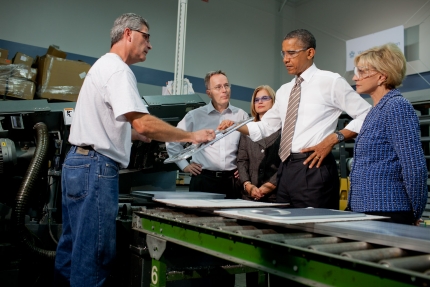
President Barack Obama tours WestStar Precision in N.C.

President Barack Obama is shown a piece of cut aluminum during a tour of WestStar Precision, a small business that will benefit from the proposed American Jobs Act, in Apex, N.C., Sept. 14, 2011. With President Obama are, from left, employee Barry Blackman, co-owners, Ervin and Susan Portman, and North Carolina Gov. Bev Perdue. (Official White House Photo by Chuck Kennedy)

While in North Carolina today, President Obama met with Erv Portman, the owner of WestStar Precision, a company that creates parts for airplanes and one of the 170,000 small businesses in North Carolina alone that would benefit from the American Jobs Act. The jobs bill that President Obama sent to Congress this week will help companies like Erv's by cutting taxes when they hire new employees and raise the salaries of their current employees and by cutting their payroll taxes in half. The President also announced a new policy that will accelerate payments to small business government contractors so they can reinvest that money in the economy and drive job growth.

After talking with employees at WestStar Precision, President Obama headed over to North Carolina State University where he was greeted by over 9,000 people who are ready to get the economy moving again, including many students. Here's what the President said:

I came to talk about how America can get back to a place where we’re creating good middle-class jobs again -– jobs that pay well; jobs that offer some security; jobs that are available for all the young people who are going to be graduating from N.C. State.  Because I know that’s what the students are thinking about.  And we can do that if we can finally get Washington to act -– if we can get folks to stop worrying so much about their jobs and start worrying a little more about your jobs. 

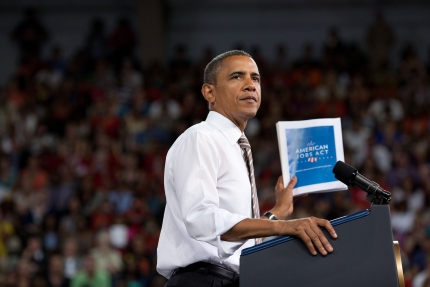
President Barack Obama delivers remarks on the American Jobs Act in N.C.

President Barack Obama delivers remarks on the American Jobs Act in the William Neal Reynolds Coliseum at North Carolina State University in Raleigh, N.C., Sept. 14, 2011. (Official White House Photo by Pete Souza)

Related Topics: Economy, North Carolina, Ohio

President Obama Urges Congress to Pass American Jobs Act

September 14, 2011 | 24:30 | Public Domain

President Obama travelled to North Carolina State University where he delivered remarks on the American Jobs Act, emphasizing the need for Congress to pass it now and put more people back to work and more money in the pockets of working Americans, while not adding a dime to the deficit.

Download mp4 (234MB) | mp3 (23MB)

The White House

Office of the Press Secretary

Remarks by the President on the American Jobs Act in Raleigh, North Carolina

North Carolina State University
Raleigh, North Carolina

12:51 P.M. EDT

THE PRESIDENT:  Hello, North Carolina!  (Applause.)  Thank you!  Thank you!  Thank you!  Thank you!  Thank you.  Thank you so much.  How’s it going, Raleigh?  (Applause.)  It is good to be back at N.C. State!  (Applause.)  Good to have all these Wolves in my wolfpack.  (Applause.)  I just hope none of the students here are skipping class on account of me.  (Laughter and applause.)  Your professors can see you on TV, you know.

I want to thank so many people who helped to set this up, but a couple of folks in particular I want to acknowledge.  First of all, the outstanding governor of the great state of North Carolina, Bev Perdue is in the house.  (Applause.)  Bev has been working tirelessly on behalf of the state, and obviously helped to guide so much of the emergency efforts that were taking place after the hurricane.  So we’re grateful to her.  And we also have one of the finest public servants I know, the former governor of the great state of North Carolina, Jim Hunt is in the house.  (Applause.) 

I want to thank Chancellor William Woodson, chancellor of North Carolina State University -- (applause) -- as well as Thomas Ross, president of North Carolina State University.  And I want to thank the power sound of the South for their outstanding performance.  (Applause.)  Thank you. 

Now, everybody can sit down if you want.  You all have seats.  (Laughter.)  That’s fine.  I got -- except folks in the front.  (Applause.)  See, this is the hardcore right here.  (Applause.)  I want to thank Erv for the introduction.  Now, as he mentioned, I just visited his small business, which is called WestStar Precision; it’s down the road in Apex.  And like Erv said, what they do is what a lot of companies here in the Research Triangle do so well:  They hire smart people; they give them the best technology; they create something of lasting value.  And that’s how this country built a strong and growing economy and a strong, expanding middle class.  That’s our history.  And that’s what we’ve got to get back to.  And that’s why I came to Raleigh here today.  (Applause.)

I came to talk about how America can get back to a place where we’re creating good middle-class jobs again -– jobs that pay well; jobs that offer some security; jobs that are available for all the young people who are going to be graduating from N.C. State.  (Applause.)  Because I know that’s what the students are thinking about.  And we can do that if we can finally get Washington to act -– if we can get folks to stop worrying so much about their jobs and start worrying a little more about your jobs.  (Applause.) 

Now, on Monday, I sent Congress this piece of legislation -- it’s called the American Jobs Act.  It’s a plan that does two things:  It puts more people back to work, and it puts more money back into the pockets of working Americans.  (Applause.)  Everything in this proposal, everything in this legislation, everything in the American Jobs Act is the kind of proposal that in the past, at least, has been supported by Democrats and Republicans.  Everything in it will be paid for.  (Applause.)  Anybody who wants to know more about it, you can read it on whitehouse.gov.  (Laughter.)  I know you guys don’t have enough to read.  And every single one of you can help make this bill a reality by telling Congress to pass this bill.  Pass this jobs bill.  (Applause.)

Now, let me tell you why you need to pass this bill.  Tell them to pass this bill so we can help the people who create most of the new jobs in this country, and that’s small business owners like Erv.  (Applause.)  Because while corporate profits have come roaring back, smaller companies haven’t.  So what this jobs bill does is it cuts taxes for small businesses that hire new employees.  It cuts taxes for small businesses that raise the salaries of their current employees.  (Applause.)  It cuts small businesses’ payroll taxes in half, and that would help 170,000 small business owners in North Carolina alone.  (Applause.)  And if they choose to make new investments next year, it lets them write off those investments.  And for small business owners who have contracts with the federal government, we’re going to do more than that.  Today I’m ordering all federal agencies to make sure those small business owners get paid a lot faster than they do now.  (Applause.)  In many cases, it will be twice as fast.  So that puts more money in their pockets quicker, which means they can hire folks quicker.  (Applause.)

Now, we’ve got to tell Congress to do their part.  You’ve got some Republicans in Congress, they like to talk about how “We’re in favor of America’s job creators.”  Well, you know what, if you’re in favor of America’s job creators, this is your bill.  This will actually help America’s job creators.  So we need to pass this jobs bill right away.  (Applause.)

But that’s not all this bill does.  Pass this jobs bill, and companies will get new tax credits for hiring America’s veterans.  (Applause.)  Now, we ask these men and women to leave their careers, leave their families, risk their lives to fight for us, to fight for our freedoms.  The last thing they should have to do is fight for a job when they come home.  (Applause.)  That’s why Congress needs to pass this bill.

Pass this bill because it will help hundreds of thousands of young people find summer jobs next year.  (Applause.)  It’s also got a $4,000 tax credit for companies that hire anybody who has spent more than six months looking for a job.  (Applause.)  It extends unemployment insurance, which means it’s providing help and support for folks who are out there, want to work, but haven’t found a job yet.  And that also puts more money into the economy, because they spend that money in small businesses and in large businesses, and that means they have more customers and they’ll hire more people.  But we’re also saying that if you’re collecting unemployment insurance, you’re going to get connected to temporary work as a way to keep your skills sharp while you’re looking for a permanent job.  (Applause.)

Pass this bill, and right here in North Carolina, about 19,000 construction workers will have a job again.  (Applause.) This is a common-sense idea.  Governor Perdue can tell you -- there are a lot of roads and a lot of bridges that need fixing.  There is a lot of work that needs to be done in schools and airports.  All these things are in need of repair.  In North Carolina alone, there are 153 structurally deficient bridges that need to be repaired.  Four of them are near here, on or around the Beltline.  Why would we wait to act until another bridge falls?  (Applause.)  All across North Carolina, all across the country, there are schools with leaking ceilings and lousy heating; ventilation so poor it can make students sick.  How can we expect our kids to do their best in places like that?

And the answer is we can’t.  This is America.  (Applause.)  I don’t know about you -- I don’t know about you, but I don’t want any of our young people studying in broken-down schools; I want our kids to study in the best schools.  (Applause.)  I don’t want the newest airports or the fastest railroads being built in China; I want them being built right here in the United States of America.  (Applause.)  There are construction projects like these all across the country just waiting to get started.  There are millions of unemployed construction workers looking for work.  My question is, what’s Congress waiting for?  There’s work to be done; there are workers ready to do it; let’s pass this jobs bill right away and let’s get it done.  (Applause.)  Let’s go. 

Pass this jobs bill, and there will be funding to save the jobs of up to 13,000 North Carolina teachers, cops and firefighters.  (Applause.)  I hope some of the young people here plan to go into teaching, plan to go into education.  (Applause.)  But here’s the challenge:  We’ve got incredibly talented young people who want to teach, but while places like South Korea are adding teachers to prepare their kids for the global economy, we’re laying off teachers left and right.  You’ve seen it here in North Carolina.  Budget cuts are forcing superintendents all over the state to make layoffs they don’t want to make.  It’s unfair to our kids, it undermines their future, it undermines our future -- it has to stop.  If we want our kids ready for college, ready for careers in the 21st century, tell Congress to pass the American Jobs Act and put teachers back into the classroom where they belong.  (Applause.)  Yes, we can.  We could pass this thing, but we need Congress to help us do it.  (Applause.)

Now, if we pass this bill, the typical working family in North Carolina will get a $1,300 tax cut next year.  (Applause.)  Thirteen hundred dollars that would have been taken from your paycheck will now go into your pocket.  That will help local businesses know that they’ve got customers.  But if Congress doesn’t act, if Congress refuses to pass this bill, middle-class families will get hit with a tax increase at the worst possible time.  We can’t let that happen. 

AUDIENCE:  No!  No!

THE PRESIDENT:  As I pointed out last Thursday, there are folks in Congress who have been fighting pretty hard to keep tax breaks for the wealthiest Americans.  You need to tell them they need to fight just as hard to help middle-class families.  Tell them to pass this jobs bill.  (Applause.)

So that’s the American Jobs Act.  It will lead to new jobs for young people, for construction workers, for teachers, for veterans, for the unemployed.  It will provide tax relief for every worker and every small business in America.  It will not add to the deficit.  It will be paid for.  (Applause.) 

We will pay for this plan.  We will pay down our debt.  We’ll do it following the same principles that every family follows:  We’ll make sure the government lives within its means.  We’ll cut what we can’t afford to pay for what we really need.  (Applause.)  And that means we’re going to have to make -- we’re going to have to cut some things we wouldn’t make if we hadn’t racked up so much debt over the last decade. 

But it does mean that we’re going to keep on doing the things that matter, like making sure that you guys who are here at N.C. State aren’t coming up with all that debt.  That’s why we’ve made sure to increase Pell Grants.  That’s why we’ve made sure to increase student loan affordability -- to make sure you guys can get the education you deserve.  (Applause.)  But in order to do that, we’ve got to make sure everybody pays their fair share, including the wealthiest Americans and the biggest corporations.  (Applause.) 

Ultimately, North Carolina, this comes down to what our priorities are.  Do you want to keep tax loopholes for oil companies? 

AUDIENCE:  No!  No!

THE PRESIDENT:  Or do you want to renovate more schools and rebuild more roads and bridges so construction workers have jobs again?  (Applause.)  Do you want to keep tax breaks for multimillionaires and billionaires? 

AUDIENCE:  No!

THE PRESIDENT:  Or do you want to cut taxes for small business owners and middle-class families?

AUDIENCE:  Yes!  (Applause.) 

THE PRESIDENT:  It would be nice if we could do it all, but we can’t.  We’ve got to make choices.  That’s what governing is about.  And we know what’s right.  We know what we have to do to create jobs right now, and create jobs in the future.  We know that if we want businesses to start here and stay here and hire here, we’ve got to be able to out-build and out-educate and out-innovate every country on Earth.  (Applause.)  We’ve got to give workers new skills for new jobs.  We’ve got to give our young people a chance to earn a college education.  (Applause.)  And we’ve got to follow Erv’s example -- we’ve got to start manufacturing and selling more goods around the world stamped with three proud words:  “Made in America.”  (Applause.)  “Made in North Carolina.”  “Made in Raleigh.”  We need to build an economy that lasts.

And, Raleigh, that starts now. 

AUDIENCE MEMBER:  I love you, Barack!

THE PRESIDENT:  I love you back.  (Applause.)  But first -- but if you love me -- if you love me, you got to help me pass this bill.  (Applause.)  If you love me, you got to help me pass this bill.  (Applause.)  It starts with your help.  Democrats and Republicans have supported every kind of proposal that’s in the American Jobs Act in the past.  Well, we got to tell them, support it now.  That’s where you come in.

Already, you’ve got some Republicans in Washington who have said that some of this stuff may have to wait until the next election. 

AUDIENCE:  Booo!

THE PRESIDENT:  And said maybe we can just kick our problems down the road and stretch this thing out rather than work together right now.  Some of them were even quoted as saying even if they agreed with some of the things in this bill, that they don’t want to pass it because it would give me a win.

AUDIENCE:  Booo! 

THE PRESIDENT:  Give me a win?  Give me a break!  (Laughter and applause.)  That’s exactly why folks are fed up with Washington.  This isn’t about me.  This isn’t about giving me a win.  This isn’t about giving Democrats or Republicans a win.  It’s not about positioning for the election.  It’s about giving the American people a win.  That’s what it’s about.  (Applause.)  It’s about giving small business owners and entrepreneurs a win.  It’s about giving students a win.  It’s about giving working families a win.  It’s about giving all of us a win.  I get fed up with that kind of game-playing.  And we’ve been seeing it for too long.  Too long.  We’re in a national emergency.  We’ve had -- we’ve been grappling with a crisis for three years, and instead of getting folks to rise up above partisanship in a spirit that says we’re all in this together, you got folks who are purposely dividing -- purposely -- thinking just in terms of how does this play out in terms of this election?

Now, that’s not all Republicans; there are some Republicans who get it.  I was in Ohio yesterday, and their Republican governor, who -- he doesn’t agree with me on a lot of stuff, but he agreed that it’s a good idea to cut taxes for the middle class.  (Applause.)  He said, “This is not a time for partisanship.  This is a time to figure out a way in which we can get things moving in this country.”  He’s absolutely right.  A faction in Washington may be content to wait until the next election to do anything, but I’ve got news for them:  The next election is 14 months away.  And the American people don’t have the luxury to wait that long.  (Applause.)  There are a whole bunch of students here who will graduate by then and will be looking for a job.  They can’t wait that long.  There are a lot of folks living paycheck to paycheck, day to day.  They can’t wait that long.  They need action; they need action now.  (Applause.)  So, Raleigh, you need to put leaders -- you need leaders who will put country before party -- (applause) -- and your jobs and your lives and your well-being and your futures above everything else.

So for those of you who did skip class today -- (applause) -- I’ve got a homework assignment for you.  (Laughter.)  That’s right.  I am asking all of you -– not just here at N.C. State, not just you who are in Raleigh, but anyone watching, anyone listening, anybody following online –- I need you to lift your voice.  Make it heard.  You can call, you can email, you can tweet, you can fax.  You can Facebook, you can visit, you can write a letter -- when was the last time you did that?  (Laughter.)  Tell your congressperson that the time for partisanship and politics is over.  It’s not -- now is not the time for it.  The time for gridlock and games is over.  The time for action is now.  (Applause.)

So I just want to say -- I just want to make sure everybody understands their homework assignment.  Tell them.  Tell them that if you want to create jobs -- pass this bill.  (Applause.)

If you want construction workers back on the worksite -- pass this bill.  (Applause.)

If you want teachers back in the classroom -- pass this jobs bill.  (Applause.)

If you want tax cuts for middle-class families and small business owners -- pass this jobs bill.  (Applause.)

If you want to help our veterans share in the opportunity that they have defended -- pass this bill.  (Applause.)  

Now is the time to act.  We are not people who just watch things happening.  We make things happen.  (Applause.)  We’re Americans.  We are tougher than the hand that we’ve been dealt.  We’re bigger than the politics we’ve been putting up with.  We’re patriots and pioneers and innovators and entrepreneurs.  Through individual effort, but also through a commitment to one another, we have built an economy that is the engine and the envy of the world.  We’re not going to stop now.  The time for hand-wringing is over.  The time for moping around -- we’ve got to kick off our bedroom slippers and put on our marching shoes.  We’ve got to get to work.  (Applause.)

There are people who -- there may be people whose refrain is:  No, we can’t.  But I believe:  Yes, we can.  (Applause.)  We are a people who write our own destiny.  And we will write our destiny once more.  So let’s seize this moment.  Let’s get to work.  Let’s show the world once again why the United States of America is the greatest country on Earth.  (Applause.)

Thank you, North Carolina.  Thank you, Raleigh.  God bless you.  God bless the United States of America.  (Applause.)

END
1:12 P.M. EDT 

Watch Live: President Obama on the American Jobs Act in North Carolina

Ed. Note: The event has now ended. Watch video and see photos from the event.

Today, President Obama will visit Raleigh, North Carolina to continue the conversation with Americans on why Congress needs to pass the American Jobs Act to put workers back to work. Watch the President live beginning at 12:55 p.m. EDT at WhiteHouse.gov/live.

In advance of the President’s visit, Governor Beverly Perdue and mayors across North Carolina explained the importance of passing the American Jobs Act. Governor Beverly Perdue said, "My top priority is creating jobs. I'm pleased that the President put forward the American Jobs Act. Congress should pass a plan quickly that encourages companies to hire, helps unemployed people get back to work, and puts more money in the pockets of working families."

American Jobs Act and Your Community

The purpose of the American Jobs Act, which President Obama sent to Congress this week, is simple: put more people back to work and put more money in the pockets of working Americans. The President's plan will rebuild the economy the American way -- based on balance, fairness and the same set of rules for everyone from Wall Street to Main Street. 

The American Jobs Act reflects a commitment to strengthen the recovery and help increase access to jobs for all Americans. To see what impact the Jobs Act will have on your community, click on the link below.

The White House

Office of the Press Secretary

President Obama Signs Maine Disaster Declaration

The President today declared a major disaster exists in the State of Maine and ordered Federal aid to supplement state and local recovery efforts in the area affected by Tropical Storm Irene during the period of August 27-29, 2011.

Federal funding is available to state and eligible local governments and certain private nonprofit organizations on a cost-sharing basis for emergency work and the repair or replacement of facilities damaged by Tropical Storm Irene in Franklin, Oxford, and York Counties.

Federal funding is also available on a cost-sharing basis for hazard mitigation measures statewide.

W. Craig Fugate, Administrator, Federal Emergency Management Agency (FEMA), Department of Homeland Security, named Albert Lewis as the Federal Coordinating Officer for federal recovery operations in the affected area. 

FEMA said additional designations may be made at a later date if requested by the state and warranted by the results of further damage assessments.

FOR FURTHER INFORMATION MEDIA SHOULD CONTACT:  FEMA NEWS DESK AT (202) 646-3272 OR FEMA-NEWS-DESK@DHS.GOV

President Obama: "Every Child Deserves a Great School"

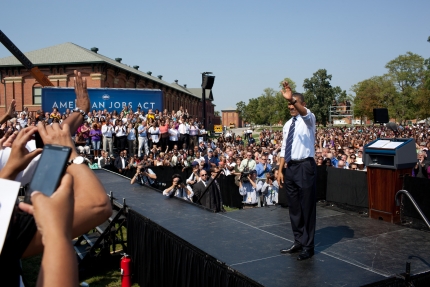
President Barack Obama on the American Jobs Act in Columbus, Ohio

President Barack Obama delivers remarks to students, faculty and staff at Fort Hayes Arts and Academic High School in Columbus, Ohio, Sept. 13, 2011. The President highlights his American Jobs Act proposal to put workers back on the job by rebuilding and modernizing schools across the country. (Official White House Photo by Pete Souza)

It was a hot afternoon in Columbus, Ohio today when President Obama spoke to an enthusiastic crowd of over 3,000 people at Fort Hayes Arts and Academic High School. He laid out how the American Jobs Act will put teachers back in the classroom and get construction workers, carpenters and electricians back on the job modernizing America's schools.

Even though the September sun felt more like midsummer, students are back in school at Fort Hayes and on days like today they’re glad to have air-conditioning, one of many recent renovations to buildings on campus that were originally built during the Civil War. The American Jobs Act would make it possible to renovate at least 35,000 schools like Fort Hayes across the country. As the President said, putting construction workers back on the job rebuilding schools is just common sense for the economy and for the education of our kids:

When buildings are that old, they start falling apart.  They start leaking, and ceiling tiles start to cave in, and there’s no heat in the winter or air-conditioning in the summer.  Some of the schools the ventilation is so poor it can make students sick. 

How do we expect our kids to do their very best in a situation like that?  The answer is we can’t.  Every child deserves a great school, and we can give it to them, but we got to pass this bill. 

Related Topics: Economy, Education, Ohio