The White House

Office of the Press Secretary

Remarks by the President in a Town Hall Meeting in Alpha, Illinois

Country Corner Farm
Alpha, Illinois

4:51 P.M. CDT

THE PRESIDENT: Hello, everybody! (Applause.) Oh, it is good to be back home. (Applause.) Everybody have a seat, relax, take a load off there.

We’ve got some special guests here I want to just acknowledge. First of all, an outstanding public servant, a great governor, Pat Quinn is in the house. (Applause.) Your former congressman, now my Secretary of Transportation, great friend of mine, Ray LaHood is here. (Applause.)

We’ve got another member of Congress who obviously took a wrong turn somewhere. (Laughter.) Thought he was heading back to the West Side of Chicago -- turned out he’s in Alpha. (Laughter.) Danny Davis is here. (Applause.)

We’ve got the mayor of Alpha, Marvin Watters is here. Where’s Mr. Mayor? There he is back there. Good to see you, sir. (Applause.)

Two great friends of mine -- Senator John Sullivan. Where’s John? There he is. (Laughter.) And Dave Koehler is here. Good to see you, Dave. (Applause.)

And finally, I want to thank the owners of this great facility, Bruce and Charlie Curry, owners of Country Corner. (Applause.)

I need to confess something to Bruce and Charlie. One of my speechwriters, it’s his birthday today, so we let him ride on the little cow pull over there. (Laughter.) It said birthday parties available, so we had him sit in there. He’s only 29, and he still fit. So he had a great time there.

This is a town hall meeting. Some of you remember I used to do these when I was your senator instead of your President. I don’t want to do a lot of talking at the front, but I just want to talk to you a little bit about what I’ve been seeing over the last couple of days and what’s been going on in Washington.
 
Obviously we’ve been going through as tough of a time as we’ve seen in my lifetime and in most people’s lifetimes these last two and a half years. We went through the worst financial crisis since the Great Depression. When I took office we had already lost 4 million jobs and we lost another 4 million just in the few months right after I took office. And we’ve been fighting our way back over the last two and half months -- or last two and a half years.

We were on the verge of going into a Great Depression, and we were able to yank ourselves out. The economy is now growing again. Over the last 17 months we’ve created over 2 million jobs in the private sector. We saved an auto industry that was on the brink. (Applause.) We have -- we’ve made investments in clean energy, in rebuilding our roads and our bridges.

And thanks to the great work of Secretary LaHood, we’ve been getting started on the process of making sure we’ve got the best infrastructure around. Thanks to the great work of our Secretary of Agriculture, Tom Vilsack, we’ve tried to strengthen rural communities and farming communities all across the country and all across the Midwest.

And so despite the fact that we’ve gone through tough times, I want everybody to remember we still have the best universities on Earth, the best workers on Earth, the best entrepreneurs on Earth, the best system on Earth. There’s not a country in the world that wouldn’t trade places with the United States of America. (Applause.)

Now, the fact is, though, times are still tough. And some of the reasons times are still tough we don’t have complete control over. The economy was predicted to be growing at about 3.5 percent at the beginning of this year, partly because we had worked a bipartisan package of tax cuts and investment credits to encourage businesses to invest. But then you had the Arab Spring, and that shot gas prices and fuel prices up. And I know a lot of farmers here experienced that spike. And then we had the tsunami in Japan, and that disrupted supply lines and that affected American manufacturing. And then we had the situation in Europe and the debt crisis there, and that started lapping up onto our shores.

And so there are some things we don’t have control over, and the question is, how do we meet these challenges? But there are things that we do have control over. And the biggest challenge we have is in Washington. There’s nothing wrong with our country, but there’s a lot wrong with our politics right now. (Applause.) And that’s what I aim to fix. That’s what we have to fix.

When you look at this recent debt ceiling debacle and the downgrade, that was a self-inflicted wound, completely unnecessary. The truth of the matter is we’ve got a real challenge with debt and deficits. We had a balanced budget in 2000, then we fought two wars without paying for them. We ended up creating a prescription drug plan for seniors, which is the right thing to do, but we didn’t pay for it. Tax cuts we didn’t pay for.

And then the recession hit, and so a lot of money was going out to help local communities keep their firefighters and police officers and teachers on staff -- and Pat Quinn knows how important that was to prevent massive layoffs at the state level. Unemployment insurance to help folks get back on their feet, but that all meant a lot of money was going out, less tax revenue was going in because businesses weren’t doing as well. So combined we’ve got a big debt and deficit challenge that we’ve got to meet.

But what’s frustrating is that two months ago, three months ago, six months ago we could have met that challenge. We could have decided we’re going to come together with a balanced package where we’re closing corporate loopholes and we’re closing tax breaks for the very wealthy, and we’re cutting spending on things we don’t need.

And if we had come together on a bipartisan basis, we could have avoided all this drama over the last two and half months. But that’s not what we did, because what’s happened in Washington these days is there is a group of folks who think that, I’d rather see my opponent lose than see America win. (Applause.) There are folks who are willing to engage in political brinksmanship even if it costs the country.

And I know you’re frustrated. And I want you to know I’m frustrated. And you should be frustrated. The last two and a half days I’ve been traveling all across the Midwest through Iowa and Minnesota and now back home in Illinois. And everywhere I go, what I see are people who are working hard. They’re looking after their families. They’re farming and feeding people not just here in America, but all around the world. They’re going to church. They’re helping out at the food pantry. They’re coaching Little League.

We just came to visit the football team over at Galesburg. They’ve got their new coach. (Applause.) And I think to myself, you know what, if folks in Washington were carrying out their responsibilities the way you’re carrying out your responsibilities, we’d be just fine. We would be just fine. (Applause.)

So the question is, what do we do going forward? Look, even though private sector job growth is good, we’ve still got a long way to go before we put everybody back to work. We need to go ahead and act right now on some proposals that are before Congress, ready to be voted on. We should extend the payroll tax cut that we passed in December, put $1,000 in the typical family’s pocket -- we need to extend that into next year. (Applause.) Because if you’ve got more money in your pockets, that means businesses have more customers, they’re more likely to hire. There’s no reason why we can’t do that right now.

There’s no reason why, as Ray LaHood knows, we’ve got over $2 trillion worth of repairs that need to be made around the country, and I know there are some right here in this county and right here in this state. And we’ve got a lot of construction workers that are out of work when the housing bubble went bust, and interest rates are low, and contractors are ready to come in on time, under budget -- this is a great time for us to rebuild our roads and our bridges, and locks in the Mississippi, and our seaports and our airports. We could be doing that right now, if Congress was willing to act. (Applause.)

Right now, we could pass trade deals that we negotiated that not only have the support of business, but have the support of the UAW. That doesn’t happen very often. And the reason is, is because folks know that not only is that good for agricultural America -- opening up markets, because we’ve got the best farmers in the world -- but it’s also good for manufacturing. There are a whole bunch of Kias and Hyundais being driven around here; that’s great. But I want some Fords and Chevys being driven in Korea. (Applause.) We should pass that bill right now.

We’ve got legislation right now that we call the American Invents Act -- basically, make patents easier so when people come up with a new product or a new service or a new invention, they’re able to turn it around without a lot of red tape and bureaucracy and start businesses that could be hiring. There’s no reason to wait. It should be passed right now.

The fact is this: All these things I just mentioned, historically they’ve had bipartisan support. I mean, if Ray LaHood was still in there -- Ray was a Republican -- he’d vote for every single one of these; he’d be sponsoring them all. (Laughter.) You’ve got a Democratic President who supports these things. There’s no reason for us not to act right now.

And over the course of the next few weeks, I’m going to be putting out more proposals to put people to work right now. And some of them -- yes, some of them cost money. And the way we pay for it is by doing more on deficit reduction than the plan that we had to come up with right at the last minute in order to avoid default. We didn’t do as much as we could have.

When folks tell you that we’ve got a choice between jobs now or dealing with our debt crisis, they’re wrong. They’re wrong. We can’t afford to just do one or the other. We’ve got to do both. And the way to do it is to make some -- reform the tax code, close loopholes, make some modest modifications in programs like Medicare and Social Security so they’re there for the next generation, stabilize those systems. And you could actually save so much money that you could actually pay for some of the things like additional infrastructure right now.

We can close the deficit and put people to work, but what’s required is that folks work together. That’s the big challenge. That’s the big challenge. (Applause.)

So the main thing is I’m here to enlist you in this fight for America’s future. I need you to send a message to your members of Congress, to your representatives that we’re tired of the games. We’re tired of the posturing. We don’t want more press releases. We want action. We want everybody to work together and stop drawing lines in the sand and saying, we’re so rigid, we’re not going to do this or we’re not going to do that, no matter what. Think about country ahead of party. Think about the next generation instead of the next election. (Applause.)

I had some interviews with some reporters, and they said, why don’t you call Congress back right now? And I said, you know what, I hope Congress goes back to their districts. And I want them to listen to how frustrated people are, how angry they are with our politics at a time when we’ve got so much work to do.

Because the last thing we need is Congress to show up back in Congress and do the exact same thing they’ve been doing. They’ve got to think differently about how we’re approaching problems. So I want them to be doing the same thing I’m doing, just talking to ordinary folks and try to remember why they got into public service in the first place. It’s not supposed to be to get attention. It’s not supposed to be so you get interviewed on cable TV. It’s not supposed to be so you have a fancy title.

You’re supposed to be in public service to serve the public. And that means that, yes, you don’t get your way 100 percent of the time. It means that you compromise. It means you apply common sense. And that’s what I’m hoping that everybody takes from visiting their district again and getting out of Washington for a while.

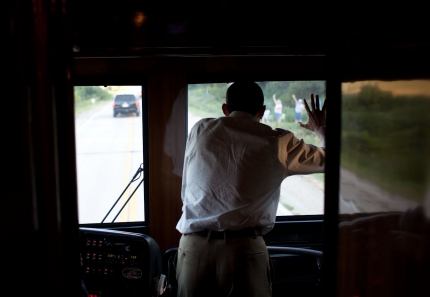
I can tell you nothing is more inspiring to me than the kind of trip that I’ve been taking over the last few days. We’re driving on this big bus and it’s all -- you can’t see out except when you’re standing in front, so I’m out in front. And having breakfast in a diner and going to a football practice; you’re passing rows of kids with flags and grandparents in their lawn chairs and mechanics out in front of their shops and farmers waving from their fields. And it inspires you, because it reminds you about what makes this country so great, why I love this country so much, and why we’ve got to be doing every single thing we can every minute of every day to make sure that you can continue to achieve your American Dream and pass it on to your kids and your grandchildren.

That’s why I ran for President. That’s why a whole bunch of you voted for me to be a U.S. senator and then to be President. (Applause.)

So I need your help, everybody. Thank you. Thank you. (Applause.)

All right, let’s see if this mic is working. It is. All right, what I’m going to do is I’m just going to call on folks as they raise their hands. The only rule is we’re going to go girl, boy, girl, boy -- (laughter) -- so everybody gets a chance. And there are folks in the audience with microphones. So please stand up and introduce yourself before you ask your question. And I’ll start with this young lady right here in the front.

Here we go. You’ve got a gentleman coming up with a mic.

Q Thank you, Mr. President, for being here today in Henry County. My name is Karen Urich (ph). I’m a multigenerational farmer, member of the Henry County Board and Henry County Farm Bureau. My question that I have today is I have a concern over estate taxes.

In 2013, if the Senate and the Congress fails to act, we will have our estate taxes go back to the 2001 level. We have family farms that are experiencing having to sell their land in order to pay the property taxes. And I was wondering what you see for the future of the estate tax. Thank you.

THE PRESIDENT: Well, there’s no reason why we have to go all the way back to the 2001 level. There is a compromise that has been discussed where you’d essentially have a $7 million exemption per family. There are some folks who just want to eliminate the estate tax all together. There are others who want to hike it up back to 2001.

There’s a mid-level proposal that would exempt most -- almost all family farms and nevertheless would still hit folks like Warren Buffett and make sure that he is able to pay what he wants to pay in terms of passing on something not only to his family, but also to the country that has blessed him so much.

So this is going to be part of the larger debate we have about the tax code. And the one thing I want to emphasize, a lot of folks don’t realize this, but there are only 3 percent of the population that has an annual income of more than $200,000 a year. Think about that, 97 percent of folks, their annual income is less than $200,000. And there are only less than 1 percent who are making millions of dollars. And then there’s less than one one-hundredth of 1 percent who are in the Warren Buffett category. That top 1 percent -- in fact, that top one-tenth of 1 percent, those are the main folks who have seen their incomes skyrocket over the last 10, 15 years. Ordinary families, including family farmers, basically your incomes and your wages have flatlined over the last decade.

And so when we think about tax reform we should be thinking about fairness. What’s fair? Nobody likes paying taxes. I promise you, I don’t like paying taxes. But I do believe in paying what I use -- paying for what I use. And if I want good roads, and if I want good schools for kids, and if I want the best universities in the world and I want to make sure that we’re continuing to invest in agricultural research at places like University of Illinois that have helped to make us the most productive farmers in the world, then I think I should have to pay for it. And if I’m better able to pay for it than a waitress who is making $25,000 a year, I don’t mind paying a slightly higher rate. There’s nothing socialist about that. That’s just basic fairness.

And, by the way, when you hear folks saying, well, you know what, that’s job killing -- that’s not job killing. When Bill Clinton was President we created 22 million jobs with a tax rate that was much higher across the board than it is now. We don’t have to go all the way back up there on the estate tax or any other taxes for us to close our deficit and our debt, but we should ask oil and gas companies that are making record profits that they don’t benefit from a special tax loophole that the mom-and-pop store in Alpha doesn’t get. And I don’t think there’s anything wrong with asking me to pay a little more so our senior citizens don’t have to pay an extra $5,000, $6,000 a year for their Medicare. (Applause.) That’s what we’re looking for, is balance in terms of our tax policy. (Applause.)

All right. Who’s next? This is an old friend of mine right here. Introduce yourself for everybody.

Q Phillip Nelson (ph). Welcome back to Illinois, Mr. President.

THE PRESIDENT: Good to see you, Phil.

Q And I just want to say on behalf of Illinois agriculture, we’re glad that you’re in the heartland. And as you know, Illinois agriculture is the major economic driver in this state that employs close to a million people. And my concern is this: As a fourth-generation farmer, we’re very concerned with some of the regulatory challenges that are coming our way as it relates to the Clean Air Act, the Clean Water Act. We’re concerned with what’s going in the Chesapeake Bay, and the fears that that might come to the Mississippi River Basin. And I guess my challenge, Mr. President, is that you work with the EPA Administrator to put some common sense back into some of these regulatory discussions so we don’t regulate farmers out of business.

THE PRESIDENT: Well, let me say this about -- (applause) -- because I got this question when I was in Atkinson. Some of these regulatory concerns that people have, frankly, are unfounded in the sense that if somebody even has an idea or a thought about some regulation, then right away the message is sent out, they’re coming and they’re going to make it impossible for you to farm and this and that and the other. And this thing may still be completely in a theoretical stage, where folks are trying to figure out how do we make sure that our streams and our rivers aren’t messed up. And there may not even be a regulation in place before people are already getting worried about what’s coming down the pipe.

There is not a rule or regulation that we don’t do a complete cost-benefit analysis at this point, and that we don’t have intensive discussions with those who would potentially be affected. Now, what I do think is true is that, in the past -- I’ll say not under my administration, but I think in the past historically -- there have been times where the EPA or other regulatory agencies don’t listen to farmers and figure out how can we provide them flexibility in meeting some of their goals.

So I was talking to Tom Vilsack yesterday, and he was using as an example that, in the state of Washington -- maybe it was Oregon; it was in the Pacific Northwest -- there was concern about some of the runoff was making it harder for salmon in those regions, which is also a big industry in Washington. And the problem was -- it wasn’t pollution, it was actually heating. Some of the runoff from some of the plants in the area were getting too hot, and that was inhibiting salmon. So instead of just coming up with a regulation that prohibited these industries, what they came up with was, working with farmers and conservationists, planting trees along the rivers that cooled the waters so that the salmon were unaffected.

Well, that’s the kind of creative approach where, if you’re listening to folks on the ground and you say, here, we’ve got a problem that we do need to solve, but is there a smarter way to doing it that ends up being a win-win instead of end up being a lose-lose? Let’s work together. And that’s the kind of approach that we need to take.

Don’t be fooled. I think if somebody goes out and says, we can’t afford clean air and clean water, that’s wrong. I don’t believe that. And I don’t think most farmers would agree with that, because, ultimately, nobody is better stewards of the land. And the reason we’ve got these incredible farms all around us is because we’ve got incredibly rich soil. We’ve got to make sure that we’re conserving that soil. We’ve got to make sure that our air and water continues to be healthy for our kids. And I think farmers care about that more than anybody.

So we’ve got the same goal. The question is, are we able to work together to figure out a smart way to achieve these goals? And that’s what my administration is going to be committed to doing, all right?

Right there. Yes.

Q Thank you, President Obama, and welcome to this area. My name is Judy Gunzeth (ph), and I’m director of tourism for Galesburg and Knox County. So thank you for coming for --

THE PRESIDENT: This is a great tourist location right here, County Corner.

Q Exactly.

THE PRESDIENT: Bring your families. (Applause.)

Q I also want to congratulate you on recently turning 50. I passed that milestone recently, and it’s not as bad as what people think.

THE PRESIDENT: How come you look so much better than me? (Laughter.)

Q I live in Galesburg. (Laughter.)

THE PRESIDENT: That’s why. Okay. All right. That makes sense, that makes sense.

Q I also want to commend your wife, our First Lady, on her efforts to encourage healthy eating.

THE PRESIDENT: Yes.

Q I believe that people who eat healthy are healthy, and a healthy nation is a productive nation. And I think a lot about our children, our school children, and people who are on food stamps -- and just the entire nation needs to live healthy. But it also, in the long term, it reduces health care costs, and we’re thinking about short-term health care costs, but we’re also thinking in long-term health care costs.

THE PRESIDENT: Right.

Q So what I’d like to hear is maybe just your philosophy from your administration -- ways to expound upon what your wife is doing and encouraging -- and positive incentives to encourage people to eat healthy, to live healthy, especially for our schoolchildren.

THE PRESIDENT: Well, it’s a great question. And first of all, thank you for what you’re doing to promote tourism here in Galesburg. I want to point out that America as a whole needs to do a better job of promoting tourism, because -- it used to be we just took for granted everybody wanting to come here. Now countries all around the world are promoting their countries, and we want tourism dollars to come here. And so I’ve set up a tourism council to make sure that they visit not just San Francisco and Manhattan, but they also understand what an incredible travel opportunity there is here in the Midwest and in small towns all across America.

Michelle has done a great job with a combination of nutrition facts, but also exercise. And you’re right, the reason she thought it was so important is she’s a mom with two kids. And she knows that Malia and Sasha, if they start off with healthy habits now, they’re going to be healthier when they get older. And it turns out -- we were just talking about the budget -- about a third of our increase in health care cost is directly attributable to obesity and illnesses like diabetes that are entirely preventable and curable if folks got back into the same habits that our parents and our grandparents had.

Now, a lot of it is just movement and exercise and getting kids off the couch. And that’s why you see Michelle, she goes to these events, and I will tell you, she is in very good shape. And she was running routes with the -- running routes with NFL players and throwing in first pitches and doing double-dutch and -- I can’t keep up with her.

But food is an important component of it, and this is something that actually can benefit farmers, particularly family farmers. We want more produce -- more vegetables and more fruit -- consumed all across the country. And a lot of times, farmers are not making all the money from their products because it goes through this chain of shipping and processing and distribution, and there are a lot of middlemen between the farmer and the end user. And so there’s an economic component as well as a health component, where if we can get farmers more directly linked to consumers, they’re selling their products more directly, they’re getting more fresh vegetables, more fresh fruit, then everybody can benefit.

And the way we’re trying to do it -- Michelle is doing it not by regulation, not by telling folks they have to do something, but by just information. And they’ve been able to get a lot of agreements with companies. You had Wal-Mart, for example, realizing that more and more people were asking for healthier products in their stores. Voluntarily, they and a whole bunch of other big retailers have said, we’re going to start linking up with family farmers; we’re going to start setting up better grocery stores in underserved communities, like in Danny’s district where you can go for miles without seeing a fresh vegetable; and linking up -- setting up farmers markets in urban areas where people can sell produce. And a lot of this stuff we’ve been able to do voluntarily without legislation.

Now, there are still some legislative elements to this thing. So, for example, we passed the Child Nutrition Act just to make sure that our meals in schools are a little bit healthier, so that kids are getting not just processed food, but they’re also getting fresh produce as well. And some of the time that’s a little bit more expensive in the schools. So the question is, are there some things we can cut out in order to pay to make sure that our kids are healthier? But they’ll learn more, they’ll be healthier in the long term, and in the long term we will save money, and it’s good for farmers as well.

Thanks for the great question. All right. The gentleman right here. You just stood up. There you go.

Q Thank you, Mr. President. My name is Alfred Ramirez. I’m president of the Hispanic Chamber in the Quad Cities area, and an employee of Group O in Moline. I’m going to -- this is one of the most painful places I think our country has been in decades or centuries, where we have those in power and influence who are literally tearing our country apart between the haves and the have-nots. We are willing to dismantle programs that they call entitlement programs, and those recipients or beneficiaries of those programs don’t have a mind of their own and are merely asking for a handout. And as we look for our adjustments to the budget and our cuts, could you please speak to some of those very programs that are not necessarily sacred but must stay in place to even have a ripple effect for those who benefit from them?

THE PRESIDENT: Well, first of all, let me separate out some of these programs. And I’m going to start with Social Security. People pay into Social Security. It’s a social insurance program. They’re not getting it for free. It’s not a handout. It’s taken out of your check. It’s been taken out of your check for a lifetime. And it provides you a floor when you retire.

Now, hopefully, people have other savings that help supplement their incomes in their golden years. But we’ve got to make sure Social Security is there not just for this generation but for the next generation. (Applause.) Now, Social Security is not posing a huge problem with respect to our debt and our deficit. There is a problem that if we don’t make any modifications at all, then in a few years what will start happening is, is that the amount of money going out is more than the amount coming -- amount of money going in. And people debate how soon, but in a couple of decades you’d start having a situation where you’d only get 75 cents on the dollar that you expected on Social Security.

If we make some modest changes now, the kind of changes that Ronald Reagan and Tip O’Neill agreed to back in 1983, we can preserve Social Security, make sure it’s there for the future 75 years out. So Social Security is something that we can solve relatively easily. It doesn’t mean that we don’t make any changes at all, because there may be some tweaks that we can make to the program, but we can assure that Social Security is there for future generations.

The bigger problem is Medicare and Medicaid. And the reason that’s a problem is because health care costs keep on going up faster than inflation, people’s wages, people’s incomes at the same as folks are getting older, so we’ve got more people into the system. And if we didn’t do anything, then Medicare and Medicaid would gobble up basically the entire federal budget -- and we couldn’t pay for our schools, we couldn’t pay for fixing our airports, we couldn’t pay for basic research. All the things that we expect out of our federal government we couldn’t do. All we’d be doing is just paying doctors and hospitals and nursing home facilities. That would take up the whole budget. That’s no way to run a country.

The health care bill that I passed begins the process of trying to reduce the cost of health care, reforming the cost of health care by, for example, telling providers instead of having five tests that you charge for each one, have one test and email to the five specialists who may need the test. (Applause.) Start using electronic medical records. Instead of reimbursing you for how many procedures you do, we’re going to reimburse you for how well you help the patient get well overall. We’re going to say to hospitals, how good are you at reducing infection rates in your hospital so that people aren’t being readmitted getting sick all the time.

So there are a whole bunch of things we can do to make the health care system more efficient. But even if we do all those things, we’re still going to have a problem with Medicare and Medicaid. And my basic principle is, let’s make sure that we keep this program intact, both programs -- Medicare and Medicaid -- for people in need: for our seniors, for disabled kids, for folks who’ve got a parent who’s severely ill and they’ve only got a certain capacity to support them and help them. But let’s also make sure that we’re making some common-sense changes that allows the program to be there in the future. This is in contrast to the approach that’s been taken, I’ve got to admit, by the House of Representatives when they passed their budget.

They passed a budget that basically called for voucherizing the Medicare system. This is the Republicans in the House of Representatives. And basically what they say is, here’s a flat rate that you get for Medicare, and you know what, if it turns out that it doesn’t buy you enough insurance, that’s your problem; that’s not our problem.

Now, this will cut the deficit. It will save the government money, but it does so by shifting the costs from the government to individual seniors. It doesn’t solve the problem by actually reducing health care costs. So I think that’s the wrong approach to take. I think that’s the wrong approach to take. (Applause.)

But I want to be honest with folks: We are going to have to make some modifications to Medicare and Medicaid. They don’t have to be radical, but we’re going to have to make some modifications to them in order for them to be there for the next generation. That’s part of our obligation, because we can’t just be not thinking about our kids and our grandkids as we move forward.

But we can do it in a way where the average senior is still protected, is still getting all the help that they need. It’s not a voucher program. It is guaranteed health care, because I think that’s a core principle that we’ve got to preserve. All right? (Applause.)

All right. It’s getting a little warm out here, huh? You guys doing all right? You guys hanging in there? All right. It’s a young woman’s turn. Right over there in the striped shirt. You. Yes.

Q Our family does a lot of --

THE PRESIDENT: What’s your name?

Q Allie Hand (ph).

THE PRESIDENT: Hey, Allie.

Q Our family does a lot of farming and stuff. And we’ve noticed the county fairs are shrinking. Is there anything you’re going to do about that?

THE PRESIDENT: Well, one thing I’m going to do -- I went to a county fair today and they were showing some cows. And I didn’t judge them. (Laughter.) They all looked pretty good to me. (Laughter.)

But I think the county fair tradition is so important, not only because it’s an economic attraction for the community, but also because it brings the community together. It’s a focal point for a county and it reminds people of what holds America together and the heartland together.

And so, working with the state of Illinois, working with tourism bureaus, we want to continue to promote county fairs all across Illinois. One of the things I’d like to see is -- and Danny may agree with this, coming from Chicago. There are kids in Danny’s district -- in fact, the overwhelming majority of kids in Danny’s district, they’ve never seen a cornfield like this. They’ve never seen a cow. If you asked them what does a tomato plant look like, they’d have no idea.

So part of what I’d like to see is actually more tourism maybe organized through school trips and others for people from outside of rural areas to appreciate what’s happening in rural areas. Where are they getting their food from? It doesn’t just show up in cellophane in a supermarket. Somebody is growing that. And part of the challenge is America has become so productive agriculturally that you now only have a couple percent of the people who are actively involved in farming. Ninety-eight percent of people, they just eat. (Laughter.) And I think a county fair can be a powerful education tool, and I’d like to see more kids just coming out here and be able to appreciate all the hard work that goes into the food on their table. And so maybe that’s something that your outstanding governor might want to work on. All right? (Applause.)

I got time for two more questions. Two more questions. Young man in the green, right there. Well, there are two young men in green, but I was calling on this guy right here. Yes.

Q Hello. My name is Eric Palmer (ph) and I go to Augustana College.

THE PRESIDENT: Great school.

Q Yes, it is. First of all, I just want to let you know of one thing: I am not disappointed in you like Michele Bachmann wants everyone to believe. (Applause.)

THE PRESIDENT: Thank you. I appreciate that.

Q My question is about Social Security. I know that one of your ideas to fix the solvency of it is to reevaluate the equation that determines the COLA, the cost-of-living adjustment. But as the law stands right now, we are only taxed on the first $107,000 that we make.

THE PRESIDENT: Right.

Q That means every dime that I make is taxed for Social Security.

THE PRESIDENT: Right.

Q I don’t make $107,000. (Laughter.) But that means that --

THE PRESIDENT: Somebody said you will --

Q Someday, I hope.

THE PRESIDENT: Yes, you sound pretty smart. It sounds like you’re going to do just great.

Q Thanks. But that means that people like Mitt Romney only pay into Social Security on the first one-tenth of 1 percent of what they make.

THE PRESIDENT: Right.

Q Can we look forward to you telling the Republicans that it’s time that the wealthy pay their fair share? (Applause.)

THE PRESIDENT: Well, first -- this is a very well-informed young man here. (Laughter.) You’re exactly right that the way the Social Security system works, there’s what’s called -- there’s basically a cap on your Social Security, which there isn’t, by the way, on Medicare. But Social Security, it only goes up to the first $107,000; and you’re right, somebody who makes -- who has net assets of $250 million and are making maybe $5 million a year just on interest or capital gains or something, just a fraction of it’s going to Social Security. I think there’s a way for us to make adjustments on the Social Security tax that would be fairer than the system that we use right now.

I do think, in terms of how we calculate inflation, that’s important as well. By the way, seniors -- a bunch of them were upset over the last couple years because some of -- because seniors didn’t get a cost-of-living adjustment. I got a lot of letters -- “Mr. President, how come I didn’t get a COLA this year for my Social Security?” And I answered this question at the previous town hall; I figured I’d clear something up now. The way the system works is you automatically get a cost-of-living adjustment based on the inflation rate. The President doesn’t make that decision; it’s based on a formula.

And when the economy was really in the drink in 2009 and 2010, there was basically no inflation -- prices were actually going down. That’s why seniors did not get the cost-of-living adjustment. That doesn’t mean that they weren’t still having a hard time because food prices or gas prices or what have you might have been going up, or the cost of medicine. So as a consequence, we actually proposed -- and I’m sure Danny was one of the co-sponsors of this -- legislation that would have given an extra $250 to seniors just to help make ends meet. We couldn’t get Republican support for it. But seniors who are still upset about not getting your COLA -- or if they’re not here, but when you go back and you’re talking to your grandma and they’re still mad at me about it, I just want you guys to set the record straight, okay?

All right, I’ve got one last question, and I’m going -- I’ve got to ask this young lady right here, the next generation -- she gets the last word.

Q Mr. President, my name is Jordan Vinolcavak (ph), and my stepdad is the sheriff of Henry County. This year could set a record on the number of law enforcement officers killed in the line of duty. Does your administration have any plans that would include better equipping, training, or anything else that would help keep all officers safe?

THE PRESIDENT: Well, it’s a great question. How old are you, Jordan?

Q Thirteen.

THE PRESIDENT: Thirteen -- you’re Malia’s age. So you’re going into 8th grade?

Q Yes.

THE PRESIDENT: Did you already start?

Q Yes.

THE PRESIDENT: Yes? How’s school going so far?

Q Good. Today was my first day. (Laughter.)

THE PRESIDENT: Yes? No wonder you look so cheerful. (Laughter.) Well, thank you for the question, Jordan, and tell your stepdad we’re proud of him for his service. This is an example of what we have to pay for. You’re right, we’ve seen -- even though the crime rate overall and the violent crime rate has been going down, fatalities among law enforcement have actually been going up. And part of it is because criminals are getting more powerful weapons than they ever have before.

And so we’ve got to help our law enforcement -- provide them with better protection, provide them with better crime-fighting strategies. That’s true in big cities; it’s also true in rural communities. We’ve got to do a better job of tracing weapons that are going to criminals.

I’m a big believer in the Second Amendment. And I’m a big believer in hunting and sportsmen. But I also think that making sure that we’re keeping guns out of the hands of criminals is something all of us should be able to agree on. (Applause.)

But, Jordan, let me tell you something. We actually have been doing a lot. We’ve been giving a lot of money to local law enforcement, partly to prevent layoffs, partly to ensure they’ve got better equipment, things like interoperable radios so that when something happens -- let’s say you’ve got all power out, one of these tornadoes hit like hit in Joplin -- that they’re able to come together and still communicate effectively.

We’ve got things called Burn Grants that are very important to local law enforcement in dealing with, for example, methamphetamine production here in the Midwest. But all that costs money. And that’s why I want everybody to remember you’re going to hear a lot of stuff over the next year and a half, just like you have for the last two and half years, people attacking government and saying government is the problem.

And I think Jordan just reminded us government are our police officers and our firefighters. Government is all those young men and women who have been serving, protecting us in Afghanistan and Iraq. (Applause.) Government are the folks who work for FEMA, who when there’s a flood come in and help communities get back on their feet. Government is our astronauts. Government are the folks who are helping make sure that our food is properly inspected.

So don’t buy into this notion that somehow all our problems would be solved if we eliminate government. Part of the reason we had this financial crisis was because we didn’t have government doing a good enough job looking over the shoulders of the banks to make sure that they weren’t taking crazy risks. (Applause.)

And part of what happens is that people get so frustrated with politics that they just get fed up and they kind of lump government together with politics. Well, no, government needs to improve. It needs to get more efficient. We’ve got to be smarter about how we regulate issues. We’ve got to make sure that we’re not wasting taxpayer money.

But there’s a difference between politics and government. And what’s really broken is a politics that doesn’t reflect the core values and the decency and the neighborliness of the American people. (Applause.)

And that’s what I’m fighting for, and that’s what I need you fighting for. Thank you very much, Alpha. Love you. Appreciate you. (Applause.)

END
5:40 P.M. CDT

Rural Tour Day Three: Encouraging Job Growth

Watch the President's Rural Town Hall here.

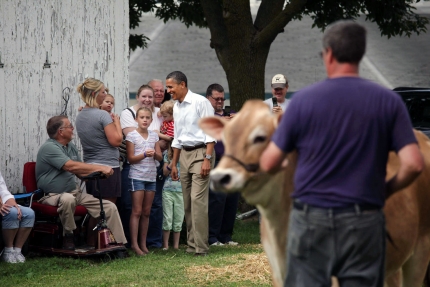
The final day of President Obama's bus tour across America's heartland was jam packed with meetings and spontaneous stops to enjoy the local landscape. On his way to a town hall in Atkinson, Illinois to talk about strengthening the economy, the President pulled in to the Whiteside County Fair and checked out the dairy cow judging.

President Barack Obama stops by the Whiteside County Fair in Morrison, Ill.

President Barack Obama talks with people watching the dairy cow judging during a stop at the Whiteside County Fair in Morrison, Ill., , Aug. 17, 2011. (Official White House Photo by Samantha Appleton)

During the town hall, President Obama discussed how inspiring the conversations he's having with Americans have been:

Now, what’s been striking as I’ve been traveling through over the last few days -- you guys, you’re all fulfilling your responsibilities.  You’re working hard, you’re looking after your families, you’re volunteering at church, you’re coaching Little League -- you’re doing everything right.  And all you’re asking for, if I’m not mistaken, is that your political representatives take their responsibilities just as seriously. 

And part of that means that you have to put politics aside sometimes to do what’s right for the country.  People have been asking me, well, why didn’t you call Congress back after this whole debt ceiling thing?  Why’d you let them leave town?  I say, well, I don’t think it would be good for business confidence and certainty just to see members of Congress arguing all over again.  I figured it was time for them to spend a little time back in their districts, hear your frustrations, hear your expectations. 

As I’ve been driving on this bus, just seeing all those flags on the way in, seeing folks waving, little kids ready to go back to school, and grandparents in their lawn chairs, and folks out in front of the machine shop and out in front of the fire stations -- you go through small towns all throughout America, and it reminds you how strong we are and how resilient we are and how decent we are.  And that should be reflected in our politics; that should be reflected in our government. 

Related Topics: Economy, Rural, Illinois

The White House

Office of the Press Secretary

Remarks by the President in a Town Hall Meeting in Atkinson, Illinois

Wyffels Hybrids Production Facility, Atkinson, Illinois

12:02 P.M. CDT

        THE PRESIDENT:  Hello, Atkinson!  (Applause.)  Thank you.  Thank you, everybody.  Thank you so much.  Thank you.  Everybody have a seat.

        It is good to be back -- back home.  (Applause.)  It is good to be back in Atkinson, good to be back in Henry County.  I just came from the Whiteside County Fair.  (Applause.)  Got some Whiteside folks here.  Spent some time with some cows.  (Laughter.)

        I want to acknowledge a few people who are with us today -- wonderful, wonderful folks.  First of all, our Secretary of Transportation, Peoria’s own Ray LaHood is in the house.  (Applause.)  Our outstanding Secretary of Agriculture Tom Vilsack is here.  (Applause.)  Mayor Gus Junior is in the house.  (Applause.)  I told Gus that I didn’t have any gray hair either when I took office.  (Laughter.)  So I just want you to know what you have ahead in store for you right here.  (Laughter.)  But everybody tells me he’s doing a great job.

        I want to thank the Waffles family for -- (laughter) -- Wyffels, rather, excuse me.  I haven’t had lunch.  (Laughter.)  I want to thank -- I want to thank the Wyffels family for hosting us here today.  Please give them a big round of applause.  (Applause.)  

        I want to thank Lisa of Lisa’s Place.  Where’s Lisa?  (Applause.)  Is that Lisa?  Because Secret Service had to shut down the road and do all this stuff, I know some of you guys have not been able to enjoy her outstanding food.  So as a consequence, my staff has been I think trying to eat up as much as possible.  (Laughter.)  My understanding is I’ve got a pie coming.  Is that correct?  (Applause.)  What kind of pie?  Coconut cream and a cinnamon roll?  (Applause.)  I’m very excited about that.  (Laughter.)  Coconut cream is one of my favorite pies.  So thank you.

        And we also have here -- Congressman Bobby Schilling is here.  (Applause.)  

        Now, it is absolutely terrific to be back home.  And I just want to first of all say to so many of you -- I had a chance when I was still running for the United States Senate, and a lot of people did not know my name -- this young lady, she’s still got -- she’s got, like, a picture from the -- I will sign it, of course I will.  (Applause.)  

        And so as we’ve been traveling through the back roads of Iowa and now Illinois, it is such a reminder of why I decided to get involved in public service in the first place.  

        We’ve obviously been going through a tough time over these last two and a half years.  And we went through the worst recession since the Great Depression.  We saw 8 million jobs lost, 4 million before I took office, and then another 4 million the first few months of 2009.  A lot of small businesses got hit.

        And so I think a lot of times there have been folks who said -- who wonder whether our best days are still ahead of us or are they behind us.   But I will tell you, when I travel through downstate Illinois, when I travel through Iowa, when I travel through the Midwest, I am absolutely confident about this country.  And the reason is because of you.  The reason is because of the American people, because, as tough of a time as we’ve had, there is not a country on Earth that would not readily change places with us right now.  (Applause.)  

        We’ve still got the best workers in the world.  We’ve got the best entrepreneurs in the world.  We’ve got the best scientists, the best universities.  We have so much going for us, and you see it at a company like this one.  I was talking to the Wyffel brothers and they were telling me that they’re now expanding; they’ve hired some new folks, they’re starting to go into new markets around this region.

        So we’ve got so much going for us.  There’s nothing wrong with our country right now.  There is something wrong with our politics.  There is something wrong with our politics.  (Applause.)

        When you look at this debacle we had with the debt ceiling and raising it, what you realize is, is that our politics -- engaging in partisan brinksmanship and potentially seeing the first default of the United States of America -- that that has no place in how we move forward together.  When this country is operating off a common ground, nobody can stop us.  But when we’re divided, then we end up having a whole lot of self-inflicted problems.

        Now, the fact of the matter is, is the economy has gotten better than it was when I first took office.  I mean, we’ve seen over the last 17 months 2 million -- over 2 million private sector jobs created.  But everybody here knows we’ve still got a long way to go, and it is urgent for us to make sure that we are joining together and not thinking about party first, not thinking about elections first, but thinking about country first.  That’s the message that we need to send to Washington.  (Applause.)

        There are some things that we could be doing right now to put our neighbors and our friends, some family members back to work.  And over the last not just two days but over the last several weeks, I’ve been talking about some additional things we need to do.  There is no reason why we should not extend a payroll tax cut that put $1,000 into the pockets of every single family out there.  That means they’ve got more money to spend, that means businesses have more customers, that means the economy grows and more people get hired.  And we could renew it right now to give businesses certainty that they’re going to have customers, not just this year but next year as well.

        The only thing holding us back is our politics.  It’s traditionally a bipartisan idea; there’s no reason why we shouldn’t pass it.  There’s no reason why we shouldn’t put Americans back to work all across the country rebuilding America.  As I was driving in here -- (applause) -- as I was driving in here, I saw that a new fire station is being built, right -- (applause) -- thanks to the Recovery Act.  Well, we need roads and bridges and schools all across the country that could be rebuilt.  And all those folks who got laid off from construction because the economy went south or the housing bubble burst, they’re dying for work.  Contractors are willing to come in under budget and on time.

        And interest rates are low, so we could finance right now the rebuilding of infrastructure all across America that drove not only unemployment in the construction industry down, but drove unemployment down across the board.  And traditionally that hasn’t been a Democratic or a Republic issue.  That’s been an American issue.  We’ve taken pride in rebuilding America.

        The only thing that’s holding us back right now is our politics.  We should be passing trade deals right now because, look, the Koreans, they can sell Kias and Hyundais here in the United States; I think that’s great.  I want to be selling Fords and Chryslers and Chevys in Korea.  (Applause.)  And I want products all across the world stamped with three words:  “Made in America.”  That’s something that we could be doing right now.  (Applause.)

        There’s a bill pending in Congress right now that’s called the America Invents bill.  It basically says entrepreneurs who are coming up with good ideas -- let’s say if the Wyffel brothers came up with a new strain and they wanted to patent it in some way, make it easier for them so that they can market it and make money off it and hire people for it.

        We could do that right now.  The only thing that’s holding us back is our politics.  Look, over the last six months, even though the economy has been growing, even though the economy has been recovering, it has not recovered as fast as it could.  

        And some of those things are not in our control.  We couldn’t control the tsunami in Japan that disrupted supply chains.  We could not control what happened in the Middle East that drove up gas prices.  We don’t have complete control over what happens in Europe with their problems.  And all those things have affected our economy, but there are so many things that we’ve got control over right now that we could be doing to put people back to work.

        And by the way, there’s no reason to think that putting people back to work is somehow in conflict with us getting our fiscal house in order.  You know, this downgrade that happened, they didn’t downgrade us because America couldn’t pay its bills.  They downgraded it because they felt that our political system couldn’t seem to make good decisions in order to deal with our budget the same way families deal with their budgets.  

        And so, the fact of the matter is, is that we came close to a grand bargain, which would have said, we’re going to cut spending we don’t need in order to pay for the things we do.  We’re going to eliminate unnecessary programs so we can pay for student loans, so they can go to the University of Illinois or University of Iowa.  (Applause.)  We know that we’ve got to invest in basic research; that’s part of what made us the most productive agricultural powerhouse in the world.  (Applause.)  So we don’t want to cut back agricultural research in order to pay for it; we got to get rid of some things.

        But what we’ve also said is we’ve got to do it in a balanced way.  We’ve got to do it in a balanced way.  A couple days ago, Warren Buffett wrote a op-ed piece in which he said, “It’s time to stop coddling billionaires.”  (Applause.)  And he pointed out that he pays a lower tax rate than anybody in his office, including his secretary.  That doesn’t make any sense.  (Applause.)  

        If everybody took an attitude of shared sacrifice, that we’re not going to put the burden on any single person, we can solve our deficit and debt problem next week.  And it wouldn’t require radical changes, but it does have to be balanced.  I don’t want a tax break, as lucky as I’ve been, if that tax break means that a senior citizen is going to have to pay an extra $6,000 for their Medicare.  That’s not fair.  

        I think it makes sense before we ask that student to pay a little more for their student loan, we should ask those oil and gas companies to get rid of some corporate tax loophole that they don’t need because they’ve been making record profits.  (Applause.)  

        A lot of this is common sense.  I was saying -- I was at a town hall in a Minnesota -- I pointed out, you know, when -- there have been times in my life -- Michelle and I, things were a little tight, when we were just starting a family and had all these new expenses, and we had to make some choices.  We didn’t say to ourselves, well, we’re not going to put any money into the college fund so we can keep on eating fancy dinners anytime we want.  We didn’t say to ourselves -- I didn’t say to Michelle, honey, you got to stop buying clothes but I’m going to keep my gold clubs.  (Laughter.)  What we said was, well, let’s figure out what are the things that are going to be important to our family to make sure it succeeds not just now but in the long term; let’s invest in those things and let’s stop investing in the things that don’t work.  And the same approach has to be taken for the American family.

        Now, what’s been striking as I’ve been traveling through over the last few days -- you guys, you’re all fulfilling your responsibilities.  You’re working hard, you’re looking after your families, you’re volunteering at church, you’re coaching Little League -- you’re doing everything right.  And all you’re asking for, if I’m not mistaken, is that your political representatives take their responsibilities just as seriously.  (Applause.)  

        And part of that means that you have to put politics aside sometimes to do what’s right for the country.  People have been asking me, well, why didn’t you call Congress back after this whole debt ceiling thing?  Why’d you let them leave town?  I say, well, I don’t think it would be good for business confidence and certainty just to see members of Congress arguing all over again.  I figured it was time for them to spend a little time back in their districts, hear your frustrations, hear your expectations.  

        As I’ve been driving on this bus, just seeing all those flags on the way in, seeing folks waving, little kids ready to go back to school, and grandparents in their lawn chairs, and folks out in front of the machine shop and out in front of the fire stations -- you go through small towns all throughout America, and it reminds you how strong we are and how resilient we are and how decent we are.  And that should be reflected in our politics; that should be reflected in our government.  (Applause.)  

        And that’s why I’m enlisting you -- that’s why I’ve got to enlist you in this fight we have for our future.  I need you to send a message.  I need you to send a message to folks in Washington:  Stop drawing lines in the sand; stop engaging in rhetoric instead of actually getting things done.  It’s time to put country ahead of party; it’s time to worry more about the next generation than the next election.  (Applause.)  If we do that, I guarantee you nobody can stop us, Atkinson.  Nobody can stop the United States of America.  

        God bless you.  Thank you.  (Applause.)

        So what I want to do is -- now, I just want to take some questions.  And it’s not very formal -- you just raise your hand.  We got folks with microphones.  I’m going to go boy, girl, boy, girl, so it’s fair.  (Laughter.)  And I’m going to try to get in as many questions as I can.  So do stand up and introduce yourself, though.  I want to know who I’m talking to.

        All right?  I’ll start with this gentleman right here since he’s right next to the mic.

        Q    Is it on?  
                            
        THE PRESIDENT:  Yes, there you go.

        Q    Rod Catchdig (ph).  Welcome to Atkinson, Mr. President.

        THE PRESIDENT:  Thank you, sir.

        Q    I farm north of here.  We enjoy growing corn and soybeans, and we feel we do it as safely and efficiently as we possibly can.  And Mother Nature has really challenged us this growing season -- moisture, drought, whatever.  Please don’t challenge us with more rules and regulations from Washington, D.C., that hinder us from doing that.  We would prefer to start our day in a tractor cab or combine cab rather than filling out forms and permits to do what we’d like to do.  (Applause.)

        THE PRESIDENT:  Well, we’ve got the Secretary of Agriculture right now, so is there a particular -- is there a particular rule that you’re worried about?

        Q    We hear what’s coming down about noise pollution, dust pollution, water runoff.  Sometimes the best approach is just common sense, and we are already using that.

        THE PRESIDENT:  Yes.  Here’s what I’d suggest is, the -- if you hear something is happening, but it hasn’t happened, don’t always believe what you hear.  (Laughter and applause.)  No -- and I’m serious about that.  Because a lot of times, what will happen is the folks in Washington -- there may be some staff person somewhere that wrote some article or said maybe we should look into something.  And I’m being perfectly honest, the lobbyists and the associations in Washington, they’ll get all ginned up and they’ll start sending out notices to everybody saying, look what’s coming down the pike.  And a lot of times we are going to be applying common sense.  And if somebody has an idea -- if we don’t think it’s a good idea, if we don’t think that there’s more benefit than cost to it, we’re not going to do it.

        And so, I want to make sure that everybody gets accurate information.  If you ever have a question as to whether we’re putting something in place that’s going to make it harder for you to farm, contact USDA.  Talk to them directly.  Find out what it is that you’re concerned about.  My suspicion is a lot of times they’re going to be able to answer your questions and it will turn out that some of your fears are unfounded.  

        But nobody is more interested in seeing our agricultural sector successful than I am, partly because I come from a farm state.  And I spent a lot of time thinking about downstate issues as a United States senator.  And I’m very proud of the track record that we’ve developed.  If you look at what’s been happening in terms of agricultural exports -- what’s been happening in terms of agricultural income during the time that I’ve been President of the United States -- I think we’ve got a great story to tell.  And I want to continue to work with you and other farmers to make sure that we’re doing it in the right way that’s not inhibiting you from being successful.

        Q    Thank you.  We appreciate that.  

        THE PRESIDENT:  Appreciate you, sir.  (Applause.)  Young lady right back there with the glasses on.  There she is.  

        Q    Welcome, Mr. President, to Henry County.  My name is Luanne Levine (ph), and I own a local real estate company here in Henry County, over in Geneseo.  So you know we’re I’m headed:   housing.  Every week I sit around the kitchen table of families that are here today and I listen to the stories of a lost job, upside down in their house.  And they ask, Luanne, how can you help?  What programs are out there?

        I have to say I saw a turnaround come May and June.  My phone was ringing.  I was busier than all get-out.  I could see that the country -- yes, we are in rehab.  People have made adjustments and I saw progress.  

        Since the debt ceiling fiasco in Washington, the phones have stopped.  We have no consumer confidence after what has just happened.  Interest rates are a record low.  I should be out working 14 hours a day, and I am not.  What are your future plans in helping middle-class America -- Generation X and Y and middle-class America will get the country out of where we are, and I want to know what are your contingent plans?       

        THE PRESIDENT:  Well, first of all, you’re absolutely right that housing has been at the key -- at the core of a lot of the hardships we’ve been going through over the last two and a half years.  And that’s why we’ve made it such a priority to try to help families stay in their homes the last two and a half years.  And that’s why we’ve made it such a priority to try to help families stay in their homes if they can still afford the home.  There were some folks who couldn’t -- who bought homes they couldn’t afford, but there were a lot of folks who just had a run of bad luck because somebody lost a job or lost a shift.  And so what we’ve been trying to do is push the banks, push the servicers to do loan modifications that will allow people to stay in their homes and will try to buck up housing prices generally.

        Q    Can I -- Can I please say --

        THE PRESIDENT:  Sure, go ahead.

        Q    -- the loan modification system has been a nightmare.  Short sales are a nightmare.  And the lenders are so tight and you have to be so perfect, and it’s not a perfect world.

        THE PRESIDENT:  Well, what we’ve been trying to do is make sure that -- we’ve probably had a couple of million loan modifications that have been taking place.  The problem is, is that the housing market is so big.  And so a lot of families have just had to work down their debts, and they’ve been successful -- and as you said, we were starting to see things bottom out and confidence start picking up.

        Now, I can’t excuse the self-inflicted wound that was that whole debt debate.  It shouldn’t have happened the way it did.  We shouldn’t have gotten that close to the brink.  It was inexcusable.  But moving forward, I think a lot of this has to do with confidence, as you said.

        Q    A hundred percent.

        THE PRESIDENT:  Companies have never been more profitable.  They’re seeing record profits; it’s just they’re hoarding their cash, they’re not investing it.  A lot of banks have now recovered, but they’re not lending the way they used to.  Now, they need to have slightly tighter lending criteria than they used to have, obviously, because that was part of the reason that we had that housing bubble.  But one of the things we’ve talked about is, can we encourage banks now to take a look at customers who are good credit risks, but are being unfairly punished as a consequence of what happened overall?

        There are some other ideas that we’re looking at on the housing front.  But I’ll be honest with you, when you’ve got many trillions of dollars’ worth of housing stock out there, the federal government is not going to be able to do this all by itself.  It’s going to require consumers and banks and the private sector working alongside government to make sure that we can actually get the housing moving back again.  And it will probably take this year and next year for us to see a slow appreciation again in the housing market.  

        What we can do is make sure we don’t do any damage.  And that’s what happened in this last month.  That’s why I was so frustrated by it, and I suspect that’s why you were so frustrated by it as well.

        Q    Very much.

        THE PRESIDENT:  The last thing I’ll say, though, is if we get the overall economy moving, if we pass this payroll tax cut, if we get some of these tax credits for businesses that we passed back in December extended into next year so that we’re giving incentives for folks to invest in plants and equipment now -- if the overall economy is doing well, that means consumers are doing better; it also means that housing will start doing better as well.

        All right?  Thank you so much for your great question.  (Applause.)

        Q    Thank you.

        THE PRESIDENT:  Gentleman in the glasses, right there.  Yes, sir.

        Q    Hi, Mr. President.  My name is Larry Floriani (ph) and I work at the Rock Island Arsenal.  And thanks a lot for coming to our town.  We’re really happy to have you here so we can talk to you.

        THE PRESIDENT:  You bet.

        Q    Okay, my question is, what do you think the Simpson-Bowles commission contributed to the deficit and debt discussion, and what do you expect will be accomplished by the new super congressional committee?

        THE PRESIDENT:  Well, first of all, let me thank everybody who does work at the arsenal, because you guys are out there and you’ve been saving lives and making sure our troops are well equipped for generations now.  (Applause.)  So thank you.

        The Bowles-Simpson committee, this is a committee that I set up to look at our current fiscal situation to see what could be done.  And it was a bipartisan committee; it was chaired by a well-known Republican, Alan Simpson, former senator, and Erskine Bowles, who used to be the chief of staff for Bill Clinton.  And it had equal numbers of Democrats and Republicans, as well as business sector and private sector leaders.  

        And basically what they recommended was what I’ve been talking about, which is a balanced approach in which we’re making some modifications to what’s called discretionary spending -- that’s the spending we do every year on everything from farm programs to student loan programs to food stamps to you name it -- that we cut defense spending in a sensible way, that we look at how we can make modifications that strengthen Social Security and Medicare for the next generation, and how we raise additional revenue so that we bring the overall budget into a sustainable place.  

        And the truth of the matter is, is that the commission recommendations are ones that not only I, but the so-called Gang of Six, these senators in the United States Senate, agreed to as well.  And that was bipartisan; you had Democrats and Republicans.  

        It was that kind of balanced package that I proposed to Speaker John Boehner that we move forward on.  And, frankly, we came pretty close.  And I’ll tell you, I think Speaker Boehner was prepared to do it.  But he got some resistance in his caucus, because they said, we’re not going to vote for anything that has revenue in it.  

        And so instead of doing this big package that got our debt and our deficit sustainable, what we got was this $1 trillion worth of cuts where we needed $4 trillion to close the deficit and the debt, and we got this commission to come up with another $1.5 trillion.  

        Now, I continue to believe that we need a balanced approach.  So when this committee comes forward, I’m going to be making a presentation that has more deficit reduction than the $1.5 trillion that they have been assigned to obtain.  Because I don’t think it’s good enough for us to just do it partway.  If we’re going to do it, let’s go ahead and fix it.  And if we’re going to fix it, the only way, I believe, to do it in a sensible way is you’ve got to have everything on the table.  You can’t take things off the table.  

        And I’ve been concerned that Speaker Boehner has already said that the folks he assigned, none of them can vote to increase revenues.  That’s a concern of mine.  I was concerned when I saw the Republican presidential candidates -- somebody asked them, well, if you got $10 of spending cuts for every $1 in additional revenue, would you be willing to accept it, and all of them said no.  

        Now, that’s just not common sense.  I can’t imagine that’s how Atkinson runs its operations, right?  I mean, if the mayor had to deal with a situation in which we’re not going to pay for anything -- we’re not going to pay for roads, we’re not going to pay for schools, we’re not going to pay for garbage pickup -- you name it, we’re not going to pay for it -- but we still expect you to provide those services, the mayor would be in a pretty tough spot.  There’s no reason why we would expect the federal government to operate in the same way.

        So the bottom line is this:  I will be presenting, as I’ve already presented -- I did back earlier this year -- a plan that says we’re going to have spending cuts and we’re going to have revenue.  We’ll have more spending cuts than we have revenue, but we’re going to have to take a balanced approach and everything is going to be on the table, including our long-term obligations, because the thing that is driving the deficit, if you look at -- we had a balanced budget back in 2000.  Here’s what happened.  Number one is we decided that we would cut taxes without paying for it.  So we had huge tax cuts in 2001, 2003.  Then we had two wars.  And for the first time in our history, we didn’t pay for our wars.  When our grandparents fought in World War II, the entire country paid for the wars that it fought.  They didn’t pass it onto the next generation, didn’t put it on a credit card.  We were the first generation not to pay for the wars that we fought.  

        And then we had a big prescription drug plan that was added to Medicare, and that wasn’t paid for.  Then the recession hits, which means less money is coming in but more money is going out in terms of helping the unemployed or helping states and local governments not lay off teachers and firefighters and so on.  

        You combine all those things, we’ve got a big debt and a big deficit.  The good news is this is not -- it doesn’t require radical surgery for us to fix it.  It just requires us all taking an approach that says we’re a family and all of us are going to share a little bit in the burden.  And those of us who are most fortunate, we can do a little bit more.  (Applause.)

        And corporations, they can afford to close some loopholes and simplify the tax code to get it done.  All right?  Thank you.  

        All right, this young lady in the pink right here.  Yes.

        Q    Hello.  I’m Jan Lowhouse (ph).  I’m from Tiskilwa, Illinois.  

        THE PRESIDENT:  Good to see you, Jan.

        Q    Thanks.  It’s about 30 miles east of here.  It’s a rural community based on farming.  My question is about jobs.  I think you have done some improvement in jobs, but what can you do without Congress today to make a change in jobs and so we can see a growth in job opportunities?

        THE PRESIDENT:  Well, there are some things that we can do without Congress, and we’re trying to do them.  So, for example, I set up a jobs council made up of a lot of employers, both small businesses but also some of the biggest companies in the world, and asked them what can we be doing to encourage job growth.  And they’ve come up with a series of recommendations, some of which don’t involve Congress at all, and we’re trying to implement them.

        So a while back I announced we’ve got a lot of vets coming back from Afghanistan and Iraq who have incredible experience -- 25-year-olds who were leading platoons into battle; 26-year-olds who were handling $100 million pieces of equipment.  But the problem is, is that we’re not doing as good of a job helping them market the skills and experience and leadership that they have to employers and we’re not linking them to employers who may be able to use their talents.  

        And so we just announced a couple weeks ago a whole new initiative where the Department of Defense is going to have a reverse boot camp.  Just like you train folks to come into the military, you train them going out to figure out how they’re going to get jobs.  (Applause.)  And we got commitments from local -- from employers all across the country to say, we are going to hire veterans.  

        And in some cases, what we want to do is to change certifications, for example -- I’ll give you a good example.  I had lunch with a group of veterans in Minnesota a couple days ago.  One was an emergency medic who had been in theater.  And you can imagine what that must be like.  

        And he had come back -- he wanted to be a nurse.  He was having to take the whole nursing program from scratch.  And here he had been dealing with young men and young women in uniform who had had the worst kinds of medical emergency.  He’s patching them up under the most extraordinary strain.  He’s having to go back as if he’d never been in the medical field at all.  Well, that’s a waste of money.  That doesn’t make sense.

        So those are examples of things that we can do administratively.  The other thing -- this gentleman here asked me about regulations.  Well, one of the things we’re doing is we’re saying, show us particular regulations that may be getting in the way of you hiring.  And there are going to be some that are important.  We want clean air.  We want clean water.  But if there’s a bunch of bureaucratic red tape and it’s not actually improving the situation, let’s figure out how to get rid of some existing rules and let’s review every rule that comes in for its cost and its benefits.  Again, that’s something that we can do administratively.  

        So there are some things that we can help on.  But, frankly, we could do a lot more if we got Congress’s cooperation.  And every proposal that I talked about previously, those are proposals that historically have had support from Republicans and Democrats.  These aren’t radical ideas.  I mean, building roads, when did that become a partisan issue, putting folks back to work?  (Applause.)  Eisenhower built the Interstate Highway System -- Dwight Eisenhower built the Interstate Highway System; last time I checked, he was a very popular Republican.

        But this is what I mean about politics getting in the way sometimes.  You can’t bring an attitude that says, I’d rather see my opponent lose than America win.  You can’t have that attitude.  (Applause.)

        This gentleman right here with the goatee there.  There you go.  Mic’s right there.

        Q    Thank you Mr. President.  My name is Justin Hubbs (ph).  My question was just about revenue.  I see a lot of the Republican presidential nominees signing pledges not to raise taxes.  I was wondering if you could make a pledge that any deal will have a revenue increase.

        THE PRESIDENT:  Well, here’s -- it’s just math.  If you have a deal that does not have revenue in it and you still want to close the deficit by, say, $4 trillion, which is what the experts say is required in order to stabilize our debt and our deficit -- and this is over a 10-year period -- if you have no revenue, then the only way to do that is you’ve got to drastically cut things like Medicare.  You have to -- there’s no two ways about it.  You’ve got to drastically cut Medicare; you’ve got to drastically cut Medicaid; you’ve got to cut back on education support in significant ways that affect schoolkids right here in Atkinson and all across the country.

        So since I’m in Wyffels Hybrids, it’s like eating your seed corn.  You are cutting back on the things that are going to help you grow and help this country succeed over the long term.  It’s just not a smart thing to do.  It’s not how you would run your own family business.  And so I think it’s also important to understand that we can raise the kind of revenues we’re talking about without having an impact on middle-class families who are already struggling and haven’t seen their wages and their incomes go up in over a decade now.  It can be done.  (Applause.)  The tax code is full of loopholes.  Close those loopholes.  (Applause.)  

        When it comes to the corporate tax rate, we could actually lower the overall corporate tax rate, which would make us more competitive, if we closed up a whole bunch of these loopholes that special interests and lobbyists have been able to get into the tax code.  It might put some lawyers out of business -- (applause) -- but it would be the right thing to do.

        And when it comes to upper-income folks -- I talked about Warren Buffett -- but the truth is -- I’ll just give you one example.  The reason Warren Buffett’s taxes are so low is because he typically gets his income from capital gains.  Capital gains are taxed at 15 percent.  Now, your income taxes, you’re not being taxed at 15 percent, most of you.  And as a consequence, these days the richer you are the lower your tax rate.  Now, that can’t be something that is defensible regardless of party.  I don’t care whether you’re a Democrat or Republican, an independent.  That can’t be the way it is.  (Applause.)

        One last point I want to make, though, about these pledges -- I take an oath.  My pledge is to make sure that every day I’m waking up looking out for you, for the American people.  (Applause.)  And so I don’t go around signing -- I don’t go around signing pledges because I want to make sure that every single day, whatever it is that’s going to be best for the American people, that’s what I’m focused on, that’s what I’m committed to.  And that’s how I think every representative in Congress should be thinking, not about some pledge that they signed for some special interest group or some lobbyist or some association somewhere.  They should be waking up thinking what’s best for the country.  (Applause.)

        All right.  This young lady has been very patient right here.  Yes, you.

        Q    Hi, I’m Kelly Wyffels -- relation to Bob and Bill -- and I’m a student at Western Illinois University.

        THE PRESIDENT:  What are you studying?

        Q    I’m a supply chain management major and a French major.  And I’m wondering what you think is one of the best majors to major in, in order to get a job.  Our professor seems to think that supply chain you get -- there’s a lot of job opportunities out there, but I wonder what other majors you think that are good for students to study.

        THE PRESIDENT:  Well, first of all, I can tell you’re going to be good, whatever you do.  (Laughter and applause.)  So when you finish, you let me know.  We’ll talk to LaHood or Vilsack and we may hire you -- because you seem very impressive.

        Look, the -- you’re already ahead of the curve because what you understand is that the economy is changing, and the days when just because you’re willing to work hard, you could automatically find a job -- those days are over.  The truth of the matter is, is that everything requires an education.  I don’t have to tell the farmers here.  You guys are looking at GPS and have all kinds of equipment; you’re studying markets around the world.  And it is a complicated piece of business that you’re engaged in.  It’s not just a matter of going out with a plow in a field.  

        And that’s happened to every industry.  When I go into factories these days, what’s amazing is how clean and how quiet they are, because what used to take 1,000 folks to do now only takes 100 folks to do.  And one of the challenges in terms of rebuilding our economy is businesses have gotten so efficient that -- when was the last time somebody went to a bank teller instead of using the ATM, or used a travel agent instead of just going online?  A lot of jobs that used to be out there requiring people now have become automated.  And that means us investing in our kids’ education -- nothing’s more important.  Nothing is more important.  (Applause.)

        Now -- but you’re also asking a good question, which is, don’t just go to college without having some idea about what interests you.  Now, this supply chain management I think is a great field, because the world is shrinking and products from Atkinson end up on a dinner table in China somewhere, and that means that people who understand how to move products and services and people in efficient ways, there’s going to be high demand for them.  So I don’t think your professor is just trying to keep you in class; I think he actually is onto something here.

        One of the things I’m worried about and we’re trying to put a lot of emphasis on in the Department of Education is, can we do more to encourage math, science, engineering, technology learning -- (applause) -- because I can guarantee you, if you are a skilled engineer, if you are a skilled computer scientist, if you’ve got strong math skills and technical skills, you are going to be very employable in today’s economy.  And that has to start even before young people get to college.  So we’re trying to institute a whole -- what’s called a STEM program -- science, technology, engineering and math -- in the lower schools so that kids start getting oriented towards those fields.  That’s where we traditionally have had a comparative advantage, but we’re losing ground to China and India and places like that where those kids are just focused on those subjects.  And we need more of those, so you keep on studying the supply chain management.  

        I will tell you, though, just in case there are any French teachers here or foreign language teachers, having a foreign language, that’s important, too.  That makes you so much more employable -- (applause) -- because if you go to a company and they’re doing business in France or Belgium or Switzerland or Europe somewhere, and they find out you’ve got that language skill, that’s going to be important as well.  And we don’t do that as much as we should; we don’t emphasize that as much as we should here in the United States.  So congratulations -- proud of you.  (Applause.)

        Q    Thanks.

        THE PRESIDENT:  All right.  A couple more?  It’s a guy’s turn, isn’t it?  Well, I’m going to -- I’ve got to call on this guy right here.  What’s your name, young man?

        Q    My name is Alex McAvoy (ph).  

        THE PRESIDENT:  Alex, how old are you?

        Q    I’m 10 -- I’m 11, sorry.  (Laughter.)

        THE PRESIDENT:  Eleven -- you just -- did you just have a
        birthday?

        Q    Yes, yesterday.  

        THE PRESIDENT:  Yesterday was your birthday?

        Q    Yes.

        THE PRESIDENT:  Happy birthday.  (Applause.)

        Q    Thank you, Mr. President.

        THE PRESIDENT:  Give Alex a big round of applause.
        (Applause.)  He made 11.  

        Q    My grandpa is a farmer, and he owns -- well, yes, he
        owns part of the local ethanol plant.  I was wondering, what are you going to do to keep the ethanol plant running?

        THE PRESIDENT:  Well, that is a great question.  Where is
        your grandpa, is he close by?

        Q    He lives in Geneseo.

        THE PRESIDENT:  Oh, okay.  He lives up there.  Well, you’re an excellent representative for your grandfather, I must say.  (Laughter and applause.)  We might have to hire you, too.  (Laughter.)  I think those of you know that when I was a state senator, when I was a United States senator, I was a strong supporter of biofuels.  I continue to be a strong supporter of biofuels.  Tom Vilsack, as our Agriculture Secretary, continues to be a strong supporter of ethanol and biofuels.

        I will say that the more we see the science, the more we want to find ways to diversify our biofuels so that we’re not just reliant on corn-based ethanol.  Now, we can do more to make corn-based ethanol more efficient than it is, and that’s where the research comes in.  And there are some wonderful research facilities in our own University of Illinois system that have done a lot to advance the science on this.  

        But the key going forward is going to be, can we create biofuels out of switchgrass and wood chips and other materials that right now are considered waste materials?  And part of the reason that’s important is because, as I think most farmers here know, particularly if you’re in livestock farming, right now the costs of feed keep on going up and the costs of food as a consequence are also going up.  Only about 4 percent of that is accounted for by corn being diverted into ethanol, but as you see more and more demand placed on our food supplies around the world -- as folks in China and folks in India start wanting to eat more meat and commodity prices start going up, it’s going to be important for us to figure out how can we make biofuels out of things that don’t involve our food chain.

        And so hopefully your grandfather, with his ethanol plant, is starting to work with our Department of Agriculture to find new approaches to the biofuel industry.  But this is a huge area of support.  This is another example of where we’ve got to make sure that our budget continues to invest in basic research, and that costs money.  And if all we’re doing is cutting and we’re not thinking about investments, then over time we’re going to fall behind to countries like Brazil, where they’ve already got a third, I think, of their auto fleet operates on biofuels.  Well, that’s -- there’s no reason why we should fall behind a country like Brazil when it comes to developing alternative energy.  I want to be number one in alternative energy, and that’s good for the farm economy.  (Applause.)

        Yes, sir.  Hold on right here.

        Q    Thank you, Mr. President, for being the President and I also -- (applause) --

        THE PRESIDENT:  Thanks.

        Q    And I want to go home and maybe ask my mother to cook me a good meal so I could tell her that I lobbied you.  She’s a senior citizen.  What’s the likelihood of her Social Security getting the cost of living next year?

        THE PRESIDENT:  Well, let me talk to you about Social Security.  It is very likely that she will see a COLA, a cost-of-living increase next year, because inflation actually rose this year.  The reason that there were a couple of years where she did not get a cost-of-living increase was because even though she probably felt like the cost of food and gas and groceries were going up, the overall inflation index actually did not go up.  There was a period there where we actually had what’s called deflation, where the costs were a little bit lower than they had been comparable to the previous year.

        So all that is done automatically.  It’s not something that I make a decision about each year.  And I promise you when folks don’t get their COLA, they all write to me and say, Mr. President, why -- you didn’t give us a cost of living, and don’t you care about senior citizens.  And I have to write back and explain to them, no, that’s not something I did.  These things just happen automatically based on estimates of what inflation is going to be.

        While we’re on the topic of Social Security, though, I want to make sure everybody understands Social Security is not in crisis.  We have a problem with Medicare and Medicaid because health care costs are going up so fast.  Part of the reason we passed health care reform was to make sure that we could start changing how the health care system operates and try to reduce health care inflation.  

        But we have a genuine problem on Medicare and Medicaid:  Health care costs are going up, but at the same time, there’s a lot more folks who are entering into the system.  And if we don’t do anything about Medicare or Medicaid, it will gobble up our entire budget.  

        Social Security is in a better position.  And so when I hear folks say, is Social Security going to be there for me 20 years from now -- yes, it will be there for you 20 years from now.  It should be there for you 30 or 40 years from now.  And the adjustments that we have to make on Social Security are relatively modest.  They’re the kind of changes that Ronald Reagan and Tip O’Neill agreed to back in 1983 that created long-term solvency of the system.  We can have Social Security solvent for another 75 years with just a few modest changes.

        So when your grandmother -- tell her it wasn’t me who didn’t give her her COLA the last couple years.  In fact, we tried to pass through Congress a $250 supplement because we knew seniors were having a tough time.  We couldn’t get it passed through Congress.  But they should get some modest increase next year.  Okay?  (Applause.)

        All right.  I think I’ve got time for a couple more questions.  One more?  Oh, this is always a tough one, this last one.  I’m going to call on -- I’ll just call on you.  You’re right there in front of me and the mics are already there.  What’s your name?

        Q    Hi, my name is Pam Dennis (ph).  I actually work for the Community Action Agency that serves Henry County.  I also serve on the Henry County FEMA board.  And I understand that drastic cuts need to be made in order to balance our budget.  But with the last couple years being so difficult for jobs, why are budget cuts to programs that are helping these people keep their heads above water?  I’m referring to the LIHEAP program, Community Service and Experience Works -- those type of programs that are helping people keep their heads above water.  Why couldn’t we cut somewhere else and leave those alone for now, or at least fewer -- lessen cuts?

        THE PRESIDENT:  Yes, well, first of all, I think it’s important to understand if we take a balanced approach we don’t need drastic cuts.  The Low Income Housing Assistance Program, just to take one example, what we’ve done is we’ve said -- we have modestly reduced it, but partly because we had increased it significantly right when the recession hit, and it turned out that we didn’t need as much budgeted as was actually used.  And obviously it varies depending on the weather any given winter.  But what we’ve tried to do is actually keep the bulk of that program in place, and folks will get help in the winter if they can’t afford to buy home heating oil.  That’s not going away.

        The general principle you’re talking about is right, though.  We should not cut those things that help the folks who are most vulnerable if we can find other places to cut for folks that would be nice to have but we don’t need.  (Applause.)  I agree with that general principle.

        When Congress gets back in September, my basic argument to them is this:  We should not have to choose between getting our fiscal house in order and jobs and growth.  We can’t afford to do just one or the other.  We got to do both.  And by the way, the best thing we can do for our deficit and debt is grow the economy -- (applause) -- because when the economy is growing, more money in people’s pockets, they pay more in taxes, and there’s more revenue and fewer people are on unemployment.  And that helps to reduce the strains on our budget.

        So we’ve got to do both.  And essentially, the best way for us to do this is to look at some of our long-term obligations and costs, figure out long-term savings that are gradually phased in so they don’t hit too hard right now.  In the short term, there should be some things that we do that are paid for by some of these long-term savings in order to get the economy rolling and get the economy moving.

        And some of the programs you mentioned I think are ones that, in a wealthy and decent society like ours, we should be able to help people make sure that they’re not freezing during the winter.  I mean, that’s just I think a basic obligation we have to our fellow Americans.  (Applause.)

        Q    Some of those programs are dependent upon the unemployment rate.  My question is, with the unemployment rate, you’re only counting the people who are actually on unemployment.  It’s not counting the people who worked a temporary job that was not eligible for unemployment or the people who were on unemployment and now that unemployment has ran out.  So those people are not being counted.  

        So that affects specifically the FEMA funding that our Henry County gets.  Henry County is not eligible for the FEMA money.  They get the set-aside.  And this year, because of the unemployment rate, we were not even able to get those set-aside funds.  So I think that’s kind of a skewed number by using the unemployment rate.

        THE PRESIDENT:  Well, here’s the basic principle:  With the economy not growing as fast as we want it to, the need is going to outstrip our resources.  There’s always going to be more need out there relative to the amount of money that the federal government can spend.  

        But I guess the main argument I’m making to you is that don’t think that our choice is we’ve either got to stop our obligations to the most vulnerable or to our seniors or to our kids, or otherwise the budget is just going to go sky high -- or the deficit and debt are going to go sky high.  We can do both in a sensible way.

        And I will be presenting before this joint committee a very detailed, specific approach to this problem that allows us to grow jobs right now, provide folks who need help the help they need, and still gets our deficit and debt under control.  

        We do also have to look at some programs, because they may not be well designed, as well designed as they could be.  I’ll give you an example.  Unemployment insurance, the way it’s designed -- it was designed back at a time when you’d have layoffs and then people would hire you back when the business cycle went back.  

        The economy is changing so fast right now, people are having to re-train; companies move to an entirely different state.  We’ve got to rethink how we do unemployment insurance.  There is a smart program in Georgia.  What they do is they say, all right, instead of you just getting unemployment insurance, just a check, what we’re going to do is we will give a subsidy to any company that hires you with your unemployment insurance so that you’re essentially earning a salary and getting your foot in the door into that company.  And if they hire you full-time, then the unemployment insurance is used to subsidize you getting trained and getting a job.  (Applause.)  And so those kinds of adjustments to programs -- we’ve got to be more creative in terms of not doing things the way we’ve always done them.  

        But let me just close by saying this, Atkinson.  First of all, it is good to be back.  I’m grateful to all of you for your extraordinary welcome and hospitality.  Don’t bet against America.  Don’t bet against our workers.  Don’t bet against our businesses.  (Applause.)

        We have gone through tougher times than this before, and we’ve always come out on top.  As long as we pull together and as long as American know-how and ingenuity is promoted, there’s no reason why we’re not going to get this tough time just like we have before.  And America is going to emerge stronger, more unified, more successful than it was in the past.  

        In order for that to happen, though, I’m going to need your help.  I need your voices out there, talking to folks from both parties and telling them we expect you to show some cooperation; stop thinking about politics for a little bit; try to make sure that we’re moving our country forward.  

        And if you’re delivering that message, it’s a lot stronger than me delivering that message, because you’re the folks ultimately that put those members of Congress into office.

        All right?  Thank you, everybody.  God bless you.  God bless America.  (Applause.)

END 1:06 P.M. CDT

Rural Tour Day 3: Atkinson, Ill Town Hall

August 17, 2011 | 1:03:16 | Public Domain

President Obama talks about the economy at a factory in his home state.

Download mp4 (604MB) | mp3 (58MB)

Read the Transcript

Remarks by the President in a Town Hall Meeting in Atkinson, Illinois

12:02 P.M. CDT

        THE PRESIDENT:  Hello, Atkinson!  (Applause.)  Thank you.  Thank you, everybody.  Thank you so much.  Thank you.  Everybody have a seat.

        It is good to be back -- back home.  (Applause.)  It is good to be back in Atkinson, good to be back in Henry County.  I just came from the Whiteside County Fair.  (Applause.)  Got some Whiteside folks here.  Spent some time with some cows.  (Laughter.)

        I want to acknowledge a few people who are with us today -- wonderful, wonderful folks.  First of all, our Secretary of Transportation, Peoria’s own Ray LaHood is in the house.  (Applause.)  Our outstanding Secretary of Agriculture Tom Vilsack is here.  (Applause.)  Mayor Gus Junior is in the house.  (Applause.)  I told Gus that I didn’t have any gray hair either when I took office.  (Laughter.)  So I just want you to know what you have ahead in store for you right here.  (Laughter.)  But everybody tells me he’s doing a great job.

        I want to thank the Waffles family for -- (laughter) -- Wyffels, rather, excuse me.  I haven’t had lunch.  (Laughter.)  I want to thank -- I want to thank the Wyffels family for hosting us here today.  Please give them a big round of applause.  (Applause.)  

        I want to thank Lisa of Lisa’s Place.  Where’s Lisa?  (Applause.)  Is that Lisa?  Because Secret Service had to shut down the road and do all this stuff, I know some of you guys have not been able to enjoy her outstanding food.  So as a consequence, my staff has been I think trying to eat up as much as possible.  (Laughter.)  My understanding is I’ve got a pie coming.  Is that correct?  (Applause.)  What kind of pie?  Coconut cream and a cinnamon roll?  (Applause.)  I’m very excited about that.  (Laughter.)  Coconut cream is one of my favorite pies.  So thank you.

        And we also have here -- Congressman Bobby Schilling is here.  (Applause.)  

        Now, it is absolutely terrific to be back home.  And I just want to first of all say to so many of you -- I had a chance when I was still running for the United States Senate, and a lot of people did not know my name -- this young lady, she’s still got -- she’s got, like, a picture from the -- I will sign it, of course I will.  (Applause.)  

        And so as we’ve been traveling through the back roads of Iowa and now Illinois, it is such a reminder of why I decided to get involved in public service in the first place.  

        We’ve obviously been going through a tough time over these last two and a half years.  And we went through the worst recession since the Great Depression.  We saw 8 million jobs lost, 4 million before I took office, and then another 4 million the first few months of 2009.  A lot of small businesses got hit.

        And so I think a lot of times there have been folks who said -- who wonder whether our best days are still ahead of us or are they behind us.   But I will tell you, when I travel through downstate Illinois, when I travel through Iowa, when I travel through the Midwest, I am absolutely confident about this country.  And the reason is because of you.  The reason is because of the American people, because, as tough of a time as we’ve had, there is not a country on Earth that would not readily change places with us right now.  (Applause.)  

        We’ve still got the best workers in the world.  We’ve got the best entrepreneurs in the world.  We’ve got the best scientists, the best universities.  We have so much going for us, and you see it at a company like this one.  I was talking to the Wyffel brothers and they were telling me that they’re now expanding; they’ve hired some new folks, they’re starting to go into new markets around this region.

        So we’ve got so much going for us.  There’s nothing wrong with our country right now.  There is something wrong with our politics.  There is something wrong with our politics.  (Applause.)

        When you look at this debacle we had with the debt ceiling and raising it, what you realize is, is that our politics -- engaging in partisan brinksmanship and potentially seeing the first default of the United States of America -- that that has no place in how we move forward together.  When this country is operating off a common ground, nobody can stop us.  But when we’re divided, then we end up having a whole lot of self-inflicted problems.

        Now, the fact of the matter is, is the economy has gotten better than it was when I first took office.  I mean, we’ve seen over the last 17 months 2 million -- over 2 million private sector jobs created.  But everybody here knows we’ve still got a long way to go, and it is urgent for us to make sure that we are joining together and not thinking about party first, not thinking about elections first, but thinking about country first.  That’s the message that we need to send to Washington.  (Applause.)

        There are some things that we could be doing right now to put our neighbors and our friends, some family members back to work.  And over the last not just two days but over the last several weeks, I’ve been talking about some additional things we need to do.  There is no reason why we should not extend a payroll tax cut that put $1,000 into the pockets of every single family out there.  That means they’ve got more money to spend, that means businesses have more customers, that means the economy grows and more people get hired.  And we could renew it right now to give businesses certainty that they’re going to have customers, not just this year but next year as well.

        The only thing holding us back is our politics.  It’s traditionally a bipartisan idea; there’s no reason why we shouldn’t pass it.  There’s no reason why we shouldn’t put Americans back to work all across the country rebuilding America.  As I was driving in here -- (applause) -- as I was driving in here, I saw that a new fire station is being built, right -- (applause) -- thanks to the Recovery Act.  Well, we need roads and bridges and schools all across the country that could be rebuilt.  And all those folks who got laid off from construction because the economy went south or the housing bubble burst, they’re dying for work.  Contractors are willing to come in under budget and on time.

        And interest rates are low, so we could finance right now the rebuilding of infrastructure all across America that drove not only unemployment in the construction industry down, but drove unemployment down across the board.  And traditionally that hasn’t been a Democratic or a Republic issue.  That’s been an American issue.  We’ve taken pride in rebuilding America.

        The only thing that’s holding us back right now is our politics.  We should be passing trade deals right now because, look, the Koreans, they can sell Kias and Hyundais here in the United States; I think that’s great.  I want to be selling Fords and Chryslers and Chevys in Korea.  (Applause.)  And I want products all across the world stamped with three words:  “Made in America.”  That’s something that we could be doing right now.  (Applause.)

        There’s a bill pending in Congress right now that’s called the America Invents bill.  It basically says entrepreneurs who are coming up with good ideas -- let’s say if the Wyffel brothers came up with a new strain and they wanted to patent it in some way, make it easier for them so that they can market it and make money off it and hire people for it.

        We could do that right now.  The only thing that’s holding us back is our politics.  Look, over the last six months, even though the economy has been growing, even though the economy has been recovering, it has not recovered as fast as it could.  

        And some of those things are not in our control.  We couldn’t control the tsunami in Japan that disrupted supply chains.  We could not control what happened in the Middle East that drove up gas prices.  We don’t have complete control over what happens in Europe with their problems.  And all those things have affected our economy, but there are so many things that we’ve got control over right now that we could be doing to put people back to work.

        And by the way, there’s no reason to think that putting people back to work is somehow in conflict with us getting our fiscal house in order.  You know, this downgrade that happened, they didn’t downgrade us because America couldn’t pay its bills.  They downgraded it because they felt that our political system couldn’t seem to make good decisions in order to deal with our budget the same way families deal with their budgets.  

        And so, the fact of the matter is, is that we came close to a grand bargain, which would have said, we’re going to cut spending we don’t need in order to pay for the things we do.  We’re going to eliminate unnecessary programs so we can pay for student loans, so they can go to the University of Illinois or University of Iowa.  (Applause.)  We know that we’ve got to invest in basic research; that’s part of what made us the most productive agricultural powerhouse in the world.  (Applause.)  So we don’t want to cut back agricultural research in order to pay for it; we got to get rid of some things.

        But what we’ve also said is we’ve got to do it in a balanced way.  We’ve got to do it in a balanced way.  A couple days ago, Warren Buffett wrote a op-ed piece in which he said, “It’s time to stop coddling billionaires.”  (Applause.)  And he pointed out that he pays a lower tax rate than anybody in his office, including his secretary.  That doesn’t make any sense.  (Applause.)  

        If everybody took an attitude of shared sacrifice, that we’re not going to put the burden on any single person, we can solve our deficit and debt problem next week.  And it wouldn’t require radical changes, but it does have to be balanced.  I don’t want a tax break, as lucky as I’ve been, if that tax break means that a senior citizen is going to have to pay an extra $6,000 for their Medicare.  That’s not fair.  

        I think it makes sense before we ask that student to pay a little more for their student loan, we should ask those oil and gas companies to get rid of some corporate tax loophole that they don’t need because they’ve been making record profits.  (Applause.)  

        A lot of this is common sense.  I was saying -- I was at a town hall in a Minnesota -- I pointed out, you know, when -- there have been times in my life -- Michelle and I, things were a little tight, when we were just starting a family and had all these new expenses, and we had to make some choices.  We didn’t say to ourselves, well, we’re not going to put any money into the college fund so we can keep on eating fancy dinners anytime we want.  We didn’t say to ourselves -- I didn’t say to Michelle, honey, you got to stop buying clothes but I’m going to keep my gold clubs.  (Laughter.)  What we said was, well, let’s figure out what are the things that are going to be important to our family to make sure it succeeds not just now but in the long term; let’s invest in those things and let’s stop investing in the things that don’t work.  And the same approach has to be taken for the American family.

        Now, what’s been striking as I’ve been traveling through over the last few days -- you guys, you’re all fulfilling your responsibilities.  You’re working hard, you’re looking after your families, you’re volunteering at church, you’re coaching Little League -- you’re doing everything right.  And all you’re asking for, if I’m not mistaken, is that your political representatives take their responsibilities just as seriously.  (Applause.)  

        And part of that means that you have to put politics aside sometimes to do what’s right for the country.  People have been asking me, well, why didn’t you call Congress back after this whole debt ceiling thing?  Why’d you let them leave town?  I say, well, I don’t think it would be good for business confidence and certainty just to see members of Congress arguing all over again.  I figured it was time for them to spend a little time back in their districts, hear your frustrations, hear your expectations.  

        As I’ve been driving on this bus, just seeing all those flags on the way in, seeing folks waving, little kids ready to go back to school, and grandparents in their lawn chairs, and folks out in front of the machine shop and out in front of the fire stations -- you go through small towns all throughout America, and it reminds you how strong we are and how resilient we are and how decent we are.  And that should be reflected in our politics; that should be reflected in our government.  (Applause.)  

        And that’s why I’m enlisting you -- that’s why I’ve got to enlist you in this fight we have for our future.  I need you to send a message.  I need you to send a message to folks in Washington:  Stop drawing lines in the sand; stop engaging in rhetoric instead of actually getting things done.  It’s time to put country ahead of party; it’s time to worry more about the next generation than the next election.  (Applause.)  If we do that, I guarantee you nobody can stop us, Atkinson.  Nobody can stop the United States of America.  

        God bless you.  Thank you.  (Applause.)

        So what I want to do is -- now, I just want to take some questions.  And it’s not very formal -- you just raise your hand.  We got folks with microphones.  I’m going to go boy, girl, boy, girl, so it’s fair.  (Laughter.)  And I’m going to try to get in as many questions as I can.  So do stand up and introduce yourself, though.  I want to know who I’m talking to.

        All right?  I’ll start with this gentleman right here since he’s right next to the mic.

        Q    Is it on?  
                            
        THE PRESIDENT:  Yes, there you go.

        Q    Rod Catchdig (ph).  Welcome to Atkinson, Mr. President.

        THE PRESIDENT:  Thank you, sir.

        Q    I farm north of here.  We enjoy growing corn and soybeans, and we feel we do it as safely and efficiently as we possibly can.  And Mother Nature has really challenged us this growing season -- moisture, drought, whatever.  Please don’t challenge us with more rules and regulations from Washington, D.C., that hinder us from doing that.  We would prefer to start our day in a tractor cab or combine cab rather than filling out forms and permits to do what we’d like to do.  (Applause.)

        THE PRESIDENT:  Well, we’ve got the Secretary of Agriculture right now, so is there a particular -- is there a particular rule that you’re worried about?

        Q    We hear what’s coming down about noise pollution, dust pollution, water runoff.  Sometimes the best approach is just common sense, and we are already using that.

        THE PRESIDENT:  Yes.  Here’s what I’d suggest is, the -- if you hear something is happening, but it hasn’t happened, don’t always believe what you hear.  (Laughter and applause.)  No -- and I’m serious about that.  Because a lot of times, what will happen is the folks in Washington -- there may be some staff person somewhere that wrote some article or said maybe we should look into something.  And I’m being perfectly honest, the lobbyists and the associations in Washington, they’ll get all ginned up and they’ll start sending out notices to everybody saying, look what’s coming down the pike.  And a lot of times we are going to be applying common sense.  And if somebody has an idea -- if we don’t think it’s a good idea, if we don’t think that there’s more benefit than cost to it, we’re not going to do it.

        And so, I want to make sure that everybody gets accurate information.  If you ever have a question as to whether we’re putting something in place that’s going to make it harder for you to farm, contact USDA.  Talk to them directly.  Find out what it is that you’re concerned about.  My suspicion is a lot of times they’re going to be able to answer your questions and it will turn out that some of your fears are unfounded.  

        But nobody is more interested in seeing our agricultural sector successful than I am, partly because I come from a farm state.  And I spent a lot of time thinking about downstate issues as a United States senator.  And I’m very proud of the track record that we’ve developed.  If you look at what’s been happening in terms of agricultural exports -- what’s been happening in terms of agricultural income during the time that I’ve been President of the United States -- I think we’ve got a great story to tell.  And I want to continue to work with you and other farmers to make sure that we’re doing it in the right way that’s not inhibiting you from being successful.

        Q    Thank you.  We appreciate that.  

        THE PRESIDENT:  Appreciate you, sir.  (Applause.)  Young lady right back there with the glasses on.  There she is.  

        Q    Welcome, Mr. President, to Henry County.  My name is Luanne Levine (ph), and I own a local real estate company here in Henry County, over in Geneseo.  So you know we’re I’m headed:   housing.  Every week I sit around the kitchen table of families that are here today and I listen to the stories of a lost job, upside down in their house.  And they ask, Luanne, how can you help?  What programs are out there?

        I have to say I saw a turnaround come May and June.  My phone was ringing.  I was busier than all get-out.  I could see that the country -- yes, we are in rehab.  People have made adjustments and I saw progress.  

        Since the debt ceiling fiasco in Washington, the phones have stopped.  We have no consumer confidence after what has just happened.  Interest rates are a record low.  I should be out working 14 hours a day, and I am not.  What are your future plans in helping middle-class America -- Generation X and Y and middle-class America will get the country out of where we are, and I want to know what are your contingent plans?       

        THE PRESIDENT:  Well, first of all, you’re absolutely right that housing has been at the key -- at the core of a lot of the hardships we’ve been going through over the last two and a half years.  And that’s why we’ve made it such a priority to try to help families stay in their homes the last two and a half years.  And that’s why we’ve made it such a priority to try to help families stay in their homes if they can still afford the home.  There were some folks who couldn’t -- who bought homes they couldn’t afford, but there were a lot of folks who just had a run of bad luck because somebody lost a job or lost a shift.  And so what we’ve been trying to do is push the banks, push the servicers to do loan modifications that will allow people to stay in their homes and will try to buck up housing prices generally.

        Q    Can I -- Can I please say --

        THE PRESIDENT:  Sure, go ahead.

        Q    -- the loan modification system has been a nightmare.  Short sales are a nightmare.  And the lenders are so tight and you have to be so perfect, and it’s not a perfect world.

        THE PRESIDENT:  Well, what we’ve been trying to do is make sure that -- we’ve probably had a couple of million loan modifications that have been taking place.  The problem is, is that the housing market is so big.  And so a lot of families have just had to work down their debts, and they’ve been successful -- and as you said, we were starting to see things bottom out and confidence start picking up.

        Now, I can’t excuse the self-inflicted wound that was that whole debt debate.  It shouldn’t have happened the way it did.  We shouldn’t have gotten that close to the brink.  It was inexcusable.  But moving forward, I think a lot of this has to do with confidence, as you said.

        Q    A hundred percent.

        THE PRESIDENT:  Companies have never been more profitable.  They’re seeing record profits; it’s just they’re hoarding their cash, they’re not investing it.  A lot of banks have now recovered, but they’re not lending the way they used to.  Now, they need to have slightly tighter lending criteria than they used to have, obviously, because that was part of the reason that we had that housing bubble.  But one of the things we’ve talked about is, can we encourage banks now to take a look at customers who are good credit risks, but are being unfairly punished as a consequence of what happened overall?

        There are some other ideas that we’re looking at on the housing front.  But I’ll be honest with you, when you’ve got many trillions of dollars’ worth of housing stock out there, the federal government is not going to be able to do this all by itself.  It’s going to require consumers and banks and the private sector working alongside government to make sure that we can actually get the housing moving back again.  And it will probably take this year and next year for us to see a slow appreciation again in the housing market.  

        What we can do is make sure we don’t do any damage.  And that’s what happened in this last month.  That’s why I was so frustrated by it, and I suspect that’s why you were so frustrated by it as well.

        Q    Very much.

        THE PRESIDENT:  The last thing I’ll say, though, is if we get the overall economy moving, if we pass this payroll tax cut, if we get some of these tax credits for businesses that we passed back in December extended into next year so that we’re giving incentives for folks to invest in plants and equipment now -- if the overall economy is doing well, that means consumers are doing better; it also means that housing will start doing better as well.

        All right?  Thank you so much for your great question.  (Applause.)

        Q    Thank you.

        THE PRESIDENT:  Gentleman in the glasses, right there.  Yes, sir.

        Q    Hi, Mr. President.  My name is Larry Floriani (ph) and I work at the Rock Island Arsenal.  And thanks a lot for coming to our town.  We’re really happy to have you here so we can talk to you.

        THE PRESIDENT:  You bet.

        Q    Okay, my question is, what do you think the Simpson-Bowles commission contributed to the deficit and debt discussion, and what do you expect will be accomplished by the new super congressional committee?

        THE PRESIDENT:  Well, first of all, let me thank everybody who does work at the arsenal, because you guys are out there and you’ve been saving lives and making sure our troops are well equipped for generations now.  (Applause.)  So thank you.

        The Bowles-Simpson committee, this is a committee that I set up to look at our current fiscal situation to see what could be done.  And it was a bipartisan committee; it was chaired by a well-known Republican, Alan Simpson, former senator, and Erskine Bowles, who used to be the chief of staff for Bill Clinton.  And it had equal numbers of Democrats and Republicans, as well as business sector and private sector leaders.  

        And basically what they recommended was what I’ve been talking about, which is a balanced approach in which we’re making some modifications to what’s called discretionary spending -- that’s the spending we do every year on everything from farm programs to student loan programs to food stamps to you name it -- that we cut defense spending in a sensible way, that we look at how we can make modifications that strengthen Social Security and Medicare for the next generation, and how we raise additional revenue so that we bring the overall budget into a sustainable place.  

        And the truth of the matter is, is that the commission recommendations are ones that not only I, but the so-called Gang of Six, these senators in the United States Senate, agreed to as well.  And that was bipartisan; you had Democrats and Republicans.  

        It was that kind of balanced package that I proposed to Speaker John Boehner that we move forward on.  And, frankly, we came pretty close.  And I’ll tell you, I think Speaker Boehner was prepared to do it.  But he got some resistance in his caucus, because they said, we’re not going to vote for anything that has revenue in it.  

        And so instead of doing this big package that got our debt and our deficit sustainable, what we got was this $1 trillion worth of cuts where we needed $4 trillion to close the deficit and the debt, and we got this commission to come up with another $1.5 trillion.  

        Now, I continue to believe that we need a balanced approach.  So when this committee comes forward, I’m going to be making a presentation that has more deficit reduction than the $1.5 trillion that they have been assigned to obtain.  Because I don’t think it’s good enough for us to just do it partway.  If we’re going to do it, let’s go ahead and fix it.  And if we’re going to fix it, the only way, I believe, to do it in a sensible way is you’ve got to have everything on the table.  You can’t take things off the table.  

        And I’ve been concerned that Speaker Boehner has already said that the folks he assigned, none of them can vote to increase revenues.  That’s a concern of mine.  I was concerned when I saw the Republican presidential candidates -- somebody asked them, well, if you got $10 of spending cuts for every $1 in additional revenue, would you be willing to accept it, and all of them said no.  

        Now, that’s just not common sense.  I can’t imagine that’s how Atkinson runs its operations, right?  I mean, if the mayor had to deal with a situation in which we’re not going to pay for anything -- we’re not going to pay for roads, we’re not going to pay for schools, we’re not going to pay for garbage pickup -- you name it, we’re not going to pay for it -- but we still expect you to provide those services, the mayor would be in a pretty tough spot.  There’s no reason why we would expect the federal government to operate in the same way.

        So the bottom line is this:  I will be presenting, as I’ve already presented -- I did back earlier this year -- a plan that says we’re going to have spending cuts and we’re going to have revenue.  We’ll have more spending cuts than we have revenue, but we’re going to have to take a balanced approach and everything is going to be on the table, including our long-term obligations, because the thing that is driving the deficit, if you look at -- we had a balanced budget back in 2000.  Here’s what happened.  Number one is we decided that we would cut taxes without paying for it.  So we had huge tax cuts in 2001, 2003.  Then we had two wars.  And for the first time in our history, we didn’t pay for our wars.  When our grandparents fought in World War II, the entire country paid for the wars that it fought.  They didn’t pass it onto the next generation, didn’t put it on a credit card.  We were the first generation not to pay for the wars that we fought.  

        And then we had a big prescription drug plan that was added to Medicare, and that wasn’t paid for.  Then the recession hits, which means less money is coming in but more money is going out in terms of helping the unemployed or helping states and local governments not lay off teachers and firefighters and so on.  

        You combine all those things, we’ve got a big debt and a big deficit.  The good news is this is not -- it doesn’t require radical surgery for us to fix it.  It just requires us all taking an approach that says we’re a family and all of us are going to share a little bit in the burden.  And those of us who are most fortunate, we can do a little bit more.  (Applause.)

        And corporations, they can afford to close some loopholes and simplify the tax code to get it done.  All right?  Thank you.  

        All right, this young lady in the pink right here.  Yes.

        Q    Hello.  I’m Jan Lowhouse (ph).  I’m from Tiskilwa, Illinois.  

        THE PRESIDENT:  Good to see you, Jan.

        Q    Thanks.  It’s about 30 miles east of here.  It’s a rural community based on farming.  My question is about jobs.  I think you have done some improvement in jobs, but what can you do without Congress today to make a change in jobs and so we can see a growth in job opportunities?

        THE PRESIDENT:  Well, there are some things that we can do without Congress, and we’re trying to do them.  So, for example, I set up a jobs council made up of a lot of employers, both small businesses but also some of the biggest companies in the world, and asked them what can we be doing to encourage job growth.  And they’ve come up with a series of recommendations, some of which don’t involve Congress at all, and we’re trying to implement them.

        So a while back I announced we’ve got a lot of vets coming back from Afghanistan and Iraq who have incredible experience -- 25-year-olds who were leading platoons into battle; 26-year-olds who were handling $100 million pieces of equipment.  But the problem is, is that we’re not doing as good of a job helping them market the skills and experience and leadership that they have to employers and we’re not linking them to employers who may be able to use their talents.  

        And so we just announced a couple weeks ago a whole new initiative where the Department of Defense is going to have a reverse boot camp.  Just like you train folks to come into the military, you train them going out to figure out how they’re going to get jobs.  (Applause.)  And we got commitments from local -- from employers all across the country to say, we are going to hire veterans.  

        And in some cases, what we want to do is to change certifications, for example -- I’ll give you a good example.  I had lunch with a group of veterans in Minnesota a couple days ago.  One was an emergency medic who had been in theater.  And you can imagine what that must be like.  

        And he had come back -- he wanted to be a nurse.  He was having to take the whole nursing program from scratch.  And here he had been dealing with young men and young women in uniform who had had the worst kinds of medical emergency.  He’s patching them up under the most extraordinary strain.  He’s having to go back as if he’d never been in the medical field at all.  Well, that’s a waste of money.  That doesn’t make sense.

        So those are examples of things that we can do administratively.  The other thing -- this gentleman here asked me about regulations.  Well, one of the things we’re doing is we’re saying, show us particular regulations that may be getting in the way of you hiring.  And there are going to be some that are important.  We want clean air.  We want clean water.  But if there’s a bunch of bureaucratic red tape and it’s not actually improving the situation, let’s figure out how to get rid of some existing rules and let’s review every rule that comes in for its cost and its benefits.  Again, that’s something that we can do administratively.  

        So there are some things that we can help on.  But, frankly, we could do a lot more if we got Congress’s cooperation.  And every proposal that I talked about previously, those are proposals that historically have had support from Republicans and Democrats.  These aren’t radical ideas.  I mean, building roads, when did that become a partisan issue, putting folks back to work?  (Applause.)  Eisenhower built the Interstate Highway System -- Dwight Eisenhower built the Interstate Highway System; last time I checked, he was a very popular Republican.

        But this is what I mean about politics getting in the way sometimes.  You can’t bring an attitude that says, I’d rather see my opponent lose than America win.  You can’t have that attitude.  (Applause.)

        This gentleman right here with the goatee there.  There you go.  Mic’s right there.

        Q    Thank you Mr. President.  My name is Justin Hubbs (ph).  My question was just about revenue.  I see a lot of the Republican presidential nominees signing pledges not to raise taxes.  I was wondering if you could make a pledge that any deal will have a revenue increase.

        THE PRESIDENT:  Well, here’s -- it’s just math.  If you have a deal that does not have revenue in it and you still want to close the deficit by, say, $4 trillion, which is what the experts say is required in order to stabilize our debt and our deficit -- and this is over a 10-year period -- if you have no revenue, then the only way to do that is you’ve got to drastically cut things like Medicare.  You have to -- there’s no two ways about it.  You’ve got to drastically cut Medicare; you’ve got to drastically cut Medicaid; you’ve got to cut back on education support in significant ways that affect schoolkids right here in Atkinson and all across the country.

        So since I’m in Wyffels Hybrids, it’s like eating your seed corn.  You are cutting back on the things that are going to help you grow and help this country succeed over the long term.  It’s just not a smart thing to do.  It’s not how you would run your own family business.  And so I think it’s also important to understand that we can raise the kind of revenues we’re talking about without having an impact on middle-class families who are already struggling and haven’t seen their wages and their incomes go up in over a decade now.  It can be done.  (Applause.)  The tax code is full of loopholes.  Close those loopholes.  (Applause.)  

        When it comes to the corporate tax rate, we could actually lower the overall corporate tax rate, which would make us more competitive, if we closed up a whole bunch of these loopholes that special interests and lobbyists have been able to get into the tax code.  It might put some lawyers out of business -- (applause) -- but it would be the right thing to do.

        And when it comes to upper-income folks -- I talked about Warren Buffett -- but the truth is -- I’ll just give you one example.  The reason Warren Buffett’s taxes are so low is because he typically gets his income from capital gains.  Capital gains are taxed at 15 percent.  Now, your income taxes, you’re not being taxed at 15 percent, most of you.  And as a consequence, these days the richer you are the lower your tax rate.  Now, that can’t be something that is defensible regardless of party.  I don’t care whether you’re a Democrat or Republican, an independent.  That can’t be the way it is.  (Applause.)

        One last point I want to make, though, about these pledges -- I take an oath.  My pledge is to make sure that every day I’m waking up looking out for you, for the American people.  (Applause.)  And so I don’t go around signing -- I don’t go around signing pledges because I want to make sure that every single day, whatever it is that’s going to be best for the American people, that’s what I’m focused on, that’s what I’m committed to.  And that’s how I think every representative in Congress should be thinking, not about some pledge that they signed for some special interest group or some lobbyist or some association somewhere.  They should be waking up thinking what’s best for the country.  (Applause.)

        All right.  This young lady has been very patient right here.  Yes, you.

        Q    Hi, I’m Kelly Wyffels -- relation to Bob and Bill -- and I’m a student at Western Illinois University.

        THE PRESIDENT:  What are you studying?

        Q    I’m a supply chain management major and a French major.  And I’m wondering what you think is one of the best majors to major in, in order to get a job.  Our professor seems to think that supply chain you get -- there’s a lot of job opportunities out there, but I wonder what other majors you think that are good for students to study.

        THE PRESIDENT:  Well, first of all, I can tell you’re going to be good, whatever you do.  (Laughter and applause.)  So when you finish, you let me know.  We’ll talk to LaHood or Vilsack and we may hire you -- because you seem very impressive.

        Look, the -- you’re already ahead of the curve because what you understand is that the economy is changing, and the days when just because you’re willing to work hard, you could automatically find a job -- those days are over.  The truth of the matter is, is that everything requires an education.  I don’t have to tell the farmers here.  You guys are looking at GPS and have all kinds of equipment; you’re studying markets around the world.  And it is a complicated piece of business that you’re engaged in.  It’s not just a matter of going out with a plow in a field.  

        And that’s happened to every industry.  When I go into factories these days, what’s amazing is how clean and how quiet they are, because what used to take 1,000 folks to do now only takes 100 folks to do.  And one of the challenges in terms of rebuilding our economy is businesses have gotten so efficient that -- when was the last time somebody went to a bank teller instead of using the ATM, or used a travel agent instead of just going online?  A lot of jobs that used to be out there requiring people now have become automated.  And that means us investing in our kids’ education -- nothing’s more important.  Nothing is more important.  (Applause.)

        Now -- but you’re also asking a good question, which is, don’t just go to college without having some idea about what interests you.  Now, this supply chain management I think is a great field, because the world is shrinking and products from Atkinson end up on a dinner table in China somewhere, and that means that people who understand how to move products and services and people in efficient ways, there’s going to be high demand for them.  So I don’t think your professor is just trying to keep you in class; I think he actually is onto something here.

        One of the things I’m worried about and we’re trying to put a lot of emphasis on in the Department of Education is, can we do more to encourage math, science, engineering, technology learning -- (applause) -- because I can guarantee you, if you are a skilled engineer, if you are a skilled computer scientist, if you’ve got strong math skills and technical skills, you are going to be very employable in today’s economy.  And that has to start even before young people get to college.  So we’re trying to institute a whole -- what’s called a STEM program -- science, technology, engineering and math -- in the lower schools so that kids start getting oriented towards those fields.  That’s where we traditionally have had a comparative advantage, but we’re losing ground to China and India and places like that where those kids are just focused on those subjects.  And we need more of those, so you keep on studying the supply chain management.  

        I will tell you, though, just in case there are any French teachers here or foreign language teachers, having a foreign language, that’s important, too.  That makes you so much more employable -- (applause) -- because if you go to a company and they’re doing business in France or Belgium or Switzerland or Europe somewhere, and they find out you’ve got that language skill, that’s going to be important as well.  And we don’t do that as much as we should; we don’t emphasize that as much as we should here in the United States.  So congratulations -- proud of you.  (Applause.)

        Q    Thanks.

        THE PRESIDENT:  All right.  A couple more?  It’s a guy’s turn, isn’t it?  Well, I’m going to -- I’ve got to call on this guy right here.  What’s your name, young man?

        Q    My name is Alex McAvoy (ph).  

        THE PRESIDENT:  Alex, how old are you?

        Q    I’m 10 -- I’m 11, sorry.  (Laughter.)

        THE PRESIDENT:  Eleven -- you just -- did you just have a
        birthday?

        Q    Yes, yesterday.  

        THE PRESIDENT:  Yesterday was your birthday?

        Q    Yes.

        THE PRESIDENT:  Happy birthday.  (Applause.)

        Q    Thank you, Mr. President.

        THE PRESIDENT:  Give Alex a big round of applause.
        (Applause.)  He made 11.  

        Q    My grandpa is a farmer, and he owns -- well, yes, he
        owns part of the local ethanol plant.  I was wondering, what are you going to do to keep the ethanol plant running?

        THE PRESIDENT:  Well, that is a great question.  Where is
        your grandpa, is he close by?

        Q    He lives in Geneseo.

        THE PRESIDENT:  Oh, okay.  He lives up there.  Well, you’re an excellent representative for your grandfather, I must say.  (Laughter and applause.)  We might have to hire you, too.  (Laughter.)  I think those of you know that when I was a state senator, when I was a United States senator, I was a strong supporter of biofuels.  I continue to be a strong supporter of biofuels.  Tom Vilsack, as our Agriculture Secretary, continues to be a strong supporter of ethanol and biofuels.

        I will say that the more we see the science, the more we want to find ways to diversify our biofuels so that we’re not just reliant on corn-based ethanol.  Now, we can do more to make corn-based ethanol more efficient than it is, and that’s where the research comes in.  And there are some wonderful research facilities in our own University of Illinois system that have done a lot to advance the science on this.  

        But the key going forward is going to be, can we create biofuels out of switchgrass and wood chips and other materials that right now are considered waste materials?  And part of the reason that’s important is because, as I think most farmers here know, particularly if you’re in livestock farming, right now the costs of feed keep on going up and the costs of food as a consequence are also going up.  Only about 4 percent of that is accounted for by corn being diverted into ethanol, but as you see more and more demand placed on our food supplies around the world -- as folks in China and folks in India start wanting to eat more meat and commodity prices start going up, it’s going to be important for us to figure out how can we make biofuels out of things that don’t involve our food chain.

        And so hopefully your grandfather, with his ethanol plant, is starting to work with our Department of Agriculture to find new approaches to the biofuel industry.  But this is a huge area of support.  This is another example of where we’ve got to make sure that our budget continues to invest in basic research, and that costs money.  And if all we’re doing is cutting and we’re not thinking about investments, then over time we’re going to fall behind to countries like Brazil, where they’ve already got a third, I think, of their auto fleet operates on biofuels.  Well, that’s -- there’s no reason why we should fall behind a country like Brazil when it comes to developing alternative energy.  I want to be number one in alternative energy, and that’s good for the farm economy.  (Applause.)

        Yes, sir.  Hold on right here.

        Q    Thank you, Mr. President, for being the President and I also -- (applause) --

        THE PRESIDENT:  Thanks.

        Q    And I want to go home and maybe ask my mother to cook me a good meal so I could tell her that I lobbied you.  She’s a senior citizen.  What’s the likelihood of her Social Security getting the cost of living next year?

        THE PRESIDENT:  Well, let me talk to you about Social Security.  It is very likely that she will see a COLA, a cost-of-living increase next year, because inflation actually rose this year.  The reason that there were a couple of years where she did not get a cost-of-living increase was because even though she probably felt like the cost of food and gas and groceries were going up, the overall inflation index actually did not go up.  There was a period there where we actually had what’s called deflation, where the costs were a little bit lower than they had been comparable to the previous year.

        So all that is done automatically.  It’s not something that I make a decision about each year.  And I promise you when folks don’t get their COLA, they all write to me and say, Mr. President, why -- you didn’t give us a cost of living, and don’t you care about senior citizens.  And I have to write back and explain to them, no, that’s not something I did.  These things just happen automatically based on estimates of what inflation is going to be.

        While we’re on the topic of Social Security, though, I want to make sure everybody understands Social Security is not in crisis.  We have a problem with Medicare and Medicaid because health care costs are going up so fast.  Part of the reason we passed health care reform was to make sure that we could start changing how the health care system operates and try to reduce health care inflation.  

        But we have a genuine problem on Medicare and Medicaid:  Health care costs are going up, but at the same time, there’s a lot more folks who are entering into the system.  And if we don’t do anything about Medicare or Medicaid, it will gobble up our entire budget.  

        Social Security is in a better position.  And so when I hear folks say, is Social Security going to be there for me 20 years from now -- yes, it will be there for you 20 years from now.  It should be there for you 30 or 40 years from now.  And the adjustments that we have to make on Social Security are relatively modest.  They’re the kind of changes that Ronald Reagan and Tip O’Neill agreed to back in 1983 that created long-term solvency of the system.  We can have Social Security solvent for another 75 years with just a few modest changes.

        So when your grandmother -- tell her it wasn’t me who didn’t give her her COLA the last couple years.  In fact, we tried to pass through Congress a $250 supplement because we knew seniors were having a tough time.  We couldn’t get it passed through Congress.  But they should get some modest increase next year.  Okay?  (Applause.)

        All right.  I think I’ve got time for a couple more questions.  One more?  Oh, this is always a tough one, this last one.  I’m going to call on -- I’ll just call on you.  You’re right there in front of me and the mics are already there.  What’s your name?

        Q    Hi, my name is Pam Dennis (ph).  I actually work for the Community Action Agency that serves Henry County.  I also serve on the Henry County FEMA board.  And I understand that drastic cuts need to be made in order to balance our budget.  But with the last couple years being so difficult for jobs, why are budget cuts to programs that are helping these people keep their heads above water?  I’m referring to the LIHEAP program, Community Service and Experience Works -- those type of programs that are helping people keep their heads above water.  Why couldn’t we cut somewhere else and leave those alone for now, or at least fewer -- lessen cuts?

        THE PRESIDENT:  Yes, well, first of all, I think it’s important to understand if we take a balanced approach we don’t need drastic cuts.  The Low Income Housing Assistance Program, just to take one example, what we’ve done is we’ve said -- we have modestly reduced it, but partly because we had increased it significantly right when the recession hit, and it turned out that we didn’t need as much budgeted as was actually used.  And obviously it varies depending on the weather any given winter.  But what we’ve tried to do is actually keep the bulk of that program in place, and folks will get help in the winter if they can’t afford to buy home heating oil.  That’s not going away.

        The general principle you’re talking about is right, though.  We should not cut those things that help the folks who are most vulnerable if we can find other places to cut for folks that would be nice to have but we don’t need.  (Applause.)  I agree with that general principle.

        When Congress gets back in September, my basic argument to them is this:  We should not have to choose between getting our fiscal house in order and jobs and growth.  We can’t afford to do just one or the other.  We got to do both.  And by the way, the best thing we can do for our deficit and debt is grow the economy -- (applause) -- because when the economy is growing, more money in people’s pockets, they pay more in taxes, and there’s more revenue and fewer people are on unemployment.  And that helps to reduce the strains on our budget.

        So we’ve got to do both.  And essentially, the best way for us to do this is to look at some of our long-term obligations and costs, figure out long-term savings that are gradually phased in so they don’t hit too hard right now.  In the short term, there should be some things that we do that are paid for by some of these long-term savings in order to get the economy rolling and get the economy moving.

        And some of the programs you mentioned I think are ones that, in a wealthy and decent society like ours, we should be able to help people make sure that they’re not freezing during the winter.  I mean, that’s just I think a basic obligation we have to our fellow Americans.  (Applause.)

        Q    Some of those programs are dependent upon the unemployment rate.  My question is, with the unemployment rate, you’re only counting the people who are actually on unemployment.  It’s not counting the people who worked a temporary job that was not eligible for unemployment or the people who were on unemployment and now that unemployment has ran out.  So those people are not being counted.  

        So that affects specifically the FEMA funding that our Henry County gets.  Henry County is not eligible for the FEMA money.  They get the set-aside.  And this year, because of the unemployment rate, we were not even able to get those set-aside funds.  So I think that’s kind of a skewed number by using the unemployment rate.

        THE PRESIDENT:  Well, here’s the basic principle:  With the economy not growing as fast as we want it to, the need is going to outstrip our resources.  There’s always going to be more need out there relative to the amount of money that the federal government can spend.  

        But I guess the main argument I’m making to you is that don’t think that our choice is we’ve either got to stop our obligations to the most vulnerable or to our seniors or to our kids, or otherwise the budget is just going to go sky high -- or the deficit and debt are going to go sky high.  We can do both in a sensible way.

        And I will be presenting before this joint committee a very detailed, specific approach to this problem that allows us to grow jobs right now, provide folks who need help the help they need, and still gets our deficit and debt under control.  

        We do also have to look at some programs, because they may not be well designed, as well designed as they could be.  I’ll give you an example.  Unemployment insurance, the way it’s designed -- it was designed back at a time when you’d have layoffs and then people would hire you back when the business cycle went back.  

        The economy is changing so fast right now, people are having to re-train; companies move to an entirely different state.  We’ve got to rethink how we do unemployment insurance.  There is a smart program in Georgia.  What they do is they say, all right, instead of you just getting unemployment insurance, just a check, what we’re going to do is we will give a subsidy to any company that hires you with your unemployment insurance so that you’re essentially earning a salary and getting your foot in the door into that company.  And if they hire you full-time, then the unemployment insurance is used to subsidize you getting trained and getting a job.  (Applause.)  And so those kinds of adjustments to programs -- we’ve got to be more creative in terms of not doing things the way we’ve always done them.  

        But let me just close by saying this, Atkinson.  First of all, it is good to be back.  I’m grateful to all of you for your extraordinary welcome and hospitality.  Don’t bet against America.  Don’t bet against our workers.  Don’t bet against our businesses.  (Applause.)

        We have gone through tougher times than this before, and we’ve always come out on top.  As long as we pull together and as long as American know-how and ingenuity is promoted, there’s no reason why we’re not going to get this tough time just like we have before.  And America is going to emerge stronger, more unified, more successful than it was in the past.  

        In order for that to happen, though, I’m going to need your help.  I need your voices out there, talking to folks from both parties and telling them we expect you to show some cooperation; stop thinking about politics for a little bit; try to make sure that we’re moving our country forward.  

        And if you’re delivering that message, it’s a lot stronger than me delivering that message, because you’re the folks ultimately that put those members of Congress into office.

        All right?  Thank you, everybody.  God bless you.  God bless America.  (Applause.)

END 1:06 P.M. CDT

Close Transcript

Investing in Advanced Biofuels to Create Jobs

Yesterday, President Obama announced that our Departments will jointly invest $510 million over the next three years to develop the domestic capacity for advanced biofuels.  The funds will be leveraged with at least a one-to-one private industry match to construct or retrofit advanced biofuel plants to produce drop-in aviation and marine biofuels that will power our military’s ships and aircraft and our commercial transportation fleet.  For the first time, our Departments’ efforts have been put behind a single project to help create the new energy future and new energy economy set out in the President’s Blueprint for a Secure Energy Future (pdf) issued this March.

As the President said yesterday at the White House Rural Economic Forum in Iowa, “We're going to do more to speed the development of next-generation biofuels, and we’re going to promote renewable energy and conservation.”

Tom Vilsack is Secretary of Agriculture and Ray Mabus is Secretary of the Navy.

Last Stop on the Rural Tour: Alpha, Illinois

Alpha, Illinois

After a surprise stop at the Whiteside County Fair, President Obama is heading to the Country Corner Farm in Alpha, Illinois for his fourth town hall in three days. The President has been traveling through the Midwest discussing ideas on how the government can help promote economic growth, accelerate hiring and spur innovation in rural communities like Cannon Falls, MN, Decorah, IA and Atkinson, IL

Tune in to the town hall live stream starting at 4:30 p.m. EDT on WhiteHouse.gov/live.

Alpha, Illinois

Related Topics: Economy, Rural, Illinois

Rural Tour Day Three: Atkinson, Illinois

Atkinson, Illinois

President Obama will meet with locals in Atkinson, Illinois later today for a town hall where he will take questions from the crowd and outline ways we can strengthen the middle class and increase economic opportunity for everyone. He’s been on the road for three days now, travelling to rural communities and talking directly with the American people about a wide variety of issues that impact our economy. In his closing remarks at the White House Rural Economic Forum in Peosta, Iowa yesterday, the President told the crowd that this trip has reminded him why he wanted to go into public service in the first place:

But getting out of Washington and meeting all of you, and seeing how hard you're working, how creative you are, how resourceful you are, how determined you are, that just makes me that much more determined to serve you as best I can as President of the United States.

Earlier this week, President Obama spoke with local citizens during town hall meetings in Cannon Falls, Minnesota and Decorah, Iowa before heading to Peosta, where he announced a series of new job initiatives.

Related Topics: Economy, Rural, Illinois, Iowa, Minnesota

Behind the Scenes Video: Green Bay Packers Visit The White House

Last week, President Obama welcomed the Super Bowl XLV Champion Green Bay Packers to the White House. In the South Portico, the President honored  the team on their victory and recognized their efforts off the field to give back to the community, noting the Packers Fit Kids program to promote childhood health. 

Go behind-the-scenes with the team as they tour the White House, present President Obama with a Green Bay jersey, and hear about the visit from players Aaron Rodgers, Mason Crosby and Greg Jennings:

Watch the behind-the-scenes video on the Green Bay Packers' visit to the White House here.


Related Topics: Service

President Obama: "Why I wanted to get into public service in the first place"

Today in Peosta, Iowa, President Obama took a moment to reflect on what his trip through rural America has meant:

Watch the President's remarks on public service here.

As I was driving down those little towns in my big bus we slowed down, and I'm standing in the front and I'm waving, I'm seeing little kids with American flags, and grandparents in their lawn chairs, and folks outside a machine shop, and passing churches and cemeteries and corner stores and farms -- I'm reminded about why I wanted to get into public service in the first place.  Sometimes there are days in Washington that will drive you crazy.  But getting out of Washington and meeting all of you, and seeing how hard you're working, how creative you are, how resourceful you are, how determined you are, that just makes me that much more determined to serve you as best I can as President of the United States.

President Obama Waves To People Along The Road In Decorah, Iowa

President Barack Obama waves to people along the road in Decorah, Iowa, Aug. 15, 2011, during a three-day bus tour in the Midwest focusing on ways to grow the economy. (Official White House Photo by Pete Souza)

Related Topics: State Fair Tour, Rural, Service, Iowa

Rural Tour Day Two: Economic Forum Closing Remarks

Watch the President's closing remarks at the White House Rural Economic Forum here.

President Obama ended today's White House Rural Economic Forum feeling energized by the ideas he heard all day from small business owners, students, entrepreneurs, ranchers, farmers and clean energy companies. He told the crowd of 125 rural leaders at the Northeast Iowa Community College in Peosta, Iowa  that the task of the entire nation "has to be to get behind what you’re doing; our task has to be making sure that nothing stands in your way, that we remove any obstacles to your success."

In addition to the President's opening and closing remarks, the day included breakout-sessions moderated by senior administration officials that covered topics ranging from initiatives on broadband access and renewable energy to job creation in small, rural towns nationwide. He told the crowd that his time on the road this week has underscored his deep confidence that the American people can put the nation’s economy back on track:

I am absolutely confident about our future.  And I’m confident because I know that while we face serious challenges -- and there’s no sugarcoating that -- there’s not a nation on Earth that would not want to trade places with us.  There’s nothing wrong with our country -- although there is some problems with our politics.  That’s what we need to fix.  That’s how we’re going to unlock the promise of America, and the incredible dynamism and creativity of our people.

And having a chance to meet with some of the men and women in this room have only made me feel more confident.  I’m excited about the future that you’re working towards each and every day.  And it ought to remind us of a simple lesson:  It’s always a mistake to bet against America. It’s always a mistake to bet against the American worker.  It’s always a mistake to bet against the American worker, the American farmer, the American small business owner, the American people.

Related Topics: Economy, Rural, Iowa