Americans respond to President Obama's speech by phone, email - and twitter

Throughout the day, we've seen reports that Congress' switchboards and websites have been overwhelmed by Americans responding to what President Obama said last night:

The American people may have voted for divided government, but they didn’t vote for a dysfunctional government.  So I’m asking you all to make your voice heard.  If you want a balanced approach to reducing the deficit, let your member of Congress know.  If you believe we can solve this problem through compromise, send that message.
At this end of Pennsylvania Avenue, we've noticed a bump in messages from Americans – email is coming in at nearly 5 times the normal rate.  About half of those emails were from people interested in the President’s ongoing efforts to find a balanced approach to reducing the deficit and ensuring that the US government lives up to its financial obligations.  Contrary to some reports, the White House Switchboard noted a slight increase in calls, but functioned normally throughout the day.   Here are a few excerpts of what people are saying:
 
"Please continue to work and speak out for an end to the partisanship. Both sides in this bitter battle need to knock it off and work together. Revenue increases as well as intelligent entitlement reforms to cut waste and fraud are needed to deal with the debt and deficit issues."
 
"Mr. President I urge you to consider your place in history, and not merely the moment. You have an opportunity to create an effective, lasting legacy. One in which Americans may be proud. The true mark of some our greatest Presidents is this same issue which now confronts you.Compromise. Please recall that you are a Servant, and it is the will of the people that you compromise- and pass a fair bill regarding the debt of this country."
 
"I support smart increases in taxes, but the cuts you have outlined are insufficient. I don't see a plan from any party that begins to even cover the deficit let alone the debt. Any family knows you have to make more than you spend. I have to balance my budget every month, why doesn't the Federal Government?"
We've also kept our eye on our social media accounts, including Twitter. In fact, we just wrapped up our first session of "Office Hours" - an online Q & A with NEC Deputy Director Brian Deese. We were also impressed with the number of people who reposted speech excerpts we published through the @WhiteHouse account while the President was speaking last night.
 
Related Topics: Debt Debate, Economy

The White House

Office of the Press Secretary

Presidential Nomination Sent to the Senate

NOMINATION SENT TO THE SENATE:

Robert S. Mueller, III, of California, to be Director of the Federal Bureau of Investigation for a term expiring September 4, 2013.  (Reappointment)

The White House

Office of the Press Secretary

Presidential Proclamation--National Korean War Veterans Armistice Day, 2011

On June 25, 1950, the Korean peninsula erupted in conflict, becoming the front line of an intensifying Cold War.  For 3 years, our Armed Forces fought to help keep Korea free, suffering bitter reversals and winning stunning victories before the Military Armistice Agreement at Panmunjom secured the border near the 38th parallel.  Together, American service members and allied forces were part of a generation that, in the words inscribed at their memorial in Washington, defended "a country they never knew and a people they never met."  Today, we express our unending gratitude to all who fought and died in pursuit of freedom and democracy for the Korean peninsula.

Our veterans' courage and sacrifice have enabled the Republic of Korea to flourish as a strong and prosperous nation for over half a century.  In the decades following the Armistice, the American and South Korean people have maintained a warm friendship, and our alliance is stronger than ever.  We remember our common values and shared suffering during the Korean War, and we continue to work together towards advancing the cause of freedom and stability in East Asia and around the world.

Today, we honor the tens of thousands of service members who gave their last full measure of devotion to protect the people of the Republic of Korea.  We also pay tribute to the generations of Americans who have guarded the border since hostilities concluded.  It is our sacred duty as a grateful Nation to care for all those who have served, and to provide for our veterans and their families.

We will never forget that America owes its liberty, security, and prosperity to the heroic acts of our service members.  We must also remember that their selfless sacrifices have had a profound impact on the promotion of freedom across the globe.  On National Korean War Veterans Armistice Day, we recommit to supporting our venerable warriors and their families, and we pay our deepest respects to those who laid down their lives.

NOW, THEREFORE, I, BARACK OBAMA, President of the United States of America, by virtue of the authority vested in me by the Constitution and the laws of the United States, do hereby proclaim July 27, 2011, as National Korean War

Veterans Armistice Day.  I call upon all Americans to observe this day with appropriate ceremonies and activities that honor our distinguished Korean War Veterans.

IN WITNESS WHEREOF, I have hereunto set my hand this twenty sixth day of July, in the year of our Lord two thousand eleven, and of the Independence of the United States of America the two hundred and thirty-sixth.

BARACK OBAMA

President Obama Drops By Community Leader Briefing

July 26, 2011 | 3:17 | Public Domain

President Barack Obama drops by a community leader briefing at the White House with community leaders from Florida. http://obamawhitehouse.archives.gov/engage

Download mp4 (101.6MB)

The San Francisco Giants Say “Thanks” to Our Fans and Followers

Yesterday, the 2010 World Series Champion San Francisco Giants visited the White House to be honored by President Obama.  In addition to congratulating them on their victory, the President also recognized the efforts the Giants make to give back to their community:

This team has also made a point of giving back -- whether it’s supporting wounded warriors and their families, or becoming the first professional sports team to join the “It Gets Better” campaign against bullying. 

While they were here, the Giants took some time to thank you - our fans and followers on Facebook and Twitter for giving back in your own community. 

We asked you how you’re giving back and we got some great responses:

Related Topics: Service

President Obama Addresses the Nation on Dangers of Default

July 25, 2011 | 14:48 | Public Domain

With eight days until our nation faces an unprecedented financial crisis, the President addressed the nation on the consequences the stalemate in Congress could have on the stability of our economy.

Download mp4 (141MB) | mp3 (14MB)

Read the Transcript

Address by the President to the Nation

East Room

9:01 P.M. EDT

THE PRESIDENT:  Good evening.  Tonight, I want to talk about the debate we’ve been having in Washington over the national debt -- a debate that directly affects the lives of all Americans.

For the last decade, we’ve spent more money than we take in.  In the year 2000, the government had a budget surplus.  But instead of using it to pay off our debt, the money was spent on trillions of dollars in new tax cuts, while two wars and an expensive prescription drug program were simply added to our nation’s credit card.

As a result, the deficit was on track to top $1 trillion the year I took office.  To make matters worse, the recession meant that there was less money coming in, and it required us to spend even more -– on tax cuts for middle-class families to spur the economy; on unemployment insurance; on aid to states so we could prevent more teachers and firefighters and police officers from being laid off.  These emergency steps also added to the deficit.

Now, every family knows that a little credit card debt is manageable.  But if we stay on the current path, our growing debt could cost us jobs and do serious damage to the economy.  More of our tax dollars will go toward paying off the interest on our loans.  Businesses will be less likely to open up shop and hire workers in a country that can’t balance its books.  Interest rates could climb for everyone who borrows money -– the homeowner with a mortgage, the student with a college loan, the corner store that wants to expand.  And we won’t have enough money to make job-creating investments in things like education and infrastructure, or pay for vital programs like Medicare and Medicaid.

Because neither party is blameless for the decisions that led to this problem, both parties have a responsibility to solve it.  And over the last several months, that’s what we’ve been trying to do.  I won’t bore you with the details of every plan or proposal, but basically, the debate has centered around two different approaches.

The first approach says, let’s live within our means by making serious, historic cuts in government spending.  Let’s cut domestic spending to the lowest level it’s been since Dwight Eisenhower was President.  Let’s cut defense spending at the Pentagon by hundreds of billions of dollars.  Let’s cut out waste and fraud in health care programs like Medicare -- and at the same time, let’s make modest adjustments so that Medicare is still there for future generations.  Finally, let’s ask the wealthiest Americans and biggest corporations to give up some of their breaks in the tax code and special deductions.

This balanced approach asks everyone to give a little without requiring anyone to sacrifice too much.  It would reduce the deficit by around $4 trillion and put us on a path to pay down our debt.  And the cuts wouldn’t happen so abruptly that they’d be a drag on our economy, or prevent us from helping small businesses and middle-class families get back on their feet right now.

This approach is also bipartisan.  While many in my own party aren’t happy with the painful cuts it makes, enough will be willing to accept them if the burden is fairly shared.  While Republicans might like to see deeper cuts and no revenue at all, there are many in the Senate who have said, “Yes, I’m willing to put politics aside and consider this approach because I care about solving the problem.”  And to his credit, this is the kind of approach the Republican Speaker of the House, John Boehner, was working on with me over the last several weeks.

The only reason this balanced approach isn’t on its way to becoming law right now is because a significant number of Republicans in Congress are insisting on a different approach -- a cuts-only approach -– an approach that doesn’t ask the wealthiest Americans or biggest corporations to contribute anything at all.  And because nothing is asked of those at the top of the income scale, such an approach would close the deficit only with more severe cuts to programs we all care about –- cuts that place a greater burden on working families.

So the debate right now isn’t about whether we need to make tough choices.  Democrats and Republicans agree on the amount of deficit reduction we need.  The debate is about how it should be done.  Most Americans, regardless of political party, don’t understand how we can ask a senior citizen to pay more for her Medicare before we ask a corporate jet owner or the oil companies to give up tax breaks that other companies don’t get.  How can we ask a student to pay more for college before we ask hedge fund managers to stop paying taxes at a lower rate than their secretaries?  How can we slash funding for education and clean energy before we ask people like me to give up tax breaks we don’t need and didn’t ask for?  

That’s not right.  It’s not fair.  We all want a government that lives within its means, but there are still things we need to pay for as a country -– things like new roads and bridges; weather satellites and food inspection; services to veterans and medical research. 

And keep in mind that under a balanced approach, the 98 percent of Americans who make under $250,000 would see no tax increases at all.  None.  In fact, I want to extend the payroll tax cut for working families.  What we’re talking about under a balanced approach is asking Americans whose incomes have gone up the most over the last decade -– millionaires and billionaires -– to share in the sacrifice everyone else has to make.  And I think these patriotic Americans are willing to pitch in.  In fact, over the last few decades, they’ve pitched in every time we passed a bipartisan deal to reduce the deficit.  The first time a deal was passed, a predecessor of mine made the case for a balanced approach by saying this:

“Would you rather reduce deficits and interest rates by raising revenue from those who are not now paying their fair share, or would you rather accept larger budget deficits, higher interest rates, and higher unemployment?  And I think I know your answer.”

Those words were spoken by Ronald Reagan.  But today, many Republicans in the House refuse to consider this kind of balanced approach -– an approach that was pursued not only by President Reagan, but by the first President Bush, by President Clinton, by myself, and by many Democrats and Republicans in the United States Senate.  So we’re left with a stalemate. 

Now, what makes today’s stalemate so dangerous is that it has been tied to something known as the debt ceiling -– a term that most people outside of Washington have probably never heard of before. 

Understand –- raising the debt ceiling does not allow Congress to spend more money.  It simply gives our country the ability to pay the bills that Congress has already racked up.  In the past, raising the debt ceiling was routine.  Since the 1950s, Congress has always passed it, and every President has signed it.  President Reagan did it 18 times.  George W. Bush did it seven times.  And we have to do it by next Tuesday, August 2nd, or else we won’t be able to pay all of our bills.  

Unfortunately, for the past several weeks, Republican House members have essentially said that the only way they’ll vote to prevent America’s first-ever default is if the rest of us agree to their deep, spending cuts-only approach.   

If that happens, and we default, we would not have enough money to pay all of our bills -– bills that include monthly Social Security checks, veterans’ benefits, and the government contracts we’ve signed with thousands of businesses. 

For the first time in history, our country’s AAA credit rating would be downgraded, leaving investors around the world to wonder whether the United States is still a good bet.  Interest rates would skyrocket on credit cards, on mortgages and on car loans, which amounts to a huge tax hike on the American people.  We would risk sparking a deep economic crisis -– this one caused almost entirely by Washington.

So defaulting on our obligations is a reckless and irresponsible outcome to this debate.  And Republican leaders say that they agree we must avoid default.  But the new approach that Speaker Boehner unveiled today, which would temporarily extend the debt ceiling in exchange for spending cuts, would force us to once again face the threat of default just six months from now.  In other words, it doesn’t solve the problem.  

First of all, a six-month extension of the debt ceiling might not be enough to avoid a credit downgrade and the higher interest rates that all Americans would have to pay as a result.  We know what we have to do to reduce our deficits; there’s no point in putting the economy at risk by kicking the can further down the road.    

But there’s an even greater danger to this approach.  Based on what we’ve seen these past few weeks, we know what to expect six months from now.  The House of Representatives will once again refuse to prevent default unless the rest of us accept their cuts-only approach.  Again, they will refuse to ask the wealthiest Americans to give up their tax cuts or deductions.  Again, they will demand harsh cuts to programs like Medicare.  And once again, the economy will be held captive unless they get their way. 

This is no way to run the greatest country on Earth.  It’s a dangerous game that we’ve never played before, and we can’t afford to play it now.  Not when the jobs and livelihoods of so many families are at stake.  We can’t allow the American people to become collateral damage to Washington’s political warfare. 

Congress now has one week left to act, and there are still paths forward.  The Senate has introduced a plan to avoid default, which makes a down payment on deficit reduction and ensures that we don’t have to go through this again in six months. 

I think that’s a much better approach, although serious deficit reduction would still require us to tackle the tough challenges of entitlement and tax reform.  Either way, I’ve told leaders of both parties that they must come up with a fair compromise in the next few days that can pass both houses of Congress -– and a compromise that I can sign.  I’m confident we can reach this compromise.  Despite our disagreements, Republican leaders and I have found common ground before.  And I believe that enough members of both parties will ultimately put politics aside and help us make progress.

Now, I realize that a lot of the new members of Congress and I don’t see eye-to-eye on many issues.  But we were each elected by some of the same Americans for some of the same reasons.  Yes, many want government to start living within its means.  And many are fed up with a system in which the deck seems stacked against middle-class Americans in favor of the wealthiest few.  But do you know what people are fed up with most of all?

They’re fed up with a town where compromise has become a dirty word.  They work all day long, many of them scraping by, just to put food on the table.  And when these Americans come home at night, bone-tired, and turn on the news, all they see is the same partisan three-ring circus here in Washington.  They see leaders who can’t seem to come together and do what it takes to make life just a little bit better for ordinary Americans.  They’re offended by that.  And they should be. 

The American people may have voted for divided government, but they didn’t vote for a dysfunctional government.  So I’m asking you all to make your voice heard.  If you want a balanced approach to reducing the deficit, let your member of Congress know.  If you believe we can solve this problem through compromise, send that message.

America, after all, has always been a grand experiment in compromise.  As a democracy made up of every race and religion, where every belief and point of view is welcomed, we have put to the test time and again the proposition at the heart of our founding:  that out of many, we are one.  We’ve engaged in fierce and passionate debates about the issues of the day, but from slavery to war, from civil liberties to questions of economic justice, we have tried to live by the words that Jefferson once wrote:  “Every man cannot have his way in all things -- without this mutual disposition, we are disjointed individuals, but not a society.” 

History is scattered with the stories of those who held fast to rigid ideologies and refused to listen to those who disagreed.  But those are not the Americans we remember.  We remember the Americans who put country above self, and set personal grievances aside for the greater good.  We remember the Americans who held this country together during its most difficult hours; who put aside pride and party to form a more perfect union.  

That’s who we remember.  That’s who we need to be right now.  The entire world is watching.  So let’s seize this moment to show why the United States of America is still the greatest nation on Earth –- not just because we can still keep our word and meet our obligations, but because we can still come together as one nation. 

Thank you, God bless you, and may God bless the United States of America. 

END
9:16 P.M. EDT

Close Transcript

The White House

Office of the Press Secretary

Address by the President to the Nation

East Room

9:01 P.M. EDT

THE PRESIDENT:  Good evening.  Tonight, I want to talk about the debate we’ve been having in Washington over the national debt -- a debate that directly affects the lives of all Americans.

For the last decade, we’ve spent more money than we take in.  In the year 2000, the government had a budget surplus.  But instead of using it to pay off our debt, the money was spent on trillions of dollars in new tax cuts, while two wars and an expensive prescription drug program were simply added to our nation’s credit card.

As a result, the deficit was on track to top $1 trillion the year I took office.  To make matters worse, the recession meant that there was less money coming in, and it required us to spend even more -– on tax cuts for middle-class families to spur the economy; on unemployment insurance; on aid to states so we could prevent more teachers and firefighters and police officers from being laid off.  These emergency steps also added to the deficit.

Now, every family knows that a little credit card debt is manageable.  But if we stay on the current path, our growing debt could cost us jobs and do serious damage to the economy.  More of our tax dollars will go toward paying off the interest on our loans.  Businesses will be less likely to open up shop and hire workers in a country that can’t balance its books.  Interest rates could climb for everyone who borrows money -– the homeowner with a mortgage, the student with a college loan, the corner store that wants to expand.  And we won’t have enough money to make job-creating investments in things like education and infrastructure, or pay for vital programs like Medicare and Medicaid.

Because neither party is blameless for the decisions that led to this problem, both parties have a responsibility to solve it.  And over the last several months, that’s what we’ve been trying to do.  I won’t bore you with the details of every plan or proposal, but basically, the debate has centered around two different approaches.

The first approach says, let’s live within our means by making serious, historic cuts in government spending.  Let’s cut domestic spending to the lowest level it’s been since Dwight Eisenhower was President.  Let’s cut defense spending at the Pentagon by hundreds of billions of dollars.  Let’s cut out waste and fraud in health care programs like Medicare -- and at the same time, let’s make modest adjustments so that Medicare is still there for future generations.  Finally, let’s ask the wealthiest Americans and biggest corporations to give up some of their breaks in the tax code and special deductions.

This balanced approach asks everyone to give a little without requiring anyone to sacrifice too much.  It would reduce the deficit by around $4 trillion and put us on a path to pay down our debt.  And the cuts wouldn’t happen so abruptly that they’d be a drag on our economy, or prevent us from helping small businesses and middle-class families get back on their feet right now.

This approach is also bipartisan.  While many in my own party aren’t happy with the painful cuts it makes, enough will be willing to accept them if the burden is fairly shared.  While Republicans might like to see deeper cuts and no revenue at all, there are many in the Senate who have said, “Yes, I’m willing to put politics aside and consider this approach because I care about solving the problem.”  And to his credit, this is the kind of approach the Republican Speaker of the House, John Boehner, was working on with me over the last several weeks.

The only reason this balanced approach isn’t on its way to becoming law right now is because a significant number of Republicans in Congress are insisting on a different approach -- a cuts-only approach -– an approach that doesn’t ask the wealthiest Americans or biggest corporations to contribute anything at all.  And because nothing is asked of those at the top of the income scale, such an approach would close the deficit only with more severe cuts to programs we all care about –- cuts that place a greater burden on working families.

So the debate right now isn’t about whether we need to make tough choices.  Democrats and Republicans agree on the amount of deficit reduction we need.  The debate is about how it should be done.  Most Americans, regardless of political party, don’t understand how we can ask a senior citizen to pay more for her Medicare before we ask a corporate jet owner or the oil companies to give up tax breaks that other companies don’t get.  How can we ask a student to pay more for college before we ask hedge fund managers to stop paying taxes at a lower rate than their secretaries?  How can we slash funding for education and clean energy before we ask people like me to give up tax breaks we don’t need and didn’t ask for?  

That’s not right.  It’s not fair.  We all want a government that lives within its means, but there are still things we need to pay for as a country -– things like new roads and bridges; weather satellites and food inspection; services to veterans and medical research. 

And keep in mind that under a balanced approach, the 98 percent of Americans who make under $250,000 would see no tax increases at all.  None.  In fact, I want to extend the payroll tax cut for working families.  What we’re talking about under a balanced approach is asking Americans whose incomes have gone up the most over the last decade -– millionaires and billionaires -– to share in the sacrifice everyone else has to make.  And I think these patriotic Americans are willing to pitch in.  In fact, over the last few decades, they’ve pitched in every time we passed a bipartisan deal to reduce the deficit.  The first time a deal was passed, a predecessor of mine made the case for a balanced approach by saying this:

“Would you rather reduce deficits and interest rates by raising revenue from those who are not now paying their fair share, or would you rather accept larger budget deficits, higher interest rates, and higher unemployment?  And I think I know your answer.”

Those words were spoken by Ronald Reagan.  But today, many Republicans in the House refuse to consider this kind of balanced approach -– an approach that was pursued not only by President Reagan, but by the first President Bush, by President Clinton, by myself, and by many Democrats and Republicans in the United States Senate.  So we’re left with a stalemate. 

Now, what makes today’s stalemate so dangerous is that it has been tied to something known as the debt ceiling -– a term that most people outside of Washington have probably never heard of before. 

Understand –- raising the debt ceiling does not allow Congress to spend more money.  It simply gives our country the ability to pay the bills that Congress has already racked up.  In the past, raising the debt ceiling was routine.  Since the 1950s, Congress has always passed it, and every President has signed it.  President Reagan did it 18 times.  George W. Bush did it seven times.  And we have to do it by next Tuesday, August 2nd, or else we won’t be able to pay all of our bills.  

Unfortunately, for the past several weeks, Republican House members have essentially said that the only way they’ll vote to prevent America’s first-ever default is if the rest of us agree to their deep, spending cuts-only approach.   

If that happens, and we default, we would not have enough money to pay all of our bills -– bills that include monthly Social Security checks, veterans’ benefits, and the government contracts we’ve signed with thousands of businesses. 

For the first time in history, our country’s AAA credit rating would be downgraded, leaving investors around the world to wonder whether the United States is still a good bet.  Interest rates would skyrocket on credit cards, on mortgages and on car loans, which amounts to a huge tax hike on the American people.  We would risk sparking a deep economic crisis -– this one caused almost entirely by Washington.

So defaulting on our obligations is a reckless and irresponsible outcome to this debate.  And Republican leaders say that they agree we must avoid default.  But the new approach that Speaker Boehner unveiled today, which would temporarily extend the debt ceiling in exchange for spending cuts, would force us to once again face the threat of default just six months from now.  In other words, it doesn’t solve the problem.  

First of all, a six-month extension of the debt ceiling might not be enough to avoid a credit downgrade and the higher interest rates that all Americans would have to pay as a result.  We know what we have to do to reduce our deficits; there’s no point in putting the economy at risk by kicking the can further down the road.    

But there’s an even greater danger to this approach.  Based on what we’ve seen these past few weeks, we know what to expect six months from now.  The House of Representatives will once again refuse to prevent default unless the rest of us accept their cuts-only approach.  Again, they will refuse to ask the wealthiest Americans to give up their tax cuts or deductions.  Again, they will demand harsh cuts to programs like Medicare.  And once again, the economy will be held captive unless they get their way. 

This is no way to run the greatest country on Earth.  It’s a dangerous game that we’ve never played before, and we can’t afford to play it now.  Not when the jobs and livelihoods of so many families are at stake.  We can’t allow the American people to become collateral damage to Washington’s political warfare. 

Congress now has one week left to act, and there are still paths forward.  The Senate has introduced a plan to avoid default, which makes a down payment on deficit reduction and ensures that we don’t have to go through this again in six months. 

I think that’s a much better approach, although serious deficit reduction would still require us to tackle the tough challenges of entitlement and tax reform.  Either way, I’ve told leaders of both parties that they must come up with a fair compromise in the next few days that can pass both houses of Congress -– and a compromise that I can sign.  I’m confident we can reach this compromise.  Despite our disagreements, Republican leaders and I have found common ground before.  And I believe that enough members of both parties will ultimately put politics aside and help us make progress.

Now, I realize that a lot of the new members of Congress and I don’t see eye-to-eye on many issues.  But we were each elected by some of the same Americans for some of the same reasons.  Yes, many want government to start living within its means.  And many are fed up with a system in which the deck seems stacked against middle-class Americans in favor of the wealthiest few.  But do you know what people are fed up with most of all?

They’re fed up with a town where compromise has become a dirty word.  They work all day long, many of them scraping by, just to put food on the table.  And when these Americans come home at night, bone-tired, and turn on the news, all they see is the same partisan three-ring circus here in Washington.  They see leaders who can’t seem to come together and do what it takes to make life just a little bit better for ordinary Americans.  They’re offended by that.  And they should be. 

The American people may have voted for divided government, but they didn’t vote for a dysfunctional government.  So I’m asking you all to make your voice heard.  If you want a balanced approach to reducing the deficit, let your member of Congress know.  If you believe we can solve this problem through compromise, send that message.

America, after all, has always been a grand experiment in compromise.  As a democracy made up of every race and religion, where every belief and point of view is welcomed, we have put to the test time and again the proposition at the heart of our founding:  that out of many, we are one.  We’ve engaged in fierce and passionate debates about the issues of the day, but from slavery to war, from civil liberties to questions of economic justice, we have tried to live by the words that Jefferson once wrote:  “Every man cannot have his way in all things -- without this mutual disposition, we are disjointed individuals, but not a society.” 

History is scattered with the stories of those who held fast to rigid ideologies and refused to listen to those who disagreed.  But those are not the Americans we remember.  We remember the Americans who put country above self, and set personal grievances aside for the greater good.  We remember the Americans who held this country together during its most difficult hours; who put aside pride and party to form a more perfect union.  

That’s who we remember.  That’s who we need to be right now.  The entire world is watching.  So let’s seize this moment to show why the United States of America is still the greatest nation on Earth –- not just because we can still keep our word and meet our obligations, but because we can still come together as one nation. 

Thank you, God bless you, and may God bless the United States of America. 

END
9:16 P.M. EDT

President Obama: Both Parties Have a Responsibility to Solve this Problem

Watch the President's full remarks here.

With eight days until our nation faces an unprecedented financial crisis, the President addressed the nation on the consequences the stalemate in Congress could have on the stability of our economy.   

 Here are some key passages from his remarks

The debate right now isn’t about whether we need to make tough choices.  Democrats and Republicans agree on the amount of deficit reduction we need. The debate is about how it should be done.  Most Americans, regardless of political party, don’t understand how we can ask a senior citizen to pay more for her Medicare before we ask a corporate jet owner or the oil companies to give up tax breaks that other companies don’t get.  How can we ask a student to pay more for college before we ask hedge fund managers to stop paying taxes at a lower rate than their secretaries?  How can we slash funding for education and clean energy before we ask people like me to give up tax breaks we don’t need and didn’t ask for?  

Related Topics: Economy

President Obama Welcomes the World Series Champion San Francisco Giants

President Obama with the San Francisco Giants

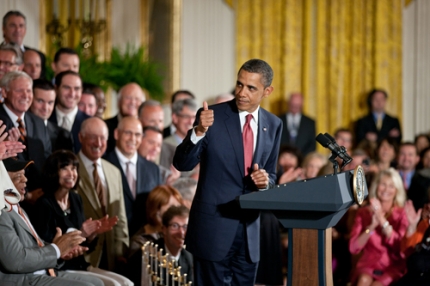
President Barack Obama gives a thumbs up to the 2010 Major League Baseball Champion San Francisco Giants during a visit with the team in the East Room of the White House. July 25, 2011. (Official White House Photo by Lawrence Jackson)

 
President Obama today welcomed the 2010 World Series winners, the San Francisco Giants, to the White House. He congratulated the team on their first championship in 56 years. Baseball legend Willie Mays, who was a 23-year-old outfielder for the Giants the last time they won the title, joined the team for the meeting in the East Room.
 
The President commended the Giants for their commitment to giving back to the community, from their work with the Wounded Warrior program to their leadership as the first professional sports team to join the "It Gets Better" campaign against bullying.
Related Topics: Service, New York

President Obama Meets 2010 World Series Champions

July 25, 2011 | 9:44 | Public Domain

The San Francisco Giants bring special guest Willie Mays on their trip to the White House.

Download mp4 (93MB) | mp3 (9MB)

Read the Transcript

Remarks by the President in Welcoming the 2010 World Series Champion San Francisco Giants

4:15 P.M. EDT

    
THE PRESIDENT:  Well, hello, everybody.  Have a seat, have a seat.  This is a party.  Welcome to the White House, and congratulations to the Giants on winning your first World Series title in 56 years.  (Applause.)  

I want to start by recognizing some very proud Giants fans in the house.  We've got Mayor Ed Lee -- (applause) -- Lieutenant Governor Gavin Newsom.  (Applause.)  We have quite a few members of Congress -- I am going to announce one; the Democratic leader in the House, Nancy Pelosi is here.  (Applause.)  We've got Senator Dianne Feinstein who is here.  (Applause.)  And our newest Secretary of Defense and a big Giants fan, Leon Panetta is in the house.  (Applause.)  

I also want to congratulate Bill Neukom and Larry Baer for building such an extraordinary franchise. 

I want to welcome obviously our very special guest, the "Say Hey Kid" -- Mr. Willie Mays is in the house.  (Applause.)  Two years ago, I invited Willie to ride with me on Air Force One on the way to the All-Star Game in St. Louis.  It was an extraordinary trip.  Very rarely when I'm on Air Force One am I the second most important guy on there.  (Laughter.)  Everybody was just passing me by -- "Can I get you something, Mr. Mays?"  (Laughter.)  What's going on?

Willie was also a 23-year-old outfielder the last time the Giants won the World Series, back when the team was in New York. And even though there have been some great Giants teams since then, none of them had brought a championship back to the Bay Area.

And then this team came along.  Manager Bruce Bochy once called them a bunch of “misfits and castoffs.”  Let me take a look at these guys.  (Applause.)  Or as GM Brian Sabean put it, “We've got a lot of characters -- (applause) -- with a lot of character.” 

One of these characters is Tim Lincecum.  Where's Tim?  I see him back there.  (Applause.)  Recognize the hair.  (Laughter.)  When Tim entered the draft five years ago, nine teams passed him over before the Giants picked him up.  Nobody thought somebody that skinny -- (laughter) -- with that violent a delivery could survive without just flying apart.  But now, with two Cy Youngs under his belt, everybody understands why he’s called “The Freak.”  (Laughter.)  Before Game 5 last year, Tim was so relaxed he was singing in the clubhouse.  That’s how his teammates knew they were about to see something special.  And after watching him pitch eight incredible innings -- including a stretch of 11 strikes in a row -- America learned sometimes it’s a good idea to bet on the skinny guy.  (Laughter and applause.) So, you and me. 

And then there’s the guy with the beard.  Where's he?  (Laughter.)  I do fear it.  (Laughter.)  Have you guys seen the SportsCenter ad where it's -- ESPN -- where it starts doing a dance?  (Laughter.) 

Now, underneath Brian’s beard, and the spandex tuxedo -- (laughter) -- and the sea captain costume, and the cleats with his face on them -- is also one of the most dominant closers in baseball.  (Applause.)  And I do think, Brian, you should know that Michelle was very relieved that the press was going to be talking about what somebody else wears here in the White House –(laughter) -- so that it’s not just her making a fashion statement.

So even though this team is a little different -- even though these players haven’t always followed the traditional rules, one thing they know is how to win.  Maybe some of that wisdom comes from all the old-time greats who never won a Series, but know that being a Giant means being a Giant for life.  And that’s why greats like Willie McCovey can often be found hanging around the clubhouse, pulling young players aside and offering them hitting tips.  And the love goes both ways.  Brian said, "What those players went through when they played, to not bring one home like we did, this is for them."

So for this team, winning the World Series means remembering their roots -- especially when those roots run deep.  Last year, after all the confetti had been cleaned up and the players had gone home, Willie Mays took the trophy back to the site of the old Polo Grounds in New York.  And he visited students at P.S. 46, on the spot where the stadium once stood, and told them stories about playing stickball with the neighborhood kids all those years ago.

And the rest of this team has also made a point of giving back -- whether it’s supporting wounded warriors and their families, or becoming the first professional sports team to join the “It Gets Better” campaign against bullying.  (Applause.)
So that’s what this team is all about:  characters with character.  And so once again I want to congratulate this team and wish them all the best of luck in the rest of the season -- unless the White Sox are in the World Series -- (laughter) -- which right now is not a sure thing.

Congratulations, everybody.  (Applause.)

COACH BOCHY:  Thank you, Mr. President.  We have a few gifts here.  But first, we want to thank you very much for having us here.  We know you’re busy, and on behalf of the Giants family we’re honored and privileged for you to have us here.

THE PRESIDENT:  Thank you.

COACH BOCHY:  So a special day for us after having a special season.  Thank you.

(Baby crying.)

THE PRESIDENT:  He’s really upset that I quit talking.  (Laughter.) 

(A gift is presented.) 

Oh, that’s terrific.  Thank you -- 44.  Thank you.  Thank you, guys.  (Applause.)  What else do you got?

MR. CAIN:  We just wanted to present you with a team-signed bat. 

THE PRESIDENT:  Thank you so much.

MR. CAIN:  Your name -- special edition.  So it’s right there --

THE PRESIDENT:  That is beautiful.  Thank you so much.  Thank you.  Congratulations.  Thank you.  (Applause.)  This is beautiful. 

MR. NEUKOM:  Mr. President, on behalf of the entire Giants organization, our investors -- many of whom are here today -- the front office -- many of whom are also here today -- and of course this amazing ball club with the trainers and the coaches and the players and the broadcast folks, on behalf of all of us, we thank you for making time for us and for your kind words.  And we wish you well, and we’d like our general manager to make a presentation to you and the family, if he may.

THE PRESIDENT:  Oh, thank you.

MR. NEUKOM:  A custom glove.  Real deal.

THE PRESIDENT:  Oh, that’s what I need right there.  (Laughter.)

MR. NEUKOM:  White Sox colors. 

THE PRESIDENT:  I notice you put the silver and black on there.  I appreciate that.  That was good.  (Laughter.)  Thank you. 

We should do something like every day.  Look at all this loot.  (Laughter and applause.)  This is good.  All right, let’s strike the podium.  We’ll take a good picture. 

END  4:25 P.M. EDT

Close Transcript