President Obama Meets with Leaders of Nations Representing Africa’s Democratic Progress

The President Meets with Democratically Elect African Heads of State

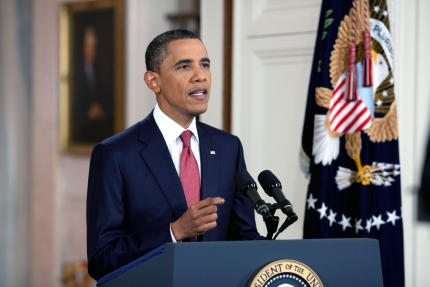
President Barack Obama makes a statement to the press after meeting with democratically elected African heads of state, including, from left, President Mahamadou Issoufou of Niger, President Boni Yayi of Benin, President Alpha Condé of Guinea, and President Alassane Ouattara of Cote D’Ivoire, in the Cabinet Room of the White House, July 29, 2011. (Official White House Photo by Samantha Appleton)

Today, President Obama welcomed President Yayi of Benin, President Conde of Guinea, President Issoufou of Niger, and President Ouattara of Côte d’Ivoire to the White House. In the President's remarks he spoke about the four leaders' efforts to strengthen democracy in Africa:         

All these leaders were elected through free and fair elections.  They’ve shown extraordinary persistence in wanting to promote democracy in their countries despite significant risks to their own personal safety and despite enormous challenges, in some cases -- most recently in Côte d’Ivoire -- in actually implementing the results of these elections.

But because of their fortitude and because of the determination of their people to live in democratic, free societies, they have been able to arrive at a position of power that is supported by the legitimate will of their peoples.  And as such, they can serve as effective models for the continent.

These countries all underscore what I emphasized when I visited Ghana and gave a speech about Africa as a whole -- this is a moment of great opportunity and significant progress in Africa.  Politically, the majority of Sub-Saharan African countries are now embracing democracy.  Economically, Africa is one of the fastest-growing regions in the world. 

 And we just had a very productive discussion where we discussed how we can build on both the political progress, the economic progress, and address the security challenges that can continue to confront Africa.  And I emphasized that the United States has been and will continue to be a stalwart partner with them in this process of democratization and development. 

Related Topics: Foreign Policy

The White House

Office of the Press Secretary

President Obama Announces More Key Administration Posts

WASHINGTON – Today, President Barack Obama announced his intent to nominate the following individuals to key Administration posts:

  • Michael E. Horowitz – Inspector General, Department of Justice
  • Anneila I. Sargent -Member, National Science Board, National Science Foundation

The President also announced his intent to appoint the following individuals to key Administration posts:

  • Betty Castor– Member,  J. William Fulbright Foreign Scholarship Board
  • Susan Ness - Member,  J. William Fulbright Foreign Scholarship Board
  • Clement A. Price -  Vice Chairman, Advisory Council on Historic Preservation

President Obamasaid, “The extraordinary dedication these men and women bring to their new roles will greatly serve the American people.  I am grateful they have agreed to serve in this Administration and I look forward to working with them in the months and years to come.”

President Obama announced his intent to nominate the following individuals to key Administration posts:

Michael E. Horowitz,Nominee for Inspector General, Department of Justice

Michael E. Horowitz is currently a Partner at Cadwalader, Wickersham, & Taft LLP, where his practice focuses on white collar defense, internal investigations, and regulatory compliance.  Mr. Horowitz previously served as a Commissioner for the U.S. Sentencing Commission, a position he held from 2003 to 2009. From 1999 to 2002, he was Deputy Assistant Attorney General and then Chief of Staff for the Criminal Division at the Department of Justice. From 1991 to 1999, Mr. Horowitz was an Assistant U.S. Attorney in the U.S. Attorney’s Office for the Southern District of New York, serving as Chief of the Public Corruption Unit from 1997 to 1999. Earlier in his career, Mr. Horowitz was an associate at Debevoise & Plimpton and clerked for Judge John G. Davies of the U.S. District Court for the Central District of California.  Mr. Horowitz is a board member of the Ethics Resource Center, the Society of Corporate Compliance and Ethics, and the Lawyers Committee for Civil Rights Under Law.  Mr. Horowitz holds a B.A. from Brandeis University and a J.D. from Harvard Law School.

Dr. Anneila I. Sargent, Nominee for Member, National Science Board, National Science Foundation

Dr. Anneila I. Sargent is Vice President for Student Affairs and the Benjamin M. Rosen Professor of Astronomy at the California Institute of Technology.  An accomplished astronomer, Dr. Sargent has served as President of the American Astronomical Society, Chair of NASA’s Space Science Advisory Committee and Chair of the National Research Council’s Board of Physics and Astronomy.  She was also a Member of the Nation Science Foundation’s Mathematical and Physical Sciences Advisory Committee. Dr. Sargent led two large research operations as Director of the Combined Array for Research in Millimeter-wave Astronomy and the Owens Valley Radio Observatory. She was awarded the NASA Public Service Medal in 1998, and is a Fellow of the American Academy for Arts and Sciences. Dr. Sargent holds B.Sc. and D.Sc. degrees from the University of Edinburgh, and a Ph.D. from Caltech.

President Obama announced his intent to appoint the following individuals to  key Administration posts:

Betty Castor, Appointee for Member, J. William Fulbright Foreign Scholarship Board

Betty Castor is the former President of the University of South Florida in Tampa, Florida, where she served as President for six years from 1994 until 1999.  Prior to her tenure as President, she was the Florida Commissioner of Education for seven years and the first woman ever elected to the Florida Cabinet.  Ms. Castor has held other leadership positions in education, most recently as the Executive Director of the Patel Center for Global Solutions at USF.  She is a former state legislator having served three terms in the Florida Senate.  Ms. Castor is a member of the Tampa Bay Committee on Foreign Relations and the Society of International Business Fellows.  She began her educational career as a secondary school teacher in Uganda, East Africa and continues to support the Teachers for East Africa Alumni Foundation.  She received her Bachelor’s degree from Rowan University, Glassboro, New Jersey and her Master’s degree from the University of Miami, Coral Gables, Florida.

Susan Ness, Appointee for Member, J. William Fulbright Foreign Scholarship Board

Susan Ness is the founder of Susan Ness Strategies, a communications policy consulting firm, and a Senior Fellow at the Center for Transatlantic Relations at Johns Hopkins School of Advanced International Studies.  She is also currently a board member of Vital Voices Global Partnership.  Previously, Ms. Ness served as the President and CEO of GreenStone Media, LLC, which produced syndicated talk radio programming targeting women, and as a Distinguished Visiting Professor at the Annenberg School for Communications.  From 1994 to 2001, Ms. Ness was a member of the Federal Communications Commission, having been appointed by President Clinton.  Prior to joining the FCC, she was corporate vice president of the American Security Bank, specializing in the telecom and media sectors, and assistant counsel to the Banking Committee of the U.S. House of Representatives.  She received her Bachelor’s Degree from Douglass College, her J.D. from Boston College and her M.B.A. from The Wharton School at the University of Pennsylvania.

Clement A. Price, Appointee for Vice Chairman, Advisory Council on Historic Preservation

Clement A. Price is the Board of Governors Distinguished Service Professor of History and the Founder and Director of the Institute on Ethnicity, Culture, and the Modern Experience at Rutgers University, Newark Campus.  Professor Price is involved in many historic and cultural institutions in New Jersey. He currently serves as the Chair of the Save Ellis Island Foundation and the Newark Education Trust, and is a member of the New Jersey Historical Commission, the New Jersey State Council on the Arts, and the Newark Black Film Festival.  He received his B.A. and M.A. in History from the University of Bridgeport and his Ph.D. in History from Rutgers.

The White House

Office of the Press Secretary

Remarks of President Obama After Meeting with African Heads of State

Cabinet Room

4:13 P.M. EDT

        PRESIDENT OBAMA:  Well, I just wanted to publicly welcome four very distinguished leaders to the White House:  President Yayi of Benin; President Conde of Guinea; President Issoufou of Niger; and President Ouattara of Côte d’Ivoire.  

        Although, obviously, we’ve got a lot of things going here in Washington today, it was important for us I think to maintain this scheduled appointment with four leaders of nations that represent Africa’s democratic progress, which is vital to a stable and prosperous and just Africa, but is also critical to the stability and prosperity of the world.

        All these leaders were elected through free and fair elections.  They’ve shown extraordinary persistence in wanting to promote democracy in their countries despite significant risks to their own personal safety and despite enormous challenges, in some cases -- most recently in Côte d’Ivoire -- in actually implementing the results of these elections.

        But because of their fortitude and because of the determination of their people to live in democratic, free societies, they have been able to arrive at a position of power that is supported by the legitimate will of their peoples.  And as such, they can serve as effective models for the continent.

        These countries all underscore what I emphasized when I visited Ghana and gave a speech about Africa as a whole -- this is a moment of great opportunity and significant progress in Africa.  Politically, the majority of Sub-Saharan African countries are now embracing democracy.  Economically, Africa is one of the fastest-growing regions in the world.  

        And we just had a very productive discussion where we discussed how we can build on both the political progress, the economic progress, and address the security challenges that can continue to confront Africa.  And I emphasized that the United States has been and will continue to be a stalwart partner with them in this process of democratization and development.  

        Despite the impressive work of all these gentlemen, I’ve said before and I think they all agree, Africa does not need strong men; Africa needs strong institutions.  So we are working with them as partners to build effective judiciaries, strong civil societies, legislatures that are effective and inclusive, making sure that human rights are protected.  

        With respect to economic development, all of us agree that we can’t keep on duplicating a approach that breeds dependence, but rather we need to embrace an approach that creates sustainability and capacity within each of these countries, through trade and investment and the development of human capital and the education of young people throughout these countries.

        We discussed as well that not only do we want to encourage trade between the United States and each of these respective countries but we want to encourage inter-African and regional trade, and that requires investments in infrastructure in those areas.  

        We are partners in resolving conflicts peacefully and have worked effectively with ECOWAS and the African Union to resolve crises in the region.  And we appreciate very much the assistance that we’ve received on battling terrorism that currently is trying to gain a foothold inside of Africa.

        And, finally, we discussed how we can partner together to avert the looming humanitarian crisis in eastern Africa.  I think it hasn’t gotten as much attention here in the United States as it deserves.  But we’re starting to see famine developing along the Horn of Africa, in areas like Somalia in particular.  And that’s going to require an international response, and Africa will have to be a partner in making sure that tens of thousands of people do not starve to death.

        So let me just close by saying that many of the countries here are -- either have celebrated or are in the process of celebrating their 50th year of independence.  As President Issoufou pointed out, I’m also celebrating my 50th of at least existence.  (Laughter.)  

        And when we think about the extraordinary progress that’s been made, I think there’s much we can be proud of.  But of course, when we think about the last 50 years, we also have to recognize there have been a lot of opportunities missed.  And so, these leaders I think are absolutely committed to making sure that 50 years from now they can say that they helped to turn the tide in their countries, to establish strong, democratic practices, to help establish economic prosperity and security.  

        And we just want you to know the United States will stand with you every step of the way.

        Thank you very much, everyone.  (Applause.)  

END 4:24 P.M. EDT

The White House

Office of the Press Secretary

President Obama Signs Kansas Disaster Declaration

The President today declared a major disaster exists in the State of Kansas and ordered Federal aid to supplement State and local recovery efforts in the area struck by severe storms, straight-line winds, tornadoes, and floodingduring the period of May 19 to June 4, 2011.

Federal funding is available to State and eligible local governments and certain private nonprofit organizations on a cost-sharing basis for emergency work and the repair or replacement of facilities damaged by the severe storms, straight-line winds, tornadoes, and floodingin the counties of Barton, Clay, Cloud, Hamilton, Jewell, Lincoln, Logan, Lyon, Marion, Mitchell, Morton, Osage, Osborne, Ottawa, Pottawatomie, Republic, Riley, Rooks, Rush, Russell, Sherman, Smith, Stafford, Stanton, and Washington.

Federal funding is also available on a cost-sharing basis for hazard mitigation measures statewide. 

W. Craig Fugate, Administrator, Federal Emergency Management Agency (FEMA), Department of Homeland Security, named Bradley Harris as the Federal Coordinating Officer for Federal recovery operations in the affected area. 

FEMA said additional designations may be made at a later date if requested by the State and warranted by the results of further damage assessments.

FOR FURTHER INFORMATION MEDIA SHOULD CONTACT:  FEMA NEWS DESK AT (202) 646-3272 OR FEMA-NEWS-DESK@DHS.GOV

The Time for #Compromise is Now

"The time for compromise on behalf of the American people is now," said President Obama during a statement on debt negotiations this morning. On Twitter, people are using the hashtag #compromise in response to his speech. Here @whitehouse, we've been using Twitter all week for our new White House Office Hours series, where senior staff have been answering your questions on the debt debate and the economy in 140 characters or less.

Here are some ways you can stay engaged in the conversation on Twitter:

  • Use the hashtag #compromise on Twitter to respond to the President's remarks
  • Keep on using the hashtag #WHChat to ask White House staff question during Office Hours
  • Retweet or reply to our live tweeting of the President's remarks (below)
Related Topics: Debt Debate, Economy

Weekly Wrap-Up: "Every Man Cannot Have His Way in All Things"

A quick look at what happened this week on WhiteHouse.gov

President Barack Obama delivers remarks on the deficit to the Nation

President Barack Obama delivers remarks to the Nation in the East Room of the White House on the stalemate in Washington over avoiding default and the best approach to cutting deficits, July 25, 2011. (Official White House Photo by Pete Souza)

Deficit Talks: The President spoke throughout the week on the importance of compromise, telling Congress “it’s important for everybody to step up and show the leadership that the American people expect.” He encouraged the American people to make their voices heard during his Monday address to the nation. Many Americans are wondering how the country is spending $12.7 trillion this year, so we created an infographic that details the impact policies and programs implemented over the last 10 years are having on our nation's bottom line.

White House Office Hours: We've been trying something new on our social networks: Senior administration officials have been holding "Office Hours" to answer questions on the ongoing deficit debate. We've been using the hashtag #WHChat on Twitter, where White House staff have been responding in real-time (using only 140 characters per answer) during Office Hours. Why don't you join us next week?

Related Topics: Debt Debate, Economy, Veterans

President Obama Announces New Fuel Economy Standards

July 29, 2011 | 12:30 | Public Domain

Consumers will save $1.7 trillion at the pump, $8K per vehicle by 2025.

Download mp4 (119MB) | mp3 (12MB)

Read the Transcript

Remarks by the President on Fuel Efficiency Standards

Walter E. Washington Convention Center
Washington, D.C.

10:57 A.M. EDT

THE PRESIDENT:  Thank you, everybody.  Thank you.  (Applause.)  Good morning.  I've been having a lot of fun this week, but -- (laughter) -- nothing more fun and more important to the future of the American economy than the agreement that we're announcing today.

I am extraordinarily proud to be here today with the leaders of the world’s largest auto companies, and the folks who represent autoworkers all across America.  (Applause.)  I’m glad that I have a chance to see some of the great cars that you are manufacturing.  As some of you may know, it’s only a matter of time until Malia gets her learner’s permit -- (laughter) -- so I’m hoping to see one of those models that gets a top speed of 15 miles an hour -- (laughter) -- the ejector seat anytime boys are in the car.  (Laughter.)  So, hopefully you guys have some of those in the pipeline.

Now, for the last few months, gas prices have just been killing folks at the pump.  People are filling up their tank, and they're watching the cost rise -- $50, $60, $70.  For some families, it means driving less.  But a lot of folks don’t have that luxury.  They’ve got to go to work.  They’ve got to pick up the kids.  They’ve got to make deliveries.  So it’s just another added expense when money is already tight.

And of course, this is not a new problem.  For decades, we’ve left our economy vulnerable to increases in the price of oil.  And with the demand for oil going up in countries like China and India, the problem is only getting worse.  The demand for oil is inexorably rising far faster than supply.  And that means prices will keep going up unless we do something about our own dependence on oil.  That’s the reality.

At the same time, it’s also true that there is no quick fix to the problem.  There’s no silver bullet here.  But there are steps we can take now that will help us become more energy independent.  There are steps we can take that will save families money at the pump, that will make our economy more secure, and that will help innovative companies all across America generate new products and new technologies and new jobs. 

So I’ve laid out an energy strategy that would do that.  In the short term, we need to increase safe and responsible oil production here at home to meet our current energy needs.  And even those who are proponents of shifting away from fossil fuels have to acknowledge that we’re not going to suddenly replace oil throughout the economy.  We’re going to need to produce all the oil we can.

But while we’re at it, we need to get rid of, I think, the $4 billion in subsidies we provide to oil and gas companies every year at a time when they’re earning near-record profits, and put that money toward clean energy research, which would really make a big difference.  (Applause.)

Those are all short-term solutions, though.  In the long run, we’re going to have to do more.  We’re going to have to harness the potential of startups and clean energy companies across America.  We’re going to need to build on the progress that I’ve seen in your factories, where workers are producing hybrid cars and more fuel-efficient engines and advanced electric vehicles.  We need to tap into this reservoir of innovation and enterprise. 

And that’s why we’re here today.  This agreement on fuel standards represents the single most important step we’ve ever taken as a nation to reduce our dependence on foreign oil.  Think about that.  (Applause.)

Most of the companies here today were part of an agreement that we reached two years ago to raise the fuel efficiency of their cars over the next five years.  And the vehicles on display here are ones that benefited from that standard.  Folks buying cars like these in the next several years will end up saving more than $3,000 over time because they can go further on a gallon of gas.

And today, these outstanding companies are committing to doing a lot more.  The companies here today have endorsed our plan to continue increasing the mileage on their cars and trucks over the next 15 years.  We’ve set an aggressive target, and the companies here are stepping up to the plate. 

By 2025, the average fuel economy of their vehicles will nearly double to almost 55 miles per gallon.  (Applause.)  So this is an incredible commitment that they’ve made.  And these are some pretty tough business guys.  They know their stuff.  And they wouldn’t be doing it if they didn’t think that it was ultimately going to be good business and good for America. 

Think about what this means.  It means that filling up your car every two weeks instead of filling it up every week.  It will save a typical family more than $8,000 in fuel costs over time.  And consumers in this country as a whole will save almost $2 trillion in fuel costs.  That’s trillion with a T.

And just as cars will go further on a gallon of gas, our economy will go further on a barrel of oil.  In the next 15 years, we’re going to reduce the amount of oil we need by 2.2 million barrels per day.  And this will help meet the goal that I’ve set for America:  reducing our dependence on foreign oil by one-third.

Using less oil also means our cars will produce fewer emissions.  So when your kids are biking around the neighborhood, they’ll be breathing less pollution and fewer toxins.  It means we’re doing more to protect our air and water.  And it means we’re reducing the carbon pollution that threatens our climate.

Lastly, these standards aren’t just about the bad things we’ll prevent; it’s about the good things that we’ll build.  As these companies look for ways to boost efficiency, they’ll be conducting research and development on test tracks.  They’re going to look to startups working on biofuels and new engine technologies.  They’re going to continue to invest in advanced battery manufacturing.  They’re going to spur growth in clean energy.  And that means new jobs in cutting-edge industries all across America.

I’ll give you a couple of examples.  There’s a company called Celgard in North Carolina that’s expanding its production line to meet demand for advanced batteries.  And they’ve hired 200 employees and they’re adding 250 more.  There’s A123, a clean-energy manufacturer in Michigan that just hired its 1,000th worker as demand has soared for its vehicle components.  Companies like these are taking root and putting people to work in every corner of the country. 

And after a very difficult time for the automotive sector in this country -- after a period of painful restructuring, with the federal government lending a helping hand to two of the Big Three American automakers -- we’re seeing growth and a rise in sales, led by vehicles using new, more fuel-efficient technologies.  And that bodes well for the future.  That tells us that these standards are going to be a win for consumers, for these companies, for our economy, for our security, and for our planet.

So we are happy to welcome all the auto companies to this effort.  But I do want to pay special tribute to the extraordinary progress of General Motors, Ford and Chrysler.  It was little more than two years ago that many doubted whether these companies would still be around, much less moving forward and leading the kind of change that we’re seeing.

I also want to point out all this progress we’re talking about today -- the promise of this agreement -- it is only possible because we’ve made investments in technology.  It’s only possible because we’re willing, as a nation, to make sure that young people could afford to go to college and get engineering degrees; to make sure that we’re backing the basic research of our scientists; to make sure innovative small businesses could get the credit to open their doors and ultimately maybe be a supplier for one of these big companies.

So as we look to close the deficit, this agreement is a reminder of why it’s so important that we have a balanced approach.  We’ve got to make serious spending cuts while still investing in our future; while still investing in education and research and technology like clean energy, which are so important for our economy.

And finally, this agreement ought to serve as a valuable lesson for leaders in Washington.  This agreement was arrived at without legislation.  You are all demonstrating what can happen when people put aside differences -- these folks are competitors, you've got labor and business, but they decided, we’re going to work together to achieve something important and lasting for the country.  (Applause.) 

So when it comes to tackling the deficit, or it comes to growing the economy, when it comes to giving every American an opportunity to achieve their American Dream, the American people are demanding the same kind of resolve, the same kind of spirit of compromise, the same kind of problem solving that all these folks on stage have shown.  They’re demanding that people come together and find common ground; that we have a sensible, balanced approach that’s based on facts and evidence and us reasoning things out and figuring out how to solve problems, and asks everybody to do their part. 

That’s what I’m fighting for.  That’s what this debate is all about.  That’s what the American people want.

So I want to once again thank automakers.  I want to thank workers.  I want to thank the state of California -- (applause) -- which has been -- the state of California has consistently been a leader on this issue.  I want to thank the environmental leaders and elected officials, including Leader Pelosi who is here, and the leaders here from the Michigan delegation and -- because obviously the state of Michigan has a huge stake and has been on the cutting-edge of these issues and have helped to pave the way forward.  I want to thank all of you for helping to reduce our dependence on oil, on growing the economy, and leaving for future generations a more secure and prosperous America.

So, congratulations, gentlemen.  Thank you very much.  (Applause.)

END
11:10 A.M. EDT

Close Transcript

The White House

Office of the Press Secretary

Statement by the President on the First Anniversary of the Tribal Law and Order Act

A year ago today, I was proud to sign the Tribal Law and Order Act into law.   American Indians and Alaska Natives have long been victimized by violent crime at far higher rates than the rest of the country, and the Tribal Law and Order Act is already helping us better address the unique public safety challenges that confront tribal communities.  Over the past year, tribes have gained greater sentencing authority.  The rights of defendants are stronger.  Services for victims are better.  We’re working together to combat alcohol and drug abuse, and to help at-risk youth in more effective ways.  We’ve established new guidelines and training for officers handling domestic violence and sex crimes.  And we’ve expanded recruitment and retention of Bureau of Indian Affairs and tribal officers, and given them better access to the criminal databases they need to keep people safe.  These are important steps in addressing serious issues.  And as long as I am President, we will continue to strengthen and fortify our government-to-government relationship with Indian Country.

President Obama on the Status of Debt Ceiling Negotiations

July 29, 2011 | 5:32 | Public Domain

President Obama delivered a statement once again calling on Congress to compromise and avoid defaulting on the Nation’s debt.

Download mp4 (53MB) | mp3 (5MB)

Read the Transcript

Remarks by the President on the Status of Debt Ceiling Negotiations

Diplomatic Reception Room

10:36 A.M. EDT

THE PRESIDENT:  Good morning, everybody.  I want to speak about the ongoing and increasingly urgent efforts to avoid default and reduce our deficit.

Right now, the House of Representatives is still trying to pass a bill that a majority of Republicans and Democrats in the Senate have already said they won’t vote for.  It’s a plan that would force us to re-live this crisis in just a few short months, holding our economy captive to Washington politics once again.  In other words, it does not solve the problem, and it has no chance of becoming law.  

What’s clear now is that any solution to avoid default must be bipartisan.  It must have the support of both parties that were sent here to represent the American people -– not just one faction.  It will have to have the support of both the House and the Senate.  And there are multiple ways to resolve this problem.  Senator Reid, a Democrat, has introduced a plan in the Senate that contains cuts agreed upon by both parties.  Senator McConnell, a Republican, offered a solution that could get us through this.  There are plenty of modifications we can make to either of these plans in order to get them passed through both the House and the Senate and would allow me to sign them into law.  And today I urge Democrats and Republicans in the Senate to find common ground on a plan that can get support -- that can get support from both parties in the House –- a plan that I can sign by Tuesday. 

Now, keep in mind, this is not a situation where the two parties are miles apart.  We’re in rough agreement about how much spending can be cut responsibly as a first step toward reducing our deficit.  We agree on a process where the next step is a debate in the coming months on tax reform and entitlement reform –- and I’m ready and willing to have that debate.  And if we need to put in place some kind of enforcement mechanism to hold us all accountable for making these reforms, I’ll support that too if it’s done in a smart and balanced way.   

So there are plenty of ways out of this mess.  But we are almost out of time.  We need to reach a compromise by Tuesday so that our country will have the ability to pay its bills on time, as we always have -- bills that include monthly Social Security checks, veterans’ benefits and the government contracts we’ve signed with thousands of businesses.  Keep in mind, if we don’t do that, if we don’t come to an agreement, we could lose our country’s AAA credit rating, not because we didn’t have the capacity to pay our bills -- we do -- but because we didn’t have a AAA political system to match our AAA credit rating.

And make no mistake -– for those who say they oppose tax increases on anyone, a lower credit rating would result potentially in a tax increase on everyone in the form of higher interest rates on their mortgages, their car loans, their credit cards.  And that’s inexcusable.

There are a lot of crises in the world that we can’t always predict or avoid -– hurricanes, earthquakes, tornadoes, terrorist attacks.  This isn’t one of those crises.  The power to solve this is in our hands.  And on a day when we’ve been reminded how fragile the economy already is, this is one burden we can lift ourselves.   We can end it with a simple vote –- a vote that Democrats and Republicans have been taking for decades, a vote that the leaders in Congress have taken for decades.

It’s not a vote that allows Congress to spend more money.  Raising the debt ceiling simply gives our country the ability to pay the bills that Congress has already racked up.  I want to emphasize that.  The debt ceiling does not determine how much more money we can spend, it simply authorizes us to pay the bills we already have racked up.  It gives the United States of America the ability to keep its word. 

Now, on Monday night, I asked the American people to make their voice heard in this debate, and the response was overwhelming.  So please, to all the American people, keep it up.  If you want to see a bipartisan compromise -– a bill that can pass both houses of Congress and that I can sign -- let your members of Congress know.  Make a phone call.  Send an email.  Tweet.  Keep the pressure on Washington, and we can get past this.

And for my part, our administration will be continuing to work with Democrats and Republicans all weekend long until we find a solution.  The time for putting party first is over.  The time for compromise on behalf of the American people is now.  And I am confident that we can solve this problem.  I’m confident that we will solve this problem.  For all the intrigue and all the drama that’s taking place on Capitol Hill right now, I’m confident that common sense and cooler heads will prevail.

But as I said earlier, we are now running out of time.  It’s important for everybody to step up and show the leadership that the American people expect.

Thank you. 

END
10:42 A.M. EDT

Close Transcript

West Wing Week: 7/29/11 or "Mutual Disposition"

Welcome to the West Wing Week, your guide to everything that's happening at 1600 Pennsylvania Ave. This week, the President was inspired by students at a town hall, met with the Prime Minister of New Zealand, honored the World Series champs, spoke to Hispanic community advocates and addressed the nation on the importance of compromising on a balanced approach to reduce the deficit (infographic). Plus, senior White House advisors answered questions on the ongoing deficit negotiations via  live "office hours" on Twitter. That's July 22nd to July 28th or "Mutual Disposition"

Watch West Wing Week here.