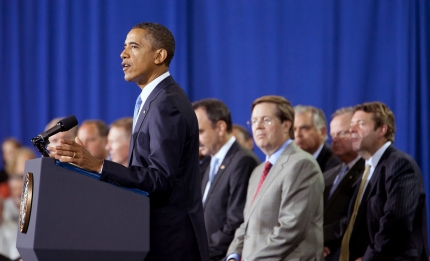
President Obama Calls on the American People to Make their Voices Heard

Watch the President's full remarks here.

This morning, President Obama spoke on the status of the debt ceiling negotiations from the Diplomatic Reception Room at the White House. The President urged Republicans and Democrats in Congress to find a bipartisan solution to avoid default that he can sign by Tuesday. Though we are almost out of time, the President made it clear that there are multiple ways to resolve this problem:

Now, keep in mind, this is not a situation where the two parties are miles apart.  We’re in rough agreement about how much spending can be cut responsibly as a first step toward reducing our deficit.  We agree on a process where the next step is a debate in the coming months on tax reform and entitlement reform –- and I’m ready and willing to have that debate.  And if we need to put in place some kind of enforcement mechanism to hold us all accountable for making these reforms, I’ll support that too if it’s done in a smart and balanced way.   

The White House

Office of the Press Secretary

Remarks by the President on Fuel Efficiency Standards

Walter E. Washington Convention Center
Washington, D.C.

10:57 A.M. EDT

THE PRESIDENT:  Thank you, everybody.  Thank you.  (Applause.)  Good morning.  I've been having a lot of fun this week, but -- (laughter) -- nothing more fun and more important to the future of the American economy than the agreement that we're announcing today.

I am extraordinarily proud to be here today with the leaders of the world’s largest auto companies, and the folks who represent autoworkers all across America.  (Applause.)  I’m glad that I have a chance to see some of the great cars that you are manufacturing.  As some of you may know, it’s only a matter of time until Malia gets her learner’s permit -- (laughter) -- so I’m hoping to see one of those models that gets a top speed of 15 miles an hour -- (laughter) -- the ejector seat anytime boys are in the car.  (Laughter.)  So, hopefully you guys have some of those in the pipeline.

Now, for the last few months, gas prices have just been killing folks at the pump.  People are filling up their tank, and they're watching the cost rise -- $50, $60, $70.  For some families, it means driving less.  But a lot of folks don’t have that luxury.  They’ve got to go to work.  They’ve got to pick up the kids.  They’ve got to make deliveries.  So it’s just another added expense when money is already tight.

And of course, this is not a new problem.  For decades, we’ve left our economy vulnerable to increases in the price of oil.  And with the demand for oil going up in countries like China and India, the problem is only getting worse.  The demand for oil is inexorably rising far faster than supply.  And that means prices will keep going up unless we do something about our own dependence on oil.  That’s the reality.

At the same time, it’s also true that there is no quick fix to the problem.  There’s no silver bullet here.  But there are steps we can take now that will help us become more energy independent.  There are steps we can take that will save families money at the pump, that will make our economy more secure, and that will help innovative companies all across America generate new products and new technologies and new jobs. 

So I’ve laid out an energy strategy that would do that.  In the short term, we need to increase safe and responsible oil production here at home to meet our current energy needs.  And even those who are proponents of shifting away from fossil fuels have to acknowledge that we’re not going to suddenly replace oil throughout the economy.  We’re going to need to produce all the oil we can.

But while we’re at it, we need to get rid of, I think, the $4 billion in subsidies we provide to oil and gas companies every year at a time when they’re earning near-record profits, and put that money toward clean energy research, which would really make a big difference.  (Applause.)

Those are all short-term solutions, though.  In the long run, we’re going to have to do more.  We’re going to have to harness the potential of startups and clean energy companies across America.  We’re going to need to build on the progress that I’ve seen in your factories, where workers are producing hybrid cars and more fuel-efficient engines and advanced electric vehicles.  We need to tap into this reservoir of innovation and enterprise. 

And that’s why we’re here today.  This agreement on fuel standards represents the single most important step we’ve ever taken as a nation to reduce our dependence on foreign oil.  Think about that.  (Applause.)

Most of the companies here today were part of an agreement that we reached two years ago to raise the fuel efficiency of their cars over the next five years.  And the vehicles on display here are ones that benefited from that standard.  Folks buying cars like these in the next several years will end up saving more than $3,000 over time because they can go further on a gallon of gas.

And today, these outstanding companies are committing to doing a lot more.  The companies here today have endorsed our plan to continue increasing the mileage on their cars and trucks over the next 15 years.  We’ve set an aggressive target, and the companies here are stepping up to the plate. 

By 2025, the average fuel economy of their vehicles will nearly double to almost 55 miles per gallon.  (Applause.)  So this is an incredible commitment that they’ve made.  And these are some pretty tough business guys.  They know their stuff.  And they wouldn’t be doing it if they didn’t think that it was ultimately going to be good business and good for America. 

Think about what this means.  It means that filling up your car every two weeks instead of filling it up every week.  It will save a typical family more than $8,000 in fuel costs over time.  And consumers in this country as a whole will save almost $2 trillion in fuel costs.  That’s trillion with a T.

And just as cars will go further on a gallon of gas, our economy will go further on a barrel of oil.  In the next 15 years, we’re going to reduce the amount of oil we need by 2.2 million barrels per day.  And this will help meet the goal that I’ve set for America:  reducing our dependence on foreign oil by one-third.

Using less oil also means our cars will produce fewer emissions.  So when your kids are biking around the neighborhood, they’ll be breathing less pollution and fewer toxins.  It means we’re doing more to protect our air and water.  And it means we’re reducing the carbon pollution that threatens our climate.

Lastly, these standards aren’t just about the bad things we’ll prevent; it’s about the good things that we’ll build.  As these companies look for ways to boost efficiency, they’ll be conducting research and development on test tracks.  They’re going to look to startups working on biofuels and new engine technologies.  They’re going to continue to invest in advanced battery manufacturing.  They’re going to spur growth in clean energy.  And that means new jobs in cutting-edge industries all across America.

I’ll give you a couple of examples.  There’s a company called Celgard in North Carolina that’s expanding its production line to meet demand for advanced batteries.  And they’ve hired 200 employees and they’re adding 250 more.  There’s A123, a clean-energy manufacturer in Michigan that just hired its 1,000th worker as demand has soared for its vehicle components.  Companies like these are taking root and putting people to work in every corner of the country. 

And after a very difficult time for the automotive sector in this country -- after a period of painful restructuring, with the federal government lending a helping hand to two of the Big Three American automakers -- we’re seeing growth and a rise in sales, led by vehicles using new, more fuel-efficient technologies.  And that bodes well for the future.  That tells us that these standards are going to be a win for consumers, for these companies, for our economy, for our security, and for our planet.

So we are happy to welcome all the auto companies to this effort.  But I do want to pay special tribute to the extraordinary progress of General Motors, Ford and Chrysler.  It was little more than two years ago that many doubted whether these companies would still be around, much less moving forward and leading the kind of change that we’re seeing.

I also want to point out all this progress we’re talking about today -- the promise of this agreement -- it is only possible because we’ve made investments in technology.  It’s only possible because we’re willing, as a nation, to make sure that young people could afford to go to college and get engineering degrees; to make sure that we’re backing the basic research of our scientists; to make sure innovative small businesses could get the credit to open their doors and ultimately maybe be a supplier for one of these big companies.

So as we look to close the deficit, this agreement is a reminder of why it’s so important that we have a balanced approach.  We’ve got to make serious spending cuts while still investing in our future; while still investing in education and research and technology like clean energy, which are so important for our economy.

And finally, this agreement ought to serve as a valuable lesson for leaders in Washington.  This agreement was arrived at without legislation.  You are all demonstrating what can happen when people put aside differences -- these folks are competitors, you've got labor and business, but they decided, we’re going to work together to achieve something important and lasting for the country.  (Applause.) 

So when it comes to tackling the deficit, or it comes to growing the economy, when it comes to giving every American an opportunity to achieve their American Dream, the American people are demanding the same kind of resolve, the same kind of spirit of compromise, the same kind of problem solving that all these folks on stage have shown.  They’re demanding that people come together and find common ground; that we have a sensible, balanced approach that’s based on facts and evidence and us reasoning things out and figuring out how to solve problems, and asks everybody to do their part. 

That’s what I’m fighting for.  That’s what this debate is all about.  That’s what the American people want.

So I want to once again thank automakers.  I want to thank workers.  I want to thank the state of California -- (applause) -- which has been -- the state of California has consistently been a leader on this issue.  I want to thank the environmental leaders and elected officials, including Leader Pelosi who is here, and the leaders here from the Michigan delegation and -- because obviously the state of Michigan has a huge stake and has been on the cutting-edge of these issues and have helped to pave the way forward.  I want to thank all of you for helping to reduce our dependence on oil, on growing the economy, and leaving for future generations a more secure and prosperous America.

So, congratulations, gentlemen.  Thank you very much.  (Applause.)

END
11:10 A.M. EDT

The White House

Office of the Press Secretary

President Obama Announces Historic 54.5 mpg Fuel Efficiency Standard

Consumers will save $1.7 trillion at the pump, $8K per vehicle by 2025

WASHINGTON, DC – President Obama today announced a historic agreement with thirteen major automakers to pursue the next phase in the Administration’s national vehicle program, increasing fuel economy to 54.5 miles per gallon for cars and light-duty trucks by Model Year 2025. The President was joined by Ford, GM, Chrysler, BMW, Honda, Hyundai, Jaguar/Land Rover, Kia, Mazda, Mitsubishi, Nissan, Toyota and Volvo – which together account for over 90% of all vehicles sold in the United States – as well as the United Auto Workers (UAW), and the State of California, who were integral to developing this agreement.

“This agreement on fuel standards represents the single most important step we’ve ever taken as a nation to reduce our dependence on foreign oil,” said President Obama. “Most of the companies here today were part of an agreement we reached two years ago to raise the fuel efficiency of their cars over the next five years. We’ve set an aggressive target and the companies are stepping up to the plate.  By 2025, the average fuel economy of their vehicles will nearly double to almost 55 miles per gallon.”

Building on the Obama administration’s agreement for Model Years 2012-2016 vehicles, which will raise fuel efficiency to 35.5 mpg and begin saving families money at the pump this year, the next round of standards will require performance equivalent to 54.5 mpg or 163 grams/ mile of CO2 for cars and light-duty trucks by Model Year 2025. Achieving the goals of this historic agreement will rely on innovative technologies and manufacturing that will spur economic growth and create high-quality domestic jobs in cutting edge industries across America.

These programs, combined with the model year 2011 light truck standard, represent the first meaningful update to fuel efficiency standards in three decades and span Model Years 2011 to 2025.  Together, they will save American families $1.7 trillion dollars in fuel costs, and by 2025 result in an average fuel savings of over $8,000 per vehicle. Additionally, these programs will dramatically cut the oil we consume, saving a total of 12 billion barrels of oil, and by 2025 reduce oil consumption by 2.2 million barrels a day – as much as half of the oil we import from OPEC every day.

The standards also curb carbon pollution, cutting more than 6 billion metric tons of greenhouse gas over the life of the program – more than the amount of carbon dioxide emitted by the United States last year. The oil savings, consumer, and environmental benefits of this comprehensive program are detailed in a new report entitled Driving Efficiency:  Cutting Costs for Families at the Pump and Slashing Dependence on Oil, which the Administration released today. 

The Environmental Protection Agency (EPA) and the Department of Transportation (DOT) have worked closely with auto manufacturers, the state of California, environmental groups, and other stakeholders for several months to ensure these standards are achievable, cost-effective and preserve consumer choice.   The program would increase the stringency of standards for passenger cars by an average of five percent each year. The stringency of standards for pick-ups and other light-duty trucks would increase an average of 3.5 percent annually for the first five model years and an average of five percent annually for the last four model years of the program, to account for the unique challenges associated with this class of vehicles.

“These standards will help spur economic growth, protect the environment, and strengthen our national security by reducing America’s dependence on foreign oil,” said U.S. Transportation Secretary Ray LaHood. “Working together, we are setting the stage for a new generation of clean vehicles.”

“This is another important step toward saving money for drivers, breaking our dependence on imported oil and cleaning up the air we breathe,” said EPA Administrator Lisa P. Jackson. “American consumers are calling for cleaner cars that won’t pollute their air or break their budgets at the gas pump, and our innovative American automakers are responding with plans for some of the most fuel efficient vehicles in our history.”

A national policy on fuel economy standards and greenhouse gas emissions provides regulatory certainty and flexibility that reduces the cost of compliance for auto manufacturers while addressing oil consumption and harmful air pollution. Consumers will continue to have access to a diverse fleet and can purchase the vehicle that best suits their needs.

EPA and NHTSA are developing a joint proposed rulemaking, which will include full details on the proposed program and supporting analyses, including the costs and benefits of the proposal and its effects on the economy, auto manufacturers, and consumers.  After the proposed rules are published in the Federal Register, there will be an opportunity for public comment and public hearings.  The agencies plan to issue a Notice of Proposed Rulemaking by the end of September 2011. California plans on adopting its proposed rule in the same time frame as the federal proposal.
Given the long time frame at issue in setting standards for MY2022-2025 light-duty vehicles, EPA and NHTSA intend to propose a comprehensive mid-term evaluation.  Consistent with the agencies’ commitment to maintaining a single national framework for vehicle GHG and fuel economy regulation, the agencies will conduct the mid-term evaluation in close coordination with California.

In achieving the level of standards described above for the 2017-2025 program, the agencies expect automakers’ use of advanced technologies to be an important element of transforming the vehicle fleet.  The agencies are considering a number of incentive programs to encourage early adoption and introduction into the marketplace of advanced technologies that represent “game changing” performance improvements, including:

  • Incentives for electric vehicles, plug-in hybrid electric vehicles, and fuel cells vehicles;
  • Incentives for advanced technology packages for large pickups, such as hybridization and other performance-based strategies;
  • Credits for technologies with potential to achieve real-world CO2 reductions and fuel economy improvements that are not captured by the standards test procedures. 

In addition, EPA plans to propose provisions for:

  • Credits for improvements in air conditioning (A/C) systems, both for efficiency improvements and for use of alternative, lower global warming potential refrigerant;
  • Treatment of compressed natural gas (CNG);
  • Continued credit banking and trading, including a one-time carry-forward of unused MY 2010-2016 credits through MY 2021.

President Obama Announces New Fuel Economy Standards

Fuel Economy Standards infographic, small

President Obama today announced the next phase in the Administration’s program to increase fuel efficiency and reduce greenhouse gas pollution for all new cars and trucks sold in the United States. These new standards will cover cars and light trucks for Model Years 2017-2025, requiring performance equivalent to 54.5 mpg in 2025 while reducing greenhouse gas emissions to 163 grams per mile.

President Barack Obama delivers remarks on Fuel Efficiency Standards

President Barack Obama delivers remarks on fuel efficiency standards for 2017-2025 model year cars and light-duty trucks during an event at the Washington Convention Center in Washington, D.C., July 29, 2011. Seated behind the President are at left are auto industry executives and Transportation Secretary Ray LaHood. (Official White House Photo by Samantha Appleton)


The White House

Office of the Press Secretary

Remarks by the President on the Status of Debt Ceiling Negotiations

Diplomatic Reception Room

10:36 A.M. EDT

THE PRESIDENT:  Good morning, everybody.  I want to speak about the ongoing and increasingly urgent efforts to avoid default and reduce our deficit.

Right now, the House of Representatives is still trying to pass a bill that a majority of Republicans and Democrats in the Senate have already said they won’t vote for.  It’s a plan that would force us to re-live this crisis in just a few short months, holding our economy captive to Washington politics once again.  In other words, it does not solve the problem, and it has no chance of becoming law.  

What’s clear now is that any solution to avoid default must be bipartisan.  It must have the support of both parties that were sent here to represent the American people -– not just one faction.  It will have to have the support of both the House and the Senate.  And there are multiple ways to resolve this problem.  Senator Reid, a Democrat, has introduced a plan in the Senate that contains cuts agreed upon by both parties.  Senator McConnell, a Republican, offered a solution that could get us through this.  There are plenty of modifications we can make to either of these plans in order to get them passed through both the House and the Senate and would allow me to sign them into law.  And today I urge Democrats and Republicans in the Senate to find common ground on a plan that can get support -- that can get support from both parties in the House –- a plan that I can sign by Tuesday. 

Now, keep in mind, this is not a situation where the two parties are miles apart.  We’re in rough agreement about how much spending can be cut responsibly as a first step toward reducing our deficit.  We agree on a process where the next step is a debate in the coming months on tax reform and entitlement reform –- and I’m ready and willing to have that debate.  And if we need to put in place some kind of enforcement mechanism to hold us all accountable for making these reforms, I’ll support that too if it’s done in a smart and balanced way.   

So there are plenty of ways out of this mess.  But we are almost out of time.  We need to reach a compromise by Tuesday so that our country will have the ability to pay its bills on time, as we always have -- bills that include monthly Social Security checks, veterans’ benefits and the government contracts we’ve signed with thousands of businesses.  Keep in mind, if we don’t do that, if we don’t come to an agreement, we could lose our country’s AAA credit rating, not because we didn’t have the capacity to pay our bills -- we do -- but because we didn’t have a AAA political system to match our AAA credit rating.

And make no mistake -– for those who say they oppose tax increases on anyone, a lower credit rating would result potentially in a tax increase on everyone in the form of higher interest rates on their mortgages, their car loans, their credit cards.  And that’s inexcusable.

There are a lot of crises in the world that we can’t always predict or avoid -– hurricanes, earthquakes, tornadoes, terrorist attacks.  This isn’t one of those crises.  The power to solve this is in our hands.  And on a day when we’ve been reminded how fragile the economy already is, this is one burden we can lift ourselves.   We can end it with a simple vote –- a vote that Democrats and Republicans have been taking for decades, a vote that the leaders in Congress have taken for decades.

It’s not a vote that allows Congress to spend more money.  Raising the debt ceiling simply gives our country the ability to pay the bills that Congress has already racked up.  I want to emphasize that.  The debt ceiling does not determine how much more money we can spend, it simply authorizes us to pay the bills we already have racked up.  It gives the United States of America the ability to keep its word. 

Now, on Monday night, I asked the American people to make their voice heard in this debate, and the response was overwhelming.  So please, to all the American people, keep it up.  If you want to see a bipartisan compromise -– a bill that can pass both houses of Congress and that I can sign -- let your members of Congress know.  Make a phone call.  Send an email.  Tweet.  Keep the pressure on Washington, and we can get past this.

And for my part, our administration will be continuing to work with Democrats and Republicans all weekend long until we find a solution.  The time for putting party first is over.  The time for compromise on behalf of the American people is now.  And I am confident that we can solve this problem.  I’m confident that we will solve this problem.  For all the intrigue and all the drama that’s taking place on Capitol Hill right now, I’m confident that common sense and cooler heads will prevail.

But as I said earlier, we are now running out of time.  It’s important for everybody to step up and show the leadership that the American people expect.

Thank you. 

END
10:42 A.M. EDT

The White House

Office of the Press Secretary

Background on President Obama’s Fuel Efficiency Event Today

The President will deliver remarks at the Walter E. Washington Convention Center in Washington, D.C. announcing the next round of a coordinated national program to dramatically improve fuel efficiency and cut carbon pollution for cars and light-duty trucks for Model Years 2017 to 2025. 

The President will be joined on-stage at the event by Transportation Secretary Ray LaHood, Environmental Protection Agency Administrator Lisa Jackson, several auto company executives and UAW President Bob King. These individuals have signed onto and been instrumental in achieving this historic agreement. The participating auto companies are also providing advanced technology vehicles to display at the event.  

The President will speak to an audience of approximately 250 people including representatives from the auto companies, UAW employees, environmental leaders, union representatives and Members of Congress.  Thirteen companies will have representatives at the event, including Ford, GM, Chrysler, BMW, Honda, Hyundai, Jaguar/Land Rover, Kia, Mazda, Mitsubishi, Nissan, Toyota and Volvo – which together account for over 90% of all vehicles sold in the United States.

Stage Participants
Dan Akerson, Chairman & CEO, GM
Alan Mulally, President and CEO, Ford
Sergio Marchionne, CEO, Chrysler
John Krafcik, President & CEO, Hyundai Motor America
Jim Lentz, President and COO, Toyota Motors Sales USA, Inc.
Josef Kerscher, President, BMW Manufacturing Co.
Andrew Goss, President, Jaguar Land Rover North America
Doug Speck, President & CEO, Volvo Cars North America
John Mendel, Executive Vice President, American Honda
Scott Becker, Senior Vice President, Administration and Finance, Nissan North America Inc.
James O’Sullivan, President & CEO, Mazda North American Operations
Bob King, President, UAW
Secretary Ray LaHood, Department of Transportation
Administrator Lisa Jackson, Environmental Protection Agency

Advanced Vehicles on Display
2012 Range Rover, Model "Evoque"
2012 Volvo S60 T5
2011 Nissan Leaf (plug-in electric vehicle)
2010 Toyota Plug-In Hybrid
2011 Hyundai Sonata Hybrid
2012 Honda Civic Hybrid
2011 Ford F-150 4x4 with "EcoBOOST"
2011 Dodge Ram 4x4 SLT
2011 Chevy Cruz LTZ
2011 KIA Optima Hybrid

Congressional Members and Key Audience Members in Attendance
Representative Nancy Pelosi, D-CA, Democratic Leader
Representative John Dingell, D-MI
Representative Henry Waxman, D-CA
Representative Ed Markey, D-MA
Representative Dale Kildee, D-MI
Representative Sander Levin, D-MI
Representative Gary Peters, D-MI
Representative Tim Walberg, R-MI
Representative Hansen Clarke, D-MI
Tomas Loveless, Vice President Sales, Kia
Yoichi Yokozawa, CEO, Mitsubishi Motors North America

West Wing Week 07/29/11 or "Mutual Disposition"

July 28, 2011 | 5:01

This week, The President held a town hall, met with the Prime Minister of New Zealand, honored the world series champions, spoke to Hispanic community advocates and addressed the Nation on the importance of compromising on a balanced approach to reduce the deficit. That's July 22nd to July 28th or "Mutual Disposition"

Download mp4 (155MB)

Read the Transcript

West Wing Week: 7/29/11 or "Mutual Disposition"

Welcome to the West Wing Week, your guide to everything that's happening at 1600 Pennsylvania Ave. This week, the President was inspired by students at a town hall, met with the Prime Minister of New Zealand, honored the World Series champs, spoke to Hispanic community advocates and addressed the nation on the importance of compromising on a balanced approach to reduce the deficit (infographic). Plus, senior White House advisors answered questions on the ongoing deficit negotiations via  live "office hours" on Twitter. That's July 22nd to July 28th or "Mutual Disposition"

Watch West Wing Week here.

Close Transcript

The White House

Office of the Press Secretary

Presidential Nominations Sent to the Senate

NOMINATIONS SENT TO THE SENATE:

Ronnie Abrams, of New York, to be United States District Judge for the Southern District of New York, vice Lewis A. Kaplan, retired.

Rudolph Contreras, of Virginia, to be United States District  Judge for the District of Columbia, vice Ricardo M. Urbina, retired.

David T. Danielson, of California, to be an Assistant Secretary of Energy (Energy Efficiency and Renewable Energy), vice Catherine  Radford Zoi, resigned.

LaDoris Guess Harris, of Georgia, to be Director of the Office of Minority Economic Impact, Department of Energy, vice Jose Antonio Garcia, resigned.

Evan Jonathan Wallach, of New York, to be United States Circuit Judge for the Federal Circuit, vice Arthur Gajarsa, retiring.

The White House

Office of the Press Secretary

President Obama Nominates Judge Evan Jonathan Wallach to the United States Court of Appeals for the Federal Circuit

WASHINGTON, DC – Today, President Obama nominated Judge Evan Jonathan Wallach to the United States Court of Appeals for the Federal Circuit.  Judge Wallach is currently a judge on the United States Court of International Trade.

“Judge Wallach has distinguished himself throughout his legal career in both the public and private sectors,” said President Obama.  “He possesses a keen intellect and a commitment to fairness and integrity that will serve him well as a judge on the Federal Circuit.”

Judge Evan Jonathan Wallach:  Nominee for the United States Court of Appeals for the Federal Circuit
Judge Evan Jonathan Wallach has been a judge on the United States Court of International Trade, based in New York, since 1995.  He has also served as an adjunct law professor on the law of war at numerous institutions, including Brooklyn Law School and New York Law School, since 1997.  Born in Superior, Arizona, Judge Wallach enlisted in the United States Army in 1969, and served in the Vietnam War from 1970 to 1971 as a terrain reconnaissance sergeant in the 8th Engineer Battalion.  He was awarded the Bronze Star Medal.  He returned from the war to complete his B.A. at the University of Arizona in 1973.  He received his J.D. from University of California at Berkeley's Boalt Hall School of Law in 1976, and also received an LL.B. in public international law from University of Cambridge Law School in 1981. In 1976, after completing law school, Judge Wallach joined the law firm of Lionel Sawyer & Collins in Las Vegas as a litigation associate, becoming a partner in 1983.  He took a leave of absence from the firm from 1980 to 1981 to study at Cambridge in the United Kingdom, and then another leave of absence from 1987 to 1988 to serve as general counsel and public policy advisor to Senator Harry Reid.  From 1989 to 1995, Judge Wallach served in the Nevada Army National Guard as an attorney-advisor, providing legal counsel for his brigade’s commanders and all brigade personnel.  In 1991, he entered active service during the Persian Gulf War, serving as an attorney-advisor in the International Affairs Division of the Office of the Judge Advocate General of the Army at the Pentagon.  Judge Wallach was appointed to the Court of International Trade in 1995.  Since that time, he has presided over more than 230 cases to verdict or judgment addressing questions of international trade and customs law.  He has also frequently sat by designation on several federal trial and appellate courts, hearing more than 80 cases on the Courts of Appeals for the Second, Third, and Ninth Circuits.

The White House

Office of the Press Secretary

President Obama Nominates Two to the United States District Court

WASHINGTON, DC – Today, President Obama nominated Ronnie Abrams to the United States District Court for the Southern District of New York and Rudolph Contreras to the United States District Court for the District of Columbia.   

“I am honored to put forward these highly qualified candidates for the federal bench,” President Obama said.  “They will be distinguished public servants and valuable additions to the United States District Court.”

Ronnie Abrams:  Nominee for the United States District Court for the Southern District of New York
Ronnie Abrams is Special Counsel for Pro Bono at Davis Polk & Wardwell LLP, a position she has held since 2008.  Previously, Abrams served as an Assistant United States Attorney in the Southern District of New York from 1998 to 2008, where she served as Acting Chief of the General Crimes Unit from 2004 to 2005, Chief of the General Crimes Unit from 2005 to 2007, and Deputy Chief of the Criminal Division from 2007 to 2008.  From 1994 to 1998, Abrams was an associate at Davis Polk & Wardwell LLP.  She served as a law clerk to the Honorable Thomas P. Griesa of the United States District Court for the Southern District of New York from 1993 to 1994.  Abrams earned a J.D. in 1993 from Yale Law School and a B.A. in 1990 from Cornell University.

Rudolph Contreras:  Nominee for the United States District Court for the District of Columbia
Rudolph Contreras has been an Assistant United States Attorney for the past 17 years, representing the federal government in civil litigation.  For the past five years, Contreras has served as Chief of the Civil Division in the United States Attorney’s Office in the District of Columbia, having previously served in the same position in the District of Delaware from 2003 to 2006.  Prior to beginning his service as a government attorney in the District of Columbia in 1994, Contreras spent three years as an associate at Jones Day.  He received his J.D. cum laude in 1991 from the University of Pennsylvania School of Law and his B.S. in 1984 from Florida State University.