West Wing Week: "Ready to Tweet!"

Welcome to the West Wing Week, your guide to everything that's happening at 1600 Pennsylvania Ave. This week, President Obama celebrated Independence day with military families on the South Lawn, hosted a Twitter Town Hall on the economy and jobs and continued to work with leaders from both houses of Congress to find a balanced approach to reducing our long-term deficit.  That's July 1st to July 7th or "Ready to Tweet!"


Monday, July 4th:

Tuesday, July 5th:

Wednesday, July 6th:

Thursday, July 7th:

Thanks for tuning in to watch your West Wing Week.

Related Topics: Economy, Pennsylvania

President Obama on Finding a Balanced Approach to Deficit Reduction

President Barack Obama makes a Statement to the Media on Deficit Reduction

President Barack Obama makes a statement to the media in the James S. Brady Briefing Room following the meeting with the Congressional Leadership to discuss the ongoing efforts to find a balanced approach to deficit reduction, July 7, 2011. (Official White House Photo by Pete Souza)

Today, President Obama held a meeting with Congressional leaders to discuss the ongoing efforts to find a balanced approach to reduce our deficit. Following the meeting, the President stopped by the press briefing to give a statement on the negotiations:

I just completed a meeting with all the congressional leaders from both chambers, from both parties, and I have to say that I thought it was a very constructive meeting.  People were frank.  We discussed the various options available to us.  Everybody reconfirmed the importance of completing our work and raising the debt limit ceiling so that the full faith and credit of the United States of America is not impaired.

What we decided was that staffs, as well as leadership, will be working during the weekend, and that I will reconvene congressional leaders here on Sunday with the expectation that, at that point, the parties will at least know where each other’s bottom lines are and will hopefully be in a position to then start engaging in the hard bargaining that’s necessary to get a deal done.

Related Topics: Fiscal Responsibility

Press Briefing

July 07, 2011 | 53:11 | Public Domain

White House Press Briefings are conducted most weekdays from the James S. Brady Press Briefing Room in the West Wing.

Download mp4 (508MB) | mp3 (49MB)

Read the Transcript

Press Briefing by Press Secretary Jay Carney, 7/7/2011

1:06 P.M. EDT

        MR. CARNEY:  Thank you all.  Get set up here.  We’ll let that be my topper and I’ll go straight to questions.

        Mr. Feller.

        Q    Thanks, Jay.  The President said that the talks were very constructive but also that they’re -- the sides are still far apart on a range of issues.  Can you offer any detail at all about what progress was made specifically?

        MR. CARNEY:  No.  We are committing --

        Q    Thank you.

        MR. CARNEY:  Yes, I could end there if you like.  There is a commitment among the folks in the room, as there was a commitment among the folks in the room when the Vice President was leading those negotiations, not to read out the content and the specifics of these meetings -- not because there’s an interest in secrecy or hiding or anything like that, but because it preserves an environment that allows real progress to be made.

        That is why the President just now did not get into specifics and why I will not get into specifics.  There was a constructive tenor set.  As the President said, he felt that participants came in the spirit of compromise, but, as he said, there are significant differences that remain on key issues.  

        And that’s why staffs will work over the next 48 hours very hard, why leaders will be talking among themselves; members will be talking among themselves.  They’ll be talking with senior folks over here, including the President and the Vice President, probably.  But the content and specifics of this meeting and others we’re not going to read out.

        Q    A couple others, please.  You put out a statement earlier that suggested there’s nothing really new in terms of the role of Social Security in this debate, going back to what the President said in the State of the Union.  But one detail that does seem to be new is the possibility of changing the way cost of living increases are laid out, changing the inflation measure and it could result in smaller increases.  Is that not the case?

        MR. CARNEY:  Let me just be clear, as I think I tried to be in the statement I gave to all of you.  This story is really not new at all.  The President has -- in fact, it essentially was written back when the President delivered his State of the Union address and he talked about his openness to doing things to strengthen Social Security, things that would not slash benefits.

        But he also made very clear that we do not believe -- and a lot of independent economists back up our contention -- that Social Security is an issue in the near- and medium-term deficit.  So when you talk about deficit reduction, dealing with the issues that have been before us in these negotiations for these many weeks, Social Security is not a factor.  

        But it also remains true, as he made clear in the State of the Union, that he is willing to and thinks it’s important to talk about the long-term strength of Social Security.  And it is also true, as he has made clear -- and the Vice President and others -- that they have created an atmosphere -- or tried to -- an environment, in the negotiations that they’ve had where everybody, every participant, feels that he or she can bring to the room issues that they think are important.  And that’s what we mean by -- when we say everything is on the table.  But it does not mean that the President’s position has changed at all.

        Q    Well, I’m just asking about that one --

        MR. CARNEY:  Well, you’re asking about a specific that I’m not going to get into.  But I think it’s clear from what I have been willing to say, and clear from the position the President enunciated at his State of the Union address and I just reiterated here, that we do not believe, and we think there is ample economic evidence to back this up, that Social Security is really an issue when we talk about our near- and medium-term deficits.

        Q    One other.  Can you update us on the deadline that the parties are working under, not the August 2nd debt limit but the real deadline to get this done, in particular because this meeting happening on Sunday -- I’m wondering why they’re meeting on Sunday as opposed to Monday or some other date.

        MR. CARNEY:  Well, I think that reflects the sense of urgency that everyone shares.  As the President said, there is a recognition in the room that while we have to make sure the United States does not default on its obligations, that deadline, as you said, is August 2nd.  You have to work back from there -- and this is a little bit of an imprecise science -- but you have to work back from there to allow for what it would take to write and pass legislation that would take care of this issue.

        So without putting a date on it, we’re in the end game here because of the absolute August 2nd deadline that does represent the point at which the United States could default on its obligations.

        Q    Thanks.

        MR. CARNEY:  Yes, Caren.

        Q    So is July 22nd still the date that you’re --

        MR. CARNEY:  Well, I think that was -- again, I think I just explained this, that is an imprecise -- this is working back from an August 2nd date, recognizing the way that Congress works and the pace at which it works, even under duress, that there needs to be some time to produce a product and pass it.  So I think this was a date that emerged in the context of a rough estimate of what it would take.  This is not -- the 22nd is not a hard deadline, but it is an assertion of the recognition that obviously it all can’t happen on August 2nd.

        Q    And on Social Security, you said that the President’s position hasn’t changed from what he said in the State of the Union, but what is new is that this might be a part of the talks.  So are you confirming that it’s part of the talks now?

        MR. CARNEY:  What I simply said is that the President and the Vice President in the negotiations that they have led have created an environment, quite consciously, that allows for anyone, any participant who’s there in good faith, to bring to the table any issue that he or she thinks is relevant or important.  And that means bringing the House Republican plan to the table.

        Obviously there are elements of that that we simply categorically disagree with, but the Ryan plan was brought to the table.  There are elements of the President’s framework that Republicans disagree with, but we brought that to the table.  Simpson-Bowles, Rivlin-Domenici, Gang of Six ideas, that sort of thing.

        So that’s what we mean.  So to use terminology is -- different things, part of the talks are on the table -- it’s not -- we have not ruled anything out as an issue to talk about.  But that doesn’t change the position that the President takes or the limits beyond which he will not go on any issue of significance.

        Q    And just on the progress that he said was made, was there a specific breakthrough at this meeting that has made you optimistic, or was the real progress made over the weekend that laid the groundwork for this?  Where are things now?

        MR. CARNEY:  Look, there has been a lot of work going on for weeks now, represented in large part by the Biden negotiations; also, in obviously meetings between staffs and consultations between various folks.  This was another step in that process, an important step to bring the eight leaders of Congress here in a meeting with the President and the Vice President to further these discussions.  Because in the end, obviously, something that has to go through Congress has to have all the leaders engaged.

        So there’s no -- again, going back to what I said to Ben, I’m not going to get into specifics but I can say that there’s not a specific breakthrough that happened today, but there was a constructive atmosphere and a recognition that we all need to continue working towards this.  And that is why there will be work done in the next several days and then the President will have the same group back on Sunday.

        Jake.

        Q    The White House -- White House officials have repeatedly said that this cannot pass the House with just Republican votes; it needs Democratic votes as well.  What outreach has President Obama done?  What conversations has he had with Democratic leaders in terms of trying to get their rank and file onboard with whatever --

        MR. CARNEY:  Well, as you know, he met with the Democratic caucus in the House, the Democratic caucus in the Senate.  He has had regular conversations with the leaders of both houses in the Democratic Party.  And those continue.

        Q    But what has he told -- in terms of assurances, in terms of their concern about being reelected if they vote for a plan that cuts benefits for --

        MR. CARNEY:  He has told them exactly what he’s told you and the American people about the need -- the greater good here that needs to be reached for, which is significant agreement on deficit reduction created by an opportunity that does not come very often and has not come in Washington since the mid-’90s, and that that is good for America, it’s good for Democrats and it’s good for Republicans, and that we ought to do it.

        I mean, really, the message is not very complicated.  The issues here have been substantive and not political because this is really a case where good policy is good politics.  

        Q    I’m also wondering if you have any response to the fact that one of the leading Republican presidential candidates, Michele Bachmann, who is a member of Congress and will vote on this, who has said that she will not vote to raise the debt ceiling, that that is --

        MR. CARNEY:  There may be other members who feel that way.  We obviously disagree strongly and think that it’s a -- it would be a mistake not to do that because we are talking here about the United States of America defaulting on its obligations for the first time in its history.  The consequences of that -- as Ronald Reagan believed, as President Obama believes -- would be significant and unpredictable and in no way positive.  They would definitely be negative.  The question is just how seriously negative, and I think there’s ample evidence to suggest that it would be quite serious.  

        Chip.  Oh, sorry.  Okay.  

        Q    Is this my order?

        MR. CARNEY:  How are you?  Are you -- yes, you’re up.

        Q    It’s my first.  This is my order.  Can I ask, strategically, why the administration believes it’s feasible to get a $4 trillion deal done in two weeks when you’ve been unable to negotiate a $2 trillion deal in more than two months?

        MR. CARNEY:  Well, I think you’re making assumptions about numbers that are not ones that I’m going to concede.  We think -- we have said that a big deal is possible and should be sought and reached for, and by a big deal we mean in the range of the roughly $4 trillion in deficit reduction that the President put forward over 10 to 12 years; that the budget that emerged from the House from the Republicans put forward -- Simpson-Bowles, Domenici-Rivlin, et cetera, Gang of Six -- that that is the context of a big deal.  How close it gets to $4 million [sic] is not really the issue.

        And to answer your question why does -- something big doesn’t happen until the end.  I mean, that’s the way these things always work.  We have made very clear that because of the consequences of even approaching the August 2nd deadline that Congress should not postpone final action on this until right up until the deadline.  But these are hard issues.  So, as the Vice President has said and the President said again just now, this is a situation where nothing is agreed upon until everything is agreed upon.  So no matter how large the size of savings in an agreement, that would be true if you were at one penny short of $2 trillion or one penny short of $4 trillion.  It would not come together until the very end.

        Q    Was the atmosphere, the constructive atmosphere more constructive with the big deal?

        MR. CARNEY:  Look, I think that there is an appreciation within Congress that this is an opportunity and that there is something transcendent about the possibility of achieving significant deficit reduction that makes the achievement of the kind of deficit reduction and fiscally responsible measures that makes the pain involved for everyone that a compromise would represent more tolerable.

        You would not want to give on an issue that is hard for you as a Republican or a Democrat if the reward is not significant.  And the reward here for both parties is the opportunity to significantly reduce the deficit, send the message that we’re getting our fiscal house in order, and providing, therefore, the confidence in the American economy that will help us grow faster and create jobs faster.  That’s the reward that everyone seeks here.  

        And the price for that reward is the willingness to compromise and move off of your starting position, to accept the fact that you’re not going to get 100 percent of what you want.  The plan you came to the table with will not be the plan that you leave the table with.  And I think that that is what the President has asked every participant to acknowledge and accept, and that’s why I think he feels pleased with the tone in the room today -- recognizing, as he did, that there are significant differences, and we’re not going to ignore that fact.  There’s a lot to be resolved.

        Chip.

        Q    Jay, you said -- you said, the President, and everybody says -- almost everybody says that everything has got to be on the table.  But just this morning John Boehner said everything is on the table except raising taxes on the American people.  Are they still -- were they still that intransigent in there?  And is there any reason to believe that they’re going to back down from that hard position?

        MR. CARNEY:  Well, I’m not going to get into specifics about what went on in the room, but I think that there is -- there was a constructive atmosphere.  A lot has been said and I’m not going to interpret the words of a member of Congress, except to say that everyone recognizes that a significant deal cannot pass this Congress that does not have a balance -- that does not take a balanced approach.  

        So to achieve something significant requires balance, requires an acknowledgment in fact and in deed -- or an acknowledgment not just in word, rather, but in deed that savings has to come -- will have to come from discretionary spending; cuts in programs, in some cases that Democrats and the President will see as painful but necessary; cuts in defense spending that are significant but protect our national security; cuts in entitlement spending; savings that we can extract to reduce health care costs without putting the onus on seniors or the disabled; and cuts in tax spending.

        And that’s the only way that you can plausibly get a big deal.  It’s the only fair and responsible way.  And it’s certainly the only way that you can get to a deal that will pass this Congress and be signed by this President if you want a deal that’s significant in size.

        Q    Back on the question -- so if they don’t back off that position, there’s no deal?

        MR. CARNEY:  Again, this -- there’s a lot of positioning that takes place -- and I mean this broadly, not in reference to a single member or a single statement -- and then there is the reality of what everyone recognizes has to take place in order to achieve a significant deal.

        Q    On the tone, it was just yesterday that the President suggested the Republicans were using the debt limit as a gun to the head of the American people to expect tax breaks for corporate jets and with the oil and gas industry.  I take it his tone --

        MR. CARNEY:  Well, he suggested that some have that approach.  Those who would not vote to raise the debt ceiling either under any circumstance or without the success of their absolutist position, which is impossible -- therefore they won’t vote to raise the debt ceiling.  So that is in essence holding a gun to the head of the American people because make no mistake, the specific consequences of default may be unknowable or unpredictable, but we know they will be seriously negative and they will impact -- they will have an impact directly on the American people.  They will have an effect on growth, they will have an effect on job creation, they will have an effect on interest rates -- very quickly.  And the uncertainty created even by approaching that deadline will have negative consequences.  

        So I think that’s what the President meant.  I know that’s what the President meant.  But that does not mean that -- I mean, the fact that some people hold that view or take that position does mean that a majority of Congress or even a majority of one party holds that view.

        Q    But were there -- last question.  Were there contentious or tense moments in there today?

        MR. CARNEY:  It was a very constructive atmosphere.  

        Q    Just like in here.  (Laughter.)  

        MR. CARNEY:  Yes, actually, very collegial, very constructive.  I appreciate that.  I can say there were no tense moments when I was in the room, and I wasn’t in there the whole time, but not when I was in the room.

        Q    Is everyone involved in the talks onboard with the “big deal” concept now, the closer to $4 trillion rather than $2 trillion in deficit reduction?

        MR. CARNEY:  I don’t want to characterize, again, how each -- you know, when you say “everyone,” that’s eight members plus the President and the Vice President.  So that would -- I’m not going to say that every member accepted a certain proposition.  I can simply say that there was a recognition that we need to work hard, we need to try to get to a big deal.  You’ll have to go -- we have some faith and confidence that everyone recognizes the importance of not reading out every detail of all of these meetings.  But in terms of the general tone and sense that each participant has about the meeting, obviously they may have something to say about that.

        Q    All right, we’ll move away from the meetings themselves and talk about the President’s proposal, which as I understand was $4 trillion over 12 years.  There’s some criticism that the majority of the cuts are backloaded in the last two, so that a 10-year timeframe for the President’s proposal is unworkable.

        MR. CARNEY:  In what sense?
        Q    In that you would not even come close to the number of -- even half the $4 trillion over a 10-year period of time.

        MR. CARNEY:  It’s been awhile since I had the details of the President’s framework on the tip of my tongue, but I don’t think that’s accurate, actually.  But the President’s framework represents $4 trillion in savings over 12 years.  There is significant savings in the President’s framework in 10 years.  

        I had also said, I think, and I made quite clear, that nobody’s framework, nobody’s plan is going to be the plan that emerges.  No single plan -- whether it’s the President’s or the House Republican plan, or anybody else’s -- is going to be the plan that emerges from these negotiations as the final product.  The President has made clear that he accepts the responsibility and the need to compromise and that he won’t get everything that he wants, that he will have to make tough choices.  And he is calling on others to do the same.

        Q    In your statement today about Social Security, you assured that benefits would not be cut.  And the House progressives spoke today and said it’s going to be a tough sell to seniors.  What don’t they understand about the President’s proposal?  

        MR. CARNEY:  Again, the President’s position on Social Security and addressing Social Security has been explicit since he uttered it in front of millions of viewers in the joint session of Congress at the State of the Union in January.  And that is the position that I repeated today in my statement, and that is the position he holds today.  

        The reason why I issued the statement is because there was a misperception created by some reporting about what -- like the idea that the President put forward some plan related to these talks affecting Social Security, and that’s simply not the case.  The President’s position on Social Security is today what it was in January.  And I think the most important point to understand is that his position is the position held by many, and I would say most, credible economists that Social Security is not a contributor to our short- and medium-term deficit problem.

        So when you’re building a plan to deal with our short- and medium-term deficit problem, Social Security is not an issue.  So when we talk about entitlement savings and the kinds that the President has put forward, in addition to the ones he found in the Affordable Care Act, we’re talking about savings from Medicare and Medicaid to the cost of health care, and not savings that put added burdens on beneficiaries.

        Q    So why is it involved then?

        MR. CARNEY:  You were here, right?  I just went through this where we have said that everything -- any issue that any participant in these negotiations who is there in good faith -- and we believe they have been there in good faith -- wants to bring into the room for discussion and to raise, they are welcome to do so.  Just -- but that does not make them viable options for an outcome or something that the President is going to agree to or necessarily other members might agree to.  But we have not put restrictions on what can be brought into the room or put on the table to use the variety of sort of --

        Q    I guess with the deadline looming, the suggestion is the only things on the table are things that will pay benefits toward the goal you’re trying to achieve.  If Social Security is not a significant contributor --

        MR. CARNEY:  The President put forward a plan with $480 billion in savings in Medicare and Medicaid over 12 years that does not overly burden seniors but finds savings in the cost of health care.  So that’s simply not the case.  And the savings that are represented in the Affordable Care Act are savings that Republicans want to gather as well.  So -- and those do not represent -- do not cause harm to seniors or to beneficiaries.  So I reject that premise.

        Q    Jay, I don’t mean to harp on this, but how is this not a policy change?  The President specifically said it should not be included, and then now you guys are acknowledging it’s included in the talks.

        MR. CARNEY:  The President has said since January that he is willing and eager to have discussions about Social Security --

        Q    But not -- but he always -- was specific to say not connected to this stuff.

        MR. CARNEY:  He has always said that it is not connected to the short- and medium-term deficit problems that we face as a nation.  It doesn’t mean that he’s not willing to talk about, as a separate matter, as he has made clear since January, the need to strengthen Social Security in the long term in a way that doesn’t slash benefits.

        Q    How is it a separate matter today?

        MR. CARNEY:  But what he has also said -- and, again, I don’t want to make too much about what people seem to think has been going on in the room.  I’m hamstrung a little bit by the fact that I’m not going to discuss details.  But sometimes there are sources for stories that -- people who source stories have agendas.  The fact is the President’s position has not changed at all since January.  He has also said that anybody who wants to --

        Q    So there is no deal that comes out of this that’s going to include Social Security?

        MR. CARNEY:  I’m not going to characterize what would be in or out of a deal.

        Q    Well, that was the President’s position.

        MR. CARNEY:  Look, you could -- if somebody felt it was very important to talk about -- go abstract so nobody thinks I’m -- some policy that had nothing to do with even economic -- we’re not excluding things from the room.  But what doesn’t change is the fact that Social Security is not a driver of our short- and medium-term deficits; that when you’re talking about a deficit reduction plan, it is addressing just that and trying to glean up to $4 trillion of savings over 10 to 12 years.  Social Security is not a player in that.

        Q    So if it’s included in the final deal, then it’s a policy change?

        MR. CARNEY:  I’m not --

        Q    Fair?

        MR. CARNEY:  No.  And I’m not even suggesting that it will be.  But it depends on -- like you can attach -- you could attach anything to this that may not have anything to do with dealing with our short- or medium-term deficit.  And I’m not suggesting that this will be.  Again, I want to make clear there is no news in the story that pretended to be news this morning.  But the -- (laughter) --  

        Q    She’s not even here to defend herself.

        MR. CARNEY:  Well, there are headline writers, too.

        Q    All right, let me ask -- there is an empty chair.

        MR. CARNEY:  Yes, there is an empty chair for the organization that produced that story.

        Q    I was confused by something.  The President said Sunday was about coming in with your bottom lines; that that’s what everybody has got to come back to.  So that implies that nobody had their bottom line today?

        MR. CARNEY:  Well, this group has not met, at least not recently, on this issue, and it was important for this meeting to take place as a way to move the process forward.  This was not --

        Q    This was a surprise?  Nobody came prepared for a bottom line today?

        MR. CARNEY:  Again, I’m not getting into details in the meetings.  And I go back to what I said yesterday -- people are very aware of what the parameters of the discussion is here, when we’re talking about how do we reduce our deficit significantly over 10 to a dozen years, and how we need to do that in what we think is a balanced way, in a way that can actually pass Congress and be signed into law, and how we need to make sure that the United States doesn’t default on its obligations.

        So obviously there have been a lot of discussions up to this point -- there have been the Biden negotiations and obviously other discussions -- so there is an understanding of where we stand, what the issues are.  But what did not happen here was any sort of "this is as far as I will go on this," or "this is as far as I will go on that."  There was --

        Q    So you’re asking --

        MR. CARNEY:  There was a discussion -- no -- there was a discussion of the various issues and the fact that -- and it was established what people knew, which is that there are differences, significant in some cases, in a variety of areas.  And the President is inviting -- or asking, and participants are willingly accepting, the charge that we need to go back over the next several days and work on these issues and then for these participants to come back on Sunday to move these discussions even further down the road.

        Q    I guess I’m just confused by the President’s use of “bottom line.”  They didn’t have it today, and the expectation is on Sunday they better have it?

        MR. CARNEY:  Well, I can’t improve upon his words.  I think he did expect that people will have bottom lines on Sunday, yes.

        Q    One more on that sort of point.  Will the staffs of the eight leaders and White House staff tasked with driving towards $4 trillion -- is there a number -- I mean, is that what they’re supposed to do between now and Sunday?

        MR. CARNEY:  I think we shouldn’t get hung up on a specific number, just because this is a bit like a jigsaw puzzle, and to go to the context of what’s in the room and what’s not and how you -- if the puzzle is 60 pieces but there are 100 pieces on the table, and you have to find the pieces that all fit together and then add them up, if they all have values, and whether that’s -- what we’re looking for here is a significant deal that goes significantly beyond sort of the lower dollar figures that we’ve talked about and gets you in the range of, not necessarily hitting or precisely -- slightly below, slightly below -- but gets you in the range of what everyone has talked about as a significant deal.  But I don’t want to say that if it’s a few dollars short of this or a few dollars over that we’ve missed a target, because we don’t have a specific dollar target.  Bigness is our target.  Comprehensiveness and balance are our targets.  

        Yes.

        Q    And in the next 48 hours, does the President plan to do anything personally to reach out to Democrats and sort of walk them to and bring them along --

        MR. CARNEY:  He will participate and I’m sure have discussions with folks involved in this process.  

        Q    Is there anything that you can already announce?

        MR. CARNEY:  I have nothing on his schedule to announce to you.  But I think he said that everybody in that room will be engaged in this in the two days before we get to Sunday, and then obviously in the meeting on Sunday.  

        Q    Does he see that as part of his job to -- as leader of the party to bring the party along?

        MR. CARNEY:  To talk to -- he sees it as part of his job as President to talk to lawmakers on both sides and also obviously to talk to Democrats, yes.

        Q    Jay, when the President says there will be political pain involved, can you tell us what -- will it be equally distributed pain --

        MR. CARNEY:  How much it hurts?  (Laughter.)

        Q    -- what the threshold of pain -- what he --

        MR. CARNEY:  What medications might alleve the pain?

        Q    Is there any medication that will alleviate the pain?

        MR. CARNEY:  Alleviate the pain, rather, or relieve the pain.  Look, I think, again, we’re talking about pain can sometimes be psychological and not physical.  And it can be perceived pain.  And every politician knows his or her own politics best.  So it’s not for him to say, or the Vice President or others, to tell one member -- one elected official what he or she can tolerate.  

        What they can say is that everybody should be willing to accept some discomfort, if you will, so that everyone has some skin in the game, everyone is willing to move off of their desired position, their perfect outcome, and accept a less-than-perfect outcome because it will result in a bigger deal.  And then that then alleviates some of the pain because Americans I think overwhelmingly expect Washington to work for them and they’re more concerned about that then they are about the specific issues that animate different constituencies and the two parties.

        Q    So back to Social Security, just to be clear, you said the President wants to strengthen Social Security, but the CBO said that changing the inflation adjustment measure would reduce spending on Social Security by 1.2 percent over 10 years.  So I just want to be clear, how is it strengthening it?  Why is it still on the table if indeed it would actually reduce Social Security benefits?

        MR. CARNEY:  Well, again, you’re making assumptions about what’s being discussed here that I don’t want to acknowledge by answering the question without prefacing it the way I just did.  But I will go back -- I mean, I could have taken this question three months ago in relation to the President’s State of the Union address.  We do not think Social Security is -- and there’s ample evidence to back us up here -- that Social Security is a driver of our near- and medium-term deficit problems.  As with all of these entitlement programs, there are issues in terms of long-long-term strength.  And the President is interested in strengthening Social Security for the long term in ways that preserve the promise of the program and don’t slash benefits.

        So we’re talking about preserving and enhancing its long-term solvency in ways that do not -- that preserve the integrity of the program and doesn’t slash benefits.  I mean, I think that -- you know, I’m not going to get into line items and how you achieve that and not -- again, and not answering this question in the context of what is or isn’t on the table in these negotiations, but just as a matter of fact, in terms of the President’s position that he took in the State of the Union address lo these many months ago.

        Q    So the inflation adjustment measure is off the table because it would slash benefits, right?

        MR. CARNEY:  I’m not going to talk about individual items about the President’s policy that he enunciated back in January.

        Q    Okay.  And will eligibility age and other parts of Social Security be on the table?

        MR. CARNEY:  I’m not -- look, again, broadly, without addressing the specific question, the President and the Vice President created an environment in these negotiations where they have asked -- told everybody that they -- that there are no preconditions about what you can or can’t bring into the room and raise for discussion, on the presumption that you’re there in good faith to talk about issues that you think are important as part of this discussion.

        So I don’t want to -- it does not behoove us to say something is on or off the table, something can or cannot come into the room.  But what gets into the room doesn’t necessarily emerge from the room.

        Q    What does “slash” mean?

        MR. CARNEY:  Haven’t you got, like, a dictionary app on your iPhone?

        Q    Well, it’s a word that you use instead of “cut.”

        MR. CARNEY:  “Slash” is, I think, quite clear.  It’s slash.  It’s like that.  (Laughter.)  It’s a significant whack.  (Laughter.)  

        Q    So it means a significant --

        MR. CARNEY:  I’m not going to put a numerical figure on it.

        Q    So it means a significant cut.

        MR. CARNEY:  I think slashing is a pretty sharp, direct --

        Q    It’s not the same thing as cutting -- the point is, it’s not the same thing as “cut.”

        MR. CARNEY:  It’s slash.  (Laughter.)  And I don’t mean the guitarist.  (Laughter.)  

        Q    A pledge to not slash benefits is not the same thing as a pledge to not cut benefits.

        MR. CARNEY:  I’m not -- again, we’re talking about a policy enunciated by the President back in January, and that is --

        Q    This is a diction you guys have chosen.  

        MR. CARNEY:  No, no, I get that, and we did choose it, and the President used it.  But I’m not here to negotiate the semantics --

        Q    Just so everybody understands -- just so everybody understands, when you say “slash,” you don’t mean “cut.”

        MR. CARNEY:  We have said that to address the long-term solvency of the problem -- of the program, because this is not an issue that drives short- or medium-term deficits, that we would look -- the President is interested in looking at ways to strengthen the program and enhance its long-term solvency that protects the integrity of the program and doesn’t slash benefits.

        Q    Which is not the same thing as not cutting benefits.

        Q    Jay, can I have a clarification?  You keep saying that it’s in the talks because anybody can bring anything up.  Are you suggesting Social Security is a topic of the conversation not because the President made it one but because somebody else did?

        MR. CARNEY:  Can I just say that I’m just not going to talk about the contents of the conversation.  All I’m saying is the story today way overwrote a simple fact that has been true since January, which is the President is willing to and interested in talking about ways to strengthen Social Security in the long term, and then separately but in a related way, because of the nature of the story, we have also not put any bars on the door to -- that disallow issues that people want to bring into the room.

        Q    Just a clarification, is the staff of all eight members going to be part of the staff talks leading up to Sunday, or is it a smaller group than that?

        MR. CARNEY:  I don’t have a manifest for -- and there’s not -- it’s not like one group meeting as far as I know.  I mean, this is a more fluid and evolving thing, but I would imagine that staff members who, either because of their expertise or who they work for, will be involved beyond even the members in that room.

        Q    And then totally unrelated to the debt talks, tomorrow is the sixth [sic] anniversary of the Tucson shootings and gun control groups are upset that there’s no action to prevent such an event from happening in the future.  Why not?

        MR. CARNEY:  As you know, the President directed the Attorney General to form working groups with key stakeholders to identify common-sense measures that would improve Americans’ safety and security while fully respecting Second Amendment rights.  That process is well underway at the Department of Justice with stakeholders on all sides working through these complex issues.  And we expect to have some more specific announcements in the near future.

        Q    Any definition of near future?

        MR. CARNEY:  Near and not far into the future.

        Q    Jay, has anyone --

        MR. CARNEY:  The New York Times -- oh, there you are.

        Q    Can I -- and I apologize if this was asked, I was filing a few minutes ago -- if you were going -- to reach the kind of -- and let’s leave numbers out -- to reach the kind of large package that the President desires, you’re going to need a level of revenues that most economists say is impossible to achieve without fundamental reform of the tax code.  First of all, I’ll ask whether you agree with that.  And then secondly, if that’s the case, do you foresee a deal where you reach some level of revenues that everyone agrees on next week, but agree that the broader tax reform, a process that will take a long time, will have to be handled later and hence much of the future tax revenues you don’t really have in this deal that you reach next week, that’s to be worked out in the coming months?

        MR. CARNEY:  Let me start with the second question and then go to the first.  I’m not going to get into specifics about what may or may not be part of the specific negotiations related to a significant deficit reduction package.  I will contest the premise -- even though I’m not an economist -- because I will point you to the framework the President laid out, which did not -- which did achieve savings, significant savings, out of the tax code without the kind of sweeping tax reform that you talk about.

        Now, I understand that not everything that the President wants or every approach that he takes is going to be accepted by the larger group, and that’s true for everybody at the table.  But I just think that the premise is not entirely correct.

        Q    Yes, but just let me point out, I mean, David Plouffe I think appeared at a Bloomberg breakfast and raised tax reform as a possible scenario here.  So I think the White House appears to be open to that scenario.  And if it does happen, that’s obviously something that doesn’t happen over the next two weeks, it happens over a period of several months.

        MR. CARNEY:  Well, I don’t think -- again, you’re correct, and David -- and I’m not going to further elaborate on what David said.  It’s certainly true that tax reform can’t be done in two weeks.  But there are a variety of ways to skin a cat here, and going back to my jigsaw puzzle analogy, there are different -- and some of those pieces are identical in shape; they just have different images on them and you can make them work and get to a big significant package.  I just don’t want to favor or disfavor any element that may or may not be part of a negotiation because these things can change regularly and I don’t want to prejudice the outcome.

        Connie.

        Q    Thank you.  Do you have any evidence that North Korea has been bribing Pakistan to get nuclear technology? And also, how concerned is the President over this security surgical implant situation?

        MR. CARNEY:  Well, I addressed the issue of the warnings that TSA -- or the notifications that TSA made to foreign air carriers -- air carriers and our foreign partners yesterday, and I don’t have anything to add on that in terms of that.  

        But on Pakistan, I don’t have anything to say beyond the fact that we take obviously North Korea’s nuclear program very seriously.

        Q    Is the U.S. trying to buy Pakistan’s friendship and have we succeeded?

        MR. CARNEY:  I think I’ve said on many occasions, Connie, that our relationship with Pakistan is complicated.  We don’t always agree, it is not always perfect, but it is significant and important.  And it is significant and important because it helps us protect the United States of America, protect United States citizens and assets abroad, as well as our allies, and that Pakistan has been an important partner in our effort to disrupt, dismantle and ultimately defeat al Qaeda and continues to be so.  So that’s why we continue to work on that relationship.  

        Peter.

        Q    Why is bigness an important value here?  If the stakes are so high and the deadline is so close, why not reasonableness or why not -- you know, doing what’s feasible?  

        MR. CARNEY:  Well, the reasonable thing to do here -- reasonableness and bigness walk down the street hand-in-hand here because the -- (laughter) --

        Q    That’s quite an image.

        Q    I didn’t even know they were dating.  (Laughter.)

        MR. CARNEY:  TMZ.  (Laughter.)  But seriously, the reasonable thing to do here is be willing to accept less than your ideal outcome, because you acknowledge that the only possible outcome if you hope to achieve something significant is a compromise.  

        And bigness is important because the opportunity to do something this significant does not present itself very often.  The stars, in some ways, have aligned here because of the circumstances of the economy, the dynamic in Washington, the recognition by members of both parties that -- of what the problem is in a very real sense.  

        There’s not -- often you get a situation here where one side thinks something is a very, very important issue and a big problem that needs to be solved, and the other side doesn’t even accept the premise that there’s a problem.  And that’s just not the case here.

        We saw this last in the mid-’90s when a Democratic President and a Republican House and Senate were able to come together and achieve significant deficit reduction and actually a balanced budget that created -- and I’ll go down memory lane here -- that created significant surpluses, surpluses as far as the eye could see and that disappeared in the previous decade -- or in the decade after that, rather -- because of some decisions made to put a lot of stuff on the credit card without paying for it.

        And now we’re in the situation where we have very significant deficits, growing deficits, and a much larger debt.  We’ve got to deal with that and we have the opportunity to deal with it.  And the President feels very strongly that leaders were elected to lead.  And leading is not always a comfortable thing to do.  It’s easy to tell everyone in your party or your constituency exactly what they want to hear.  What’s hard to do is to say, you know, we have to make tough choices and I’m going to do this because it serves the overall good.  In this case, the overall good is significant deficit reduction that strengthens our economy and helps us create jobs.

        Carrie.

        Q    Jack Lew -- I believe you and I think others --

        MR. CARNEY:  Speaking of the mid-’90s.

        Q    Speaking of the mid-’90s -- have said that -- in regards to Social Security -- that that conversation had to happen on a parallel track because there was opposition to using anything from Social Security for deficit reduction.  So if you consider, like, the adjustment to cost of living for Social Security beneficiaries, is there a commitment or desire by the President to make sure that money is kept to shore up Social Security, not as part of the broader package?  Is that --

        MR. CARNEY:  I’m not going to -- it’s a well-put question, but I’m not going to go down the road any further in discussing a hypothetical about what strengthening the Social Security program might look like if that were indeed addressed in any near time period.  The President is interested in doing that for the reasons I’ve laid out.  We feel very strongly and have a lot of economic evidence to back it up that it is not an issue when it comes to our near- and medium-term deficits.

        So -- but that doesn’t mean he’s not interested in doing it.

        Q    Would you agree, though, that that would be a shift by the administration, though, if you don’t adhere to what your top aides have been saying for months, that it needs to be parallel and not used for deficit reduction?  It seems like there’s some --

        MR. CARNEY:  Well, we don’t -- we don’t think that there is an issue in terms of short- and medium-term deficit problems created by Social Security.  So I’m not -- but, again, I’m not going to get into the specifics of what strengthening the Social Security program would look like any more than I’m going to get into specifics of what the ultimate jigsaw puzzle when it comes together will look like, because the jigsaw masters are putting it together.

        Jon-Christopher.  How are you?

        Q    Just great, Jay.  Thank you for asking.  A change of topic a little bit.  The President is sending a distinguished delegation to the Republic of South Sudan, including Ambassador Rice and Deputy -- excuse me, Donald Payne, former Secretary of State Colin Powell, et cetera, and many other distinguished individuals.  They will be there to attend a ceremony on Saturday to mark the birth of a new nation.  In light of the reports of violence perpetrated by the north on the south, how optimistic is the President that this new nation in its independence from the north will actually mean peace for the people and an end to the violence?

        MR. CARNEY:  Well, we’re very hopeful and we think that the peaceful transition to independence for South Sudan is a major milestone on the path to a more peaceful and prosperous future for both Sudan and South Sudan.

        Now, we’ve made clear that we call on a cessation of violence -- some of the violence that we’ve seen recently.  But in the days and the months ahead, the leaders of Sudan and South Sudan will need to work together to prevent violence and ensure that any isolated incidents do not cause wider instability or threaten a peaceful future for the citizens of these new nations.  So we monitor these things but we do believe that this is a moment that’s significant -- the creation of a new nation that creates the opportunity for a more peaceful and prosperous future for both nations.

        Q    Has this -- may I -- has this administration been involved in any of the talks regarding the U.N. peacekeeping groups that will stay on afterwards or throughout this --

        MR. CARNEY:  No, I would direct that to Ambassador Rice’s office.  We have been very engaged in this issue, so I would hazard a guess that the answer is yes, but I would not go with that.  I would check with our mission to the U.N.

        Q    Thanks, Jay.

        MR. CARNEY:  Last one, Richard.

        Q    The President said that there was agreement on August 2 as a hard deadline in this meeting.  Is that considered new?  Had all the parties not agreed that August 2 should be it?  Is that --

        MR. CARNEY:  I don’t know that all the parties in this -- in the room had not agreed to it, but, again, they hadn’t all been in a room together and had that discussion.  So I think it’s important that as a starting point everyone acknowledge that that was a hard deadline; that the analysts who do this at the Treasury Department are basing it on very hard data that they crunch and they analyze; and it’s simply an inescapable fact that on August 2nd, without a vote to raise the debt ceiling, we will be in arrears.

        Q    And on bigness, is the President no longer thinking that $2.4 trillion or something in that range would be a deal worth taking?

        MR. CARNEY:  Look, there are things we can do.  There are outcomes we can do that would be an accomplishment, would represent an accomplishment.  But then there is something we could and should do, which is bigger, because it will represent a substantial achievement and accomplishment as opposed to a more modest one, and that the payoff for that in some ways is larger even than the increase numerically in the size of the package because of the confidence it instills -- the potential for a significant package to have a truly lasting impact on the size of our national debt as a ratio of GDP and that sort of thing.  So it’s not that something less than that couldn’t be achieved, it’s that the President believes this opportunity has to be seized because something bigger can be achieved.

        Q    Just one more quick one.  Just a last quick follow on Mark’s question on taxes.

        MR. CARNEY:  Yes, this is my last one.

        Q    Is it possible that what you’re looking at in terms of bigness is throwing tax reform in and not throwing the specific taxes in, that just like appropriations you’re going to have some agreement on taxes but push all the details to the tax writing committees?

        MR. CARNEY:  Yes, I’ll go back to what I said at the beginning that I’m not going to get into the specifics of what may or may not be -- end up being negotiated.  I will say that there are lots of pieces to the puzzle, and some of them could be used and others may not be.  And what’s in the puzzle today may not be in tomorrow.

        Okay, thanks.

        Q    And there are many ways to skin a cat.  

        MR. CARNEY:  Yes, there are.  

        Q    Say hi to bigness for us.  

END 1:50 P.M. EDT

Close Transcript

The White House

Office of the Press Secretary

Remarks by the President on the Status of Efforts to Find a Balanced Approach to Deficit Reduction

James S. Brady Press Briefing Room

1:02 P.M. EDT

        THE PRESIDENT:  Hello, everybody.  I’m going to make a very brief statement.

        I just completed a meeting with all the congressional leaders from both chambers, from both parties, and I have to say that I thought it was a very constructive meeting.  People were frank.  We discussed the various options available to us.  Everybody reconfirmed the importance of completing our work and raising the debt limit ceiling so that the full faith and credit of the United States of America is not impaired.

        What we decided was that staffs, as well as leadership, will be working during the weekend, and that I will reconvene congressional leaders here on Sunday with the expectation that, at that point, the parties will at least know where each other’s bottom lines are and will hopefully be in a position to then start engaging in the hard bargaining that’s necessary to get a deal done.

        I want to emphasize that nothing is agreed to until everything is agreed to.  And the parties are still far apart on a wide range of issues.  But, again, I thought that all the leaders here came in a spirit of compromise, in a spirit of wanting to solve problems on behalf of the American people.  Everybody acknowledged that the issue of our debt and our deficit is something that needs to be tackled now.  Everybody acknowledged that in order to do that, Democrats and Republicans are going to be required in each chamber.  Everybody acknowledged that we have to get this done before the hard deadline of August 2nd to make sure that America does not default for the first time on its obligations.  And everybody acknowledged that there’s going to be pain involved politically on all sides, but our biggest obligation is to make sure that we’re doing the right thing by the American people, creating an environment in which we can grow the economy and make sure that more and more people are being put back to work.

        So I want to thank all the leaders.  I thought it was a very constructive meeting.  And I will be seeing them back here on Sunday.  A lot of work will be done between now and then.

END 1:05 P.M. EDT

President Obama on Deficit Reduction Talks

July 07, 2011 | 2:41 | Public Domain

President Obama describes talks on deficit reform as productive in a statement to the press following a meeting with Congressional leaders at the White House.

Download mp4 (26MB) | mp3 (3MB)

Read the Transcript

Remarks by the President on the Status of Efforts to Find a Balanced Approach to Deficit Reduction

1:02 P.M. EDT

        THE PRESIDENT:  Hello, everybody.  I’m going to make a very brief statement.

        I just completed a meeting with all the congressional leaders from both chambers, from both parties, and I have to say that I thought it was a very constructive meeting.  People were frank.  We discussed the various options available to us.  Everybody reconfirmed the importance of completing our work and raising the debt limit ceiling so that the full faith and credit of the United States of America is not impaired.

        What we decided was that staffs, as well as leadership, will be working during the weekend, and that I will reconvene congressional leaders here on Sunday with the expectation that, at that point, the parties will at least know where each other’s bottom lines are and will hopefully be in a position to then start engaging in the hard bargaining that’s necessary to get a deal done.

        I want to emphasize that nothing is agreed to until everything is agreed to.  And the parties are still far apart on a wide range of issues.  But, again, I thought that all the leaders here came in a spirit of compromise, in a spirit of wanting to solve problems on behalf of the American people.  Everybody acknowledged that the issue of our debt and our deficit is something that needs to be tackled now.  Everybody acknowledged that in order to do that, Democrats and Republicans are going to be required in each chamber.  Everybody acknowledged that we have to get this done before the hard deadline of August 2nd to make sure that America does not default for the first time on its obligations.  And everybody acknowledged that there’s going to be pain involved politically on all sides, but our biggest obligation is to make sure that we’re doing the right thing by the American people, creating an environment in which we can grow the economy and make sure that more and more people are being put back to work.

        So I want to thank all the leaders.  I thought it was a very constructive meeting.  And I will be seeing them back here on Sunday.  A lot of work will be done between now and then.

END 1:05 P.M. EDT

Close Transcript

President Obama @ Twitter Town Hall: Economy, Jobs, Deficit, and Space Exploration

The President answered a series of questions on jobs and the economy at the first-ever Twitter Town Hall at the White House. Check out the full video of the event below, or just the jump links to skip to the questions.

Watch President Obama's Twitter Town Hall here.

 
Related Topics: Economy, Technology, Louisiana, Texas

The White House

Office of the Press Secretary

Readout of the President's Drop-By During a Meeting with Peruvian President-elect Humala

This afternoon, President Obama dropped by a meeting between National Security Advisor Tom Donilon and President-elect of Peru Ollanta Humala in the Roosevelt Room.

The President again congratulated President-elect Humala on his electoral victory and underscored the value of the long-standing relationship between the United States and Peru to address a range of bilateral, regional, and global issues. 

The President and President-elect Humala discussed the importance of coupling sound market-based economic policies with efforts to increase economic and social inclusion, noting the significant success enjoyed by those countries in the Americas that have adopted such an approach.  President Obama underscored the United States' commitment to supporting similar efforts in Peru.  The Leaders also discussed the importance of deepening U.S. and Peruvian environmental cooperation, as well as working to advance comprehensive approaches to enhancing counternarcotics cooperation and citizen security. 

President-elect Humala was accompanied by his wife, Nadine Heredia; Peruvian Ambassador Luis Chuquihuara; and Peruvian Congressman Daniel Abugattas.

Twitter Town Hall

July 06, 2011 | 1:06:20 | Public Domain

President Obama answers your questions on the economy and jobs submitted via the Twitter hashtag #AskObama

Download mp4 (633MB) | mp3 (61MB)

Read the Transcript

Remarks by the President in Twitter Town Hall

2:04 P.M. EDT

        MR. DORSEY:  Good afternoon and welcome to the White House.  I am Jack Dorsey, from Twitter.

        Through more than 200 million tweets per day, people around the world use Twitter to instantly connect to what's most meaningful to them.  In every country -- Egypt and Japan, the UK and the United States -- much of this conversation is made up of everyday people engaging in spirited debate about the future of their countries.

        Our partners at Salesforce Radian6 studied more than a million tweets, discussing our nation's politics over the recent weeks, and they found that America's financial security to be one of the most actively talked about topics on Twitter.  They further found that President Obama's name comes up in more than half of these conversations.  

        And so today this vibrant discussion comes here to the White House and you get to ask the questions.  To participate, just open your web browser and go to askObama.Twitter.com.  Neither the President or I know the questions that will be asked today.  That decision is driven entirely by the Twitter users.

        And so let's get the conversation started.  Ladies and gentlemen, the President of the United States.  (Applause.)

        THE PRESIDENT:  Hello, everybody!  (Applause.)  First of all, everybody can sit down.  (Laughter.)  It's much easier to tweet from a seated position.  (Laughter.)  

        MR. DORSEY:  And I understand you want to start the conversation off with a tweeter yourself.

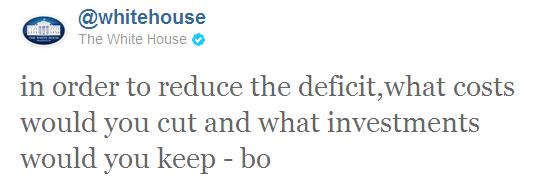
        THE PRESIDENT:  I'm going to make history here as the first President to live tweet.  So we've got a computer over here.  (Types in tweet.)

        MR. DORSEY:  It's only 140 characters.  (Laughter.)  

        THE PRESIDENT:  All right, I think I have done this properly.  But here's the test.  

        MR. DORSEY:  And you tweeted.

        THE PRESIDENT:  How about that?  Not bad.  (Applause.)  Thank you.  So I think my question will be coming up at some point.

        MR. DORSEY:  So what was your question?  Here it is.      

        THE PRESIDENT:  Here's the question:  "In order to reduce the deficit, what costs would you cut and what investments would you keep?"  

        And the reason I thought this was an important question is, as all of you know, we are going through a spirited debate here in Washington, but it's important to get the whole country involved, in making a determination about what are the programs that can help us grow, can create jobs, improve our education system, maintain our clean air and clean water, and what are those things that are a waste that we shouldn’t be investing in because they're not helping us grow or create jobs or creating new businesses.  And that debate is going to be heating up over the next couple of weeks, so I'd love to hear from the American people, see what thoughts they have.  

        MR. DORSEY:  Excellent.  Well, first question comes from a curator in New Hampshire.  And we have eight curators around the country helping us pick tweets from the crowd so that we can read them to the President.  

        And this one comes from William Smith:  "What mistakes have you made in handling this recession and what would you do differently?"

        THE PRESIDENT:  That's a terrific question.  When I first came into office we were facing the worst recession since the Great Depression.  So, looking around this room, it's a pretty young room -- it's certainly the worst recession that we've faced in our lifetimes.  And we had to act quickly and make some bold and sometimes difficult decisions.

        It was absolutely the right thing to do to put forward a Recovery Act that cut taxes for middle-class folks so they had more money in their pocket to get through the recession.  It was the right thing to do to provide assistance to states to make sure that they didn’t have to lay off teachers and cops and firefighters as quickly as they needed to.  And it was the right thing to do to try to rebuild our infrastructure and put people back to work building roads and bridges and so forth.

        It also was the right thing to do, although a tough decision, to save the auto industry, which is now profitable and gaining market share -- the U.S. auto industry -- for the first time in a very long time.

        I think that -- probably two things that I would do differently.  One would have been to explain to the American people that it was going to take a while for us to get out of this.  I think even I did not realize the magnitude, because most economists didn’t realize the magnitude, of the recession until fairly far into it, maybe two or three months into my presidency where we started realizing that we had lost 4 million jobs before I was even sworn in.  

        And so I think people may not have been prepared for how long this was going to take and why we were going to have to make some very difficult decisions and choices.  And I take responsibility for that, because setting people’s expectations is part of how you end up being able to respond well.

        The other area is in the area of housing.  I think that the continuing decline in the housing market is something that hasn’t bottomed out as quickly as we expected.  And so that’s continued to be a big drag on the economy.  

        We’ve had to revamp our housing program several times to try to help people stay in their homes and try to start lifting home values up.  But of all the things we’ve done, that’s probably been the area that’s been most stubborn to us trying to solve the problem.

        MR. DORSEY:  Mr. President, 27 percent of our questions are in the jobs category, as you can see from the screen over here.  Our next question has to do about jobs and technology.  It comes from David:  "Tech and knowledge industries are thriving, yet jobs discussion always centers on manufacturing.  Why not be realistic about jobs?"  

        THE PRESIDENT:  Well, it’s not an either/or question; it’s a both/and question.  We have to be successful at the cutting-edge industries of the future like Twitter.  But we also have always been a country that makes stuff.  And manufacturing jobs end up having both higher wages typically, and they also have bigger multiplier effects.  So one manufacturing job can support a range of other jobs -- suppliers and the restaurant near the plant and so forth.  So they end up having a substantial impact on the overall economy.

        What we want to focus on is advanced manufacturing that combines new technology, so research and development to figure out how are we going to create the next Twitter, how are we going to create the next Google, how are we going to create the next big thing -- but make sure that production is here.  

        So it’s great that we have an Apple that’s creating iPods, iPads and designing them and creating the software, but it would be nice if we’re also making the iPads and the iPods here in the United States, because that's some more jobs that people can work at.  

        And there are going to be a series of decisions that we’ve got to make.  Number one, are we investing in research and development in order to emphasize technology?  And a lot of that has to come from government.  That's how the Internet got formed. That's how GPS got formed.  Companies on their own can’t always finance the basic research because they can’t be assured that they’re going to get a return on it.

        Number two, we’ve got to drastically improve how we train our workforce and our kids around math and science and technology.

        Number three, we’ve got to have a top-notch infrastructure to support advanced manufacturing, and we’ve got to look at sectors where we know this is going to be the future.  Something like clean energy, for example.  For us not to be the leaders in investing in clean energy manufacturing so that wind turbines and solar panels are not only designed here in the United States but made here in the United States makes absolutely no sense.  We’ve got to invest in those areas for us to be successful.

        So you can combine high-tech with manufacturing, and then you get the best of all worlds.

        MR. DORSEY:  You mentioned education.  There's a lot of questions coming about education and its impact on the economy.  This one in particular is from a curator who is pulling from a student in Ohio, named Dustin:  "Higher ed is necessary for a stronger economy, but for some middle-class Americans it’s becoming too expensive.  What can be done?"

        THE PRESIDENT:  Well, here is some good news.  We’ve already done something that is very significant, and people may not know. As part of a higher education package that we passed last year, what we were able to do was to take away subsidies that were going to banks for serving as middlemen in the student loan program and funnel that to help young people, through Pell Grants and lower rates on student loans.  And so there are millions of students who are getting more affordable student loans and grants as a consequence of the steps that we’ve already taken.  This is about tens of billions of dollars' worth of additional federal dollars that were going to banks are now going to students directly.

        In addition, what we’ve said is that starting in 2013, young people who are going to college will not have to pay more than 10 percent of their income in repayment.  And that obviously helps to relieve the burden on a lot students -- because, look, I’m a guy who had about $60,000 worth of debt when I graduated from law school, and Michelle had $60,000.  And so we were paying a bigger amount every month than our mortgage.  And we did that for eight, 10 years.  So I know how burdensome this can be.

        I do think that the universities still have a role in trying to keep their costs down.  And I think that it’s important -- even if we've got better student loan programs, more grants, if the costs keep on going up then we'll never have enough money, you'll never get enough help to avoid taking on these huge debts. And so working with university presidents to try to figure out, where can you cut costs -- of course, it may mean that the food in the cafeteria is a little worse and the gym is not as fancy.  But I think all of us have to figure out a way to make sure that higher education is accessible for everybody.

        One last point -- I know, Twitter, I’m supposed to be short. (Laughter.)  But city -- community colleges is a huge, under-utilized resource, where what we want to do is set up a lifelong learning system where you may have gotten your four-year degree, but five years out you decide you want to go into another field or you want to brush up on new technologies that are going to help you advance.  We need to create a system where you can conveniently access community colleges that are working with businesses to train for the jobs that actually exist.  That’s a huge area where I think we can make a lot of progress.

        MR. DORSEY:  You mention debt a lot.  That’s come up in conversation a lot recently, especially in some of our recent questions, specifically the debt ceiling.  And this is formulated in our next question from RenegadeNerd out of Atlanta:  "Mr. President, will you issue an executive order to raise the debt ceiling pursuant to Section 4 of the 14th Amendment?"

        THE PRESIDENT:  Can I just say, RenegadeNerd, that picture is -- captures it all there.  (Laughter.)  He's got his hand over there, he’s looking kind of confused.  (Laughter.)    

        Let me, as quickly as I can, describe what’s at stake with respect to the debt ceiling.  Historically, the United States, whenever it has a deficit, it finances that deficit through the sale of treasuries.  And this is a very common practice.  Over our lifetimes, typically the government is always running a modest deficit.  And Congress is supposed to vote on the amount of debt that Treasury can essentially issue.  It’s a pretty esoteric piece of business; typically has not been something that created a lot of controversy.

        What’s happening now is, is that Congress is suggesting we may not vote to raise the debt ceiling.  If we do not, then the Treasury will run out of money.  It will not be able to pay the bills that are owing, and potentially the entire world capital markets could decide, you know what, the full faith and credit of the United States doesn’t mean anything.  And so our credit could be downgraded, interest rates could go drastically up, and it could cause a whole new spiral into a second recession, or worse.

        So this is something that we shouldn’t be toying with.  What Dexter’s question referred to was there are some people who say that under the Constitution, it’s unconstitutional for Congress not to allow Treasury to pay its bills and are suggesting that this should be challenged under the Constitution.  

        I don’t think we should even get to the constitutional issue.  Congress has a responsibility to make sure we pay our bills.  We’ve always paid them in the past.  The notion that the U.S. is going to default on its debt is just irresponsible.  And my expectation is, is that over the next week to two weeks, that Congress, working with the White House, comes up with a deal that solves our deficit, solves our debt problems, and makes sure that our full faith and credit is protected.

        MR. DORSEY:  So back to jobs.  We have a question from New York City about immigrant entrepreneurs:  "Immigrant entrepreneurs can build companies and create jobs for U.S. workers.  Will you support a startup visa program?"

        THE PRESIDENT:  What I want to do is make sure that talented people who come to this country to study, to get degrees, and are willing and interested in starting up businesses can do so, as opposed to going back home and starting those businesses over there to compete against the United States and take away U.S. jobs.

        So we’re working with the business community as well as the entrepreneurial community to figure out are there ways that we can streamline the visa system so if you are studying here, you’ve got a PhD in computer science or you’ve got a PhD in engineering, and you say I’m ready to invest in the United States, create jobs in the United States, then we are able to say to you, we want you to stay here.  

        And I think that it is possible for us to deal with this problem.  But it’s important for us to look at it more broadly.  We’ve got an immigration system that’s broken right now, where too many folks are breaking the law but also our laws make it too hard for talented people to contribute and be part of our society.  And we’ve always been a nation of laws and a nation of immigrants.  And so we need comprehensive immigration reform, part of which would allow entrepreneurs and high-skilled individuals to stay here -- because we want to be attracting that talent here.  We don’t want that -- we don’t want to pay for training them here and then having them benefit other countries.

        MR. DORSEY:  Our next question was just -- was sent just an hour ago and touches on alternative energy and job creation:  "Will you focus on promoting alternative energy industries in oil states like Louisiana and Texas?"

        THE PRESIDENT:  I want to promote alternative energy everywhere, including oil states like Louisiana and Texas.  This is something that I’m very proud of and doesn’t get a lot of attention.  We made the largest investment in clean energy in our history through the Recovery Act.  And so we put forward a range of programs that provided credits and grants to startup companies in areas like creating wind turbines, solar panels.  

        A great example is advanced battery manufacturing.  When I came into office, advanced batteries, which are used, for example, in electric cars, we only accounted for 2 percent of the world market in advanced batteries.  And we have quintupled our market share, or even gone further, just over the last two years. And we’re projecting that we can get to 30 to 40 percent of that market.  That’s creating jobs all across the Midwest, all across America.  

        And whoever wins this race on advanced battery manufacturing is probably going to win the race to produce the cars of the 21st century.  China is investing in it.  Germany is investing in it. We need to be investing in it as well.  

        MR. DORSEY:  I wanted to take a moment and point out the map just behind you.  These are tweets coming in, in real time, and these are questions being asked right now.  And it flips between the various categories that we’ve determined and also just general askObama questions.  

        So our next question is coming up on the screen now, from Patrick:  “Mr. President, in several states we have seen people lose their collective bargaining rights.  Do you have a plan to rectify this?"  

        THE PRESIDENT:  The first thing I want to emphasize is that collective bargaining is the reason why the vast majority of Americans enjoy a minimum wage, enjoy weekends, enjoy overtime.  So many things that we take for granted are because workers came together to bargain with their employers.  

        Now, we live in a very competitive society in the 21st century.  And that means in the private sector, labor has to take management into account.  If labor is making demands that make management broke and they can’t compete, then that doesn’t do anybody any good.  

        In the public sector, what is true is that some of the pension plans that have been in place and the health benefits that are in place are so out of proportion with what’s happening in the private sector that a lot of taxpayers start feeling resentful.  They say, well, if I don’t have health care where I only have to pay $1 for prescription drugs, why is it that the person whose salary I’m paying has a better deal?  

        What this means is, is that all of us are going to have to make some adjustments.  But the principle of collective bargaining, making sure that people can exercise their rights to be able to join together with other workers and to negotiate and kind of even the bargaining power on either side, that’s something that has to be protected.  And we can make these adjustments in a way that are equitable but preserve people’s collective bargaining rights.

        So, typically, the challenges against bargaining rights have been taking place at the state level.  I don't have direct control over that.  But what I can do is to speak out forcefully for the principle that we can make these adjustments that are necessary during these difficult fiscal times, but do it in a way that preserves collective bargaining rights.  And certainly at the federal level where I do have influence, I can make sure that we make these adjustments without affecting people’s collective bargaining rights.

        I'll give you just one example.  We froze federal pay for federal workers for two years.  Now, that wasn’t real popular, as you might imagine, among federal workers.  On the other hand, we were able to do that precisely because we wanted to prevent layoffs and we wanted to make sure that we sent a signal that everybody is going to have to make some sacrifices, including federal workers.

        By the way, people who work in the White House, they’ve had their pay frozen since I came in, our high-wage folks.  So they haven’t had a raise in two and a half years, and that's appropriate, because a lot of ordinary folks out there haven’t, either.  In fact, they’ve seen their pay cut in some cases.

        MR. DORSEY:  Mr. President, 6 percent of our questions are coming in about housing, which you can see in the graph behind me.  And this one in particular has to do with personal debt and housing:  “How will admin work to help underwater homeowners who aren’t behind in payments but are trapped in homes they can’t sell?”  From Robin.

        THE PRESIDENT:  This is a great question.  And remember, I mentioned one of our biggest challenges during the course of the last two and a half years has been dealing with a huge burst of the housing bubble.  

        What's happened is a lot of folks are underwater, meaning their home values went down so steeply and so rapidly that now their mortgage, the amount they owe, is a lot more than the assessed worth of their home.  And that obviously burdens a lot of folks.  It means if they’re selling, they’ve got to sell at a massive loss that they can’t afford.  It means that they don’t feel like they have any assets because the single biggest asset of most Americans is their home.

        So what we’ve been trying to do is to work with the issuers of the mortgages, the banks or the service companies, to convince them to work with homeowners who are paying, trying to do the right thing, trying to stay in their homes, to see if they can modify the loans so that their payments are lower, and in some cases, maybe even modify their principal, so that they don’t feel burdened by these huge debts and feel tempted to walk away from homes that actually they love and where they’re raising their families.

        We’ve made some progress.  We have, through the programs that we set up here, have probably seen several million home modifications either directly because we had control of the loan process, or because the private sector followed suit.  But it’s not enough.  And so we’re going back to the drawing board, talking to banks, try to put some pressure on them to work with people who have mortgages to see if we can make further adjustments, modify loans more quickly, and also see if there may be circumstances where reducing principal is appropriate.

        MR. DORSEY:  And our next question comes from someone you may know.  This is Speaker Boehner.

        THE PRESIDENT:  Oh, there you go.  (Laughter.)

        MR. DORSEY:  “After embarking on a record spending binge that left us deeper in debt, where are the jobs?”  And I want to note that these characters are his fault.  (Laughter.)

        THE PRESIDENT:  First of all --

        MR. DORSEY:  Not his fault, not his fault.

        THE PRESIDENT:  -- John obviously needs to work on his typing skills.  (Laughter.)  Well, look, obviously John is the Speaker of the House, he’s a Republican, and so this is a slightly skewed question.  (Laughter.)  But what he’s right about is that we have not seen fast enough job growth relative to the need.  I mean, we lost, as I said, 4 million jobs before I took office, before I was sworn in.  About 4 million jobs were lost in the few months right after I took office before our economic policies had a chance to take any effect.  

        And over the last 15 months, we’ve actually seen two million jobs created in the private sector.  And so we’re each month seeing growth in jobs,  But when you’ve got a 8 million dollar -- 8-million-job hole and you’re only filling it 100,000-200,000 jobs at a time each month, obviously that’s way too long for a lot of folks who are still out of work.

        There are a couple of things that we can continue to do.  I actually worked with Speaker Boehner to pass a payroll tax cut in December that put an extra $1,000 in the pockets of almost every single American.  That means they’re spending money.  That means that businesses have customers.  And that has helped improve overall growth.

        We have provided at least 16 tax cuts to small businesses who have needed a lot of help and have been struggling, including, for example, saying zero capital gains taxes on startups -- because our attitude is we want to encourage new companies, young entrepreneurs, to get out there, start their business, without feeling like if they’re successful in the first couple of years that somehow they have to pay taxes, as opposed to putting that money back into their business.

        So we’ve been able to cooperate with Republicans on a range of these issues.  There are some areas where the Republicans have been more resistant in cooperating, even though I think most objective observers think it’s the right thing to do.  I’ll give you a specific example.  

        It’s estimated that we have about $2 trillion worth of infrastructure that needs to be rebuilt.  Roads, bridges, sewer lines, water mains; our air traffic control system doesn’t make sense.  We don’t have the kind of electric grid that’s smart, meaning it doesn’t waste a lot of energy in transmission.  Our broadband system is slower than a lot of other countries.

        For us to move forward on a major infrastructure initiative where we’re putting people to work right now -- including construction workers who were disproportionately unemployed when the housing bubble went bust -- to put them to work rebuilding America at a time when interest rates are very low, contractors are looking for work, and the need is there, that is something that could make a huge, positive impact on the economy overall.  And it’s an example of making an investment now that ends up having huge payoffs down the road.  

        We haven’t gotten the kind of cooperation that I’d like to see on some of those ideas and initiatives.  But I’m just going to keep on trying and eventually I’m sure the Speaker will see the light.  (Laughter.)

        MR. DORSEY:  Speaking of startups, there’s a ton of questions about small businesses and how they affect job creation.  This one comes from Neal:  “Small biz create jobs.  What incentives are you willing to support to improve small business growth?”

        THE PRESIDENT:  Well, I just mentioned some of the tax breaks that we’ve provided not only to small businesses, but also in some cases were provided big businesses.  For example, if they’re making investments in plants and equipment this year, they can fully write down those costs, take -- essentially depreciate all those costs this year and that saves them a pretty big tax bill.  So we’re already initiating a bunch of steps.  

        The biggest challenge that I hear from small businesses right now actually has to do with financing, because a lot of small businesses got their financing from community banks.  Typically, they’re not getting them from the big Wall Street banks, but they’re getting them from their various regional banks in their communities.  A lot of those banks were pretty over-extended in the commercial real estate market, which has been hammered.  A lot of them are still digging themselves out of bad loans that they made that were shown to be bad during the recession.  

        And so, what we’ve tried to do is get the Small Business Administration, the federal agency that helps small businesses, to step in and to provide more financing -- waiving fees, seeing if we can lower interest rates in some cases, making sure that the threshold for companies that qualify for loans are more generous.  And that’s helped a lot of small businesses all across the country.  And this is another example of where, working with Congress, my hope is, is that we can continue to provide these tax incentives and maybe do even a little bit more.

        Q    Our next question was tweeted less than five minutes ago and comes to us from Craig:  “My question is, can you give companies a tax break if they hire an honorable discharged veteran?”  

        THE PRESIDENT:  This is something that I’ve been talking a lot about internally.  We’ve got all these young people coming back from Iraq and Afghanistan; have made incredible sacrifices; have taken on incredible responsibilities.  You see some 23-year-old who's leading a platoon in hugely dangerous circumstances, making decisions, operating complex technologies.  These are folks who can perform.  But, unfortunately, what we’re seeing is that a lot of these young veterans have a higher unemployment rate than people who didn’t serve.  And that makes no sense.

        So what we’d like to do is potentially combine a tax credit for a company that hires veterans with a campaign to have private companies step up and do the right thing and hire more veterans. And one of the things that we’ve done is internally in the federal government we have made a huge emphasis on ramping up our outreach to veterans and the hiring of veterans, and this has been a top priority of mine.  The notion that these guys who are sacrificing for our freedom and our security end up coming home and not being able to find a job I think is unacceptable.

        MR. DORSEY:  Mr. President, this next question comes from someone else you may recognize.  And what's interesting about this question, it was heavily retweeted and voted up by our userbase.  This comes from NickKristof:  “Was it a mistake to fail to get Republicans to commit to raise the debt ceiling at the same time tax cuts were extended?”

        THE PRESIDENT:  Nicholas is a great columnist.  But I have to tell you the assumption of the question is, is that I was going to be able to get them to commit to raising the debt ceiling.  

        In December, we were in what was called the lame duck session.  The Republicans knew that they were going to be coming in as the majority.  We only had a few short weeks to deal with a lot of complicated issues, including repealing "don't ask, don't tell," dealing with a START treaty to reduce nuclear weapons, and come to terms with a budget.  And what we were able to do was negotiate a package where we agreed to do something that we didn’t like but that the Republicans badly wanted, which is to extend the Bush tax cuts on the wealthy for another two years.  

        In exchange, we were able to get this payroll tax that put $1,000 -- tax cut that put $1,000 in the pockets of every American, which would help economic growth and jobs.  We were also able to get unemployment insurance extended for the millions of Americans out there who are still out of work and whose benefits were about to run out.  And that was a much better deal than I think a lot of people expected.  

        It would have been great if we were able to also settle this issue of the debt ceiling at that time.  That wasn’t the deal that was available.  But here’s the more basic point:  Never in our history has the United States defaulted on its debt.  The debt ceiling should not be something that is used as a gun against the heads of the American people to extract tax breaks for corporate jet owners, or oil and gas companies that are making billions of dollars because the price of gasoline has gone up so high.  

        I’m happy to have those debates.  I think the American people are on my side on this.  What we need to do is to have a balanced approach where everything is on the table.  We need to reduce corporate loopholes.  We need to reduce discretionary spending on programs that aren’t working.  We need to reduce defense spending.  Everything has -- we need to look at entitlements, and we have to say, how do we protect and preserve Medicare and Social Security for not just this generation but also future generations.  And that’s going to require some modifications, even as we maintain its basic structure.

        So what I’m hoping to see over the next couple of weeks is people put their dogmas aside, their sacred cows aside; they come together and they say, here’s a sensible approach that reduces our deficit, makes sure that government is spending within its means, but also continues to make investments in education, in clean energy, and basic research that are going to preserve our competitive advantage going forward.

        MR. DORSEY:  So speaking of taxes, our next question is coming from us -- from Alabama, from Lane:  "What changes to the tax system do you think are necessary to help solve the deficit problem and for the system to be fair?"

        THE PRESIDENT:  Well, I think that, first of all, it’s important for people to realize that since I’ve been in office I’ve cut taxes for middle-class families, repeatedly.  The Recovery Act cut taxes for 95 percent of working families.  The payroll tax cut that we passed in December put an extra thousand dollars in the pockets of every family in America.

        And so we actually now have the lowest tax rates since the 1950s.  Our tax rates are lower now than they were under Ronald Reagan.  They’re lower than they were under George Bush -- senior or George Bush, junior.  They’re lower than they were under Bill Clinton.

        The question is how do we pay for the things that we all think are important and how do we make sure that the tax system is equitable?  And what I’ve said is that in addition to eliminating a whole bunch of corporate loopholes that are just not fair -- the notion that corporate jets should get a better deal than commercial jets, or the notion that oil and gas companies that made tens of billions of dollars per quarter need an additional break to give them an incentive to go drill for oil -- that doesn’t make sense.

        But what I’ve also said is people like me who have been incredibly fortunate, mainly because a lot of folks bought my book -- (laughter) -- for me to be able to go back to the tax rate that existed under Bill Clinton, to pay a couple of extra percentage points so that I can make sure that seniors still have Medicare or kids still have Head Start, that makes sense to me.  And, Jack, we haven’t talked about this before, but I’m assuming it makes sense to you, given Twitter has done pretty well.  (Laughter.)

        I think that for us to say that millionaires and billionaires can go back to the tax rate that existed when Bill Clinton was President, that doesn’t affect middle-class families who are having a tough time and haven’t seen their incomes go up. It does mean that those who are in the top 1-2 percent, who have seen their incomes go up much more quickly than anybody else, pays a little bit more in order to make sure that we can make the basic investments that grow this country -- that’s not an unreasonable position to take.  And the vast majority of Americans agree with me on that.

        That doesn’t mean that we can just continue spending anything we want.  We’re still going to have to make some tough decisions about defense spending, or even some programs that I like but we may not need.  But we can’t close the deficit and debt just by cutting things like Head Start or Medicare.  That can’t be an equitable solution to solving the problem.  And then, we say to millionaires and billionaires, you don’t have to do anything.  I don’t want a $200,000 tax break if it means that some senior is going to have to pay $6,000 more for their Medicare that they don’t have, or a bunch of kids are going to be kicked off of Head Start and aren’t going to get the basics that they need in order to succeed in our society.  I don’t think that’s good for me; I don’t think it’s good for the country.

        MR. DORSEY:  So we have a follow-up question to your answer about homeowners being underwater.  And this one came in under 10 minutes ago from Shnaps:  "Is free-market an option?  Obama on homeowners underwater: have made some progress, but plus needed looking at options."

        THE PRESIDENT:  Well, when Shnaps -- (laughter) -- when Shnaps talks about free market options, I mean, keep in mind that most of this is going to be a function of the market slowly improving because people start having more confidence in the economy; more people decide, you know what, the housing market has kind of bottomed out, now is the time to buy.  They start buying.  That starts slowly lifting up prices, and you get a virtuous cycle going on.  

        So a lot of this is going to be determined by how well the overall economy does:  Do people feel more confident about jobs? Do they feel more confident that they’re going to be able to make their mortgage?  And given the size of the housing market, no federal program is going to be able to solve the housing problem. Most of this is going to be free market.

        The one thing that we can do it make sure that for homeowners who have been responsible, didn’t buy more house than they could afford, had some tough luck because they happened to buy at the top of the market, can afford to continue to pay for that house, can afford their current mortgage, but need some relief, given the drop in value -- that we try to match them up with bankers so that each side ends up winning.  The banker says, you know, I’m going to be better off than if this house is foreclosed upon and I have to sell it at a fire sale.  The mortgage owner is able to stay in their home, but still pay what’s owed.  

        And I think that that kind of adjustment and negotiation process is tough.  It’s difficult partly because a lot of banks these days don’t hold mortgages.  They were all sold to Wall Street and were sliced and diced in these complex financial transactions.  So sorting through who owns what can be very complicated.  And as you know, some of the banks didn’t do a very good job on filing some of their papers on these foreclosure actions, and so there’s been litigation around that.  

        But the bottom line is we should be able to make some progress on helping some people, understanding that some folks just bought more home than they could afford and probably they’re going to be better off renting.  

        MR. DORSEY:  So 10 percent of our questions now are about education, and this one was surfaced from our curator in California by Marcia:  “Public education here in California is falling apart, not graduating enough skilled workers or smart citizens.  Privatization looming?”

        THE PRESIDENT:  Look, when America was making a transition from an agricultural society to an industrial society, we as a country made a decision that we were going to have public high schools that would upgrade the skills of young people as they were leaving the farms and start participating in a more complex industrial economy.  When my grandfather’s generation came back from World War II, we made a decision that we were going to have a GI Bill that would send these young people to college because we figured that would help advance our economy.  

        Every time we’ve made a public investment in education, it has paid off many times over.  For us now to give short shrift to education when the world is more complex than ever, and it’s a knowledge-based society and companies locate based on whether they’ve got skilled workforces or not, that makes no sense.

        And so we’ve got to get our priorities straight here.  It is important for us to have a healthy business climate, to try to keep taxes low, to make sure that we’re not spending on things that don’t work.  It’s important that we get a good bang for the buck in education.  And so my administration has pushed more reform more vigorously across the country through things like Race to the Top than most previous administrations have been able to accomplish.  So we don’t just need more money; we need more reform.

        But we do have to pay for good teachers.  Young, talented people aren’t going to go into teaching if they’re getting paid a poverty wage.  We do have to make sure that buildings aren’t crumbling.  It's pretty hard for kids to concentrate if there are leaks and it’s cold and there are rats running around in their schools.  And that’s true in a lot of schools around the country.

        We do have to make sure that there are computers in a computer age inside classrooms, and that they work and that there’s Internets that are actually -- there are Internet connections that actually function.  

        And I think that those states that are going to do well and those countries that do well are the ones that are going to continue to be committed to making education a priority.

        MR. DORSEY:  We have another follow-up sent about 10 minutes ago in response to your answer on Vietnam vets.  From Brendan:  “We definitely need to get more vets into jobs, but when are we going to support the troops by cutting oil dependence?”

        THE PRESIDENT:  Reducing our dependence on oil is good for our economy, it’s good for our security, and it’s good for our planet -- so it’s a "three-fer."  And we have not had a serious energy policy for decades.  Every President talks about it; we don’t get it done.  

        Now, I’d like to see robust legislation in Congress that actually took some steps to reduce oil dependency. We’re not going to be able to replace oil overnight.  Even if we are going full-throttle on clean energy solutions like solar and wind and biodiesel, we’re going to need oil for some time.  But if we had a goal where we’re just reducing our dependence on oil each year in a staggered set of steps, it would save consumers in their pocketbook; it would make our businesses more efficient and less subject to the whims of the spot oil market; it would make us less vulnerable to the kinds of disruptions that have occurred because of what happened in the Middle East this spring; and it would drastically cut down on our carbon resources.

        So what I -- unfortunately, we have not seen a sense of urgency coming out of Congress over the last several months on this issue.  Most of the rhetoric has been about, let’s produce more.  Well, we can produce more, and I’m committed to that, but the fact is, we only have 2 to 3 percent of the world’s oil reserves; we use 25 percent of the world’s oil.  We can’t drill our way out of this problem.

        What we can do that we’ve already done administratively is increase fuel-efficiency standards on cars, just to take one example.  That will save us millions of barrels of oil, just by using existing technologies and saying to car companies, you can do better than 10 miles a gallon or 15 miles a gallon.  And you’re starting to see Detroit respond.  U.S. car companies have figured out, you know what, if we produce high-quality electric vehicles, if we produce high-quality low gas -- or high gas mileage vehicles, those will sell.  

        And we’re actually starting to see market share increase for American cars in subcompact and compact cars for the first time in many years.  And that’s partly because we increased fuel-efficiency standards through an administrative agreement.  It’s also because, as part of the deal to bail out the oil companies, we said to them, start focusing on the cars of the future instead of looking at big gas guzzlers of the past.

        MR. DORSEY:  So all of our questions now are coming in real time -- this one less than 10 minutes ago, and surfaced from a curator:  "So will you raise taxes on the middle class at least to President George W. Bush levels?"

        THE PRESIDENT:  No, what we’ve said is let’s make permanent the Bush tax cuts for low and moderate income folks -- people in -- for the 98 percent of people who, frankly, have not seen their wages go up or their incomes go up over the last decade.  They don’t have a lot of room; they’re already struggling to meet the rising cost of health care and education and gas prices and food prices.  

        If all we do is just go back to the pre-Bush tax cut rates for the top income brackets, for millionaires and billionaires, that would raise hundreds of billions of dollars.  And if you combine it with the cuts we’ve already proposed, we could solve our deficit and our debt problems.  

        This is not something that requires radical solutions.  It requires some smart, common-sense, balanced approaches.  I think that’s what the American people are looking for and that’s what I’ve proposed.  And that’s what I’m going to keep on trying to bring the parties together to agree to, is a balanced approach that has more cuts than revenue, but has some revenue, and that revenue should come from the people who can most afford it.

        Q    So a slight deviation from the economy -- we have a lot of questions, and this will be our last before we start reading some responses to your question -- about the space program.  And this one from Ron:  "Now that the space shuttle is gone, where does America stand in space exploration?"

        THE PRESIDENT:  We are still a leader in space exploration. But, frankly, I have been pushing NASA to revamp its vision.  The shuttle did some extraordinary work in low-orbit experiments, the International Space Station, moving cargo.  It was an extraordinary accomplishment and we’re very proud of the work that it did.  But now what we need is that next technological breakthrough.  

        We’re still using the same models for space travel that we used with the Apollo program 30, 40 years ago.  And so what we’ve said is, rather than keep on doing the same thing, let’s invest in basic research around new technologies that can get us places faster, allow human space flight to last longer.  

        And what you’re seeing now is NASA I think redefining its mission.  And we’ve set a goal to let’s ultimately get to Mars.  A good pit stop is an asteroid.  I haven’t actually -- we haven’t identified the actual asteroid yet, in case people are wondering. (Laughter.)  But the point is, let’s start stretching the boundaries so we’re not doing the same thing over and over again, but rather let’s start thinking about what’s the next horizon, what’s the next frontier out there.

        But in order to do that, we’re actually going to need some technological breakthroughs that we don’t have yet.  And what we can do is for some of this low-orbit stuff, some of the more routine space travel -- obviously no space travel is routine, but it could become more routine over time -- let’s allow the private sector to get in so that they can, for example, send these low-Earth orbit vehicles into space and we may be able to achieve a point in time where those of you who are just dying to go into space, you can buy a ticket, and a private carrier can potentially take you up there, while the government focuses on the big breakthroughs that require much larger investments and involve much greater risk.

        MR. DORSEY:  So, Mr. President, we received a lot of responses to your question over the last hour.  And we wanted to go through seven of them that we picked out and just spend some time giving feedback on each.  This one from Brian:  "Cut defense contracting, end war on drugs, eliminate agribiz and big oil subsidies, invest in public campaign financing."

        THE PRESIDENT:  Well, that’s not a bad list.  (Laughter.)  The defense contracting is something we’re already making progress on.  

        I think with respect to the war on drugs, what we’ve always said is that investing in prevention, reducing demand, is going to be the most cost-effective thing that we can do.  We still have to interdict the big drug kingpins and we still have to enforce our drug laws.  But making sure that we’re spending more on prevention and treatment can make a huge difference.

        With respect to some of these big agribusiness and big oil subsidies, those are the examples of the kinds of loopholes we can close.  And public campaign financing is something that I’ve supported in the past.  There is no doubt that money has an impact on what happens here in Washington.  And the more we can reduce money’s impact on Washington, the better off we’re going to be.

        MR. DORSEY:  Our next response from Elizabeth in Chicago:  “Stop giving money to countries that waste it -- Pakistan.  Keep military, share the wealth between branches, and don’t cut education.”

        THE PRESIDENT:  You know, the one thing I would say is, on the notion of giving money to countries that waste it -- and Pakistan is listed there -- I think it’s important for people to know that foreign aid accounts for less than 2 percent of our budget.  And if you defined it just narrowly as the kind of foreign aid to help feed people and what we think of classically as foreign aid, it’s probably closer to 1 percent.

        So sometimes people have an exaggerated sense that we spend 25 percent of the federal budget on foreign aid.  It’s a tiny amount that has a big impact.  And I think America, to be a leader in the world, to have influence, to help stabilize countries and create opportunity for people so that they don’t breed terrorists or create huge refugee flows and so forth, it’s smart for us to make a very modest investment in foreign aid.  It’s a force multiplier and it’s something that even in tough fiscal times America needs to continue to do as part of our role as a global leader.

        MR. DORSEY:  This next one is pretty simple, from Daniel:  “We need to raise taxes, period.”  (Laughter.)  

        THE PRESIDENT:  As I said before, if wealthy individuals are willing to simply go back to the rates that existed back in the 1990s when rich people were doing very well -- it’s not like they were poor -- and by the way, that’s when we saw the highest job growth rates and that’s when we saw the highest -- the greatest reduction in poverty, and that’s when we saw businesses very profitable -- if the wealthiest among us -- and I include myself in this category -- are willing to give up a little bit more, then we can solve this problem.  It does not take a lot.

        And I just have to say, when people say, job-killing tax increases, that’s what Obama is proposing, we’re not going to -- you’re entitled to your own opinions, but not your own facts.  And the facts are that a modest increase for wealthy individuals is not shown to have an adverse impact on job growth.  

        I mean, we can test the two theories.  You had what happened during the ‘90s -- right?  Taxes for wealthy individuals were somewhat higher, businesses boomed, the economy boomed, great job growth.  And then the 2000s, when taxes were cut on wealthy individuals, jobs didn’t grow as fast, businesses didn’t grow as fast.  I mean, it’s not like we haven’t tried what these other folks are pitching.  It didn’t work.  And we should go with what works.

        MR. DORSEY:  So our next response -- we have about nine minutes left and four more responses -- this one from Tammy:   “Cut military spending on oil subsidies and keep education investments.”

        THE PRESIDENT:  I agree with this.  The one thing I’ll say about military spending -- we’ve ended the war in Iraq, our combat mission there, and our -- all our troops are slated to be out by the end of this year.  We’ve already removed 100,000.  I announced that we were going to begin drawing down troops in Afghanistan and pivot to a transition process where Afghans are taking more responsibility for their defense.  

        But we have to do all of this in a fairly gradual way.  We can’t simply lop off 25 percent off the defense budget overnight. We have to think about all the obligations we have to our current troops who are in the field, and making sure they’re properly equipped and safe.  We’ve got to make sure that we are meeting our commitments for those veterans who are coming home.  We’ve got to make sure that -- in some cases, we’ve got outdated equipment that needs to be replaced.

        And so I’m committed to reducing the defense budget, but as Commander-in-Chief, one of the things that we have to do is make sure that we do it in a thoughtful way that’s guided by our security and our strategic needs.  And I think we can accomplish that.  And the nice thing about the defense budget is it’s so big, it’s so huge, that a 1 percent reduction is the equivalent of the education budget.  Not -- I’m exaggerating, but it’s so big that you can make relatively modest changes to defense that end up giving you a lot of head room to fund things like basic research or student loans or things like that.

        Q    Our next response from southwest Ohio, Mostlymoderate: “Cut subsidies to industries which are no longer in crisis or are unsuccessful, cotton, oil, corn subsidies from ethanol.”

        THE PRESIDENT:  Well, there’s been a interesting debate taking place in Congress recently.  I’m a big supporter of biofuels.  But one of the things that's become clear is, is that we need to accelerate our basic research in ethanol and other biofuels that are made from things like woodchips and algae as opposed to just focusing on corn, which is probably the least efficient energy producer of these various other approaches.  

        And so I think that it’s important for even those folks in farm states who traditionally have been strong supporters of ethanol to examine are we, in fact, going after the cutting-edge biodiesel and ethanol approaches that allow, for example, Brazil to run about a third of its transportation system on biofuels.  Now, they get it from sugar cane and it’s a more efficient conversion process than corn-based ethanol.  And so us doing more basic research in finding better ways to do the same concept I think is the right way to go.

        Q    I believe you addressed this next one, so we’re going to skip past it.

        THE PRESIDENT:  I did.  

        Q    But from Ryan:  “I would cut defense spending.”

        Q    And James:  “I’d cut costs by cutting some welfare programs.  People will never try harder when they are handed everything.”

        THE PRESIDENT:  Well, here’s what I would say.  I think we should acknowledge that some welfare programs in the past were not well-designed and in some cases did encourage dependency.  And as somebody who worked in low-income neighborhoods, I’ve seen it, where people weren’t encouraged to work, weren’t encouraged to upgrade their skills, were just getting a check, and over time their motivation started to diminish.  And I think even if you’re progressive, you’ve got to acknowledge that some of these things have not been well-designed.  

        I will say that today, welfare payments are not the big driver of our deficit or our debt.  There are work obligations attached to welfare, that the vast majority of folks who are getting welfare want to work but can’t find jobs.  And what we should be doing is in all our social programs evaluating what are upgrading people’s skills, giving them the tools they need to get into the workforce, nudging them into the workforce but letting them know that we’re there to support you and encourage you as long as you’re showing the kind of responsibility for being willing to work that every American should be expected to show.  

        And I’m somebody who believes that we can constantly improve any program, whether it’s a defense program -- those who say that we can’t cut military at all, they haven’t spent a lot of time looking at military budgets.  Those who say that we can’t make any changes to our social welfare programs or else you’re being mean to poor people, that’s not true.  There are some programs that can always be improved.  And some programs, if they don’t work, we should have the courage to eliminate them, and then use that money to put it into the programs that do work.

        But the bottom line is that our core values of responsibility, opportunity, making sure that the American Dream is alive and well so that anybody who is willing to put in the time and the effort and the energy are able to get a good education in this society, find a job that pays a living wage, that they’re able to send their kids to college without going broke, that they’ve got basic health care, they’re going to be able to retire with some dignity and some respect, that that opportunity is open to anybody regardless of race or religion or sexual orientation -- that that basic principle, that’s what holds us together.  That’s what makes us Americans.  

        We’re not all tied together by ethnicity or a single religion.  What ties us together is this idea that everybody has got a shot.  As long as you carry out your responsibilities, you can make it.  You can get into the middle class and beyond.  And you can start a company and suddenly help bring the whole world together.  That’s what makes this country outstanding.

        But in order to do that, it requires us to both have a commitment to our individualism and our freedom and our creativity and our idiosyncrasies.  But it also requires us to have a commitment to each other, and recognize that I would not be President if somebody hadn’t helped provide some scholarships for my school, and you would not have Twitter if the Department of Defense, at some point, and a bunch of universities hadn’t made some investments in something that ended up being the Internet.  And those were public goods that were invested in.

        So you and I are sitting here because somebody, somewhere, made an investment in our futures.  We’ve got the same obligation for the folks who are coming up behind us.  We’ve got to make sure that we’re looking out for them, just like the previous generations looked out for us.  And that’s what I think will help us get through what are some difficult times and make sure that America’s future is even brighter than the past.

        MR. DORSEY:  And on that note, thank you very much, Mr. President.  (Applause.)

        THE PRESIDENT:  Thank you.  I appreciate it.  (Applause.)  All right, thank you, guys.  Thanks.  (Applause.)

END 3:12 P.M. EDT

Close Transcript

The White House

Office of the Press Secretary

President Obama Announces Presidential Delegation to the Republic of South Sudan to Attend the Ceremony Marking the Declaration of the Independence of the Republic of South Sudan

President Barack Obama today announced the designation of a Presidential Delegation to the Republic of South Sudan to attend the ceremony marking the Declaration of the Independence of the Republic of South Sudan on July 9, 2011.

The Honorable Susan E. Rice, United States Permanent Representative to the United Nations will lead the delegation.

Members of the Presidential Delegation:

The Honorable Donald M. Payne, United States Representative from New Jersey and Ranking Member of House Foreign Affairs Subcommittee on Africa, Global Health, and Human Rights

The Honorable Colin L. Powell, Former Secretary of State and Chairman of the Joint Chiefs of Staff

The Honorable Johnnie Carson, Assistant Secretary of State for the Bureau of African Affairs, Department of State

The Honorable Princeton N. Lyman, United States Special Envoy to Sudan, Department of State

The Honorable Brooke Anderson, Deputy National Security Advisor, Chief of Staff and Counselor for the National Security Staff

The Honorable Donald K. Steinberg, Deputy Administrator, USAID

General Carter F. Ham, Commander, United States Africa Command

The Honorable R. Barrie Walkley, United States Consul General in Juba

Mr. Ken Hackett, President of Catholic Relief Services

President Obama Tweets from the White House

July 06, 2011 | 1:35 | Public Domain

President Obama kicks off the Twitter Town Hall with a Tweet asking the American people for their ideas on reducing the deficit.

Download mp4 (13MB) | mp3 (1MB)

Read the Transcript

Video: The President Tweets from the White House

Watch the President tweet here.

Today, President Obama participated in the first ever Twitter Town Hall at the White House, answering questions from Americans across the country submitted on Twitter using the #AskObama hashtag.

The President kicked off the event with a tweet asking the American public for their ideas on reducing the deficit.

@WhiteHouse in order to reduce the deficit, what costs could you cut and what investments would you keep -bo

Close Transcript