The White House

Office of the Press Secretary

Readout of the President’s Call with Kenyan President Uhuru Kenyatta

President Obama called President Kenyatta today to offer United States support following a major fire at Kenya’s Jomo Kenyatta International Airport.  The President also commemorated this day, the 15th anniversary of al-Qa’ida’s terrorist attack against the U.S. Embassy in Nairobi, by expressing condolences to the loved ones of those killed and wounded in the attack, and highlighting our continued commitment to countering terrorism around the globe.

The White House

Office of the Press Secretary

Readout of the President’s Call with Kenyan President Uhuru Kenyatta

President Obama called President Kenyatta today to offer United States support following a major fire at Kenya’s Jomo Kenyatta International Airport.  The President also commemorated this day, the 15th anniversary of al-Qa’ida’s terrorist attack against the U.S. Embassy in Nairobi, by expressing condolences to the loved ones of those killed and wounded in the attack, and highlighting our continued commitment to countering terrorism around the globe.  

The White House

Office of the Press Secretary

Readout of President Obama’s Call with Prime Minister Erdogan of Turkey

President Obama spoke by phone today from California with Prime Minister Erdogan of Turkey, at the Prime Minister’s request, about developments in Syria and Egypt.  The President and Prime Minister discussed the danger of foreign extremists in Syria and agreed on the importance of supporting a unified and inclusive Syrian opposition.  The President and Prime Minister expressed concern about the situation in Egypt and a shared commitment to supporting a democratic and inclusive way forward.  The two leaders agreed to have their teams continue to coordinate closely to promote our shared interests.  The President gave his best wishes to the Prime Minister and the Turkish people on the beginning of their Ramazan holiday.  

The White House

Office of the Press Secretary

Press Gaggle Aboard Air Force One en route Andrews Air Force Base

Aboard Air Force One
En Route Andrews Air Force Base

2:48 P.M. PDT

MR. CARNEY:  Hey, everybody.  Good afternoon.  Thanks for being here aboard Air Force One as we fly east towards home.  I hope you enjoyed our trip today and the visit to Camp Pendleton. I know the President did.

I have no announcements to make.  I know we put out a variety of announcements today earlier in Washington, so beyond that, I'll just take your questions.  Julie.

Q    Is there anything more you can tell us about the President’s decision-making process to not go to Russia?  When did he make that decision?  And does he plan to talk to Putin before he goes to the G20?
 
MR. CARNEY:  On the last question, I’m not aware of any calls scheduled or conversation scheduled.  As you know, there is a meeting scheduled for Friday, a two-plus-two, foreign and defense ministers, and I think that that represents the fact that we continue to have issues of importance to discuss with the Russians, and we will certainly do that.

The President, like his whole national security team, wanted the Moscow summit decision to be made on the merits, and we looked at the utility of the summit in light of a number of issues and a number of challenges that we've encountered and decided that it did not make sense to have that bilateral summit in Moscow in September.

Q    -- the final decision, though, to scrap the summit? 

MR. CARNEY:  I don't have a time and an hour, but we announced it reasonably soon after the decision was made.

Q    Would you say that the reset with Russia is now over?

MR. CARNEY:  I would say that we have important relations with the Russians.  We engage with them on a variety of matters and we have been able over the years to cooperate and find new cooperation with the Russians as part of the so-called reset approach.  And some of that cooperation continues and is important, including the supply of our troops in Afghanistan as well as cooperation in other areas, as you know.

So there’s no question that we've encountered some challenges in our relations with Russia more recently, but it also should not be viewed entirely in a black-and-white fashion. Even several years ago, as we were making progress in our relationship with Russia in some areas, we continued to have disagreements with them on missile defense and other matters.

So that has always been the case and we've managed to continue to engage in this important relationship because it’s in the best interests of the United States.  So we will do that.

Q    As you were debating whether or not to have the summit did the pros of having a one-on-one, face-to-face meeting to talk about Edward Snowden weigh in at all?  Do you see any -- obviously that's not what you decided, but wouldn't that have also been perhaps worth having an Obama-Putin discussion on?

MR. CARNEY:  Well, the President and President Putin did speak by phone, as we have previously discussed, and Mr. Snowden was one topic of discussion among several others -- or many others.  There’s no question that the Russians clearly understood our perspective. 

There was not another argument to be made about our view that there was ample legal justification for Mr. Snowden to be returned to the United States to face the charges brought against him as a defendant afforded all the protections and rights of defendants in this country.  The arguments that we made or the points we made in public were very much the points we made in private, and not just at the presidential level, but at a variety of levels, including senior law enforcement channels as well as at the Foreign Minister level or Secretary of State level.

So I think that that discussion was had.  Russia made a decision that was disappointing.  But the judgment was made that for a variety of reasons, this was not an optimum time to have a summit.

Q    Is there a concern that this could escalate into leading to trouble for some of the cooperative efforts that the U.S. and Russia are engaged in?

MR. CARNEY:  Well, I don't necessarily see that.  Again, we are continuing to meet and have discussions with our Russian counterparts.  We have a host of issues that we need to engage on between us and we'll continue to do that.  And I think I pointed out that even when we've made progress in some areas in our relations with Russia we have continued to encounter disagreement in other areas, and I expect that will be the case going forward.

Q    Should we expect any other ways that the administration and the President will express their disappointment and frustration?

MR. CARNEY:  I don't have any expectation of that.

Q    I may have missed something just because we've been in the air, but have you heard from the Russians since this announcement was made?

MR. CARNEY:  Well, the President hasn’t had any discussions. I'm sure the State Department and maybe the Defense Department, because as they’re setting up additional meetings or another meeting, might have had conversations with the Russians.  But I would refer you to them.

Q    So the Friday meeting is a wide-ranging meeting; it would deal with Snowden, but a variety of other issues?

MR. CARNEY:  Not necessarily.  I think -- it’s not a meeting about Snowden.  I would refer you to State and Defense for more detail about the two-and-two.  These are -- again, we have a broad range of significant matters that we regularly engage with the Russians on, and these kinds of meetings focus on that broad range of issues.

Q    So the President won't be going to Moscow, but you did announce that Sweden is now on the itinerary.  Can you just tell us a little bit about how that decision was made, why Sweden?

MR. CARNEY:  I really don't have a lot of detail on that.  Obviously Sweden is an important country and a key partner in many areas, and we look forward to that meeting.  We'll have more details about the visit in the days ahead, and I know the President looks forward to making the trip.

Q    Was the Sweden visit even under consideration before the decision to scrap the summit was made?

MR. CARNEY:  I believe that a visit to Sweden has been under consideration for some time, yes.

Q    Jay, can I just clarify something last night?  In the interview, the President said that he thought that Putin was the head of the KGB.  Is that the President’s impression, that Putin was once headed up the KGB?

MR. CARNEY:  Obviously President Putin had a long and senior career in intelligence, which is well known.  As I recall, and you can check my facts, he was head in the Leningrad region -- perhaps not head of the overall organization.  But I think the point the President was making is that President Putin did spend quite a bit of his formative years in the KGB.

Q    But the idea -- the President wasn’t suggesting that he’d led the KGB?

MR. CARNEY:  No, I believe he was making the point that President Putin spent a long time in his formative years in the KGB.

Q    Officials in Yemen today claimed that they’ve broken up some kind of large al Qaeda plot.  One, has the administration been briefed on what the Yemenis are saying?  And then, two, is that plot that they’re talking about the same as the threat that has led to the embassy closures?

MR. CARNEY:  On the issue of the threat, I have no updates and am not aware of any new information that would lead us to change our approach in terms of the precautions we are taking as a result of that threat and in reaction to it.  On the other matter, we work, as we’ve said in the past, cooperatively with Yemen on counterterrorism and welcome any successes in that effort.  But I don’t have details on the announcement that you mentioned.  Perhaps the Defense or State Department will have more.  I just don’t.

Q    Can you say whether what they are talking about is the same as what has led to the closures?

MR. CARNEY:  All I can say is that it’s my understanding that we have not made any changes in the steps we’ve taken in reaction to the threat that we’ve been discussing these last several days.

Q    Thank you.

MR. CARNEY:  Thanks.

END
2:59 P.M. PDT

President Obama Speaks to Troops at Camp Pendleton

August 07, 2013 | 25:31 | Public Domain

President Obama thanks troops and their families for their extraordinary service to our nation.

Download mp4 (941MB) | mp3 (62MB)

Read the Transcript

Remarks by the President at Camp Pendleton, CA

Hangar 6 West
Camp Pendleton, California

12:45 P.M. PDT

THE PRESIDENT:  Hello, Marines!  (Oorah!)  Hello, Camp Pendleton!  (Oorah!)  It is great to be here, at the home of the 1st Marine Expeditionary Force -- (Oorah!) -- and one of our nation’s oldest and most decorated military units, the legendary 1st Marine Division.  (Oorah!)  And I think I see some proud Navy folks here, too.  (Applause.) 

Let me thank General Nicholson for the introduction and for his outstanding leadership of our Marines in Iraq, in Afghanistan.  And that includes your command of the 2nd Marine Expeditionary Brigade out of Camp Lejeune, which we recognized last year with the Presidential Unit Citation.  Thank you, General Nicholson.

I want to thank all of your commanders for welcoming me today, including General Coglianese and General Busby.  And I want to recognize your incredible staff, noncommissioned officers, including Sergeants Major Ronald Green, Scott Helms and David Jobe. 

I want to salute Debbie Nicholson and all the spouses and military families who are here -- (applause) -- because we understand they’re the force behind the force.  (Applause.)  Just like Michelle is the force behind me.  (Applause.)  I want everyone to give a big round of applause to the amazing families who serve along with you.  (Applause.) 

And I want to acknowledge members of Congress who are here, including Susan Davis, Darrell Issa and Dana Rohrabacher.  (Applause.) 

Now, I've got to tell you the truth, I’ve been looking forward to this visit because -- and this is a little tricky to say this -- but my family and I, we've got a special place in our hearts for the Marine Corps.  (Oorah!)  Now, part of it is because every day at the White House, we’re surrounded by Marines.  (Oorah!)  In fact, we've probably got some folks here who were at the White House who are now here at Camp Pendleton.  (One person cheers.)  See?  (Laughter.)  I figured as much.   

And then, of course, every time I need kind of a hop, skip and a jump somewhere, every time I get on Marine One, I rely on some of the best aviators in the world.  I’ve seen your Honor; I've seen your Courage; I've seen your Commitment -- whether in protecting our diplomatic posts around the world, or preparing to deploy to Iraq or Afghanistan, or recovering from wounds received in battle. 

A few years ago, you gave a great Camp Pendleton welcome to my wife, Michelle.  And I know it’s not as exciting when I come to visit -- (laughter) -- but she says hi.  I guess I’m kind of like that Army general who once said, “The more Marines I have around, the better I like it.”  (Oorah!)  

I’m here because, for more than a decade, you -— and all our men and women in uniform -— have borne the burden in this time of war.  Ever since that awful September morning when our nation was attacked, when thousands of innocents were killed, we’ve been at war against al Qaeda.  And our fight in Afghanistan -— nearly 12 years -— has become America’s longest war.  I’m here because we recently marked another milestone in this war.  As of this past June, for the first time, Afghan forces have taken the lead for security across their entire country. 

Instead of leading the fight, our troops now have a different mission, which is to train and advise and assist Afghan forces.  And what the signals is that our war in Afghanistan has entered the final chapter.  More of our troops are coming home.  We’ll be down to 34,000 this winter.  By the end of next year -— in just 17 months -— the transition will be complete.  Afghans will take full responsibility for their security and our war in Afghanistan will be over.  (Applause.)      

None of this progress would have been possible had it not been for you.  We thank all who have served there, especially our Camp Pendleton Marines.  After our nation was attacked, you were some of the very first conventional forces in Afghanistan -— racing in, hundreds of miles by helicopter, toppling that regime and driving al Qaeda from its camps.  Then when the fight shifted to Iraq, you were there -— racing toward Baghdad and deposing a dictator.  And through years of combat -— in Tikrit, Fallujah and Ramadi -— your courage added to the glories of the Marines’ long and illustrious history. 

When we refocused on Afghanistan, you led the way again -—surging into Helmand, pushing the Taliban out of its strongholds, like Marjah and Now Zad and Sangin.  (Oorah!)  And when future generations study those fights, they will stand in awe of the unparalleled sacrifice of the 3rd Battalion, 5th Marines -— our “Darkhorse” Marines.  (Oorah!)  

Today, we hold close the memory of all who have made the ultimate sacrifice in these years of war.  That includes 326 fallen heroes from Camp Pendleton.  We honor all of them -— every single one.  And we stand with their families, like the Gold Star families that I had an opportunity to meet with before I came out here.  We are grateful to them.  We’re grateful for their sacrifice.  They’ve given a piece of their heart to America, and America will always honor their sacrifice. 

I know some of you recently returned from Afghanistan.  On behalf of a grateful nation, welcome home.  We send our prayers to all those who at this very moment are still in harm’s way, including your Regimental Combat Team 7, which is coming home this month.  (Oorah!)  I know some of you are getting ready to deploy in the months to come.  (Oorah!)  This is still a hard fight.  Our Afghan partners have stepped up.  They're bearing a bigger brunt of the firepower.  They're taking on a lot more casualties.  They're in the lead, but it’s still tough.  And we’re still needed.

And here’s what I want every single one of you to know.  Because of you -- the 9/11 Generation -- we are accomplishing what we set out to do.  Because of you, Osama bin Laden is no more.  (Oorah!)  Because of you, al Qaeda’s top ranks have been hammered.  The core of al Qaeda in Afghanistan and Pakistan is on the way to defeat.  That happened because of you.  Because of you, more Afghans are reclaiming their communities -— their markets, their schools, their towns -- and they have a chance to forge their own future.  Because of you, more Afghans are trained and stepping up and defending their own country.  Because of you -- and to preserve the gains you fought and bled for -- we are going to make sure that Afghanistan is never again a source of attacks against our country.  (Oorah!)  That happened because of you.       

So the war in Afghanistan will end.  For you, that means fewer deployments.  It means more training time, preparing for the future -- getting back to what Marines do better than anybody else on Earth, amphibious operations.  (Oorah!)  It means more time here on the home front with your families -- your wives, your husbands, your kids.

But, of course, the end of the war in Afghanistan doesn’t mean the end of threats to our nation.  As I’ve said before, even as we decimated the al Qaeda leadership that attacked us on 9/11, al Qaeda affiliates and like-minded extremists still threaten our homeland, still threaten our diplomatic facilities, still threaten our businesses abroad.  And we've got to take these threats seriously and do all we can to confront them.  We’ve been reminded of this again in recent days. 

So I want to take a special time out to salute all our brave diplomats and tireless intelligence and military personnel who have been working around the clock to safeguard our embassies and our consulates and our fellow Americans serving overseas, including all those vigilant Marines standing guard at our embassies around the world.  They're doing an outstanding job.  (Applause.)

As for these extremists, here’s what those who would cowardly attack our civilians don’t get.  The United States is never going to retreat from the world.  We don't get terrorized. We’re going to keep standing up for our interests.  We're going to keep standing up for the security of our citizens.  We're going to keep standing up for human rights and dignity for people wherever they live.  We’re going to keep working with our allies and our partners.  We're going to keep offering a future of hope and progress -- in stark contrast to terrorists who only know how to kill and destroy and maim.  And like generations before us, the United States of America is going to remain the greatest force for freedom that the world has ever known.  

You are an integral part of that.  That's what you do, serving in uniform every single day.  But this is not just a job for our military.  It takes diplomacy.  It takes development.  It takes trade.  It takes intelligence to stay true to our values as a nation.  This is a complicated time.  The world is going through big changes, especially in the Middle East and North Africa.  And we have to have a military strategy to protect ourselves.  But we've also got to lead with our values and our ideals and all elements of our power. 

But it does mean keeping our military the absolute best in the world.  We've got to be vigilant about that.  As the war in Afghanistan ends, it’s true, our military, including our Marine Corps, will be leaner.  Budgets will be tighter.  And that’s only natural.  Part of ending a war responsibly is moving off a perpetual wartime footing.  It’s time to use some of the money we’ve been spending on war to do some nation-building right here at home.  (Applause.)

But what we can't do is repeat the mistakes of history.  We've seen in the past where after a war we hollowed out our military, left our military unprepared.  We’ve got right now the best-led, best-trained, best-equipped military in human history. Our Marine Corps is the finest expeditionary force in the world. (Oorah!)  And as Commander-in Chief, I’m going to keep it that way.  (Oorah!) 

Now, to do that, we're going to need some help out of Washington.  Congress couldn’t agree on a plan to reduce the deficit in what I consider a sensible way, so instead what we've got is these big, across-the-board cuts called the sequester.  The sequester kicked in.  It includes defense.  And we're already starting to see the effects.  Here at Pendleton, you’re feeling it.  Hardworking folks are getting furloughed, families getting by on less, fewer ships available for your training exercises, the commissary your families rely on closed a day a week.  We can do better than that.  That's not how a great nation should be treating its military and military families.

And, by the way, cuts in other non-defense areas of the budget affect our troops and our military families as well.  Our military -- part of what makes us best is we've got extraordinary recruits.  But if we want the best-qualified recruits, we shouldn't be cutting investments in education.  We should be increasing our investments in education.  (Applause.) 

Our wounded warriors, our veterans, depend on new technologies for their recovery and their health care, so we shouldn’t be slashing investments in science and medical research.  We should continue to be the world leader in science and research.      

So that’s why I’m going to keep on working to get rid of the sequester.  You get up and do your jobs every day; let’s make sure Washington gets up and does its job.  (Oorah!)  And what makes me frustrated is sometimes the very folks who say they stand with our military proudly are the same ones who are standing in the way of fixing the sequester.  (Oorah!)  It’s important to look at deeds and not words.

Now, keep in mind it is true that for our national security we've always got to look and make sure we're dealing with our deficits and our debt.  If our economy is strong, that means the military will be strong.  If our economy is weak, that weakens our military.  But our deficits right now are falling at the fastest rate in decades.  We've cut them in half and they keep on moving in the right direction.  In that context, Congress needs to agree on a responsible plan that reduces our deficits but also keeps our military strong; also invests in education; also invests in research; also invests in our infrastructure.

That’s what you deserve.  That’s what your families deserve.  That's what I’m fighting for and that is my commitment to you.  (Applause.)  

Keeping our military strong requires something else, and that's taking care of our extraordinary wounded warriors.  Here at Pendleton, you’re doing outstanding work.  For those who can, we want to get our troops back to where they want to be -- back with their units.  For those with Traumatic Brain Injury, we’re going to keep making unprecedented investments in new care and new treatments.  For those suffering from Post-Traumatic Stress, we’re going keep saying it as loud as we can -- it is not a sign of weakness to ask for help.  It is a sign of strength.  And we’re here to help you recover and stand tall again. 

We've got to make sure that we're doing everything we can for our wounded warriors.  And I'm pleased to see the hospital here is making progress -- that's going to be an outstanding new facility that will be helpful. 

Keeping our military strong also means ensuring the safety of everyone who puts on the uniform.  No military unit can succeed without discipline, without trust, and without cohesion. So I want you to hear it directly from me, the Commander-in-Chief:  It undermines what this military stands for and it undermines what the Marine Corps stands for when sexual assault takes place within our units.  And that’s why we are going to work together -- all of us --to stop these crimes of sexual assault, and uphold the honor and the integrity that defines the finest military on Earth.  (Applause.)  And that message is coming all the way from the top. 

Keeping our military strong means keeping our military families strong.  Michelle and Vice President -- Joe Biden’s wife, Dr. Jill Biden, they’ve made this their mission.  And because of their efforts, Joining Forces, more Americans are stepping up to support your families.  (Applause.)  And that includes more companies hiring our talented military spouses.  After everything you’ve done for America, every American ought to be doing something to support your families.  (Applause.)   

As this time of war ends, some of you will be taking off the uniform and returning to civilian life.  And just as we gave you the tools to succeed on the battlefield, I want to make sure we’re giving you the tools to succeed in the next stage of your lives as well.

So we’ve improved transition assistance to help you find a job that’s worthy of your skills.  We’re helping you and your families pursue your education under the Post-9/11 G.I. Bill and making sure that instead of ripping you off, schools that give you the education you paid for are being held accountable. 

We’re making sure more states and more industries are recognizing your military skills with licenses and credentials you need for a civilian job.  When I first came into office, I was meeting medics who had been treating folks on the battlefield, and when they went back to school because they wanted to be a nurse, they had to start all over again at nursing 101.  And here they are, dealing with some of the worst injuries possible, and they’re not getting any credit for it, which means it’s costing them time, costing them money.  We’re changing all that.  If you’ve done the job on the battlefield with bullets coming at you, you can sure as heck do the job back here in the United States of America.  (Applause.)

Then we issued a challenge to the private sector, and so far America’s businesses have hired or trained 290,000 veterans and military spouses, and they’ve committed to hiring hundreds of thousands more.  So more vets are finding jobs.  The unemployment rate for vets is coming down.  And we’re going to keep saying to every company in America, if you want somebody who knows how to get the job done, hire a veteran.  (Oorah!)  Hire a veteran.  (Applause.)  Your generation has carried us through this time of war; well, you’re going to help us write the next great chapter in American history, right here at home. 

Now, few embody that truth more than a Marine who’s here today, Captain Matthew Lampert.  Matt is one of our Marine special operators.  He and his team were in Afghanistan cleaning out a compound, and then, in a terrible incident, an IED took both of his legs.  Matt survived.  And soon he had a new mission -- getting back to his unit, back to his team.  “Once a Marine, always a Marine.”  (Oorah!) 

So Matt endured excruciating rehab, therapy that could last all day, month after month, rebuilding his strength.  Recovery was slow -- taking his first shaky steps on short prosthetics; then a new pair of knees; then full legs, taking him back to normal height.  Stepping forward with two canes, then just one, then none.  Learning to walk again.  Learning to run -- in his uniform, then his body armor.  And then, just 18 months after he was injured and lost both legs, Matt -- a double amputee -- returned to his unit and redeployed to Afghanistan.  (Oorah!)   (Applause.) 

For a time, Matt even served as team leader.  And today, Matt and his company are preparing for their next deployment -- to the Pacific.  His wife, Camille, also a Marine, is working to become a test pilot because, Matt says, she likes to “fly aggressively.”  (Laughter.)  And this inspiring Marine couple is looking ahead to serving their country for many years to come. 

Matt and Camille, please wave.  (Applause.)  Thank you so much.  Thank you so much.  (Applause.)  

There are stories like Matt and Camille’s throughout our Marine Corps.  They represent what’s best in our Marine Corps.  “Semper Fidelis.”  (Oorah!)  That’s the ethic of your lives:  Always faithful.  Always faithful to each other -- the few and the proud.  Always faithful to your Corps -- for 237 years.  Always faithful to your country, for whom you wear the eagle, globe and anchor.  After all you’ve given to our nation, you have to know your nation will always be faithful to you. 

As your Commander-in-Chief, that’s my commitment to you.  That’s the commitment America must uphold to you and your family for all the years to come.

Semper Fi.  God bless you all.  God bless the Marine Corps, and God bless the United States of America.  (Oorah!)  (Applause.)

                        END                1:11 P.M. PDT


Close Transcript

President Obama Answers Your Housing Questions with Zillow

August 07, 2013 | Public Domain

President Obama answers housing questions from Americans around the country in an interview with Zillow CEO Spencer Rascoff. Questions were submitted via social media channels including Twitter, Facebook, Instagram and Vine.

Download mp4 (1065MB) | mp3 (68MB)

President Obama Thanks Troops and Military Families at Camp Pendleton

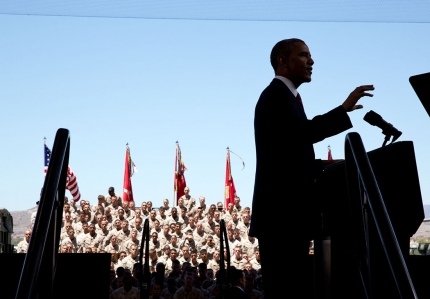
President Barack Obama delivers remarks to troops during a rally at Marine Corps Base Camp Pendleton

President Barack Obama delivers remarks to troops during a rally at Marine Corps Base Camp Pendleton, Calif., Aug. 7, 2013. (Official White House Photo by Pete Souza)

President Obama traveled to Camp Pendleton today to visit with troops and their families and thank them for their extraordinary service to our nation.

“I’m here because, for more than a decade, you -— and all our men and women in uniform -— have borne the burden in this time of war,” President Obama said.

After our nation was attacked, you were some of the very first conventional forces in Afghanistan -— racing in, hundreds of miles by helicopter, toppling that regime and driving al Qaeda from its camps. Then when the fight shifted to Iraq, you were there -— racing toward Baghdad and deposing a dictator. And through years of combat -— in Tikrit, Fallujah and Ramadi -— your courage added to the glories of the Marines’ long and illustrious history.

President Obama also called on Congress to agree on a responsible plan that reduces our deficits but also keeps our military strong, which includes caring for wounded warriors, military families, and service members who transition to civilian life.

“That’s what you deserve,” President Obama said. “That’s what your families deserve. That's what I’m fighting for and that is my commitment to you.”

Related Topics: Veterans, California

The White House

Office of the Press Secretary

Remarks by the President at Camp Pendleton, CA

Hangar 6 West
Camp Pendleton, California

12:45 P.M. PDT

THE PRESIDENT:  Hello, Marines!  (Oorah!)  Hello, Camp Pendleton!  (Oorah!)  It is great to be here, at the home of the 1st Marine Expeditionary Force -- (Oorah!) -- and one of our nation’s oldest and most decorated military units, the legendary 1st Marine Division.  (Oorah!)  And I think I see some proud Navy folks here, too.  (Applause.) 

Let me thank General Nicholson for the introduction and for his outstanding leadership of our Marines in Iraq, in Afghanistan.  And that includes your command of the 2nd Marine Expeditionary Brigade out of Camp Lejeune, which we recognized last year with the Presidential Unit Citation.  Thank you, General Nicholson.

I want to thank all of your commanders for welcoming me today, including General Coglianese and General Busby.  And I want to recognize your incredible staff, noncommissioned officers, including Sergeants Major Ronald Green, Scott Helms and David Jobe. 

I want to salute Debbie Nicholson and all the spouses and military families who are here -- (applause) -- because we understand they’re the force behind the force.  (Applause.)  Just like Michelle is the force behind me.  (Applause.)  I want everyone to give a big round of applause to the amazing families who serve along with you.  (Applause.) 

And I want to acknowledge members of Congress who are here, including Susan Davis, Darrell Issa and Dana Rohrabacher.  (Applause.) 

Now, I've got to tell you the truth, I’ve been looking forward to this visit because -- and this is a little tricky to say this -- but my family and I, we've got a special place in our hearts for the Marine Corps.  (Oorah!)  Now, part of it is because every day at the White House, we’re surrounded by Marines.  (Oorah!)  In fact, we've probably got some folks here who were at the White House who are now here at Camp Pendleton.  (One person cheers.)  See?  (Laughter.)  I figured as much.   

And then, of course, every time I need kind of a hop, skip and a jump somewhere, every time I get on Marine One, I rely on some of the best aviators in the world.  I’ve seen your Honor; I've seen your Courage; I've seen your Commitment -- whether in protecting our diplomatic posts around the world, or preparing to deploy to Iraq or Afghanistan, or recovering from wounds received in battle. 

A few years ago, you gave a great Camp Pendleton welcome to my wife, Michelle.  And I know it’s not as exciting when I come to visit -- (laughter) -- but she says hi.  I guess I’m kind of like that Army general who once said, “The more Marines I have around, the better I like it.”  (Oorah!)  

I’m here because, for more than a decade, you -— and all our men and women in uniform -— have borne the burden in this time of war.  Ever since that awful September morning when our nation was attacked, when thousands of innocents were killed, we’ve been at war against al Qaeda.  And our fight in Afghanistan -— nearly 12 years -— has become America’s longest war.  I’m here because we recently marked another milestone in this war.  As of this past June, for the first time, Afghan forces have taken the lead for security across their entire country. 

Instead of leading the fight, our troops now have a different mission, which is to train and advise and assist Afghan forces.  And what the signals is that our war in Afghanistan has entered the final chapter.  More of our troops are coming home.  We’ll be down to 34,000 this winter.  By the end of next year -— in just 17 months -— the transition will be complete.  Afghans will take full responsibility for their security and our war in Afghanistan will be over.  (Applause.) 

None of this progress would have been possible had it not been for you.  We thank all who have served there, especially our Camp Pendleton Marines.  After our nation was attacked, you were some of the very first conventional forces in Afghanistan -— racing in, hundreds of miles by helicopter, toppling that regime and driving al Qaeda from its camps.  Then when the fight shifted to Iraq, you were there -— racing toward Baghdad and deposing a dictator.  And through years of combat -— in Tikrit, Fallujah and Ramadi -— your courage added to the glories of the Marines’ long and illustrious history. 

When we refocused on Afghanistan, you led the way again -—surging into Helmand, pushing the Taliban out of its strongholds, like Marjah and Now Zad and Sangin.  (Oorah!)  And when future generations study those fights, they will stand in awe of the unparalleled sacrifice of the 3rd Battalion, 5th Marines -— our “Darkhorse” Marines.  (Oorah!)  

Today, we hold close the memory of all who have made the ultimate sacrifice in these years of war.  That includes 326 fallen heroes from Camp Pendleton.  We honor all of them -— every single one.  And we stand with their families, like the Gold Star families that I had an opportunity to meet with before I came out here.  We are grateful to them.  We’re grateful for their sacrifice.  They’ve given a piece of their heart to America, and America will always honor their sacrifice. 

I know some of you recently returned from Afghanistan.  On behalf of a grateful nation, welcome home.  We send our prayers to all those who at this very moment are still in harm’s way, including your Regimental Combat Team 7, which is coming home this month.  (Oorah!)  I know some of you are getting ready to deploy in the months to come.  (Oorah!)  This is still a hard fight.  Our Afghan partners have stepped up.  They're bearing a bigger brunt of the firepower.  They're taking on a lot more casualties.  They're in the lead, but it’s still tough.  And we’re still needed.

And here’s what I want every single one of you to know.  Because of you -- the 9/11 Generation -- we are accomplishing what we set out to do.  Because of you, Osama bin Laden is no more.  (Oorah!)  Because of you, al Qaeda’s top ranks have been hammered.  The core of al Qaeda in Afghanistan and Pakistan is on the way to defeat.  That happened because of you.  Because of you, more Afghans are reclaiming their communities -— their markets, their schools, their towns -- and they have a chance to forge their own future.  Because of you, more Afghans are trained and stepping up and defending their own country.  Because of you -- and to preserve the gains you fought and bled for -- we are going to make sure that Afghanistan is never again a source of attacks against our country.  (Oorah!)  That happened because of you.  

So the war in Afghanistan will end.  For you, that means fewer deployments.  It means more training time, preparing for the future -- getting back to what Marines do better than anybody else on Earth, amphibious operations.  (Oorah!)  It means more time here on the home front with your families -- your wives, your husbands, your kids.

But, of course, the end of the war in Afghanistan doesn’t mean the end of threats to our nation.  As I’ve said before, even as we decimated the al Qaeda leadership that attacked us on 9/11, al Qaeda affiliates and like-minded extremists still threaten our homeland, still threaten our diplomatic facilities, still threaten our businesses abroad.  And we've got to take these threats seriously and do all we can to confront them.  We’ve been reminded of this again in recent days. 

So I want to take a special time out to salute all our brave diplomats and tireless intelligence and military personnel who have been working around the clock to safeguard our embassies and our consulates and our fellow Americans serving overseas, including all those vigilant Marines standing guard at our embassies around the world.  They're doing an outstanding job.  (Applause.)

As for these extremists, here’s what those who would cowardly attack our civilians don’t get.  The United States is never going to retreat from the world.  We don't get terrorized. We’re going to keep standing up for our interests.  We're going to keep standing up for the security of our citizens.  We're going to keep standing up for human rights and dignity for people wherever they live.  We’re going to keep working with our allies and our partners.  We're going to keep offering a future of hope and progress -- in stark contrast to terrorists who only know how to kill and destroy and maim.  And like generations before us, the United States of America is going to remain the greatest force for freedom that the world has ever known.  

You are an integral part of that.  That's what you do, serving in uniform every single day.  But this is not just a job for our military.  It takes diplomacy.  It takes development.  It takes trade.  It takes intelligence to stay true to our values as a nation.  This is a complicated time.  The world is going through big changes, especially in the Middle East and North Africa.  And we have to have a military strategy to protect ourselves.  But we've also got to lead with our values and our ideals and all elements of our power. 

But it does mean keeping our military the absolute best in the world.  We've got to be vigilant about that.  As the war in Afghanistan ends, it’s true, our military, including our Marine Corps, will be leaner.  Budgets will be tighter.  And that’s only natural.  Part of ending a war responsibly is moving off a perpetual wartime footing.  It’s time to use some of the money we’ve been spending on war to do some nation-building right here at home.  (Applause.)

But what we can't do is repeat the mistakes of history.  We've seen in the past where after a war we hollowed out our military, left our military unprepared.  We’ve got right now the best-led, best-trained, best-equipped military in human history. Our Marine Corps is the finest expeditionary force in the world. (Oorah!)  And as Commander-in Chief, I’m going to keep it that way.  (Oorah!) 

Now, to do that, we're going to need some help out of Washington.  Congress couldn’t agree on a plan to reduce the deficit in what I consider a sensible way, so instead what we've got is these big, across-the-board cuts called the sequester.  The sequester kicked in.  It includes defense.  And we're already starting to see the effects.  Here at Pendleton, you’re feeling it.  Hardworking folks are getting furloughed, families getting by on less, fewer ships available for your training exercises, the commissary your families rely on closed a day a week.  We can do better than that.  That's not how a great nation should be treating its military and military families.

And, by the way, cuts in other non-defense areas of the budget affect our troops and our military families as well.  Our military -- part of what makes us best is we've got extraordinary recruits.  But if we want the best-qualified recruits, we shouldn't be cutting investments in education.  We should be increasing our investments in education.  (Applause.) 

Our wounded warriors, our veterans, depend on new technologies for their recovery and their health care, so we shouldn’t be slashing investments in science and medical research.  We should continue to be the world leader in science and research. 

So that’s why I’m going to keep on working to get rid of the sequester.  You get up and do your jobs every day; let’s make sure Washington gets up and does its job.  (Oorah!)  And what makes me frustrated is sometimes the very folks who say they stand with our military proudly are the same ones who are standing in the way of fixing the sequester.  (Oorah!)  It’s important to look at deeds and not words.

Now, keep in mind it is true that for our national security we've always got to look and make sure we're dealing with our deficits and our debt.  If our economy is strong, that means the military will be strong.  If our economy is weak, that weakens our military.  But our deficits right now are falling at the fastest rate in decades.  We've cut them in half and they keep on moving in the right direction.  In that context, Congress needs to agree on a responsible plan that reduces our deficits but also keeps our military strong; also invests in education; also invests in research; also invests in our infrastructure.

That’s what you deserve.  That’s what your families deserve.  That's what I’m fighting for and that is my commitment to you.  (Applause.)  

Keeping our military strong requires something else, and that's taking care of our extraordinary wounded warriors.  Here at Pendleton, you’re doing outstanding work.  For those who can, we want to get our troops back to where they want to be -- back with their units.  For those with Traumatic Brain Injury, we’re going to keep making unprecedented investments in new care and new treatments.  For those suffering from Post-Traumatic Stress, we’re going keep saying it as loud as we can -- it is not a sign of weakness to ask for help.  It is a sign of strength.  And we’re here to help you recover and stand tall again. 

We've got to make sure that we're doing everything we can for our wounded warriors.  And I'm pleased to see the hospital here is making progress -- that's going to be an outstanding new facility that will be helpful. 

Keeping our military strong also means ensuring the safety of everyone who puts on the uniform.  No military unit can succeed without discipline, without trust, and without cohesion. So I want you to hear it directly from me, the Commander-in-Chief:  It undermines what this military stands for and it undermines what the Marine Corps stands for when sexual assault takes place within our units.  And that’s why we are going to work together -- all of us --to stop these crimes of sexual assault, and uphold the honor and the integrity that defines the finest military on Earth.  (Applause.)  And that message is coming all the way from the top. 

Keeping our military strong means keeping our military families strong.  Michelle and Vice President -- Joe Biden’s wife, Dr. Jill Biden, they’ve made this their mission.  And because of their efforts, Joining Forces, more Americans are stepping up to support your families.  (Applause.)  And that includes more companies hiring our talented military spouses.  After everything you’ve done for America, every American ought to be doing something to support your families.  (Applause.)   

As this time of war ends, some of you will be taking off the uniform and returning to civilian life.  And just as we gave you the tools to succeed on the battlefield, I want to make sure we’re giving you the tools to succeed in the next stage of your lives as well.

So we’ve improved transition assistance to help you find a job that’s worthy of your skills.  We’re helping you and your families pursue your education under the Post-9/11 G.I. Bill and making sure that instead of ripping you off, schools that give you the education you paid for are being held accountable. 

We’re making sure more states and more industries are recognizing your military skills with licenses and credentials you need for a civilian job.  When I first came into office, I was meeting medics who had been treating folks on the battlefield, and when they went back to school because they wanted to be a nurse, they had to start all over again at nursing 101.  And here they are, dealing with some of the worst injuries possible, and they’re not getting any credit for it, which means it’s costing them time, costing them money.  We’re changing all that.  If you’ve done the job on the battlefield with bullets coming at you, you can sure as heck do the job back here in the United States of America.  (Applause.)

Then we issued a challenge to the private sector, and so far America’s businesses have hired or trained 290,000 veterans and military spouses, and they’ve committed to hiring hundreds of thousands more.  So more vets are finding jobs.  The unemployment rate for vets is coming down.  And we’re going to keep saying to every company in America, if you want somebody who knows how to get the job done, hire a veteran.  (Oorah!)  Hire a veteran.  (Applause.)  Your generation has carried us through this time of war; well, you’re going to help us write the next great chapter in American history, right here at home. 

Now, few embody that truth more than a Marine who’s here today, Captain Matthew Lampert.  Matt is one of our Marine special operators.  He and his team were in Afghanistan cleaning out a compound, and then, in a terrible incident, an IED took both of his legs.  Matt survived.  And soon he had a new mission -- getting back to his unit, back to his team.  “Once a Marine, always a Marine.”  (Oorah!) 

So Matt endured excruciating rehab, therapy that could last all day, month after month, rebuilding his strength.  Recovery was slow -- taking his first shaky steps on short prosthetics; then a new pair of knees; then full legs, taking him back to normal height.  Stepping forward with two canes, then just one, then none.  Learning to walk again.  Learning to run -- in his uniform, then his body armor.  And then, just 18 months after he was injured and lost both legs, Matt -- a double amputee -- returned to his unit and redeployed to Afghanistan.  (Oorah!)   (Applause.) 

For a time, Matt even served as team leader.  And today, Matt and his company are preparing for their next deployment -- to the Pacific.  His wife, Camille, also a Marine, is working to become a test pilot because, Matt says, she likes to “fly aggressively.”  (Laughter.)  And this inspiring Marine couple is looking ahead to serving their country for many years to come. 

Matt and Camille, please wave.  (Applause.)  Thank you so much.  Thank you so much.  (Applause.)  

There are stories like Matt and Camille’s throughout our Marine Corps.  They represent what’s best in our Marine Corps.  “Semper Fidelis.”  (Oorah!)  That’s the ethic of your lives:  Always faithful.  Always faithful to each other -- the few and the proud.  Always faithful to your Corps -- for 237 years.  Always faithful to your country, for whom you wear the eagle, globe and anchor.  After all you’ve given to our nation, you have to know your nation will always be faithful to you. 

As your Commander-in-Chief, that’s my commitment to you.  That’s the commitment America must uphold to you and your family for all the years to come.

Semper Fi.  God bless you all.  God bless the Marine Corps, and God bless the United States of America.  (Oorah!)  (Applause.)

END
1:11 P.M. PDT

President Obama Answers Your Questions About Housing

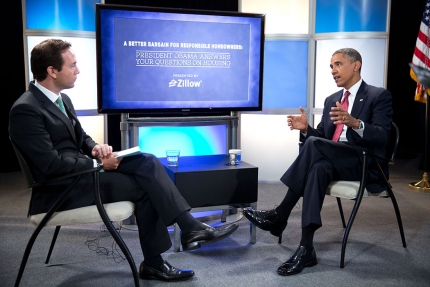
President Barack Obama participates in an interview with Spencer Rascoff, CEO of Zillow

President Barack Obama participates in an interview with Spencer Rascoff, CEO of Zillow, at the Hilton Woodland Hills/Los Angeles hotel in Woodland Hills, Calif., Aug. 7, 2013. (Official White House Photo by Pete Souza)

Today in Los Angeles President Obama sat down with Zillow CEO Spencer Rascoff to answer questions about housing from Americans all over the country.

As President Obama explained yesterday in Phoenix, having the chance to own your home is a cornerstone of what it means to be middle class in America. And while our housing market is beginning to heal from the 2008 collapse – home prices are rising and sales are up – there’s still more work to do.

“We’ve got to give more hardworking Americans the chance to buy their first home. We have to help more responsible homeowners refinance their mortgages,” President Obama said. “And we’ve got to turn the page on this kind of bubble-and-bust mentality that helped to create this mess in the first place.”

Homeowners, renters and prospective buyers submitted questions via social media about issues like mortgage interest rates, access to refinancing, help for neighborhoods hit hard by the housing crisis, and President Obama’s plan for reforming the housing finance market. Watch the full interview, or jump to selected questions from the list below.

The White House

Office of the Press Secretary

Remarks by the President in Q and A with Spencer Rascoff, CEO of Zillow

Hilton Woodland Hills
Los Angeles, California

10:01 A.M. PDT

MR. RASCOFF:  Welcome, and thank you for joining us today.  Zillow is honored to host this unprecedented event and connect homeowners, renters and prospective buyers with President Obama, who’s ready to answer your housing questions.

The housing market has come a long way in the last year and we're all very happy to see most local markets bouncing back after the housing recession, with many homeowners free from negative equity and sellers enjoying a competitive environment.  Still there are concerns about the future.  And we've received thousands of questions over the last couple of days via social media.  Today we'll pose some of these questions -- your questions -- to the President.

I'm honored to welcome President Barack Obama.  Mr. President.

THE PRESIDENT:  Great to see you. 

MR. RASCOFF:  Thank you.

THE PRESIDENT:  Thank you so much.

MR. RASCOFF:  Mr. President, our first question comes from Andrew Houston in Gainesville, Florida.  Let’s watch his video.

Q    Good morning, Mr. President.  My name is Andrew Houston in Gainesville, Florida.  And I was wondering how you feel rising interest rates over the last three months are going to affect the housing recovery going forward.  I was actually fortunate enough to refinance at historically low rates earlier this year, but I am still well in excess of 30 percent negative on my mortgage, and I'm wondering how these interest rates are going to affect the future value of my home.  Thank you very much for your time.

THE PRESIDENT:  Well, it’s a great question, and obviously, particularly in states like Florida where, when the housing bubble burst, it was very painful.  A lot of people have been watching the interest rates and watching what are happening with home values. 

Just a little bit of historic context.  What we saw in terms of the plunge in home prices in the midst of the great recession was something we hadn’t seen in a very long time.  And it hurt a lot of families.  Homeownership is the quintessential element of the American Dream.  It’s what all of us understand when we say we want to have some middle-class security. 

And so what we did over the first three and a half, four years of my administration was throw everything that we could at helping homeowners who had seen their houses go underwater to slowly build back that equity.  With the help of the Federal Reserve, interest rates came down.  And as you said, Spencer, what we've seen is healing pretty much across the country when it comes to the housing market.

We've also seen a lot of refinancing activity, in part because we modified some administrative rules so that folks who had government guarantees could refinance even if they were underwater -- and it saves people a lot of money, up to $3,000.  We've seen interest rates now tick up.  So far at least, though, the housing market has continued to be fairly robust.  And there’s been reporting just this week, some of the data has come in showing that you’re still seeing some good, steady growth.

But I think that all of us recognize that it is still a soft housing market, in part because it’s still a soft employment market -- there are still a lot of folks who are out of work.  And the real economy is directly related to the housing market.  So what we've heard from the Fed Reserve Chairman is that he thinks it’s important for interest rates to remain relatively low so long as unemployment remains high.  That should continue to help the housing market. 

But given that interest rates tick up a little bit as the economy improves, it is especially important for Congress to act on the proposal that we put forward which says let’s not just let a few people refinance; let’s allow everybody who is potentially eligible to go ahead and refinance.  It can end up being the equivalent of a $3,000 tax cut, basically, money in your pocket, or, alternatively, as Andrew was talking about, it gives homeowners an opportunity to start building back some of the equity in the home that they lost during the Great Recession.

MR. RASCOFF:  And you're referring to HARP 3, which we have a lot of questions about, so we’re certainly going to discuss that.  To keep the long-term perspective, mortgage rates have ticked up about a point, but we’re still in the low fours, which, if you take the long view, is still an incredibly low rate for a mortgage.

THE PRESIDENT:  Well, not to get too personal, but our home back in Chicago -- not the White House, which as I said, that’s a rental -- (laughter) -- our home back in Chicago, my mortgage interest rate, I would probably benefit from refinancing right now.  (Laughter.)  I would save some money.  When you’re President, you have to be a little careful about these transactions, so we haven’t refinanced.  But there’s no doubt that somebody like Michelle and I, who bought our house several years ago, that if we went out to the market right now, we’d end up saving some money.

MR. RASCOFF:  Right, right. 

This next question comes from Jill Fitzpatrick, from Louisiana, and she’s from a part of the country where home values have bounced 20 percent off the bottom.  Let’s watch Jill’s video.

Q    My name is Jill Fitzpatrick.  I was wondering what changes you think could be made to help second-time homeowners.  I refer specifically to young families who lost considerable equity in their first homes due to the housing bust -- families faced with buying a second, larger house, now in a market like New Orleans, where I live, where prices have skyrocketed astronomically, pricing many of us out of what should have been a logical and economically feasible next move.

THE PRESIDENT:  Well, I think the point that was made there is really important.  Most of us, when we buy our first home, we buy a starter home.  When Michelle and I bought our first home, we bought a condo, and lived in it for about 10 years before we then moved into a full-fledged standalone home.  And the reason we were able to do it was because we built up some equity, as well as got some raises and eventually were able to get the down payment together for a larger house.  It’s tougher now for folks who have lost their equity. 

I can’t say that there is a magic formula in a situation that was just described, in a place like New Orleans.  On the one hand, it’s great that housing values have bounced back; on the other hand, most folks haven’t gotten all their equity back if they purchased right in 2005 or 2004, right before the bubble popped. 

What we do know is that if, number one, we keep interest rates low, that will help.  Number two, that keeping the overall economy moving in the right direction means that there is a stronger market for homes and the values of the existing starter home goes up.  The good news is, is that you’ve got a lot of potential families or families that put off buying a home during the midst of the recession, and so if you look at the numbers, the amount of new family formation is going to be increasing fairly rapidly.  There’s going to be pent-up demand.  And potentially, those smaller starter homes, they’re going to increase in value as well. 

And one of the things that we’ve been looking at is, finally, how can we make sure that more people whose homes are still underwater can potentially benefit from the refinancing programs that we talked about.

MR. RASCOFF:  All right.  So that’s a perfect segue to the next question, which is in fact about HARP 3.  So this question comes from Colin Robertson.  And of course, HARP is the government program which lets homeowners who are underwater on their home refinance their mortgage, as long as they’re not more than 20 percent underwater and as long as their loans are backed by Fannie and Freddie.  About 10 percent of the questions submitted today were about HARP.

So Colin writes to us.  He says:  “What’s happening with MyRefi or HARP 3?  Is there any hope of such a program?” 

THE PRESIDENT:  I think there should be hope.  Keep in mind that this is a program that not only I put forward and supported and talked about during the State of the Union, but this was an idea that was strongly supported by Mitt Romney’s chief economic advisor.  So there shouldn’t be an ideological barrier to getting this done.  This should be something that Democrats and Republics can come together and get done.

Now, Congress, I think all of us recognize, has been a little broken lately.  But the good news is, is that there are Republican and Democratic senators, at least, who have been in a conversation about how do we learn the lessons of the past and start building a firmer foundation for housing going forward.  And a lot of the concerns, a lot of the questions had to do with how do we get Fannie and Freddie reformed so that they are not in a situation in which taxpayers are essentially subsidizing huge risks that they’re taking. 

As part of a package, you could see Fannie and Freddie reform that protects taxpayers, puts housing on a more stable footing, but in the interim also provides some immediate relief to homeowners, giving them a chance to refinance while interest rates are still low.

So this is something that I’m going to push again once Congress gets back in September, once they’re back in session.  As part of a broader package of housing reform, let’s see if we can potentially even get this done before the end of the year.

MR. RASCOFF:  And we’re going to talk about GSE reform, which was a very hot topic among the questions that were submitted as well. 

This question is from Jason Boatman, from Phoenix.  Phoenix, of course, is one of the parts of the country that was hardest hit by the recession.  It’s where you delivered a very important housing address yesterday.  Let’s see what Jason has to say.

Jason writes:  “I live in the greater Phoenix area.  My neighborhood has been hit very hard by the foreclosure crisis.  Things are finally starting to look up, but we’re certainly not back to pre-recession levels.  How is the administration planning to help homeowners in areas like Phoenix regain our footing?”

THE PRESIDENT:  Well, there were some areas like Phoenix, like Las Vegas, parts of Florida, that had been especially hard hit.  So in the immediate aftermath of the crisis, one of the things that we did was to get a special fund allocated to those states specifically to help some of these communities.  In some cases, it meant more hands-on help and counseling for homeowners in these areas.  In some cases, it was a question of states or local communities finding ways to get some of the foreclosed properties off the market, or at least stabilized so that they weren’t depressing adjoining properties. 

And we are continuing to work with the Mayor of Phoenix, the Mayor of Las Vegas, those communities that had been especially hard hit. 

In some areas, one of the questions is, are there so many foreclosures and abandoned properties that it actually pays off for us to either repair them and put them on the market as rental properties, or alternatively, in certain areas of the country where these are really rundown properties, go ahead and tear them down. 

The advantage of putting these on the rental market is obviously if somebody is living in them, they're more likely to maintain them, and it creates the kind of atmosphere in the neighborhood that allows property values to go back up.  And we’ve got a lot of creative programs like that.  What we want to do is make sure that there are enough resources coming out of Congress.  And the Secretary of Housing and Urban Development I know has a number of ideas about how we can have even more of an impact in revitalizing some of those communities that have been hardest hit.

MR. RASCOFF:  It’s been great to see in some of these communities institutional investors have been buying up tens of thousands of these properties and rehabbing them and then renting them -- in some cases, renting them to the existing homeowners who are underwater on their own home.

THE PRESIDENT:  That makes a lot of sense, and it’s good business sense.  Look, we know that a basic principle of the free market is if you can buy low and sell high, you’re in a pretty good spot.  These institutional investors pulling together big chunks of property, going ahead and making them rental properties, which help to cover their costs immediately, but they're also hoping to see appreciation in the long term -- that can be good business sense for them.  But just as importantly or more importantly, for those middle-class families where they saw these property values drop, having that kind of stabilization can really make a difference. 

And in a place like Phoenix, we’ve actually seen 20-25 percent increases in property values.  People are feeling much more optimistic about the future than they were before.  And we’re also seeing more housing construction going up, which tells you that there’s still pent-up demand out there.  We’ve just got to make sure that we get everybody firing on all cylinders to maximize it.

MR. RASCOFF:  This next question comes from Jacob.  Jacob is among the one in three Millennials who lives with his parents because he can't find affordable housing.  So let’s watch Jacob’s video.

Q    Good morning, President Obama.  My name is Jacob and I live in LA.  I’m a recent college graduate with a full-time job, but I still live at home with my parents.  I’m wondering, with massive student loan debt, will I ever be able to move into a house of my own?  Not even looking to buy, just looking to rent.

THE PRESIDENT:  Well, Jacob asks a question that a lot of young people are asking right now.  And there are two components to it.  Number one, we need more affordable, quality rental housing.  And what I said in my speech yesterday, all of us, long term, have the aspiration of a home of our own.  But in a lot of markets, renting is a great option, especially if you're still young.  And so as we look at the various housing proposals that I’ve put forward -- making sure that people can refinance, making sure that we’re reforming these GSEs -- one of the components is also making sure that we’ve got more resources to construct or get on the market more affordable housing.

And that is not something that people should shy away from, deciding that at this stage in their lives -- Jacob looked like a pretty young guy -- that renting is probably the best option, until you know that you can actually purchase safely, soundly and make your payments.  Part of what happened during the housing bubble was that people who probably should have been renting were encouraged to go into the housing market, and they got hurt and the economy as a whole got hurt.

But he also mentioned something else, which is the fact that a lot of young people, what for their parents would have been the down payment on a home right now is going to service their student loan debt.  So I know that Zillow is focused on housing and not college education, but I will say that some of the initiatives that I’m putting forward to drive down the cost of college and the debt burdens that young people have when they get out of school can make a huge difference in the housing market over the long term, because the $30,000 or $25,000 on average that young people from state universities are coming out with in terms of debt, that's a down payment on a house. 

And so we’ve got a whole range of ideas about how we can drive tuition down, work with universities to be more efficient, help young people graduate faster so that they're not ending up spending more money, reducing the interest rates on student loans.  All that will have an impact on the housing market.

I should add, by the way, there’s another issue that doesn't seem like it’s related to the housing market, but actually is related, and that's immigration reform.  We know that if we get immigration reform done, suddenly you’ve got all kinds of families coming out of the shadows, paying taxes, paying penalties, but they're also going to be really likely to buy homes, oftentimes in some of the neighborhoods where you have the most foreclosures, the most trouble.  They add value to a community, increase property values. 

And over the long term, it’s one of the reasons why it’s estimated that immigration reform would actually add a trillion dollars to the overall economy, partly because they’d be buying houses.

MR. RASCOFF:  It’s what’s so interesting about the housing industry overall is it impacts all these disparate issues from immigration to student loans to the global economy. 

THE PRESIDENT:  Well, part of -- and the reason is, is because this is where most Americans have their wealth.

MR. RASCOFF:  It’s where our wealth is.  Yes.  (Laughter.)

THE PRESIDENT:  So if you’ve got trillions of dollars tied up in housing, if we get that right, then it makes a big different everywhere else.

MR. RASCOFF:  All right, so the big one, GSE reform.  This next question comes in from Steve from Bloomington, Minnesota.  And Steve writes:  “If Congress is successful” -- and if you’re successful -- “in scaling Fannie Mae and Freddie Mac down, what model fills the gap?”

THE PRESIDENT:  Well, we are fairly unique in the sense that most advanced developed countries don't have such a large government presence in the housing market.  Traditionally, Fannie and Freddie were supposed to be subsidiary to the private marketplace.  And prior to the Great Recession, in fact, Fannie and Freddie’s portfolio was as a total a smaller percentage of the overall lending that was taking place in the housing market. Now it’s significantly higher, right? 

And what we’ve tried to do is to make sure that we’re providing the support we need to help the housing market heal, but recognize you can't have a situation in which the government is underwriting and guaranteeing all the mortgage lending that's taking place around the country and big profits are being made by these quasi-private institutions, and then if things go wrong, suddenly taxpayers are on the hook. 

So a couple of things that we’ve done administratively, we’ve been trying to reduce the portfolio each year by an incremental amount so --

MR. RASCOFF:  The loans owned by Fannie and Freddie.

THE PRESIDENT:  -- loans owned by Fannie and Freddie -- not too quickly, but allowing the market to catch up. 

Our long-term goal is to say let’s have the private market get in there and provide those loans.  And what the government can do is to step in to make sure, for example, that there’s still a 30-year mortgage available; to make sure that homes that are not too upscale are available for young families, for veterans, for folks who may have some limited means, but have saved and scrapped and are ready to go out there and buy. 

But, for example, we increased the maximum home value that could be financed in the midst of the recession because it helped to strengthen homes.  Now we're starting to scale that back.  And we're actually confident that the private market can step in, do a good job, and the government can be a backstop so that we still have affordability and 30-year mortgages, but it's not the dominate player.

And in some ways, it's a return to earlier models.  The way to think about it I think is that during both the housing bubble and its aftermath Fannie and Freddie just got too big, and that was anomalous -- that was not sort of typical of what's happened during the course of our history in the housing market. 

So the good news is that you've got a bipartisan bill -- Senators Warner of Virginia and Corker of Tennessee are working together.  The principles that they have announced are ones that are pretty consistent with me:  Let's have the market get in there.  Let's make sure you don't have a “heads I win, tails you lose” formula for Fannie and Freddie, so that taxpayers aren't left on the hook, but we're still focusing on affordability; we still are focused on a 30-year mortgage.

And my expectation is, is that if a bill passes -- and I think it's the right thing to do for the economy over the long term -- it's still going to be phased in.  So the one thing we want to prevent is just at a time when the housing market is getting back on its feet that suddenly you have a big shock to the system.  This is something that would have to be phased in over a number of years and I'm confident could be done. 

And, look, lenders can go in there and make some money doing it.  In fact, you could argue that part of the reason why a lot of first-time buyers or well-qualified buyers are having trouble right now is that a lot of lenders are worried that Fannie and Freddie and the government-backed loans may end up squeezing them if for some reason buyers aren't making their payments.  And so they're tightening up their status -- and that the market might be willing to take more educated risks about the market if, in fact, you had the private sector back in there.

MR. RASCOFF:  So from Fannie and Freddie to loans not backed by Fannie and Freddie, this next question comes from Elias.  And about 30 percent of our questions actually touch on themes that Elias asks about.  Let's watch his video.

Q    Mr. President, what help is available for homeowners who are looking to refinance, but don't have their loan backed by Freddie or Fannie?  Thank you.

THE PRESIDENT:  Well, we've already talked about that.  That's the HARP 3 program.  And so this is something that can get done.

Keep in mind, by the way, this would be good for the entire economy, because some of the money would go back to building equity.  But some folks would decide they're going to buy a new laptop for their kid who’s going off to college, or they'd end up using that to help finance a new car.  And, as a consequence, the entire economy would be more likely to pop, which in turn would help the housing market and help home values.

MR. RASCOFF:  So tell Elias to root for HARP 3.  (Laughter.) 
THE PRESIDENT:  Well, don't just root for it.  Everybody who’s on Zillow, there's no reason why you shouldn't contact your congressman and say, why aren't we doing this?  This should be a no-brainer.

MR. RASCOFF:  All right.  Our last question comes from Jennifer in North Carolina.  Jennifer writes in, she says, "I'm a high school teacher in North Carolina.  I get paid so little that I can't afford my own apartment.  The rent here goes up every year, but I haven't had a raise in years.  A fixed mortgage would be more consistent than rising rents, but I don't have the job stability."  So what advice would you give to someone like Jennifer, and how can the government help?

THE PRESIDENT:  Well, the first thing I'd say is teachers need to get paid more.  And I mean that.  Look, one of the challenges that we've seen is, is that middle-class families -- teachers, construction workers, firefighters -- their wages and incomes have not gone up even if their jobs have held steady.  Some of them have lost jobs. 

And one of the big challenges for our housing market is making sure that not only do we have a strong employment market, but people, if they're working hard, they should be getting paid a decent wage.  And a lot of what I'm doing and will continue to do for the remainder of my presidency is focused on how are we improving middle-class security.  And teachers fall in that category.

Now, we already talked about the fact that renting can be a good option if we get more affordable rental housing on the market.  And there are a number of communities that have been doing creative stuff.  There are a number of properties that right now are sitting there not being rented -- big chunks in certain cities.  In my hometown of Chicago, for example, we could be renovating, rehabbing and putting on the rental market thousands of units that would help to stabilize rental prices. Ideally for somebody like Jennifer, renting for a while at a affordable rate that allows you then to save a nest egg that lets you then put your down payment on a home -- that's traditionally how folks did it. 

It's nice if your parents can help you or your grandparents. But for folks like Michelle and I, who didn't come from a fancy background -- actually we lived in Michelle's mom's house for a couple of years.

MR. RASCOFF:  Just like Jacob.  (Laughter.) 

THE PRESIDENT:  Just like Jacob -- before we were able to get the down payment together.  And that's how we do things.

So just one closing comment, Spencer.  I think you guys have done a great job in helping to make consumers more empowered when they are buying a home, selling a home.  And it's a wonderful service.  One of the things that we're really proud of is the Consumer Finance Protection Bureau that we've put together, headed up by Richard Cordray, a former attorney general in Ohio. And the CFPB, as we call it, its entire job is how do we help consumers so they get a fair deal.

One of their key focus areas has been on home finance and mortgages.  And we can expect that we're going to try to simplify mortgage as soon as the fall, so that you don't have a lot of fine print, you know exactly what you're getting.  Somebody who’s involved in a transaction can operate with some complete transparency; they can know what they might owe once they get a mortgage potentially approved. 

The more knowledge consumers have, the more empowered they're going to be and the more likely they're going to be to live out the American Dream that I think all of us want to see not just for ourselves, but for our kids and our grandkids.

MR. RASCOFF:  And we have been big fans of what the CFPB is trying to do with mortgages and we've actually been working with them and giving them comments on it.  So Zillow is all about transparency of information, empowering consumers.  And so, certainly if we can make it easier for people to understand the complexities of a mortgage, then that would be great for the country.

THE PRESIDENT:  Absolutely.  Well, you guys have done a great job.

MR. RASCOFF:  Thank you.  Thank you very much, Mr. President.  And a big thank-you to the thousands of Americans who submitted questions.  I hope this conversation answered a lot of them.  And Zillow is honored to have hosted this event.  Thank you.

END
10:35 A.M. PDT