The White House

Office of the Press Secretary

Press Gaggle by Press Secretary Jay Carney, 7/30/2013

Aboard Air Force One
En Route Chattanooga, Tennessee

11:46 A.M. EDT

MR. CARNEY:  Welcome aboard Air Force One as we make our way to Chattanooga, Tennessee.  As you know, the President will speak at the Amazon fulfillment center in Chattanooga today, where he’ll talk about one of the cornerstones of his economic agenda, all of which is focused on an economy that helps increase the size and security of the middle class.  And today he’ll focus on how jobs are an essential component of that agenda.

I wanted to note that while at the Amazon fulfillment center today, President Obama will sit down for an interview with Amazon Kindle Singles editor, David Blum.  This Kindle Singles interview, which will focus on the issues of jobs and the economy, will be available for free on Wednesday on Kindle and Kindle free reading apps.  Kindle Singles launched in January 2011.  Each Kindle Single represents a compelling idea -- well researched, well argued, and well illustrated -- expressed at its natural length.  So that interview will take place today.

Q    Do you have that app?

MR. CARNEY:  I have a Kindle.  I’m not trying to be -- but since you asked, I’m on my second Kindle, in fact.

Q    That readout sounds like an ad.

MR. CARNEY:  For the interview the President is giving, for sure.

Q    That each Kindle Single is a well-researched, valuable, et cetera, et cetera.

MR. CARNEY:  Well, I think for those who see this transcript or otherwise inform themselves with their gaggle, who may not be aware of Kindle Singles, it’s a useful description.

With that, I will take your questions.

Q    Can you tell us anything about the President’s meeting this morning with the peace negotiators?

MR. CARNEY:  I can.  As I think you’ve been made aware, the President this morning did meet with Israeli and Palestinian negotiators at the White House.  The meeting was relatively brief, but they discussed the formal resumption of direct Israeli-Palestinian negotiations. 

The Israeli negotiating team was represented by Justice Minister, Tzipi Livni, and Yitzhak Molcho.  And the Palestinian negotiating team was represented by chief negotiators, Saeb Erekat and Mohammad Shtayyeh.  The President was joined by Vice President Biden, Secretary Kerry, National Security Advisor Rice, Special Envoy Martin Indyk, and White House Coordinator for the Middle East Phil Gordon.

The President used this opportunity to convey his appreciation to both sides for the leadership and courage they have shown in coming to the table, and to directly express his personal support for final status negotiations towards the goal of achieving two states living side by side in peace and security.

He underscored that while the parties have much work to do in the days and months ahead, the United States stands ready to support them in their efforts to achieve peace.

Q    How long was he in there for?

MR. CARNEY:  I think the meeting was a little under a half hour.

Q    Jay, did the President put down on the table some of the ideas he’s raised in the past, like using 1967 borders as a basis for the territorial negotiations?

MR. CARNEY:  Well, this is a brief meeting Mark, and I think that my readout reflects the content of the meeting in terms of the President’s participation.  But I’ll also say, as Secretary Kerry and others have made clear, all sides agree that it would be most conducive to this process not to read out details of readings or negotiations.  So we’re going to abide by that. 

I do believe that Secretary Kerry and Israeli and Palestinian negotiators are having a press availability late morning today, and will be able to add some detail.  But, in general, the process -- the opportunity for success here is enhanced, we believe, as all sides believe, by confidentiality.

Q    Do you have a sense when direct negotiations could begin?

MR. CARNEY:  I will leave that to the statements that I believe Secretary Kerry and the others are making today.

Q    What does the President see as his role in this process?

MR. CARNEY:  As I think others have said, this process has arrived at the point where we have Israeli and Palestinian negotiators in Washington meeting because of an effort begun by the President with his visit to the Middle East earlier this year.  The President tasked Secretary Kerry with following through with the parties on that effort, and there has been a lot of work put in by all sides and a lot of leadership encouraged -- shown by both sides, the Israeli and Palestinian sides, to get us to this point.

But this is a step in a process, and there's a great deal of work to be done.  And we're not going to predict outcomes here, we're simply going to do everything we can to help facilitate a process.

Q    If not outcomes, what does he plan to have in terms of involvement?  Will he be involved in these negotiations at times, or does he want to stay mostly hands off?

MR. CARNEY:  Well, I'd say a couple of things about that.  One is I'm not going to predict the future here in terms of meetings and participation in those meetings.  Two, the President is engaged in this process.  It was really sparked by his visit to the Middle East earlier this year, and then followed by the President's decision to task Secretary Kerry to follow up on those meetings that the President had to see if we could move the process forward. 

The President met with negotiators today, this morning.  And, as you know, he's engaged in conversations with leaders of both the Israelis and the Palestinians as well as leaders in the region with some regularity.  But in terms of manifests and conversation -- manifests of meetings and conversations in the future, I just don’t think it makes sense to get into that, even if we could predict it. 

Q    Jay, the Republicans are complaining that the President's proposal today is not revenue-neutral.  What do you say to them?

MR. CARNEY:  The fact of the matter is the President is proposing today a grand bargain for the middle class, a grand bargain for middle-class jobs.  And he is suggesting to everyone in Washington that we can achieve corporate tax reform that closes loopholes, that lowers rates, and then ensures that everybody is playing by the same set of rules, and use the essentially one-time revenue generated by that reform to invest in the future, to invest in manufacturing or community colleges or infrastructure building as a way of helping create good-paying, secure jobs for the middle class.

I think everyone who's examined this issue acknowledges that in the reform process of our business tax code, one-time revenues would be generated.  The overall effect of the reform would be revenue-neutral in the long term -- in other words, the revenues created initially will not be forthcoming in the future.  They're a one-time proposition, but they would be significant enough to allow for investment -- significant investment in middle-class jobs.  And that’s what the -- I mean, this is -- this should be something, as the President sees it, that all sides should embrace. 

Republicans have long called for business tax reform.  The President has said he’s for that.  In the past, he’s said he’s for that only as part of a broader fiscal package that included asking the wealthier to pay more through individual tax reform.  And he’s willing to make this proposal today to couple corporate tax reform with -- or business tax reform with initiatives and significant investment in job creation.  Because he believes, as you heard him say in Galesburg last week, this ought to be our fundamental focus right now in Washington -- how do we create a rising, thriving middle class?  Because that is the foundation for our economic future.

Q    One last thing.  How much would be in this one-time revenue fund?

MR. CARNEY:  I think I’ll leave the details of that to those who will hammer it out.  There are a variety of ways to approach this, and I think that will depend on the progress we make in negotiating this out with Congress.

Q    How should we see today’s proposal in context of the speeches over the next several weeks?  Is this all going to lead up to some grander, economic package?  Or is this sort of the crux of what the President is going to be pushing for and fighting for going forward?

MR. CARNEY:  That's a good question.  As I think we tried to lay out -- and I know that there’s a lot of parts here -- but we tried to lay out last week, the President gave an overall speech -- agenda-setting speech in Galesburg, followed up by two that amplified those themes last week.

Today is the first of the cornerstone speeches that he’ll give where he talks about one of the five essential cornerstones to growing the middle class and creating secure middle-class jobs -- and that's jobs, while an element of all of this is the focus of today’s speech.  The other elements are, of course, education and retirement security, clean energy and the like.

So today will focus on this component of it.  It will feature the grand bargain -- or the new grand bargain that we’ve discussed already, and then he will move on to give other speeches on other cornerstones.

Q    I guess I’m just trying to get a sense of to what degree he’s going to be throwing his weight behind this proposal, how much he’s going to be trying to sell this one component.

MR. CARNEY:  I think he’ll be very much throwing his weight behind it, using the bully pulpit, as you’ll hear today, and making the case that this makes eminent sense.  That even as we remain committed, as the President has demonstrated, to a bigger, balanced package that would reduce our deficit in the long term and deal with our -- address our debt challenges in the long term, while investing in our economy, we can move forward with this.  Because of the stalemate we face in that effort thus far, we can move forward with this business tax reform, coupling it with investments in the middle class and investments in job creation, and demonstrate that we’re focused on the thing that matters most here in his eyes and in the eyes of most Americans across the country.

So I’m sure you’ll hear more from him about it, as he addresses the other cornerstones of his economic vision.

Q    And also, officials have said that this is an issue that comes up during meetings with the business community.  Was the business -- or business leaders consulted?  Were they briefed on this before today?  Or was Jeff Bezos even briefed on it, the CEO of Amazon?

MR. CARNEY:  Well, on the end of that, the President has spoken with Mr. Bezos in advance of this visit, so the answer to that is, yes.  And, in general, we did make --

Q    So he did tell him that this is what he was going to be proposing?

MR. CARNEY:  I believe that's right, in broad terms.  Members of the administration, the senior team of the administration have been in contact with leaders on the Hill and key players on the Hill, as well as with business leaders and other leaders about this idea in the last 18 hours or so -- 12 hours -- 18 hours or so to notify them about the President’s proposal.

Q    Republicans say they’ve always supported business tax code reform in conjunction with the individual tax code reform, and that proposing one without the other is a nonstarter.  So given that the White House has known that that's the Republican position for a long time, why propose changing the business tax code without talking about the individual tax code?

MR. CARNEY:  Well, what’s been a nonstarter is a Republican proposal to give massive tax cuts to the wealthy as part of their individual tax reform.  What the President has always said in the past is that we would have to address tax reform in a way that, in addition to reforming in a revenue-neutral way our business tax code, that we would have to make our income -- our individual tax code more fair, not less fair, which has traditionally been the approach that Republicans have taken.  And that has been a nonstarter with the President and with the American people.

What the President is proposing is taking business tax reform -- something Republicans say they want, businesses say they want -- and coupling it with investments in things that Republicans also have traditionally said they want, which is investments in infrastructure, investments in manufacturing, investments in education, because those investments are key to creating jobs now and in the future for the middle class.

The bargain here should be a bargain for the middle class, not a bargain for a party or a faction on Capitol Hill, but what can we do that most benefits the middle class now and in the near future.  And that's what the President is proposing.

Q    So who did he talk to on the Hill before rolling this out?

MR. CARNEY:  The President's team spoke to a number of members and staff on Capitol Hill, as well as, as I mentioned, some business leaders and other leaders who have an interest and stake in this.

Q    Any names you want to throw out?

MR. CARNEY:  I'm not -- I haven't gotten the question.  But I will note that the White House did reach out to Speaker Boehner's office and as of about a half an hour ago had not yet heard back.  And we reached out yesterday. 

Q    You did reach out to them yesterday?

MR. CARNEY:  To Speaker Boehner's office.

Q    You never heard back?

MR. CARNEY:  Never heard back.

Q    They're saying the first word they got of this was through the media.  But miscommunication, I guess?

MR. CARNEY:  Well, again, an effort was made to reach Mr. Boehner's staff yesterday.  And as of about a half an hour ago we had not heard back from them.

Q    Does he not return calls frequently to the White House?

MR. CARNEY:  I'll just say that that call has not been returned.

Q    Who reached out to Boehner's office?

MR. CARNEY:  A senior member of the White House staff.

Q    Who?

MR. CARNEY:  Miguel Rodriguez, legislative director.

Q    Can we ask about the nature of the facility he is visiting?  There's been obviously some discussion of both the wage level of the new jobs that Amazon is talking about, the nature of the work being particularly exhausting.  And then, lastly and sort of I guess separately, that independent booksellers point out that Amazon has gone a long way toward putting them out of business.  How would you sort of react to those three issues?

MR. CARNEY:  Well, what the President is doing by visiting this facility is highlighting a company that's part of a broader effort here that is bringing about the creation of jobs in the United States.  And there have been a lot of jobs created by Amazon, and that's obviously a good thing.

Q    They're low-wage jobs though.

MR. CARNEY:  Well, again, the President supports raising the minimum wage.  And that is a cornerstone of his economic proposals that you've heard from him in the past and you'll hear in the future.  What the fact is, is that our minimum wage in this country is at its lowest level in real terms since Ronald Reagan was President, and we ought to address that.  And the President will speak about that frequently in the coming weeks and months, because it's an essential part of his economic vision.

Q    And the sellers?

MR. CARNEY:  I just don't know enough about the marketplace there.  What the President is focused on is creating jobs here in America for Americans.  And he very much looks forward to his visit.

Q    Do you know of any plans by the intelligence community to declassify more information this week?

MR. CARNEY:  I have no updates for you on that process that you refer to.

END
12:04 P.M. EDT

The White House

Office of the Press Secretary

President Obama Announces More Key Administration Posts

WASHINGTON, DC – Today, President Obama announced his intent to nominate the following individuals to key Administration posts:

  • Michael L. Connor – Deputy Secretary, Department of the Interior
  • Robert Blake – Ambassador to the Republic of Indonesia, Department of State
  • Thomas Frederick Daughton – Ambassador to the Republic of Namibia, Department of State
  • John L. Estrada – Ambassador to the Republic of Trinidad and Tobago, Department of State
  • Phillip S. Goldberg – Ambassador to the Republic of the Philippines, Department of State
  • Michael Stephen Hoza – Ambassador to the Republic of Cameroon, Department of State
  • Noah Bryson Mamet – Ambassador to the Argentine Republic, Department of State
  • Eunice S. Reddick – Ambassador to the Republic of Niger, Department of State 

President Obama said, “I am grateful that these impressive individuals have chosen to dedicate their talents to serving the American people at this important time for our country.  I look forward to working with them in the months and years ahead.”

President Obama announced his intent to nominate the following individuals to key Administration posts:

Michael L. Connor, Nominee for Deputy Secretary, Department of the Interior

Michael L. Connor is the Commissioner of the U.S. Bureau of Reclamation at the U.S. Department of the Interior (DOI), a position he has held since 2009.  Previously, Mr. Connor served as Counsel on the U.S. Senate Energy and Natural Resources Committee from 2001 to 2009.  He served in the Secretary’s Indian Water Rights Office at DOI as Director from 1999 to 2001 and Deputy Director from 1998 to 1999.  Mr. Connor has worked as an attorney in a number of offices at DOI from 1993 to 1997, including the Southwestern Regional Solicitor’s Office, the Division of Indian Affairs, and the Solicitor’s Honors Program.  He was a research assistant in the Natural Resources Law Center at the University of Colorado from 1991 to 1993.  From 1984 to 1990, Mr. Connor worked as a professional engineer in a variety of roles.  He received a B.S. in Chemical Engineering from New Mexico State University and a J.D. from the University of Colorado School of Law.

Ambassador Robert Blake, Nominee for Ambassador to the Republic of Indonesia, Department of State

Ambassador Robert Blake, a career member of the Senior Foreign Service, Class of Career-Minister, is Assistant Secretary of State for South Asian Affairs.  Previously, he served as Ambassador to the Democratic Socialist Republic of Sri Lanka and the Republic of Maldives from 2006 to 2009.  Prior to that, Ambassador Blake served as the Deputy Chief of Mission at the U.S. Embassy in New Delhi, India from 2003 to 2006.  Previous domestic assignments include: Executive Assistant to the Under Secretary for Political Affairs from 2001 to 2003, Deputy Executive Secretary from 2000 to 2001, and the Turkey Desk Officer from 1998 to 2000.  Overseas assignments include:  Head of the Political Section at the U.S. Embassy Tunis, Tunisia from 1995 to 1998 and Economic Officer at the U.S. Embassy in Algiers, Algeria from 1993 to 1994.  He received a B.A. from Harvard College and an M.A. from John Hopkins School of Advanced International Studies. 

Thomas Frederick Daughton, Nominee for Ambassador to the Republic of Namibia, Department of State

Thomas Frederick Daughton, a career member of the Senior Foreign Service, Class of Minister-Counselor, is the Senior Advisor for Security Negotiations and Agreements in the Bureau of Political-Military Affairs at the Department of State.  From 2009 to 2011, he served as Deputy Chief of Mission at the U.S. Embassy in Beirut, Lebanon.  Mr. Daughton served as the Deputy Chief of Mission at the U.S. Embassy in Algiers, Algeria from 2006 to 2009, and Counselor for Political Affairs at the U.S. Embassy in Kuala Lumpur, Malaysia from 2003 to 2006.  He was the Deputy Chief of Mission and Chargé d’ Affaires at the U.S. Embassy in Libreville, Gabon from 2000 to 2003, and Political and Administrative Officer at the U.S. Consulate General in Thessaloniki, Greece from 1997 to 2000.  From 1994 to 1996, he served as a Country Desk Officer for the Philippines in the Bureau of East Asian and Pacific Affairs and from 1993 to 1994, he served as a Staff Assistant in the Bureau of Near Eastern Affairs.  Prior to joining the Foreign Service he was an Associate with the law firm Sidley & Austin.  He received a B.A. from Amherst College and a J.D. from the University of Virginia.

John L. Estrada, Nominee for Ambassador to the Republic of Trinidad and Tobago, Department of State

John L. Estrada is Senior Manager for Lockheed Martin Training Solutions Incorporated, a position he has held since 2008.  Previously, he was a business development specialist for Coalescent Technology Corporation from 2007 to 2008.  Prior to his career in the private sector, Sergeant Major Estrada served in the U.S. Marine Corps for 34 years, rising to become the 15th Sergeant Major of the United States Marine Corps, the nation’s highest-ranking enlisted Marine.  He served as Sergeant Major of the Corps from 2003 to 2007.  From 2001 to 2003, he served as Sergeant Major of the 3rd Marine Aircraft Wing, Marine Corps Air Station Miramar.  From 2000 to 2001, he was Sergeant Major of the Recruit Training Regiment at Parris Island, and from 1998 to 2000 he was Sergeant Major for the Recruiting Station in Sacramento, California.  In 2010, he was appointed as a Member of the American Battle Monuments Commission.  Sergeant Major Estrada serves as a committee member of the Defense Advisory Committee on Women in the Services, a member of the national Board of Directors for Operation Homefront, and on the executive committee for the United Services Organization.  Sergeant Major Estrada received a B.S. from the University of Phoenix.

Ambassador Philip S. Goldberg, Nominee for Ambassador to the Republic of the Philippines, Department of State

Ambassador Philip S. Goldberg, a career member of the Senior Foreign Service, Class of Career-Minister, is Assistant Secretary for Intelligence and Research at the Department of State, a position he has held since 2010.  From 2006 to 2008, he served as Ambassador to Bolivia.  From 2005 to 2006, he served as Chief of Mission in Pristina, Kosovo.  From 2001 to 2004, Ambassador Goldberg served as Charge d’Affaires and Deputy Chief of Mission at the U.S. Embassy in Santiago, Chile.  In 2001, he served as Acting Deputy Assistant Secretary for Legislative Affairs.  From 1996 to 2000, he served as Special Assistant and then Executive Assistant to the Deputy Secretary of State.  He served as the Department's Bosnia Desk Officer from 1994 to 1996.  Previous overseas assignments include: Consular and Political Officer at the U.S. Embassy in Bogota, Colombia and Political-Economic Officer in Pretoria, South Africa.  He began his career as a Liaison Officer for the City of New York for the United Nations.  He received a B.A. from Boston University.

Michael Stephen Hoza, Nominee for Ambassador to the Republic of Cameroon, Department of State

Michael Stephen Hoza, a career member of the Senior Foreign Service, Class of Minister-Counselor, is Management Counselor at the U.S. Embassy in Moscow, Russia, a position he has held since 2010.  From 2007 to 2010, Mr. Hoza was Management Counselor and Acting Deputy Chief of Mission at the U.S. Embassy in Nairobi, Kenya.  Mr. Hoza served as Management Counselor at the U.S. Embassy in Madrid, Spain from 2004 to 2007 and Human Resources Officer at the U.S. Embassy in Paris, France from 2002 to 2004.  He was the Management Officer and Acting Deputy Chief of Mission at the U.S. Embassy in Kathmandu, Nepal from 2000 to 2002.  From 1997 to 2000, he served as Deputy Chief of Mission at the U.S. Embassy in Mbabane, Swaziland, and Administrative Officer at the U.S. Embassy in Asmara, Eritrea from 1993 to 1997.  From 1991 to 1993, he served as Post Management Officer for Luanda, Angola and Mogadishu, Somalia in the Bureau of African Affairs at the Department of State in Washington, D.C.  Mr. Hoza began his career at the Washington Post Company in Washington, D.C. in 1979.  He received a B.S. from Georgetown University.

Noah Bryson Mamet, Nominee for Ambassador to the Argentine Republic, Department of State

Noah Bryson Mamet is Founder and President of Noah Mamet & Associates, a position he has held since 2004.  Previously, he served as Senior Advisor and National Finance Director for House Democratic Leader Richard Gephardt from 1995 to 2003, and continued his service for Leader Gephardt’s Presidential bid in 2004.  Mr. Mamet serves as a member of the Pacific Council on International Policy and the American Council of Young Political Leaders.  He also sits on the boards of the Los Angeles based Green Dot Public Schools and NatureBridge.  In 2007, Mr. Mamet served on an international delegation for the National Democratic Institute to monitor elections in Sierra Leone.  Mr. Mamet received a B.A. from the University of California, Los Angeles.

Ambassador Eunice S. Reddick, Nominee for Ambassador to the Republic of Niger, Department of State

Ambassador Eunice S. Reddick, a career member of the Senior Foreign Service, Class of Minister-Counselor, is Director of the Office of West African Affairs in the Bureau of African Affairs at the Department of State.  From 2010 to 2011, she served as Diplomat in Residence at Howard University.  From 2007 to 2010, she served as Chief of Mission at the U.S. Embassy in Libreville, Gabon and from 2005 to 2007, she served as Director of the Office of East African Affairs in the Bureau of African Affairs.  She served as Deputy Director and then Director of the Office of Philippines, Malaysia, Brunei and Singapore Affairs in the Bureau of East Asian and Pacific Affairs from 2000 to 2004.  Previous overseas assignments include: Chief of the Political Section at the American Institute in Taiwan in Taipei, Taiwan and Political Officer in the U.S. Embassy Beijing, China.  She received a B.A. from New York University and an M.A. from Columbia University.

The White House

Office of the Press Secretary

President Obama Announces More Key Administration Posts

WASHINGTON, DC – Today, President Obama announced his intent to nominate the following individuals to key Administration posts:

  • Kenneth L. Mossman – Member, Defense Nuclear Facilities Safety Board
  • Kenneth R. Weinstein – Member, Broadcasting Board of Governors 

President Obama announced his intent to nominate the following individuals to key Administration posts:

Dr. Kenneth L. Mossman, Nominee for Member, Defense Nuclear Facilities Safety Board

Dr. Kenneth L. Mossman is currently a Professor of Health Physics at Arizona State University, a position he has held since 1990.  He is also an Administrative Judge for the Nuclear Regulatory Commission’s Atomic Safety and Licensing Board, where he has served since 2007.  From 1997 to 2004, Dr. Mossman was the Director of the University Office of Radiation Safety at Arizona State University, and from 1990 to 1992 he served as the University’s Assistant Vice President for Research.  Previously, he was a professor at Georgetown University Medical Center from 1973 to 1990.  He also was the Director and Founding Chairman of the Department of Radiation Science in Georgetown University Graduate School from 1982 to 1990.  Dr. Mossman received a B.S. from Wayne State University, an M.S. and Ph.D. from University of Tennessee, and an M.Ed. from University of Maryland.

Dr. Kenneth R. Weinstein, Nominee for Member, Broadcasting Board of Governors

Dr. Kenneth R. Weinstein is President and CEO of Hudson Institute, a position he has held since 2011.  Since joining Hudson Institute in 1999, he has held several other positions, including Senior Fellow, Director of the Washington Office, and Chief Operating Officer.  From 1996 to 1998, he was the Director of the Government Reform Project at the Heritage Foundation, and from 1994 to 1996, he was Director of Research at the New Citizenship Project.  He served on the National Council of the Humanities from 2006 to 2012 and was appointed to the D.C. State Advisory Board to the U.S. Commission on Human Rights in 2010.  Dr. Weinstein received an A.B. from the University of Chicago, an M.Phil. from Institut d’ Études Politiques de Paris, and a Ph.D. from Harvard University.

The White House

Office of the Press Secretary

President Obama Nominates L. Paige Marvel to the United States Tax Court

WASHINGTON, DC – President Obama announced today his intent to nominate L. Paige Marvel as Judge to the United States Tax Court.

“Paige has demonstrated unwavering integrity and a firm commitment to public service throughout her career,” said President Obama.  “I am proud to nominate her to serve for another term on the United States Tax Court.”

Judge L. Paige Marvel, Nominee for Judge, United States Tax Court

Judge L. Paige Marvel currently serves as a Judge of the United States Tax Court, a position she has held since April 1998.  From 1988 to 1998, she worked as a Partner with Venable, Baetjer & Howard.  Previously, from 1986 to 1988, she was a Shareholder with Melnicove, Kaufman, Weiner, Smouse & Garbis.  Judge Marvel was an Associate with Garbis & Schwait from 1974 to 1976, and Shareholder from 1976 to 1986.  She received a B.A. from the College of Notre Dame of Maryland and J.D. from the University of Maryland School of Law.

President Obama Speaks on Jumpstarting Job Growth

July 30, 2013 | 33:22 | Public Domain

President Obama lays out a plan that simplifies the tax code for our businesses and gives working families a better deal to help ensure that every American who is willing to work for it will have the opportunity for a good job that pays good wages.

Download mp4 (1260MB) | mp3 (80MB)

Read the Transcript

Remarks by the President on Jobs for the Middle Class, 07/30/13

Amazon Chattanooga Fulfillment Center
Chattanooga, Tennessee

2:00 P.M. EDT

THE PRESIDENT:  Hello, Chattanooga!  (Applause.)  It is good to be back in Tennessee.  (Applause.)  It’s great to be here at Amazon.  (Applause.) 

I want to thank Lydia for the introduction and sharing her story.  Give Lydia a big round of applause.  (Applause.)  So this is something here.  I just finished getting a tour of just one little corner of this massive facility -- size of 28 football fields.  Last year, during the busiest day of the Christmas rush, customers around the world ordered more than 300 items from Amazon every second, and a lot of those traveled through this building.  So this is kind of like the North Pole of the south right here.  (Applause.)  Got a bunch of good-looking elves here.     

Before we start, I want to recognize your general manager, Mike Thomas.  (Applause.)  My tour guide and your vice president, Dave Clark.  (Applause.)  You've got the Mayor of Chattanooga, Andy Berke.  (Applause.)  And you've got one of the finest gentlemen I know, your Congressman, Jim Cooper.  (Applause.)  So thank you all for being here.

So I’ve come here today to talk a little more about something I was discussing last week, and that’s what we need to do as a country to secure a better bargain for the middle class -– a national strategy to make sure that every single person who's willing to work hard in this country has a chance to succeed in the 21st century economy.  (Applause.) 

Now, you heard from Lydia, so you know -- because many of you went through it -- over the past four and a half years, we’ve been fighting our way back from the worst recession since the Great Depression, and it cost millions of Americans their jobs and their homes and their savings.  And part of what it did is it laid bare the long-term erosion that’s been happening when it comes to middle-class security.  

But because the American people are resilient, we bounced back.  Together, we've righted the ship.  We took on a broken health care system.  We invested in new American technologies to reverse our addiction to foreign oil.  Changed a tax code that had become tilted too much in favor of the wealthy at the expense of working families.  Saved the auto industry, and thanks to GM and the UAW working together, we're bringing jobs back here to America, including 1,800 autoworkers in Spring Hill.  (Applause.)  1,800 workers in Spring Hill are on the job today where a plant was once closed. 

Today, our businesses have created 7.2 million new jobs over the last 40 months.  This year, we’re off to our best private-sector jobs growth since 1999.  We now sell more products made in America to the rest of the world than ever before.  (Applause.)  We produce more renewable energy than ever.  We produce more natural gas than anybody else in the world.  (Applause.)  Health care costs are growing at the slowest rate in 50 years.  Our deficits are falling at the fastest rate in 60 years.  (Applause.)

So thanks to hardworking folks like you, thanks to the grit and resilience of the American people, we’ve been able to clear away some of the rubble from the financial crisis.  We've started to lay a new foundation for a stronger, more durable America -- the kind of economic growth that’s broad-based, the foundation required to make this century another American century. 

But as I said last week, and as any middle-class family will tell you, we’re not there yet.  Even before the financial crisis hit, we were going through a decade where a few at the top were doing better and better, but most families were working harder and harder just to get by.  And reversing that trend should be Washington’s highest priority.  (Applause.)  It’s my highest priority. 

But so far, for most of this year, we’ve seen an endless parade of distractions and political posturing and phony scandals.  And we keep on shifting our way -- shifting our attention away from what we should be focused on, which is how do we strengthen the middle class and grow the economy for everybody.  (Applause.)  And as Washington heads towards yet another budget debate, the stakes couldn’t be higher. 

And that’s why I’m visiting cities and towns like this -– to lay out my ideas for how we can build on the cornerstone of what it means to be middle class in America.  A good job with good wages.  A good education.  (Applause.)  A home to call your own.  (Applause.)  Affordable health care that’s there for you when you get sick.  (Applause.)  A secure retirement even if you’re not rich.  (Applause.)  More chances for folks to earn their way into the middle class as long as they’re willing to work for it.  And, most importantly, the chance to pass on a better future for our kids.  (Applause.)

So I’m doing a series of speeches over the next several weeks, but I came to Chattanooga today to talk about the first and most important cornerstone of middle-class security, and that's a good job in a durable, growing industry.  (Applause.)

It’s hard to get the other stuff going if you don't have a good job.  And the truth is everything I’m going to be talking about over the next several weeks really is about jobs.  Because preparing our children and our workers for the global competition they’ll face, that’s about jobs.  A housing finance system that makes it easier and safer to buy and build new homes, that’s about jobs in the construction industry.  Health care that frees you from the fear of losing everything after you’ve worked so hard, and then having the freedom to maybe start your own business because you know you’ll be able to get health care, that’s about jobs.  And, obviously, retirement benefits speak to the quality of our jobs.

And let me say this, it’s something everybody here understands:  Jobs are about more than just paying the bills.  Jobs are about more than just statistics.  We’ve never just defined having a job as having a paycheck here in America.  A job is a source of pride, is a source of dignity.  It’s the way you look after your family.  (Applause.)  It’s proof that you’re doing the right things and meeting your responsibilities and contributing to the fabric of your community and helping to build the country.  That's what a job is all about.  It’s not just about a paycheck.  It’s not just about paying the bills.  It’s also about knowing that what you’re doing is important, that it counts. 

So we should be doing everything we can as a country to create more good jobs that pay good wages.  Period.  (Applause.)

Now, here’s the thing, Chattanooga, the problem is not that  we don't have ideas about how we could create even more jobs.  We’ve got a lot of ideas out there.  There are plenty of independent economists, plenty of business owners, people from both parties agree on some of the ingredients that we need for creating good jobs.  And you’ve heard them debated again and again over these past few years.  I proposed a lot of these ideas myself.  Just two years ago, I announced the American Jobs Act -- full of ideas that every independent economist said would create more jobs.  Some were passed by Congress.  But I got to admit, most of them weren’t.  Sometimes there were ideas that historically had Republican support and for some reason suddenly Republicans didn’t want to support them anymore.

Putting people back to work rebuilding America’s infrastructure.  Equipping our kids and our workers with the best skills.  Leading the world in scientific research that helps to pave the way for new jobs in new industries.  Accelerating our clean energy and natural gas revolutions.  Fixing a broken immigration system so that American workers aren’t undercut, undermined because some businesses are unscrupulous and hiring folks and not paying them decent wages.  (Applause.) 

Independent economists say immigration reform would boost our economy by more than a trillion dollars.  So we’ve got ideas out there we know can work.  And if we don’t make these investments, if we don’t make these reforms, then we might as well be waving the white flag to the rest of the world, because they’re moving forward.  They’re not slowing down.  China, Germany, India -- they’re going.  And we can’t just sit by and do nothing.  Doing nothing doesn’t help the middle class.  (Applause.) 

So today, I came here to offer a framework that might help break through some of the political logjam in Washington and try to get Congress to start moving on some of these proven ideas.  But let me briefly outline some of the areas I think we need to focus on if we want to create good jobs, with good wages, in durable industries -– areas that will fuel our future growth.

Number one -- jobs in American manufacturing.  (Applause.)  Over the past four years, for the first time since the 1990s, the number of manufacturing jobs in America hasn’t gone down, it’s actually gone up.  (Applause.)  So the trend lines are good; now we’ve got to build on that progress.  I want to offer new incentives for manufacturers not to ship jobs overseas, but to bring them back here to America.  (Applause.)  I want new tax credits so communities hit hardest by plant closures can attract new investment.  (Applause.) 

In my State of the Union address, I asked Congress to build on a successful pilot program we’ve set up.  We want to create not just 15 manufacturing innovation institutes that connect businesses and universities and federal agencies to help communities left behind by global competition to become centers of high-tech jobs.  Today, I’m asking Congress to build on this bipartisan support and triple that number from 15 to 45 -- these hubs -- where we’re getting businesses, universities, communities all to work together to develop centers of high-tech industries all throughout the United States that allow us to be at the forefront of the next revolution of manufacturing.  I want it made here in the United States of America.  I don't want that happening overseas.  (Applause.)

Number two -- I talked about this last week -- jobs rebuilding our infrastructure.  I look at this amazing facility and you guys, you don't miss a beat.  I mean, you've got these packages coming out.  You've got dog food and Kindles and beard trimmers.  (Laughter.)  I mean, there's all kinds of stuff around here.  But once it's packed up, it's got to get to the customer.  And how quickly and how dependably it gets to the customer depends on do we have good roads, do we have good bridges, do we have state-of-the-art airports. 

We've got about $2 trillion of deferred maintenance here in this country.  So let’s put more construction workers back on the job doing the work America needs done.  (Applause.)  These are vital projects that Amazon needs, businesses all across the country need, like widening Route 27 here in Chattanooga -- (applause) -- deepening the Jacksonville Port that I visited last week.  These are projects vital to our national pride.

We're going to be breaking ground this week at the St. Louis Arch.  Congress should pass what I've called my “Fix-It-First” plan to put people to work immediately on our most urgent repairs, like the 100,000 bridges that are old enough to qualify for Medicare.  That will create good middle-class jobs right now.  (Applause.)  And we should partner with the private sector to upgrade what businesses like Amazon need most.  We should have a modern air traffic control system to keep planes running on time.  We should have modern power grids and pipelines to survive a storm.  We should have modern schools to prepare our kids for the jobs of tomorrow.  (Applause.)  

Number three, we need to keep creating good jobs in energy -- in wind and solar and natural gas.  Those new energy sources are reducing energy costs.  They're reducing dangerous carbon pollution.  They're reducing our dependence on foreign oil.  So now is not the time to gut investments in American technology.  Now is the time to double down on renewable energy and biofuels and electric vehicles, and to put money into the research that will shift our cars and trucks off oil for good.  (Applause.) 

And let me tell you, cheaper costs of natural gas is a huge boost to our businesses here in America, so we should develop it even more.  We've got to do it in a way that protects our air and our water for our children and future generations.  But we can do that.  We've got the technology to do it. 

Number four, we've got to export more.  We want to send American goods all around the world.  (Applause.)  A year ago, I signed a new trade agreement with Korea, because they were selling a lot of Hyundais here, but we weren't selling a lot of GM cars over there.  Since we signed that deal, our Big Three automakers are selling 18 percent more cars in Korea than they were.  (Applause.) 

So now we've got to help more of our businesses do the same thing.  I’m asking Congress for the authority to negotiate the best trade deals possible for our workers, and combine it with robust training and assistance measures to make sure our workers have the support and the skills they need for this new global competition.  And we're going to have to sharpen our competitive edge in the global job marketplace. 

Two years ago, we created something called SelectUSA.  This is a coordinated effort to attract foreign companies looking to invest and create jobs here in the United States.  And today I’m directing my Cabinet to expand these efforts.  And this October, I’m going to bring business leaders from around the world, and I'm going to connect them to state leaders and local leaders like your mayor who are ready to prove there’s no better place to do business than right here in the United States of America.  (Applause.)

Number five -- let's do more to help the more than 4 million long-term unemployed Americans that are out there.  (Applause.)  One of the problems is a lot of folks, they lose their jobs during this really bad recession through no fault of their own.  They've got what it takes to fill that job opening, but because they’ve been out of work so long employers won’t even give their application a fair look.  (Applause.) 

So I’m challenging CEOs to do more to get these Americans back on their feet.  And I'm going to bring together the CEOs and companies that are putting in place some of the best practices for recruiting and training and hiring workers who have been out of work for a long time, but want the chance to show that they're ready to go back to work.  (Applause.) 

And at the same time, I'm calling on our businesses to do more for their workers.  (Applause.)  Amazon is a great example of what's possible.  What you're doing here at Amazon with your Career Choice Program pays 95 percent of the tuition for employees who want to earn skills in fields with high demand -- not just, by the way, jobs here at Amazon, but jobs anywhere --  computer-aided design or nursing.  I talked to Jeff Bezos yesterday, and he was so proud of the fact that he wants to see every employee at Amazon continually upgrade their skills and improve.  And if they've got a dream they want to pursue, Amazon wants to help them pursue it.  (Applause.) 

That’s the kind of approach that we need from America's businesses.  Offering training programs, health care, retirement plans, paying better wages -- that’s not just the right thing to do, it’s actually good for your bottom line.  A recent study shows that when a company makes the list of the “100 Best Companies to Work for in America,” its share price outperforms its competitors, because the stock market and investors, they know if a company has employees that are motivated and happy, that business is more likely to succeed.  (Applause.)  That business is more likely to succeed.

And because nobody who works full-time in America should have to live in poverty, I'm going to keep on making the case and fighting for the fact that we need to raise our minimum wage, because right now it's in lower terms than it was when Ronald Reagan took office.  (Applause.)  When folks have more money in their pockets, that’s good for Amazon; it means your customers have a little more money.  They can order a little more of that protein powder.  (Laughter.)  I noticed a lot of folks were ordering protein power.  Everybody is trying to get bulked up.  (Laughter.) 

So here's -- those are some of the ideas that we're out there, we're promoting.  We're not lacking for ideas, we're just lacking action, especially out of Washington.  (Applause.)

For most of the past two years, Washington has just taken its eye off the ball when it comes to the middle class.  And I'll tell you -- look, there are a growing number of -- the good news is there are a growing number of Republican senators who are trying to work with Democrats to get some stuff done.  (Applause.)  That’s good news. 

The bad news is that rather than keep our focus on what should be our priority -- which is growing our economy and creating good middle-class jobs -- we’ve seen a certain faction of Republicans in Congress hurt a fragile recovery by saying that they wouldn’t pay the very bills that Congress racked up in the first place, threatening to shut down the people’s government if they can’t get rid of Obamacare.  Instead of reducing our deficits with a scalpel to get rid of programs we don’t need, but keep vital investments that we do, this same group has kept in place this meat cleaver called the sequester that is just slashing all kinds of important investments in education and research and our military.  All the things that are needed to make this country a magnet for good middle-class jobs, those things are being cut. 

And these moves don’t just hurt our economy in the long term; they hurt our middle class right now.  The independent Congressional Budget Office estimates that the cuts that are being made right now in Washington will cost our economy 750,000 jobs this year; 900,000 fewer jobs next year.  And a lot of the jobs at risk are at small businesses that contract with our military or our federal agencies.

Over the past four years, another 700,000 workers at the federal, state, and local levels of government have lost their jobs.  These are cops and firefighters, and about half of them are people who work in our schools.  Those are real jobs.  It doesn’t help a company like Amazon when a teacher or a cop or a firefighter loses their job.  They don't have money to place an order.  That's hundreds of thousands of customers who have less money to spend. 

If those layoffs had not happened, if public sector employees grew like they did in the past two recessions, the unemployment rate would be 6.5 percent instead of 7.5 percent.  Our economy would be much better off, and the deficit would still be going down because we’d be getting more tax revenue.

So the point is, if Washington spent as much time and energy these past two years figuring out how to grow our economy and grow our middle class as it’s spent manufacturing crises in pursuit of a cut-at-all-costs approach to deficits, we’d be much better off.  We’d be much better off.  (Applause.)

And it’s not like we don't have to cut our deficits.  As a share of the economy, we’ve cut our deficits by nearly half since I took office.  Half.  And they're projected to go down even further, but there’s a right way to do it and a wrong way to do it.  And we should do it in a way that actually helps middle-class families instead of hurts them.  (Applause.)

I’ve told Republicans that if they’re serious about a balanced, long-term fiscal plan that replaces harmful budget cuts that would get serious about a long-term plan that prevents those 900,000 jobs from being lost, that helps grow the economy, that helps the middle class, I am ready to go.  But we can't lose sight of our North Star.  We can’t allow an impasse over long-term fiscal challenges to distract us from what the middle class needs right now.

So here’s the bottom line:  If folks in Washington really want a grand bargain, how about a grand bargain for middle-class jobs?  (Applause.)  How about a grand bargain for middle-class jobs?  

I don't  want to go through the same old arguments where I propose an idea and the Republicans just say, no, because it’s my idea.  (Applause.)  So I’m going to try offering something that serious people in both parties should be able to support:  a deal that simplifies the tax code for our businesses and creates good jobs with good wages for middle-class folks who work at those businesses. 

Right now, everybody knows this -- our tax code is so riddled with loopholes and special interest tax breaks that a lot of companies who are doing the right thing and investing in America pay 35 percent in their taxes; corporations who have got fancy accountants and stash their money overseas, they pay little or nothing in taxes.  That’s not fair, and it's not good for the economy here. 

So I'm willing to simplify our tax code -- closes those loopholes, ends incentives to ship jobs overseas, lowers the rate for businesses that are creating jobs right here in America, provides tax incentives for manufacturers that bring jobs home to the United States.  Let's simplify taxes for small business owners, give them incentives to invest so they can spend less time filling out complicated forms, more time expanding and hiring. 

I'm willing to do all that that should help businesses and help them grow.  But if we’re going to give businesses a better deal, then we're also going to have to give workers a better deal, too.  (Applause.)  I want to use some of the money that we save by closing these loopholes to create more good construction jobs with infrastructure initiatives that I already talked about.  We can build a broader network of high-tech manufacturing hubs that leaders from both parties can support.  We can help our community colleges arm our workers with the skills that a global economy demands.  All these things would benefit the middle class right now and benefit our economy in the years to come.

So, again, here’s the bottom line:  I’m willing to work with Republicans on reforming our corporate tax code, as long as we use the money from transitioning to a simpler tax system for a significant investment in creating middle-class jobs.  That’s the deal.  (Applause.) 

And I'm just going to keep on throwing ideas out there to see if something takes.  (Laughter.)  I'm going to lay out my ideas to give the middle class a better shot.  But now it's time for Republicans to lay out their ideas. 

If they’ve got a better plan to bring back more manufacturing jobs here to Tennessee and around the country, then let them know -- let me know.  I want to hear them.  If they've got a better plan to create jobs rebuilding our infrastructure or to help workers earn the high-tech skills that they need, then they should offer up these ideas. 

But I've got to tell you, just gutting our environmental protection, that’s not a jobs plan.  Gutting investments in education, that’s not a jobs plan.  They keep on talking about this -- an oil pipeline coming down from Canada that’s estimated to create about 50 permanent jobs -- that’s not a jobs plan.  Wasting the country’s time by taking something like 40 meaningless votes to repeal Obamacare is not a jobs plan.  That’s not a jobs plan.  (Applause.) 

So let's get serious.  Look, I want to tell everybody here the truth.  And you know, look, I know that the politics for Obama aren't always great in Tennessee.  I understand that.  But I want everybody to just hear the honest truth.  I've run my last campaign, so I don't need to spin.  (Applause.) 

And here's the truth -- there are no gimmicks that create jobs.  There are no simple tricks to grow the economy.  Growing the economy, making sure that the middle class is strong is like getting in shape.  You can't just go on the muffin and doughnut diet and the latest fad and lose weight.  You've got to work out and you've got to eat better.  Well, the same is true for our economy.  The same is true for helping the middle class.

We've got to have a serious, steady, long-term American strategy to reverse the long-term erosion of middle-class security and give everybody a fair shot.  (Applause.)  And we know what we have to do.  It involves education.  It involves infrastructure.  It involves research.  It involves good energy policy.  And we just have to stay at it -- more good jobs that pay decent wages, a better bargain for the middle class, an economy that grows from the middle out.  That's got to be our focus. 

We can't be getting into a whole bunch of fads and pretend like you roll back Obamacare and suddenly all these jobs are going to be created, because the middle class was struggling before I came into office.  (Applause.)  The middle class was losing ground before I came into office.  (Applause.)  Jobs were getting shipped overseas before Obamacare was in place.  So we've got to be honest.  We've got to be honest about the challenges we face, but also the opportunities that are out there. 

And that's what I'm going to be focused on not just for the next few months.  I'm going to be focused for every one of the 1,270 days I've got left in my presidency on how to make sure that we've got more opportunity and more security for everybody who is willing to work hard in this country.  That's where I believe America needs to go.  (Applause.)  And we can do it if we work together, Chattanooga.  Let's get to work. 

Thank you very much, everybody.  God bless you.  God bless the United States of America.  

END               
2:32 P.M. EDT

Close Transcript

A Plan to Simplify the Tax Code for Businesses and Give Working Families a Better Deal

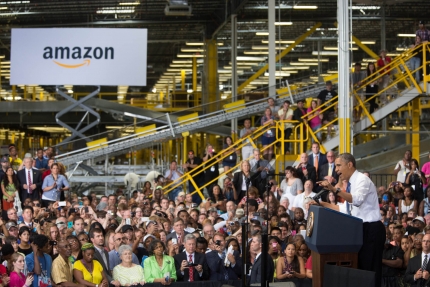
President Barack Obama delivers remarks on the economy at the Amazon Chattanooga Fulfillment Center

President Barack Obama delivers remarks on the economy at the Amazon Chattanooga Fulfillment Center in Chattnooga, Tenn., July 30, 2013. (Official White House Photo by Amanda Lucidon)

President Obama traveled to Chattanooga, Tennessee today to talk about the first and most important cornerstone of middle class security: a good job in a durable, growing industry.

“We should be doing everything we can as a country to create more good jobs that pay good wages,” President Obama said. And plenty of independent economists, business owners, and people from both parties are already in agreement on some of the ingredients that we need for creating good jobs, he explained:

Putting people back to work rebuilding America’s infrastructure. Equipping our kids and our workers with the best skills. Leading the world in scientific research that helps to pave the way for new jobs in new industries. Accelerating our clean energy and natural gas revolutions. Fixing a broken immigration system so that American workers aren’t undercut, undermined because some businesses are unscrupulous and hiring folks and not paying them decent wages.

“We're not lacking for ideas, we're just lacking action, especially out of Washington,” he said.

"So I’m going to try offering something that serious people in both parties should be able to support:  a deal that simplifies the tax code for our businesses and creates good jobs with good wages for middle-class folks who work at those businesses." 

The White House

Office of the Press Secretary

Remarks by the President on Jobs for the Middle Class, 07/30/13

Amazon Chattanooga Fulfillment Center
Chattanooga, Tennessee

2:00 P.M. EDT

THE PRESIDENT:  Hello, Chattanooga!  (Applause.)  It is good to be back in Tennessee.  (Applause.)  It’s great to be here at Amazon.  (Applause.) 

I want to thank Lydia for the introduction and sharing her story.  Give Lydia a big round of applause.  (Applause.)  So this is something here.  I just finished getting a tour of just one little corner of this massive facility -- size of 28 football fields.  Last year, during the busiest day of the Christmas rush, customers around the world ordered more than 300 items from Amazon every second, and a lot of those traveled through this building.  So this is kind of like the North Pole of the south right here.  (Applause.)  Got a bunch of good-looking elves here.     

Before we start, I want to recognize your general manager, Mike Thomas.  (Applause.)  My tour guide and your vice president, Dave Clark.  (Applause.)  You've got the Mayor of Chattanooga, Andy Berke.  (Applause.)  And you've got one of the finest gentlemen I know, your Congressman, Jim Cooper.  (Applause.)  So thank you all for being here.

So I’ve come here today to talk a little more about something I was discussing last week, and that’s what we need to do as a country to secure a better bargain for the middle class -– a national strategy to make sure that every single person who's willing to work hard in this country has a chance to succeed in the 21st century economy.  (Applause.) 

Now, you heard from Lydia, so you know -- because many of you went through it -- over the past four and a half years, we’ve been fighting our way back from the worst recession since the Great Depression, and it cost millions of Americans their jobs and their homes and their savings.  And part of what it did is it laid bare the long-term erosion that’s been happening when it comes to middle-class security.  

But because the American people are resilient, we bounced back.  Together, we've righted the ship.  We took on a broken health care system.  We invested in new American technologies to reverse our addiction to foreign oil.  Changed a tax code that had become tilted too much in favor of the wealthy at the expense of working families.  Saved the auto industry, and thanks to GM and the UAW working together, we're bringing jobs back here to America, including 1,800 autoworkers in Spring Hill.  (Applause.)  1,800 workers in Spring Hill are on the job today where a plant was once closed. 

Today, our businesses have created 7.2 million new jobs over the last 40 months.  This year, we’re off to our best private-sector jobs growth since 1999.  We now sell more products made in America to the rest of the world than ever before.  (Applause.)  We produce more renewable energy than ever.  We produce more natural gas than anybody else in the world.  (Applause.)  Health care costs are growing at the slowest rate in 50 years.  Our deficits are falling at the fastest rate in 60 years.  (Applause.)

So thanks to hardworking folks like you, thanks to the grit and resilience of the American people, we’ve been able to clear away some of the rubble from the financial crisis.  We've started to lay a new foundation for a stronger, more durable America -- the kind of economic growth that’s broad-based, the foundation required to make this century another American century. 

But as I said last week, and as any middle-class family will tell you, we’re not there yet.  Even before the financial crisis hit, we were going through a decade where a few at the top were doing better and better, but most families were working harder and harder just to get by.  And reversing that trend should be Washington’s highest priority.  (Applause.)  It’s my highest priority. 

But so far, for most of this year, we’ve seen an endless parade of distractions and political posturing and phony scandals.  And we keep on shifting our way -- shifting our attention away from what we should be focused on, which is how do we strengthen the middle class and grow the economy for everybody.  (Applause.)  And as Washington heads towards yet another budget debate, the stakes couldn’t be higher. 

And that’s why I’m visiting cities and towns like this -– to lay out my ideas for how we can build on the cornerstone of what it means to be middle class in America.  A good job with good wages.  A good education.  (Applause.)  A home to call your own.  (Applause.)  Affordable health care that’s there for you when you get sick.  (Applause.)  A secure retirement even if you’re not rich.  (Applause.)  More chances for folks to earn their way into the middle class as long as they’re willing to work for it.  And, most importantly, the chance to pass on a better future for our kids.  (Applause.)

So I’m doing a series of speeches over the next several weeks, but I came to Chattanooga today to talk about the first and most important cornerstone of middle-class security, and that's a good job in a durable, growing industry.  (Applause.)

It’s hard to get the other stuff going if you don't have a good job.  And the truth is everything I’m going to be talking about over the next several weeks really is about jobs.  Because preparing our children and our workers for the global competition they’ll face, that’s about jobs.  A housing finance system that makes it easier and safer to buy and build new homes, that’s about jobs in the construction industry.  Health care that frees you from the fear of losing everything after you’ve worked so hard, and then having the freedom to maybe start your own business because you know you’ll be able to get health care, that’s about jobs.  And, obviously, retirement benefits speak to the quality of our jobs.

And let me say this, it’s something everybody here understands:  Jobs are about more than just paying the bills.  Jobs are about more than just statistics.  We’ve never just defined having a job as having a paycheck here in America.  A job is a source of pride, is a source of dignity.  It’s the way you look after your family.  (Applause.)  It’s proof that you’re doing the right things and meeting your responsibilities and contributing to the fabric of your community and helping to build the country.  That's what a job is all about.  It’s not just about a paycheck.  It’s not just about paying the bills.  It’s also about knowing that what you’re doing is important, that it counts. 

So we should be doing everything we can as a country to create more good jobs that pay good wages.  Period.  (Applause.)

Now, here’s the thing, Chattanooga, the problem is not that  we don't have ideas about how we could create even more jobs.  We’ve got a lot of ideas out there.  There are plenty of independent economists, plenty of business owners, people from both parties agree on some of the ingredients that we need for creating good jobs.  And you’ve heard them debated again and again over these past few years.  I proposed a lot of these ideas myself.  Just two years ago, I announced the American Jobs Act -- full of ideas that every independent economist said would create more jobs.  Some were passed by Congress.  But I got to admit, most of them weren’t.  Sometimes there were ideas that historically had Republican support and for some reason suddenly Republicans didn’t want to support them anymore.

Putting people back to work rebuilding America’s infrastructure.  Equipping our kids and our workers with the best skills.  Leading the world in scientific research that helps to pave the way for new jobs in new industries.  Accelerating our clean energy and natural gas revolutions.  Fixing a broken immigration system so that American workers aren’t undercut, undermined because some businesses are unscrupulous and hiring folks and not paying them decent wages.  (Applause.) 

Independent economists say immigration reform would boost our economy by more than a trillion dollars.  So we’ve got ideas out there we know can work.  And if we don’t make these investments, if we don’t make these reforms, then we might as well be waving the white flag to the rest of the world, because they’re moving forward.  They’re not slowing down.  China, Germany, India -- they’re going.  And we can’t just sit by and do nothing.  Doing nothing doesn’t help the middle class.  (Applause.) 

So today, I came here to offer a framework that might help break through some of the political logjam in Washington and try to get Congress to start moving on some of these proven ideas.  But let me briefly outline some of the areas I think we need to focus on if we want to create good jobs, with good wages, in durable industries -– areas that will fuel our future growth.

Number one -- jobs in American manufacturing.  (Applause.)  Over the past four years, for the first time since the 1990s, the number of manufacturing jobs in America hasn’t gone down, it’s actually gone up.  (Applause.)  So the trend lines are good; now we’ve got to build on that progress.  I want to offer new incentives for manufacturers not to ship jobs overseas, but to bring them back here to America.  (Applause.)  I want new tax credits so communities hit hardest by plant closures can attract new investment.  (Applause.) 

In my State of the Union address, I asked Congress to build on a successful pilot program we’ve set up.  We want to create not just 15 manufacturing innovation institutes that connect businesses and universities and federal agencies to help communities left behind by global competition to become centers of high-tech jobs.  Today, I’m asking Congress to build on this bipartisan support and triple that number from 15 to 45 -- these hubs -- where we’re getting businesses, universities, communities all to work together to develop centers of high-tech industries all throughout the United States that allow us to be at the forefront of the next revolution of manufacturing.  I want it made here in the United States of America.  I don't want that happening overseas.  (Applause.)

Number two -- I talked about this last week -- jobs rebuilding our infrastructure.  I look at this amazing facility and you guys, you don't miss a beat.  I mean, you've got these packages coming out.  You've got dog food and Kindles and beard trimmers.  (Laughter.)  I mean, there's all kinds of stuff around here.  But once it's packed up, it's got to get to the customer.  And how quickly and how dependably it gets to the customer depends on do we have good roads, do we have good bridges, do we have state-of-the-art airports. 

We've got about $2 trillion of deferred maintenance here in this country.  So let’s put more construction workers back on the job doing the work America needs done.  (Applause.)  These are vital projects that Amazon needs, businesses all across the country need, like widening Route 27 here in Chattanooga -- (applause) -- deepening the Jacksonville Port that I visited last week.  These are projects vital to our national pride.

We're going to be breaking ground this week at the St. Louis Arch.  Congress should pass what I've called my “Fix-It-First” plan to put people to work immediately on our most urgent repairs, like the 100,000 bridges that are old enough to qualify for Medicare.  That will create good middle-class jobs right now.  (Applause.)  And we should partner with the private sector to upgrade what businesses like Amazon need most.  We should have a modern air traffic control system to keep planes running on time.  We should have modern power grids and pipelines to survive a storm.  We should have modern schools to prepare our kids for the jobs of tomorrow.  (Applause.)  

Number three, we need to keep creating good jobs in energy -- in wind and solar and natural gas.  Those new energy sources are reducing energy costs.  They're reducing dangerous carbon pollution.  They're reducing our dependence on foreign oil.  So now is not the time to gut investments in American technology.  Now is the time to double down on renewable energy and biofuels and electric vehicles, and to put money into the research that will shift our cars and trucks off oil for good.  (Applause.) 

And let me tell you, cheaper costs of natural gas is a huge boost to our businesses here in America, so we should develop it even more.  We've got to do it in a way that protects our air and our water for our children and future generations.  But we can do that.  We've got the technology to do it. 

Number four, we've got to export more.  We want to send American goods all around the world.  (Applause.)  A year ago, I signed a new trade agreement with Korea, because they were selling a lot of Hyundais here, but we weren't selling a lot of GM cars over there.  Since we signed that deal, our Big Three automakers are selling 18 percent more cars in Korea than they were.  (Applause.) 

So now we've got to help more of our businesses do the same thing.  I’m asking Congress for the authority to negotiate the best trade deals possible for our workers, and combine it with robust training and assistance measures to make sure our workers have the support and the skills they need for this new global competition.  And we're going to have to sharpen our competitive edge in the global job marketplace. 

Two years ago, we created something called SelectUSA.  This is a coordinated effort to attract foreign companies looking to invest and create jobs here in the United States.  And today I’m directing my Cabinet to expand these efforts.  And this October, I’m going to bring business leaders from around the world, and I'm going to connect them to state leaders and local leaders like your mayor who are ready to prove there’s no better place to do business than right here in the United States of America.  (Applause.)

Number five -- let's do more to help the more than 4 million long-term unemployed Americans that are out there.  (Applause.)  One of the problems is a lot of folks, they lose their jobs during this really bad recession through no fault of their own.  They've got what it takes to fill that job opening, but because they’ve been out of work so long employers won’t even give their application a fair look.  (Applause.) 

So I’m challenging CEOs to do more to get these Americans back on their feet.  And I'm going to bring together the CEOs and companies that are putting in place some of the best practices for recruiting and training and hiring workers who have been out of work for a long time, but want the chance to show that they're ready to go back to work.  (Applause.) 

And at the same time, I'm calling on our businesses to do more for their workers.  (Applause.)  Amazon is a great example of what's possible.  What you're doing here at Amazon with your Career Choice Program pays 95 percent of the tuition for employees who want to earn skills in fields with high demand -- not just, by the way, jobs here at Amazon, but jobs anywhere --  computer-aided design or nursing.  I talked to Jeff Bezos yesterday, and he was so proud of the fact that he wants to see every employee at Amazon continually upgrade their skills and improve.  And if they've got a dream they want to pursue, Amazon wants to help them pursue it.  (Applause.) 

That’s the kind of approach that we need from America's businesses.  Offering training programs, health care, retirement plans, paying better wages -- that’s not just the right thing to do, it’s actually good for your bottom line.  A recent study shows that when a company makes the list of the “100 Best Companies to Work for in America,” its share price outperforms its competitors, because the stock market and investors, they know if a company has employees that are motivated and happy, that business is more likely to succeed.  (Applause.)  That business is more likely to succeed.

And because nobody who works full-time in America should have to live in poverty, I'm going to keep on making the case and fighting for the fact that we need to raise our minimum wage, because right now it's in lower terms than it was when Ronald Reagan took office.  (Applause.)  When folks have more money in their pockets, that’s good for Amazon; it means your customers have a little more money.  They can order a little more of that protein powder.  (Laughter.)  I noticed a lot of folks were ordering protein power.  Everybody is trying to get bulked up.  (Laughter.) 

So here's -- those are some of the ideas that we're out there, we're promoting.  We're not lacking for ideas, we're just lacking action, especially out of Washington.  (Applause.)

For most of the past two years, Washington has just taken its eye off the ball when it comes to the middle class.  And I'll tell you -- look, there are a growing number of -- the good news is there are a growing number of Republican senators who are trying to work with Democrats to get some stuff done.  (Applause.)  That’s good news. 

The bad news is that rather than keep our focus on what should be our priority -- which is growing our economy and creating good middle-class jobs -- we’ve seen a certain faction of Republicans in Congress hurt a fragile recovery by saying that they wouldn’t pay the very bills that Congress racked up in the first place, threatening to shut down the people’s government if they can’t get rid of Obamacare.  Instead of reducing our deficits with a scalpel to get rid of programs we don’t need, but keep vital investments that we do, this same group has kept in place this meat cleaver called the sequester that is just slashing all kinds of important investments in education and research and our military.  All the things that are needed to make this country a magnet for good middle-class jobs, those things are being cut. 

And these moves don’t just hurt our economy in the long term; they hurt our middle class right now.  The independent Congressional Budget Office estimates that the cuts that are being made right now in Washington will cost our economy 750,000 jobs this year; 900,000 fewer jobs next year.  And a lot of the jobs at risk are at small businesses that contract with our military or our federal agencies.

Over the past four years, another 700,000 workers at the federal, state, and local levels of government have lost their jobs.  These are cops and firefighters, and about half of them are people who work in our schools.  Those are real jobs.  It doesn’t help a company like Amazon when a teacher or a cop or a firefighter loses their job.  They don't have money to place an order.  That's hundreds of thousands of customers who have less money to spend. 

If those layoffs had not happened, if public sector employees grew like they did in the past two recessions, the unemployment rate would be 6.5 percent instead of 7.5 percent.  Our economy would be much better off, and the deficit would still be going down because we’d be getting more tax revenue.

So the point is, if Washington spent as much time and energy these past two years figuring out how to grow our economy and grow our middle class as it’s spent manufacturing crises in pursuit of a cut-at-all-costs approach to deficits, we’d be much better off.  We’d be much better off.  (Applause.)

And it’s not like we don't have to cut our deficits.  As a share of the economy, we’ve cut our deficits by nearly half since I took office.  Half.  And they're projected to go down even further, but there’s a right way to do it and a wrong way to do it.  And we should do it in a way that actually helps middle-class families instead of hurts them.  (Applause.)

I’ve told Republicans that if they’re serious about a balanced, long-term fiscal plan that replaces harmful budget cuts that would get serious about a long-term plan that prevents those 900,000 jobs from being lost, that helps grow the economy, that helps the middle class, I am ready to go.  But we can't lose sight of our North Star.  We can’t allow an impasse over long-term fiscal challenges to distract us from what the middle class needs right now.

So here’s the bottom line:  If folks in Washington really want a grand bargain, how about a grand bargain for middle-class jobs?  (Applause.)  How about a grand bargain for middle-class jobs?  

I don't  want to go through the same old arguments where I propose an idea and the Republicans just say, no, because it’s my idea.  (Applause.)  So I’m going to try offering something that serious people in both parties should be able to support:  a deal that simplifies the tax code for our businesses and creates good jobs with good wages for middle-class folks who work at those businesses. 

Right now, everybody knows this -- our tax code is so riddled with loopholes and special interest tax breaks that a lot of companies who are doing the right thing and investing in America pay 35 percent in their taxes; corporations who have got fancy accountants and stash their money overseas, they pay little or nothing in taxes.  That’s not fair, and it's not good for the economy here. 

So I'm willing to simplify our tax code -- closes those loopholes, ends incentives to ship jobs overseas, lowers the rate for businesses that are creating jobs right here in America, provides tax incentives for manufacturers that bring jobs home to the United States.  Let's simplify taxes for small business owners, give them incentives to invest so they can spend less time filling out complicated forms, more time expanding and hiring. 

I'm willing to do all that that should help businesses and help them grow.  But if we’re going to give businesses a better deal, then we're also going to have to give workers a better deal, too.  (Applause.)  I want to use some of the money that we save by closing these loopholes to create more good construction jobs with infrastructure initiatives that I already talked about.  We can build a broader network of high-tech manufacturing hubs that leaders from both parties can support.  We can help our community colleges arm our workers with the skills that a global economy demands.  All these things would benefit the middle class right now and benefit our economy in the years to come.

So, again, here’s the bottom line:  I’m willing to work with Republicans on reforming our corporate tax code, as long as we use the money from transitioning to a simpler tax system for a significant investment in creating middle-class jobs.  That’s the deal.  (Applause.) 

And I'm just going to keep on throwing ideas out there to see if something takes.  (Laughter.)  I'm going to lay out my ideas to give the middle class a better shot.  But now it's time for Republicans to lay out their ideas. 

If they’ve got a better plan to bring back more manufacturing jobs here to Tennessee and around the country, then let them know -- let me know.  I want to hear them.  If they've got a better plan to create jobs rebuilding our infrastructure or to help workers earn the high-tech skills that they need, then they should offer up these ideas. 

But I've got to tell you, just gutting our environmental protection, that’s not a jobs plan.  Gutting investments in education, that’s not a jobs plan.  They keep on talking about this -- an oil pipeline coming down from Canada that’s estimated to create about 50 permanent jobs -- that’s not a jobs plan.  Wasting the country’s time by taking something like 40 meaningless votes to repeal Obamacare is not a jobs plan.  That’s not a jobs plan.  (Applause.) 

So let's get serious.  Look, I want to tell everybody here the truth.  And you know, look, I know that the politics for Obama aren't always great in Tennessee.  I understand that.  But I want everybody to just hear the honest truth.  I've run my last campaign, so I don't need to spin.  (Applause.) 

And here's the truth -- there are no gimmicks that create jobs.  There are no simple tricks to grow the economy.  Growing the economy, making sure that the middle class is strong is like getting in shape.  You can't just go on the muffin and doughnut diet and the latest fad and lose weight.  You've got to work out and you've got to eat better.  Well, the same is true for our economy.  The same is true for helping the middle class.

We've got to have a serious, steady, long-term American strategy to reverse the long-term erosion of middle-class security and give everybody a fair shot.  (Applause.)  And we know what we have to do.  It involves education.  It involves infrastructure.  It involves research.  It involves good energy policy.  And we just have to stay at it -- more good jobs that pay decent wages, a better bargain for the middle class, an economy that grows from the middle out.  That's got to be our focus. 

We can't be getting into a whole bunch of fads and pretend like you roll back Obamacare and suddenly all these jobs are going to be created, because the middle class was struggling before I came into office.  (Applause.)  The middle class was losing ground before I came into office.  (Applause.)  Jobs were getting shipped overseas before Obamacare was in place.  So we've got to be honest.  We've got to be honest about the challenges we face, but also the opportunities that are out there. 

And that's what I'm going to be focused on not just for the next few months.  I'm going to be focused for every one of the 1,270 days I've got left in my presidency on how to make sure that we've got more opportunity and more security for everybody who is willing to work hard in this country.  That's where I believe America needs to go.  (Applause.)  And we can do it if we work together, Chattanooga.  Let's get to work. 

Thank you very much, everybody.  God bless you.  God bless the United States of America.  

END               
2:32 P.M. EDT

Securing the Vote for All Americans

Yesterday, President Obama, Attorney General Eric Holder, and Secretary of Labor Tom Perez met with civil rights leaders, and state and local elected officials at the White House to discuss how to safeguard every eligible American’s right to vote in light of the recent Supreme Court decision on Shelby County vs. Holder.

President Barack Obama meets with Civil Rights leaders in the Roosevelt Room of the White House

President Barack Obama meets with Civil Rights Leaders in the Roosevelt Room of the White House, July 29, 2013. (Official White House Photo by Lawrence Jackson)

The Supreme Court’s decision invalidating one of the Voting Rights Act’s core provisions, upsets decades of well-established practices that help make sure voting is fair, especially in places where voting discrimination has been historically prevalent.

President Obama acknowledged that for nearly 50 years, the Voting Rights Act has helped secure the right to vote for millions of Americans, and expressed deep disappointment about the recent decision.  He asked the leaders in the room for their ideas on how to strengthen voting rights, and also encouraged them to continue educating their communities on the Voting Rights Act, and how to exercise voting rights.

Valerie B. Jarrett is a Senior Advisor to President Barack Obama. She oversees the Offices of Public Engagement and Intergovernmental Affairs and chairs the White House Council on Women and Girls.

The White House

Office of the Press Secretary

FACT SHEET: A Better Bargain for the Middle Class: Jobs

One of the cornerstones of the President’s plan to create a better bargain for the middle class is to ensure that every American who is willing to work for it will have the opportunity for a good job that pays good wages. In today’s speech, the President laid out an idea that both parties should be able to support to create jobs: a plan that simplifies the tax code for our businesses and gives working families a better deal. 

Our current tax code is broken and too complex, with businesses that play by the rules paying a 35% tax rate while many corporations that can hire hundreds of lawyers pay virtually no taxes at all. That is why the President has called for a revenue-neutral simplification of our business tax code to eliminate loopholes that encourage companies to ship jobs overseas and establishes a top tax rate of 28%. Under the President’s proposal, some businesses would pay less, some corporations would pay more, but everyone would pay their fair share. But if we’re going to give businesses a better deal, we should give the people who work there a better deal too. Today, the President is calling for a pro-growth tax reform and jobs package that would be fully offset using one-time revenues raised as we transition to a new business tax system. The transition revenue would support much-needed investments such as modernizing our infrastructure; creating new manufacturing hubs; and training our workers with the skills they need for the jobs of today and tomorrow. At the same time, President Obama remains committed to pursuing a long-term deficit reduction deal that includes revenue-raising individual tax reform and a balanced approach to replacing the damaging sequester.

The bottom line is that the President will work with Republicans on a package to simplify our business tax code so long as it includes real investments to help restore middle class security, create jobs and grow the economy.

Summary of the Pro-Growth Tax Reform and Jobs Package

  1. Simplify the Tax Code for Businesses to Create Jobs and Economic Growth: The President has put forward a framework for simplifying the corporate tax code to encourage job creation here at home – without adding a dime to the deficit:
  • Eliminating Loopholes While Lowering the Top Rate to No Higher than 28%
  • Simplifying Tax Filing and Increasing Incentives to Invest for Small Businesses
  • A Manufacturing Tax Rate No Higher Than 25%
  • Removing Incentives to Locate Overseas
  1. A Broader Package to Support Middle Class Jobs: The President believes we can design a broader growth and jobs package without adding a penny to the deficit by, for example, using one-time funds raised as we transition to a new tax system to support investments like:
  • Rebuilding American Infrastructure:
  • Immediate Infrastructure Investments With a “Fix It First” Focus
  • A “Rebuild America Partnership” to Leverage Private Sector Funds
  • “America Fast Forward” Bonds – Including for Modernized Schools
  • Creating 45 New Manufacturing Innovation Institutes Over 10 Years
  • Investing in Community Colleges to Train Workers for Jobs of the Future
  1. New Executive Actions on Jobs: In addition to the package above, President Obama announced new executive actions to support jobs:
  • Building A Competitive Edge for Foreign Investment Through An Expanded SelectUSA
  • Call to Action on Public-Private Efforts to Get the Long-Term Unemployed Back to Work 

Simplifying the Tax Code for Businesses to Create Jobs and Economic Growth

The President has put forward a framework for revenue-neutral business tax reform that lowers corporate tax rates and simplifies the corporate tax code to encourage job creation here at home – without adding a dime to the deficit – by:

  • Eliminating Loopholes that Send Jobs Overseas: President Obama has called for eliminating dozens of tax loopholes to ensure that every corporation pays their fair share, and reinvesting these savings to lower the top corporate tax rate from 35 percent to a globally competitive 28 percent. 
  • Simplifying Tax Filing and Increasing Incentives to Invest for Small Businesses: President Obama believes tax reform should make tax filing simpler for small businesses. As part of his framework, he has proposed to allow businesses to expense up to $1 million in investments, providing them with an incentive to invest in new plants and equipment and removing a source of complexity in the tax code. 
  • Creating Good Manufacturing Jobs Here at Home:  The President has called for refocusing the manufacturing deduction and using the savings to reduce the effective rate on manufacturing to no more than 25 percent, while encouraging research and development and the production of clean energy. 
  • Ensuring Every Corporation Pays In: The President believes the tax system should not give companies incentives to locate production overseas or engage in accounting games to shift profits abroad – which is why he has put forward a minimum tax on foreign earnings. 

Coupling Business Tax Reform With Investments in Middle Class Jobs

President Obama believes that business tax reform is necessary to create jobs and spur investment, but that it should come as part of a broader effort to support job creation and competitiveness that benefits the middle class. By using one-time revenue raised in the transition to a new business tax system, we can support investments like modernizing our infrastructure that will make us more competitive at home. That’s why the President is calling for business tax reform that is revenue-neutral over the long-term, and a one-time deficit-neutral growth package that includes measures such as:

  • Rebuilding American Infrastructure: The President has called for significant investments to modernize our nation’s infrastructure: 
  • Immediate Investments With a “Fix It First” Focus: The President’s plan would invest immediately in our nation’s infrastructure, with an emphasis on reducing the backlog of deferred maintenance on highways, bridges, transit systems, and airports nationwide.  
  • A “Rebuild America Partnership” to Leverage Private Sector Investment: Combined with his plan for immediate investments, President Obama has called for new efforts to leverage private funds to rebuild our infrastructure. The President has proposed a National Infrastructure Bank, expanding the successful TIFIA program and changes to tax rules to encourage greater private investment. 
  • Encouraging Private Investment Through “America Fast Forward” Bonds – Including for Modernized Schools:  The President’s new America Fast Forward (AFF) bonds program would build upon and expand a successful program created in the Recovery Act to attract private capital for infrastructure investments – including additional support for bonds that finance school construction and modernization. 
  • Creating Up to 45 New Manufacturing Innovation Institutes: To support investment in U.S. manufacturers’ competitiveness and accelerate innovation in manufacturing, the President has put forward an expanded proposal to create a network of manufacturing innovation institutes across the country that bring together companies, universities and community colleges, and government. Following on the initial success of a pilot institute in Youngstown, Ohio and efforts under way to launch three new institutes this year, the President is calling for Congress to create up to 45 new manufacturing innovation institutes over 10 years, tripling that number from the 15 institutes originally proposed. 
  • Investing in Community Colleges to Train Workers for Jobs of the Future: The Community College to Career Fund would invest in the nation’s community colleges to train workers for good-paying jobs in high-growth and high-demand industries. The fund would help create a more skilled workforce by linking community colleges with the private sector, supporting programs that invest in apprenticeships, entrepreneurial training and on-the-job training opportunities as well as industry skill consortia that help identify and respond to pressing workforce needs. 

New Executive Actions to Spur Middle Class Job Growth

In addition to the items above, President Obama is calling in Chattanooga today for two executive actions to support job growth:

  • Building the United States Competitive Edge for Foreign Investment Through An Expanded SelectUSA: In 2011, the President launched SelectUSA, creating the first federal program to promote and facilitate U.S. investment in partnership with our states. Today, President Obama is directing his economic team and Cabinet – particularly the Commerce and State Departments – to put forward an unprecedented, coordinated Administration-wide effort at using our resources at home and abroad to bring new job creation to the U.S., with the goal of raising the United States to the top of the world in investment promotion efforts. The President will also host a summit bringing together business leaders from around the world on October 31st and November 1st to showcase investing in the U.S. and connecting them with state and local officials to make real progress on making the U.S. a magnet for jobs. 
  • Call to Action for the Private Sector to Work With Government on Getting the Long-Term Unemployed Back to Work: With evidence that the long-term unemployed face particular barriers in getting hired, President Obama is challenging the private sector, non-profits and government to join together in efforts to help these workers build their skills and find jobs. Later this fall, President Obama will convene CEOs and others who are joining together to put in place best practices for training, recruiting and hiring the long-term unemployed. 

Additional Efforts to Support Middle Class Jobs

  • Increasing the Minimum Wage So That No Family Who Works Full-Time Has to Raise Their Family in Poverty: After decades in which the minimum wage has eroded in value, President Obama is calling on Congress to raise the minimum wage to the level it was at the beginning of the Reagan Administration in 1981, while indexing it for inflation and raising the tipped minimum wage. 
  • Supporting U.S. Exports While Protecting Workers and Investing in Skills: As part of his commitment to increase exports and the good-paying jobs supported by exports, President Obama will work with Congress to secure Trade Promotion Authority as part of a package that ensures American workers have the support and skills they need to compete in the global economy, including through the Trade Adjustment Assistance program. 
  • Strengthening America’s Manufacturing Communities: To both prevent downward spirals and strengthen the ability of communities hardest hit by the recession to attract investment, the President has called for a $6 billion credit over three years so that communities that are in the process of suffering a major job loss can apply for a credit they could use to help attract new investment immediately into the community. President Obama has also created the Investing in Manufacturing Communities Partnership, proposing new funding for it through the Department of Commerce and directing Federal agencies to provide coordinated assistance to manufacturing communities to strengthen their ongoing ability to attract lasting business investment. 
  • Increasing Our Investments in Clean Energy Research: To ensure that the United States is the leader in the clean energy sector – creating new companies and new jobs – President Obama has proposed increasing funding for clean energy technology across all agencies by 30 percent to $7.9 billion. In addition, President Obama has proposed setting aside $2 billion over 10 years, using proceeds from Federal oil and gas development, to support research into a range of cost-effective technologies – like advanced vehicles that run on electricity, homegrown biofuels, fuel cells, and domestically produced natural gas. 

Supporting Clean Natural Gas as Part of The United States’ Competitive Advantage: The President’s budget proposed to invest more than $40 million in research to ensure safe and responsible natural gas production. And as part of a $375 million investment in cleaner energy from fossil fuels, the President’s budget includes a new $25 million prize for the first natural gas combined cycle power plant to integrate carbon capture and storage.  The President’s Budget also includes a tax credit to offset the incremental cost of dedicated alternative fuel trucks, covering both natural gas and electric trucks.

The White House

Office of the Press Secretary

Statement by the President on the Confirmation of James Comey as the Director of the Federal Bureau of Investigation

I applaud the overwhelming, bipartisan majority of Senators who today confirmed Jim Comey to be the next director of the FBI. Jim is a natural leader of unquestioned integrity.  In the face of ever-changing threats, he has repeatedly demonstrated his commitment to defending America’s security and ideals alike.  With Jim at the Bureau’s helm, I know that the FBI will be in good hands long after I’ve left office.

As welcome as today’s vote is, however, the Senate still has work to do.  Like the FBI, the Bureau of Alcohol, Tobacco, Firearms and Explosives is a critical law enforcement agency, and it has been without a confirmed director for far too long.  I urge the Senate to swiftly confirm Todd Jones, my nominee to lead the ATF, so that he and his team can do their part to keep American families safe.  As Senators from both parties recognized today, we cannot allow partisan politics to get in the way of protecting the American people.