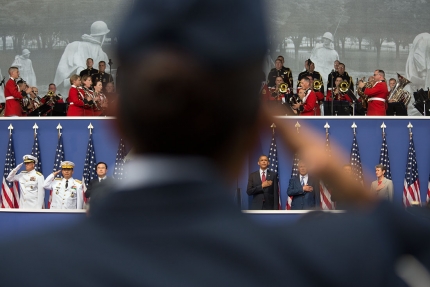
Remarks by the President at 60th Anniversary of the Korean War Armistice
National Korean War Veterans Memorial Washington, D.C.
10:44 A.M. EDT
THE PRESIDENT: Thank you so much. (Applause.) Thank you. Please be seated. Good morning. Annyong haseyo.
Secretaries Hagel, Jewell and Shinseki; Admiral Winnefeld; General Jung; all our friends from the Republic of Korea, including the legendary General Paik Sun Yup; distinguished guests; and most of all, veterans of the Korean War and your families. (Applause.) To our veterans -- many in your 80s, a few in your old uniforms -- which still fit -- (laughter) -- let me just say you look outstanding. And I would ask that all United States, Republic of Korea, and other veterans who fought -- I would ask those who can stand to please stand so that we can properly honor you here today. (Applause.)
July 27th, 1953 -- 60 years ago today. In the village of Panmunjom, in a barren room, the generals picked up their pens and signed their names to the agreement spread before them. That night, as the armistice took hold, the guns of war thundered no more. Along the jagged front, men emerged from their muddy trenches. A Marine raised his bugle and played taps. And a soldier spoke for millions when he said, “Thank God it is over.”
In the days that followed, both sides pulled back, leaving a demilitarized zone between them. Soldiers emptied their sandbags and tore down their bunkers. Our POWs emerged from the camps. Our troops boarded ships and steamed back across the ocean. And describing the moment he passed under the Golden Gate Bridge, one of those soldiers wrote, “We suddenly knew we had survived the war, and we were home.”
Yet ask these veterans here today and many will tell you, compared to other wars, theirs was a different kind of homecoming. Unlike the Second World War, Korea did not galvanize our country. These veterans did not return to parades. Unlike Vietnam, Korea did not tear at our country. These veterans did not return to protests. Among many Americans, tired of war, there was, it seemed, a desire to forget, to move on. As one of these veterans recalls, “We just came home and took off our uniforms and went to work. That was about it.”
You, our veterans of Korea, deserved better. And down the decades, our nation has worked to right that wrong, including here, with this eternal memorial, where the measure of your sacrifice is enshrined for all time. Because here in America, no war should ever be forgotten, and no veteran should ever be overlooked. And after the armistice, a reporter wrote, “When men talk in some distant time with faint remembrance of the Korean War, the shining deeds will live.” The shining deeds will live.
On this 60th anniversary, perhaps the highest tribute we can offer our veterans of Korea is to do what should have been done the day you come home. In our hurried lives, let us pause. Let us listen. Let these veterans carry us back to the days of their youth, and let us be awed by their shining deeds.
Listen closely and hear the story of a generation -- veterans of World War II recalled to duty. Husbands kissing their wives goodbye yet again. Young men -- some just boys, 18, 19, 20 years old -- leaving behind everyone they loved “to defend a country they never knew and a people they never met.” Let’s never forget all the daughters who left home, especially our heroic nurses who saved so many. Our women in Korea also served with honor. They also gave their lives. (Applause.)
Listen, and hear how these Americans faced down their fears and did their duty. Clutching their rifles; hearing the bugles in the distance; knowing that waves of enemy fighters would soon be upon them. In ships offshore, climbing down the ropes into the landing craft, knowing some of them would not leave that beach. On the tarmacs and flight decks, taking off in their Corsairs and Sabres, knowing that they might not return to this earth.
Listen, and hear of their gallantry -- often outnumbered and outgunned -- in some of the most brutal combat in modern history. How they held the line at the Pusan Perimeter. How they landed at Inchon and turned the tide of the war. How, surrounded and freezing, they battled their way out of Chosin Reservoir. And how they fought -- foxhole by foxhole, mountain after mountain, day and night -- at the Punchbowl and Heartbreak Ridge, Old Baldy and Pork Chop Hill.
Listen, and hear how perhaps the only thing worse than the enemy was the weather. The searing heat, the choking dust of summer. The deep snow and bitter cold of winter -- so cold their weapons could jam; so cold their food would turn to ice. And surely no one endured more than our POWs in those hellish camps, where the torment was unimaginable. Our POWs from Korea are some of the strongest men our nation has ever produced, and today we honor them all -- those who never came home and those who are here today. (Applause.)
Listen to these veterans and you’ll also hear of the resilience of the human spirit. There was compassion -- starving prisoners who shared their food. There was love -- men who charged machine guns, and reached for grenades, so their brothers might live. There was the dark humor of war -- as when someone misunderstood the code name for mortar rounds -- “Tootsie Rolls” -- and then shipped our troops thousands of Tootsie Rolls -- candies.
And there was hope -- as told in a letter home written by a soldier in the 7th Cavalry. Marching through the snow and ice, something caught his eye -- a young lieutenant up ahead, and from the muzzle of his rifle hung a pair of tiny baby booties, “swinging silently in the wind…like tiny bells.” They were sent by the lieutenant’s wife, pregnant with their first child, and she promised to send ribbons -- blue if a boy, pink if a girl. But as the war ground on, those soldiers were scattered. Until one day, on a Korean road, he spotted the lieutenant again. “Swinging gaily in the first rays of the morning sun,” the soldier wrote, were those booties, “and fluttering below them was the brightest, bluest piece of ribbon I have ever seen.”
Six decades on, these moments may seem like faint remembrances of a distant time. But for you -- our Korea veterans and your families -- I know it must feel sometimes just like just yesterday. And on days such as this, you’re back there once more. For Korea was the fire that helped to forge you.
As we listen to the story of your service, I say let us also learn, because your lives hold lessons for us today. Korea taught us the perils when we fail to prepare. After the Second World War, a rapid drawdown left our troops underequipped, so that in the early days of Korea, their rockets literally bounced off enemy tanks. Today, as we end a decade of war and reorient our forces for the future, as we make hard choices at home, our allies and adversaries must know the United States of America will maintain the strongest military the world has ever known, bar none, always. That is what we do. (Applause.)
Korea taught us that, as a people, we are stronger when we stand as one. On President Truman’s orders, our troops served together in integrated units. And the heroism of African Americans in Korea -- and Latinos and Asian Americans and Native Americans -- advanced the idea: If these Americans could live and work together over there, surely we could do the same thing here at home. (Applause.)
Change came slowly. And we continue our long journey toward a more perfect union. But for the great strides we have made toward the ideals of equality and opportunity, we must give thanks to our Korean War veterans who helped point the way.
Korea reminds us that when we send our troops into battle, they deserve the support and gratitude of the American people -- especially when they come home. Today, let us remember that -- right now -- our sons and daughters continue to risk their lives, give their lives, in Afghanistan. And as this war ends and we welcome them home, we will make it our mission to give them the respect and the care and the opportunities that they have earned. (Applause.)
And Korea reminds us that our obligations to our fallen and their families endure long after the battle ends. To this day, 7,910 Americans are still missing from the Korean War. And we will not stop working until we give these families a full accounting of their loved ones. (Applause.) Like Sergeant First Class William Robinson -- 26 years old -- missing for 63 years. This week, in Indiantown Gap, Pennsylvania, the Robinsons will welcome their uncle home and finally lay him to rest -- with full military honors. (Applause.)
Freedom is not free. And in Korea, no one paid a heavier price than those who gave all -- 36,574 American patriots, and, among our allies, more than one million of our South Korean friends -- soldiers and civilians. That July day, when the fighting finally ended, not far from where it began, some suggested this sacrifice had been for naught, and they summed it up with a phrase -- “die for a tie.”
It took many decades for this memorial to gain its rightful place on this great Mall where we tell our American story. It has, perhaps, taken even longer to see clearly, and understand fully, the true legacy of your service. But here, today, we can say with confidence that war was no tie. Korea was a victory. When 50 million South Koreans live in freedom -- a vibrant democracy, one of the world’s most dynamic economies, in stark contrast to the repression and poverty of the North -- that’s a victory; that’s your legacy. (Applause.)
When our soldiers stand firm along the DMZ; when our South Korean friends can go about their lives, knowing that the commitment of the United States to the security of the Republic of Korea will never waver -- that is a victory, and that is your legacy.
When our allies across the Asia Pacific know -- as we have proven in Korea for 60 straight years -- that the United States will remain a force for peace and security and prosperity --that’s a victory; that’s your legacy.
And for generations to come, when history recalls how free nations banded together in a long Cold War, and how we won that war, let it be said that Korea was the first battle -- where freedom held its ground and free peoples refused to yield, that, too, is your victory, your legacy.
Most of all, your legacy burns brightest right here, in a grateful nation that reveres you; in the loving families that cherish you -- like that young soldier with those baby booties swinging from his rifle. Ever since the war, the story of that soldier has been passed among our Korean War vets. Some of you may have heard it before. And many may have wondered what became of that soldier. Today, six decades later, we now know -- because we found him. His was Richard Shank, from St. Louis, Missouri. For his valor in Korea he earned the Silver Star. Yes, Dick survived the war. He returned home. He held his baby boy in his arms. He was able to be a father to his son.
But this story doesn’t end there -- because like so many of you, Dick continued to serve in uniform. His son grew into a man, got married, had children of his own. Those children are now adults themselves, scattered across the country. And like so many American families, they still speak with pride of their grandfather’s service in Korea.
Today, Dick Shank lives in Gainesville, Florida, and I believe he’s watching us this morning. He’s 84 years old, recovering from a recent fall while roller skating. (Laughter.) “Life is short,” he says, “and I just keep on living it.” And one of the ways he keeps living it is by meeting up every year with his buddies from Korea, and recalling the time they shared together in that fight which ended 60 years ago today.
Veterans of the Korean War -- in the spring of your youth you learned how short and precious life can be. And because of you, millions of people can keep on living it, in freedom and in peace. Your lives are an inspiration. Your service will never be forgotten. You have the thanks of a grateful nation. And your shining deeds will live -- now and forever.
May God bless those who gave all in Korea. May God bless you and your families. May God bless the alliances that helped secure our prosperity and our security. And may God continue to bless these United States of America. Thank you very much. (Applause.)