The White House

Office of the Press Secretary

Remarks by the President on the Economy -- Warrensburg, Missouri

University of Central Missouri
Warrensburg, Missouri

5:09 P.M. CDT

THE PRESIDENT:  Hello, Warrensburg!  (Applause.)  Hello, Mules!  (Applause.)  Hello, Jennies!  (Applause.)  Well, I know it’s hot.  (Laughter.)  That’s why I took off my jacket.  If you’ve still got yours on feel free to take it off.  It is great to be back in Missouri.  It’s great to be back in the Midwest.  It’s great to be here at UCM.  (Applause.)

I want to thank your outstanding president, Dr. Chuck Ambrose, for having me here today.  (Applause.)  Give Brian a big round of applause for the introduction.  (Applause.)  You’ve got your outstanding governor, Jay Nixon, in the house.  (Applause.)  Your mayor, Charlie Rutt, is here.  (Applause.)  And I brought a special guest with me who is celebrating her birthday today -- your senator, Claire McCaskill.  (Applause.)  I figured the least I could do is give her a ride on Air Force One for her birthday.  (Laughter.) 

So we’ve got Mules in the house.  We’ve got Jennies in the house.  We’ve got governors, we’ve got senators, and now we’ve probably got some very confused people watching at home, because who is Jennie?  (Laughter.) 

I want to thank all the students who came out on a summer afternoon.  I know that summer is -- especially a day as pretty as today, it’s tempting to be outside.  I know classes don’t start for a few more weeks.  You could be over on Pine Street beating the heat.  (Applause.)  Now that I think about it, it may be good that you’re here instead of getting into trouble.  (Laughter.)

I’ve just come from Knox College in Galesburg, Illinois, where I gave a pretty long speech on the economy.  I will not repeat the whole thing here.  (Applause.)  But what I did want to talk about today is what I’ve talked about when I gave my first big speech as a senator eight years ago, and that’s where we as a country need to go to give every American a chance to get ahead in the 21st century.  And UCM understands how important that is.  (Applause.)

Just a little context here -- in the period after World War II, you had a growing middle class that was the engine of our prosperity.  The economy did well in part because everybody was participating.  And whether you owned a company, or you swept the floors of that company, or you worked anywhere in between, America offered a basic bargain:  If you work hard, then you will be rewarded with fair wages and benefits.  You’ll have the chance to buy your own home.  You’ll have the chance to save for retirement.  You’ll have the protection of decent health insurance.  But most of all, you’ll have the chance to pass on a better life to your kids. 

And then what happened was that engine began to stall.  The bargain began to fray.  So technology made some jobs obsolete -- nobody goes to a bank teller anymore.  You want to schedule a trip somewhere, you get online.  Global competition sent some jobs overseas.  When I was in Galesburg, we talked about the Maytag plant that used to make household brands there and people -- thousands of people used to work in the plant and it went down to Mexico.  Then Washington doled out bigger tax cuts to folks at the top income brackets, smaller minimum wage increases for people who were struggling.  You combine all this and the income of the top 1 percent quadrupled from 1979 to 2007, but the typical family’s incomes barely budged. 

So a lot of middle-class families began to feel that the odds were stacked against them -- and they were right.  And then for a while, this was kind of papered over because we had a housing bubble going on, and everybody was maxing out on their credit cards, everybody was highly leveraged, there were a lot of financial deals going around.  And so it looked like the economy was going to be doing okay, but then by the time I took office, the bottom had fallen out.  And it cost, as we know, millions of Americans their jobs or their homes or their savings.  And that long-term erosion of middle-class security was evident for everybody to see.

Now, the good news is, five years later, five years after the crisis first hit, America has fought its way back.  So together, we saved an auto industry.  We took on a broken health care system.  We invested in new American technologies to reverse our addiction to foreign oil.  We doubled the production of clean energy.  Natural gas took off.  We put in place tough new rules on big banks and mortgage lenders and credit card companies.  We changed the tax code so it was fair for middle-class folks and didn't just benefit folks at the very top like me.  (Laughter.)  No, it's true, because things were skewed too much towards folks who were already blessed, already lucky.  And you take all that together and now you add it all up. 

What we've seen is over the past 40 months, our businesses have created more than 7.2 million new jobs.  This year, we're off to our strongest private sector job growth since 1999.  (Applause.)  Our exports have surged, so we sell more products made in America to the rest of the world than ever before.  (Applause.)  We produce more natural gas than any country on Earth.  We’re about to produce more of our own oil than we buy from overseas, and that's the first time that's happened in nearly 20 years.  (Applause.)  The cost of health care is growing at its slowest rate in 50 years, so we're slowing the growth of health care costs.  (Applause.)  And our deficits are falling at the fastest rate in 60 years.  (Applause.)  Deficits have been cut by almost half from the time I took office.

So we did this together, because Americans are gritty and resilient and work hard.  We've been able to clear away the rubble of the financial crisis.  We're starting to lay a new foundation for more durable economic growth.  And with the new revolutions in energy and technology and manufacturing and health care, we're actually poised -- we're in a position to reverse all those forces that battered middle-class families for too long.  We can start building now an economy where everybody who works hard can get ahead.  That's all good.  That's the good news.

But, Missouri, I’m here to tell you what you already know, which is we're not there yet.  In some ways, the trends that have been building for decades -- this winner-take-all economy where a few do better and better, but everybody else just treads water -- all those trends were made worse by the recession.  And reversing these trends has to be Washington’s number one priority.  (Applause.)  It has to be Washington's number one priority.  (Applause.) 

Putting people back to work, making sure the economy is working for everybody, building the middle class, making sure they're secure -- that's my highest priority.  That's what I'm interested in.  (Applause.)  Because when the economy is working for middle-class families, it solves an awful lot of other problems.  Now the poor start having ladders of opportunity they can climb into if they work hard.  A lot of the social tensions are reduced, because everybody is feeling pretty good.  

Now, unfortunately, over the past couple of years in particular, Washington hasn’t just ignored this problem -- they've actually made it worse.  And I am interested in working with everybody, and there are a bunch of not just Democrats, but also Republicans who recognize that Washington is not working.  But we've also seen a group of folks, particularly in the House, a group of Republicans in Congress that -- they suggested they wouldn’t vote to pay the bills that Congress had already run up.  And that fiasco harmed a fragile recovery back in 2011. 

We've got a growing number of Republican senators who are trying to get things done with their Democratic counterparts -- just passed an immigration bill that economists say is going to boost our economy by more than a trillion dollars.  (Applause.)  But so far, at least, there's a faction of House Republicans who won't let the bill go to the floor for a vote.  And if you ask them, well, okay, what's your economic agenda for the middle class, how are we going to grow our economy so everybody prospers, they'll start talking about out-of-control government spending -- although, as I said, government spending has actually gone down and deficits are going down -- or they'll talk about Obamacare, the whole idea that somehow if we don't provide health insurance to 50 million Americans that's going to improve the economy.  Never mind the fact that our jobs growth is a lot faster now than it was during the last recovery when Obamacare wasn't around.

So we've got some basic challenges that we're just going to have to meet.  We've cut our deficit.  We're creating jobs at nearly twice the pace.  We are providing health care for Americans that need it.  But we now have to get back and focus on what's important.  An endless parade of distractions and political posturing and phony scandals can't get in the way of what we need to do.  (Applause.)  And I'm here to say it's got to stop.  We've got to focus on jobs and the economy, and helping middle-class families get ahead.  And if we do that, we're going to solve a whole lot of problems.  (Applause.)

And as we're thinking about these issues, we can't get involved in short-term thinking.  We can't have all the same old debates.  That's not what the moment requires.  We've got to focus on the core economic issues that matter to you.  And as Washington is now preparing for another debate about the budget, the stakes could not be higher.  If we don't make the investments America needs to make this country a magnet for good jobs, if we don't make investments in education and manufacturing and science and research and transportation and information networks, we will be waving the white flag while other countries forge ahead in a global economy.  (Applause.)  If we just stand by and do nothing, we're saying it’s okay for middle-class folks to keep taking it on the chin.  And I don't think it's okay. 

And that's why I came here to Warrensburg today.  I need you involved in this debate to remind Washington what’s at stake.  And over the next several weeks, in towns just like this one, I’m going to lay out my ideas for how we build on the cornerstones of what it means to be middle class, what it takes to work your way into the middle class -- a good job with good wages in durable, growing industries; a good education for our kids and our workers; a home to call your own; affordable health care that’s there for you when you or your family members get sick -- (applause) -- a secure retirement even if you’re not rich -- (applause) -- more ladders of opportunity for people who want to earn their way into the middle class as long as they're willing to work for it. 

And what we need what we need is not a three-month plan, or even a three-year plan -- we need a long-term plan based on steady, persistent effort to reverse the forces that have conspired against middle-class families for decades.  And I am confident -- I know -- there are members of both parties who understand what’s at stake. 

So I welcome ideas from anybody across the political spectrum.  But I’m not going to allow gridlock or inaction or willful indifference to get in this country’s way.  We’ve got to get moving.  (Applause.) 

So where I can act on my own, I’m going to.  I’m not going to wait for Congress.  (Applause.)  Because the choices that we make now aren’t just going to determine what happens to the young people here at this school, it’s going to determine what happens to your kids and your grandkids.  So one thing I really want to focus on here, because UCM is doing some extraordinary things, I want to focus on just briefly that second cornerstone -- an education that prepares our kids and our workers for the global competition that you’ll face.  That is why I wanted to highlight what’s happening here at the University of Central Missouri, because you guys are doing some things right.  (Applause.)

In an age where business knows no borders, jobs are going to seek out the countries that have the most talented, skilled citizens, and those are the folks who are going to make a good living.  The days when the wages for a worker with a high-school degree could keep pace with the earnings of somebody with a college degree -- those days are over.  You can see it all throughout the Midwest, where you’ve got folks who a generation ago could just walk into a factory or a plant, didn’t have a lot of skills, get trained on the job, make a good living, live out a middle-class life.  That’s not going to happen anymore.  Technology, global competition -- those things are not going away. 

So we can either throw up our hands and resign ourselves to lower living standards, or we can do what America has always done -- we can adapt, we can pull together, we can fight back, we can win.  (Applause.)  And if we don’t invest in American education, then we’re going to put our kids, our workers, our countries, our businesses at a competitive disadvantage.  Because if you think it’s -- if you think education is expensive, you should see how much ignorance is going to cost in the 21st century.  It’s going to be expensive.  (Applause.) 

So what do we need to do on education?  Number one, it’s got to start in the earliest years.  And that means working with states to make high-quality preschool available for every four-year-old in America.  (Applause.)  Every study shows this is a smart investment, encourages healthy behaviors, increases our kids’ success in the classroom, increases their earning power as they grow up, reduces rates of teen pregnancy, reduces criminal behavior.  It’s really important.  And any working parent will tell you that knowing your kid is in a safe place to learn is a big relief, so it’s also important for the parents. 

This idea of early childhood education, it shouldn’t be partisan.  States with Republican governors are doing it just like a lot of Democratic governors are doing it.  Our kids don’t care about politics.  We should prove that we care about them and make this thing happen.  And I am going to keep on pushing, as long as I am President, until we have a situation where every kid is getting a good, healthy start in life and are prepared when they go to school.  (Applause.) 

We’re going to take action on proven ideas to upgrade our schools that don’t require Congress.  So for example, last month, I announced a goal of connecting 99 percent of America’s students to high-speed Internet within five years.  We’re going ahead and taking steps for that to happen right now.  Now, some of you may have gone to schools where you had internet in every classroom, but a lot of schools right now, they’ve got maybe a computer lab, but if you go in the classroom, kids, they don’t have it.  In America, in this country, every child at every desk should have access to the entire world’s information, and every teacher should have the cutting-edge technology to help their kids succeed and learn.  We’re going to make that happen.  (Applause.)

We’ve got to rethink our high schools so that our kids graduate with the real-world skills that this new age demands.  We’ve got to reward the schools that forge partnerships with local colleges and businesses, and that focus on the fields of the future like science and technology and math and engineering.

And I’m going to use the power of my office over the next few months to highlight a topic that affects probably everybody here, and that is the soaring cost of higher education.  (Applause.) 

Now, three years ago, I worked with Democrats to reform the student loan system so that taxpayer dollars weren’t going to pad the pockets of big banks, and instead were going to help students get a college education.  So millions of students were helped by that.  We took action to cap loan repayments at 10 percent of monthly incomes for responsible borrowers.  A lot of young people don’t know this, but if you’ve taken out federal loans, then if you choose a job, let’s say, that doesn’t pay as much as you’d like or you deserve, if you’re a teacher or some other profession, you only have to pay 10 percent of your income, which means that you can afford to go to college and know that you’re not going to be broke when you graduate -- which is important.  And not enough young people are using this.  (Applause.) 

As we speak -- and then, as we speak, we're working with both parties to reverse the doubling of student loan rates that happened a few weeks ago because Congress didn’t get its act together.  We've got to get student loan rates -- interest rates back down.  (Applause.)

So these are all good steps, but here's the problem -- and this is where what's happening at University of Central Missouri is so important.  We can put more and more money into student loans, we can put more and more money into grants, but if college costs keep on going up, then there's never going to be enough money.  I can keep student loan rates low, but if you're borrowing $80,000 for college, or $100,000 and you get out, it doesn’t matter whether interest rate is 3.5 or 8.5, you're still going to have trouble repaying it.  It'll take you longer to buy a house.  If you've got an idea for a business, it's going to take you longer to invest in starting your business.

So we've got to do something about college costs.  Families and taxpayers can’t just keep paying more and more into an undisciplined system.  We’ve got to get a better bang for our buck.  (Applause.)  So states have to do their part by prioritizing higher education in their budgets -- (applause) -- because part of the reason tuition has been skyrocketing is colleges aren't -- state-funded colleges aren't getting as much funding, and so then tuition is going up on the backs of students and families.  But we've also got to test new ways of funding based not just on how many students enroll, but how well they do.  And colleges have to do their part by keeping costs from going up. 

So here at Central Missouri, you are a laboratory for this kind of innovation.  I had a great discussion with not only the president of this university but also the superintendent of schools here, the head of the community colleges.  What's happened at UCM is you've partnered with the Lee’s Summit School District, with the Metropolitan Community College, with local health care, engineering, energy, and infrastructure firms -- all industries that are going to drive job growth in the future -- and everybody is now working together to equip students with better skills, allow them to graduate faster with less debt, and with the certainty of being able to get a job at the other end.  (Applause.)  That's a recipe for success over the long term.

So we've got students at Summit Technology Academy -- (applause) -- there we go.  Those students, they're beginning to accrue credits towards an associate’s degree while they’re still in high school, which means they can come here to earn a bachelor’s degree in two years and graduate debt free.  (Applause.)  Debt free, on a fast track.  (Applause.)

And because the community colleges and industries are involved, students are making quicker decisions about the industries that are going to create jobs, and the businesses are helping to design the programs to make sure that they have the skills for those jobs so that not only are you graduating debt free, but you also know that you've got a job waiting for you on the other end.  (Applause.)

Now, that is exactly the kind of innovation we need when it comes to college costs.  That’s what's happening right here in Warrensburg.  And I want the entire country to notice it, and I want other colleges to take a look at what's being done here.  And I’ve asked my team to shake the trees all across the country for some of the best ideas out there for keeping college costs down, so that as students prepare to go back to school, I’m in a position to lay out what’s going to be an aggressive strategy to shake up the system to make sure that middle-class students, working-class students, poor kids who have the drive and the wherewithal and want to get a good college education, they can get it without basically mortgaging their entire future.  We can make this happen but this is an example of the kind of thing we’ve got to focus on instead of a bunch of distractions in Washington.  (Applause.) 

Tackling college costs, creating more good jobs, establishing a better bargain for middle-class families and everybody trying to work to join into it, an economy that grows not from the top down but from the middle out -- that’s not just what I’m going to focus on for the next few months, that’s what I’m going to be focused on for the remainder of my presidency.  And I’m going to take these plans all across the country, and I’m going to ask folks for help because, frankly, sometimes I just can’t wait for Congress.  It just takes them a long time to decide on stuff.  (Applause.) 

So we’re going to reach out to CEOs and we’re going to reach out to workers, and we’re going to reach out to college presidents and we’re going to reach out to students.  We’ll talk to Democrats and independents -- and, yes, I will be asking Republicans to get involved because this has to be our core project for the next decade.

I want to lay out my ideas to give the middle class a better shot in the 21st century.  And look, I want Republicans to lay out their ideas.  If they’ve got a better idea to bring down college costs that we haven’t thought of, let’s hear them.  I’m ready to go.  If they’ve got a better plan to make sure that every American knows the security of affordable health care, then please share it with the class.  Raise your hand.  (Applause.)  But what you can’t do is just manufacture another crisis because you think it might be good politics, just as our economy is getting some traction.  What you can’t do is shut down our government just because I’m for opening the government.  (Applause.)  You can’t threaten not to pay the bills this country racked up or to cut investments in education and science and basic research that are going to help us grow. 

If we’re going to manage deficits and debt, let’s do it in a sensible way.  We can do this if we work together.  And it may seem hard right now, but if we’re willing to take a few bold steps -- if Washington will just shake off its complacency, set aside the kind of slash-and-burn partisanship that we’ve seen over the past few years -- I promise you, our economy will be stronger a year from now, just like it’s stronger now than it was last year.  And then it will be stronger five years from now, and then it will be stronger 10 years from now.  (Applause.)  And more Americans will have the pride of a first paycheck.  And more Americans will have the satisfaction of starting their own business and flipping that sign that says “open”.  More folks will have the thrill of marching across the stage to earn a diploma from a university like this, and then know that they’ve got a job waiting for them when they graduate.

What makes us special -- a lot of times we talk about American exceptionalism and how much we love this country, and there are so many wonderful things about our country.  But what makes us the envy of the world has not just been our ability to generate incredible wealth for a few people; it’s the fact that we’ve given everybody a chance to pursue their own true measure of happiness.  (Applause.)  That’s who we are. 

We haven’t just wanted success for ourselves; we want it for our neighbors.  We want it for our neighborhoods.  That’s why we don’t call it Bob’s dream or Barbara’s dream or Barack’s dream -- we call it the American Dream.  (Applause.)  It’s one that we share.  That's who we are -- the idea that no matter who you are, what you look like, where you come from, who you love, you can make it here in America if you’re trying hard.  (Applause.) 

That’s what a college education can be all about.  That’s what inspires your President, that’s what inspires the faculty.  That’s why when we see young people like you, we’re inspired -- because you’re an expression of that idea.  And we’ve got to make sure that that continues -- not just for this generation, but for the next generation. 

And I’ve got a hundred -- I’ve got 1,267 days left in my presidency.  And I’m going to spend every minute, every second, as long as I have the privilege of being in this office, making sure that I am doing every single thing that I can so that middle-class families, working families, people who are out there struggling every single day -- that they know that that work can lead them to a better place.  And we’re going to make sure that that American Dream is available for everybody, not just now, but in the future.  (Applause.) 

So thank you, Missouri.  Thank you, UCM.  Thank you, Mules.  Thank you, Jennies.  God bless you.  God bless the United States of America.  Let’s get to work.  (Applause.)

END 
5:41 P.M. CDT

President Obama Speaks on Education and the Economy

July 24, 2013 | 30:41 | Public Domain

At the University of Central Missouri, President Obama discusses his vision for rebuilding an economy that puts the middle class and those fighting to join it front and center, which includes investing in education. UCM is home to The Missouri Innovation Campus, which prepares students with the education and skills they need to succeed at an accelerated pace while lowering costs and without student debt.

Download mp4 (1157MB) | mp3 (74MB)

The White House

Office of the Press Secretary

Statement by the President on Student Loans

A better bargain for the middle class means making a college education available to every single American willing to work for it.  That’s why I applaud the wide bipartisan majority of Senators who passed a bill to cut rates on nearly all new federal student loans, rolling back a July 1st rate hike and saving undergraduates an average of more than $1,500 on loans they take out this year.

This compromise is a major victory for our nation’s students.  It meets the key principles I laid out from the start: it locks in low rates next year, and it doesn’t overcharge students to pay down the deficit.  I urge the House to pass this bill so that I can sign it into law right away, and I hope both parties build on this progress by taking even more steps to bring down soaring costs and keep a good education – a cornerstone of what it means to be middle class – within reach for working families.

###

President Obama Speaks on the Economy

July 24, 2013 | 1:06:44 | Public Domain

At Knox College, President Obama kicks off a series of speeches that will lay out his vision for rebuilding an economy that puts the middle class and those fighting to join it front and center.

Download mp4 (2529MB) | mp3 (161MB)

Read the Transcript

Remarks by the President on the Economy -- Knox College, Galesburg, IL

Knox College
Galesburg, Illinois

12:13 P.M. CDT
 
THE PRESIDENT:  Hello, Galesburg!  (Applause.)  Well, it’s good to be home in Illinois!  (Applause.)  It is good to be back. It’s good to be back.  Thank you.  Thank you so much, everybody. (Applause.)  Thank you.  Everybody, have a seat, have a seat.  Well, it is good to be back.
 
I want to, first of all, thank Knox College -- (applause) -- I want to thank Knox College and your president, Teresa Amott, for having me here today.  Give Teresa a big round of applause.  (Applause.)   I want to thank your Congresswoman, Cheri Bustos, who’s here.  (Applause.)  We've got Governor Quinn here.  (Applause.)  I'm told we've got your Lieutenant Governor, Sheila Simon, is here.  (Applause.)  There she is.  Attorney General Lisa Madigan is here.  (Applause.)
 
I see a bunch of my former colleagues, some folks who I haven't seen in years and I'm looking forward to saying hi to.  One in particular I've got to mention, one of my favorites from the Illinois Senate -- John Sullivan is in the house.  (Applause.)  John was one of my earliest supporters when I was running for the U.S. Senate, and it came in really handy because he’s got, like, 10 brothers and sisters, and his wife has got 10 brothers and sisters -- (laughter) -- so they’ve got this entire precinct just in their family.  (Laughter.)  And they all look like John -- the brothers do -- so he doesn’t have to go to every event.  He can just send one of his brothers out.  (Laughter.)  It is good to see him.
 
Dick Durbin couldn’t make it today, but he sends his best. And we love Dick.  (Applause.)  He’s doing a great job.  And we’ve got one of my favorite neighbors, the Senator from Missouri, Claire McCaskill, in the house, because we’re going to Missouri later this afternoon.  (Applause.)
 
And all of you are here, and it’s great to see you.  (Applause.)  And I hope everybody is having a wonderful summer.  The weather is perfect.  Whoever was in charge of that, good job. (Laughter.) 
 
So, eight years ago, I came here to deliver the commencement address for the class of 2005.  Things were a little different back then.  For example, I had no gray hair -- (laughter) -- or a motorcade.  Didn’t even have a prompter.  In fact, there was a problem in terms of printing out the speech because the printer didn’t work here and we had to drive it in from somewhere.  (Laughter.)  But it was my first big speech as your newest senator. 
 
And on the way here I was telling Cheri and Claire about how important this area was, one of the areas that I spent the most time in outside of Chicago, and how much it represented what’s best in America and folks who were willing to work hard and do right by their families.  And I came here to talk about what a changing economy was doing to the middle class -- and what we, as a country, needed to do to give every American a chance to get ahead in the 21st century.
 
See, I had just spent a year traveling the state and listening to your stories -- of proud Maytag workers losing their jobs when the plant moved down to Mexico.  (Applause.)  A lot of folks here remember that.  Of teachers whose salaries weren’t keeping up with the rising cost of groceries.  (Applause.)  Of young people who had the drive and the energy, but not the money to afford a college education.  (Applause.)  
 
So these were stories of families who had worked hard, believed in the American Dream, but they felt like the odds were increasingly stacked against them.  And they were right.  Things had changed.
 
In the period after World War II, a growing middle class was the engine of our prosperity.  Whether you owned a company, or swept its floors, or worked anywhere in between, this country offered you a basic bargain -- a sense that your hard work would be rewarded with fair wages and decent benefits, the chance to buy a home, to save for retirement, and most of all, a chance to hand down a better life for your kids.
 
But over time, that engine began to stall -- and a lot of folks here saw it -- that bargain began to fray.  Technology made some jobs obsolete.  Global competition sent a lot of jobs overseas.  It became harder for unions to fight for the middle class.  Washington doled out bigger tax cuts to the very wealthy and smaller minimum wage increases for the working poor. 
 
And so what happened was that the link between higher productivity and people’s wages and salaries was broken.  It used to be that, as companies did better, as profits went higher, workers also got a better deal.  And that started changing.  So the income of the top 1 percent nearly quadrupled from 1979 to 2007, but the typical family’s incomes barely budged.
 
And towards the end of those three decades, a housing bubble, credit cards, a churning financial sector was keeping the economy artificially juiced up, so sometimes it papered over some of these long-term trends.  But by the time I took office in 2009 as your President, we all know the bubble had burst, and it cost millions of Americans their jobs, and their homes, and their savings.  And I know a lot of folks in this area were hurt pretty bad.  And the decades-long erosion that had been taking place -- the erosion of middle-class security -- was suddenly laid bare for everybody to see.
 
Now, today, five years after the start of that Great Recession, America has fought its way back.  (Applause.)  We fought our way back.  Together, we saved the auto industry; took on a broken health care system.  (Applause.)  We invested in new American technologies to reverse our addiction to foreign oil.  We doubled wind and solar power.  (Applause.)  Together, we put in place tough new rules on the big banks, and protections to crack down on the worst practices of mortgage lenders and credit card companies.  (Applause.)  We changed a tax code too skewed in favor of the wealthiest at the expense of working families -- so we changed that, and we locked in tax cuts for 98 percent of Americans, and we asked those at the top to pay a little bit more.  (Applause.)
 
So you add it all up, and over the past 40 months, our businesses have created 7.2 million new jobs.  This year, we’re off to our strongest private sector job growth since 1999. 
 
And because we bet on this country, suddenly foreign companies are, too.  Right now, more of Honda’s cars are made in America than anyplace else on Earth.  (Applause.)  Airbus, the European aircraft company, they’re building new planes in Alabama.  (Applause.)  And American companies like Ford are replacing outsourcing with insourcing -- they’re bringing jobs back home.  (Applause.) 
 
We sell more products made in America to the rest of the world than ever before.  We produce more natural gas than any country on Earth.  We’re about to produce more of our own oil than we buy from abroad for the first time in nearly 20 years.  (Applause.)  The cost of health care is growing at its slowest rate in 50 years.  (Applause.)  And our deficits are falling at the fastest rate in 60 years.  (Applause.)
 
So thanks to the grit and resilience and determination of the American people -- of folks like you -- we’ve been able to clear away the rubble from the financial crisis.  We started to lay a new foundation for stronger, more durable economic growth. And it's happening in our own personal lives as well, right?  A lot of us tightened our belts, shed debt, maybe cut up a couple of credit cards, refocused on those things that really matter. 
 
As a country, we’ve recovered faster and gone further than most other advanced nations in the world.  With new American revolutions in energy and technology and manufacturing and health care, we're actually poised to reverse the forces that battered the middle class for so long, and start building an economy where everyone who works hard can get ahead.
 
But -- and here's the big “but” -- I’m here to tell you today that we're not there yet.  We all know that.  We're not there yet.  We've got more work to do.  Even though our businesses are creating new jobs and have broken record profits, nearly all the income gains of the past 10 years have continued to flow to the top 1 percent.  The average CEO has gotten a raise of nearly 40 percent since 2009.  The average American earns less than he or she did in 1999.  And companies continue to hold back on hiring those who’ve been out of work for some time. 
 
Today, more students are earning their degree, but soaring costs saddle them with unsustainable debt.  Health care costs are slowing down, but a lot of working families haven’t seen any of those savings yet.  The stock market rebound helped a lot of families get back much of what they had lost in their 401(k)s, but millions of Americans still have no idea how they’re going to be able to retire. 
 
So in many ways, the trends that I spoke about here in 2005 -- eight years ago -- the trend of a winner-take-all economy where a few are doing better and better and better, while everybody else just treads water -- those trends have been made worse by the recession.  And that's a problem.
 
This growing inequality not just of result, inequality of opportunity -- this growing inequality is not just morally wrong, it’s bad economics.  Because when middle-class families have less to spend, guess what, businesses have fewer consumers.  When wealth concentrates at the very top, it can inflate unstable bubbles that threaten the economy.  When the rungs on the ladder of opportunity grow farther and farther apart, it undermines the very essence of America -- that idea that if you work hard you can make it here.
 
And that’s why reversing these trends has to be Washington’s highest priority.  (Applause.)  It has to be Washington's highest priority.  (Applause.)  It’s certainly my highest priority.  (Applause.) 
 
Unfortunately, over the past couple of years, in particular, Washington hasn’t just ignored this problem; too often, Washington has made things worse.  (Applause.)
 
And I have to say that -- because I'm looking around the room -- I've got some friends here not just who are Democrats,  I've got some friends here who are Republicans -- (applause) -- and I worked with in the state legislature and they did great work.  But right now, what we’ve got in Washington, we've seen a sizable group of Republican lawmakers suggest that they wouldn’t vote to pay the very bills that Congress rang up.  And that fiasco harmed a fragile recovery in 2011 and we can't afford to repeat that. 
 
Then, rather than reduce our deficits with a scalpel -- by cutting out programs we don’t need, fixing ones that we do need that maybe are in need of reform, making government more efficient -- instead of doing that, we've got folks who’ve insisted on leaving in place a meat cleaver called the sequester that's cost jobs.  It's harmed growth.  It's hurt our military.  It's gutted investments in education and science and medical research.  (Applause.) 
 
Almost every credible economist will tell you it's been a huge drag on this recovery.  And it means that we're underinvesting in the things that this country needs to make it a magnet for good jobs.
 
Then, over the last six months, this gridlock has gotten worse.  I didn't think that was possible.  (Laughter.)  The good news is a growing number of Republican senators are looking to join their Democratic counterparts and try to get things done in the Senate.  So that's good news.  (Applause.)  For example, they worked together on an immigration bill that economists say will boost our economy by more than a trillion dollars, strengthen border security, make the system work. 
 
But you've got a faction of Republicans in the House who won’t even give that bill a vote.  And that same group gutted a farm bill that America’s farmers depend on, but also America's most vulnerable children depend on.
 
AUDIENCE MEMBER:  Booo --
 
THE PRESIDENT:  And if you ask some of these folks, some of these folks mostly in the House, about their economic agenda how it is that they'll strengthen the middle class, they’ll shift the topic to “out-of-control government spending” –- despite the fact that we've cut the deficit by nearly half as a share of the economy since I took office.  (Applause.) 
 
Or they’ll talk about government assistance for the poor, despite the fact that they’ve already cut early education for vulnerable kids.  They've already cut insurance for people who’ve lost their jobs through no fault of their own.  Or they’ll bring up Obamacare -- this is tried and true -- despite the fact that our businesses have created nearly twice as many jobs in this recovery as businesses had at the same point in the last recovery when there was no Obamacare.  (Applause.)
 
AUDIENCE MEMBER:  My daughter has insurance now!
 
THE PRESIDENT:  I appreciate that.  (Applause.)  That’s what this is about.  That’s what this is about.  (Applause.)  That’s what we've been fighting for.  
 
But with this endless parade of distractions and political posturing and phony scandals, Washington has taken its eye off the ball.  And I am here to say this needs to stop.  (Applause.) This needs to stop. 
 
This moment does not require short-term thinking.  It does not require having the same old stale debates.  Our focus has to be on the basic economic issues that matter most to you, the people we represent.  That’s what we have to spend our time on and our energy on and our focus on.  (Applause.) 
 
And as Washington prepares to enter another budget debate, the stakes for our middle class and everybody who is fighting to get into the middle class could not be higher.  The countries that are passive in the face of a global economy, those countries will lose the competition for good jobs.  They will lose the competition for high living standards.  That’s why America has to make the investments necessary to promote long-term growth and shared prosperity -- rebuilding our manufacturing base, educating our workforce, upgrading our transportation systems, upgrading our information networks.  (Applause.)  That’s what we need to be talking about.  That’s what Washington needs to be focused on. 
 
And that’s why, over the next several weeks, in towns across this country, I will be engaging the American people in this debate.  (Applause.)  I'll lay out my ideas for how we build on the cornerstones of what it means to be middle class in America, and what it takes to work your way into the middle class in America:  Job security, with good wages and durable industries.  A good education.   A home to call your own.  Affordable health care when you get sick.  (Applause.)  A secure retirement even if you’re not rich.  Reducing poverty.  Reducing inequality.  Growing opportunity.  That’s what we need.  (Applause.)  That’s what we need.  That’s what we need right now.  That’s what we need to be focused on.  (Applause.)  
 
Now, some of these ideas I’ve talked about before.  Some of the ideas I offer will be new.  Some will require Congress.  Some I will pursue on my own.  (Applause.)  Some ideas will benefit folks right away.  Some will take years to fully implement.  But the key is to break through the tendency in Washington to just bounce from crisis to crisis.  What we need is not a three-month plan, or even a three-year plan; we need a long-term American strategy, based on steady, persistent effort, to reverse the forces that have conspired against the middle class for decades. That has to be our project.  (Applause.)
 
Now, of course, we’ll keep pressing on other key priorities. I want to get this immigration bill done.  We still need to work on reducing gun violence.  (Applause.)  We’ve got to continue to end the war in Afghanistan, rebalance our fight against al Qaeda. (Applause.)  We need to combat climate change.  We’ve got to standing up for civil rights.  We’ve got to stand up for women’s rights.  (Applause.)
 
So all those issues are important, and we’ll be fighting on every one of those issues.  But if we don’t have a growing, thriving middle class then we won’t have the resources to solve a lot of these problems.  We won’t have the resolve, the optimism, the sense of unity that we need to solve many of these other issues.
 
Now, in this effort, I will look to work with Republicans as well as Democrats wherever I can.  And I sincerely believe that there are members of both parties who understand this moment, understand what’s at stake, and I will welcome ideas from anybody across the political spectrum.  But I will not allow gridlock, or inaction, or willful indifference to get in our way.  (Applause.)
 
That means whatever executive authority I have to help the middle class, I’ll use it.  (Applause.)  Where I can’t act on my own and Congress isn’t cooperating, I’ll pick up the phone -- I’ll call CEOs; I’ll call philanthropists; I’ll call college presidents; I’ll call labor leaders.  I’ll call anybody who can help -- and enlist them in our efforts.  (Applause.)
 
Because the choices that we, the people, make right now will determine whether or not every American has a fighting chance in the 21st century.  And it will lay the foundation for our children’s future, our grandchildren’s future, for all Americans. 
So let me give you a quick preview of what I’ll be fighting for and why.  The first cornerstone of a strong, growing middle class has to be, as I said before, an economy that generates more good jobs in durable, growing industries.  That's how this area was built.  That's how America prospered.  Because anybody who was willing to work, they could go out there and they could find themselves a job, and they could build a life for themselves and their family.
 
Now, over the past four years, for the first time since the 1990s, the number of American manufacturing jobs has actually gone up instead of down.  That's the good news.  (Applause.)  But we can do more.  So I’m going to push new initiatives to help more manufacturers bring more jobs back to the United States.  (Applause.)  We’re going to continue to focus on strategies to make sure our tax code rewards companies that are not shipping jobs overseas, but creating jobs right here in the United States of America.  (Applause.)
 
We want to make sure that -- we’re going to create strategies to make sure that good jobs in wind and solar and natural gas that are lowering costs and, at the same time, reducing dangerous carbon pollution happen right here in the United States.  (Applause.)
 
And something that Cheri and I were talking about on the way over here -- I’m going to be pushing to open more manufacturing innovation institutes that turn regions left behind by global competition into global centers of cutting-edge jobs.  So let’s tell the world that America is open for business.  (Applause.)  I know there’s an old site right here in Galesburg, over on Monmouth Boulevard -- let’s put some folks to work.  (Applause.)
 
Tomorrow, I’ll also visit the Port of Jacksonville, Florida to offer new ideas for doing what America has always done best, which is building things.  Pat and I were talking before I came  -- backstage -- Pat Quinn -- he was talking about how I came over the Don Moffitt Bridge.  (Applause.)  But we’ve got work to do all across the country.  We’ve got ports that aren’t ready for the new supertankers that are going to begin passing through the new Panama Canal in two years’ time.  If we don’t get that done, those tankers are going to go someplace else.  We’ve got more than 100,000 bridges that are old enough to qualify for Medicare. (Laughter and applause.) 
 
Businesses depend on our transportation systems, on our power grids, on our communications networks.  And rebuilding them creates good-paying jobs right now that can’t be outsourced.  (Applause.)
 
And by the way, this isn’t a Democratic idea.  Republicans built a lot of stuff.  This is the Land of Lincoln.  Lincoln was all about building stuff -- first Republican President.  (Applause.)  And yet, as a share of our economy, we invest less in our infrastructure than we did two decades ago.  And that’s inefficient at a time when it’s as cheap as it’s been since the 1950s to build things.  It’s inexcusable at a time when so many of the workers who build stuff for a living are sitting at home waiting for a call. 
 
The longer we put this off, the more expensive it will be and the less competitive we will be.  Businesses of tomorrow will not locate near old roads and outdated ports.  They’ll relocate to places with high-speed Internet, and high-tech schools, and systems that move air and auto traffic faster, and not to mention will get parents home quicker from work because we’ll be eliminating some of these traffic jams.  And we can watch all of that happen in other countries, and start falling behind, or we can choose to make it happen right here, in the United States.  (Applause.)
 
In an age when jobs know no borders, companies are also going to seek out the countries that boast the most talented citizens, and they’ll reward folks who have the skills and the talents they need -- they’ll reward those folks with good pay. 
 
The days when the wages for a worker with a high school degree could keep pace with the earnings of somebody who got some sort of higher education -- those days are over.  Everybody here knows that.  There are a whole bunch of folks here whose dads or grandpas worked at a plant, didn’t need a high school education. You could just go there.  If you were willing to work hard, you might be able to get two jobs.  And you could support your family, have a vacation, own your home.  But technology and global competition, they’re not going away.  Those old days aren’t coming back. 
 
So we can either throw up our hands and resign ourselves to diminishing living standards, or we can do what America has always done, which is adapt, and pull together, and fight back, and win.  That’s what we have to do.  (Applause.)
 
And that brings me to the second cornerstone of a strong middle class -- and everybody here knows it -- an education that prepares our children and our workers for the global competition that they’re going to face.  (Applause.)  And if you think education is expensive, wait until you see how much ignorance costs in the 21st century.  (Laughter and applause.) 
 
If we don’t make this investment, we’re going to put our kids, our workers, and our country at a competitive disadvantage for decades.  So we have to begin in the earliest years.  And that’s why I’m going to keep pushing to make high-quality preschool available for every 4-year-old in America.  (Applause.) Not just because we know it works for our kids, but because it provides a vital support system for working parents. 
 
And I’m going to take action in the education area to spur innovation that don’t require Congress.  (Applause.)  So, today, for example, as we speak, federal agencies are moving on my plan to connect 99 percent of America’s students to high-speed Internet over the next five years.  We’re making that happen right now.  (Applause.)  We’ve already begun meeting with business leaders and tech entrepreneurs and innovative educators to identify the best ideas for redesigning our high schools so that they teach the skills required for a high-tech economy.  
 
And we’re also going to keep pushing new efforts to train workers for changing jobs.  So here in Galesburg, for example, a lot of the workers that were laid off at Maytag chose to enroll in retraining programs like the one at Carl Sandburg College.  (Applause.)  And while it didn’t pay off for everyone, a lot of the folks who were retrained found jobs that suited them even better and paid even more than the ones they had lost. 
 
And that’s why I’ve asked Congress to start a Community College to Career initiative, so that workers can earn the skills that high-tech jobs demand without leaving their hometown.  (Applause.)  And I’m going to challenge CEOs from some of America’s best companies to hire more Americans who’ve got what it takes to fill that job opening but have been laid off for so long that nobody is giving their résumé an honest look. 
 
AUDIENCE MEMBER:  More talent!
 
THE PRESIDENT:  That, too.
 
I’m also going to use the power of my office over the next few months to highlight a topic that’s straining the budgets of just about every American family -- and that’s the soaring cost of higher education.  (Applause.)  Everybody is touched by this, including your President, who had a whole bunch of loans he had to pay off.  (Laughter.) 
 
Three years ago, I worked with Democrats to reform the student loan system so that taxpayer dollars stopped padding the pockets of big banks, and instead helped more kids afford college.  (Applause.)  Then, I capped loan repayments at 10 percent of monthly incomes for responsible borrowers, so that if somebody graduated and they decided to take a teaching job, for example, that didn’t pay a lot of money, they knew that they were never going to have to pay more than 10 percent of their income and they could afford to go into a profession that they loved.  That’s in place right now.  (Applause.)  And this week, we’re working with both parties to reverse the doubling of student loan rates that happened a few weeks ago because of congressional inaction.  (Applause.)
 
So this is all a good start -- but it isn’t enough.  Families and taxpayers can’t just keep paying more and more and more into an undisciplined system where costs just keep on going up and up and up.  We’ll never have enough loan money, we’ll never have enough grant money, to keep up with costs that are going up 5, 6, 7 percent a year.  We’ve got to get more out of what we pay for. 
 
Now, some colleges are testing new approaches to shorten the path to a degree, or blending teaching with online learning to help students master material and earn credits in less time.  In some states, they’re testing new ways to fund college based not just on how many students enroll, but how many of them graduate, how well did they do. 
 
So this afternoon, I’ll visit the University of Central Missouri to highlight their efforts to deliver more bang for the buck to their students.  And in the coming months, I will lay out an aggressive strategy to shake up the system, tackle rising costs, and improve value for middle-class students and their families.  It is critical that we make sure that college is affordable for every single American who’s willing to work for it.  (Applause.)
 
Now, so you’ve got a good job; you get a good education -- those have always been the key stepping stones into the middle class.  But a home of your own has always been the clearest expression of middle-class security.  For most families, that’s your biggest asset.  For most families, that’s where your life’s work has been invested.  And that changed during the crisis, when we saw millions of middle-class families experience their home values plummeting.  The good news is over the past four years, we’ve helped more responsible homeowners stay in their homes.  And today, sales are up and prices are up, and fewer Americans see their homes underwater.
 
But we’re not done yet.  The key now is to encourage homeownership that isn’t based on unrealistic bubbles, but instead is based on a solid foundation, where buyers and lenders play by the same set of rules, rules that are clear and transparent and fair. 
 
So already, I’ve asked Congress to pass a really good, bipartisan idea -- one that was championed, by the way, by Mitt Romney’s economic advisor -- and this is the idea to give every homeowner the chance to refinance their mortgage while rates are still low so they can save thousands of dollars a year.  (Applause.)  It will be like a tax cut for families who can refinance. 
 
I’m also acting on my own to cut red tape for responsible families who want to get a mortgage but the bank is saying no.  We’ll work with both parties to turn the page on Fannie Mae and Freddie Mac, and build a housing finance system that’s rock-solid for future generations.
 
So we’ve got more work to do to strengthen homeownership in this country.  But along with homeownership, the fourth cornerstone of what it means to be middle class in this country is a secure retirement.  (Applause.)  I hear from too many people across the country, face to face or in letters that they send me, that they feel as if retirement is just receding from their grasp.  It’s getting farther and farther away.  They can't see it. 
 
Now, today, a rising stock market has millions of retirement balances going up, and some of the losses that had taken place during the financial crisis have been recovered.  But we still live with an upside-down system where those at the top, folks like me, get generous tax incentives to save, while tens of millions of hardworking Americans who are struggling, they get none of those breaks at all.  So as we work to reform our tax code, we should find new ways to make it easier for workers to put away money, and free middle-class families from the fear that they won't be able to retire.  (Applause.) 
 
And if Congress is looking for a bipartisan place to get started, I should just say they don’t have to look far.  We mentioned immigration reform before.  Economists show that immigration reform makes undocumented workers pay their full share of taxes, and that actually shores up the Social Security system for years.  So we should get that done.  (Applause.) 
 
Good job; good education for your kids; home of your own; secure retirement. 
 
Fifth, I'm going to keep focusing on health care -- (applause) -- because middle-class families and small business owners deserve the security of knowing that neither an accident or an illness is going to threaten the dreams that you’ve worked a lifetime to build. 
 
As we speak, we're well on our way to fully implementing the Affordable Care Act.  (Applause.)  We're going to implement it.  Now, if you’re one of the 85 percent of Americans who already have health insurance either through the job or Medicare or Medicaid, you don’t have to do anything, but you do have new benefits and better protections than you did before.  You may not know it, but you do.  Free checkups, mammograms, discounted medicines if you're on Medicare -- that’s what the Affordable Care Act means.  You're already getting a better deal.  No lifetime limits.
 
If you don’t have health insurance, then starting on October 1st, private plans will actually compete for your business, and you'll be able to comparison-shop online.  There will be a marketplace online, just like you’d buy a flat-screen TV or plane tickets or anything else you're doing online, and you'll be able to buy an insurance package that fits your budget and is right for you. 
 
And if you're one of the up to half of all Americans who’ve been sick or have a preexisting condition -- if you look at this auditorium, about half of you probably have a preexisting condition that insurance companies could use to not give you insurance if you lost your job or lost your insurance -- well, this law means that beginning January 1st, insurance companies will finally have to cover you and charge you the same rates as everybody else, even if you have a preexisting condition.  (Applause.)  That’s what the Affordable Care Act does.  That’s what it does.  (Applause.)   
 
Now, look, I know because I've been living it that there are folks out there who are actively working to make this law fail.  And I don’t always understand exactly what their logic is here, why they think giving insurance to folks who don’t have it and making folks with insurance a little more secure, why they think that’s a bad thing.  But despite the politically motivated misinformation campaign, the states that have committed themselves to making this law work are finding that competition and choice are actually pushing costs down.
 
So just last week, New York announced that premiums for consumers who buy their insurance in these online marketplaces will be at least 50 percent lower than what they're paying today -- 50 percent lower.  (Applause.)  So folks' premiums in the individual market will drop by 50 percent.  And for them and for the millions of Americans who’ve been able to cover their sick kids for the first time -- like this gentlemen who just said his daughter has got health insurance -- or have been able to cover their employees more cheaply, or are able to have their kids who are younger than -- who are 25 or 26 stay on their parents' plan -- (applause) -- for all those folks, you'll have the security of knowing that everything you’ve worked hard for is no longer one illness away from being wiped out.  (Applause.)  
 
Finally, as we work to strengthen these cornerstones of middle-class security -- good job with decent wages and benefits, a good education, home of your own, retirement security, health care security -- I’m going to make the case for why we've got to rebuild ladders of opportunity for all those Americans who haven't quite made it yet -- who are working hard but are still suffering poverty wages, who are struggling to get full-time work.  (Applause.) 
 
There are a lot of folks who are still struggling out here, too many people in poverty.  Here in America, we’ve never guaranteed success -- that's not what we do.  More than some other countries, we expect people to be self-reliant.  Nobody is going to do something for you.  (Applause.)  We've tolerated a little more inequality for the sake of a more dynamic, more adaptable economy.  That's all for the good.  But that idea has always been combined with a commitment to equality of opportunity to upward mobility -- the idea that no matter how poor you started, if you're willing to work hard and discipline yourself and defer gratification, you can make it, too.  That's the American idea.  (Applause.)  
 
Unfortunately, opportunities for upward mobility in America have gotten harder to find over the past 30 years.  And that’s a betrayal of the American idea.  And that’s why we have to do a lot more to give every American the chance to work their way into the middle class.
 
The best defense against all of these forces -- global competition, economic polarization -- is the strength of the community.  So we need a new push to rebuild rundown neighborhoods.  (Applause.)  We need new partnerships with some of the hardest-hit towns in America to get them back on their feet.  And because no one who works full-time in America should have to live in poverty, I am going to keep making the case that we need to raise the minimum wage -- (applause) -- because it's lower right now than it was when Ronald Reagan took office.  It's time for the minimum wage to go up.  (Applause.)
 
We're not a people who allow chance of birth to decide life’s biggest winners or losers.  And after years in which we’ve seen how easy it can be for any of us to fall on hard times -- folks in Galesburg, folks in the Quad Cities, you know there are good people who work hard and sometimes they get a bad break.  A plant leaves.  Somebody gets sick.  Somebody loses a home.  We've seen it in our family, in our friends and our neighbors.  We've seen it happen.  And that means we cannot turn our backs when bad breaks hit any of our fellow citizens.
 
So good jobs; a better bargain for the middle class and the folks who are working to get into the middle class; an economy that grows from the middle out, not the top down -- that's where I will focus my energies.  (Applause.)  That's where I will focus my energies not just for the next few months, but for the remainder of my presidency. 
 
These are the plans that I'll lay out across this country.  But I won’t be able to do it alone, so I'm going to be calling on all of us to take up this cause.  We’ll need our businesses, who are some of the best in the world, to pressure Congress to invest in our future.  And I’ll be asking our businesses to set an example by providing decent wages and salaries to their own employees.  And I’m going to highlight the ones that do just that. 
 
There are companies like Costco, which pays good wages and offers good benefits.  (Applause.)  Companies like -- there are companies like the Container Store, that prides itself on training its employees and on employee satisfaction -- because these companies prove that it’s not just good for the employees, it’s good for their businesses to treat workers well.  It’s good for America.  (Applause.) 
 
So I’m going to be calling on the private sector to step up. I will be saying to Democrats we’ve got to question some of our old assumptions.  We’ve got to be willing to redesign or get rid of programs that don't work as well as they should.  (Applause.) We’ve got to be willing to -- we’ve got to embrace changes to cherished priorities so that they work better in this new age.  We can't just -- Democrats can't just stand pat and just defend whatever government is doing.  If we believe that government can give the middle class a fair shot in this new century -- and I believe that -- we’ve an obligation to prove it.  And that means that we’ve got to be open to new ways of doing things.
 
And we’ll need Republicans in Congress to set aside short-term politics and work with me to find common ground.  (Applause.) 
 
It’s interesting, in the run-up to this speech, a lot of reporters say that, well, Mr. President, these are all good ideas, but some of you’ve said before; some of them sound great, but you can't get those through Congress.  Republicans won’t agree with you.  And I say, look, the fact is there are Republicans in Congress right now who privately agree with me on a lot of the ideas I’ll be proposing.  I know because they’ve said so.  But they worry they’ll face swift political retaliation for cooperating with me.
 
Now, there are others who will dismiss every idea I put forward either because they’re playing to their most strident supporters, or in some cases because, sincerely, they have a fundamentally different vision for America -- one that says inequality is both inevitable and just; one that says an unfettered free market without any restraints inevitably produces the best outcomes, regardless of the pain and uncertainty imposed on ordinary families; and government is the problem and we should just shrink it as small as we can.
 
In either case, I say to these members of Congress:  I’m laying out my ideas to give the middle class a better shot.  So now it’s time for you to lay out your ideas.  (Applause.)  You can't just be against something.  You got to be for something.  (Applause.)
 
Even if you think I’ve done everything wrong, the trends I just talked about were happening well before I took office.  So it’s not enough for you just to oppose me.  You got to be for something.  What are your ideas?  If you’re willing to work with me to strengthen American manufacturing and rebuild this country’s infrastructure, let’s go.  If you’ve got better ideas to bring down the cost of college for working families, let’s hear them.  If you think you have a better plan for making sure that every American has the security of quality, affordable health care, then stop taking meaningless repeal votes, and share your concrete ideas with the country.  (Applause.) 
 
Repealing Obamacare and cutting spending is not an economic plan.  It’s not.
 
If you’re serious about a balanced, long-term fiscal plan that replaces the mindless cuts currently in place, or if you’re interested in tax reform that closes corporate loopholes and gives working families a better deal, I’m ready to work.  (Applause.)  But you should know that I will not accept deals that don’t meet the basic test of strengthening the prospects of hardworking families.  This is the agenda we have to be working on.  (Applause.)
 
We’ve come a long way since I first took office.  (Applause.)  As a country, we’re older and wiser.  I don’t know if I’m wiser, but I’m certainly older.  (Laughter.)  And as long as Congress doesn’t manufacture another crisis -- as long as we don’t shut down the government just because I’m for keeping it open -- (laughter) -- as long as we don’t risk a U.S. default over paying bills that we’ve already racked up, something that we’ve never done -- we can probably muddle along without taking bold action.  If we stand pat and we don’t do any of the things I talked about, our economy will grow, although slower than it should.  New businesses will form.  The unemployment rate will probably tick down a little bit.  Just by virtue of our size and our natural resources and, most of all, because of the talent of our people, America will remain a world power, and the majority of us will figure out how to get by.
 
But you know what, that’s our choice.  If we just stand by and do nothing in the face of immense change, understand that part of our character will be lost.  Our founding precepts about wide-open opportunity, each generation doing better than the last -- that will be a myth, not reality.  The position of the middle class will erode further.  Inequality will continue to increase. Money’s power will distort our politics even more. 
 
Social tensions will rise, as various groups fight to hold on to what they have, or start blaming somebody else for why their position isn’t improving.  And the fundamental optimism that’s always propelled us forward will give way to cynicism or nostalgia.
 
And that’s not the vision I have for this country.  It’s not the vision you have for this country.  That’s not the America we know.  That’s not the vision we should be settling for.  That’s not a vision we should be passing on to our children. 
 
I have now run my last campaign.  I do not intend to wait until the next campaign or the next President before tackling the issues that matter.  I care about one thing and one thing only, and that’s how to use every minute -- (applause) -- the only thing I care about is how to use every minute of the remaining 1,276 days of my term -- (laughter) -- to make this country work for working Americans again.  (Applause.)  That’s all I care about.  I don’t have another election.  (Applause.)
 
Because I’ll tell you, Galesburg, that’s where I believe America needs to go.  I believe that’s where the American people want to go.  And it may seem hard today, but if we’re willing to take a few bold steps -- if Washington will just shake off its complacency and set aside the kind of slash-and-burn partisanship that we’ve just seen for way too long -- if we just make some common-sense decisions, our economy will be stronger a year from now.  It will be stronger five years from now.  It will be stronger 10 years from now.  (Applause.) 
 
If we focus on what matters, then more Americans will know the pride of that first paycheck.  More Americans will have the satisfaction of flipping the sign to “Open” on their own business.  More Americans will have the joy of scratching the height of their kid on that door of their brand-new home.  (Applause.)   
 
And in the end, isn't that what makes us special?  It's not the ability to generate incredible wealth for the few; it's our ability to give everybody a chance to pursue their own true measure of happiness.  (Applause.)  We haven’t just wanted success for ourselves -- we want it for our neighbors, too.  (Applause.) 
 
When we think about our own communities -- we're not a mean people; we're not a selfish people; we're not a people that just looks out for “number one.”  Why should our politics reflect those kinds of values?  That’s why we don’t call it John’s dream or Susie’s dream or Barack’s dream or Pat's dream -- we call it the American Dream.  And that’s what makes this country special  -- the idea that no matter who you are or what you look like or where you come from or who you love, you can make it if you try. (Applause.)  That’s what we're fighting for. 
 
So, yes, Congress is tough right now, but that’s not going to stop me.  We're going to do everything we can, wherever we can, with or without Congress, to make things happen.  We're going to go on the road and talk to you, and you'll have ideas, and we want to see which ones we can implement.  But we're going to focus on this thing that matters.
 
One of America’s greatest writers, Carl Sandburg, born right here in Galesburg over a century ago -- (applause) -- he saw the railroads bring the world to the prairie, and then the prairie sent out its bounty to the world.  And he saw the advent of new industries, new technologies, and he watched populations shift.  He saw fortunes made and lost.  And he saw how change could be painful -- how a new age could unsettle long-held customs and ways of life.  But he had that frontier optimism, and so he saw something more on the horizon.  And he wrote, “I speak of new cities and new people.  The past is a bucket of ashes.  Yesterday is a wind gone down, a sun dropped in the west.  There is only an ocean of tomorrows, a sky of tomorrows.”
 
Well, America, we’ve made it through the worst of yesterday’s winds.  We just have to have the courage to keep moving forward.  We've got to set our eyes on the horizon.  We will find an ocean of tomorrows.  We will find a sky of tomorrows for the American people and for this great country that we love.
 
So thank you.  God bless you.  And God bless the United States of America.  (Applause.) 
 
END
1:17 P.M. CDT

Close Transcript

President Obama Lays Out a Better Bargain for the Middle Class

Watch this video on YouTube

Today President Obama returned to Knox College in Illinois to kick off a series of speeches about his vision for rebuilding an economy that puts the middle class -- and those fighting to join it – front and center.

In his remarks, President Obama laid out the progress we’ve made together in the five years since the start of the recession that cost millions of Americans their jobs, their homes, and their savings

Thanks to the grit and resilience and determination of the American people -- of folks like you -- we’ve been able to clear away the rubble from the financial crisis. We started to lay a new foundation for stronger, more durable economic growth.

As a country, we’ve recovered faster and gone further than most other advanced nations in the world. With new American revolutions in energy and technology and manufacturing and health care, we're actually poised to reverse the forces that battered the middle class for so long, and start building an economy where everyone who works hard can get ahead.

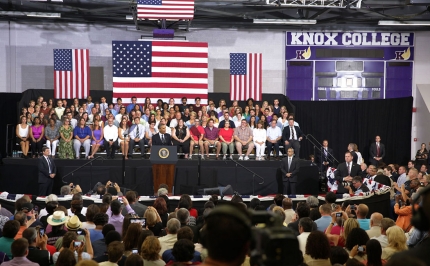
President Barack Obama delivers a speech on the economy at Knox College in Galesburg, Ill

President Barack Obama delivers a speech on the economy at Knox College in Galesburg, Ill., July 24, 2013. (Official White House Photo by Lawrence Jackson)

But, he said, “I’m here to tell you today that we're not there yet.”

The White House

Office of the Press Secretary

President Obama Announces More Key Administration Posts

WASHINGTON, DC – Today, President Obama announced his intent to nominate the following individuals to key Administration posts:

  • Marcel Lettre – Principal Deputy Under Secretary of Defense for Intelligence, Department of Defense
  • Robert M. Simon – Associate Director for Energy and Environment, Office of Science and Technology Policy
  • Caroline Kennedy – Ambassador to Japan, Department of State 

The President also announced his intent to appoint the following individual to a key Administration post:

  • Betty Sutton – Administrator, Saint Lawrence Seaway Development Corporation 

President Obama said, “These fine public servants both bring a depth of experience and tremendous dedication to their new roles.  Our nation will be well-served by these individuals, and I look forward to working with them in the months and years to come.”

President Obama announced his intent to nominate the following individuals to key Administration posts:

Marcel Lettre, Nominee for Principal Deputy Under Secretary of Defense for Intelligence, Department of Defense

Marcel Lettre currently serves as Special Assistant to the Secretary of Defense.  From 2009 to 2011, he served as Principal Deputy Assistant Secretary of Defense for Legislative Affairs.  From 2005 to 2009, he served as Senate Majority Leader Harry Reid’s Senior Defense and Intelligence Advisor and later as his Senior National Security Advisor.  From 2002 to 2005, Mr. Lettre served as a Professional Staff Member for the U.S. House Permanent Select Committee on Intelligence.  He was an associate for Booz Allen Hamilton from 2000 to 2001.  Mr. Lettre served as a Senior Policy Analyst for the Deutch Commission to Assess the Organization of the Federal Government to Combat Weapons of Mass Destruction from 1998 to 1999.  He was a Senior Staff Assistant in the American University Office of the President from 1995 to 1997, and a Junior Fellow at the Carnegie Endowment for International Peace from 1994 to 1995.  He received a B.A. from the University of the South and an M.P.P. from the John F. Kennedy School of Government at Harvard University.

Dr. Robert M. Simon, Nominee for Associate Director for Energy and Environment, Office of Science and Technology Policy

Dr. Robert M. Simon is currently a consultant in the Office of Science and Technology Policy, a position he has held since June 2013.  Previously, he served as a Senior Advisor in the Office of Science at the U.S. Department of Energy (DOE).  From 1999 to 2012, Dr. Simon directed the Democratic staff of the U.S. Senate Committee on Energy and Natural Resources, serving as the committee’s Staff Director from 2007 to 2012.  He served as a policy analyst with the Joint Economic Committee from 1998 to 1999 and served on the Committee on Energy and Natural Resources from 1993 to 1997.  Dr. Simon was the Principal Deputy Director of the Office of Energy Research at DOE from 1991 to 1993.  He served as the Executive Director of the Secretary of Energy Advisory Board from 1990 to 1992.  From 1982 to 1989, he served in a number of roles at the National Research Council.  In 2006, Dr. Simon was elected as a Fellow of the American Association for the Advancement of Science.  Dr. Simon received a B.S. from Ursinus College and a Ph.D. from the Massachusetts Institute of Technology. 

Caroline Kennedy, Nominee for Ambassador to Japan, Department of State

Caroline Kennedy is President of the John F. Kennedy Library Foundation and Chair of the Senior Advisory Committee of the Institute of Politics at Harvard University.  In September 2012, she was appointed as a General Trustee of the Board of Trustees of the John F. Kennedy Center for the Performing Arts.  From 2002 to 2012, she served as Vice Chair of the Fund for Public Schools in New York City.  She is also on the Board of Directors of New Visions for Public Schools and serves as Honorary Chair of the American Ballet Theater.  From 1998 to 2009, she served on the Board of Directors of the National Association for the Advancement of Colored People Legal Defense and Educational Fund.    From 1994 to 2011, she served on the Board of Directors of the Commission on Presidential Debates.  She is the editor of several New York Times best-selling books on topics including constitutional law, American history, politics, and poetry.  She received a B.A. from Harvard University and a J.D. from Columbia Law School.

President Obama announced his intent to appoint the following individual to a key Administration post:

Betty Sutton, Appointee for Administrator, Saint Lawrence Seaway Development Corporation

Betty Sutton most recently served in the U.S. House of Representatives where she represented Ohio’s 13th District from 2007 to 2012.  From 2001 to 2006, she worked as an Attorney at Faulkner, Muskovitz, & Phillips LLP.  Ms. Sutton was a Representative in the Ohio State House of Representatives from 1993 to 2000.  From 1991 to 1993, she was a member and then Vice President of the Summit County Council.  Ms. Sutton served as a member of the Barberton City Council from 1990 to 1991.  She received a B.A. from Kent State University and a J.D. from the University of Akron School of Law.

The White House

Office of the Press Secretary

Remarks by the President on the Economy -- Knox College, Galesburg, IL

Knox College
Galesburg, Illinois

12:13 P.M. CDT
 
THE PRESIDENT:  Hello, Galesburg!  (Applause.)  Well, it’s good to be home in Illinois!  (Applause.)  It is good to be back. It’s good to be back.  Thank you.  Thank you so much, everybody. (Applause.)  Thank you.  Everybody, have a seat, have a seat.  Well, it is good to be back.
 
I want to, first of all, thank Knox College -- (applause) -- I want to thank Knox College and your president, Teresa Amott, for having me here today.  Give Teresa a big round of applause.  (Applause.)   I want to thank your Congresswoman, Cheri Bustos, who’s here.  (Applause.)  We've got Governor Quinn here.  (Applause.)  I'm told we've got your Lieutenant Governor, Sheila Simon, is here.  (Applause.)  There she is.  Attorney General Lisa Madigan is here.  (Applause.)
 
I see a bunch of my former colleagues, some folks who I haven't seen in years and I'm looking forward to saying hi to.  One in particular I've got to mention, one of my favorites from the Illinois Senate -- John Sullivan is in the house.  (Applause.)  John was one of my earliest supporters when I was running for the U.S. Senate, and it came in really handy because he’s got, like, 10 brothers and sisters, and his wife has got 10 brothers and sisters -- (laughter) -- so they’ve got this entire precinct just in their family.  (Laughter.)  And they all look like John -- the brothers do -- so he doesn’t have to go to every event.  He can just send one of his brothers out.  (Laughter.)  It is good to see him.
 
Dick Durbin couldn’t make it today, but he sends his best. And we love Dick.  (Applause.)  He’s doing a great job.  And we’ve got one of my favorite neighbors, the Senator from Missouri, Claire McCaskill, in the house, because we’re going to Missouri later this afternoon.  (Applause.)
 
And all of you are here, and it’s great to see you.  (Applause.)  And I hope everybody is having a wonderful summer.  The weather is perfect.  Whoever was in charge of that, good job. (Laughter.) 
 
So, eight years ago, I came here to deliver the commencement address for the class of 2005.  Things were a little different back then.  For example, I had no gray hair -- (laughter) -- or a motorcade.  Didn’t even have a prompter.  In fact, there was a problem in terms of printing out the speech because the printer didn’t work here and we had to drive it in from somewhere.  (Laughter.)  But it was my first big speech as your newest senator. 
 
And on the way here I was telling Cheri and Claire about how important this area was, one of the areas that I spent the most time in outside of Chicago, and how much it represented what’s best in America and folks who were willing to work hard and do right by their families.  And I came here to talk about what a changing economy was doing to the middle class -- and what we, as a country, needed to do to give every American a chance to get ahead in the 21st century.
 
See, I had just spent a year traveling the state and listening to your stories -- of proud Maytag workers losing their jobs when the plant moved down to Mexico.  (Applause.)  A lot of folks here remember that.  Of teachers whose salaries weren’t keeping up with the rising cost of groceries.  (Applause.)  Of young people who had the drive and the energy, but not the money to afford a college education.  (Applause.)  
 
So these were stories of families who had worked hard, believed in the American Dream, but they felt like the odds were increasingly stacked against them.  And they were right.  Things had changed.
 
In the period after World War II, a growing middle class was the engine of our prosperity.  Whether you owned a company, or swept its floors, or worked anywhere in between, this country offered you a basic bargain -- a sense that your hard work would be rewarded with fair wages and decent benefits, the chance to buy a home, to save for retirement, and most of all, a chance to hand down a better life for your kids.
 
But over time, that engine began to stall -- and a lot of folks here saw it -- that bargain began to fray.  Technology made some jobs obsolete.  Global competition sent a lot of jobs overseas.  It became harder for unions to fight for the middle class.  Washington doled out bigger tax cuts to the very wealthy and smaller minimum wage increases for the working poor. 
 
And so what happened was that the link between higher productivity and people’s wages and salaries was broken.  It used to be that, as companies did better, as profits went higher, workers also got a better deal.  And that started changing.  So the income of the top 1 percent nearly quadrupled from 1979 to 2007, but the typical family’s incomes barely budged.
 
And towards the end of those three decades, a housing bubble, credit cards, a churning financial sector was keeping the economy artificially juiced up, so sometimes it papered over some of these long-term trends.  But by the time I took office in 2009 as your President, we all know the bubble had burst, and it cost millions of Americans their jobs, and their homes, and their savings.  And I know a lot of folks in this area were hurt pretty bad.  And the decades-long erosion that had been taking place -- the erosion of middle-class security -- was suddenly laid bare for everybody to see.
 
Now, today, five years after the start of that Great Recession, America has fought its way back.  (Applause.)  We fought our way back.  Together, we saved the auto industry; took on a broken health care system.  (Applause.)  We invested in new American technologies to reverse our addiction to foreign oil.  We doubled wind and solar power.  (Applause.)  Together, we put in place tough new rules on the big banks, and protections to crack down on the worst practices of mortgage lenders and credit card companies.  (Applause.)  We changed a tax code too skewed in favor of the wealthiest at the expense of working families -- so we changed that, and we locked in tax cuts for 98 percent of Americans, and we asked those at the top to pay a little bit more.  (Applause.)
 
So you add it all up, and over the past 40 months, our businesses have created 7.2 million new jobs.  This year, we’re off to our strongest private sector job growth since 1999. 
 
And because we bet on this country, suddenly foreign companies are, too.  Right now, more of Honda’s cars are made in America than anyplace else on Earth.  (Applause.)  Airbus, the European aircraft company, they’re building new planes in Alabama.  (Applause.)  And American companies like Ford are replacing outsourcing with insourcing -- they’re bringing jobs back home.  (Applause.) 
 
We sell more products made in America to the rest of the world than ever before.  We produce more natural gas than any country on Earth.  We’re about to produce more of our own oil than we buy from abroad for the first time in nearly 20 years.  (Applause.)  The cost of health care is growing at its slowest rate in 50 years.  (Applause.)  And our deficits are falling at the fastest rate in 60 years.  (Applause.)
 
So thanks to the grit and resilience and determination of the American people -- of folks like you -- we’ve been able to clear away the rubble from the financial crisis.  We started to lay a new foundation for stronger, more durable economic growth. And it's happening in our own personal lives as well, right?  A lot of us tightened our belts, shed debt, maybe cut up a couple of credit cards, refocused on those things that really matter. 
 
As a country, we’ve recovered faster and gone further than most other advanced nations in the world.  With new American revolutions in energy and technology and manufacturing and health care, we're actually poised to reverse the forces that battered the middle class for so long, and start building an economy where everyone who works hard can get ahead.
 
But -- and here's the big “but” -- I’m here to tell you today that we're not there yet.  We all know that.  We're not there yet.  We've got more work to do.  Even though our businesses are creating new jobs and have broken record profits, nearly all the income gains of the past 10 years have continued to flow to the top 1 percent.  The average CEO has gotten a raise of nearly 40 percent since 2009.  The average American earns less than he or she did in 1999.  And companies continue to hold back on hiring those who’ve been out of work for some time. 
 
Today, more students are earning their degree, but soaring costs saddle them with unsustainable debt.  Health care costs are slowing down, but a lot of working families haven’t seen any of those savings yet.  The stock market rebound helped a lot of families get back much of what they had lost in their 401(k)s, but millions of Americans still have no idea how they’re going to be able to retire. 
 
So in many ways, the trends that I spoke about here in 2005 -- eight years ago -- the trend of a winner-take-all economy where a few are doing better and better and better, while everybody else just treads water -- those trends have been made worse by the recession.  And that's a problem.
 
This growing inequality not just of result, inequality of opportunity -- this growing inequality is not just morally wrong, it’s bad economics.  Because when middle-class families have less to spend, guess what, businesses have fewer consumers.  When wealth concentrates at the very top, it can inflate unstable bubbles that threaten the economy.  When the rungs on the ladder of opportunity grow farther and farther apart, it undermines the very essence of America -- that idea that if you work hard you can make it here.
 
And that’s why reversing these trends has to be Washington’s highest priority.  (Applause.)  It has to be Washington's highest priority.  (Applause.)  It’s certainly my highest priority.  (Applause.) 
 
Unfortunately, over the past couple of years, in particular, Washington hasn’t just ignored this problem; too often, Washington has made things worse.  (Applause.)
 
And I have to say that -- because I'm looking around the room -- I've got some friends here not just who are Democrats,  I've got some friends here who are Republicans -- (applause) -- and I worked with in the state legislature and they did great work.  But right now, what we’ve got in Washington, we've seen a sizable group of Republican lawmakers suggest that they wouldn’t vote to pay the very bills that Congress rang up.  And that fiasco harmed a fragile recovery in 2011 and we can't afford to repeat that. 
 
Then, rather than reduce our deficits with a scalpel -- by cutting out programs we don’t need, fixing ones that we do need that maybe are in need of reform, making government more efficient -- instead of doing that, we've got folks who’ve insisted on leaving in place a meat cleaver called the sequester that's cost jobs.  It's harmed growth.  It's hurt our military.  It's gutted investments in education and science and medical research.  (Applause.) 
 
Almost every credible economist will tell you it's been a huge drag on this recovery.  And it means that we're underinvesting in the things that this country needs to make it a magnet for good jobs.
 
Then, over the last six months, this gridlock has gotten worse.  I didn't think that was possible.  (Laughter.)  The good news is a growing number of Republican senators are looking to join their Democratic counterparts and try to get things done in the Senate.  So that's good news.  (Applause.)  For example, they worked together on an immigration bill that economists say will boost our economy by more than a trillion dollars, strengthen border security, make the system work. 
 
But you've got a faction of Republicans in the House who won’t even give that bill a vote.  And that same group gutted a farm bill that America’s farmers depend on, but also America's most vulnerable children depend on.
 
AUDIENCE MEMBER:  Booo --
 
THE PRESIDENT:  And if you ask some of these folks, some of these folks mostly in the House, about their economic agenda how it is that they'll strengthen the middle class, they’ll shift the topic to “out-of-control government spending” –- despite the fact that we've cut the deficit by nearly half as a share of the economy since I took office.  (Applause.) 
 
Or they’ll talk about government assistance for the poor, despite the fact that they’ve already cut early education for vulnerable kids.  They've already cut insurance for people who’ve lost their jobs through no fault of their own.  Or they’ll bring up Obamacare -- this is tried and true -- despite the fact that our businesses have created nearly twice as many jobs in this recovery as businesses had at the same point in the last recovery when there was no Obamacare.  (Applause.)
 
AUDIENCE MEMBER:  My daughter has insurance now!
 
THE PRESIDENT:  I appreciate that.  (Applause.)  That’s what this is about.  That’s what this is about.  (Applause.)  That’s what we've been fighting for.  
 
But with this endless parade of distractions and political posturing and phony scandals, Washington has taken its eye off the ball.  And I am here to say this needs to stop.  (Applause.) This needs to stop. 
 
This moment does not require short-term thinking.  It does not require having the same old stale debates.  Our focus has to be on the basic economic issues that matter most to you, the people we represent.  That’s what we have to spend our time on and our energy on and our focus on.  (Applause.) 
 
And as Washington prepares to enter another budget debate, the stakes for our middle class and everybody who is fighting to get into the middle class could not be higher.  The countries that are passive in the face of a global economy, those countries will lose the competition for good jobs.  They will lose the competition for high living standards.  That’s why America has to make the investments necessary to promote long-term growth and shared prosperity -- rebuilding our manufacturing base, educating our workforce, upgrading our transportation systems, upgrading our information networks.  (Applause.)  That’s what we need to be talking about.  That’s what Washington needs to be focused on. 
 
And that’s why, over the next several weeks, in towns across this country, I will be engaging the American people in this debate.  (Applause.)  I'll lay out my ideas for how we build on the cornerstones of what it means to be middle class in America, and what it takes to work your way into the middle class in America:  Job security, with good wages and durable industries.  A good education.   A home to call your own.  Affordable health care when you get sick.  (Applause.)  A secure retirement even if you’re not rich.  Reducing poverty.  Reducing inequality.  Growing opportunity.  That’s what we need.  (Applause.)  That’s what we need.  That’s what we need right now.  That’s what we need to be focused on.  (Applause.)  
 
Now, some of these ideas I’ve talked about before.  Some of the ideas I offer will be new.  Some will require Congress.  Some I will pursue on my own.  (Applause.)  Some ideas will benefit folks right away.  Some will take years to fully implement.  But the key is to break through the tendency in Washington to just bounce from crisis to crisis.  What we need is not a three-month plan, or even a three-year plan; we need a long-term American strategy, based on steady, persistent effort, to reverse the forces that have conspired against the middle class for decades. That has to be our project.  (Applause.)
 
Now, of course, we’ll keep pressing on other key priorities. I want to get this immigration bill done.  We still need to work on reducing gun violence.  (Applause.)  We’ve got to continue to end the war in Afghanistan, rebalance our fight against al Qaeda. (Applause.)  We need to combat climate change.  We’ve got to standing up for civil rights.  We’ve got to stand up for women’s rights.  (Applause.)
 
So all those issues are important, and we’ll be fighting on every one of those issues.  But if we don’t have a growing, thriving middle class then we won’t have the resources to solve a lot of these problems.  We won’t have the resolve, the optimism, the sense of unity that we need to solve many of these other issues.
 
Now, in this effort, I will look to work with Republicans as well as Democrats wherever I can.  And I sincerely believe that there are members of both parties who understand this moment, understand what’s at stake, and I will welcome ideas from anybody across the political spectrum.  But I will not allow gridlock, or inaction, or willful indifference to get in our way.  (Applause.)
 
That means whatever executive authority I have to help the middle class, I’ll use it.  (Applause.)  Where I can’t act on my own and Congress isn’t cooperating, I’ll pick up the phone -- I’ll call CEOs; I’ll call philanthropists; I’ll call college presidents; I’ll call labor leaders.  I’ll call anybody who can help -- and enlist them in our efforts.  (Applause.)
 
Because the choices that we, the people, make right now will determine whether or not every American has a fighting chance in the 21st century.  And it will lay the foundation for our children’s future, our grandchildren’s future, for all Americans. 
So let me give you a quick preview of what I’ll be fighting for and why.  The first cornerstone of a strong, growing middle class has to be, as I said before, an economy that generates more good jobs in durable, growing industries.  That's how this area was built.  That's how America prospered.  Because anybody who was willing to work, they could go out there and they could find themselves a job, and they could build a life for themselves and their family.
 
Now, over the past four years, for the first time since the 1990s, the number of American manufacturing jobs has actually gone up instead of down.  That's the good news.  (Applause.)  But we can do more.  So I’m going to push new initiatives to help more manufacturers bring more jobs back to the United States.  (Applause.)  We’re going to continue to focus on strategies to make sure our tax code rewards companies that are not shipping jobs overseas, but creating jobs right here in the United States of America.  (Applause.)
 
We want to make sure that -- we’re going to create strategies to make sure that good jobs in wind and solar and natural gas that are lowering costs and, at the same time, reducing dangerous carbon pollution happen right here in the United States.  (Applause.)
 
And something that Cheri and I were talking about on the way over here -- I’m going to be pushing to open more manufacturing innovation institutes that turn regions left behind by global competition into global centers of cutting-edge jobs.  So let’s tell the world that America is open for business.  (Applause.)  I know there’s an old site right here in Galesburg, over on Monmouth Boulevard -- let’s put some folks to work.  (Applause.)
 
Tomorrow, I’ll also visit the Port of Jacksonville, Florida to offer new ideas for doing what America has always done best, which is building things.  Pat and I were talking before I came  -- backstage -- Pat Quinn -- he was talking about how I came over the Don Moffitt Bridge.  (Applause.)  But we’ve got work to do all across the country.  We’ve got ports that aren’t ready for the new supertankers that are going to begin passing through the new Panama Canal in two years’ time.  If we don’t get that done, those tankers are going to go someplace else.  We’ve got more than 100,000 bridges that are old enough to qualify for Medicare. (Laughter and applause.) 
 
Businesses depend on our transportation systems, on our power grids, on our communications networks.  And rebuilding them creates good-paying jobs right now that can’t be outsourced.  (Applause.)
 
And by the way, this isn’t a Democratic idea.  Republicans built a lot of stuff.  This is the Land of Lincoln.  Lincoln was all about building stuff -- first Republican President.  (Applause.)  And yet, as a share of our economy, we invest less in our infrastructure than we did two decades ago.  And that’s inefficient at a time when it’s as cheap as it’s been since the 1950s to build things.  It’s inexcusable at a time when so many of the workers who build stuff for a living are sitting at home waiting for a call. 
 
The longer we put this off, the more expensive it will be and the less competitive we will be.  Businesses of tomorrow will not locate near old roads and outdated ports.  They’ll relocate to places with high-speed Internet, and high-tech schools, and systems that move air and auto traffic faster, and not to mention will get parents home quicker from work because we’ll be eliminating some of these traffic jams.  And we can watch all of that happen in other countries, and start falling behind, or we can choose to make it happen right here, in the United States.  (Applause.)
 
In an age when jobs know no borders, companies are also going to seek out the countries that boast the most talented citizens, and they’ll reward folks who have the skills and the talents they need -- they’ll reward those folks with good pay. 
 
The days when the wages for a worker with a high school degree could keep pace with the earnings of somebody who got some sort of higher education -- those days are over.  Everybody here knows that.  There are a whole bunch of folks here whose dads or grandpas worked at a plant, didn’t need a high school education. You could just go there.  If you were willing to work hard, you might be able to get two jobs.  And you could support your family, have a vacation, own your home.  But technology and global competition, they’re not going away.  Those old days aren’t coming back. 
 
So we can either throw up our hands and resign ourselves to diminishing living standards, or we can do what America has always done, which is adapt, and pull together, and fight back, and win.  That’s what we have to do.  (Applause.)
 
And that brings me to the second cornerstone of a strong middle class -- and everybody here knows it -- an education that prepares our children and our workers for the global competition that they’re going to face.  (Applause.)  And if you think education is expensive, wait until you see how much ignorance costs in the 21st century.  (Laughter and applause.) 
 
If we don’t make this investment, we’re going to put our kids, our workers, and our country at a competitive disadvantage for decades.  So we have to begin in the earliest years.  And that’s why I’m going to keep pushing to make high-quality preschool available for every 4-year-old in America.  (Applause.) Not just because we know it works for our kids, but because it provides a vital support system for working parents. 
 
And I’m going to take action in the education area to spur innovation that don’t require Congress.  (Applause.)  So, today, for example, as we speak, federal agencies are moving on my plan to connect 99 percent of America’s students to high-speed Internet over the next five years.  We’re making that happen right now.  (Applause.)  We’ve already begun meeting with business leaders and tech entrepreneurs and innovative educators to identify the best ideas for redesigning our high schools so that they teach the skills required for a high-tech economy.  
 
And we’re also going to keep pushing new efforts to train workers for changing jobs.  So here in Galesburg, for example, a lot of the workers that were laid off at Maytag chose to enroll in retraining programs like the one at Carl Sandburg College.  (Applause.)  And while it didn’t pay off for everyone, a lot of the folks who were retrained found jobs that suited them even better and paid even more than the ones they had lost. 
 
And that’s why I’ve asked Congress to start a Community College to Career initiative, so that workers can earn the skills that high-tech jobs demand without leaving their hometown.  (Applause.)  And I’m going to challenge CEOs from some of America’s best companies to hire more Americans who’ve got what it takes to fill that job opening but have been laid off for so long that nobody is giving their résumé an honest look. 
 
AUDIENCE MEMBER:  More talent!
 
THE PRESIDENT:  That, too.
 
I’m also going to use the power of my office over the next few months to highlight a topic that’s straining the budgets of just about every American family -- and that’s the soaring cost of higher education.  (Applause.)  Everybody is touched by this, including your President, who had a whole bunch of loans he had to pay off.  (Laughter.) 
 
Three years ago, I worked with Democrats to reform the student loan system so that taxpayer dollars stopped padding the pockets of big banks, and instead helped more kids afford college.  (Applause.)  Then, I capped loan repayments at 10 percent of monthly incomes for responsible borrowers, so that if somebody graduated and they decided to take a teaching job, for example, that didn’t pay a lot of money, they knew that they were never going to have to pay more than 10 percent of their income and they could afford to go into a profession that they loved.  That’s in place right now.  (Applause.)  And this week, we’re working with both parties to reverse the doubling of student loan rates that happened a few weeks ago because of congressional inaction.  (Applause.)
 
So this is all a good start -- but it isn’t enough.  Families and taxpayers can’t just keep paying more and more and more into an undisciplined system where costs just keep on going up and up and up.  We’ll never have enough loan money, we’ll never have enough grant money, to keep up with costs that are going up 5, 6, 7 percent a year.  We’ve got to get more out of what we pay for. 
 
Now, some colleges are testing new approaches to shorten the path to a degree, or blending teaching with online learning to help students master material and earn credits in less time.  In some states, they’re testing new ways to fund college based not just on how many students enroll, but how many of them graduate, how well did they do. 
 
So this afternoon, I’ll visit the University of Central Missouri to highlight their efforts to deliver more bang for the buck to their students.  And in the coming months, I will lay out an aggressive strategy to shake up the system, tackle rising costs, and improve value for middle-class students and their families.  It is critical that we make sure that college is affordable for every single American who’s willing to work for it.  (Applause.)
 
Now, so you’ve got a good job; you get a good education -- those have always been the key stepping stones into the middle class.  But a home of your own has always been the clearest expression of middle-class security.  For most families, that’s your biggest asset.  For most families, that’s where your life’s work has been invested.  And that changed during the crisis, when we saw millions of middle-class families experience their home values plummeting.  The good news is over the past four years, we’ve helped more responsible homeowners stay in their homes.  And today, sales are up and prices are up, and fewer Americans see their homes underwater.
 
But we’re not done yet.  The key now is to encourage homeownership that isn’t based on unrealistic bubbles, but instead is based on a solid foundation, where buyers and lenders play by the same set of rules, rules that are clear and transparent and fair. 
 
So already, I’ve asked Congress to pass a really good, bipartisan idea -- one that was championed, by the way, by Mitt Romney’s economic advisor -- and this is the idea to give every homeowner the chance to refinance their mortgage while rates are still low so they can save thousands of dollars a year.  (Applause.)  It will be like a tax cut for families who can refinance. 
 
I’m also acting on my own to cut red tape for responsible families who want to get a mortgage but the bank is saying no.  We’ll work with both parties to turn the page on Fannie Mae and Freddie Mac, and build a housing finance system that’s rock-solid for future generations.
 
So we’ve got more work to do to strengthen homeownership in this country.  But along with homeownership, the fourth cornerstone of what it means to be middle class in this country is a secure retirement.  (Applause.)  I hear from too many people across the country, face to face or in letters that they send me, that they feel as if retirement is just receding from their grasp.  It’s getting farther and farther away.  They can't see it. 
 
Now, today, a rising stock market has millions of retirement balances going up, and some of the losses that had taken place during the financial crisis have been recovered.  But we still live with an upside-down system where those at the top, folks like me, get generous tax incentives to save, while tens of millions of hardworking Americans who are struggling, they get none of those breaks at all.  So as we work to reform our tax code, we should find new ways to make it easier for workers to put away money, and free middle-class families from the fear that they won't be able to retire.  (Applause.) 
 
And if Congress is looking for a bipartisan place to get started, I should just say they don’t have to look far.  We mentioned immigration reform before.  Economists show that immigration reform makes undocumented workers pay their full share of taxes, and that actually shores up the Social Security system for years.  So we should get that done.  (Applause.) 
 
Good job; good education for your kids; home of your own; secure retirement. 
 
Fifth, I'm going to keep focusing on health care -- (applause) -- because middle-class families and small business owners deserve the security of knowing that neither an accident or an illness is going to threaten the dreams that you’ve worked a lifetime to build. 
 
As we speak, we're well on our way to fully implementing the Affordable Care Act.  (Applause.)  We're going to implement it.  Now, if you’re one of the 85 percent of Americans who already have health insurance either through the job or Medicare or Medicaid, you don’t have to do anything, but you do have new benefits and better protections than you did before.  You may not know it, but you do.  Free checkups, mammograms, discounted medicines if you're on Medicare -- that’s what the Affordable Care Act means.  You're already getting a better deal.  No lifetime limits.
 
If you don’t have health insurance, then starting on October 1st, private plans will actually compete for your business, and you'll be able to comparison-shop online.  There will be a marketplace online, just like you’d buy a flat-screen TV or plane tickets or anything else you're doing online, and you'll be able to buy an insurance package that fits your budget and is right for you. 
 
And if you're one of the up to half of all Americans who’ve been sick or have a preexisting condition -- if you look at this auditorium, about half of you probably have a preexisting condition that insurance companies could use to not give you insurance if you lost your job or lost your insurance -- well, this law means that beginning January 1st, insurance companies will finally have to cover you and charge you the same rates as everybody else, even if you have a preexisting condition.  (Applause.)  That’s what the Affordable Care Act does.  That’s what it does.  (Applause.)   
 
Now, look, I know because I've been living it that there are folks out there who are actively working to make this law fail.  And I don’t always understand exactly what their logic is here, why they think giving insurance to folks who don’t have it and making folks with insurance a little more secure, why they think that’s a bad thing.  But despite the politically motivated misinformation campaign, the states that have committed themselves to making this law work are finding that competition and choice are actually pushing costs down.
 
So just last week, New York announced that premiums for consumers who buy their insurance in these online marketplaces will be at least 50 percent lower than what they're paying today -- 50 percent lower.  (Applause.)  So folks' premiums in the individual market will drop by 50 percent.  And for them and for the millions of Americans who’ve been able to cover their sick kids for the first time -- like this gentlemen who just said his daughter has got health insurance -- or have been able to cover their employees more cheaply, or are able to have their kids who are younger than -- who are 25 or 26 stay on their parents' plan -- (applause) -- for all those folks, you'll have the security of knowing that everything you’ve worked hard for is no longer one illness away from being wiped out.  (Applause.)  
 
Finally, as we work to strengthen these cornerstones of middle-class security -- good job with decent wages and benefits, a good education, home of your own, retirement security, health care security -- I’m going to make the case for why we've got to rebuild ladders of opportunity for all those Americans who haven't quite made it yet -- who are working hard but are still suffering poverty wages, who are struggling to get full-time work.  (Applause.) 
 
There are a lot of folks who are still struggling out here, too many people in poverty.  Here in America, we’ve never guaranteed success -- that's not what we do.  More than some other countries, we expect people to be self-reliant.  Nobody is going to do something for you.  (Applause.)  We've tolerated a little more inequality for the sake of a more dynamic, more adaptable economy.  That's all for the good.  But that idea has always been combined with a commitment to equality of opportunity to upward mobility -- the idea that no matter how poor you started, if you're willing to work hard and discipline yourself and defer gratification, you can make it, too.  That's the American idea.  (Applause.)  
 
Unfortunately, opportunities for upward mobility in America have gotten harder to find over the past 30 years.  And that’s a betrayal of the American idea.  And that’s why we have to do a lot more to give every American the chance to work their way into the middle class.
 
The best defense against all of these forces -- global competition, economic polarization -- is the strength of the community.  So we need a new push to rebuild rundown neighborhoods.  (Applause.)  We need new partnerships with some of the hardest-hit towns in America to get them back on their feet.  And because no one who works full-time in America should have to live in poverty, I am going to keep making the case that we need to raise the minimum wage -- (applause) -- because it's lower right now than it was when Ronald Reagan took office.  It's time for the minimum wage to go up.  (Applause.)
 
We're not a people who allow chance of birth to decide life’s biggest winners or losers.  And after years in which we’ve seen how easy it can be for any of us to fall on hard times -- folks in Galesburg, folks in the Quad Cities, you know there are good people who work hard and sometimes they get a bad break.  A plant leaves.  Somebody gets sick.  Somebody loses a home.  We've seen it in our family, in our friends and our neighbors.  We've seen it happen.  And that means we cannot turn our backs when bad breaks hit any of our fellow citizens.
 
So good jobs; a better bargain for the middle class and the folks who are working to get into the middle class; an economy that grows from the middle out, not the top down -- that's where I will focus my energies.  (Applause.)  That's where I will focus my energies not just for the next few months, but for the remainder of my presidency. 
 
These are the plans that I'll lay out across this country.  But I won’t be able to do it alone, so I'm going to be calling on all of us to take up this cause.  We’ll need our businesses, who are some of the best in the world, to pressure Congress to invest in our future.  And I’ll be asking our businesses to set an example by providing decent wages and salaries to their own employees.  And I’m going to highlight the ones that do just that. 
 
There are companies like Costco, which pays good wages and offers good benefits.  (Applause.)  Companies like -- there are companies like the Container Store, that prides itself on training its employees and on employee satisfaction -- because these companies prove that it’s not just good for the employees, it’s good for their businesses to treat workers well.  It’s good for America.  (Applause.) 
 
So I’m going to be calling on the private sector to step up. I will be saying to Democrats we’ve got to question some of our old assumptions.  We’ve got to be willing to redesign or get rid of programs that don't work as well as they should.  (Applause.) We’ve got to be willing to -- we’ve got to embrace changes to cherished priorities so that they work better in this new age.  We can't just -- Democrats can't just stand pat and just defend whatever government is doing.  If we believe that government can give the middle class a fair shot in this new century -- and I believe that -- we’ve an obligation to prove it.  And that means that we’ve got to be open to new ways of doing things.
 
And we’ll need Republicans in Congress to set aside short-term politics and work with me to find common ground.  (Applause.) 
 
It’s interesting, in the run-up to this speech, a lot of reporters say that, well, Mr. President, these are all good ideas, but some of you’ve said before; some of them sound great, but you can't get those through Congress.  Republicans won’t agree with you.  And I say, look, the fact is there are Republicans in Congress right now who privately agree with me on a lot of the ideas I’ll be proposing.  I know because they’ve said so.  But they worry they’ll face swift political retaliation for cooperating with me.
 
Now, there are others who will dismiss every idea I put forward either because they’re playing to their most strident supporters, or in some cases because, sincerely, they have a fundamentally different vision for America -- one that says inequality is both inevitable and just; one that says an unfettered free market without any restraints inevitably produces the best outcomes, regardless of the pain and uncertainty imposed on ordinary families; and government is the problem and we should just shrink it as small as we can.
 
In either case, I say to these members of Congress:  I’m laying out my ideas to give the middle class a better shot.  So now it’s time for you to lay out your ideas.  (Applause.)  You can't just be against something.  You got to be for something.  (Applause.)
 
Even if you think I’ve done everything wrong, the trends I just talked about were happening well before I took office.  So it’s not enough for you just to oppose me.  You got to be for something.  What are your ideas?  If you’re willing to work with me to strengthen American manufacturing and rebuild this country’s infrastructure, let’s go.  If you’ve got better ideas to bring down the cost of college for working families, let’s hear them.  If you think you have a better plan for making sure that every American has the security of quality, affordable health care, then stop taking meaningless repeal votes, and share your concrete ideas with the country.  (Applause.) 
 
Repealing Obamacare and cutting spending is not an economic plan.  It’s not.
 
If you’re serious about a balanced, long-term fiscal plan that replaces the mindless cuts currently in place, or if you’re interested in tax reform that closes corporate loopholes and gives working families a better deal, I’m ready to work.  (Applause.)  But you should know that I will not accept deals that don’t meet the basic test of strengthening the prospects of hardworking families.  This is the agenda we have to be working on.  (Applause.)
 
We’ve come a long way since I first took office.  (Applause.)  As a country, we’re older and wiser.  I don’t know if I’m wiser, but I’m certainly older.  (Laughter.)  And as long as Congress doesn’t manufacture another crisis -- as long as we don’t shut down the government just because I’m for keeping it open -- (laughter) -- as long as we don’t risk a U.S. default over paying bills that we’ve already racked up, something that we’ve never done -- we can probably muddle along without taking bold action.  If we stand pat and we don’t do any of the things I talked about, our economy will grow, although slower than it should.  New businesses will form.  The unemployment rate will probably tick down a little bit.  Just by virtue of our size and our natural resources and, most of all, because of the talent of our people, America will remain a world power, and the majority of us will figure out how to get by.
 
But you know what, that’s our choice.  If we just stand by and do nothing in the face of immense change, understand that part of our character will be lost.  Our founding precepts about wide-open opportunity, each generation doing better than the last -- that will be a myth, not reality.  The position of the middle class will erode further.  Inequality will continue to increase. Money’s power will distort our politics even more. 
 
Social tensions will rise, as various groups fight to hold on to what they have, or start blaming somebody else for why their position isn’t improving.  And the fundamental optimism that’s always propelled us forward will give way to cynicism or nostalgia.
 
And that’s not the vision I have for this country.  It’s not the vision you have for this country.  That’s not the America we know.  That’s not the vision we should be settling for.  That’s not a vision we should be passing on to our children. 
 
I have now run my last campaign.  I do not intend to wait until the next campaign or the next President before tackling the issues that matter.  I care about one thing and one thing only, and that’s how to use every minute -- (applause) -- the only thing I care about is how to use every minute of the remaining 1,276 days of my term -- (laughter) -- to make this country work for working Americans again.  (Applause.)  That’s all I care about.  I don’t have another election.  (Applause.)
 
Because I’ll tell you, Galesburg, that’s where I believe America needs to go.  I believe that’s where the American people want to go.  And it may seem hard today, but if we’re willing to take a few bold steps -- if Washington will just shake off its complacency and set aside the kind of slash-and-burn partisanship that we’ve just seen for way too long -- if we just make some common-sense decisions, our economy will be stronger a year from now.  It will be stronger five years from now.  It will be stronger 10 years from now.  (Applause.) 
 
If we focus on what matters, then more Americans will know the pride of that first paycheck.  More Americans will have the satisfaction of flipping the sign to “Open” on their own business.  More Americans will have the joy of scratching the height of their kid on that door of their brand-new home.  (Applause.)   
 
And in the end, isn't that what makes us special?  It's not the ability to generate incredible wealth for the few; it's our ability to give everybody a chance to pursue their own true measure of happiness.  (Applause.)  We haven’t just wanted success for ourselves -- we want it for our neighbors, too.  (Applause.) 
 
When we think about our own communities -- we're not a mean people; we're not a selfish people; we're not a people that just looks out for “number one.”  Why should our politics reflect those kinds of values?  That’s why we don’t call it John’s dream or Susie’s dream or Barack’s dream or Pat's dream -- we call it the American Dream.  And that’s what makes this country special  -- the idea that no matter who you are or what you look like or where you come from or who you love, you can make it if you try. (Applause.)  That’s what we're fighting for. 
 
So, yes, Congress is tough right now, but that’s not going to stop me.  We're going to do everything we can, wherever we can, with or without Congress, to make things happen.  We're going to go on the road and talk to you, and you'll have ideas, and we want to see which ones we can implement.  But we're going to focus on this thing that matters.
 
One of America’s greatest writers, Carl Sandburg, born right here in Galesburg over a century ago -- (applause) -- he saw the railroads bring the world to the prairie, and then the prairie sent out its bounty to the world.  And he saw the advent of new industries, new technologies, and he watched populations shift.  He saw fortunes made and lost.  And he saw how change could be painful -- how a new age could unsettle long-held customs and ways of life.  But he had that frontier optimism, and so he saw something more on the horizon.  And he wrote, “I speak of new cities and new people.  The past is a bucket of ashes.  Yesterday is a wind gone down, a sun dropped in the west.  There is only an ocean of tomorrows, a sky of tomorrows.”
 
Well, America, we’ve made it through the worst of yesterday’s winds.  We just have to have the courage to keep moving forward.  We've got to set our eyes on the horizon.  We will find an ocean of tomorrows.  We will find a sky of tomorrows for the American people and for this great country that we love.
 
So thank you.  God bless you.  And God bless the United States of America.  (Applause.) 
 
END
1:17 P.M. CDT

White House Photographer Pete Souza Joins Instagram

Pete Souza, the Chief Official White House Photographer, is now on Instagramand it's an account worth following. Through his Instagram account, you'll get a unique look at the presidency with behind-the-scenes photos from the road and around the White House.

Take a look at Pete's first day on Instagram (so far), as President Obama traveled to Knox College in Galesburg, IL to lay out his economic vision where everyone who works hard can get ahead. Then, head on over to Instagram to follow Pete Souza (and to check out our other official Instagram accounts for the White House and First Lady Michelle Obama).

For more photos from Pete Souza and the White House photo office, follow @PeteSouza on Twitter, and visit Flickr.com/WhiteHouse and WH.gov/photos.

The White House

Office of the Press Secretary

Press Gaggle by Press Secretary Jay Carney aboard Air Force One en route to Galesburg, IL, 7/24/13

Aboard Air Force One
En Route Galesburg, Illinois

11:16 A.M. EDT

MR. CARNEY:  Welcome aboard Air Force One.  It’s been a little bit since we've had the great honor and privilege of flying aboard this terrific airplane.  We're headed, as you know, to Illinois, to Knox College in Galesburg, where the President will deliver a major economic address, laying out his vision for where we need to go in our economy to ensure that we have a rising and thriving middle class, because that is essential for the long-term health of our economy and for the American people.

So we've spoken a lot about that already this week.  I wanted to let you know that later in the day when he travels to the University of Central Missouri, home to the Missouri Innovation Campus, he will note that the Missouri Innovation Campus prepares students with the education and skills they need to succeed at an accelerated pace while lowering costs and without student debt.  Established in 2012, the Missouri Innovation Campus was developed through a partnership between the University of Central Missouri, Lee’s Summit School District, Metropolitan Community College, and local companies in order to drive growth in critical areas for the regional economy, including health care, engineering, energy and infrastructure.

The Missouri Innovation Campus provides an integrated academic experience that combines real-world, on-the-job experience with rigorous academics to graduate students from high school with a diploma as well as an associate’s degree, and then allowing them to earn a bachelor’s degree in only two years.  This partnership provides students with a well-aligned education and prepares them with the skills they need to succeed in the Missouri economy and graduate with sought-after skills for high-paying careers, creating a pipeline for high school students to earn their diploma and degrees and get hired by local companies.

And I think it reflects the President’s firm belief that education is a cornerstone to the foundation we need to build economically.  And that's why ensuring that as many Americans have access to higher education as possible and can afford that higher education is so important to the President.

With that, I will take your questions.

Q    Jay, what is the latest information the White House has on the status of Edward Snowden?  There were Russian media reports earlier today that he had gotten papers that would allow him to enter Russia, and then the latest update that we had was that his lawyer said that he was going to stay in the transit zone in the airport.  So what’s the latest that you all know about him?

MR. CARNEY:  Thank you, Darlene.  We have seen reports of the nature you just described and of both kinds, and we are seeking clarity from Russian authorities about Mr. Snowden’s status and any change in it.  But beyond that, I don't have any more information.  And I can say that our position on Mr. Snowden remains what it was, which is that he is neither a human rights activist, nor a dissident.  He’s been charged with serious felonies for the unauthorized leaking of highly classified information, and there is ample precedent and legal justification for him to be returned to the United States where he will face trial with all the rights and protections afforded defendants in the United States of America.

Q    Jay, what steps is the President prepared to take today to stop Edward Snowden from getting somewhere if he should be on the move?

MR. CARNEY:  We've made our position clear to the Russian government, to Russian authorities, and we'll continue to do that.  It is absolutely our view that Mr. Snowden should be expelled and returned to the United States.  And that's a message we've communicated both publicly and privately to the Russians, and I'm sure we will continue to do that.

Q    I mean beyond -- if he were to leave Russia on a plane, I suppose, what steps is the United States prepared to take to stop him from getting wherever he goes?  There was the incident with the Bolivian President’s plane and all that.

MR. CARNEY:  There’s a series of hypotheticals in there that I don't think I should address or need to address because even today’s reports don't suggest that that is what might be happening.  I think today’s reports -- which are contradictory, as Darlene noted -- suggested that he might be leaving the transit area of the airport and entering Russia proper.  But again, we've just seen the press reports, both those that say that might be happening and those that say it’s not happening, and we're seeking clarification from Russian officials.

But again, we've just seen the press reports, both those that say that might be happening and those that say it is not happening.  And we're seeking clarification from Russian officials.

Q    Jay, you said you're seeking clarification.  Will you be able to brief us or give us an update later today?

MR. CARNEY:  We'll obviously see if further information is available.  But I think it's certainly the case that your colleagues who are Moscow-based could also inquire of the Russian government if there's any new information to be imparted.

Q    Any update on whether President Obama will meet with President Putin in Moscow on the sidelines of the G20?

MR. CARNEY:  Well, the G20 is in St. Petersburg, so that would be a very wide sideline.  But the President intends to travel to Russia for the G20 Summit, and as I've noted in the past, I have no further announcements to make about that travel.

Q    Any announcements about the Fed secretary -- the Fed chair?

MR. CARNEY:  Are you interested?

Q    I am.  There were reports yesterday that you guys were close to naming Larry Summers as the Fed chair.

MR. CARNEY:  I have no personnel announcements to make or short lists to provide.  That’s kind of a thing that the President assesses and decides and announces on his own.

Q    As he sort of assesses that, though, how big a deal is his choice and the larger issue of monetary policy in terms of rebuilding the middle class that he's going to be talking about today?  Like, is that part of it?

MR. CARNEY:  You can pretty much count on the fact that any question about monetary policy and Federal Reserve actions policy will not receive a response from me.  The Fed is independent, and I have no comment on that process.

Q    This morning, Mitch McConnell -- and I'm paraphrasing  -- that this speech is being hyped like a new Bond film, but it's actually just sort of a rerun of like an old matinee.  What do you make of Republicans dismissing the speech before it's been delivered?

MR. CARNEY:  I thought the last couple of Bond films were pretty good, first of all.  But, secondly, there seems to be some effort to make hay out of the fact that the President is consistent when he speaks about what we need to do in our economy, and that consistency traces all the way back to the first speech he gave at Knox College in 2005, when he correctly identified challenges facing the middle class in our country that had been building for years and even decades, even prior to the great recession, and the recession merely exacerbated those challenges. 

And even as we recover from the recession, and even as we create a substantial number of jobs -- 7.2 million private sector jobs so far over 40 months -- there is much work that needs to be done at the macro level in terms of overall job creation, but specifically when it comes to increasing the security and the size of the middle class.

A stable and growing middle class is essential to the kind of economic growth that we need in the country.  It was the expansion of the middle class in the 20th century that drove the American economic engine, which was unlike anything the world had ever seen, and it firmly established the United States as the most powerful and most admired economy in the world. 

And we need to take every step we can to ensure that the economy is being addressed in a way that serves the interests of the middle class and those who aspire to the middle class, because the alternative is to diminish the American Dream for millions of families across the country. 

And that’s why the President believes it’s essential to refocus everyone’s attention on the preoccupation of most Americans across the country, which is making sure that there are high-paying, solid jobs available; making sure that they’re able to save a little bit for their retirement; that they can own their own home and that they can send their kids to college -- and afford to send their kids to college.  These are the basic building blocks of what it means to be part of the American economy and the uniqueness of the American economy.  So we think it is the most important thing we can talk about, and that’s why the President is giving this address today.

Q    Jay, does the President have an opinion on whether it’s appropriate for Eliot Spitzer or Mr. Weiner to be elected to the offices that they’re seeking in New York, given the things they’ve done in their background?

MR. CARNEY:  I have not discussed either situation with the President so I don’t have a comment from him on either.

Q    Jay, we heard what sounded like some frustration from the White House yesterday on immigration.  We saw Dan Pfeiffer’s tweet and you addressed this from the podium a little bit yesterday.  Is the President discouraged by what’s happening in the House with immigration, particularly when you see comments like what Congressman King said yesterday?

MR. CARNEY:  Well, those are separate but related issues.  On the first point, I think Dan’s tweet simply pointed out the strongly felt objections expressed in La Opinion, in a Spanish-language newspaper, about the approach House Republicans were taking on immigration reform.  And I think it reflects the fact that House Republicans need to take seriously the views of the Hispanic media, and the reflection in those views, of the views of Hispanic Americans, as well as beyond that, the vast and diverse coalition in America that supports comprehensive immigration reform that includes business and labor, faith communities and law enforcement communities, Republicans and Democrats.

I thought that their reaction to that tweet was super sensitive, and it suggests that they still haven’t figured out how important it is to address immigration reform in a comprehensive way -- because it’s good for the economy, good for the middle class, and good for our businesses.

I thought Congressman King’s comments were extremely unfortunate, and I think a number of people have pointed out that they were offensive.  They certainly don’t help any efforts by Republicans to improve their standing among Hispanic Americans, I would assume.  But I obviously would leave those assessments to others.

Q    On today’s speech, the last time the President was at Knox College, he joked that he was ranked 99th in seniority out of a hundred senators, and now he’s flying there on Air Force One.  Have you heard him reflect personally on sort of the distance he’s traveled since he was last there?

MR. CARNEY:  That's an interesting question.  I have heard him reflect on the distance he’s traveled, but not in relation to this speech this week.  I think it's a remarkable American story, “only in America” kind of story, where you have somebody like Barack Obama, who, it's fair to say, could have walked the streets of Washington, D.C. in total anonymity less than 10 years ago and is obviously now in his second term as President of the United States.  It's a remarkable story. 

But I haven't heard him talk about it in relation to the Knox College speech.  But, obviously, that was right as he -- fairly soon after he had become well known nationally, after his speech at the 2004 Democratic convention, so the world changed a little bit for him after that.

Q    Today's two speeches are at college campuses.  Tomorrow, it's at the port in Jacksonville.  Will the remarks tomorrow be sort of the same as today, or should we read anything into it being at a port?

MR. CARNEY:  I'm glad you asked because, as we've let reporters know, today's speech is sort of a higher-altitude speech that takes a broad look at where we've been and where we need to go with our economy in a way that's focused on the middle class.  The speech at University of Central Missouri and then the speech in Jacksonville will largely amplify what the President says today at Knox College.

After that he will, as we've said, give additional speeches focused on aspects of the economy that we can address.  And those speeches will have specifics and will have new ideas and both proposals that can be worked on together with Congress, and actions that the President can take using his executive authority and actions he can take through working with outside stakeholders. 

So that's sort of the way this will roll out.  And I think just to sort of help preview today's remarks, I would look at these in terms of their scope and duration in a similar vein as you saw when he spoke at Osawatomie or Georgetown, those two previous economic speeches -- similar in their altitude and in their scope.

Q    Length of the speech -- about 45 minutes?

MR. CARNEY:  -- is another way of saying roughly the same length as those two speeches, which obviously depends on applause, but in the 50 to 55-minute range. 

Q    There were some new staff names in a Wall Street Journal article this morning.  I'm wondering if you can confirm those.

MR. CARNEY:  I can.

Q    You can?

MR. CARNEY:  I can.

Q    I'm sorry, what was the question?

MR. CARNEY:  I can confirm the personnel changes that appeared in the Wall Street Journal today.  For the NEC personnel, right, the National Economic Council?

Q    There was a couple. 

MR. CARNEY:  Wheeler and --

Q    Deputy NEC and then, there was Wheeler -- and there was another one, too.

MR. CARNEY:  Yes, they're all accurate.  Yes.

Q    Thanks, Jay.

MR. CARNEY:  All right, thanks very much.

END 
11:33 A.M. EDT

President Obama Welcomes the Louisville Cardinals

July 23, 2013 | 10:27 | Public Domain

The President honors the 2013 NCAA Men's Basketball champion Louisville Cardinals in a ceremony in the East Room of the White House.

Download mp4 (383MB) | mp3 (25MB)

Read the Transcript

Remarks by the President with the NCAA Champion Louisville Cardinals

2:16 P.M. EDT

THE PRESIDENT:  Hello, everybody!  (Applause.)  Please have a seat.  Welcome to the White House.  And let's give it up for Coach Pitino and the National Champion, the Louisville Cardinals. (Applause.)

Now, I have to start by recognizing a proud graduate of the University of Louisville, Senator Mitch McConnell, who is here.  (Applause.)  We've got a number other members of Congress who are here.  We've also got Louisville Mayor Greg Fischer in the house. (Applause.)  We've got Kentucky Attorney General Jack Conway in the house.  (Applause.)  And I gather we have a whole bunch of fans everywhere.  (Laughter and applause.)

Today we're here to celebrate a Louisville team that always played hard, that always worked together, that stayed focused on one singular goal, and that is to bust my bracket.  (Laughter.)  I've been having a tough time lately on my brackets.  (Laughter.) This year I was close -- I had the Cardinals in the title game. But I guess I discounted the motivational power of making your 60-year-old coach promise to get a tattoo if you won.  (Laughter.) 

Now, we're not going to ask Coach to show it here at the White House -- (laughter) -- but I have to hand it to you, Coach, you did not chicken out.  You kept your word.  And in return, you’ve got something that will stay with you forever -- a shirtless picture of you on the Internet.  (Laughter.)  That will never be erased.  (Laughter.)

But even if the rest of us don't have a tattoo on our shoulder to serve as a reminder, I think we all agree this is a team we will not forget.  It had a swarming defense and, as a consequence, the Cardinals were able to capture their school’s third national title, but their first since 1986.  They ran off 16 straight wins to end the season.  They captured the Big East Tournament title.  They sailed through the first four games of the NCAAs. 

In the Final Four, they needed a pair of three pointers from walk-on Tim Henderson to mount a late comeback.  Go ahead and give Tim a big round of applause.  (Applause.)  Mounting a late comeback against Wichita State to make the title game.  And then against Michigan, they treated us to one of the best championship games that any of us have seen in a very, very long time.  Luke Hancock led the way.  (Applause.)  Luke!  At one point scoring 14 points in a row, including four straight 3s, before helping to ice the game with a pair of free throws in the final minutes.  And that made Luke one of the first -- I believe the first player ever to come off the bench and win the Final Four’s Most Outstanding Player.  So it’s a great testament to him.

This win also made Coach Pitino the first coach in history to win a championship at two different schools.  (Applause.)  And we won’t name the other one -- right?  (Laughter.)

Coach Pitino’s second title came in the same week that he not only found out that his son been hired as coach at Minnesota, but he had been named to the Basketball Hall of Fame.  So he had a pretty good year.  And the horse was all right.  (Laughter.)  I think I actually lost some money on that horse, so.  (Laughter.)

But Coach understands he didn’t do any of this alone.  As he said, “Players put coaches in the Hall of Fame.”  And this team had some players.  Gorgui Dieng, who is -- by the way, I went to Senegal, and everybody was very excited about Mr. Dieng.  (Applause.)  Played outstanding.  (Applause.)  Peyton Siva -- both Gorgui and Peyton were taken in last month’s NBA draft.  And so we wish them all the best of luck in their next endeavors.

Luke earned a spot on Team USA in the World University Games, serving as flag bearer in the opening ceremonies.  Russ Smith was a third-team All-American last season.  And even though he couldn’t be here today, we are all excited to see what Russdiculous has in store for his senior year.  (Laughter.)

And then, of course, there’s Kevin Ware.  I told him to say hi to his mom because moms don't like seeing their kids get hurt. And obviously all of us remember the terrible injury that Kevin suffered.  But what we also remember is the love that all of his teammates showed for him, the way that he was on crutches a day later.  A week after that, he was up there cutting the nets in Atlanta.  Today, he’s standing here with his teammates, working out, hoping to be ready for fall practice.

And that’s the kind of resilience and strong spirit that this team has had.  They didn't just show it on the court; they showed it in the classroom and in the community.  As a team, the Cardinals earned just under a 3.3 GPA, which is outstanding.  (Applause.)  Three players organized a beard-shaving event that raised more than $7,500 for the American Cancer Society.  Peyton spent his Christmas morning delivering toys to kids in a children’s hospital.  And just before this event, the team met with some of our nation’s wounded warriors who are here in the audience with us now.  And we could not be more proud of them and more grateful to them.

So I want to thank everybody with the Cardinals organization for their outstanding performances, their leadership, and their contributions not just to Louisville, not just to Kentucky, but to the entire country.

Coach, we want to congratulate you again for your amazing leadership.  You’re a great teacher.  Congratulations again on the National Title.  And from what I’ve seen in the preseason polls, we might see you back here at some point.  (Laughter.)    So, congratulations, Coach Pitino.  (Applause.)

COACH PITINO:  Well, the first gift that we’d like to give our President is -- it’s a Louisville Slugger, which is located in Louisville.  It says, “Nationals Champions,” your name on it. And the reason we picked the bat is some press conferences are difficult, as it is for me.  (Laughter.)  Feel free to use this at any time.

THE PRESIDENT:  There you go.  You hear that, people?  (Laughter and applause.)  He’s talking to you.  I like that.  Absolutely.

COACH PITINO:  And obviously, the standard jersey. 

THE PRESIDENT:  There you go.  Thank you so much.  (Applause.) 

COACH PITINO:  I guess the greatest thing for us -- the first time you were running, I would always try to get my guys to participate in politics and they really had very little interest. They were worried about social activities at school.  And I said, you guys, when you get the right to vote you should vote, even if it's local contests.  They said, well, we don't really know a whole lot about politics.  I said, you need to study it, whether you're a political science major or not.

When you ran, I said to my team, okay, how many guys are going to vote -- trying to get them to -- encourage them again. And every person, including managers and coaches, all gave me the time that they would have to miss practice to vote.  (Applause.)

This team, I think is the perfect example of what a team is all about.  They suffer together.  They cry together.  Everything that you've heard in Jimmy V's speech is represented with this basketball team.  They do their best on the court.  They do their best off the court.  They love each other.

They were so excited to see you today -- so were the coaches.  (Laughter.)  And we just really, really are proud of what Louisville represents.  We're a blue-collar school.  Twenty percent of our students have to have a second job to pay for school.  We have 26 Fulbright scholars, more than MIT and Dartmouth and a lot of elite universities -- not Harvard -- (laughter) -- but most places like that.  So we're real, real proud, because they're overachievers.  They go beyond it and have to work real hard.  It's everything that our President is trying to build with our country. 

So this is a tremendous capping-off of an unbelievable season.  We have Kevin Ware now walking.  He'll soon be running. We have two of our players moving on.  We have great academic prowess in the classroom.  And we got a chance today to cap off a great season with a visit to the White House and meet a President on our team that's very much well loved.  So we're very excited.

One thing is missing for my players.  If Michelle was here, they would be -- (laughter and applause.)

THE PRESIDENT:  Thank you so much.  (Applause.)

                             END                  2:26 P.M. EDT


Close Transcript