You're Going to Want to Watch This Speech

I just finished reading the draft of a speech the President plans to deliver on Wednesday, and I want to explain why it’s one worth checking out.

Eight years ago, not long after he was elected to the United States Senate, President Obama went to Knox College in his home state of Illinois where he laid out his economic vision for the country. It’s a vision that says America is strongest when everybody’s got a shot at opportunity – not when our economy is winner-take-all, but when we’re all in this together.

Revisiting that speech, it’s clear that it sowed the seeds of a consistent vision for the middle class he’s followed ever since. It’s a vision he carried through his first campaign in 2008, it’s a vision he carried through speeches like the one he gave at Georgetown University shortly after taking office that imagined a new foundation for our economy and one in Osawatomie, Kansas on economic inequality in 2011 -- and it’s a vision he carried through his last campaign in 2012.

Watch that history here and see why this moment is so important.

All of these speeches – Knox College, Georgetown, Osawatomie – make clear that since day one, the President has had one clear economic philosophy: The American economy works best when it grows from the middle-out, not the top down.

Related Topics: Jobs, Economy, Housing, Illinois, Kansas

The White House

Office of the Press Secretary

Statement by NSC Spokesperson Caitlin Hayden on the Investiture of His Majesty King Philippe, King of the Belgians

On behalf of the American people, the President congratulates His Majesty King Philippe on the occasion of his investiture as King of the Belgians, and wishes the very best to him, Queen Mathilde, and the Belgian people on this special day.  The United States and Belgium share a rich history and strong ties, including as NATO allies.  The President also sends his heartfelt appreciation to King Albert II for his warmth, service, and leadership as he steps down after nearly 20 years.  Belgium is a valued friend of the United States, and the President looks forward to continuing to deepen this bond in the years to come.

The White House

Office of the Press Secretary

Statement by the President

Michelle and I were saddened to learn of the passing of Helen Thomas.  Helen was a true pioneer, opening doors and breaking down barriers for generations of women in journalism.  She covered every White House since President Kennedy’s, and during that time she never failed to keep presidents – myself included – on their toes.  What made Helen the “Dean of the White House Press Corps” was not just the length of her tenure, but her fierce belief that our democracy works best when we ask tough questions and hold our leaders to account.  Our  thoughts are with Helen’s family, her friends, and the colleagues who respected her so deeply.

###

The White House

Office of the Press Secretary

Weekly Address: Confirming Rich Cordray to Lead the CFPB

WASHINGTON, DC— In this week’s address, President Obama discussed the Senate’s confirmation of Rich Cordray as Director of the Consumer Financial Protection Bureau. The CFPB is an independent watchdog set up to protect families from irresponsible behavior in the financial sector – one that puts mortgage lenders, student lenders, payday lenders, and credit reporting and debt collection agencies under greater scrutiny, while providing the American people a place to get some measure of justice if they don’t play by the rules. 

The audio of the address and video of the address will be available online at www.whitehouse.gov at 6:00 a.m. ET, July 20, 2013.

Remarks of President Barack Obama
Weekly Address
The White House
July 20, 2013

Hi, everybody.  Three years ago this weekend, we put in place tough new rules of the road for the financial sector so that irresponsible behavior on the part of the few could never again cause a crisis that harms millions of middle-class families.

As part of that reform, we set up the Consumer Financial Protection Bureau, the first-ever independent consumer watchdog with one job: to protect families from that sort of behavior. 

Two years ago, I nominated a man named Rich Cordray, a former attorney general from Ohio, to run this consumer protection bureau.  But Republicans in the Senate refused to give him a simple up-or-down vote, not because they didn’t think he was the right person for the job, but because they didn’t like the law that set up the consumer watchdog in the first place. 

So last year, I acted on my own to put him in charge – because without a director, the CFPB couldn’t use all the tools at its disposal to protect consumers from shady mortgage lenders, or unscrupulous credit reporting agencies, or predatory lenders who targeted veterans and seniors.  And I’m pleased to say that he was finally confirmed this week by a bipartisan vote.

Because of the work that’s been done at the CFPB over the past two years, today, mortgage lenders, student lenders, payday lenders, and credit reporting and debt collection agencies all face greater scrutiny.  And if they don’t play by the rules, you now have somewhere to go to get some measure of justice.  In fact, the CFPB has already addressed more than 175,000 complaints from every state.

Today, as part of the CFPB’s “Know Before You Owe” efforts, students and their parents can get a simple report with the information they need to make informed decisions before taking out student loans – and more than 700 colleges have stepped up to make this information clear and transparent.   And if you’ve noticed that some credit card forms are actually easier to understand than they used to be, that’s because of the work that Rich’s team and others in the Administration have done.

Today, veterans have the tools they need to defend against dishonest lenders and mortgage brokers who try to prey on them when they come home.  Seniors are better protected from someone who sees their homes or retirement savings as an easy target.  And thanks to the hard work of folks at the CFPB, so far six million Americans have gotten more than $400 million in refunds from companies that engaged in unscrupulous practices.  That’s money we didn’t have the power to recover before.

You know, we’ve come a long way over the past four and a half years.  Our economy’s growing.  Our businesses have created 7.2 million new jobs in the past 40 months.  We’ve locked in new safeguards to protect against another crisis and end bailouts for good.  And even though more work remains, our financial system is more fair and much more sound than it was.

We’ve still got a long way to go to restore the sense of security that too many middle-class families are still fighting to rebuild.  But if we keep moving forward with our eyes fixed on that North Star of a growing middle class, then I’m confident we’ll get to where we need to go.

Thanks, and have a great weekend.


Weekly Address: Confirming Rich Cordray to Lead the CFPB

In this week’s address, President Obama discusses the Senate’s confirmation of Rich Cordray as Director of the Consumer Financial Protection Bureau. The CFPB is an independent watchdog set up to protect families from irresponsible behavior in the financial sector – one that puts mortgage lenders, student lenders, payday lenders, and credit reporting and debt collection agencies under greater scrutiny, while providing the American people a place to get some measure of justice if they don’t play by the rules. 

Transcript | Download mp4 | Download mp3

Related Topics: Economy

Weekly Address: Confirming Rich Cordray to Lead the CFPB

July 20, 2013 | 3:29 | Public Domain

In this week’s address, President Obama discusses the Senate’s confirmation of Rich Cordray as Director of the Consumer Financial Protection Bureau.

Download mp4 (126MB) | mp3 (8MB)

Read the Transcript

Weekly Address: Confirming Rich Cordray to Lead the CFPB

WASHINGTON, DC— In this week’s address, President Obama discussed the Senate’s confirmation of Rich Cordray as Director of the Consumer Financial Protection Bureau. The CFPB is an independent watchdog set up to protect families from irresponsible behavior in the financial sector – one that puts mortgage lenders, student lenders, payday lenders, and credit reporting and debt collection agencies under greater scrutiny, while providing the American people a place to get some measure of justice if they don’t play by the rules. 

The audio of the address and video of the address will be available online at www.whitehouse.gov at 6:00 a.m. ET, July 20, 2013.

Remarks of President Barack Obama
Weekly Address
The White House
July 20, 2013

Hi, everybody.  Three years ago this weekend, we put in place tough new rules of the road for the financial sector so that irresponsible behavior on the part of the few could never again cause a crisis that harms millions of middle-class families.

As part of that reform, we set up the Consumer Financial Protection Bureau, the first-ever independent consumer watchdog with one job: to protect families from that sort of behavior. 

Two years ago, I nominated a man named Rich Cordray, a former attorney general from Ohio, to run this consumer protection bureau.  But Republicans in the Senate refused to give him a simple up-or-down vote, not because they didn’t think he was the right person for the job, but because they didn’t like the law that set up the consumer watchdog in the first place. 

So last year, I acted on my own to put him in charge – because without a director, the CFPB couldn’t use all the tools at its disposal to protect consumers from shady mortgage lenders, or unscrupulous credit reporting agencies, or predatory lenders who targeted veterans and seniors.  And I’m pleased to say that he was finally confirmed this week by a bipartisan vote.

Because of the work that’s been done at the CFPB over the past two years, today, mortgage lenders, student lenders, payday lenders, and credit reporting and debt collection agencies all face greater scrutiny.  And if they don’t play by the rules, you now have somewhere to go to get some measure of justice.  In fact, the CFPB has already addressed more than 175,000 complaints from every state.

Today, as part of the CFPB’s “Know Before You Owe” efforts, students and their parents can get a simple report with the information they need to make informed decisions before taking out student loans – and more than 700 colleges have stepped up to make this information clear and transparent.   And if you’ve noticed that some credit card forms are actually easier to understand than they used to be, that’s because of the work that Rich’s team and others in the Administration have done.

Today, veterans have the tools they need to defend against dishonest lenders and mortgage brokers who try to prey on them when they come home.  Seniors are better protected from someone who sees their homes or retirement savings as an easy target.  And thanks to the hard work of folks at the CFPB, so far six million Americans have gotten more than $400 million in refunds from companies that engaged in unscrupulous practices.  That’s money we didn’t have the power to recover before.

You know, we’ve come a long way over the past four and a half years.  Our economy’s growing.  Our businesses have created 7.2 million new jobs in the past 40 months.  We’ve locked in new safeguards to protect against another crisis and end bailouts for good.  And even though more work remains, our financial system is more fair and much more sound than it was.

We’ve still got a long way to go to restore the sense of security that too many middle-class families are still fighting to rebuild.  But if we keep moving forward with our eyes fixed on that North Star of a growing middle class, then I’m confident we’ll get to where we need to go.

Thanks, and have a great weekend.


Close Transcript

The White House

Office of the Press Secretary

Press Briefing by Press Secretary Jay Carney, 7/19/2013

James S. Brady Press Briefing Room

1:52 P.M. EDT

MR. CARNEY:  I'm here to take your questions, traditional briefing.  I would understand if folks need to go file -- that’s fine.  And I leave it to our friends in the front row to tell me how brief we can keep this.

Q    Yes, keep it short.

MR. CARNEY:  Keep it short.

Q    Yes.

MR. CARNEY:  Let me go to Julie.

Q    I guess just to start off, can you tell us a little bit about the process of having that -- said remarks happen?  Why did the President decide to do it now at the end of the week, almost a week after this verdict?

MR. CARNEY:  I'll just say a couple of things, because the process is far less important than the words the President spoke.  And he wanted to say something and he came out and said it, and he's obviously mindful of the discussions that have been going on.

I think some of us had discussions earlier this week that when -- he was certainly prepared to take questions on this issue when he had some interviews earlier in the week, and would have answered them in probably similar fashion.  But he felt like today was a good day to speak about it.

Q    And then just on Detroit, the Vice President said in his event earlier today that there have been some meetings at the White House on the situation there.  Is there any type of federal response or federal assistance that the White House deems appropriate in this situation?

MR. CARNEY:  You have heard leaders in Michigan say -- and we believe they're correct -- that this is an issue that has to be resolved between Michigan and Detroit and the creditors, when it comes to the insolvency of the city. 

Now, we are, of course, engaged in conversations with -- about policy options and other ways that we can be of assistance to Detroit, and that includes Gene Sperling, and Valerie Jarrett, and Shaun Donovan, the Secretary of Housing and Urban Development -- all of whom have had discussions with the leadership team in Detroit and with leaders in Michigan.

But on the issue of insolvency and on those matters, that’s something that local leaders and creditors are going to have to resolve.  But we will be partners in an effort to assist the city and the state as they move forward. 

Q    Is there any talk of a bailout for Detroit?

MR. CARNEY:  I think, again, I would point you to what we have said and what leaders in Michigan and Detroit have said, which is that on the matter of their insolvency, that’s something for the city and the creditors to resolve.

Q    And how worried are you about the overall impact of this on the U.S. economy?

MR. CARNEY:  Well, I don’t have anything concrete to say about that.  We're concerned, obviously, about the citizens of Detroit and of the state, and continuing to assist Detroit in moving forward.  And there has been, obviously, especially when it comes to the automobile industry, remarkable progress since the depths of the great recession, at which time there was the prospect of liquidation or elimination of the automobile industry in this country.  And this President said that was unacceptable to him, and he took action to prevent that from happening.  And now we see month after month and quarter after quarter of robust automobile sales, and some of the best cars being made in the world coming out of Detroit, broadly speaking.

So that’s obviously part of an effort to revitalize an iconic American industry, but one that’s also very linked to this city.

Q    And, Jay, based on the President's remarks, would he like to see the Florida "stand your ground" law be repealed?

MR. CARNEY:  I think that you heard from the President, and I will point you to what the President said on that issue and the other issues that he talked about.

Q    Because he mentioned it specifically.

MR. CARNEY:  Well, he spoke -- I think he made a very good point about his views on that, and it reflects -- or rather, in reverse, what I have said earlier this week about state laws and that law is that I think reflects what I knew the President felt, which is that we ought to be examining these and judging them by the standard of whether or not they contribute to or make worse the problem of gun violence.  And I think that is consistent with what the President just said.

April.

Q    Jay, the President's statement seemed very thought out from before he gave the way forward, and even after with his points -- his four or five points on the way forward.  I just want a little tick-tock.  First of all, how long -- how hard was it for you guys to put this together, to make this happen?  Because he came out with some words and some things that we have not heard him say before -- even first-term Obama.  This is second-term Obama with a little bit more depth into issues of race, particularly the African American community.  How hard was that?  And did other communities -- I mean, like people come to him -- Stevie Wonder, who happens to be his friend; Reverend Al Sharpton -- who has he talked to about this?  What kind of bombardment, if there was, on him about that?

MR. CARNEY:  April, I don’t have any sort of internal deliberations or outside conversations to report to you.  This is not hard at all.  The President wanted to say something and he opened the briefing today so that he could say something.  That was pretty much it. 

And when it comes to issues like this, obviously he has conversations with a lot of people, as he does on every issue.  But I don’t think there's any question -- and you can judge by what he just said and how he said it -- that he knows what he thinks, and he knows what he feels, and he has not just in the past week, but for a good portion of his life, given a lot of thought to these issues.

So I think that’s reflected in his pre-political life, with the book that he wrote, and throughout his career in the public world.

Q    And also, on Detroit, during the first term, the Obama administration had Detroit and New Orleans in a certain type of pot, if you will, because they had different issues than the average American city.  And then later on in the administration, they became a regular city, because they were dealing with regular issues like every other city.  But now Detroit is in bankruptcy.  Is Detroit now viewed by this White House in that special pot again, or in that special grouping, because they're having financial woes?  And how do you deal with Detroit now, since it's --

MR. CARNEY:  Well, setting aside categorization, I would simply say that clearly the situation in Detroit is unique at this time given the declaration and the size of the city and the size of the challenges that Detroit faces.

And you can see, based on what I told you about the conversations in meetings about Detroit here in the White House and broadly in the administration, that we’re paying close attention to the challenges that Detroit is facing and looking for ways that we can be of assistance, being clear, as I have been and others have been that -- and including leaders in Michigan and in Detroit -- that the issue here of the insolvency and dealing with that is one that Detroit and Detroit’s creditors will have to resolve.

But we, of course, will be of assistance in general both in terms of policy as well as just being a partner with Detroit as Detroit finds its way and moves forward in the coming weeks, months and years.

Q    And did the President call the Martin family?  Have they talked at all?

MR. CARNEY:  I don't have any conversations to read out.

Bill.

Q    On Detroit, the Vice President said that “we talked to them about it.”  Who is “we”?

MR. CARNEY:  I think I said Valerie Jarrett; Gene Sperling, the Director of the National Economic Council; Secretary Shaun Donovan, the Secretary of Housing and Urban Development.  Those are the three principals that I’m aware of who have been in conversations with leaders in Detroit and Michigan.

Q    Not the President or the Vice President?

MR. CARNEY:  Not that I’m aware of, no.

Peter.

Q    Jay, very quickly, Senators Lindsey Graham and Chuck Schumer have proposed a resolution where they're suggesting that calls for -- they're calling for moving the location of the G20 out of St. Petersburg if there isn’t new progress or changes regarding the situation of Edward Snowden in Russia.  Curious if the White House has any thoughts or has given any consideration to asking them to change.

MR. CARNEY:  Well, I’d say two things.  The G20 is a body of 20 nations.  Russia is the host of the G20 this year in St. Petersburg, and it is our intention -- the President’s intention to travel to Russia for that meeting.  So I’m not sure exactly what that proposition is meant to suggest.

But on the issue obviously that sparks it, which is the disposition of Mr. Snowden, our message is what it has been, which is that he ought to be expelled and returned here to the United States where he will be afforded all of the significant rights given to defendants in this country as he faces charges related to the unauthorized publication of -- or unauthorized leaking of classified -- very sensitive classified information.

Anybody else?  Roger.

Q    Jay, when you say the city of Detroit needs to work it out with its creditors, are you then ruling out any federal aid of some sort?

MR. CARNEY:  I think that when people ask me the question about -- and others have asked the question about can the -- are we going to solve this problem, I think it’s been made clear by local leaders and state leaders and by us that the broader issue here is one for -- that has to be resolved between the city and its creditors.

We will, of course, as we would with any city in this country, work with that city and have policy discussions with leaders in the city, and make suggestions and offer assistance where we can.  But I think it’s important to say, as I have several times already today, that when local leaders and state leaders say that the matter here of insolvency is one that has to be resolved between the city and its creditors, we concur on that.

Q    Could you give an idea of what kind of -- when you say “assistance,” any idea?

MR. CARNEY:  I don't have any -- we’re obviously going to work with Detroit, moving forward, to help it move forward, but I don't have a specific idea to present to you today.

Q    But just one other one.  The Federal Pension Benefit Guarantee Corporation, does it have any role in a situation like this?

MR. CARNEY:  You're asking the wrong person.  We’ll have to maybe direct that question to Treasury or elsewhere.

Yes.

Q    Jay, could you give us a few more details on what the President and Prime Minister Netanyahu discussed over the phone?  Also, Secretary Kerry met with Palestine leader Mahmoud Abbas today in Ramallah.  What was the message given to him and Palestine? 

Second question on the peace talks with Taliban.  Since Taliban office was closed in Doha almost 10 days ago, is the U.S. administration preparing another plan for Taliban and Afghan government before G20 Summit?

MR. CARNEY:  Okay, let me take these in relative order.  Well, maybe I’ll start with the second question first, which is with regards to Secretary Kerry and his travels, as you know, he’s in the Middle East this week as part of our efforts to bring the Israelis and Palestinians back to the negotiating table.  Those meetings are ongoing, and I don't have anything to say at this point that would get ahead of those discussions. 

I believe Secretary Kerry will address some issues perhaps later today.  But I don't have anything from here to say about that beyond noting that he has been working on this issue very hard in trying to get the two parties to return to negotiations.

On the matter of the Taliban, we have said all along that we absolutely believe that reconciliation is the only ultimate path forward for Afghanistan to achieve peace.  Afghans have to have these negotiations with Afghans.  And the Doha office has been a -- is a means by which that process could move forward, but the Taliban has to decide that it wants to move forward.  And if it does not -- if they do not, then we will continue to look for avenues and means for pursuing reconciliation, but ultimately the Taliban have to decide to make that choice themselves. 

So I don’t have any updates for you on that.  We certainly -- again, as a long-term proposition, reconciliation is essential, and that is something -- an opinion we share with the Afghan government, and we will be strong partners with the Afghan government going forward in that effort.  But the Taliban have to decide to participate and under the conditions that we’ve discussed.

Q    And some details, did the President talk with --

MR. CARNEY:  I don’t have any more details on that.  As you know, the President and the Prime Minister speak and meet with some frequency and discuss a range of issues, both bilateral and related to the region, but I don’t have any more specifics about that phone call.

Q    Jay, after Sandy Hook, why wasn’t “stand your ground” a bigger part of the President and the Vice President’s initiatives on gun violence?  Was it considered too difficult or too contentious?  Or was it not --

MR. CARNEY:  You’re asking me whether a Florida State law was --

Q    Well, no, this was meant to be a comprehensive look at gun violence around the country and wasn’t --

MR. CARNEY:  Well, I concede your point that there are other issues that can be looked at that go beyond even -- or are in addition to what the President’s comprehensive plan to deal with gun violence addresses.  And I think that, as we’ve seen in the wake of the Trayvon Martin shooting, that this is another issue that can be looked at, we believe, not just in Florida but around the country when we’re examining --

Q    Over 30 states have those laws.

MR. CARNEY:  Right.  And the -- I’m not sure that -- you seem to be trying to make some sort of pressing point here.  I think you heard the President talk about, and I’ve talked about, the fact that it would be a good idea for states to review laws like that and make assessments about whether they, in fact, contribute to or reduce gun violence in their communities.  And if they don’t, they should be reexamined and perhaps changed.

Q    Is there any reason we’re hearing about it now and not necessarily before the Martin case -- the Zimmerman case was resolved?

MR. CARNEY:  I think it’s pretty self-evident that the Martin/Zimmerman case elevated awareness about this issue and this problem.

Q    I don’t want to jump the week ahead here, but can you give us some details on the President’s travel plans next week and the economic message that he’s going to be touching on while he’s out in the Midwest?

MR. CARNEY:  On Monday, the President will attend meetings at the White House.

On Tuesday, the President will welcome NCAA Champion Louisville Cardinals to the White House to honor the team and their 2013 NCAA Men’s Basketball Championship.  This visit will also continue the tradition begun by President Obama of honoring sports teams for their efforts to give back to communities as part of their trip to Washington.

On Wednesday, the President will travel to Galesburg, Illinois and Warrensburg, Missouri for events on the economy.

On Thursday morning, the President will welcome the President of Vietnam to the White House.  The President welcomes the opportunity to discuss with President Sang how to further strengthen our partnership on regional strategic issues and enhance our cooperation with ASEAN.  The President also looks forward to discussing human rights, emerging challenges such as climate change, and the importance of completing a high standard Trans-Pacific Partnership agreement.

In the afternoon, the President will travel to Jacksonville, Florida for an event on the economy.

And on Thursday evening, the President will host an Iftar dinner celebrating Ramadan at the White House.

On Friday, the President will attend meetings at the White House.

So beyond the announcement of that travel, I don’t have any more details for you except to say that the economy and the things that we can do help it grow and to strengthen and secure and expand the middle class has been, is, and will be the central focus of the President’s domestic policy.

Q    Is there a reason he’s doing it that week?  I mean, is it anything that it is going to be tied to or --

MR. CARNEY:  We’ll see.  I don’t have any more details for you, Mike, sorry.

Q    Jay, can I just ask you one follow-up question on Jared’s question.  Another law that has a lot of blacks and Hispanics upset is one in New York; it’s a “stop and frisk” law.  Ray Kelly -- who Obama has been very complimentary about in recent days regarding the DHS post -- has overseen this.  Is that the type of law the President would be concerned about, particularly in nominating Ray Kelly?

MR. CARNEY:  I think you’re getting -- on the personnel issues, you’re getting way ahead of yourself and in the process.  So let me leave that there.

And I don’t have -- I haven’t had a conversation with him or anyone here about that particular law.  I think in general, obviously, we’ve had discussions about the “stand your ground” law because of its relevance to the case that put in on the consciousness of so many people.  But I think, broadly speaking, this would be something we would encourage all states to look at in term of ways that we can reduce gun violence in our communities.

All set?

Q    Can I just follow up on the week ahead, please?

MR. CARNEY:  Yes.

Q    It was reported today that he’s also going to talk about immigration on the Midwest trip on Wednesday.  Is that -- can we confirm that?

MR. CARNEY:  I’m not sure where it was reported.  I just reported that he’s going to talk about the economy.

Q    Well, isn’t immigration part of the economy?

MR. CARNEY:  It is.  (Laughter.)  But I have no more details.  In fact, comprehensive immigration reform --

Q    Oh, great.  (Laughter.)

MR. CARNEY:  -- I’m sure this is of interest to at least one reporter -- would significantly reduce our deficit, would expand economic growth, would raise wages, and would enhance the creation of innovative businesses by entrepreneurs.  So a win-win no matter how you look at it.

Thanks very much, guys.

END
2:13 P.M. EDT

President Obama Speaks on Trayvon Martin

July 19, 2013 | 17:33 | Public Domain

President Obama makes a statement about Trayvon Martin and the verdict of the court trial that followed the Florida teenager's death.

Download mp4 (646MB) | mp3 (42MB)

Read the Transcript

Remarks by the President on Trayvon Martin

James S. Brady Press Briefing Room

1:33 P.M. EDT

THE PRESIDENT:  I wanted to come out here, first of all, to tell you that Jay is prepared for all your questions and is very much looking forward to the session.  The second thing is I want to let you know that over the next couple of weeks, there’s going to obviously be a whole range of issues -- immigration, economics, et cetera -- we'll try to arrange a fuller press conference to address your questions.

The reason I actually wanted to come out today is not to take questions, but to speak to an issue that obviously has gotten a lot of attention over the course of the last week -- the issue of the Trayvon Martin ruling.  I gave a preliminary statement right after the ruling on Sunday.  But watching the debate over the course of the last week, I thought it might be useful for me to expand on my thoughts a little bit.

First of all, I want to make sure that, once again, I send my thoughts and prayers, as well as Michelle’s, to the family of Trayvon Martin, and to remark on the incredible grace and dignity with which they’ve dealt with the entire situation.  I can only imagine what they’re going through, and it’s remarkable how they’ve handled it.

The second thing I want to say is to reiterate what I said on Sunday, which is there’s going to be a lot of arguments about the legal issues in the case -- I'll let all the legal analysts and talking heads address those issues.  The judge conducted the trial in a professional manner.  The prosecution and the defense made their arguments.  The juries were properly instructed that in a case such as this reasonable doubt was relevant, and they rendered a verdict.  And once the jury has spoken, that's how our system works.  But I did want to just talk a little bit about context and how people have responded to it and how people are feeling. 

You know, when Trayvon Martin was first shot I said that this could have been my son.  Another way of saying that is Trayvon Martin could have been me 35 years ago.  And when you think about why, in the African American community at least, there’s a lot of pain around what happened here, I think it’s important to recognize that the African American community is looking at this issue through a set of experiences and a history that doesn’t go away.

There are very few African American men in this country who haven't had the experience of being followed when they were shopping in a department store.  That includes me.  There are very few African American men who haven't had the experience of walking across the street and hearing the locks click on the doors of cars.  That happens to me -- at least before I was a senator.  There are very few African Americans who haven't had the experience of getting on an elevator and a woman clutching her purse nervously and holding her breath until she had a chance to get off.  That happens often.

And I don't want to exaggerate this, but those sets of experiences inform how the African American community interprets what happened one night in Florida.  And it’s inescapable for people to bring those experiences to bear.  The African American community is also knowledgeable that there is a history of racial disparities in the application of our criminal laws -- everything from the death penalty to enforcement of our drug laws.  And that ends up having an impact in terms of how people interpret the case.

Now, this isn't to say that the African American community is naïve about the fact that African American young men are disproportionately involved in the criminal justice system; that they’re disproportionately both victims and perpetrators of violence.  It’s not to make excuses for that fact -- although black folks do interpret the reasons for that in a historical context.  They understand that some of the violence that takes place in poor black neighborhoods around the country is born out of a very violent past in this country, and that the poverty and dysfunction that we see in those communities can be traced to a very difficult history.

And so the fact that sometimes that’s unacknowledged adds to the frustration.  And the fact that a lot of African American boys are painted with a broad brush and the excuse is given, well, there are these statistics out there that show that African American boys are more violent -- using that as an excuse to then see sons treated differently causes pain.

I think the African American community is also not naïve in understanding that, statistically, somebody like Trayvon Martin was statistically more likely to be shot by a peer than he was by somebody else.  So folks understand the challenges that exist for African American boys.  But they get frustrated, I think, if they feel that there’s no context for it and that context is being denied. And that all contributes I think to a sense that if a white male teen was involved in the same kind of scenario, that, from top to bottom, both the outcome and the aftermath might have been different.

Now, the question for me at least, and I think for a lot of folks, is where do we take this?  How do we learn some lessons from this and move in a positive direction?  I think it’s understandable that there have been demonstrations and vigils and protests, and some of that stuff is just going to have to work its way through, as long as it remains nonviolent.  If I see any violence, then I will remind folks that that dishonors what happened to Trayvon Martin and his family.  But beyond protests or vigils, the question is, are there some concrete things that we might be able to do. 

I know that Eric Holder is reviewing what happened down there, but I think it’s important for people to have some clear expectations here.  Traditionally, these are issues of state and local government, the criminal code.  And law enforcement is traditionally done at the state and local levels, not at the federal levels.

That doesn’t mean, though, that as a nation we can’t do some things that I think would be productive.  So let me just give a couple of specifics that I’m still bouncing around with my staff, so we’re not rolling out some five-point plan, but some areas where I think all of us could potentially focus.

Number one, precisely because law enforcement is often determined at the state and local level, I think it would be productive for the Justice Department, governors, mayors to work with law enforcement about training at the state and local levels in order to reduce the kind of mistrust in the system that sometimes currently exists. 

When I was in Illinois, I passed racial profiling legislation, and it actually did just two simple things.  One, it collected data on traffic stops and the race of the person who was stopped.  But the other thing was it resourced us training police departments across the state on how to think about potential racial bias and ways to further professionalize what they were doing. 

And initially, the police departments across the state were resistant, but actually they came to recognize that if it was done in a fair, straightforward way that it would allow them to do their jobs better and communities would have more confidence in them and, in turn, be more helpful in applying the law.  And obviously, law enforcement has got a very tough job.

So that’s one area where I think there are a lot of resources and best practices that could be brought to bear if state and local governments are receptive.  And I think a lot of them would be.  And let's figure out are there ways for us to push out that kind of training.

Along the same lines, I think it would be useful for us to examine some state and local laws to see if it -- if they are designed in such a way that they may encourage the kinds of altercations and confrontations and tragedies that we saw in the Florida case, rather than diffuse potential altercations. 

I know that there's been commentary about the fact that the "stand your ground" laws in Florida were not used as a defense in the case.  On the other hand, if we're sending a message as a society in our communities that someone who is armed potentially has the right to use those firearms even if there's a way for them to exit from a situation, is that really going to be contributing to the kind of peace and security and order that we'd like to see? 

And for those who resist that idea that we should think about something like these "stand your ground" laws, I'd just ask people to consider, if Trayvon Martin was of age and armed, could he have stood his ground on that sidewalk?  And do we actually think that he would have been justified in shooting Mr. Zimmerman who had followed him in a car because he felt threatened?  And if the answer to that question is at least ambiguous, then it seems to me that we might want to examine those kinds of laws.

Number three -- and this is a long-term project -- we need to spend some time in thinking about how do we bolster and reinforce our African American boys.  And this is something that Michelle and I talk a lot about.  There are a lot of kids out there who need help who are getting a lot of negative reinforcement.  And is there more that we can do to give them the sense that their country cares about them and values them and is willing to invest in them?

I'm not naïve about the prospects of some grand, new federal program.  I'm not sure that that’s what we're talking about here. But I do recognize that as President, I've got some convening power, and there are a lot of good programs that are being done across the country on this front.  And for us to be able to gather together business leaders and local elected officials and clergy and celebrities and athletes, and figure out how are we doing a better job helping young African American men feel that they're a full part of this society and that they've got pathways and avenues to succeed -- I think that would be a pretty good outcome from what was obviously a tragic situation.  And we're going to spend some time working on that and thinking about that. 

And then, finally, I think it's going to be important for all of us to do some soul-searching.  There has been talk about should we convene a conversation on race.  I haven't seen that be particularly productive when politicians try to organize conversations.  They end up being stilted and politicized, and folks are locked into the positions they already have.  On the other hand, in families and churches and workplaces, there's the possibility that people are a little bit more honest, and at least you ask yourself your own questions about, am I wringing as much bias out of myself as I can?  Am I judging people as much as I can, based on not the color of their skin, but the content of their character?  That would, I think, be an appropriate exercise in the wake of this tragedy.

And let me just leave you with a final thought that, as difficult and challenging as this whole episode has been for a lot of people, I don’t want us to lose sight that things are getting better.  Each successive generation seems to be making progress in changing attitudes when it comes to race.  It doesn’t mean we’re in a post-racial society.  It doesn’t mean that racism is eliminated.  But when I talk to Malia and Sasha, and I listen to their friends and I seem them interact, they’re better than we are -- they’re better than we were -- on these issues.  And that’s true in every community that I’ve visited all across the country.

And so we have to be vigilant and we have to work on these issues.  And those of us in authority should be doing everything we can to encourage the better angels of our nature, as opposed to using these episodes to heighten divisions.  But we should also have confidence that kids these days, I think, have more sense than we did back then, and certainly more than our parents did or our grandparents did; and that along this long, difficult journey, we’re becoming a more perfect union -- not a perfect union, but a more perfect union.

Thank you, guys.

END
1:52 P.M. EDT 

Close Transcript

The White House

Office of the Press Secretary

Proclamation -- Captive Nations Week, 2013

CAPTIVE NATIONS WEEK, 2013
- - - - - - -
BY THE PRESIDENT OF THE UNITED STATES OF AMERICA
A PROCLAMATION

As citizens of the oldest democracy on earth, we believe that all people are created equal with certain inalienable rights, including life, liberty, and the pursuit of happiness. Together, we have kept that most basic promise shining bright for more than two centuries -- upholding civil rights and expanding their reach, advancing freedom's march and widening the circle of opportunity for all.

Our commitment to universal rights is also a foundation for American leadership abroad. In the course of our Nation's history, countries worldwide have pledged themselves to a Universal Declaration of Human Rights. Corrupt dictatorships have given way to new democracies, forcing out the stale air of authoritarian rule with a fresh breath of freedom.

We know that work is not yet complete. Even as the light of liberty and justice has spread across the globe, too many people still labor in the darkness of tyranny and oppression. In too many parts of the world, fundamental freedoms remain unrealized, and the protections of law extend only to a privileged few.

Captive Nations Week is an opportunity to reaffirm America's role in advancing human rights worldwide. It is a task that can begin here, with the example we set and the understanding that we are stronger when all our people are granted opportunity -- no matter what they look like, where they worship, or who they love. And it can continue by extending a hand to those who reach for freedom abroad. Different peoples will determine their own paths. But we must reject the notion that those who live in distant places do not yearn for freedom, self-determination, dignity, and the rule of law, just as we do.

When President Dwight D. Eisenhower first marked this day, he noted that it should recur "until such time as freedom and independence shall have been achieved for all the captive nations of the world." We have come a long way since then -- but despite our progress, that time has not yet come. So let us keep striving to bring it about -- supporting those who seek the same freedoms we enjoy as Americans, and extending the blessings of peace and prosperity here at home and around the world.

The Congress, by joint resolution approved July 17, 1959 (73 Stat. 212), has authorized and requested the President to issue a proclamation designating the third week of July of each year as "Captive Nations Week."

NOW, THEREFORE, I, BARACK OBAMA, President of the United States of America, do hereby proclaim July 21 through July 27, 2013, as Captive Nations Week. I call upon the people of the United States to reaffirm our deep ties to all governments and people committed to freedom, dignity, and opportunity for all.

IN WITNESS WHEREOF, I have hereunto set my hand this
nineteenth day of July, in the year of our Lord two thousand thirteen, and of the Independence of the United States of America the two hundred and thirty-eighth.

BARACK OBAMA

President Obama: Trayvon Martin Could Have Been Me

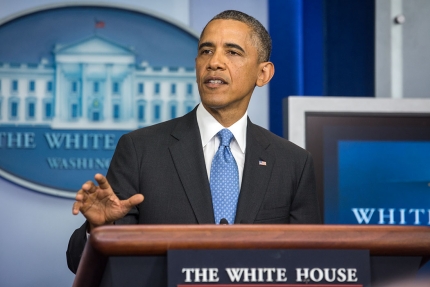
President Barack Obama delivers remarks on the verdict in the George Zimmerman trial for the killing of Trayvon Martin

President Barack Obama delivers remarks on the verdict in the George Zimmerman trial for the killing of Trayvon Martin, in the James S. Brady Press Briefing Room of the White House, July 19, 2013. (Official White House Photo by Chuck Kennedy)

This afternoon, President Obama spoke from the White House Press Briefing Room about Trayvon Martin and the verdict of the court trial that followed the Florida teenager’s death.

Read the President’s remarks here, or watch here

Related Topics: Florida