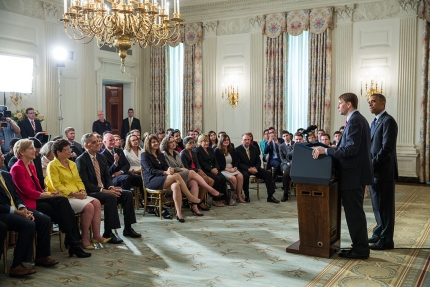
Press Briefing by Press Secretary Jay Carney, 7/17/2013
James S. Brady Press Briefing Room
1:05 P.M. EDT
MR. CARNEY: Good afternoon, everyone. Thanks for being here. I apologize for the slight delay. I was just rereading, for the pure enjoyment the article above the fold in The New York Times today about projected decline in health care premiums. (Laughter.) Highly recommend it.
Before I take your questions, on Thursday the President will deliver remarks to discuss how the Affordable Care Act is holding insurance companies accountable and putting money back into the pockets of over 8.5 million Americans. We hear a lot about what the law might do or could do, but tomorrow the President will detail one concrete way that Americans who have health insurance today are affected by the law.
This summer 8.5 million consumers are receiving half a billion dollars in rebates. The average consumer rebate is around $100. This is just one of the many ways the Affordable Care Act is giving consumers a better value for their health care dollar and making our health care system stronger.
As I mentioned earlier, you may have seen this morning that New York State announced the health insurance plan rates for insurers seeking to offer coverage through New York’s health insurance marketplace. Not only will new insurers be entering the market to offer plans to consumers, the cost for even the most comprehensive plans will be down by over 50 percent, according to the state. This is despite the fact that New York’s health care costs are much higher than the national average.
But this is in line with what we’ve seen in other states, like California and Oregon. Competition and transparency in the marketplaces, plus the hard effort by those committed to making the law work, are leading to affordable, new, and better choices for families.
I noticed in that article that, for example, an individual whose premium this year is $1,000 might see his or her premium drop in New York next year to $308. There is a particular poignancy to this story today, because for the 38th, 39th, 40th time -- I’ve lost count; I think they have, too -- the House of Representatives will be voting to repeal the Affordable Care Act today.
In other words, they’ll be voting, through their measure to delay implementation of the individual mandate, to keep those rates at $1,000 for the individual in New York, rather than $308, to ensure that everyone out there who worries about whether they have or a family member has a preexisting condition, and whether or not they’ll get health insurance coverage, will continue to worry. That worry doesn’t exist now because of the Affordable Care Act, but if Republicans in the House had their way, Americans could worry again about that prospect.
So they go about the business, again, of trying to overturn a law that is providing enormous benefits, and as we’ve seen again, will provide even more benefits to the American people. We’re going about the business of implementing a law that provides those benefits.
And with that, I will take your questions. Nedra.
Q Thanks, Jay. On the Senate deal on nominees, is the President 100 percent happy with this? I mean, there’s still the prospect that future nominees who get held up, he’s still having a problem getting through some of his judicial nominees. Does he wish there would have been more to prevent those kind of holdups in the future?
MR. CARNEY: The President believes that Senator Reid did an excellent job in the manner in which he approached this problem and the manner in which he worked with his colleagues to resolve it. Let’s look at the end result. All of the President’s nominees will be confirmed, according to the agreement. That includes, as the President mentioned today, Richard Cordray as head of the CFPB.
Now, if I had stood before you two weeks ago and said, I predict that Rich Cordray will get confirmed by a 66-vote margin, you would have laughed me out of the room. You probably would have said that if I had predicted that the President would have nominees to the NLRB Board confirmed, and perhaps if I had said that about his EPA and Labor Department nominees.
This is a good development and it achieves what the President has long sought, which is that his qualified nominees be considered and confirmed efficiently by the Senate. And the President is very pleased, as you heard him say today, by the result of the hard work and the approach that Senator Reid and his colleagues put into this effort.
Q Now that you have this deal, do you want to see the -- does the administration and the President want to see the Supreme Court weigh in on recess appointments? Or are there any considerations of asking them to dismiss that case?
MR. CARNEY: Well, I would refer you to the Department of Justice, but I would say that the question of whether any President should retain the ability that has been enjoyed by Presidents for over a century to make recess appointments is one that is still at issue. And our views on this have not changed. What the next steps are I would leave to the Justice Department to describe, but as you noted, that case is before the Supreme Court, and our position on it and the right of this President and any President going forward to make recess appointments as predecessors have for more than a century remains very strong.
Q So it sounds like you would like to see the Supreme Court continue --
MR. CARNEY: Well, again, the answer is, yes. But for specific legal questions I would refer you to Justice.
Q Today, Samantha Power testified at the Senate and she said that the U.S. response to Syria’s civil war is a “disgrace” -- her word -- that history will judge harshly, and she said that it’s one of the worst cases of mass brutality she’s ever seen. I'm wondering if the White House agrees and what the White House feels the U.N. should be doing specifically?
MR. CARNEY: I think she’s referring to the United Nations Security Council’s failure to pass resolutions that we strongly supported and that were denied or vetoed by Russia and China. And we've made our views and our disappointment over that well known. It is extremely unfortunate.
And we continue to work with the United Nations, with our Security Council partners, and with our allies and partners in the region, and specifically with the Syrian opposition to move closer to the day when the Syrian people can enjoy a future that is free of the appalling violence that their putative leader has inflicted upon them. So the President shares Samantha Power's views on the extreme disappointment that we all felt at the Security Council's failure to move on Syria, to act on Syria.
Q And how concerned is the President and the White House about how history is going to view the United States' response to the crisis in Syria?
MR. CARNEY: The President is focused on doing everything we can, working with our partners and allies, to assist the Syrian opposition, to isolate the Bashar al-Assad regime, to continue to make the case to Russia and others who are in the extreme minority when it comes to the views that we have about and the world has about Assad, to help bring about the day when the Syrian people can enjoy a future free of the atrocious bloodshed that Assad has inflicted and continues to inflict upon the Syrian people.
So our focus is on ramping up our aid to the Syrian opposition, working with our allies and partners and the Syrian opposition to strengthen the opposition in its resistance to Assad, and to push forward towards a negotiated settlement that leads to the transition away from Assad that is essential for Syria's future.
Q Can you give us any indication of how the ramping up of that aid is going? Has the White House and Congress, have they -- have you worked through the issues that were there --
MR. CARNEY: Again, as I've said in the past, we continue to consult closely with Congress on matters related to our Syria assistance. We are ramping up assistance. We can't provide details about the timeline or logistics of delivery for every type of assistance. But the provision of assistance continues.
Dan.
Q What kind of pressure is being applied on Russia now to try and block Edward Snowden from getting asylum?
MR. CARNEY: We are engaged in conversations with the Russian government, as I said yesterday and have said in the past, about our view that Mr. Snowden should be expelled and returned to the United States where he has been charged with serious felonies. And that is a conversation that's ongoing.
I think what we say to the Russians privately is what we say publicly about this matter, and what I've said here all week and in days previous to this week. And that is that while we don't have an extradition treaty with Russia, it is our view that there is substantial legal justification for him to be returned to the United States. He is not a human rights advocate or dissident. He is someone who has unquestionably disclosed classified information in an unauthorized manner, and who has, in the view of the administration and the government, caused harm to our national security interests through that disclosure.
Q Senator Lindsey Graham suggested that the U.S. should boycott the 2014 Olympics if Snowden does get asylum there. What's the White House view on that?
MR. CARNEY: Well, our view is that we're continuing to work with the Russian government and other nations on this matter. And we hope to see Mr. Snowden returned to the United States.
Q And if he’s not?
MR. CARNEY: I'm not going to engage in speculation about that, and the Olympics are a long way off. We believe that we have a strong case, and we have made that case to Russia. We share President Putin's views, expressed again, that we don’t want this matter to do harm to our bilateral relations. We have a very important and broad relationship with Russia that encompasses a great many areas of cooperation, as well as some areas of disagreement. But it's a broad and important relationship, and we want to continue to see that relationship strengthen. And we share President Putin's views that this does not need to, and should not, do any harm to those relations.
Q And one quick question on the economy. Unemployment is still I think at 7.6 percent. There are some surveys out there that show that while some jobs are being created, they're not the kinds of jobs that people can live on. What else can the President do over the remainder of his second term, or what does he plan to do to try and boost the sluggish economy?
MR. CARNEY: Well, that's an excellent question. And what we have seen, as you know, is 40 months -- straight months, I believe -- 40, Amy, is that correct -- of positive private sector job creation. We've seen sustained economic growth. But the President is the first person to say that it is not enough and we have substantially more work to do. And that is why we need, with Congress, to work towards achieving policies that help the economy to continue to grow and create jobs.
And the President has put forward numerous proposals. And he hopes that Congress will work with him to enact those proposals towards job creation and assisting, for example, on a specific matter. We've seen some strength in the housing market overall, and that has been positive in our recovery of late.
One item that could do -- would be a great benefit in furthering the expansion of the housing market and furthering its impact on -- a positive impact on both job creation and economic growth would be to extend the ability to refinance to millions of more Americans. And we need Congress to work with us to do that. So far, Republicans in Congress have resisted that. But we believe it's the kind of thing that Democrats and Republicans can come together to achieve and produce the positive benefits for the economy and the American people -- the same with investments in our infrastructure.
The broader facts here are that we are seeing our deficits decline at the fastest pace since demobilization after World War II. We see both in our projections and CBO projections continued deficit reduction. And while we need to take action to address our long-term -- middle and long-term -- deficit and debt challenges, we also need to focus on what we can do to keep the economy growing by investing in areas like infrastructure and innovation, and research and development, and education that provide immediate benefits, as well as employment, and also provide a long-term foundation for future economic growth. And that's the President's economic agenda has always been about.
And while I'm an eager student of Dr. Alan Krueger and I hear his economic briefs, and I can tell you the statistics are pretty remarkable when you look at this recovery and compare it to past recoveries.
One thing that's startling to me is that in recent recoveries, including under President George W. Bush and certainly under President Reagan, but also under President Clinton, state and local governments have grown in employment during recoveries.
Now, we have seen under this recovery a huge shedding of jobs in state and local governments, and a disproportionate share of that job loss has been in education. Now you know the President has put forward for a long time proposals to return teachers to the classroom, which would reduce that job loss, would help the bottom line when it came to employment, and would also have the added benefit of improving the education of our children. Republicans have resisted that, unfortunately.
So if we had the same kind of -- a similar dynamic when it came to state and local, public employment that, say, happened under Ronald Reagan, I believe we’d have a full percentage point lower unemployment right now. And I can get those statistics for you.
We need Congress to work with us to invest in our economy to help it to continue to create jobs as we continue to bring down our deficit. And, again, as I said earlier, we are experiencing the sharpest reduction in our deficits that we’ve seen since demobilization in World War II.
Jon.
Q Jay, just out of --
MR. CARNEY: Dan, were you done? Sorry.
Q Yes.
MR. CARNEY: Okay, Jon.
Q Just to follow up on the Olympics question -- an Olympic boycott is not on the table here, is there?
MR. CARNEY: I didn't suggest it was. I mean, I --
Q Well, I’m asking. I mean, isn’t that kind of a -- that's not going to happen.
MR. CARNEY: I think that we are in a situation where we’re working with Russia to resolve this matter, and we hope that it will be resolved. So I think speculation about what might happen if it’s not resolved is certainly not helpful, because we’re focused on having conversations with the Russian government about our views on this matter and about ways that we can use traditional law enforcement channels to resolve it so that Mr. Snowden is returned here to face the charges that have been brought against him and to enjoy all the rights and benefits accorded to defendants in this country under our legal system.
Q The last time we had an Olympic boycott, the Soviets invaded Russia --
Q Afghanistan.
Q I’m sorry -- invaded Afghanistan.
MR. CARNEY: That would have been interesting. (Laughter.) Now some Russians believe they did, but you know --
Q But I mean, this is not anywhere of that level, is it? This is -- I know you don’t want to do any speculating, but isn’t this --
MR. CARNEY: Oh, yes, I refer you to the senator who sort of threw out that suggestion.
We’re focused on trying to resolve this matter in a way that is in the interest of the United States and in the interest of U.S.-Russian relations.
Q So on health care, what can you say -- how is the average American going to see the impact as this law goes into effect -- continues to go into effect over the next year? What would you say? This situation in New York, you’ve mentioned -- I think it's like 17,000 people that are going to be directly affected by that. What would you say broadly speaking --
MR. CARNEY: No, I think you're misreading the story. I think there are 17,000 who currently buy insurance as individuals in New York. I think the potential is much higher because of the Affordable Care Act and the reduction in rates that that is -- that competition in the marketplace is bringing about, according to New York State, and because of the subsidies that will be provided for those who cannot afford insurance. I mean, that's the central premise here.
And the individual responsibility provision is so elemental to this, because it is that provision which makes it possible for the marketplaces to work in a way that allows for us to assure Americans, by law, that if they have a preexisting condition, they cannot be denied insurance. Think about how significant that is for families across the country.
And recently, when discussing their goal of repealing Obamacare, Republican lawmakers were asked on Capitol Hill, “Well, what would you do if it were repealed on the matter of preexisting conditions?” And a senator, a Republican senator conceded that they had no alternative proposal to deal with that. And I think that that speaks volumes about the effort underway here, which is to refight old battles that have been fought. Congress passed the law. The President signed the law. The Supreme Court upheld the law. And we’re about the business of implementing the law and making sure that it provides the benefits -- the many benefits to the American people that they deserve.
Q So I’m just asking -- I don’t want to go through all of that -- just a straight out thing: What should Americans be looking for, again, as --
MR. CARNEY: Look, one of the fundamental facts about the Affordable Care Act is that for millions of Americans who get their insurance through their employer and are happy with their insurance will see no change, or certainly no substantial change. They may see a reduction in benefits because of the overall increase in competition -- I mean, a reduction, rather, in costs because of the overall increase in competition.
Q There went the headline.
MR. CARNEY: What’s that? You would like to see that?
Q I said there went the headline. (Laughter.)
MR. CARNEY: Yes. Yes, sorry about that. No, obviously a reduction in costs, as we’ve seen in different states as these marketplaces have become -- gotten up and running.
What is also the case is that millions of Americans who don’t have insurance will have access to insurance for the first time. And there are provisions within the Affordable Care Act that provide assistance to employers who want to provide insurance to their employees, and assistance to individuals who otherwise could not afford insurance, even at reduced competitive rates, to obtain insurance.
So the net impact will be to see more Americans insured at affordable costs, with all the benefits that that provides, and then to see continued benefits when it comes to an elimination of lifetime caps; the elimination of the ability of insurance companies to throw you off their insurance, or not provide you insurance if you have a preexisting condition; the ability of young Americans to stay on their parents’ insurance policies up to the age of 26. That’s a constant problem that families have faced, a challenge they have faced when their children come of age. And because they’re just starting out in the job market or are still getting education, they don’t necessarily have access, or easy access to insurance. Now they can stay on their parents’ policies up through age 26.
The benefits that the President will talk about tomorrow, where refunds are being provided, under the so-called “medical loss ratio provision,” to millions of Americans, because the Affordable Care Act ensures that insurance companies are using the premiums that they collect substantially towards the benefits they provide. And if they don’t, they have to provide a refund to their consumers. So this will continue.
And as we see more and more benefits and more and more Americans getting insurance, the net positive effect on our economy will be significant. And certainly it will increase the peace of mind for millions of Americans across the country.
Q Do you expect public opinion to move --
MR. CARNEY: We’re about the business of implementing the law, and I’m not going to predict how the public feels about it. I think that those Americans who have never -- or at least recently have not had the opportunity or ability to buy and afford insurance, who will have insurance, I’m sure will feel more secure when they have it. But we’ll let public opinion and politics take care of itself. We’ll implement the policy because we know that it’s right for the American people.
Q Let’s go back to the Olympics. (Laughter.) I mean, is it safe to say, based on --
MR. CARNEY: You guys aren’t jumping to a superficial headline, are you?
Q Based on what you have said so far, can we conclude that the President thinks it would be a bad idea to boycott the Olympics?
MR. CARNEY: Bill, come on. You guys are -- what it is -- you are talking about an event that is a year and a half away, right, roughly? Whenever the Olympics are. Is that -- when are they?
Q Nine months.
Q Yes, but I’m just asking a plain question.
MR. CARNEY: Nine months? Okay. But --
Q Does he think it would be a bad idea?
MR. CARNEY: This is -- a lawmaker put it out there. We’re not even -- we’re not focused on that. We’re focused on working with the Russians to bring about the return of Mr. Snowden to the United States. And we agree with President Putin that we do not want this issue to negatively affect our relationship with Russia, which is broad and important, and where we see --
Q So a boycott is a bad idea, right?
MR. CARNEY: Yes. But it’s not one that is an issue right now because we’re engaged with the Russians and other governments in helping bring about a positive resolution to this matter.
Q Is the U.S. upset with Cuba for sending missile parts, apparently, to North Korea?
MR. CARNEY: What can I tell you about that? I think as you heard from our colleagues at the State Department yesterday, the United States commends the actions that the government of Panama took in this case. And Panama, as you know, has a very important responsibility to ensure that the Panama Canal is utilized for safe and legal commerce, and has consistently shown that it takes that responsibility seriously. Panama is a close partner of the United States, and we will carefully consider any requests for assistance.
Efforts to determine exactly what was on the ship that you mentioned are ongoing, and it will take time to confirm all of the details. If it is --
Q But Cuba has said that they’re sending missile parts to be refurbished.
MR. CARNEY: Well, again, there is an effort underway to determine exactly what was on the ship. And if it is determined that materials found onboard the vessel violate U.N. sanctions, sanctions enforcement would be handled through a United Nations process. And if that eventuality presents itself, I’d refer you to the State Department and USUN for additional details and information on next steps.
Q But you don’t want to get involved in criticizing Cuba, it looks like.
MR. CARNEY: I think that we don’t want to get ahead of a process that’s underway to determine what exactly was on the ship. And then, if it’s determined that materials found onboard that vessel violate sanctions, then the body that levied the sanctions, the United Nations, would handle enforcement matters.
Yes.
Q Both you and the Attorney General have suggested that “stand your ground” laws may contribute to more violence than they prevent, and called for a debate on that. What do you envision to be the means of that debate? And do you think the “stand your ground” laws should be tested in the Supreme Court?
MR. CARNEY: Well, the last part I leave to lawyers and experts in the field. The second -- the beginning of the question I think answers itself. The discussion is underway. I would refer to the Attorney General’s remarks. I would refer you to an ongoing discussion underway about a specific state and its laws. But I think that the discussion, in the President’s view, ought to be engaged in other states across the country, simply out of good sense that the laws that we see on the books ought to be reviewed and examined with an eye towards whether or not they reduce the problem of gun violence, or inadvertently make it worse.
And I’m not passing judgment on any particular law. I'm simply saying and echoing the President’s views here that we should certainly examine those laws and examine them with the goal in mind here, which is to reduce gun violence.
Q But not examine them to see whether they pass constitutional muster?
MR. CARNEY: Again, I'm not a lawyer, I haven't seen that question asked with regards to the constitutionality. Perhaps you could address it to the Department of Justice. I think the issue is, are they effective; do they have unintended consequences? And it’s the President’s view that the goal should be here to reduce gun violence so that we have fewer tragic deaths as a result of gun violence.
Q On the Affordable Care Act, you put out a statement of administration policy yesterday on a couple of House bills, one of which would repeal the individual mandate or give the President the authority to do that. The other would give him the authority to repeal the employer mandate. You rejected them as a pair. Do you also reject them individually? In other words, the employer mandate, which the Treasury Department has put off for a year, would seem to be something that you already accept the ability of the administration to do.
MR. CARNEY: Well, the statement of administration policy on that bill reflects the fact that it’s unnecessary. As we've made clear and the Treasury Department has made clear, the authority to delay the deadline for the implementation of that provision is well grounded and it is being brought into effect in the interest of accommodating the concerns of that relatively small percentage of businesses that would be affected by it.
When it comes to the individual responsibility provision, I mean, that's just repeal by another name. The individual responsibility provision, as I said earlier, is essential to the fulfillment of health care reform in a way that ensures that those with preexisting conditions cannot be denied insurance.
Q I'll grant you that, but on the employer mandate --
MR. CARNEY: And I understand -- but, Wendell, let’s just --
Q Given that some Republicans have challenged the Treasury Department’s authority and be delaying this for a year, would you not, like, have Congress’s blessing for it, essentially?
MR. CARNEY: There are few things more cynical than the House Republicans who have made it their mission in life to repeal the Affordable Care Act and deny the American people the benefits that they would receive from implementation of the Affordable Care Act, claiming that they are concerned about the delay of the implementation of a relatively small provision within the Affordable Care Act. You know that. I know that. Everybody in this room knows it. Everybody on the Hill knows it. Most of the American people understand that.
And what it comes down to is that this repeated, futile effort to repeal the Affordable Care Act exposes Republicans who are engaged in it, rightfully, to the charge that they would rather see Americans denied insurance; they would rather return to a situation where the insurance companies dictated whether or not you had insurance or got insurance if you had a preexisting condition, whether or not you could be kicked off insurance if you met -- if you exceeded an arbitrary cap than what prevails now under the law of the land, which is the Affordable Care Act.
And as I said earlier, when we saw on Capitol Hill, a press conference call with, I’m sure, the desire to trumpet the need for repeal, and a Republican lawmaker had to admit that they had no suggestion for how to deal with Americans who have preexisting conditions if their vision of repeal were to come true. And I just wonder what they say to the half of their constituents who have preexisting conditions about their intent here and who benefits from the potential fulfillment of their goal.
So absolutely, the President would veto those bills, because if they were ever to become law, it would be bad for the American people.
Yes, Kristen.
Q Jay, thanks. The President yesterday met with a number of senators. They discussed student loans. What came out of that meeting specifically? And how close are they to getting a deal based on your estimation?
MR. CARNEY: The President believes, as we have long said, that there is no question that there is a compromise available on this issue, that the two sides are not that far apart, and we just need to get it done. And I think that’s what the meeting was about. It was a bipartisan meeting. And the President hopes and expects that a resolution to this matter can be reached -- because, as we’ve said, we cannot allow a situation where students who depend on these loans see their rates double. And we need to find a resolution that ensures that rates are kept low and that -- a resolution that is retroactive so that the doubling of the rates that occurred on July 1st is reversed.
And there is a way to achieve this. There’s a way to do it that's deficit-neutral. There’s a way to do it that does not ask students to bear the burden of further deficit reduction.
I’ve noted earlier that A, we have seen substantial deficit reduction, and there is more to be done on that, but substantial deficit reduction. And comprehensive immigration reform, if Republicans were truly focused on ways to reduce the deficit, that also provide benefits to our overall economy and the American middle class, they ought to get about the business of passing immigration reform in the House, because as the CBO said, the Senate bill would significantly reduce the deficit.
Q But staying on student loans, does he expect there to be a deal before the August recess, before they break?
MR. CARNEY: He certainly hopes and expects that there will be a resolution to this very soon.
Q And just to be clear, does he support the compromise that seems to be coming together that would peg rates to the 10-year Treasury notes with a cap?
MR. CARNEY: I think we’re going to let the senators involved in this effort to get about the business of finding a resolution here that is acceptable to all sides and to the President. We think it’s achievable, so I don't -- we’ll wait to see what is produced before we judge it. But, obviously, the President is very concerned about this issue, and that's why he had the meeting.
Q And one on Egypt, Jay. Secretary of State John Kerry said in an interview today that he’s not going to rush to judgment about whether or not there was a military coup. You have said in comments this week that there’s no timeline for determining whether or not there was a coup. So what specifically is the administration doing to try to come to a determination?
MR. CARNEY: We are continuing to work with the Egyptian transitional government to assist them in what they state is their goal, which is a return to a democratically elected civilian government.
Q Does that help you determine whether or not there was a coup?
MR. CARNEY: It helps us determine what is the right course of action for the best interests of the United States and our national security, as well as the future of Egypt, which is broadly of interest to the United States and our national security.
And as I’ve said before, and I’ve been quite candid about it, we will not act precipitously on this designation because we do not think it would be in our interest to do so. But we have made clear to the transitional authorities in Egypt that the way out of this crisis is through a quick return to a democratically elected civilian government, and a government that is representative of all Egyptians and that is inclusive, that allows for the participation of all parties and individuals -- that that is the answer to a better future for Egypt.
And what we saw -- the demands of millions of Egyptians who went to the streets in protest of the Morsi government reflected their views that that government was not inclusive, that it was not taking into consideration the views and will of all the Egyptian people and all the parties and groups and individuals within Egypt.
And it is evident from that and through Egypt’s experience throughout this period that the -- it is essential for Egypt’s successful democratic transition that the government take actions that demonstrate its fealty to the idea of reconciliation and inclusion.
Peter.
Q Thank you, Jay. Does Russia’s handling of the Snowden case have any impact, any bearing at all on the President’s decision to attend the summit with President Putin in Moscow?
MR. CARNEY: What I said yesterday is that the President intends to travel to Russia for the G20 Summit. And I have no further announcements to make beyond what we’ve said in the past about the President’s travel to Russia in the fall.
Q You can't say definitively whether he will indeed go to Moscow as the White House has previously announced?
MR. CARNEY: I can say that the President intends to travel to Russia for the G20 Summit. I don't have anything to add to what we've said in the past about that trip.
Q Jay, back on Egypt. Does the administration believe that Morsi should be released?
MR. CARNEY: We believe that it is essential that the transitional government refrain from making arbitrary arrests and detentions, and that those who are being held without charge be released. And that includes President Morsi, yes.
Q The Egyptians say that Secretary Burns didn't even bring him up while he was there. Do you know why that would have been?
MR. CARNEY: I don’t have -- I wouldn’t speak for the Egyptians, and I don’t have a specific readout or that kind of detailed readout on Deputy Secretary Burns's meetings. He met broadly with Egyptian authorities, as well as representatives of parties and groups. That included a phone call with a representative of the Muslim Brotherhood while he was in Cairo. And his message throughout was that we look to the transitional government and the new cabinet that has been formed to govern in an inclusive manner in keeping with the commitments made publicly by those transitional authorities.
And it is our view that ensuring representation of all parties, groups and sectors of society is also a way to address one of the main grievances voiced by, as I said, millions of Egyptians over the past several weeks. And we hope that the interim government will hasten the return of a democratically elected civilian government as soon as possible. And that was the message that Deputy Secretary Burns conveyed in his meetings in Cairo.
Q And who does the U.S. recognize as the leader of Egypt right now?
MR. CARNEY: We are engaged with the interim authorities, the transitional authorities, and we are urging them to meet their own promise of returning Egypt to a civilian-led, democratically elected government as soon as possible.
What we do through our representation in Cairo and in other countries is meet with the governing authorities, as well as opposition parties, groups and sectors of society. And that practice was true in the previous government and the one before that, and it will be true going forward. Because our interest and support is not for an individual or a party or a group, it's for a process that we believe, if fulfilled, will lead Egypt out of this crisis, current crisis, and towards a better future.
Yes, Mara.
Q Putting the Olympics aside, will there be any consequences for Russia if Snowden is not returned?
MR. CARNEY: We’re focused right now, Mara, on working with the Russians to make clear to them our views about what we think should happen to Mr. Snowden, that he ought to be returned here where he faces felony charges. We are working with them through normal channels and having conversations with Russian government officials at all levels about this matter. I am not going to get ahead of that process. We certainly hope that it ends and is resolved in a way that allows for Mr. Snowden to be returned here to the United States.
Q Can you describe the difference of what the administration sees between Snowden and Viktor Bout, who was not returned, although the Russian's wanted him returned?
MR. CARNEY: I can just tell you that our view on Mr. Snowden is clear. And we are working with the Russians to hopefully return him to the United States, where he will be afforded all of the rights and privileges of defendants in this country. And we believe that there's ample legal justification for his return.
Yes, sir.
Q Because of the death threats --
MR. CARNEY: Can you tell me who you -- since I don't know you -- who you are?
Q I’m Gabe Finger with The Daily Caller. Because of the death threats being received by George Zimmerman and his parents, is the President going to take any action for their security, or are they on their own?
MR. CARNEY: Well, I think I would refer you to Florida authorities. I'm not aware of that story. But the President has called for echoing the statements of Trayvon Martin's family for a calm reflection in the wake of the verdict. And that continues to be his position. He certainly would oppose any violence of any kind.
Q So they're on their own?
MR. CARNEY: You can editorialize all you want, and I have no doubt that you will, but that is a ridiculous statement.
Olivier.
Q Jay, a couple on Syria. Are America's Gulf allies being as careful in arming the right Syrian rebels as the administration would like them to be?
MR. CARNEY: We are working with our allies and partners on this incredibly important matter. And we have made clear our views that it is important to help build up the opposition, and especially those elements of the opposition that believe that Syria's future will be best served by a post-Assad government that reflects the will of all the Syrian people, a government that reflects the civil liberties of the Syrian people and that rejects terrorism. And that's the position we take, and it is a position we make clear to all of our partners and allies who are engaged in the effort of assisting the opposition.
Q Why can't you detail any part of this military aid package? Is this a classified matter?
MR. CARNEY: Well, I certainly don’t discuss classified matters from the podium. And I would simply say that the President made clear that it's his intention to increase our assistance to the Syrian military council. And I'm not going to get into a detailed accounting of the forms of that assistance, except to say that it’s our view that it ought to be, in accordance with the President’s policy, increased because of the brutality inflicted on the Syrian people and the opposition directly by the Assad regime, with the assistance, notably, of Hezbollah and Iran.
Q But why not? I mean, you keep saying you’re not going to -- I get that. But why aren’t you? I mean, shouldn’t Americans be allowed to judge this escalation of America’s role in a pretty bloody civil war?
MR. CARNEY: Again, I’m just not going to detail or catalog the specific forms of assistance, except to say that the President believes we ought to continue to ramp up that assistance.
April.
Q Jay, since the ACA was passed into law, are you finding that more Americans -- or your stats -- more Americans or less Americans are finding out more about the Affordable Care Act? Because there was a learning curve or a communications curve at the very beginning.
MR. CARNEY: We’re focused on implementation, April, and I think that there’s a lot of -- there are a lot of surveys and a lot of information out there. I think that most Americans who enjoy the benefits provided by the Affordable Care Act -- whether it’s a reduction in the cost of prescription drugs for seniors, or the ability of families to have their children up to the age of 26 stay on their parents’ insurance policies, or those who have gotten rebate checks because of the provision within the Affordable Care Act that ensures that insurance companies spend a certain percentage of the premiums they receive from their consumers, and if they don’t, they rebate the money to the consumers -- believe that those benefits are very worthy and helpful to them.
We believe that as we move forward with implementation, more Americans will experience the benefits of the Affordable Care Act, including those millions of Americans who will have insurance for the first time because of the access provided to insurance and the affordability of that insurance that the Affordable Care Act gives those Americans.
Q If I can follow up on that. As you said, you’re focused on implementation, and that was even the case, I guess, at the very beginning. But many Americans just did not understand, particularly people who are in the insurance industry and the health care field, they didn’t understand. But are you finding the more time has passed, the more people are understanding beyond implementation? What you’re saying the successes and benefits of --
MR. CARNEY: Again, I think you’re asking sort of a public relations question, and our focus is on implementation of the law. And we believe that from the implementation of good policy that provides benefits to the American people, the awareness of those benefits will increase. And the positive impacts will be assessed by both specialists in the field as well as the general interest press, as we saw today in the reports about the expected drop in premiums in New York State, reflecting similar accounts that we’ve seen in states like Colorado and Oregon.
But what you don’t hear from opponents, who have spent an enormous amount of money and an exceptionally large amount of time attempting to repeal the Affordable Care Act, is what the consequences of that would be for average, hardworking Americans -- for those with preexisting conditions; for seniors who would see their prescription drug costs jump; for families who have a son or a daughter who’s 23 on their insurance policies who would be kicked off those policies as a result of the action advocated by, at least today, House Republicans, but broadly by Republicans. And we don’t think that’s good policy, and it’s not going to happen.
Phil.
Q Yes, back to the “stand your ground” laws. When you say the administration wants this examined, what specifically do you want to take place? Do you want state legislatures to consider repealing them or revising them or replacing them? Or do you -- is there something Congress --
MR. CARNEY: Again, the suggestion is not specific to any one state or law; it’s broader than that. And it’s simply that the focus ought to be on a reduction in violence, in gun violence in particular. Too many Americans are losing their lives needlessly to gun violence, and that was a point that we made frequently during the effort to pass common-sense measures to reduce gun violence through Congress. And it’s an effort that we continue as we implement the executive actions associated with the President’s plan to reduce gun violence.
And it’s a component of what we’re saying now about actions that states could take to look at the laws on their books and evaluate them against the standard, which is, are these laws improving or making worse the situation with regards to gun violence. And I think that’s a worthwhile exercise in every state, so it’s not focused on any individual state. Obviously, the question comes because of that, but this is something that every state -- and I’m sure states are engaging in this -- but every state could.
Q And you mean state governments?
MR. CARNEY: Correct. These are state laws that I’m talking about.
Sam, I did promise you one. And then Ann, and we’ll end there.
Q Tomorrow, the House Oversight Committee is holding another hearing on the IRS’s screening of conservative groups. It’s been two months, roughly, since the report was released, and a lot has come out since then. Some Democrats are questioning whether the report was full. I’m wondering if the White House still believes that the report’s findings are intolerable and inexcusable. And if not, how do they view what’s happened in the past two months, the revelations around the screening process?
MR. CARNEY: Well, I think more information is better, and I think the revelations about the practices have been helpful in providing a fuller understanding of what took place.
The President’s interest is in ensuring that the tax laws enforced by the IRS are enforced in a nonpartisan way and fairly across the board, and that setting aside partisanship, which I think some of these revelations do, that our laws and the enforcement of them ought to be sensible and effective.
So we believe, the President believes that Danny Werfel is effectively going about the business of evaluating exactly what happened and what steps need to be taken to ensure that the processes there are improved. But I take your question. And I’ve seen some very interesting stories that cast some light and I think might cause everyone here to reflect upon how this was viewed in the immediate aftermath of the breaking of the story.
And the President’s interest has been in ensuring that the agencies of government that affect the lives of the American people operate effectively and responsibly. And when there are indications and revelations that that is not happening, he has always insisted that action be taken to correct it. And others try to make this about politics. Others issue conclusions before facts are known, and that's not helpful to the process.
Q Didn’t you issue a conclusion when you called the report’s findings intolerable and inexcusable?
MR. CARNEY: The report’s findings were. Now we're finding out more information. And what is important here is that we take remedial steps to ensure that, as Danny Werfel is doing, that the IRS functions effectively on behalf of all the American people.
Ann, last one.
Q One very short clarification for your answer from Peter.
MR. CARNEY: Might have been deliberately vague -- (laughter) -- so I'm not sure I can clarify.
Q One month ago today, when Ben Rhodes briefed, saying, “In advance of the G20 in St. Petersburg, there will be a bilateral summit between the U.S. and Russia in Moscow, so we will be going to Moscow before we go to St. Petersburg.” Does that stand?
MR. CARNEY: I have no further announcements on our travel to Russia. The President intends to go to Russia in September.
Q But you won't say Moscow --
MR. CARNEY: I just have nothing else to say on it.
Q Being deliberately vague.
MR. CARNEY: That's for you to decide. (Laughter.)
Thanks, everybody.
END
1:55 P.M. EDT