The White House

Office of the Press Secretary

Press Briefing by Press Secretary Jay Carney, 7/16/2013

James S. Brady Press Briefing Room

12:58 P.M. EDT

MR. CARNEY:  Good afternoon, ladies and gentlemen.  Thank you for being here, as ever, for your White House briefing.  I do not have any announcements or discussions of my weekend for the top, and therefore, I will go straight to Julie Pace.

Q    Thank you.  Does the White House support this deal that's emerging in the Senate to move forward on some of the President’s nominees?

MR. CARNEY:  Let me say a couple things.  One, any agreement that there might be between senators has yet to be formally announced, and so we will not get ahead of such an announcement if and when it comes. 

We have worked very closely with Senator Reid and we have made clear our support for Senator Reid’s position in this because we share -- the President shares his frustration over the obstructionism that we've seen from Republicans in the Senate when it comes to the confirmation of the President’s nominees.  And we would be glad to see a resolution that results in the speedy confirmation of the President’s qualified nominees to these positions that have been at issue.  And that includes Rich Cordray at CFPB; it includes Gina McCarthy at EPA and Tom Perez at Labor, and others.

So we won't have a full comment on an agreement that is yet to be announced, but we hope there is one.  We simply hope that there’s a resolution that allows for the confirmation of the President’s nominees, which is why we supported all along Senator Reid in his approach to this matter.

Q    Senator McCain, who has been quite involved in this process, says that he spoke with Vice President Biden and Denis McDonough over the past few days on this.  Can you tell us what the White House’s role was in trying to break this impasse?

MR. CARNEY:  The White House was not involved in negotiating.  The White House provided information and answered questions when it came to working with Senate Republicans, including, of course, Senator McCain, who, again, as I understand it, based on what we've seen, deserves significant credit for his efforts in trying to find a resolution here -- a resolution that allows for hopefully the speedy confirmation of the President’s nominees.

But this has been a -- this solution that has been sought has been one that has been sought and negotiated by senators.  And our position has been to communicate with and work with Senator Reid and other Democrats on this issue.  But the negotiating between Democrats and Republicans has happened between senators.

Q    Also, Edward Snowden has applied for temporary asylum in Russia.  Has the White House reached out to the Russians since he filed his application?  Is there any general comment on his taking this step?

MR. CARNEY:  There are regular communications between the U.S. government and the Russian government on a host of matters, including this one.  I don't know that there have been any communications today, but there may have been -- certainly not out of the White House that I'm aware of. 

But our position on this remains what it was and is quite clear, which is that we believe there is ample legal justification for the return of Mr. Snowden to the United States, where he has been charged with serious felonies.  And it should be clear when we see discussions about -- or suppositions or discussions about the idea that Mr. Snowden is somehow being persecuted, he is a United States citizen who has been charged with crimes, and under our system of law, he should be afforded every bit of due process here in the United States, and he should return here to face trial.  And that’s our position, and it's the position we've taken in our conversations with the Russians and with other governments who have had an interest in this or which might be transit points or end destinations, potentially, for Mr. Snowden if that were to come about.

But our interest has always been in seeing him expelled from Russia and returned to the United States.

Yes.

Q    Thank you.  Staying on Snowden, how would the President feel if Russia did, in fact, give him temporary asylum status? 

MR. CARNEY:  Again, as I said to Julie, our position is that Mr. Snowden ought to be expelled and returned to the United States and that he should not be allowed to engage in further international travel except as necessary to return to the United States.  He is not a human right activist.  He is not a dissident.  He's accused of leaking classified information.  He's been charged with three felony counts related to the leaking of classified information.  And for those reasons, he should be returned to the United States.

The fact of the matter is, our message has been clear and consistent with every government in this regard.  And Mr. Snowden has all of the rights that every American citizen charged with a crime in the United States has, and he should be returned here where he can stand trial and take advantage of those rights.  So that’s the conversation we're having with foreign governments; that’s the conversations we're having with our Russian counterparts.  

Q    The President is scheduled to go to Russia for an international summit in September.  Could Russia's decision on Snowden impact the President's decision to attend that summit?

MR. CARNEY:  The President intends to travel to Russia in September for the G20 Summit, and I don’t have any further announcements with regard to that travel.

Q    Moving back here, Senator Gillibrand's legislation on sexual assault in the military is gaining supporters, including Senators Cruz and Paul.  The chairman of the committee responsible for the military has a separate bill.  People in the military question whether you should bypass the chain of command on that issue.  Does Senator Gillibrand's bill contain anything that the President thinks would be useful in addressing this problem?  How does he think we should go forward on this?

MR. CARNEY:  Well, first of all, as the President said earlier this summer when he met with Secretary Hagel, Chairman Dempsey and our senior civilian and military leaderships, sexual assault is a crime.  It is shameful, and it is disgraceful.  And nowhere is our responsible -- responsibility, rather, greater than in the military. 

Women and men who step forward to serve our country must be protected from this devastating crime, and offenders must be appropriately held accountable.  The men and women serving our nation deserve nothing less.  And those who engage in sexual assault are dishonoring the uniform that they wear.

Now, when it comes to proposed solutions to this continuing problem, we are open to consideration of any ideas, and that includes proposed legislation.  And we will work with Congress and we will work with the Department of Defense on ways to deal with and improve the prosecution and prevention and victim support when it comes to sexual military -- sexual assault in the military.

Q    As Commander-in-Chief could the President back a piece of legislation that the military appears to have concerns about?

MR. CARNEY:  Well, we’ll work with the Congress on proposed legislation.  We haven’t taken a position on or seen specific legislation, but we’ll review any idea that addresses this problem, and we’ll work with the Congress and we’ll work with the Defense Department to move forward because it’s an issue that is of great concern to the President.

Q    Can we just skip to Egypt for a second?

MR. CARNEY:  Sure.

Q    There’s renewed violence there and reports of seven more deaths.  When the U.S. envoy, Ambassador Burns, was there apparently groups -- major groups on both sides of the issue, the pro-Morsi and protest groups declined to meet with him.  What is -- what message does Burns have for the Egyptians in this sort of turbulent environment?

MR. CARNEY:  Well, first of all, Deputy Secretary Burns met with a number of people from a variety of groups, and he held a roundtable with political activists.  And this roundtable included representatives from Free Egyptians Party, the Egyptian Social Democratic Party, el-Dastour, al-Wafd, and the April 6th movement.  So that was a pretty broad representation.  And Tamarod, I think which is one of the parties that you are referring to, was invited but did not attend.  State would have more information about that. 

Our interest in this visit and in our communications in general is to speak to representatives of all groups and factions and parties of all the Egyptian people and urge upon them a peaceful effort towards reconciliation as opposed to polarization.  And we’ve made that clear to the current government -- we’ve made it clear to the current government and the military that we want to see maximum restraint exercised by the military, and we want all sides to refrain from violence, because we believe that that is the only path forward for Egypt in resolving this crisis and moving towards a restoration of a democratically elected civilian government.

Jessica.

Q    First, just following up on Egypt.  It’s been almost two weeks since the unrest began.  Does the President fear that the messages he’s conveyed and others in the administration have conveyed to leaders there are not being heeded?  And would he like to see more from the leadership there?

MR. CARNEY:  Well, when we have seen violence, we’ve been very clear that we condemn the violence.  We’ve been very clear that we believe all parties need to move towards reconciliation and away from polarization; that a transition back to a democratically elected civilian government requires the participation of all groups; that there should not be arbitrary arrests or detentions, especially arrests that target specific groups.  And those messages are being communicated daily.  And we are monitoring the progress being made -- and, in some cases, the lack of progress being made -- in Egypt as we engage with Egyptians from across the board.

Our interest is -- and we try to make this clear -- not in the success or failure of an individual or a party, but in the success of the process, a democratic process that allows for all Egyptian voices to be heard and represented and that allows for peaceful reconciliation and negotiation and compromise. 

And I take your point that it's been two weeks, but I could also say it's been two weeks.  And the path towards the future of Egypt that we all hope for and that we believe the vast majority of Egyptians hope for, which is a peaceful democratic future that allows for the fulfillment of Egypt's enormous potential economically and culturally and politically, is not an easy one. And it has not been for a long time.  But it is an important one and it's one that we support.

In every conversation we have, we make our position clear.  We make clear that we don't favor groups here or individuals or parties.  We favor a process that is peaceful and that has as its foundation reconciliation rather than polarization.

Q    I have a quick question on Snowden, and then Panama.  Does the President believe the Russian government's claim that President Putin has absolutely no say in whether Snowden is granted asylum in Russia? 

MR. CARNEY:  We have had discussions with the Russian government about our belief that he ought to be expelled.

Q    But on the Putin question?

MR. CARNEY:  Well, President Putin is the President of the country and we believe that the government obviously has a role to play here, as we made clear when we expressed our disappointment in the government's role in allowing for the press conference, if you will, with human rights organizations -- if only to make clear that the Russian government has an opportunity here to work with us through the normal channels to expel Mr. Snowden. 

Because it is in our view, as well as the view expressed by Russian leaders, including President Putin, that this should not be something that causes long-term problems for U.S.-Russian relations -- those relations are very important and they see the countries engaging on a number of important issues, both economic and security-related issues.  And we want to continue that relationship unimpeded by this issue. 

And we believe there's a way to move forward here that allows for Mr. Snowden to return to the United States and be afforded all of the rights and protections that he, as a citizen of this country and a defendant in court, enjoys, and for Russia to resolve this situation that they have been dealing with now for three weeks.

Q    And then, on Panama, does the U.S. have any more clarity now on what was on the North Korean-flagged vessel, where it was headed and for whom?

MR. CARNEY:  I just don't have any more information on that at this time.  If we get more, we can answer those questions.  But I don't have anything yet, anything more than we've provided thus far.

Q    On Trayvon Martin, which continues to be a subject of national discussion, when you look at what's being said on the Internet, on cable, especially from African American parents, there seems to be a deep concern and sentiment that their children are less safe today than they were before this verdict  -- that they're deeply concerned that the law does not protect young black males as much as it protects everybody else.  The President, as an African American parent, does he have anything to say to those parents, reassuring them in any way about whether or not the law is going to step up and protect their children?  And this is regarding their sentiments being expressed.

MR. CARNEY:  I appreciate the question and I think I'll take it in pieces.  When the President spoke about this in early days, he made a very personal statement that I think goes to some of what you're asking about, and that is that if President Obama had a son, that that son would look like Trayvon Martin.  And I think that in saying that he was reflecting in a personal way his understanding of the pain that Trayvon Martin's parents were experiencing then and obviously have experienced ever since, and pain that they are experiencing in the wake of the verdict.

The President also said in his statement on Sunday that he understands that passions have been running high in general in response to this case, and in particular in the wake of the verdict.  But it is also the case that a court heard this case and a jury has spoken, and he echoes the call for calm reflection that Trayvon Martin's parents made in the wake of the verdict.

Broadly, on the issue of laws -- and again, I think I need to note without reference to this specific case the President's views on issues like racial profiling have been well known.  It's something that he worked on in the state Senate in Illinois.  But when it comes to this case, which obviously the Justice Department is continuing to look into, we're not going to get out ahead of that and we're not going to comment on any particulars.

Right now, the President views this as a tragedy, the loss of a young person, for his family, for the community and for the country.  And it's a reflection of the tragedy that we see daily when we see young victims of gun violence lose their lives.  And he urges upon all communities to examine what we can do and to reflect upon what we can do to bring our communities closer together; to consider what we can do to prevent these kinds of tragedies from happening in the future; and to reduce gun violence in general; and to look at our laws and examine whether those laws that we have serve to reduce gun violence or, in some cases, inadvertently make the problem worse.  And that’s been his view, and that’s why he pursues and continues to pursue common-sense measures to reduce gun violence.

Q    If I could just change to immigration briefly.  The President this morning had several interviews with local Hispanic stations.  Did he express any more concern than he has, or any other new strategies about how to move along immigration reform, which does, according to many pundits, seem to be stalled?

MR. CARNEY:  Well, I won't get ahead of the broadcasting of those interviews.  It wouldn’t be fair to those news organizations that did interview the President earlier today.  I think it's fair to say that immigration and the progress of immigration reform was discussed.  It is a topic very much on the minds of a lot of people across the country, and certainly one that is getting a lot of attention here in Washington, and it's one that the President is very focused on.

And let's review where we are.  A bipartisan majority -- significant bipartisan majority passed landmark legislation on comprehensive immigration reform, legislation that meets all four principles that the President laid out two years ago and has reiterated ever since when it comes to border security and an earned path to citizenship and making sure everyone plays by the same set of rules when it comes to holding our businesses accountable and improving and streamlining our legal immigration system.

That is no small victory.  But it is not the ultimate victory here, which would see the passage of comprehensive immigration law by the whole Congress -- a bill by the whole Congress and signed into law by the President.  So there’s a lot of work to do.

The President believes that this will happen, or that it should happen because there is such an unprecedentedly broad coalition that supports it.  So this is a choice here, when it comes to House Republicans who are dealing with it now.  This is a matter of volition.  They can move forward in support of a proposition that has the backing of business and labor, faith communities and law enforcement communities, Republicans and Democrats; a measure that does significant good for our economy, including reducing the deficit -- so there is much in here for conservatives to like.  Or they can choose to block it.  But the choice really is theirs.

And the President is confident that the American people and all the stakeholders who want to see this move forward will, in the end, prevail upon lawmakers to do the right thing, which is to pass comprehensive immigration reform that meets the standards that the President laid out.

Q    So right now is the strategy of staying out of the process, is that still the right strategy at this point in time?

MR. CARNEY:  Well, let me say a couple of things about that. One is we have approached this strategically with an eye towards getting it done, and getting it done in a way that meets the standards set by the President. 

The idea that we’re staying out of it is a fallacy, and has been forever.  We wouldn’t be where we are if the President hadn’t been reelected and made comprehensive immigration reform one of his top priorities.  We wouldn’t be where we are with a bill that passed the Senate with bipartisan support if it hadn’t been for the role the President played -- which is not to diminish, because it was vital, the role played by that bipartisan group in the Senate that crafted the legislation that met the principles the President set.  Because the President knew all along that the only way this would happen is if -- would be if there were substantial bipartisan support for it.

So we look at this at every step of the way through the prism of what’s the best approach we can take to ensure that it gets done.  But it’s an active approach in all cases, and that includes speeches and weekly addresses and interviews.  It includes phone calls and meetings with lawmakers and stakeholders.  And it includes direct and constant consultation with lawmakers as they move forward on this important piece of business.

Ed.

Q    Jay, I want to follow on Jim with the Trayvon Martin case.  After the “beer summit,” there was talk here, back in 2009, that it was sort of a teachable moment on race.  The President made comments after that saying he thought it was a friendly, thoughtful conversation and some progress had been made.  So my question now is do you feel similarly that this is a teachable moment for the country right now?

MR. CARNEY:  The President put out a statement in response to the verdict, and I think that his words on this are the best representation of how he views it and what he hopes will come front it, which is the sort of peaceful reflection and conversation by communities across the country.  And that conversation is taking place both in private and in the public sphere on a range of issues.  So I don’t -- I would simply say that these conversations and this reflection is taking place in a lot of communities across the country, and that’s a good thing in the President’s view.

Q    That conversation includes -- the Attorney General will be at the NAACP Annual Convention today in Orlando, very close to the courthouse where the trial went down.  Back in 2009, the Attorney General said at one point in a speech that “we’re a nation of cowards” when it comes to race.  And I think he meant that we’re -- people are not always frank and honest about it, it’s a difficult conversation.  Based on what you just said a moment ago, you seem to think this conversation is happening.  Have we made progress?  Are we no longer a nation of cowards, in his words?

MR. CARNEY:  Well, again, I would obviously refer you to the Department of Justice and to the Attorney General for an examination of statements by the Attorney General.  But I would say that this President believes, and he has long believed, that this is a conversation that we have to continually have.  And he’s said that in the past and said it repeatedly. 

So I’m not going to make an assessment about where we are on that continuum.  There’s no question that we’ve made enormous progress.  There’s no question that we still have progress to make.  And that’s a broad statement, not a specific statement about a case, but a statement about where we are as a country as we move forward and make progress on this issue.

Q    Lastly and briefly, I want to ask you about the IRS.  The Washington Times has a story today saying that the Treasury Department’s inspector general is doing a report or an investigation of some kind where there are allegations that various political candidates were targeted improperly with audits, that government officials may have looked at their tax records improperly.  Some of this dates back to 2006, so it would have been in the Bush administration.  And it’s not clear so far whether these were Democrats or Republicans who were targeted, I want to make clear as well.  My question is -- the President put a new chief in place in Danny Werfel.  How confident are you, as these various things trickle out there, that some of these problems -- again, might go back to 2006, they may be systemic -- how confident are you and the President that Danny Werfel, now in place, can reform the IRS?

MR. CARNEY:  The President has a lot of confidence in Danny Werfel.  He's made clear from the day he started his intention to examine the practices of the past and to make the necessary corrections where they're needed. 

With regards to that story I think -- and I appreciate you filling in all the caveats.  I think one that I read -- it was hard when you get to the bottom of the story -- was both the examples that they cite happened prior to this administration, and even the four that they cite, three of them were deemed inadvertent.  And I think a Senate Republican was saying it's not indicative of anything broad.  But any problems is a problem that obviously needs to be looked at.  And that’s a general statement, not one with regards to this report, which I only read but I don’t know more about. 

So I'm sure that when it comes to the President's confidence in Mr. Werfel, it is strong.  And he is pleased with the performance we've seen so far since he's taken over.

Peter.

Q    Jay, I want to ask you about the health care reform act very quickly.  A number of restaurants and low-wage employers recently have said that they're increasing their staffs largely by hiring part-time employees as opposed to full-time employees. In the act, right now the 30-hour-per-week mark is where full-time is set.  I'm curious if that’s a concern to the President, that 30-hour mark, where some people are lowering the number of hours they give to their employees or hiring employees for a limited number of hours only -- if it's one that the White House would consider any change, in keeping with some other changes taking place in terms of --

MR. CARNEY:  Well, I would say broadly that if you look at the economic data, the suggestion that the ACA is reducing full-time employment is belied by the facts.  So what the ACA allows is the opportunity for individuals who could not, prior to passage of the Affordable Care Act, afford insurance, to get insurance.  And it provides subsidies for those who need help in affording it.  And it assists businesses in that effort so that they can provide insurance to their employees. 

And again, the broader data here does not reflect that assertion.  I don’t have a specific response to the story you're citing, but I think the data is very clear on this.

Q    The 30-hour limit, though, is that one that the White House has any plans to, or is even considering --

MR. CARNEY:  Again, I don’t have a response to your specific story here.  What I can say is that the data reflects that there is not support for the proposition that businesses are not hiring full-time employees because of the Affordable Care Act.

Q    That 30-hour limit, that wasn't from my story.  Part of the question was from the story. 

Let me ask you on a separate topic quickly that’s been making headlines here in our area -- and you may not have any particular news to share with us today -- but given the headlines that have surrounded Governor Bob McDonnell in recent weeks and the scandals that are now swirling in this community, does the President have any intentions to visit Virginia in any forum to support the candidacy of the Democrat in that race, Terry McAuliffe?  Given the fact that each of the last nine state gubernatorial elections have voted for the party opposite the President, this would be a history-making election.

MR. CARNEY:  I think the President has already appeared in support of Terry McAuliffe’s candidacy.

Q    I'm asking about going forward here.

MR. CARNEY:  Oh, I don't have any scheduling announcements to make, but he certainly supports the Democratic candidate, Terry McAuliffe, in that race.

April, and then Mara.

Q    Jay, in the aftermath of the verdict this weekend, I’m asking you about next steps -- a couple of things on next steps. When it comes to racial profiling, as you just talked to Jim about, looking back at the statement the he made in 2007, he said he was very proud that he passed the first racial profiling legislation in Illinois.  And if I’m correct, it also involved videotaping interrogation.  If he was hands-on and has a knowledge of this, is the White House looking at ways of possibly talking to states to review their racial profiling laws and things of that nature in the aftermath of what happened?

MR. CARNEY:  Again, I want to hesitate from commenting on this in a way that ties it directly to any specific case.  I would simply point out that the President does have a history on this issue and has long opposed racial profiling.  And he did, as you noted, work successfully to pass legislation in the Illinois state senate that enjoyed bipartisan support on this issue.  But I don't have any process to announce today going forward except to say that the President worked on this in Illinois, and he worked on it as a United States senator, and believes it’s an issue worthy of consideration and action.

Q    So you’re saying, if I’m understanding you, “worthy of consideration” but action is --

MR. CARNEY:  Well, I’m simply stating that that has long been his view because he’s opposed to it.

Q    All right.  And then -- and lastly, since you can't talk about the next steps, Bill Clinton in his second term conducted the race initiative and it was found that we can't really legislate against the heart.  It’s a heart issue.  Do you think, at this point, with the feelings, the emotions that are going on in this country from everyone, to include Stevie Wonder, who -- a friend of the President, who has just decided not to perform in Florida anymore -- do you think it might be time to have conversations about race?

MR. CARNEY:  Well, the President does believe we should have an ongoing conversation about it in our communities and churches and in the public square.  And the President, as you know, has spoken about the issue of race quite prominently in the past. 

But if you take a step back, there is something else here that's important, and it goes to your question when you talked about efforts in the past to address these issues, and that is that everything the President stands for has as its focus the need to expand the middle class, the need for us as a country to make sure that opportunity is available to all Americans.  And that is the foundation of his economic agenda.  It is the foundation of everything he does to try to move this country forward.  It’s why he ran for President and why he ran for reelection.  And that opportunity, if broadly shared, will empower this country and move it forward.  It is what has made us great in the past and it is what will make us great continually in the future. 

So the focus of his economic agenda has been in making the middle class more secure, and providing opportunities for those who aspire to the middle class to attain that status.  And that is the focus of his economic agenda, it's the focus of his education agenda, and it is the focus of his vision, and has been for a long time, when it comes to the future of this country.

And I think that goes to the part that there are -- we have to address these issues in a number of ways, and that includes conversations at every level.  But it also includes taking concrete actions that improve the lot of the American people, and improve and expand the size and security of the middle class.  And that's been his focus. 

Q    Like Bill Clinton -- since you said the President believes that we should have these conversations, would President Obama be willing to lead these conversations, as Bill Clinton did, around the country in various spots?

MR. CARNEY:  Look, I think that the President believes two things.  One, he has spoken about this.  I remember a very prominent speech in Philadelphia on the issue of race that then-candidate Obama delivered.  But he also believes that we need to empower Americans and improve the lot of Americans through concrete actions. 

Conversation is important, but it's in many ways equally important at the local and community and church level as it is at the national level.  And action is important, too, when it comes to doing things through education and economic growth that expand the size of the middle class and move this country forward.

Q    Jay, it sounds like what you're saying is that he thinks the conversation is important, but going forward he doesn't feel that he has a specific role in the conversation other than to push his broader agenda?

MR. CARNEY:  Mara, we could parse this a million ways.  The President has spoken about this and when he is asked about it, he speaks about it.  But his focus as President has always been on taking action to improve the lives of everyday Americans across the country.  And that includes taking actions to lift Americans who aspire to the middle class into the middle class, and to provide hope to those Americans who are struggling economically, through initiatives that empower them and help them move forward.

And that's sort of the essence of his economic agenda and his domestic agenda.  And he will continue with that as his principal focus.  But he'll continue obviously to discuss and answer questions about these other issues.  So I think you can't separate it out.  And I'm not going to announce future speeches on this subject or any other, but the President has always taken an approach that he believes offers -- through the policies he espouses and the actions that he has taken -- that he hopes will and believes will improve the lot of as many Americans as possible.

Q    Well, you mentioned something specific today about whether laws are reducing gun violence or inadvertently making things worse.  And when the President made his statement about "If I had a son, he'd look like Trayvon," he also mentioned the need to take a look at these laws.  And I'm assuming you guys are referring to the “stand your ground” laws -- is that correct?  And what does he want to do about this?

MR. CARNEY:  I think that there are questions you could ask about state laws across the country when it comes to these issues.  And what I think the President is saying and what I'm saying is that it is worthwhile to look at the laws that we have at the state level and consider them through the prism of gun violence, and ask whether or not they are improving the situation with regards to gun violence, or inadvertently making that situation worse.  I'm not judging any particular law here.  I'm saying at the state level -- since that’s where these laws are written and passed or overturned -- that these are the conversations that ought to take place. 

Q    So the President is going to encourage people -- I just -- I'm not sure what --

MR. CARNEY:  Again, you're asking me for a view on a specific law, which I'm not going to offer.  I'm simply saying that, as the President has said and which I just said, is that at every level, we ought to examine laws and evaluate them in terms of whether or not they make the situation with gun violence better or worse.

Q    Does he have a role in examining those laws or encouraging -- specifically encouraging people to do that?  What -- that’s what I don’t understand.

MR. CARNEY:  It's been an incredibly busy year, but I'd say that this year demonstrates that he has a role in advancing the cause of common-sense measures that reduce gun violence.

Phil.

Q    As part of this conversation you're talking about, has the President had any private talks in the last three days with civil rights leaders or other who have been sort of talking about the Zimmerman verdict in public?  I mean, has he had phone calls? Has he had any meetings?

MR. CARNEY:  I don’t have any -- beyond what we've provided, I don’t have any conversations or phone calls to read out.

Q    Okay.  And on a separate issue, to piggyback on Peter's question about Governor McDonnell in Virginia, does the President believe he should be able to serve out the rest of his term?

MR. CARNEY:  Oh, I don’t have a comment on that situation.

Roger, and then Mark, and then Mark.

Q    You mentioned a while ago that the President intends to go to Russia, in response to a question.  Does that include the leg of the trip to Moscow that was announced at the G8?

MR. CARNEY:  I answered your question inadvertently without it being asked, which is the President intends to travel to Russia in September.  And I don’t have anything to add to our previous announcements on presidential travel. 

Q    You're not making a distinction of Moscow?

MR. CARNEY:  I’m just saying that the President intends to go to Russia.  There is a G20 --

Q    That isn't in Moscow.

MR. CARNEY:  Again, I don’t have anything to add to our previous announcements. 

Q    Do you mean to leave that intentionally vague?  (Laughter.) 

MR. CARNEY:  I don’t have anything to add.  (Laughter.) 

Q    Thank you.

Q    Jay, where are you going this weekend?

MR. CARNEY:  Not Russia.  (Laughter.)

Mark.

Q    Jay, now that Bill Burns has been to Egypt, does it move the White House any closer to a decision on whether there was a coup in Egypt?

MR. CARNEY:  Our focus is on reinforcing our key messages, and that’s what Deputy Secretary Burns did during his visit, which is, namely, our support for an inclusive process in which all political parties and groups as well as sectors of society are represented, and the need to make a transition to a democratically elected government as soon as possible.

Deputy Secretary Burns also expressed our concerns about the violence that has claimed the lives of too many Egyptians on all sides, and stressed the immediate need for all political leaders to work to prevent violence and incitement. 

When it comes to the issue of our assistance programs, our position remains that we do not believe it is in the best interest of the United States to immediately suspend or other ways alter are assistance programs.  We are evaluating our legal obligations and consulting with Congress about steps forward, and taking the time necessary to do that in a way that allows, in our view, our focus to be on working with the Egyptian authorities to help bring about the transition back to a democratically elected government as soon as possible.

Q    How long does it take?

MR. CARNEY:  I don't have a timeline.

Q    It’s almost self-evident, though, that you’re not willing to recognize what is apparent to everybody else.

MR. CARNEY:  Well, as I said in the immediate wake of the situation there that resulted in President Morsi’s removal from power, there are millions of Egyptians who do not view what happened there as a coup and who were demanding a new government and who were extremely unhappy with the undemocratic governance of President Morsi and his administration.  And we are mindful of the significance of the designation that we’re talking about, and we’re mindful of it because we care about our long-term relationship with Egypt and our ability to work with Egypt and assist Egypt in its transition to return to democratically elected civilian governance. 

`So I think at the time I was trying to be clear that we believe that -- we’re being very deliberate about this because we believe that's in our national security interests and in the interests of our policy in Egypt.

Let me -- Mark, did you have one?

Q    Yes, actually, could I quickly follow up -- because it was right off of what Mark asked.  You’ve made the point a few times now that you want to see a process where all the groups are included.  One thing that did happen overnight is that the interim President announced a new Cabinet, and in that Cabinet he gave the head of the Egyptian armed forces, General al-Sisi, an expanded title of first deputy prime minister, which is a title that almost by definition assures the military a larger political role in this interim period.  So I guess picking up on what Mark was pressing you on, how can the White House not acknowledge that the military not only engineered a change of power, but now in the aftermath of that shift, is assuming a political role in the administration of the country, which really makes it, by anyone’s definition, a coup?  Doesn't that seem to you to be kind of an unfavorable development in this process?

MR. CARNEY:  Well, I would say that anything that moves Egypt away from reconciliation and towards further polarization is an unfavorable development.  And that includes some of the violence we’ve seen, as well as some of the arbitrary arrests and detentions that we’ve seen.  And we’ve made that view clear to the Egyptian authorities, the existing transitional government included. 

So our view is, though, that we need to use our good offices to try to encourage reconciliation over polarization, transition back to democratically elected government.  And that's what we’re in the process of doing.  That's what Deputy Secretary Burns’s visit was about and the conversations that we have continually with Egyptian authorities.

If your point is that not everything that we’ve seen happen in the last two weeks demonstrates progress towards reconciliation, I wouldn’t argue with that, although there have been some steps that represent progress.  And that's why we’re working with the Egyptian authorities and observing what happens, and working with Egyptians to help facilitate in any way that we can, providing any assistance we can, to a return towards democratically elected civilian government.  Because we think the position we’ve taken provides us the best opportunity to bring about a positive result. 

But there's no question that we are at a critical stage here in Egypt, and that Egypt's future here is at stake -- certainly its potential for a democratic future is at stake; and that our view is that the only way out of this crisis is through reconciliation, and that if there is not reconciliation, if there is increased polarization and increased chaos and increased violence, that Egypt's prospects will be diminished.  And that will be bad, most especially for the Egyptians, as well as for the United States.

Q    Does giving Egypt's senior military official an additional civilian title contribute to reconciliation or polarization in your view?

MR. CARNEY:  I don’t have a specific response to any position that has been filled.  I would simply say that we are making clear to Egyptian authorities that they need -- that it is in the interest of Egypt and the Egyptian people to take steps towards a return to a democratically elected civilian government, and to take steps towards reconciliation and a process that allows for the views of all Egyptians to be heard and considered, and for all Egyptians to participate in the process.  And the steps that go in the opposite direction are not helpful, and in the end, won't serve Egypt's interests particularly well, in our view.

I wanted to call on -- Adriana Vargas is here.  Is she here?

Q    Yes.

MR. CARNEY:  Yes.  Did you have a question?

Q    Yes, thank you very much.  I would like to know -- I'm going back to the case of Mr. Snowden, and I would like to know what is the position of the White House regarding other Latin American countries such as Nicaragua, such as Venezuela, even Ecuador, even though it was a backup -- they seem to have offered asylum, another kind of backup for Mr. Snowden -- so I would like to know what is the position regarding those governments.  And do you take it as a defeat -- is this any kind of defeat for the White House coming from these Latin American nations?

MR. CARNEY:  We've made clear to governments in Latin America as we have to other governments around the world that we believe that Mr. Snowden should be returned to the United States and not permitted to travel to other destinations; that he's wanted here on felony charges, and he is afforded here all the rights and all the due process that our laws allow -- and they're considerable.

And so we've had conversations with governments around Latin America and the message has been the same with every one, and that is that Mr. Snowden ought to be returned to the United States, that precedent and legal justification is clear here, and that he should not be allowed to travel elsewhere.

So, as of now, Mr. Snowden is where he is -- and I took questions earlier about our conversations with the Russian government.  But we have had, as I've said in the past, conversations with other governments that have been suggested as possible either transit points or end destinations for Mr. Snowden, and the message has been the same with all of them.

Q    Thanks, Jay.

MR. CARNEY:  I'll take Christi, and then if León Krauze is here.  Yes.

Q    Thank you, Jay.  Can you say if the President is open to the idea of pulling back two of his appointees to the NLRB and sending up replacement appointments?

MR. CARNEY:  The President has long taken the position that a President's qualified nominees for critical position ought to be considered and confirmed in a timely fashion by the United States Senate.  And the fact that we have not seen qualified nominees considered and confirmed in a timely fashion in case after case is sort of the crux of the problem here and the conflict.  And that has been I think ably expressed by Senator Reid and by President Obama. 

We are for a resolution that allows for the confirmation of the President's qualified nominees -- his nominees.  And I don’t want to get ahead of any potential settlement that’s reached through negotiation among senators except to say that our view has always been -- and I think we share this with Senator Reid and Democrats in the Senate -- that the President's nominees ought to be afforded timely consideration and, if they're qualified, confirmation.  And this has come about precisely because there has been so much obstructionism in the cases of very qualified nominees to a host of positions.

Q    So if those two nominees meet that criteria you just outlined, would the President object in principle to --

MR. CARNEY:  Again, I'm not going to get into specifics unless and until there's a settlement or deal announced by Senate leaders.  What I would say is that the issue at stake here is that the President ought to be able to nominate individuals, and if they are qualified, they should be considered and confirmed in a timely fashion.  And the President hopes and expects that this conflict will be resolved in a way that allows for his nominees to be confirmed.

Q    If the resolution did involve sending new people, do you have a pool of candidates who are vetted and ready to go?

MR. CARNEY:  Again, I'm just not going to get ahead of Senate leadership here.  I don’t want to jinx anything. 

Yes.

Q    Has the President been asked to drop two nominees?

MR. CARNEY:  Sorry, I want to get to León.

Q    Is Labor Day the deadline for immigration reform for the administration?  Is there a deadline, even a tacit deadline, for negotiations?

MR. CARNEY:  Our view and the President's view is that the House ought to act on this right away.  There has been significant debate, there has been significant work done by the Senate and by members of the House who have examined comprehensive immigration reform and looked at ways to achieve it.  So we believe that this ought to be acted on right away.  It certainly could be. 

Now, we’ll see what the House does.  And as I said earlier, this is really a choice for House Republicans and the House Republican leadership.  There is a possibility here of getting something significant done for the country that would reduce the deficit, improve border security, provide an earned path to citizenship for 11 million undocumented people in this country; that would make sure that businesses are all playing by the same set of rules; that would improve vastly our legal immigration system; that, in turn, would enhance the development of innovative job-creating businesses here in the United States. 

The benefits here are significant and broad.  They would add -- immigration reform would add to GDP.  It would add to labor productivity.  It would add to wage growth as well as, as I said, deficit reduction and the creation of new businesses by entrepreneurs.  Against all that you have some House Republicans who at least are considering blocking what is the will of a broad-based majority in this country and a broad base of shareholders who don’t always see -- or stakeholders who don’t normally see eye-to-eye when it comes to business or labor, for example.

So we can’t, in the end, obviously dictate what happens in the House.  But we believe, and the President strongly believes, that the opportunity is here.  And we are optimistic that the opportunity will be seized -- not because President Obama believes we need to pass comprehensive immigration reform, or Democrats and Republicans in the Senate believe it, but because so many Americans across the country believe it’s the right thing to do for our economy, for the middle class, for our businesses, for our security. 

And the President’s view is that the sooner the House gets around to doing it, the better.  And we obviously want that to be as soon as possible.  But I don’t have a deadline to provide to you except that we hope and expect that action will be taken.

Thanks very much.

END 
1:50 P.M. EDT
The White House

Office of the Press Secretary

Presidential Nominations Sent to the Senate

NOMINATIONS SENT TO THE SENATE:

Rhonda K. Schmidtlein, of Missouri, to be a Member of the United States International Trade Commission for a term expiring December 16, 2021, vice Shara L. Aranoff, term expired.

Gregory Dainard Winfree, of New York, to be Administrator of the Research and Innovative Technology Administration, Department of Transportation, vice Peter H. Appel.

President Obama Honors the 5000th Daily Point of Light Award

July 15, 2013 | 30:08 | Public Domain

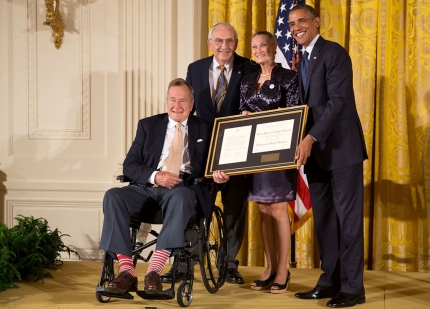
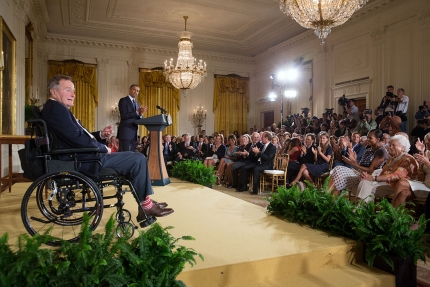
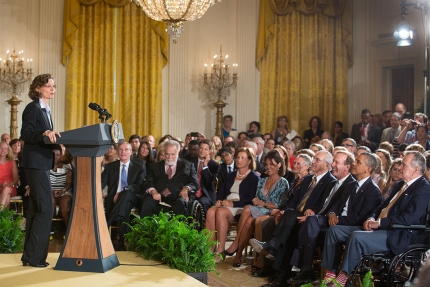
President hosts host former President George H. W. Bush, former First Lady Barbara Bush, and members of the Bush family for an event honoring the winner of the 5,000th Daily Point of Light Award. Points of Light is the world’s largest organization dedicated to volunteer service.

Download mp4 (1137MB) | mp3 (73MB)

Read the Transcript

Remarks by President Obama and President George H.W. Bush at Points of Light Award Ceremony

East Room

1:55 P.M. EDT

PRESIDENT OBAMA:  Well, good afternoon, everybody.  And on behalf of Michelle and myself, welcome to the White House. 

Twenty-three years ago, President George H.W. Bush began a tradition.  He knew that across the country every day, Americans were finding ways to serve others and give back to their communities -- often with very few resources and very little recognition.  And President Bush knew that their good works were valuable to the people they helped -- but beyond that, he knew that their spirit of service was vital to our national character.  So he created an award, the Daily Point of Light Award, to recognize Americans who serve their neighbors and communities in innovative ways that inspire us all.

And for the rest of his presidency, nearly every single day, President Bush gave someone a Daily Point of Light Award.  And after he left the White House, he kept going and going and going -- in between skydiving and other activities -- (laughter) -- he kept going, which should come as no surprise, since we’re talking about somebody who has served his country in such extraordinary ways.  And when you do a parachute jump at the age of 85, not just a parachute jump, but another parachute jump -- I believe his seventh -- this is somebody who’s not going to slow down any time soon.

So, today, we are extraordinarily honored to be joined by the family that helped build the Points of Light Foundation into the world’s largest organization dedicated to volunteer service.  President Bush, Mrs. Bush, Neil Bush -- we want to welcome you.  And we also want to recognize Michelle Nunn, the CEO of Points of Light.  It’s worth an applause.  (Applause.)

Now, this is not the first time President Bush and I have come together for an event like this.  Four years ago, I went down to Texas A&M University, where President Bush has his library, to help celebrate the 20th anniversary of Points of Light.  And I appreciated the warm welcome -- by which I mean the extremely loud “howdy” that I received.  (Laughter.)  I was deeply impressed by how invested the students there are in community service.  But, most of all, I was moved by how much they love President Bush. 

And now we’ve come together to mark another milestone.  As of this minute, 4,999 Points of Light awards have been presented to individuals and organizations across this country.  And so now I have the honor of joining President Bush in presenting number 5,000.  (Applause.)  Number 5,000.  (Applause.)

 About 10 years ago, Floyd Hammer and Kathy Hamilton were getting ready to retire.  They had been farming for years.  They had earned a break.  They planned to sail around the world.  And then their friend told them about a special place that they should visit along the way:  In a village in Tanzania, a volunteer mission was helping to renovate an HIV-AIDS clinic.  And Floyd and Kathy thought it sounded like a worthwhile detour. 

 When they arrived in Tanzania, the country was in the third year of a brutal drought.  People were starving and dying.  Many of them were children.  And having seen this, Kathy and Floyd simply had to do something about it.  And so their vision of a leisurely retirement was replaced by a new mission:  fighting global hunger. 

 Today, the nonprofit they created, Outreach, has distributed free meals to hungry children here in the United States and in more than 15 countries worldwide -- to date, more than 233 million meals.  They’ve gone to see many of the kids that they met in Tanzania grow up healthy and strong.  And this work, they say, is the most rewarding thing they’ve ever done.  And I have to say, having just been to Tanzania with Michelle, we can attest to how important this kind of work is, how it changes lives.

 It’s also fitting that later this week, on July 18th, people around the world will celebrate the legacy of the magnificent public servant, Nelson Mandela, by performing acts of public and community service.  And as people look for examples, Outreach provides an extraordinary demonstration of how service can lift people’s lives. 

 And so if the purpose of this award is to celebrate Americans who work to make our country and world a better place -- not for their own advantage or for any ulterior motives, but just to serve, pure and simple -- I can't think of anyone more deserving than Kathy Hamilton and Floyd Hammer.

 Now, before we actually present this award, I would be remiss if I didn't take a moment to honor the man who made this all possible.  He hates this, but I’m going to do it anyway.  (Laughter.) 

 Much has been said about President Bush’s own extraordinary life of service, but I’m not sure everybody fully appreciates how much he’s done to strengthen our country’s tradition of service.  In addition to this award, he created the first White House office dedicated to promoting volunteerism, and he championed and signed the National and Community Service Act.  By Washington standards, it was a modest law.  It involved little money; President Bush signed it with little fanfare.  But looking back, we see that it sparked a national movement.  By laying the groundwork for the Corporation for National and Community Service and AmeriCorps and Senior Corps, it gave tens of millions of Americans meaningful opportunities to serve.
And today, thanks to those programs and others like them, and thanks to the passion of leaders like President Bush and citizens who found the same passion over the years, volunteerism has gone from something some people do some of the time to something lots of people do as a regular part of their lives. 

Since 1989, the number of Americans who volunteer has grown by more than 25 million.  Service is up across age groups and across regions.  It’s now a graduation requirement in many high schools and colleges.  It’s embedded in the culture of businesses large and small.  And speaking for my family, volunteering has brought joy and meaning to Michelle and me and our daughters over the years, and I know that’s the case for many of your families, too. 

This national tradition may seem perfectly ordinary to many Americans, especially those who have grown up during this period.  But, in fact, it reflects tremendous progress.  And today we can say that our country is a better and a stronger force for good in the world because, more and more, we are a people that serve.  And for that, we have to thank President Bush, and his better half, Barbara, who is just as committed as her husband to service, and has dedicated her life to it as well.  (Applause.)

The presidents who followed President Bush have had the good sense to continue this work -- and not just because one of them calls him Dad.  (Laughter.)  Even after leaving office, President Clinton and both President Bushes have come together to help people affected by natural disasters here at home and around the world -- a reminder that service is not a Democratic or a Republican value, but it’s a core part of being an American.  And at the White House today, we’re proud to carry forward that legacy. 

I created the Office of Social Innovation and Civic Participation to find new ways to use innovation to strengthen service.  We expanded the Office of Faith-Based and Neighborhood Partnerships -- originally created by President George W. Bush -- which works closely with religious and community organizations across the country to help Americans in need. 

And today I want to announce a new task force, with representatives from Cabinet agencies and other departments across the government, to take a fresh look at how we can better support national service -- in particular, on some of our most important national priorities:  improving schools, recovering from disasters and mentoring our kids.  And this task force will be led by my team here at the White House, along with Wendy Spencer, who is here -- the CEO of the Corporation for National and Community Service -- who previously led the volunteer commission in Florida for Governor Jeb Bush.  So we've got a whole family thing working.  (Laughter.) 

In times of tight budgets and some very tough problems, we know that the greatest resource we have is the limitless energy and ingenuity of our citizens.  And when we harness that energy and create more opportunities for Americans to serve, we pay tribute to the extraordinary example set by President Bush.

And just to close on a personal note, Mr. President, I am one of millions of people who have been inspired by your passion and your commitment.  You have helped so many Americans discover that they, too, have something to contribute -- that they, too, have the power to make a difference. 

You’ve described for us those thousand points of light -- all the people and organizations spread out all across the country who are like stars brightening the lives of those around them.  But given the humility that's defined your life, I suspect it’s harder for you to see something that’s clear to everybody else around you, and that's how bright a light you shine -- how your vision and example have illuminated the path for so many others, how your love of service has kindled a similar love in the hearts of millions here at home and around the world.  And, frankly, just the fact that you're such a gentleman and such a good and kind person I think helps to reinforce that spirit of service. 

So on behalf of us all, let me just say that we are surely a kinder and gentler nation because of you and we can’t thank you enough.  (Applause.)  

So it is now my great pleasure to join President Bush and all of you in presenting this extraordinary award to an extraordinary couple who have done so much for so many people.  We are very grateful to them.  Floyd and Kathy, will you please step up and receive your award.  (Applause.)

(The award is presented.)

 PRESIDENT GEORGE H.W. BUSH:  My remarks are simply to say something nice about Neil, my son.  (Laughter.)  It’s not hard to do, and he’s been very active in this whole concept of volunteering, helping others.  And so it’s my privilege to introduce Neil, and first, of course, thank the President and Mrs. Obama for this wonderful hospitality.  It’s like coming home for Barbara and me with the rest of you just coming to this magnificent house and being greeted by this superb hospitality -- knows no bounds.

 So thank you all very much.  Now, Neil.  (Applause.)

*****

PRESIDENT OBAMA:  Well, thank you very much, Michelle, for your outstanding work.  To all the Points of Light Award recipients, we’re proud of you, congratulations, and keep up the great work.  You inspire us and make us want to do that much more, especially when you see young people who are already making such a difference and such an impact, it gives you enormous confidence that America, for all its challenges, will always meet them because we’ve got this incredible character.

 And with that, what I want to do is once again thank President and Mrs. Bush for their outstanding leadership.  We are so grateful to both of you.  I want to thank Neil for his leadership, and I want to make sure that everybody enjoys a reception.  I suspect the food may be pretty good.  (Laughter.)

 So thank you very much, all of you, for being here.  Thank you.  (Applause.)

END  
2:25 P.M. EDT

Close Transcript

The White House

Office of the Press Secretary

FACT SHEET: Accelerating Improvements in HIV Prevention and Care in the United States through the HIV Care Continuum Initiative

"We’ve got to keep pushing. We’ve got to make access to health care more available and affordable for folks living with HIV."

President Obama, June 13, 2013

In July 2010, President Obama released the first comprehensive National HIV/AIDS Strategy. The HIV Care Continuum Initiative calls for coordinated action in response to data that has been released since the Strategy three years ago, showing only a quarter of people living with HIV in the United States have achieved the treatment goal of controlling the HIV virus. In fact, along the entire HIV care continuum – the sequential stages of care from being diagnosed to suppressing the virus—there are significant gaps. To address this need, the HIV Care Continuum Initiative will mobilize Federal efforts in line with the recent advances in our understanding of how best to prevent and treat HIV infection. It will support further integration of HIV prevention and care efforts; promote expansion of successful HIV testing and service delivery models; encourage innovative approaches to addressing barriers to accessing testing and treatment; and ensure that Federal resources are appropriately focused on implementing evidence-based interventions along the HIV care continuum in relation to other scientifically proven approaches to combatting HIV.

Scientific advances in the three years since the Strategy’s release highlight the importance of accelerating efforts to increase HIV testing, services, and treatment along the continuum:

  • Federal guidelines now recommend antiretroviral treatment for all adults and adolescents living with HIV in the United States. Instead of waiting for the immune system to show signs of decline, experts now recommend starting treatment right away. Evidence indicates that treating HIV as soon as possible reduces HIV-related complications.

  • Treatment reduces the risk of HIV transmission. Along with other proven prevention methods, such as condom use, abstinence, and comprehensive drug treatment, effective treatment reduces the risk of HIV transmission. An NIH-sponsored study showed that among heterosexual couples, starting treatment early reduced transmission risk by 96%.

  • Screening for HIV is now recommended for all persons 15-65 in the United States. About half of Americans have never been tested for HIV, and nearly 200,000 people living with HIV in this country are unaware that they are infected. Screening all persons between 15 and 65 years of age is now a grade "A" recommendation of the independent U.S. Preventive Services Task Force.

Towards an AIDS-Free Generation

The HIV Care Continuum Initiative will be overseen by the Office of National AIDS Policy. A workgroup including key Federal agencies is charged with implementing the Initiative. Today, as part of the Initiative launch, the Secretary of the Department of Health and Human Services (HHS), Kathleen Sebelius, announced that HHS plans to launch "Integrating HIV Prevention and Care Services to Improve HIV Outcomes in Areas of High Unmet Need," a new demonstration project to expand the capacity of community health centers, local health departments, and their grantees to provide integrated HIV prevention and treatment services across the HIV care continuum. Estimated annual funding: $8.5 to $10 million.

Other upcoming projects relevant to the Initiative include:

o In October 2013, HRSA plans to release a new funding opportunity announcement from its Special Projects of National Significance (SPNS) initiative, "System-level Workforce Capacity Building for Integrating HIV Primary Care in Community Healthcare Settings." This initiative will identify factors that increase the potential for successful integration of HIV care into primary care and community healthcare settings; enhance the capacity and readiness of funded organizations to adapt and realign their systems to identify and provide care to people living with HIV along the care continuum; and identify models and best practices to increase the HIV workforce’s capacity to identify, link, retain and achieve viral load suppression. Estimated annual funding: $4.7 million.

o CDC will release its "National Capacity Building Assistance for High Impact Prevention" funding opportunity announcement to address gaps in each step of the HIV care continuum by providing quality training and technical assistance to optimize workforce performance within health departments, community-based organizations, and healthcare organizations. Estimated annual funding: $26 million.

o The Department of Housing and Urban Development (HUD) will invest $300,000 in a year-long technical assistance initiative as part of the Housing Opportunities for Persons with AIDS (HOPWA) program. This initiative will build grantee capacity to integrate health care planning and care outcome measures into HIV housing programs.

In addition to today’s announcements, the Administration is implementing policies and programs the work group will focus on in identifying steps to improve outcomes along the HIV care continuum:

Increasing healthcare coverage:

o The Affordable Care Act will expand health insurance coverage to millions of Americans, including thousands living with HIV. Under the Affordable Care Act, new health insurance plans will be required to cover HIV testing without additional out-of-pocket costs. Starting in 2014, insurance companies will not be able to deny coverage based on pre-existing conditions, including HIV.

Maintaining strong support for the Ryan White Program:

o The Ryan White Program is the largest Federal program solely dedicated to providing HIV care and treatment. The Ryan White Program will continue to play a vital role in completing coverage and ensuring people living with HIV continue to receive treatment without service gaps.

Supporting innovation to link and engage persons living with HIV into care:

o Funded through the Secretary's Minority AIDS Initiative Fund, the Care and Prevention of HIV in the United States demonstration project is underway in eight states and is designed to reduce HIV-related morbidity, mortality, and related health disparities among racial and ethnic minorities.

Focusing on prevention interventions that work:

o CDC and its partners are pursuing a High-Impact Prevention approach to reducing new HIV infections. This approach is using combinations of scientifically proven, cost-effective, and scalable interventions targeted to the right populations in the right geographic areas to increase the impact of HIV prevention efforts.

Standardizing HIV data to improve health outcomes along the care continuum:

o In June 2013, the Secretary approved plans submitted by nine HHS operating divisions to adopt and deploy seven HIV common core indicators and streamline data collection for HIV services grantees. HHS offices are working to include these indicators as clinical quality measures in electronic health record (EHR) systems beginning in 2016.

Supporting research to improve outcomes along the HIV care continuum:

o The National Institutes of Health (NIH) has expanded its investment in research to address gaps and opportunities in the HIV care continuum. Highlights include investigations of the effectiveness of methods to identify HIV-infected people earlier and to link them to care; community-level interventions to expand HIV testing and treatment; interventions to improve HIV outcomes among substance users; and evaluation of innovative network approaches for HIV testing and referral for uninfected persons in the correctional system.

Supporting HIV prevention , care and treatment for veterans living with HIV/AIDS:

o The Veterans Administration (VA) is focusing on increasing HIV testing rates and the number of veterans who are aware of their HIV status. The HIV program office will support HIV testing quality improvement efforts in all medical settings, provide educational opportunities, develop best practices, and monitor HIV rates annually. The HIV program office will work to ensure that all Veterans diagnosed with HIV in VA are linked to a provider within 90 days of that diagnosis and have equal access to medication, care, and supportive services.

Addressing HIV-related stigma and discrimination:

o Stigma and discrimination keep people from getting tested, care and treatment. The Department of Justice (DOJ) will continue its aggressive HIV non-discrimination enforcement efforts, specifically targeting enforcement and outreach to the geographic areas with the highest prevalence of HIV, and continue its efforts to address HIV criminalization laws. DOJ will also increase its work under the Barrier-Free Health Care Initiative, which focuses on removing barriers to health care for people with HIV. The Federal Bureau of Prisons (BOP) will continue its efforts to maximize optimal HIV treatment for inmates and improve clinical linkages upon their release.

Increasing employment opportunities and economic advancement for people living with HIV/AIDS:

o Unemployment, low income status, and social marginalization are linked to poor health outcomes. The Department of Labor (DOL), in collaboration with the HUD, will develop an online, multimedia training to increase the capacity of service providers to create employment opportunities and economic advancement for people living with HIV/AIDS and those at risk of HIV/AIDS.

Supporting robust funding for domestic HIV/AIDS programs:

o The President’s proposed 2014 domestic HIV budget is over $23.2 billion, and includes increases in discretionary funding for HIV prevention, care, and treatment. For more details on how the President’s budget supports the fight against the domestic HIV epidemic go to:

http://obamawhitehouse.archives.gov/omb/budget/factsheet/strengthening-the-economy-hiv-aids

The White House

Office of the Press Secretary

Press Briefing by Press Secretary Jay Carney, 7/15/2013

James S. Brady Press Briefing Room

12:24 P.M. EDT

MR. CARNEY:  Good day, everyone.  Welcome to the White House.  I hope you had a terrific weekend.  Since you asked, I had a great weekend.  (Laughter.) 

Q    How great was it?

MR. CARNEY:  I took my son to see Paul McCartney Friday night.  That was unbelievable because --

Q    He was with the Beatles, you know.  (Laughter.) 

MR. CARNEY:  It turns out he was.  Wrote a few very good songs.  It’s just a fantastic experience because he’s amazing and his songs are amazing, but to be there with an 11-year-old who also knew all the words is pretty special. 

And Saturday night, I went to see, my wife and I, a local band, U.S. Royalty, which brought down the house at this place off of H Street, N.E., where all the kids go, apparently.  Very cool. So I recommend that.  It was a musical weekend. 

And with that, I'll --

Q    We could sing the briefing. 

MR. CARNEY:  I'll refrain from --

Q    -- Jay’s Week Ahead.  (Laughter.) 

MR. CARNEY:  We won't sing my week ahead.  (Laughter.)

Seriously, U.S. Royalty -- you’ll be hearing from them I'm sure.  And with that, I'll take your questions.  Oh, before I do, hard stop at 1:00 p.m. because we have the dual President event.

Q    The White House doesn’t often put out statements from the President on trials that don't directly involve the government.  Why did the President decide to put out the statement yesterday on the Zimmerman trial?

MR. CARNEY:  The verdict, obviously, was fairly big news and it was something that was being watched nationally, and the President, of course, had spoken about Trayvon Martin in the past after he was killed, and the President wanted to convey that he felt that the death of Trayvon Martin was a tragedy for his family and for the community, but also for the country.  And he wanted to note that in the wake of the verdict, the strong passions the case had elicited could be running even higher, and that it was important to remember that we are a nation of laws and a jury had spoken. 

The President also wanted to ask every American to heed the call for calm reflection from Trayvon Martin’s parents, a rather remarkable request given how much they have suffered and were suffering after losing their son.  And he wanted to express his view that as we reflect in response to that call that we should ask ourselves if we are doing all that we can to foster compassion and understanding in our communities, and to stem the tide of gun violence, as well as how we can prevent future tragedies like this from happening.

Q    Even though the jury in this case has spoken, the Justice Department is still considering whether to file criminal civil rights charges.  Does the President feel like that decision needs to be made quickly in order to have some kind of finality to this case?

MR. CARNEY:  This is a decision made by the Justice Department, by career prosecutors, and all questions about how that process is undertaken should be directed there.  And that is not something the President involves himself in.  As the Justice Department said yesterday, they first acknowledged last year that they have an open investigation into Trayvon Martin’s death and they are continuing to evaluate that evidence.

Q    But since the President did speak about this case last year in pretty personal terms, did he have any personal reaction to the verdict?  Does he have any personal feelings on the need for the Justice Department to make a decision on this quickly?

MR. CARNEY:  Well, he has no opinion to express about the disposition of how the Justice Department would look at this.  He did speak about it in personal terms, and I think his statement yesterday reflects how the loss of a young person is a source of great anguish and pain for the parents of that person, for the community where that person lived -- that young person lived, and for the whole country, because the loss is greater when a young person dies because the potential of that life is so unfulfilled.
So I think that’s how the President viewed it then and views it now.

Q    And then just quickly, is there any reason that President George W. Bush is not coming to the event today?

MR. CARNEY:  Oh, I think you would have to ask the Bush family.  I should say this -- having covered President George W. Bush -- and I’m sure as you all know, he’s enormously proud of his father, of course, and his father’s presidency, but in particular, this remarkable program that President George H.W. Bush initiated. 

And the current President, President Obama, has recognized the importance of this program and the role that President George H.W. Bush has played in fostering a spirit of community service in this nation.  It’s so important.  And this organization that he started has contributed significantly to fostering that sense of community service.  It’s a much more common thing in our country, I think, to hear about, and for young people to get involved in, community service.  And I think the President believes that President Bush 41 deserves a large portion of credit for that.

Yes, Jessica.

Q    I know you’re not going to comment on the civil rights case, but I’m curious if the White House is feeling any pressure because the number of civil rights leader calling for a civil rights case is mounting.  There are 600 signatures on a NAACP petition; some -- let’s see -- more than 15,000 in just 24 hours on a White House petition online.  Does the President feel some pressure on this administration to bring a case against Zimmerman?

MR. CARNEY:  Cases are brought on the merits and the merits are evaluated by the professionals at the Department of Justice. And the President expects, as in every case, that the process will be handled in the way it should be at the Department of Justice, and certainly not here.

Go ahead.

Q    He is an attorney.  Does the President believe that there are merits to the case?

MR. CARNEY:  Again, I would point you to the President’s statement for his reaction to the verdict and his statement about the verdict, and the broader issues that he thinks we might all reflect upon.  He will not comment on a Department of Justice investigation or on a decision that the Department of Justice will make on how to proceed, if to proceed.

Q    But more broadly, he said that we’re a nation of laws.  Does he feel the Florida “stand your ground” law should change?

MR. CARNEY:  I mean, this is a state law that you’re referring to.  And again, within the context of this case, I just don’t have any comment from the President to provide to you.  That’s something, again, that would be more appropriately answered by the Department of Justice.

Q    And finally, is there any concern about what kind of message the verdict sends?

MR. CARNEY:  I think the President’s statement reflects his views about the verdict, about the tragic loss of Trayvon Martin, for his family, his community and for the country, the fact that his loss reflects and symbolizes the loss we see daily in this country of young people to gun violence.  And that’s why I think the President’s statement contained within it the elements that I described.

Q    Can I follow on Jeff’s question?

MR. CARNEY:  Yes.

Q    Jay, should the Martin family be encouraged to pursue a wrongful death lawsuit rather than wait for a decision by the Justice Department regarding a civil rights investigation?

MR. CARNEY:  April, I’m just not going to comment on any kind of decision like that that the Martin family would have to make.

Q    Well, okay.  Well, has the President -- when is the last time the President talked to Eric Holder, particularly about this case?

MR. CARNEY:  I’m not sure that I know the answer to that question.  I don’t believe that this is something the President views as a discussion he would have with the Attorney General, especially on the substance of the case or decisions the Department of Justice would make.  That is something the Department of Justice makes, and they have talked about this and put out statements about it, and they will make assessments and decisions on the merits and on the evidence.

Q    Well, tomorrow, Eric Holder, Kathleen Sebelius and Shaun Donovan will be in Florida addressing the NAACP, and one of the issues is on gun violence.  And according to the NAACP, black males ages 15 to 19 were eight times as likely as white males of the same age, and two and a half times as likely as their Hispanic peers, to be killed in gun-related homicides in 2009.  And Kathleen Sebelius, Eric Holder and Shaun Donovan will be addressing those issues.  What does the White House have to say, particularly as you can’t push forward gun legislation?

MR. CARNEY:  Well, the President has made clear his feelings about the failure of the Senate to act on common-sense legislation that would have improved upon our background check system -- legislation that has enormous support across the country, in blue states and purple states and red states, and that the Senate should have approved. 

The fact of the matter is -- and the President has spoken about this -- he will continue to work with members of his administration to advance the cause of reducing gun violence, using the powers that the administration has, but will also continue to try to impress upon Congress the need to have Congress act on this important problem and to reflect the will of the American people when it comes to common-sense steps -- steps that respect our Second Amendment rights, rights that the President supports, and that simply, in the case of the background check legislation, as we discussed quite intensively for a period earlier this year, would simply build upon and improve an existing system, so that those who should not have access to firearms because they’re convicted criminals or have a serious mental instability are prevented from obtaining them.  It’s a pretty simple proposition.

So the President will continue that work.  And I’m sure that the Cabinet Secretaries that will be speaking in Florida will talk about the need to continue that work.  And the President’s package of steps to reduce gun violence included a number of -- 23, if I’m not mistaken -- executive actions, and there has been significant progress on almost all of those.  And the President will continue to press for those to be completed.

Q    And lastly, the irony with Top Cop in Florida at this time, on that situation -- the verdict for George Zimmerman.

MR. CARNEY:  Well, I’m sure that the Attorney General looks forward to having that conversation.  The issues surrounding gun violence in this country remain -- they remain a priority for this administration.  So I don’t want to anticipate what remarks he or the other members of the Cabinet might make, but these continue to be important priorities for the President and his administration.

Q    On the nuclear option, as you know, the Senate is meeting to have a discussion later on this evening.  I know you said you would defer, the White House would defer to Reid on matters of procedure.  But is the President concerned that in the expediency of moving forward on nominations, you might sacrifice the ability for the minority voice to be heard in the Senate?

MR. CARNEY:  Well, first of all, I think we should note that there’s a joint caucus meeting today in the Senate, and we take that as a constructive step towards streamlining the confirmation process and breaking the Republican gridlock holding up executive branch appointments.  Our view, which I’ve expressed and the President and others have expressed, is that Republicans have needlessly and systematically obstructed our nominees, even though the individuals the President has nominated for these posts have extraordinary credentials and bipartisan support, and several of them, as I noted last week, have been waiting for more than 100 days for a floor vote. 

So gridlock is something we’ve seen in Washington for some time, but the Republicans in the Senate have brought gridlock to new heights -- or new lows, depending on how you look at it.  The data bear this out in terms of the vast increase in filibusters and the blocking of nominations; the needless stalling of nominations; the unprecedented filibuster of a Defense Secretary nominee, who happened to be a former Senate Republican, of all things.  So the President’s views on this are oft expressed and well-known.

As for the process in the Senate, we do defer on Senate rules and processes to the Senate Leader, and we do that today, noting that there will be this joint caucus later today.

Q    And to shift to Syria, has the administration resolved questions and doubts expressed by members of Congress about arming the Syrian rebels?  Are those objections holding up the plan for moving forward at all?

MR. CARNEY:  Well, let me say a couple things.  We have been clear, even though I get this question in a variety of ways, that we cannot provide details about the timeline or logistics of delivery for every type of assistance, or catalog specific types of assistance. 

But we are in daily contact with the Syrian Military Council to discuss how we can support their needs.  And as I said last week, and I can say again today, we are in regular consultation with Congress on matters related to Syria assistance.  And the President believes very strongly, as he made clear, that our updated assistance to Syria is essential to helping buttress the opposition as it endures this vicious assault from Bashar al-Assad that is supported -- in a manner that speaks volumes about who he is and who his friends are -- by Hezbollah and Iran.

Anybody else on the front row?  Jon.

Q    Jay, does the President have a personal opinion about whether or not there should be a civil rights suit brought against --

MR. CARNEY:  Jon, I think I’ve been pretty clear at the top here that the President’s views on this matter were expressed in his statement.  I don’t have any others to convey.  And it would be inappropriate, as you might imagine, for a President of the United States to express an opinion on what the Justice Department should do.

Q    The New York Times had a story over the weekend about military sexual assault cases, saying that the President’s comments have prejudiced several cases and could complicate many cases going forward.  I’m just wondering your view on that.  Is that accurate as far as you know?

MR. CARNEY:  Well, I don’t know about how people view this in terms of the story.  I think the President has spoken very clearly about the problem, which has been significantly documented in a way that proves how serious the problem is.  And he's expressed his opinion that as Commander-In-Chief he has no tolerance for sexual assault in the military, and that those who participate in it or who engage in that conduct are dishonoring the uniform that they wear.

So that’s the President's views.  And I think they're very high-altitude -- they're not specific to a case; they're his views about the commission of a crime.  And I mean, it's a crime in the military as it is outside of the military.  So I don’t think they're anything but general views that reflect his feelings about how a problem like this needs to be addressed.

Q    But in light of the impact that we've already started to see, did the President misspeak when he outlined in some detail what he thought the punishment should be?

MR. CARNEY:  Again, I think the President's words reflected his general views about the seriousness of the problem, which has been amply documented, about the particular significance of it taking place within the military, and how he believes that those who engage in that conduct are dishonoring the uniform they wear. But it’s certainly true in the military and true outside of the military that specific cases have to be adjudicated, and everyone waits for those results on individual cases.  But the problem itself is well-documented and exists, and needs to be fixed.

Q    And just quickly on the Senate rules dispute -- Senate Republicans have made it clear that if Democrats go through with this rule change -- I understand that the President is leaving this up to Harry Reid -- but Senate Republicans have basically threatened that they're going to shut everything down if Senate Democrats go through with this rule change.  Is the President concerned that the Senate could actually become even more dysfunctional than it's been?  (Laughter.)

MR. CARNEY:  Well, it boggles the mind how they would achieve that.  But the fact is the Senate needs to confirm this President's nominees in a timely and efficient manner -- to consider and confirm.  And that is true and will be true for the next President and the next President after that.  This has become ridiculous.

And you have a situation with Gina McCarthy, the President's nominee -- highly qualified nominee to head the EPA, whose qualifications are not in dispute at all -- it would be odd if they were, since she worked for Mitt Romney in Massachusetts --  but she’s been held up.  Tom Perez, enormously qualified -- he’s been held up.  And perhaps most appallingly of all, Rich Cordray, who has broad bipartisan support around the country, whose work is unimpeachable and in the position already has achieve remarkable things.  And the only reason why Republicans have stalled his nomination for two years is because they don't like the agency that he heads up. 

But the agency was created by law, and Republicans ought to explain what they don't like about an agency that's designed to protect consumers from financial fraud; what they don't like about the $425 million that has already been refunded as a result of the 2012 CFPB enforcement actions and that money has been refunded to consumers who had been subjected to deceptive practices.  Do Republicans who oppose the CFPB not want to see that money refunded?  Because that's what Rich Cordray oversees.

What about the 6 million consumers who have received funds because of the 2012 CFPB enforcement actions?  Should they not have received the funds for the deceptive practices -- as reimbursement for the deceptive practices that were uncovered by the CFPB?  That's the agency that they oppose.  And they don't oppose the nominee because they all have made clear that they don't think he’s anything but highly qualified, but they have held him up for two years because they don't like the work that the CFPB has done.

But let’s look at that work:  200 million customers who have files at the major consumer reporting agencies which are now, for the first time, subject to federal supervision; or the 30 million consumers -- I meant consumers in the other one -- consumers who currently are subject to debt collection agencies, those agencies now subject to federal supervision for the first time; 31,000 military and veteran consumers that the bureau’s Office of Servicemember Affairs communicated with in 2012 through 82 outreach events.  The CFPB has --

Q    It sounds like it’s working without a nominee.

MR. CARNEY:  Well, the thing is that they want -- but they want to prevent it from working.  They have made that clear.  They want to undermine its functioning.  And they have used their refusal to confirm this enormously qualified individual as a means of trying to achieve that.

Now, you’re right that the President has pressed ahead and Rich Cordray has pressed ahead in making sure that the CFPB functions for hardworking Americans out there.  But we should not have to do this and the American people should not have to tolerate this kind of obstructionism, because this agency does good work and it is a key element of Wall Street reform and that Wall Street reform is benefiting Americans around the country. 

And I understand that Republicans who oppose Wall Street reform and oppose the CFPB as currently constructed are joined in that opposition by a number of powerful banks and other interests.  But the American people deserve these protections and they deserve to have Rich Cordray confirmed by the Senate.

Q    I understand you have concerns about nominees.  But what I'm asking is Republicans are basically threatening to blow the place up so that nothing gets through the Senate.  Are you worried?  Do you take that threat seriously?

MR. CARNEY:  We take the fact that the Senate has been riddled by gridlock -- I'm not sure that's a metaphor that works -- but that has been overwhelmed by gridlock to be obvious and it has manifested itself in this nomination process.  That's why it's so important to work it out, to work out a system so that we can streamline the nomination process.  And we're talking about executive branch nominees.  We have big problems on the judicial branch nomination process, too, but this is just executive branch nominees.

And we look forward to the session tonight, and we defer to Senator Reid in terms of next steps.  But the problem is real.  And here it is again -- when the obstructionism, on the one hand, in this case, or the attempts to undermine agencies like CFPB or the implementation of the Affordable Care Act, who suffers as a result?  It's not the members themselves who obstruct and it's not the special interests that support their obstructionism.  It's average Americans, average Americans who would, when we move on to the Affordable Care Act and the ongoing efforts by Republicans to undermine that -- what if they were to achieve in repealing the Affordable Care Act?  They won't, but what if they were -- since it seems to be the only business that they focus on?  Who would suffer?  Average Americans. 

They are going after the individual responsibility provision of the Affordable Care Act now, their latest attempt at repeal.  Well, that aspect of the Affordable Care Act is absolutely essential to ensuring that people with preexisting conditions can get insurance.  And guess what -- half of you have preexisting conditions.  Half of your kids will have preexisting conditions. Who loses if the House Republicans get their way?  Anybody else? Or is that a perfect -- I should drop the mic, right?  (Laughter.)

Q    But just to clarify -- (laughter) --

MR. CARNEY:  Thank you. 

Q    -- the President has no objection to this possible rule change, even though at some point it might negatively impact his own party?

MR. CARNEY:  Look, the President believes that the Senate ought to function and hopes that the Senate will figure out a way to ensure that the nomination process is appropriately streamlined.  What we defer to --

Q    What I want to know is whether he endorses this.

MR. CARNEY:  The President supports Harry Reid and supports the support --  he supports Harry Reid and he is appreciative of the support that Harry Reid has given to the President and his nominees, and will give to the President and his nominees.  And we're talking about a process that should not work the way it's been working, because it hasn't been working very well. 

Q    And is there any chance that we would hear from the President about the Trayvon Martin case?

MR. CARNEY:  I think the President's statement yesterday reflects his reaction to the verdict and his feelings about the usefulness in response to the call by Trayvon Martin's parents that we all reflect calmly on the loss here and on what we can do to bring our communities together to prevent things like this from happening and to reduce gun violence.

Q    So will he say it publicly?

MR. CARNEY:  I don't have any announcements to make about presidential remarks. 

Q    Jay, on Zimmerman, on the civil rights question, you said earlier that the Justice Department will decide this on the merits of the case.  There were records released in the case last week that showed that the FBI had interviewed nearly three dozen people in the Zimmerman case and found that there was no evidence that racial bias was a motivating factor in the shooting.  So my question would be what is the open question then for the administration?  This is not the Zimmerman defense attorney saying that; this is the FBI looking at it independently.  They've determined from interviewing nearly three dozen people in the case that racial bias was not a factor in the shooting.  What's the open civil rights question?

MR. CARNEY:  Well, that is a question that the Department of Justice will answer.  And the Department of Justice, appropriately, handles these investigations, reviews the evidence and makes determinations about next steps.  That's not something that we do from here.

Q    When you said earlier that it would be inappropriate for the President to comment on a possible Justice Department investigation, why are you drawing that line now?  He already did that last March.

MR. CARNEY:  No, the President commented on the death of a young man and the pain that his parents were feeling, and he commented in very personal terms.  He didn’t comment about the disposition of an investigation or a case.  He commented on the death of a young man.

Q    And you don’t think that put any pressure on his Justice Department, others in the government, based on his personal feelings that he felt there should be an investigation?

MR. CARNEY:  I think the President expressed the fact that it was a tragedy that a young man’s life was taken.  And I think that was true then and it’s true today.  Meanwhile, there is a process in place that resulted in a trial and verdict by a jury, and there’s a process in place by which the Department of Justice looks into these matters and makes decisions about next steps.  The President’s views were personal and his statement yesterday I think reflects personal views.

Q    Following up on what Bill said, very quickly, though, would Vice President Joe Biden cast the 51st vote, if necessary, to change the filibuster rules?  Would the President support that?

MR. CARNEY:  Again, I’d refer you to the Senate Majority Leader’s office for procedures related to this issue of obstructionism in the Senate over nominations.

Q    If it requires an additional vote and he were the tiebreaker?

MR. CARNEY:  I think that’s a speculation that I’m not going to engage in, because it’s up to the Senate to figure out something that really is a matter between the members of the Senate.

Q    I want to ask you briefly about immigration reform, if I can.  The Associated Press wrote an article over the weekend talking about the President’s intentions going forward in terms of fighting on behalf of immigration.  And Dan Pfeiffer was quoted as saying, “We’re doing meetings, we’re talking to folks, we’re behind the scenes at every step.”  And then asked when the pressure might mount, Pfeiffer said, “There might be a moment where the hammer comes out, but we’re not there yet.”  When does the “hammer,” in Dan’s language, come out?  When does the President take the next step in terms of --

MR. CARNEY:  When that moment arrives, if it arrives. 

Q    What is that moment, then?

MR. CARNEY:  Well, I think -- we don’t know yet. 

Q    What are the options --

MR. CARNEY:  What has been our approach all along has been to evaluate the progress that comprehensive immigration reform has been making in the Congress, and against that progress to make judgments about how we can best, from the President on down, advance the cause.  And we have done that, and we have been engaged from day one.  And this process is where it is in no small measure because of the positions the President took very publically; because of the positions the President campaigned on; because of the fact that he won reelection; and then because of the remarkably good work in the Senate by a bipartisan group of senators and then by the whole Senate in considering broad, principled comprehensive immigration reform. 

And now we’re at another stage in the process and we are looking at this the same way.  You know, because I think we put it out, the President is going to give some interviews to local Spanish-language television, where he will talk about, again, the need to move forward on immigration reform.  He’ll talk about the benefits, the enormous benefits of immigration reform -- economic benefits, which were made clear by the CBO, as well as all the other benefits to our businesses, to the rule of law, to the capacity for our country to continue to generate innovative ideas and entrepreneurial advances.

So this is all part of the process.  But I don’t have a prediction to make to you about what events might illicit this kind of comment by the President, or a speech by the President, or this phone call from the President.  He's engaged and he will always be engaged in this process as we move forward.

Q    Can I follow up on immigration?

MR. CARNEY:  Sure.

Q    You've said in the past that he wouldn’t sign anything that didn’t have a path to citizenship.  Does that mean a path to citizenship for all 11 million, or would the DREAM Act be sufficient?

MR. CARNEY:  The President believes that comprehensive immigration reform must include a path to citizenship -- a clear path to citizenship for the 11 million Americans here.  I misspoke -- for the 11 million immigrants here, illegal immigrants, who would be given a path to citizenship through the Senate immigration bill -- comprehensive immigration bill, and that that is an earned path which includes taxes and learning English and a lot of steps along the way.

So let's be clear about, as those of you who've written in detail about it, what that path looks like.  And the President supports the Senate bill.

Q    And on Trayvon Martin, does the President feel justice was done in this case or has been done in this case?

MR. CARNEY:  Again, I have no more to add to the President's I think very poignant statement yesterday about the verdict and about the pain that Mr. Martin, Trayvon Martin's parents feel, and that we all can feel at the loss of a young person.

Q    But the jury has spoken is not the same thing as justice has been done.

MR. CARNEY:  Again, I don’t have anything to add.  Obviously, as we've discussed already here, this is something that’s under review by the Department of Justice, and I don’t have further comment on it.

Anita.

Q    Following on that, your favorite topic today, could you just tell us if the President spoke to the Martin family over the weekend?  

MR. CARNEY:  I don’t have any calls to read out.  I don’t believe so, but I don’t have any presidential calls to read out. 
Q    You asked?

MR. CARNEY:  I think that is something -- if you want to ask -- I mean, we're not going to read out personal calls, but I don’t have any reason -- I do not believe that he did.  But I don’t have any calls to read out.

Q    -- his statement with such public a case, I mean, that is a real question.

MR. CARNEY:  I understand, but I think that any phone calls that he might make like that -- and again, I don’t have any call to read out -- might be something that individuals might want to share or not share.

Alexis, then Connie. 

Q    Can I follow up on Mara?  I want to make sure I understand -- if the House decides to take up immigration in a piecemeal fashion before the end of the year and some elements of that could be conferenced with provisions in the comprehensive Senate bill, I just want to clarify -- would the President support that effort to carve it into pieces with the DREAM Act as part of it?

MR. CARNEY:  Are you talking about process in the House, or what emerges from a conference?

Q    Well, it would be both.

MR. CARNEY:  Well, it's hard to predict what the House will do.  We obviously saw the outcome of their meeting, the House Republicans, and their bottom-line statement by leaders that inaction is not an option, which we believe is a sign of progress and an important recognition about why we need to move forward on this issue.  How action manifests itself is obviously for House leaders to decide and House rank-and-file members. 

We believe that the Senate bill is a great vehicle to act on, and were it to pass the House and land on the President's desk he would sign it.  But obviously, this is a process that House leaders will decide.  And it's just -- there are too many permutations to imagine here to get into a game of “well, if it included this, what do you” -- because in the end, whatever emerges from the House, if something does emerge from the House, then it would hopefully be conferenced with the Senate bill, and then a bill would emerge from that.  And that is what we would evaluate as against the President’s principles.

Q    So he might just sign the DREAM Act part --

MR. CARNEY:  No, I didn't say that at all.

Q    I'm getting more confused.

MR. CARNEY:  You are.  Because what the House does on -- because there’s been much discussed about smaller measures sequentially -- it’s just impossible for me to comment on it, one, because they haven’t done anything; and two, there are infinite permutations.  So my point is whatever the House does, if it does something, will then obviously, hopefully, go to conference.  And then it would be the bill that emerges from that we would judge against the President’s principles.

Q    But his principles -- is it for current families, citizenship for every family?

MR. CARNEY:  What I just said remains true.  The President believes that comprehensive immigration reform must include a viable, earned path to citizenship.

Q    For everybody?

MR. CARNEY:  For 11 million.

Q    But just to follow up again, because now I’m confused  -- (laughter.)

MR. CARNEY:  You guys are confusing yourselves.  What I’m saying is I can't -- I cannot even begin to count the number of possibilities that could emerge through the House process, so I’m not going to.  What I’m saying is that the end result has to meet the President’s principles if he’s going to sign it into law.

Q    Okay.  So the President’s principles -- comprehensive, pathway to citizenship and --

MR. CARNEY:  Enhanced border security, ensuring everybody plays by the same rules, eVerify and the like -- that these are the principles that were the foundation of what the President put out on whitehouse.gov two years ago and that he’s been talking about ever since.

Q    So if there’s a lesser --

MR. CARNEY:  You guys are -- it’s hard for me to know what sort of imagined result I’m commenting on, and I don't want to suggest that there’s anything besides what the President has made clear are his principles.

Q    I know I’m fighting you on time, but you were talking about the President’s desire to be very deliberate in choosing a successor to Secretary Napolitano.  But there are members on the Hill who are saying that they want it to be about -- the confirmation -- they would like the President to be mindful of being swift in nominating folks because it’s important to the immigration reform effort.  Can you give us any more guidance about how swiftly the President would like to -- because, as you know, there was some question --

MR. CARNEY:  As swiftly as deliberation allows.  I mean, that is his approach to all these slots that need to be filled.

First of all, Secretary Napolitano remains on the job.  And the President will consider candidates to replace her in a deliberate manner but an efficient manner.  But I don't have anything beyond that in terms of timing or names to float.

Connie.

Q    Thanks, Jay.  On Zimmerman, has the President said anything about George Zimmerman?  Is there some message here?  The statement --

MR. CARNEY:  I think -- again, I read the statement the President put out yesterday -- or rephrased it.

Q    The statement was on Trayvon Martin, but nothing on Zimmerman.  Is there a message here?

MR. CARNEY:  I think everything that the President has to say was contained within that statement.

Q    Do you have any update on the Middle East peace process and Iran --

MR. CARNEY:  That's a lot.  I think I’ve been -- we got a hard deadline here.  I have nothing specific on those issues.

Thank you very much.

END
1:00 P.M. EDT

America's Commitment to Volunteerism and Service

Michelle Nunn, the CEO of Points of Light, delivers remarks during an event to honor Outreach Inc. co-founders

Michelle Nunn, the CEO of Points of Light, delivers remarks during an event to honor Outreach Inc. co-founders Floyd Hammer and Kathy Hamilton, winners of the 5,000th Daily Point of Light Award, in the East Room of the White House, July 15, 2013. (Official White House Photo by Chuck Kennedy)

The first immigrants to America came seeking freedom, but they survived -- and, in time, came to thrive -- because of their determination and because of each other. They valued self-reliance, but in times of strife they also knew could rely on neighbors, friends, sometimes even strangers to offer a helping hand.

That neighbor-helping-neighbor spirit is woven into the DNA of the American spirit. It defines in a very real sense who we are as a people.

It also unites us.

That unity was on vivid display this Monday when President Obama welcomed the man who launched the modern service movement, President George H. W. Bush, back to the White House to honor the recipients of the 5,000th Daily Point of Light award. Together, they lauded Kathy Hamilton and Floyd Hammer of Union, Iowa for stepping up to fight hunger and improve the lives of children worldwide.

President Barack Obama and former President George H. W. Bush present the 5,000th Daily Point of Light Award to Outreach Inc. co-founders

President Barack Obama and former President George H. W. Bush present the 5,000th Daily Point of Light Award to Outreach Inc. co-founders Floyd Hammer and Kathy Hamilton, winners of the 5,000th Daily Point of Light Award, in the East Room of the White House, July 15, 2013. (Official White House Photo by Pete Souza)

Nearly 10 years ago, Hamilton and Hammer participated in a volunteer mission to Tanzania to help renovate an HIV/AIDS hospital there. Startled by the starvation they saw, the couple started Outreach, Inc., which has engaged thousands of volunteers in packaging and distributing 230 million free meals to children in more than 15 countries, including the United States.

Their story is a simple one: Two people decided that they simply had to do something. Telling that story, day in and day out, is what the Daily Point of Light Award is all about.

President Bush was the first president in U.S. history to institute a daily presidential recognition program from the White House, conferring 1,020 Daily Point of Light Awards between 1990 and 1993. And President Bush helped launch a nonprofit – Points of Light – that has become the largest organization in the world dedicated to volunteer service.

While he didn't originate the notion of helping our fellow man, he reasserted it as a national priority and insisted that "there can be no definition of a successful life that does not include service to others."

President Obama built on this commitment to service when he signed the Edward M. Kennedy Serve America Act in 2009, which will increase the size of AmeriCorps from 75,000 volunteers to 250,000 by 2017. In 2012, the President created the FEMA Corps program, which established a FEMA-dedicated unit of AmeriCorps members to work solely on disaster preparedness, response and recovery efforts -- and he launched the Serve.gov platform to make it easier for Americans to find and post local volunteer opportunities. 

Related Topics: Service, Social Innovation, Iowa

The White House

Office of the Press Secretary

Remarks by President Obama and President George H.W. Bush at Points of Light Award Ceremony

East Room

1:55 P.M. EDT

PRESIDENT OBAMA:  Well, good afternoon, everybody.  And on behalf of Michelle and myself, welcome to the White House. 

Twenty-three years ago, President George H.W. Bush began a tradition.  He knew that across the country every day, Americans were finding ways to serve others and give back to their communities -- often with very few resources and very little recognition.  And President Bush knew that their good works were valuable to the people they helped -- but beyond that, he knew that their spirit of service was vital to our national character.  So he created an award, the Daily Point of Light Award, to recognize Americans who serve their neighbors and communities in innovative ways that inspire us all.

And for the rest of his presidency, nearly every single day, President Bush gave someone a Daily Point of Light Award.  And after he left the White House, he kept going and going and going -- in between skydiving and other activities -- (laughter) -- he kept going, which should come as no surprise, since we’re talking about somebody who has served his country in such extraordinary ways.  And when you do a parachute jump at the age of 85, not just a parachute jump, but another parachute jump -- I believe his seventh -- this is somebody who’s not going to slow down any time soon.

So, today, we are extraordinarily honored to be joined by the family that helped build the Points of Light Foundation into the world’s largest organization dedicated to volunteer service.  President Bush, Mrs. Bush, Neil Bush -- we want to welcome you.  And we also want to recognize Michelle Nunn, the CEO of Points of Light.  It’s worth an applause.  (Applause.)

Now, this is not the first time President Bush and I have come together for an event like this.  Four years ago, I went down to Texas A&M University, where President Bush has his library, to help celebrate the 20th anniversary of Points of Light.  And I appreciated the warm welcome -- by which I mean the extremely loud “howdy” that I received.  (Laughter.)  I was deeply impressed by how invested the students there are in community service.  But, most of all, I was moved by how much they love President Bush. 

And now we’ve come together to mark another milestone.  As of this minute, 4,999 Points of Light awards have been presented to individuals and organizations across this country.  And so now I have the honor of joining President Bush in presenting number 5,000.  (Applause.)  Number 5,000.  (Applause.)

 About 10 years ago, Floyd Hammer and Kathy Hamilton were getting ready to retire.  They had been farming for years.  They had earned a break.  They planned to sail around the world.  And then their friend told them about a special place that they should visit along the way:  In a village in Tanzania, a volunteer mission was helping to renovate an HIV-AIDS clinic.  And Floyd and Kathy thought it sounded like a worthwhile detour. 

 When they arrived in Tanzania, the country was in the third year of a brutal drought.  People were starving and dying.  Many of them were children.  And having seen this, Kathy and Floyd simply had to do something about it.  And so their vision of a leisurely retirement was replaced by a new mission:  fighting global hunger. 

 Today, the nonprofit they created, Outreach, has distributed free meals to hungry children here in the United States and in more than 15 countries worldwide -- to date, more than 233 million meals.  They’ve gone to see many of the kids that they met in Tanzania grow up healthy and strong.  And this work, they say, is the most rewarding thing they’ve ever done.  And I have to say, having just been to Tanzania with Michelle, we can attest to how important this kind of work is, how it changes lives.

 It’s also fitting that later this week, on July 18th, people around the world will celebrate the legacy of the magnificent public servant, Nelson Mandela, by performing acts of public and community service.  And as people look for examples, Outreach provides an extraordinary demonstration of how service can lift people’s lives. 

 And so if the purpose of this award is to celebrate Americans who work to make our country and world a better place -- not for their own advantage or for any ulterior motives, but just to serve, pure and simple -- I can't think of anyone more deserving than Kathy Hamilton and Floyd Hammer.

 Now, before we actually present this award, I would be remiss if I didn't take a moment to honor the man who made this all possible.  He hates this, but I’m going to do it anyway.  (Laughter.) 

 Much has been said about President Bush’s own extraordinary life of service, but I’m not sure everybody fully appreciates how much he’s done to strengthen our country’s tradition of service.  In addition to this award, he created the first White House office dedicated to promoting volunteerism, and he championed and signed the National and Community Service Act.  By Washington standards, it was a modest law.  It involved little money; President Bush signed it with little fanfare.  But looking back, we see that it sparked a national movement.  By laying the groundwork for the Corporation for National and Community Service and AmeriCorps and Senior Corps, it gave tens of millions of Americans meaningful opportunities to serve.
And today, thanks to those programs and others like them, and thanks to the passion of leaders like President Bush and citizens who found the same passion over the years, volunteerism has gone from something some people do some of the time to something lots of people do as a regular part of their lives. 

Since 1989, the number of Americans who volunteer has grown by more than 25 million.  Service is up across age groups and across regions.  It’s now a graduation requirement in many high schools and colleges.  It’s embedded in the culture of businesses large and small.  And speaking for my family, volunteering has brought joy and meaning to Michelle and me and our daughters over the years, and I know that’s the case for many of your families, too. 

This national tradition may seem perfectly ordinary to many Americans, especially those who have grown up during this period.  But, in fact, it reflects tremendous progress.  And today we can say that our country is a better and a stronger force for good in the world because, more and more, we are a people that serve.  And for that, we have to thank President Bush, and his better half, Barbara, who is just as committed as her husband to service, and has dedicated her life to it as well.  (Applause.)

The presidents who followed President Bush have had the good sense to continue this work -- and not just because one of them calls him Dad.  (Laughter.)  Even after leaving office, President Clinton and both President Bushes have come together to help people affected by natural disasters here at home and around the world -- a reminder that service is not a Democratic or a Republican value, but it’s a core part of being an American.  And at the White House today, we’re proud to carry forward that legacy. 

I created the Office of Social Innovation and Civic Participation to find new ways to use innovation to strengthen service.  We expanded the Office of Faith-Based and Neighborhood Partnerships -- originally created by President George W. Bush -- which works closely with religious and community organizations across the country to help Americans in need. 

And today I want to announce a new task force, with representatives from Cabinet agencies and other departments across the government, to take a fresh look at how we can better support national service -- in particular, on some of our most important national priorities:  improving schools, recovering from disasters and mentoring our kids.  And this task force will be led by my team here at the White House, along with Wendy Spencer, who is here -- the CEO of the Corporation for National and Community Service -- who previously led the volunteer commission in Florida for Governor Jeb Bush.  So we've got a whole family thing working.  (Laughter.) 

In times of tight budgets and some very tough problems, we know that the greatest resource we have is the limitless energy and ingenuity of our citizens.  And when we harness that energy and create more opportunities for Americans to serve, we pay tribute to the extraordinary example set by President Bush.

And just to close on a personal note, Mr. President, I am one of millions of people who have been inspired by your passion and your commitment.  You have helped so many Americans discover that they, too, have something to contribute -- that they, too, have the power to make a difference. 

You’ve described for us those thousand points of light -- all the people and organizations spread out all across the country who are like stars brightening the lives of those around them.  But given the humility that's defined your life, I suspect it’s harder for you to see something that’s clear to everybody else around you, and that's how bright a light you shine -- how your vision and example have illuminated the path for so many others, how your love of service has kindled a similar love in the hearts of millions here at home and around the world.  And, frankly, just the fact that you're such a gentleman and such a good and kind person I think helps to reinforce that spirit of service. 

So on behalf of us all, let me just say that we are surely a kinder and gentler nation because of you and we can’t thank you enough.  (Applause.)  

So it is now my great pleasure to join President Bush and all of you in presenting this extraordinary award to an extraordinary couple who have done so much for so many people.  We are very grateful to them.  Floyd and Kathy, will you please step up and receive your award.  (Applause.)

(The award is presented.)

 PRESIDENT GEORGE H.W. BUSH:  My remarks are simply to say something nice about Neil, my son.  (Laughter.)  It’s not hard to do, and he’s been very active in this whole concept of volunteering, helping others.  And so it’s my privilege to introduce Neil, and first, of course, thank the President and Mrs. Obama for this wonderful hospitality.  It’s like coming home for Barbara and me with the rest of you just coming to this magnificent house and being greeted by this superb hospitality -- knows no bounds.

 So thank you all very much.  Now, Neil.  (Applause.)

*****

PRESIDENT OBAMA:  Well, thank you very much, Michelle, for your outstanding work.  To all the Points of Light Award recipients, we’re proud of you, congratulations, and keep up the great work.  You inspire us and make us want to do that much more, especially when you see young people who are already making such a difference and such an impact, it gives you enormous confidence that America, for all its challenges, will always meet them because we’ve got this incredible character.

 And with that, what I want to do is once again thank President and Mrs. Bush for their outstanding leadership.  We are so grateful to both of you.  I want to thank Neil for his leadership, and I want to make sure that everybody enjoys a reception.  I suspect the food may be pretty good.  (Laughter.)

 So thank you very much, all of you, for being here.  Thank you.  (Applause.)

END  
2:25 P.M. EDT

The Next Step of the HIV/AIDS Strategy

Editor's note: This post was originally posted on The Huffington Post. You find it here.

Three years ago, President Obama announced an historic comprehensive plan to help turn the tide on HIV/AIDS in the United States: the National HIV/AIDS Strategy. The Strategy has given a new sense of direction, and purpose in our fight against HIV and AIDS.

Since the Strategy’s release, scientific developments have advanced our understanding of how to best fight HIV.  We now understand that to prevent long-term complications of HIV, treatment is recommended for all adults and adolescents living with HIV in the United States.

This is a significant shift; previous recommendations were to hold treatment until people showed signs of immune decline. Recent research also shows that an important benefit of earlier treatment is that it dramatically reduces the risk of HIV transmission to partners.  Furthermore, HIV testing technology is faster, and more accurate than ever before, and HIV drug treatment is less toxic, and easier to administer. 

All of this has powerful implications for how we focus our efforts. 

And there is a clear need to do so: data released since the Strategy shows that along the HIV continuum of care-- which is the progression from diagnosis to receiving optimal treatment -- nearly 200,000 persons living with HIV in the United States are undiagnosed, and only 1 in 4 has the virus under control.

Today we are thrilled to announce two new developments specifically focused on addressing many of the factors that lead people to fall out of the continuum of care.

First, President Obama signed an Executive Order creating the HIV Care Continuum Initiative.

The Initiative directs Federal agencies to prioritize addressing the continuum of HIV care, by accelerating efforts and directing existing federal resources to increase HIV testing, services, and treatment, and improve patient access to all three.

Expanding National Service

President Barack Obama, with former President George H. W. Bush, delivers remarks before they present the 5,000th Daily Point of Light Award

President Barack Obama, with former President George H. W. Bush, delivers remarks before they present the 5,000th Daily Point of Light Award to Outreach Inc. co-founders Floyd Hammer and Kathy Hamilton, winners of the 5,000th Daily Point of Light Award, in the East Room of the White House, July 15, 2013. (Official White House Photo by Chuck Kennedy)

In his 1989 Inaugural Address, when President George H.W. Bush uttered the words “a thousand points of light” he launched a movement. By signing the first National Service Act in 1990, President Bush ushered in the modern era of national service, setting the stage for the creation of the Corporation for National and Community Service (CNCS).

Likewise, President Obama long has believed that service builds stronger communities and can improve the lives of those who take part. In his first 100 days in office, he signed the bipartisan Serve America Act that set out a plan to increase AmeriCorps, our flagship national service program. Since that time, applications to AmeriCorps have reached an all-time high and more Americans are volunteering than at any previous point in the past five years. 

The Administration has responded to this new demand by launching new programs such as FEMA Corps and School Turnaround AmeriCorps that create new pathways for people to serve. In these new “Corps,” young people are serving their country, while gaining valuable experience in fields such as emergency management or classroom instruction that can help to prepare them for the workforce. 

Building on the momentum of these new pathways, during an event with President Bush earlier today, the President unveiled a new Presidential Memorandum on Expanding National Service. With this memo, President Obama seeks to tap the full resources of the federal government to provide more opportunities for citizens to engage in service and volunteering.

Related Topics: Service, Social Innovation

The White House

Office of the Press Secretary

Presidential Memorandum -- Expanding National Service

MEMORANDUM FOR THE HEADS OF EXECUTIVE DEPARTMENTS AND AGENCIES

SUBJECT: Expanding National Service Through Partnerships to Advance Government Priorities

Service has always been integral to the American identity. Our country was built on the belief that all of us, working together, can make this country a better place for all. That spirit remains as strong and integral to our identity today as at our country's founding.

Since its creation 20 years ago, the Corporation for National and Community Service (CNCS) has been the Federal agency charged with leading and expanding national service. The Edward M. Kennedy Serve America Act of 2009 (SAA) expanded CNCS's authority to create opportunities for more Americans to serve. This landmark, bipartisan legislation focuses national service on six areas: emergency and disaster services; economic opportunity; education; environmental stewardship; healthy futures; and veterans and military families. The SAA provides greater opportunities for CNCS to partner with other executive departments and agencies (agencies) and with the private sector to utilize national service to address these critical areas.

National service and volunteering can be effective solutions to national challenges and can have positive and lasting impacts that reach beyond the immediate service experience. Americans engaged in national service make an intensive commitment to tackle unmet national and local needs by working through non-profit, faith-based, and community organizations. Service can help Americans gain valuable skills, pursue higher education, and jumpstart their careers, which can provide immediate and long-term benefits to those individuals, as well as the communities in which they serve.

Americans are ready and willing to serve. Applications from Americans seeking to engage in national service programs far exceed the number of available positions. By creating new partnerships between agencies and CNCS that expand national service opportunities in areas aligned with agency missions, we can utilize the American spirit of service to improve lives and communities, expand economic and educational opportunities, enhance agencies' capacity to achieve their missions, efficiently use tax dollars, help individuals develop skills that will enable them to prepare for long-term careers, and build a pipeline to employment inside and outside the Federal Government.

Therefore, by the authority vested in me as President by the Constitution and the laws of the United States of America, and in order to expand the positive impact of national service, I hereby direct the following:

Section 1. Establishing a Task Force on Expanding National Service. There is established a Task Force on Expanding National Service, to be co-chaired by the Chief Executive Officer of CNCS and the Director of the Domestic Policy Council, which shall include representatives from agencies and offices that administer programs and develop policies in areas that include the six focus areas set forth in the SAA. The Task Force shall include representatives from:

(a) the Department of Defense;

(b) the Department of Justice;

(c) the Department of the Interior;

(d) the Department of Agriculture;

(e) the Department of Commerce;

(f) the Department of Labor;

(g) the Department of Health and Human Services;

(h) the Department of Housing and Urban Development;

(i) the Department of Transportation;

(j) the Department of Energy;

(k) the Department of Education;

(l) the Department of Veterans Affairs;

(m) the Department of Homeland Security;

(n) the Peace Corps;

(o) the National Science Foundation;

(p) the Office of Personnel Management;

(q) the Environmental Protection Agency;

(r) the White House Office of Cabinet Affairs; and

(s) such other agencies and offices as the co-chairs may designate.

Sec. 2. Mission and Function of the Task Force. (a) The Task Force shall:

(i) identify existing, and, if appropriate, recommend new, policies or practices that support the expansion of national service and volunteer opportunities that align with the SAA and agency priorities;

(ii) make recommendations on the most effective way to coordinate national service and volunteering programs across the Federal Government;

(iii) identify and develop opportunities for interagency agreements between CNCS and other agencies to support the expansion of national service and volunteering;

(iv) identify and develop public-private partnerships to support the expansion of national service and volunteering;

(v) identify and develop strategies to use innovation and technology to facilitate the ability of the public to participate in national service and volunteering activities; and

(vi) develop a mechanism to evaluate the effectiveness and cost-effectiveness of national service and volunteering interventions in achieving agency priorities, and aggregate and disseminate the results of that evaluation.

(b) Within 18 months of the date of this memorandum, the Task Force shall provide the President with a report on the progress made with respect to the functions set forth in subsection (a) of this section.

Sec. 3. Facilitating National Service and Volunteering Partnerships. (a) Each agency on the Task Force shall:

(i) within 180 days of the date of this memorandum, consult with CNCS about how existing authorities and CNCS programs can be used to enter into interagency and public-private partnerships that allow for meaningful national service and volunteering opportunities, including participating in AmeriCorps, and help the agency achieve its mission;

(ii) work with CNCS to evaluate the effectiveness and cost-effectiveness of such partnerships; and

(iii) work with CNCS to identify ways in which the agency's national service participants and volunteers can develop transferable skills, and also how national service can serve as a pipeline to employment inside and outside the Federal Government.

(b) Where practicable, agencies may consider entering into interagency agreements with CNCS to share program development and funding responsibilities, as authorized under 42 U.S.C. 12571(b)(1).

Sec. 4. Recruitment of National Service Participants in the Civilian Career Services. In order to provide national service participants a means to pursue additional opportunities to continue their public service through career civilian service, the Office of Personnel Management shall, within 120 days of the date of this memorandum, issue guidance to agencies on developing and improving Federal recruitment strategies for participants in national service.

Sec. 5. General Provisions. (a) Nothing in this memorandum shall be construed to impair or otherwise affect:

(i) the authority granted by law or Executive Order to an agency, or the head thereof; or

(ii) the functions of the Director of the Office of Management and Budget relating to budgetary, administrative, or legislative proposals.

(b) This memorandum shall be implemented consistent with applicable law and subject to the availability of appropriations.

(c) This memorandum is not intended to, and does not, create any right or benefit, substantive or procedural, enforceable at law or in equity by any party against the United States, its departments, agencies, or entities, its officers, employees, or agents, or any other person.

(d) The Chief Executive Officer of CNCS is hereby authorized and directed to publish this memorandum in the Federal Register.

BARACK OBAMA