The White House

Office of the Press Secretary

President Obama Signs Colorado Disaster Declaration

The President today declared a major disaster exists in the State of Colorado and ordered federal aid to supplement state and local recovery efforts in the area affected by the Royal Gorge Fire during the period of June 11-16, 2013.

Federal funding is available for Disaster Unemployment Assistance for affected individuals in Fremont County.

Federal funding also is available to state and eligible local governments and certain private nonprofit organizations on a cost-sharing basis for emergency work and the repair or replacement of facilities damaged by the Royal Gorge Fire in Fremont County.

Federal funding is also available on a cost-sharing basis for hazard mitigation measures statewide.

West Wing Week: 07/26/13 or "Becoming A More Perfect Union"

This week, the President hosted the NCAA Champion Louisville Cardinals, the President of Vietnam, pressed for the passage of comprehensive immigration reform, and laid out his vision of growing the economy from the middle class out, while traveling to Illinois, Missouri, and Florida. 

The White House

Office of the Press Secretary

Remarks to the Press by Vice President Biden and Prime Minister Lee of Singapore

Istana
Singapore

**Please see below for a correction to the transcript, marked with an asterisk.

3:45 P.M. SGT

PRIME MINISTER LEE:  Ladies and gentlemen, is it my great pleasure to welcome Vice President Biden to Singapore. 

I was -- met him last in the White House in April (inaudible) together with President Obama, and I’m delighted to reciprocate Vice President Biden’s very kind hospitality.  I hope you enjoy the visit and I hope that Mrs. Biden likes the orchid that we made up. 

Our relations with the U.S. are wide-ranging and in excellent shape.  Many U.S. institutions, colleges like Yale University, Duke Medical School or Johns Hopkins Peabody Institute are partnering with Singapore universities.  And American companies are here too in big numbers, like Pratt & Whitney, which the Vice President is visiting.  And they have contributed much to our economy and they are continuing to invest and to upgrade their operations.

We are also pleased to have a very good security relationship and defense relationship with the U.S.  And we’re hosting the first U.S. LCS littoral combat ship in Singapore, which arrived in April to conduct exercises together with navies in the region.

So in our discussions just now, the Vice President and I agreed to explore new partnerships in R&D, in culture and in education.  We are (inaudible) very happy that the U.S. is engaged in the region, Asia Pacific, and particularly, of course, in Southeast Asia and ASEAN, our partners as well -- and on a global front, through security cooperation, trade, education, energy and so on.

Singapore is friends with America, also with India, Japan and China and the other major powers.  And we would like to maintain our good relations with all of them.  And we’ve always believed that the U.S. has a constructive role to play in the region, and the Vice President has played a significant role being responsible for these efforts in this administration, and especially in maintaining and strengthening (inaudible) between U.S. and China. 

One of the manifestations of America’s engagement in the region is the TPP, the Trans-Pacific Partnership.  Singapore played a modest role getting this going because we were one of the founding members in the P4, together with Brunei, with Chile and New Zealand.  And the TPP is built around the blueprints of the P4. 

We support Japan’s participation in the TPP.  And I met Prime Minister Abe earlier this morning.  And we are very happy that with Japan’s and with the United States’ and the other countries’ support, the TPP is as strategically and needed-for step forward towards free trade in the Asia Pacific.

So we look forward to continuing our conversation with the United States and (inaudible) our cooperation.  And I wish the Vice President a very successful visit, and I look forward to carrying on the conversation with him over dinner tonight.

VICE PRESIDENT BIDEN:  Thank you very much, Mr. Prime Minister.  Thank you for your hospitality. 

Let me begin by echoing comments that the Prime Minister said.  The United States also is friends with India, China and Japan.  We have a positive relationship with all and a strong strategic relationship with Japan.

I want to thank you, Mr. Prime Minister, for continuation of what was a wide-ranging and delightful conversation that we started in the United States.  And we discussed many issues of interest to the United States and Singapore, and we stand shoulder-to-shoulder on the vast majority of the issues that we jointly face.

I’ve come to Singapore at the request of President Obama to underscore our commitment to our rebalance in the Asia Pacific, and particularly to Southeast Asia, and to our bilateral relationship with Singapore.

Ours is a growing partnership, and it’s also a partnership of growing purpose.  Singapore sits equidistant from Beijing and New Delhi, at the center of the region’s east, west and north, south trade routes.  Singapore’s port is the world’s largest trans-shipping hub.  ASEAN now represents $2 trillion of economy, and 600 million people, and Singapore is its economic (inaudible).

And so, Mr. Prime Minister, as we discussed, there’s enormous pride -- there’s enormous promise in our economic cooperation for our two countries and I would respectfully suggest the entire region.  It’s remarkable that Singapore, a country of 5 million people, now has a $50 billion trading relationship with the United States.*  And that you are our 17th largest trading partner, ahead of Russia and other much larger countries.

Your economic success is testament to the people and the leaders of Singapore, and it is -- I have the great honor of being able to meet your father shortly, one of the most admired men in the world, one of the reasons why you are where you are -- not you personally, but your country.

And also Singapore is also -- as (inaudible) economic (inaudible) we share in 21st century:  fewer barriers at and behind our borders; protections of intellectual property and rewards for innovation; rules governing congress that are transparent -- excuse me, governing commerce that are transparent and clearly defined; high standards and a new commitment to treat companies fairly whether they are foreign or domestic, state-owned or private.

These are the core ingredients of 21st century growth in our opinion, and they're major reasons why businesses flock to Singapore. 

And I also (inaudible) to the Trans-Pacific Partnership our countries have been negotiating in Malaysia in these past few weeks.  This agreement will connect Singapore and the United States with Pacific economies as diverse as Vietnam, Chile, New Zealand, Mexico and now Japan. 

We welcome Japan negotiating this week, and now the 12 countries at the negotiating table account for 40 percent -- 40 percent -- of the world’s GDP.  The TPP nations represent a core constituency for stronger, global economic rules of the road for the 21st century.  That's at the core of what you’re about.

These -- this agreement is ambitious, and it should be.  But it’s also -- the TPP, it’s not only ambitious, it’s doable.  And we’re working hard with Singapore and others to get it done in 2013. 

Prime Minister Lee and I also spoke about our regional security.  We each expressed our concerns about rising tensions in the South China Sea.  All the parties have a common interest in the freedom of navigation and peaceful resolution of territorial disputes.  The United States urges all parties to reject coercion, intimidation, threats and the use of force.  We encourage the ASEAN and China to quickly reach agreement on a code of conduct. 

We were encouraged by the agreements that started discussions in the code of conduct, and we hope to see them follow through in the upcoming weeks. 

We also discussed the need to deepen our counterproliferation, law enforcement cooperation to address emerging threat and maintain the momentum in our military-to-military relationship, which is strong and effective.

I look forward tomorrow to visiting the USS Fitzgerald and a littoral combat ship, the USS Freedom, which is evidence of the nature of that strong relationship.

The Freedom is currently rotationally deployed here in Singapore, a powerful symbol of our shared commitment to stability, security and freedom of navigation in (inaudible).

And finally we discussed (inaudible) greater rights that people across the region are seeking. 

So let me then close by thanking the people of Singapore for their incredible hospitality.  Mr. Prime Minister, never did I think in my wildest dreams that I would have an orchid named after me and my wife in Singapore.  (Laughter.)  That was beyond any expectation I ever had as a child or as an adult, but it’s truly a great honor.  (Laughter.)

And so it’s a tremendous honor to be with you again, Mr. Prime Minister, and I thank you for this gesture and for the terrific discussion.  Thank you.

END
3:55 P.M. SGT

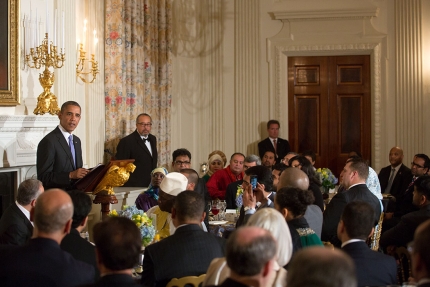
President Obama Hosts Iftar Dinner at the White House

President Barack Obama hosts an Iftar dinner celebrating Ramadan in the State Dining Room

President Barack Obama hosts an Iftar dinner celebrating Ramadan in the State Dining Room of the White House, July 25, 2013. (Official White House Photo by Lawrence Jackson)

Last Night, continuing a White House tradition, President Obama hosted his fifth Iftar dinner celebrating Ramadan. The Iftar is the meal that breaks the day of fasting during Ramadan, when Muslim families eat together after sunset. During his remarks, the President thanked the Muslim community for the sacrifices they’ve made for the United States.

Throughout our history, Islam has contributed to the character of our country, and Muslim Americans, and their good works, have helped to build our nation -- and we’ve seen the results. We’ve seen those results in generations of Muslim immigrants -- farmers and factory workers, helping to lay the railroads and build our cities. Muslim innovators who helped build some of our highest skyscrapers and who helped to unlock the secrets of our universe.

Every day, Muslim Americans are helping to shape the way that we think and the way that we work and the way that we do business. And that’s the spirit that we celebrate tonight -- the dreamers, the creators whose ideas are pioneering new industries, creating new jobs and unleashing new opportunities for all of us.

President Obama also wished Muslim Americans and Muslims all around the world a blessed Ramadan.

West Wing Week: 07/26/13 or "Becoming A More Perfect Union"

July 26, 2013 | 04:28 | Public Domain

This week, the President hosted the NCAA Champion Louisville Cardinals, the President of Vietnam, pressed for the passage of comprehensive immigration reform, and laid out his vision of growing the economy from the middle class out, while traveling to Illinois, Missouri, and Florida.

Download mp4 (177MB)

The White House

Office of the Press Secretary

President Obama Signs West Virginia Disaster Declaration

The President today declared a major disaster exists in the State of West Virginia and ordered federal aid to supplement state and local recovery efforts in the area affected by severe storms and flooding on June 13, 2013.

Federal funding is available to state and eligible local governments and certain private nonprofit organizations on a cost-sharing basis for emergency work and the repair or replacement of facilities damaged by the severe storms and flooding in the counties of Mason and Roane.

Federal funding is also available on a cost-sharing basis for hazard mitigation measures statewide.

W. Craig Fugate, Administrator, Federal Emergency Management Agency (FEMA), Department of Homeland Security, named Jack Schuback as the Federal Coordinating Officer for federal recovery operations in the affected area.

FEMA said additional designations may be made at a later date if requested by the state and warranted by the results of further damage assessments.

President Obama Hosts an Iftar Dinner

July 25, 2013 | 7:29 | Public Domain

President Obama hosts an Iftar dinner celebrating Ramadan in the State Dining Room. This is the fifth Iftar that President Obama has hosted, continuing the tradition of hosting Iftars that began annually under President Clinton and was continued by President George W. Bush. The invited guests include elected officials, religious and grassroots leaders in the Muslim American community, and leaders of diverse faiths and members of the diplomatic corps.

Download mp4 (273MB) | mp3 (18MB)

The White House

Office of the Press Secretary

Remarks by the President at Iftar Dinner

State Dining Room

8:50 P.M. EDT

THE PRESIDENT:  Thank you.  Good evening, everybody.  Please have a seat. 

Let me begin by saying welcome to all of you.  I’m so glad that all of you were able to attend.  I want to acknowledge members of the diplomatic corps; we have members of Congress here, including Keith Ellison and Andre Carson.  Where’s Andres? He’s usually not hard to miss.  (Laughter.)  There you go.  Leaders from my administration, and guests from all across our nation.  And to all of you, and to Muslim Americans all across the country and around the world -- Ramadan Kareem.

Here at the White House, we now have a tradition of celebrating the sacred days of our various faiths.  And these are occasions to reflect on the teachings that so many religions share; to celebrate the diversity that defines our country; and to reaffirm one of our most deeply held beliefs, that here in America and around the world, people should be free to choose the God that they worship however they choose, to practice their faiths freely, or to practice no faith at all.

For Muslims, Ramadan is a time of reflection, a chance to demonstrate one’s devotion to God through prayer and through fasting.  But it’s also a time for family and friends to come together -- as we do tonight -- in a spirit of love and respect, to renew our obligations to one another, as well as to renew our commitment to our neighbors and helping the most needy among us. For as the Koran teaches, whoever does an atom’s weight of good, will see its results.

Throughout our history, Islam has contributed to the character of our country, and Muslim Americans, and their good works, have helped to build our nation -- and we’ve seen the results.  We’ve seen those results in generations of Muslim immigrants -- farmers and factory workers, helping to lay the railroads and build our cities.  Muslim innovators who helped build some of our highest skyscrapers and who helped to unlock the secrets of our universe. 

Every day, Muslim Americans are helping to shape the way that we think and the way that we work and the way that we do business.  And that’s the spirit that we celebrate tonight -- the dreamers, the creators whose ideas are pioneering new industries, creating new jobs and unleashing new opportunities for all of us.

We celebrate entrepreneurs like Shazi Visram, whose parents came here from Pakistan and Tanzania to give their children a better life.  And as the founder, CEO and “Chief Mom” of Happy Family -- (laughter) -- Shazi is a leader in affordable, organic foods for children -- which makes Michelle very happy.  In just seven years, she’s grown to 58 full-time employees, 75 part-time working moms, and they’re on track to hit $100 million in revenue this year.  So no wonder she’s been called a “Rockstar of the New Economy.”  (Applause.)  

By the way, every time that they sell one of their products, they contribute to global efforts to end child hunger.  So Shazi is not only just an outstanding businesswoman, but also a leader that all of us can emulate.

We celebrate innovators like Aunim Hossain.  In one of his first ventures, he designed a hand-held device to help detect breast cancer.  Now, as the creator of Tista Games, he’s setting his sights on the video game industry.  But Aunim also has a bigger vision, and that's harnessing the talents and energy of hundreds of millions of gamers around the world to do social good.  And he imagines applying the same high-quality stories and graphics in his games to the next generation of educational material to help children learn.  So we're very appreciative for Aunim for the good work that he’s doing.

We celebrate pioneers like Dr. Iya Khalil, whose father came here from Libya to finish his education -- she grew up watching him in his lab and dreaming of being a scientist herself.  Today, she calls herself a “recovering physicist” -- and she puts her talents to work as an entrepreneur.  She co-founded her own bio-tech research company, which today employs almost 50 people and is a leader in genomic medicine -- making it possible for doctors to prescribe personalized treatment plans for patients with diseases like cancer, and giving new hope to people around the world.  So we thank Iya for her efforts.

So Shazi, Aunim, Iya, and so many of you who have traveled here tonight -- each of you have traveled your own path, but each of you have also lived out an American story.  You started with an idea -- something no one had done before.  You took a leap of faith.  And with daring and determination, you brought your dream to life.  And that’s what we Americans have been doing for more than two centuries.  That’s what we do every day -- we work a little harder; we aim a little higher; and we keep striving to create more opportunity for our children and future generations.

And of course, this isn’t just the American Dream; it’s the aspiration of people around the world.  It’s the basic human desire for progress, to find dignity that comes from work, to give our children something better.  These yearnings for economic freedom and opportunity, just as much as political freedom, are at the root of so much of the change we’ve seen around the world in the past few years -- including in North Africa and in the Middle East.  

And that’s why, even as we support citizens seeking to determine their own destiny, a key part of our engagement with Muslim communities around the world has to be supporting economic opportunity and entrepreneurship.  So we launched our annual entrepreneurship summit to spur innovation and business growth in Muslim communities.  I'm going to be attending one when I go to the ASEAN meeting in Southeast Asia later this year.  In my second term, we’re going to keep helping young entrepreneurs pursue their dreams and create opportunities, the kind of prosperity that can transform lives around the world.  

Whoever does an atom’s weight of gold [good] will see its results.  When I look around the room tonight, beyond the communities you represent, I see all the profound good that’s been accomplished.  So all of us are seeing the results of your good work -- the opportunities to create for your colleagues and your communities and for our country.  So I want to thank you for what you do, and for reminding us that our nation is stronger and more successful when we harness the talents of all Americans -- no matter where we come from, or what we look like, what our last names are, or how we pray. 

So God bless you all.  May you and your families have a blessed Ramadan.  And with that, I know people are hungry -- (laughter) -- let’s eat.  Thank you.  (Applause.)

END
8:59 P.M. EDT

President Obama Speaks on Infrastructure and the Economy

July 25, 2013 | 26:14 | Public Domain

At Jacksonville Port, President Obama lays out his vision for rebuilding an economy that grows from the middle out, not the top down, which includes creating jobs by investing in our nation's infrastructure.

Download mp4 (968MB) | mp3 (63MB)

Read the Transcript

Remarks by the President on the Economy -- Jacksonville, FL

Port Terminal Building
Jacksonville Port
Jacksonville, Florida

2:45 P.M. EDT

THE PRESIDENT:  Hello, Jacksonville!  (Applause.)  Well, it is good to be in Jacksonville.  Good to be back.  (Applause.)  How you all doing today?

AUDIENCE:  Good!

THE PRESIDENT:  You look good. 

AUDIENCE MEMBER:  Thank you!

THE PRESIDENT:  Thank you.  (Laughter.) 

I want to thank Jacksonville Port Authority Chairman, Joe York.  Give him a big round of applause.  (Applause.)  I want to thank the CEO of M.O.L. America, Tsuyoshi Yoshida.  (Applause.)  I want to thank everybody here at Jaxport for having me here today.  I brought along our new Secretary of Transportation, Anthony Foxx.  He is here.  (Applause.)  We’ve got wonderful Congresswoman Corrine Brown here.  Yay, Corrine!  (Applause.)  Mayor Alvin Brown is also in the house.  (Applause.) 

And I would like to recognize the folks from the port and TraPac for showing me the cranes you’ve got back at the terminal. Those are some big cranes.  (Laughter.)  This is some serious business here.  And just watching what was going on down here and knowing what’s possible is a reminder of all the potential that we’ve got in this country to put folks to work to rebuild America, to make sure that everybody has got a fair shot.

Yesterday, in Illinois, I talked about what we need to do as a country to build a better bargain for the middle class and everybody who’s trying to get into the middle class -- a strategy that we’ve got to pursue, together, to make sure that everybody who works hard has a chance to get ahead in this 21st century economy.  Because, for decades, a growing middle class was the engine of our prosperity; it’s what made us great.  If you worked hard, you knew your work was going to be rewarded, with fair wages, good benefits, the chance to buy a home, save for retirement, and most of all, the chance to pass down a better life to your kids.  That’s the American Dream. 

But eventually, that engine of prosperity began to stall.  You had technology that made some jobs obsolete.  You had globalization, which meant some jobs got shipped overseas.  Unions got weaker, in part because some of the laws that we passed.  And so for most of the last decade, people were working harder and harder just to get by.  And then you have a devastating recession because of what happened in the financial markets, and that cost millions of Americans their jobs, and their homes, and their savings.  And what it did was lay bare for everybody to see the steady erosion of middle-class security that had been happening for almost a generation.

Now, the good news is that after nearly five years since that financial crisis happened, thanks to the hard work and the resilience of the American people, America has fought back.  So together, we saved an auto industry.  And I was told that the terminal I was at is one of the places where we’re sending out more American cars than ever before, all around the world.  (Applause.) 

We took on a broken health care system.  We invested in new American technologies to reverse our addiction to foreign oil.  We doubled our production of clean energy.  We put in place tough new rules on the big banks, and the mortgage lenders, and credit card companies, to make sure that we didn’t have the same kinds of financial shenanigans that we had seen before.  We changed a tax code that was too skewed in favor of the wealthy, made sure it was doing more for middle-class and working-class families.  We locked in tax cuts for 98 percent of Americans, and then we asked folks at the top to pay a little bit more.

So you add all this up, and over the last 40 months, our businesses have created 7.2 million new jobs -- 7.2.  (Applause.) And this year, we’re off to our strongest private sector job growth since 1999 -- strongest job growth in over a decade. 

So today, we sell more products made in America to the rest of the world than ever before.  Our exports have surged.  We produce more natural gas than any country on Earth.  We’re about to produce more of our own oil than we buy from overseas.  That's the first time that's happened in nearly 20 years.  (Applause.)  The cost of health care is growing at its slowest rate in 50 years.  And our deficits are falling at the fastest rate in 60 years.  (Applause.)  So you've got health care costs starting to slow down, deficits plummeting -- jobs up, exports up, energy production up.

We've cleared away the rubble from the financial crisis, thanks to the grit and resilience of the American people, and we've begun to lay a new foundation for stronger, more durable more sustainable economic growth.  And with the revolutions that are coming in energy and technology and manufacturing and health care, we're poised to be able to finally reverse some of those forces that were hurting middle-class families for so long.  We can start rebuilding an economy where everybody who works hard can get ahead.  That's our goal.  (Applause.)

But I’m here to tell you today what you already know -- we’re not there yet.  In a lot of ways, those trends that have been building for decades, this winner-take-all economy where a few folks are doing better and better and better at the top, and everybody else is just treading water -- those trends have been made worse by the recession.  And reversing those trends should be Washington’s highest priority.  It’s my highest priority.

Unfortunately, over the past couple of years, in particular, Washington hasn’t just ignored the problem, a lot of times it’s made things worse.  And sometimes when you're on the outside, you look and it just sounds like a bunch of noise and you don't know what's going on between Democrats and Republicans.  And my attitude is that we're all Americans first and no party has a monopoly on good ideas.  And I think there are a number of Republicans out there who mean well, although they're not always willing to say so, because they might get in trouble.  (Laughter.)

But right now, we’ve seen a group of Republicans in the House, in particular, who suggest they wouldn’t vote to pay the very bills that Congress has already racked up.  That harmed our recovery back in 2011.  It would severely harm it again.  It could plunge us back into financial crisis. 

Over the last six months, the gridlock has gotten worse.  There are a number of Republican senators who are trying to get things done.  They passed a strong immigration bill that economists say will boost our economy by more than a trillion dollars.  But so far, we haven't been able to get the House Republicans to give it a vote.

And if you ask some of these same folks about how they would strengthen the middle class, they'll tell you, well, out-of-control government spending is the problem -- despite the fact that as a share of the economy we have cut the deficit by nearly half since I took office.  Or they’ll say Obamacare is the problem -- the problem is that we're trying to give health insurance to millions of Americans who don't have it.  (Applause.)  Now, I've got to tell you our businesses created jobs at nearly twice the pace of the last recovery, when there was no Obamacare, so it's kind of hard to figure how Obamacare is actually the problem, giving people health insurance.  And by the way, tens of millions of Americans now have new benefits like free checkups and cheaper medicine on Medicare.  So they don't think that's a problem.  (Applause.)

The point is, with an endless distraction of political posturing and phony scandals and lord knows what, Washington keeps taking its eye off the ball.  And that needs to stop.  We’ve got to stop with the short-term thinking.  We’ve got to stop with the outdated debates.  That's not what the moment requires. 

A focus on the core economic issues that matter to you, that matter to middle-class Americans, all those who are trying to get in the middle class -– that’s what this moment requires.  We’ve got to stay focused on how do we build an economy that works everybody.  That's my focus.  (Applause.)

And as Washington prepares to enter another budget battle, another budget debate, the stakes could not be higher.  At a time when we need to make investments to create jobs, and strengthen the middle class, and grow our economy -- because we’ve got competition coming from all around the world -- we’ve got some of the House Republicans who put forward a budget that does just the opposite.  They’re pushing bills that would cut education, cut science, cut research, prevent us from meeting these priorities.

We should be doubling down on American clean energy technology -- they're creating jobs, lowering dangerous carbon pollution.  But they want to protect taxpayer giveaways to big oil companies.  Let other countries win the race for the jobs of the future.  That doesn't make sense.

Instead of helping hardworking students afford the college degree that the jobs of tomorrow increasingly demand, they want to slash funding for the very grants that help students make their tuition payments. 

Instead of giving more families the security of decent health care, they want to let insurance companies reinstate lifetime dollar limits and drop millions of people from their plans.

And if we don’t make the necessary investments to ensure that America is a magnet for good jobs -- investments in education, manufacturing, research and transportation and information networks -- we’re just waving the white flag of surrender to other countries as they forge ahead in this global economy.  That kind of attitude is saying there’s nothing we can do to help middle-class families compete and win and grow.  And that's a bad bargain for the middle class.

So that’s why I came down to Jacksonville today.  I want you involved in this debate and remind Washington what’s at stake.  And over the next several weeks, in cities and towns just like this one, I’m going to lay out my ideas for how we build on the cornerstones of what it means to be middle class in America, what it takes to work your way into the middle class in America, and what we can do to help families -- not help special interests, but help families.  That's what we need.  (Applause.)

And by the way, Jacksonville, what we need isn’t a three-month plan, or even a three-year plan, we’ve got to have a long-term plan based on steady, persistent effort to reverse the forces that are conspiring against the middle-class families.  That’s what I’m pushing for.  And like I said, I think that there are Democrats and Republicans who understand what’s at stake, and I’m going to welcome ideas from anybody across the political spectrum.  But I’m not going to let gridlock or inaction or indifference to the plight of families get in the way of this country. 

So where I can act on my own, I’m going to act on my own.  I won’t wait for Congress.  (Applause.)  Because the choices we make right now will determine whether or not every American will have a fighting chance in the 21st century.

So we know what those cornerstones of middle-class security are:  A good job with good wages; a good education; a home you can call your own; affordable health care that’s there for you when you get sick; a secure retirement even if you’re not rich.  More chances for folks to earn their way into the middle class as long as they’re willing to work hard for it.

But I’m here today to specifically talk about the cornerstone, the essence of middle-class security, and that’s a good job in a growth industry.  We’ve got to help more manufacturers bring more jobs back to America.  (Applause.)  We’ve got to keep creating good jobs in manufacturing.  We’ve got to create good jobs in wind and solar energy.  We’ve got to tap into this natural gas revolution that’s bringing energy costs down in this country, which means manufacturers now want to locate here because they’re thinking that we’ve got durable, reliable supplies of energy.  We’ve got to create more jobs today doing what you’re doing right here at JAXPORT -- and that’s building this country’s future.  (Applause.) 

We need modern schools for our kids.  We need modern power grids and fuel networks that can withstand stronger storms.  And we need modern ports so we can move more goods made in America out to the rest of the world.  (Applause.)

If you want to create jobs right now, but also jobs that will have impacts for years, here’s the way to do it.  We know strong infrastructure is a key ingredient to a thriving economy. That’s how the United States became the best place in the world to do business.  Unfortunately, over the past two years, too many folks in Washington have been cutting these investments.  The world can't wait for Congress to get its act together.  So let me give you an example -- and many of you are familiar with this. 

In a couple of years, new supertankers are going to start coming through the Panama Canal.  Those supertankers can hold three times the amount of cargo.  We want those supertankers coming here to Jacksonville.  (Applause.)  If we’ve got more supertankers coming here, that means more jobs at the terminals. That means more warehouses in the surrounding area.  That means more contractors are getting jobs setting up those warehouses.  That means they’ve got more money to spend at the restaurant.  That means the waitress has more money to spend to buy her iPod. It starts working for everybody. 

If we want our workers and businesses to compete, then our ports have to be ready to receive those supertankers.  Otherwise, they’ll go to Brazil or some other place.

AUDIENCE MEMBER:  You tell them, Mr. President! 

THE PRESIDENT:  So that’s why last year I acted without Congress, and I took executive action to speed up the permitting process that gets workers breaking ground on projects like this one.  (Applause.)  And then private companies came onboard here at Jaxport.  They saw it as a good investment.  And we’re building the same kind of partnerships across the country -- especially, by the way, in some of these Gulf ports -- Charleston, Savannah.  And now, these ports are on track to be better prepared for those supertankers and their cargo loads ahead of schedule. 

But we now have got to keep at it.  The businesses of tomorrow will not locate near old roads, outdated ports -- they’re going to go to places where the ports are good, the roads are good, the rail lines are good, you’ve got high-speed Internet, you’ve got high-tech schools, trained workers, systems that move air traffic and auto traffic faster. 

Think about it in terms of your own house, right?  If you’ve got a leaky roof and you haven't done the tuckpointing, and the boiler is getting kind of old and rickety, you can say to yourself, well, I'm going to save money by not fixing my roof.  And I'm going to save money by not getting a new boiler.  And I'm not going to worry about that tuckpointing.  And then, two years later, five years down the road, what happens?  House starts breaking down.  You end up spending more money.

We can't defer things that we know we're going to have to do and, by the way, would put people to work right now doing them.  But that's what we're doing right now.  As a share of our economy, we’re investing less in rebuilding America than we did two decades ago.  We're spending less on fixing our infrastructure than China is, than Germany is.  All our competitors, they know we've got to start taking care of this stuff.  We're lagging behind. 

And the irony is right now it’s cheaper to build than it’s been since the 1950s.  You’ve got a whole bunch of construction workers who are looking for work right now.  You’ve got a whole bunch of contractors who will come in under -- with low bids, and they'll come in on time.

So now is the time for us to do it.  The longer we put this off, the more expensive it will be; the less competitive we'll be.  So why aren't we doing it?  Now, part of it's just politics right now.  But making sure we've got world-class infrastructure, that shouldn’t be a partisan issue.  That’s an American issue.  It's not a Republican or a Democratic issue. 

But this year’s budget cuts have delayed two important rapid transit projects right here in Jacksonville that would carry more people into downtown, alleviate congestion at the same time, and put more Floridians back to work. 

We can do better than that.  There’s a bipartisan bill in the Senate to fund critical improvements in our highways and our bridges, our transit and rail systems and our ports like this one.  And so the House should act quickly on that bill.  Let's get more Americans back on the job doing the work America needs done.  That will be good for middle-class families.  That will be good for middle-class security.  (Applause.)  That will be good for homeownership.  That will be good for education.  That is the smart thing to do.  Let's get past politics and do it.  (Applause.) 

I tell my Republican friends this is not a partisan issue.  The first Republican President is a guy from my home state.  He was a pretty good President, named Abraham Lincoln.  (Laughter.) He had a whole lot of things to worry about -- had a Civil War, probably the biggest crisis that this country ever experienced.  And yet, in the middle of that, he was still thinking about how do we build that Transcontinental Railroad?  How are we going to widen our canals and our ports so that we can move products all around the country and eventually the world?  How do we invest in land-grant colleges so that our workers are now skilled and can get those new jobs?  We're going to invest in the National Science Foundation to make sure that we stay ahead of everybody else when it comes to technology. 

He made those investments, the first Republican President.  He didn’t say, well, that’s not the job of government to help do that.  He wouldn’t have understood that kind of philosophy, because he understood there are some things we can only do together.  And rebuilding our infrastructure is one of them. 

Creating more good jobs, a better bargain for the middle class, helping folks who are working to join the middle class, an economy that grows from the middle out -- this isn’t what I’m going to be focusing on for the next few months; this is what I’m going to be focusing on for all the days I've got left in my presidency.  I've counted them -- there are 1,266 days left -- (applause) -- 1,266 days left.   

So over the next several weeks, we're going to roll out these plans.  We're going to take them across the country.  We're going to ask not just Congress to do something; we're going to ask everybody for their help -- CEOs, workers, college presidents, students, Democrats, independents, and, yes, Republicans. 

I'm laying out my ideas to give the middle class a better shot.  And if the Republicans don’t agree with me, I want them to lay out their ideas.  If they’ve got a better plan to create jobs to rebuild our infrastructure and make sure that we've got great ports all along the Gulf, come on, let me know what your ideas are.  I'm listening. 

If they've got better ideas to make sure every American knows the security of affordable health care, well, share it with the country.  Repealing Obamacare and slashing our budgets in education and research and infrastructure, that's not an economic plan.  There's no economist who would look at that and say, well, that's the way we're going to help middle-class families, we're really going to grow doing that.

Shutting down the government just because I’m for keeping it open, that's not an economic plan.  Threatening that you won’t pay the bills in this country when we've already racked up those bills, that's not an economic plan.  That's just being a deadbeat.  (Laughter and applause.)

So put out some plans.  I don't claim to have a monopoly on every good idea.  (Laughter.)  I don't.  I'm happy to steal good ideas from anybody, because I just want to make things work.  And it may seem hard sometimes, but if we're willing to take a few bold steps -- if Washington will just shake off its complacency and set aside just this kind of constant gridlock and “my way or the highway” attitude, then our economy will be better a year from now, just like it's better now than it was last year.  And it will be better five years from now.  And it will be better 10 years from now. 

And I'm going to spend every single minute of every day, as long as I have the privilege of this office, making sure that I'm doing everything in my power to make this economy work for working Americans again -- to build a better middle class and to make sure the American Dream is something that’s alive and real and achievable for decades to come.  (Applause.) 

That's what I'm fighting for, Florida.  That's what I need you for, Florida.  (Applause.)  Let's make it happen.  God bless you.  God bless the United States of America.  (Applause.)

END
3:09 P.M. EDT

Close Transcript

President Obama's Bilateral Meeting with President Truong Tan Sang

July 25, 2013 | 18:31 | Public Domain

President Obama and President Truong Tan Sang of Vietnam speak to the press after a bilateral meeting in the Oval Office.

Download mp4 (681MB) | mp3 (45MB)

Read the Transcript

Remarks by President Obama and President Truong Tan Sang of Vietnam after Bilateral Meeting

Oval Office

11:30 A.M. EDT

PRESIDENT OBAMA:  It is my pleasure to welcome President Truong Tan Sang to the White House and to the Oval Office for his first bilateral meeting with me.  This represents the steady progression and strengthening of the relationship between our two countries. 

Obviously, we all recognize the extraordinarily complex history between the United States and Vietnam.  Step by step, what we have been able to establish is a degree of mutual respect and trust that has allowed us now to announce a comprehensive partnership between our two countries that will allow even greater cooperation on a whole range of issues from trade and commerce to military-to-military cooperation, to multilateral work on issues like disaster relief, to scientific and educational exchanges.

What we've also discussed is the ways in which through the Trans-Pacific Partnership -- or TPP -- both the United States and Vietnam are participating in what will be an extraordinarily ambitious effort to increase trade, commerce and transparency in terms of commercial relationships throughout the Asia Pacific region.  And we're committed to the ambitious goal of completing this agreement before the end of the year because we know that this can create jobs and increase investment across the region and in both our countries. 

We discussed the need for continued efforts to resolve peacefully maritime issues that have surfaced in the South China Sea and other parts of the Asia Pacific region.  And we very much appreciate Vietnam’s commitment to working with ASEAN and the East Asia Summit in order for us to arrive at Codes of Conduct that will help to resolve these issues peacefully and fairly.

We discussed the challenges that all of us face when it comes to issues of human rights, and we emphasized how the United States continues to believe that all of us have to respect issues like freedom of expression, freedom of religion, freedom of assembly.  And we had a very candid conversation about both the progress that Vietnam is making and the challenges that remain.

We both reaffirmed the efforts that have been made to deal with war legacy issues.  We very much appreciate Vietnam's continued cooperation as we try to recover our Missing in Action and those that were lost during the course of the war.  And I reaffirmed the United States' commitment to work with Vietnam around some of the environmental and health issues that have continued, decades later, because of the war.

Finally, we agreed that one of the great sources of strength between our two countries is the Vietnamese American population that is here but obviously has continued strong ties to Vietnam. And ultimately, it's those people-to-people relations that are the glue that can strengthen the relationship between any two countries. 

So I just want to say to President Sang how much I appreciate his visit.  I think it signifies the maturing and the next stage of the development between the United States and Vietnam.  As we increase consultation, increase cooperation, increase trade, and scientific and education exchanges, ultimately, that’s going to be good for the prosperity and opportunities of the people here in the United States, as well as good for the opportunities and prosperity of the people of Vietnam. 

At the conclusion of the meeting, President Sang shared with me a copy of a letter sent by Ho Chi Minh to Harry Truman.  And we discussed the fact that Ho Chi Minh was actually inspired by the U.S. Declaration of Independence and Constitution, and the words of Thomas Jefferson.  Ho Chi Minh talks about his interest in cooperation with the United States.  And President Sang indicated that even if it's 67 years later, it's good that we're still making progress. 

Thank you very much for your visit.  And I look forward to continued work together. 

PRESIDENT SANG:  (As interpreted.)  Once again, I would like to thank you, President Obama, for your kind invitation extended to me to visit the United States as well as the warm hospitality that you have extended to me over the past couple of days while I'm here in the U.S.

To be frank, President Obama and I had a very candid, open, useful and constructive discussion.  Given the progress of our bilateral relationship over the past 18 years, it is time now to form a comprehensive partnership in order to further strengthen our relations in various areas. 

We discussed various matters, including political relations, science and technology, education, defense, the legacy of the war issue, environment, the Vietnamese-American community, human rights as well -- and the East Sea as well.

In a candid, open and constructive spirit, we have come to agree on many issues.  We will strengthen high-level exchanges between the two countries.  We will consider in order to continue our -- to upgrade the mechanism of cooperation at the high level, as well as take the best use of the existing mechanism of cooperation.  Particularly, we will continue regular dialogue at the highest level as possible.  I believe that this is the way in order to build a political trust for further development of our cooperation in all areas. 

Economic and trade relation continue to be important to our relations.  As far as TPP is concerned, the Vietnamese side will do its upmost in order to participate in the process of negotiations for the conclusion of TPP by the end of this year. 

We also discussed in detail our cooperation in science and technology, in education and training, as well as security and defense.  We also touched upon the war legacy issue, including human rights, which we still remain -- which we still have differences on the issue.

I also expressed my appreciation for the care that the U.S. has extended to the Vietnamese who came to settle in the United States and now they have become American citizens and contributing to the overall development of the U.S.  And thanks to the support and assistance from the U.S. government as well as the American people, the Vietnamese-American community here in the U.S. has become more and more prosperous and successful in their life as well as work.

And I also would like to take this opportunity to convey a message from our government to the Vietnamese-American community here in the U.S. that we would like to see you contributing more and more to the friendship between our two countries as well as further development of our relationship in the future.

We also discussed in detail the issue of the East Sea.  We appreciate and welcome the U.S. support for our stance in this matter, as well as the stance of ASEAN related to this particular matter, and we appreciate the U.S. support to solving the matter by peaceful means in accordance with international law, DOC, and moving toward COC.  We welcome the United States’ support as well as other countries’ support in the matter in order to ensure peace, stability, prosperity not only in the East Sea but also in the Asia Pacific and the world at large.

Last but not least, I also, on behalf of our government and our state, to extend to President Obama our invitation to visit Vietnam.  And President Obama has accepted our invitation and will try his best to pay a visit to Vietnam during his term.

And, once again, I would like to thank President Obama and all of the American people for their warm hospitality extended to me during this trip to the United States.  And I believe that our cooperation will continue to strengthen for the mutual interest and benefit of our people.

Thank you. 

PRESIDENT OBAMA:  Thank you very much, everybody.

END
11:50 A.M. EDT

Close Transcript