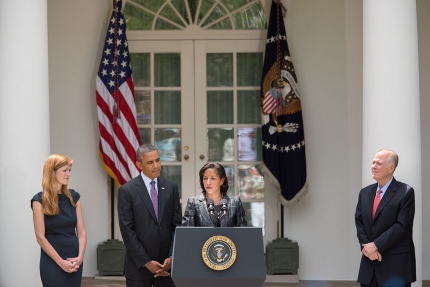
President Obama Announces New National Security Team Members

Amb. Susan Rice, U.S. Permanent Representative to the United Nations delivers remarks in the Rose Garden

Amb. Susan Rice, U.S. Permanent Representative to the United Nations delivers remarks in the Rose Garden of the White House, June 5, 2013. President Barack Obama announced that Amb. Rice will succeed National Security Advisor Tom Donilon, and Samantha Power, former Senior Director for Multilateral Affairs and Human Rights, as the nominee to succeed Rice. (Official White House Photo by Amanda Lucidon)

Speaking this afternoon from the Rose Garden, President Obama announced several changes to his national security team.

Of all the jobs in government, leading my national security team is certainly one of the most demanding, if not the most demanding. And since the moment I took office, I've counted on the exceptional experience and insights of Tom Donilon. Nearly every day for the past several years I've started each morning with Tom leading the presidential daily brief, hundreds of times, a sweeping assessment of global developments and the most pressing challenges. As my National Security Advisor his portfolio is literally the entire world. 

He has definitely advanced our strategic foreign policy initiatives while at the same time having to respond to unexpected crises, and that happens just about every day. He's overseen and coordinated our entire national security team across the government, a Herculean task. And it's non-stop -- 24/7, 365 days a year.

Today, I am wistful to announce that after more than four years of extraordinary service, Tom has decided to step aside at the beginning of July. And I am extraordinarily proud to announce my new National Security Advisor, our outstanding Ambassador to the United Nations, Susan Rice as well as my nominee to replace Susan in New York, Samantha Power. 

Related Topics: Foreign Policy, New York

The White House

Office of the Press Secretary

Remarks by the President in Personnel Announcement

Rose Garden

2:17 P.M. EDT

THE PRESIDENT:  Thank you, everybody.  (Applause.)  Thank you.  Please, everybody have a seat.  Well, good afternoon.  It is a beautiful day, and it's good to see so many friends here. 

Of all the jobs in government, leading my national security team is certainly one of the most demanding, if not the most demanding.  And since the moment I took office, I've counted on the exceptional experience and insights of Tom Donilon.  Nearly every day for the past several years I've started each morning with Tom leading the presidential daily brief, hundreds of times, a sweeping assessment of global developments and the most pressing challenges.  As my National Security Advisor his portfolio is literally the entire world. 

He has definitely advanced our strategic foreign policy initiatives while at the same time having to respond to unexpected crises, and that happens just about every day.  He's overseen and coordinated our entire national security team across the government, a Herculean task.  And it's non-stop -- 24/7, 365 days a year.

Today, I am wistful to announce that after more than four years of extraordinary service, Tom has decided to step aside at the beginning of July.  And I am extraordinarily proud to announce my new National Security Advisor, our outstanding Ambassador to the United Nations, Susan Rice -- (applause) -- as well as my nominee to replace Susan in New York, Samantha Power.  (Applause.) 

When I first asked Tom to join my team, I knew I was getting one of our nation's premier foreign policy leaders, somebody with a deep sense of history and a keen understanding of our nation's place in the world.  He shared my view that in order to renew American leadership for the 21st century, we had to fundamentally rebalance our foreign policy.  And more than that, he knew how we could do it.

See, Tom is that rare combination of the strategic and the tactical.  He has a strategic sense of where we need to go, and he has a tactical sense of how to get there.

Moreover, Tom’s work ethic is legendary.  He began his public service in the Carter White House when he was just 22 years old -- and, somehow, he has been able to maintain the same drive, and the same stamina, and the same enthusiasm and reverence for serving in government.  He has helped shape every single national security policy of my presidency -- from forging a new national security strategy rooted in our economic strength here at home to ending the war in Iraq.  Here at the White House, Tom oversaw the operation that led us to bin Laden.  He’s helped keep our transition on track as we wind down the war in Afghanistan.

At the same time, Tom has played a critical role as we’ve bolstered the enduring pillars of American power -- strengthening our alliances, from Europe to Asia; enhancing our relationship with key powers; and moving ahead with new trade agreements and energy partnerships.  And from our tough sanctions on Iran to our unprecedented military and intelligence cooperation with Israel -- (baby cries) -- it’s true --  (laughter) -- from New START with Russia to deeper partnerships with emerging powers like India, to stronger ties with the Gulf states, Tom has been instrumental every step of the way.

I’m especially appreciative to Tom for helping us renew American leadership in the Asia Pacific, where so much of our future security and prosperity will be shaped.  He has worked tirelessly to forge a constructive relationship with China that advances our interests and our values.  And I’m grateful that Tom will be joining me as I meet with President Xi of China this week.

And finally, Tom, I am personally grateful for your advice, for your counsel, and most of all for your friendship.  Whenever we sit down together -- whether it’s in the Oval Office or the Situation Room -- I do so knowing that you have led a rigorous process:  that you’ve challenged assumptions, that you’ve asked the tough questions, that you’ve led an incredibly hard-working national security staff, and presented me with a range of options to advance our national interests.  A President can’t ask for anything more than that, and this is a testament to your incredible professionalism, but also your deep love of country.

I know that this relentless pace has meant sacrifices for your family -- for Cathy, who is here, Dr. Biden’s former Chief of Staff, who I was proud to nominate as our new Global Ambassador for Women; and for Tom and Cathy’s wonderful children, Sarah and Teddy.  So today, I want to publicly thank all the Donilons for their abiding commitment to public service that runs through the family.  (Applause.)

You’ve been with me every step of the way these past four years, and the American people owe you an enormous debt of gratitude for everything that you’ve done.  You’ve helped to restore our nation’s prestige and standing in the world.  You’ve positioned us well to continue to lead in the years ahead.  I think that Tom Donilon has been one of the most effective national security advisors our country has ever had, and he’s done so without a lot of fanfare and a lot of fuss.  So, Tom, on behalf of us all, thank you for your extraordinary service.  (Applause.)

Now, I am proud that this work will be carried on by another exemplary public servant -- Ambassador Susan Rice.  (Applause.)  Susan was a trusted advisor during my first campaign for President.  She helped to build my foreign policy team and lead our diplomacy at the United Nations in my first term.  I’m absolutely thrilled that she’ll be back at my side, leading my national security team in my second term.

With her background as a scholar, Susan understands that there is no substitute for American leadership.  She is at once passionate and pragmatic.  I think everybody understands Susan is a fierce champion for justice and human dignity, but she’s also mindful that we have to exercise our power wisely and deliberately.

Having served on the National Security Council staff herself, she knows how to bring people together around a common policy and then push it through to completion -- so that we’re making a difference where it matters most, here in the country that we have pledged to defend, and in the daily lives of the people we’re trying to help around the world.

Having served as an Assistant Secretary of State, she knows our policies are stronger when we harness the views and talents of people across government.  So Susan is the consummate public servant -- a patriot who puts her country first.  She is fearless; she is tough.  She has a great tennis game and a pretty good basketball game.  (Laughter.)  Her brother is here, who I play with occasionally, and it runs in the family -- throwing the occasional elbow -- (laughter) -- but hitting the big shot. 

As our Ambassador to the U.N., Susan has been a tireless advocate in advancing our interests.  She has reinvigorated American diplomacy, in New York.  She has helped to put in place tough sanctions on Iran and North Korea.  She has defended Israel.  She has stood up for innocent civilians, from Libya to Cote d’Ivoire.  She has supported an independent South Sudan.  She has raised her voice for human rights, including women’s rights. 

Put simply, Susan exemplifies the finest tradition of American diplomacy and leadership.  So thank you, Susan, for being willing to take on this next assignment.  I'm absolutely confident that you're going to hit the ground running.  And I know that after years of commuting to New York while Ian, Jake and Maris stayed here in Washington, you will be the first person ever in this job who will see their family more by taking the National Security Advisor's job.  (Applause.) 

Now, normally I'd be worried about losing such an extraordinary person up at the United Nations and be trying to figure out how are we ever going to replace her.  But fortunately, I'm confident we've got an experienced, effective and energetic U.N. ambassador-in-waiting in Samantha Power.

Samantha first came to work for me in 2005, shortly after I became a United States senator, as one of our country's leading journalists; I think she won the Pulitzer Prize at the age of 15 or 16.  One of our foremost thinkers on foreign policy, she showed us that the international community has a moral responsibility and a profound interest in resolving conflicts and defending human dignity.

As a senior member of my national security team, she has been a relentless advocate for American interests and values, building partnerships on behalf of democracy and human rights, fighting the scourge of anti-Semitism and combatting human trafficking.  To those who care deeply about America’s engagement and indispensable leadership in the world, you will find no stronger advocate for that cause than Samantha.

And over the last four years, Samantha has worked hand-in-glove with Susan in her role because Samantha has been the lead White House staffer on issues related to the United Nations.  And I'm fully confident she will be ready on day one to lead our mission in New York while continuing to be an indispensable member of my national security team. 

She knows the U.N.'s strengths.  She knows its weaknesses.  She knows that American interests are advanced when we can rally the world to our side.  And she knows that we have to stand up for the things that we believe in.  And to ensure that we have the principled leadership we need at the United Nations, I would strongly urge the Senate to confirm her without delay.

So, Samantha, thank you.  To Cass, and you, and Declan and Rian for continuing to serve our country. 

This team of people has been extraordinarily dedicated to America.  They have made America safer.  They have made America's values live in corners of the world that are crying out for our support and our leadership.  I could not be prouder of these three individuals -- not only their intelligence, not only their savvy, but their integrity and their heart. 

And I'm very, very proud to have had the privilege of working with Tom.  I'm very proud that I'll continue to have the privilege of working with Samantha and with Susan. 

So with that, I'd invite Tom to say a few words.  Tom.  (Applause.) 

MR. DONILON:  Thank you, Mr. President.  You mentioned the many hours that we’ve worked together in the Situation Room, put together here by John Kennedy and without windows.

THE PRESIDENT:  No windows.

MR. DONILON:  No windows.  So I would first like to thank you for this rare opportunity to be outside and experience the natural light.  (Laughter.) 

You also mentioned how I began my public service here under President Carter in 1977 when I was 22 years old.  And I still remember leaving at the end of the day, walking up West Executive Drive, past the office of then-National Security Advisor Zbigniew Brzezinski, and looking up at the windows of the White House -- the light is always on in Zbig’s office, no matter how late.  And I’d think to myself, don’t those guys ever go home?  And now, these many years later, I finally have the answer -- no, they don’t go home very much, at least not as often or as early as their spouses and families would like.

Mr. President, to serve in this capacity where we’ve had the opportunity to protect and defend the United States, to improve the position of the United States in the world, has been the privilege of a lifetime.  To serve during your presidency, however, is to serve during one of the defining moments in our nation’s history.  This is because of your vision, your principled leadership, your commitment to defending our interests and upholding our ideals.

Those many hours of meetings and briefings have given me the opportunity to see you as few people do:  behind closed doors, away from the cameras, when a leader’s character is revealed.  And with your permission, I’d like to take this opportunity to share a little bit of what I’ve seen.

First, I’ve seen you make the most difficult decisions a Commander-in-Chief can make -- the decision to send our men and women in uniform into harm’s way.  I’ve seen the great care with which you have weighed these grave decisions and I’ve seen your devotion to the families of our men and women in uniform.

I have seen your fierce patriotism, your love of our country.  When confronted with competing agendas and interests, you always bring the discussion back to one question:  What’s in the national interest, what’s best for America?  I’ve seen your abiding commitment to the core values that define us as Americans, our Constitution, civil liberties, the rule of law.  Time and time again, you have reminded us that our decisions must stand up to the judgment of history.

Finally, Mr. President, I’ve seen you represent the United States around the world and what you mean to the people around the world when you represent our country.  When you step off that plane with the words, “United States of America”, when you reach out to foreign audiences and speak to the basic aspirations we share as human beings, you send a clear message that America wants to be their partner.  And that ability to connect, to forge new bonds, is a form of American power and influence that advocates our interests and ideals as well.

To Vice President Biden and Jill, Cathy and I have considered you dear friends for more than 30 years, and it has been an honor to make this journey with you.

To my colleagues and friends here at the White House and across the government, the American people will never truly know how hard you work in their defense.

To my long-time partners in the senior leadership of the National Security Council -- Denis McDonough, John Brennan, Tony Blinken, Lisa Monaco, Mike Froman, Ben Rhodes, and Brian McKeon.  I could not have asked for better brothers or sisters in this effort. 

To you and all our remarkable national security staff, you're a national treasure.  And every day you get up, you come here -- you devote your days to keeping our country secure.  You are the best our nation has to offer, and it's been an honor and a privilege to serve with each and every one of you.  And I'm glad so many of you are here today.  (Applause.)

And to my friends and colleagues -- Susan and Sam -- congratulations, the nation is fortunate to have leaders of your intellect, compassion, character, and determination.  Susan, you'll be an outstanding National Security Advisor.  Sam, you'll be an outstanding Ambassador to the United Nations.  And we really appreciate your willingness to do this.  (Applause.)

Finally, and most importantly, to Cathy, Sarah and Teddy -- as the President said, this job has meant great sacrifices for you.  And each of you in your way has made a contribution to the country.  And I could not be more grateful.

So again, Mr. President, thank you for the opportunity -- the extraordinary opportunity to serve you and to serve our nation.  I stand here -- 36 years ago, almost to the day when I first came on the 18 acres of the White House to come to work, and I must tell you I leave this position much less cynical and never more optimistic about our country and its future.  Thank you very much, Mr. President.  (Applause.)

Susan.

AMBASSADOR RICE:  Mr. President, thank you so much.  I'm deeply honored and humbled to serve our country as your National Security Advisor.  I'm proud to have worked so closely with you for more than six years.  And I'm deeply grateful for your enduring confidence in me.

As you've outlined, we have vital opportunities to seize and ongoing challenges to confront.  We have much still to accomplish on behalf of the American people.  And I look forward to continuing to serve on your national security team to keep our nation strong and safe. 

Tom, it's been a real honor to work with you again.  You have led with great dedication, smarts, and skill, and you leave a legacy of enormous accomplishment.  All of us around the principals’ table will miss you.  And I wish you and Cathy, and your family, all the very best. 

Above all, I want to thank my own wonderful family for their unfailing support -- my mother, Lois; my wonderful husband, Ian; our children Jake and Maris; and my brother, John, have all been my strength and my greatest source of humor.  I'm also thinking today about my late father, who would have loved to be here.  I'm forever grateful to my family for their love and sacrifice. 

I want to thank my remarkable colleagues at the U.S. Mission to the United Nations.  I am so proud of the work we've done together under your leadership, Mr. President, to advance America's interests at the United Nations. 

And, Samantha, my friend -- warmest congratulations.  You're a tremendous colleague, and the United States will be extremely well served by your leadership at the United Nations.  And I'm so glad we get to continue to work together.

Mr. President, having participated in the national security decision-making process over the last four years, I admire the exemplary work done every day by our colleagues at State, Defense, the intelligence community, and across the government to make our nation more secure.  I look forward to working closely with you, your extraordinary national security team, our country's most experienced leaders from both parties, and your superb national security staff to protect the United States, advance our global leadership, and promote the values Americans hold dear.

Thank you very much. 

Sam.  (Applause.) 

MS. POWER:  Thank you, Mr. President.  From the day I met you and you told me that you had spent a chunk of your vacation reading a long, dark book on genocide -- (laughter) -- I knew you were a different kind of leader, and I knew I wanted to work for you.

It has been my privilege here at the White House to serve you, and it would be the honor of a lifetime to fight for American values and interests at the United Nations.  Now that I have two small children, Declan and Rian -- somewhere -- the stakes feel even higher. 

Thank you, Tom and Susan.  I consider myself immensely fortunate these last four years to have collaborated with both of you.  There are two no more dedicated professionals on this Earth, no more strategic stewards of our foreign policy than these two individuals.  And I'm honored and immensely humbled to share the stage with you. 

I moved to the United States from Ireland when I -- with my parents, who are here -- when I was 9 years old.  I remember very little about landing in Pittsburgh, except that I was sure I was at the largest airport in the history of the world.  I do remember what I was wearing -- a red, white and blue stars and stripes t-shirt.  It was the t-shirt I always wore in Ireland on special occasions. 

Even as a little girl with a thick Dublin accent who had never been to America, I knew that the American flag was the symbol of fortune and of freedom.  But I quickly came to learn that to find opportunity in this country, one didn’t actually need to wear the flag, one just needed to try to live up to it.

For the next three months, I came home from school every day, as my mother can attest, my dad can attest, and I sat in front of the mirrors for hours, straining to drop my brogue so that I, too, could quickly speak and be American. 

Not long ago, my husband, Cass Sunstein, came across a letter written toward the end of World War II by his father, Dick Sunstein, who was a Navy lieutenant.  Dick had happened to stop briefly in San Francisco after his two years fighting for this country in the Pacific, and he wrote to his family on April 25th, 1945, the very day that the nations of the world were coming together in San Francisco to establish the new United Nations. 

And in this letter to my mother-in-law, who I never had the chance to meet, he wrote, excitedly, “Conference starts today.  The town is going wild with excitement.  It is a pleasure to be here for the opening few days.  Let’s pray that they accomplish something.” 

Let’s pray that they accomplish something.  The question of what the United Nations can accomplish for the world and for the United States remains a pressing one.  I have seen U.N. aid workers enduring shellfire to deliver food to the people of Sudan.  Yet I’ve also see U.N. peacekeepers fail to protect the people of Bosnia.  As the most powerful and inspiring country on this Earth, we have a critical role to play in insisting that the institution meet the necessities of our time.  It can do so only with American leadership.

It would be an incomparable privilege to earn the support of the Senate and to play a role in this essential effort, one on which our common security and common humanity depend.  Thank you.  (Applause.)

THE PRESIDENT:  Thank you, everybody.  (Applause.)

END
2:41 P.M. EDT

The White House

Office of the Press Secretary

Statement by the Press Secretary on the Presidential Determination Pursuant to Section 1245(d)(4)(B) and (C) of the National Defense Authorization Act for Fiscal Year 2012

Today the President made the determination required under section 1245(d)(4)(B) and (C) of the National Defense Authorization Act for Fiscal Year 2012 regarding the supply of petroleum and petroleum products from countries other than Iran.

The analysis contained in the Energy Information Administration’s report of April 25, 2013, indicates that global oil consumption has exceeded production in recent months.  The international response to concerns about Iran’s nuclear activities has increased demand for non-Iranian crude.  However, rising production from other countries, greater spare production capacity, economic developments, and smaller inventory draws in March and April 2013 indicate a looser international crude market. 

There currently appears to be sufficient supply of non-Iranian oil to permit foreign countries to significantly reduce their purchases of Iranian oil, taking into account current estimates of demand, increased production by countries other than Iran, inventories of crude oil and petroleum products, and available spare production capacity.  In this context, it is notable that many purchasers of Iranian crude oil have reduced or ceased altogether their purchases from Iran.

The White House

Office of the Press Secretary

Presidential Memorandum -- Presidential Determination Pursuant to Section 1245(d)(4)(B) and (C) of the National Defense Authorization Act for Fiscal Year 2012

Presidential Determination

No. 2013-10

MEMORANDUM FOR THE SECRETARY OF STATE
THE SECRETARY OF THE TREASURY
THE SECRETARY OF ENERGY

SUBJECT: Presidential Determination Pursuant to Section 1245(d)(4)(B) and (C) of the National Defense Authorization Act for Fiscal Year 2012

By the authority vested in me as President by the Constitution and the laws of the United States, after carefully considering the report submitted to the Congress by the Energy Information Administration on April 25, 2013, and other relevant factors, including global economic conditions, increased oil production by certain countries, and the level of spare capacity, I determine, pursuant to section 1245(d)(4)(B) and (C) of the National Defense Authorization Act for Fiscal Year 2012, Public Law 112-81, and consistent with my determinations of March 30, 2012, June 11, 2012, and December 7, 2012, that there is a sufficient supply of petroleum and petroleum products from countries other than Iran to permit a significant reduction in the volume of petroleum and petroleum products purchased from Iran by or through foreign financial institutions.

I will closely monitor this situation to ensure that the market can continue to accommodate a reduction in purchases of petroleum and petroleum products from Iran.

The Secretary of State is authorized and directed to publish this memorandum in the Federal Register.

BARACK OBAMA

The Super Bowl Champion Baltimore Ravens Visit the White House

Today, President Obama welcomed the Baltimore Ravens to the White House to congratulate the team on its Super Bowl win earlier this year.

“I imagine there were times last year when these players were the only ones who knew that they’d make it here to show off this trophy,” President Obama said. Because, during the year, they lost player after player to injury; they dropped four of their last five regular season games. In the playoffs, they trailed Denver by a touchdown with 70 yards and less than a minute to go.” 

And during the Super Bowl, he said, “just when it looked like they had the momentum, the lights went out for a half hour. But these Ravens always pulled through.”

Related Topics: Inside the White House

The White House

Office of the Press Secretary

Remarks by the President Congratulating the Super Bowl Champion Baltimore Ravens

South Lawn

12:11 P.M. EDT

THE PRESIDENT:  Hello, everybody!  Welcome to the White House.  (Applause.)  And welcome to the Super Bowl Champion -- world champion -- Baltimore Ravens.  (Applause.)  Everybody can have a seat.  That’s why we set up chairs.  (Laughter.)

Now, I suspect that these guys are wondering, what kind of introduction is that?  No smoke machine.  (Laughter.)  No fire cannons.  Obama didn’t even tear up chunks of turf and rub them on his suit.  (Laughter.)  That reminds me, by the way -- please don’t do that on the South Lawn.  (Laughter.) 

I want to congratulate Coach John Harbaugh, an outstanding coach; and general manager, Ozzie Newsome, outstanding general manager.  (Applause.)  I know there’s some very proud Ravens fans in the house today, including -- you got the entire delegation from Maryland here, and they’re a little puffed up.

I notice, though, I’m the only one wearing purple.  (Laughter.)  Some of you guys didn’t get the memo. 

Now, I imagine there were times last year when these players were the only ones who knew that they’d make it here to show off this trophy.  Because, during the year, they lost player after player to injury; they dropped four of their last five regular season games.  In the playoffs, they trailed Denver by a touchdown with 70 yards and less than a minute to go.  And I still don’t know how -- well -- (laughter).  And then, in the Super Bowl, just when it looked like they had the momentum, the lights went out for a half hour.  (Laughter.) 

But these Ravens always pulled through.  In that playoff game against the Broncos, Jacoby Jones -- (applause) -- those are all fans of “Dancing with the Stars” -- (laughter) -- he slipped behind the defense to catch a Joe Flacco Hail Mary to force overtime.  I’m trying to figure out whether he was doing the Two-Step or the Fox Trot.  But somehow he got open and Joe got him the ball.

And then in the Super Bowl, after the lights came back on and the 49ers came storming back, this team’s defense -- the pride and joy of Baltimore -- stopped a fierce offense four straight times inside the 10-yard line.  One of the most dramatic goal-line stands in Super Bowl history.  (Applause.)

Joe was named the game’s MVP.  Where’s Joe?  There he is.  (Applause.)  Good timing with that contract up.  (Laughter.)  That was some good timing.  (Laughter.)  Capped off one of the greatest post-seasons ever by a quarterback -- more than 11,000 passing yards, 11 touchdowns, no interceptions.  I don't know about you, Joe, but I would say that qualifies as [elite].  (Laughter.)  And I’d say that if you keep on playing like that, you’re going to challenge Biden for the most popular person from Delaware.  (Laughter.)

After the Super Bowl, Joe said, “The win was representative and symbolic of our city.  We’re a blue-collar city, and I know that we had to keep grinding it out.”

You see that same attitude, great pride but humility in Coach Harbaugh, a guy who responds to all the attention he got for coaching against his brother in the Super Bowl by saying, “This isn’t exactly Churchill and Roosevelt, just a couple of football coaches coming together.”

You see that grit in team advisor O.J. Brigance, a former Raven whose courageous fight against ALS is an inspiration to Americans all across the country.  (Applause.)

You see the resilience in players like Torrey Smith -- (applause) -- who lost his younger brother in a motorcycle accident the night before the game against the Patriots, but Torrey wanted to play, and he responded with 127 yards and two scores, so we’re so proud of Torrey.  (Applause.)

And then, of course, you can't think about Baltimore without thinking of Ray Lewis and Ed Reed -- (applause) -- two of the greatest defenders who ever played the game.  Now, these two won’t be wearing purple next year.  Everybody is going to have to get used to that.  It’s welcome news for quarterbacks. 

Ray retired on top, coming back from a triceps injury, which I believe was caused by that dance he does.  (Laughter.)

TEAMMATE:  You got to do that --

THE PRESIDENT:  But -- no, I’m not doing that dance.  (Laughter.)  It caused him to miss most of the regular season.

Ed sprained ligaments in both of his knees during the Super Bowl, but he still made the game’s only interception.  And before he left Houston, where he’ll be playing next year, Ed took out a full-page ad in the Baltimore Sun to thank Ravens fans, saying, “I have such deep love for all of you.”  (Applause.)  So that's a class act.  Thank you. 

I will point out, by the way, that Ed is getting some gray hair, though.  (Laughter.)  I’m not the only one.  (Laughter.)  Huh?  You’re like an old man.  (Laughter.) 

MR. REED:  You know what they’ll do to you. 

THE PRESIDENT:  I’m telling you.  That makes me feel better.  (Laughter.)  I thought I was the only guy.  No.  All right. 

But that's the spirit of the entire team.  Last year, this team donated more than $1 million to charitable causes.  They helped young people get active through the Play 60 campaign.  Over Thanksgiving, they Skyped with a Maryland National Guard unit stationed in Afghanistan.  Later this month, Coach Harbaugh will host a youth football clinic that emphasizes player safety and proper tackling technique. 

And today, I’m proud to announce that the Ravens will be donating brand new uniforms for varsity football and girls’ basketball teams at public schools all across Baltimore -- that’s a total of 42 teams.  (Applause.)  We’re glad to have some high school athletes from Baltimore here to celebrate with us here today.

So this year, Baltimore won’t just be seeing the Ravens on Sundays or Monday night or Thursday night.  You’ll see their impact in high schools under Friday night lights.  And that’s a testimony to the connection they feel to this city. 

You’ll see players spending their Tuesdays -- normally their only day off during the season -- visiting hospitals and schools and senior centers, and day after day, you’ll see a team that loves Baltimore as much as Baltimore loves the Ravens.  So I want to thank all of you for the good work that you’re doing. 

Congratulations again on your Super Bowl Championship.  Best of luck next season -- you’re going to need it in week 11 when you go to my hometown of Chicago to play the Bears.  (Applause.)  I brought some Chicago fans in here.  (Applause.)  Just so we weren’t overwhelmed -- (laughter) -- and keep things in proper perspective.  But with that, I would like to have Ozzie Newsome and Coach Harbaugh come up and just say a few words, and then I’m going to get my spiffy jersey.  (Laughter and applause.)

END
12:20 P.M. EDT

The White House

Office of the Press Secretary

Statement by the Press Secretary on the President’s Speech in Berlin

During his visit to Berlin, Germany, on June 19, at the invitation of Chancellor Merkel, President Obama will speak at the Brandenburg Gate. President Obama will speak about the deep and enduring bonds between the United States and Germany, the vital importance of the transatlantic alliance, and the values that bind us together. The President looks forward to meeting with Chancellor Merkel, and speaking directly to the German people. Further details will be provided at a later date.

The White House

Office of the Press Secretary

President Obama Announces More Key Administration Posts

WASHINGTON, DC – Today, President Barack Obama announced his intent to appoint the following individuals to key Administration posts:

  • Kenny Alameda – United States Commissioner, Commission for the Conservation and Management of Highly Migratory Fish Stocks in the Western and Central Pacific Ocean

  • Joye Frost – Director of the Office for Victims of Crime, Department of Justice

  • Marlene Sallo - Staff Director, United States Commission on Civil Rights

  • Robert Wolf – Member, President’s Export Council

  • Steve Bennett – Member, President’s National Security Telecommunications Advisory Committee

  • Angel Ruiz – Member, President’s National Security Telecommunications Advisory Committee

President Obama said, “I am grateful that these talented and dedicated individuals have agreed to take on these important roles and devote their talents to serving the American people.  I look forward to working with them in the coming months and years.”

President Obama announced his intent to appoint the following individuals to key Administration posts:

Kenny Alameda, Appointee for United States Commissioner, Commission for the Conservation and Management of Highly Migratory Fish Stocks in the Western and Central Pacific Ocean
Kenny Alameda is the President and Owner of Clipper Oil Company, a position he has held since 1984.  He was also the President of Cape Fisheries Holdings from 2001 to 2002.  He served as the General Manager of Tuna Clipper Marine from 1980 to 1992.  Mr. Alameda was Vice President and Partner at Morris Whaley, Inc. from 1980 to 1990, Vice President at Bumble Bee Seafoods from 1978 to 1980, and Vice President for Tuna Procurement at Sun Harbor Industries from 1977 to 1978.  He was a Manager at Van Camp Seafood Company from 1975 to 1977 and Assistant Fleet Manager at Westgate California Foods from 1971 to 1975.  Mr. Alameda has served on several boards, including Industry Advisor to the Inter-American Tropical Tuna Commission, Director of Pacific Tuna Development Foundation, and Director of the American Tuna Research Foundation.  He was a member of the Board of Directors of the United States Tuna Foundation and an Industry Delegate to the United States State Department for Indonesian/United States Tuna Development Project.  Mr. Alameda received his B.S. from San Diego State University.

Joye Frost, Appointee for Director of the Office for Victims of Crime, Department of Justice

Joye Frost is the Deputy Director of the Office for Victims of Crime (OVC) in the Office of Justice Programs at the Department of Justice.  She has been performing the duties of the OVC Director since January 2009.  Ms. Frost has worked at OVC since 1997, previously holding the titles of Principal Associate Director and Program Specialist.  From 1995 to 1997, she was a Social Work Associate for the Department of Veterans Affairs.  Prior to this, she worked at U.S. Army headquarters in Heidelberg, Germany as a Manager for the Family Support Branch from 1990 to 1993, and from 1988 to 1989, she worked at the Army Community Service Center in Mainz, Germany as a Family Services Coordinator.  She received a B.A. from the University of Texas at Austin and an M.S. from the University of Mary Hardin-Baylor. 

Marlene Sallo, Appointee for Staff Director, United States Commission on Civil Rights
Marlene Sallo is currently Special Assistant at the United States Commission on Civil Rights, a position she has held since 2011.  Previously, Ms. Sallo worked at the National Council of La Raza as a Juvenile Justice Policy Fellow from 2010 to 2011.  From 2008 to 2010, Ms. Sallo was an attorney and trainer at the Children’s Law Center with the University of South Carolina School of Law.  From 2007 to 2008, Ms. Sallo worked as an attorney on the Education Team for Disabilities Rights Florida.  Prior to that, she was a trial attorney at Harbsmeier & DeZayas, L.L.P. from 2006 to 2007 and a senior trial attorney at the Florida Department of Children & Families from 2005 to 2006.  She is a Commissioner with the American Bar Association (ABA) Commission for Youth at Risk and a web editor for the ABA Children's Rights Litigation Committee.  Ms. Sallo received a B.A. from Manhattanville College and a J.D. from Florida State University College of Law.

Robert Wolf, Appointee for Member, President’s Export Council
Robert Wolf is CEO of 32 Advisors, a consulting and advisory firm he founded in 2012.  Previously, he was Chairman of UBS Americas and President of UBS Investment Bank.  Prior to becoming Chairman, he held a number of positions since 1994, including Group Regional CEO, COO of UBS Investment Bank, Global Head of Fixed Income, and Chair of the firm’s Diversity Committee.  From 1985 to 1994, he was Vice President at Salomon Brothers.  He served on the President’s Council on Jobs and Competitiveness from 2011 to 2013, the President's Economic Recovery Advisory Board from 2009 to 2011, and the Homeland Security Advisory Council’s Border Infrastructure Task Force in 2012.  He serves on the Undergraduate Executive Board of the Wharton School, and on the boards of the Robert F. Kennedy Center for Justice & Human Rights and the Partnership for NYC.  He is also a member of the Council on Foreign Relations, and from 2007 to 2010, was on the Board of Directors of the Financial Services Roundtable.  Mr. Wolf received a B.S. in Economics from the Wharton School at the University of Pennsylvania.

Steve Bennett, Appointee for Member, President’s National Security Telecommunications Advisory Committee
Steve Bennett is President and CEO of Symantec, a global software company that offers information security, storage and systems management products.  From 2010 to 2013, he served on Symantec’s Board of Directors, serving as Chairman from 2011 to 2013.  From 2000 to 2007, he was President and CEO of Intuit, a software company that provides products and services to support small business operations.  Mr. Bennett joined Intuit after a 23-year career at General Electric, where he held management roles in various segments within the company, including GE Capital e-Business, GE Capital Vendor Financial Services, and GE Electrical Distribution and Control.  He currently serves on the boards of American Airlines and AMR Corporation, the American Airlines parent company.  Mr. Bennett received a B.S. from the University of Wisconsin.

Angel Ruiz, Appointee for Member, President’s National Security Telecommunications Advisory Committee
Angel Ruiz is Head of Region North America at Ericsson, a global telecommunications equipment and services provider.  Mr. Ruiz first joined Ericsson in 1990 and has held a number of sales and managerial positions, including Executive Vice President and General Manager for Cingular Key Account and Vice President and General Manager for Ericsson’s BellSouth (now AT&T) Key Account.  Prior to joining Ericsson, Mr. Ruiz was the Senior Product Manager at Alcatel from 1988 to 1990, the Supervision Engineer and Senior Project Manager for Network Planning at Sprint from 1984 to 1988, the Engineering Supervisor for Non-switched Fixed Network, Special Services for AT&T from 1983 to 1984, and the Engineering Supervisor for Special Services for Bell Atlantic from 1980 to 1983.  Mr. Ruiz received a B.S. from the University of Central Florida and an M.A. from John Hopkins University.

The White House

Office of the Press Secretary

Background Conference Call by Senior Administration Officials on the President's Meetings with President Xi Jinping of China

Via Telephone

4:18 P.M. EDT

SENIOR ADMINISTRATION OFFICIAL:  Thanks, everybody, for joining this call.  We wanted to preview the President’s upcoming meeting with President Xi of China.  Just to reiterate ground rules, we’re going to do this on background.  We can do it as White House officials. 

I’ll just open by making a few comments and then turn it over here to my colleague, and then we’ll take your questions. 

First of all, just to go through the planned schedule as well as the overarching purposes of the meeting, the President will be meeting with President Xi in California.  This is at a site, Sunnylands, that has been used dating back to President Eisenhower for presidential meetings, and it provides a really perfect venue for the type of discussions that we’d like to have with the Chinese President, which I’ll reference in a minute here.

But the meetings will begin on Friday afternoon, we anticipate around 4:00 p.m.  There will be -- this will begin with a bilateral meeting between the two Presidents.  We anticipate the two of them being able to make statements at the beginning of that meeting and take a couple of questions at the end of that meeting.  So they’ll have an extensive bilateral meeting that afternoon for several hours.

Then after the bilateral meeting, the two leaders will have a private dinner.  And then, the next day, Saturday morning, they’ll continue their discussions with some informal meeting in the morning followed by a bilateral meeting between the two leaders to conclude midday Saturday.

Just stepping back, we felt that this is an important opportunity for President Obama and President Xi to meet early in President Obama’s second term and shortly after President Xi took office in China.  We have a very broad agenda that we cover with the Chinese that touches upon issues that are directly relevant to the lives and interests of the American people -- from our efforts to promote economic growth around the world to some of the leading security challenges that we face like the situation in North Korea, to the ongoing necessity of cybersecurity, which is so important to U.S. businesses and security.

Early in the term of both Presidents, we felt that having this type of wide-ranging, informal setting for discussions between the two leaders would allow them to cover the broadest possible agenda, but also to forge a working relationship that we will be relying on very much in the years to come, given the fact that the U.S.-China relationship is as important as any bilateral relationship for shaping the trajectory of the global economy and global security in the 21st century.

With that, I'll turn it over to my colleague here to get a little bit more in depth about the goals for the meeting and the agenda. 

SENIOR ADMINISTRATION OFFICIAL:  Thanks very much and thanks to all of you for joining this call.  I'd start with a word of context to put this meeting in perspective.  President Obama has led a four-and-a-half year effort to rebalance our approach to the Asia Pacific region.  And a big part of that has been to work to shape the region and to influence China's behavior and China's emergence as a major actor in a positive way.  One line of effort has been for the President to strengthen America's alliances in the Asia Pacific, and another is the work that he has done to build and develop institutions.

But a big part of the rebalancing strategy has been to ensure high-level and direct communications with leaders, and particularly with the Chinese leadership.  I think the Chinese system is one that puts a premium on direct dialogue with leaders.  And President Xi Jinping, as my colleague pointed out, is at the very beginning of his probable tenure. 

Now, President Obama had invested in an effort to get to know him when Xi was the Vice President of China, partly through the good efforts from Vice President Biden who traveled there -- he visited then-Vice President Xi Jinping last year in February -- also through an extended meeting that President Obama had with the then-Vice President in the Oval Office, but also through the recent conversations since Xi took office that have been conducted during visits by the Secretary of State, the Secretary of Treasury, the Chairman of the Joint Chiefs of Staff, and most recently and very importantly, the National Security Advisor.

So President Obama is beginning this conversation from a very substantial basis of communication with the Chinese.  And it's also worth pointing out that since beginning the second term, he has also hosted in the Oval Office the new Prime Minister of Japan, a close treaty ally; the new President of the Republic of Korea, another treaty ally; the Chairman of ASEAN in 2013, the Sultan of Brunei; other major security partners like the Prime Minister of Singapore and so on. 

The setup of the meeting, as my colleague mentioned, is a smaller, informal format that I think will allow for real conversation and some candor -- a little bit less scripted perhaps than the formalities of a state visit.  The fact that the new Chinese leader agreed to an untested and unprecedented format for a meeting with an American President is I think encouraging. 

In terms of timing, we saw value in an early discussion on priorities, on our goals, as well as on our concerns.  And in terms of substance, I think the expectation is that the discussions will sort themselves out into the categories of political and security issues as well as economic issues.  And we can go through those in detail if you like.  But the fundamentally obvious candidates -- even though, as I said, this is not a state visit with a rigorously negotiated detailed agenda -- would be priority issues of concern to both of us, such as North Korea, such as the territorial disputes and maritime security issues in the Pacific area.

As always, the President will forthrightly -- and I think persuasively -- raise American human rights concerns.  And it’s an opportunity for the two leaders also to talk about questions such as how our two militaries operate and will operate in the Asia Pacific theater.

On the economic side, we see this as an opportunity to get a better understanding of the kind of domestic policies and reforms that President Xi and his new Prime Minister have spoken about.  It is clearly important to President Obama to look at how we can expand our bilateral economic ties in a balanced manner; how we can cooperate on global economic issues like climate and energy security; how we can work in institutions like the G20; and how to deal with issues, such as my colleague mentioned, of the cyber-enabled theft of intellectual property.

So to sum up the way that I would characterize the goals of the meeting are, one, to get to know and to start work with the guy who the President will be dealing with over the next four years.  Two, to communicate the President’s priorities and his concerns, but also to hear from Xi Jinping.  Third, to identify and hopefully to develop out further some areas for practical cooperation and push for convergence around things that both leaders judge to be priorities like denuclearization, like economic growth and so on.

And this is important now because the two sides will be meeting in July in the regularly scheduled strategic and economic dialogue which constitutes an important mechanism for us to generate more specific deliverables.

And then, lastly, come away with some ideas about how we can interact in the future and how to better position ourselves to manage some of the areas of disagreement or the problems that we both face.

Q    Thank you very much.  On cybersecurity, a high-level working group has already been agreed to.  And as we know, it will begin its meetings in July as well.  What, if anything, can the two leaders accomplish on this issue at the summit?  Especially if you keep in mind that the Chinese have yet to actually admit that hacking is emanating from their territory and from their institutions like the military, does the President expect to get an agreement from Xi to rein in cyber hacking of U.S. targets?

SENIOR ADMINISTRATION OFFICIAL:  Thanks for the question, Matt.  I’ll just say a couple things.  First of all, this is an issue that we’ve paid increased attention to over the course of the last several years as we saw an increased number of cyber threats and from a range of actors, and as we saw the need to strengthen our own defenses.  That’s why the President announced an executive order in the State of the Union that allows for better information-sharing and cybersecurity practices, both by the government and the private sector.  That’s why we’re working to achieve cybersecurity legislation with the Congress that will better enable us to set high standards for cybersecurity.

But we also feel the need to have very direct and candid discussions about cybersecurity with other countries, notably China.  And we have raised this issue publicly and privately as it relates to cyber intrusions on, for instance, U.S. businesses and the need to protect both intellectual property and the U.S. economy from cyber threats.

And to advance that agenda, the two Presidents will address the issue of cybersecurity.  They also, as you note, the two Presidents will also discuss the agenda for a working group between the U.S. and China that takes on cybersecurity issues that will move forward in the strategic and economic dialogue meetings that take place in July.

But we expect this to become a standing issue in the U.S.-China relationship, given the importance of cybersecurity to the global economy.  As the type of responsibility that that entails, we believe that all nations need to abide by international norms and firm, clear rules for the road as it relates to cybersecurity.  And that, frankly, means dealing with actions emanating from within your territory, so that if there are cyber threats emerging from within another country that pose a risk to U.S. businesses, we’re going to raise that.  And so we’re going to do that with China just as we would insist that every country meet their responsibilities. 

So I think that the message that the President will send is that there’s an expectation that all of us are working together to protect the infrastructure of the global economy against cyber intrusion, and that countries need to meet their responsibilities.  And that will be a focal point not just of these discussions, but importantly of this working group going forward.

Q    Thanks so much.  Following up on that, is the President seeking an acknowledgment from China that, according to the studies and according to what Secretary Hagel has said and others, that there is government involvement, particularly in that center in Shanghai?  That this is not some sort of diffuse cyber-attacks and that some of them have been, in fact, against American government institutions and political institutions. 

SENIOR ADMINISTRATION OFFICIAL:  I'd just say a couple of things.  First of all, you've seen the reports that have been issued privately, also by the Pentagon regarding cyber intrusions.  Frankly, the fact of the matter is governments are responsible for cyber-attacks that take place from within their borders.  And so there's a responsibility for governments to uphold international rules of the road as it relates to the protection of digital infrastructure.

And we certainly, as a part of our interest in protecting U.S. businesses, will raise with the Chinese any concerns we have about intrusions that we believe emanate from China.  And we will make clear that, frankly, it's not in anybody's interest for there to be a situation in which businesses don't have the confidence that they have certain protections in place such that their intellectual property can't be compromised and sensitive data can't be compromised.  So you have the issue, obviously, of the government's ability to protect our own networks, and that's something we do every day here in the United States government.  But we also have a significant concern that our businesses have confidence that there's not a threat being posed to their sensitive information.

So I think we will raise it in that context and make clear that we need to have an open and candid and ongoing bilateral dialogue on this issue, so that our concerns can be met and so that we have an international framework for dealing with cybersecurity that protects the lifeblood of the global economy. 

Let me just turn it over to my colleague here real quick.

Q    Let me just follow up and just ask -- how do you keep this summit from being a cyber summit?  How do you keep the balance between the getting to know you, building the personal relationship, and these very serious concerns?

SENIOR ADMINISTRATION OFFICIAL:  Andrea, that's one of the reasons that we decided to invite Xi Jinping to a venue such as Sunnylands and developed a format that allows for adequate time and opportunities to meet the multiple goals that we've outlined.  We think that it's possible to develop the personal relationship by the means of a candid and serious discussion of a range of issues both in terms of goal and targets, as well as identifying risks to our respective interests and to the U.S.-China relationship.

One of the issues that threatens to damage U.S.-China relations, as well as potentially damage the international economy and China's reputation, is the use of cyber technology -- particularly as a means of obtaining intellectual property from American companies and institutions. 

So to your first question, I think the thing to look for is recognition on China's part of the urgency and the scope of the problem and the risk it entails to their and our respective interests.  And as my colleague said, every government has a responsibility to seriously investigate what may be happening within its own borders, including its virtual cyber borders, and make best efforts to put a stop to activities. 

If there is untoward involvement of government officials in any nation, that's something that needs to be dealt with directly by the government concerned.  

Q    Does the U.S. have a fix on exactly what Xi plans for the U.S.-China relationship when he talks about sort of a new great power relationship and where he wants to go with this?  And do you see aspects of his character and his style, and the way he kind of establishes power in China since taking the presidency that leads you to think that the sort of interactions you can have with him in the summit will be more open and less kind of stilted, perhaps, than the ones that the President had with Hu Jintao?

SENIOR ADMINISTRATION OFFICIAL:  Thanks for the question.  On this issue of building a new model of great power relations, I think both leaders have recognized that there is a danger that a rising power and an established power could come into conflict at some point, and that to avoid kind of this trap of rivalry between a rising power and an established power, that it’s important to put in place kind of ways -- patterns of interaction between the two bilateral mechanisms that allow them to deal with the greatest sources of instability and competition that could take this relationship down the pathway toward rivalry.  And I think there’s an understanding on both sides that that's an approach that we want to avoid.

And so when the Chinese talk about this new model of great power relations, the focus is to avoid this so-called historic inevitability of conflict between the two.

SENIOR ADMINISTRATION OFFICIAL:  Yes, I’d just add to that.  The question that Andrea asked about cyber is a good example of that, which is that we are going to have issues where we disagree and we have strong differences -- we have on certain economic issues, for instance, in our first term. 

And the point is that the U.S. relationship with China is so broad, it encompasses so many issues that we need to have the ability to work well in some areas even when we’re in competition or have strong differences in other areas.  And so, therefore, we have, for instance, had pretty constructive cooperation with China as it relates to North Korea in recent weeks, even as we’ve been raising concerns on cyber. 

We’ve made good progress on some of our economic agenda with China even as we would like to see them take additional steps to respect the interests and the rights of our companies doing business in China.  So it’s having a relationship that is broad enough that it can encompass both cooperation and a degree of competition.  I think that’s what we’ve sought to establish with China. 

On Xi Jinping, I’ll just say a couple of things.  One is we have seen him -- when the Vice President traveled to China, for instance, or when he came here -- he can be both a formal and an informal interlocutor.  He’s somebody who is clearly well-established in the Chinese system. 

And getting to a venue like Sunnylands allows for a more informal set of discussions than we’ve had with China to date in the sense that it’s a less scripted, less formal, less rigid agenda, but rather there is some space for the two leaders to interact and have more open-ended discussions about the issues that underlie the U.S.-China relationship. 

So it’s not just dealing with the irritant of the day, but also stepping back and getting more of a blue-sky sense of where the United States and China stand on these issues.  And I think we’ve seen Xi Jinping, he’s a leader who both has a firmly established (inaudible) and also the ability to have that type of informal interaction with the President.

Q    Hey, thanks for doing the call.  And I just want to pick up on that last question and ask if you can describe the extent of President Obama and President Xi’s relationship to date.  I know they’ve met before, but have they talked on the phone much?  Do they interact at all before Sunnylands?  And obviously, this is an important relationship they’re both trying to develop, and I’m just wondering if you could point out what in President Xi’s kind of character, his background, his training, his education, his career, what kind of clues do you see that might indicate that he could hit it off well with President Obama.  Sort of what similarities might they have in their style.

SENIOR ADMINISTRATION OFFICIAL:  Well, when then-Vice President Xi Jinping came to the United States in February of last year, he visited President Obama in the Oval Office and they had a meeting, which to my recollection lasted over 90 minutes or so, which in leaders’ terms is a pretty substantive and a pretty significant conversation.  More recently, in March, virtually the day that Xi Jinping was named President of China, he had a substantive and fairly extended conversation with President Obama.

But what I’d also point out is that dating back to the state visit of Hu Jintao in early 2011 when the two leaders asked their respective Vice Presidents to get to know each other and to exchange visits.  As my colleague referenced, Vice President Biden, who is quite an experienced interlocutor in foreign affairs and has come to know personally many leaders of the last 40 years, traveled to China and spent several days with then-Vice President Xi Jinping in formal and in in informal settings.

And then you will recall that when Vice President Xi came to the United States, not only did he come to Washington, but he traveled with Vice President Biden and spent some time in Los Angeles, and then he alone revisited the venue of a homestay experience that he had had in Muscatine, Iowa, and visited the family that had hosted him at the time and met and traveled a bit in Iowa.  The significance of that is twofold, one that not everything that President Obama has learned about Xi Jinping or has communicated to Xi Jinping has been done directly by him.  He has worked through his Vice President just as he gotten full and detailed reports from his National Security Advisor and Secretary of State, Secretary of Treasury and Chairman of the Joint Chiefs of Staff of their conversations with President Xi Jinping over the last few months.

The second part is that for any of you who covered then-Vice President Xi Jinping, either in Iowa or in his public engagements in Washington, I suspect you will have come to the same observation that many of us and many other observers of China did, which is that he seems to be someone who is fast on his feet, who is open to engagement, who is willing to speak directly to Americans and to issues of concern to Americans in a manner that was not the hallmark of some of his predecessors.  He spoke I think openly and directly in his public remarks.  He met in Los Angeles with a group of U.S. governors, and talked knowledgeably about a range of economic and investment-related matters. 

So on that basis, there is reason to hope that President Obama and President Xi can, beginning from a high starting point, have a substantive, candid, and productive conversation, but of course, this is a proposition that we are seeking to test. 

SENIOR ADMINISTRATION OFFICIAL:  Yes, the only thing I would add to that is that President Obama believes it's important to invest in relationships with his counterparts.  That investment can pay off down the line when there are major crises that emerge or issues that we need to make progress on.

And I think you've seen that he enjoys interacting with leaders who can be at times more informal, who are direct and candid and can put aside talking points.  And we have seen indications that President Xi brings a bit more of that type of style than has been the case in the past.

So we have always had a very deep and substantive engagement with the Chinese.  I think the combination of a new leader in this unique venue was intended to allow for that type of more open-ended discussion.  And as my colleague mentioned, there are elements of President Xi's personality that lend themselves to that type of exchange, including his past experience in the United States in a state that is very important to the President personally -- Iowa. 

Q    Hey, guys.  I hate to bring everyone back to cybersecurity, but I had one follow-up question.  You guys, as you mentioned, have pointed out pretty repeatedly and publicly that hacking is a problem from China.  And it’s not really had too much of an effect on stopping some of the hacking coming from China.  So should we expect the President to put forward any sorts of new punishments if China doesn't address as what you guys said is its responsibility to take care of some of the intrusions originating within its borders?  Should we expect some punishments there?

SENIOR ADMINISTRATION OFFICIAL:  I’d just say a couple of things here.  First of all, I think we, on a broad range of issues, have made clear that we’re willing to be direct with the Chinese when we have differences and take measures to protect our interests.

So for instance, on the economic side, in addition to the dialogue we’ve had with them on economic issues, we’ve brought cases at the WTO at a greater pace than any previous administration, and we won those cases in terms of sticking up for U.S. businesses.  So we have demonstrated that when we believe that we’re not making progress simply through dialogue, we’re willing to use the measures available to us within the international system to elevate those concerns.

On cybersecurity -- this is something we’ve raised, and there are different components of this.  One, the United States needs to get our own house in order to the best that we can.  And that means having the strongest cyber defense as possible.  And that's why in addition to the executive order, we would like Congress to pass legislation that allows for higher standards on cybersecurity.

But it also means raising these issues directly with the Chinese.  These are things that we monitor very closely in terms of cyber intrusions.  They ebb and flow.  There are times when the threat is reduced.  There are times when we see it elevated.  Those are the times I think that you’ve seen us speak out.  And the whole purpose of having a working group is so that we’re not simply addressing these issues on an ad hoc basis, but that we’re putting an architecture of rules of the road and greater transparency and communication around cybersecurity practices.

And what we’ve essentially done is elevate this issue within the bilateral relationship so that it’s a constant, just as economic issues are a constant focus and just as certain security issues are a constant focus.  We want to have that type of regularized exchange with the Chinese on cybersecurity.

We believe that the most fruitful avenue towards progress is through that type of direct exchange.  At the same time, we’re going to do what’s necessary to protect U.S. networks and U.S. businesses from cyber intrusions, both through our own cybersecurity measures and through how we engage with other countries in the international community. 

So we monitor this closely but the purpose of rolling this into a standing working group is to provide a venue where we are constantly addressing it so it’s not simply in response to a spike in activity, because what we have seen is -- we’ve seen periods of time when there have been less of these intrusions and periods of time when there have been more.  Attributing those directly is not a simple thing, so I wouldn’t oversimplify it in that regard, but the point we made earlier is an important one, which is that no matter who is responsible, countries have a set of responsibilities for what is emanating from within their borders as it relates to cybersecurity.  And that’s the backdrop to the discussions that the two Presidents will have.

Q    My question would be about -- expect the Presidents are going to talk about Syria.  Do you think China could be of any help?  And what do you make of the French new allegations of the weapons -- of chemical weapons?  Thank you.

SENIOR ADMINISTRATION OFFICIAL:  On your second question, we feel like the French statement tracks closely the things that the United States has said.  We, too, have intelligence assessments that determined the use of a chemical agent, sarin gas, within Syria.  We have every reason to believe that any use would be by the Assad regime since they maintain custody of these weapons.

We have also pursued our own investigation to build on our intelligence assessments and to establish the firmest basis of facts to confirm not just the use of chemical weapons but the place and manner in which it was used so the chain of custody by which chemical weapons were used.  And we, in that process, I should note, are going to be working closely with our allies -- in particular, I would highlight France and the United Kingdom as important allies who we have been sharing information with and will be sharing more information with on chemical weapons.

So I believe that we are of similar views, and we both believe it's necessary to continue to gather evidence, to continue to share information, and to build the strongest evidentiary basis to guide not just our public presentation but the decisions that we make about how to respond to what the President has said would change his calculus in Syria.

On your first question, we believe that, frankly, all nations should be working together as best we can to help bring about an end to the violence within Syria.  And that means, in the first instance, seeking to bring about a negotiated political solution.  And we have the ongoing Geneva II process, which aims to bring the parties together, both the regime and the opposition, to negotiate a transition.  Now, the United States has been clear that that transition should include Bashar al-Assad stepping down from power. 

Outside of that process, given the various difficulties that we've encountered, the United States is working with a number of like-minded countries to significantly ramp up our support for the Syrian opposition and to apply pressure on the Assad regime, because ultimately we believe it's the Assad regime that is responsible for the initiation of violence within Syria, and it must come to an end in order to bring about an improvement in the humanitarian situation and the political future that the Syrian people deserve.

Frankly, I will say that on this issue, Russia has been at the forefront as a supporter and longstanding ally of the Assad regime, and so this is something that we do discuss with the Chinese.  But at the same time, to be candid, this is one of those instances where we see Russia taking more of a leading role within the Security Council and within other venues in terms of, frankly, in our view, blocking previously U.N. Security Council resolutions that should have passed and standing in the way of the future that the Syrian people deserve.

Now, we're seeking to enlist Russia's support and China's support in a political transition.  At the same time, even as we raise this issue with the Chinese in that context, this is something we're working particularly aggressively with the Russians. 

The other side of that coin is North Korea is an issue where we work with Russians, but the Chinese tend to be a critical interlocutor, both at the Security Council through the Six-Party Talks and also in our efforts to manage the situation on the Korean Peninsula.

Q    Do you think the two leaders will share the message from North Korea delivered by Kim Jong-un's personal envoy who met with President Xi recently?  And if so, how would that opportunity contribute to further discussion on the North Korea issue at the summit?

SENIOR ADMINISTRATION OFFICIAL:  There is no doubt that North Korea is of concern in the forefront of the minds of both President Obama and President Xi.  I think without prejudice to what the two leaders actually say, we can recognize two things about the visit of the special envoy, General Choe, from North Korea to China. 

Number one, the public statements by President Xi in the wake of that visit directly and forcefully restated China's commitment to and priority on the complete denuclearization of the Korean Peninsula.  Second, I would point to a statement issued by the North Korean government the day after General Choe returned to Pyongyang in which they repudiated denuclearization, something which not only are they obligated to abide by under the U.N. Security Council resolutions, but the essential element of what North Korea committed to in the Six Party process.  The starting point for both leaders is security and stability in the region -- that directly affects the welfare and national security of the U.S., of our allies, but also of China. 

The key driver of instability and the principal threat from the region is the North Korea continued dogged pursuit of a nuclear weapon and a ballistic missile capability.  The challenge for the two leaders undoubtedly will be to identify more specifically the areas of shared concerns and the range of actions that the two governments acting in tandem can take to try to mitigate that threat by halting, rolling back, and verifiably eliminating North Korea's nuclear program.

SENIOR ADMINISTRATION OFFICIAL:  Great.  And I'll just reiterate there that it's very important that we've been united and sending a continued message that denuclearization has to remain the goal on the Korean Peninsula -- consistent, frankly, with North Korea's previous commitments and the security interests of both the United States and China, as well as our allies, Japan and South Korea.

With that, we'll wrap up the call.  We'll have plenty of opportunity to engage with those of you in the next couple of days, including those of you who are going to California.  I look forward to seeing you and answering your questions as this meeting unfolds.

END
5:00 P.M. EDT

President Obama's Bilateral Meeting with President Sebastián Piñera of Chile

June 04, 2013 | 8:37 | Public Domain

President Obama and President Sebastián Piñera of Chile speak to the press after a bilateral meeting in the Oval Office.

Download mp4 (316MB) | mp3 (21MB)

Read the Transcript

Remarks by President Obama and President Piñera of Chile After Bilateral Meeting

Oval Office

12:05 P.M. EDT
 
PRESIDENT OBAMA:  I want to welcome President Piñera and his delegation to the Oval Office.  It gives me an opportunity to return the extraordinary hospitality that they showed during my visit to Santiago and the wonderful warmth that the Chilean people extended to me and my delegation during my visit.
 
Obviously, we’ve got strong relationships throughout the hemisphere, but the relationship between the United States and Chile is as strong and as important as any of the relationships that we have.  Chile has been on a remarkable growth trajectory over several decades, and the progress that it’s made in terms of strengthening its economy, pulling people out of poverty, establishing a strong manufacturing and industrial and service base, its strong exports sector are all proof of the talents of the Chilean people but also Chile’s embrace of democracy and human rights and a market economy.  And as a consequence, Chile has become not only a leader in the hemisphere but also a leader in the world.
 
President Piñera’s outstanding leadership has continued and enhanced this process, and he and I have had an excellent relationship in a number of multilateral settings.
 
Today we had a wide-ranging discussion.  Some of the topics were very specific.  For example, the process whereby we anticipate Chile being able to achieve membership in the Visa Waiver Program that will facilitate the freer flow of people between our two countries.  And I know it’s one of President Piñera’s highest priorities. 
 
We discussed the Trans-Pacific Partnership, a high-standard, high-level trade agreement with the countries of the Asia Pacific region, which is the most dynamic and fastest-growing region of the world.  And Chile has been an excellent partner with us in trying to bring this multilateral trade agreement to a close.
 
I congratulated President Piñera on the work that Chile is doing in the Pacific Partnership, in which Chile, Colombia, México and Peru are joining together to create not only economic integration, but also educational and scientific exchanges that will not only enhance each member country but also are pointing the way for a model of economic development and growth throughout the region that I think a lot of people are paying attention to.
 
And we also discussed the ways in which the United States and Chile can continue to strengthen its people-to-people exchanges and continue to deepen our cooperation on areas like energy that are so important to the continued prosperity of our people.
 
So, overall, I think that the relationship between the United States and Chile is extraordinarily strong.  I want to thank President Piñera for his friendship and his leadership.  I'm confident that during the remaining year in which he's in office he's going to accomplish even more for the Chilean people, and continue to project Chile on the world stage as a very positive force for good.  And I hope that he has found this visit here to the United States useful.
 
I look forward to an opportunity at some point to returning to Chile -- one of my favorite visits during the course of my travels.  And I look forward to a lot of good work in the years ahead. 
 
So thank you very much, Mr. President. 
 
PRESIDENT PIÑERA:  Well, thank you very much, President Obama.  You know that you are always welcome in Chile.  Your visit was a very important one, not only for Chile but for the whole hemisphere. 
 
We have confirmed once again that the United States and Chile, we share the same values -- our commitment with democracy, human rights, rule of law, our market-oriented economy, our commitment with world peace.  And therefore, we keep collaborating with the U.S. in strengthening and promoting these values all over the world.
 
Of course, we discussed many different aspects; one of them was the Trans-Pacific Partnership.  And Chile is fully committed, not only with a Chilean agreement and create the largest free trade -- in the world, which would be the case if the Trans-Pacific Partnership is approved, but also, we want to approve it within the timeframe that we have set.
 
So we hope that in the near future we will be able to make the progress necessary to get that Trans-Pacific Partnership deal done. 
 
On the other hand, we have a free trade agreement with the U.S.; it was signed in 2004.  Since then, we have more than tripled our trade with the U.S.  The U.S. has a very significant surplus in its trade particularly.  We are very happy with that.  But it's not only in trade.  We're interested in many other things.  That's why this conversation has been extremely helpful, because we have discussed other issues like the education, clean renewal energies, science, technology.  In all those areas we have a lot to learn from the U.S. and we have a lot to collaborate with the U.S.
 
We are very happy that we have signed special agreements with two states -- with California and with Massachusetts.  And therefore, I would like to emphasize, President Obama, that we are following what you are doing in the U.S.  Of course, it has been a difficult task, because the world is going through difficult times.  But we are very optimistic that the U.S. economy is picking up.  It's growing.  It's creating jobs.  And that's good for the U.S. people, but also for the whole world. 
 
A little bit in Spanish.  (Speaks in Spanish.)
 
PRESIDENT OBAMA:  Thank you very much. 
 
END
12:14 P.M. EDT
 

Close Transcript