From the Rhodes - Sunnylands Summit

June 10, 2013 | 01:37 | Public Domain

Deputy National Security Advisor Ben Rhodes checks in from President Obama's summit with President Xi Jinping of China at the Sunnylands estate in California.

Download mp4 (64MB)

It's Been 50 Years Since the Equal Pay Act

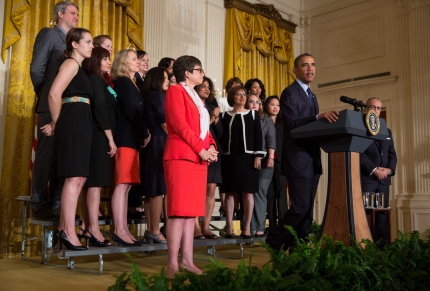
President Barack Obama delivers remarks commemorating the 50th anniversary of the Equal Pay Act (June 10, 2013)

President Barack Obama delivers remarks commemorating the 50th anniversary of the Equal Pay Act, in the East Room of the White House, June 10, 2013. (Official White House Photo by Lawrence Jackson)

It's been 50 years since President Kennedy signed the Equal Pay Act, but its goals today stand unrealized. In 2013, full-time working women still make less than men on average.

This morning, President Obama spoke at an event to mark the anniversary.

"The day that the bill was signed into law, women earned 59 cents for every dollar a man earned on average, he said. "Today, it’s about 77 cents. So it was 59 and now it’s 77 cents. It’s even less, by the way, if you’re an African American or a Latina. So I guess that’s progress, but does anybody here think that’s good enough?"

The President has made tackling this issue a priority since his first day in the White House. The first bill that President Obama ever signed was the Lilly Ledbetter Fair Pay Act. His administration was the first to create a White House Council on Women and Girls. He launched a National Equal Pay Task Force to help crack down on violations of equal pay laws, and earlier this year, he signed a presidential memorandum directing the federal government to close the gender gap for its employees.

But there's more work to do -- like passing the Paycheck Fairness Act, training more women for careers in science, technology, and math, and making sure that businesses offer parents the flexibility they need to excel in their jobs and care for their children.

"This will be part of our broader agenda to create good jobs and to strengthen middle-class security, to keep rebuilding an economy that works for everybody, that gives every American the chance to get ahead, no matter who you are or what you look like, or what your last name is and who you love," the President said.

For more perspective on the anniversary of the Equal Pay Act, check out the video below:


Learn More: 

Related Topics: Economy, Equal Pay, Women

The White House

Office of the Press Secretary

Remarks by the President on the 50th Anniversary of the Equal Pay Act

East Room

11:53 A.M. EDT

THE PRESIDENT:  Thank you.  (Applause.)  Thank you, everybody.  Everybody have a seat.  Welcome to the White House.  It is wonderful to see all of you.  Thank you, Joe, for that kind introduction.  Thank you, Valerie, for the great leadership you’ve shown on this.  And to all of you -- business leaders and advocates, members of Congress, who are here, members of my administration -- I am so glad that all of you could be here to celebrate the 50th anniversary of the Equal Pay Act. 

When you think about it, we’re not just celebrating a law.  We’re honoring the heroes who made that law possible -- the fierce determination of Americans who saw a wrong and worked to right it.  There were women who were sick and tired of being sick and tired -- (laughter) -- of seeing the same jobs advertised with different pay scales.  Women who were tired of being treated like second-class workers.  Women like Dorothy Height and Congresswoman Edna Kelly -- (applause) -- and Esther Peterson, all who pushed to make the Equal Pay Act a reality. 

And, today, we recognize the work of those brave women.  But until equal pay truly is a reality, we’re also here to recommit ourselves to the work that remains to be done.

Fifty years ago today, President Kennedy signed the Equal Pay Act into law, right here in the White House.  He said it was basic to our democracy.  It’s the idea that all of us are created equal.  And as I said in my inaugural address this year, our journey to equality is not complete until our wives, our mothers, our daughters can earn a living equal to their efforts.

The day that the bill was signed into law, women earned 59 cents for every dollar a man earned on average.  Today, it’s about 77 cents.  So it was 59 and now it’s 77 cents.  It’s even less, by the way, if you’re an African American or a Latina.  So I guess that’s progress, but does anybody here think that’s good enough? 

AUDIENCE:  No!

THE PRESIDENT:  I assume everybody thinks we can do better.

AUDIENCE:  Yes!

AUDIENCE MEMBER:  We can.

THE PRESIDENT:  Yes, we can.  (Laughter and applause.)

Over the course of her career, a working woman with a college degree will earn on average hundreds of thousands of dollars less than a man who does the same work.  Now, that’s wrong.  I don’t want that for Malia and Sasha.  I don’t want that for your daughters.  I don’t want that to be an example that any child growing up ends up accepting as somehow the norm.  I want every child to grow up knowing that a woman’s hard work is valued and rewarded just as much as any man’s.

Now, what’s important to realize also, though, is this is not just an issue of fairness.  This is a family issue.  This is a middle-class issue.  This is an economic issue.  Just last week, a report confirmed what we already know:  that women are increasingly the breadwinners for American families.  Women are now the primary source of income for nearly 40 percent of American families.  Forty percent -- almost half. 

That’s not something to panic about, or to be afraid about  -– that’s a sign of the progress and the strides that we’ve made.  But what it does mean is that when more women are bringing home the bacon, they shouldn’t just be getting a little bit of bacon.  (Laughter.)  If they’re bringing home more of the income and that income is less than a fair share, that means that families have less to get by on for childcare or health care, or gas or groceries.  It makes it harder for middle-class families to save and retire.  It leaves small businesses with customers who have less money in their pockets -- which is not good for the economy.  That’s not a good example to set for our sons and daughters, but it’s also not a good recipe for long-term, stable economic growth.

So to anyone who says 77 cents on the dollar sounds pretty close to equal, I say, you’re math is bad.  (Laughter.)  You wouldn’t like it if your vote only counted in three out of four elections.  (Laughter.)  You wouldn’t like it if your daughters or sons went to school but they only got taught three out of four days a week, or four out of five days a week.  You wouldn’t like it if you were forced to work every fourth day without pay.  Men would be complaining about that.  (Laughter.)  They wouldn’t think that was equal or fair.

So this is the 21st century.  It’s time to close that gap.  That’s why the first bill I signed into law was the Lilly Ledbetter Fair Pay Act.  (Applause.)

That’s why, as Valerie mentioned, I created the first-ever White House Council on Women and Girls, which is working to close that gap.  (Applause.)  And Valerie’s council -- this council is doing a great job in bringing the experiences of women into our federal policies as well.

It’s why I established a National Equal Pay Task Force to help crack down on violations of equal pay laws, which, by the way, they’re doing at a record rate.  And, through education and outreach, they’re also helping employers develop tools to comply with the nation’s equal pay laws on their own.  And that’s why, earlier this year, I signed a presidential memorandum directing the federal government to close that gap for good for its employees.  (Applause.)  We have to set an example.

It’s also why we’re using the latest technology to help workers get the information they need to figure out if they’re underpaid.  And thanks to innovators like Rachel and Laquitta, who are up here, we can now say, “There’s an app for that.”  (Laughter.)   

But as long as this gap persists, we’re going to have more work to do.  And now is the time to keep up the work that all those trailblazers started 50 years ago.

Now is the time for Congress to step up and pass the Paycheck Fairness Act so women have better tools to fight for equal pay for equal work.  (Applause.)  

Now is the time for us to encourage more young women to pursue math and science education.  Now is the time for us to hire more STEM teachers so all our children are prepared for the high-tech, high-wage jobs of tomorrow. 

Now is the time to make sure businesses offer men and women the flexibility to be good employees and good parents.  And I really want to commend Deloitte and SumAll, and the CEOs who are with us here today, they are creating exactly the kinds of innovative workplaces that help hard-working Americans thrive, and they’re committed to pay equity.  And so when you have a chance to talk to Joe, say thank you.  And the CEOs who are out there, if you want a first-class company that is tapping into the talents and resources of all your employees, make sure that you’re putting in place systems so that they all feel like they’re being treated fairly and equally.  It’s a simple principle and it’s a powerful one.

And now is the time to make sure that we are putting in place a minimum wage that you can live on -- (applause) -- because 60 percent of those making the minimum wage are women. 

If we do all this -- and this will be part of our broader agenda to create good jobs and to strengthen middle-class security, to keep rebuilding an economy that works for everybody, that gives every American the chance to get ahead, no matter who you are or what you look like, or what your last name is and who you love. 

That’s what I’m going to keep on fighting for.  That’s what you’re going to keep on fighting for.  And we have all of you and your predecessors to thank for the incredible progress this country has made in eliminating the barriers and injustices that might keep our daughters from enjoying the same rights, same chances, and same freedoms as our sons.  I’m proud of you.

Thank you very much.  (Applause.)

END
12:02 P.M. EDT

The Right to Equal Pay for Equal Work

June 10, 2013 | 2:55 | Public Domain

Did You Know That Women Are Still Paid Less Than Men? In 1963, President Kennedy signed the Equal Pay Act but till this day full-time working women are still paid, on average, less than men. This significant gap is more than a statistic -- it has real life consequences. When women, who make up nearly half the workforce, bring home less money each day, it means they have less for the everyday needs of their families, and over a lifetime of work, far less savings for retirement. Learn more about how President Obama is tackling this issue: http://obamawhitehouse.archives.gov/equalpay

Download mp4 (227.5MB)

The White House

Office of the Press Secretary

Remarks by President Obama and President Xi Jinping of the People's Republic of China After Bilateral Meeting

Sunnylands Retreat
Rancho Mirage, California

8:09 P.M. PDT

PRESIDENT OBAMA:  Everybody ready?  Well, I know we’re a little behind, but that’s mainly because President Xi and I had a very constructive conversation on a whole range of strategic issues, from North Korea to cyberspace to international institutions.  And I’m very much looking forward to continuing the conversation, not only tonight at dinner but also tomorrow. 

But I thought we’d take a quick break just to take a question from both the U.S. and Chinese press.  So what I’ll do is I’ll start with Julie Pace and then President Xi can call on a Chinese counterpart.

Q    Thank you, Mr. President.  How damaging has Chinese cyber-hacking been to the U.S.?  And did you warn your counterpart about any specific consequences if those actions continue?  And also, while there are obviously differences between China’s alleged actions and your government’s surveillance programs, do you think that the new NSA revelations undermine your position on these issues at all during these talks?

And President Xi, did --

PRESIDENT OBAMA:  Why don’t you let the interpreter --

Q    And President Xi, did you acknowledge in your talks with President Obama that China has been launching cyber attacks against the U.S.?  Do you also believe that the U.S. is launching similar attacks against China?  And if so, can you tell us what any of the targets may have been?  Thank you.

PRESIDENT OBAMA:  Well, Julie, first of all, we haven’t had, yet, in-depth discussions about the cybersecurity issue.  We’re speaking at the 40,000-foot level, and we’ll have more intensive discussions during this evening’s dinner.

What both President Xi and I recognize is that because of these incredible advances in technology, that the issue of cybersecurity and the need for rules and common approaches to cybersecurity are going to be increasingly important as part of bilateral relationships and multilateral relationships.

In some ways, these are uncharted waters and you don’t have the kinds of protocols that have governed military issues, for example, and arms issues, where nations have a lot of experience in trying to negotiate what’s acceptable and what’s not.  And it’s critical, as two of the largest economies and military powers in the world, that China and the United States arrive at a firm understanding of how we work together on these issues. 

But I think it’s important, Julie, to get to the second part of your question, to distinguish between the deep concerns we have as a government around theft of intellectual property or hacking into systems that might disrupt those systems -- whether it’s our financial systems, our critical infrastructure and so forth -- versus some of the issues that have been raised around NSA programs. 

When it comes to those cybersecurity issues like hacking or theft, those are not issues that are unique to the U.S.-China relationship.  Those are issues that are of international concern.  Oftentimes it’s non-state actors who are engaging in these issues as well.  And we’re going to have to work very hard to build a system of defenses and protections, both in the private sector and in the public sector, even as we negotiate with other countries around setting up common rules of the road.

And as China continues in its development process and more of its economy is based on research and innovation and entrepreneurship, they’re going to have similar concerns, which is why I believe we can work together on this rather than at cross-purposes. 

Now, the NSA program, as I discussed this morning, is a very limited issue, but it does have broad implications for our society because you’ve got a lot of data out there, a lot of communications that are in cyberspace.  And how we deal with both identifying potential terrorists or criminals, how the private sector deals with potential theft, and how the federal government, state governments, local governments and the private sector coordinate to keep out some of these malicious forces while still preserving the openness and the incredible power of the Internet and the web and these new telecommunications systems -- that’s a complicated and important piece of business.  But it’s different from these issues of theft and hacking. 

And every government is then inevitably going to be involved in these issues, just like big companies are going to be involved in these issues.  I mean, you’ve got private companies that have a lot more data and a lot more details about people’s emails and telephone calls than the federal government does.  And if we’re called upon not only to make sure that we’re anticipating terrorist communications but we’re also called upon to work with the private sector to prevent theft out of ATMs, et cetera, then we’re going to have to find ways to deal with this big data in ways that are consistent with our values; in ways that protect people’s privacy, that ensure oversight, and strike the right balance. 

And as I indicated this morning, that’s a conversation that I welcome having.

PRESIDENT XI:  (As interpreted.)  As President Obama said, in our meeting this afternoon we just briefly touched upon the issue of cybersecurity.  And the Chinese government is firm in upholding cybersecurity and we have major concerns about cybersecurity. 

In the few days before President Obama and I meet today, I note sharp increased media coverage of the issue of cybersecurity.  This might give people the sense or feeling that cybersecurity as a threat mainly comes from China or that the issue of cybersecurity is the biggest problem in the China-U.S. relationship. 

The application of new technology is a double-edged sword.  On the one hand, it will drive progress in ensuring better material and cultural life for the people.  On the other hand, it might create some problems for regulators and it might infringe upon the rights of states, enterprises, societies and individuals.

We need to pay close attention to this issue and study ways to effectively resolve this issue.  And this matter can actually be an area for China and the United States to work together with each other in a pragmatic way.  And I'm happy to learn that within the context of the China-U.S. strategic and economic dialogue, a working group has been established to discuss cybersecurity issues.  So this is an issue that the two sides will continue to discuss.

By conducting good-faith cooperation we can remove misgivings and make information security and cybersecurity a positive area of cooperation between China and the U.S.  Because China and the United States both have a need and both share a concern, and China is a victim of cyber attacks and we hope that earnest measures can be taken to resolve this matter.

Thank you.

Q    I’m with China Central Television and my question for President Xi is, what are the main issues that were discussed in the longer-than-expected meeting this afternoon?  And what are the major areas of consensus that have emerged from the discussion?  And last year, when you were visiting the United States, you raised the concept of the two sides working together to explore what you call a new model of major country relationship, something that is unprecedented in the relationship and that can inspire future generations.  And after this concept was raised, there has been much discussion and comment on it, both in China and the United States and in the world more broadly.  So did you have further discussion on this issue in your meeting this afternoon?

And my question for President Obama is, what will the United States do to contribute to the building of a new model of major country relationship between China and the U.S.?

PRESIDENT XI:  (As interpreted.)  In the first meeting that I’ve had with President Obama this afternoon, we had an in-depth, sincere and candid discussion on the domestic and foreign policies of China and the United States, on our joint work to build a new model of major country relationship, and our international and regional issues of mutual interest.  And the President and I reached important consensus on these issues.

I stated very clearly to President Obama that China will be firmly committed to the path of peaceful development and China will be firm in deepening reform and opening up the country wider to the world.  China will work hard to realize the Chinese dream of the great national renewal and will work hard to push forward the noble cause of peace and development for all mankind.

By the Chinese dream, we seek to have economic prosperity, national renewal and people’s well-being.  The Chinese dream is about cooperation, development, peace and win-win, and it is connected to the American Dream and the beautiful dreams people in other countries may have.

President Obama and I both believe that in the age of economic globalization and facing the objective need of countries sticking together in the face of difficulties, China and the United States must find a new path -- one that is different from the inevitable confrontation and conflict between the major countries of the past.  And that is to say the two sides must work together to build a new model of major country relationship based on mutual respect and win-win cooperation for the benefit of the Chinese and American peoples, and people elsewhere in the world. 

The international community looks to China and the United States to deliver this.  When China and the United States work together, we can be an anchor for world stability and the propeller of world peace.

I stand ready to work with President Obama to expand on all levels of exchanges between the two sides.  I look forward to maintaining close communication with the President through mutual visits, bilateral meetings, exchange of letters and phone calls. And I invited President Obama to come to China at an appropriate time for a similar meeting like this.  And we look forward to visiting each other country.

At the same time, the two sides will work hard to make progress in the various bilateral mechanisms, such as the strategic and economic dialogue and the high-level consultation on people-to-people exchange.  Also, the Chinese Minister of Foreign Affairs and the Chinese Minister of National Defense will both make visits to the United States within the year.

Our two sides should also step up exchanges and cooperation in economy and trade, energy, environment, people-to-people, and cultural fields, as well as at the sub-national level, so that we can deepen the shared interests of the two countries and expand them to all areas. 

We should also improve and strengthen the military-to-military relationship between the two countries and promote the building of a new model of military relationship between the two sides.  The two sides should also improve coordination microeconomic policies so that by strengthening cooperation, we can contribute to our respective development at home, and promote strong, sustainable and balanced economic growth in the Asia Pacific region and the world at large.

And I’m confident in our joint effort to build a new model of major country relationship.  I believe success hinges on the human effort.  Firstly, both sides have the political will to build this relationship.  Secondly, our cooperation in the last 40 years provides a good foundation for us to build on.  Thirdly, between China and the United States, there are over 90 intergovernmental mechanisms which provide the institutional underpinning for our efforts. 

Fourth, there is strong public support for this kind of relationship between China and the United States.  There are 220 pairs of sister provinces, states and cities between China and the U.S.  There are 190,000 Chinese students in the United States, and 20,000 American students in China. 

And 5th, there is enormous scope for future cooperation between China and the U.S.

Of course, this endeavor is unprecedented and one that will inspire future generations.  So we need to deepen our mutual understanding, strengthen our mutual trust, further develop our cooperation and manage our differences so that we can avoid the traditional path of inevitable confrontation between major countries and really embark on a new path.

The Chinese nation and American nation are great nations, and the Chinese people and American people are great peoples.  As long as we stand high and look far, as long as we make specific progress and accumulate them over time, as long as we maintain confidence and determination, as long as we have wisdom and patience, I'm confident that we will succeed in achieving this historical mission.

I'm sorry for going too long.  Thank you. 

PRESIDENT OBAMA:  Well, I think President Xi summarized very well the scope of our conversations.  We spoke about some very specific issues -- for example, President Xi mentioned the importance of military-to-military communications.  In the past, we've had high-level diplomatic communications about economic and strategic issues, but we haven't always had as effective communications between our militaries.  And at a time when there's so much activity around the world, it's very important that we each understand our strategic objectives at the military as well as the political levels.  So that's an example of concrete progress that can advance this new model of relations between the United States and China.

So we'll be taking steps to institutionalize and regularize such discussions.  But more broadly, I think President Xi identified the essence of our discussions in which we shared our respective visions for our countries' futures and agreed that we're more likely to achieve our objectives of prosperity and security of our people if we are working together cooperatively, rather than engaged in conflict. 

And I emphasized my firm belief to President Xi that it is very much in the interest of the United States for China to continue its peaceful rise, because if China is successful, that helps to drive the world economy and it puts China in the position to work with us as equal partners in dealing with many of the global challenges that no single nation can address by itself.

So, for example, neither country by itself can deal with the challenge of climate change.  That's an issue that we'll have to deal with together.  China as the largest country, as it continues to develop, will be a larger and larger carbon emitter unless we find new mechanisms for green growth.  The United States, we have the largest carbon footprint per capita in the world; we've got to bring down our carbon levels in order to accommodate continued growth.  And so that will translate then into opportunities for specific work around green technologies and research and development, and interactions between our scientists so that we can, together, help advance the goal of a sustainable planet, even as we continue to grow and develop.

We've got a lot of work to do to take these broad understandings down to the level of specifics, and that will require further discussions not only today and tomorrow, but for weeks, months, years to come.  But what I'm very encouraged about is that both President Xi and myself recognize we have a unique opportunity to take the U.S.-China relationship to a new level.  And I am absolutely committed to making sure that we don't miss that opportunity.

Thank you very much, everybody.

END
8:47 P.M. PDT

The White House

Office of the Press Secretary

WEEKLY ADDRESS: Time to Pass Commonsense Immigration Reform

WASHINGTON, DC—In this week’s address, President Obama said that the United States Senate will soon take action to fix our broken immigration system with a commonsense bill. The President urged the Senate to act quickly to pass this bill so that we can continue to live up to our traditions as a nation of laws, and also a nation of immigrants.

The audio of the address and video of the address will be available online at www.whitehouse.gov at 6:00 a.m. ET, June 8, 2013.

Remarks of President Barack Obama
The Weekly Address
Mooresville, North Carolina
June 8, 2013

Hi, everybody.  In the next few days, America will take an important step towards fixing our broken immigration system.  The entire United States Senate will begin debating a commonsense immigration reform bill that has bipartisan support.

See, we define ourselves as a nation of immigrants.  The promise we find in those who come from every corner of the globe has always been one of our greatest strengths.  It’s kept our workforce vibrant and dynamic.  It’s kept our businesses on the cutting edge.  And it’s helped build the greatest economic engine the world has ever known. 

But for years, our out-of-date immigration system has actually harmed our economy and threatened our security.

Now, over the past four years, we’ve taken steps to try and patch up some of the worst cracks in the system. 

We strengthened security on the southern border by putting more boots on the ground than at any time in our history.  And, in part, by using technology more effectively – today, illegal crossings are near their lowest level in decades.    

We focused enforcement efforts on criminals who are here illegally – who endanger our communities – and today, we deport more criminals than ever before.

And we took up the cause of “Dreamers,” the young people who were brought to this country as children.  We said that if they’re able to meet certain criteria, we’d consider offering them the chance to come out of the shadows so they can continue to work here, and study here, and contribute to our communities legally. 

But if we’re going to truly fix a broken system, we need Congress to act in a comprehensive way.  And that’s why what’s happening next week is so important.

The bill before the Senate isn’t perfect.  It’s a compromise.  Nobody will get everything they want – not Democrats, not Republicans, not me.  But it is a bill that’s largely consistent with the principles I’ve repeatedly laid out for commonsense immigration reform.

This bill would continue to strengthen security at our borders, increase criminal penalties against smugglers and traffickers, and hold employers more accountable if they knowingly hire undocumented workers.  If enacted, it would represent the most ambitious enforcement plan in recent memory.

This bill would provide a pathway to earned citizenship for the 11 million individuals who are in this country illegally – a pathway that includes passing a background check, learning English, paying taxes and a penalty, and then going to the back of the line behind everyone who’s playing by the rules and trying to come here legally.   

This bill would modernize the legal immigration system so that, alongside training American workers for the jobs of tomorrow, we’re also attracting highly-skilled entrepreneurs and engineers who will grow our economy.  And so that our people don’t have to wait years before their loved ones are able to join them in this country we love.

That’s what immigration reform looks like.  Smarter enforcement.  A pathway to earned citizenship.  Improvements to the legal immigration system.   They’re all commonsense steps.  They’ve got broad support – from Republicans and Democrats, CEOs and labor leaders, law enforcement and clergy.  So there is no reason that Congress can’t work together to send a bill to my desk by the end of the summer. 

We know the opponents of reform are going to do everything they can to prevent that.  They’ll try to stoke fear and create division.  They’ll try to play politics with an issue that the vast majority of Americans want addressed.  And if they succeed, we will lose this chance to finally fix an immigration system that is badly broken.    

So if you agree that now is the time for commonsense reform, reach out to your Representatives.  Tell them we have to get this done so that everyone is playing by the same rules.  Tell them we have the power to do this in a way that lives up to our traditions as a nation of laws, and a nation of immigrants. 

In the end, that’s what this is all about.  Men and women who want nothing more than the chance to earn their way into the American story, just like so many of our ancestors did.  Throughout our history, that has only made us stronger.  And it’s how we’ll make sure that America’s best days always lie ahead. 

Thanks.  And have a great weekend.  

Weekly Address: Time to Pass Commonsense Immigration Reform

In this week’s address, President Obama says that the United States Senate will soon take action to fix our broken immigration system with a commonsense bill, and urges lawmakers to act quickly to pass this bill so that we can continue to live up to our traditions as a nation of laws, and also a nation of immigrants.

Transcript | Download mp4 | Download mp3

Related Topics: Immigration

The White House

Office of the Press Secretary

Remarks by President Obama and President Xi Jinping of the People's Republic of China Before Bilateral Meeting

Sunnylands Retreat
Palm Springs, California

5:21 P.M. PDT

PRESIDENT OBAMA:  Well, it gives me great pleasure to welcome President Xi back to the United States.  We first met during my visit to China in 2009, and I had the opportunity to welcome him to the Oval Office last year when he was still Vice President and a guest of Vice President Biden’s.

I think some of you may know that President Xi is no stranger to the United States.  He’s remembered fondly in Iowa, where he once visited and stayed with a local family, and on his trip last year, he had a chance to come to California -- including, I understand, going to a Lakers game, which I was very jealous of.  (Laughter.)

President Xi just took office in March.  Our decision to meet so early, I think, signifies the importance of the U.S.-China relationship.  It’s important not only for the prosperity of our two countries and the security of our two countries, but it’s also important for the Asia Pacific region and important for the world.

And the importance of this relationship in some ways is reflected with this somewhat unusual setting that we are hosting the President in.  Our thought was that we would have the opportunity for a more extended and more informal conversation in which we were able to share both our visions for our respective countries and how we can forge a new model of cooperation between countries based on mutual interest and mutual respect.  I think both of us agree that continuous and candid and constructive conversation and communication is critically important to shaping our relationship for years to come.

And for my part, this will give me an opportunity to reiterate how the United States welcomes the continuing peaceful rise of China as a world power and that, in fact, it is in the United States’ interest that China continues on the path of success, because we believe that a peaceful and stable and prosperous China is not only good for Chinese but also good for the world and for the United States.

Of course, as two of the largest economies in the world, we’re going to have a healthy economic competition, but we also have a whole range of challenges on which we have to cooperate, from a nuclear North Korea -- or North Korea’s nuclear and missile programs -- to proliferation, to issues like climate change.

And the United States seeks an international economy and international economic order where nations are playing by the same rules, where trade is free and fair, and where the United States and China work together to address issues like cybersecurity and the protection of intellectual property.

In addition to the strategic concerns that we share and the economic challenges that each of our countries face, I will continue to emphasize the importance of human rights.  President Xi has spoken of a nation and a people that are committed to continuous self-improvement and progress, and history shows that upholding universal rights are ultimately a key to success and prosperity and justice for all nations.

So I want to again welcome President Xi to the United States.  We’re very glad that he’s here.  Inevitably, there are areas of tension between our two countries, but what I’ve learned over the last four years is both the Chinese people and the American people want a strong, cooperative relationship, and that I think there’s a strong recognition on the part of both President Xi and myself that it is very much in our interest to work together to meet the global challenges that we face.  And I’m very much looking forward to this being a strong foundation for the kind of new model of cooperation that we can establish for years to come. 

So welcome, and thank you very much for being here.

PRESIDENT XI:  (As interpreted.)  Honorable President Obama, it’s my great pleasure to meet you.  We’re meeting with each other earlier than people might have expected.  They thought that we might have to wait until the Saint Petersburg G20 summit to meet with each other, but here we are.  I want to thank you for your invitation, and it’s my great pleasure to meet you here at Sunnylands, the Annenberg Estate. 

This is a wonderful place, a place of sunshine, and it’s very close to the Pacific Ocean.  And on the other side of the ocean is China.  When I visited the United States last year, I stated that the vast Pacific Ocean has enough space for the two large countries of China and the United States.  I still believe so.

And, Mr. President, we’re meeting here today to chart the future of China-U.S. relations and draw a blueprint for this relationship and continue our cooperation across the Pacific Ocean.

And this reminds us of what happened over 40 years ago when the leaders of China and the United States, with the strategists’ political courage and wisdom, realized a handshake across the Pacific Ocean and reopened the door of exchanges between China and the United States.  And in the more than 40 years since then, the China-U.S. relationship has gone through winds and rains and it made historical progress.  And our two peoples and the people elsewhere in the world have reaped huge benefits from this.

And at present, the China-U.S. relationship has reached a new historical starting point.  Our two countries have vast convergence of shared interests, from promoting our respective economic growth at home to ensuring the stability of the global economy; from addressing international and regional hotspot issues to dealing with all kinds of global challenges.  On all these issues, our two countries need to increase exchanges and cooperation.

And under the new environment, we need to take a close look at our bilateral relationship:  What kind of China-U.S.  relationship do we both want?  What kind of cooperation can our two nations carry out for mutual benefit?  And how can our two nations join together to promote peace and development in the world?  These are things that not just the people in our two countries are watching closely, but the whole world is also watching very closely.

Both sides should proceed from the fundamental interests of our peoples and bear in mind human development and progress.  We need to think creatively and act energetically so that working together we can build a new model of major country relationship.

President Obama, I look forward to having in-depth communication with you on major strategic issues of common interest to deepen our mutual understanding and to push forward all-round cooperation.  I’m confident that our meeting will achieve positive outcomes and inject fresh momentum into the China-U.S. relationship.

Thank you.

PRESIDENT OBAMA:  Thank you very much, everybody.

END
5:34 P.M. PDT

President Obama's Bilateral Meeting with President Xi Jinping of China

June 07, 2013 | 38:02 | Public Domain

President Obama and President Xi Jinping of China take questions from the press after their bilateral meeting.

Download mp4 (1434MB) | mp3 (92MB)

Weekly Address: Time to Pass Commonsense Immigration Reform

June 08, 2013 | 4:33 | Public Domain

In this week’s address, President Obama says that the United States Senate will soon take action to fix our broken immigration system with a commonsense bill, and urges lawmakers to act quickly to pass this bill so that we can continue to live up to our traditions as a nation of laws, and also a nation of immigrants.

Download mp4 (165MB) | mp3 (11MB)