The White House

Office of the Press Secretary

Joint Statement between the United States and Peru

TOWARD A STRATEGIC PARTNERSHIP FOR THE 21ST CENTURY

President Barack Obama and President Ollanta Humala reaffirmed today their desire to strengthen the U.S.-Peru relationship by further deepening cooperation on economic prosperity and social inclusion; education; science and technology; and citizen security.  The two leaders resolved to continue working together on a diversified cooperative agenda to bolster our relationship and ensure it remains strong and relevant to the challenges and opportunities of the 21st century

Both Presidents acknowledged the historic relationship between our two nations and reaffirmed their intent to strengthen and deepen it based on shared fundamental values and principles such as democracy, respect for human rights, belief in open markets, and the rule of law.

Both leaders also recognized that the United States and Peru are working to consolidate a strategic partnership for the 21st century that will further enhance security, prosperity and development in the hemisphere.

They also welcomed closer relationships at the state and local level to expand opportunities for mutual cooperation.

ECONOMIC PROSPERITY AND SOCIAL INCLUSION

Underpinning our successful U.S.-Peru economic relationship is the successful implementation of the U.S.-Peru Trade Promotion Agreement, which facilitated nearly $16 billion in bilateral trade in 2012 and supported robust job creation in both countries.  The two Presidents noted that in the four years since the Agreement entered into force, the United States and Peru have made it easier for our businesses to trade, further diversified our trading relationship, and continue to work jointly to protect the environment.  They reiterated the importance of maintaining regular dialogue on specific proposals for deepening the trading relationship.  The two Presidents also reviewed Trans-Pacific Partnership negotiations, including at the 17th negotiating Round hosted by Peru in May, and reaffirmed their shared commitment to conclude negotiations this year.

Both Presidents discussed the importance of taking advantage of economic prosperity to also reduce poverty and inequality.  In this context, the leaders noted the importance of public-private partnerships and expressed their belief in sustainable and inclusive economic growth.

The United States welcomed Peru to the Small Business Network of the Americas, wherein the United States will support the establishment of small business development centers in Peru to provide entrepreneurs and small business owners with training and other job creating services. 

The two leaders also highlighted joint efforts to expand internet connectivity to rural areas of Peru, apply science and technology to accelerate development, and provide support to 1,000 small- and medium-sized businesses led by Peruvian women entrepreneurs through the Pathways Access Initiative and ongoing Women’s Entrepreneurship in the Americas Initiative (WEAmericas).  As founding members of the Equal Futures Partnership, Peru and the United States have committed to expand opportunities for women and girls and to promote gender equality across political, economic and social spheres. 

The leaders reaffirmed their desire to boost sustainable, inclusive, and balanced growth and job creation; promote productive investment; reform and strengthen the international financial architecture; and enhance multilateral trade.  They reiterated their support for a successful ninth WTO Ministerial Meeting, which will take place in December this year in Bali, Indonesia.

The Presidents also highlighted the importance of the "Pacific Alliance," one of the most innovative regional integration initiatives, and underscored its auspicious prospects for deepening trade liberalization and enhancing cooperation between its members.

EDUCATION

The two Presidents highlighted education as an increasingly important strategic priority for both countries, focusing particularly on science, technology, innovation, and competitiveness.  Recognizing the economic advantages for both countries of increasing contact between Americans and Peruvians, the United States and Peru launched an Education Policy Dialogue to further facilitate information-sharing and best practices, and to promote linkages to President Obama’s 100,000 Strong in the Americas initiative, as well as Peruvian scholarship initiatives such as “Beca 18” and “Beca Presidente de la República.”  Both presidents also welcomed joint efforts to provide high-quality English language training and instruction to Peruvian teachers and students. 

Both Presidents recognized the importance of cultural heritage to their respective nations and expressed willingness to continuously strengthen bilateral cooperation to prevent illicit traffic of cultural heritage property and restore it to its country of origin in accordance with bilateral and multilateral agreements to which both countries are party. 

SCIENCE AND THE ENVIRONMENT

Both nations resolved to work together to address the impact of global climate change.  The two leaders welcomed the signing of a Memorandum of Understanding that lays out measures to enhance Peru's capacity to design and implement a Low Emissions Development Strategy.  Through the design and implementation of such actions, the United States and Peru intend to work together to reduce emissions from Peru’s largest greenhouse gas emission sources.

The two countries also intend promote clean energy and energy security throughout Peru under the auspices of the Energy and Climate Partnership of the Americas, and the “Connecting the Americas 2022” initiative.  President Obama and President Humala affirmed their decision to work together toward successful outcomes at the international negotiations on climate change.  This cooperation includes working together to building a new international climate regime that is ambitious, effective, and can attract the participation of all parties.

They welcomed strong and deepening cooperation on environmental related science and technology issues between the two nations, including the ongoing collaboration and exchange of experts between the U.S. National Oceanic and Atmospheric Administration and the Instituto del Mar del Perú in the field of maritime matters, and the further establishment of a framework agreement between both institutions.

ENHANCING CITIZEN SECURITY

The two leaders reiterated their shared interest in enhancing citizen security, highlighting the importance of strengthening institutions that build and sustain the rule of law, protect human rights, and improve public security over the long-term. 

President Obama applauded Peru’s participation in the UN Stabilization Mission in Haiti, where Peruvian peacekeeping forces have been continuously deployed since the mission’s establishment in 2004.  President Humala welcomed U.S. support for the Peruvian National Police, including educational opportunities and training on enhanced community policing. 

Highlighting the threat posed by narcotics trafficking to both countries, President Obama reaffirmed U.S. commitment to partnering with Peru to combat the production and trafficking of illicit narcotics.  President Humala welcomed President Obama’s intent to increase counternarcotics and alternative development assistance to Peru by more than $20 million to provide additional support for the implementation of the Government of Peru’s counternarcotics strategy.  The two leaders also applauded joint initiatives to: reduce the production of cocaine and further advance an inclusive and sustainable alternative development strategy in coca-growing regions, noting successes with cacao and coffee; investigate and prosecute organized criminal organizations; support Peru’s transition to a new criminal procedure code; and strengthen cooperation to combat money laundering and financial crimes. 

The two leaders agreed to develop closer bilateral defense ties, and welcomed the progress made in the negotiations toward a robust new Defense Cooperation Agreement between the United States and Peru intended to address shared security challenges and threats such as drug trafficking, terrorism, proliferation, and natural disasters.

The United States and Peru also welcomed the signature of the Megaports initiative agreement to begin a cooperative effort to detect, deter, and interdict illicit smuggling of nuclear and other radioactive material.

The presidents expressed their mutual commitment to the Open Government Partnership as a means of enhancing transparency, government accountability to citizens, fighting corruption and encouraging citizen participation.

Presidents Obama and Humala will remain in close consultation on these and other issues of mutual interest in order to further the partnership between our nations.


The White House

Office of the Press Secretary

Remarks by President Obama and President Humala of Peru After Bilateral Meeting

Oval Office

12:16 P.M. EDT

PRESIDENT OBAMA:  I'm very happy to welcome President Humala and his delegation to the Oval Office.  We've been able to work together and interact in a wide range of multilateral forums, but this is the first time that I've been able to have the President here in Washington. 

Peru is one of our strongest and most reliable partners in the hemisphere.  We have a strong commercial and trading relationship.  We cooperate on a wide range of security issues, including our counter-narcotics efforts.  And we spent most of our discussion focused on how we can further deepen this important bilateral relationship. 

I want to congratulate President Humala on being able to sustain strong growth rates in Peru, and his focus on broad-based economic growth that includes all people.  As a consequence, Peru has been able to see not only increased growth but also reduced poverty and steps to reduce inequality. 

For both the United States and Peru, growth is also dependent on our continued expansion in the global marketplace, and that’s why I'm very glad that Peru and the United States are working so closely together in finalizing the Trans-Pacific Partnership, which offers the possibility of opening up markets throughout the Asia Pacific region with high standards and protections for labor and the environment. 

We've also agreed to a number of bilateral programs that will strengthen our cooperation.  For example, as part of my 100,000 Strong in the Americas program, we're going to deepen education exchange programs between our two countries, and we're also focusing on how we work together to include small businesses and medium-sized businesses in a hemisphere-wide network that allows those businesses to access markets throughout the region. 

And we also talked about how we can deepen at a strategic level our work together to continue to combat the scourge of transnational drug networks that have an adverse impact not only in Peru, but throughout the region.

So overall, the state of our relationship is very strong.  I think it will become even stronger as a result of some of the initiatives that we have shaped in this meeting.  And I'm very glad that President Humala was able to visit us.  I also wish the Peruvian soccer team the best of luck this evening.  (Laughter.) 

PRESIDENT HUMALA:  (As interpreted.)  Thank you very much, President Obama.  My visit here is a sign of the strength that we want to carry out in our relationships between the United States and Peru. 

We have found in your administration an open environment in which we can build on all the strategic areas so as to strengthen our bonds.  I am convinced that under your administration we will substantively and qualitatively fight against the scourge of drugs. 

But that has not been the only topic that we have addressed during our talk.  We have also discussed about education, training, science, technology, and strengthening the capacities of our young population.  We wish to move forward on exchange programs and scholarships not only with the United States, but also with the states of the union, so that way we can provide young people more opportunities. 

We have agreed on the importance of building democracy on respecting human rights, on improving economic openness, on working on trade, because this allows us to grow our economies and to develop further.  In addition, we have highlighted that Peru is an important trade partner with the United States.  We provide economic growth.  We have economic trust.  We also provide legal stability. 

Finally, we have invited President Obama, despite his busy agenda, to visit Peru.  I hope he does find the time to come down and visit us. 

We would like to thank you for your well wishes for the match this afternoon.  The referee is from the U.S.  (Laughter.)  No, I'm just kidding.  I'm just kidding.  (Laughter.)  This is not true.  I'm just kidding.

PRESIDENT OBAMA:  If it was, hopefully the Peruvian team will be so strong that it doesn't need help from the referee.  (Laughter.)

END
12:33 P.M. EDT

The White House

Office of the Press Secretary

Remarks by the President on Immigration Reform

East Room

10:38 A.M. EDT

THE PRESIDENT:  Good morning, everybody.  Welcome to the White House.  It is a pleasure to have so many distinguished Americans today from so many different walks of life.  We’ve got Democrats and Republicans; we've got labor and business leaders up on stage; we have law enforcement and clergy -- Americans who don’t see eye-to-eye on every issue, in fact, in some cases, don't see eye-to-eye on just about any issue -- (laughter) -- but who are today standing united in support of the legislation that is front and center in Congress this week -- a bipartisan bill to fix our broken immigration system.

And I have to say -- please give Tolu another round of applause.  (Applause.)  It takes a lot of courage to do what Tolu did -- to step out of the shadows, to share her story, and to hope that, despite the risks, she could make a difference.  But Tolu I think is representative of so many DREAMers out there who have worked so hard -- and I've had a chance to meet so many of them who’ve been willing to give a face to the undocumented and have inspired a movement across America.  And with each step, they’ve reminded us -- time and again -- what this debate is all about.  This is not an abstract debate.  This is about incredible young people who understand themselves to be Americans, who have done everything right but have still been hampered in achieving their American Dream.

And they remind us that we're a nation of immigrants.  Throughout our history, the promise we found in those who come from every corner of the globe has always been one of our greatest strengths.  It’s kept our workforce vibrant and dynamic.  It’s kept our businesses on the cutting edge.  It’s helped build the greatest economic engine that the world has ever known. 

When I speak to other world leaders, one of the biggest advantages we have economically is our demographics.  We're constantly replenishing ourselves with talent from across the globe.  No other country can match that history.  And what was true years ago is still true today -- who’s beeping over there?  (Laughter.)  You’re feeling kind of self-conscious, aren’t you?  (Laughter.)  It’s okay. 

In recent years, one in four of America’s new small business owners were immigrants.  One in four high-tech startups in America were founded by immigrants.  Forty percent of Fortune 500 companies were started by a first- or second-generation American. Think about that -- almost half of the Fortune 500 companies when they were started were started by first- or second-generation immigrants.  So immigration isn’t just part of our national character.  It is a driving force in our economy that creates jobs and prosperity for all of our citizens.

Now, here’s the thing.  Over the past two decades, our immigration system hasn’t kept pace with changing times and hasn’t matched up with our most cherished values. 

Right now, our immigration system invites the best and the brightest from all over the world to come and study at our top universities, and then once they finish -- once they’ve gotten the training they need to build a new invention or create a new business -- our system too often tells them to go back home so that other countries can reap the benefits, the new jobs, the new businesses, the new industries.  That’s not smart.  But that’s the broken system we have today. 

Right now, our immigration system keeps families apart for years at a time.  Even for folks who, technically, under the legal immigration system, should be eligible to become citizens but it is so long and so cumbersome, so byzantine, that families end up being separated for years.  Because of a backlog in visas, people who come here legally -- who are ready to give it their all to earn their place in America -- end up waiting for years to join their loved ones here in the United States.  It’s not right. But that’s the broken system we have today. 

Right now, our immigration system has no credible way of dealing with the 11 million men and women who are in this country illegally.  And, yes, they broke the rules; they didn’t wait their turn.  They shouldn’t be let off easy.  They shouldn’t be allowed to game the system.  But at the same time, the vast majority of these individuals aren’t looking for any trouble.  They’re just looking to provide for their families, contribute to their communities. 

They’re our neighbors.  We know their kids.  Too often, they’re forced to do what they do in a shadow economy where shady employers can exploit them by paying less than the minimum wage, making them work without overtime, not giving them any benefits. That pushes down standards for all workers.  It’s bad for everybody.  Because all the businesses that do play by the rules, that hire people legally, that pay them fairly -- they’re at a competitive disadvantage.  American workers end up being at a competitive disadvantage.  It’s not fair.  But that’s the broken system that we have today.

Now, over the past four years, we’ve tried to patch up some of the worst cracks in the system.  We made border security a top priority.  Today, we have twice as many border patrol agents as we did in 2004.  We have more boots on the ground along our southern border than at any time in our history.  And in part, by using technology more effectively, illegal crossings are near their lowest level in decades.    

We focused our enforcement efforts on criminals who are here illegally and who are endangering our communities.  And today, deportation of criminals is at its highest level ever.

And having put border security in place, having refocused on those who could do our communities harm, we also then took up the cause of the DREAMers, young people like Tolu who were brought to this country as children.  We said that if you’re able to meet some basic criteria, like pursuing a higher education, then we’ll consider offering you the chance to come out of the shadows so you can continue to work here, and study here, and contribute to our communities legally.

So my administration has done what we can on our own.  And we’ve got members of my administration here who’ve done outstanding work over the past few years to try to close up some of the gaps that exist in the system.  But the system is still broken.  And to truly deal with this issue, Congress needs to act.  And that moment is now. 

This week, the Senate will consider a common-sense, bipartisan bill that is the best chance we’ve had in years to fix our broken immigration system.  It will build on what we’ve done and continue to strengthen our borders.  It will make sure that businesses and workers are all playing by the same set of rules, and it includes tough penalties for those who don’t.  It’s fair for middle-class families, by making sure that those who are brought into the system pay their fair share in taxes and for services.  And it’s fair for those who try to immigrate legally by stopping those who try to skip the line.  It’s the right thing to do.

Now, this bill isn’t perfect.  It’s a compromise.  And going forward, nobody is going to get everything that they want -- not Democrats, not Republicans, not me.  But this is a bill that’s largely consistent with the principles that I and the people on this stage have laid out for common-sense reform. 

First of all, if passed, this bill would be the biggest commitment to border security in our nation’s history.  It would put another $6.5 billion -- on top of what we’re already spending -- towards stronger, smarter security along our borders.  It would increase criminal penalties against smugglers and traffickers.  It would finally give every employer a reliable way to check that every person they’re hiring is here legally.  And it would hold employers more accountable if they knowingly hire undocumented workers.  So it strengthens border security, but also enforcement within our borders.

I know there’s a lot of talk right now about border security, so let me repeat -- today, illegal crossings are near their lowest level in decades.  And if passed, the Senate bill as currently written and as hitting the floor would put in place the toughest border enforcement plan that America has ever seen.  So nobody is taking border enforcement lightly.  That’s part of this bill.   

Number two, this bill would provide a pathway to earned citizenship for the 11 million individuals who are in this country illegally.  So that pathway is arduous.  You've got to pass background checks.  You've got to learn English.  You've got to pay taxes and a penalty.  And then you've got to go to the back of the line behind everybody who’s done things the right way and have tried to come here legally.

So this won’t be a quick process.  It will take at least 13 years before the vast majority of these individuals are able to even apply for citizenship.  So this is no cakewalk.  But it’s the only way we can make sure that everyone who’s here is playing by the same rules as ordinary families -- paying taxes and getting their own health insurance. 

That’s why, for immigration reform to work, it must be clear from the outset that there is a pathway to citizenship.  If we’re asking everybody to play by the same rules, you got to give people a sense of certainty that they go through all these sacrifices, do all this, that there’s at the end of the horizon, the opportunity -- not the guarantee, but the opportunity -- to be part of this American family.  And by the way, a majority of Americans support this idea.

Number three, this bill would modernize the legal immigration system so that, alongside training American workers for the jobs of tomorrow, we’re also attracting the highly skilled entrepreneurs and engineers from around the world who will ultimately grow our economy.  And this bill would help make sure that our people don’t have to wait years before their loved ones are able to join them here in America.

So that’s what immigration reform looks like:  Smarter enforcement; a pathway to earned citizenship; improvements to our legal system.  They’re all common-sense steps.  They’ve got bipartisan support.  They’ve got the support of a broad cross-section of leaders from every walk of life.  So there’s no reason Congress can’t get this done by the end of the summer. 

Remember, the process that led to this bill was open and inclusive.  For months, the bipartisan Gang of Eight looked at every issue, reconciled competing ideas, built a compromise that works.  Then the Judiciary Committee held numerous hearings.  More than a hundred amendments were added, often with bipartisan support.  The good news is every day that goes by, more and more Republicans and Democrats are coming out to support this common-sense immigration reform bill.

And I’m sure the bill will go through a few more changes in the weeks to come.  But this much is clear:  If you genuinely believe we need to fix our broken immigration system, there’s no good reason to stand in the way of this bill.  A lot of people -- Democrats and Republicans -- have done a lot of good work on this bill.  So if you’re serious about actually fixing the system, then this is the vehicle to do it. 

If you’re not serious about it, if you think that a broken system is the best America can do, then I guess it might make sense to try to block it.  But if you're actually serious and sincere about fixing a broken system, this is the vehicle to do it.  And now is the time to get it done.  There is no good reason to play procedural games or engage in obstruction just to block the best chance we’ve had in years to address this problem in a way that’s fair to middle-class families, to business owners, to legal immigrants. 

And there’s no good reason to undo the progress we’ve already made -- especially when it comes to extreme steps like stripping protections from DREAMers that my administration has provided, or asking law enforcement to treat them the same way they treat violent criminals.  That’s not who we are. 

We owe it to America to do better.  We owe it to the DREAMers to do better.  We owe it to the young people like Tolu and Diego Sanchez, who’s with us here today.  Where's Diego?  Right here.  Diego came here from Argentina with his parents when he was just a kid, and growing up, America was his home.  This is where he went to school.  This is where he made friends.  This is where he built a life.  You ask Diego and he’ll tell you he feels American in every way -- except one; on paper.   

In high school, Diego found out that he was undocumented.  Think about that.  With all the stuff you're already dealing with in high school -- (laughter) -- and suddenly, oh, man, really?  (Laughter.)  So he had done everything right -- stayed out of trouble, excelled in class, contributed to his community -- feeling hopeful about his future, and suddenly he finds out he's got to live in fear of deportation. Watching his friends get their licenses knowing he couldn’t get one himself.  Seeing his classmates apply for summer jobs knowing he couldn’t do that either. 

When Diego heard that we were going to offer a chance for folks like him to emerge from the shadows, he went and signed up. All he wanted, he said, was a chance to, “live a normal life” and to “contribute to the country I love.”  And Diego, this year, was approved for deferred action.  A few weeks ago, he graduated from St. Thomas University, where he was student body president and “Student of the Year.”  (Applause.) 

So now he’s set his sights higher -- master's degree and then law school so he can pursue a career in public policy, help America shape its future.  Why wouldn’t we want to do the right thing by Diego?  What rationale is there out there that wouldn’t want to make sure Diego achieves his dreams?  Because if he does, that helps us all achieve our dreams.

So in the weeks to come, you'll hear some opponents of immigration reform try to gin up fear and create division and spread the same old rumors and untruths that we’ve heard before. And when that happens, I want you to think about Tolu.  I want you to think about Diego.  And I want you to think about your own parents and your own grandparents and your own great grandparents, and all the men and women and children who came here.  The notion that somehow those who came through Ellis Island had all their papers right -- (laughter) -- had checked every box and followed procedures as they were getting on that boat -- they were looking for a better life just like these families.  And they want to earn their way into the American story. 

And if you’re willing to stand with them -- and if you’re willing to stand with all these outstanding leaders up here -- then now is the time to make your voice heard.  You need to call and email and tweet your senators and tell them, don't kick this problem down the road.  Come together.  Work together.  Do your job not only to fix a broken immigration system once and for all, but to leave something better for all the generations to come, to make sure we continue to be a nation of laws and a nation of immigrants.  Do the right thing.  

Thanks.  God bless you.  God bless America.

END
11:02 A.M. EDT

The White House

Office of the Press Secretary

President Obama Announces More Key Administration Posts

WASHINGTON, DC – Today, President Barack Obama announced his intent to nominate the following individuals to key Administration posts:

  • Daniel B. Baer – United States Representative to the Organization for Security and Cooperation in Europe, with rank of Ambassador, Department of State
  • Michael G. Carroll  - Inspector General, United States Agency for International Development
  • James Cole, Jr. – General Counsel, Department of Education
  • Keith M. Harper – United States Representative to the United Nations Human Rights Council, with rank of Ambassador,  Department of State
  • Catherine E. Lhamon – Assistant Secretary for Civil Rights, Department of Education
  • Stephen W. Preston – General Counsel, Department of Defense

The President also announced his intent to appoint the following individuals to key Administration posts:

  • Brigadier General Anthony C. Funkhouser, USA – Commissioner, Mississippi River Commission
  • Betsey Stevenson – Member, Council of Economic Advisers

President Obama said, “These men and women have demonstrated knowledge and dedication throughout their careers. I am grateful they have chosen to take on these important roles, and I look forward to working with them in the months and years to come.”

President Obama announced his intent to nominate the following individuals to key Administration posts:

Daniel B. Baer, Nominee for United States Representative to the Organization for Security and Cooperation in Europe, with the rank of Ambassador, Department of State
Daniel B. Baer is a Deputy Assistant Secretary in the Bureau of Democracy, Human Rights, and Labor at the U.S. Department of State.  Prior to joining the Administration in 2009, he was an Assistant Professor of Strategy, Economics, Ethics, and Public Policy at the McDonough School of Business at Georgetown University.  From 2007 to 2008, Dr. Baer was a Faculty Fellow in the Edmond J. Safra Foundation Center for Ethics at Harvard University.  From 2004 to 2007, he worked at The Boston Consulting Group, first as a consultant and later a project leader.  Dr. Baer received an A.B. from Harvard University, an M.Phil and a D.Phil from Oxford University.

Michael G. Carroll, Nominee for Inspector General, United States Agency for International Development
Michael G. Carroll is Deputy Inspector General at the U.S. Agency for International Development (USAID), a position he has held since May 2012.  From October 2011 to May 2012, he was Acting Inspector General at USAID.  From 2006 to 2011, he was Deputy Inspector General, and from 2000 to 2004, he was the Assistant Inspector General for Management at USAID.  Mr. Carroll was the Director of Administration at the Bureau of Industry and Security at the Department of Commerce from 2004 to 2006.  Previously, he was Deputy Executive Director at the U.S. Nuclear Waste Technical Review Board from 1995 to 2000.  Prior to that, Mr. Carroll served at the U.S. Information Agency as the Director of Administrative Services from 1992 to 1995, Director of Operations for the Agency’s Exhibits Service from 1987 to 1992, and as a Logistics Manager at its Office of Administration from 1984 to 1987.  Mr. Carroll also worked for the U.S. Coast Guard from 1982 to 1984.  Mr. Carroll received a B.A. from St. John’s University.

James Cole, Jr., Nominee for General Counsel, Department of Education
James Cole, Jr. is the Deputy General Counsel at the U.S. Department of Transportation, a position he has held  since 2011.  From 1996 to 2011, he worked at Wachtell Lipton Rosen & Katz in New York, where he was elected as partner in the Corporate department in 2003.  From 1995 to 1996, Mr. Cole clerked for Chief Judge Stephanie K. Seymour of the U.S. Court of Appeals for the Tenth Circuit.  From 1990 to 1992, he was an analyst in the Financial Management Program at General Electric Capital Corporation.  He has served on the Board of Directors for the NAACP Legal Defense and Educational Fund and on the Board of Trustees for Prep for Prep.  He received a B.S. from the University of Illinois at Urbana-Champaign and a J.D. from the University of Chicago Law School.

Keith M. Harper, Nominee for Representative of the United States to the United Nations Human Rights Council, with rank of Ambassador, Department of State
Keith M. Harper is a partner at the law firm of Kilpatrick Townsend & Stockton LLP, where he is chair of the Native American Practice Group.  He currently serves as a Member on the President’s Commission on White House Fellowships.  Prior to his current role, Mr. Harper was Senior Staff Attorney for the Native American Rights Fund from 1995 to 2006.  From 2007 to 2008, he served as a Supreme Court Justice on the Supreme Court of the Poarch Band of Creek Indians, and from 2001 to 2007, he served as an Appellate Justice on the Mashantucket Pequot Tribal Court.  From 1998 to 2001, he was an adjunct professor at the Catholic University of America Columbus School of Law, and from 1999 to 2001, he was a Professorial Lecturer at the American University Washington College of Law.  Mr. Harper was a Law Clerk to the Honorable Lawrence W. Pierce on the Second Circuit of the United States Court of Appeals.  He began his career as a Litigation Associate with Davis, Polk & Wardwell in New York.  He is a member of the Cherokee Nation of Oklahoma.  He received a B.A. from the University of California, Berkeley and a J.D. from New York University School of Law.

Catherine E. Lhamon, Nominee for Assistant Secretary for Civil Rights, Department of Education
Catherine E. Lhamon is currently the Director of Impact Litigation at Public Counsel, a position she has held since October 2009.  Prior to this, she worked at the American Civil Liberties Union of Southern California as Assistant Legal Director in 2009, Racial Justice Director from 2005 to 2009, and Okrand/Wirin Attorney from 1999 to 2005.  From 1997 to 1999, she was a Supervising Attorney in the Appellate Litigation Program at the Georgetown University Law Center.  She clerked for the Honorable William A. Norris on the Ninth Circuit Court of Appeals in Los Angeles, California from 1996 to 1997.  California Lawyer honored Ms. Lhamon as an Attorney of the Year for Civil Rights in 2004.  The Daily Journal named her one of the Top 20 California Lawyers Under 40 in 2007 and she was honored as one of the State’s Top Women Litigators in 2010 and 2007.  Ms. Lhamon received her B.A. from Amherst College and her J.D. from Yale Law School. 

Stephen W. Preston, Nominee for General Counsel, Department of Defense
Stephen W. Preston is General Counsel for the Central Intelligence Agency.  Prior to his appointment in 2009, he was a partner at WilmerHale, where he was Co-Chair of the Defense and National Security Practice.  He joined WilmerHale in 1986, and later returned in 2001 after serving at both the Pentagon and the U.S. Department of Justice.  From 1998 to 2000, Mr. Preston was General Counsel of the Department of the Navy.  From 1995 to 1998, he was Deputy Assistant Attorney General at the U.S. Department of Justice.  From 1993 to 1995, Mr. Preston was Principal Deputy General Counsel of the Department of Defense, during which time he also served as Acting General Counsel.  Mr. Preston received a B.A. from Yale University and a J.D. from Harvard Law School.

President Obama announced his intent to appoint the following individuals to key Administration posts:

Brigadier General Anthony C. Funkhouser, USA, Appointee for Commissioner, Mississippi River Commission
Brigadier General Anthony C. Funkhouser is Commander of the United States Army Engineer Division, Northwestern, based in Portland, Oregon.  His military service includes an assignment as the Commander of the Tulsa Engineer District and service in Afghanistan during Operation Enduring Freedom.  He was a Commander of the 5th Engineer Battalion, 1st Engineer Brigade at Fort Leonard Wood, and served in Iraq during Operation Iraqi Freedom.  From 2005 to 2006, he was Chief of Staff at the United States Army Engineer School at Fort Leonard Wood in Missouri.  He has received the Legion of Merit, the Bronze Star Medal, the Meritorious Service Medal, and the Army Commendation Medal.  Brigadier General Funkhouser received a B.S. in Civil Engineering from the United States Military Academy, an M.S. in Engineering Management from the University of Missouri-Rolla, an M.S. in Strategic Studies from the United States Army War College, and an M.M.A.S. in Advanced Military Studies from the United States Army Command and General Staff College.

Dr. Betsey Stevenson, Appointee for Member, Council of Economic Advisers
Dr. Betsey Stevenson is an Associate Professor of Public Policy at the Gerald R. Ford School of Public Policy at the University of Michigan, a position she has held since 2012.  From 2004 to 2012, she was an Assistant Professor at the University of Pennsylvania’s Wharton School of Business.  During her tenure at Wharton, she took leave from 2011 to 2012 to serve as a Visiting Assistant Professor and Visiting Associate Research Scholar at Princeton University.  In addition, Dr. Stevenson was on leave to serve as Chief Economist at the Department of Labor from 2010 to 2011.  From 2001 to 2004, she was a Senior Consumer Research Advisor at Forrester Research.  Dr. Stevenson is a Faculty Research Fellow at the National Bureau of Economic Research.  She serves on the Board of Directors for the American Law and Economics Association and as an Advisor at the Brookings Papers on Economic Activity.  Dr. Stevenson received a B.A. from Wellesley College and an M.A. and Ph.D. from Harvard University.

The White House

Office of the Press Secretary

Press Gaggle by Principal Deputy Press Secretary Josh Earnest en route Los Angeles, CA, 6/7/2013

Aboard Air Force One
En Route Los Angeles, California

10:21 A.M. PDT

MR. EARNEST:  Good morning, everybody.  Welcome aboard Air Force One on a beautiful Friday morning.  I do have one quick update before we get to your questions.  The first is the President has been getting updates on Tropical Storm Andrea.  FEMA has been in close touch with local officials in the state of Florida and other states along the East Coast that are in the path of the storm.  As you know, FEMA is responsible for both monitoring the storm but also being the primary liaison with local officials who are responsible for responding to this storm.

What we would encourage people to do -- there are a couple of things -- a couple of good reminders with the first storm of the hurricane season is this is a good time for individuals, particularly those who live along the coast, to consult with local officials about whether or not they live in an evacuation zone.  We also encourage people to visit Ready.gov to see what they can do to protect or prepare themselves and their family in the event of a storm this hurricane season. 

We anticipate the President will get additional updates as necessary, as the storm progresses.

So with that, we’ll open it up for questions.

Q    So is the NSA domestic program, is it proving to be a distraction that’s going to hurt your agenda, Josh?

MR. EARNEST:  The President, I think, is pretty focused on the ambitious domestic agenda that he’s laid out.  You saw that the President spent some time yesterday at a school in Mooresville that’s investing in exactly the kind of technology that will improve the prospects of students who are going to come out and compete in a 21st global economy.  The President believes that the foundation of a high-quality education is critical to a strong and growing and thriving middle class.  That’s what the President is focused on. 

You heard the President begin his day by talking about the implementation of the Affordable Care Act and the impact that that will have on expanding access to quality, affordable health care for millions of Americans and lower the health care costs of millions of other American families and American small businesses. 

So the President has laid out a pretty specific and ambitious domestic agenda, and that’s his top priority.

Q    Is there a concern that the reports about the NSA surveillance will overshadow the meetings this afternoon and tomorrow with China’s President?

MR. EARNEST:  Not at all.  The President does have an important meeting this weekend with the President of China.  It will be an opportunity for the President and -- the President of the United States and the incoming President of China to talk about the varied and complex bilateral relationship that we have with China -- from a range of diplomatic issues, economic issues, and security issues.  There are opportunities for us to expand the areas in which we cooperate with the Chinese.  There are certainly some areas of competition.  Economic competition is probably among the most important of those.

But what we want to do is we want to examine this relationship and see if there are broader opportunities for us to expand those issues in which we cooperate.

 So this will be an informal atmosphere where they'll have the opportunity to spend some time together in a variety of settings and talk over this wide range of issues.  As you know, they’ve met before, but they haven’t had the opportunity to spend an extensive amount of time together talking about these issues that are very important to the citizens of both countries.

Q    So companies from Apple to Yahoo have been denying that they gave the NSA access to their data and their information.  Does that mean that the government accessed that information without their knowledge?

MR. EARNEST:  Well, for specific operational details about the way that this program is conducted, I would refer you to the Director of National Intelligence.  I’m not sure that I can get into the granular details that you’re asking about.

But what I can assure you is that these are -- that the authorities that we've been talking about, this Section 702, are authorities that have oversight of all three branches of government.  This is a principle that we talked about a little bit yesterday when we were talking about Section 215 of the Patriot Act. 

And it is important for people to understand that these authorities have oversight over all three branches of government. It’s also important for people to understand that these authorities do not apply to U.S. citizens or people who live in the United States.

Q    And given what the President said today about the need for balance in these programs, and also what he talked about during his campaign when these programs were under President Bush, why hasn’t he done more earlier to at least give the public a general sense of what’s been going on, of what these programs are, and even why they’re important?

MR. EARNEST:  Well, I’d say a couple of things about that.  The first is there have been numerous debates inside the United States Congress that duly-elected representatives of the people have a responsibility to examine what kind of authority should be granted to the executive branch to protect the interests and national security of the United States of America.  So there has been a robust debate in Congress about this, much of which has taken place publicly, that when we’re talking -- when we’re debating legislation, you have members of Congress who are casting public votes.  And I would point out that the reauthorization of the Patriot Act has been approved by Congress many times with strong bipartisan support.

So there has been a debate.  There has been an opportunity for members of Congress on both sides to weigh in.  And what we’ve seen is members of Congress on both sides approve of these authorities.

In terms of the public debate, I would make the case to you that the President actually has sought to engage the public in these debates.  The President gave a very prominent speech early on in his first term where he talked about striking the balance between protecting the constitutional rights and civil liberties of American citizens with the responsibility that the Commander-in-Chief has to protect the national security of the United States. 

And the President gave another high-profile speech just a couple of weeks ago at the National Defense University where he talked about these issues again.  Much of the attention was focused on the use of drones, but as I read yesterday during the gaggle, there was a portion of the speech that was dedicated to surveillance programs and a robust discussion of how to balance the privacy rights of American citizens and our national security interests.

So the President is genuine when he suggests that he welcomes a public debate about how to appropriately balance what I think the vast majority of Americans acknowledge are two very important priorities.

Q    So he welcomes the debate, but is he willing to rein in some of these programs if the debate reaches that conclusion?

MR. EARNEST:  Well, I would say two things about that.  The first is, when this President took office, he did carefully examine these programs and did put in place tougher, stricter oversight measures.  I think most people would argue that that actually is reining in his -- constraining his authority.  So I would make the case to you that the President, when he took office, examined this balance and made some changes based on his own assessment. 

Ultimately, this is the responsibility of Congress to engage in a debate about what kind of authority should be granted to the executive branch.  So all the authority that we’re talking about is authority that has previously been approved by Congress.  I understand that the reauthorization of the Patriot Act is coming up, so if Congress wants to engage in that debate again and wants to reexamine some of these issues and consider making some changes, they’ll have the opportunity to have that debate and they’ll have the opportunity to make some changes if that’s what they vote to do. 

But none of that changes the President’s commitment to ensuring that we have strict oversight of all three branches of government.  And when I say all three branches of government, I don’t just mean Congress being regularly briefed and I don’t just mean federal judges who are issuing warrants.  I also mean individuals who are independent of the regular structure inside the executive branch -- inspectors general, for example, who also have a role to audit the conduct of national security professionals who are implementing these programs.  And so that is also an important source of constraining the authority that the President has been granted, all within the bounds, though, of a robust defense of our national security.

Q    Will he make some proposals on his own in the debate leading up to the Patriot Act reauthorization, or is he just leaving it up to Congress?

MR. EARNEST:  Well, we -- the President, as you can tell from his answers today, has thought about this a lot and has some very strong views based -- that are informed primarily by his responsibility to protect the national security of the United States of America.  But he also took an oath to defend the Constitution of the United States, including the constitutional right to privacy that is enjoyed by American citizens.

So the President certainly has some thoughts about this -- there’s no doubt about that.  So he would participate in that debate.  This is not a debate that he wants other people to have. He would participate in this debate.  I think that was evident from his answer today.  I think that was evident from the speech that he gave two weeks ago.  And we certainly would welcome the opportunity to have conversations with Congress about this as well.

Q    As these reports have come out this week, has the White House heard from leaders in Congress who want to reopen the debate or who are suggesting to you that changes should be made?

MR. EARNEST:  I don’t have any specific conversations to read out to you.  I would -- there certainly is an opportunity for members of Congress to express their concerns, either publicly or to the White House, if they choose to do so.

Q    Does this undercut the President’s message to President Xi this evening and tomorrow about sort of the Chinese, sort of domestic reforms in China, and sort of the human rights issues and things of that sort, in terms of -- and cyber as well?  Does this -- do these revelations make the President’s case that much harder?

MR. EARNEST:  I actually think that you could make the case that this is a pretty good illustration of the kind of conversation that we want to have about respecting civil liberties and protecting the constitutional rights of the people that you govern.   

What the President did was he put in place some -- a very strict oversight regime, one that he strengthened when he took office, that, as I mentioned to Steve, constrained his own ability, constrained his own authority.  And I think that is a testament to the strength of our system of government that we can inspire a lot of confidence in the American public and in the free media even, who have questions about these programs and have questions about the exercise of executive authority to keep the country safe.   

The fact that there are different branches of government, some of whom are elected, like members of Congress, some of whom, as the President referenced, are insulated from short-term political pressures like the federal judiciary -- they have an opportunity to provide some oversight.  And that is a testament to the strength of our system.  It’s also a testament to the shared commitment of the people who are leading this country, both to protecting the constitutional rights of American citizens, but also protecting the national security of the United States.

Q    Josh, what do you have to say to critics, especially those on the far left, who say that these revelations that the President’s surveillance policy is basically a redo of that of his predecessor?

MR. EARNEST:  I’d say several things, actually.  The first is just -- I’ll give a shorter version to what I said to Steve, which is that when this President took office, he reexamined the executive authority that he was granted by Congress to implement programs that protect our national security.  Based on his assessment of those programs after taking office, he put in a stronger oversight regime that included more robust congressional oversight and that included a role for independent members of the executive branch to play in auditing the conduct of national security professionals.  So I think there are some significant changes that the President has put in place from that standpoint.

But there are other broader, in some ways more prominent examples of changes that the President has made.  I think the biggest one is ending the war in Iraq.  You’ll recall that when the President ran for this office, the war in Iraq was the central front in the war on terror.  The President disagreed with that and vowed to end the war in Iraq.  And that's exactly what he did.

And I think that there have been -- we’ve made the case to you that there are significant benefits enjoyed by the American people in terms of the success we’ve had in fighting al Qaeda core because we’ve been able to move resources from Iraq to what we see as the central front -- or had been at the time was the central front in the war on terror.

I think another example would be ending the use of torture. That's something that this President did when he took office.  I’d remind you that it’s the President’s predecessor who opened the prison at Guantanamo Bay, and it’s this President who is determined to close it.

Now, Congress has done some things to throw up some obstacles to that effort, but that's something -- you’ve seen reports today that the White House Chief of Staff has traveled to the prison at Guantanamo Bay with a couple of members of the United States Senate who share the President’s commitment to closing the prison at Guantanamo Bay.  We believe that we should do that both because it’s in the interest of our national security, but also because it’s not a particularly effective or efficient means of conduct of our fight here, of keeping the American people safe.

 So I think there are a variety of ways in which the President has fulfilled the commitments that he made during the campaign to better strike the balance between protecting the civil liberties of American citizens and protecting the national security of the United States and our interests.

Q    Whose idea was it for Denis McDonough to go to Guantanamo Bay?

MR. EARNEST:  I don't have the details about how that --

Q    I mean, did it originate with Senator McCain or with Denis?

MR. EARNEST:  Yes, I’m not sure how that trip originated.  I know that it was a follow-up of the speech that the President gave a couple of weeks ago in which the President reiterated his determination to close the prison.

Q    And do they expect -- are they going to review the hunger strikers?  Or what are they going to do down there?

MR. EARNEST:  My understanding is that they will -- that they're going to take a look firsthand at the conditions there and have some conversations with the folks who are responsible for administering the prison to gather some information to again take the next steps that are necessary to finally close the prison there.

Anything else?  Okay, thanks, guys.  We’ll see you on the ground.

END
10:35 A.M. PDT

President Obama Makes a Personnel Announcement

June 10, 2013 | 11:10 | Public Domain

President Obama announces he is nominating Jason Furman as Chairman of the Council of Economic Advisers.

Download mp4 (410MB) | mp3 (27MB)

Read the Transcript

Remarks by the President Nominating Jason Furman as Chairman of the Council of Economic Advisers

State Dining Room

2:14 P.M. EDT

THE PRESIDENT:  Good afternoon, all of you.  It’s now been nearly five years since an economic crisis and a punishing recession came together to cost far too many Americans their jobs, and their homes, and the sense of security that they had built up over time.  And by the time I took office, my team and I were facing bubbles that had burst; markets that had cratered; bank after bank on the verge of collapse.  And the heartbeat of American manufacturing, our auto industry, was flatlining.  And all this meant that hundreds of thousands of Americans were losing their jobs each month. So this was a scary time. And nobody had any idea where the bottom would be.

Four and a half years later, our businesses have created nearly 7 million new jobs over the past 36 months.  The American auto industry has come roaring back.  We’re producing more of our own energy, we’re consuming less that we import from other countries.  Our deficits are shrinking rapidly.  The cost of health care is slowing.  The housing market is rebounding.  People’s retirement savings are growing.  The wealth that was lost from that recession has now been recovered. 

All of this progress is a testament to the grit and resolve of the American people, most of all.  But it’s also due in some measurable way to the incredible dedication of the men and women who helped to engineer America’s response.  And two of those people are standing next to me, two very smart economists:  Alan Krueger and Jason Furman.

Today, I can announce that Alan is heading back to teach his beloved students at Michelle’s alma mater -- Princeton University.  When they get together all they can talk about is Princeton and they’re all very proud, and those of us who didn’t go to Princeton have to put up with it.  (Laughter.)  And I’m proud to say that Jason Furman has agreed to replace Alan as the Chairman of my Council of Economic Advisers.

During the crisis, Alan stepped in initially to help engineer our response as Assistant Secretary and chief economist at the Treasury Department.  He was so good that we then had to beg him to come back, extend his tour, to serve as the Chairman of my Council of Economic Advisers, where he’s been the driving force behind actions that we’ve taken to help restart the flow of lending to small businesses, and create new jobs, and arm workers with the skills they need to fill them, to reduce income inequality, to rebuild our aging infrastructure, and to bring down our deficits in a responsible way. 

And Alan is driven by the basic bargain at the heart of our economy -- the idea that hard work should be rewarded.  He’s motivated by the principle that no one who works full-time in the greatest nation on Earth should have to raise their families in poverty or below poverty levels.  His commitment to a rising, thriving middle class shines through in his often passionate presentations and -- at least for an economist they’re passionate.  (Laughter.)  And in the policies that he’s pushed, and I know this will continue to be a focus of his research. 

Alan’s wife and son are here today, and I know that they’re all looking forward to having Alan back.  (Laughter.)  And now that Alan has some free time, he can return to another burning passion of his -- “Rockonomics.”  The economics of rock and roll.  This is something that Alan actually cares about -- seriously, on Wednesday he’s giving a speech at the Rock and Roll Hall of Fame.  He’s got a t-shirt under his suit -- (laughter) -- with a big tongue sticking out.  (Laughter.)  Don’t show it.  (Laughter and applause.) 

So Alan has become one of my most trusted advisors.  He’s become a wonderful friend.  I’m sad to see him go.  But I know that he will continue to do outstanding work and, fortunately, he’ll still be available for us to consult with him periodically because he’s a constant font of good ideas about how we can further help the American people.  So thank you very much, Alan, for all the good work that you’ve done.  (Applause.)  

I’m also proud to nominate another outstanding economist to take his place.  Jason Furman is one of the most brilliant economic minds of his generation, don’t take my word for it -- you can talk to other economists who know a lot more than I do about it.  He’s won the respect and admiration from his peers across the political spectrum.  His Ph.D. thesis advisor, Greg Mankiw, chaired the Council of Economic Advisers under George W. Bush.  Nobel Prize Winner Joe Stiglitz, on the other side of the economic spectrum, hired Jason to work for the CEA under President Clinton.

After leaving President Clinton’s White House, Jason finished his Ph.D. in economics, quickly acquired a reputation as a world-class scholar and researcher.  But public service kept calling, and Jason kept answering that call because he believes deeply in it.  So from working at the World Bank on issues of inequality and international finance to developing new proposals to strengthen our health and retirement programs, he helped to shape some of our most important economic policy debates. 

And when I asked him to join my team in 2008, even though his baby daughter -- that’s right -- (laughter) -- you were this big -- had just been born, he agreed to serve once again.  And over the last five years I’ve come to trust not only his head, but also his heart, because Jason never forgets who it is that we’re fighting for:  middle-class families, folks who are working hard to climb their way into the middle class, the next generation. 

And when the stakes are highest, there's no one I'd rather turn to for straightforward, unvarnished advice that helps me to do my job.  He understands all sides of an argument, not just one side of it.  He's worked tirelessly on just about every major economic challenge of the past four and a half years, from averting a second depression, to fighting for tax cuts that help millions of working families make ends meet, to creating new incentives for businesses to hire, to reducing our deficits in a balanced way that benefits the middle class.

And so, Eve, Jason's wife, who is an accomplished writer herself, has put up with a lot of hours with Jason away.  Henry and Louisa, who are here, they've made a lot of sacrifices so that their husband and dad could be here working for the American people.  So I appreciate you guys for sharing daddy.  (Laughter.)  Just a little bit longer.  (Laughter.)  And the reason it's important is because while we've cleared away the rubble of crisis and laid a new foundation for growth, our work is nowhere near done. 

Even though the economy is growing, too many middle-class families still feel like they're working harder and harder and can't get ahead.  Inequality is still growing in our society.  Too many young people aren't sure whether they'll be able to match the living standards of their parents.  We have too many kids in poverty in this country still. 

There are some basic steps that we can take to strengthen the position of working people in this country, to help our economy grow faster, to make sure that it's more competitive.  And some of that requires political will.  Some of it requires an abiding passion for making sure everybody in this country has a fair shot.  But it also requires good economists.  I know it's called a dismal science, but I don’t find it that dismal.  (Laughter.)  I think it's actually pretty interesting.  Alan and Jason appreciate that.  (Laughter.)  So sometimes the rest of my staff thinks, oh, Obama is getting together with his economists and they're going to have a wonkfest for the next hour.  (Laughter.) 

But this stuff matters.  It's not just numbers on a page.  It makes a difference in terms of whether or not people get a chance at life, and also, how do we optimize opportunity and make sure that it -- we don’t have a contradiction between an efficient, growing, free-market economy, and one in which everybody gets a fair shot and where we're caring for the vulnerable and the disabled and folks in our society who need help.

So a growing economy that creates good middle-class jobs, that rewards hard work and responsibility, that’s our North Star.  Jason shares that focus.  I know Alan shares that passion.  And Jason's new role as the Chairman of the Economic -- Council of Economic Advisors, he'll be working with some of our country's leading economists, including Jim Stock, who has joined us.  And I'm relying on them to provide analysis and recommendations with just one thing in mind: What's going to do the most good for the most people in this country -- not what's best for a political party, not what's best for a special interest.  I don’t have another election.  It's not what's best for me -- what's best for our middle class, and everybody who is working hard to get there.  That’s what the American people deserve. 

So I would urge the Senate to swiftly confirm Jason Furman. And I want to, again, thank Alan for his outstanding service.  I want to thank Jason and his family for continuing to serve the country they love.  And for all the economists in the room, thank you for the occasionally under-appreciated work that you do.  (Laughter.)

Thank you.  (Applause.) 

END  
2:25 P.M EDT

Close Transcript

The White House

Office of the Press Secretary

Press Briefing by Press Secretary Jay Carney, 6/10/2013

James S. Brady Press Briefing Room

1:37 P.M. EDT

MR. CARNEY:  Good afternoon, ladies and gentleman.  Thanks for being here.  Welcome back to the White House on this Monday. Before I take your questions, I wanted to note that tomorrow morning the Senate Judiciary Committee will hold a hearing on the nomination of Todd Jones to serve as Director of the Bureau of Alcohol, Tobacco, Firearms and Explosives.

Todd Jones is a highly qualified nominee who has decades of experience in law enforcement and a track record of effective leadership as Acting ATF Director.  He also enjoys strong law enforcement support, including the Fraternal Order of Police. 

The ATF is a critical law enforcement agency that helps protect our communities from dangerous criminals, gun violence, and acts of terror.  Yet for the past six years, it has been serving without a confirmed director because Senate Republicans have blocked every nominee regardless of their qualifications.  As part of this common-sense plan to reduce gun violence -- or rather, his common-sense plan to reduce gun violence, the President called on Congress to finally put a confirmed director at the helm of this vital agency, and we hope that they will act swiftly to do so.

With that, I will take your questions.  Nedra.

Q    Thank you.  Now that we have an identity of the NSA leaker, and you heard a little bit about why he says he did that, can you talk about how the President views him and his motivations, and how vigorously this administration is planning to pursue an investigation?

MR. CARNEY:  Thank you for the question.  There has obviously been some news over the weekend.  I will say at the outset that there is obviously an investigation underway into this matter, and for that reason I am not going to be able to discuss specifically this individual or this investigation, nor would I characterize the President’s views on an individual or an ongoing investigation.

You heard the President talk on Friday, on a couple of occasions, about his views in general of some of the revelations that have been made, the leaks that have occurred, and I think he spoke fairly expansively about both his concerns and his belief that we need to strike the appropriate balance between our national security interests and our interests in privacy.  The fact that upon coming into office, he assessed and his team assessed the programs that existed and, in some cases, enhanced oversight, and he believes that with the oversight that exists and the implementation of the programs as they are implemented, that the balance is appropriately struck -- has been appropriately struck. 

But it is an absolutely appropriate topic for debate both now and going into the future, because the kinds of technological advances we've seen when it comes to communications will only continue, and this is a matter that is absolutely appropriate for public debate.

Q    Well, on a debate, there’s a lot of pressure coming from Congress and now even overseas over concerns on this.  And Germany’s Chancellor says she’s going to bring this up and wants to talk to the President about it in their meetings next week -- concerned about privacy of Germans who might be using U.S. systems.  Does the President fear that that could damage this trip and the relationship-building he was trying to do?

MR. CARNEY:  No, I don't believe he thinks that.  I think that he believes that this is a conversation especially worth having, and debate especially worth having here in the United States, but obviously beyond as well.  He believes when it comes to Section 702, which the Director of National Intelligence has discussed in some detail, that it’s entirely appropriate for a program to exist to look at foreign data and foreign -- potential foreign terrorists. 

But there are procedures in place, as the Director made clear and as the President made clear, both at the congressional, executive and judicial levels that provide oversight over these programs.  And there are briefings that happen consistently, in terms of members of Congress, and continual oversight by the judiciary as well as by the executive branch.

Q    One other topic.  We understand there’s a meeting here today with top officials from several federal agencies on Syria. Does this indicate the President is moving toward arming the rebels or some other action now to oppose Assad’s advance?

MR. CARNEY:  There are frequent meetings, as you would expect, here at the White House and elsewhere within the administration on that subject.  Syria is an ongoing challenge as a policy matter, and there are continual discussions about the implementation of our policy and our assessments of the options available to the President. 

The President has made clear, I have made clear that all options remain on the table in terms of Syria, and -- although he has also said that he does not foresee a circumstance that would involve American boots on the ground.  But he insists that all the options be available to him, and he is constantly reviewing them.  But I have no announcements to make about new policy.

Q    It just seems there might be some more activity.  Secretary Kerry has cancelled his trip to the Middle East.  Do you think that’s accurate that there’s --

MR. CARNEY:  Well, I’m not sure about the Secretary’s schedule.  But again, I think, and I know, that there have been meetings periodically about Syria for some time.  This has been a problem for a long time now.  The situation in Syria continues to deteriorate.  We provide substantial assistance to Syria, both humanitarian assistance and assistance to the opposition as well as to the Supreme Military Council.  And we are always reviewing our options when it comes to how best can we achieve our goal; what policy tools will help achieve our goal, which is a transition in Syria to a post-Assad government that respects the rights of the Syrian people and that gives that country a chance for a better future, a democratic future, and an economically prosperous future.

Q    Jay, does the United States know, or do U.S. authorities know where Edward Snowden is right now?  And are they trying to get in touch with him?

MR. CARNEY:  There is, as has been stated, an investigation into this matter and this individual, and I would refer you to the investigative bodies for that information.

Q    One of the things that he has been quoted as saying is that the reason he allegedly provided this information was because he was disappointed in President Obama and he felt that he was failing to live up to his pledges of transparency.  How does the White House feel about that accusation?

MR. CARNEY:  Well, again, I’m not going to comment on a specific case or an individual.  I think that the President’s record on transparency is broad and significant.  I think the President’s record on making the kinds of changes that he promised he would make to the ways that we pursue our fight against al Qaeda and our fight against terrorists and extremists he has lived up to.  I think that if you look at the distinction between how that fight was engaged in the previous administration and how it is engaged now, you will find that he has lived up to those promises and kept those promises and made those changes.

I mean, if you think about it, under the previous administration, the top four things, if you will, that we remember was the decision to invade Iraq as part of the war on terrorism.  It was the decision to allow so-called enhanced interrogation techniques, otherwise known as torture; the decision to open a permanent detention facility, Guantanamo Bay; and the allowance of warrantless wire-tapping.

In every case, the President’s policy -- this President’s policy has been different.  He has ended torture.  The programs that we’ve discussed because of the leaks that have happened lately, while legitimate subject of debate and discussion when we talk about the balance necessary, all involve court approval; they involve judicial -- I mean, they involve congressional review and oversight.

When it comes to Guantanamo Bay, as you know, the President has sought to close that facility.  The President’s Chief of Staff was just there on Friday with Senators McCain and Feinstein, and they issued a joint statement calling for the closure of Guantanamo Bay.  And of course, the President ended the war in Iraq.

Q    Going back to Nedra’s question about Syria, Britain and France both recently lifted their prevention -- prohibitions against arming the rebels.  Has the President or the National Security Advisor been in touch with Britain and France to discuss Assad’s recent advances in that civil war?

MR. CARNEY:  I don’t have any conversations to read out to you or to make public at that level.  I’m sure there are constant communications at different levels between this government and the governments of our allies, very close allies, allies that we work with on this issue and many others.

When it comes to Syria, as I said earlier, the President is constantly reviewing the options available to him and assessing those options through the lens of -- through a decision-making process that is geared towards achieving an objective and making sure that options that we pursue help bring that objective closer and don’t push it further away.

Jessica.

Q    Jay, on Friday the President said, “When it comes to telephone calls, every member of Congress has been briefed on this program.”  What’s he talking about?

MR. CARNEY:  Well, as you know, the so-called, I think, Section 215 program has been notified to all members of Congress. I would point you to a letter from Senator Feinstein where she says -- this is from the business records provision of the Patriot Act in 2001; it was renewed in 2005, 2010 -- rather, 2009, 2010, and 2011 before the last two renewals -- “Both the vice chairman of the intelligence committee and myself sent a letter to every member of the Senate saying this was the case.”  Additionally, the intelligence committee has had hearings on this, the judiciary has had hearings on it, and it's been out on the floor.

I think that --

Q    Was something comparable extended to members of the House?  Because I've asked around and nobody has been able to find any similar offer to House members.

MR. CARNEY:  In these cases, there has been substantial provision of information to Congress, both depending on the section we're talking about of the Patriot Act, either to all members or to the appropriate committee members and leadership. 

It is also important to step back and recognize that when we talk about "section this" and "section that," we're talking about sections of a public statute that was debated, passed, renewed, debated again, passed, altered, passed, with bipartisan majority. But here's --

Q    But on that point --

MR. CARNEY:  Well, Jessica, let me finish.

Q    -- Congressman Sensenbrenner, who is the co-author of the Patriot Act, says the FISA order related to telephone calls is not consistent with the Patriot Act, as he understood it.  And Senator Udall said, while the law itself has been public, the ways it's interpreted has been secret until now, and he says the law should be reopened.  Does the President agree that the law should be reopened and this is an opportunity to do that?

MR. CARNEY:  The President made clear on Friday that he believes that it is entirely appropriate to debate these matters. As we find the appropriate balance between our national security interests -- our security interests, on one hand, and our privacy interests on the other, he also made clear that you cannot have 100 percent security and 100 privacy, or zero inconvenience, and that he believes we are achieving an appropriate balance; that he believes these programs are effective when it comes to protecting --

Q    Would you welcome --

MR. CARNEY:  Let me finish -- when protecting --

Q    -- efforts to reform the Patriot Act?

MR. CARNEY:  Again, he believes, as he said on Friday, that we are finding that appropriate balance.  But he welcomes a debate.  And certainly, if that debate were to lead to building a consensus around changes, he would look at that.  Because, again, I think the President has been very clear that he takes the concerns about these issues very seriously, because he thinks these are broad matters -- broader in some ways than the specific instances that we’re talking about.

And, as I alluded at the top, in the age that we live in, with the technological innovations that we see constantly, this is an issue that will be with us as a nation and a world from this time forward.  So it’s something that we need to constantly assess and debate.  But it is also true that we need to be very mindful of the fact, as the Director of National Intelligence has said and others, that these programs exist in order to protect the United States and its citizens from attack by --

Q    He himself emphasized the importance of oversight.

MR. CARNEY:  Absolutely.

Q    He used -- he mentioned oversight in the Congress or the courts 20 times in his remarks on Friday.  And it seems that most of the oversight is done in secret.  The FISA Court since 2006 has had more than 13,000 applications and has denied only seven -- had denied only one since President Obama has been in office.  Is the President comfortable that these judges are doing more than rubberstamping the requests?

MR. CARNEY:  I think the President spoke to this, and I think that the questions you raise are questions that should be asked.  It is the case that in some of these matters, some of these issues, we are dealing with information that's highly sensitive and classified for a reason, because to provide a roadmap to those who would do harm to the United States or its citizens for how we try to combat their efforts would assist them in fulfilling their objectives, which is harming the United States and harming American citizens.  So there has to be some discussion about this that's not open to the public.  But there are procedures in place for that purpose.

But we should debate those, and there should be -- there has been and there should be a debate in Congress, because it should be acknowledged -- I remember because -- and I’m sure you do, too -- the original Patriot Act was debated with great animation and the renewal of it, the reauthorization of it, and all of its iterations were matters of sustained and interested debate, as it should be.  And that should continue going forward as far as the President is concerned.

Q    Will you just tell us how he learned about Snowden?  Did he watch the video?

MR. CARNEY:  The President was briefed by members of his senior staff about that development and others, and he has been briefed regularly as these matters have occurred over these last several days.

Q    Has he seen the video?

MR. CARNEY:  Again, I’m not going to get into what information he has consumed.  I can tell you that he has been regularly updated and briefed on these matters.

Jon.

Q    Jay, how much damage has been done by these series of leaks?

MR. CARNEY:  I can tell you that the -- I believe the Office of the Director of the National Intelligence has said that they will be doing a damage assessment.  The DNI’s National Counterintelligence Executive, rather, is conducting a formal damage assessment.  And for details on that process -- I don't believe they’ve reached conclusions -- but for details on that, I would refer you to them.

Q    Well, we did hear from one of Clapper’s statements over the weekend, saying that “grave damage” has been done to our intelligence-gathering capabilities.  Does the White House share that view?

MR. CARNEY:  We certainly support what Director Clapper has said.  And again, I think that that assessment is ongoing, but he’s certainly in a position to know, broadly speaking, that revelations like this can be and have been damaging.

Q    How do you square that with what you just said a few minutes ago about how every member of Congress was told about this, there was a public debate on all of this?  How do you square this with being kind of “nothing new here,” programs that have been in place for years that have been thoroughly debated, with it being something that causes grave national security damage?

MR. CARNEY:  Well, I can spell it out for you, Jon.  Obviously, there are specific classified operations and programs, but there are authorizations for this overall effort that are public, part of a public statute.  That’s the public debate about the Patriot Act and its reauthorizations.  Then there are procedures for oversight -- whether they’re through the FISA Court or through briefings to members of Congress -- that are necessarily not public because they deal with this very sensitive operational information.  But those procedures were put into place precisely to provide that kind of -- those checks and balances that the President believes are necessary. 

When he came in, he instituted and his team instituted a series of additional oversight measures through the executive branch to enhance that process of providing checks and balances precisely because he believes it’s important.  But again, as he said, and I’ll repeat, he thinks this is a worthy subject for discussion.  This is not the manner by which he had hoped to have the debate.  He spoke about this just a few weeks ago in his long speech at the National Defense University -- spoke about a number of matters, but actually talked about surveillance and privacy and national security, specifically. 

And he is interested in having that debate and having this discussed.  He believes it’s in our interest as a nation to discuss it and debate it, and for us to collectively assess where that balance should be struck.  He has, obviously, because of his responsibilities in office, assessed and made determinations about the efficacy of programs that exist that are in the interest of our national security, and taken action to ensure that the balance is struck, in his view, appropriately.  But that doesn’t mean that we shouldn’t continue to debate this, because it is a matter of great national interest.

Q    Snowden and The Guardian have both suggested that there is more to come.  What is being done to ensure that this 29-year-old does no more damage to national security by leaking more classified information?

MR. CARNEY:  Well, those are the kinds of assessments and actions that will be done and taken by investigative authorities as well as the intelligence community.  So I would refer you to them, except to say that, as you would expect, action is being taken and will be taken to protect our national security information.

Q    And then just one more.  There’s a petition on the White House website saying, “Pardon Edward Snowden immediately,” calling on the President to issue a pardon -- 12,000 signatures last time I saw.  What is the White House reaction to such a notion and to the sense that he is a hero?  Some are calling him a hero for being a whistleblower on this.  What does the White House say to that?

MR. CARNEY:  Well, I won’t comment specifically on an individual or his status.  When it comes to the petitions, we obviously await a threshold being crossed before we respond to it, and that threshold has not been crossed.

Q    Well, not on him; the notion of whoever leaked this, whether it be him or whether it be somebody else -- what do you say to the notion that whoever leaked this is a national hero?

MR. CARNEY:  I think Director Clapper has spoken about this, I think the President has, that in general, leaks of sensitive classified information that cause harm to our national security interests are a problem -- a serious problem.  And they’re classified for a reason.  And as I said I think to Jessica, when you -- and I’m basically paraphrasing Director Clapper -- that when you divulge information that provides a playbook, if you will, to how we -- to efforts that this government undertakes to counter the efforts of those who would kill Americans or attack the United States in some way, or our allies, you’re assisting them in evading those measures.

But again, I’m just paraphrasing the expert here, if you will.  Assessments are being made more broadly about the damage done here by the appropriate authorities.

Major.

Q    Mike Hayden said yesterday that this administration has put in more protections and evidentiary standards than the Bush administration had for this type of surveillance, but that it’s also engaged in a much larger and wider scope of surveillance.  Would you agree with both statements?

MR. CARNEY:  Well, I would point you to the agencies that undertake these efforts.  I’m not sure I could make that qualitative assessment.  I would simply say that --

Q    But you have about one.

MR. CARNEY:  I’m sorry?

Q    You have about one element of what he said, which is the safeguards and evidentiary standards the administration has put in --

MR. CARNEY:  But again, I’m not going to comment on programs and the scope of efforts that we undertake to combat terrorists or extremists with any specificity.  What I can tell you is that the programs are judged by the President and by his national security team to be necessary and effective.  They are also accorded oversight by all three branches of government, as is appropriate, and it is also the case that these programs and the general principle about finding the balance between our security interests and our need and desire for privacy is something that we should constantly engage in.

Q    You said the President is comfortable having this debate, but it’s obvious the debate would not be happening unless there had been a leak.  The leak is now subject to prosecution.

MR. CARNEY:  I would point you to the speech the President gave prior to the leaks, where he --

Q    I read the speech.  You read it, too, and it had nothing to do with this.  It didn’t discuss the specificity --

MR. CARNEY:  Major, I would refer you to his speech.  There was a section on this.

Q    No, no, it didn’t discuss these specific methods.

MR. CARNEY:  It talks about -- he talks -- well, if you’re saying that he didn’t leak classified information, I agree with that.  But the --

Q    But I’m saying, if the President is comfortable with this debate, it’s a debate that is now happening because somebody leaked information, correct?

MR. CARNEY:  Well, that’s -- I think I just said earlier that the President doesn’t obviously welcome this way that this debate has been --

Q    So how is it going to happen?

MR. CARNEY:  The President gave nearly an hour-long speech in which he talked about a variety of approaches to counterterrorism, and he talked --

Q    But it’s just --

MR. CARNEY:  If I could, he talked specifically about surveillance programs and finding the balance between --

Q    Right -- subject to interpretations that this administration has carried out under those very sections, interpretations that are largely not --

MR. CARNEY:  With oversight by the judiciary and Congress.

Q    -- that are not viewable by the public, generally speaking.

MR. CARNEY:  Right.  Again, I think that the question you asked is how are we -- would we have had this debate, and I would point you to the fact that the President gave a speech calling for this debate several weeks ago, prior to these leaks.

Q    Jay, on this question, if it is doing so much damage to our national security, where is the anger?  Where is the outrage?  You seem to just be saying, well, it’s being investigated.  Was the President personally angry about this?  Is there any --

MR. CARNEY:  The President spoke to this on Friday.  I would point you to his comments.  Neither he nor I is going to comment on a specific case that’s just under investigation, but I will point you to what the Director of the DNI said and what the President said about the harm done by the leak of highly sensitive classified information.

And I think that both are true -- that we have to be mindful of the fact that this information and this -- in these, broadly speaking, these instances are classified -- this information is classified for a reason; that as Director Clapper said, there is damage done by the revelation of this information. 

And then, on the other hand, we can talk more broadly about the debate that we have had and should continue to have about finding the proper balance between our security interests and our privacy interests.

Q    You mentioned the President's comments on Friday.  To follow on what Jessica was asking about oversight -- on Friday, you referred to that -- the President said, "Every member of Congress has been briefed on this program."  Why, then, are not just Republicans but Democrats like Keith Ellison saying, I heard nothing about this.  He said he checked his email; he had his staff go back through records.  He hasn't been briefed on this.

MR. CARNEY:  I can't speak to individual members.  What I can tell you is that --

Q    But the President said every member of Congress has been briefed on this.

MR. CARNEY:  The chair and ranking members of the intelligence committee have made clear that every member was advised of this and had the opportunity for briefings.  As was widely reported over the weekend, the Department of Justice and intelligence officials have taken multiple actions to inform members of these authorities, including providing in-person briefings and classified white papers.  The classified white papers were provided by the intelligence committees in December of 2009 and 2011, along with a formal request that the white papers be made available for review by all members. 

The intelligence judiciary committees have been briefed on these operations multiple times and have been provided access to copies of the classified FISA Court orders and opinions relevant to the use of Section 215.  And I would point you to statements by other members of Congress about the fact that this congressional oversight exists.

Again, I can't speak to every individual member.  What I can say is that it is simply true that there is substantial congressional oversight, but that’s simply a matter of course and as it should be.  It does not mean that these matters shouldn’t be debated or that voices shouldn’t be heard if there's disagreement about where we have found that balance and whether we ought to consider making adjustments.  But that debate should also include an understanding and appreciation for the need for programs like this in the world that we live in and given the threats that we face.

Q    Two other quick ones on this -- but we were told that all House members are getting a briefing on Tuesday about these surveillance programs.  It sounds a little bit like retroactively, if the President Friday says, "Every member of Congress has been briefed" -- now, if they have been briefed, why are they getting another briefing on Tuesday?  Have there been major updates?

MR. CARNEY:  Ed, I'm not aware of any -- I'm not aware of it.  I would refer you to the agencies that are briefing.

Q    You're not aware of a briefing?  There's a briefing on Tuesday.

MR. CARNEY:  Well, I'm not personally giving it, but I would refer you to the agencies that might be involved.  But I can just point you to what numerous members of Congress have said to the very facts about congressional oversight here, and tell you that it’s an important part of this process; that both the courts and Congress provide oversight of these programs, as does the executive branch through inspectors general and through other means, to make sure that there are checks and balances in place.

That doesn't make them perfect.  It means that the programs do have the oversight that was sought in the past as a means of ensuring that they were conducted properly and in legal -- both conducted properly and legally and consistent with our values.

Q    Last thing.  In light of this debate that we’re talking about, some comments the President made as a state senator in 2001 about the Patriot Act are getting some notice because he specifically said when these kinds of things “apply to everybody, there tends to be sort of a majoritarian check,” a suggestion, perhaps, when you have a wide scope, you’re not targeting individuals, you’re having a broad brush here.  Is that the view inside the White House still?

MR. CARNEY:  I’m not even sure -- you have to give me more context to that.

Q    He said you would be more concerned about encroachment on civil liberties if these kinds of provisions in the Patriot Act just applied to people selectively, but when it’s a broader brush it doesn’t target people individually.  Is that the --

MR. CARNEY:  Again, I'm hesitant to judge that specifically. First of all, that was in the initial debate about the Patriot Act.  It has since been altered and reauthorized, and additional oversight has been included for some of these programs.

But I think on -- I'm not quite sure the question you're asking.  I think when you were talking about the Section 215 program that, again, I think has been made clear does not deal with content or the names of individuals, that further investigation would require further oversight, another warrant from the court, as is the case in criminal proceedings.  But I'm not even sure if that's what your question goes to.

Q    Part of the defense from the administration has been that you're not targeting individual Americans and that this is a broad brush; you're just looking at phone numbers.  So what I'm trying to get at, is that part of the defense, that it’s such a broad --

MR. CARNEY:  It’s not a defense.  These are issues -- this is a matter --

Q    But there are people who disagree with that and say actually you are targeting them.

MR. CARNEY:  Well, that's just not the case.  As has been amply discussed by Director Clapper and others, the way this program works -- as well as by members of Congress -- is that when you're talking about the Section 215 program, again, part of the Patriot Act, it involves telephone numbers and the duration of phone calls; it does not involve individuals or the content of phone calls.  Any further investigation would require court approval.  And again, all of this -- all activity like this is subject to the oversight regime that's in place.

So the suggestion that the program itself targets individuals is just a misstatement. 

Peter.

Q    Jay, since 2012, as we've noted in the front row, I think there have been about 1,789 cases brought by the government before this FISA Court; zero denied.  I want to get a sense of who provides the alternate argument in that FISA Court.

MR. CARNEY:  I would point you to others to answer that question.  What I can tell you is that the FISA Court is established to provide oversight over exactly these kinds of matters, and the FISA Court, as a piece of oversight, as one of the pieces of the oversight puzzle that was put together as part of the legislation, is backed by bipartisan majorities.  And when it comes to questions like that in terms of the role that the FISA Court plays, I think that, and I think the President believes that it’s perfectly appropriate to have that debate.

Q    So having that debate that he says he welcomes, should that be a cause of concern, based on the conversations we've all had that appears there is nobody who provides -- there is congressional oversight, as you would indicate, but there’s nobody providing that alternate argument?  Is that a cause for concern?

MR. CARNEY:  I'm not sure that’s the case.  I think that the judiciary is an independent body not subject to political influence.  These are lifetime appointments to the bench.  And the independence of the judiciary exists for that reason.  But in terms of the specific reviews of these matters, I would refer you to the agencies that bring them, or to members of Congress who have concerns about them.  But the oversight exists, and it is certainly worth discussing and debating whether or not the balance that we’ve struck is the right balance.

And the President spoke to this on Friday.  Members of Congress have spoken to it.  Members of Congress have voted on it on numerous occasions.

Q    So we’re asking for your -- the White House’s position on that.

MR. CARNEY:  I think the President spoke to it on Friday, twice.

Q    Then, more broadly, with this debate as well, does the President have a sense that now as you’ve had limited time to review this, but as the White House obviously has focused great attention on it, that too much information is being classified?

MR. CARNEY:  I think that, broadly speaking, that is a subject that is worth discussing.  It is a subject that has been debated periodically. 

Q    What’s the White House --

MR. CARNEY:  Again, that's a broad question, and I think that we have to look at specific matters here.  I don't have a specific opinion to render here on that except to say that that is certainly a matter to debate.

What is not a matter to debate, again pointing to what Director Clapper said, is that the kinds of revelations we’ve been talking about of late certainly fall within the category of information that is sensitive and classified for a reason.

Q    Concerning President’s trip to California, meeting with the President of China, was [there] any progress on any issue that matters to the two countries?  And on Turkey, you said us before the U.S. administration is closely monitoring recent events in Turkey.  What does the President think about the Turkish Prime Minister’s approach to protesters?

MR. CARNEY:  On Turkey -- let me begin with that -- we continue to follow the events there closely and with concern.  And as we have said, the United States supports full freedom of expression and assembly, including the right of peaceful protest as fundamental to any democracy.  And we believe that the vast majority of the protesters have been peaceful, law-abiding, ordinary citizens exercising their rights.

We continue to have serious concerns about the reports of excessive use of force by police and large numbers of injuries and damage to property, and welcome calls for these events to be investigated.  We also continue to urge all parties to refrain from provoking violence.  We’re monitoring these developments and continue to have the concerns that we’ve expressed.

On the President’s meetings with President Xi, our National Security Advisor, Tom Donilon, I think briefed the press pretty extensively about the meetings that were held -- the substantive meetings that were held between the two leaders and their teams, and I would say that there was progress made and they were productive meetings.

Mr. Donilon spoke about a number of topics.  I think he spoke in some depth about the discussions over cybersecurity and the President’s concerns that he raised with President Xi about the theft of economic information.  But I would refer you to Mr. Donilon’s comments on that.

Peter.

Q    Thank you, Jay.  Does the President’s call for this debate, as you mentioned -- does the President believe that Americans are armed with sufficient information to really make a reasoned judgment about where the line -- where the balance is -- where appropriate balance has been struck between security and privacy?

MR. CARNEY:  Well, that’s an excellent question and I think that that, too, is a matter for discussion.  When it comes to dealing with classified information, necessarily classified information even that is dealt with by the appropriate congressional committees, obviously the people’s representatives are elected and sent to Congress to represent them, and on some of these matters, represent them in their dealings with issues that are classified.

But again, I think that this is a broader concern and should be a broader subject of debate going forward in our country because of the world that we live in when it comes to electronic communications and technological innovations.

Q    Would the President like to lead this debate?  Would he like to convene meetings for this debate?  Would he like to push legislation in Congress that might spark a discussion in Congress about the debate? 

MR. CARNEY:  I don’t have anything to preview for you, Peter.  I would simply point you to the major speech the President gave that preceded these recent leaks in which he talked about this matter as well as others to demonstrate his interest in having the debate and the legitimacy of asking probing questions about these matters.

Mr. Horsley.

Q    Jay, both you and the President referred to some additional safeguards that were put in place after he came into office with, as he said, healthy skepticism.  Can you just elaborate on that?

MR. CARNEY:  I can try.  As I understand it -- and I have to get it for you -- but there were -- when the President came in there were additional oversight safeguards placed in -- regarding the executive branch, in terms of executive branch oversight.  But we can get more information for you on that.

Q    Jay, does the President think it's ever acceptable for a member of the national security establishment to leak classified material to journalists when that person believes that the law is being violated, or something is wrong?

MR. CARNEY:  What I can tell you is that everyone who takes an oath or signs an oath understands that divulging classified information is a violation of the law and a violation of that oath.  There are provisions in place for people who work in the intelligence community to pursue concerns that they have.  But I hesitate to speak broadly because it will be applied very narrowly to a single case, and I'm not going to comment on a single case. 

Q    Let me just ask a related question.  You mentioned earlier the President had opposed torture, warrantless wiretapping -- practices that came to light because of national security leaks which were condemned at the time as these are being condemned today.  Do you see those leaks and this current leak any differently in any qualitative sense?

MR. CARNEY:  I would say that the oversight that exists is qualitatively different, as you know, and that the fact is that while we are having a debate and we will continue to have a debate about these matters, broadly speaking, and the balance between security and privacy, what the revelations of late have made clear is that these programs are legal.  They are subject to the appropriate oversight from three branches of government.  And while we should continue to debate finding that balance, we should recognize that as well.  And I think the President spoke more eloquently than I have to this on Friday.

Mark.

Q    Jay, can I bring it back to Syria for a moment?  

MR. CARNEY:  Is the President -- I want to let you guys --

Q    The President has started.

MR. CARNEY:  Has he started?   You are welcome to leave if you’d like to listen to him. 

Yes.

Q    General Salim Idris, who is, as you know, the U.S.’s principal contact in the Syrian military opposition, said over the weekend that if the U.S. and other countries don’t begin supplying the rebels with arms and ammunition, he will not attend a peace conference in Geneva.  Do you think that’s a reasonable position for him to take?

MR. CARNEY:  Well, we believe that the -- pursuing the Geneva Communiqué is an important aspect of helping bring about a resolution to Syria.  And we are working with our allies as well as the opposition, working with the Russians and others, to help bring that about. 

When it comes to the seriousness of the situation in Syria, when it comes to reviewing the options available to the President, we are constantly doing that.  But we think that the process of reviewing those options, making policy choices that help bring about or bring us closer to the ultimate policy goal are one thing, and then the necessity of bringing the parties together around the Geneva Communiqué is another.  Now, they’re related, but we’re evaluating them separately.

Q    Would you urge him, under the circumstances that you laid out, to attend this conference even without that kind of --

MR. CARNEY:  We’re in the process of working with our allies and others on constituting that conference and participation in it, but we obviously believe it should take place and that the necessary parties ought to participate.

Q    Can you do the State IG report before we leave?  The State IG report -- do you have any comments on that?

MR. CARNEY:  That is an IG report that I believe has not been released, and therefore --

Q    No, there is a final report that’s been released -- the internal memo we got access to, but the final IG report has been released. 

MR. CARNEY:  I have certainly not seen it.  I have not -- I’m not aware that anybody here has seen it, so I don’t have a commend on it at this time.  Thanks, all, very much.

Q    Question from The Guardian?

MR. CARNEY:  Question from The Guardian.

Q    Thank you.  Given that you welcome this is an appropriate debate Edward Snowden started, and there is concern on the Hill, would you in general be willing to admit someone like that to testify at hearings on the Hill if they were to be called?

MR. CARNEY:  Admit someone like what?

Q    Someone who has released classified information and is currently fleeing the country?

MR. CARNEY:  That’s a general question that goes right to a specific individual who is under investigation, so I would not engage in a hypothetical like that, I’m afraid.  But thank you very much.

END
2:19 P.M. EDT
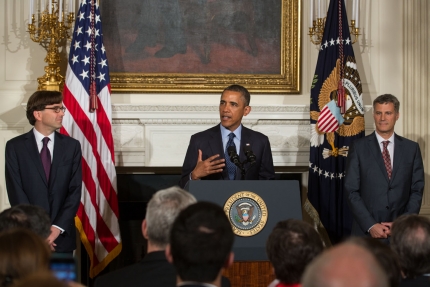
President Obama Nominates Jason Furman as Chairman of the Council of Economic Advisers

President Barack Obama announces his intent to nominate Jason Furman

President Barack Obama announces his intent to nominate Jason Furman, Principal Deputy Director of the National Economic Council, left, as the Chairman of the Council of Economic Advisers to succeed current CEA Chairman Alan Krueger, right, in the State Dining Room of the White House, June 10, 2013. (Official White House Photo by Chuck Kennedy)

This afternoon, President Obama nominated Jason Furman to replace Alan Krueger as the chairman of the White House Council of Economic Advisers.

Furman, 42, will bring a vast amount of economic experience to the role. In 2009, he joined the Obama administration as an Assistant to the President for Economic Policy and the Principal Deputy Director of the National Economic Council.

Furman previously worked at the Brookings Institute as a Senior Fellow in Economic Studies and Director of the Hamilton Project, the Council of Economic Advisers as a Staff Economist, and the World Bank as a Senior Adviser to the Chief Economist and Senior Vice President.

This is his second stint in the White House. Under President Clinton, Furman was a Special Assistant to the President for Economic Policy at the National Economic Council.

The President praised Furman’s work for the middle class, and urged Congress to confirm him quickly.

“When the stakes are highest, there’s no one I’d rather turn to for straightforward, unvarnished advice that helps me to do my job,” President Obama said. “[Furman] understands all the sides of an argument, not just one side of it. He’s worked tirelessly on just about every major economic challenge of the past four and a half years, from averting a second depression, to fighting for tax cuts that help millions of working families make ends meet, to creating new incentives for businesses to hire, to reducing our deficits in a balanced way that benefits the middle class.”

The White House

Office of the Press Secretary

Remarks by the President Nominating Jason Furman as Chairman of the Council of Economic Advisers

State Dining Room

2:14 P.M. EDT

THE PRESIDENT:  Good afternoon, all of you.  It’s now been nearly five years since an economic crisis and a punishing recession came together to cost far too many Americans their jobs, and their homes, and the sense of security that they had built up over time.  And by the time I took office, my team and I were facing bubbles that had burst; markets that had cratered; bank after bank on the verge of collapse.  And the heartbeat of American manufacturing, our auto industry, was flatlining.  And all this meant that hundreds of thousands of Americans were losing their jobs each month. So this was a scary time. And nobody had any idea where the bottom would be.

Four and a half years later, our businesses have created nearly 7 million new jobs over the past 36 months.  The American auto industry has come roaring back.  We’re producing more of our own energy, we’re consuming less that we import from other countries.  Our deficits are shrinking rapidly.  The cost of health care is slowing.  The housing market is rebounding.  People’s retirement savings are growing.  The wealth that was lost from that recession has now been recovered. 

All of this progress is a testament to the grit and resolve of the American people, most of all.  But it’s also due in some measurable way to the incredible dedication of the men and women who helped to engineer America’s response.  And two of those people are standing next to me, two very smart economists:  Alan Krueger and Jason Furman.

Today, I can announce that Alan is heading back to teach his beloved students at Michelle’s alma mater -- Princeton University.  When they get together all they can talk about is Princeton and they’re all very proud, and those of us who didn’t go to Princeton have to put up with it.  (Laughter.)  And I’m proud to say that Jason Furman has agreed to replace Alan as the Chairman of my Council of Economic Advisers.

During the crisis, Alan stepped in initially to help engineer our response as Assistant Secretary and chief economist at the Treasury Department.  He was so good that we then had to beg him to come back, extend his tour, to serve as the Chairman of my Council of Economic Advisers, where he’s been the driving force behind actions that we’ve taken to help restart the flow of lending to small businesses, and create new jobs, and arm workers with the skills they need to fill them, to reduce income inequality, to rebuild our aging infrastructure, and to bring down our deficits in a responsible way. 

And Alan is driven by the basic bargain at the heart of our economy -- the idea that hard work should be rewarded.  He’s motivated by the principle that no one who works full-time in the greatest nation on Earth should have to raise their families in poverty or below poverty levels.  His commitment to a rising, thriving middle class shines through in his often passionate presentations and -- at least for an economist they’re passionate.  (Laughter.)  And in the policies that he’s pushed, and I know this will continue to be a focus of his research. 

Alan’s wife and son are here today, and I know that they’re all looking forward to having Alan back.  (Laughter.)  And now that Alan has some free time, he can return to another burning passion of his -- “Rockonomics.”  The economics of rock and roll.  This is something that Alan actually cares about -- seriously, on Wednesday he’s giving a speech at the Rock and Roll Hall of Fame.  He’s got a t-shirt under his suit -- (laughter) -- with a big tongue sticking out.  (Laughter.)  Don’t show it.  (Laughter and applause.) 

So Alan has become one of my most trusted advisors.  He’s become a wonderful friend.  I’m sad to see him go.  But I know that he will continue to do outstanding work and, fortunately, he’ll still be available for us to consult with him periodically because he’s a constant font of good ideas about how we can further help the American people.  So thank you very much, Alan, for all the good work that you’ve done.  (Applause.)  

I’m also proud to nominate another outstanding economist to take his place.  Jason Furman is one of the most brilliant economic minds of his generation, don’t take my word for it -- you can talk to other economists who know a lot more than I do about it.  He’s won the respect and admiration from his peers across the political spectrum.  His Ph.D. thesis advisor, Greg Mankiw, chaired the Council of Economic Advisers under George W. Bush.  Nobel Prize Winner Joe Stiglitz, on the other side of the economic spectrum, hired Jason to work for the CEA under President Clinton.

After leaving President Clinton’s White House, Jason finished his Ph.D. in economics, quickly acquired a reputation as a world-class scholar and researcher.  But public service kept calling, and Jason kept answering that call because he believes deeply in it.  So from working at the World Bank on issues of inequality and international finance to developing new proposals to strengthen our health and retirement programs, he helped to shape some of our most important economic policy debates. 

And when I asked him to join my team in 2008, even though his baby daughter -- that’s right -- (laughter) -- you were this big -- had just been born, he agreed to serve once again.  And over the last five years I’ve come to trust not only his head, but also his heart, because Jason never forgets who it is that we’re fighting for:  middle-class families, folks who are working hard to climb their way into the middle class, the next generation. 

And when the stakes are highest, there's no one I'd rather turn to for straightforward, unvarnished advice that helps me to do my job.  He understands all sides of an argument, not just one side of it.  He's worked tirelessly on just about every major economic challenge of the past four and a half years, from averting a second depression, to fighting for tax cuts that help millions of working families make ends meet, to creating new incentives for businesses to hire, to reducing our deficits in a balanced way that benefits the middle class.

And so, Eve, Jason's wife, who is an accomplished writer herself, has put up with a lot of hours with Jason away.  Henry and Louisa, who are here, they've made a lot of sacrifices so that their husband and dad could be here working for the American people.  So I appreciate you guys for sharing daddy.  (Laughter.)  Just a little bit longer.  (Laughter.)  And the reason it's important is because while we've cleared away the rubble of crisis and laid a new foundation for growth, our work is nowhere near done. 

Even though the economy is growing, too many middle-class families still feel like they're working harder and harder and can't get ahead.  Inequality is still growing in our society.  Too many young people aren't sure whether they'll be able to match the living standards of their parents.  We have too many kids in poverty in this country still. 

There are some basic steps that we can take to strengthen the position of working people in this country, to help our economy grow faster, to make sure that it's more competitive.  And some of that requires political will.  Some of it requires an abiding passion for making sure everybody in this country has a fair shot.  But it also requires good economists.  I know it's called a dismal science, but I don’t find it that dismal.  (Laughter.)  I think it's actually pretty interesting.  Alan and Jason appreciate that.  (Laughter.)  So sometimes the rest of my staff thinks, oh, Obama is getting together with his economists and they're going to have a wonkfest for the next hour.  (Laughter.) 

But this stuff matters.  It's not just numbers on a page.  It makes a difference in terms of whether or not people get a chance at life, and also, how do we optimize opportunity and make sure that it -- we don’t have a contradiction between an efficient, growing, free-market economy, and one in which everybody gets a fair shot and where we're caring for the vulnerable and the disabled and folks in our society who need help.

So a growing economy that creates good middle-class jobs, that rewards hard work and responsibility, that’s our North Star.  Jason shares that focus.  I know Alan shares that passion.  And Jason's new role as the Chairman of the Economic -- Council of Economic Advisors, he'll be working with some of our country's leading economists, including Jim Stock, who has joined us.  And I'm relying on them to provide analysis and recommendations with just one thing in mind: What's going to do the most good for the most people in this country -- not what's best for a political party, not what's best for a special interest.  I don’t have another election.  It's not what's best for me -- what's best for our middle class, and everybody who is working hard to get there.  That’s what the American people deserve. 

So I would urge the Senate to swiftly confirm Jason Furman. And I want to, again, thank Alan for his outstanding service.  I want to thank Jason and his family for continuing to serve the country they love.  And for all the economists in the room, thank you for the occasionally under-appreciated work that you do.  (Laughter.)

Thank you.  (Applause.) 

END  
2:25 P.M EDT

President Obama Speaks on the Equal Pay Act

June 10, 2013 | 9:50 | Public Domain

President Obama delivers remarks commemorating the 50th anniversary of the Equal Pay Act.

Download mp4 (361MB) | mp3 (24MB)

Read the Transcript

Remarks by the President on the 50th Anniversary of the Equal Pay Act

East Room

11:53 A.M. EDT

THE PRESIDENT:  Thank you.  (Applause.)  Thank you, everybody.  Everybody have a seat.  Welcome to the White House.  It is wonderful to see all of you.  Thank you, Joe, for that kind introduction.  Thank you, Valerie, for the great leadership you’ve shown on this.  And to all of you -- business leaders and advocates, members of Congress, who are here, members of my administration -- I am so glad that all of you could be here to celebrate the 50th anniversary of the Equal Pay Act. 

When you think about it, we’re not just celebrating a law.  We’re honoring the heroes who made that law possible -- the fierce determination of Americans who saw a wrong and worked to right it.  There were women who were sick and tired of being sick and tired -- (laughter) -- of seeing the same jobs advertised with different pay scales.  Women who were tired of being treated like second-class workers.  Women like Dorothy Height and Congresswoman Edna Kelly -- (applause) -- and Esther Peterson, all who pushed to make the Equal Pay Act a reality. 

And, today, we recognize the work of those brave women.  But until equal pay truly is a reality, we’re also here to recommit ourselves to the work that remains to be done.

Fifty years ago today, President Kennedy signed the Equal Pay Act into law, right here in the White House.  He said it was basic to our democracy.  It’s the idea that all of us are created equal.  And as I said in my inaugural address this year, our journey to equality is not complete until our wives, our mothers, our daughters can earn a living equal to their efforts.

The day that the bill was signed into law, women earned 59 cents for every dollar a man earned on average.  Today, it’s about 77 cents.  So it was 59 and now it’s 77 cents.  It’s even less, by the way, if you’re an African American or a Latina.  So I guess that’s progress, but does anybody here think that’s good enough? 

AUDIENCE:  No!

THE PRESIDENT:  I assume everybody thinks we can do better.

AUDIENCE:  Yes!

AUDIENCE MEMBER:  We can.

THE PRESIDENT:  Yes, we can.  (Laughter and applause.)

Over the course of her career, a working woman with a college degree will earn on average hundreds of thousands of dollars less than a man who does the same work.  Now, that’s wrong.  I don’t want that for Malia and Sasha.  I don’t want that for your daughters.  I don’t want that to be an example that any child growing up ends up accepting as somehow the norm.  I want every child to grow up knowing that a woman’s hard work is valued and rewarded just as much as any man’s.

Now, what’s important to realize also, though, is this is not just an issue of fairness.  This is a family issue.  This is a middle-class issue.  This is an economic issue.  Just last week, a report confirmed what we already know:  that women are increasingly the breadwinners for American families.  Women are now the primary source of income for nearly 40 percent of American families.  Forty percent -- almost half. 

That’s not something to panic about, or to be afraid about  -– that’s a sign of the progress and the strides that we’ve made.  But what it does mean is that when more women are bringing home the bacon, they shouldn’t just be getting a little bit of bacon.  (Laughter.)  If they’re bringing home more of the income and that income is less than a fair share, that means that families have less to get by on for childcare or health care, or gas or groceries.  It makes it harder for middle-class families to save and retire.  It leaves small businesses with customers who have less money in their pockets -- which is not good for the economy.  That’s not a good example to set for our sons and daughters, but it’s also not a good recipe for long-term, stable economic growth.

So to anyone who says 77 cents on the dollar sounds pretty close to equal, I say, you’re math is bad.  (Laughter.)  You wouldn’t like it if your vote only counted in three out of four elections.  (Laughter.)  You wouldn’t like it if your daughters or sons went to school but they only got taught three out of four days a week, or four out of five days a week.  You wouldn’t like it if you were forced to work every fourth day without pay.  Men would be complaining about that.  (Laughter.)  They wouldn’t think that was equal or fair.

So this is the 21st century.  It’s time to close that gap.  That’s why the first bill I signed into law was the Lilly Ledbetter Fair Pay Act.  (Applause.)

That’s why, as Valerie mentioned, I created the first-ever White House Council on Women and Girls, which is working to close that gap.  (Applause.)  And Valerie’s council -- this council is doing a great job in bringing the experiences of women into our federal policies as well.

It’s why I established a National Equal Pay Task Force to help crack down on violations of equal pay laws, which, by the way, they’re doing at a record rate.  And, through education and outreach, they’re also helping employers develop tools to comply with the nation’s equal pay laws on their own.  And that’s why, earlier this year, I signed a presidential memorandum directing the federal government to close that gap for good for its employees.  (Applause.)  We have to set an example.

It’s also why we’re using the latest technology to help workers get the information they need to figure out if they’re underpaid.  And thanks to innovators like Rachel and Laquitta, who are up here, we can now say, “There’s an app for that.”  (Laughter.)   

But as long as this gap persists, we’re going to have more work to do.  And now is the time to keep up the work that all those trailblazers started 50 years ago.

Now is the time for Congress to step up and pass the Paycheck Fairness Act so women have better tools to fight for equal pay for equal work.  (Applause.)  

Now is the time for us to encourage more young women to pursue math and science education.  Now is the time for us to hire more STEM teachers so all our children are prepared for the high-tech, high-wage jobs of tomorrow. 

Now is the time to make sure businesses offer men and women the flexibility to be good employees and good parents.  And I really want to commend Deloitte and SumAll, and the CEOs who are with us here today, they are creating exactly the kinds of innovative workplaces that help hard-working Americans thrive, and they’re committed to pay equity.  And so when you have a chance to talk to Joe, say thank you.  And the CEOs who are out there, if you want a first-class company that is tapping into the talents and resources of all your employees, make sure that you’re putting in place systems so that they all feel like they’re being treated fairly and equally.  It’s a simple principle and it’s a powerful one.

And now is the time to make sure that we are putting in place a minimum wage that you can live on -- (applause) -- because 60 percent of those making the minimum wage are women. 

If we do all this -- and this will be part of our broader agenda to create good jobs and to strengthen middle-class security, to keep rebuilding an economy that works for everybody, that gives every American the chance to get ahead, no matter who you are or what you look like, or what your last name is and who you love. 

That’s what I’m going to keep on fighting for.  That’s what you’re going to keep on fighting for.  And we have all of you and your predecessors to thank for the incredible progress this country has made in eliminating the barriers and injustices that might keep our daughters from enjoying the same rights, same chances, and same freedoms as our sons.  I’m proud of you.

Thank you very much.  (Applause.)

END
12:02 P.M. EDT

Close Transcript