Bringing America’s Students into the Digital Age

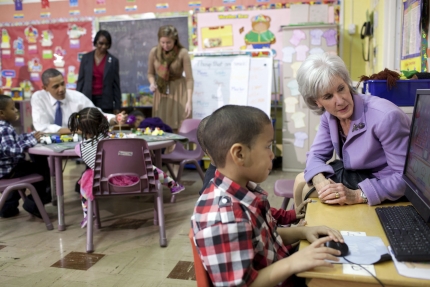
President Barack Obama views student projects created on laptops during a tour at Mooresville Middle School

President Barack Obama views student projects created on laptops during a tour at Mooresville Middle School in Mooresville, N.C., June 6, 2013 (Official White House Photo by Pete Souza)

Update: Read President Obama's remarks in Mooresville here

Today, in Mooresville, North Carolina the President is announcing a bold and transformative education initiative to breathe life into the classroom of the 21st century. The goal of the President’s ConnectED initiative is to bring high-speed Internet connections to 99 percent of America’s students – which he is calling on the FCC to do within five years.

This is not connectivity for connectivity’s sake. It is laying the foundation for a vision of classrooms where students are engaged in individualized digital learning and where teachers can assess progress lesson by lesson and day by day. It’s about creating learning environments where students can both succeed and struggle without embarrassment, where barriers for children with disabilities are removed, and where we can bring the most modern, innovative, and up-to-date content into the classroom.

Yet this national vision of the 21st Century classroom is impossible with the level of connectivity that most schools have today. Only 20 percent of educators feel their classrooms have the connectivity to meet their teaching needs today. In fact, the average school has about the same level of connectivity as the average home, even though the average school has 200 times more people. Thousands of schools don’t even have the bandwidth to stream two videos into their school at the same time - let alone provide the kind of opportunities that can be seen in Mooresville, where students in classroom after classroom are learning on their own individual digital devices.

The President understands that we have to take bold action if we are to offer our young people the best education in the world so they can compete for jobs in the global economy. South Korea, which tops global rankings in reading and math, already has 100 percent of schools with high-speed connectivity – and by 2016, its schools are planning on eliminating textbooks from the classroom altogether. We have to move with force and speed if we are to lead – not follow – on developing the best learning opportunities for our young people.

Cecilia Muñoz is the Director of the Domestic Policy Council. Gene Sperling is the Director of the National Economic Council.

Behind the Scenes: Honoring the Super Bowl Champion Baltimore Ravens at the White House

June 06, 2013 | 3:38 | Public Domain

President Obama honors the Super Bowl winning season of the Baltimore Ravens at the White House. Hear from team members in this look behind the scenes at the event.

Download mp4 (214.3MB)

What is ConnectED?

Ed. note: To highlight the importance of connected classrooms, the White House held a virtual "show and tell" with three schools that are embracing technology and digital learning. Watch the full hangout at wh.gov/show-and-tell

20111108 Head Start Announcement

President Barack Obama and Health and Human Services Secretary Kathleen Sebelius, right, talk with students while visiting a classroom at the Yeadon Regional Head Start Center in Yeadon, Pa., Nov. 8, 2011. (Official White House Photo by Pete Souza)

Preparing America’s students with the skills they need to get good jobs and compete with countries around the world relies increasingly on interactive, individualized learning experiences driven by new technology.

From digital textbooks that help students visualize and interact with complex concepts, to apps and platforms that adapt to the level of individual student knowledge and help teachers know precisely which lessons or activities are working, many schools are already seeing the benefits of digital learning and connectivity. This technology is real, it is available, and its capacity to improve education is profound.

But today, millions of students lack access to the high-speed broadband internet that supports this sort of learning technology. Fewer than 20 percent of educators across the country say their school’s Internet connection meets their teaching needs.

Although the United States was once a pioneer in connecting schools to the internet, we’re now falling behind while other nations move forward with aggressive investment in digital learning and technology education. In South Korea, for example, all schools have high-speed internet connections, and all teachers are trained in digital learning. Printed textbooks will be phased out by 2016.

The fact is, schools without internet access put our students at a disadvantage.

That’s why President Obama is unveiling a bold, new initiative called ConnectED, which will connect 99 percent of America’s students to the internet through high-speed broadband and high-speed wireless within 5 years.

The President also directed the federal government to make better use of existing funds to get Internet connectivity and educational technology into classrooms, and into the hands of teachers trained on its advantages. And he called on businesses, states, districts, schools and communities to support this vision, which requires no congressional action.

Here’s how ConnectED works:

The White House

Office of the Press Secretary

President Obama Unveils ConnectED Initiative to Bring America’s Students into Digital Age

Calls on FCC to leverage E-Rate program to have 99 percent of students connected within 5 years

WASHINGTON, DC — President Obama today unveiled a bold, new initiative called ConnectED to connect 99 percent of America’s students to the internet through high-speed broadband and high-speed wireless within 5 years, calling on the FCC to modernize and leverage its existing E-Rate program to meet that goal. The President also directed the federal government to make better use of existing funds to get Internet connectivity and educational technology into classrooms, and into the hands of teachers trained on its advantages.  And he called on businesses, states, districts, schools and communities to support this vision. This ambitious initiative does not require Congressional action.

“We are living in a digital age, and to help our students get ahead, we must make sure they have access to cutting-edge technology,” said President Obama. “So today, I’m issuing a new challenge for America – one that families, businesses, school districts and the federal government can rally around together – to connect virtually every student in America’s classrooms to high-speed broadband internet within five years, and equip them with the tools to make the most of it.”

Preparing America’s students with the skills they need to get good jobs and compete with countries around the world will rely increasingly on interactive, individualized learning experiences driven by new technology. But today, millions of students lack high-speed broadband access and fewer than 20 percent of educators say their school’s Internet connection meets their teaching needs. ConnectED will bring high-speed Internet within their reach, with a particular benefit for rural communities that have lagged behind in connectivity.

In addition to connecting America’s students, ConnectED harnesses the ingenuity of the American private sector get new technologies into students’ hands and support digital learning content.

ConnectED also better invests existing federal funds to ensure that every educator in America receives support and training in using education technology tools to improve student learning. For more details on the ConnectED initiative, click HERE.

The ambitious new vision for digital, connected learning builds on work the Administration has done over the past four years to increase broadband access across the country.

The White House

Office of the Press Secretary

Statement by NSC Spokesperson Caitlin Hayden on Deputy National Security Advisor Tony Blinken’s Meeting with Bahraini Crown Prince and First Deputy Prime Minister Prince Salman bin Hamad Al-Khalifa

President Obama joined Deputy National Security Advisor Tony Blinken’s meeting today with Bahraini Crown Prince and First Deputy Prime Minister Prince Salman bin Hamad Al-Khalifa.  The President reaffirmed the importance of the United States’ partnership with Bahrain and our commitment to further strengthening the ties between our two countries.  The President congratulated the Crown Prince on his appointment as First Deputy Prime Minister, and wished him success in this new role.

The President emphasized U.S. support for Bahrain’s stability and security, and stressed that meaningful reform, dialogue, and respect for universal human rights is the best path to achieving the peace and security that all Bahraini citizens deserve.  The President conveyed the United States’ firm support for Bahrain’s National Dialogue, launched by King Hamad bin Isa Al-Khalifa, and noted that the United States continues to encourage all sides to engage constructively to achieve progress.  The President commended the Crown Prince’s commitment to advancing reform in Bahrain, and underscored that the United States will continue to support these efforts.  A photo of the meeting can be found HERE.

President Obama Makes a National Security Personnel Announcement

June 05, 2013 | 23:58 | Public Domain

President Obama announces that after more than four years overseeing the work of the National Security Council, Tom Donilon will depart in July as National Security Advisor and will be succeeded by Susan Rice. Ambassador Rice will be succeeded by Samantha Power as the next U.S. Ambassador to the United Nations, pending Senate confirmation.

Download mp4 (884MB) | mp3 (58MB)

Read the Transcript

Remarks by the President in Personnel Announcement

Rose Garden

2:17 P.M. EDT

THE PRESIDENT:  Thank you, everybody.  (Applause.)  Thank you.  Please, everybody have a seat.  Well, good afternoon.  It is a beautiful day, and it's good to see so many friends here. 

Of all the jobs in government, leading my national security team is certainly one of the most demanding, if not the most demanding.  And since the moment I took office, I've counted on the exceptional experience and insights of Tom Donilon.  Nearly every day for the past several years I've started each morning with Tom leading the presidential daily brief, hundreds of times, a sweeping assessment of global developments and the most pressing challenges.  As my National Security Advisor his portfolio is literally the entire world. 

He has definitely advanced our strategic foreign policy initiatives while at the same time having to respond to unexpected crises, and that happens just about every day.  He's overseen and coordinated our entire national security team across the government, a Herculean task.  And it's non-stop -- 24/7, 365 days a year.

Today, I am wistful to announce that after more than four years of extraordinary service, Tom has decided to step aside at the beginning of July.  And I am extraordinarily proud to announce my new National Security Advisor, our outstanding Ambassador to the United Nations, Susan Rice -- (applause) -- as well as my nominee to replace Susan in New York, Samantha Power.  (Applause.) 

When I first asked Tom to join my team, I knew I was getting one of our nation's premier foreign policy leaders, somebody with a deep sense of history and a keen understanding of our nation's place in the world.  He shared my view that in order to renew American leadership for the 21st century, we had to fundamentally rebalance our foreign policy.  And more than that, he knew how we could do it.

See, Tom is that rare combination of the strategic and the tactical.  He has a strategic sense of where we need to go, and he has a tactical sense of how to get there.

Moreover, Tom’s work ethic is legendary.  He began his public service in the Carter White House when he was just 22 years old -- and, somehow, he has been able to maintain the same drive, and the same stamina, and the same enthusiasm and reverence for serving in government.  He has helped shape every single national security policy of my presidency -- from forging a new national security strategy rooted in our economic strength here at home to ending the war in Iraq.  Here at the White House, Tom oversaw the operation that led us to bin Laden.  He’s helped keep our transition on track as we wind down the war in Afghanistan.

At the same time, Tom has played a critical role as we’ve bolstered the enduring pillars of American power -- strengthening our alliances, from Europe to Asia; enhancing our relationship with key powers; and moving ahead with new trade agreements and energy partnerships.  And from our tough sanctions on Iran to our unprecedented military and intelligence cooperation with Israel -- (baby cries) -- it’s true --  (laughter) -- from New START with Russia to deeper partnerships with emerging powers like India, to stronger ties with the Gulf states, Tom has been instrumental every step of the way.

I’m especially appreciative to Tom for helping us renew American leadership in the Asia Pacific, where so much of our future security and prosperity will be shaped.  He has worked tirelessly to forge a constructive relationship with China that advances our interests and our values.  And I’m grateful that Tom will be joining me as I meet with President Xi of China this week.

And finally, Tom, I am personally grateful for your advice, for your counsel, and most of all for your friendship.  Whenever we sit down together -- whether it’s in the Oval Office or the Situation Room -- I do so knowing that you have led a rigorous process:  that you’ve challenged assumptions, that you’ve asked the tough questions, that you’ve led an incredibly hard-working national security staff, and presented me with a range of options to advance our national interests.  A President can’t ask for anything more than that, and this is a testament to your incredible professionalism, but also your deep love of country.

I know that this relentless pace has meant sacrifices for your family -- for Cathy, who is here, Dr. Biden’s former Chief of Staff, who I was proud to nominate as our new Global Ambassador for Women; and for Tom and Cathy’s wonderful children, Sarah and Teddy.  So today, I want to publicly thank all the Donilons for their abiding commitment to public service that runs through the family.  (Applause.)

You’ve been with me every step of the way these past four years, and the American people owe you an enormous debt of gratitude for everything that you’ve done.  You’ve helped to restore our nation’s prestige and standing in the world.  You’ve positioned us well to continue to lead in the years ahead.  I think that Tom Donilon has been one of the most effective national security advisors our country has ever had, and he’s done so without a lot of fanfare and a lot of fuss.  So, Tom, on behalf of us all, thank you for your extraordinary service.  (Applause.)

Now, I am proud that this work will be carried on by another exemplary public servant -- Ambassador Susan Rice.  (Applause.)  Susan was a trusted advisor during my first campaign for President.  She helped to build my foreign policy team and lead our diplomacy at the United Nations in my first term.  I’m absolutely thrilled that she’ll be back at my side, leading my national security team in my second term.

With her background as a scholar, Susan understands that there is no substitute for American leadership.  She is at once passionate and pragmatic.  I think everybody understands Susan is a fierce champion for justice and human dignity, but she’s also mindful that we have to exercise our power wisely and deliberately.

Having served on the National Security Council staff herself, she knows how to bring people together around a common policy and then push it through to completion -- so that we’re making a difference where it matters most, here in the country that we have pledged to defend, and in the daily lives of the people we’re trying to help around the world.

Having served as an Assistant Secretary of State, she knows our policies are stronger when we harness the views and talents of people across government.  So Susan is the consummate public servant -- a patriot who puts her country first.  She is fearless; she is tough.  She has a great tennis game and a pretty good basketball game.  (Laughter.)  Her brother is here, who I play with occasionally, and it runs in the family -- throwing the occasional elbow -- (laughter) -- but hitting the big shot. 

As our Ambassador to the U.N., Susan has been a tireless advocate in advancing our interests.  She has reinvigorated American diplomacy, in New York.  She has helped to put in place tough sanctions on Iran and North Korea.  She has defended Israel.  She has stood up for innocent civilians, from Libya to Cote d’Ivoire.  She has supported an independent South Sudan.  She has raised her voice for human rights, including women’s rights. 

Put simply, Susan exemplifies the finest tradition of American diplomacy and leadership.  So thank you, Susan, for being willing to take on this next assignment.  I'm absolutely confident that you're going to hit the ground running.  And I know that after years of commuting to New York while Ian, Jake and Maris stayed here in Washington, you will be the first person ever in this job who will see their family more by taking the National Security Advisor's job.  (Applause.) 

Now, normally I'd be worried about losing such an extraordinary person up at the United Nations and be trying to figure out how are we ever going to replace her.  But fortunately, I'm confident we've got an experienced, effective and energetic U.N. ambassador-in-waiting in Samantha Power.

Samantha first came to work for me in 2005, shortly after I became a United States senator, as one of our country's leading journalists; I think she won the Pulitzer Prize at the age of 15 or 16.  One of our foremost thinkers on foreign policy, she showed us that the international community has a moral responsibility and a profound interest in resolving conflicts and defending human dignity.

As a senior member of my national security team, she has been a relentless advocate for American interests and values, building partnerships on behalf of democracy and human rights, fighting the scourge of anti-Semitism and combatting human trafficking.  To those who care deeply about America’s engagement and indispensable leadership in the world, you will find no stronger advocate for that cause than Samantha.

And over the last four years, Samantha has worked hand-in-glove with Susan in her role because Samantha has been the lead White House staffer on issues related to the United Nations.  And I'm fully confident she will be ready on day one to lead our mission in New York while continuing to be an indispensable member of my national security team. 

She knows the U.N.'s strengths.  She knows its weaknesses.  She knows that American interests are advanced when we can rally the world to our side.  And she knows that we have to stand up for the things that we believe in.  And to ensure that we have the principled leadership we need at the United Nations, I would strongly urge the Senate to confirm her without delay.

So, Samantha, thank you.  To Cass, and you, and Declan and Rian for continuing to serve our country. 

This team of people has been extraordinarily dedicated to America.  They have made America safer.  They have made America's values live in corners of the world that are crying out for our support and our leadership.  I could not be prouder of these three individuals -- not only their intelligence, not only their savvy, but their integrity and their heart. 

And I'm very, very proud to have had the privilege of working with Tom.  I'm very proud that I'll continue to have the privilege of working with Samantha and with Susan. 

So with that, I'd invite Tom to say a few words.  Tom.  (Applause.) 

MR. DONILON:  Thank you, Mr. President.  You mentioned the many hours that we’ve worked together in the Situation Room, put together here by John Kennedy and without windows.

THE PRESIDENT:  No windows.

MR. DONILON:  No windows.  So I would first like to thank you for this rare opportunity to be outside and experience the natural light.  (Laughter.) 

You also mentioned how I began my public service here under President Carter in 1977 when I was 22 years old.  And I still remember leaving at the end of the day, walking up West Executive Drive, past the office of then-National Security Advisor Zbigniew Brzezinski, and looking up at the windows of the White House -- the light is always on in Zbig’s office, no matter how late.  And I’d think to myself, don’t those guys ever go home?  And now, these many years later, I finally have the answer -- no, they don’t go home very much, at least not as often or as early as their spouses and families would like.

Mr. President, to serve in this capacity where we’ve had the opportunity to protect and defend the United States, to improve the position of the United States in the world, has been the privilege of a lifetime.  To serve during your presidency, however, is to serve during one of the defining moments in our nation’s history.  This is because of your vision, your principled leadership, your commitment to defending our interests and upholding our ideals.

Those many hours of meetings and briefings have given me the opportunity to see you as few people do:  behind closed doors, away from the cameras, when a leader’s character is revealed.  And with your permission, I’d like to take this opportunity to share a little bit of what I’ve seen.

First, I’ve seen you make the most difficult decisions a Commander-in-Chief can make -- the decision to send our men and women in uniform into harm’s way.  I’ve seen the great care with which you have weighed these grave decisions and I’ve seen your devotion to the families of our men and women in uniform.

I have seen your fierce patriotism, your love of our country.  When confronted with competing agendas and interests, you always bring the discussion back to one question:  What’s in the national interest, what’s best for America?  I’ve seen your abiding commitment to the core values that define us as Americans, our Constitution, civil liberties, the rule of law.  Time and time again, you have reminded us that our decisions must stand up to the judgment of history.

Finally, Mr. President, I’ve seen you represent the United States around the world and what you mean to the people around the world when you represent our country.  When you step off that plane with the words, “United States of America”, when you reach out to foreign audiences and speak to the basic aspirations we share as human beings, you send a clear message that America wants to be their partner.  And that ability to connect, to forge new bonds, is a form of American power and influence that advocates our interests and ideals as well.

To Vice President Biden and Jill, Cathy and I have considered you dear friends for more than 30 years, and it has been an honor to make this journey with you.

To my colleagues and friends here at the White House and across the government, the American people will never truly know how hard you work in their defense.

To my long-time partners in the senior leadership of the National Security Council -- Denis McDonough, John Brennan, Tony Blinken, Lisa Monaco, Mike Froman, Ben Rhodes, and Brian McKeon.  I could not have asked for better brothers or sisters in this effort. 

To you and all our remarkable national security staff, you're a national treasure.  And every day you get up, you come here -- you devote your days to keeping our country secure.  You are the best our nation has to offer, and it's been an honor and a privilege to serve with each and every one of you.  And I'm glad so many of you are here today.  (Applause.)

And to my friends and colleagues -- Susan and Sam -- congratulations, the nation is fortunate to have leaders of your intellect, compassion, character, and determination.  Susan, you'll be an outstanding National Security Advisor.  Sam, you'll be an outstanding Ambassador to the United Nations.  And we really appreciate your willingness to do this.  (Applause.)

Finally, and most importantly, to Cathy, Sarah and Teddy -- as the President said, this job has meant great sacrifices for you.  And each of you in your way has made a contribution to the country.  And I could not be more grateful.

So again, Mr. President, thank you for the opportunity -- the extraordinary opportunity to serve you and to serve our nation.  I stand here -- 36 years ago, almost to the day when I first came on the 18 acres of the White House to come to work, and I must tell you I leave this position much less cynical and never more optimistic about our country and its future.  Thank you very much, Mr. President.  (Applause.)

Susan.

AMBASSADOR RICE:  Mr. President, thank you so much.  I'm deeply honored and humbled to serve our country as your National Security Advisor.  I'm proud to have worked so closely with you for more than six years.  And I'm deeply grateful for your enduring confidence in me.

As you've outlined, we have vital opportunities to seize and ongoing challenges to confront.  We have much still to accomplish on behalf of the American people.  And I look forward to continuing to serve on your national security team to keep our nation strong and safe. 

Tom, it's been a real honor to work with you again.  You have led with great dedication, smarts, and skill, and you leave a legacy of enormous accomplishment.  All of us around the principals’ table will miss you.  And I wish you and Cathy, and your family, all the very best. 

Above all, I want to thank my own wonderful family for their unfailing support -- my mother, Lois; my wonderful husband, Ian; our children Jake and Maris; and my brother, John, have all been my strength and my greatest source of humor.  I'm also thinking today about my late father, who would have loved to be here.  I'm forever grateful to my family for their love and sacrifice. 

I want to thank my remarkable colleagues at the U.S. Mission to the United Nations.  I am so proud of the work we've done together under your leadership, Mr. President, to advance America's interests at the United Nations. 

And, Samantha, my friend -- warmest congratulations.  You're a tremendous colleague, and the United States will be extremely well served by your leadership at the United Nations.  And I'm so glad we get to continue to work together.

Mr. President, having participated in the national security decision-making process over the last four years, I admire the exemplary work done every day by our colleagues at State, Defense, the intelligence community, and across the government to make our nation more secure.  I look forward to working closely with you, your extraordinary national security team, our country's most experienced leaders from both parties, and your superb national security staff to protect the United States, advance our global leadership, and promote the values Americans hold dear.

Thank you very much. 

Sam.  (Applause.) 

MS. POWER:  Thank you, Mr. President.  From the day I met you and you told me that you had spent a chunk of your vacation reading a long, dark book on genocide -- (laughter) -- I knew you were a different kind of leader, and I knew I wanted to work for you.

It has been my privilege here at the White House to serve you, and it would be the honor of a lifetime to fight for American values and interests at the United Nations.  Now that I have two small children, Declan and Rian -- somewhere -- the stakes feel even higher. 

Thank you, Tom and Susan.  I consider myself immensely fortunate these last four years to have collaborated with both of you.  There are two no more dedicated professionals on this Earth, no more strategic stewards of our foreign policy than these two individuals.  And I'm honored and immensely humbled to share the stage with you. 

I moved to the United States from Ireland when I -- with my parents, who are here -- when I was 9 years old.  I remember very little about landing in Pittsburgh, except that I was sure I was at the largest airport in the history of the world.  I do remember what I was wearing -- a red, white and blue stars and stripes t-shirt.  It was the t-shirt I always wore in Ireland on special occasions. 

Even as a little girl with a thick Dublin accent who had never been to America, I knew that the American flag was the symbol of fortune and of freedom.  But I quickly came to learn that to find opportunity in this country, one didn’t actually need to wear the flag, one just needed to try to live up to it.

For the next three months, I came home from school every day, as my mother can attest, my dad can attest, and I sat in front of the mirrors for hours, straining to drop my brogue so that I, too, could quickly speak and be American. 

Not long ago, my husband, Cass Sunstein, came across a letter written toward the end of World War II by his father, Dick Sunstein, who was a Navy lieutenant.  Dick had happened to stop briefly in San Francisco after his two years fighting for this country in the Pacific, and he wrote to his family on April 25th, 1945, the very day that the nations of the world were coming together in San Francisco to establish the new United Nations. 

And in this letter to my mother-in-law, who I never had the chance to meet, he wrote, excitedly, “Conference starts today.  The town is going wild with excitement.  It is a pleasure to be here for the opening few days.  Let’s pray that they accomplish something.” 

Let’s pray that they accomplish something.  The question of what the United Nations can accomplish for the world and for the United States remains a pressing one.  I have seen U.N. aid workers enduring shellfire to deliver food to the people of Sudan.  Yet I’ve also see U.N. peacekeepers fail to protect the people of Bosnia.  As the most powerful and inspiring country on this Earth, we have a critical role to play in insisting that the institution meet the necessities of our time.  It can do so only with American leadership.

It would be an incomparable privilege to earn the support of the Senate and to play a role in this essential effort, one on which our common security and common humanity depend.  Thank you.  (Applause.)

THE PRESIDENT:  Thank you, everybody.  (Applause.)

END
2:41 P.M. EDT

Close Transcript

President Obama Honors Superbowl XLVII Champion Baltimore Ravens

June 05, 2013 | 10:08 | Public Domain

President Obama welcomes the Baltimore Ravens to the White House.

Download mp4 (371MB) | mp3 (25MB)

Read the Transcript

Remarks by the President Congratulating the Super Bowl Champion Baltimore Ravens

South Lawn

12:11 P.M. EDT

THE PRESIDENT:  Hello, everybody!  Welcome to the White House.  (Applause.)  And welcome to the Super Bowl Champion -- world champion -- Baltimore Ravens.  (Applause.)  Everybody can have a seat.  That’s why we set up chairs.  (Laughter.)

Now, I suspect that these guys are wondering, what kind of introduction is that?  No smoke machine.  (Laughter.)  No fire cannons.  Obama didn’t even tear up chunks of turf and rub them on his suit.  (Laughter.)  That reminds me, by the way -- please don’t do that on the South Lawn.  (Laughter.) 

I want to congratulate Coach John Harbaugh, an outstanding coach; and general manager, Ozzie Newsome, outstanding general manager.  (Applause.)  I know there’s some very proud Ravens fans in the house today, including -- you got the entire delegation from Maryland here, and they’re a little puffed up.

I notice, though, I’m the only one wearing purple.  (Laughter.)  Some of you guys didn’t get the memo. 

Now, I imagine there were times last year when these players were the only ones who knew that they’d make it here to show off this trophy.  Because, during the year, they lost player after player to injury; they dropped four of their last five regular season games.  In the playoffs, they trailed Denver by a touchdown with 70 yards and less than a minute to go.  And I still don’t know how -- well -- (laughter).  And then, in the Super Bowl, just when it looked like they had the momentum, the lights went out for a half hour.  (Laughter.) 

But these Ravens always pulled through.  In that playoff game against the Broncos, Jacoby Jones -- (applause) -- those are all fans of “Dancing with the Stars” -- (laughter) -- he slipped behind the defense to catch a Joe Flacco Hail Mary to force overtime.  I’m trying to figure out whether he was doing the Two-Step or the Fox Trot.  But somehow he got open and Joe got him the ball.

And then in the Super Bowl, after the lights came back on and the 49ers came storming back, this team’s defense -- the pride and joy of Baltimore -- stopped a fierce offense four straight times inside the 10-yard line.  One of the most dramatic goal-line stands in Super Bowl history.  (Applause.)

Joe was named the game’s MVP.  Where’s Joe?  There he is.  (Applause.)  Good timing with that contract up.  (Laughter.)  That was some good timing.  (Laughter.)  Capped off one of the greatest post-seasons ever by a quarterback -- more than 11,000 passing yards, 11 touchdowns, no interceptions.  I don't know about you, Joe, but I would say that qualifies as [elite].  (Laughter.)  And I’d say that if you keep on playing like that, you’re going to challenge Biden for the most popular person from Delaware.  (Laughter.)

After the Super Bowl, Joe said, “The win was representative and symbolic of our city.  We’re a blue-collar city, and I know that we had to keep grinding it out.”

You see that same attitude, great pride but humility in Coach Harbaugh, a guy who responds to all the attention he got for coaching against his brother in the Super Bowl by saying, “This isn’t exactly Churchill and Roosevelt, just a couple of football coaches coming together.”

You see that grit in team advisor O.J. Brigance, a former Raven whose courageous fight against ALS is an inspiration to Americans all across the country.  (Applause.)

You see the resilience in players like Torrey Smith -- (applause) -- who lost his younger brother in a motorcycle accident the night before the game against the Patriots, but Torrey wanted to play, and he responded with 127 yards and two scores, so we’re so proud of Torrey.  (Applause.)

And then, of course, you can't think about Baltimore without thinking of Ray Lewis and Ed Reed -- (applause) -- two of the greatest defenders who ever played the game.  Now, these two won’t be wearing purple next year.  Everybody is going to have to get used to that.  It’s welcome news for quarterbacks. 

Ray retired on top, coming back from a triceps injury, which I believe was caused by that dance he does.  (Laughter.)

TEAMMATE:  You got to do that --

THE PRESIDENT:  But -- no, I’m not doing that dance.  (Laughter.)  It caused him to miss most of the regular season.

Ed sprained ligaments in both of his knees during the Super Bowl, but he still made the game’s only interception.  And before he left Houston, where he’ll be playing next year, Ed took out a full-page ad in the Baltimore Sun to thank Ravens fans, saying, “I have such deep love for all of you.”  (Applause.)  So that's a class act.  Thank you. 

I will point out, by the way, that Ed is getting some gray hair, though.  (Laughter.)  I’m not the only one.  (Laughter.)  Huh?  You’re like an old man.  (Laughter.) 

MR. REED:  You know what they’ll do to you. 

THE PRESIDENT:  I’m telling you.  That makes me feel better.  (Laughter.)  I thought I was the only guy.  No.  All right. 

But that's the spirit of the entire team.  Last year, this team donated more than $1 million to charitable causes.  They helped young people get active through the Play 60 campaign.  Over Thanksgiving, they Skyped with a Maryland National Guard unit stationed in Afghanistan.  Later this month, Coach Harbaugh will host a youth football clinic that emphasizes player safety and proper tackling technique. 

And today, I’m proud to announce that the Ravens will be donating brand new uniforms for varsity football and girls’ basketball teams at public schools all across Baltimore -- that’s a total of 42 teams.  (Applause.)  We’re glad to have some high school athletes from Baltimore here to celebrate with us here today.

So this year, Baltimore won’t just be seeing the Ravens on Sundays or Monday night or Thursday night.  You’ll see their impact in high schools under Friday night lights.  And that’s a testimony to the connection they feel to this city. 

You’ll see players spending their Tuesdays -- normally their only day off during the season -- visiting hospitals and schools and senior centers, and day after day, you’ll see a team that loves Baltimore as much as Baltimore loves the Ravens.  So I want to thank all of you for the good work that you’re doing. 

Congratulations again on your Super Bowl Championship.  Best of luck next season -- you’re going to need it in week 11 when you go to my hometown of Chicago to play the Bears.  (Applause.)  I brought some Chicago fans in here.  (Applause.)  Just so we weren’t overwhelmed -- (laughter) -- and keep things in proper perspective.  But with that, I would like to have Ozzie Newsome and Coach Harbaugh come up and just say a few words, and then I’m going to get my spiffy jersey.  (Laughter and applause.)

END
12:20 P.M. EDT

Close Transcript

The White House

Office of the Press Secretary

President Obama Announces Another Key Administration Post

WASHINGTON, DC – Today, President Barack Obama announced his intent to nominate the following individual to a key Administration post:

  • Howard A. Husock – Member, Board of Directors of the Corporation for Public Broadcasting 

President Obama announced his intent to nominate the following individual to a key Administration post:

Howard A. Husock, Nominee for Member, Board of Directors of the Corporation for Public Broadcasting

Howard A. Husock is Vice President for Policy Research at the Manhattan Institute, which he joined in 2006.  He also directs the Institute’s Social Entrepreneurship and Philanthropy Initiative.  From 1987 to 2006, Mr. Husock served as Director of Case Studies in Public Policy and Management at the John F. Kennedy School of Government at Harvard University, where he was also a research fellow at the Hauser Center for Nonprofit Organizations from 2005 to 2006.  In 1989, he was a Fellow in the Media Studies Project at the Woodrow Wilson International Center for Scholars, and from 1981 to 1982, he was a Mid-Career Fellow at the Woodrow Wilson School of Public and International Affairs at Princeton University.  From 1979 to 1986, he worked as a producer, director, and reporter at WGBH Boston, where he received three Emmy Awards and the Robert F. Kennedy Journalism Award.  Since 1998, he has been a Contributing Editor to City Journal.  Mr. Husock received a B.S. in Journalism from Boston University.

The White House

Office of the Press Secretary

President Obama Announces More Key Administration Posts

WASHINGTON, DC – Today, President Barack Obama announced his intent to nominate the following individuals to key Administration posts:

  • Thomas Carper – Director, Amtrak Board of Directors
  • Avi Garbow – General Counsel, Environmental Protection Agency

President Obama said, “These dedicated and accomplished individuals will be valued additions to my Administration as we tackle the important challenges facing America. I look forward to working with them in the months and years ahead.”

President Obama announced his intent to nominate the following individuals to key Administration posts:

Thomas Carper, Nominee for Director, Amtrak Board of Directors

Thomas Carper served as a Director of the Amtrak Board of Directors, from March 2008 to March 2013.  In 2009, he was elected Chairman of the Board.  From 2003 to 2010, Mr. Carper served as Regional Director of the West Central Region for Opportunity Returns, an Illinois economic development program. From 1991 to 2003, he served three terms as the Mayor of Macomb, Illinois. From 2000 to 2001, Mr. Carper was appointed by the Amtrak Board of Directors to serve as Chair of the Amtrak Mayors’ Advisory Council.  Prior to his first election in 1991, he was a bar and nightclub owner in Macomb, and he served in the U.S. Army in Vietnam and Thailand from 1967 to 1970.  Mr. Carper received a B.A. from Western Illinois University.

Avi Garbow, Nominee for General Counsel, Environmental Protection Agency

Avi Garbow is currently the Deputy General Counsel at the Environmental Protection Agency (EPA), a role he has held since September 2009.  Prior to this, he worked at Cohen Milstein Sellers & Toll PLLC from 2005 to 2009, most recently as a partner, and from 2002 to 2005 he served at Wilmer Cutler Pickering Hale and Dorr LLP, most recently as a junior partner.  Prior to that, Mr. Garbow was a trial attorney with the Department of Justice from 1995 to 2002, where he worked in both the Environmental Crimes and Wildlife and Marine Resources Sections.  From 1992 to 1995, he was an attorney and Special Assistant to the Assistant Administrator for Enforcement and Compliance Assurance at EPA.  Mr. Garbow received a B.A. from the University of Michigan, and a M.A. and J.D. from the University of Virginia. 

The White House

Office of the Press Secretary

Press Briefing by Press Secretary Jay Carney, 6/5/2013

James S. Brady Press Briefing Room

1:15 P.M. EDT
 
MR. CARNEY:  Good afternoon, ladies and gentlemen.  Thanks for being here today, on another glorious day.  And fortunately, we will all be outside soon.  We need a hard stop -- I'm looking at my friend from the Associated Press -- at 2:00 p.m. so that people can get out to the Rose Garden for the announcement the President is making from there at 2:15 p.m.  Because of that, I will refrain from opening statements and go straight to questions.
 
Yes, sir.
 
Q    Thanks, Jay.  Are you concerned at all that by selecting Susan Rice that it will be more fuel in the debate over Benghazi, just as the White House is trying to look at other things other than that issue?
 
MR. CARNEY:  Not at all.  Let me say a couple of things.  Ambassador Rice is one of the most qualified and experienced experts in the field of foreign policy in the country.  She has served with distinction as U.S. Ambassador to the United Nations. She has served in various capacities in the National Security Council and at the State Department.  She is extremely smart, she’s extremely experienced, and she is extremely tough.  And she has been a principal on the President’s foreign policy team throughout his presidency and as a foreign policy advisor prior to that.
 
When it comes to Benghazi, I would say a couple of things.  First, what we learned through the revival of this story and the release of emails and talking points was what we had said all along, which is that Ambassador Rice went out to the Sunday shows and conveyed what was the intelligence community’s best assessment of what had happened in Benghazi at the time.  It is fully apparent from any fair review of the talking points and their evolution that that was the case.  The one factual issue that was ever a matter of dispute and concern was clearly drafted by the intelligence community -- and I would point you to statements by the DNI Director and the Director of the CIA and Deputy Director of the CIA to back that up.
 
So finally I would say that we've seen an enormous amount of positive reaction to the President’s decision to make Ambassador Rice his National Security Advisor, and that includes we've also seen statements from Senators McCain and Graham and Ayotte, who obviously have played a role in the discussions about the Benghazi talking points, saying that they will be working with her as National Security Advisor.  So we think -- we're very pleased by that and by the reception to this announcement that we're seeing today.
 
Q    Both Ambassador Rice and Samantha Power have had a major role when it comes to Syria.  Do their selections signal a desire to move the ball forward at all on that issue?
 
MR. CARNEY:  Well, I would say a couple of things.  Both Samantha Power and Ambassador Rice have been advisors to the President on national security matters throughout his time as President -- or almost throughout it, since Samantha left the National Security Council at the end of the first term.  But the fact of the matter is the President wants and expects the principals on his national security team to have strongly held views that they express in meetings with him.  That's why he has a strong Secretary of Defense, a strong CIA Director, a strong Secretary of State -- which was obviously the case in his first term as well.
 
But ultimately, it is the President of the United States who assesses the views of his foreign policy team when there are issues to be debated, and then he makes the decision.  So I would simply say that the President's policy on Syria will be the President's policy as it is today.
 
Q    And, Jay, there is a new poll out from NBC that says 58 percent of Americans still think that the country is in recession.  Why do you think so many Americans are not feeling some of the progress that the White House has described in terms of the housing market, jobs and other things?
 
MR. CARNEY:  Because we still have so much work to do.  One of the things you hear from the President all the time, one of the things you will hear from the President as he makes another stop on his Middle-Class Jobs and Opportunity Tour is that we need to keep at the business of helping this recovery along. 
 
We have come a long way from the worst recession since the Great Depression.  We have seen sustained economic growth and sustained job creation.  But we are not where we need to be yet. Too many Americans are out of work still.  Too many middle-class Americans are struggling to get by.  Even those who have work are still worried about how they're going to pay for their children's education, how they're going to care for their elderly parents. 
 
That’s why we need to make the kinds of investments that the President wants to make, and made clear both in his budget and in his State of the Union address, because this economy needs to continue to grow.  And we need to make the right choices when it comes to economic policy to ensure that we are strengthening and expanding the middle class. 
 
And I think the President has made clear since the day he took office in 2009 that this has been his number-one priority.  And he made clear at the beginning of this year in his State of the Union address and in the presentation of his budget and in a series of events since then that the economy and the need to have it continue to grow, the need to make investments that create jobs and spur economic growth, remains his top priority.
 
Yes.
 
Q    I wanted to ask about the timing of this transition.  As you know, it comes right before Tom Donilon was to depart for these meetings, these foreign meetings with China and the G8, Africa.  I'm curious to know whether Tom Donilon in his meetings with Chinese officials leading up to this visit told them, look, I'm only going to be around until July.
 
MR. CARNEY:  Well, let me correct a little bit of an impression that might have been left from your question.  Mr. Donilon, Tom Donilon is not leaving until the end of this month. He will be participating in the meetings that the President will be having with the Chinese President precisely because Tom has been so key in the formulation of the President's foreign policy and in the rebalancing effort towards Asia that has been a cornerstone of the President's foreign policy. 
 
As I think has been reported, and I can say that it's accurate, that the President began discussing with Tom Tom’s desire to transition out of this job after the election.  And the President asked him to stay precisely because he had a series of transition moments with the appointment of a new Secretary of Defense and a new Secretary of State, and his new CIA Director, but also some key foreign policy matters that he wanted Tom by his side as he dealt with them, and that includes this upcoming meeting with the Chinese President.
 
Q    What challenges does this transition pose at this time, given that the key architect of the President’s policy on China is leaving just ahead of --
 
MR. CARNEY:  Well, I think this will be a very smooth transition, as you will hear from the President when he announces it today.  This is a process that will take place over the course of roughly a month.  And in Ambassador Rice we are having someone take over as National Security Advisor who has been a principal on the President’s foreign policy team from day one and even prior to his election to the presidency.  So that will be seamless.  And we will have in Samantha Power someone who has also been a major player on the National Security Council for the President and an advisor to then-Senator Obama, dating back to 2005 on foreign policy issues. 
 
So I think this will be a very smooth transition, and the President is enormously gratified that Ambassador Rice and Samantha Power have agreed to take these positions on because he has for so long depended on their advice and counsel.
 
Q    Is the President girding for a contentious confirmation hearing for Samantha Power?
 
MR. CARNEY:  We would not expect one.  Obviously, the Senate will fulfill its responsibilities here, hopefully with speed as well as deliberation.  I think you’ve seen in the reaction to the news that Sam Power will be nominated for this position a whole series of experts in the field who know her and have worked with her come out in support of that nomination. 
 
And I think that reflects the standing she has, given her remarkable career both as a journalist, who in 1993 saw images of emaciated men behind barbed wire in Europe and immediately headed to the Balkans to be a war correspondent.  Those of you who are familiar with her work on genocide and her Pulitzer Prize-winning book, “A Problem from Hell,” know her passion for these issues.  And she has been remarkable and a remarkably effective advocate for the President’s policies as a member of the National Security Council team on U.N. and Multilateral Affairs.  So I think that the breadth of her experience and her effective advocacy for policy positions will serve her well in her confirmation process.
 
Q    Is the President going to press for a quick hearing, or would he even consider a recess appointment?
 
MR. CARNEY:  The President expects the Senate to fulfill its responsibility to consider this nomination and believes that Sam is fully qualified and will enjoy support from both sides of the aisle.
 
Q    And would you describe just a little bit the difference between Susan Rice and Tom Donilon’s styles, how they might be different as National Security Advisor?
 
MR. CARNEY:  Obviously, everybody is different in an administration and a White House.  I think that it is worth noting, as people focus on what’s new here, which is a new national security advisor and a new ambassador to the United Nations, to take a moment to focus on Tom Donilon’s departure, because he has been an extremely effective National Security Advisor. 
 
I think for those of us who have been around a little bit of time and seen the importance of this role and know its importance through history, especially modern presidential history, we can say I think with great confidence that Tom has been one of the most effective National Security Advisors this country and any President has ever worked with. 
 
And he was by the President’s side and a major player in the operation that took out Osama bin Laden; was a major player in the keeping of the promise to end the war in Iraq; a major advisor and player in the multi-agency process that is in effect now as we keep the President’s commitment to wind down the war in Afghanistan.  He is, as has been discussed already, at the forefront of the President’s effort to rebalance our foreign policy so that we are paying the due attention to Asia that Asia requires in the 21st century.
 
So it is, I think, a testament to Tom’s skill that he has played this major role in the way that he has.  And I know that the President is extremely grateful for that.
 
Jon.
 
Q    Just to get a clarification on immigration.  Over the weekend, the Republican Chairman of the House Judiciary Committee said that he opposes a special pathway to citizenship for the 11 million or so undocumented immigrants in the United States.  For the White House, for the President, is a pathway to citizenship something that must be in a comprehensive immigration reform?
 
MR. CARNEY:  Yes.  We’ve made that clear.  And I think that’s clear from the statements of the President, from the principles that have been available to the public for so long, and clear from the work of the Gang of Eight in the Senate that has moved along, making significant progress as it has emerged from committee in bill form and will be taken up on the Senate floor next week.
 
I think it’s important to note that the elements that the President laid out as essential to any comprehensive immigration reform have been reflected in the work produced by a bipartisan group of senators and voted out of committee by a significant bipartisan margin.  We look forward to working with the Senate as they consider this legislation on the floor, and as I noted the other day, this work is far from done.
 
We hope and expect that the Senate will vote in favor of a bill that reflects the President's principles and that the vote for that bill will be strong and bipartisan.  And we have been working with the House Gang of Eight -- so-called Gang of Eight as well, and with House members who have taken up this need for comprehensive immigration reform and will continue that effort. 
 
There are, of course, going to be challenges along the way. If there weren't, we wouldn’t be talking about this because it would have been achieved already.  But the President is very pleased with the progress we've seen so far, and you can be sure that his team is working very closely with Congress to help bring about this very necessary reform and legislation.
 
Q    All right, that seems clear, so let me just clarify a fine point here.  If a bill was to be produced along the lines of what the Republican Judiciary Chairman is talking about, a more piecemeal approach that falls short of a pathway to citizenship, this would be something the President would veto?
 
MR. CARNEY:  Well, you're speculating about a bill that doesn’t exist that might somehow emerge from one committee in the House and become the product of Congress.  We certainly don’t expect that.  We expect the Senate to pass comprehensive immigration reform that reflects the principles that the President has laid out and supports, and that reflects the principles that so many senators of both parties support.  And we will work with the House, as the Senate will work with the House, as they move this process forward. 
 
But the President has been clear about what needs to be included as part of a comprehensive immigration reform package, and he's been clear about why immigration reform needs to be done in a comprehensive way.  So I'm not going to speculate about outcomes that we don’t expect, or even outcomes that may come to pass.  Right now, there has been substantial progress, and we need to focus on the work that needs to be done.
 
Ed Henry.
 
Q    Jay, Eric Holder -- Republicans like Goodlatte, Sensenbrenner are saying they want more information from him.  They've set a 5 o'clock deadline.  Obviously, the Justice Department view is they've turned over letters and information about the various media investigations.  They, so far, feel like they've turned over enough information.  Republicans are sort of at a standstill saying they want more information.  The point is, they're now threatening a subpoena to get the Attorney General to testify if they don’t get more information by 5 o'clock today.  Would the White House expect the Attorney General to comply with that subpoena, or do you think that this is going overboard?  And does the President still --
 
MR. CARNEY:  Ed, I'll be honest with you, I'm not even sure of what efforts you're talking about here.
 
Q    They want more information about the scope of the investigations of various people in the media, and they -- I believe it was Monday, the Justice Department turned over some info; they say they want more.
 
MR. CARNEY:  I would refer you to the Justice Department.  I'm just not familiar with the particulars of House Republicans' requests.
 
Q    Does the Attorney General still have the full confidence of the President?
 
MR. CARNEY:  Absolutely.  He's doing an excellent job, as I made clear when I was asked about this yesterday and pointed to a statement by Denis McDonough, the Attorney General has the full confidence of the President of the United States and is handling his job very well.
 
Q    Some quick things.  An Inspector General report has found that former Defense Secretary Panetta apparently leaked some top secret information to the filmmaker of Zero Dark Thirty about the bin Laden investigation.  There’s some suggestion it might have been an inadvertent leak at an awards ceremony, but nonetheless, top secret information was leaked.  Do you expect the Attorney General to have an investigation of this?
 
MR. CARNEY:  I have not seen that report.  I'll have to take the question.
 
Q    Okay.  Last thing, Susan Rice -- you described her as one of the most qualified, experienced foreign policy experts in America.  If that's the case, how did she get the information on Benghazi so wrong five days after the attack?
 
MR. CARNEY:  Ed, I welcome the opportunity to correct the record, especially for some news outlets who persist in misrepresenting the facts.  You have seen the so-called talking points.  You have seen the testimony of the Deputy Director of the CIA.  You have seen the documents themselves that demonstrate that the central contested point that Ambassador Rice made on those Sunday shows was drafted, in the first instance and in every instance thereafter, by the CIA.
 
Q    Central point being whether it was terror --
 
MR. CARNEY:  No.  Whether there was a protest -- whether there were protests outside of the Benghazi facility that were inspired by the events in Cairo.  The fact is the talking points said that there were extremists involved.  And that was -- the decision to characterize them as extremists, again, I would point to statements by intelligence community senior officials who have made clear that that was their judgment.
 
And the idea that -- whether it was the President referring to it as an act of terror the next day after the events in Benghazi, or Susan Rice herself on one of the Sunday shows, talking about that it could be al Qaeda, it could be al Qaeda-related groups -- this is a false distinction that has been propounded by Republicans for political reasons from the very first days after the events in Benghazi, and it has been an unfortunate focus when the real focus should have been, and continues to be as far as the President is concerned, on taking the necessary measures to ensure that our diplomatic security is as strong as it can be so that this can't happen again, and to ensuring that we are doing everything we can to bring to justice those who killed four Americans.
 
Q    Then why did various intelligence officials say in various testimony elsewhere that they almost immediately knew that this was terror?  And if she’s so experienced in these matters, why wouldn't she see that as they saw it, regardless of what the talking points say?
 
MR. CARNEY:  So you're suggesting that a senior member of the national security team should actually disagree with the assessments of the intelligence community provided by the CIA --
 
Q    Actually, the intelligence community --
 
MR. CARNEY:  -- because somebody interviewed on FOX News perhaps said something --
 
Q    No, at one point, General Petraeus said the talking points he didn’t want to agree with anymore because the talking points had been changed so much the CIA Director didn’t think they were worth anything.
 
MR. CARNEY:  Ed, I honestly think --
 
Q    Isn't that what he said?
 
MR. CARNEY:  One of the things that was written about was that the CIA Director, General Petraeus, disagreed with the removal of a point about a warning to the embassy in Cairo, which reinforced, had it been included, the central point that the protests outside of Benghazi or the demonstrations and the attacks outside of Benghazi had been inspired by what was happening in Cairo.  So that, unfortunately, doesn’t fit the narrative you’re trying to propose here.
 
I think there has been ample demonstration by the facts of the evolution of the talking points, the role that Ambassador Rice played in conveying the information that Director Clapper, that Mike Morell, that senior members of the intelligence community have made very clear were the assessments of the intelligence community.  And in every iteration of this, Ambassador Rice made clear, as I did, that these were early assessments that were certain to change as we obtained more facts.  And to suggest otherwise is just irresponsible.
 
Yes.
 
Q    Thanks, Jay.  I want to go back to the NBC News-Wall Street Journal poll.  Overall, it shows that the President’s approval rating has held steady, but if you look at some of the internals, it tells a different story.  Now only 28 percent of independents say that he’s doing a good job.  That’s down from 41 percent.  Does that suggest that some of these controversies are, in fact, taking a toll on the President?
 
MR. CARNEY:  I think that most Americans believe that their elected officials in Washington, from the President on down, should be focused on the matters that concern them the most -- the need to continue to grow the economy; the need to take action on policies that help the middle class feel more secure and help the middle class expand; the need to invest in our economy so that the jobs of the future are created here in the United States; the need to invest in innovation --
 
Q    But independents don’t see it that way.
 
MR. CARNEY:  You can piece -- you can tease apart a poll that, as you said in the first instance, was supposedly good news for the President, and try to find bad news.  We’re not really paying attention to individual polls.  We’re paying attention to the work that needs to be done on behalf of the American people. And there is no question, I think going to Josh’s point, that the American people are still not satisfied with the economy.  They believe that their elected representatives in Washington need to take further action so that the economy grows and that the economy grows in a way that benefits the middle class.  And that is what the President is focused on.
 
Q    Is there any concern, though, that this could make it harder for him to get things passed in his second term like immigration, deficit reduction?
 
MR. CARNEY:  I think that it has always been the case that when it comes to challenging legislative objectives and the requirement that there is bipartisan support for them, that the will to move forward with those on the Republican side will depend on assessments by Republicans of what’s in their interests as well as what’s the best policy.
 
And we believe that whether it’s immigration reform or the need to reduce the deficit in a balanced way, the need to invest in our economy so that we’re rebuilding our infrastructure, or ensuring that our competitive advantage in fields of innovation continues -- that those decisions will be made by Republicans because they’ll see it -- the decision to cooperate with Democrats and with the President will be made because they’ll see it as in their interest to do so and in the interest of the American economy and the American people.
 
Q    I just want to shift to Syria quickly.  It seems as though Bashar al-Assad and the government seem to have taken the upper hand in a number of key areas.  Does that essentially dampen hopes that they will join in talks later this month, peace talks?  And does it add pressure to this administration to do something -- to take action in Syria?
 
MR. CARNEY:  We are working with our allies to have those talks take place as part of the Geneva Communiqué.  We remain very concerned, and we condemn in the strongest possible terms the Assad regime's assault on Qusayr.  The Syrian government and other parties to this conflict must fulfill their obligations under international human rights and humanitarian law by immediately allowing neutral, impartial humanitarian organizations, including U.N. agencies, safe access to evacuate the wounded and provide lifesaving medical treatment and supplies.
 
It is clear that the regime is unable to contest the opposition's control of a place like Qusayr on their own, and that is why they are dependent on Hezbollah and Iran to do their work for them.  And as I've said before, the fact that a regime like Assad has its partners in tyranny here -- Hezbollah and Iran -- says a great deal about their intentions and the fact that Assad's principal concern has been his own grasp on power, not his own people -- people that he's butchered.
 
So we are working with all of our allies and partners and the Syrian opposition to strengthen the opposition, to isolate the Assad regime, and to bring about a peaceful transition.  And we believe that the conference that you mentioned in your question is part of that process.
 
Q    Do you have any expectation that the Assad government will participate on any level at this point in time?
 
MR. CARNEY:  Well, we certainly hope that that will be the case, and we are working with the Russians, who are fully supportive of this effort, as well as others to bring that about.
 
Donovan.
 
Q    Thanks, Jay.  I just wanted to go back real quick to the Panetta report. 
 
MR. CARNEY:  I think I just said I don’t have it so I can't --
 
Q    I was unclear if you had -- that you hadn't seen the journalism report, or you hadn't -- weren't aware of the DOD IG report. 
 
MR. CARNEY:  Both.  In both cases, I will have to take the question. 
 
Q    Thank you.  Can you let us know?
 
MR. CARNEY:  Yes.  April.
 
Q    Jay, after Susan Rice did not gain the nomination for Secretary of State it was pretty much an open secret around Washington that she would be named national security advisor because that was the seat that she would have been able to confirm for.  Did Republicans quibble about that at that time, when that open secret was being bantered about around Washington?
 
MR. CARNEY:  First of all, I'm not sure that I agree that it was an open secret.  I think that the President makes personnel decisions when he makes them, and then he announces them.  So there's that.
 
On the second point, I think there's been a lot of discussion about Ambassador Rice within the context that Ed brought up, but I haven't seen a great deal of discussion about whether or not she would take over as national security advisor until today.  The President said early on this year that Susan Rice could fill any number of senior foreign policy posts in our government and perform capably as she did as United Nations Ambassador.  And I think that that sentiment is reflected in his decision today to ask her to be his next National Security Advisor.
 
Q    But let me ask you this then.  Were there any Republicans that talked to the White House around this time about her political future -- “If she doesn’t make this, don’t do that or there will be consequences”?  Did you get any of that kind of --
 
MR. CARNEY:  Not that I’m aware of, April.
 
Ann.
 
Q    Thank you.  The jobs of U.N. ambassador and national security advisor are very, very different.  Does the President consider this a promotion for Susan Rice?
 
MR. CARNEY:  Well, I think they are very senior jobs and both positions are principal positions on the President’s national security team.  And you’re right that they’re different jobs, and it says a great deal about Susan Rice that she is, in the depth of her experience and qualifications, that she is eminently qualified and capable of fulfilling each role.
 
She, as I mentioned earlier, served on the National Security Council staff.  She has served at the State Department.  And, of course, now she’s served at the United Nations.  So she is well-versed in the various agencies that are responsible for carrying out a President’s foreign policy agenda and national security agenda, and will bring that experience to bear when she takes her position in the West Wing as National Security Advisor, a position for which a keen understanding of the interagency process is vital, and she has that.
 
Alexis.
 
Q    Jay, if we look at the President’s foreign policy advisors, they’ve all -- almost all of them are transitioning in the second term.  Can you just summarize whether the President looks to these new familiar faces but new personalities and new positions as a help to him in shifting into a second term foreign policy and executing that in a second term?  Or is very much the same -- he’s not expecting a new approach?
 
MR. CARNEY:  As I said earlier, I think every individual in any position who’s capable and experienced and brings something new to the table -- and even individuals like Ambassador Rice, who has served in one position and will now serve in another -- bring something new by doing that.  But the President’s foreign policy and his national security agenda are what they are, and his team helps him develop his policies and then they implement those policies. 
 
And I think that Secretary Kerry, when he was Senator and Chairman of the Foreign Relations Committee, was obviously a key outside advisor, if you will, to the foreign policy team here and we worked very closely with him.  Secretary Hagel was an advisor -- an outside advisor to the President on foreign policy matters, as you know.  And then Susan Rice and Samantha Power have been internal advisors.  So there’s a continuity here even as these positions have changed and the personalities have changed.
 
But, look, I think there’s always an opportunity for the kind of -- when individuals take new roles to sort of further enhance the discussion about foreign policy objectives.  And the President has always insisted on a kind of keen discussion of these challenging issues among his principals, and he will expect that now that his new team is being rounded out.
 
Q    Can you update us on how far along the investigation on chemical weapons report in Syria may be, how long that may take?
 
MR. CARNEY:  As I said the other day, we are working very closely with our partners on this matter -- with the United Nations, with France and Great Britain, with the Syrian opposition, with others -- on this issue as we gather more evidence and sift through it. 
 
As was noted when this became an issue and we sent the letter to members of the Senate, we have evidence that gives us varying degrees of confidence to assert that chemical weapons were used in Syria.  What we are still seeking is the kind of evidence to build on top of that existing evidence that makes a concrete case for the assertion that chemical weapons were -- have been used that can demonstrate when and by whom they were used, and the consequences of that use.  And we are about the business of gathering that information.
 
Q    Can I follow on that?
 
MR. CARNEY:  Sure.
 
Q    Given the Syrian advances and the help they’re getting from Iran and Hezbollah and Russia, does that change the President’s thinking about what he might be able to do to help the rebels?  In other words, does that change the ability of the U.S. to change the outcome on the ground?
 
MR. CARNEY:  The situation in Syria remains extremely difficult, there is no question.  And as the President retains every option in response to that situation and evaluates the options available to him, he is mindful of ongoing developments there.
 
We have been clear from the President on down that we rule out no option.  And he continues to assess the possibilities here in terms of action that we might take, or we might take together with partners or allies, to help bring about the policy objective that we seek, which is the transition -- peaceful transition away from the Bashar al-Assad regime in Syria.
 
We are continuously mindful of the fact that we don’t want to make policy decisions that inadvertently make that objective harder to achieve, and that is something that we take into account as the President and his team make assessments about the options available. 
 
But there is no question that the challenges that we see in Syria -- the suffering and the violence and the tyranny exhibited by the Assad regime -- make clear how serious the situation is and make clear why we need to do what we have done, which is become the top provider of humanitarian assistance, the top provider of nonlethal direct assistance to the Syrian opposition and to the opposition military.  But we are continuing to assess the options available to us.
 
Q    Does “mindful of developments” mean that there’s a -- that you’ve made a conclusion that the dynamic has changed?
 
MR. CARNEY:  I mentioned earlier I think in response to a similar question that we’re not going to provide battlefield assessments of which way the fight is going based on events in one town.  What is clear is that Assad does not have control of his country.  What is clear is that there is a great deal of carnage taking place in Syria, and that Assad is ultimately responsible for it.  And that is why we are acting with our partners and allies and the opposition to bring about a transition.
 
Connie.
 
Q    Thank you.  There are some reports that the new U.N. ambassador has a strong history against Israel.  Do you expect -- if that’s true, does the administration expect that to be a factor in the confirmation?
 
MR. CARNEY:  Well, it's not true.  So there's that.
 
The fact of the matter is, as a lead staffer at the -- the lead staffer at the National Security Council on United Nations and Multilateral Issues, Samantha Power consistently led the effort to stand up against all efforts to delegitimize Israel and she supported Israel's right to defend itself.  And that includes opposing the one-sided Goldstone Report, blocking efforts to single out Israel and the Security Council after the flotilla incident, and opposing unilateral Palestinian efforts to achieve statehood at the United Nations.
 
Samantha Power is a proven friend and supporter of Israel and the U.S.-Israel relationship.  And she will continue to carry that forward as our next U.N. ambassador. 
 
Yes, ma'am.
 
Q    -- protest in front of the White House on June 17th calling for the President to execute an order that would stop the so-called war on drugs, especially against people of color.  And on the heels of the Supreme Court decision to allow law enforcement to take DNA from those arrested, I'm just wondering what the President's position is on this, and if the administration has any further action planned on the so-called war on drugs.
 
MR. CARNEY:  Well, the President -- we have a document that we produce every year that I would point you to in terms of the President's policy positions when it comes to illegal drug use and his approach to -- which includes a robust effort towards prevention and treatment, and is not focused solely on the criminalization aspects of this or the law enforcement aspects of it.
 
I don’t know about the protest.  But I would point you to the President's policy positions on these matters.
 
Kathleen.
 
Q    The First Lady, at an event last night, was confronted by a protestor who was asking about the executive order for federal contractors, and I'm just wondering if you could explain again why the President hasn't signed the executive order.
 
MR. CARNEY:  Well, I did yesterday, so I could point you to what I said yesterday.  The President fully supports a legislative effort, a bill called ENDA, on this matter.  And again, I would just point you to what I said yesterday.
 
Q    The legislative effort doesn’t seem to be going anywhere.  Given what you know about how Congress is moving things, I think it's unlikely to move.  So I'm just wondering what is the --
 
MR. CARNEY:  I think that assessment is made frequently about difficult propositions, but that does not mean we should not support it and it does not mean that it won't come to pass.
 
Q    Is there some reason you think it should be a legislative effort and not an executive order?
 
MR. CARNEY:  Again, I've addressed this many times, but we do believe that that’s the right way to go.  It was the right way to go with "don't ask, don't tell" and the repeal of "don't ask, don't tell," and we believe this is the right way to go strategically.  And that’s why we're working with Chairman Harkin and others and pushing for this legislatively.
 
Mark.
 
Q    Jay, if I could follow up on that -- any chance you asked the President what he thinks of the way Mrs. Obama responded to a heckler last evening?
 
MR. CARNEY:  I haven't asked the President that, but it's my personal opinion that she handled it brilliantly.
 
Q    On Tom Donilon, what is the reason he is stepping down?  Is he burned out?  Is it that kind of a job? 
 
MR. CARNEY:  I think these are challenging jobs, but he is not.  In fact, anybody who has seen Tom and knows Tom, knows that he is one of the most enthusiastic and energized people in the West Wing.  In one of the most challenging positions imaginable, Tom Donilon approaches his work with sheer love of service and zest for the challenges that we could all emulate, quite honestly. 
 
I remember running into him once on West Executive not long after he had become National Security Advisor, and there were just all sorts of significant challenges happening in the world of national security and foreign affairs, and he was -- you could just tell how much he enjoyed playing this role, serving the President, serving his country.  And I think it is as true today as it was on that occasion.
 
So I think the fact is that from the day he walked in here, he has been leading the National Security Council.  He has been National Security Advisor for almost three years.  And he approached the President after the election about making a transition; the President asked him to stay longer and Tom has done that.  But I think that he has done a remarkable job.  I know the President agrees.
 
Q    And will Ambassador Rice start trying to get up to speed right away?  Will she go to the China summit or the G8 or the Africa trip?
 
MR. CARNEY:  I don’t believe that she’s -- Tom is coming to California for the China meetings, the meetings with the President of China.
 
Q    And the G8 and Africa?  Is he still doing those?
 
MR. CARNEY:  I believe he’s doing the G8.  I’m not sure about Africa.  But I can get that for you.
 
Q    -- she in Africa?
 
MR. CARNEY:  No, I don’t believe so.  I don’t believe Ambassador Rice is traveling with us between now and when she takes over as NSA.
 
Q    Just a thought on yesterday’s background briefing on the visit with the Chinese President.  The senior officials say territorial dispute will come up as a topic during the meeting.  So what’s the expectation that President Obama has over the discussion on the maritime tension?  And also, will Taiwan issue come up in this meeting?
 
MR. CARNEY:  As I’ve said repeatedly, it is a hallmark of our relationship with China and the way that we approach our relationship with China that we speak very clearly and candidly about all the issues that the two countries deal with, and that includes all the areas of cooperation and the areas where we seek deepening cooperation, the areas of -- the ways that our economies are intertwined as the two largest economies in the world; the ways that we can cooperate more fully in the national security sphere and the military sphere.  And it also includes those areas where we disagree or we have different points of view, and we discuss them all.
 
So I don’t have a specific preview of the issues that will be raised and how they will be discussed, but we have always been very direct in our meetings with -- the President in his meetings with his counterparts, and Secretary Clinton and Secretary Kerry and Tom Donilon and others with their counterparts, on the whole array of issues that we always discuss with the Chinese.  So I think that you can be sure that that will be the President’s approach, and he looks very -- very much looks forward to his discussion with President Xi.
 
Q    What’s the President’s stance on Taiwan?
 
MR. CARNEY:  What’s that?
 
Q    What’s the White House --
 
MR. CARNEY:  Our position on Taiwan is unchanged. 
 
I think I’ve got to go so you guys can go out to the Rose Garden.  Thanks very much.
 
END 
1:58 P.M. EDT