Press Briefing by Press Secretary Jay Carney, 6/4/2013
James S. Brady Press Briefing Room
**Please see below for a correction to the transcript, marked with an asterisk.
1:13 P.M. EDT
MR. CARNEY: Hello, everyone. I hope you’re well. It is a glorious day outside. And while it is always a privilege and honor to stand before you, today it’s a little difficult because I was just outside, and, man, is it beautiful. I wish we could --
Q Briefing outside?
MR. CARNEY: Yes, one day, perhaps. I know my predecessor tried that. I think there were some logistical challenges involved in pulling it off. (Laughter.) But it really -- it could not be -- I had a rare gap in my schedule a little earlier today, and so I took a walk around the Ellipse, working my BlackBerry as I went, and it was beautiful, spectacular. So that's why I’m in such a good mood.
Q -- recognize you?
MR. CARNEY: I put on a beard and some sunglasses. (Laughter.)
Q Autographs?
MR. CARNEY: No, unmolested. So before I take your questions -- it’s a fair word. (Laughter.) Before I take your questions, I have a couple of announcements. Settle in.
Before departing for Los Angeles, President Obama will deliver a statement in San Jose on Friday morning about the benefits of the Affordable Care Act for working Californians and all Americans. He’ll highlight the promising news that despite dire predictions, early data on insurance competition and premiums in the state show that ACA, the Affordable Care Act, is creating quality, affordable choices for Californians who plan to buy insurance this fall.
California is the largest state, with the biggest insurance market in the country. And with nearly 6 million uninsured, the state is also a critical part of the effort to sign up Americans for insurance. More details on his statement will be released as they become available.
Second announcement. As part of the Obama administration’s all-of-the-above energy strategy to continue to expand domestic energy production, earlier today, Secretary of the Interior Sally Jewell announced that the administration will hold the first ever competitive lease sale for renewable energy on the U.S. Outer Continental Shelf. The auction, scheduled to take place on July 31st, will offer 164,750 acres offshore off of Rhode Island and Massachusetts for commercial wind energy leasing. The announcement comes on the heels of the Interior Department’s approval yesterday of three major renewable energy projects in Nevada and Arizona, which, when built, are expected to deliver up to 520 megawatts to the electricity grid, enough to power nearly 200,000 homes.
Since 2009, Interior has approved 25 utility-scale solar facilities, 9 wind farms, and 11 geothermal plants with associated transmission corridors and infrastructure to connect to established power grids. When built, these projects could provide more than 12,500 megawatts of power, or enough electricity to power more than 4.4 million homes and support an estimated 17,000 construction and operation jobs.
All of these efforts support the President’s commitment to expanding American-made energy, including increasing renewable energy production, which doubled in the President’s first term.
In April, the Department announced that it will hold a 21 million-acre offshore oil and gas lease sale in the Gulf of Mexico, which builds on the 39 million-acre sale held in March and 20 million-acre sale held last November.
Domestic oil and gas production has grown each year that President Obama has been in office, with domestic oil production currently higher than at any time in two decades. Again, domestic oil production is currently higher than at any time in two decades. Natural gas production is at its highest level ever. And renewable electricity generation from wind, solar and geothermal sources have doubled.
Combined with recent declines in oil consumption, foreign oil imports now account for less than 40 percent of the oil consumed in America, the lowest level since 1988. That's announcement two.
Actually, the third one isn't really an announcement, but I hope some of you were up early enough to get our press release that we sent out where the President announced that he is taking five executive actions and making seven legislative proposals to address the problem caused by certain patent-holding firms who abuse the patent system -- clog it with litigation, disrupt innovation and competition. Some people, their detractors call those firms "patent trolls" and so do we, which is why we believe that innovation and not litigation is the way to go when it comes to patent trolls.
Q Looks like E.T.
MR. CARNEY: Yes, it does a little bit. Remember those pencils with the troll hair? With that, I'll take your questions.
Darlene.
Q You should go for a walk more often. (Laughter.)
MR. CARNEY: I'll tell you, there are days when I come in the morning and I leave in the evening and I realize that I never left the West Wing. We all need to walk more. There was that great article in The New Yorker about treadmill desks. Did anybody see that? It seems a little risky, right? But I was thinking --
Q You could have one up there. (Laughter.)
MR. CARNEY: Walking is a good thing.
Sorry, Darlene, go ahead.
Q Thank you. Is there any reaction to the reports in Paris with the French Foreign Minister saying that tests confirm that sarin gas was used in Syria multiple times?
MR. CARNEY: What I can tell you about that is that we have worked very closely with the French, as well as other allies, as well as the Syrian opposition, to build on the information that we had developed about the likely use of chemical weapons in Syria. And we continue to work with the French and the British and others, and the Syrian opposition to do that. I would note that the French report that you're citing says that more work needs to be done to establish who was responsible for the use and the amount that was used and more details about the circumstances around it.
And that is of course what we said when we made that letter available that was sent to members of the Senate, discussing the information that we had and that we need to build on as we investigate the likely chemical weapons use in Syria. As the President made clear, we need to expand the evidence we have. We need to make it reviewable. We need to have it corroborated before we make any decisions based on the clear violation the use of chemical weapons would represent by the Syrian regime. So we will continue in that effort.
Q There was a U.N. report today along the same lines. How much longer before the U.S. will be able to say definitively whether Assad -- whether it believes Assad has used --
MR. CARNEY: I don’t have a timetable for you, but we are working very assiduously on this issue with our allies, with the Syrian opposition. We obviously have been pressing for the United Nations investigation team to be allowed into Syria to pursue that investigation into the possible use of chemical weapons. President Assad has, having called for that investigation, has consistently blocked and not allowed -- blocked the investigation and not allowed investigators in. But we continue to press for that.
But we are not relying on the United Nations alone. We are aggressively pursuing other avenues to gather the evidence that is required here. And I can assure you that we are working very diligently as an administration with our allies and the Syrian opposition on this matter.
We would note that, as the U.S. delegation to the Human Rights Council said yesterday in their statement, that we agree with the inquiry’s expression of serious concern for the unacceptable levels of violence being perpetrated against the Syrian people. And I would note that we are deeply concerned by the continued fighting in Qusayr and condemn the indiscriminate killing of civilians by Assad's forces and his proxies, including Hezbollah fighters.
The regime's siege of Qusayr has created a dire humanitarian situation with severe shortages of food, water, and medicine. We are appalled by the regime's statement that they will not allow the international committee of the Red Cross to enter Qusayr to aid trapped civilians until its military operations are completed.
We call upon the Syrian government to cease its siege and its attacks on civilians; to allow civilians to escape Qusayr without the threat of violence; and to allow immediate and unimpeded access for all humanitarian actors and supplies into Qusayr.
We are also concerned about the spillover violence into Lebanon, which we've discussed in the past, and which highlights the risk of regional instability from Hezbollah's intervention on behalf of the Assad regime -- an intervention both Hassan Nasrallah and Bashar al-Assad have acknowledged publicly. Hassan Nasrallah is risking Lebanon's stability and the security of the Lebanese people in order to preserve Bashar al-Assad's rule, and we condemn in the strongest terms the active role Hezbollah has taken in the fighting on behalf of the Assad regime.
We reaffirm our support for Lebanon's policy of disassociation from the conflict in Syria, and urge all parties to avoid actions that will involve the Lebanese people in the conflict.
Yes, Mark.
Q Jay, just following up on Darlene's question. Do these two statements or reports of evidence, actual evidence of toxic weapons, inconclusive though they may be, raise the U.S. concerns about what's going on there in any way?
MR. CARNEY: I think they affirm the concerns that we've expressed. They affirm the evidence that we have already gathered and noted to the Senate and to the public. And they make clear the need to investigate further and to gather more evidence to corroborate the evidence that exists that chemical weapons have been used; to pin down when those weapons were used, by whom, what the chain of custody was; and to establish a body of information that can be presented and reviewed, and upon which policy decisions can be made.
Q About Turkey -- Turkey's Deputy Prime Minister recently said the crackdown on the protests have been excessive and unfair. He apologized to the protestors. Can you say, were there discussions between the administration, the United States and Turkey in this regard, and that may have swayed these comments which differ from those of the Prime Minister recently?
MR. CARNEY: I think it's useful to check with the State Department on conversations that may have been held between State Department officials and the Turkish government. And I don’t mean to suggest that there were. I’m simply saying that, as I did I think yesterday, that I have no conversations from the White House to report. But we are obviously in regular contact with the Turkish government on a range of issues, and we have made clear our concerns about the excessive use of force that has been reported and had called on all sides to refrain from provoking violence. And we noted, obviously, the comments by the Deputy Prime Minister.
Q Did the more conciliatory comments suggest a lowering of the temperature, in a way?
MR. CARNEY: Well, we hope that, as we have made clear, that the Turkish government will handle this in a way that respects the rights of free speech and assembly that are elemental to democracies. And we welcome the Deputy Prime Minister’s comments apologizing for excessive force, and we continue to welcome calls for these events to be investigated.
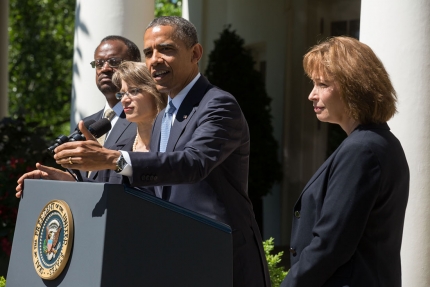
Q On a different topic altogether. The event just now in the Rose Garden on the judges, the President seemed heated when he was talking about obstacles facing judicial nominees. What did he hope to accomplish by expressing his frustration in public? Is he trying to shame Congress into -- by making an appeal to the court of public opinion on this?
MR. CARNEY: The President spoke today because this is an issue that is vital to the carrying out of justice in our system of government. We need judges nominated and confirmed to our courts. And, as the President made clear, his nominees have been subjected to political obstruction repeatedly. The duration from nomination [Committee approval] to confirmation is three times greater in his presidency than it was in his predecessor’s.*
He also made clear that both parties have practiced the slowing down of this process in the past, but it is irrefutable that this situation has gotten out of control, that it is one that some have called a crisis. And it has to be addressed. I mean, every one of his nominees, once they overcome the obstacles, have been confirmed. These are highly qualified nominees.
The case of Caitlin Halligan is unconscionable. She was an enormously qualified nominee. The President is pleased by the confirmation, the overwhelming confirmation of Sri Srinivasan. But there are still three vacancies on that court. And the argument being made that the workload has been reduced and therefore we should eliminate some of the seats on that court is spurious on its face. The caseload is higher now than it was 2005 when some of the same Republican senators were arguing for the necessity of confirming President Bush’s nominees to that court.
There are other courts where some of the same Republican senators have urged for and voted for the confirmation of judges that have a lower caseload than the D.C. Circuit. This is politics. And it is not helpful to the carrying out of the constitutional responsibilities that the President has or that the Senate has. The President is doing his job. He is nominating qualified candidates for these judicial posts. The Senate has to do its job, which is to consider and vote yes or no on those nominees.
And while the progress I noted for one seat on this court was welcome, we have a long way to go before this Senate, Republicans in the Senate, demonstrate a willingness to fulfill their constitutional responsibility in the way that they were meant to fulfill it, which is efficiently. The Constitution doesn't say advise and consent over two years after a nomination is put forward of a highly qualified individual. These need to be acted on quickly.
Jessica.
Q Even some liberal advocacy groups have been critical of the President for being slow to name judges, especially at the district court level. So doesn't the President share at least some responsibility for the delay in filling vacancies in the court?
MR. CARNEY: The President’s nominees have been qualified, have been supported on a bipartisan basis from the legal community and by individuals who have served in administrations both Republican and Democratic. The facts are clear that when we have these nominations put forward, some of them are delayed for months and sometimes years, and it is unconscionable.
And then we have a situation where whatever the reason was, whatever the political reason that was behind the obstruction is removed, then that nominee is suddenly confirmed overwhelmingly. So clearly there was never a problem fundamentally with the nominee and his or her qualifications.
The fact is the President had a nominee, Caitlin Halligan, to this court, and she was blocked, as the President noted, for an unconscionably long period of time. And he is fulfilling his responsibility by nominating qualified individuals to these posts, and the Senate has clearly taken more than its time in considering these nominations. And it needs to act, and that's why the President nominated three more candidates for the D.C. Circuit Court -- D.C. District Court, rather -- sorry, D.C. Circuit Court in hopes that -- I’m sorry, the United States Court of Appeals for the District of Columbia, which is commonly known as the D.C. Circuit, which is how I always refer to it. But those slots have been open for years. When Sri Srinivasan was confirmed, that was to a seat that hadn't been filled since Chief Justice John Roberts left the court in 2005. So we need action.
Q As you say, those slots have been open for years. And you said filling them is vital to carrying out our system of government. So why is he doing this now, not sooner?
MR. CARNEY: He has nominated candidates in the past for a variety of judicial posts, and they have -- I mean, the record is clear in terms of the -- when he nominates qualified individuals and they take three times as long to be considered by the Senate, that slows the whole system down. And there is no justifiable reason for it. The rather remarkable statements by some senators about wanting to basically court-pack in reverse by what was essential that these posts be filled, that these seats be filled under a Republican President, because of the workload. Now the workload is actually the same, or in many cases, greater than it was then -- suddenly, we can eliminate those seats because there is a Democratic President nominating highly qualified candidates. And it's nakedly political, so we need to get on about the business of considering these nominees. If senators oppose them for substantive reasons, they should vote against them. That's how the process is supposed to work.
Jon.
Q Jay, of course the President said the use of chemical weapons in Syria is a red line, a game changer. Now with more evidence that chemical weapons were used in Syria, what is the President going to do about it?
MR. CARNEY: Well, as you heard the President say, Jon, he wants to be sure that we have collected not just the evidence that we had when we talked about this earlier and that was discussed in the letter to the senators. We need more and we need to build on it. We need to establish chain of custody. We need to establish the incidents themselves of the use of chemical weapons. And we need to be able to have the kind of evidence that can be corroborated and reviewed if we are going to make policy decisions based on the assertion that chemical weapons were used by the Bashar al-Assad regime.
Q And if you come to the same conclusion after gathering all that evidence that the U.N. has and that others have, what does the President do about it?
MR. CARNEY: Well, the U.N. report said that there are reasonable grounds to believe that chemical weapons have been used. We have already said that there are reasonable grounds to believe that chemical weapons have been used. The French announcement today is entirely consistent with what we said a number of weeks ago, that there is evidence that exists that established reasonable grounds that chemical weapons have been used. And we have made clear that we believe that if chemical weapons were in fact used in Syria, they were used by the Assad regime. We are highly skeptical of claims that the opposition used chemical weapons. The chemical weapons in Syria we believe have been and remain under the control of the Assad regime.
But we need more information. Others have said, and I think it is worth noting, that the case for Saddam Hussein having weapons of mass destruction was stronger than the case initially presented for the use of chemical weapons in Syria. And I think that it is essential and I think the American people expect that we take that evidence and we build on it and we build on it until we know what we have and we can present it. And that's what the President is insisting we do.
Q But, what I'm asking is --
MR. CARNEY: What he will do once --
Q -- what he will do if he is convinced that red line has been crossed.
MR. CARNEY: I think the President will be the one to make that announcement when he decides on action to be taken, if action is to be taken, if we establish the evidence necessary.
Q But action will be taken if you are convinced that the red line was crossed?
MR. CARNEY: I think the President made clear that he would consider the use of chemical weapons by Assad, by his regime, to be a game changer to basically -- well, a game changer is the phrase he used, but that this would be cause for an evaluation -- a reevaluation of our policy options.
But I’m not going to get into specific choices. I have said all along, as he has and others, that we retain every option available to us to address this situation in Syria. And that is certainly the case today.
Q And another subject. The President -- two veto threats that were issued yesterday on the Veterans appropriations bill and Homeland Security appropriations bill, and seems like will do this for all the appropriations bills based on if I’m reading it correctly. Is the President threatening a government shutdown if the Republicans don't come his way on this?
MR. CARNEY: The President is making clear that Republicans need to keep their commitments based on the agreements of the past about spending levels. And it is not acceptable to change those levels in a way that does inordinate harm to average Americans out there when there is a refusal by the Republicans thus far to agree to the basic principle that we should be able to find common ground if everybody is willing to compromise a little bit when it comes to deficit reduction.
So I think you’re over-interpreting this. And I think that the statements that we’ve made about these appropriations bills are clear, and I think they reflect the President’s judgment that Republicans need to honor the commitments they’ve made.
Q Are you saying if Republicans don't do that, he’s going to veto the spending bills, which means there’s a government shutdown, right?
MR. CARNEY: Jon, I think you’re extrapolating in a hypothetical about outcomes --
Q It’s a veto threat for an appropriations bill. I mean, that means --
MR. CARNEY: Exactly. And to suggest that that immediately leads to a shutdown would leave out a great deal of how the legislative process works and has worked in the past. We’re making clear our opposition --
Q If you veto appropriations bills --
MR. CARNEY: Hey, Jon, we’re making clear our opposition. You’re predicting outcomes that aren’t necessarily the case. What we’re saying is we need to honor the commitments that we’ve made, and that's reflected in the statements of administration policy.
Yes.
Q In other words, statements of administration policy are for now the President is not interested in --
MR. CARNEY: That's not what I’m saying. You’re asking me -- Jon was asking me to predict the future of the outcomes of how Republicans in Congress will react to --
Q I asked if he was threatening a government shutdown.
MR. CARNEY: And the answer is no. Obviously, he’s not threatening a government shutdown. He’s making very clear -- or the statement of administration policy and the views of his advisors is clearly stated, but it is not a broad statement about outcomes here. It’s a statement about how we should responsibly fund our government in ways that keep the commitments that Congress has made in the past to the American people.
Q Let me ask you about the Associated Press story today that described what it called a variety of senior administration officials possessing secret email addresses. And I’d like to ask you a couple of questions about that. One, what is the standard of transparency this administration is going to use in FOIA requests about these things, or in disclosing these going forward? And is it -- or has it been the policy of this administration, whenever there is a congressional inquiry about email traffic on a given subject, that both the established email address and the secondary, or secret one, is always given over to Congress?
MR. CARNEY: Let's be clear -- this is a practice consistent with prior administrations of both parties, and, as the story itself made clear, any FOIA request or congressional inquiry includes a search in all of the email accounts used by any political appointee.
So the answer is, all of this information is provided. Having alternate email addresses for Cabinet secretaries and other high-profile officials makes eminent sense, much as it does for columnists, for example, of major publications who provide email addresses for their readers but have alternate work email addresses so that if they are inundated in one account with either public emails or spam or the like, that they can continue to use their other account for normal work. And that is the case with officials of this administration, officials of the previous administrations who have had email addresses.
And the fundamental question here in terms of FOIA requests and congressional inquiries is that all of these email addresses are included.
Q Were you -- in mentioning previous administrations, the use of these alternate email addresses for political purposes did become a bedeviling --
MR. CARNEY: No, no, no you're talking about private email accounts. I am talking about work email accounts, and that’s what this article was talking about. So let's not confuse this.
It is obviously counseled very clearly that we do not use and should not use private email accounts for work. But this is an issue about alternate work email accounts, all of which are part of and are included in searches for FOIA requests and congressional inquiries.
Q But there's nothing secretive about this.
MR. CARNEY: There's not secretive. It's about having a public email address as well as a -- one for internal workings. But they're all available when FOIA requests are made and congressional inquiries are conducted.
Q You mentioned the President is going to give remarks in California about the ACA. I'm curious if you were aware of a legislative effort in South Carolina to empower the Attorney General there to sue any business, including health insurers, if they in fact implement any of the President's health care law in that state, in that jurisdiction.
MR. CARNEY: I’m not aware of that, no.
Q Do you have any general reaction to any state-level legislation of this kind which would operate outside of the litigious challenges to the law?
MR. CARNEY: I would hesitate to offer an opinion based on that except to say that we are very much about the business of implementing the Affordable Care Act, which has already provided benefits to millions of Americans -- whether it's the allowance to young Americans up to age 26 to remain on their parent's health insurance, or preventive free screenings for millions of Americans, assistance to seniors to pay their prescription bills.
These are benefits that are already enjoyed because of the Affordable Care Act, and as we implement the bill further, millions more Americans will have access to insurance that they did not have before. And we're very much focused on that, and progress on that continues.
Q One last thing on the D.C. Circuit. In the context of Senate consideration of Sri Srinivasan's pending nomination, Majority Leader Harry Reid said there is a crisis on the D.C. Circuit, mentioning several opinions from that court that he disagreed with; I would imagine the administration also disagrees with. Does the President believe, and was one of the reasons for putting these three nominees up today, to address a crisis in not just the court itself its recent rulings that have either been disruptive to or displeasing to this administration.
MR. CARNEY: The President believes that this court, which is commonly referred to as the “Second Highest Court in the Land,” should be fully staffed. And that is a view consistent with the views of the very same senators who are suggesting we eliminate seats on this court to the views they held a few years ago when they were promoting the nominations of President Bush to this very court at a time when the workload was not dissimilar at all.
Q But there’s no crisis and no problem with the rulings?
MR. CARNEY: I think that every President is accorded by the Constitution the duty and responsibility to nominate judges, and he or she is obligated to nominate qualified individuals. This President is fulfilling that duty. The Senate needs to fulfill its duty in advising and consenting to these nominations, voting yes or no, but doing so in a responsible way and in a reasonable timeframe.
Q Jay, on the email story, since this is -- you suggest a routine practice throughout the administration, are there White House officials who have multiple email accounts as well then?
MR. CARNEY: As you know, Ed, the White House, like Congress -- which I’m sure will be part of any story you do on this -- is not subject to FOIA. But --
Q That's not my question.
MR. CARNEY: -- the point is. Well, I’m not going to get into people’s individual email addresses, but I will simply say that it is -- let me tell you a story. When Robert Gibbs came out here like a week before I started, and he mentioned my email address, I changed it so that I wouldn’t be inundated with -- and gave it to all of you -- but I wouldn’t be inundated with tons of emails and spam and the like. So if that's -- it’s actually my only email address, but it is not in the format that's traditional for the accounts here. But that's a very reasonable thing to do.
And all I’m suggesting is that the issue here is -- are these accounts, these work accounts secret? And the answer is, no, because they are subject to FOIA requests and they subject to congressional inquiry just like their public addresses.
Q And so when the Associated Press says -- because you make it sound very simple and that this is routine -- the Associated Press says they sent a FOIA three months ago asking for a list of these various accounts in different departments and agencies, and they got no response. If this was kind of a routine thing, why was AP --
MR. CARNEY: Well, I would refer you to the agencies for specific FOIA requests. What I can say is that this administration has made significant strides in improving FOIA practices compared with all of our predecessors. Agencies have improved their processes for administering the FOIA, disclosed more information, invoked FOIA exemptions less frequently, and answered more requests.
Agencies are also increasingly disclosing information without waiting for a specific FOIA request, and I’ve got a ton of data here to back up those statements. And so I think our record on FOIA is -- compares favorably to every previous administration, and it reflects our efforts to be more transparent, to provide more information.
Q Last question on Syria, to follow up on what was asked before. I understand the reason that has been cited many times about getting it right in terms of actually having the evidence that chemical weapons were used. But now when you have allies like France coming forward and saying they believe it was used, as more time passes, is there not a lessening behind the power of the President’s words drawing a red line last summer? If action does not back up those words, does that not send a signal around the world that he has not followed up?
MR. CARNEY: The President believes it’s highly important to get this right, and that the American people would expect the President and Congress and military leadership and intelligence leadership to get this right. And that is what he has instructed his team to do as they work with our allies and the Syrian opposition.
This is a very serious matter, and it should be dealt with in a deliberate and serious manner.
Peter.
Q Just following up on the conversation that happened in the Rose Garden earlier today, the President spent about as much time criticizing Republicans as he did lauding his own nominees that he was bringing forward today. Acknowledging the past precedent that he acknowledged today that this has happened by Democrats and Republicans alike, how does the President hope that that helps move this conversation forward and doesn't just continue the same practices of the past? How does it help get more done?
MR. CARNEY: Because not criticizing them has worked so effectively where they are now blocking nominees or obstructing nominees at a pace three times greater than under the previous administration? I think that is a rhetorical question that answers itself. And the President -- the point of the event was to both announce these nominations, but specifically to take issue with the really absurd statements of opposition to filling these seats that we’ve seen from some Republicans -- absurd just on the facts that they are using to make their arguments and absurd within the broader context of the kind of slowdown that we’ve seen throughout President Obama’s time in office.
Again, this is a constitutional duty of the President and of the Senate. Basic stuff here. Presidents nominate individuals to the bench. They are obligated to nominate qualified individuals. The nominees the President has put forward have been universally judged as highly qualified by the American Bar Association, by predecessors of Republican and Democratic administrations, by the experts in the legal field, across the board. And yet, we have faced this obstructionism. And it is a problem, and it is a problem that needs to be fixed. And it is an opportunity for the Senate to demonstrate -- Republicans in the Senate to demonstrate that we can, even as we disagree on some matters, get about the business of fulfilling fundamental responsibilities, constitutional responsibilities.
I could cite you statements by Senator Grassley and others that directly contradict what they're saying today, statements that were made when President Bush was in office about this specific court, about the caseload of this specific court. So I think it makes clear that this is about politics. And it’s the kind of thing that frustrates the American people about the way Washington works. At the very least we ought to be able to get this done, because again and again, when the hurdle is clear and the obstacle is removed that has held up an individual nominee, that nominee is confirmed, which suggests that that nominee is qualified. And usually, that nominee is confirmed overwhelmingly.
So it certainly makes clear that that nominee, if he or she was qualified a year after being nominated, he or she was qualified three months after being nominated or six months after being nominated.
Q The President’s friend, as evidenced by the game of Touchdown Fever last week on the Jersey Shore, Governor Chris Christie is in the unique position of having to fill a Senate seat being now vacated by the loss of Senator Lautenberg. I’m curious what the White House’s position is in terms of what it thinks Governor Christie should do in terms of nominating a Democrat to follow a Democrat or whether it could be a Republican.
MR. CARNEY: That is a right reserved to the Governor, and obviously the Governor will exercise that right. And we have no opinion on it. We look forward to working with whomever Governor Christie puts in that position.
Q No opinion and no preference?
MR. CARNEY: Well, certainly not an opinion or preference to express publicly. (Laughter.) This is something that -- any Jersey residents here want to put themselves forward? This is obviously something that is a right reserved to the Governor and one that I'm sure he will exercise. And we will work with whomever he appoints.
Phil.
Q Jay, on the D.C. Circuit Court nominees today, what was the motive behind nominating all three of them at once? It seems like an unusual move? What's the strategy there? What does he hope, the President hope the Senate does? Does he expect the Senate to take up all three of the nominees together and vote on them around the same time? Or would he be satisfied if they were staggered?
MR. CARNEY: Well, procedure in the Senate, strategy in the Senate we generally leave to Senator Reid and the Committee Chairman. So I would ask you to raise that with them.
The President nominated these three individuals, because having successfully seen the confirmation of one enormously qualified nominee -- which was very welcome -- and having three nominees ready to be nominated for the three still unfilled seats to that court, the President decided that we would nominate them all together. And I think that the -- if you look at the qualifications and backgrounds of the individuals he nominated today, I think you see in these three nominees a reflection of the high standards that the President has placed on all of his nominees and on the nomination process.
These are enormously qualified individuals, both legal scholarship on the bench and in practicing law -- both defense and prosecution, private and public. They should be confirmed. They are qualified and have support from Republicans and Democrats. So the President hopes that, as he made clear today, that we can move beyond the sort of politics of this process and get about the business of seating highly qualified judges on this court.
Q Jay, over a year ago when we learned the President would not sign an executive order prohibiting federal contractors from LGBT workplace discrimination, advocates were told that the White House would instead commission a study of LGBT workplace discrimination possibly led by the Council of Economic Advisors. I was wondering if you could give us any status or update on that study.
MR. CARNEY: I don't have any updated status on that for you. I can tell you that the President has long supported, as you know, an inclusive Employment Non-Discrimination Act, known as ENDA. And his administration will continue to work to build support for it. And we welcomed Chairman Harkin's announcement that he will vote -- hold a vote, rather, on ENDA this year. And that remains our position.
Q Are there any details about the study? Who's leading it, when it might be released, or anything like that?
MR. CARNEY: I just don’t have any details for you.
Q And one last follow-up. On this issue, people are becoming a little disheartened with the White House. What do you say to those who look at this answer from you today and are discouraged or say, if you want an issue to go away in Washington, you commission a study? What's your response to that?
MR. CARNEY: I think that the President's record on support for LGBT rights is significant and well known. The President believes that the right approach to this problem is an inclusive piece of legislation, and that’s the approach that we're taking. It was the approach that we took with repeal of "don't ask, don't tell". And we continue to support this effort. We welcome Chairman Harkin's steps in the direction of holding a vote on this.
So that’s the position that we think is right, strategically, when it comes to making this happen.
Yes, ma'am.
Q Thank you, Jay. Back to Turkey. Do you think the unrest in Turkey will affect the long-term political, economic relation between U.S. and Turkey? Or is this just a minor bump in the road?
MR. CARNEY: Well, we've made clear our concern about the reports of the use of excessive force, and we welcome the comments by the Deputy Prime Minister about -- that apologized for that excessive force. We call on all parties to refrain from provoking violence, and we continue to make known our opinion that these events should be investigated.
We have a very important relationship with Turkey. Turkey is a NATO ally. We are working with Turkey on a range of regional issues that are obviously of great importance to U.S. national security and to regional security, and we will continue to do that.
Cheryl.
Q Thanks, Jay. You addressed this a little bit yesterday, but the IRS IG report came out this morning on wasteful spending. Have you seen it now? And do you have any other comments on it?
MR. CARNEY: I have not seen it. I would refer to the comments made by the acting -- the new acting commissioner of the IRS, making clear that the conference in question is an unfortunate vestige from a prior era; that the actions that have been taken to rein in this kind of activity have resulted in a drop in travel and training expenses of more than 80 percent since 2010.
And I cited yesterday and won't take time doing it again today the actions the administration has taken overall to deal with this in keeping with the President's strict mandate that we all have to be careful stewards of the taxpayer dollar. And he does not have tolerance for waste of taxpayer money. And I think that was evidenced in his response to the GSA report and in response to this.
All the way in the back.
Q Senator Rubio said today that the immigration reforms lack 60 votes from the Senate. My question is, has the President been working lately on the phone, twisting arms on Capitol Hill about it?
MR. CARNEY: The President has been working very hard on this matter. He has had numerous conversations with lawmakers of both parties. We remain encouraged by the progress being made in the Senate. We believe that the bill that emerged from committee is in keeping with the principles the President outlined two years ago now when it comes to comprehensive immigration reform. But there is much work that needs to be done.
I'm not counting votes right now. I would refer you to Senate leaders for that. But we look forward to the bill moving to the floor, to a healthy debate, and to passage of comprehensive immigration reform in the Senate with bipartisan support that reflects the principles the President has long espoused. It will not be everything that the President would want. It will not be written exactly the way he would write it. But I think that would be true of every strong supporter of comprehensive immigration reform, whether that supporter is a member of the Gang of Eight or someone who is not even in the Congress. It won't be exactly what everyone wants. It can't be, because it will have, hopefully, broad bipartisan support. But it will be, we hope, in keeping with the President's principles.
Q Jay, I want to press you on Syria again. So if this U.N. report is implicating the rebels in using chemical weapons, you seem to be vague about how you're going to deal with the Syrian government. How are you going to hold the rebels accountable if they use chemical weapons? And, on Turkey --
MR. CARNEY: Wait, the U.N. report doesn't say that. The U.N. report says that there are reasonable grounds to believe that chemical weapons have been used.
Q -- reports that are implicating the rebels as well. It's not just the government.
MR. CARNEY: Well, that was a statement from a number of weeks ago. I don't think that's reflected in today's report.
Q Then how are you going to hold them responsible?
MR. CARNEY: We do not believe it is -- we are very skeptical of the suggestion that chemical weapons that we believe have been in the control of the Assad regime were used by the opposition. Obviously, we are gathering facts. We are gathering evidence rather than making assumptions. But it is fair to say that we are skeptical of suggestions that the opposition has used chemical weapons.
Q Okay, just on Turkey, please. If you are concerned about what's happening in Turkey, why are you raising it on the ambassador level only and not on the level with the Secretary of State or the President?
MR. CARNEY: Well, I'd refer you to the State Department for conversations that we have with our counterparts in the Turkish government all the time. I just don't have any conversations to report to you from the White House.
April.
Q Jay, I just want to find out a little bit of the tick-tock on how the President comes to and how the White House comes to nominate these three. Talk to us about the lists that are compiled for these judge nominations, these court nominations.
MR. CARNEY: Well, I don't have a great deal of tick-tock to provide to you. When there are openings on courts, a process is in place to look at any number of potential candidates to fill these posts, and then a selection process is undertaken and potential nominees are presented to the President for consideration. And he makes a decision about who he wants to nominate for these posts. And it's not dissimilar from the process of administration posts that are filled through nominations. Obviously, this is a little different because of the nature of these judicial posts. But in its basic sense, it's not dissimilar.
Q Is it similar somewhat to the Supreme Court, the way that you pull together the list for Supreme Court -- is it something along that line?
MR. CARNEY: Well, I personally haven't participated in one of these selection processes, but I think it's fair to say that it mirrors that to some degree. But obviously, the Supreme Court is the Supreme Court, and seats to that court do not open up that frequently. So there is a probably more intense level of consideration in that process. But for this court, let's be clear -- this is a court that is commonly viewed as and considered the “Second Highest Court in the Land.” This is an extraordinarily important court that decides cases that affect every American. And that's why it's important to have it fully staffed with highly qualified judges.
Q So since this court is so important, were these names already on the list or was there a list already?
MR. CARNEY: I don't have a lot of --
Q Because for the Supreme Court, we know when you walked in the door there was a list; there was a standing list already of some names.
MR. CARNEY: Well, that's what people assume in the --
Q Well, we were told --
MR. CARNEY: Well, again, I don't have a lot of insight to provide to you about the sort of internal process of selecting nominees for this court, except that it's rigorous and the threshold is candidates who are extremely qualified.
Olivier.
Q Jay, some veterans groups are getting pretty upset about the backlog in the processing of disability claims. One group told us it's time for the President to step up and get more personally involved in the process of reducing that backlog. Does the White House plan any new initiatives on that, or have you done all you can?
MR. CARNEY: No, we believe very strongly that this is something that requires commitment and dedication every day. The President is deadly serious about the need to deal with this problem. He's made clear that he expects results. Too many veterans are waiting far too long to receive the benefits that they have earned and deserve, and it's unacceptable.
He's directed -- the President has -- Secretary Shinseki to fix the problem and to eliminate the backlog by 2015. And again, he is clear that he expects results. As you know, and as Denis McDonough, the Chief of Staff, said in April, this is a national priority -- at least that’s how it's considered in this White House, and that’s been made clear administration-wide. And it's something that is -- the efforts to address and deal with the backlog are monitored regularly here at the White House because this is a very high priority.
Q I’m going to try to go back to Syria. It's 8:00 p.m. at this moment in Paris, and the French Foreign Minister, Laurent Fabius, is on the evening news, and he's suggesting that for the French the red line has been crossed. Do you support the French position?
Q Well, Laura, I've answered this question in several different ways. The report I read is that the French believe that there are grounds to suggest that chemical weapons have been used but that more evidence needs to be gathered, which is exactly the position that this administration holds. And we work very closely with the French and the British and others, as well as, importantly, the Syrian opposition, in gathering evidence and corroborating evidence, and reviewing it, and making sure that we have hard facts.
And our partnership with the French on this is very close, so we will continue to work with the French, the British, the opposition and others as we gather the evidence that we believe we need to gather as we consider our options, policy-wise, in Syria.
Q But officially, the French are saying that they have evidence tonight.
MR. CARNEY: Again, I would point you to reports and the fact that they said that more evidence needs to be gathered about who used the weapons, where they were specifically used. And that’s the position that we enunciated a number of weeks ago.
Q The patent troll executive actions -- is that --
MR. CARNEY: Troll -- really?
Q Hold it up again. (Laughter.)
MR. CARNEY: You didn’t see that, April? Innovation.
Q Isn't that a White House graphic?
MR. CARNEY: Innovation -- yes, we had somebody draw it. No, it's innovation, not litigation.
Q Did you (inaudible)? (Laughter.)
MR. CARNEY: (Laughter.) I didn’t. I wanted one of those troll pencils to bring out, but they don’t have them at CVS.
Q Jay, is this related to the President's Silicon Valley fundraiser on Thursday night?
MR. CARNEY: No. The President addressed this, as you know, earlier this year. This is a big problem, and it stifles innovation, and it is something that we need to deal with because there are these firms out there that exist primarily to get licensing fees and other -- by gumming up the process through litigation. And it does great harm. It costs, I think, $29 billion in direct costs, and that’s a problem.
We are blessed in this country because of our system and our economy and the quality of our universities and the quality of the people who work in fields of innovation that we are constantly on the cutting edge. We need to stay there. And patent trolls are, through what they do, making it harder and harder to stay there.
And the President announced the executive actions that he is taking and the legislative proposals that he's putting forward because we have to address this problem. It's very important to our economy. Everybody here knows that innovation in the fields of technology in particular is vital to future economic growth.
And so this is -- the troll is a funny way to get people's attention, but it's an extremely important economic problem.
Thanks, all.
END
2:07 P.M. EDT