The White House

Office of the Press Secretary

President Obama Announces More Key Administration Posts

WASHINGTON, DC – Today, President Barack Obama announced his intent to nominate the following individuals to key Administration posts:

• Stephanie Sanders Sullivan – Ambassador to the Republic of the Congo, Department of State
• Joseph Y. Yun – Ambassador to Malaysia, Department of State

The President also announced his intent to appoint the following individuals to key Administration posts:

• Avril D. Haines – Deputy Director of the Central Intelligence Agency
• Michael J. Morell – Member, President’s Intelligence Advisory Board

President Obama said, “I am proud that such experienced and committed individuals have agreed to serve the American people in these important roles. I look forward to working with them in the months and years ahead.”

President Obama announced his intent to nominate the following individuals to key Administration posts:

Stephanie Sanders Sullivan, Nominee for Ambassador to the Republic of the Congo, Department of State
Stephanie Sanders Sullivan, a career member of the Senior Foreign Service, Class of Minister-Counselor, is Chief of Staff for the Office of the Deputy Secretary of State for Management and Resources.  Previously, from 2010 to 2011, she was Managing Director of Management Policy, Rightsizing and Innovation in the Office of Management Policy.  From 2008 to 2010, she was Director of the Department of State Executive Secretariat Operations Center, where she served as Deputy Director from 2003 to 2005.  Ms. Sullivan’s additional assignments in Washington have included: Senior Watch Officer in the Executive Secretariat Operations Center from 2002 to 2003, Post Management Officer in the Executive Office of the Bureau of African Affairs from 2001 to 2002, and Desk Officer for Mali, Niger and Burkina Faso in the Bureau of African Affairs from 1991 to 1993.  Since joining the Foreign Service, Ms. Sullivan has served overseas in Ghana and Cameroon.  Ms. Sullivan served as a Peace Corps volunteer in the Democratic Republic of the Congo from 1980 to 1983 and later worked as Chief of Operations for the Africa Region at the Peace Corps from 1994 to 1996.  She received a B.A. from Brown University and an M.S. from the National War College.

Joseph Y. Yun, Nominee for Ambassador to Malaysia, Department of State
Joseph Y. Yun, a career member of the Senior Foreign Service, Class of Minister-Counselor, currently serves as Principal Deputy Assistant Secretary of State for East Asian and Pacific Affairs.  Prior to this, he served as Deputy Assistant Secretary of State for East Asian and Pacific Affairs from 2010 to 2011.  From 2009 to 2010, he was Director of the Office of Maritime Southeast Asia.  Since joining the Foreign Service in 1985, Mr. Yun has served overseas in Korea, Thailand, France, Indonesia and Hong Kong.  Before joining the Foreign Service, he was an economist for Data Resources, Inc. in Massachusetts.  Mr. Yun received a B.S. from the Cardiff University and an M.S. and M.Phil from the London School of Economics.

President Obama announced his intent to appoint the following individuals to key Administration posts:

Avril D. Haines, Appointee for Deputy Director of the Central Intelligence Agency
Avril D. Haines is Deputy Assistant to the President and Deputy Counsel to the President for National Security Affairs at the White House.  Prior to joining the White House Counsel’s office in 2010, she was Assistant Legal Adviser for Treaty Affairs at the Department of State.  She previously worked in the Office of the Legal Adviser at the Department of State from 2003 to 2006, first in the Office of Treaty Affairs and then in the Office of Political Military Affairs.  From 2007 to 2008, she worked on the Senate Committee on Foreign Relations as Deputy Chief Counsel for the Majority.  Ms. Haines clerked for Judge Danny Boggs on the U.S. Court of Appeals for the Sixth Circuit from 2002 to 2003.  From 2001 to 2002, she was a Legal Officer at The Hague Conference on Private International Law.  She received a B.S. in Physics from the University of Chicago and a J.D. from Georgetown University Law Center.

Michael J. Morell, Appointee for Member, President’s Intelligence Advisory Board
Michael J. Morell is Deputy Director of the Central Intelligence Agency (CIA).  Prior to this, he led the CIA’s Directorate of Intelligence.  From 2006 to 2008, he was Associate Deputy Director of the CIA, before which he served briefly as a Deputy Director of the National Counterterrorism Center.  Mr. Morell began his career with the CIA in 1980 as an analyst covering international energy issues.  He later worked on East Asia issues for 14 years, until he became Director of the Office of Asian Pacific and Latin American Analysis in 1999.  Mr. Morell’s additional roles in the CIA include intelligence briefer to the President in 2001 and Executive Assistant to the Director of the CIA from 1998 to 1999.  He received a B.A. from the University of Akron and an M.A. from Georgetown University.

The White House

Office of the Press Secretary

Remarks by the President at Markey for Senate Rally -- Boston, MA

Reggie Lewis Track and Athletic Center
Roxbury Crossing, Massachusetts

1:27 P.M. EDT

THE PRESIDENT:  Hello, Boston!  (Applause.)  It is great to be back in Boston.  (Applause.)  Good to be back in Massachusetts.  (Applause.)  And, most of all, it is great to be here with the next senator from Massachusetts -- Ed Markey.  (Applause.)  

First of all, I want to thank Ed for that great introduction.  (Applause.)  Because I am here with my great friends from Boston, because I'm here to campaign on behalf of somebody who will be an outstanding member of the United States Senate, I am not going to talk trash about the hockey game.  (Laughter.)  I'm not going to say anything about the outstanding qualities of the Chicago Blackhawks.  (Laughter.) 

AUDIENCE:  Boooo --

THE PRESIDENT:  I'm not going to say anything.  I'm not going to do it.  (Laughter.)  Because I don't want to make you all feel bad.  (Laughter.)  I want you to feel good. 

Part of the reason you should feel good is not only do you have an outstanding congressional delegation, you also have a great Governor -- my good friend, Deval Patrick.  (Applause.)   You’ve got one of the finest mayors in the United States of America -- we love Tom Menino.  (Applause.)  I was just backstage talking to Tom, and he doesn’t just inspire Boston and make it a better place, he inspires the country.  And we’re grateful for his lifetime of service.

The last time I saw Tom, the last time I saw a lot of you was for the memorial service honoring the victims of the Marathon bombing.  So this morning, before I came here, I wanted to spend some time with some Bostonians, so we stopped by Charlie’s Sandwich Shop -- (applause) -- and I got a burger and fries.  And we were saying hi to everybody and hugging folks, and Ed was with me.  And one of the people I met in the shop just by happenstance was a young man whose family had been injured by the bombing.  And he was with a nurse who had been at Mass General the day those folks got brought in.  And she was on her day off.  But I gave her a big hug and I reminded her of how much what she did had meant to so many people all throughout the city and she was an example of the spirit of Boston during a very difficult time. 
And I asked people, how is the city doing?  And they said, you know, we're bouncing back.  Boylston Street may be open again.  Life may be back to normal in a lot of ways.  But we know there's still too many middle-class families that aren't seeing their hard work rewarded, too many young people who are looking for work and can't find it, too many Americans who feel like the rungs on the ladder of opportunity have grown farther and farther apart.  And that’s why Ed and I are focused on building the true engine of long-term economic growth -- and that is a rising, thriving middle class.  (Applause.)   

And every day I wake up, I ask three questions:  How do I make America a magnet for good jobs?  How do we make sure our workers earn the skills and education they need for those jobs?  How do we make sure those jobs are paying a decent living?  And the answer to that is, government can't do it by itself.  Obviously, the private sector is the driver of our economy.  It's the engine of our growth. 

But when people say the whole problem is government, they don't understand government can help by establishing smart priorities, by making smart choices, by investing in American manufacturing so we're bringing more of our jobs back from overseas -- (applause) -- investing in our roads and our bridges and our ports to make sure that we are staying competitive all around the world; educating our children from the earliest years, keeping them safe from gun violence; rethinking our high schools, making college more affordable -- (applause) -- making sure we stay at the cutting edge in science and technology; securing our energy future; addressing climate change.  There are some things that government can do that will help middle-class families, and that's what Ed Markey is committed to doing.  (Applause.)

We can do all this.  We have all the plans.  We have all the policies.  We have solutions to our challenges.  We have all the ingredients for success.  This is not only the greatest nation on Earth in the past, this is going to be the greatest nation on Earth for the foreseeable future.  There's no country on Earth that would not gladly trade places with the United States.  But what’s holding us back right now is inaction in Washington, gridlock in Washington -- too many folks in Washington who are putting the next election ahead of the next generation.  (Applause.)

Now, Boston, I want you to know I've run my last campaign.  Michelle is very happy about that.  (Laughter.)  So my only concern is making sure that we advance the interests of the broadest number of Americans and we leave our children a stronger, safer, more prosperous country than the one we inherited.  That’s all I care about.  (Applause.)  And that means I’m willing to work with anybody -- I’ll work with Republicans, Democrats, independents -- anybody who wants to make progress. I’m ready to get going.  I want to work with them.  (Applause.)

So, for example, right now on immigration, we’ve got a good bipartisan bill moving through the Senate that strengthens our borders and reforms the system so that everybody is playing by the same rules -- reform that will allow us to continue to attract talent from all around the world, the best and the brightest.  And whenever Republicans are ready to work with me, I’m ready to work with them.  (Applause.)  I want to govern not just politic.  (Applause.)

And I notice on gun violence, there are a lot of Republicans out there who recognize that we need some common-sense gun safety measures.  Some Republicans may be rethinking the stances that they took in the past.  That’s the good news.  We want to encourage that.  But the fact of the matter is that a whole bunch of Republicans out there are not interested in getting things done.  They think compromise is a dirty word.  They think the problem we’ve got is just working people who join unions -- that that’s what holding us back.  They think environmental regulations are what’s holding us back.  They think that we’re spending, I guess, too much money on science and research and technology. 

And because of those attitudes, we’ve got to have some Democrats like Ed Markey, who will stand up and do the right thing.  That’s what we need.  (Applause.) 

Ed mentioned that the idea of being a Democrat -- look, I don’t believe that any single party has a monopoly on wisdom.  My favorite President is a guy from Illinois who founded the Republican Party, effectively -- Abraham Lincoln, our first Republican President.  (Applause.)  But what does make me a Democrat is the basic idea that in this country, no matter what you look like, no matter where you come from, no matter who you love, you should be able to get ahead if you’re willing to work hard and act responsibly.  (Applause.)

You should be able to buy a home and send your kids to college, and save a little bit for retirement, make sure your kids get a good education, not go bankrupt when you get sick.  Most Americans aren’t asking for a lot.  They know they’ve got to take care of themselves.  They just want to make sure that if they're working hard, they can get ahead.  That's the essence of what it means to be a Democrat.

And that's why we’ve got to have folks like Ed Markey, who are going to help keep weapons of war off the streets and out of our schools; make it harder for criminals to get a gun in their hands.

That's why we’ve got to have a Democrat who is going to make sure that we implement the Affordable Care Act -- because in a nation this wealthy, nobody should have to go without affordable, accessible health care.  They don't have to do it in Massachusetts.  They shouldn’t have to do it anywhere else.  (Applause.)  It’s the right thing to do, and we need Ed Markey to make sure that it gets implemented.  (Applause.)

We’re fighting to make sure that when it comes to women’s health, no employer or insurance company or politician gets to decide your health care.  Women should make decisions about their health care, not some politician in Washington.  (Applause.)

We need somebody who is going to be supportive of the Consumer Financial Protection Board that Elizabeth Warren and I started talking about even before I was elected President and that we’ve now implemented to make sure you’re not getting cheated by unscrupulous financial practices.  We need somebody who is going to support that robustly.  That's what Ed is going to do.

We don't need politicians who are going to roll back these rights.  We need somebody like Ed Markey who is going to fight to secure them, no matter how many times the Republicans in Washington want to refight the old battles.

Do you know that the House Republicans have held nearly 40 votes to repeal Obamacare?  They did another one just two weeks ago because they figured that they were a couple new representatives that hadn’t had a chance to vote against Obamacare.  That's not a productive thing to do, people. 

This law is going to mean big things for the economic security of middle-class families.  We should be spending time figuring out how to spread the word that if you don't have health insurance, you can now get it. 

We need a senator from Massachusetts who will help me, work with me, to deal with climate change in an honest, realistic way. (Applause.)  Ed has been fighting this battle for decades.  If we want our children and our grandchildren to live in the same beautiful planet, the same abundance and natural glory that we have enjoyed in our lives, we’ve got to double down on our investment in science and basic research.  We can't just develop the energy sources of the past.  We’ve got to develop the energy sources of the future.  

We’ve got the tools and the capabilities to make huge strides.  We’ve already doubled the production of clean energy.  We’ve already doubled fuel-efficiency standards on cars.  We've got to keep on going forward, not backwards.  And that's what Ed Markey is going to help us do.  (Applause.)

We've ended a war in Iraq; we're winding down the war in Afghanistan responsibly.  Now we're going to have to take care of our veterans and keep Americans safe.  And I will keep working with the other side of the aisle on these issues.  But I want somebody like Ed Markey who every single day is going to be fighting on behalf of our veterans, going to be fighting on behalf of our first responders. 

These budget battles we have in Washington, they have implications for whether or not we're helping cities and states fund their firefighters, fund their police officers.  And everybody here in Boston knows how much those first responders mean to us when a crisis has hit.  (Applause.)  And we've got to make sure we're there for them.  (Applause.)

So, look, here’s the bottom line.  We've gone through some tough times over these last few years and so many of you put your faith in me in 2008 and 2012 -- (applause) -- the folks here in Massachusetts were very kind to me back in 2004, when nobody could pronounce my name.  (Laughter.) 

And every single day, I think about all of you.  I look out on the faces in this crowd -- some of you I know, some of you have knocked on doors for me, some of you poured your heart and soul into our efforts. 

But here’s the thing that I think all of us understand -- the job of rebuilding America, the job of making sure our kids have a great education, the job of making sure everybody has health care, the job of making sure that financial institutions treat everybody fairly, the job of making sure our veterans have the care that they need, the job of making sure we have a bright energy future, the job of preserving our environment, the job of making sure we stay on the cutting-edge when it comes to innovation -- that job is not mine alone.  I can't do it by myself.  I've got to have folks with me who care as passionately about these things as I do.  (Applause.)  I've got to have folks in the United States Senate who are willing to stand up for working people just like I have.  I need folks in the United States Senate who, every day, are waking up thinking about the people who sent them there, and trying to figure out how do I make sure that they are getting a brighter future.

That's who Ed Markey is.  I need Ed Markey in the United States Senate.  (Applause.) 

So this election is going to come down to turnout.  We've got a whole lot of Democrats in this state and a whole lot of Obama voters, but you can't just turnout during a presidential election.  You've got to turn out in this election.  You can't think, oh, I did my work in 2012.  You've got some work to do right now in 2013.  (Applause.)  You can't just pat your back and say, well, I knocked on some doors back in November.  I need you knocking on some doors right now in June.  (Applause.) 

And if you work with the same focus and the same passion -- if you are knocking on some doors and making some phone calls, if you're talking to your friends and you're talking to your neighbors -- if you're talking to cousin Jimmy who doesn't always vote unless you give him a phone call -- if you are making sure that people know Ed Markey's remarkable record in Congress, then I guarantee you he will be the next United States senator from Massachusetts.  (Applause.)  He'll join Elizabeth Warren.  He'll carry on the legacy of Ted Kennedy and John Kerry.  He will be my partner, and we will continue the march forward on behalf of not just this generation, but future generations. 

Thank you.  Let's get to work.  God bless you. 

END
1:51 P.M. EDT

The White House

Office of the Press Secretary

Gaggle en route Boston, MA

Aboard Air Force One
En Route Boston, Massachusetts

11:08 A.M. EDT

MR. CARNEY:  Welcome aboard Air Force One this morning as we make our way to the great state of Massachusetts.  I think you have a readout of the President’s events today, so I won't repeat them.  I have no announcements to make, so I'm here to take your questions.  Associated Press.

Q    Thanks, Jay.  Is the President participating today either remotely or in person in the principals meeting on Syria?

MR. CARNEY:  The President is here on the plane.  We tend not to send the plane with you guys in it unless the President is on board.  You're making an assumption that I believe is false about a meeting that the President is chairing when in fact he’s flying to Boston and then Miami.

Q    I didn’t say he was chairing it, but he could be participating ostensibly.

MR. CARNEY:  We do regular meetings on Syria.  I think I've mentioned that now for several days running.  I have no specific meeting to read out.  But the President is traveling today --

Q    Do you have any reaction to the Senate vote yesterday on the early test of the immigration bill?

MR. CARNEY:  We're very pleased by the significant bipartisan vote that we saw.  And that reflects what the President said yesterday that the bill forged by the Gang of Eight, a bipartisan group of senators, represents a compromise -- represents a compromise that sticks to the principles that he’s enunciated and that other supporters of comprehensive immigration reform have allied themselves with. 

So that's an encouraging sign.  But we are obviously still very much in the thick of the process in the Senate as debate gets underway and look forward to being engaged in that and in encouraging senators of both parties to keep focused on the goal here, which is broad comprehensive immigration reform that strengthens our border, makes life better for our businesses and for the middle class, holds businesses accountable when it comes to ensuring that those they hire are working legally, and provides a pathway to citizenship -- a clear pathway to citizenship for the 11 million people living in this country illegally.

Those are the broad outlines of the kind of comprehensive immigration reform that the Senate bill represents and that the President supports.  So we will be part of this effort every step of the way.

Q    Jay, can I just go back to Syria for a second?  Is this a critical week in the sense that there have been clear setbacks for the rebels combating Assad?  Does the President have to make an important decision?  There are all these reports about meetings that he’s having.  What does he have to do this week on the Syria situation?

MR. CARNEY:  We are constantly evaluating the situation in Syria and the options available to the President when it comes to encouraging a transition there as well as supporting the opposition so that that transition can take place.  I have no announcements to make, but this is something that is obviously a serious matter.  It’s something that we discuss regularly -- certainly not just this week but for two years now. 

So the situation on the ground continues to worsen with elevated levels of violence with the participation of Hezbollah and Iran.  And the President has made clear that he rules no option out, although he has also made clear that he does not envision a scenario that would lead to putting American boots on the ground in Syria.  But setting aside that, he rules no option out and he’s constantly evaluating his policy options. 

And as he does so, he keeps the focus on which possible policy options would help lead to the ultimate goal here, and he wants a rigorous process that assesses whether -- assesses policy options based on whether they would lead to that goal or whether they would inadvertently set back progress on achieving that goal. 

So that’s where we are on Syria.  When we have and if we have announcements to make, we’ll make them.

Q    Can you also just address does he have any concerns about what appears to be a broadening role of Iran in the conflict and the chance that Iran’s influence in the region might benefit from its involvement in this?

MR. CARNEY:  There’s no question that Bashar al-Assad has two very clear friends in the region -- Hezbollah and Iran.  And that ought to tell you everything you need to know about Bashar al-Assad and his tyrannical regime, and the fact that he is calling on outside assistance in the murderous campaign against his own people. 

We have long been concerned about the instability caused by the conflict in Syria and its capacity to spread regionally, and certainly the participation of Hezbollah and Iran in the effort causes concern.  And the President evaluates these developments as he’s assessing policy options.

Q    Staying with Syria, David Cameron said today that he’s going to be discussing Syria with Vladimir Putin before the G8 starts next week.  I was wondering is Syria going to be kind of the elephant in the room at G8, do you think?

MR. CARNEY:  I think that the phrase usually suggests that it’s a topic that will be unremarked upon but present nonetheless.  I don't think that's the case.  The leaders of these countries are I think always in a situation to discuss a broad array of subjects that are front and center globally. 

So I don't have a specific agenda to lay out to you -- I think we might provide more of a preview tomorrow on the trip.  But the fact of the matter is that Syria is an issue of great concern to many of the nations represented at the G8 -- all of them, in fact.  And we have had regular conversations with Britain and France and others, the Russians, about what’s happening in Syria and the need to take action to bring about a transition there.

Q    Would it be fair to assume that the President will be talking with allies about Syria next week?

MR. CARNEY:  Again, I don't have --

Q    -- on the sidelines?

MR. CARNEY:  I mean, I think, again, as I was saying, this is an issue of concern.  I’m not saying it’s on the formal agenda, but it’s a topic that we are discussing with our allies regularly as it is, and I certainly wouldn’t rule out that being a topic of discussion.

Q    Jay, as part of the campaign swing today, the chairman of the RNC is quoted in an AP story today saying that early Democratic candidates are “running away fast from the President.” Would you care to respond to that?

MR. CARNEY:  No.  Spin from a political committee is what it is.

Q    Jay, on the IRS, does the White House think that Chairman Issa should reveal -- release the full transcripts of the interviews that he conducted with IRS employees?

MR. CARNEY:  I think the Chairman promised he would.  I think the Ranking Member has demonstrated that we have seen yet again some cherry-picking when it comes to the release of testimony, release of information.  And I would just refer you to the comments of the Ranking Member on the committee.

Q    Jay, any reaction to Google and other tech companies sending a letter to Holder and Mueller asking to release their national security requests?  Is that something the White House would support?

MR. CARNEY:  We have seen the letters from Google and other companies and understand that they have questions about how we can best talk about these programs moving forward.  The Department of Justice and the Federal Bureau of Investigation are reviewing Google's request, so I would refer you to them.  But we're certainly aware of the letters.

Q    Jay, what can you tell us about Biden's gun control event next week, and any efforts to kind of re-launch that effort to get legislation passed?

MR. CARNEY:  I think it is important to understand that the commitment of this President and the Vice President to taking action to reduce gun violence is as strong today as it was at the beginning of the year and in the wake of Newtown.  The President made clear his deep disappointment with the decision of the minority of senators to flout the will of the vast majority of the American people -- the majority of Republicans, Democrats and independents -- in states across the country.

We've also made clear, and it was laid out in the plan that the Vice President led a group in developing and that the President presented, that we would pursue legislative action and we would take executive action.  And I think that this -- we're doing that.  But I wouldn’t -- I think that “restarting” or “relaunching” is a characterization made by a reporter, not by us.

Q    Jay, back to the NSA for a minute and Mr. Snowden.  You've said that it would be inappropriate for you to comment on something while it's being investigated, but prominent people from both parties now are commenting and are saying that based on what this gentleman has revealed or acknowledged himself that he is a traitor.  So are people like Senator Feinstein and Speaker Boehner acting inappropriately by commenting on that?

MR. CARNEY:  I've simply said what our disposition is on this, that we're not going to comment on the subject of a recently begun and ongoing investigation into the unauthorized disclosure of classified information.  Others can speak for themselves.

Q    And a number of lawmakers are appearing to be a little bit confused about it or said that they weren't fully aware of certain things.  Is the reason that lawmakers are learning more now about this because they weren't given the information they needed, or because they didn't properly attend briefings or pay attention to information that was given to them?

MR. CARNEY:  I think it's been amply demonstrated that with regards to both sections of the Patriot Act and the programs that exist under those authorities that members of Congress were briefed or had the opportunity to be briefed on them.  And I would point you to statements by Senator Reid and to the simple facts.  And it is certainly the case that some members of Congress did not avail themselves of the opportunity to be briefed, but that's certainly their prerogative.

Q    On today's event, Jay, can you talk a little bit about what the President wants to accomplish by participating in a rally with Congressman Markey?  Is the Martha Coakley-Scott Brown experience fresh in the minds of Democrats?  And is the President concerned about effects that these controversies that we've been talking to you about over the weeks are going to have on Markey's candidacy?

MR. CARNEY:  The answer to the second question is no.  But the answer to the first question is the President supports Ed Markey's candidacy, as you would expect, and believes he'll make an excellent senator.  And that's why he is traveling here to have a rally in support of Congressman Markey's campaign.

Q    At an event benefiting that same candidate last night, the Vice President said that Republicans in the Senate are cowering to two of their freshmen senators -- Paul from Kentucky and Cruz from Texas.  Is that a view that the President shares?

MR. CARNEY:  I haven't talked to the President about that view.  I would simply say that Vice President Biden is an expert on the Senate. 
Q    Thanks, Jay.

END
11:22 A.M. EDT

President Obama's Bilateral Meeting with President Humala of Peru

June 11, 2013 | 10:39 | Public Domain

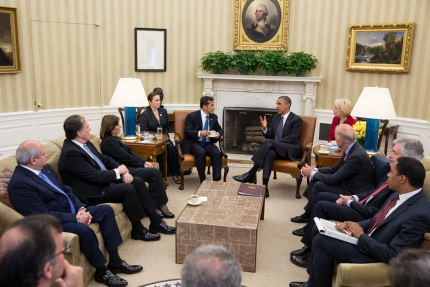
President Obama and President Ollanta Humala of Peru speak to the press after a bilateral meeting in the Oval Office.

Download mp4 (390MB) | mp3 (26MB)

Read the Transcript

Remarks by President Obama and President Humala of Peru After Bilateral Meeting

Oval Office

12:16 P.M. EDT

PRESIDENT OBAMA:  I'm very happy to welcome President Humala and his delegation to the Oval Office.  We've been able to work together and interact in a wide range of multilateral forums, but this is the first time that I've been able to have the President here in Washington. 

Peru is one of our strongest and most reliable partners in the hemisphere.  We have a strong commercial and trading relationship.  We cooperate on a wide range of security issues, including our counter-narcotics efforts.  And we spent most of our discussion focused on how we can further deepen this important bilateral relationship. 

I want to congratulate President Humala on being able to sustain strong growth rates in Peru, and his focus on broad-based economic growth that includes all people.  As a consequence, Peru has been able to see not only increased growth but also reduced poverty and steps to reduce inequality. 

For both the United States and Peru, growth is also dependent on our continued expansion in the global marketplace, and that’s why I'm very glad that Peru and the United States are working so closely together in finalizing the Trans-Pacific Partnership, which offers the possibility of opening up markets throughout the Asia Pacific region with high standards and protections for labor and the environment. 

We've also agreed to a number of bilateral programs that will strengthen our cooperation.  For example, as part of my 100,000 Strong in the Americas program, we're going to deepen education exchange programs between our two countries, and we're also focusing on how we work together to include small businesses and medium-sized businesses in a hemisphere-wide network that allows those businesses to access markets throughout the region. 

And we also talked about how we can deepen at a strategic level our work together to continue to combat the scourge of transnational drug networks that have an adverse impact not only in Peru, but throughout the region.

So overall, the state of our relationship is very strong.  I think it will become even stronger as a result of some of the initiatives that we have shaped in this meeting.  And I'm very glad that President Humala was able to visit us.  I also wish the Peruvian soccer team the best of luck this evening.  (Laughter.) 

PRESIDENT HUMALA:  (As interpreted.)  Thank you very much, President Obama.  My visit here is a sign of the strength that we want to carry out in our relationships between the United States and Peru. 

We have found in your administration an open environment in which we can build on all the strategic areas so as to strengthen our bonds.  I am convinced that under your administration we will substantively and qualitatively fight against the scourge of drugs. 

But that has not been the only topic that we have addressed during our talk.  We have also discussed about education, training, science, technology, and strengthening the capacities of our young population.  We wish to move forward on exchange programs and scholarships not only with the United States, but also with the states of the union, so that way we can provide young people more opportunities. 

We have agreed on the importance of building democracy on respecting human rights, on improving economic openness, on working on trade, because this allows us to grow our economies and to develop further.  In addition, we have highlighted that Peru is an important trade partner with the United States.  We provide economic growth.  We have economic trust.  We also provide legal stability. 

Finally, we have invited President Obama, despite his busy agenda, to visit Peru.  I hope he does find the time to come down and visit us. 

We would like to thank you for your well wishes for the match this afternoon.  The referee is from the U.S.  (Laughter.)  No, I'm just kidding.  I'm just kidding.  (Laughter.)  This is not true.  I'm just kidding.

PRESIDENT OBAMA:  If it was, hopefully the Peruvian team will be so strong that it doesn't need help from the referee.  (Laughter.)

END
12:33 P.M. EDT

Close Transcript

President Obama Speaks on Immigration Reform

June 11, 2013 | 21:57 | Public Domain

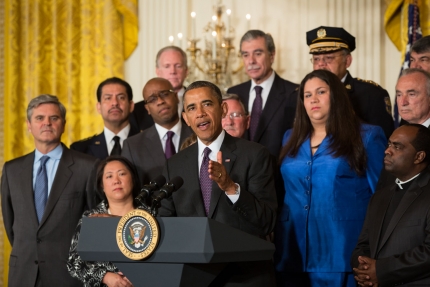
President Obama calls on the U.S. Senate to take action quickly on a common-sense, bipartisan immigration reform bill that he calls "the best chance we’ve had in years to fix our broken immigration system."

Download mp4 (810MB) | mp3 (53MB)

Read the Transcript

Remarks by the President on Immigration Reform

East Room

10:38 A.M. EDT

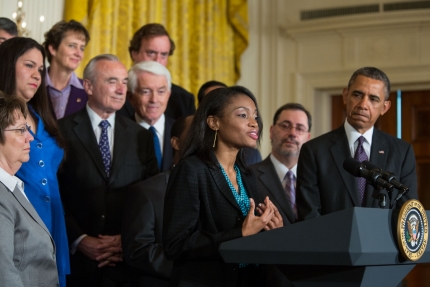
THE PRESIDENT:  Good morning, everybody.  Welcome to the White House.  It is a pleasure to have so many distinguished Americans today from so many different walks of life.  We’ve got Democrats and Republicans; we've got labor and business leaders up on stage; we have law enforcement and clergy -- Americans who don’t see eye-to-eye on every issue, in fact, in some cases, don't see eye-to-eye on just about any issue -- (laughter) -- but who are today standing united in support of the legislation that is front and center in Congress this week -- a bipartisan bill to fix our broken immigration system.

And I have to say -- please give Tolu another round of applause.  (Applause.)  It takes a lot of courage to do what Tolu did -- to step out of the shadows, to share her story, and to hope that, despite the risks, she could make a difference.  But Tolu I think is representative of so many DREAMers out there who have worked so hard -- and I've had a chance to meet so many of them who’ve been willing to give a face to the undocumented and have inspired a movement across America.  And with each step, they’ve reminded us -- time and again -- what this debate is all about.  This is not an abstract debate.  This is about incredible young people who understand themselves to be Americans, who have done everything right but have still been hampered in achieving their American Dream.

And they remind us that we're a nation of immigrants.  Throughout our history, the promise we found in those who come from every corner of the globe has always been one of our greatest strengths.  It’s kept our workforce vibrant and dynamic.  It’s kept our businesses on the cutting edge.  It’s helped build the greatest economic engine that the world has ever known. 

When I speak to other world leaders, one of the biggest advantages we have economically is our demographics.  We're constantly replenishing ourselves with talent from across the globe.  No other country can match that history.  And what was true years ago is still true today -- who’s beeping over there?  (Laughter.)  You’re feeling kind of self-conscious, aren’t you?  (Laughter.)  It’s okay. 

In recent years, one in four of America’s new small business owners were immigrants.  One in four high-tech startups in America were founded by immigrants.  Forty percent of Fortune 500 companies were started by a first- or second-generation American. Think about that -- almost half of the Fortune 500 companies when they were started were started by first- or second-generation immigrants.  So immigration isn’t just part of our national character.  It is a driving force in our economy that creates jobs and prosperity for all of our citizens.

Now, here’s the thing.  Over the past two decades, our immigration system hasn’t kept pace with changing times and hasn’t matched up with our most cherished values. 

Right now, our immigration system invites the best and the brightest from all over the world to come and study at our top universities, and then once they finish -- once they’ve gotten the training they need to build a new invention or create a new business -- our system too often tells them to go back home so that other countries can reap the benefits, the new jobs, the new businesses, the new industries.  That’s not smart.  But that’s the broken system we have today. 

Right now, our immigration system keeps families apart for years at a time.  Even for folks who, technically, under the legal immigration system, should be eligible to become citizens but it is so long and so cumbersome, so byzantine, that families end up being separated for years.  Because of a backlog in visas, people who come here legally -- who are ready to give it their all to earn their place in America -- end up waiting for years to join their loved ones here in the United States.  It’s not right. But that’s the broken system we have today. 

Right now, our immigration system has no credible way of dealing with the 11 million men and women who are in this country illegally.  And, yes, they broke the rules; they didn’t wait their turn.  They shouldn’t be let off easy.  They shouldn’t be allowed to game the system.  But at the same time, the vast majority of these individuals aren’t looking for any trouble.  They’re just looking to provide for their families, contribute to their communities. 

They’re our neighbors.  We know their kids.  Too often, they’re forced to do what they do in a shadow economy where shady employers can exploit them by paying less than the minimum wage, making them work without overtime, not giving them any benefits. That pushes down standards for all workers.  It’s bad for everybody.  Because all the businesses that do play by the rules, that hire people legally, that pay them fairly -- they’re at a competitive disadvantage.  American workers end up being at a competitive disadvantage.  It’s not fair.  But that’s the broken system that we have today.

Now, over the past four years, we’ve tried to patch up some of the worst cracks in the system.  We made border security a top priority.  Today, we have twice as many border patrol agents as we did in 2004.  We have more boots on the ground along our southern border than at any time in our history.  And in part, by using technology more effectively, illegal crossings are near their lowest level in decades.    

We focused our enforcement efforts on criminals who are here illegally and who are endangering our communities.  And today, deportation of criminals is at its highest level ever.

And having put border security in place, having refocused on those who could do our communities harm, we also then took up the cause of the DREAMers, young people like Tolu who were brought to this country as children.  We said that if you’re able to meet some basic criteria, like pursuing a higher education, then we’ll consider offering you the chance to come out of the shadows so you can continue to work here, and study here, and contribute to our communities legally.

So my administration has done what we can on our own.  And we’ve got members of my administration here who’ve done outstanding work over the past few years to try to close up some of the gaps that exist in the system.  But the system is still broken.  And to truly deal with this issue, Congress needs to act.  And that moment is now. 

This week, the Senate will consider a common-sense, bipartisan bill that is the best chance we’ve had in years to fix our broken immigration system.  It will build on what we’ve done and continue to strengthen our borders.  It will make sure that businesses and workers are all playing by the same set of rules, and it includes tough penalties for those who don’t.  It’s fair for middle-class families, by making sure that those who are brought into the system pay their fair share in taxes and for services.  And it’s fair for those who try to immigrate legally by stopping those who try to skip the line.  It’s the right thing to do.

Now, this bill isn’t perfect.  It’s a compromise.  And going forward, nobody is going to get everything that they want -- not Democrats, not Republicans, not me.  But this is a bill that’s largely consistent with the principles that I and the people on this stage have laid out for common-sense reform. 

First of all, if passed, this bill would be the biggest commitment to border security in our nation’s history.  It would put another $6.5 billion -- on top of what we’re already spending -- towards stronger, smarter security along our borders.  It would increase criminal penalties against smugglers and traffickers.  It would finally give every employer a reliable way to check that every person they’re hiring is here legally.  And it would hold employers more accountable if they knowingly hire undocumented workers.  So it strengthens border security, but also enforcement within our borders.

I know there’s a lot of talk right now about border security, so let me repeat -- today, illegal crossings are near their lowest level in decades.  And if passed, the Senate bill as currently written and as hitting the floor would put in place the toughest border enforcement plan that America has ever seen.  So nobody is taking border enforcement lightly.  That’s part of this bill.   

Number two, this bill would provide a pathway to earned citizenship for the 11 million individuals who are in this country illegally.  So that pathway is arduous.  You've got to pass background checks.  You've got to learn English.  You've got to pay taxes and a penalty.  And then you've got to go to the back of the line behind everybody who’s done things the right way and have tried to come here legally.

So this won’t be a quick process.  It will take at least 13 years before the vast majority of these individuals are able to even apply for citizenship.  So this is no cakewalk.  But it’s the only way we can make sure that everyone who’s here is playing by the same rules as ordinary families -- paying taxes and getting their own health insurance. 

That’s why, for immigration reform to work, it must be clear from the outset that there is a pathway to citizenship.  If we’re asking everybody to play by the same rules, you got to give people a sense of certainty that they go through all these sacrifices, do all this, that there’s at the end of the horizon, the opportunity -- not the guarantee, but the opportunity -- to be part of this American family.  And by the way, a majority of Americans support this idea.

Number three, this bill would modernize the legal immigration system so that, alongside training American workers for the jobs of tomorrow, we’re also attracting the highly skilled entrepreneurs and engineers from around the world who will ultimately grow our economy.  And this bill would help make sure that our people don’t have to wait years before their loved ones are able to join them here in America.

So that’s what immigration reform looks like:  Smarter enforcement; a pathway to earned citizenship; improvements to our legal system.  They’re all common-sense steps.  They’ve got bipartisan support.  They’ve got the support of a broad cross-section of leaders from every walk of life.  So there’s no reason Congress can’t get this done by the end of the summer. 

Remember, the process that led to this bill was open and inclusive.  For months, the bipartisan Gang of Eight looked at every issue, reconciled competing ideas, built a compromise that works.  Then the Judiciary Committee held numerous hearings.  More than a hundred amendments were added, often with bipartisan support.  The good news is every day that goes by, more and more Republicans and Democrats are coming out to support this common-sense immigration reform bill.

And I’m sure the bill will go through a few more changes in the weeks to come.  But this much is clear:  If you genuinely believe we need to fix our broken immigration system, there’s no good reason to stand in the way of this bill.  A lot of people -- Democrats and Republicans -- have done a lot of good work on this bill.  So if you’re serious about actually fixing the system, then this is the vehicle to do it. 

If you’re not serious about it, if you think that a broken system is the best America can do, then I guess it might make sense to try to block it.  But if you're actually serious and sincere about fixing a broken system, this is the vehicle to do it.  And now is the time to get it done.  There is no good reason to play procedural games or engage in obstruction just to block the best chance we’ve had in years to address this problem in a way that’s fair to middle-class families, to business owners, to legal immigrants. 

And there’s no good reason to undo the progress we’ve already made -- especially when it comes to extreme steps like stripping protections from DREAMers that my administration has provided, or asking law enforcement to treat them the same way they treat violent criminals.  That’s not who we are. 

We owe it to America to do better.  We owe it to the DREAMers to do better.  We owe it to the young people like Tolu and Diego Sanchez, who’s with us here today.  Where's Diego?  Right here.  Diego came here from Argentina with his parents when he was just a kid, and growing up, America was his home.  This is where he went to school.  This is where he made friends.  This is where he built a life.  You ask Diego and he’ll tell you he feels American in every way -- except one; on paper.   

In high school, Diego found out that he was undocumented.  Think about that.  With all the stuff you're already dealing with in high school -- (laughter) -- and suddenly, oh, man, really?  (Laughter.)  So he had done everything right -- stayed out of trouble, excelled in class, contributed to his community -- feeling hopeful about his future, and suddenly he finds out he's got to live in fear of deportation. Watching his friends get their licenses knowing he couldn’t get one himself.  Seeing his classmates apply for summer jobs knowing he couldn’t do that either. 

When Diego heard that we were going to offer a chance for folks like him to emerge from the shadows, he went and signed up. All he wanted, he said, was a chance to, “live a normal life” and to “contribute to the country I love.”  And Diego, this year, was approved for deferred action.  A few weeks ago, he graduated from St. Thomas University, where he was student body president and “Student of the Year.”  (Applause.) 

So now he’s set his sights higher -- master's degree and then law school so he can pursue a career in public policy, help America shape its future.  Why wouldn’t we want to do the right thing by Diego?  What rationale is there out there that wouldn’t want to make sure Diego achieves his dreams?  Because if he does, that helps us all achieve our dreams.

So in the weeks to come, you'll hear some opponents of immigration reform try to gin up fear and create division and spread the same old rumors and untruths that we’ve heard before. And when that happens, I want you to think about Tolu.  I want you to think about Diego.  And I want you to think about your own parents and your own grandparents and your own great grandparents, and all the men and women and children who came here.  The notion that somehow those who came through Ellis Island had all their papers right -- (laughter) -- had checked every box and followed procedures as they were getting on that boat -- they were looking for a better life just like these families.  And they want to earn their way into the American story. 

And if you’re willing to stand with them -- and if you’re willing to stand with all these outstanding leaders up here -- then now is the time to make your voice heard.  You need to call and email and tweet your senators and tell them, don't kick this problem down the road.  Come together.  Work together.  Do your job not only to fix a broken immigration system once and for all, but to leave something better for all the generations to come, to make sure we continue to be a nation of laws and a nation of immigrants.  Do the right thing.  

Thanks.  God bless you.  God bless America.

END
11:02 A.M. EDT

Close Transcript

The White House

Office of the Press Secretary

Presidential Nominations Sent to the Senate

NOMINATIONS SENT TO THE SENATE:

Daniel Brooks Baer, of Colorado, to be U.S. Representative to the Organization for Security and Cooperation in Europe, with the rank of Ambassador.

Michael G. Carroll, of New York, to be Inspector General, United States Agency for International Development, vice Donald A. Gambatesa, resigned.

James Cole, Jr., of New York, to be General Counsel, Department of Education, vice Charles P. Rose.

Jason Furman, of New York, to be Member and Chairman of the Council of Economic Advisers, vice Alan B. Krueger.

Keith Michael Harper, of Maryland, for the rank of Ambassador during his tenure of service as United States Representative to the UN Human Rights Council.

Catherine Elizabeth Lhamon, of California, to be Assistant Secretary for Civil Rights, Department of Education, vice Russlynn Ali.

Stephen Woolman Preston, of the District of Columbia, to be General Counsel of the Department of Defense, vice Jeh Charles Johnson, resigned.

The White House

Office of the Press Secretary

Press Briefing by Press Secretary Jay Carney, 6/11/2013

James S. Brady Press Briefing Room

1:15 P.M. EDT

MR. CARNEY:  Good afternoon, ladies and gentlemen.  Thanks for being here.  I have no announcements to make, so we'll go straight to your questions.

Julie.

Q    Thank you.  I wanted to see if you had anything to tell us today on the location of Edward Snowden.  More generally, if he’s in Hong Kong or some other country that has an extradition treaty with the United States, is it the White House’s expectation that that country would send him back to the U.S.?

MR. CARNEY:  As was the case yesterday, I am not going to discuss the subject of a recently opened investigation.  So the whereabouts of this individual, his status, any details about the investigation I would refer to -- questions about those matters I would refer to the Department of Justice and the FBI.

Q    On the broader question, though, if he is in a country, or if someone were to be in a country that had an extradition treaty with the United States, would it be the White House’s expectation that that country would --

MR. CARNEY:  Again, I think that goes to the case itself, and we're going to wait for the investigation to proceed before we weigh in with that kind of assessment.

Q    I'll try this one then.  Was the President aware that this was an individual that the U.S. was looking at, or his whereabouts, when he met with President Xi during the China summit over the weekend?

MR. CARNEY:  I believe the answer to that is no.

Q    So this didn’t come up as part of those discussions?

MR. CARNEY:  Not that I’m aware of. 

Q    Thank you.  And then on a separate topic, can you explain a little bit of the administration’s thinking on the decision to stop pushing for changes on the morning-after pill availability?

MR. CARNEY:  Julie, if I could just say on the last one, I think I mentioned yesterday, the President was made aware of the revelations about the individual taking responsibility for these leaks by senior staff aboard Air Force One after departing California. 

On the other question, on Plan B, could you ask me again and I’ll --

Q    I just wanted to know what the thinking behind the decision last night was.

MR. CARNEY:  Well, twofold.  You know what the President’s personal views are.  He expressed them here in this room.  And he supported the decision by Secretary Sebelius with regards to the use of this medication by young girls, ages 10 and 11, and the lack of sufficient data, in his view.  And so he supported Secretary Sebelius’s decision, having not played a role in the making of the decision.

We have been through a legal process and the court has ruled against the administration -- an appeals court -- as you know, and that ruling means that -- or meant that Plan B would be immediately available to anyone of any age.  And it was the decision given that court ruling to proceed with making the simpler version of Plan B available, because at the very least that addresses some of the concerns about the ability of younger girls to use that medication.

So the ruling came in against; the administration immediately made a form of Plan B available, and it was a decision that the President supports to proceed to making sure that the FDA approved the simpler version of Plan B.

Q    What steps is the administration taking to ensure with defense contractors who work on intelligence issues that their employees -- that they have adequate safeguards against rogue insiders?

MR. CARNEY:  Well, there are a couple of pieces to that question, some of which have been answered by the DNI, the Director of National Intelligence.  So there are several.  First of all, there’s the damage assessment that’s ongoing.  Secondly, it is important to note that when it comes to contractors, they swear an oath to protect classified secrets just as government workers do.  And that is important to remember.

In terms of procedures that are in place, I think I would refer you to the various agencies that have contractors that deal with classified information -- Department of Defense, NSA, CIA and the like -- in terms of the procedures that are in place or any procedures that they may be engaged in now in the wake of these leaks.  But again, I think it’s important to note that individuals who take an oath to protect classified information are bound by it, whether they are government employees or contracted employees.

Q    So is there anything new that the administration is doing, then, in terms of seeking extra assurances from contractors in the wake of what’s happened?

MR. CARNEY:  Again, I think I would refer you to the agencies that employ contractors who have access to, once they have gone through all the rigorous background checks and other procedures to give them the security clearances that they have, and that they take the oath that they do, for any post-revelation measures they may be taking.

Q    And if I could ask you about President Putin today -- he said he has no doubts about Iran’s nuclear program.  What do you make of those comments?  What does the administration make of those comments and the importance of them, given Russia’s place in the peace discussions and Iran’s nuclear program?

MR. CARNEY:  About Iran’s -- I'm sorry, I haven’t seen those comments so maybe you can characterize them for me further.  No doubts in that Iran’s pursuit is for non-peaceful means, military means? 

Q    Yes.

MR. CARNEY:  Well, that’s certainly our view and it’s been our view that Iran needs to abide by its international obligations.

Q    Sorry, no doubts that Iran is pursuing this for nefarious intentions.  No doubts in terms of -- he said he has no doubts that Iran is pursuing a nuclear program for peaceful means.

MR. CARNEY:  Oh, okay, so that’s the opposite of what I thought you were saying.  Our views haven’t changed.  I’m not aware of the comments by the Russian President that you just relayed to me, but I would say that Iran has failed to live up to its obligations under international law, to prove that its pursuit of nuclear technology is for peaceful means.  There is ample evidence to the contrary. 

And we are engaged in a process with our allies to try to bring about a change in behavior by the regime in Tehran.  And as part of that process, we have instituted the most stringent and broad sanctions regime in the history of the world.  And that is both unilaterally and with our allies, and through the United Nations and through different means.

We have said that there remains time for Iran to choose a path of engaging with the international community and abandoning its nuclear weapons ambitions, but that that time is not unlimited.  And we obviously monitor the situation very closely with our allies.

Dan.

Q    Thank you, Jay.  Does the President believe that keeping America safe is more important than keeping the information of Americans secret?

MR. CARNEY:  As you heard the President say on Friday, he believes that we must strike a balance between our security interests and our desire for privacy.  He made clear that you can not have 100 percent security and 100 percent privacy, and thus we need to find that balance.  He believes as Commander-in-Chief, that the oversight structures that are in place to ensure that there is the proper review of the kinds of programs that we have in place, authorized by Congress through the Patriot Act, and FISA do strike that balance. 

He also said that he understands and believe it is entirely legitimate that some may disagree.  Some may believe that that balance ought to be shifted in one direction or the other from where it currently is, and he welcomes the debate about that.

He mentioned this very explicitly in his speech to the National Defense University several weeks ago on the broader topics of our counterterrorism programs, but he spoke specifically about surveillance and the balance that we need to strike between security and privacy, between security and inconvenience.  And that is a worthy discussion to have in public and he welcomes that debate, because it’s an important debate.

And I think it’s important to note that we have had this debate every time the Patriot Act has come up for passage and reauthorization.  And it has been a spirited debate with strongly held opinions expressed by people who are opposed to the structures that are in place that have been authorized by bipartisan majorities in Congress, that are overseen by the courts, as well as internally by the executive branch.  So that's important and it’s healthy and we should continue to have that debate.

Q    But isn't it true, though, that security at times will have to take a backseat to -- or rather privacy will have to take a backseat to security?

MR. CARNEY:  I think I've answered the question that we have to find a balance between those two and that we cannot have, if we hope to successfully protect ourselves, a hundred percent privacy; that there has to be some modest concession to the need for information as we pursue terrorists who mean to do harm to the country and to take the lives of Americans; but that we need to make sure that the programs we have in place are properly overseen, that they are legal, that they are authorized by Congress and they are authorized by the courts.  And that is the case here and has been the case with the discussion that we've had in the wake of these revelations.

But again, I just want to emphasize that the fact that these systems are in place and the oversight exists and it is significant does not mean that the conversation has ended, in the President’s view.  It means that we need to continue to debate this.  And as I said yesterday, this goes to sort of broader issues about our nation and the world, in terms of the nature of electronic communications and broader issues of privacy.

So this is an important debate for us as a nation.  It's important, in the President's view, that we have the kinds of debates that we've had in Congress over the Patriot Act and its reauthorization, the improvements to the Patriot Act that ensure that there was oversight that had not existed prior to 2006 I believe, and then the measures that have been taken to ensure that there's judicial and executive branch and congressional oversight since.

So the President certainly does not welcome the way that this debate has earned greater attention the last week.  The leak of classified information about sensitive programs that are important in our fight against terrorists who would do harm to Americans is a problem and it is a great concern.  But the debate itself is legitimate and should be engaged.

Q    And about the congressional picnic that has been postponed -- what was behind that?  Did sequester play into that decision at all?

MR. CARNEY:  No, this was a -- I think had to do with the President's schedule and the fact that he is, as you know, taking several overseas trips in June, and that necessitated trying to postpone this.

Q    The top Republican on the Senate Foreign Relations Committee, Senator Corker of Tennessee, is urging the President to arm Syrian rebels at the earliest possible time.  What is your response?  And is Senator Corker correct when he says the President is facing a critical policy decision on Syria this week?

MR. CARNEY:  The President has been evaluating his policy options on Syria repeatedly for some time.  There are a number of issues that we've discussed here that have to do with the use, potentially, of chemical weapons by the Assad regime and the need to build on the evidence that we have already accumulated, that that in fact has taken place. 

Then there is the issue of how best to achieve our policy goal, which is a negotiated political settlement to an authority in Syria that can provide security and stability; that can protect the rights of all Syrians; and that can secure unconventional and advanced conventional weapons; that can counter terrorist activity; and that can keep the state and its institutions preserved to the extent possible.  So that’s the policy goal that we have as a nation, a policy goal we have with our allies and partners on this issue, and then we evaluate the options available to us in a very challenging situation based on whether or not they will bring us closer or inadvertently move us further away from achievement of that policy goal. 

The President is, as you know and as he has said, reassessing those options.  One of the options that he has not taken off the table and that we continue to assess is the potential of providing arms to the opposition.  We already have provided an enormous amount of assistance to both the Syrian people, through humanitarian assistance, as well as to the opposition.  But we evaluate every other option.  The one exception to that, although all options remain on the table, is the President has made clear that he does not foresee a circumstance where we would have American boots on the ground in Syria.

Q    And what about the timing?  What about this week?  Is there a policy decision we should be expecting?

MR. CARNEY:  I don't have any policy announcements to preview for you or forecast, except to say that the situation in Syria is obviously serious and it continues to deteriorate.  And that is of great concern to the President and to everyone with an interest in Syria and the region.  And we continue to discuss this with our allies and partners.

Q    So has the President or his administration sent any messages to Nelson Mandela or his family this week? 

MR. CARNEY:  I am not aware of any communications from the White House, where obviously he is and the First Lady is.  And we all are concerned about Nelson Mandela's health and wish him and his family well and hope that he recovers.

Q    Can I follow on that, please? 

MR. CARNEY:  Yes, April.

Q    Was the Johannesburg part of the trip the President is going to take later this month basically for the President to go see Nelson Mandela?

MR. CARNEY:  No, April.  I think that that understates significantly the importance of South Africa and the bilateral relationship we have with that country.  There is every reason to visit South Africa on a visit to Africa.  But I don't have any specifics on the schedule or the plan for the President's trip beyond what we've put out already.

Q    Well, we understood it that Johannesburg was added.  It was supposed to be Cape Town for South Africa, and then Johannesburg was added.  And Nelson Mandela, at that time, was in Johannesburg.  And the question was how this is --

MR. CARNEY:  Again, I don’t have any specifics on a schedule that's still coming together to provide to you, except to say that we're obviously concerned about Nelson Mandela's health, and wish him well and a speedy recovery.  But we obviously also have a very important relationship with South Africa.

Q    When was the last time President Obama talked with Nelson Mandela, particularly as both of them really are the essence of the first black President for the United States and for South Africa?

MR. CARNEY:  I don't have an answer to that question in terms of the last time they spoke.  I know they did meet when President Obama was a senator.  And the First Lady was in South Africa and met with Nelson Mandela when she visited South Africa a few years ago I believe.  But I don’t know when the President last spoke with Mr. Mandela.

Q    And does he feel a kinship with him because of their historical placing in these two respective countries?

MR. CARNEY:  I think the President has written about and spoken about Nelson Mandela in the past.  So I would point you to what he said about this hugely significant figure in South African, African and global history.

Q    Just to be clear, does the United States want to prosecute Mr. Snowden?

MR. CARNEY:  There is an investigation underway, and it is for the investigators to determine whether or not crimes have been committed and to decide what charges, if any, will be brought.  And I will not get ahead of that process.

Q    You haven’t so far.

MR. CARNEY:  We have said -- well, Bill, I appreciate the opportunity to glibly get ahead of an important investigation but I’ll pass on it.  I think that we have made clear that we have very serious concerns about the leak of classified information about programs that are very important to our national security. But on this specific investigation and the status of the individual who’s being investigated, I will leave comment on that to the investigators.

Q    Speaker Boehner today called Snowden a traitor.  Would you go that far?

MR. CARNEY:  Again, I won’t comment specifically on someone who’s under investigation.  I won’t characterize him or his status.  We believe it is the appropriate posture to take to let the investigation move forward and let the determination about where that investigation will go and whether any charges will be brought and what those charges might be if they are brought to the investigators, to the FBI and the Department of Justice.

Q    As we’ve talked about this debate, you’ve said the President welcomes the debate and you’ve referred to his speech at the National Defense University.  One of the takeaways from that speech, in his own words, was that he felt it would be a mistake for the U.S. to stay on what he called a war footing, that it was sort of self-defeating.  Isn’t the lesson that we’ve learned over the last couple of weeks after that speech is that we still are on the war footing?  In fact, he’s expanded surveillance to prevent terror attacks.  So when you cite that speech, isn’t there a bit of a contradiction there?  When he was telling the public two or three weeks ago we’re kind of ramping down, we don’t want a war footing anymore, the expanded surveillance suggested we still are on a war footing.

MR. CARNEY:  Well, I think you’re conflating a number of issues here, Ed, and it’s not -- that was a fairly long and detailed speech that delved into a number of --

Q    One of the messages was that we’re scaling -- that we’re not on a war footing.

MR. CARNEY:  Well, I think with regards to that, we have as a nation been in active, hot wars for more than a decade.  And the President, keeping his commitment from when he ran for this office, ended the war in Iraq.  And he is winding down the war in Afghanistan.

But it remains the case that we continue to aggressively pursue al Qaeda and its affiliates.  And it is absolutely his obligation as Commander-in-Chief to do so and to ensure that we have the tools necessary to do that.  It is also his view and his insistence that those tools that we have and that we use are subject to oversight and are carried out and are used in a way that that keeps faith to our laws and our values -- with our laws and our values. 

So I don’t think there’s any inconsistency at all there.  We remain in conflict with al Qaeda.  Al Qaeda, even though it is greatly diminished -- core al Qaeda in particular -- remains a threat, and al Qaeda’s affiliates remain a threat.  We’ve certainly discussed that quite a bit -- whether it’s in Yemen or elsewhere.  And the President is taking every action necessary as Commander-in-Chief to ensure that we are adequately protected from that threat.

Q    One other topic.  CBS broke the story a couple days ago about the State Department -- about a memo from an official in the State Department inspector general’s office claiming that a special agent had “determined” that Ambassador Gutman in Belgium was ditching his security detail to engage prostitutes and to allegedly solicit sex with children.  He has sharply denied that. Is the President confident in the denial to keep Ambassador Gutman in place?  And what is the President’s reaction to the State Department allegedly shutting this down?

MR. CARNEY:  Well, let me say a couple of things.  These allegations are currently under investigation by an independent inspector general.  There is no final report on these inquiries by the independent inspector general.  And as in keeping with the position we take when we are dealing with independent inspector general investigations or audits, we will not comment until we have seen the results of that investigation.  And there’s a process in place for reviewing any sort of allegation of misconduct the likes of which you mentioned, and we believe that that process should unfold under regular order, and we’re not going to prejudge anyone or anything before all the facts are determined.

That said, I want to make clear the President has zero tolerance for misconduct by any government employee.  And I think his zero tolerance for misconduct has been demonstrated amply throughout his presidency.  But we’re not going to prejudge based on unfinished investigations by an independent IG.

Q    I appreciate that distinction.  One last thing on this, which is you say it’s still under investigation, the allegations against the ambassador.  But there are also allegations in this memo against Patrick Kennedy, who’s a very high State Department official, suggesting that he killed the original investigation, sort of blocked it, to protect Ambassador Gutman and maybe others.  My question is, does Under Secretary Kennedy’s conduct here, is that under investigation as far as the White House --

MR. CARNEY:  I believe all of these matters that you raise are under investigation, active investigation by the independent IG at the State Department.  And we will not prejudge the outcome of an ongoing inquiry like that.

Q    On that same topic, Jay, is it appropriate that the State Department has gone so long, I think since 2008, without a fulltime inspector general?

MR. CARNEY:  I don’t have any information for you about the staffing of the IG’s office, but I’ll have to take the question. What I can tell you is that -- if this related to the questions that Ed mentioned -- there is an active investigation --

Q    It's not.  Just in general terms, the fact that the State Department --

MR. CARNEY:  This just occurred to you?

Q    No, well, it's because it's State Department, it's Labor Department, it's Interior, Homeland Security, Defense, and I think it's the Agency for International Development all of which do not presently have full-time inspector generals.  So it would be a broader question I'm posing.

MR. CARNEY:  Okay.  Well, I'll have to take the question.

Q    I appreciate it.  Thank you.  On a separate topic then, very briefly, I think Julie got to it quickly -- on Plan B, I know the situation has changed, but has the President's personal position on emergency contraception changed?

MR. CARNEY:  The President's views are as he expressed them. Those are his personal views, and he put them in the context of being a father.  And he supported, again, the decision that Secretary Sebelius made at the time. 

But the fact is, this case has been litigated; an appeals court has ruled against the administration, making available a version of Plan B immediately.  And it is the view of the administration that given that ruling and the availability of Plan B, it is in the best interests of the country that the simpler version be made available.  And if you're familiar with the ruling and the two different versions of the medication, I think that explains why we've taken the position we have.

Q    And then, on one final topic -- Democratic Senator Wyden said of the Director of National Intelligence, James Clapper, that he, "didn’t give straight answers on the NSA surveillance during a hearing that took place in March."  The President has called for open and honest debate.  I think Wyden says specifically that the American people have the right to expect straight answers from intelligence leadership to questions asked by their representation -- or their representatives.  Is the President satisfied that the American people are getting straight answers from their leadership when it comes to American intelligence?

MR. CARNEY:  Well, he certainly believes that Director Clapper has been straight and direct in the answers that he's given, and has actively engaged in an effort to provide more information about the programs that have been revealed through the leak of classified information.

Q    Because even James Clapper said it was the least untruthful statement -- he acknowledged that it wasn't fully truthful.

MR. CARNEY:  Well, I'm not sure what statement you're talking about.

Q    This was the statement that I was referring to in the March hearing, where he was asked specifically whether all -- I have the direct language -- does the U.S. collect any type of data on all of the millions of Americans, and he said the answer to that was no.  He later sort of amended it.  But even -- in the conversation with Andrea Mitchell this weekend, he acknowledged that it was the least untruthful answer he could give.

MR. CARNEY:  Well, look, I think Director Clapper has -- in the last week has demonstrated -- has been aggressive in providing as much information as possible to the American people, to the press about these very sensitive and very important programs that are authorized by Congress under Section 702 and Section 215 of the Patriot Act -- a public statute, a much-debated public statute that has been passed into law and reauthorized I believe three times by Congress with bipartisan majorities. 

And I would point you to the statements and documents that have been put out by the ODNI that demonstrate the effort that he has undertaken to provide a significant amount of information on these programs, given the revelations that we’ve seen.

Mark Knoller, do you have something for me?

Q    Yes, let me ask you this -- what advice would the White House give --

MR. CARNEY:  I probably am going to regret -- (laughter.)

Q    -- to an official or somebody with a top-secret clearance who thinks there is wrongdoing underway?  What option does such an individual have to try and correct that?  What does such an individual do?

MR. CARNEY:  That’s an important question and I appreciate it.  The Obama administration has demonstrated a strong commitment to protecting whistleblowers.  The whistleblowers can play an important role in exposing waste, fraud, and abuse.  There are established procedures that whistleblowers can employ that also protect -- rather ensure protection of national security interests.  And I would -- if you look at the history here, the President appointed strong advocates to the Office of Special Counsel and the Merit Systems Protection Board, who have been widely praised.  They have collectively issued an all-time high number of favorable actions on behalf of whistleblowers and have begun to change the culture so that whistleblowers are more willing to come forward.

On November 27th, 2012, after four years of work with advocates and Congress to reach a compromise, the President signed the Whistleblower Protection Enhancement Act, which provides whistleblower protections for federal employees by clarifying the scope of protected disclosures, expanding judicial review, expanding the penalties imposed for violating whistleblower protections, creating new protections for transportation security officers and scientists, creating whistleblower ombudsmen, and strengthening the authority of the Office of Special Counsel to assist whistleblowers.

Because it was clear that Congress would not provide protections for intelligence community whistleblowers, the President took executive action, issuing a landmark directive that extended whistleblower protections to the intelligence and national security communities for the first time.  The directive prohibits retaliation against whistleblowers who report information through the appropriate channels and established procedures, including a review panel of IGs of other agencies to ensure that such retaliation does not occur.

The President’s commitment on this issue far exceeds that of past administrations, which have resisted expanding protections for whistleblowers and in doing so have steered away from transparency.

Q    That was quite an off-the-cuff answer.

MR. CARNEY:  I just happened to have this available.  (Laughter.)

Q    Does the -- are you willing to say whether you see Snowden as a whistleblower or a leader?

MR. CARNEY:  I am not willing to comment on the status of the individual under investigation.

Q    Thank you.  Is Secretary Kerry participating in an NSC meeting tomorrow on Syria?

MR. CARNEY:  I think I was asked this yesterday about yesterday.  I can simply tell you that we have meetings here on Syria with some regularity.  I'm not going to give a readout or preview of every meeting we have.  But given the seriousness of the situation there and the importance of Syria with regards to American policy, you can be sure that we have regular meetings on these issues that involve both principals and deputies on the National Security Council.  I don't have a specific meeting to announce from here because they are fairly frequent and routine.

Q    Fair to say that the White House is edging closer toward a decision meeting?

MR. CARNEY:  I don't have any decisions or announcements to make about policy, except to say that the President is constantly reviewing the options available to him and tasking his team to review those options with an eye towards what actions we might take that would bring us closer to the achievement of the goal that we seek.

Q    And one other topic -- on Snowden, can you describe a little bit about the damage he has caused?

MR. CARNEY:  I think I would refer you to the statements by the Director of National Intelligence, who is in a position to better assess that at the outset, and note that more comprehensive damage assessments are being done.  It is without question a matter of significant concern when we see leaks of highly classified information about very sensitive programs that are classified for a reason, that they are important to our effort to combat terrorists and extremists, and those who seek to do harm to our nation and take the lives of the American people.

But for more specific assessments, I would refer you to the ODNI.

Q    Any idea how long that damage assessment -- do you think it's going to take long?

MR. CARNEY:  I'm not sure.  I would ask them.

Q    On Syria again, you reminded us that the President is constantly reviewing his options.  And it's the same thing in the European capitals and Ottawa, too.  Is there any concerted NATO option there?

MR. CARNEY:  Well, I don't have a list of options to review for you since they're all on the table.  I guess you could assume that any option you might ask me about within reason and logic would be on the table.  What we tend to talk about here are what actions might be taken in response to assessments of more corroborated evidence about the use of chemical weapons, for example, what actions might be taken with regards to further assistance to the Syrian opposition given the circumstances in Syria and given the assessments we constantly make about what the impact of a decision like that would be.

But I am not going to weigh in on specific options and whether they're being considered, because as the President has said, with a caveat on the exception of on the option of putting boots on the ground, the President has said all options remain on the table.

Q    There are discussions also, are there with --

MR. CARNEY:  We talk about this issue with our allies and partners all the time, because it is of such great concern to the President and American political leaders in general, as well as the leaders in the countries of our allies and partners who have grave concerns about what’s happening in Syria, grave concerns about the impact of the violence in Syria on the region, concerns about the involvement of Hezbollah and Iran in the fighting in Syria on behalf of Bashar al-Assad.  These are all matters that are of serious concerns beyond the borders of Syria.

Q    Jay, can you tell me if the State Department review report on Keystone XL is on the President’s desk?

MR. CARNEY:  Again, that’s a process that is operated out of the State Department and I would refer you to the State Department for updates on --

Q    So, anything --

MR. CARNEY:  Again, I think you should take that question to the State Department.

Q    A follow-up on Syria again.  Considering the military gain achieved by the Syria government, what makes you confident that the Geneva talk will take place altogether?  And second, the U.S. is conducting military exercises with Jordan -- around 8,000 personnel.  Is this a plan B for Syria -- I mean, different kind of plan B?

MR. CARNEY:  Let me refer first to the -- that’s clever -- (laughter) -- refer first to the question about Jordan.

Jordan is a close friend and ally to the United States, and our militaries in particular have a longstanding relationship.  In reference to your question, a Patriot missile battery and F-16s are in Jordan in support of our annual joint exercise, Eager Lion.  And that is, again, an annual exercise.  So it not related to Syria or proposed options in Syria.

On the first question, as I noted earlier, there is concern here and elsewhere about the deteriorating situation there, about the involvement of Hezbollah and Iran in the fight in Syria on behalf of Assad.  And the President is reviewing the options available to him when it comes to American policy, and working with our allies and partners on ways that we can assist the Syrian people and assist the Syrian opposition in trying to achieve the goal that we’ve stated, which is a peaceful transition to a post-Assad Syria to an authority in place in Syria that respects the rights of all Syrians, that protects conventional and unconventional weapons, that combats terrorism and terrorists.  And it is in pursuit of that goal that we evaluate the options available to us.

Q    I’m glad you said all that, but what makes you confident that the Assad government will participate in Geneva, too?

MR. CARNEY:  On the Geneva question, we are, as you know, working to convene a conference as soon as practical, which means as soon as it is determined, in partnership with the United Nations and with our international partners, that we have done the necessary preparations to bring the parties together and move forward towards a political solution.  And we are pursuing this, and we're pursuing a conference in Geneva. 

But we are not -- that is not the one track we're pursuing here.  The political process cannot occur in a vacuum.  There is ongoing fighting in Syria.  That is why we have, even as we continue our discussions with our allies, with the Russians, with the opposition about Geneva, the situation on the ground means that we continue to explore what more we can do to support the opposition as it confronts the tyranny of Bashar al Assad.

Q    Jay, on the China summit?

MR. CARNEY:  China summit?

Q    Yes.  NSA and Donilon on Saturday had said that the President was going to follow the summit with some conversations with U.S. allies in Asia and that Donilon himself was going to have some meetings with representatives from those countries today.  Have any of those conversations happened yet?  Can you tell us anything about that?

MR. CARNEY:  I have no presidential interactions to read out to you, and I'll have to check about the National Security Advisor.

Q    Do you expect anything today?

MR. CARNEY:  Again, I just don’t know.  I'll have to take the question. 

Q    Jay, on the NSA thing, it's obviously a big deal.  You've got members of the President's own party questioning what the DNI said about this.  This clearly has repercussions that are far more significant than some of the other things we've talked about in the briefing room.  Isn't it time for the President to address the American people directly?  Isn't this sort of a litmus of leadership, to tell people when you're taking them in a new direction, and when they're confronted with these various challenges?

MR. CARNEY:  Well, Glenn, the President took questions and answered them at length on this specific issue on Friday. 

Q    How many questions did he take?

MR. CARNEY:  I think he answered for a total of 14 minutes; two multi-part questions on these issues that probably, given the standards here, that’s six or eight questions.  And the fact of the matter is he will continue to discuss this, and he will continue -- he is interested in and believes in a debate about these issues and believes it's worthy and important to engage in that debate. 

Q    What is this debate?

MR. CARNEY:  And I would just note, as I did earlier, that prior to these revelations, the President addressed this specific issue in a speech at the National Defense University --

Q    But we didn’t know about the magnitude of this.

MR. CARNEY:  Oh, so you're saying you weren't interested until there were revelations?

Q    I think most Americans were not aware of this.  Don’t you think --

MR. CARNEY:  But, Glenn -- let me just say that the Patriot Act, which I know you've heard of, is a public statute.  There is spirited and animated debate about the reauthorization of the Patriot Act every time it comes up for reauthorization, which includes, most recently, in 2011.  And the provisions under which -- the sections of the law under which these programs exist have been and are debated, and they have been, since the first reauthorization, updated in a way that made sure that oversight that did not exist over programs in the previous administration, in the first years of the previous administration, does exist.  And that was at the insistence of lawmakers including then-Senator Obama, that that kind of enhanced oversight by all three branches of government take place and exist with programs that are vital to our national security.

Q    Former Attorney General Mike Mukasey has said that the President ought to have a fireside chat with the American people about this.  Why not do that?  I mean, is there --

MR. CARNEY:  Well, I'm not saying -- I think I just said -- Glenn, although I appreciate yours and the former attorney general's specific recommendations about the modalities of presidential communications -- the President has and will speak about this subject.

Q    Jay, you just said now to Glenn and to answers today and yesterday, you've referred us back to the President's speech at National Defense University.  Nowhere in that speech does the President specifically address the use of private contractors either for intelligence or for any of the other initiatives that the President was looking to address.  Is the President --

MR. CARNEY:  Jared, I think you’ve kind of missed the big story here.  But I grant that there’s a question here about contractors, but the focus of the President --

Q    The President --

MR. CARNEY:  -- about the conversation we’ve been having here is the balance between our security interests and our desire for privacy.

Q    Right, and the question I was trying to ask was that is the President looking at this as an opportunity to reexamine the proportion or depth that private contractors have, including in our intelligence community?

MR. CARNEY:  Well, I think that is an interesting question and perhaps worthy of debate as part of this conversation that we should be having.  I would note that contractors have long been involved in both our defense and intelligence efforts, and that when it comes to security clearances, they are subject to the same system of checks and security clearance procedures as government employees.  But, again, I -- which is not to be at all dismissive of the question, because I think that, too, is certainly a question that merits debate. 

But the issue is if you are a private contractor and you take an oath to handle and protect classified information, you are under the same obligations as I am and Josh is and others here who have security clearances.  So the legal protections and the legal regime is the same, and the obligations are the same.

Q    But in an hour at National Defense University the President didn’t specifically mention private contractors once.  And this is now -- you say that he wants to have a conversation  --

MR. CARNEY:  Jared, I appreciate -- I’m not sure what point you’re trying to make.  The President gave a lengthy speech that was about specific issues like the use of --

Q    Because you keep cutting me off.  (Laughter.)  What I’m trying to ask is the President didn’t mention specifically contractors. 

MR. CARNEY:  You’ve said that.

Q    -- in the vacuum of that omission, the Snowden incident has filled that gap and so the President wants to have the conversation.  Does this conversation begin now on the contractors issue, which is up to 70 percent of intelligence gathering in some capacities?  Doesn’t that open a door that the President had left closed?

MR. CARNEY:  No.  I think that that is an issue, as I think I said in answer to your partial questions, that merits debate.  But whether it’s a private contractor or a government employee, the issue of classified information and the obligations that individuals who take an oath to protect it have is the same, one. 

Two, it is certainly worth a discussion -- there has been discussion and debate in the past about the use of contractors in various other parts of the government, and that’s certainly worth debate.  But when it comes to the issue of protecting our privacy and protecting our security, the balance that we seek remains the central issue regardless of the employment status of the individuals who take the oath to protect classified information.

Q    Jay, on immigration, the President this morning talked about maybe potential changes to the bill.  Senator McConnell is looking for what he terms “major changes” in the areas of border security, benefits, and taxes.  Is the President open to any major changes to this bill?

MR. CARNEY:  The President gave remarks about immigration reform just a few hours ago, and made the point that the bill that emerged from the Senate Judiciary Committee represents an extraordinary amount of hard work by a bipartisan group of United States senators, a process in committee that allowed consideration of numerous amendments and passage of amendments with bipartisan support. 

It does not represent letter for letter exactly what the President wants, nor does it represent letter for letter exactly what any individual Republican lawmaker or Democratic lawmaker wants.  But it does represent a strong consensus position on the central principles that the President laid out when it comes to comprehensive immigration reform, and we strongly support that bill. 

And we look forward to a process that begins today of consideration on the Senate floor of comprehensive immigration reform.  And we sincerely hope that as this bill is debated and as amendments are considered that the significant majority of lawmakers in the Senate who support comprehensive immigration reform -- reflecting the support that’s out there in the American public and the views of the President -- prevail over any efforts to sabotage that, when we have, as the President said, a unique opportunity to address this challenge for this first time in many, many years.  And we do not want to miss that opportunity, an opportunity that will be good for the middle class, be good for our businesses, be good for our security.

On one of the issues that is frequently raised when it comes to immigration reform -- border security -- it is important to note, A, that we have taken significant steps to enhancing our border security.  Since President Obama took office, we have I think the most boots on the ground on the border that we’ve ever had as a nation, and we’ve doubled the number of border patrol agents.  And in addition to that, the bill itself that the Senate passed out of committee represents the most significant border security bill in our history in terms of resources allocated towards further border security.  And that’s very important.

It also makes clear that we have to have a clear path to citizenship for the 11 million illegals in this country -- illegal immigrants in the country, and that that path has to be clear because that’s the right thing to do for our businesses and for the middle class and for our economy.

So the President, as you heard him say today, looks forward to a healthy debate in the Senate as they consider this important legislation; looks forward to bipartisan passage of that bill in the Senate and in consideration in the House, and ultimately passage by the full Congress.

Q    Jay, does the President believe that the government is currently striking the right balance between privacy and security?  Is it getting it right?  And if so, why?  And if not, which way should it tilt more, privacy or security?

MR. CARNEY:  The President has addressed this, and so I will paraphrase him by saying yes -- (laughter) -- the President believes that -- thank you, Glenn.  The President believes that we are striking the right balance, in his view, through programs that are subject, first of all, to debate, consideration and passage by Congress; and then subject to an oversight regime that involves all three branches of government. 

And I think it's important, whether it's Section 702 or 215, to be fully aware of the kind of oversight that exists when it comes to these programs.  And I'd like to at this late date or late moment in my briefing to remind you of some of that oversight that exists -- if I have it here, which I may not.

Q    While you search let me ask, why welcome the -- why invite all the debate?  If there is this debate now, if your position is --

MR. CARNEY:  Because the President has made clear that he does not believe that just because he has come to the conclusion that we have struck the balance that is the right balance that that should end debate.  He believes that this is a subject where well-meaning and thoughtful people can disagree and that we ought to have that debate.  And we certainly are having it now and we should continue to have it. 

But what I think is important to note, as we've seen these revelations, is that there is a system in place with regards to these two programs that ensures that there is oversight by the judicial branch, by the legislative branch and by the executive branch to make sure that these programs as they are implemented  are done so in a way that is consistent with the law and with the guidelines that exist to ensure that there aren't -- that they don't run afoul over our laws or values.

And depending on the programs -- the 215 program we talked about that is subject to renewal every 90 days through the courts, it is briefed and reviewed by Congress.  And similarly, with 702, there are procedures for both requirements for judicial consent and review, and for congressional review and notification and updates.  Additionally, there are procedures in place in the executive branch for monitoring these programs to ensure that in the implementation of the authorities granted by Congress, those who carry out these programs are doing so in a way that's consistent with our law, and with the values and the oversight regime that's in place. 

Thanks very much, guys.

END
2:01 P.M. EDT

President Obama Meets with President Humala of Peru

President Barack Obama participates in a bilateral meeting with President Ollanta Humala of Peru

President Barack Obama participates in a bilateral meeting with President Ollanta Humala of Peru in the Oval Office, June 11, 2013. (Official White House Photo by Pete Souza)

Today, President Obama held a bilateral meeting with President Ollanta Humala of Peru.

“Peru is one of our strongest and most reliable partners in the hemisphere, President Obama said.  “And we spent most of our discussion focused on how we can further deepen this important bilateral relationship.” 

I want to congratulate President Humala on being able to sustain strong growth rates in Peru, and his focus on broad-based economic growth that includes all people.  As a consequence, Peru has been able to see not only increased growth but also reduced poverty and steps to reduce inequality. 

For both the United States and Peru, growth is also dependent on our continued expansion in the global marketplace, and that’s why I'm very glad that Peru and the United States are working so closely together in finalizing the Trans-Pacific Partnership, which offers the possibility of opening up markets throughout the Asia Pacific region with high standards and protections for labor and the environment. 

The two leaders also discussed additional areas of cooperation, including deepening education exchange programs, connecting small and medium-sized businesses to markets throughout the hemisphere, and combatting transnational drug networks.

The White House

Office of the Press Secretary

FACT SHEET: U.S. - Peru Economic Relations

The United States and Peru share a strong commitment to expanding economic growth, job creation and inclusion through integration into global markets.  Our close cooperation in the Trans-Pacific Partnership (TPP) negotiation and our high standard United States – Peru Trade Promotion Agreement (the Agreement) are recent examples of efforts to strengthen trade and investment ties bilaterally and to expand economic links between the Americas and growing markets of the Pacific Rim.  Additionally, Peru is a partner in the Asia-Pacific Economic Cooperation (APEC) forum and the Pathways to Prosperity in the Americas initiative. 

Leaders in the Trans-Pacific Partnership

The United States and Peru are two of the original members of the Trans-Pacific Partnership (TPP).  TPP is a comprehensive, high-standard, 21st century trade agreement that will increase exports and jobs in both the United States and Peru, and address the issues that U.S. and Peruvian businesses and workers are facing in the 21st century.   The United States and Peru have worked closely and constructively as partners in the TPP negotiation, cooperating to open markets and deepen economic ties across the Pacific.

The TPP, one of the highest trade priorities for President Obama’s second term, is central to the U.S. - Peru economic partnership.  The TPP currently includes 11 countries, and with the upcoming entry of Japan (following completion of each TPP member’s domestic procedures), TPP members will represent nearly 40 percent of global GDP.  The TPP members made significant progress at the 17th negotiating round, hosted by Peru in Lima in May, and the negotiations are on an accelerated track toward concluding in the 2013 timeframe envisioned by President Obama, President Humala and the leaders of the other TPP member countries.  The next round of negotiations is set for July 15-25, in Malaysia.

A Key Bilateral Trading Partner

February 1, 2013 marked the four year anniversary of the Agreement’s entry into force.  In 2012, two-way trade in goods between the United States and Peru was $15.8 billion, and the outlook for future growth is positive.  In the past three years, U.S. exports to Peru have increased by 90 percent, while U.S. imports from Peru have increased by 52 percent.  According to Peruvian trade statistics, Peru experienced a 10 percent increase in non-traditional exports to the United States last year.

The United States is Peru’s second largest export market and primary supplier of imports; Peru was the United States’ 32nd largest goods export market in 2012, up from 36th in 2009.  

The United States and Peru are committed to frequent engagement under the Agreement in order to ensure its benefits are fully realized.  During the week of June 3, four committees established under the Agreement convened in Washington, DC for annual meetings.  The committees included the Standing Committee on Sanitary and Phytosanitary Measures, the Environmental Affairs Council, the Environmental Cooperation Commission and the Free Trade Commission.   The Joint Statement from the Free Trade Commission meeting can be found here.

Environmental Achievements under the Trade Promotion Agreement

The Environment Chapter of the Agreement is the most comprehensive and ambitious of any U.S. trade agreement to date, and includes a groundbreaking Forest Sector Governance Annex aimed at combatting illegal logging and illegal wildlife trade.  In order to comply with its commitments under the agreement, Peru has made enormous strides in implementing institutional changes and legal and regulatory reforms, including the creation of a Ministry of Environment and increased criminal penalties for environmental crimes. 

The United States and Peru collaborate closely on implementation of the environmental obligations in the Agreement to ensure that increased trade does not occur at the expense of the environment.  Through environmental cooperation programs, the United States and Peru have made significant progress to strengthen institutional capacity in Peru, improve Peru’s forest sector governance, and promote public participation in the environmental decision-making process.   The United States is committed to continuing this close partnership to achieve further environmental benefits.

Peru Joins U.S. – Created WTO Standards Alliance to Collaborate on Technical Barriers to Trade (TBT)

Peru is the first country in Latin America to be accepted into the WTO Standards Alliance program launched by the United States in November 2012.  Peru will benefit from the program by having access to specialized training regarding the WTO TBT Agreement; by receiving orientation for Peruvian officials regarding standardization, regulatory and metrology systems; and by obtaining specialized assistance in evaluating Peruvian regulatory agencies’ compliance with the TBT Agreement. As of November 2013, Peru will be able to continue to work with the Standards Alliance through a partnership with the American National Standards Institute (ANSI) for a period of at least five years. 

President Obama: The Best Chance We've Had in Years to Fix Our Broken Immigration System

President Barack Obama delivers remarks on immigration reform

President Barack Obama delivers remarks on immigration reform in the East Room of the White House, June 11, 2013. (Official White House Photo by Pete Souza)

Today, President Obama spoke about the need for the Senate to pass bipartisan, commonsense immigration reform. A broad, bipartisan and diverse coalition of business, labor, religious and faith leaders as well as law enforcement and other community leaders from across the country joined the President in his call for action on this critical legislation.

Standing behind the President was a diverse, bipartisan group of leaders who don’t always see eye-to-eye on every issue, but nevertheless agree on the need for immigration reform. They see the harmful consequences of a broken immigration system for our businesses and communities and understand why Congress needs to act.

From Tom Donohue, the President and CEO of the US Chamber of Commerce to Richard Trumka, President of the AFL-CIO, to Philadelphia Police Commissioner Charles Ramsey, to San Antonio Mayor Julian Castro, these participants demonstrated the wide-ranging support across the country and political spectrum for commonsense immigration reform.

Tolu Olubunmi, a DREAMer originally from Lagos, Nigeria who has lived in the United States since age 14, introduced the President at today’s event. Tolu exemplifies the very core of why commonsense immigration reform is so critical. Throughout her life, Tolu has shown exceptional promise, earning high school honors and graduating at the top of her class from a prestigious university with a chemistry and engineering degree.

Tolu Olubunmi introduces President Barack Obama before his remarks on immigration reform

Tolu Olubunmi introduces President Barack Obama before his remarks on immigration reform in the East Room of the White House, June 11, 2013. (Official White House Photo by Amanda Lucidon)

But because of our broken immigration system, she has spent years hiding in the shadows. It’s time to help DREAMers like Tolu find a permanent pathway to earned citizenship.

Cecilia Muñoz is the Director of the Domestic Policy Council
Related Topics: Immigration