The White House

Office of the Press Secretary

Remarks by the President and Governor Christie After Surveying Damage from Hurricane Sandy

Brigantine Marina
Brigantine, New Jersey

4:38 P.M. EDT

GOVERNOR CHRISTIE:  Good afternoon, everybody.  And thank you all for coming today.  I want to thank the members who are here as well.  And obviously, I want to thank the President. 

We spent a significant afternoon together surveying the damage up and down the New Jersey coastline; we were on Marine One together to be able to show the President that personally.  I had an opportunity to see it, and we had an opportunity to discuss it at length.  And then, going over to the shelter here, being able to meet with folks to have them see the President and his concern, and the concern that all of us have for making sure that things get back to normal as quickly as possible.

We have lots of challenges.  One of our challenges now is to get back to normalcy.  And so the things we need to do is to make sure that we get power restored as quickly as possible; make sure that people have clean drinking water, and waste water treatment plants are working; hospitals are taken care of the way they need to; and that we get kids back to school.

And so, I discussed all those issues today with the President, and I’m pleased to report that he has sprung into action immediately to help get us those things while we were in the car riding together.  So I want to thank him for that.  He has worked incredibly closely with me since before the storm hit.  I think this is our sixth conversation since the weekend, and it’s been a great working relationship to make sure that we’re doing the jobs that people elected us to do.  And I cannot thank the President enough for his personal concern and compassion for our state and for the people of our state.  And I heard it on the phone conversations with him, and I was able to witness it today personally. 

And so we’re going to continue to work.  The state government is here.  We’re doing what we need to do.  We’re coordinating with FEMA, and I want to thank Administrator Fugate for being here and for the input he’s already had in helping to make our operation even better.  And we will move on from here.

What I said yesterday I really mean.  I know there has got to be sorrow, and you see that and the President has seen that today in the eyes -- the faces of a lot of the folks he’s met.  And that sorrow is appropriate; we’ve suffered some loss.  Luckily, we haven’t suffered that much loss of life and we thank God for that.  But we have suffered losses, and this is the worst storm that I’ve seen in my lifetime in this state.  But we cannot permit that sorrow to replace the resilience that I know all New Jerseyans have.  And so we will get up and we’ll get this thing rebuilt, and we’ll put things back together, because that’s what this state is all about and always has been all about.

And so for all of you who are here -- and I met a bunch of you today at Brigantine who disregarded my admonition -- (laughter) -- to get the hell out of here -- you’re forgiven this time.  You are forgiven this time, but not for much longer.  We’ve got to make sure when all of you look around and you see all this destruction, that’s fine -- but you know what, all that stuff can be replaced.  You look to your right and to your left, to your husband or wife, your son or your daughter -- those are the things that can’t be replaced.  So I’m glad that we don’t have that kind of loss of life to have to deal with.

So I want to thank him for being here today, for bringing his personal attention to it.  And it’s my honor to introduce to all of you the President of the United States.  (Applause.)

THE PRESIDENT:  Thank you, everybody.  Let me just make sure that I acknowledge the folks who are here, because they’ve played an important role in this.

First of all, your congressional delegation -- Senator Bob Menendez, Senator Frank Lautenberg, Congressman Frank LoBiondo, Atlantic County Executive Dennis Levinson, and Brigantine Mayor Philip Guenther. 

Obviously, this is a federal, state, and local effort.  And the first thing I want to do is just to thank everybody who has been involved in the entire rescue and recovery process.  At the top of my list, I have to say that Governor Christie throughout this process has been responsive; he has been aggressive in making sure that the state got out in front of this incredible storm.  And I think the people of New Jersey recognize that he has put his heart and soul into making sure that the people of New Jersey bounce back even stronger than before.  So I just want to thank him for his extraordinary leadership and partnership.

I want to thank the congressional delegation because part of the reason we're going to be able to respond quickly to all this is because they helped to make sure that FEMA financing was in place, and we're very appreciative of those efforts.  And I want to thank Craig Fugate; sometimes people just think FEMA and they don’t think the people behind them, but Craig lives and breathes this stuff, making sure that we're providing the help that people so desperately need in these situations.

I want to thank all the first responders who have been involved in this process -- the linesmen, the firefighters, the folks who were in here shuttling out people who were supposed to “get the hell out” and didn’t.  You've helped to save a lot of lives and a lot of property.  And one of the things that you learn in these tragedies is, the first responders -- keep in mind their homes usually are underwater too, or their families have been affected in some way, and yet they make those personal sacrifices to help other people.  So we really appreciate them.

I'm just going to make a couple of comments.  Number one, and most important, our hearts go out to the families who have lost loved ones.  It's true that because of some good preparation, the loss of life was kept lower than it might have been, but for those individual families, obviously their world has been torn apart.  And we need to make sure that everybody who has lost a loved one knows they're in our thoughts and prayers -- and I speak for the whole country there.

For those like the people I just had the chance to meet on this block and throughout New Jersey and throughout the region whose lives have been upended, my second message is we are here for you, and we will not forget; we will follow up to make sure that you get all the help that you need until you've rebuilt. 

At this point, our main focus is on the states of New Jersey, which got hit harder than anybody; the state of New York, particularly lower Manhattan and Long Island.  We are very concerned about some situations in Connecticut as well, and we're still monitoring West Virginia where there are heavy snows in some inaccessible areas.  But for the most part, those four states are really bearing the brunt of this incredible storm. 

What we've been able to do is to pre-position and stage commodities -- water, power generators, ambulances in some cases, food, medical supplies, emergency supplies -- and we have over 2,000 FEMA personnel that are on the ground right now.  Their job, now that we're moving out of the search-and-rescue phase, is to make sure that they are going out and talking to individual communities so that people know exactly how they can get the help that they need.

We expedited our emergency declarations for the state of New Jersey and local counties that have been affected.  What that means is, is that people can immediately start registering for emergency assistance.  And one of the things I want to emphasize to the people of New Jersey and throughout the region:  Now that you're safe, your family is safe, but you're trying to figure out where you’re going to stay for the next couple of days, et cetera, it's very important that you know that there is help available to you right now, for example, to find rental housing or to be able to pay for some groceries.  Over at the community center we saw a young woman who had a newborn, or I guess probably an eight-month old, still needs diapers and formula, and has run out.  Those are the kinds of basic supplies and help that we can provide.

If you call 800-621-FEMA -- 800-621-FEMA -- or DisasterAssistance.gov -- if you've got access to the Internet, you can go to DisasterAssistance.gov.  What that allows you to do is to register right now so that you can immediately start receiving help.  We want to make sure that you get everything that you need.

Just a couple of final points.  Obviously, our biggest priority right now is getting power turned back on.  We were very pleased that Newark got power yesterday; Jersey City is getting power we believe today.  But there are still big chunks of the community, including this community right here, that don’t have power.  And so it's hard enough cleaning up debris and dealing with boats that have been upended and roads that are blocked; when people don’t have power, though, obviously they're disabled in all sorts of ways and it's hard to get back to normal.

So yesterday, I had a chance to speak to the CEOs of the utilities from all across the country.  And a lot of the states that were spared, that were not hard hit, or some states as far away as California, they have pledged to start getting equipment crews, et cetera, here into New Jersey and New York and Connecticut as quickly as possible. 

And one of the things that we've been able to do -- just to give you a sense of how this is an all-hands-deck approach -- we're able to get C-17s and C-130s, military transport planes, potentially, to move assets, personnel to speed up the process of getting power up and running as soon as possible.

Our first priority is water filtration plants and some other critical infrastructure in the state; for that, we've got emergency generators.  We've got a Navy ship that has some helicopters that can help to move assets around the state as well.  And so we're going to be working with Governor Christie's office and local officials to identify what are those critical infrastructure, how can we get what's needed as quickly as possible.

Just a couple of other things that we're concerned about -- one is, as power starts coming back on, we want to make sure that people can also get to work.  Obviously, there are a lot of folks in Jersey who work in New York, in the city, and in other places where transportation may be hobbled.  One of the things I mentioned to the Governor is the possibility of us using federal assets, military assets, as well as taking inventory of assets from around the country that can be brought in so that we can help people get to their work. 

And Governor Christie also mentioned the importance of schools.  The sooner we can get our kids back into school, the sooner they're back into a routine; that obviously helps the families and helps the kids as well.

So we're going to have a lot of work to do.  I don’t want anybody to feel that somehow this is all going to get cleaned up overnight.  We want to make sure that people have realistic expectations. 

But what I can promise you is that the federal government will be working as closely as possible with the state and local officials, and we will not quit until this is done.  And the directive that I have given -- and I said this yesterday, but I will repeat; and I think Craig and others who are working with me right now know I mean it -- we are not going to tolerate red tape.  We're not going to tolerate bureaucracy.  And I've instituted a 15-minute rule, essentially, on my team:  You return everybody's phone calls in 15 minutes, whether it's the mayors’, the governors’, county officials’.  If they need something, we figure out a way to say yes. 

As I was just gathering around, I had a chance to talk to some of the young people here who have been volunteering, going up and down the block cleaning up debris.  And when we were over at the community center, there was a restaurant owner who, for the last 18 hours, had been cooking meals, just as his contribution to the recovery process.  And some of the folks were saying the food was better than they got at home.  (Laughter.)  You had a 15-year-old young man whose mother was disabled, and he was making sure that she was okay, and taking on extraordinary responsibilities for himself but also for his mom. 

And when you see folks like that respond with strength and resilience, when you see neighbors helping neighbors, then you're reminded about what America is all about.  We go through tough times, but we bounce back.  And the reason we bounce back is because we look out for one another and we don’t leave anybody behind.

And so my commitment to the people on this block, the people in this community, and the people of this state is that that same spirit will carry over all the way through until our work is done.  All right?

Thank you very much, everybody.  (Applause.)  

END               
4:51 P.M. EDT

The White House

Office of the Press Secretary

Press Gaggle by Press Secretary Jay Carney aboard Air Force One en route New Jersey, 10/31/2012

Aboard Air Force One
En Route New Jersey   

12:47 P.M. EDT

MR. CARNEY:  Good afternoon, ladies and gentlemen.  Welcome aboard Air Force One as we make our way to the great state of New Jersey, which, as you know, has been devastated by Sandy.  You know the President’s schedule:  He will be taking an aerial tour with Governor Christie of some of the areas that were most affected by storm damage, and he'll be discussing with local officials the response effort and recovery effort underway in New Jersey.

As you know, earlier today, the President went to FEMA, where he held a briefing at FEMA’s National Response Coordination Center, and was joined by Secretary LaHood, Secretary Sebelius, Secretary Chu, Secretary Napolitano, Administrator Fugate -- who is with me today -- Secretary Panetta, Secretary Donovan, Chief of Staff Jack Lew, Assistant to the President for Homeland Security John Brennan, and other senior members of his team.  Vice President Biden joined the briefing by video teleconference. In addition, U.S. NORTHCOM Commander General Jacoby joined by video teleconference.

Administrator Fugate is with us today, and I asked him to join me so that he could answer some of your specific questions about recovery and relief efforts. 

Before he left, the President also placed a phone call to NYU -- and let me get that information here -- where he spoke with NYU Langone Medical Center dean, Dr. Grossman; the chief nursing officer, Dr. Glassman -- that would be Dr. Robert Grossman, the dean and CEO of the Medical Center; and Dr. Kimberly Glassman, chief nursing officer at NYU Langone Medical Center.

Dr. Grossman and Dr. Glassman were responsible for the safe evacuation of over 200 patients after the hospital’s power generators failed.  I think we all are aware of the story -- the President mentioned it yesterday on his visit to the Red Cross and I think highlighted it as an example of how, in response to disasters like this, Americans come together to help one another, neighbors help neighbors.  And it was a heartening story about, as the President said, in the darkness of the storm, the brightness of America shown through.

With that, we're here to take your questions.  Again, I have with me FEMA Administrator Craig Fugate.

Q    What does the President make of all the attention that's kind of been focused on the very effusive praise that  Governor Christie lavished on the President yesterday, and in terms of optics today of -- we're six days from the election, and the President going to New Jersey with a strong supporter of Governor Romney?

MR. CARNEY:  You’ve heard the President say that this is a time to focus on what was a devastating storm and the terrible aftermath of that storm.  New Jersey was, by many measures, the hardest hit state -- I believe that's correct -- and it is entirely appropriate for the President to visit New Jersey and receive updates on the efforts there to recover and to view firsthand the damage inflicted by Sandy.  This is not a time for politics.  And the President appreciates the efforts of governors, state and local officials, across the various states that were affected by the storm, regardless of political party.

Q    What is he hoping to get out of it?

MR. CARNEY:  The President is Commander-in-Chief.  The President has overseen the federal response effort, as you know, for these past several days.  He has been meeting regularly with the entire federal team that has been coordinated by Administrator Fugate, and directed them to spare no effort, to lean forward in their response to the storm and in the provision of assistance to states and localities that have been affected by the storm. 

As you know, there have been -- there were, I think, about 10 emergency declarations signed by the President that went out before the storms.  New York, New Jersey, and Connecticut have all received major disaster declarations that includes individual assistance, whereby individuals in affected counties can apply directly for aid.  And I’m sure Administrator Fugate has more information on that.

Q    What does he hope to get out of this --

MR. CARNEY:  Again, he‘s overseeing -- as part of his job to oversee the federal response effort, he wants to see how bad it is.  He wants to meet with Governor Christie and other local officials to hear from them directly and in person about the response efforts.  He wants to thank those first responders in New Jersey, and while he’s in New Jersey, those first responders in other states who have done such remarkable things and acted so heroically in order to prevent further loss of life and damage.

Q    Can you give us some background about how this trip came about, who initiated it?  Was it Governor Christie’s office that reached out to the White House?  I mean, who specifically from the White House was the go-between?

MR. CARNEY:  I don’t have the specific details on that.  I think, in general, when we have incidents like this, natural disasters like this, and the President travels to the location, that we are very careful about making sure that the places that we visit, we are not using resources that would otherwise be used in recovery efforts.  That’s the case here. 

We reached out I believe to New Jersey and worked with the Governor’s office to make this trip happen.  I know it’s been reported that there were discussions about New York.  It was the assessment at the White House that because of the situation in Lower Manhattan, it would not be appropriate for the President, for the very resource allocation issue, to visit New York at this time.

Q    So when Mayor Bloomberg said that he made the point to the White House that it wasn’t appropriate, he was not correct on that?

MR. CARNEY:  No, he was agreeing with our assessment, which is that it was not appropriate at this time.

Q    Can I ask one more follow-up question?  At a rally for Mitt Romney today, former Governor Jeb Bush -- and Administrator Fugate, I wonder if you could respond to this -- Bush said, “My experience in all this emergency response business is that it is the local level and the state level that really matters, that if they do their job right, the federal level works out pretty good.”  Do you agree with that?

ADMINISTRATOR FUGATE:  That’s the system.  We’re called the federal government, and our job is to support the governors and their teams.  And I think when you look at the states impacted, there are four that are going to primarily need federal assistance beyond just a normal grant -- and that’s New Jersey, New York, Connecticut, and West Virginia where it’s still snowing.  So these are the areas where we have active requests for commodities, generators, and other support. 

But the system is always built upon the federal government supports the states; the states support local governments.  That’s why the investment in Homeland Security dollars has been so critical in building up more robust capabilities, allowing state and local responders to deal with the most immediate lifesaving missions, while we backstop them, including the Department of Defense for the type of catastrophic impacts we’re seeing.

Q    Are you at a point right now where you can make an assessment for a state like New Jersey as to how long this recovery process is going to take, or it still too early?

ADMINISTRATOR FUGATE:  When did the storm stop blowing?  I mean, we’re still -- you look at -- the first thing was search and rescue.  We mobilized the Federal Emergency Management Agency’s Urban Search and Task Forces to support New Jersey.  Swift Water Rescue -- the lead federal agency was the U.S. Coast Guard. 

We still do not have the primary all-clear.  So we are still checking and looking for people.  And, unfortunately, I think -- we’re hoping that we’ve gotten to all the living, and now the next step will be to go and look for those that were lost, particularly in the fires, the flooding.  The Coast Guard still has an active search on for the missing captain off of the HMS Bounty. 

So we’re moving right now from search and rescue to the immediate needs.  One of the things Jay talked about the President did was, in declaring the disaster, people can start registering for FEMA assistance.  And probably the most important one is people that have had flood damage to their homes, that they’re not going to be able to go back, can start registering.  What we want to do is get them rental assistance and give them a place to stay. 

When a lot of people’s power comes back on that’s going to be what really needs to happen, but there were homes that were flooded and destroyed, or are so badly damaged they need a place, they need help.  So we’re doing that. 

And one follow-up -- yes, I know there’s no power and the Internet is not going to help and you can’t call 1-800-FEMA.  That’s why we also put people on the ground, starting today, to go door to door, start getting into those neighborhoods.  It will take time to reach everybody.  But we also are aware that those that can call in can call 1-800-621-FEMA.  And people already have registered.  You can go online.  Our website is mobile friendly, so you can register online if you’ve got connectivity. But we’re going to go into the neighborhoods with the state and reach out to everybody that may need assistance.
   
Q    -- about using assets in a novel way, maybe bringing the military to bear more than has been done in the past.  Can you cite any examples of things that you’re doing maybe a little differently this time to expedite the recovery?

ADMINISTRATOR FUGATE:  Everybody looks at this going, we’re doing things differently -- I’m thinking, no, this is how we planned for it.  When you look at the number of people -- this is a large population -- you’ve got to bring a lot of stuff ahead of time.  And you look at the role of the Army Corps of Engineers, NORTHCOM -- this is what we’ve designed the whole system for in these types of events when it goes beyond what the governors’ teams can do.

A lot of disasters is financial assistance.  This one is getting stuff there based upon the populations at risk.  So I wouldn’t say it’s so much novel as much as, yes, this is how we’ve been planning it, but this may be the first time since Katrina you’ve seen this happen.

Q    Can we talk about environmental concerns on the water? There’s a whole bunch of subway water.  Where do you pump it out? There’s a bunch of gas on top of it; raw sewage in the Potomac River that there’s concerns about if it floods.  And that was front page of the Post.  Where does this stuff go?  How do we -- what’s the plan to --

ADMINISTRATOR FUGATE:  Guess what, it happens when it floods.  This is not novel.  The lead for this will be the Coast Guard and U.S. EPA, working with state environmental agencies.  They are already identifying where there are sheens, where there are spills.  They have contractors on support.
 
So part of this remediation will be making decisions about how to mitigate some of the hazards where cleanups need to occur. So that assessment is also taking place.  And as the Coast Guard, shifting from search and rescue, their what we call ESF 10, the HAZMAT function, will be one of their activities going through the next days as they get in there and see what’s  --

Q    Can you identify places where you would pump this water to, particularly in New York City?
 
ADMINISTRATOR FUGATE:  This is, again -- the U.S. Army Corps of Engineers is going to support the locals in pumping.  Part of it’s going to be what’s the contamination, what has to be done immediately.  So, again, I kind of walk around with this as I don’t know the answer to all the questions, but our job is getting smart people there that can answer the questions to get things done.  And that’s what we’re doing with this team.
 
MR. CARNEY:  Part of the federal role here is to expedite the assistance that the federal government can provide.  This effort has been led by Administrator Fugate.  One of the things that came out of the President’s call with utility companies last night is that FEMA established a power restoration working group, which includes a representative of the utilities at the National Response Coordination Center to cut through the red tape, increase federal, state, local and private coordination, and restore power to people as quickly as possible. 

This is a very high priority of the President.  And in that conversation with utility executives yesterday, he praised the companies in their efforts thus far and the bravery of linemen who are involved in restoring power in sometimes dangerous situations.  But he made clear that we need to collectively give 100 percent to that effort, because power restoration is such a vital component of recovery.

Q    Jay, there was some question yesterday about statements that Mitt Romney had made during the primary debates about turning some of the FEMA funding over to the state or even to the private sector.  And I was curious, does the President have a response to that in Romney’s non-response to those questions yesterday?

MR. CARNEY:  This is really a day not for politics, but for focusing on the damage caused by the storm.  That’s why we’re in New Jersey.  That’s why the President will be viewing some of the hardest hit areas in this state.  So I just don’t have a comment on a political matter right now.

Q    Can you be more specific about why New Jersey is different than New York in terms of diverting resources from --

MR. CARNEY:  Well, it’s not about -- well, Administrator Fugate can talk about the allocation of resources.  I think both states were extraordinarily hard hit.  New Jersey I think was hardest hit of all by some measures.
 
Q    But in terms of the President coming and not diverting resources?  Why is it okay for him to go to New Jersey and not New York?

MR. CARNEY:  -- the White House and Mayor Bloomberg that because of the unique nature of the damage to Lower Manhattan and the resources that need to be brought to bear there, that it was not appropriate for the President to visit Manhattan today.

Q    Why did he scrub the trick-or-treat tonight?

MR. CARNEY:  I would refer you to the East Wing for more details on that.  I think they put out a statement that it was because of the storm.
 
Q    Administrator Fugate, can federal money -- this disaster aid be used to get the election happening in these states on Tuesday?  Is that money usable for that?

ADMINISTRATOR FUGATE:  Here’s what happened in 2004 -- we had so many places that were impacted, at polling stations, that the Florida Supervisor of Elections had requested assistance in getting temporary facilities back up.  We worked with FEMA and it was eligible funding.

But the actual part -- who does what, what needs to be done -- is a state responsibility.  But we’re able to support, as a state puts in a request for anything, to support the actual polling operations. 

Q    Thanks, guys.

MR. CARNEY:  All right, thanks so much.  Thank you, Mr. Fugate.  I appreciate it. 

END 
1:03 P.M. EDT

The White House

Office of the Press Secretary

President Obama Signs Connecticut Disaster Declaration

The President today declared a major disaster exists in the State of Connecticut and ordered Federal aid to supplement state, Tribal, and local recovery efforts in the area affected by Hurricane Sandy beginning on October 27, 2012, and continuing.

The President's action makes federal funding available to affected individuals in the counties of Fairfield, Middlesex, New Haven, and New London and the Mashantucket Pequot Tribal Nation and Mohegan Tribal Nation located within New London County.

Assistance can include grants for temporary housing and home repairs, low-cost loans to cover uninsured property losses, and other programs to help individuals and business owners recover from the effects of the disaster.

Federal funding is available to state, Tribal, and eligible local governments and certain private nonprofit organizations on a cost-sharing basis for debris removal and emergency protective measures, including direct Federal assistance, for the counties of Fairfield, Middlesex, New Haven, and New London and the Mashantucket Pequot Tribal Nation and Mohegan Tribal Nation located within New London County.

Federal funding is also available on a cost-sharing basis for hazard mitigation measures for all counties and Tribes within the state.

W. Craig Fugate, Administrator, Federal Emergency Management Agency (FEMA), Department of Homeland Security, named Albert Lewis as the Federal Coordinating Officer for federal recovery operations in the affected area. 

FEMA said that damage surveys are continuing in other areas, and more counties and additional forms of assistance may be designated after the assessments are fully completed.

FEMA said that residents and business owners who sustained losses in the designated counties can begin applying for assistance by registering online at http://www.DisasterAssistance.gov or by calling 1-800-621-FEMA(3362) or 1-800-462-7585 (TTY) for the hearing and speech impaired. The toll-free telephone numbers will operate from 7 a.m. to 10 p.m. (local time) seven days a week until further notice.

The White House

Office of the Press Secretary

Readout of the President’s Conference Call with Electric Utility Executives

Late this afternoon, the President participated in a call in the White House Situation Room with Energy Secretary Stephen Chu, FEMA Administrator Craig Fugate and utility executives to underscore that restoring power to the millions of Americans who lost electricity during Sandy is a top priority and explore areas where FEMA and federal partners can provide additional assistance as companies and states work towards this goal.  He thanked the executives for the efforts their companies made to preposition assets in advance of the storm and for the important work that has already begun to restore power, including the ongoing effort to move existing private sector assets from as far away as the West Coast.  The President also commended the dangerous and exhausting work being undertaken by the lineman and utility workers on the front lines in the field, repairing downed power lines and conducting other important tasks.

On the call the President made clear his existing directive to agencies to eliminate any bureaucratic roadblocks the companies and their crews could encounter that delay the power restoration effort, and identified steps the companies and the Administration could take now to help speed this critical effort – including the deployment of an industry liaison to FEMA’s National Response Coordination Center beginning tomorrow.  The President instructed his team to keep him updated on the progress made by the utilities to restore power.

President Obama at Red Cross

October 30, 2012 | 9:58 | Public Domain

The President discusses relief efforts for those impacted by Hurricane Sandy.

Download mp4 (369MB) | mp3 (24MB)

Read the Transcript

Remarks by the President at the American Red Cross

Washington, D.C.

2:18 P.M. EDT

THE PRESIDENT:  First of all, I want to thank Gail and Charlie who are on the scene doing work every time we have a disaster here in the United States of America.  But obviously, the Red Cross is doing outstanding work internationally, so we want to thank them for their outstanding work.

A few things that I want to emphasize to the public at the top.  This storm is not yet over.  We’ve gotten briefings from the National Hurricane Center.  It is still moving north.  There are still communities that could be affected.  And so I want to emphasize there are still risks of flooding, there are still risks of down power lines, risks of high winds.  And so it is very important for the public to continue to monitor the situation in your local community, listen to your state and local officials, follow instructions.  The more you follow instructions, the easier it is for our first responders to make sure that they are dealing with true emergency situations.  So the better prepared individual families are for the situation, the easier it is going to be for us to deal with it.

Next, obviously, I want to talk about the extraordinary hardship that we’ve seen over the last 48 hours.  Our thoughts and prayers go out to all the families who have lost loved ones.  Unfortunately, there have been fatalities as a consequence of Hurricane Sandy, and it’s not clear that we’ve counted up all the fatalities at this point.  And obviously, this is something that is heartbreaking for the entire nation.  And we certainly feel profoundly for all the families whose lives have been upended and are going to be going through some very tough times over the next several days and perhaps several weeks and months.

The most important message I have for them is that America is with you.  We are standing behind you, and we are going to do everything we can to help you get back on your feet.

Earlier today I had a conversation with the governors and many of the mayors in the affected areas, including Governor Christie, Governor Cuomo, and Mayor Bloomberg.  I want to praise them for the extraordinary work that they have done.  Sadly, we are getting more experience with these kinds of big impact storms along the East Coast, and the preparation shows.  Were it not for the outstanding work that they and their teams have already done and will continue to do in the affected regions, we could have seen more deaths and more property damage.  So they have done extraordinary work working around the clock.  The coordination between the state, local, and federal governments has been outstanding. 

Obviously, we’re now moving into the recovery phase in a lot of the most severely affected areas.  New Jersey, New York in particular have been pounded by this storm.  Connecticut has taken a big hit.  Because of some of the work that had been done ahead of time, we’ve been able to get over a thousand FEMA officials in place, pre-positioned.  We’ve been able to get supplies, food, medicine, water, emergency generators to ensure that hospitals and law enforcement offices are able to stay up and running as they are out there responding.

We are going to continue to push as hard as we can to make sure that power is up throughout the region.  And obviously, this is mostly a local responsibility, and the private utilities are going to have to lean forward, but we are doing everything we can to provide them additional resources so that we can expedite getting power up and running in many of these communities.

There are places like Newark, New Jersey, for example, where you’ve got 80, 90 percent of the people without power.  We can't have a situation where that lasts for days on end.  And so my instructions to the federal agency has been, do not figure out why we can't do something; I want you to figure out how we do something.  I want you to cut through red tape.  I want you to cut through bureaucracy.  There’s no excuse for inaction at this point.  I want every agency to lean forward and to make sure that we are getting the resources where they need -- where they're needed as quickly as possible.

So I want to repeat -- my message to the federal government:  No bureaucracy, no red tape.  Get resources where they're needed as fast as possible, as hard as possible, and for the duration, because the recovery process obviously in a place like New Jersey is going to take a significant amount of time.  The recovery process in a lower Manhattan is going to take a lot of time.

And part of what we’re trying to do here is also to see where are some resources that can be brought to bear that maybe traditionally are not used in these kind of disaster situations.  For example, there may be military assets that allow us to help move equipment to ensure that pumping and getting the flooding out of New York subway systems can proceed more quickly.  There may be resources that we can bring to bear to help some of the private utilities get their personnel and their equipment in place more swiftly so that we can get power up and running as soon as possible.

So my message to the governors and the mayors and, through them, to the communities that have been hit so hard is that we are going to do everything we can to get resources to you and make sure that any unmet need that is identified, we are responding to it as quickly as possible.  And I told the mayors and the governors if they're getting no for an answer somewhere in the federal government, they can call me personally at the White House.

Now, obviously, the state, local, federal response is important, but what we do as a community, what we do as neighbors and as fellow citizens is equally important.  So a couple of things that I want the public to know they can do.

First of all, because our local law enforcement, our first responders are being swamped, to the extent that everybody can be out there looking out for their neighbors, especially older folks, I think that's really important.  If you’ve got a neighbor nearby, you’re not sure how they're handling a power outage, flooding, et cetera, go over, visit them, knock on their door, make sure that they're doing okay.  That can make a big difference.  The public can be the eyes and ears in terms of identifying unmet needs.

Second thing, the reason we’re here is because the Red Cross knows what it’s doing when it comes to emergency response.  And so for people all across the country who have not been affected, now is the time to show the kind of generosity that makes America the greatest nation on Earth.  And a good place to express that generosity is by contributing to the Red Cross.

Obviously, you can go on their website.  The Red Cross knows what they're doing.  They're in close contact with federal, state, and local officials.  They will make sure that we get the resources to those families as swiftly as possible.  And again, I want to thank everybody here who is doing such a great job when it comes to the disaster response.

The final message I’d just say is during the darkness of the storm, I think we also saw what’s brightest in America.  I think all of us obviously have been shocked by the force of Mother Nature as we watch it on television.  At the same time, we’ve also seen nurses at NYU Hospital carrying fragile newborns to safety.  We’ve seen incredibly brave firefighters in Queens, waist-deep in water, battling infernos and rescuing people in boats. 

One of my favorite stories is down in North Carolina, the Coast Guard going out to save a sinking ship.  They sent a rescue swimmer out, and the rescue swimmer said, “Hi, I’m Dan.  I understand you guys need a ride.”  That kind of spirit of resilience and strength, but most importantly looking out for one another, that's why we always bounce back from these kinds of disasters.

This is a tough time for a lot of people -- millions of folks all across the Eastern Seaboard.  But America is tougher, and we’re tougher because we pull together.  We leave nobody behind.  We make sure that we respond as a nation and remind ourselves that whenever an American is in need, all of us stand together to make sure that we’re providing the help that's necessary.

So I just want to thank the incredible response that we’ve already seen, but I do want to remind people this is going to take some time.  It is not going to be easy for a lot of these communities to recovery swiftly, and so it’s going to be important that we sustain that spirit of resilience, that we continue to be good neighbors for the duration until everybody is back on their feet.

Thank you very much, everybody.  Thank you, Red Cross.  (Applause.)

END
2:28 P.M. EDT

Close Transcript

The White House

Office of the Press Secretary

Remarks by the President at the American Red Cross

Washington, D.C.

2:18 P.M. EDT

THE PRESIDENT:  First of all, I want to thank Gail and Charlie who are on the scene doing work every time we have a disaster here in the United States of America.  But obviously, the Red Cross is doing outstanding work internationally, so we want to thank them for their outstanding work.

A few things that I want to emphasize to the public at the top.  This storm is not yet over.  We’ve gotten briefings from the National Hurricane Center.  It is still moving north.  There are still communities that could be affected.  And so I want to emphasize there are still risks of flooding, there are still risks of down power lines, risks of high winds.  And so it is very important for the public to continue to monitor the situation in your local community, listen to your state and local officials, follow instructions.  The more you follow instructions, the easier it is for our first responders to make sure that they are dealing with true emergency situations.  So the better prepared individual families are for the situation, the easier it is going to be for us to deal with it.

Next, obviously, I want to talk about the extraordinary hardship that we’ve seen over the last 48 hours.  Our thoughts and prayers go out to all the families who have lost loved ones.  Unfortunately, there have been fatalities as a consequence of Hurricane Sandy, and it’s not clear that we’ve counted up all the fatalities at this point.  And obviously, this is something that is heartbreaking for the entire nation.  And we certainly feel profoundly for all the families whose lives have been upended and are going to be going through some very tough times over the next several days and perhaps several weeks and months.

The most important message I have for them is that America is with you.  We are standing behind you, and we are going to do everything we can to help you get back on your feet.

Earlier today I had a conversation with the governors and many of the mayors in the affected areas, including Governor Christie, Governor Cuomo, and Mayor Bloomberg.  I want to praise them for the extraordinary work that they have done.  Sadly, we are getting more experience with these kinds of big impact storms along the East Coast, and the preparation shows.  Were it not for the outstanding work that they and their teams have already done and will continue to do in the affected regions, we could have seen more deaths and more property damage.  So they have done extraordinary work working around the clock.  The coordination between the state, local, and federal governments has been outstanding. 

Obviously, we’re now moving into the recovery phase in a lot of the most severely affected areas.  New Jersey, New York in particular have been pounded by this storm.  Connecticut has taken a big hit.  Because of some of the work that had been done ahead of time, we’ve been able to get over a thousand FEMA officials in place, pre-positioned.  We’ve been able to get supplies, food, medicine, water, emergency generators to ensure that hospitals and law enforcement offices are able to stay up and running as they are out there responding.

We are going to continue to push as hard as we can to make sure that power is up throughout the region.  And obviously, this is mostly a local responsibility, and the private utilities are going to have to lean forward, but we are doing everything we can to provide them additional resources so that we can expedite getting power up and running in many of these communities.

There are places like Newark, New Jersey, for example, where you’ve got 80, 90 percent of the people without power.  We can't have a situation where that lasts for days on end.  And so my instructions to the federal agency has been, do not figure out why we can't do something; I want you to figure out how we do something.  I want you to cut through red tape.  I want you to cut through bureaucracy.  There’s no excuse for inaction at this point.  I want every agency to lean forward and to make sure that we are getting the resources where they need -- where they're needed as quickly as possible.

So I want to repeat -- my message to the federal government:  No bureaucracy, no red tape.  Get resources where they're needed as fast as possible, as hard as possible, and for the duration, because the recovery process obviously in a place like New Jersey is going to take a significant amount of time.  The recovery process in a lower Manhattan is going to take a lot of time.

And part of what we’re trying to do here is also to see where are some resources that can be brought to bear that maybe traditionally are not used in these kind of disaster situations.  For example, there may be military assets that allow us to help move equipment to ensure that pumping and getting the flooding out of New York subway systems can proceed more quickly.  There may be resources that we can bring to bear to help some of the private utilities get their personnel and their equipment in place more swiftly so that we can get power up and running as soon as possible.

So my message to the governors and the mayors and, through them, to the communities that have been hit so hard is that we are going to do everything we can to get resources to you and make sure that any unmet need that is identified, we are responding to it as quickly as possible.  And I told the mayors and the governors if they're getting no for an answer somewhere in the federal government, they can call me personally at the White House.

Now, obviously, the state, local, federal response is important, but what we do as a community, what we do as neighbors and as fellow citizens is equally important.  So a couple of things that I want the public to know they can do.

First of all, because our local law enforcement, our first responders are being swamped, to the extent that everybody can be out there looking out for their neighbors, especially older folks, I think that's really important.  If you’ve got a neighbor nearby, you’re not sure how they're handling a power outage, flooding, et cetera, go over, visit them, knock on their door, make sure that they're doing okay.  That can make a big difference.  The public can be the eyes and ears in terms of identifying unmet needs.

Second thing, the reason we’re here is because the Red Cross knows what it’s doing when it comes to emergency response.  And so for people all across the country who have not been affected, now is the time to show the kind of generosity that makes America the greatest nation on Earth.  And a good place to express that generosity is by contributing to the Red Cross.

Obviously, you can go on their website.  The Red Cross knows what they're doing.  They're in close contact with federal, state, and local officials.  They will make sure that we get the resources to those families as swiftly as possible.  And again, I want to thank everybody here who is doing such a great job when it comes to the disaster response.

The final message I’d just say is during the darkness of the storm, I think we also saw what’s brightest in America.  I think all of us obviously have been shocked by the force of Mother Nature as we watch it on television.  At the same time, we’ve also seen nurses at NYU Hospital carrying fragile newborns to safety.  We’ve seen incredibly brave firefighters in Queens, waist-deep in water, battling infernos and rescuing people in boats. 

One of my favorite stories is down in North Carolina, the Coast Guard going out to save a sinking ship.  They sent a rescue swimmer out, and the rescue swimmer said, “Hi, I’m Dan.  I understand you guys need a ride.”  That kind of spirit of resilience and strength, but most importantly looking out for one another, that's why we always bounce back from these kinds of disasters.

This is a tough time for a lot of people -- millions of folks all across the Eastern Seaboard.  But America is tougher, and we’re tougher because we pull together.  We leave nobody behind.  We make sure that we respond as a nation and remind ourselves that whenever an American is in need, all of us stand together to make sure that we’re providing the help that's necessary.

So I just want to thank the incredible response that we’ve already seen, but I do want to remind people this is going to take some time.  It is not going to be easy for a lot of these communities to recovery swiftly, and so it’s going to be important that we sustain that spirit of resilience, that we continue to be good neighbors for the duration until everybody is back on their feet.

Thank you very much, everybody.  Thank you, Red Cross.  (Applause.)

END
2:28 P.M. EDT

The White House

Office of the Press Secretary

Presidential Proclamation - Implementation of the United States-Panama Trade Promotion Agreement

TO IMPLEMENT THE
UNITED STATES-PANAMA TRADE PROMOTION AGREEMENT
AND FOR OTHER PURPOSES

- - - - - - -

BY THE PRESIDENT OF THE UNITED STATES OF AMERICA

A PROCLAMATION

1. On June 28, 2007, the United States entered into the United States-Panama Trade Promotion Agreement (the "Agreement"). The Congress approved the Agreement in section 101(a) of the United States-Panama Trade Promotion Agreement Implementation Act (the "Implementation Act") (Public Law 112-43, 125 Stat. 497).

2. Section 105(a) of the Implementation Act authorizes the President to establish or designate within the Department of Commerce an office that shall be responsible for providing administrative assistance to panels established under chapter 20 of the Agreement.

3. Section 201 of the Implementation Act authorizes the President to proclaim such modifications or continuation of any duty, such continuation of duty-free or excise treatment, or such additional duties, as the President determines to be necessary or appropriate to carry out or apply Articles 3.3, 3.5, 3.6, and 3.27, 3.28, and 3.29 and Annex 3.3 of the Agreement.

4. Consistent with section 201(a)(2) of the Implementation Act, Panama is to be removed from the enumeration of designated beneficiary developing countries eligible for the benefits of the Generalized System of Preferences (GSP).

5. Consistent with section 201(a)(3) of the Implementation Act, Panama is removed from the enumeration of beneficiary countries under the Caribbean Basin Economic Recovery Act (CBERA) (19 U.S.C. 2701 et seq.), subject to the exceptions set out in section 201(a)(3)(B) of the Implementation Act.

6. Consistent with section 213(b)(5)(D) of the CBERA, as amended by the Caribbean Basin Trade Partnership Act (CBTPA) (Public Law 106-200), Panama is removed from the enumeration of designated CBTPA beneficiary countries.

7. Consistent with section 604 of the Trade Act of 1974, as amended (the "1974 Act") (19 U.S.C. 2483), I have determined that other technical and conforming changes to the Harmonized Tariff Schedule of the United States (HTS) are necessary to reflect that Panama is no longer eligible to receive the benefits of the GSP, the CBERA, and the CBTPA.

8. Section 201(d) of the Implementation Act authorizes the President to take such action as may be necessary in implementing the tariff-rate quotas set forth in Appendix I to the General Notes to the Schedule of the United States to Annex 3.3 of the Agreement to ensure that imports of agricultural goods do not disrupt the orderly marketing of commodities in the United States.

9. Section 203 of the Implementation Act sets forth certain rules for determining whether a good is an originating good for the purpose of implementing preferential tariff treatment provided for under the Agreement. I have determined that it is necessary to include these rules of origin, together with particular rules applicable to certain other goods, in the HTS.

10. Section 203(o)(4) of the Implementation Act authorizes the President, after receiving a request from an interested entity, to determine that a fabric, yarn, or fiber is or is not available in commercial quantities in a timely manner in Panama and the United States; to establish procedures governing the submission of a request for any such determination and ensuring appropriate public participation in any such determination; to add to the list of the United States as set forth in Annex 3.25 of the Agreement any fabric, yarn, or fiber determined to be not available in commercial quantities in a timely manner in Panama and the United States; or to remove from the list in Annex 3.25 of the Agreement any fabric, yarn, or fiber that the President has previously added to that list.

11. Section 208 of the Implementation Act authorizes the President to take certain enforcement actions relating to trade with Panama in textile and apparel goods.

12. Subtitle B of title III of the Implementation Act authorizes the President to take certain actions in response to a request by an interested party for relief from serious damage or actual threat thereof to a domestic industry producing certain textile or apparel articles.

13. Executive Order 11651 of March 3, 1972, as amended, established the Committee for the Implementation of Textile Agreements (CITA), consisting of representatives of the Departments of State, the Treasury, Commerce, and Labor, and the Office of the United States Trade Representative, with the representative of the Department of Commerce as Chairman, to supervise the implementation of textile trade agreements. Consistent with section 301 of title 3, United States Code, when carrying out functions vested in the President by statute and assigned by the President to CITA, the officials collectively exercising those functions are all to be officers required to be appointed by the President with the advice and consent of the Senate.

14. Section 202(o)(2)(B)(ii) of the United States-Korea Free Trade Agreement Implementation Act authorizes the President, subject to the consultation and layover provisions of section 104, to proclaim before the end of the 1-year period beginning on the date on which the United States-Korea Free Trade Agreement (the "Korea FTA") enters into force, modifications to the HTS to correct any typographical,
clerical, or non-substantive technical error regarding the provisions of chapters 50 through 63 (as included in Annex 4-A of the Korea FTA). The Korea FTA entered into force on March 15, 2012.

15. A provision in chapter 61 (as included in Annex 4-A of the Korea FTA) contained a clerical error that the United States and Korea have agreed to correct. I have determined that a modification to the HTS is necessary to correct this error and to provide the intended tariff treatment. The requirements of the consultation and layover provisions for the proposed correction of this error were completed on August 17, 2012.

16. Presidential Proclamation 8341 of January 16, 2009, implemented the U.S. tariff commitments under the United States-Peru Trade Promotion Agreement and incorporated by reference Publication 4058 of the U.S. International Trade Commission (the "Commission"), entitled "Modifications to the Harmonized Tariff Schedule of the United States to Implement the United States-Peru Free Trade Agreement." Annex I of Publication 4058 included a technical error that affected the tariff treatment of a good of Peru and omitted cross-references for certain tariff lines. I have determined that modifications to the HTS are necessary to correct this error and omission.

17. Presidential Proclamation 8783 of March 6, 2012, implemented U.S. tariff commitments under the Korea FTA and incorporated by reference Publication 4308 of the Commission, entitled "Modifications to the Harmonized Tariff Schedule of the United States to Implement the United States-Korea Free Trade Agreement." Annexes I and II to that publication each included a technical error that affected the tariff treatment accorded to certain goods of Korea. I have determined that a modification to the HTS is necessary to correct these errors.

18. Presidential Proclamation 8818 of May 14, 2012, implemented U.S. tariff commitments under the United States-Colombia Trade Promotion Agreement and incorporated by reference Publication 4320 of the Commission, entitled "Modifications to the Harmonized Tariff Schedule of the United States to Implement the United States-Colombia Trade Promotion Agreement." Annexes I and II to that publication included technical errors that affected the tariff treatment accorded to certain goods of Colombia and omitted cross-references for certain tariff lines. I have determined that modifications to the HTS are necessary to correct the technical errors and omissions.

19. Section 604 of the 1974 Act authorizes the President to embody in the HTS the substance of relevant provisions of chapter V of that Act, and of other Acts affecting import treatment, and of actions taken thereunder, including the removal, modification, continuance, or imposition of any rate of duty or other import restriction.

NOW, THEREFORE, I, BARACK OBAMA, President of the United States of America, by virtue of the authority vested in me by the Constitution and the laws of the United States of America, including but not limited to section 604 of the 1974 Act, sections 105(a), 201, 203, and 208, and subtitle B of title III of the Implementation Act, and section 301 of title 3, United States Code, and having made the determination under section 101(b) of the Implementation Act necessary for the exchange of notes, do hereby proclaim:

(1) In order to provide generally for the preferential tariff treatment being accorded under the Agreement, to set forth rules for determining whether goods imported into the customs territory of the United States are eligible for preferential tariff treatment under the Agreement, to provide certain other treatment to originating goods of Panama for the purposes of the Agreement, and to reflect Panama's removal from the list of beneficiary developing countries under the GSP, and from the list of beneficiary countries under CBERA and CBTPA, the HTS is modified as set forth in Annex I of Publication 4349 of the Commission, entitled "Modifications to the Harmonized Tariff Schedule of the United States to Implement the United States-Panama Trade Promotion Agreement," which is incorporated by reference into this proclamation.

(2) The modifications to the HTS made in paragraph (1) of this proclamation shall be effective with respect to goods entered, or withdrawn from warehouse for consumption, on or after the relevant dates indicated in Annex I of Publication 4349.

(3) In order to implement the initial stage of duty elimination provided for in the Agreement and to provide for future staged reductions in duties for originating goods of Colombia for purposes of the Agreement, the HTS is modified as provided in Annex II of Publication 4349, effective on the dates specified in the relevant sections of such Annex and on any subsequent dates set forth for such duty reductions in that Annex.

(4) The Secretary of Commerce is authorized to exercise the authority of the President under section 105(a) of the Implementation Act to establish or designate an office within the Department of Commerce to carry out the functions set forth in that section.

(5) The CITA is authorized to exercise the authority of the President under section 203(o)(4) of the Implementation Act to determine that a fabric, yarn, or fiber is or is not available in commercial quantities in a timely manner in Panama and the United States; to establish procedures governing the request for any such determination and ensuring appropriate public participation in any such determination; to add any fabric, yarn, or fiber determined to be not available in commercial quantities in a timely manner in Panama and the United States to the list in Annex 3.25 of the Agreement; or to remove from the list in Annex 3.25 of the Agreement any fabric, yarn, or fiber that the President has previously added to that list.

(6) The CITA is authorized to exercise the authority of the President under section 208 of the Implementation Act to direct the exclusion of certain textile and apparel goods from the customs territory of the United States and to direct the denial of preferential tariff treatment to textile and apparel goods.

(7) The CITA is authorized to exercise the functions of the President under subtitle B of title III of the Implementation Act to review requests, and to determine whether to commence consideration of such requests; after an appropriate determination, to cause to be published in the Federal Register a notice of commencement of consideration of a request and notice seeking public comment; to determine whether imports of a Panamanian textile or apparel article are causing serious damage, or actual threat thereof, to a domestic industry producing an article that is like, or directly competitive with, the imported article; and to provide relief from imports of an article that is the subject of an affirmative determination as to damage or threat.

(8) The United States Trade Representative (USTR) is authorized to fulfill the obligations of the President under section 104 of the Implementation Act to obtain advice from the appropriate advisory committees and the Commission on the proposed implementation of an action by Presidential proclamation; to submit a report on such proposed action to the appropriate congressional committees; and to consult with those congressional committees regarding the proposed action.

(9) The USTR is authorized to modify U.S. note 4 to subchapter XX of chapter 99 of the HTS in a notice published in the Federal Register to reflect modifications pursuant to paragraph (7) of this proclamation by the CITA to the list of fabrics, yarns, or fibers in Annex 3.25 of the Agreement.

(10) In order to provide the intended tariff treatment to goods of Korea under the terms of general note 33, the HTS is modified as set forth in section E of Annex III to Publication 4349.

(11) The modifications to the HTS set forth in section E of Annex III to Publication 4349 shall be effective with respect to goods entered, or withdrawn from warehouse for consumption, on or after March 15, 2012.

(12) In order to provide the intended tariff treatment to certain goods of Peru, U.S. note 28 to subchapter XXII of chapter 98 of the HTS is modified as set forth in section A of Annex III to Publication 4349. In addition with respect to goods of Peru under the terms of general note 32, the HTS is modified as set forth in section D of Annex III to Publication 4349.

(13) The modifications to the HTS set forth in sections A and D of Annex III to Publication 4349 shall be effective with respect to goods of Peru entered, or withdrawn from warehouse for consumption, on or after February 1, 2009.

(14) In order to provide the intended tariff treatment to certain goods of Colombia the HTS is modified as set forth in sections C and D of Annex III to Publication 4349.

(15) The modifications to the HTS set forth in sections C and D of Annex III to Publication 4349 are effective with respect to goods of Colombia entered, or withdrawn from warehouse for consumption, on or after May 15, 2012.

(16) All provisions of previous proclamations and Executive Orders that are inconsistent with the actions taken in this proclamation are superseded to the extent of such inconsistency.

IN WITNESS WHEREOF, I have hereunto set my hand this twenty-ninth day of October, in the year of our Lord two thousand twelve, and of the Independence of the United States of America the two hundred and thirty-seventh.

BARACK OBAMA

The White House

Office of the Press Secretary

President Obama Signs New Hampshire Emergency Declaration

The President today declared an emergency exists in the State of New Hampshire and ordered federal aid to supplement state and local response efforts due to the emergency conditions resulting from Hurricane Sandy beginning on October 26, 2012, and continuing.

The President's action authorizes the Department of Homeland Security, Federal Emergency Management Agency (FEMA), to coordinate all disaster relief efforts which have the purpose of alleviating the hardship and suffering caused by the emergency on the local population, and to provide appropriate assistance for required emergency measures, authorized under Title V of the Stafford Act, to save lives and to protect property and public health and safety, and to lessen or avert the threat of a catastrophe in all counties in the State of New Hampshire.

Specifically, FEMA is authorized to identify, mobilize, and provide at its discretion, equipment and resources necessary to alleviate the impacts of the emergency.  Emergency protective measures, limited to direct federal assistance, will be provided at 75 percent federal funding. 

W. Craig Fugate, Administrator, Federal Emergency Management Agency (FEMA), Department of Homeland Security, named Kevin L. Hannes as the Federal Coordinating Officer for federal recovery operations in the affected area.

The White House

Office of the Press Secretary

Readout of the President’s Call with Governors and Mayors

Today, the President held a call with Governors and Mayors from affected states and areas to express his concern for residents who have been and continue to be impacted by Sandy, as well as to hear directly from the Governors and Mayors on their ongoing response efforts. On the call, the President began by thanking the officials for their leadership in the face of this severe storm, and praised the heroism of the emergency response teams leading the efforts. He also noted his sadness over the loss of life associated with the storm so far.  The President made clear that he has directed his team to continue to lean forward and provide all available resources to support ongoing response and recovery efforts.

On the call, a number of Governors offered assistance to states that had more severe impacts and the President directed Administrator Fugate to make sure FEMA was providing any and all assistance they could to support the movement of these resources from state to state. The President also made clear that his team is working to identify any additional assistance that could further help the state, local, and private sector efforts to bring power back online faster, and that his team would continue aggressively towards this goal.

The President closed the call by asking the Governors and Mayors to identify any unmet needs as the response to Sandy continues, and told them that his team, through Homeland Security Secretary Napolitano and Administrator Fugate, would remain in constant contact. The President made clear that the state and local officials should be in touch with him directly if any issues arose.
 
A full list of participants on the call can be found below:

Governor:
North Carolina Governor Bev Perdue
Virginia Governor Robert McDonnell
Maryland Governor Martin O’Malley
Delaware Governor Jack Markell
West Virginia Governor Earl Ray Tomblin
Pennsylvania Governor Tom Corbett
New Jersey Governor Christopher Christie
New York Governor Andrew Cuomo
Connecticut Governor Dan Malloy
Massachusetts Governor Deval Patrick
Rhode Island Governor Lincoln Chafee
Vermont Governor Peter Shumlin
New Hampshire Governor John Lynch

Mayor:
District of Columbia Mayor Vincent Gray
City of Baltimore Mayor Stephanie Rawlings-Blake
Philadelphia Mayor Michael Nutter
City of New York Mayor Michael Bloomberg
City of Newark Mayor Cory Booker
Jersey City Mayor Jerramiah Healy
Atlantic City Mayor Lorenzo Langford

Secretary of Homeland Security Janet Napolitano
FEMA Administrator Craig Fugate
National Hurricane Center Director Dr. Rick Knabb

The President was joined in the Situation Room by Chief of Staff Jack Lew, Assistant to the President for Homeland Security John Brennan, Press Secretary Jay Carney, Deputy Chief of Staff Alyssa Mastromonaco, Deputy Assistant to the President for Homeland Security Richard Reed, White House Director of Intergovernmental Affairs David Agnew, Deputy Communications Director Jen Palmieri, and other senior members of the President's team.

Update on Hurricane Sandy

President Barack Obama receives an update from officials via video teleconference on the ongoing response to Hurricane Sandy

President Barack Obama receives an update from officials via video teleconference on the ongoing response to Hurricane Sandy, in the Situation Room of the White House, Oct. 30, 2012. Pictured, from left, are: John Brennan, Assistant to the President for Homeland Security and Counterterrorism; Tony Blinken, National Security Advisor to the Vice President; David Agnew, Director for Intergovernmental Affairs; Alyssa Mastromonaco, Deputy Chief of Staff for Operations; and Chief of Staff Jack Lew. October 30, 2012. (Official White House Photo by Pete Souza)

As Hurricane Sandy continues to track westward, federal response teams are already providing assistance for those affected by the storm.

This morning, President Obama convened a video-teleconference in the White House Situation Room with his team to receive the latest update on Sandy’s impact and the work being done to help communities begin the recovery process.

Overnight, at the requests of the governors, the President approved major disaster declarations for New Jersey and New York, making additional federal support for state and local efforts available, as well as direct federal assistance to affected individuals in declared counties.

For the latest information about recovery efforts, visit FEMA.gov and keep checking back at WhiteHouse.gov.

Update:

This afternoon, President Obama traveled to the Washington headquarters of the U.S. Red Cross where he offered another update about federal efforts to assist with the recovery and clean up from Hurricane Sandy.

The remnants of Sandy continue to track westward, however, and to begin, he spoke directly to those who live in areas still in the path of the storm.

“This storm is not yet over.  We’ve gotten briefings from the National Hurricane Center.  It is still moving north,” he said. “There are still communities that could be affected.  And so I want to emphasize there are still risks of flooding, there are still risks of down power lines, risks of high winds.  And so it is very important for the public to continue to monitor the situation in your local community, listen to your state and local officials, follow instructions.  The more you follow instructions, the easier it is for our first responders to make sure that they are dealing with true emergency situations.”

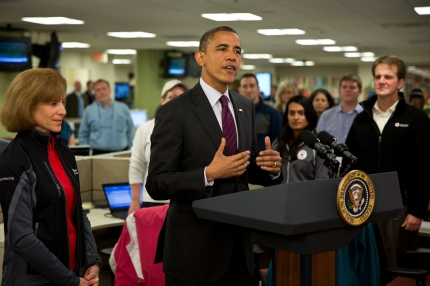
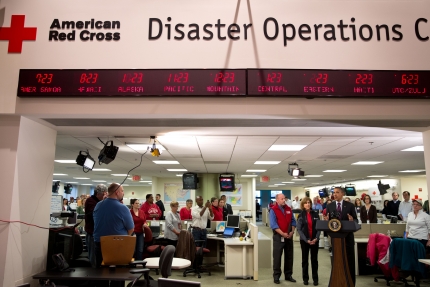
President Barack Obama delivers remarks at the Red Cross (October 30, 2012)

President Barack Obama delivers remarks during his visit to the Disaster Operation Center at the Red Cross national headquarters in Washington, D.C., Oct. 30, 2012. (Official White House Photo by Pete Souza)

There are still millions of people without power and many whose neighborhoods have been damaged or destroyed by water, heavy winds, and falling trees. The President promised to bring the full weight of federal resources to bear in helping those victims recover.

“There are places like Newark, New Jersey, for example, where you’ve got 80, 90 percent of the people without power,” he said. “We can't have a situation where that lasts for days on end.  And so my instructions to the federal agency has been, do not figure out why we can't do something; I want you to figure out how we do something.  I want you to cut through red tape.  I want you to cut through bureaucracy.  There’s no excuse for inaction at this point.  I want every agency to lean forward and to make sure that we are getting the resources where they need -- where they're needed as quickly as possible.”

Watch the full remarks here.

President Obama delivers remarks during his visit to the Disaster Operation Center at the Red Cross

President Barack Obama delivers remarks during his visit to the Disaster Operation Center at the Red Cross national headquarters in Washington, D.C., Oct. 30, 2012. (Official White House Photo by Pete Souza)