The White House

Office of the Press Secretary

Readout of the President’s Briefing on Hurricane Sandy

This morning, the President convened a video-teleconference in the White House Situation Room with his team to receive the latest update on Hurricane Sandy, and federal efforts underway to support response activities in several states. Overnight, at the requests of the Governors, the President approved major disaster declarations for the states of New Jersey and New York, making additional federal support for state and local efforts available, as well as direct federal assistance to affected individuals in declared counties. On the video-teleconference the President was joined by Vice President Biden, Homeland Security Secretary Napolitano, FEMA Administrator Fugate, Secretary of Energy Chu, Transportation Secretary Lahood, Defense Secretary Panetta, Vice Chairman of the Joint Chiefs of Staff Winnefeld, USNORTHCOM Commander General Jacoby, Health and Human Services Secretary Sebelius, and National Hurricane Center Director Dr. Knabb. Treasury Secretary Geithner joined the briefing by phone. The President was joined in the Situation Room by Chief of Staff Jack Lew, Assistant to the President for Homeland Security John Brennan, Deputy Chief of Staff Alyssa Mastromonaco, Deputy Assistant to the President for Homeland Security Richard Reed, White House Director of Intergovernmental Affairs David Agnew, National Security Advisor to the Vice President Tony Blinken, and other senior members of the President's team.

During the briefing the President expressed his concern for those impacted by the storm, as well as the heroic first responders who are selflessly putting themselves in harm’s way to protect members of their communities. He also noted his sadness over the loss of life associated with the storm so far.  The President was updated on Sandy’s track and impacts, and heard from Administrator Fugate on the federal coordination and resources being brought to bear to support state and local responders, including the extensive deployment of resources, such as generators that were pre-staged ahead of the storm, as well as National Guard units which have been activated in a number of states. Through FEMA, the federal government is leveraging assets from the Department of Homeland Security, the Department of Defense, the Department of Energy, the Department of Transportation and the Department of Health and Human Services. The President also received an update from Secretary Geithner on conditions in financial markets and the operations of the financial system.
 
The President told his team that their top priority is to make sure all available resources are being provided to state and local responders as quickly as possible and directed them to identify and resolve any potential bottlenecks or shortfalls should they arise. The President made clear that beyond the immediate lifesaving and life sustaining activities, which remain the primary focus, he wanted his team to continue to focus on what they can do to support state, local, and private sector efforts to restore power and asked the Department of Defense and the Department of Energy to continue to work in support of FEMA towards this goal.  The President made clear that he expects his team to remain focused as the immediate impacts of Hurricane Sandy continue and lean forward in their response. The President urges Americans to continue to follow the direction and advice of local officials, Governors, and Mayors, many of whom the President will speak with later today.

The White House

Office of the Press Secretary

President Obama Signs New Jersey Disaster Declaration

The President today declared a major disaster exists in the State of New Jersey and ordered Federal aid to supplement state and local recovery efforts due to Hurricane Sandy beginning on October 26, 2012, and continuing.

The President's action makes Federal funding available to affected individuals in the counties of Atlantic, Cape May, Essex, Hudson, Middlesex, Monmouth, Ocean, and Union.

Assistance can include grants for temporary housing and home repairs, low-cost loans to cover uninsured property losses, and other programs to help individuals and business owners recover from the effects of the disaster.

Federal funding is available to state and eligible local governments and certain private nonprofit organizations on a cost-sharing basis for debris removal and emergency protective measures, including direct Federal assistance, for the counties of Atlantic, Cape May, Essex, Hudson, Middlesex, Monmouth, Ocean, and Union.

Federal funding is also available on a cost-sharing basis for hazard mitigation measures statewide.

W. Craig Fugate, Administrator, Federal Emergency Management Agency (FEMA), Department of Homeland Security, named Michael J. Hall as the Federal Coordinating Officer for Federal recovery operations in the affected area.

FEMA said that damage surveys are continuing in other areas, and more counties and additional forms of assistance may be designated after the assessments are fully completed.

FEMA said that residents and business owners who sustained losses in the designated counties can begin applying for assistance by registering online at http://www.DisasterAssistance.gov or by calling 1-800-621-FEMA(3362) or 1-800-462-7585 (TTY) for the hearing and speech impaired. The toll-free telephone numbers will operate from 7 a.m. to 10 p.m. (local time) seven days a week until further notice.

The White House

Office of the Press Secretary

President Obama Signs New York Disaster Declaration

The President today declared a major disaster exists in the State of New York and ordered Federal aid to supplement state and local recovery efforts due to Hurricane Sandy beginning on October 27, 2012, and continuing.

The President's action makes Federal funding available to affected individuals in the counties of Bronx, Kings, Nassau, New York, Richmond, Suffolk, and Queens.

Assistance can include grants for temporary housing and home repairs, low-cost loans to cover uninsured property losses, and other programs to help individuals and business owners recover from the effects of the disaster.

Federal funding is available to State and eligible local governments and certain private nonprofit organizations on a cost-sharing basis for debris removal and emergency protective measures, including direct Federal assistance, for the counties of Bronx, Kings, Nassau, New York, Richmond, Suffolk, and Queens.

Federal funding is also available on a cost-sharing basis for hazard mitigation measures statewide.

W. Craig Fugate, Administrator, Federal Emergency Management Agency (FEMA), Department of Homeland Security, named Michael F. Byrne as the Federal Coordinating Officer for Federal recovery operations in the affected area.

FEMA said that damage surveys are continuing in other areas, and more counties and additional forms of assistance may be designated after the assessments are fully completed.

FEMA said that residents and business owners who sustained losses in the designated counties can begin applying for assistance by registering online at http://www.DisasterAssistance.gov or by calling 1-800-621-FEMA(3362) or 1-800-462-7585 (TTY) for the hearing and speech impaired. The toll-free telephone numbers will operate from 7 a.m. to 10 p.m. (local time) seven days a week until further notice.

The White House

Office of the Press Secretary

President Obama Signs Virginia Emergency Declaration

The President today declared an emergency exists in the Commonwealth of Virginia and ordered federal aid to supplement commonwealth and local response efforts due to the emergency conditions resulting from Hurricane Sandy beginning on October 26, 2012, and continuing.

The President's action authorizes the Department of Homeland Security, Federal Emergency Management Agency (FEMA), to coordinate all disaster relief efforts which have the purpose of alleviating the hardship and suffering caused by the emergency on the local population, and to provide appropriate assistance for required emergency measures, authorized under Title V of the Stafford Act, to save lives and to protect property and public health and safety, and to lessen or avert the threat of a catastrophe in all counties and independent cities in the Commonwealth of Virginia.

Specifically, FEMA is authorized to identify, mobilize, and provide at its discretion, equipment and resources necessary to alleviate the impacts of the emergency.  Emergency protective measures, limited to direct federal assistance, will be provided at 75 percent federal funding. 

W. Craig Fugate, Administrator, Federal Emergency Management Agency (FEMA), Department of Homeland Security, named Donald L. Keldsen as the Federal Coordinating Officer for federal recovery operations in the affected area.

The White House

Office of the Press Secretary

President Obama Signs West Virginia Emergency Declaration

The President today declared an emergency exists in the State of West Virginia and ordered federal aid to supplement state and local response efforts due to the emergency conditions resulting from Hurricane Sandy beginning on October 29, 2012, and continuing.

The President's action authorizes the Department of Homeland Security, Federal Emergency Management Agency (FEMA), to coordinate all disaster relief efforts which have the purpose of alleviating the hardship and suffering caused by the emergency on the local population, and to provide appropriate assistance for required emergency measures, authorized under Title V of the Stafford Act, to save lives and to protect property and public health and safety, and to lessen or avert the threat of a catastrophe in all counties in the State of West Virginia.

Specifically, FEMA is authorized to identify, mobilize, and provide at its discretion, equipment and resources necessary to alleviate the impacts of the emergency.  Emergency protective measures, limited to direct federal assistance, will be provided at 75 percent federal funding.

W. Craig Fugate, Administrator, Federal Emergency Management Agency (FEMA), Department of Homeland Security, named Dolph A. Diemont as the Federal Coordinating Officer for federal recovery operations in the affected area.

President Obama Urges Caution for Those in the Path of Hurricane Sandy

President Obama talks to employees at FEMA

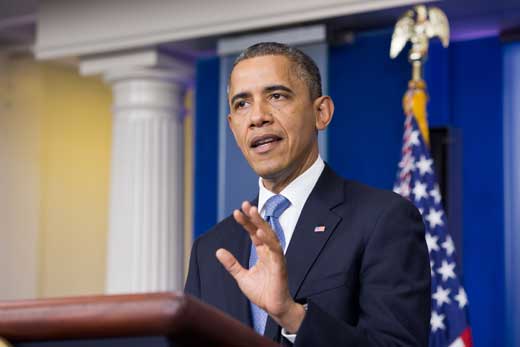
President Barack Obama delivers a statement after receiving an update on the ongoing response to Hurricane Sandy, in the Brady Press Briefing Room at the White House, Oct. 29, 2012. (Official White House Photo by Chuck Kennedy)

Communities up and down the East Coast of the United States are beginning to feel the impact of Hurricane Sandy. Today, President Obama convened a meeting in the White House Situation Room to receive updates from FEMA and the National Hurricane Center.

Following that briefing, the President discussed how federal emergency response teams are moving resources into place to ensure that potentially affected areas have the food, water, and disaster relief supplies they need to begin recovery

“Obviously, everybody is aware at this point that this is going to be a big and powerful storm,” the President said. “And all across the Eastern seaboard, I think everybody is taking the appropriate preparations."

Related Topics: Homeland Security

President Obama Makes a Statement on Hurricane Sandy

October 29, 2012 | 6:29 | Public Domain

President Obama discusses efforts underway to prepare for Hurricane Sandy and urges those who may be affected by the storm to take all needed precautions.

Download mp4 (239MB) | mp3 (15MB)

Read the Transcript

Remarks by the President on Hurricane Sandy

James S. Brady Press Briefing Room

12:46 P.M. EDT

THE PRESIDENT:  Hello, everybody.  I just received a full briefing from our emergency response teams, including FEMA, and agencies that are going to be helpful in the response and recovery efforts -- the Department of Energy, the Department of Transportation, the Department of Homeland Security, and the Department of Health and Human Services.

Obviously, everybody is aware at this point that this is going to be a big and powerful storm.  And all across the Eastern seaboard, I think everybody is taking the appropriate preparations.
 
I’ve spoken to all the governors in all these states.  They have issues emergency declarations.  Those have been turned around quickly here in the White House.  We have prepositioned assets so that FEMA personnel are working closely with state and local governments.  We’re making sure that food and water and emergency generation is available for those communities that are going to be hardest hit.
 
We anticipate that the center of the storm is going to land fall sometime this evening.  But because of the nature of this storm, we are certain that this is going to be a slow-moving process through a wide swath of the country, and millions of people are going to be affected.

So the most important message that I have for the public right now is, please listen to what your state and local officials are saying.  When they tell you to evacuate, you need to evacuate.  Do not delay.  Don’t pause; don’t question the instructions that are being given, because this is a serious storm and it could potentially have fatal consequence if people haven’t acted quickly.

The good news is, is that the governors and local officials I think have had a few days of preparation.  There's been extraordinarily close coordination between state, federal, and local governments.  And so we’re confident that the assets are prepositioned for an effective response in the aftermath of the storm. 

But keep in mind that for folks who are not following instructions, if you are not evacuating when you’ve been asked to evacuate, you’re putting first responders at danger.  We’re going to have to have search-and-rescue teams in and around multiple states all at the same time.  And although we’ve got Coast Guard and the Department of Defense all positioned, if the public is not following instructions, that makes it more dangerous for people and it means that we could have fatalities that could have been avoided.
  
Transportation is going to be tied up for a long time.  And probably the most significant impact for a lot of people, in addition to flooding, is going to be getting power back on.  We anticipate that there are going to be a lot of trees down, a lot of water.  And despite the fact that the power companies are working very closely with their various state officials and local officials to make sure that they are bringing in as many assets as possible and getting those ready in preparation for the storm, the fact is that a lot of these emergency crews are not going to be able to get into position to start restoring power until some of these winds have died down.  And because of the nature of this storm, that may take several days.
 
So the public should anticipate that there’s going to be a lot of power outages, and it may take time for that power to get back on.  The same is true with transportation; there are going to be a lot of backlogs, and even after the storm has cleared, it’s going to take a considerable amount of time for airlines, subways, trains, and so forth, potentially to get back on schedule, depending on the amount of damage that has occurred.

Let me summarize just by saying that I’m extraordinarily grateful for the cooperation of our state and local officials.  The conversations that I’ve had with all the governors indicate that at this point there are no unmet needs.  I think everybody is taking this very seriously.  We’ve gotten prepositioned all the resources that we need.

But right now, the key is to make sure that the public is following instructions.  For those of you who still need additional information about how to respond, you can go to Ready.gov -- that’s Ready.gov.  And that website should provide you with all the information that your family needs in terms of how you can prepare for this storm.

Our thoughts and prayers go out to all the people who are potentially affected.  We are extraordinarily grateful for our first responders, because they’re going to be working 24/7 around the clock, non-stop.  And I want to make sure that our thoughts and prayers go out to all those who may end up be dealing with a very difficult situation over the next several days.

Last point I’ll make, though -- this is going to be a big storm.  It’s going to be a difficult storm.  The great thing about America is when we go through tough times like this we all pull together.  We look out for our friends.  We look out for our neighbors.  And we set aside whatever issues we may have otherwise to make sure that we respond appropriately and with swiftness.  And that’s exactly what I anticipate is going to happen here.

So I want to thank all the federal teams, state and local teams that are in place.  I’m confident that we’re ready.  But I think the public needs to prepare for the fact that this is going to take a long time for us to clean up.  The good news is we will clean up and we will get through this.

Q    What about the impact on the election, sir?

THE PRESIDENT:  I am not worried at this point about the impact on the election.  I’m worried about the impact on families, and I’m worried about the impact on our first responders.  I’m worried about the impact on our economy and on transportation. 

The election will take care of itself next week.  Right now, our number-one priority is to make sure that we are saving lives, that our search-and-rescue teams are going to be in place, that people are going to get the food, the water, the shelter that they need in case of emergency, and that we respond as quickly as possible to get the economy back on track.

Thank you, everybody.

END
12:52 P.M. EDT

Close Transcript

The White House

Office of the Press Secretary

Remarks by the President on Hurricane Sandy

James S. Brady Press Briefing Room

12:46 P.M. EDT

THE PRESIDENT:  Hello, everybody.  I just received a full briefing from our emergency response teams, including FEMA, and agencies that are going to be helpful in the response and recovery efforts -- the Department of Energy, the Department of Transportation, the Department of Homeland Security, and the Department of Health and Human Services.

Obviously, everybody is aware at this point that this is going to be a big and powerful storm.  And all across the Eastern seaboard, I think everybody is taking the appropriate preparations.
 
I’ve spoken to all the governors in all these states.  They have issues emergency declarations.  Those have been turned around quickly here in the White House.  We have prepositioned assets so that FEMA personnel are working closely with state and local governments.  We’re making sure that food and water and emergency generation is available for those communities that are going to be hardest hit.
 
We anticipate that the center of the storm is going to land fall sometime this evening.  But because of the nature of this storm, we are certain that this is going to be a slow-moving process through a wide swath of the country, and millions of people are going to be affected.

So the most important message that I have for the public right now is, please listen to what your state and local officials are saying.  When they tell you to evacuate, you need to evacuate.  Do not delay.  Don’t pause; don’t question the instructions that are being given, because this is a serious storm and it could potentially have fatal consequence if people haven’t acted quickly.

The good news is, is that the governors and local officials I think have had a few days of preparation.  There's been extraordinarily close coordination between state, federal, and local governments.  And so we’re confident that the assets are prepositioned for an effective response in the aftermath of the storm. 

But keep in mind that for folks who are not following instructions, if you are not evacuating when you’ve been asked to evacuate, you’re putting first responders at danger.  We’re going to have to have search-and-rescue teams in and around multiple states all at the same time.  And although we’ve got Coast Guard and the Department of Defense all positioned, if the public is not following instructions, that makes it more dangerous for people and it means that we could have fatalities that could have been avoided.
  
Transportation is going to be tied up for a long time.  And probably the most significant impact for a lot of people, in addition to flooding, is going to be getting power back on.  We anticipate that there are going to be a lot of trees down, a lot of water.  And despite the fact that the power companies are working very closely with their various state officials and local officials to make sure that they are bringing in as many assets as possible and getting those ready in preparation for the storm, the fact is that a lot of these emergency crews are not going to be able to get into position to start restoring power until some of these winds have died down.  And because of the nature of this storm, that may take several days.
 
So the public should anticipate that there’s going to be a lot of power outages, and it may take time for that power to get back on.  The same is true with transportation; there are going to be a lot of backlogs, and even after the storm has cleared, it’s going to take a considerable amount of time for airlines, subways, trains, and so forth, potentially to get back on schedule, depending on the amount of damage that has occurred.

Let me summarize just by saying that I’m extraordinarily grateful for the cooperation of our state and local officials.  The conversations that I’ve had with all the governors indicate that at this point there are no unmet needs.  I think everybody is taking this very seriously.  We’ve gotten prepositioned all the resources that we need.

But right now, the key is to make sure that the public is following instructions.  For those of you who still need additional information about how to respond, you can go to Ready.gov -- that’s Ready.gov.  And that website should provide you with all the information that your family needs in terms of how you can prepare for this storm.

Our thoughts and prayers go out to all the people who are potentially affected.  We are extraordinarily grateful for our first responders, because they’re going to be working 24/7 around the clock, non-stop.  And I want to make sure that our thoughts and prayers go out to all those who may end up be dealing with a very difficult situation over the next several days.

Last point I’ll make, though -- this is going to be a big storm.  It’s going to be a difficult storm.  The great thing about America is when we go through tough times like this we all pull together.  We look out for our friends.  We look out for our neighbors.  And we set aside whatever issues we may have otherwise to make sure that we respond appropriately and with swiftness.  And that’s exactly what I anticipate is going to happen here.

So I want to thank all the federal teams, state and local teams that are in place.  I’m confident that we’re ready.  But I think the public needs to prepare for the fact that this is going to take a long time for us to clean up.  The good news is we will clean up and we will get through this.

Q    What about the impact on the election, sir?

THE PRESIDENT:  I am not worried at this point about the impact on the election.  I’m worried about the impact on families, and I’m worried about the impact on our first responders.  I’m worried about the impact on our economy and on transportation. 

The election will take care of itself next week.  Right now, our number-one priority is to make sure that we are saving lives, that our search-and-rescue teams are going to be in place, that people are going to get the food, the water, the shelter that they need in case of emergency, and that we respond as quickly as possible to get the economy back on track.

Thank you, everybody.

END
12:52 P.M. EDT

The White House

Office of the Press Secretary

Press Gaggle by Press Secretary Jay Carney Aboard Air Force One En Route Andrews Air Force Base, 10/29/2012

Aboard Air Force One
En Route Andrews Air Force Base
Returning From Florida

9:33 A.M. EDT

MR. CARNEY:  Thanks for being with us as we return to Washington earlier than expected.  I have a couple of statements I want to give to you. 

First -- and this just went out from me -- the President will no longer travel to Green Bay, Wisconsin tomorrow for a campaign event so that he can stay in Washington, D.C. on Tuesday and closely monitor the impact of and response to Hurricane Sandy. 

As he said at FEMA Headquarters yesterday, the President has instructed his team to make sure that needed federal resources are in place to support state and local recovery efforts. 

Additional details about the President's schedule will be announced as soon as they are available.

Separately, when the President gets back to Washington he will lead a meeting in the White House Situation Room, where he will be updated on the latest forecast for Hurricane Sandy and the extensive federal efforts underway to support the state and local response of this historic storm. 

The President will convene the meeting via video teleconference with Homeland Security Secretary Napolitano, FEMA Administrator Fugate, Transportation Secretary LaHood, Energy Secretary Chu, and National Hurricane Center Director Richard Knabb.  Also participating at the White House will be Chief of Staff Jack Lew, Assistant to the President for Homeland Security John Brennan, Deputy Chief of Staff Alyssa Mastromonaco, Deputy Assistant to the President for Homeland Security Richard Reed, and other senior members of the President's team.

That's all I have at the top.

Q    Are we going to hear from the President today?

MR. CARNEY:  I have no scheduling announcements for you on that.

Q    Jay, could you tell us how the decision unfolded for him to return to Washington without the political event today?

MR. CARNEY:  Sure.  As you know, we had already made adjustments to our schedule because of Hurricane Sandy.  The storm overnight picked up speed and intensity, and a decision was made that in order to return to Washington to monitor and oversee the efforts to prepare for the storm and respond to it, that we needed to leave earlier than planned.

Q    You guys tell us often that the President can do his job as President on the road, while he's campaigning.  Why decide to actually go back to Washington and be at the White House for this event when he's stayed out on the road for campaign events in previous incidents this year?

MR. CARNEY:  The President's priority right now is the safety and security of Americans who are in the path of the storm and who will be affected by it.  It's essential, in his view, that he be in Washington, one of the areas that will be affected and where his team is, to oversee that effort and to be updated on it.

It is true that the President is President 24 hours a day.  This is one of the circumstances where, in his view, it makes the most sense for him to be in place in the White House fulfilling those responsibilities. 

Q    Just to clarify, the early departure today back to D.C., was that primarily for safety reasons -- would it have been unsafe to have flown in at 2:00 p.m. this afternoon?

MR. CARNEY:  Well, I'm not an aviation expert, but it is the case that we had originally hoped to do the event this morning and then fly back, but because the storm was moving more quickly than was the case, as I understand it, yesterday evening, that it made it essential for us to leave earlier in the morning.
 
Q    So the President is losing two days of campaigning then?  It won't be either today or tomorrow?

MS. PSAKI:  That's right.

MR. CARNEY:  That's correct.

Q    And no calls on Wednesday yet, right? 

MS. PSAKI:  We have not made a call.  We're obviously closely monitoring the storm, relying on local and state authorities for their guidance, and will make adjustments to the schedule accordingly.

Q    Jay, some of the utilities are saying that the power is going to be out in some areas for up to 10 days, which would obviously include Election Day.  Is there any contingency planning to alter the Election Day schedule because of this?

MR. CARNEY:  I think that is not something I'm able to address.  The fact is the storm is just taking effect now and having an impact now and making landfall I believe tonight.  We have to focus on not the campaign and not the election, but on making sure that all federal resources are both prepositioned and in place to help states and localities respond to the storm, to help Americans who are affected by the storm.  That's our focus right now.

Q    Would the President have the power to adjust Election Day?

MR. CARNEY:  I don't know the answer to that question.  I think you're getting way ahead of yourself here.

Q    Some of the utilities are saying 10 days of power outage, like Virginia, for instance. 

MR. CARNEY:  I just don't -- I think we'll have to take that question.

]    Q    Does the President have more confidence in Pepco, or Old Dominion Power?

MR. CARNEY:  The President is working with his team; FEMA is working with state and local governments who obviously liasse directly with utility companies to handle this kind of an event.

Q    So that means Pepco?

Q    Can you describe how the schedule changes are going to affect the get out the vote operation in Florida and elsewhere?

MS. PSAKI:  Well, sure.  As Jay has mentioned, our focus, the President’s focus, the campaign’s focus is ensuring the safety of the American people, of our volunteers, of our supporters.  That’s what the President is focused on every single day.  There are places where -- in Virginia, for example, the State Board of Elections is now allowing voters who may be affected by the storm to vote absentee in person.  That’s a step they took in response to this.  There are steps like that that obviously are encouraging. 

But we are -- where it is safe, our campaign is up and running in the places where our volunteers and our staff are safe.  That’s many parts of the country.  But that doesn’t intercede with the fact that the President’s focus over the next 48 hours, or however long it takes, will be on the storm and making sure people are safe across the country.

MR. CARNEY:  Also, before -- I meant to mention this at the top.  The President -- overnight, we announced several more emergency declarations, and that brings to eight the total of emergency declarations.  That includes Rhode Island, Pennsylvania, Connecticut, New York, the District of Columbia, New Jersey, Massachusetts and Maryland.  These declarations make federal aid available to make sure state and local responders have support they need as they work to save lives and to protect property and public health and safety, as preparations and initial response efforts take place.  And as you know, emergence declarations are made in response to requests from states and also the District of Columbia.

MS. PSAKI:  And I'll just add, we’re taking it, and our team is taking it, day by day, because no one can predict exactly where we’ll be in 24 hours or 48 hours.  So decisions are made on a daily basis.  And that applies to the President’s schedule but it also applies to what’s happening on the ground where appropriate.

Q    Do you expect the President to campaign with Bill Clinton later?  I mean, are you going to try to reschedule that?

MS. PSAKI:  We don’t have any updates on that.  As you know, or just to confirm for you, President Clinton is doing the event this morning in Florida.  He’ll be going on to Youngstown to do the event in Ohio.  Obviously we are big fans of having him out there advocating for the President.  So where possible over the next eight days we would love that but don’t have any updates on them campaigning together.

Q    Talk to us about the balancing act that the President obviously has to do right now.  We’re seven days out, eight days out -- what’s he weighing, how is he doing it?

MR. CARNEY:  Well, let me just say that the balance tilts heavily towards, in a situation like this, his responsibilities as President.  That’s why we’ve made the changes to the schedule that we’ve made.  That’s why we’re headed back to Washington now. That’s why the President will be in Washington through today and tomorrow, and we will make changes to the schedule as necessary  -- if necessary, going forward.

This is a time not for politics, but at a moment like this, with a storm as severe as this, with likely impacts as consequential as we will see, the President is very focused on making sure that the federal response effort is comprehensive, that every state and locality has what it needs.  And that includes all the prepositioning of resources that FEMA has done in key locations prior to landfall.  It includes embedding FEMA officials in state emergency centers so that that communication is immediate.  And it includes at the presidential level, directing all responsible parties in the federal government to be taking the necessary steps to ensure that everything possible is done to protect the American people in a storm like this.

Q    Jen, you guys have lost two campaign days now.  How does the President make up for that lost time?

MS. PSAKI:  I think this is a case where politics takes a backseat.  And the President's role is governing the country and doing what he was elected to do four years ago, which is to make sure people have the resources and the information they need.  That will be his focus as long as it’s needed.  And we’re not worried about the other piece of this.

Q    At what point did you make the call not to attend the event this morning? 

MR. CARNEY:  This morning.

Q    And that’s not something that could have been made last night?  I mean, we were all looking at forecasts last night that made it seem like the storm was going to be in D.C. pretty early.

MR. CARNEY:  We’ve based on our decisions on the information that we’ve been getting about the storm and the recommendations of the various agencies that assess storms like these and also have responsibility for transportation and security for the President.

As of yesterday evening, the intention was -- based on what we knew about the storm’s trajectory and speed -- that we could have the event in Florida this morning and leave in time to get back to Washington.  The decision was made early this morning that we needed to leave earlier.

Q    Will the Vice President stay on the trail throughout the week during this storm?

MS. PSAKI:  The Vice President will be in Ohio today with President Clinton.  I don’t know beyond today what his schedule is, but we can get back to you on that.

Q    And what kind of role do you think Governor Romney should be playing during the storm?  Is it appropriate for him to stay on the trail with a full slate of events, or scale back as well?

MS. PSAKI:  We’ll let the American people be the judge of that.  The President’s role as Commander-in-Chief is to be focused on making sure the American people are safe and have the information they need.  That’s what his focus is. 

We’ve also been encouraging our supporters to donate online to the American Red Cross through BarackObama.com and through our Facebook site. Traditionally with emergency situations like Hurricane Sandy, the Red Cross asks for financial donations so that they can manage the distribution, and so that’s what we’re encouraging people to do as well.

Q    What kind of pizzas did the President deliver last night?

MS. PSAKI:  We’ll have to take that question and get back to you.

Q    Was the President upset that he went all this way just to deliver six boxes of pizza?

MS. PSAKI:  He was happy he was able to make some calls to some super volunteers.  If the President -- if the storm had allowed us to go to the event even early this morning, we would have done that.  And it just -- the circumstances just didn’t allow that to happen.

Q    Thanks, guys.

MR. CARNEY:  Thank you.

END
10:07 A.M. EDT

The White House

Office of the Press Secretary

President Obama Signs Delaware Emergency Declaration

The President today declared an emergency exists in the State of Delaware and ordered federal aid to supplement state and local response efforts due to the emergency conditions resulting from Hurricane Sandy beginning on October 27, 2012, and continuing.

The President's action authorizes the Department of Homeland Security, Federal Emergency Management Agency (FEMA), to coordinate all disaster relief efforts which have the purpose of alleviating the hardship and suffering caused by the emergency on the local population, and to provide appropriate assistance for required emergency measures, authorized under Title V of the Stafford Act, to save lives and to protect property and public health and safety, and to lessen or avert the threat of a catastrophe in all counties in the State of Delaware.

Specifically, FEMA is authorized to identify, mobilize, and provide at its discretion, equipment and resources necessary to alleviate the impacts of the emergency.  Emergency protective measures, limited to direct federal assistance, will be provided at 75 percent federal funding. 

W. Craig Fugate, Administrator, Federal Emergency Management Agency (FEMA), Department of Homeland Security, named Regis Leo Phelan as the Federal Coordinating Officer for federal recovery operations in the affected area.