The White House

Office of the Press Secretary

Weekly Address: Protecting the American People with New Wall Street Reforms

WASHINGTON, DC— In this week’s address, President Obama highlighted the work of the new independent consumer watchdog he fought to create, which stands up for consumers and protects Americans from mistakes made by the companies who determine your credit scores.  Republicans in Congress have tried to roll back consumer protections that help prevent big banks from creating another financial crisis, but the President refuses to let that happen and will continue to fight for working Americans as we move this country forward.

Remarks of President Barack Obama
Weekly Address
The White House
October 27, 2012

Hi, everybody.  It’s now been four years since a crisis that began on Wall Street spread to Main Street, hammering middle-class families and ultimately costing our economy 9 million jobs.

Since then, we’ve fought our way back.  Our businesses have added more than 5 million new jobs.  The unemployment rate has fallen to the lowest level since I took office.  Home values are rising again.  And our assembly lines are humming once more.    

And to make sure America never goes through a crisis like that again, we passed tough new Wall Street reform to end taxpayer-funded bailouts for good. 

Wall Street reform also created the first-ever independent consumer watchdog, whose sole job is to look out for you.

That means making sure you’ve got all the information you need to make important financial decisions like buying a home or paying for college.  And it means going after anyone who tries to take advantage of you, or rip you off.

Starting this month, that includes the folks who come up with your credit score.

If you haven’t checked out your credit score recently, you should.  It can have a major impact on your life.  It can determine whether or not you qualify for a loan or what kind of interest you have to pay.  It can even affect your chances at renting an apartment or getting a job.

But here’s the thing: the companies that put your credit score together can make mistakes.  They may think you had a loan or a credit card that was never yours.  They may think you were late making payments when you were on time.  And when they mess up, you’re the one who suffers. 

Until this week, if you had a complaint, you took it to the company.  Sometimes they listened.  Sometimes they didn’t.  But that was pretty much it.  They were your only real hope. 

Not anymore.  If you have a complaint about your credit score that hasn’t been properly addressed, you can go to consumerfinance.gov/complaint and let the consumer watchdog know. 

Not only will they bring your complaint directly to the company in question, they’ll give you a tracking number, so you can check back and see exactly what’s being done on your behalf. 

And fixing your credit score isn’t the only thing they can help with. 

If you’re opening a bank account, trying to get a student loan, or applying for a credit card and something doesn’t seem right, you can let them know and they’ll check it out.

If you’re looking to buy a home, and you want to know if you’re getting a fair deal on your mortgage, you can give them a call and they’ll get you an answer. 

Their only mission is to fight for you.  And when needed, they’ll take action. 

For example, alongside other regulators, they recently ordered three big credit card companies to return more than $400 million to folks who were deceived or misled into buying things they didn’t want or didn’t understand.

That’s what Wall Street reform is all about – looking out for working families and making sure that everyone is playing by the same rules. 

Unfortunately, that hasn’t been enough to stop Republicans in Congress from fighting these reforms.  Backed by an army of financial industry lobbyists, they’ve been waging an all-out battle to delay, defund and dismantle these new rules. 

I refuse to let that happen. 

I believe that the free market is one of the greatest forces for progress in human history, and that the true engine of job creation in this country is the private sector, not the government. 

But I also believe that the free market has never been about taking whatever you want, however you can get it.  Alongside our innovative spirit, America only prospers when we meet certain obligations to one another, and when we all play by the same set of rules.

We’ve come too far – and sacrificed too much – to go back to an era of top-down, on-your-own economics.  And as long as I’m President, we’re going to keep moving this country forward so that everyone – whether you start a business or punch a clock – can have confidence that if you work hard, you can get ahead. 

Thanks and have a great weekend.

Weekly Address: Protecting the American People with New Wall Street Reforms

In this week’s address, President Obama highlights the work of the new independent consumer watchdog he fought to create. This agency’s mission is to stand up for consumers and includes protecting every American from mistakes made by the companies who determine their credit scores. 

Transcript  |  Download mp4  |  Download mp3

Related Topics: Economy, Financial Reform

Weekly Address: Protecting the American People with New Wall Street Reforms

October 27, 2012 | 4:07 | Public Domain

In this week’s address, President Obama highlights the work of the new independent consumer watchdog he fought to create. This agency’s mission is to stand up for consumers and includes protecting every American from mistakes made by the companies who determine their credit scores.

Download mp4 (328MB) | mp3 (10MB)

The White House

Office of the Press Secretary

Readout of the President's Call with the Indiana Fever

Earlier today, President Obama called Head Coach Lin Dunn, Finals MVP Tamika Catchings, and C.O.O. and General Manager Kelly Krauskopf to congratulate them and the entire Indiana Fever team on winning the 2012 WNBA Finals. The President said as the father of two girls it’s always great to see women setting a positive example as strong leaders on the court and in their communities. The President also said he looks forward to congratulating the team in person at the White House.

The White House

Office of the Press Secretary

Executive Order -- Establishing the White House Homeland Security Partnership Council


EXECUTIVE ORDER
- - - - - - -
ESTABLISHING THE WHITE HOUSE
HOMELAND SECURITY PARTNERSHIP COUNCIL
 
 
By the authority vested in me as President by the Constitution and the laws of the United States of America, and in order to advance the Federal Government's use of local partnerships to address homeland security challenges, it is hereby ordered as follows:
 
Section 1. Policy. The purpose of this order is to maximize the Federal Government's ability to develop local partnerships in the United States to support homeland security priorities. Partnerships are collaborative working relationships in which the goals, structure, and roles and responsibilities of the relationships are mutually determined. Collaboration enables the Federal Government and its partners to use resources more efficiently, build on one another's expertise, drive innovation, engage in collective action, broaden investments to achieve shared goals, and improve performance. Partnerships enhance our ability to address homeland security priorities, from responding to natural disasters to preventing terrorism, by utilizing diverse perspectives, skills, tools, and resources.
 
The National Security Strategy emphasizes the importance of partnerships, underscoring that to keep our Nation safe "we must tap the ingenuity outside government through strategic partnerships with the private sector, nongovernmental organizations, foundations, and community-based organizations. Such partnerships are critical to U.S. success at home and abroad, and we will support them through enhanced opportunities for engagement, coordination, transparency, and information sharing." This approach recognizes that, given the complexities and range of challenges, we must institutionalize an all-of-Nation effort to address the evolving threats to the United States.
 
Sec. 2. White House Homeland Security Partnership Council and Steering Committee.
 
(a) White House Homeland Security Partnership Council. There is established a White House Homeland Security Partnership Council (Council) to foster local partnerships -- between the Federal Government and the private sector, nongovernmental organizations, foundations, community-based organizations, and State, local, tribal, and territorial government and law enforcement -- to address homeland security challenges. The Council shall be chaired by the Assistant to the President for Homeland Security and Counterterrorism (Chair), or a designee from the National Security Staff.
 
(b) Council Membership.
 
(i) Pursuant to the nomination process established in subsection (b)(ii) of this section, the Council shall be composed of Federal officials who are from field offices of the executive departments, agencies, and bureaus (agencies) that are members of the Steering Committee established in subsection (c) of this section, and who have demonstrated an ability to develop, sustain, and institutionalize local partnerships to address policy priorities.
 
(ii) The nomination process and selection criteria for members of the Council shall be established by the Steering Committee. Based on those criteria, agency heads may select and present to the Steering Committee their nominee or nominees to represent them on the Council. The Steering Committee shall consider all of the nominees and decide by consensus which of the nominees shall participate on the Council. Each member agency on the Steering Committee, with the exception of the Office of the Director of National Intelligence, may have at least one representative on the Council.
 
(c) Steering Committee. There is also established a Steering Committee, chaired by the Chair of the Council, to provide guidance to the Council and perform other functions as set forth in this order. The Steering Committee shall include a representative at the Deputy agency head level, or that representative's designee, from the following agencies:
 
(i) Department of State;
 
(ii) Department of the Treasury;
 
(iii) Department of Defense;
 
(iv) Department of Justice;
 
(v) Department of the Interior;
 
(vi) Department of Agriculture;
 
(vii) Department of Commerce;
 
(viii) Department of Labor;
 
(ix) Department of Health and Human Services;
 
(x) Department of Housing and Urban Development;
 
(xi) Department of Transportation;
 
(xii) Department of Energy;
 
(xiii) Department of Education;
 
(xiv) Department of Veterans Affairs;
 
(xv) Department of Homeland Security;
 
(xvi) Office of the Director of National Intelligence;
 
(xvii) Environmental Protection Agency;
 
(xviii) Small Business Administration; and
 
(xix) Federal Bureau of Investigation.
 
At the invitation of the Chair, representatives of agencies not listed in subsection (c) of this section or other executive branch entities may attend and participate in Steering Committee meetings as appropriate.
 
(d) Administration. The Chair or a designee shall convene meetings of the Council and Steering Committee, determine their agendas, and coordinate their work. The Council may establish subgroups consisting exclusively of Council members or their designees, as appropriate.
 
Sec. 3. Mission and Function of the Council and Steering Committee. (a) The Council shall, consistent with guidance from the Steering Committee:
 
(i) advise the Chair and Steering Committee members on priorities, challenges, and opportunities for local partnerships to support homeland security priorities, as well as regularly report to the Steering Committee on the Council's efforts;
 
(ii) promote homeland security priorities and opportunities for collaboration between Federal Government field offices and State, local, tribal, and territorial stakeholders;
 
(iii) advise and confer with State, local, tribal, and territorial stakeholders and agencies interested in expanding or building local homeland security partnerships;
 
(iv) raise awareness of local partnership best practices that can support homeland security priorities;
 
(v) as appropriate, conduct outreach to representatives of the private sector, nongovernmental organizations, foundations, community-based organizations, and State, local, tribal, and territorial government and law enforcement entities with relevant expertise for local homeland security partnerships, and collaborate with other Federal Government bodies; and
 
(vi) convene an annual meeting to exchange key findings, progress, and best practices.
 
(b) The Steering Committee shall:
 
(i) determine the scope of issue areas the Council will address and its operating protocols, in consultation with the Office of Management and Budget;
 
(ii) establish the nomination process and selection criteria for members of the Council as set forth in section 2(b)(ii) of this order;
 
(iii) provide guidance to the Council on the activities set forth in subsection (a) of this section; and
 
(iv) within 1 year of the selection of the Council members, and annually thereafter, provide a report on the work of the Council to the President through the Chair.
 
Sec. 4. General Provisions. (a) The heads of agencies participating in the Steering Committee shall assist and provide information to the Council, consistent with applicable law, as may be necessary to implement this order. Each agency shall bear its own expense for participating in the Council.
 
(b) Nothing in this order shall be construed to impair or otherwise affect:
 
(i) the authority granted by law to an executive department, agency, or the head thereof;
 
(ii) the functions of the Director of the Office of Management and Budget relating to budgetary, administrative, or legislative proposals; or
 
(iii) the functions of the Overseas Security Advisory Council.
 
(c) This order shall be implemented consistent with applicable law and appropriate protections for privacy and civil liberties, and subject to the availability of appropriations.
 
(d) This order is not intended to, and does not, create any right or benefit, substantive or procedural, enforceable at law or in equity by any party against the United States, its departments, agencies, or entities, its officers, employees, or agents, or any other person.
 
BARACK OBAMA
 
THE WHITE HOUSE,
October 26, 2012.


The White House

Office of the Press Secretary

Readout of the President’s Briefing on Hurricane Sandy

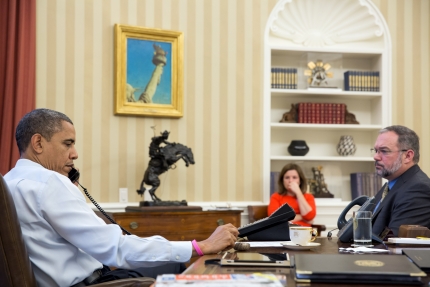
This morning, President Obama convened a call with FEMA Administrator Craig Fugate, National Hurricane Center Director Dr. Rick Knabb, and Homeland Security Advisor John Brennan to receive an update on Hurricane Sandy and ongoing federal actions to prepare for the storm as it continues to move toward the United States mainland. The President directed Administrator Fugate to ensure that all available federal resources are being brought to bear to support state and local responders in potentially affected areas along the eastern seaboard as they prepare for the severe weather.
 
Impacts from the storm could be felt as early as this weekend, and FEMA is in close contact with state and local partners as the storm approaches. At the request of states, FEMA is proactively deploying Incident Management Assistance Teams to multiple states up and down the Eastern seaboard to assist efforts as state and local partners prepare for the storm. Because of the potential for significant power outages, FEMA is encouraging state and local authorities responsible for coordinating with local utility companies to do so ahead of any impacts. The President asked his team to continue to ensure there were no unmet needs and to keep him regularly updated on weather forecasts and hurricane preparations.

A photo of today’s call can be found HERE.

Monitoring Hurricane Sandy

President Obama receives an update on the ongoing response to Hurricane Sandy (October 26, 2012)

President Barack Obama receives an update on the ongoing response to Hurricane Sandy during a conference call with FEMA Administrator Craig Fugate, Dr. Rick Knabb, Director of the National Hurricane Center, and John Brennan, Assistant to the President for Homeland Security and Counterterrorism, in the Oval Office, Oct. 26, 2012. Alyssa Mastromonaco, Deputy Chief of Staff for Operations, and Richard Reed, Deputy Assistant to the President for Homeland Security, are seated at right. (Official White House Photo by Pete Souza)

As Hurricane Sandy moves away from the Bahamas and toward the East Coast of the United States, forecasters with the National Weather Center are tracking the path of the storm, while FEMA offices from Atlanta to Boston are readying for a potential impact.

Earlier today, President Obama spoke on the phone with FEMA Administrator Craig Fugate, Dr. Rick Knabb, Director of the National Hurricane Center, and John Brennan, Assistant to the President for Homeland Security and Counterterrorism about the ongoing preparations.

FEMA is currently advising residents in the path of Sandy (which includes those on much of the East Coast) to prepare for tropical storm and hurricane conditions. Here are a set of basic safety tips they shared last night:

  • For the severe weather forecast for your area, listen to your NOAA Weather Radio, local media and forecast reports.
  • Check on the items in your family’s emergency kit - Remember to include items like a flashlight, hand-crank radio, and a solar powered cell phone charger to your emergency kit. Hurricanes often bring power outages, so be sure your emergency kit can sustain your family for at least 72 hours after the storm.
  • Make a plan for how you will contact friends and family in the event of an emergency. Flooding is often the most significant threat from hurricanes and tropical storms - avoid walking or driving through flooded areas – it only takes six inches of fast-moving flood water to knock over an adult and two feet to move a vehicle.
  • As always, follow the direction of local officials. Don’t put yourself at risk, if they give the order to evacuate, do so immediately.

For more tips on preparing your home and family for the effects of a hurricane or tropical storm, visit www.ready.gov/hurricanes.

Related Topics: Homeland Security

West Wing Week: 10/26/12 or "The Difference One Person Can Make"

Welcome to the West Wing Week, your guide to everything that's happening at 1600 Pennsylvania Ave. This week, the President urged Congress to join him in helping responsible homeowners refinance, Cecilia Muñoz reflected on the importance of the Cesar Chavez National Monument, and the Vice President and Dr. Biden honored Breast Cancer Awareness Month, while the White House wrapped up its annual fall garden tours and held a Garden Social Tweet Up.

Watch the West Wing Week here.

West Wing Week: 10/26/12 or "The Difference One Person Can Make"

October 25, 2012 | 4:46 | Public Domain

This week, the President urged Congress to join him in helping responsible homeowners refinance, Cecilia Muñoz reflected on the importance of the Cesar Chavez National Monument, and the Vice President and Dr. Biden honored Breast Cancer Awareness Month, while the White House wrapped up its annual fall garden tours and held a Garden Social Tweet Up.

Download mp4 (159.6MB)

The White House

Office of the Press Secretary

Remarks by the President at a Campaign Event, Cleveland, OH

Cleveland Burke Lakefront Airport Tarmac
Cleveland, Ohio

8:24 P.M. EDT

THE PRESIDENT:  Hello, Ohio!  (Applause.)  Are you fired up? (Applause.)  Are you ready to go?  (Applause.)  I can't hear you.  Are you fired up?

AUDIENCE:  Yes!

THE PRESIDENT:  Are you ready to go?

AUDIENCE:  Yes!

THE PRESIDENT:  I am glad to be back in Cleveland, Ohio!  (Applause.)  We've got two extraordinary representatives who are here -- Betty Sutton and Marcy Kaptur -- give them a big round of applause.  (Applause.) 

It's great to see all of you who are here. 

AUDIENCE MEMBER:  We love you!

THE PRESIDENT:  I love you back.  (Applause.)

This is the final stop on our 48-hour fly-around all across America.  We've been going for two days straight.  (Applause.)  We've been from the East Coast to the West Coast, and now we're going back East again.  (Applause.)  We just made a quick stop in Chicago so I could vote.  (Applause.)  I can't tell you who I voted for because it's a secret ballot.  (Laughter.)  But Michelle told me she voted for me.  (Applause.) 

So, Ohio, I've got to tell you, even though I've been going for about 38 hours straight, even though my voice is getting kind of hoarse, I've still got a spring in my step.  (Applause.)  Because our cause is right.  (Applause.)  Because we're fighting for the future.  (Applause.)  I've come to Ohio today to ask you for your vote.  (Applause.) 

AUDIENCE:  Four more years!  Four more years!  Four more years!

THE PRESIDENT:  And the good news is I'm asking for your vote and I'm asking you to vote early.  (Applause.)  Here in Ohio, you can vote now.  You don't have to vote later.  I need you to vote early, and I need your help to keep moving America forward.  (Applause.) 

Look, we've already now had three debates.  We've had a year of campaigning.  We have had way too many TV commercials.  I feel bad for the state of Ohio -- you've had a lot of commercials.  (Laughter.)  You've now heard Governor Romney's sales pitch.

AUDIENCE:  Booo --

THE PRESIDENT:  No, no, no, don't boo --

AUDIENCE:  Vote!

THE PRESIDENT:  -- vote.  (Applause.) 

But Governor Romney has been running around saying he's got a five-point plan to fix the economy.  Turns out it's only a one-point plan -- folks at the very top get to play by a different set of rules than you do.  They get to pay a lower tax rate, outsource more jobs, let Wall Street run wild again.  It was the philosophy he had when he was in the private sector.  It was the philosophy he had as a governor in Massachusetts.  And if it sounds familiar, it's because we just tried that philosophy in the decade before I took office.  And we know what happened.  It didn’t work. 

Jobs were being shipped overseas at a record pace.  Incomes were falling.  Record deficits, the slowest job growth in half a century.  Incomes were not going up -- they were going down.  The worst economic crisis since the Great Depression.  That’s what those ideas produced.  And we’ve been working for four years now, Ohio, to clean up the mess that those policies left behind. 

Now, Governor Romney understands this.  He knows his plan is no different than what we tried under the previous President.  So in the final weeks of this election, since he knows that it’s probably not going to be real popular, he’s trying to kind of fuzz things up a little bit.  He’s counting on you to forget.  He’s hoping that you come down with what we call a case of --

AUDIENCE:  Romnesia!  (Applause.)

THE PRESIDENT:  -- Romnesia.  (Laughter.)  He’s hoping you won’t remember that his economic plan is more likely to create jobs in China than here in Ohio, because it rewards companies that ship jobs overseas instead of companies that are creating jobs right here in Ohio, right here in the United States of America.  (Applause.)

He’s hoping you won’t remember that he wants to give millionaires and billionaires a $250,000 tax cut.  And the reason he can’t explain it is because the only way to pay for it is either by blowing a hole in the deficit, making it even bigger, or making your taxes higher.

AUDIENCE:  Booo --

THE PRESIDENT:  Don’t boo -- vote. 

He’s hoping that if he just keeps on saying how much he loves cars over and over again -- (laughter) -- that you won’t remember he wrote an article that was titled, “Let Detroit Go Bankrupt.”

AUDIENCE:  Booo --

THE PRESIDENT:  I mean, I don’t know how a guy sits on a stage, talking to tens of millions of fellow Americans, and you are saying somehow that you were all for the auto industry when everybody remembers you weren’t.  (Applause.)  The people of Detroit remember.  The people of Ohio remember.  (Applause.) 

If Mitt Romney had been President when the auto industry was on the verge of collapse, we might not have an American auto industry today.  We’d be buying cars from China, instead of selling cars to China. 

The auto industry supports one in eight Ohio jobs.  It’s a source of pride to this state.  It’s a source of pride for generations of workers.  I refused to walk away from those workers.  I refused to walk away from those jobs.  (Applause.)   I wasn’t going to let Detroit go bankrupt, or Toledo go bankrupt, or Lordstown go bankrupt.  (Applause.)  I bet on American workers.  I bet on American manufacturing.  And I’d do it again, because that bet always pays off.  (Applause.)

So now, in the closing moments of the election, Governor Romney is hoping you, too, will come down with a severe case of Romnesia.

AUDIENCE:  No!

THE PRESIDENT:  So I’m here to tell you, Cleveland, if you start feeling a temperature, if you’re eyes are getting a little blurry and your hearing is getting a little muffled, if you’re feeling a little weak, you need to know that whatever the symptoms are, don’t worry, Obamacare covers preexisting conditions.  (Applause.)  We can fix you up.  We can make you well.  There’s a cure, Ohio, you just have to make sure to vote. (Applause.) 
 
AUDIENCE:  Four more years!  Four more years!  Four more years!

THE PRESIDENT:  Look, we joke about Romnesia, but it’s not funny because it speaks to something serious.  It has to do with trust.  There’s no more serious issue in a presidential campaign than trust.  Trust matters.  You know what, Ohio, after all these years you now know me.  You know that I mean what I say and I say what I mean.  (Applause.)  You know that I’ve been willing to take some tough positions even when they’re not popular.  And, by the way, saving the auto industry wasn’t popular when we were doing it even in Ohio, even in Michigan.  But it was the right thing to do.
 
You know that every single day when I get up in the morning, I’m thinking about you.  When I walk into that Oval Office, I’m fighting for your families.  And we may not have gotten every single thing done that we need to get done, but I have kept the commitments and the promises that I made.  (Applause.)

I told you I’d end the war in Iraq -- and we did.  (Applause.)  I said we’d transition out of Afghanistan -- and we are.  (Applause.)  I said we’d refocus on the terrorists who actually carried out the 9/11 attacks -- and al Qaeda is decimated and Osama bin Laden is dead.  (Applause.)  We kept those promises.  (Applause.)  A new tower is rising above the New York skyline.  Our heroes are starting to come home.  I’ve kept those promises. 

I was proud and humbled to learn today that we have Colin Powell’s support in this campaign.  (Applause.)  And I’m grateful to him because of his lifetime of service for his country, as a soldier and as a diplomat.  But I’m also grateful to every brave American who serves in uniform.  And they should know this:  As long as I’m your Commander-in-Chief, I will sustain the strongest military the world has ever known.  (Applause.)  That’s a promise I’ve kept.

Four years ago, I promised to cut taxes for families like yours, for middle-class families -- we kept that promise.  I promised to cut taxes for small businesses -- we’ve cut taxes for small businesses 18 times.  I kept that promise.  (Applause.)  I promised to end taxpayer-funded bailouts for Wall Street -- I’ve kept that promise, and we got every dime back that we used to rescue the financial system.  (Applause.)

I promised that we would make sure that nobody in this great country of ours goes bankrupt if somebody in their family gets sick -- we’ve kept that promise.  (Applause.)

I promised to repeal “don't ask, don't tell,” because anybody who is willing to serve our country should be able to with honor and dignity regardless of who they love.  I kept that promise.  (Applause.)

I said that we would keep the American auto industry going, and today its engines are roaring at full throttle.  Nearly 250,000 new jobs -- not just something the Midwest can be proud of, something America can be proud of.  (Applause.)   

We’re moving forward, Ohio.  After losing 9 million jobs in the Great Recession, using the policies that Mitt Romney now wants to bring back that caused all those jobs to be lost, we’ve now added, using my policies, more than 5 million new jobs in the past two and a half years.  (Applause.)  The unemployment rate has fallen.  Manufacturing is coming back to our shores.  Assembly lines are humming again.  (Applause.)   

We’ve got a long way to go, but, Ohio, we’ve come too far to turn back now.  (Applause.)  We can't go backwards to the policies that caused us so much trouble, that hurt so many families.  We’ve got to stick to the policies that are getting out -- getting us out of this mess. 

I need you, Ohio.  America needs you, Ohio.  That's why I’m running for a second term as President of the United States.  (Applause.)

AUDIENCE:  Four more years!  Four more years!  Four more years!

THE PRESIDENT:  Now, Ohio, I don't want your vote just because of what I have done; I want your vote because of what I’m going to do.  (Applause.)  I’ve got a plan that will actually create jobs, a plan that will actually create middle-class security.  And unlike Mr. Romney, I’m proud to talk about what is actually in my plan because my plan adds up.  The math works.  If you want to take a look, go to BarackObama.com/plans.  I want you to share it with your neighbors.  Share it with your friends.  Share it with your co-workers.  There are still people out there who are trying to make up their minds.  Some of you may be still trying to make up your mind.

AUDIENCE:  No!

THE PRESIDENT:  Oh, no, maybe your girlfriend brought you here and she said, I’m going to convince you tonight you need to vote for Obama -- but you haven’t made up your mind yet.  Maybe your Grandma said, you need to vote for Obama.  And you said, okay, Grandma, I’ll come.  But you’re not yet sure.  So I want you to look at this plan.  Compare my plan to Governor Romney’s. I’m not scared of the comparison.  I want you to know what’s in my plan and what’s in his, and see what’s better for you and your family and for America.  (Applause.)

Look, here’s what’s in my plan:  I want to end tax breaks for companies that ship jobs overseas.  I want to rewards small businesses and manufacturers who create jobs right here in Ohio, right here in the United States of America.  (Applause.)

Number two, I want to cut our oil imports in half by 2020 so we control more of our own energy.  We’re less dependent on foreign oil than any time in the last two decades, and we’re producing jobs doing it.  And one reason, by the way, is because we increased fuel-efficiency standards on cars and trucks made right here in America, so your cars and trucks will go twice as far on a gallon of gas.  (Applause.) 

I don't want fuel-efficient cars, or long-lasting batteries, or wind turbines, or solar panels built in China.  I want them built here.  (Applause.)   I want them manufactured in Cleveland. I want them made in Ohio.  I want them stamped with:  Made in America.  We can do that.  (Applause.)

Now, I also want to make sure that our kids and our workers are better trained than everybody else.  We’ve got to make this a national mission.  I want to recruit 100,000 math and science teachers to make sure our kids are at the cutting edge.  (Applause.)  I want to train 2 million workers at community colleges so they have the skills for the jobs that are there right now and the jobs of the future.  I want to work to make sure that colleges and universities keep tuition down so our young people aren’t burdened with debt.  (Applause.)  We can do that.

Number four, my plan will cut the deficit by $4 trillion over the next 10 years.  We need to do that, but we need to do it in a balanced way.  We can do it without sticking it to the middle class.  I’m going to cut out spending that we don't need
-- we’ve already cut a trillion dollars -- but I’m also going to ask the wealthiest among us to pay a little bit more --  (applause) -- so that we can invest in the research and technology to keep new jobs and businesses coming to America.

And by the way, I’m not going to use deficit reduction as an excuse to turn Medicare into a voucher system.  (Applause.)  Because Americans should not be spending their golden years at the mercy of insurance companies.  (Applause.)

And by the way, while we’re on the topic of health care, we saw again this week, you don't want a bunch of politicians in Washington, most of whom are male, making health care decisions for women.  Women can make those decisions themselves.  (Applause.)  That's what I stand for.  That's what I’ll continue to stand for as President of the United States of America.  (Applause.)

Number five, as we are ending the war in Iraq and Afghanistan, I want to take some of the money that we save and put it to work doing some nation-building here at home.  We’ve got construction workers and folks in the trades who are at home right now.  They're dying to get back to work.  Let’s put them back to work rebuilding our roads and our bridges, our schools all across America.  Let’s train our veterans as they're coming home to get some of those jobs.  (Applause.)

Let’s make sure that we’re giving them a chance to be police officers and firefighters and first responders.  Let’s make sure our veterans when they come home are being served as well as they’ve served us -- because nobody should have to fight for a job when you’ve fought for your country.  You shouldn’t have to fight for a roof over your heads when you’ve fought for your country.  (Applause.)

Look, Ohio, that's the plan we need.  That's how you build a strong, sustainable economy.  That's how you create good middle-class jobs.  That's how you encourage new businesses to start here and stay here.  That's how you increase take-home pay.  That’s how you give workers a chance, if they’re willing to work hard, to build a better life for themselves.  (Applause.)  That’s how you make sure that everybody has got a chance to get ahead. 

That’s what we can do.  But we can only do it together.  And Ohio, I’m going to need you to do it.  It’s now up to you to choose the path that we take.  It’s up to the young people who are here -- (applause) -- to choose the future that you want.  It’s up to the not-so-young people like me and you -- you know who you are -- (laughter) -- to choose the future you want for the next generation.

We can go back to the top-down policies that we know in our gut won’t work, or you can choose the policies that we know give us the prospect of broad-based prosperity.  You can choose a foreign policy like Governor Romney is offering that’s reckless and wrong, or you can choose the kind of policy that I’ve implemented that is steady and strong.  (Applause.)

You can choose to turn back the clock 50 years for women and immigrants and gays, or in this election, you can stand up for that basic principle enshrined in our founding documents that all of us are created equal, all of us endowed with certain inalienable rights by our Creator; that it doesn’t matter whether you’re black or white, Hispanic, Asian, Native American, young or old, rich or poor, gay or straight, abled or disabled -- we all have a place in America if you’re willing to work hard, if you’re willing to stand up, you can make it here in America if you try. That’s what we’re fighting for.  That’s who we are.  (Applause.)

Listen, Ohio, I know we’ve been through tough times.  Every day I think about everybody out there all across the country who wants to work and is still looking for a job, whose homes may be still underwater or at risk of foreclosure.  The folks out there who, at the end of the month, are sitting around the kitchen table, trying to figure out, how am I going to make all these bills.

Michelle and I understand it because we know what it’s been like to have a tough time sometimes.  But what I also know and all of you remind me of this every day when I’m talking to the American people -- we’re tougher than tough times.  We always bounce back.  We always come out on top because we pull together, because we look out for one another, because we leave nobody behind, because we don’t forget where we come from, because if we’re successful then we keep the door open for folks who are coming up from behind, because we don’t look backwards -- we look forward.  We look at that distant horizon.  We look at that new frontier.  We are not afraid of the future.  (Applause.)

America, our destiny is not written for us -- it’s written by us.  And we can write that next chapter together.  And that’s why I’m asking you for your vote in this election.  (Applause.)  And if you give me your vote, I promise you, you will continue to have a President who hears your voices; a President who fights for your families; a President who spends every waking hour trying to figure out how I can make sure that your lives are a little bit better, and more importantly, that all of our children’s lives are a whole lot brighter. 

Ohio, I believe in you. 

AUDIENCE MEMBER:  We believe in you!

THE PRESIDENT:  And I need you to keep believing in me.  And if you’re willing to roll up your sleeves and work with me, knock on some doors with me, make some phone calls with me, we’re going to win Cuyahoga County.  We’re going to win Ohio.  We’re going to win this election.  We’re going to finish what we started.  We’ll remind the world why the United States of America is the greatest nation on Earth.  (Applause.) 

God bless you, and God bless the United States of America.  (Applause.)

END
8:48 P.M. EDT