West Wing Week: 03/27/2015 or, “The Magic Page”

March 27, 2015 | 6:47 | Public Domain

This week, the President welcomed to the White House both student filmmakers and student scientists, hosted the Afghan president, and honored the five year anniversary of the Affordable Care Act, while the First Lady championed the Let Girls Learn initiative in Japan and Cambodia. That's March 20th to March 26th or, "The Magic Page"

Download mp4 (224.7MB)

In Pictures: The First Lady’s Trip to Japan and Cambodia

Eigen Onishi thanks the First Lady for her visit to Kiyomizu-dera Buddhist temple

Eigen Onishi thanks the First Lady for her visit to Kiyomizu-dera Buddhist temple. (Official White House Photo by Amanda Lucidon)

As part of the “Let Girls Learn” initiative to open the doors of education for girls around the world, First Lady Michelle Obama traveled to Tokyo, Japan; Kyoto, Japan; and Siem Reap, Cambodia from March 18 to March 22, 2015. Take a look at her trip in pictures:

“Educating girls is the best investment we can make, not just in their future, but in the future of their families, their communities, and their countries.” — The First Lady in Tokyo, Japan

Amanda Lucidon is an Official White House Photographer, covering the President and First Lady.

The White House

Office of the First Lady

Prepared Remarks of First Lady Michelle Obama for 100,000 Jobs Mission Coalition "Virtual Convening"

Hello everyone, and thank you all for joining this call.  I want to start by thanking Tony for that very kind introduction and for his work on behalf of the 100,000 Jobs Mission.

Tony is a perfect example of the kind of talent and commitment to service that define our newest generation of veterans. 

They’re highly skilled men and women who have served as IT specialists, operations managers, convoy drivers, and so much more.  They’ve overseen millions of dollars’ worth of assets… mastered the latest technologies… and managed dozens – even hundreds – of their peers.  Many of them have served in combat, where one wrong move could mean the difference between life and death.  And in the process, they’ve gained skills that you simply can’t teach anywhere else.

The same goes for our military spouses – so often, they’re working full time and raising kids, while also volunteering in their communities… and maybe even squeezing in night class for good measure.  They’re uprooting their lives and families and restarting their careers as their families are transferred from base to base.  And they’re doing it all while dealing with the emotions of a deployment – constantly wondering what kind of danger lies ahead for their loved one.

These are exactly the kinds of people anybody would want on their team – they’re resilient, driven, nimble and creative.  And I say that from personal experience.  I work with military personnel and military spouses all across the White House, including several outstanding members of my own staff. 

So it is simply unacceptable that any veterans and military spouses are struggling to find jobs and support their families.  While the unemployment rate has dropped significantly for post-9/11 veterans, it still lags behind the general population, particularly for our youngest veterans.  And that’s why, four years ago, Dr. Jill Biden and I started our Joining Forces initiative to support our troops veterans and military families. 

And you all felt the exact same way – that’s why, around the same time, you all built this coalition and got working on this issue alongside us.  And what you all have accomplished is truly amazing.  When you started the 100,000 Jobs Mission back in 2011, there were just 11 companies involved. But together, you pledged that you would hire 100,000 veterans and military spouses by 2020. 

Since then, you’ve grown your coalition from 11 companies to more than 185.  You’ve blown past your original goal and you've hired more than 217,000 vets and military spouses.  And now you’re raising the bar for yourselves once again and pledging to hire 300,000 by 2020. 

And you’re not just focused on the quantity of hires, but the quality.  You’re working to make sure that you’re not just connecting folks to jobs, you're connecting them to careers and communities. You’re sharing best practices with each other… you’re developing training courses to help familiarize corporate leaders with military culture and structure… and you’re creating Business Resource Groups, which give veterans – and non-veterans – at your companies a chance to form a community and support each other. 

So I wanted to be on this call today to say thank you.  And that starts with the folks at JPMorgan Chase who have been leading the charge from day one… especially your Director of Military and Veterans Affairs, Maureen Casey.  But we know that this story is more than just one company – together, you all have played such a pivotal role in helping us drive down veterans unemployment.  And I want to specifically thank all of the HR and hiring managers on this call – thank you for going to those vets hiring fairs and poring through resumes to find the vets who will help your companies succeed.  I am so grateful to all of you and everyone else on this call for your outstanding work. 

But let's be clear, while we've made some real progress, we still have so much work left to do.  There are still thousands of troops transitioning back to civilian life.  Many of them have gone to school on the GI Bill to get even more training.  Others might be looking for a long-term career that can better support their families.  So I want to ask all of you to make this a permanent commitment within your companies – not just until you all hit that 300,000th hire, but for the years and decades beyond.  Keep pushing yourselves to hire more vets and military spouses.  Keep finding new ways train, retain, and help veterans thrive in your companies.  And keep growing this coalition – reach out to other businesses… tell them about your best practices… show how they can benefit from hiring our veterans.

And I promise that we’ll have your back every step of the way.  We’ve got folks throughout the Administration – from the VA to the Departments of Defense and Labor to us at Joining Forces – who are working hard to make it easier for you hire vets and military spouses.  Last year, the VA rolled out an online Veterans Employment Center at ebenefits.va.gov, where employers can post job openings and connect with verified veterans looking to get hired. We direct our transitioning service members, military spouses, and veterans to this site when they’re looking for jobs.  So if your company isn’t already registered with the site, be sure to sign up right after this call.  And if there’s a way we can make it work better for all of you – by all means, let us know.  You can give feedback right to our Joining Forces team – their contact information is included in this webinar. 

Because I know that if we’re all working together… if we make veterans' employment an central part of how we do business in this country – then we’ll make a difference not just for our newest generation of veterans and military families, but for all those who serve our country in the years ahead.  So thank you all again for everything you’ve done – and I look forward to working with all of you in the years ahead.  God bless.

The First Lady’s Travel Journal: Make Your Own Mark on Our World

This post is part of a series authored by First Lady Michelle Obama to share her visit to Japan and Cambodia and the Let Girls Learn initiative with young people in the U.S. Find out how you can get involved at letgirlslearn.peacecorps.gov.

On this trip, I had the pleasure of standing with leaders who are making historic investments in girls’ education — and I had the privilege of meeting extraordinary girls and the community leaders, volunteers and teachers who are working so hard to help them go to school and pursue their dreams. Along the way, I experienced the rich culture and history of two fascinating countries.

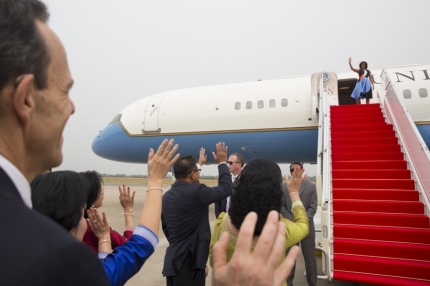
First Lady Michelle waves upon departure from Siem Reap Airport in Siem, Reap

First Lady Michelle waves upon departure from Siem Reap Airport in Siem, Reap Cambodia on March 22, 2015. The First Lady traveled to Japan and Cambodia as part of the “Let Girls Learn” initiative. (Official White House Photo by Amanda Lucidon)

The First Lady’s Travel Journal: Touring Angkor Wat

This post is part of a series authored by First Lady Michelle Obama to share her visit to Japan and Cambodia and the Let Girls Learn initiative with young people in the U.S.

After visiting the Let Girls Learn training, I traveled to Angkor Wat, a massive, ancient temple located just outside of Siem Reap. Angkor Wat was built in the early twelfth century, and it still stands as the largest religious monument on earth. It has become known as a national symbol for Cambodia — it’s even on Cambodia’s flag. Angkor Wat was originally built to celebrate the Hindu god Vishnu and then later became a Buddhist temple site. It is located in what was the capital of the ancient Khmer Empire here in Cambodia. Back then, temples, homes and farms stretched for miles around, and people created elaborate irrigation structures to bring water from rivers to farmers’ fields.

After meeting with these remarkable young women, I dropped by one of the very first Let Girls Learn trainings for Peace Corps Volunteers and the local leaders, educators and students they’re working with here in Cambodia. Together, they are doing such amazing work. They’re running girls’ leadership camps and girls’ sports teams and learning about health and nutrition, and this training will give them even more skills and tools to educate and empower girls. The Peace Corps will eventually be conducting these girls’ education trainings for all of its nearly 7,000 volunteers, and I cannot wait to see what they do with everything they learn!

Related Topics: The First Lady's Journal

The First Lady’s Travel Journal: Educating and Empowering Girls in Cambodia

This post is part of a series authored by First Lady Michelle Obama to share her visit to Japan and Cambodia and the Let Girls Learn initiative with young people in the U.S.

First Lady Michelle Obama and Mrs. Bun Rany Hun, First Lady of Cambodia, are greeted by students

First Lady Michelle Obama and Mrs. Bun Rany Hun, First Lady of Cambodia, are greeted by students while visiting the Room to Read program at Hun Sen Bakorng High School in Siem Reap, Cambodia as part of the “Let Girls Learn” initiative on March 21, 2015. (Official White House Photo by Amanda Lucidon)

I started the day with a visit to the Hun Sen Bakorng High School which has nearly 1,600 hundred students in grades seven through twelve. I was joined by the First Lady of Cambodia, Mrs. Bun Rany, who also cares deeply about girls’ education.

At this school, an organization called Room to Read runs a special scholarship program for girls who live in areas far from the school. Girls in remote parts of Cambodia often wind up dropping out of school because it’s too dangerous to travel to and from school each day or they just can’t afford the costs of transportation. But Room to Read provides girls with scholarships that cover the cost of housing, food and books, so they can live at the school and get their education.

I had the pleasure of meeting with these girls, and they were absolutely amazing — so passionate about their education and so determined to pursue their dreams. Two of these students — young women named Sohang Vean and Lorn Phounam — shared their stories with me, and I want to share them with you:

Related Topics: The First Lady's Journal

Week in Review: A Royal Visit, Leading on Climate, and The First Lady's Travel Journal

This week, the President announced a new executive order that will allow America to lead on climate, traveled to Ohio to answer a few questions at The City Club of Cleveland, hosted the the Prince of Wales and the Duchess of Cornwall, and celebrated St. Patrick's day with the Prime Minister of Ireland. The First Lady also had a busy week, heading to Japan and Cambodia to launch key partnerships for the Let Girls Learn initiative. 

Find out more about the past week in our latest weekly wrap-up.


Leading by Example

President Obama signed an executive order on Thursday that will help us cut greenhouse gas emissions and set a bold example to other nations. This week’s order positions the federal government to cut their carbon pollution emissions by 40% over 10 years. This would save taxpayers up to $18 billion in energy costs and increase the share of electricity the federal government uses from renewable sources to 30%.

Learn more about the President’s recent actions and how it sets a global example.

Chris Evans is an intern in the White House Office of Digital Strategy.
Related Topics: Grab Bag, Ohio

The White House

Office of the First Lady

Remarks by The First Lady at Peace Corps Training Event

Sofitel Angkor Phokeethra
Siem Reap, Cambodia

11:27 A.M. ICT

MRS. OBAMA:  Well, hello.  Let me try this:  Suor Sdai.  Is that okay?  (Laughter.)  I’ll work on it.

Well, hello.  It is truly a pleasure and an honor to be here in Siem Reap with all of you.  I’m grateful for the hospitality and the warmth of the Cambodian people who have made me feel welcome and at home in such a short period of time.  And I’m thrilled to join all of you today as we embark on one of the very first trainings for Let Girls Learn.

I want to start by thanking Carrie for that very kind introduction, but, more importantly, for her extraordinary leadership at the Peace Corps.  Let’s give Carrie a round of applause.  (Applause.) 

I also want to join Carrie in recognizing our terrific Ambassador to Cambodia, Ambassador Todd.  We are thrilled that you’re here.  Thank you so much for your work, and thank you for supporting us here during this visit.  And I also want to thank Danielle, as well -- who I hear is a super star -- for her wonderful remarks and her service in the Peace Corps.

But most of all, I want to thank all of you for the outstanding work that you all are doing to educate and empower girls here in Cambodia.  You all are living, breathing proof -- you’re the embodiment of what Let Girls Learn is all about.  It’s really about Peace Corps volunteers, community leaders, parents and girls themselves working side-by-side to help girls go to school, and, more importantly, stay in school. 

And that’s exactly what you all are doing.  You’re doing it every day.  You’re running girls’ leadership camps.  You’re running discussion groups and sports teams.  And you’re growing gardens, and you’re teaching girls about nutrition, and you’re helping them plan for their futures.

And most of all, you all are serving as role models for these girls.  You’re showing them what it means to be a powerful, passionate, educated woman.  And for the few brave men here -- (laughter) -- you guys are also showing girls what they should expect from the men in their lives:  They should be treated equally, with dignity and respect.

And I know from my own experience the impact you all can have with the work that you do, because while I come here today as First Lady of the United States, it wasn’t all that long ago that I was doing the same kind of work that you all are doing –- although I took a winding path to get there.

Growing up, my family certainly wasn’t wealthy, and neither of my parents went to college.  So when I graduated from law school, I had a lot of student debt -- I know some of the Peace Corps volunteers can probably relate to that.  (Laughter.)  So when I landed a job at a prestigious law firm with a nice office, big paycheck, my family was thrilled, and so was I.

Now, I had to work hard at the job.  I was grateful for the salary that they paid me, but the truth is, I always felt like something was missing.  I realized that I didn’t want to be way up in some tall building representing corporate clients.  I wanted to be down on the ground, in the neighborhood where I had grown up, working with families like mine.

So I quit that job, and eventually, I wound up running a program called Public Allies that trained young people to work in non-profit organizations and serve their communities.  This was actually an AmeriCorps national service program, and there may be some of you who knows that when AmeriCorps was first created, it was described as the “domestic Peace Corps” -- a way to empower communities at home like the Peace Corps is empowering communities abroad.

So when I started there, I took a big salary cut.  And my mother thought I was crazy for leaving that good job at the firm.  But I was happier than I had been in years -- really.  I got up every day ready to go to work, excited because I knew I was making a difference.  I could feel it.  I could see it in the faces of the young people I worked with every day.  I saw their pride as they learned new skills and gained new confidence.  I saw the impact they had on the people they served –- the students they taught, the workers they trained, the communities they organized. 

And I learned from that experience that real, meaningful change in communities doesn’t happen from the top down, it happens from the ground up.  It happens when you build on the strengths that already exist in those communities.  It happens when you empower the leaders that are already there, and then they go on to empower others.

I saw these principles in action earlier today, just a short while ago, when Mrs. Bun Rany and I visited a local school where a program called Room to Read is helping girls get their education.  And let me tell you, we met with a group of young girls, mostly 12th grade -- they were teenagers -- and these girls were amazing.  They were amazing.  They had big dreams, big, huge dreams.  And they had plans for how they’re going to use their education to serve their community and to build their country.

So what you all should understand is that the spirit of service that you all share, it’s contagious.  It truly is.  When you inspire the people you serve, they go on to inspire other people.  And when that happens. There is absolutely no limit to the impact that you can have and we can have together.

The story of one Peace Corps volunteer today is a perfect example.  So, Alexa Ofori, I’m going to embarrass you.  Where are you?  (Laughter.)  Oh, there you are.  (Laughter.)  Well, for those of you who don’t know, she’s a health volunteer who helped run a girls’ leadership camp and teaches health education at a local school -- got it right so far? 

Alexa was born in America, but her father grew up in Ghana, and her mother grew up in Grenada.  And when her parents were kids, both of them had Peace Corps volunteers teaching in their schools.  So just think about that –- two children inspired by Peace Corps volunteers grow up, get married, have this beautiful daughter -- I bet you’re smart, too -- (laughter) -- who decides to become a volunteer herself, and to inspire a new generation of young people.

And Alexa did an interview with the Peace Corps before she arrived here in Cambodia, and she talked about how excited she was to meet her host family and make new friends.  And she said -- this is her quote -- she said, “I’m really excited to share a little bit of my life with them, and to have them share a lot of their life with me.” 

And ultimately, that’s really what you all are doing here with the work that you’re doing.  You’re sharing in each other’s lives.  You’re learning from each other, you’re opening each other’s minds and hearts to your hopes, dreams and values.  And that’s something we often say about the Peace Corps –- Peace Corps volunteers help share American values with the world –- values like equality, inclusiveness, fairness, openness.

But the truth is, those aren’t just American values.  We know this.  They are universal human values.  And the foundation for those values is actually the focus of all of your work here in Cambodia, and that’s education. 

When girls get educated –- when they learn to read and write and think –- that gives them the tools to speak up and to talk about injustice, and to demand equal treatment.  It helps them participate in the political life of their country and hold their leaders accountable, call for change when their needs and aspirations aren’t being met.  

I’ve seen this process firsthand back home in America.  You probably watched what we go through, right?  It’s not always easy for a government to meet the needs of all of its people, and my husband certainly gets his share of criticism and disagreement.  But we wouldn’t have it any other way.  Not in America.  Because the voices and opinions of our people and our country -- both men and women from every background, from every walk of life -- that’s what makes America strong and vibrant. 

And that’s really my message to all the young women here today -- that Let Girls Learn is about giving girls like you here, all the girls who are here, giving you a voice in your communities and in your country.  That’s why we are all here.  It’s why we’re all here -- we’ve got a lot of us here -- because we know that you all have so much to say and so much to contribute.  And when you have the chance to fulfill your potential, there’s no limit to what you can achieve.

So I’m here today to urge you to keep working as hard as you can.  And I know it’s not easy.  I can’t guarantee you that it will ever be easy.  But the work is worth it.  Keep learning as much as you can.  And I hope you will follow the same example of the leaders and volunteers who are in this room with you, and when you’re done, reach back.  Reach back and help other girls get their education.  Because when you do that, you will truly become part of a network of women worldwide using their education to lift up their families, their communities and their country.

And being here today with all of you, I am truly so excited to see the lives you all will transform and the impact you’ll have in our world. 

So I want to end by just simply saying thank you, and making sure you all know how proud we are of you -- so proud.  All of you are doing the hard work of change.  And you should be proud of yourselves. 

So keep it up.  Promise?  (Laughter.)  Thank you all so much. 

END
11:39 A.M. ICT

The White House

Office of the First Lady

Remarks by The First Lady at Room To Read "Let Girls Learn" Event

Hun Sen Bakorng High School
Siem Reap, Cambodia

10:14 A.M. ICT

MRS. OBAMA: Well, thank you, Mrs. Bun Rany. First of all, let me just thank you so much for your kindness, your hospitality, for allowing me to spend time with these amazing young women.

These young women here are the reason why the President and I and so many around the world are pushing to get more girls educated. I am so proud of you all. I am so impressed by the level of intelligence and poise that you’ve presented today. And you all are living proof that we can’t afford to let this kind of talent go unsupported.

Before coming here, I read each of your stories, a little bit about each of your stories. And I want to thank you both for bravely sharing your stories in front of the world.

But I know that what you’re doing isn’t easy. I know that sometimes you struggle in school. I know that it can’t be easy to work on your farm, to take care of your family, to drive an hour to school or ride your bike an hour to school and then study and get good grades. I know that’s not easy. But it’s so important for you all to know that the fact that you’re here proves how smart and how strong and how capable you all are.

And there are going to be people who aren’t going to be happy that you’re so smart and strong and capable. It happened to me when I was your age. There were people who told me that I wasn’t smart enough to go to college and go to law school -- but I ignored them. And I want you to ignore them, too.

And it’s important for young women in my country to know that you exist; to know how hard you’re working, how much you’re willing to sacrifice just to get an education to improve not just your future but the futures of your family and your community.

So you all are role models to the world. There are going to be young girls that watch this and they’re going to think, I can do the same thing. They’re going to say to themselves, “I have a voice, I have a brain, and I’m going to use it.”

So here’s one thing I ask of each of you: When you complete your education -- and I know that you will, no matter how long it takes or how hard it is -- that you find another young girl in your community or in your family, and you help them. You mentor them. You hold their hand when it gets hard. And you tell them, if I can do it, you can do it. Do we have a deal? (Laughter.)

Well, keep up the great work. Your country is proud of you. And the United States’s First Lady is proud of you, too. Thank you so much for sharing today.

* * * * *

Q    If you could answer my question, how can the young Cambodian -- do in order to inspire the girls to study and achieve what they do in school?

MRS. OBAMA: Well, as I just said, the deal that we have now is that you serve as a mentor. The girls in your life -- your little sisters, your neighbors, the people in your community, the little girls -- they’re watching you. And they’re going to follow your lead. And that’s one of the most important things that you all can do right now at your age to help others.

But the other thing that you can do is finish what you started. Finish your education, and then follow your dreams to become doctors and teachers and mathematicians, and then bring all of that knowledge back to your communities and your families, just like you were saying. You’re going to help people in your community live healthier lives after you get your education. That’s the best thing you can do.

And the last thing that I think you all can do is use your voices to advocate for good things -- whether it’s more education, better health care, more freedoms, more equality -- just like you were saying. You now will have a voice. And you will have the training and the education to use it for good not just here in Cambodia, not just here in Siem Reap, but for the world. And I hope that you all will feel empowered to do that.

Q    My question is for both ladies. I’d like to ask, what is your impression about seeing us today, about being here today?

MRS. OBAMA: Well, I leave our gathering today feeling inspired and hopeful. I don’t know if you know, I have two daughters who are around your age, and it’s just so good to know that there are other young women halfway around the world who are just as smart and just as capable and just as courageous.

The reason why leaders around the country are going to band together to support girls’ education is because we need you to be the leaders of tomorrow. We need your passion. We need your intellect. We need your organizational skills. We need your nurturing, because many of you are still going to be mothers and wives -- I am. You can do both. And we need it all.

Our job -- and it’s all of our shared jobs -- is to help others come to the same conclusion about women and girls. For those people out there who think that it’s better for their daughters not to go to school, it’s going to be up to you all to help make the argument that investing in you is the best thing that your families can do for you and for their communities.

You all, we are going to have to keep having that conversation. Because it’s going to take some time for people to change their beliefs, right? Old people, we don’t change that quickly. It takes some time. But I know you all will do it. I am confident.

END
10:35 A.M. ICT

On Board: Travels with the First Lady in Kyoto, Japan

March 20, 2015 | 1:43 | Public Domain

Go on board with First Lady Michelle Obama in Kyoto, Japan as she makes a cultural visit to the Kiyomizu-dera temple and the Fushimi Inari Shrine. Narrated by First Lady Michelle Obama. March 20, 2015