President Obama and the First Family Visit Selma

March 09, 2015 | 1:58 | Public Domain

The First Family traveled to Selma, Alabama to commemorate the 50th anniversary of the marches from Selma to Montgomery, and to celebrate the passage of the Voting Rights Act of 1965.

Download mp4 (122.9MB)

The First Lady on the Launch of the Campaign to Change Direction on Mental Health

March 06, 2015 | 1:08 | Public Domain

The First Lady produced this public-service announcement to help launch the Campaign to Change Direction, a new nationwide campaign to raise awareness around mental health in America.

Download mp4 (42MB) | mp3 (1MB)

West Wing Week: 03/06/2015 or, “Just a Souvenir!”

This week, the President broke bread with My Brother's Keeper mentees, sat down with the President of Liberia and Secretary of Defense Ash Carter, shared the stage with Eric Holder and Aretha Franklin, and welcomed law enforcement officials and Peace Corps volunteers to the White House. While the Vice President was in Guatemala to discuss investing in Central America. That's February 27 to March 5 or, "Just a Souvenir!"

West Wing Week: 03/06/2015 or, “Just a Souvenir!”

March 06, 2015 | 4:43 | Public Domain

This week, the President broke bread with My Brother's Keeper mentees, sat down with the President of Liberia and Secretary of Defense Ash Carter, shared the stage with Eric Holder and Aretha Franklin, and welcomed law enforcement officials and Peace Corps volunteers to the White House. While the Vice President was in Guatemala to discuss investing in Central America. That's February 27th to March 5th or "Just a Souvenir!"

Download mp4 (156MB)

The White House

Office of the First Lady

Prepared Remarks of First Lady Michelle Obama for International Women of Courage Award

Note: Due to inclement weather, the International Women of Courage event has been cancelled. Please see the First Lady's prepared remarks below.

Remarks of First Lady Michelle Obama
As Prepared for Delivery
International Women of Courage Award
Washington, DC
March 5th, 2015

It is such a pleasure and an honor to be here with all of you today as we celebrate this year’s International Women of Courage.  When you learn about what these ten extraordinary women have done with their lives – it just takes your breath away. 

One of our awardees is the first woman to be a fixed-wing Air Force pilot in Afghanistan’s history, and she continues to fly despite threats from the Taliban and even members of her own extended family.

Another awardee is a women’s right activist whose organization has assisted more than 30,000 survivors of sexual assault and abuse in Bolivia, and for the past 30 years, she’s helped pass nearly every women’s rights law in her country.  

These women are journalists exposing corruption and extremism; they are activists fighting armed conflict and discrimination; and one of them is a nurse who contracted Ebola while caring for her patients.  But as soon as she recovered, she went right back to work, and she now serves as a spokeswoman, raising awareness and fighting the stigma around Ebola.

Each of these women has accomplished so much and helped so many people, but as we all know, they have all paid a high price for their efforts.  They’ve lost their jobs; they’ve been beaten and jailed; they’ve faced death threats and attacks on their reputations. 

But through it all, they’ve kept on going, because for them, staying silent simply isn’t an option.  For them, turning away from the injustices they see simply isn’t possible.  You see, these women refuse to believe the false comfort that other people’s suffering isn’t their problem, and they refuse to listen to those who tell them that one person can’t possibly make a difference.  Instead, they listen to the relentless moral voice inside themselves that drives them toward justice, compassion and truth.

That is one thread that connects their stories across cultures and continents.  And while these women come from different backgrounds and are working on different issues, there is another theme that runs through so many of their lives – and that is the power of education. 

Whether they attended secondary school, or a university, or got some kind of training, for so many of these women, their education helped them discover and develop their potential – it gave them a platform on which to build their professional lives.  And they have used that platform to inspire countless others to follow their example. 

I mean, think about how many girls now dream of taking to the skies or reporting breaking news.  Think about how many Ebola survivors have been able to reclaim their lives.  Think about how many survivors of violence and discrimination have finally gotten the support and justice they deserve – all because of the women on this stage.

So really, so many of these women are living, breathing proof of the ripple effect that occurs when we believe in women and girls and we invest in their potential. 

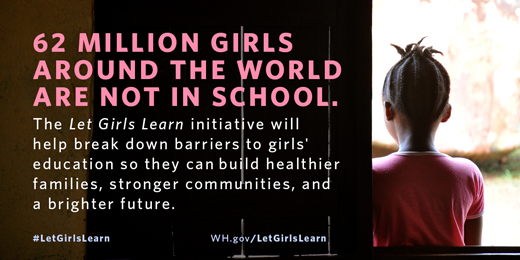
But we all know that for each of these women of courage, there are millions of others who may never have the chance to make their mark on the world.  Today, 62 million girls worldwide are not in school – girls with boundless promise, girls who are so eager to learn, so hungry to make something of their lives, but they may never get that opportunity. 

Think about the loss that represents for our world.  Think about how many of us in this room and how many of the women on this stage wouldn’t be here today if we hadn’t gotten some kind of education.  So we all know the power of education to transform the lives of women and girls – and to transform their families, communities and countries. 

And that’s why I am so thrilled that earlier this week, the U.S. Government launched a new global girls’ education effort called Let Girls Learn.  As part of this effort, in collaboration with the Peace Corps, we’ll be supporting new, community-focused girls’ education projects across the globe. 

We’ll be drawing on the talent and energy of the nearly 7,000 Peace Corps volunteers serving in more than 60 countries worldwide, and these volunteers will be supporting hundreds of new community projects to help girls go to school and stay in school – girls’ leadership camps, girls’ mentorship programs, and so much more.  These programs will be community-generated and community-led; they’ll be based on solutions devised by local leaders, families and the girls themselves.

And I am thrilled to kick off this new initiative with a trip to Asia later this month.  I’ll be going to Japan, where I’ll be meeting with Mrs. Akie Abe, the wife of Japan’s Prime Minister, who is eager to join us in this work.  I will also travel to Cambodia, where I will be meeting with Peace Corps volunteers and visiting a school where community-driven efforts are already transforming girls’ lives. 

This work could not be more urgent or more important, because we know that every single girl on this planet has something to contribute.  Every single girl has a spark of potential that is worthy of our investment.  And there is no limit to the impact we can have when we make that investment.

I think that one of today’s awardees put it best in an interview she did with a reporter about her work to help girls in Pakistan.  Tabassum Adnan was married at the age of 13, and after enduring 20 years of brutal abuse by her husband, she finally escaped, losing her home, her children and all her money.

But Tabassum refused to be defeated.  Instead, she founded an NGO to fight back against acid attacks, honor killings and other horrific violations of women’s rights in her community.  It’s dangerous work, and progress doesn’t come easily, but Tabassum won’t give up.  As she told that reporter – and these are her words: she said “We’ve come a long way, and it won’t be easy to back off now.”

That is what all of these women of courage have done – they have gone that long way, and they have inspired so many others to join them.  They’ve built movements and created waves of momentum for justice and peace and equality – and now, because of their courage and sacrifice, it’s not so easy for the rest of us to back off or back down.  Because of brave women like them, the tide is beginning to turn for women and girls across the globe.

And I am so proud to be here today to honor these women – and I am so determined to do whatever I can as First Lady of the United States and beyond to support their efforts and give all our women and girls the chances they deserve to fulfill their promise.

So congratulations to this year’s awardees.  We are so inspired by all of you, and we look forward to all that you will continue to contribute to your countries and our world in the years ahead.

Thank you so much, and God bless.

Changing the Story about Mental Health in America

Today, in support of her Joining Forces initiative, the First Lady spoke at the launch of The Campaign to Change Direction, a nation-wide effort to raise awareness around mental health in America. Spearheaded by Give an Hour and co-sponsored by the Substance Abuse and Mental Health Services Administration (SAMHSA), the campaign is designed to change the story of mental health across the nation by urging all Americans to learn the five signs that someone might be in distress.

While there has been much media attention on mental health in the military and veteran community, it is incredibly important to understand that mental health isn’t just a military issue -- it is a human issue. Mental health conditions impact our children, our grandparents, and our neighbors. Every year, roughly one in five adults -- or more than 40 million Americans -- experience a diagnosable mental health condition like depression or anxiety.

It’s up to all of us to change the conversation by encouraging everyone to reach out when a friend, co-worker, veteran, or loved one might be struggling, and to ask for help when we need it for ourselves.  

When Women Succeed, the World Succeeds: What They’re Saying About the Let Girls Learn Initiative

President Obama and the First Lady have teamed up with the Peace Corps to expand access to education for adolescent girls around the world through the Let Girls Learn initiative.

“A good education can lift you from the most humble circumstances into a life you never could have imagined.” 

— First Lady Michelle Obama

70% of the 1 billion people living in extreme poverty are women. Education can change that.

Education is not a privilege, it is a fundamental human right for all. Through a global network of support, the Let Girls Learn initiative will put lasting community-led and community-generated solutions in place for the more than 62 million girls across the globe are not receiving an education. The Peace Corps will be expanding the number of volunteers focused on advancing universal access to education and will continue to break down the barriers to girls' education in the communities they serve.

The positive effects that an education has not just for girls, but also for their families, communities and countries are boundless. As a global community, we are making progress. While we don’t yet live in a world where every women has an opportunity to learn, we do have numbers telling us why we need too.

Miranda Houchins is an intern in the White House Office of Digital Strategy.

The White House

Office of the First Lady

Remarks by The First lady at "Change Direction" Mental Health Event

Newseum
Washington, D.C.

12:04 P.M. EST

MRS. OBAMA:  Thank you, everyone.  Pardon my cough.  I know somebody else out there has this cough.  (Laughter.) 

But I want to start by thanking the Newseum for hosting us here today, and Barbara Van Dahlen, and everyone from Give an Hour for leading the charge on this event and this issue for so long.  I want to thank my dear friend, Bruce, who has been just a constant source of support on so many issues.  He is a wonderful man, and he is doing a great job for his country.

And of course, I want to thank Jenn, not just for her kind introduction, but she’s an amazing woman.  She is an inspiration.  And we all are grateful for her outstanding service to our country.  So let’s give Jenn another round of applause.  (Applause.) 

Through our Joining Forces initiative, I’ve had the chance to hear the stories of so many veterans like Jenn, folks who are so driven, who are so skilled and so ready to lead, but who have encountered obstacles during their transitions out of the military.  And I’d like to begin today by sharing the story of another one of those talented veterans –- a man named Ryan Rigdon. 

Ryan joined the Navy when he was 20 years old -- young like Jenn.  He was deployed to Iraq a few years later.  He served as a senior explosive ordnance disposal technician, which is a complicated way of saying that he was on the team that disarmed bombs and IEDs.  His first day on duty in Baghdad, Ryan and his team were sent out to dismantle explosives seven different times.  That was just one day.  Then there was the night Ryan encountered a live IED that was camouflaged to look like a rock.  Ryan didn’t have his protective suit on, and he knew the device could explode at any minute.  So he flipped it over, disarmed it with his bare hands. 

And then there were the missions where Ryan and his team would head to a place where a roadside bomb had just exploded, oftentimes killing Americans.  Their job was to clear the area of any remaining explosives, which meant sorting through unimaginable wreckage and carnage. 

During his two deployments, Ryan was awarded a Bronze Star and an Army Commendation Medal.  Yet despite these accolades, he experienced extreme emotional highs and lows -– one moment was like an adrenaline rush, he was ready to take on the world; the next, he felt like he’d fallen flat on his face, scared out of his mind. 

And of course, while Ryan was deployed, his life back home didn’t stop.  His wife, Whitney, had a baby daughter while he was gone, and Ryan didn’t get to meet her until she was three months old.  Later, his oldest daughter began having seizures.  Doctors couldn’t figure out why.  Eventually, all of this stress took its toll on Ryan. 

When he came home from his second deployment, he started having constant, splitting headaches.  His ears wouldn’t stop ringing.  He had nightmares and panic attacks.  He’d pace through the house at night thinking his family was in danger.  A few times, he even flipped over his bed trying to find something underneath.  Ryan knew he needed help, but he didn’t want to go on medication.  Instead, he coped by gambling online, drinking a little too much.

Finally, another sailor noticed he was struggling and encouraged him to seek counseling.  Fortunately, Ryan took his advice.  He was diagnosed with post-traumatic stress and he found out he’d be medically discharged from the Navy. 

For almost a year, Ryan -- his life was up in the air.  He was applying for job after job but nothing panned out.  He eventually found work in Dallas, and even though he had a good counselor there, Ryan continued to struggle.  He was worried about everything from his future to his family to his health.

Finally, one night he hit rock bottom.  He lay awake in bed, crying.  He’d had enough.  He said, “I was just tired of it.”  He said, “I was letting my family down.  I was feeling worthless.”  So he got up, walked into the bathroom, and prepared to take his own life. 

In Ryan’s story we hear the story of far too many of our veterans –- the struggle to adjust to a new life.  The terrors and anxieties that just won’t go away, even when they’re back home, safe in their own beds.  But it’s important to note that most of our veterans come home and don’t experience any mental health problems at all.  It’s also important to note that the veterans who do struggle are not alone.  There are millions of Americans affected by mental health challenges every year. 

So this isn’t just about our troops and veterans.  In fact, every year, roughly one in five adults -– or more than 40 million Americans -– experience a diagnosable mental health condition like depression or anxiety.  And young people are affected at similar rates.  These conditions touch folks of every age, every background.  They’re our kids, our grandparents, our friends, neighbors, co-workers, and yes, our veterans. 

And this shouldn’t be surprising to any of us because, let’s face it, life can be stressful.  Folks are faced with all kinds of challenges.  They are stretched thin at work.  Their paychecks don’t stretch far enough.  Millions struggle every day just to get by.  Then you add social, biological, and genetic factors on top of all that, and sometimes it’s just too much. 

So the fact is that many people in this country are fighting to put one foot in front of the other just to make it through the day.  And often they don’t ask for help because they’re worried about how it will look. 

At the root of this dilemma is the way we view mental health in this country.  When it comes to mental health conditions, we often treat them differently from other diseases like cancer, diabetes or asthma.  And that makes no sense.  Whether an illness affects your heart, your leg or your brain, it’s still an illness, and there should be no distinction.  (Applause.)  Because we know that mental health is just as important to our overall well-being as our physical health.  In fact, as Jenn alluded to, our mental health seriously affects our physical health –- studies suggest that people living with depression are more likely to die from heart disease.

So there should be absolutely no stigma around mental health.  None.  Zero.  I mean, just imagine if we treated breast cancer the way we treat mental health.  Imagine if, instead of admiring cancer patients for their courage as they fight this disease, we feared them or were embarrassed by them.  Imagine if we told folks with heart disease that they should just buck up and get it together.  (Laughter.)  Imagine if we made these folks feel that taking cholesterol medication or having surgery was something to be ashamed of.  Imagine how many people wouldn’t be alive today if we took that approach.

So it is really time to flip the script on mental health in this country.  It’s time.  It’s time to tell everyone who’s dealing with a mental health issue that they’re not alone, and that getting support and treatment isn’t a sign of weakness, it’s a sign of strength.  (Applause.)  That’s something that my husband believes strongly as President.  Because in this country, when you’re fighting an illness –- whether that’s mental or physical –- you should be able to get the help you need, end of story.  (Applause.)

That’s why the Affordable Care Act expands mental health and substance-abuse benefits and parity protections to roughly 60 million Americans -- (applause) -- and requires new plans to cover things like depression screenings for adults, behavioral assessments for kids. 

And for our troops and veterans, my husband recently signed a bill to help prevent veteran suicide.  (Applause.)  He put more counselors in place to improve access to care.  He expanded the capacity of the Veterans Crisis Line and the community-based Vets Centers.  And the VA just finalized an important new policy that ensures that service members who are taking health -- mental health medications can continue to do so as they transition from the military care at the VA -- to the VA.

So we are making progress on this issue.  But we also know that government can’t do this alone.  Because this isn’t just a policy issue or a budget issue, it’s a cultural issue.  Real change here requires a shift not just in our policies, but in our attitudes. 

And that’s why, almost two years ago, we hosted the National Conference on Mental Health at the White House –- because we wanted to reach out across the country and start changing the entire way we view mental health in America.  And that was the beginning of something really exciting, because after that conference, Dr. Van Dahlen and so many others decided to bring together folks from all sectors of our society to take this issue on.

And the result is what we’re proud to announce today:  The Campaign to Change Direction.  It’s a coalition that includes business and government, nonprofits, the medical community, our schools, our faith communities, and so many others.  These folks are all coming together to raise awareness about mental health and give people tools to help someone who might be experiencing a mental health issue. 

For example, they’re releasing a list of symptoms called The Five Signs.  This list includes things like withdrawal, agitation, hopelessness, decline in personal care, change in personality –- signs that any one of us might notice in a family member or a co-worker struggling with mental health.  And everyone should know all about these signs.  That should be like knowing how to check for lumps in a breast or getting your cholesterol taken. 

So I want to encourage everyone in this country to go to ChangeDirection.org to learn more.  I also want to encourage folks across the country to follow the lead of businesses and organizations like Give an Hour, Team Rubicon, Wake Forest University –- all who’ve committed to making a difference on mental health. 

For example, Give an Hour is co-sponsoring The Campaign to Change Direction with the Substance Abuse and Mental Health Services Administration, and [SAMHSA] will be providing subject matter expertise and coordinating our federal outreach through the VA, the DOD and HHS. 

In addition, Booz Allen will be training 11,000 employees on the Five Signs.  They’re going to be hosting awareness events, convening small group discussions among their staff.  And the National Council for Behavioral Health will be training 3 million people in Mental Health First Aid.  I went through some of this training a few weeks ago -- a shorter version of it, I have to say.  (Laughter.)  But even in that short time, I saw just how useful these tools were.  It really gives you the skills you need to identify and ultimately help someone in need.  Because you never know when these skills might be useful.

And that brings me back to Ryan, the veteran I was telling you about earlier, and the moment he hit rock bottom.  Now, thankfully, Ryan didn’t end his own life that night.  Instead, a couple of days later, Ryan summoned the courage to tell a co-worker that he’d thought about suicide.  And the co-worker, an Army veteran himself, called the Veterans Crisis Line.  He reached out to the local VA.  He offered to drive Ryan there.  But Ryan promised his friend that he’d drive himself, and he did that very same day. 

Through the VA and Give an Hour, Ryan got the medication and counseling he needed.  And slowly, he’s getting better.  Ryan will be the first to tell you that he still struggles sometimes, but he knows that he has the support of his wife and family.  And he’s proud to share his story if it means he can help just one more person.  That’s how Ryan keeps serving his country, just like Jenn.  So, Ryan, I know you’re out there.  I’d like to ask you to stand up so that we can applaud you for your courage.  There’s my man Ryan.  (Applause.) 

Now, Ryan’s story could have ended in heartbreak, but the people in his life wouldn’t let that happen.  The sailor who reached out to him, the co-worker who supported him, his wife who was there for him every day, year after year -- they all showed Ryan that he didn’t have to do this alone, and they helped him to change direction.

And that’s what we’ve got to do for every single person in our own lives.  We’ve got to listen.  We’ve got to connect with them.  We have to offer our compassion so that our friends and families and neighbors and our veterans can get the help they need, just like we would if they were diagnosed with cancer or heart disease or anything else.  Because we all know that our mental health is just as vital as our physical health, so it’s time we started treating it that way.

And that’s going to take some courage from everybody –- the courage to reach out and have those tough conversations with a friend.  The courage to listen, and seek help for ourselves when necessary. 

But here’s the thing:  If we can all just summon that strength like Ryan did, like Jenn did, then I guarantee you that we will save lives in the years ahead -- important, valuable lives.  And soon enough, caring for our mental health won’t be considered such a courageous act, it’ll be just another part our lives, just like any other part.

So what you all are doing is bringing us so much closer to that goal.  This day is important.  And I want to end by thanking all of you for the passion, the dedication, the endless hard work that you have been putting into this issue for so long.  I am so proud of all of you.  I’m grateful to you.  And I look forward to working with you really hard in the months and years ahead.

So congratulations.  Let’s roll up our sleeves and keep getting stuff done.  Thank you so much.  (Applause.)   

END
12:22 P.M. EST

Making Sure That We "Let Girls Learn"

Watch on YouTube

This afternoon, President Obama and First Lady Michelle Obama announced that the White House is ramping up its efforts to Let Girls Learn with a new initiative focused on supporting girls’ education around the world.

The Obama administration has partnered with the Peace Corps to take on the challenge of keeping girls in school.  Even in 2015, more than 62 million girls across the globe are not receiving an education, and even more are fighting to stay there. In many countries around the world, a girl risks dangerous walks to school, pressure to give up her education, and a lack of support for the resources she needs in her schooling.

Related Topics: Human Rights, Education, Women, Georgia

The White House

Office of the First Lady

As Part of the Let Girls Learn Initiative, First Lady to Travel to Japan and Cambodia March 18-22

Tokyo, Japan; Kyoto, Japan; Siem Reap, Cambodia

Coming on the heels of the President and First Lady’s launch of the Let Girls Learn international girls education initiative, Mrs. Obama will travel to Japan and Cambodia from March 18-22, 2015. She will visit Tokyo on March 18-19, Kyoto on March 20, and Siem Reap on March 21-22.  She will be joined by Peace Corps Director Carrie Hessler-Radelet for the trip. While in Japan, the First Lady will highlight the importance both countries place on international girls education, and the plans to deepen our partnership on this issue through development programs and collaboration between the Peace Corps and Japan’s Overseas Cooperation Volunteers.  The First Lady will then travel to Cambodia, one of the first 11 countries to be included in the Let Girls Learn Peace Corps initiative in the program’s first year.  In Cambodia, Mrs. Obama and Peace Corps Director Hessler-Radelet will see up close how community-driven solutions are changing girls’ lives, a key component of the Let Girls Learn Peace Corps program. For more information on the Let Girls Learn Initiative, please click HERE.

Additional details about the First Lady’s trip are forthcoming.

Tuesday, March 3, 2015

Washington, DC * 2:50 PM – On Tuesday afternoon, the President and the First Lady will deliver remarks at the White House about expanding efforts to help adolescent girls worldwide attend and stay in school. These efforts will build on the investments we have made and the successes we have achieved in global primary school education by elevating existing programs and public and private sector partnerships.

The event in the East Room will be open press and streamed live on www.whitehouse.gov/live

Thursday, March 5, 2015

Washington, DC * 1:00 PM – In honor of International Women’s Day, First Lady Michelle Obama will attend the Secretary of State’s International Women of Courage Awards ceremony in the Dean Acheson Auditorium of the U.S. Department of State.  The annual ceremony recognizes women around the globe who have shown exceptional courage and leadership in advocating for women’s rights and empowerment, often at great personal risk. Since the inception of this award in 2007, the Department of State has honored more than 70 women from 45 different countries.