#DearMe: First Lady Michelle Obama's Message To Her Younger Self

March 20, 2015 | 0:45 | Public Domain

First Lady Michelle Obama shares a message to her younger self as part of the #DearMe campaign to inspire and empower young people from Tokyo, Japan. The First Lady traveled to Japan as part of the "Let Girls Learn" initiative to open the doors of education for girls around the world. Learn more at http://WhiteHouse.gov/LetGirlsLearn.

First Lady Michelle Obama Gives Remarks at a Let Girls Learn Event in Tokyo, Japan

March 20, 2015 | 15:04 | Public Domain

The First Lady’s Travel Journal: Experiencing Kyoto’s Beauty and History

First Lady Michelle Obama is keeping a travel journal while promoting the Let Girls Learn initiative in Japan and Cambodia. Her third post appeared on Medium today. 


Today we traveled to the beautiful Japanese city of Kyoto.

Tucked into a valley and surrounded by mountains on three sides, Kyoto was the imperial capital of Japan for over 1,000 years. Because of its majestic mountain scenery, some people called the Japanese nobility who lived there “cloud dwellers.”

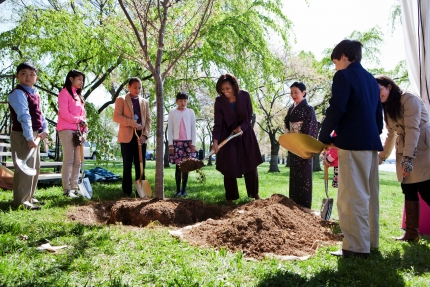
First Lady Michelle Obama participates in a centennial tree planting ceremony during the National Cherry Blossom Festival (March 27, 2012)

First Lady Michelle Obama participates in a centennial tree planting ceremony during the National Cherry Blossom Festival at the Tidal Basin in Washington, D.C., March 27, 2012. (Official White House Photo by Lawrence Jackson)


On Board: In Japan with The First Lady and Let Girls Learn

March 19, 2015 | 1:38 | Public Domain

Let Girls Learn is a government-wide effort that will leverage the investments we have made and success we have achieved in global primary school, and expand them to help adolescent girls complete their education.

Download mp4 (27.5MB)

The First Lady's Travel Journal: Coming Together on Girl's Education

First Lady Michelle Obama is keeping a travel journal while promoting the Let Girls Learn initiative in Japan and Cambodia. Her second post appeared on Medium today. 


I arrived in Tokyo, Japan last night, and this morning, I was proud to stand with Mrs. Akie Abe, the wife of Japan’s Prime Minister, as we announced a new partnership between Japan and the United States that will help girls around the world go to school.

It’s not surprising that America and Japan are coming together on this issue.

Mrs. Abe and I are both passionate about girls’ education — as are our husbands — and Japan is one of America’s strongest and most important allies. Japan and the United States also share so many values. We are both democracies and believe strongly in freedom of speech and religion and protecting the basic rights of all our citizens. Both our countries care deeply about education. And both America and Japan believe in helping other countries that have fewer resources — countries where people struggle with poverty and disease and where many young people, particularly girls, don’t have the chance to attend school.

As part of our new partnership, both Japan and the U.S. will be investing in programs that will help girls around the world get an education. As I mentioned in my opening post, here in the U.S., this effort is called Let Girls Learn, and it features a new girls’ education initiative run by the Peace Corps.

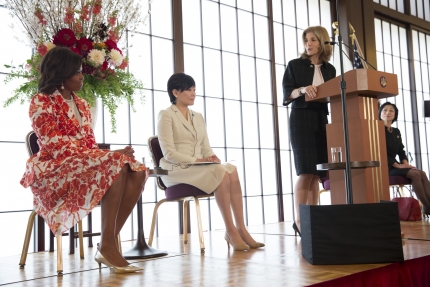
First Lady Michelle Obama In Japan for Let Girls Learn_1

First Lady Michelle Obama is joined by Ambassador Caroline Kennedy and Akie Abe, the First Lady of Japan, during a “Let GIrls Learn” announcement held at the Iikura Guest House in Tokyo, Japan on March 19, 2015. (Official White House Photo by Amanda Lucidon)

#GimmeFive for the 2015 White House Easter Egg Roll!

March 19, 2015 | :50 | Public Domain

On April 6th, 2015, the First Family will host the 137th annual White House Easter Egg Roll. This year’s theme is “#GimmeFive,” and more than 35,000 people will gather on the South Lawn to join in the celebrations. To learn more about the Easter Egg Roll, visit www.WH.gov/EasterEggRoll. Information about commemorative eggs can be found at http://easter.nationalparks.org.

Download mp4 (27MB)

The White House

Office of the First Lady

Remarks by the First Lady Before Meeting With Prime Minister Abe

Prime Minister's Residence
Tokyo, Japan

3:45 P.M. JST

MRS. OBAMA:  Prime Minister, first of all, your wife is an amazing woman.  And the restaurant is good, so you have to try it.  (Laughter.)  Maybe the next time I come to visit, you can join us.  (Laughter.)

But we had a very productive meeting today.  And we are just so grateful for your support and investment in girls’ education.  We couldn’t do this without the strong support that you’ve provided.  And I’m very excited about the work that our countries will do together to spread the word.

END
3:49 P.M. JST

The White House

Office of the First Lady

Remarks by the First Lady Before Discussion with Mrs. Abe and Students on the Importance of Girls' Education

Iikura Guest House
Tokyo, Japan

11:18 A.M. JST

MRS. OBAMA:  Well, I am incredibly excited about the partnership between our two countries around girls’ education, because I think our countries are in a very strong position to be able to reach out and help developing countries. 

As Mrs. Abe said -- eloquently said in her remarks, there is nothing more important than getting an education.  And to think that today, there are 60 million girls around the world who don’t have that opportunity, it’s an injustice.  And when we look at the advantages that we have had, as Mrs. Abe said, I think it’s our duty and it’s our responsibility to do what we can to reach out and to aid others.

One of the things that I also say about this initiative, what -- the impact that I’m hoping that it has is to inspire young people in my country who take their education for granted.  Right now, one of the things that I’m saying very often -- I’ve got an initiative called Reach Higher, where I’m trying to encourage more young people in the U.S. to embrace the role of education, and to finish high school and to go on to college.  Because we need your generation to be highly educated, highly skilled, highly trained. 

And that’s so important to the success of our countries and to the world, quite frankly.  We just can’t afford to waste the brainpower and energy of half of our citizens on this planet, and that’s what we do when we don’t invest in young girls.  So my hope is that through partnerships like ours, the United States and Japan, that we will encourage other developed nations to step up and increase their investments. 

But there’s also a role that you all can play.  You don’t have to be a powerful nation to have an impact on this issue.  I’m urging girls in the United States to look right in their own backyards; to look at home at how they can be mentors to the young girls in their communities and to their families.  Tutor a young girl.  Bring them along.  Encourage them.  If you know young women in communities that don’t have the advantages that you have, reach out as much as you can.  Because it’s that one-on-one interaction that can really make a difference.  If they see what is possible through you, they believe that they can achieve that for themselves. 

That’s one of the reasons why I share my story so much, because I want young girls around the world not to see me as the First Lady of the United States, but I want them to know that I was a young girl in Chicago that had doubts and fears and worries, and people who told me that I couldn’t.  But with hard work and that investment in education, look where we all are.  I’m sitting here with my good friend in Japan with all of you, and we have the opportunity to change the world.  You can do that too, and so can the 62 million girls out there who aren’t getting their education.

So that’s what I hope that we’ll begin to achieve with Let Girls Learn.  But this is going to be a lifetime commitment for me, I know for Mrs. Abe, and so many.  We won’t solve this in a generation.  We have to keep plugging away.  And you all are going to be the next leaders who are going to be out there pushing it to the next level.

So I’m very proud of you all.

END
11:22 A.M. JST

The White House

Office of the First Lady

Remarks by the First Lady at "Let Girls Learn" Event in Tokyo, Japan

Iikura Guest House
Tokyo, Japan

10:51 A.M. JST

MRS. OBAMA:  Konichiwa.  (Laughter.)  I am so pleased to be here today as the United States and Japan announce a new partnership to educate girls across the globe.

And before I get started, on behalf of myself and my husband, I want to join in with the others to express our condolences over the horrific event yesterday in Tunisia.  Our hearts go out to the loved ones of those who were lost here in Japan and around the world.  They are very much in our thoughts and prayers today.

I now want to start by thanking my dear friend Mrs. Abe for her tremendous kindness and hospitality.  I am happy to be here with you today.  And I want to thank her for her passionate work on behalf of girls worldwide.  Mrs. Abe has been deeply involved in Japan’s efforts to create this partnership, and I am so grateful to her and to Prime Minister Abe for their leadership.

I also want to thank Director General Naoko Saiki for her wonderful remarks as well, and for her leadership. 

And of course, I want to recognize our outstanding Ambassador, Caroline Kennedy, who is a dear friend.  I am thrilled that she could join us today because I know that she shares our commitment to addressing our girls’ education crisis.  And I don’t use the word lightly –- this truly is a crisis.  Right now, as you heard, 62 million girls worldwide are not in school.

And when we talk about this issue, we often focus on the economic barriers girls face –- school fees or uniforms, or how they live miles from the nearest school and have no safe transportation, or how the school in their community doesn’t have bathroom facilities for girls so they just can’t attend.

But we all know that the problem here isn’t just about infrastructure and resources.  It’s also about attitudes and beliefs.  It’s about whether fathers -- and mothers –- think their daughters are as worthy of an education as their sons.  It’s about whether communities value girls simply for their bodies, for their household labor, their reproductive capacities, or whether they value girls for their minds as well.  It’s about whether societies cling to laws and traditions that oppress women, or whether they view women as full citizens entitled to the same rights and freedoms as men. 

And if we’re being honest with ourselves, we have to admit that these kinds of challenges aren’t just limited to the developing world. 

For example, while we have made tremendous strides in girls’ education in the United States and Japan, women in both our countries still struggle to balance the needs of their families with the demands of their careers.  We still struggle with the outdated belief that a woman cannot be both an accomplished professional and a devoted mother; that she has to choose between the two. 

But the reality is that when we put limits like this on women’s lives, we stifle their potential, and, more importantly, we miss out on so much of what they have to offer our societies.  And for me, that’s where this issue gets personal. 

See, I grew up in a working-class neighborhood, a place where hardly anyone went to university.  Many people worked long hours for low salaries, struggled to pay their bills.  As a young girl I was bright, outgoing, with plenty of thoughts and opinions of my own, but like a lot of young women, I was often primarily defined by my relationship to the men in my life.  I was my father’s daughter, or, even though I was just as smart as my brother -- I could hit a ball just as far, I could run just as fast -- I was always just his little sister. 

When I got to school, I sometimes encountered teachers who assumed that a girl from a humble background like mine wouldn’t be a successful student.  I was even told that I would never get accepted to the prestigious school like Princeton University, so I shouldn’t even apply.  Like so many girls across the globe, I got the message that someone like me wasn’t supposed to have big dreams; that I should keep my head down, my voice quiet, and I should make myself just a little smaller to fit other people’s modest expectations. 

But I was lucky.  I had parents who believed in me, who urged me to speak up and make myself heard in the world.  So I held fast to my dreams.  I worked hard in school.  I went ahead and I applied to Princeton -- and I got accepted.  I went on to become a lawyer, a city government employee, a hospital executive, and the director of an organization that trained young people to serve their communities.  And most of all, I became a mother, which is by far the most important job I will ever have in my life. 

Now, continuing my career while raising my daughters wasn’t easy, but for me, this was the right decision.  For me, being a mother made me a better professional, because coming home every night to my girls reminded me what I was working for.  And being a professional made me a better mother, because by pursuing my dreams, I was modeling for my girls how to pursue their dreams.  And there were two main reasons I was able to achieve this balance.

First, I had the support from my husband and family who believed in me, and from my employers, who recognized the value of hiring women and providing flexible workplaces.  And both Prime Minister Abe and President Obama are working very hard to create policies like this that allow women –- and men –- to be excellent employees and excellent spouses and parents.

And second, like so many other women, I was able to achieve both personal and professional goals because of my education.  My education was truly the starting point for every opportunity I have had in my life.

But I know that for every girl like me, there are so many others across the globe who are just as smart, just as capable, just as hungry to succeed, but they never have the chance to go to school.  And that is such a profound waste of human potential -– and such a profound loss for our world. 

I mean, just think about what we would be missing here in Japan if women were not educated.  Just imagine if Sadako Ogata was never able to attend school and become one of the greatest diplomats of our time.  Imagine the loss of her moral leadership at the United Nations. 

And what if the great violinist, Midori, never had the chance to discover her talent.  Think about all the music we would never have heard.  Think of all the beauty our world would have lost.  

And how about Chiaki Mukai.  Without her education, she never could have become the first woman astronaut in Japan, inspiring so many young girls to reach for the stars.

So just take my story, or any of these women’s stories, and multiply it by 62 million.  That’s when we begin to understand the loss to our world when we fail to educate our girls. 

But when we do educate girls, when we truly invest in their potential, there is no limit to the impact we can have.  Girls who attend school have healthier families.  They earn higher salaries.  And sending more girls to school can boost a country’s entire economy.  So we know that educating girls is the best investment we can make, not just in their future, but in the future of their families, their communities and their countries.

And that is why the United States government recently launched a new, global girls’ education effort called Let Girls Learn.  As part of this initiative, U.S. Peace Corps volunteers will work side-by-side with local leaders, families, and girls themselves to help girls go to school and stay in school.  They’ll be creating mentoring programs, girls’ leadership camps and so much more. 

But, as Mrs. Abe said, of course, no one country can solve this problem alone.  And that is why I am here today in Japan.  Japan is one of America’s closest and most important allies and development partners.  In fact, Japan is the largest aid donor in all of Asia.  And today, Japan is once again leading the way with a 42-billion-yen investment in girls’ education.

With this commitment, Japan is truly setting the standard for countries around the world.  And with this new partnership between our two nations, we are issuing a call to action to nations around the world.

In the coming months and years, we will be reaching out to world leaders and asking them to deepen their commitment to girls’ education.  For those who are already investing, we’re going to ask them to invest more.  For those not yet engaged, we will invite them to join us.  And I think it is fitting that we are starting this global effort here with our friends in Japan.  Because when it comes to development issues like girls’ education, our two countries share a unique history, as you’ve heard.

President John F. Kennedy launched the Peace Corps back in 1961, and that inspired youth groups here in Japan who helped found JOCV, which is celebrating its 50th anniversary this year.  And today, President Kennedy’s daughter is proudly serving as America’s ambassador to Japan, and we are renewing our agreement for Peace Corps and JOCV volunteers to work together on issues like girls’ education.

As Mrs. Abe said, later this week, I’ll be traveling to Cambodia, which is one of the first countries where Let Girls Learn will operate.  And I understand that Mrs. Abe just made her own visit to Cambodia, where she focused on youth and education issues.  And we are both so excited to highlight the work that Peace Corps and JOCV volunteers are doing in that country and so many others; how they’re coming together to model the values of our nation -- values like fairness, equality, openness, opportunity. 

And today, I’m reminded of something that President Kennedy once said about young people who want to join the Peace Corps.  He said that they are “a light to all who seek a peaceful world.”  And I think that is just as true today as it was 50 years ago, especially when it comes to educating girls.  So many women leaders in developing countries –- businesswomen, politicians, professionals –- they can trace their journey back to a Peace Corps or JOCV volunteer who invested in their education. 

The story of a woman named Anastasia Msosa from Malawi is a perfect example.  When Anastasia was a girl, Peace Corps volunteers came to teach at her school in Malawi, and Anastasia was struck by their kindness and generosity.  Inspired by their encouragement, Anastasia went on to build a pioneering legal career, and she eventually became the first female chief justice of Malawi’s Supreme Court.

In reflecting on the impact the volunteers had on her life, Chief Justice Msosa said -– and this is her quote -- she said, “The volunteers shaped me into building up to be what I am.”  She said, “The time with the Peace Corps volunteers helped me to have dreams.”

So when Prime Minister Abe and Mrs. Abe talk about building a “society where women shine,” I think this is what they’re talking about.  They’re talking about letting the power, the genius, the creativity of women shine through.  They’re talking about ensuring that women and girls can pursue their dreams. 

And that’s what this effort is all about.  It’s about creating a world where women shine.  A world where every family, every community and every nation can benefit from the contributions of all of its citizens, men and women, boys and girls.  And I cannot think of a better partner -- better partners in this work than Mrs. Abe and Prime Minister Abe, and the great country they serve. 

I am so grateful to them.  I am grateful to all of you.  And I am so grateful to the Peace Corps and JOCV volunteers who are making this vision a reality every day across the globe. 

I look forward to working with all of you in the years ahead to give girls worldwide the education they so richly deserve.

Arigato gozaimasu.  Thank you.  Thank you so much.  (Applause.)   

END
11:16 A.M. JST

The White House

Office of the First Lady

FACT SHEET: U.S. & Japan - Collaborating to Advance Girls Education Around The World

About 62 million girls around the world – half of whom are adolescent – are not in school. These girls have diminished economic opportunities and are more vulnerable to HIV/AIDS, early and forced marriage, and other forms of violence.

Yet when a girl receives a quality education, she is more likely to earn a decent living, raise a healthy, educated family, and improve the quality of life for herself, her family, and her community.  In addition, girls’ attendance in secondary school is correlated with later marriage, later childbearing, lower maternal and infant mortality rates, lower birth rates, and lower rates of HIV/AIDS. A World Bank study found that every year of secondary school education is correlated with an 18 percent increase in a girl’s future earning power.

Earlier this month, the United States, under the leadership of the President and First Lady, announced that it is expanding its efforts to help adolescent girls worldwide access school and complete their education through an initiative called Let Girls Learn.  This new effort will build on investments that the international community, including the United States, has made and successes that have been achieved in global primary school education, and expand them to help adolescent girls complete their education and fulfill their potential.

Japan is also a global leader in international education.  Through its “School for All” concept, Japan seeks to advance education through improving educational facilities, teaching practices, community participation, administration, and health and nutrition.   Japan understands that the international community shares this concept, and believes that a comprehensive approach by other donors including the United States, international organizations, NGOs, governments of developing countries and local communities is the key to ensuring the sustainability of girls’ education.

Today we are pleased to announce that the United States and Japan will partner in this critical area, elevating the issue of girls’ education on their shared development agenda.  Japan and the United States, through this initiative, will cooperate in improving the learning environment for girls by collaborating with schools, communities and educational administration.

As two of the largest economies in the world, our combined efforts can make a difference. The President’s FY 2016 Budget request includes $250 million in new and reallocated funds in support of the Let Girls Learn Initiative.   Japan will commit Official Development Assistance (ODA) in excess of 42 billion yen over three years starting from 2015 for girls’ empowerment and gender-sensitive education.

Under this partnership:

  1. Peace Corps and the Japan International Cooperation Agency (JICA), which directs Japan’s Overseas Cooperation Volunteers (JOCV), will formalize cooperation through a Memorandum of Understanding between the two agencies.
    • This strategic partnership between Peace Corps and JOCV will be broad and encompass a variety of activities, and will focus in particular on advancing girls’ education through cooperation on the ground in countries around the world, including Cambodia.  JOCV will enhance cooperation with the Peace Corps to facilitate girls’ participation in the field of primary and secondary education, sports and physical education.
  2. With counterpart governments around the world, the United States and Japan will increase focus on girls’ education in our respective bilateral assistance programs.
    • Building on current funding and programs at USAID, the State Department, the Peace Corps, and across the US government, the United States will work to improve access to quality education and healthcare, help address violence and other barriers to education that adolescent girls face around the world. 
    • Japan will prioritize girls’ education in its new international education cooperation policy starting from 2016.  In addition, in Southeast Asia, Japan will further provide assistance for constructing and expanding elementary, middle, and high school buildings, which is expected to benefit 20,000 adolescent girls with a good educational environment.
  3. The United States and Japan support girls’ education through strong commitments to international organizations and non-governmental organizations focused on these issues.
    • For example, the President’s FY 2016 Budget request includes an increase for the U.S. contribution to the Global Partnership for Education by 40% over current funding levels, to $70 million.  Japan will double its contribution this year to United Nations Women, to $20 million.