The White House

Office of the First Lady

First Lady Michelle Obama Announces Opening of Old Family Dining Room on Public Tour Route

WATCH LIVE: At 11:00am ET, in honor of the opening of the Old Family Dining Room, First Lady Michelle Obama will surprise visitors on the White House public tour route.  To watch live, click HERE.

PHOTO: A downloadable photo of the Old Family Dining Room can be found HERE.

WASHINGTON, DC - Today, First Lady Michelle Obama unveiled the Old Family Dining Room for public viewing for the first time in White House history. Through a joint effort by the First Lady and the Committee for the Preservation of the White House, and funded by a special donation from the White House Historical Association, the room has been refurbished and will serve as a showcase of 20th century art and design.  Adjacent to the State Dining Room, the Old Family Dining Room has a rich history that dates back to 1825.  Additional information on the history of the Old Family Dining room can be found HERE.

“It is my pleasure to help pull back the curtain on this special part of the White House,” said First Lady Michelle Obama. “Today and moving forward, the Old Family Dining room will reflect the history of our former First Families and represent the legacy and impact of modern American artists.”

As part of the room’s renovation, the following items have been added to the permanent White House collection for display in the Old Family Dining Room:

  • Resurrection by Alma Thomas (1891-1978)
    1966, acrylic and graphite on canvas (36 x 36 3/16 in.)
    The George B. Hartzog, Jr. White House Acquisition Trust (White House Historical Association)
    An educator and artist in Washington, D.C. for most of her career, Alma Thomas was one of the renowned members of the Washington Color School. This painting is the first artwork by an African-American woman featured in the White House.

    Located on the north wall. 

    Early Bloomer [Anagram (a Pun)] by Robert Rauschenberg (1925-2008)
    1998, vegetable dye transfer on polylaminate panel (61 x 49¼ in.)
    Gift of Untitled Press, Inc., in honor of the Robert Rauschenberg Foundation
    An innovator in many mediums, Rauschenberg received the National Medal of the Arts in 1993.

    Located on the west wall. 

  • Study for Homage to the Square: Asking by Josef Albers (1888-1976)
    1963, oil on masonite (18 x 18 in.)
    Gifts of The Josef and Anni Albers Foundation, in honor of Barack and Michelle Obama

    Located on the south wall. 

  • Homage to the Square by Josef Albers (1888-1976)
    1966, oil on masonite (18 x 18 in.)
    Gifts of The Josef and Anni Albers Foundation, in honor of Barack and Michelle Obama
    German immigrant artist and color theorist Josef Albers began his “Squares” series in 1950, studying the effects of adjacent colors and the illusions created of squares advancing or receding in space.

    Located on the south wall. 

  • Black, White, and Gray by Anni Albers (1899-1994)
    1950, pictorial weaving adapted as a wool rug
    Gifts of The Josef and Anni Albers Foundation, in honor of Barack and Michelle Obama
    A pioneering abstract artist, Anni Albers was best known for her work in textiles.

  • New York World’s Fair Tableware
    1939, ceramic plate, china, and glassware. Silver tea set manufactured by Graff, Washbourne, & Dunn
    Received by the White House after the conclusion of the fair in 1940. The coffee and tea pots – spherical with triangular spouts – are suggestive of the Perisphere and Trylon, symbols of the 1939 fair. 

For additional information about tours of the White House, please visit: http://obamawhitehouse.archives.gov/about/tours-and-events

The Old Family Dining Room, Made New Again

The Old Family Dining Room of the White House, Feb. 9, 2015. The room opens to public view for the first time in White House history Tuesday, February 10, 2015.

The Old Family Dining Room of the White House, Feb. 9, 2015. The room opens to public view for the first time in White House history Tuesday, February 10, 2015. (Official White House Photo by Amanda Lucidon)

Today, for the first time in White House history, the Old Family Dining Room on the State Floor is open for public viewing.

The room has a rich and colorful history.

The Old Family Dining Room -- a smaller dining room off the State Dining Room -- was established by President and Mrs. John Quincy Adams in 1825 as a place for the family to take meals. Enjoyed since then by 38 Presidents and their families, it was considered the "breakfast room" until 1961, when First Lady Jacqueline Kennedy moved the family's dining room into the family's private quarters upstairs. "Breakfast room” was the Hoovers’ designation, because they ate dinners in State Dining Room. Other first families prior to the Kennedys ate all of their meals there. After the family's dining room was moved to the private residence, Presidents have used the Old Family Dining Room for small official meals, including working luncheons with foreign heads of state.

The White House

Office of the First Lady

Remarks by the First Lady at Robert Wood Johnson Foundation Announcement

Edward Reynolds Westside High School
New York, New York

2:45 P.M. EST

MRS. OBAMA:  Thank you.  (Applause.)  Thank you all so much.  Good afternoon.  (Applause.)  These applause are for you all, as well.  Thank you so much.  Rest yourselves, rest yourselves.  It is -- it’s beyond a pleasure for me to be here with all of you. 

I want to start by thanking Alexis for that very kind introduction and for his wonderful remarks.  And I told Alexis that I love him, I’m proud of him, but I am proud of him and all of the students here, and the staff, the faculty for all they’re doing not just to stay healthy but to honor Jose’s memory –- absolutely.  (Applause.)

I also want to recognize Risa Lavizzo-Mourey –- yes.  (Applause.)  Where is –- there is Risa.  You have been truly an outstanding leadership of RWJF, and it’s just been a tremendous joy to work with you.  You have been such a trooper.  You’ve been on the South Lawn running around.  She does a lot of crazy stuff on behalf of Let’s Move.  She is a true leader of the cause.  And I have just been lucky to get to know you and to work with you. 

I also want to acknowledge Senator Bill Frist, who is here.  (Applause.)  Senator, thank you for your terrific work not just with RWJF but also with the Partnership for a Healthier America.  It has been wonderful partnering up with you on this very important issue, and I’m grateful for your leadership as well. 

And of course, I want to give a big shoutout to those fabulous master chefs for showing us how to whip up healthier versions of our favorite foods.  (Applause.)  I didn’t get to eat anything, but that’s okay.  I’m going to try and get something later.  I appreciate them for being here.

But most of all, I’m here because I want to thank all of you.  And I want you to know that I am truly inspired by you.  I have learned so much from all of you here in this room.   And I am so grateful to you for everything you’re doing to give our kids the healthy futures they deserve.  You all have been such important leaders and partners in our work on this issue. 

And this year, as we mark the fifth anniversary of Let’s Move –- (applause) –- yes -- I wanted you all to be the first to know the theme that we’ve chosen for what will be an anniversary year.  And that theme is “Celebrate, Challenge, and Champion.”

Now, the “celebrate” part of the theme is obvious, because we’ve got a lot to celebrate.  Together, we’ve started a national conversation on this issue.  And we’re seeing changes at every level –- from individual families to schools to the halls of Congress.  Nationwide, childhood obesity rates have finally stopped rising, and obesity rates are actually falling among our youngest children.

So we will be celebrating the national leaders who made these successes possible –- folks like all of you.  But we’ll also be celebrating the unsung heroes –- the mom or dad making healthier choices at the supermarket.  The corner store owner who installed a refrigerator so he can sell some fresh produce in his neighborhood.  And folks like the principal of this wonderful school, Principal Jean McTavish.  (Applause.)

Now, let me just tell you a little bit about Principal McTavish, because she doesn’t just talk about eating healthy and getting active, she actually teaches her own spin classes here at West Side High School.  And I got to see some of that spinning in action -- it’s hot in there.  They were really working out.  (Laughter.)  And she does that class at 7:30 in the morning -- now that’s dedication. 

She fought an epic battle to get skinless chicken breasts into school lunches here -- that’s a fight we all have to have.  And when the vending company wouldn’t fill the machines here with healthy snacks, this woman literally turned those machines around so they were facing the wall, because, as she put it –- (applause) -- and these were her words, as I understand, Jean said, “I don’t have to sell any food in my school, thank you very much.”  (Laughter.)  I met Jean; it sounded like she would add that “thank you very much” part on there -- (laughter) -- with a little attitude, too. 

So we are going to be doing some celebrating this year.  And in the coming months, we’re going to be talking a lot about everything we’ve achieved through Let’s Move.  But we’ll also be doing some challenging, because while we’ve come a long way, we still have a long way to go.  So we’re going to be pushing folks to dig deeper and to do even more for our kids. 

And finally, we’re going to be focusing on how to truly be a champion on this issue.  How to own it.  How to invest in it.  How to make real, sustainable change have an impact.

And that’s one of the reasons why I wanted to be here today, what I wanted to talk to you guys about.  Because I want it to be very clear that no one better embodies what it means to be a champion for our kids’ health than the Robert Wood Johnson Foundation.  It’s true.  (Applause.)  Let’s just think about it for a minute:  One billion dollars.  One billion dollars.  I mean, the magnitude of that just takes your breath away.  And it’s not just the sheer amount that’s so extraordinary, it’s the risk that RWJF and Risa took to invest those dollars in the first place.

Because back in 2007, when you made that investment, when RWJF made that first big commitment to combat childhood obesity, I know there were a lot of folks out there scratching their heads thinking to themselves, “RWJF is spending $500 million on that?  Why?”  See, because back in 2007, many folks just didn’t think childhood obesity was a serious issue.  And many folks who did think it was a serious issue didn’t want to go anywhere near it, because it seemed like an impossible problem, one so big and so complex and so entrenched it was hard to even know where to begin. 

As you all know, there wasn’t much of a culture of health in this country back then.  And just think about what life was like for your average family in 2007.  You had a parent or two who was busy, working long hours to make ends meet, with kids in daycare or school, eating one or two meals a day at the school -– maybe even a snack or two.  And a typical meal at school might have been nothing but pizza and a tater tot.  Snack would have been cookies and a sugary juice.  And with the cuts to gym class and recess, the kids probably weren’t very active during the day.  And then when mom or dad got home from work and it was time for dinner, they were exhausted.  So maybe that family wound up at the drive-thru, or if they could afford it, maybe they headed to the local chain restaurant where the healthy menu was just a few lines long.

And even if those parents decided they wanted to eat better and cook more at home, maybe there wasn’t a store in their community where they could buy fresh food.  And if they had one, maybe they walked down those aisles looking at all those boxes and bags on the shelves, squinting at the labels, wondering which foods were healthy and which ones weren’t. 

See, that family back then never could have imagined that in just eight years, their kids’ school lunches would be filled with fruits and veggies, whole grains, skim milk, and schools across the country would be doing “brain breaks” and other creative efforts to get kids active during the day.  They never could have imagined that grocery stores would be cropping up in underserved areas, and convenience stores would start selling fresh produce, and a major American retailer would be putting healthy labels on their food to help people make better choices. 

No, that family never could have imagined that fast food restaurants would be putting apples and skim milk in their kid’s meals, or that the healthy menus at chain restaurants would be a page or two rather than just a footnote.  All of this progress was unthinkable, because back in 2007, the deck was so totally and utterly stacked against families who wanted to make healthy choices for their kids.  They couldn’t have imagined it.

So I think it’s fair to say that by investing $500 million in this issue back then, RWJF wasn’t just stepping on the bandwagon, they were building the bandwagon pretty much from scratch.  But they did this because they understood the science, and they realized that this issue wasn’t just undermining our kids’ health, it was undermining the health of our economy.  It was affecting the productivity of our workforce.  It was costing us billions of dollars in health care expenses. 

And while this may all be conventional wisdom now, it certainly wasn’t conventional wisdom back then.  And while I might get a lot of credit for what we’ve done through Let’s Move, I know that Let’s Move couldn’t even exist if it weren’t for RWJF’s leadership. 

For so many years, this foundation has funded the best programs and the most promising research.  And all of that is the platform on which Let’s Move was built.  It’s how we could help create a national conversation around this issue and, as Alexis said, make it fun and maybe a little cool. 

Together, we’ve made a real impact on our kids’ health.  So it would be understandable if, after seeing some progress, RWJF would decide to just sit back, congratulate themselves on a job well done and move on to the next trendy issue.  That’s what plenty of funders would do.

But instead, RWJF is doing just the opposite.  They are doubling down on this issue -- literally.  They have committed to seeing this through to the end.  Because they understand that in many ways, the progress we’ve made is fragile, and we are nowhere near finished.

We all know the statistics.  We all know the disparities that still exist for children of color and underserved kids.  And we all know that for everyone in this country who has stepped up to champion this issue, there are plenty of other folks just waiting for us to get bored.  They’re just waiting for us to declare victory and turn our attention to other matters.  We’ve seen this firsthand with our battles on school lunches.  We have seen special interests throwing every resource they have at this issue, and we know that sometimes our kids’ health isn’t exactly their first priority. 

So we simply cannot afford to be complacent for one single minute.  And that’s really what it means to be a champion on this issue –- it means being relentless like RWJF.  It means pushing and investing until every child in this country can grow up healthy, no matter where that child is from, what that child looks like or how much money their parents have.  That’s our goal. 

And the good news is that we know we can achieve this goal.  We’ve seen the progress we can make when we educate parents and we help them make healthier decisions.  And we’ve seen how those decisions then drive companies to create healthier products. 

So if RWJF could achieve so much with that first investment back in 2007 when we had so little momentum, just imagine what we can achieve with another $500 million today when we’ve got momentum like we never imagined.  (Applause.)  Well, today, with this additional investment, RWJF has thrown down the gauntlet:  They are in.  They’re setting the standard for what it means to be a champion.

And while most of us don’t have a billion dollars to invest -- I don’t -- we should all be rising to meet this standard in our own way.  And that’s really the “Challenge” part of our Let’s Move Fifth Anniversary theme.  I want to challenge you and folks across the country to make an RWJF kind of commitment at your own scale.  I want you to really dive into this issue in your schools, your organizations, communities, your companies, your families –- wherever you are a leader and a decision-maker.  Dive in. 

And I know this isn’t easy.  I know the voices of the naysayers are still loud and can be intimidating.  But if RWJF could invest half a billion dollars back when most folks didn’t even think childhood obesity was a problem, and then invest a half billion more today, then we have to say to ourselves, surely we can push the envelope and aim just a little higher in our own efforts.  If Principal McTavish can get on an exercise bike in front a bunch of teenagers -- (laughter) -- if she can take on vending companies and work with folks across the entire city food service system to get healthy food to her students, then surely we can help more parents make healthy choices for their kids. 

I know we can do this.  I have seen it with my own eyes, as have all of you.  And if we keep on pushing and innovating and moving forward, then I know that together, we can give all our kids –- every last one of them –- the healthy futures they so richly deserve.

So thank you all again.  Thank you for everything that you’ve done, everything that you will continue to do.  I’m doubling down.  And I look forward to working with all of you in the months and years ahead. 

Congratulations, and thank you so much.  Thank you for having me.

END                
3:02 P.M. EST

Changing the Conversation: The Power of Telling Veterans' Stories

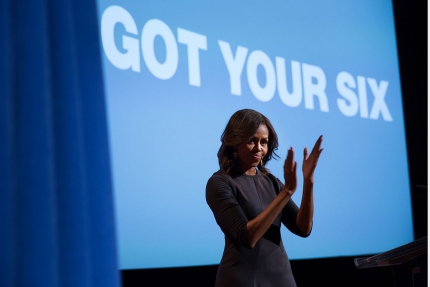
First Lady Michelle Obama Applauds at “6 Certified Campaign” Event

First Lady Michelle Obama, as part of the Joining Forces initiative, delivers remarks at an event with Got Your 6 and industry leaders in film and television to launch a new effort to expand public understanding of veterans issues, at the National Geographic headquarters in Washington, D.C. January 30, 2015. (Official White House Photo by Amanda Lucidon)

Hollywood came to Washington last week when Got Your 6 and The Company hosted the launch of the “6 Certified" campaign. During the event at National Geographic, the First Lady joined actor Bradley Cooper, producer Bruce Cohen, and others to offer remarks highlighting the role Hollywood that can play in expanding public understanding of veterans’ issues. 

The First Lady Presents the School Counselor of the Year Award

January 30, 2015 | 20:52 | Public Domain

On January 30, 2015, First Lady Michelle Obama delivered remarks at the presentation of the School Counselor of the Year Award in the East Room of the White House.

Download mp4 (770MB) | mp3 (50MB)

The White House

Office of the First Lady

Remarks by the First Lady at the Presentation of the School Counselor of the Year Award

East Room

1:42 P.M. EST

MRS. OBAMA:  Thank you guys so much.  (Applause.)  Thank you, everyone.  Welcome to the White House!  Here we are! 
 
(Child cries.)
 
MRS. OBAMA:  I know.  (Laughter.)  Let him run free, it’s the White House!  (Laughter.)  We’ve done worse in this room.  I am so thrilled to be here with all of you today. 
 
And I want to start by thanking the one and only Connie Britton for that wonderful introduction.  Yes.  (Applause.)  But more importantly, I want to thank her for bringing us Tami Taylor.  Now, Tami might be a fictional character, but she showed us the extraordinary compassion and commitment that school counselors bring to the students every day in real life, and for that we’re really grateful.  And she’s also been just a tremendous friend and advocate, and she’s very cool and funny and all that good stuff.  (Laughter.)  So we’re thrilled to have her shed some light on all of you guys.
 
I also want to thank the American School Counselor Association and its Executive Director, Richard Wong, for sponsoring the School Counselor of the Year award.  And I want to recognize our semi-finalists and finalists who are up here on stage with me today.  And I want to give a special shoutout to our School Counselor of the Year, Mr. Cory Notestine.  (Applause.)  Hey, mom.  (Laughter.) 
 
My husband and I, we’re so proud of all of you –- all of you.  And we are so excited to host the first-ever White House School Counselor of the Year Award Ceremony at the White House.  Yes!  (Applause.)  This is good.  You’re a lively bunch.  (Laughter.)  I don’t know what that says about the school counselors, but I like your spirit.  (Laughter.)
 
Now, as you all know, for decades, we’ve held the National Teacher of the Year Award Ceremony here at the White House, and we do this to send a clear message that we value our teachers.  And we do it because we believe that good teaching is the key to achieving our national goals.  It’s how we prepare our kids for good jobs and fulfilling lives.  It’s how we ensure that our workers can compete in a global marketplace.  And it’s also how we create a new generation of informed, engaged citizens and leaders. 
 
But as I started working on my Reach Higher initiative to inspire young people to complete their education beyond high school, I got to know another group of school professionals who are also critical for achieving these national goals. 
 
See, one of the very first meetings that we held about Reach Higher was with a group of school counselors.  And they told us how they’re working hard to keep kids from falling through the cracks, and how they’re supporting overwhelmed parents.  They told us how they track students down who don’t think they’re college material, or who don’t think they can afford it, and they shake them up and they tell them, you have what it takes, I believe in you, now fill out those FAFSA forms and sign up for those AP classes, get started on those college essays.  (Laughter.) 
 
And the more that I learned about our school counselors, the more I realized that often, America’s school counselors are truly the deciding factor in whether our young people attend college or not.  And in today’s global economy, higher education is essential for good jobs with good wages.  You all know that.  That is why my husband has set a goal that America will once again have the highest proportion of college graduates in the world.  That’s what we’re working for. 
 
So we know that higher education isn’t just critical for our students’ future, it’s also critical for the future of this country.  And that’s why we thought it was about time we started giving our school counselors the support and recognition they deserve.  (Applause.)  And not just with words, but with meaningful action –- with resources, programs and partners to help them do their jobs.  That’s why we issued a challenge to universities, foundations, school districts, nonprofits and others to step up.  And in the past year alone, they’ve answered our call with tens of millions of dollars of new efforts to support school counselors and the students they serve. 
 
Universities are creating college and career-readiness centers in their masters programs for school counselors.  Nonprofits are working to improve student-to-counselor ratios and to provide more professional development opportunities.  With the help of the U.S. Department of Education, over half the states in this country are giving school counselors new tools to help students fill out those FAFSA forms and college applications.  And then we finally moved the School Counselor of the Year ceremony to where it truly belongs -- right here in the White House.  (Applause.)
 
So we’re raising the bar for you guys.  And while we still have a long way to go, we’re beginning to make some real progress on this issue, and that’s due in large part to the passion and dedication of school counselors across this country -– folks like this year’s School Counselor of the Year Award recipient, Cory Notestine.  I’m going to take a few moments just to tell you a little bit about Cory.  I’m sure many of you know him, but let me give you just a taste of what’s happened in the Alamosa High School counseling department under Cory’s leadership. 
 
Over the past couple of years, Cory’s department has more than doubled the amount of financial aid that seniors receive, growing from $500,000 to more than $1.3 million in money that’s going to seniors.  (Applause.)  They’ve raised the graduation rate by targeting students most at risk for falling behind.  They’ve expanded access to college courses, and students have earned nearly 1,200 college credits in just one school year. 
 
They brought together community leaders to create the Alamosa Parent Academy to provide skills and support to parents.  They helped train student mediators to resolve school conflicts.  They created a mentoring program for underserved freshmen.  They helped start a gay-straight alliance.  And then in his ample spare time –- (laughter) -- Cory also manages to mentor interns, to serve on the board of the Colorado School Counselor Association, and –- yes -– (applause) -- and also to participate in an array of trainings and conferences throughout the year.
 
But as impressive as all these achievements are, they don’t even begin to show the impact that Cory has had during his career.  And for that, you need to hear directly from the people whose lives Cory has transformed –- his students.  And here is just a small sampling of the kind of praise that Alamosa students have for Cory. 
 
One said that Cory -- and this is a quote -- “served as a true inspiration for me in all endeavors.”  That was one of his students.  Another called Cory “a man of great integrity.”  Another said that -– and this is another quote – said, Cory “inspires me to become a better student and overall person.”
 
Now, I could do this for hours –- (laughter) –- because as -- my staff found that there were so many kids who were singing Cory’s praises that we could do this all day.  But despite all of these accomplishments and all these accolades, Cory, I have learned, is one of the most humble, unassuming, down-to-earth people that you will ever meet.  The man is so modest that in the School Counselor of the Year application video, he spends most of his time on that video talking about how wonderful his colleagues are, and he hardly mentions any of his own achievements. 
 
He does, however, allow himself a brief moment of reflection on what it means to be a school counselor.  And he says that the most important part of his job –- and this is his quote, his words –- “being able to make an impact on students’ lives and have them be successful and finally get to the place where they want to be in their lives.”
 
And I really can’t think of a better description of the mission of our school counselors, because that’s really what they, all of you, do every single day –- they help our young people get to where they want to be in their lives.  And they do it with patience and compassion, and sometimes even a little tough love.  Our school counselors convince students that they have something special, each of them, to offer, and they push those students to dig deep and fulfill every last bit of their potential. 
 
So really, every day, our school counselors help young people become the people they’re meant to be and achieve what they were put on this earth to achieve.  And that is truly an awesome responsibility –- and it’s also a tremendous privilege. 
 
So today, on behalf of myself and my husband and a grateful country, I want to just say thank you.  I want to share in Connie’s thanks -- thank you guys.  Thank you!  (Laughter and applause.)  The work you do is extraordinary.  Thank you for all that you do to support our kids and our country.  We are proud.  We’re incredibly grateful.  And we look forward to continuing our work together to support all of you in the months and years ahead.
 
So it is now my great pleasure and my great honor to introduce this year’s National School Counselor of the Year, Cory Notestine!  (Applause.)
 
END  
1:54 P.M. EST

The White House

Office of the First Lady

Remarks by the First Lady at Got Your Six Screenwriters Event - Conversation on the Power of Telling Veterans' Stories

National Geographic Society
Washington, D.C.

11:21 A.M. EST
 
MRS. OBAMA:  Good morning.  (Applause.)  Thank you all.  Thanks so much.  You all, rest yourselves.  We want you well-rested so you can get to work on this initiative.
 
I want to start by thanking Chris for that wonderful introduction, for his leadership of Got Your Six, and for his tremendous service to our country.  I also want to thank National Geographic for hosting us here today, and for highlighting the strength and courage of our men and women in uniform in their latest issue.  And I’ve got to give a big thank you to our panel from earlier today, especially Bradley Cooper, as well as my dear friend, Bruce Cohen, who has been such a tremendous ally in this effort from the very beginning.
 
And most of all, I want to thank all of you -- the writers, the content creators, and leaders from across the industry.  Thank you for taking the time out of your busy schedules to be here today.  This is very important. 
 
Every day, through the movies and TV shows and ads you all create, you have the power to shape our understanding of the world around us.  You challenge our most strongly held beliefs.  You influence our opinions on current events.  You bring ideas and perspectives into our lives that we might not be exposed to otherwise.  So the fact is, in many ways, you all are in a unique position to help us address some of the most challenging issues that we face as a nation.
 
Just take an issue like gay rights.  It wasn’t all that long ago that this was a third-rail kind of issue, not just in politics, but in entertainment as well.  It was considered sensitive, even controversial.  But in the early ‘90s, that started to change.  Tom Hanks won an Oscar for his portrayal of a gay character in “Philadelphia.”  “The Real World” included an openly gay cast member.  And over the years, there was “Ellen” and “Will and Grace,” “Milk” and “Brokeback Mountain.”   And today, “The Imitation Game” is up for Best Picture at the Oscars, and Cam and Mitchell –- two of my favorites -- are raising their daughter on “Modern Family,” one of the top-rated shows on TV.  And at the same time, we’ve seen gay rights advance in real life as well.  As my husband said, we’ve seen gay marriage go from a wedge issue into a civil right in states all across this country.
 
And that’s just one issue.  From women’s rights to interracial marriage, to combatting drunk driving –- as our nation has evolved and changed for the better, the entertainment industry has not only reflected that evolution, in many cases, Hollywood has inspired and accelerated it.  You all have told the real, honest, true stories that for too long went untold.
 
And that’s what brings us all here today.  See, there’s another great untold story in this country right now, one that is crying out for our attention -– and that is the story of our troops, veterans, and their families.  Now, as Chris mentioned, I think most folks have at least a broad idea of who those folks are.  But often, it stops there –- just a rough sketch, a superficial image.
 
As Got Your Six has found, people generally see veterans in one of two ways –- either the broken, downtrodden vet who is homeless or on drugs or has such severe PTSD that he can’t even function, or the saintly hero who lives with such courage and moral clarity that the only thing the rest of us can do is shower him with awe and amazement.  And of course, it’s always a “he.”  We sort of forget about the 1.5 million women veterans who have served in uniform.  (Applause.)
 
But these two images –- one broken, one perfect –- they’re just caricatures.  They simply don’t reflect the real, human complexity of our veterans’ lives.  They don’t reflect the real courage and struggle and sacrifice our veterans make, and all the skills they can offer.  So often we only see the emotional homecomings, but not the rest of the story.  And having had the privilege of meeting so many of our troops and veterans, I can tell you that the real stories are much more complicated –- and much more inspiring.
 
For example, take the story of Jim Zenner, who was an Army intelligence analyst during the Iraq War.  Jim is sharp, thoughtful -- but not long after he came home, his father died, and Jim says that’s when “things kind of fell apart.”  He struggled to control his emotions, got into shouting matches with his wife, and one night it got so bad he had to move out of the house.  He was suddenly homeless, with nowhere to go.
 
But Jim quickly got back on his feet.  He earned his social work degree.  He is now back with his wife and kids -- and this is the kicker -- the nonprofit that helped get Jim into housing ended up hiring him to run a veterans center in LA.  See, they didn’t see him as somehow damaged.  They saw how much of an asset he could be.  And today, he’s in charge of about 30 staffers.  He’s launched a veteran-to-veteran mentoring and training initiative.  And all together, his facility has given shelter and counseling and job training to hundreds of his fellow veterans.
 
And then there’s Trish Freeland, who served for 30 years in the Air Force, doing everything from logistics to broadcasting to career counseling.  She earned her bachelor’s and her master’s degrees along the way.  When she left the service, she went home to be with her family and struggled to find a job.  Sometimes she talked herself out of even applying for jobs if she lacked just one qualification on the posting.  Other times folks told her that she had too many skills.  And finally, more than a year after she retired from the Air Force, Trish landed a meaningful career at the Small Business Administration, and she’s putting all the skills she learned in the military to good use and she loves everything she’s doing.
 
And then there’s Melissa Meadows, whose husband sustained severe brain and nerve injuries in Afghanistan.  It was so serious that one of his doctors described him as an “advanced Alzheimer’s patient.”  So Melissa ended up leaving her job as a nurse, and today, she’s a full-time caregiver, helping her husband in and out of bed, making sure he takes all of his medications, managing his finances and offering emotional support every step of the way.  But Melissa doesn’t want sympathy.  She’s proud to be there for her husband.  She’s proud to serve her country as a military spouse.  She even helped organize a support network to help other caregivers share information and ideas -– a model that’s now being replicated at institutions around the country.
 
Now, when I think about folks like the ones I just described, I think about how easily their stories could be misrepresented.  Jim could be just the homeless vet with emotional issues; Trish, the down-on-her-luck vet that can’t find a job; Melissa, the downtrodden military wife.
 
But these men and women are nothing like those stereotypes.  They are dynamic, skilled professionals.  They’re loving sons and daughters and spouses and parents.  They’re proud of their country, and want to do their part to help make it better.  And you shouldn’t have to be First Lady to have the opportunity to see all of that.
 
So today, I’m calling on all of you and folks across the entertainment industry to change the conversation about our veterans and military families.  Give us the full story.  Show us veterans like Jim –- veterans who were born to serve and keep giving back long after they hang up their uniform.  Give us characters like Trish –- strong female veterans with skills and experience who can thrive in any kind of business or organization.  Show us the courage of people like Melissa -– spouses whose strength and passion for their family and their country can inspire us all.
 
And let’s be clear -- I’m not saying that you should tell these stories just because it’s the nice thing to do or the right thing to do.  You should do it because these are good stories, period.  They make for tremendous TV and movies that people want to see.  So these stories are good for business as well. 
 
Just look at the latest box office numbers.  The number-one movie in America right now is a complex, emotional depiction of a veteran and his family.  And I had a chance to see “American Sniper” this week on that long flight we took – (laughter) -- and while I know there have been critics, I felt that, more often than not, this film touches on many of the emotions and experiences that I’ve heard firsthand from military families over these past few years.
 
Now, I’m not going to spoil it for anyone who hasn’t seen it, but this movie reflects those wrenching stories that I’ve heard -- the complex journeys that our men and women in uniform endure.  The complicated moral decisions they are tasked with every day.  The stresses of balancing love of family with a love of country.  And the challenges of transitioning back home to their next mission in life.
 
And here’s why a movie like this is important:  see, the vast majority of Americans will never see these stories.  They will never grasp these issues on an emotional level without portrayals like this.  Like I said, I’m lucky -– I have had the   chance to visit our wounded warriors at Walter Reed, go to base after base.  I’ve been able to sit down with groups of caregivers and military spouses and hear about their struggles and their triumphs.
 
And let me tell you, those experiences have changed me.  They have changed me.  They’ve made me want to do everything I can to support our troops, veterans and their families.  But for all those folks in America who don’t have these kinds of opportunities, films and TV are often the best way we have to share those stories.
 
And here’s the thing -- you don’t have to center an entire movie or create a special episode on these issues.  These folks can just be ordinary characters in the communities you create -- a neighbor who once saw combat, a teacher whose son is deployed.   See, that’s the way we hope our country will welcome back our veterans -- not by setting them apart, but by fully integrating them into the fabric of our communities.
 
Those are the kinds of stories you can tell.  Just like the pioneers who pushed the envelope and added an interracial couple on “The Jeffersons” -– (laughter) -- or who convinced the folks at “Cheers” and “L.A. Law” to take on the issue of drunk driving -- just like all those folks, you can change the game for our newest generation of veterans and their families.  And that’s why I’m so thrilled that organizations from across the entertainment industry are coming together through Got Your Six and Six Certified to encourage writers and producers to tell our veterans’ stories.
 
But it’s not just about writing about these stories.  It’s about taking that next step and actually hiring or even casting a veteran, or bringing veterans into the writers’ room.  Because that’s how you get a real, true understanding of what it means to be an American veteran.  And this effort is really just the latest example of Hollywood answering the call to action that Jill Biden and I made back in 2011.
 
Shows ranging from “Nashville” to “Doc McStuffins” have shared the stories of our veterans in new and meaningful ways.  Disney’s “Jessie” and Nickelodeon’s “iCarly” each have military parents as recurring characters.  HBO put on that wonderful Concert for Valor on the Mall on Veterans Day.  And our Joining Forces initiative has worked with Dreamworks and iHeartRadio to create a series of powerful PSAs -– including one I did with some animated penguins.  That was new.  (Laughter.)
 
Now, I know that some of you might be thinking to yourselves, well, this all sounds great, but I don’t know anything about veterans issues so how am I going to get this done?  You might be wondering about doing our veterans a disservice by taking on something that you don’t fully understand.  And believe me, I understand that feeling -- in fact, that’s exactly how I felt when I first started working on military-family issues.
 
But what I want you to know is that you don’t have to do this on your own.  There are so many wonderful people and organizations who are ready and willing to connect you with veterans and family members who can help you tell these stories -– organizations like the Mission Continues, Team Rubicon, Blue Star Families, and so many more.
 
So with their help, any one of you can share the stories of our veterans and military families.  You can help show this country who our veterans really are.  And right now, with our combat mission over in Afghanistan and more of our veterans transitioning home, this work couldn’t be more important.  Because if we do this right, it can mean real change for how our veterans are treated in their communities.  It can mean that employers are more likely to hire a veteran or military spouse.  It can mean that teachers are reaching out to military kids in their classrooms.  It can mean that veterans are more willing to engage with their friends, families, neighbors about the challenges they face, because they know they’ll be talking to someone who maybe understands their experience just a little bit more.
 
Now, it’s not like a single episode or a movie will mean that everyone in America will immediately understand the full experience of what it’s like to wear our country’s uniform or serve in combat.  No, that’s not it.  But just like we’ve seen on other issues, bit by bit, if we can familiarize the country with who these folks truly are, if we can give folks a better picture of everything our veterans have to offer, then we can make a real difference in the lives of these folks and their families.
 
That’s what this effort is about.  It’s about making the transition home just a little easier.  It’s about serving our men and women in uniform as well as they’ve served us.  For so many years, these men and women have had our backs -- and now it’s our turn to step up for them.
 
We’ve got to join forces with them.  We’ve got to show them that we’ve truly got their six.  And I know that you all can do that.  I know that you have the talent and creativity, and, more importantly, the humanity to succeed in this mission.  And I can’t wait to see all the extraordinary stories you’re going to tell in the months and years ahead.
 
So thank you all so much for everything you do, everything you will do.  And God bless.  Take care.  (Applause.)
 
END
11:39 A.M. EST
 

West Wing Week: 1/30/15 or, “Namaste Obama”

This week, the President made history by being the first sitting President to make a second visit to India. He and the First Lady also traveled to Saudi Arabia to pay their respects to the late King. And back at home, the President convened a meeting with U.S. mayors and honored outgoing Secretary of Defense Chuck Hagel. That's January 23 to January 29 or, "Namaste Obama."

Watch on YouTube

The White House

Office of the First Lady

Op-ed by First Lady Michelle Obama on USAToday.com: Counselors build the bridge to college

The following op-ed by First Lady Michelle Obama appeared this morning on USAToday.com and across Gannett platforms.

http://www.usatoday.com/story/opinion/2015/01/30/college-funding-michelle-obama-work-counseling-high-school-column/22533683/

Counselors build the bridge to college

Growing up on the South Side of Chicago, it wasn’t exactly a forgone conclusion that I would go to college.  Neither of my parents and hardly anyone in my neighborhood had gone beyond high school, and while my folks were determined to see me and my brother Craig get a good education, they weren’t exactly sure how to make that happen.

I worked hard and got good grades, but I didn’t have much in the way of college counseling in high school.  Fortunately, Craig was a couple of years ahead of me, and he had managed to get himself into Princeton University.  So in addition to applying to one school because I liked the pictures in the brochure and to another because it was close to home, I also applied to Princeton, and my brother helped guide me through the process.  

Many young people in this country aren’t so lucky, because when it comes to college counseling in our nation’s schools, there are really two worlds.

There’s the world of high schools where the question isn’t whether students are going to college, but where.  From the first day of freshman year, students at these schools are shepherded through the process, often by school counselors who ensure they enroll in the right classes; prepare for the SAT and ACT; meet their application deadlines; and choose a school that best meets their needs and get the financial aid they need to pay for it.  That’s one world.

Then there’s the world of the schools that most of our kids attend where school counselors are too often under-valued and overstretched, and they simply don’t have what they need to do their jobs.  While the American School Counselor Association recommends no more than 250 students per counselor, the national average is one counselor for every 471 students.  And often, school counselors are burdened with all kinds of unrelated responsibilities such as proctoring exams, substitute teaching, even monitoring the lunchroom.  Many school counselors find themselves doing triage, juggling those duties while trying to help kids in crisis and also keep up with the latest college admissions deadlines and requirements.

As a result, many of our young people have little, if any, guidance on how to pursue higher education.  This is a serious loss, not just for them, but for our country.  Today, workers with a bachelor’s degree make an average of $16,000 more per year than those with just a high school diploma, and three-quarters of the fastest-growing occupations require a college degree.  The facts are very clear: if we want America to compete in the global marketplace, all of our young people will need some kind of education beyond high school, whether that’s a two-year or four-year degree or a professional certificate.

Our school counselors are the key to achieving that goal, but only if we give them the support, recognition and resources they need to do their jobs.  That’s why last year, the White House issued a challenge to universities, foundations, school districts, non-profits and others to step up – and already they have answered with tens of millions of dollars of new efforts on behalf of school counselors and the students they serve.

Non-profit organizations are working to improve student to counselor ratios.  Universities are creating college and career readiness courses in their masters degree programs for school counselors.  With the help of the U.S. Department of Education, over half the states in this country are giving school counselors new tools to help students fill out their financial aid forms and college applications.  And today, for the first time in history, we are honoring the National School Counselor of the Year with a ceremony at the White House.

This work is all driven by the simple belief that in this country, getting the education you need shouldn’t be a matter of luck, or privilege, or having a big brother who can pave the way for you like I did.  Instead, every young person who is willing to work for it should have a chance to fulfill his or her boundless promise.  That is the mission that drives America’s school counselors every day, and my husband and I and so many others are doing everything we can to support them as they support our kids and serve our country. 

Michelle Obama is First Lady of the U.S.

West Wing Week: 01/30/15 or, “Namaste Obama”

January 29, 2015 | 5:28 | Public Domain

This week, the President made history by being the first sitting President to make a second visit to India. He and the First Lady also traveled to Saudi Arabia to pay their respects to the late King. And back at home, the President convened a meeting with U.S. Mayors, and honored outgoing Secretary of Defense, Chuck Hagel. That's January 23rd to January 29th or, "Namaste Obama."

Download mp4 (178MB)