Athletes, Artists, and Astronauts: Women Mentors at the White House

As Women's History Month draws to a close, First Lady Michelle Obama brought a group of America's most accomplished women to D.C. to meet with area students. Among the attendees were WNBA star Lisa Leslie, former Olympians Michelle Kwan and Dominique Dawes, actresses Geena Davis and Hillary Swank, astronaut Ellen Ochoa, Air Force General Dana Born, and almost a dozen more leaders from the worlds of business and entertainment.

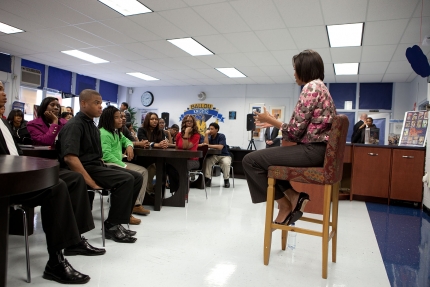
First Lady Speaks at Ballou High School

First Lady Michelle Obama shares her experiences with students at Ballou High School in Washington, D.C. Mrs. Obama encouraged them to encourage them to strive for excellence while pursuing their career goals. March 30, 2011. (Official White House Photo by Chuck Kennedy)

During the day, the First Lady paid a visit to Ballou High School in Washington, D.C., and spoke with a group of exceptional students. She reminded them that any dream is possible through a strong education and hard work:

Barack and I were not born with silver spoons in our mouths and connections and money and resources. A lot of why we’re where we are today is because we worked hard. We felt a deep passion for getting our education.  We were motivated not by making our friends proud of us, but by making our family proud of us. And with a lot of preparation, when the opportunities presented themselves, we were ready. And you all can do the same.

The White House

Office of the First Lady

Remarks by the First Lady during Remarkable Women in DC Dinner

East Room

7:22 P.M. EDT

MRS. OBAMA:  Wow.  Hi, everybody.  (Applause.)  Yes!

Please, you all, sit down.  Welcome, welcome to the White House.  Let me tell you, this -- we have a lot of staff.  You guys see them walking around, but everyone is always excited about this night.  Everybody says this is the best night at the White House.  And we do a lot of stuff at the White House, so that's pretty big.

So we’re so excited to have you here.  I’m thrilled to be here with all of these remarkable women and all of you remarkable young women from schools around the D.C. area.  I hope you guys had a good time, or are having a good time.  Everybody looks so good.  (Laughter.)  You guys look great.

I want to start by thanking a few people.  I want to think Ali, first of all, for being here, and being our emcee tonight, for that wonderful introduction.  (Applause.)  I will share this with you.  When I told my husband that -- and I just told her this -- that Ali was going to be the emcee, he was like, huh, Ali is pretty funny, but sometimes she can be a little inappropriate.  (Laughter.)  So I guaranteed her -- him that she’d be fine and I think so far so good.  There you go.  (Laughter.)  The night is not over yet, but we’ll wait until the press leaves.  (Laughter.)  But thank you so much, and thanks for spending the day with some of the kids.

I also want to recognize Secretary Sebelius, Kathleen Sebelius.  Kathleen, where are you?  Is she here?  There you are.  (Applause.)

Secretary Hilda Solis is here.  Hilda, where are you?  There you are.  There you are.  (Applause.)

And I also want to recognize and have all of the other outstanding women who are involved in this administration -- I think Valerie is here, Tina, Kristina -- stand up, you guys, so that people know who’s here from the administration, all over the place.  (Applause.)  And Jocelyn.  (Applause.)  Hey, you guys, thanks for doing this.  Everybody is getting a free meal, so they’re happy to be here.  (Laughter.)

I also want to acknowledge Abbe Raven, who’s the president and CEO of A&E Television Networks, which owns Lifetime Networks.  Abbe, where are you, Abbe?  There you are.  Here you are, right there.  (Applause.)

Lifetime is going to be launching a public service campaign and hosting events all across the country to highlight the importance of mentoring young people and particularly young women, so this is huge.  They jumped in this feet first, no hesitation, and we’re just grateful for what you’re willing to do.  Elevating this through Lifetime is going to be a terrific boost for young women all across the country, so thank you so much for being here, and thank you for your work.  (Applause.)

And of course I very much want to thank all of our mentors who are here, some pretty amazing women.  And again I’m going to ask you guys -- you guys know who’s at your table, but all of our mentors -- I see Lisa, Dominique, Judith -- everybody stand up so that people know who’s here.  Nancy is here, Michelle.  (Applause.)  Thank you, guys.

You know, if you see a lot of men hovering who work here -- everybody is trying to sneak down here and just -- even Barack was like, you need me to stop through and say a few words?  (Laughter.)  I was like, no, it’s okay, it’s okay.  (Laughter.)

But thank you all for taking the time to spend with the kids in the D.C. area.  And several of you were here before.  This isn’t -- for many, it’s the second year in a row that you’ve come to this large event.  And as I’ve told them, once you’re part of this administration, you get pulled in again and again.  So some people are probably sick of coming to the White House because we ask them to come so often.  But we’re grateful to you all, very grateful, and I hope the afternoon in the schools was good, was fun.  I know that my school was terrific -- great questions, real enthusiasm.  It was terrific.  But you guys, you young ladies here get the special treat of actually eating some food.  (Laughter.)  So, you know, we try to switch it off.  I know some schools are competing -- who got a mentor to come to their school, and who got people invited here, so we try to switch it off, so don't rub it in, all right?  (Laughter.)

But I know that this is an exciting evening, an exciting time to be here because there are so many of your heroes and role models here.  I know it’s true for me.  And I look at people and I go, I love you!  (Laughter.)

But these are women whose movies that you’ve watched, and whose songs that you sing -- Ledisi, you’ve gotten me through a many of a long road trip, thank you -- (laughter) -- and achievements that you’ve read about.  And each of these women who are here -- these mentors -- has carved out her own extraordinary path in this world.  And along the way, what I hope they share with you is that they’ve done some great things -- broken records and broken barriers and achieved success probably beyond many of their wildest dreams, right?

But all of you should know that these wonderful ladies are just as excited and maybe not -- maybe even more excited to be here with all of you tonight, as great as they are.  We all take so much pride and excitement from being able to share our stories and talk to you and look you in the face and ask you questions and give you advice.  So we’re excited, too, right?  (Applause.)  We’re very excited.  (Applause.)

We’re excited to get to know you.  We want to hear about your hopes.  We want to hear about your wildest dreams.  And that’s because so many of us see ourselves in you.  And I say this -- I was in El Salvador, and I said the same thing to young people there, because it’s true.  When we are with young people, we see ourselves in you because it wasn’t so long ago that all of us women were sitting right where you are tonight.  Not in the White House.  Probably none of us got to -- (laughter) -- I know I never -- I didn’t -- until I lived here, I didn’t get invited, I wasn’t here.  (Laughter.)  But we were in the position that you all are in.  We were once teenagers just like you, filled with our own aspirations and our own ambitions, but also filled with our own anxieties, and our own fears, and our own doubts.  So we know what you’re going through.  My daughters don't believe that, but I do, I get it.  (Laughter.)  That's why I know when they’re not telling the truth.  I try to tell them I’ve been there.  I tried to tell that lie before.  Don't do it.  (Laughter.)

These women here, all of us, we weren’t born knowing the things that we know.  We weren’t born with silver spoons in our mouths.  Many of us, we weren’t born knowing how to play a concerto, or how to blast off to space -- you know, that's not stuff you just wake up knowing -- or how to run a major television network, or how to be an Air Force General.  I know you didn’t know that.  (Laughter.)  Or how to be a Cabinet Secretary.  We didn’t know any of that.  And none of us here were handed anything.  No one just handed Dominique her medals.  No one just handed out a MacArthur Genius Award or an Oscar or a Grammy.  All of these women have earned every single honor that they have.  And they fought for many of the opportunities that they’ve experienced.

And I know that it’s easy to lose sight of that fact once you’ve seen somebody succeed, right?  Once you see somebody on TV, it looks like it’s easy, right?   But the truth is that we only really know many of these women after they have become famous, once they were on the news, and their names were in lights, and they had these wonderful fancy titles.

But what you don’t always see is what it took for many of us, many of these women to get where they are today.  You don’t always see the thousands of hours that were spent studying, or practicing, or rehearsing, the years spent working for that promotion, the hammers used to break glass ceilings, the time spent going to audition after audition, lying awake at night doubting and worrying about whether you can do it and whether you can handle it once you do it.

The truth is, is that every single one of these remarkable women have had times in their lives where they’ve struggled.  We’ve all struggled.  They’ve had times when they felt overwhelmed, when they felt like they weren’t good enough, when they thought about giving up on their own dreams.

Dominique, I know, in the days leading up to the first national championship competition, she was doubting.  She talked about that time as being a time where she was losing her focus.  And as she put it -- and this is her quote, she said: “I couldn’t stay on the balance beam to save my life.  My consistency and confidence were failing.”  See, I never knew that.  You looked good.

DOMINIQUE:  I faked it.  I faked it.

MRS. OBAMA:  Good faking.  (Laughter.)  We all fake it.  (Laughter.)

And Nancy Brinker, you know, in 1980, as her sister, Susan G. Komen, was losing her life to breast cancer, and she made the promise that she’d do everything she could to find a cure, she faced some doubts and setbacks.  Back then, newspapers were reluctant to even print the words “breast cancer.”  And Nancy started her fundraising efforts with nothing more than $200, and a list of names, and a broken typewriter.  You were using a typewriter back then.  (Laughter.)  No computers.  A group of friends who were willing to help.

And as I mentioned, Ledisi recorded her Lost & Found album, one of my favorites, I will say, but she was struggling during that time.  A lot of folks were telling her that she didn’t have the right look to be a star, right?  They were saying that she needed to straighten her hair.  Glad you didn’t do it.  (Laughter.)  They were telling her that she needed to be thinner, that she needed to look different.  And she began to think about quitting her singing career altogether.

And there are stories like these at every single table.  But she didn’t give up.  Dominique, Nancy, none of us gave up.  Instead, we just dug a little deeper.  We pushed ourselves a little harder.

I told the students that I met with today at Ballou School the minute somebody questioned me, I took that as a challenge to prove them wrong.  I was like, great, you can’t -- don't think I can do it?  I’m going to show you that I can.  It was a challenge.

We all found the courage to believe in all that we had to offer.  And what happened?

Well, Dominique went on not just to win that national championship; she went on to win more National Championship medals than any other athlete since 1963.  Did you know that?  (Applause.)

And Nancy didn’t just surpass that initial $200 goal.  She went on to raise $1.5 billion, funding all kinds of cancer research, and saving countless lives.  (Applause.)

And then Ledisi, well, she didn’t just record a good album, she recorded a great one.  Her Lost & Found album earned her nominations for best R&B album and best new artist.  And earlier this month, she performed right here in this room at our Motown Fest, and she’ll be performing again tonight, yay, for us.  (Laughter and applause.)  Back then, as she was about to start singing, she thought to herself –- and these are your words, she said, “I never gave up on what I wanted to be.  There were times when I wanted to, but I am so happy I didn’t.  I didn’t give up on what I wanted to be, and here I am at the White House.”

And one more embarrassing thing.  (Laughter.)  Ledisi, I understand that your birthday was Monday.  So let’s say happy birthday to Ledisi.  Happy Birthday!  (Applause.)

Any other birthdays we’re missing?  (Laughter.)  Oh, we got a birthday -- happy birthday, sweetie.  (Laughter.)

But in the end, Ledisi, Dominique, Nancy, and all of the other remarkable women in this room found their passion and they found their mission.  They found what they were put on this Earth to do, and they realized that it didn’t matter whether they got rich or famous doing it, whether they won any kind of award for it.  What mattered was that they were doing what they loved doing.  And that's key to you, young women.  You want to be good at stuff, but you’re good at stuff that you care about and you love.  So think about that as you move forward.  What mattered was that they were true to what was inside of them.

And their stories were possible because along the way, all of them –- every last one of them -– had someone in their lives who took the time to encourage them and to inspire them.  None of us are here on our own -- someone who told them that they’re special, that they’re talented, that they have a place in this world and a whole lot to offer.

Now, for me, that was my parents.  That was my mother.  She’s upstairs right now looking after Malia and Sasha.  My parents did not have a whole lot of money.  My parents didn’t get to finish college themselves.  But they were determined to see that me and my brother, that we got an outstanding education.  And practically from the minute we were born, they had one simple message for us, and they drilled it in, and that was you can do it; that you are as smart as anyone, that you are just as capable, that you are worthy.  That was what I heard my entire life.

So whenever anyone doubted me, as I told you, I took that as a challenge.  And there are always people out there ready to doubt you.  They doubt you even today.  It doesn’t end once you arrive.  And the remarkable women at your table will tell you that.  They’re out there forever.  The question is how do you react to those doubters.  Do you turn that doubt into power of your own?   And that's what everybody in this room has done, and that's what we expect you all to do.

Faith and love and hard work, those are the things that got us all through.  And that's really all you need.  You don't need money.  You don't need connections.  You just need to work really hard and push yourselves and push beyond your fear, because fear is all a part of it.  We have all felt fear.  We’ve all felt doubt.  But the question is, do you let that stop you, or do you keep pushing through?

So tonight is a special night for you all to learn from these women around you.  And as Ali pointed out, I want to urge you to take advantage of this time.  Don't be shy tonight.  Everybody here wants to be here, and they want to hear from you.  They want you to ask questions.  So don't hold back.  Find out as much as you can from these women.  Exchange numbers and cards.  Don't ever be hesitant.  These opportunities don't come along often.  This may be your last time at the White House, but you might be here running it some day.  So use this time with these women and take full advantage.  We’re very proud of all of you.  Just know that.

And the one thing we ask of you when you’re done here is -- and Ali mentioned this -- is that you now owe someone else.  Your job here is to reach back and pull somebody else up.  That's the price of admission tonight.  It is never too soon for you all to start mentoring.  All of you have younger girls in your lives, whether they’re sisters, or brothers, or cousins.  There are younger people in your lives who are looking up to you.  You are today a role model.  So start figuring out your plan for reaching back.

What are you going to do to make sure that someone else is following along in the path, even if that means sharing what you learned here with girls at your school who didn’t get to come.  Maybe it’s figuring out a way to turn the conversations here into something bigger at your own school, maybe in your own communities, right, because one day you will be in a place like this, and it is only worth it if you’re giving back, just like all of these women have done and will continue to do.

These folks aren’t new to mentoring, and that's one of the reasons why they’re a success, because they’re reaching back all the time.  And that's what we expect of you.  All right?

So with that, we can eat.  All right?  You all, thank you so much.  (Applause.)

END
7:42 P.M. EDT
Spring 2011 Kitchen Garden Planting

March 30, 2011 | 1:27 | Public Domain

First Lady Michelle Obama, along with DC-area children, plant the White House Kitchen Garden. The garden includes spinach, peas, lettuce, broccoli, blueberries, raspberries and other vegetables and herbs.

Download mp4 (16.7MB)

The White House

Office of the First Lady

Remarks by the First Lady during Ballou High School Visit

Ballou High School Visit, Washington, D.C.

1:57 P.M. EDT
 
     MRS. OBAMA:  Well, it was -- Principal Branch, it was important to tell that story, because another one of the reasons why I like to come out to schools is because I want the nation to see all that you all have to accomplish.  And a lot of times when I show up, other people will follow.  So I’ve heard a lot of good things about this school, about the students in this room, in this building, and I’m honored to be here.
    
One of the reasons why we do this is that when my husband was elected and we got into the White House, every First Lady can have a set of agendas.  And I have a few, but one of the things that I wanted to do with this office is to open up the White House primarily to kids in this community to make sure that everyone in this country and everyone in this district understood that the White House was their house.
 
     And sometimes you do that by inviting people in, but a lot of times you do that by stepping out and going into other people’s community.  And mentoring is also an important part of my agenda, because it was an important part of my life.  I wouldn’t be here today, and neither would my husband, if we didn’t have people in our lives who stepped off of their track to enter our lives and our worlds and help us figure out the path for getting where we needed to be.
    
And our view is that we have an obligation to give that back; you know, the further you go, the further you have to reach back and make sure you’re pulling other people along the way.  So I’ve been spending a lot of time investing in mentoring and trying to get other famous and wonderful people to do the same thing.
    
So today, we’ve got a group of women, because it is the end of Women’s History Month, who’ve come from all over the country who are going out to schools just like yours.  And I am fortunate enough to be here.  But we’ve got people like Lisa Leslie and Dominique Dawes and Geena Davis and India Arie and Ledisi and, you know, the head of Lifetime and the head of the folks who make Sesame Street.  We’ve got a general.  We’ve got an astronaut.  We’ve got, you know, people of all walks of life who’ve flown here to D.C. just to be a part of this day and to spend some time with you all, because they think, number one, you all are just that important, and they feel that same obligation that I do to try and be some point of connection for you all.
    
Another reason I like to do this is because when I listen to Principal Branch about the struggles and the journey you have to take just to get to school every day, it reminds me of me.  I went to a public magnet high school on the South Side of Chicago that was an hour and a half away from my house, because the schools around my neighborhood weren’t preparing kids for college.
    
So I would get up, get on the bus at 6:30 in the morning every morning and ride the bus all the way to the other side of town just to get an education.  So I know what it feels like to struggle to get the education that you need.  In so many ways, I see myself in you all.  And I want you to see yourselves in me, so that you’re not looking at me just as the First Lady of the United States.
    
But I grew up on the South Side of Chicago and my parents were working-class folks.  I had two of them.  I was fortunate enough to have two parents.  But my parents didn’t have a lot of money, and I went to public schools my entire career.  So there’s not too much of a difference between how I was raised and how many of you all are raised.
    
But I’m here, and the point is, is that you can be here, too.  And I say this a lot, there is no magic to being here.  You know, Barack and I were not born with silver spoons in our mouths and connections and money and resources.  A lot of why we’re where we are today is because we worked hard.  We felt a deep passion for getting our education.  We were motivated not by making our friends proud of us, but by making our family proud of us.
     And with a lot of preparation, when the opportunities presented themselves, we were ready.  And you all can do the same.
 
So that’s why I’m here.  But I’m also here so you all can ask some questions.  It’s not every day you get to talk to the First Lady of the United States, right?  I mean, I’m assuming.  (Laughter.)  You got good people that come, but I haven’t been here yet.
    
So now, I want to spend some time -- the press will stay for a short period of time, because I know that sometimes you like being in front of the press.  Sometimes, it’s easier when they’re gone.  But we’re going to take a couple of questions to start out with.  Then, we’ll let them leave.  And then, we’ll keep talking.  So you can ask anything you want, as long as it’s PG.  (Laughter.)
    
Q    Hi, Mrs. Obama.  My name is Ryan Hayes (ph).  And I was wondering if it’s possible that we can have a national anti-bullying campaign to go along with your child nutrition program?
    
MRS. OBAMA:  That’s a good question.  We just hosted, the President and I, a national conversation at the White House about bullying.  So there are a number of efforts that we’re supporting to bring to light this issue and the challenges that young people are facing in schools today.
    
So I think it’s important that we have a national conversation.  But a lot of the work that needs to happen around the question of bullying needs to happen on the ground.  It’s got to happen with parents and principals and communities and with kids, all of you all, taking some responsibility for either stepping up or staying out of that fray.
    
You know, there’s a lot of things that the President can do.  But, you know, affecting behavior on the ground, a lot of times it has to come from the community.  So I think the important thing is for people to raise awareness about the issue.  We’re trying to do our part in encouraging all of you to have conversations in your schools, in your homes and communities to sort of figure out what’s going on. What’s going on with kids today?  What are the things that are leading kids to bully?  What keeps kids from being able to stand up for themselves?  I mean, those are questions I have for all of you, because generationally, you know, you wonder if the question is, is it this generation?  Is this something that’s not new?  Has it changed?
    
And those are questions that I’m curious about.  So that’s why these conversations are really important.  Thanks for the question.
    
Q    Hi, I’m Rebecca Bib (ph).  I’m not a teenage mom, but what would you say to a teenage mom who still wants to go to college?
    
MRS. OBAMA:  I would say, good for you.  (Laughter.)  I mean, not to be funny.  But no, I would say, excellent.  But I would probably tell a teenage mother the same thing I would tell any young person who’s thinking about college.  And I would say, think about what you want to get out of college and think about it thoroughly.  Think about the cost.  Think about how you’re going to afford it.  Think about, you know, what kind of loans you’ll have to take out to go.  Think about the job market on the other end.  Where are the jobs in this economy, and what kind of training and education do you need to get them?
    
So, you know, I want young people to end their educational career with success on the other side.  And I would urge young people to think about how they define that success, right?  And it’s unfortunate that young people have to think about that so early in their lives.  I mean, when I was going to school it was a given that you’d go to college, whether you took out -- and I took out a lot of loan debt to go to college, because I went to a very expensive private school.  My parents didn’t have money.  So what you did was you took out loans.
    
But when I was going to school and you came out on the other end, there was probably a job waiting that could help defray the cost of those loans.  When I went to law school, it was the same thing.
    
Now, I would urge people to know what that job is and to think about that in addition to thinking about getting an education.
 
So I think young people nowadays have to really think about the plan.  You know, I’d urge you all to think about what are the jobs out there, what are you good at, where are your passions, and then work from there.
    
And also, the truth is, is that it’s going to change.  So you may not know.  And you may decide it’s worth the investment for me to go to a four-year college or go to a community college, because I need that baseline education and I’m going to incur that debt because in the end it’s going to prepare me for something bigger and better.  And if you know that and you’re going into it thoughtfully, go for it.  College is no joke because it is so expensive.  But it is necessary in so many ways to prepare yourselves for the jobs for the future.
    
But the first thing is to get this right, to be focused in high school, so that when you leave here, the choices are yours, right?  I mean, you don’t want to be opted out of college because you fooled around as a freshman and as a sophomore, right, because you were a knucklehead as a junior and a senior, that you weren’t thinking about anything at all.  You don’t want those doors to be closed to you, because you weren’t ready, right?
    
So what that means is that you all have to do is focus on how to prepare yourselves.  You remember what I said?  Barack and I didn’t -- there was no magic dust sprinkled on us.  But we were ready, right?  And ready meant we came to school every day, right?  We were on time.  We didn’t cause trouble.  We didn’t get into trouble.  We learned to read and write well.  We were ready, you know?
    
We had good relationships with our teachers.  We got involved in outside activities.  So then when it was time to apply to college, those options were ours to either choose or not, right?  But it wasn’t because we weren’t ready and didn’t take the courses and, then, senior year you come to find out you needed four years of English and two years of a language and now you can’t go because you weren’t thinking like that, right?  You want to be prepared for the opportunities so that these choices are yours.  And you want to think about who you want to be and how you want to structure that, so that you have a plan.
    
Look, our daughter who is 12 is thinking about this stuff now.  And she is a little interesting, right?  I mean, we weren’t thinking about this stuff at 12.  But she is thinking about it at 12.  And it’s important for you all to know that there are kids out there that are being trained to think about this stuff at 12, right?  At 12 years old, they’re thinking, okay, what courses do I need to take, and how do you get into the best schools and what are they looking for, and what do I have to do now to get myself ready?
    
You don’t want to be in 12th grade thinking about that stuff.  You want to think about it now, because the rest of the country and the world, the kids who are going to get these opportunities are preparing themselves every single day.  So you don’t want to wake up one day and start trying to get it together.  Get it together now.  And that’s what I would tell a teen mom.  And that’s what I would tell any young person thinking about college.
    
Does that make sense?  Anything that doesn’t make sense, just let me know and I’ll try and clarify.  Next?  What else?
    
PRINCIPAL BRANCH:  Okay, so we’re going to take just a quick break so that the media and such can excuse themselves.  And then, it’s going to be your time specifically with the First Lady.  So we’ll just pause for that.
    
MRS. OBAMA:  Bye, press.

END
2:09 P.M. EDT

West Wing Week: "OCONUS II: Mamalluca"

Welcome to the West Wing Week, your guide to everything that's happening at 1600 Pennsylvania Avenue. This week, President Obama remained focused on Libya, receiving secure communications from his national security team as the first family visited Latin America. The President made stops in Brazil, Chile, and El Salvador to promote American exports and economic cooperation among the neighbors in our hemisphere.

Find out more about the topics covered in this West Wing Week:

Friday, March 18th, 2011

Monday, March 21, 2011

Tuesday, March 22, 2011

Arun Chaudhary is the official White House videographer

West Wing Week: "OCONUS II: Mamalluca"

March 24, 2011 | 8:46 | Public Domain

This week, President Obama remained focused on Libya, receiving secure communications from his national security team as the first family visited Latin America. The President made stops in Brazil, Chile, and El Salvador to promote American exports and economic cooperation among the neighbors in our hemisphere.

Download mp4 (274MB)

The White House

Office of the First Lady

Remarks by the First Lady during Superate Health Clinic Tour

Superate Health Clinic, San Salvador, El Salvador

4:30 P.M. San Salvador Time

      MRS. OBAMA:  Thank you.  You guys, you know, I can’t thank you enough for spending this -- letting us spend this time with you.  You all were --

      STUDENTS:  Thank you!

      MRS. OBAMA:  I mean, we are so proud of you.  I mean, truly.  And I was just telling these guys that you all remind me of me and my brother because we benefited from programs like these for gifted students.  And as a result of it he went to Princeton and I went on to Harvard.  So I expect the same thing -- and I don't even speak another language.  (Laughter.)  You all are well ahead of the game. So keep it up.  And the fact that you’re giving back already -- that you’re tutoring younger people, that you’re helping your families --

      STUDENTS:  Yes.

      MRS. OBAMA:  The goal is to keep doing that because when you get in this position, that's the only way we continue.  We pull, we bring people up along the way.  So as you get higher and higher, you’re always reaching back, always giving back.  And you all are starting it off really well.
     
      And thank you for being so kind to my mom and to my girls.  (Laughter.)

      STUDENTS:  Thank you for coming.

                  END         4:31 P.M. San Salvador Time

The White House

Office of the First Lady

Remarks by the First Lady to Renca School

Renca School, Santiago, Chile

      2:45 P.M. Santiago Time

      MRS. OBAMA:  Thank you.  Hola.  Hello, everybody.  Es un placer estar aquí con ustedes.  (Applause.)  Gracias.  (Applause.)

      Before I begin today, I just want to say that our thoughts and prayers continue to be with the people of Japan as they begin to rebuild after the devastating earthquake and tsunami over a week ago.

      Here in Chile, you know the kind of damage these disasters can cause.  You’ve experienced it many times yourselves.  You know how difficult a time this is for so many families.  And so my heart goes out to all those in Japan, here in Chile, in the United States and around the world for those who have lost loved ones.

      But even with everything that’s going on in the world, it is a pleasure and an honor to be in this beautiful country, at this wonderful school, with all of you.

      I want to start by thanking Camila for that very, very kind introduction.

      We are honored today to be joined by the First Lady of Chile, Cecilia Morel.

      I also want to recognize the Minister of Education, Joaquin Lavín, and the mayor here, Vicky Barahona, and your principal, Palmira Cosgrove.

      And my husband and I, we are so grateful to everyone who has made us feel so welcome here.

      I’m especially excited to be here at the Condor Summit Bicentennial School, because I know how special this place is.  I know that this is the very first bicentennial high school of academic excellence in the country.  It is a place where students like all of you can learn from the best teachers, where you can use the latest technology, where you can develop the skills you need to reach your potential.  And I know that as the first graduating class, you all are breaking down barriers.  You represent the future, not just of this school, but of your entire country.

      So I’m here because I want to see all the amazing things that you’re doing.  And I want to see the progress that you’re making.  

      But there is another reason why I love to visit schools like this and to talk with students like all of you when I travel.  And that is because I see a little bit of myself in all of you.

      You see, it wasn’t so long ago that my husband and I were young people just like all of you, dreaming the same dreams, facing the same challenges that all of you are.

      I grew up in a working-class neighborhood in the city of Chicago.  Chicago is the third largest city in America, and about half the size of Santiago.  My father worked in the boiler room of a water treatment plant.  And for most of my childhood, my mother stayed home to take care of my brother and me.  

      Our family did not have a lot of money.  We did not live in a fancy neighborhood.  We lived in a teeny, little apartment on the second floor of my great-aunt and uncle’s home, and my brother and I, we shared a bedroom for as long as I can remember.

      But even though we didn’t have much, we always had a roof over our heads, we always had food in our stomachs.  We had a strong family.  Our house was filled with warmth and laughter and a lot of love.

      My parents were hard workers who made great sacrifices to give my brother and me the opportunities they never had. See, that was their dream -- to give us a better life and more opportunities than they could have ever imagined.  And in our family, that meant one thing: getting a good education.  Growing up, there was never any question in my parents’ minds that we would go to college.

      My parents and grandparents were some of the smartest people I have ever known, but they never had the chance to complete college themselves.  That’s why they were so determined to give me and my brother that chance.  And they always told us that even if we weren’t rich, we were just as smart, we were just as capable as anyone else.

      And more than anything, that was my parents’ greatest gift to us.  They taught us that if we dreamed big enough, and if we worked hard enough, anything was possible.

      And in my country, we call that the American Dream.  And I think that’s also true right here in Chile.  It’s the belief that whether you live in a little apartment in Chicago, or right here in Renca, none of us has to be limited by our circumstances.

      And that dream has guided my life, and I hope it will guide each of you as you leave this school and start building your own lives.

      Now, I’m not saying that the road ahead will be easy.  Some of you may come from families just like mine, where you’re the first one to go to a school like this, or the first one to go to college.  So maybe you’ve heard people doubting whether you’ve got what it takes to succeed.

      Maybe if you’re a girl, maybe you’re hearing people say that you can’t compete with the boys; that you can’t do well in school and build a career for yourself.  Maybe those voices come from inside your own head sometimes -- voices telling you that it’s too hard, or that the odds are stacked too high against you.

      And believe me, I know that feeling.  I do.  When I was in high school, I watched my older brother apply and get into Princeton University, one of the most prestigious universities in the country.  He was the first one in my immediate family to go to a college like that, but he also played basketball there.

      Yet when it was my turn to apply to college, and I dreamed of joining my brother at Princeton, there were people who told me that I would never be accepted, and that if I did get in, I wouldn’t be able to keep up with the kids who were wealthier or who’d gone to better high schools than I did.

      And soon, I started to doubt myself.  I started to wonder whether those people might be right.  But then I thought, well, I know I’m smarter than my brother.  So I worked harder.  I was more determined.  I was more focused.  I used those voices of doubt as a source of motivation for me.

      And you know what, I graduated from Princeton with departmental honors in sociology.  I went to law school.  I built a career and I raised a family.  I was able to accomplish all of this because I listened to the people who cared about me rather than those trying to cut me down.  I listened to people who believed in me, and told me I could do anything I set my mind to.

      And that’s what each of you is doing every day at this school.  You’re proving the voices of doubt wrong.  You’re proving that it doesn’t matter what anyone else thinks about you.  The only thing that matters is what you think about yourself and what you’re willing to do to achieve your goals.

      And that’s why I was so proud to hear that when this school first opened, so many of you came two weeks early so that you could prepare yourselves to succeed at this school.

      And I’m sure there were a lot of things you would have rather been doing those last precious days before school started.  But you came anyway and you studied hard because, as Mayor Barahona said, and this was her quote: “Big dreams also require big efforts.”

      Big dreams also require big efforts.  And that’s a lesson I learned a long time ago, and one that many of you have learned at this school, because the truth is, building a better life for yourself is never easy.  No one achieves success overnight.

      Pablo Neruda wasn’t born knowing how to write beautiful poetry.  His father worked for the railroad, and disapproved of his interest in writing and literature.  But when Pablo was a teenager, he met the principal of a local girls school, who gave him books to read and she encouraged him to become a poet.  And he went on to win the Nobel Prize.

      Marcelo Salas didn’t start out as the best football player in Chile.  He grew up in Temuco.  And every day, he would get up two hours earlier than his friends to go outside and practice his free kicks by himself.  Years later, those skills would help him lead Chile in the World Cup.

      My husband hasn’t always been the President of the United States.  He was raised by a single mother, with the help from his grandparents.  And they often struggled to make ends meet.  And he was not always the best student.  But his mother was determined to send him to college, so she woke him up early every morning to practice math problems before she went to work.  And it is that determination that helped him become the man he is today.

      So the truth is that anything worth having takes time, it takes effort, it takes determination.  So for all of you here today, the question is, what does that mean for you?  Well, it means paying attention in class every day.  It means listening to your teachers.  It means doing every assignment, and always, always doing your very best.  It means taking some risks, it means trying something new, it means trying something hard, not being afraid to make mistakes.  And it means asking questions when you don’t understand something, because that’s really how you learn.

      As the great poet Gabriela Mistral once wrote, and these are her words:  How sad the world would be if all was already done.  If there was no rosebush to plant, no enterprise to undertake.  Do not limit yourselves to easy tasks.

      And then, after you’ve done all that, after you’ve asked all those questions, after you’ve taken control of your own destiny and pulled yourselves up, then I want you all to look back and to pull someone else along after you.

      Once you’ve succeeded, I want you to help someone else succeed -- maybe that’s a brother, or a sister, maybe it’s a neighbor, maybe it’s a classmate -- because none of us can fulfill our dreams on our own.  For those of us fortunate enough to reach our goals, it is our obligation to help someone else do the same, and it is never too early to start helping others.

      So I know the journey ahead may not be easy.  And I know that many of you may be worried about what the future holds and whether you’ll be able to succeed here at this school and then in college.

      But I also know something else.  I know you can do it.  I believe in you.  My husband believes in you.  And we’re not alone.  Your country believes in you.  That’s why the hillside says “Renca La Lleva.”  (Laughter.)  “Renca Rocks.”  (Applause.)  And that’s why this school was built.

      President Piñera said, “It is in the classroom where we’re going to determine our success or our failure as a country.”  And he’s right.  Pretty soon, the world will be looking to all of you to make the discoveries and to build the businesses and to heal the divisions that will shape Chile and the world for decades to come.

      Your teachers believe in you.  I understand that here at the Condor Summit Bicentennial School, every grade is named after one of Chile’s highest mountain peaks.  Is that right?  And that is no accident because it symbolizes the heights your teachers know you can reach if you put your mind to it.  I understand one of your teachers said, and this is a quote, “I want [my students] to understand that our present is the consequence of the past, but that a better future is in their hands.”

      And then there are your parents, and the many other people who love and care about you.  They believe in you too.  That’s why so many of them have sacrificed so much, helping you get to school in the morning, making sure you do your homework at night, and doing everything they can to give you a chance at a brighter future.

      President Piñera, your teachers, your parents, my husband and I, all of us, we believe in you.  So the only thing left is for you to believe in yourself.

      And I know that Valeria Castro, she believes in herself.  I understand that Valeria is from Lo Prado, and she gets up at 5:30 every morning to come to this school.  But she doesn’t complain, because she wants to be a nurse.  You see, Valeria has cared for her sick grandfather for years, I understand.  And when she heard there was a new school being built here in Renca, she registered for the admissions test and she passed with flying colors, because she knows what it’s like to need help, and she wants to make a difference.

      And then there’s Daniel Olave.  He knows that feeling, too, I understand.  He lives in El Bosque, which is an hour and a half away from here.  Daniel’s older brother lost his life in an act of violence.  And after grieving with his family, he vowed that he would never let a tragedy like that happen to anyone else.  So he became a fireman.  And sometimes that means he goes a full night without sleep because he’s on the streets responding to emergencies.  But he doesn’t mind.  And he’s here at this school today so he can one day become a paramedic, and save lives every day.

      And then there’s Jonathan Navarrete.  When Jonathan was growing up, his parents told him that they could no longer afford his school expenses.  But rather than dropping out, Jonathan followed the advice of his history teacher and moved to Santiago, to a new city and unfamiliar city, and he lived with a relative so he could continue his education.  No one in his family finished school, but he hopes to be the first one to graduate from college.  And here in Renca, Jonathan is one step closer to making that dream a reality.

      So these are the kind of stories that inspire me.  You all are the kind of young people who make me believe that our future is in good hands.  And even though the road ahead won’t always be easy, I hope that you will never give up.

      I hope that you will never forget just how many people have sacrificed for you and believe in you and want to see you succeed.

      I hope that you know, deep in your hearts, that you have everything it takes to succeed, you have the intelligence, you have the passion, you have the courage, you have determination, everything you need to fulfill every last one of your dreams.

      So I hope that you all keep pushing, not just yourselves but you keep pushing one another.  I hope that you’ll continue to work as a community, that you support each other, that you encourage each other, that you help one another as you move up.

      And on those days that will come that you wonder whether the effort is worth it, on those days when those voices of doubt start creeping back into your head, I just want you to think of my story, I want you to think of my husband’s story, and the story of so many others who have succeeded in the face of seemingly impossible odds, and know that “Yes You Can,” “Si Tu Puedes.”

      And if you do that, I can’t wait to see all the good that all of you will do for your country and for our world in the months and years ahead.

      Gracias.  Thank you so much.  God bless you.  (Applause.)

                     END      3:04 P.M. Santiago Time

The White House

Office of the First Lady

Remarks by the First Lady at Brazilian Youth Cultural Event

Oca da Tribo Restaurant
Brasilia, Brazil

11:40 A.M. Brazil Time
 
MRS. OBAMA:  Well, thank you.  Very good.  (Laughter.) 
 
Well, hello, everybody.  Bom Dia.  (Laughter.)  Is that it?  (Applause.)  That's all I have, unfortunately.  (Laughter.)
 
But thank you so much for the warm welcome.  And I want to thank Racquel for that wonderful introduction.  I mean, she is just a point of pride for young people, for this country, for the world.  Let’s give her another round of applause.  (Applause.)
 
I also want to thank and recognize Tania Cooper Patriota, who is here with us, as well as Guisela Shannon for being here today and for serving as our MC. 
 
I’m not going to talk long because I want to see all that you have to offer, and I want my girls, my family, my mom and the girls’ godmother to see all that this country has to offer.  
 
But President Obama and I, we are honored to be here in Brazil and to re-affirm the friendship and the partnership between our two nations.  And we’re especially thrilled to have our family with us.  It is a very rare opportunity that we get to travel together.  Usually when the President and I travel, these two are in school -- where they need to be.  (Laughter.)  But they’re on break now, so they get to come, and they’ve been very excited.  So it’s a real honor and a privilege for us to have them and for you all to welcome them. 
 
Over the last couple of years, my husband and I have been fortunate enough to travel all around the world and to meet some pretty amazing people along the way.  And wherever we go, one of our favorite things to do is to visit with young people like all of you.  Both of us make it a point to put that in our busy schedules. 
 
The United States and Brazil are two of the largest economies and two of the largest democracies in the Western Hemisphere.  But we have always believed that the future of both our nations depends on more than just relationships between presidents and prime ministers.  It depends on relationships between our people, and especially between our young people.
 
That’s where communication is really going to happen.  It’s going to happen with all of you.  And that's why I’ve always believed that it’s important for young people everywhere to build those friendships around the world, to learn different languages.  Don't be like me and not know -- I only know “butterfly” in one language -- (laughter) -- and that's it.  So Malia and Sasha, you got to learn “butterfly” in at least 20 languages, okay?  (Laughter.)  But to learn different languages and to experience what the world has to offer, it is so important to get out of your comfort zone and travel the world.
 
And that’s what I’ve encouraged young people in America to do, as often as I can.  That’s why I talk to them about thinking about studying abroad, taking opportunities to travel wherever they can.  And not everyone in the United States can afford to do it, but I push them to think about seeing themselves as citizens of the world.
 
And that's why I’m pleased that so many of you here today have participated in exchange programs with the United States, and even more of you are thinking about doing that in the future.  And I hope you do.
 
Last year at the White House I had the opportunity to welcome a group of your peers who were participating in the U.S. State Department’s Youth Ambassadors Program.  And I know some of you guys are here.  I remember faces, not every name, but I definitely remember we had a good conversation.  You all were bright and not shy, which was good.  No one was shy.  And it was just wonderful to have them in the White House, sharing stories and just sharing their ideas.  It was really a wonderful gift for me to have you there.
 
So they came to my neighborhood, and I promised that I was going to come to your neighborhood.  And I’m here, as I promised.  I’m here in your neighborhood.  (Laughter.) 
 
So this is also a special visit for me because it wasn’t so long ago that I was sitting where you all were -- not here, but somewhere in my life like you, I was young once, long time ago.  (Laughter.) 
 
Like many of you, growing up, my family wasn’t rich.  My parents are some of the smartest people I know, but they didn’t get to finish college.  They didn’t get the opportunities that I had.  We didn’t have a lot of money.  We lived in a little bitty apartment.  Sometimes it’s amazing how small that apartment was.  My brother and I shared a room.
 
But what we had was a lot of love.  We were always surrounded, my brother and I, by people who loved us deeply, who made us laugh, and who always reminded us just how smart and how special we were. 
 
And they taught us that the most important thing was an education.  So I knew I had to work hard.  I knew I had to study and I had to stay focused, just like so many of you are, in order to reach my dreams.  There was nothing that guaranteed in my life that I would be the First Lady of the United States of America or that I would be here talking to you all today.
 
I made my share of mistakes along the way, but when I did I always picked myself up and I dusted myself off and I moved forward. 
 
And President Obama’s life story is very similar to so many of yours and mine.  He did not grow up with a lot of wealth.  He wasn’t the best student.  He’s smart now, but it took him a while to get there.  (Laughter.) 
 
But I learned a long time ago that it doesn’t matter who you are or where you come from, as long as you’re willing to dream big, gigantic dreams and really work hard to reach them, and also to take some risk along the way.  And if you do that, the important thing for you to know is that anything is possible.
 
I want you all to look at me and see that anything is possible.  That's why I’m here.  That's why I’ve come to talk to you all, because there is no reason why you can’t be here.  No reason at all.
 
So I hope that you all will keep pushing yourselves.  I hope that you all will keep pushing one another.  I hope that you all continue to work as a community, you support each other, that you encourage each other, that you’re each other’s way to reach up. 
 
And when you do that, when you get where you’re going, even now I want you all to look back and reach back and pull somebody else up along the way.  That's what I think I’m doing.  I feel it is my obligation not just to be here but to make sure that there are other young people like me all over the world who I’m helping to pull up -- and that's your job, as well.
 
So I am looking forward to seeing what all of you have to offer.  The world is going to be watching.  We need energetic, smart young people to fix the problems in the world.  And that's going to be all of you one day soon.  But you are more than ready, more than prepared.  So I’m excited about what you will show the world in the years to come.
 
So thank you all so much.  Thank you for being here.  Thank you for sharing so much.  And show me some stuff!  (Laughter.)  Show me some dancing!  What are we going to see next?
 
You all, thank you so much.  (Applause.)
 
END
11:48 A.M. Brazil Time

Weekly Wrap Up: Standing With the People of Japan

A quick look at the week that was on WhiteHouse.gov:

Standing with the people of Japan: After the tragic earthquakes and tsunami in Japan, President Obama spoke on the United States' commitment to support our friend and ally. He also visited the Japanese embassy and signed a condolence book. Find out more about what you can do to help at USAID.gov.

Read the Transcript  |  Download Video: mp4 (75MB) | mp3 (7MB)

Education: President Obama visited a middle school in Arlington, Virginia, where he spoke on the need to reform the No Child Left Behind legislation before the beginning of the coming school year.