National Arts and Humanities Youth Program Awards

October 20, 2010 | 38:37 | Public Domain

First Lady Michelle Obama speaks about the importance of arts and humanities programs as 15 programs across the country receive awards for fostering the creative and intellectual development of American youth.

Download mp4 (444MB) | mp3 (35MB)

Read the Transcript

Remarks by the First Lady at the National Arts and Humanities Youth Program Awards Ceremony

11:16 A.M. EDT
 
      MRS. OBAMA:  Thank you, everyone.  Please have a seat.  Hello and welcome to the White House.  Exciting!  (Laughter.)  You can be excited, yes!  (Applause.)  I know when young people come, it’s always like, can I clap, can I laugh, can I -- (laughter) -- yes!  (Laughter.)  Yes, you can, you can breathe.  (Laughter.)
 
      It is such a pleasure to be here today to celebrate the winners of this year’s National Arts and Humanities Youth Program Awards. 
 
      I want to start by thanking all the Members of the President’s Committee on the Arts and Humanities who are here with us today, especially our co-chairs, Margo Lion and George Stevens, who accompanied me in.
 
      And finally, I want to thank all the teachers, all the administrators, the directors, the artists who keep these programs going and who keep them running each and every day.  We’re just very grateful to everything that you all have been doing, because I know that these are tough times for a lot of folks.  Budgets are being squeezed.  Resources are being cut.  And for many of you, the hours are longer and unfortunately the paychecks are smaller than they used to be. 
 
      But against all the odds, you’ve kept going.  You’ve kept teaching and mentoring and innovating because you know, like all of us know, that these programs, programs like yours, can help our young people expand their imaginations and tap into their creativity. 
 
      You’ve seen how the arts and humanities can broaden their horizons and help them discover a talent or a mission or a sense of purpose that they never knew they had.
 
      And that’s exactly what’s happening in Hartford, Connecticut, where students are doing workshops with world-class jazz musicians and artists. 
 
      In Tampa, middle school girls are creating original shows based on their own stories and performing them in front of their friends and family.
 
      In San Francisco, students are developing their own voices alongside professional writers. 
 
      And right here in Washington, D.C., kids from low-income neighborhoods are using debate and hands-on activities to learn about some of the history’s great leaders.
 
      These are experiences that will stick with our young people for the rest of their lives. 
 
      But the real beauty is that you’re doing more than just teaching these young people how to become better artists or better musicians.  You’re also connecting them with mentors and college counselors.  You’re helping them become better people.  And you’re giving them skills that will help make their futures that much brighter. 
 
      When a student writes a play, she’s not just learning how to put lines on a page.  She’s boosting her language skills, becoming a better public speaker, gaining a sense of pride in her ability to set a goal and to reach it.  When students are paired up with mentors, it’s about more than just keeping their grades up or strengthening their college applications. 
 
      It’s about connecting them with someone who’s been where they’ve been, who’s willing to take a genuine interest in their future, and who can show them what it takes to succeed in the studio, in the classroom, and in life.  And when a group of young people comes together to put on a show or create a piece of artwork, it’s not just about getting recognition for the work they’ve created. It’s about learning what it means to share a gift with others, and give back to the people who’ve made a difference in their own lives.
 
      And that’s why, earlier this year, I was so proud to join some of last year’s recipients of this award to help paint a mural and plant a garden at a community center right here in D.C. 
 
      And I know that many of you are also reaching out in that same way, donating artwork, tutoring in public schools, and holding concerts for your neighborhoods.
 
      Community MusicWorks in Providence, Rhode Island, even pipes the sound from their rehearsals and string quartet performances out onto the sidewalk, filling the streets with classical music as kids walk to school each day.
 
      In the end, that’s really what all this work is about.  It is about helping our young people grow and inspiring them to give back.  It’s about taking an interest in them, and challenging them to dream a little bigger and reach a little higher.
 
      That’s what Roseanne Kadis did, along with Juliet Myers.  She co-founded FACT after-school programs in New Mexico to introduce children and teens to the power of art. When FACT first started, it was run out of the back of a station wagon.  But that didn’t matter.  As Roseanne said, “It wasn’t” -- these are her words -- “it wasn’t just about the result, making art.  It was, ‘Did it bring you joy?  Did you learn something?  Did you master a skill?’
 
      And together, they’re bringing so much joy to so many.  You’re showing our students that each of them has something valuable to contribute to this life.  And you’re opening their eyes to a world of possibility that awaits them –- one work of art, one relationship, one lifetime at a time.
 
      So thank you for everything that you are all doing.  We are just incredibly proud, incredibly honored to have you all here.  And I promise we will do our part, everything we can do, on the President’s committee, to support the work that you are doing and continue to make sure that this can happen all the time everywhere all over the country.  We’re very proud of you all.
 
      And with that, I’d like to introduce to you the co-chair of the President’s Committee on the Arts and Humanities, my dear friend and partner in crime in many ways, Margo Lion.  Come on up, Margo, and thank you.  (Applause.)
 
 
                   END                            11:22 A.M. EDT
 

Close Transcript

Behind-the-Scenes Video: "A Broadway Celebration" at the White House

Ed. Note: On Wednesday, October 20th at 11:00 a.m. EDT, First Lady Michelle Obama will discuss the importance of arts and humanities education by hosting the National Arts and Humanities Youth Program Awards – the country’s highest honor in this field. Watch the event live on WhiteHouse.gov/live.

Download Video: mp4 (19MB)

This summer, the President and First Lady continued their White House music series with "A Broadway Celebration" to honor the arts and demonstrate the importance of arts education. Before joining the ranks of Broadway’s brightest stars, dance students from local schools performed in a special dress rehearsal for the First Lady, their parents and teachers. Watch a behind-the-scenes video from the event and check out the premiere of the television special on Wednesday, October 20 at 9 p.m. ET on PBS stations nationwide (check local listings).

Related Topics: Additional Issues

The White House

Office of the Press Secretary

Remarks by the President and First Lady at a Reception for Governor Ted Strickland

Carr Residence, Chagrin Falls, Ohio

5:01 P.M. EDT
 
      MRS. OBAMA:  Wow, this is a good crowd.  Thank you all so much.  Thank you.  Everybody, off your feet.  We need you rested and ready to work.  (Laughter.)  Don’t want to waste any energy.
 
      Thank you all.  It is an honor to be here and to be introduced by one of the best governors and one of the best public servants in this country, Ted Strickland.  (Applause.)  Thank you so much.
 
      Recently I -- as Ted mentioned, I have been hitting the campaign trail a little.  But this isn’t something that I do a lot.  As Ted mentioned, this is the first time that Barack and I have campaigned together since a little campaign you might remember a couple of years ago.  (Laughter.)  So I am proud to make this my inaugural first campaign appearance with my husband since then to come here to Ohio and to support Ted.  (Applause.)
 
      Ted is a man who wakes up every morning thinking about what he can do to help Ohio families through tough times.  And truly, as a mom, I appreciate that Ted is a leader who doesn’t just think about what’s best for the next election; he thinks about what’s best for the next generation.  (Applause.)  And that’s the kind of leadership that we need right now.  That’s exactly the kind of leadership that we need in America today.
 
      And the guy that I’m going to introduce -- (laughter) -- he also looks at things that way too.  And it’s important because these are serious times.  This is a serious moment in our country.  And there’s so much at stake.
 
      This is about more than just politics, it truly is.  It’s about whether or not we as a people can move forward through challenge and cynicism and frustration and use the opportunity that we’ve been given to build better communities and to build a better country, not just for ourselves but for our children.  And that’s why Barack has fought the battles that he has fought over the past two years.  And I think he’s done it with grace and dignity indeed.  (Applause.) 
 
      And we know that there are many battles to be waged.  There’s no doubt that we still have more work to do.  But already we’ve won some very important victories that have made real and positive impact on the lives of children and families across America.
 
      Today more families are in control of their own health care.  (Applause.)  Today more students are receiving the financial aid they need to earn their college education.  (Applause.)  And today more of our veterans and military families are receiving the care and the support and the opportunity that they’ve earned.  (Applause.)
 
      And that is how these two guys measure success -- not by daily polls or noisy chatter.  They measure success by positive change that touches people’s lives.  And that’s really why I wanted to be here today.  And I know that that’s why we’re all here today.
 
      We’re not here just because of one election.  And we’re not here just because we support Ted, which we all do.  We need this man in office.  We do.  (Applause.)  But we’re here because we know that we have obligations that are much larger than ourselves that we must fulfill.  We are here to keep fighting for that change that so many Americans still need.
 
      And if you all keep fighting, doing what you’re doing for Ted and for Barack, I know that we can bring about the change that is so desperately needed.  I know we can keep building a better country.  But the truth is, these two men can’t do it alone.  We’re going to need all of you -- all of you here to be fired up and ready to go.  (Applause.) 
 
      So, Ohio, can we do this?  (Applause.)  Can we get this done?  (Applause.)  We’re going to need every ounce of your energy and your excitement.  We’re going to need you to pull in everybody you know.  We can make this happen. 
 
      Yes, we can.
 
      AUDIENCE:  Yes, we can!
 
      MRS. OBAMA:  Yes, we can.  So with that, it is my honor and privilege to introduce to you my husband, a very handsome young man.  (Laughter.)  The love of my life, even though he doesn’t always think it, and, more importantly, the President of the United States, Barack Obama.  (Applause.)
 
      THE PRESIDENT:  Hello, everybody.  (Applause.)  Hello, hello.  Hello.  Hello.  (Applause.)  Oh, thank you so much.  Thank you, everybody.   Thank you.   Everybody, please have a seat.  Have a seat.
 
      I’ve got a lot of thank yous.  First of all, to Carole and David Carr, thank you so much for your extraordinary hospitality.  Please give them a big round of applause.  (Applause.)  To John and Caroline Climaco, who are also co-hosts, thank you so much for this great event.  (Applause.)
 
      We’re mainly here for this guy, but there are a couple other folks I want to make mention of.  Yvette McGee Brown is going to be an outstanding lieutenant governor.  (Applause.)
 
      Current lieutenant governor, soon to be United States senator, Lee Fisher is in the house.  (Applause.)  A champion of working people each and every day, Senator Sherrod Brown is here.  (Applause.)  He’s around here somewhere.  There he is, back there.  He’s grabbing some of the big shrimp back there.  (Laughter.)
 
      We’ve got an outstanding congressional delegation, and I want every single one of them back with me:  Marcia Fudge, Betty Sutton, John Boccieri, Tim Ryan.  (Applause.)
 
      I love this Ohio delegation.  They have the courage of their convictions.  I mean, they have -- they get beat up.  It’s tough being a member of Congress these days.  Ted remembers.  And yet, day in, day out, they consistently think what’s best for the country, not what’s best for my reelection -- until two weeks before the reelection.  (Laughter.)
 
      So right now I want to make sure everybody else is thinking about putting them back where they belong, in Congress.  (Applause.)
 
      I want to say a little something about Michelle.  It is not true that more importantly I’m President of the United States.  More importantly, I am Michelle Obama’s husband.  (Applause.)  And Malia and Sasha’s father.  (Applause.)  And Michelle has put up with me through thick and thin, and I am grateful for her each and every day.  (Applause.)
 
      And it’s fun having her along on this road trip.  (Laughter.)  Usually I’m all by myself, listening to my iPod.  We had a wonderful conversation on the way here, and she was telling me what I should do.  (Laughter.)  It’s true.  It’s true.  You think I’m joking; I’m not.  (Laughter.)  I have witnesses.
 
      It is great to be back in Ohio, and it is great to be back in the Cleveland area.  And it’s a great honor to be helping somebody who I truly believe is one of the best governors in this country, Ted Strickland.  I truly believe that.  (Applause.)  They believe it too.  They believe it too. 
 
      Now, we all understand Ted took office during an enormously difficult time for Ohio.  It was difficult even before this terrible financial crisis struck.  Ohio had been hit harder than most states by the loss of manufacturing, jobs moving overseas.  And then when the recession hit in 2007, 2008, times got even tougher.  But from the day that he took office, Ted hasn’t wasted a minute in fighting to make sure that he turned this economy around.  Under Ted’s watch, Ohio has invested in high-growth industries and new infrastructure.  You’ve provided job training and new skills to more than 150,000 workers.  There are over 65,000 more students in college today in Ohio because of the steps that Ted has taken.  (Applause.)
 
      He’s cut red tape.  He’s kept taxes low so that businesses locate here in Ohio.  And he’s a fighter.  He hasn’t just been concerned about the next election; he’s been thinking about the next generation.  And his work is not yet done.
 
      So I implore you to do everything you can over these final two weeks to make sure that we’ve got Ted Strickland in for another four years.  (Applause.)  It is absolutely critical.  It is absolutely critical. 
 
      When you have somebody of high character, who hasn’t forgotten where he comes from and understands the essence of the American Dream, you make sure that guy gets back into office.  And that requires work, because there is a lot of money being spent on the other side to try to defeat Ted.  And there are a lot of special interests who would be more than happy to replace him.  And the way we make up for that is by effort, by knocking on doors and making phone calls and talking to friends and talking to neighbors.
 
      And I know everybody here has contributed to Ted’s campaign.  Go out and rustle up some more, because he’s going to need some help in these last two weeks.
 
      Now, I want to just speak a little bit about the broader political context, because obviously this is a tough time for Democrats here in Ohio, but it’s a tough time all across the country.  We have gone through the worst economic crisis since the Great Depression.  So when times are that difficult, elections are going to be difficult, and understandably so.
 
      You know, the six months before I took office, we lost 4 million jobs across the country -- a lot of those were in Ohio -- 4 million jobs in the six months prior to me talking office.  We then lost 750,000 jobs the month I was sworn in; 600,000 jobs the month after that; 600,000 jobs the month after that.
 
      But it wasn’t just the immediate crisis that has been weighing on people.  It’s the fact that for the previous decade, the middle class had been losing ground.  That’s not something I’m making up.  The statistics are there, and they’re clear.  From 2001 to 2009, the average middle-class family lost 5 percent of their income, lost 5 percent.  We had the most sluggish job growth since World War II between 2001 and 2009.  Slower, by the way, than it’s been over the course of this last year.  At the same time, costs of everything were skyrocketing.  Costs of health care.  Costs of sending your child to college.
 
      And so the bills were piling up for a lot of families at a time when salaries and wages weren’t going up.  And a lot of families just barely stayed afloat by working the extra job, maxing out on their credit cards, taking out home equity loans.  And when this crisis hit, all those efforts to barely stay above water became that much more difficult.
 
      So my first job when I got into office, my very first job and the task of all the members of Congress here, was to stop the bleeding and to prevent this economy from plunging into a second Great Depression.  And we did it.  (Applause.)  And it wasn’t always popular, the decisions that we made.  Those decisions weren’t always popular.  There were a whole bunch of folks in Washington who said let the car companies go under, regardless of the impact it would have on states like Ohio.  There were a lot of folks who said we don’t need to worry about unemployment insurance for folks who had been laid off and were now experiencing long-term unemployment.  There were a whole lot of arguments about doing nothing.  And we said that’s not an option.  We can’t play politics here. 
 
      And so we stood up.  All these members of Congress here stood up.  Ted Strickland stood up.  And we gave it everything we had.  And as a consequence, an economy that was contracting is now growing again.  An economy that was shedding millions of jobs, we’ve seen nine consecutive months of private sector job growth -- nine consecutive months.  (Applause.)
 
      But we’ve still got a lot of work to do.  And part of what’s so challenging is when I was first sworn in, the hope was that we’d have partners on the other side of the aisle that, despite some philosophical disagreements, would recognize the critical challenges we were facing and would decide, at least for a while, to put politics aside.  That was our hope.  Because although we are proud Democrats, we are prouder to be American and we understood that everybody had to join together -- (applause) -- that everybody had to join together to make a difference.
 
      Unfortunately, the Republican leaders in Washington and some of the Republican leaders in Ohio, they made a different decision.  They were focused on the election.  And they said to themselves, you know what, we screwed up so bad, the economy is in such a mess, that it’s probably going to take a while to fully recover.  And so rather than roll up our sleeves and help, we’re going to be better off standing on the sidelines and letting the Democrats deal with these problems.  Because people are going to be angry, and people are going to be frustrated.  People are going to be disheartened.  And if things aren’t working, then it’s Democrats who will end up suffering the political consequences.
 
      That was the decision they made.  That’s not the decision Ted Strickland made.  (Applause.)  That’s not the decision I made.  Because there are some things that are more important than politics.  And you didn’t send me to Washington, you didn’t send Ted to the Statehouse to do what was easy.  You sent us to do what was right.  And that’s what we’ve tried to do over these last several months -- do what was right.  (Applause.)
 
      Now -- so make no mistake, the stakes at this point could not be higher.  The stakes could not be higher.  The chair of the Republican campaign committee said a while back -- he was asked, what exactly would you propose to do if you ended up retaking power in Washington.  He said, well, we’re going to pursue the exact same agenda as before Obama came into power.


      And they’ve got the same answer here in Ohio.  And we know what that philosophy is.  You give tax cuts mostly to millionaires and billionaires -- folks who don’t need it and weren’t even asking for it.  You cut regulations for special interests, so that the financial system is unregulated, so that those who are polluting are unregulated, so that credit card companies are unregulated, or mortgage brokers are unregulated.  That’s the essence of their agenda.  And then you cut the middle class loose.  You let them fend for themselves.
 
      You call it the ownership society, but basically what it means is you are on your own.  (Applause.)  If you don’t have health care, tough luck, you’re on your own.  If you can’t find a job, tough luck, you’re on your own.  If you’re a child who showed the poor judgment of not choosing the right parents -- (laughter) -- so you’re born in a poor neighborhood, tough luck.  Pull yourself up by your own bootstraps.  You’re on your own.
 
      That’s the philosophy that they have been peddling for decades.  And it’s not as if we haven’t tried it.  This is not an abstract argument that I’m having with the Republicans -- because we did.  We tried it for eight years.  And it resulted in the worst economic crisis in our history.
 
      And what they’re counting on right now is that all of you have forgotten.  They are counting on amnesia.  That is the essence of their campaign strategy.  They’re counting on you having forgotten.  (Applause.)
 
      If they take over Congress, the other side has promised to roll back health care, so that insurance companies can go back to denying coverage for folks who have gotten sick.  They’ve already said they are going to cut back education funding by 20 percent to help pay for tax cuts that would only impact the top 2 percent of the country.  We want to give tax cuts to middle-class folks, the 98 percent.  They’re holding those tax cuts hostage for the top 2 percent.  And to help pay for them, they want to cut education funding by 20 percent.
 
      They’re going to be making the same choices here in Ohio if Ted Strickland doesn’t get elected because we are going to be in tough fiscal times.  We’re going to have to make tough decisions.  And we’re going to have to decide what is most important.  And when you hear the national Republicans say the single most important economic agenda item that they have is providing $700 billion worth of tax cuts, an average of $100,000 to millionaires and billionaires at the same time as we’re cutting student loans for kids to go to college, or help for community colleges that can help bridge people who need to upgrade their skills to find that new job for the future -- that is what this election is about.  That’s the choice in this election.
 
      Here’s how I’ve been putting it as I travel around the country.  The Republicans drove the car into the ditch.  And it was a pretty deep ditch.  And so me and Ted and these members of Congress, we put on our boots and we went down into the ditch, doing the responsible thing.  Let’s get the car out of the ditch.  And it was hot down there, muddy, bugs.  (Laughter.)
 
      But we kept on pushing because we knew that that next generation of Americans is going to depend on us getting this car out of the ditch.  So we push and we push.  Every once in a while we’d look up, and the Republicans would be standing there, fanning themselves.  (Laughter.)  Sipping on a Slurpee.  (Laughter and applause.)
 
      And we’d say, “Why don’t you come down and help?”  They’d say, “No, that’s all right, but you’re not pushing hard enough.”  (Laughter.)  “You’re not pushing the right way.” 
 
      That’s okay.  We decide we’re going to push.  We push, we push.  Finally we get this car up on level ground.  Finally we have this car pointing in the right direction.  It’s a little beat up, needs to go to the body shop, needs a tune-up.  But we’re moving in the right direction.
 
      Suddenly we get this tap on the shoulder.  Who is it?  It’s the Republicans.  They say, “Excuse me, we’d like the keys back.”  (Laughter.)  Well, you can’t have the keys back.  You don’t know how to drive!  You don’t know how to drive!  (Applause.)  You can’t have them back.  (Applause.)  You can’t have them back.  You can’t do it.  (Applause.)
 
      You can ride with us if you want.  (Laughter.)  But you all have to be in the back seat.  (Laughter.)  You’ve noticed when you want to go forward, what do you do with your car?  You put it in “D.”  (Laughter.)  You want to go backwards, you put it in “R.”  (Laughter and applause.)  We want to go forward, Ohio.  We don’t want to go backwards.  We’ve tried that.  We’ve tried that.  (Applause.)
 
      Look, Ted and I have a different idea -- maybe it has to do with our backgrounds because neither of us were born into fame or wealth or power.  We came from working people, folks who worked hard to get into the middle class.  We remember the trajectory of our own families.  Michelle remembers the trajectory of her family.  And we we’ve got a different idea about how this country should be working.
 
      We don’t think that government can solve all our problems.  We think government has to be lean and efficient.  That’s why Ted has consistently made tough decisions to streamline Ohio government to make sure that it works.  But in the words of the first Republican President, Abraham Lincoln, who’d have a great deal of trouble getting a nomination in the Republican Party right now.  (Laughter.)  You know that’s true.  (Laughter.)  He said that government should leave to the people -- let them do what they can do best for themselves.  But government should also be there to do things that the people can’t do so well for themselves.
 
      There are some things we’ve got to do together -- build an infrastructure, investing in clean energy, making sure our kids get the education that they need.  The notion that I am my brother’s keeper, and I am my sister’s keeper, and that we are going to rise or fall together, that you are not on your own, that’s what we believe.  (Applause.)
 
      We believe in an America that rewards hard work and responsibility, but also one where we look after one another.  We believe in an America that prizes innovation and ingenuity.  And that’s why Ted has made such a push on clean energy.  That’s why we’re seeing advanced battery manufacturing and solar panels and wind turbines.  We don’t want those jobs going to Europe or Asia.
 
      We want the new electric car.  We want the solar panel.  We want that built right here in the United States of America with American workers.  (Applause.)  And I know that’s what our members of Congress want as well.  That’s the choice in this election.  (Applause.) 
 
      For that same reason, we do not accept the notion of cutting education spending.  You think China is cutting education spending right now, or South Korea or Germany?  Those countries aren’t playing for second place.  They are playing for first.  And the United States of America doesn’t play for second place, either.  We’ve got to invest in our young people.  (Applause.)
 
      That’s why with the help of these members of Congress, we completely transformed our student loan program so we’ve got tens of billions of dollars more going to millions of students all across the country so that they can afford their education.  That’s why we passed an American Opportunity Tax Credit that provides up to $10,000 for young people to go to college.
 
      And you combine that with the efforts Ted’s made at the state level.  That’s why Ohio has been able to move forward on the education front.  And we can’t start moving backwards.  That’s the choice that we’re making in this election.  That’s what this election is all about.
 
      We see an America where the middle class is growing and opportunity is shared.  And the only limit to your success is how hard you’re willing to try.  And we believe in an America that makes sure that it treats our seniors with the dignity and the respect that they deserve, which is why when I hear some folks in the other party still talking about privatization of Social Security, we say, not on my watch -- (applause) -- because we’re not going to allow a generation’s savings to go get wasted on Wall Street.
 
      We want to make sure that insurance companies are giving you a fair deal, that if you’ve been paying your premiums, that they’re not dropping you suddenly when you get sick, and that you can still get health insurance even if your child has a preexisting condition.  And if you’re a young person graduated from college, that you can stay on your parents’ policy until you can finally get a job that offers health insurance. 
 
      We want to make sure that credit card companies are treating you fairly and not jacking up your rates unnecessarily.  We want to make sure that mortgage brokers aren’t steering you into predatory loans.  We do this not because we think that government has all the answers, but rather that the free market works best when it’s got some basic rules of the road and consumers are protected and you’re getting a fair deal.  (Applause.) 
 
      We’re promoting fair dealing all across America, and businesses are competing based on the best product and the best service and the best price.  (Applause.)  There’s nothing anti-business about that.  That’s the essence of how America got built.
 
      We want to build our infrastructure.  We used to have the best infrastructure in the world.  And now suddenly you’ve got countries in Asia that boast better trains and better airports.  What happened?  What happened to our sense of imagination?  Our sense of destiny? 
 
      That’s what Ted and I and these members of Congress, that’s what we’re fighting for.  That’s the choice in this election -- not a small, cramped vision of what America should be, where each of us just worry about ourselves.  But a big, large vision -- a generous vision about what America can be.  That’s what’s at stake in this election. 
 
      But, look, I can give the most magnificent speeches, and Michelle can go travel around the country and campaign, and we can have the greatest candidates and an outstanding governor with a great track record.  None of this means anything if you don’t believe, if you don’t commit.
 
      I know it’s a long time since Election Night two years ago and Inauguration Day, and Beyoncé singing and Bono.  (Laughter.)  And everybody was having a fine old time.  And because things have been so tough, because there are families out there still hanging on a thread, because you know family members who maybe are still looking for a job, because the news has been so tough, and, frankly, because you have been inundated with millions of dollars of negative advertising day in, day out, I know that there are times where probably it’s hard to recapture that sense of possibility.
 
      It’s hard sometimes to say, “Yes, we can.”  You start thinking, well, maybe, I don’t know.  (Laughter.)  It’s not as inspiring a slogan.
 
      But I said during the campaign, this has never been easy.  This has never been easy.  The idea of America has never been easy.  The notion of 13 colonies coming together and overthrowing the greatest empire in the world, and then drafting a document that says, we find these truths to be self-evident, that all mean are created equal, endowed with certain inalienable rights -- that’s hard. 
 
      And then having to overcome the stain of slavery and figuring out how we are going to get everybody included, and how are we going give women the right to vote, and how are we going to make sure that workers aren’t taken advantage of?  And how are we going to grow this economy so that it works for everybody?  And then after two world wars and veterans coming back, how do we make sure they get an education so that they can live out this idea of America -- that you can make it if you try?
 
      Every step of the way has been hard.  And if our parents and our grandparents and our great grandparents, if they hadn’t had that stick-to-itness, if they had just gotten disheartened because some folks got grumpy and said some mean things about them and got cynical and told them you couldn’t do it, we would not be here. 
 
      And now it’s our turn.  So, yes, it’s hard.  That’s okay.  It’s supposed to be hard because nothing worthwhile is easy.  (Applause.)  Ted Strickland understands that.  These members of Congress understand that.  I want all of you to understand that.  I want you to knock on some doors, make some phone calls, call in some chips, get organized, get mobilized.  Because if you do, we’re going to reelect Ted Strickland as governor of Ohio.  We’re going to get all these members of Congress back into Congress.  I’m going to keep on working for you.  I’m going to keep on fighting for you.  (Applause.)
 
      We are going to grow this middle class, grow this economy, and make sure the American Dream is there for the next generation.  (Applause.)
 
      God bless you.  God bless the United States of America.   (Applause.)
 
      END           5:36 P.M. EDT

The White House

Office of the First Lady

Remarks of First Lady Michelle Obama in Support of Senator Russ Feingold

Thank you so much.  I am so thrilled to be here with all of you today.  
 
Thank you, Russ, for that very kind introduction.  And thank you for inviting me here today.  
 
Now, when my husband was here in Wisconsin a couple of weeks ago, he talked about how independent and outspoken Russ is…and how Russ doesn’t always agree with him.  So Russ, that’s something that you and I have in common.  
 
But my husband also said something else about Russ that I think is worth repeating today.  He said that Russ is always looking out for the people of this state.  
 
And I think that’s clear in just about everything Russ has done during his time in office.  
 
Over the years, he’s held more than 1,200 town hall sessions to listen to the people he serves…and day after day, he’s taken courageous and principled stands on their behalf.  
 
He’s stood up for health insurance reform.  He’s stood up for campaign finance reform.  And he’s fought to create jobs and cut taxes for working folks.  
 
So he’s been out there every day working hard for families here in Wisconsin.  And I’m proud to be here for him today. Let’s give him a round of applause.
 
And let’s also give a round of applause for this state’s terrific First Lady, Jessica Doyle…for this District’s terrific Representative, Congresswoman Gwen Moore…and for our terrific candidate for Congress, State Senator Julie Lassa…thanks to all of you for joining us today.  
 
Now, to tell you the truth, this isn’t something I do very often.  
 
In fact, I haven’t really done it since a little campaign you might remember a couple of years ago.  
 
As a self-described Mom-in-Chief, my first priority has been making sure that my girls are happy and healthy and adjusting to their new life in the White House.
 
Like every parent I know, my children are the center of my world.  My hopes for their future are at the heart of every single thing I do.  
 
And that’s really why I’m here today.  
 
You see, more than anything else, I come to this as a mom.  
 
When I think about the issues facing our nation, I think about what it means for my girls…and I think about what it means for the world we’re leaving for them and for all our children.  
 
As I travel around this country, and look into the eyes of the children I meet, I see clearly what’s at stake.  
 
I see it in the child whose mom has just lost her job and worries about how her family will pay the bills.  
 
I see it in the child whose dad has just been deployed and is trying so hard to be brave for his younger siblings.  
 
I see it in the child stuck in a crumbling school, who looks around and wonders, “What does this mean for my future?”  
 
That’s how I see the world.  And I think that’s how most folks see the world.  
 
That’s something that we all share…that regardless of where we’re from…or what we look like…or how much money we have…we all want to leave something better for our kids.  
 
I know that was true in my family growing up.  
 
That’s why even after my Dad was diagnosed with Multiple Sclerosis, he hardly ever missed a day of work at the city water plant, no matter how sick he was, or how tired he felt…because he wanted something better for me and my brother.  
 
And it was also true in Barack’s family.  
 
That’s why Barack’s grandmother woke up before dawn each morning to catch the bus to her job at a bank.  And even when she was passed over for promotions year after year because she was a woman, she rarely complained…because she wanted something more for Barack and his sister.  
 
That’s what the American Dream is all about…that fundamental belief that even if you don’t have much…if you work hard, if you do what you’re supposed to do…you can build a decent life for yourself, and an even better life for your children.  
 
But for too many folks, that dream feels like it’s slipping away.  
 
Even before this recession hit, for too many people, all that hard work wasn’t adding up like it used to.  
 
For years now, middle class families have seen their incomes falling while the cost of things like health care and college tuition have gone through the roof.  
 
This is something that Barack and I heard in every corner of the country during the campaign – folks asking themselves: Are we going to go broke if we get sick?  
 
What if we can’t pay the mortgage…what will we do then?  
 
How will I ever afford to send my kids to college if I’m not rich?  
 
Where can I find a good public school for my kids?  And if I can’t, what do I do then?  How will I give my kids the same chances that I had?  
 
Folks all over the country were worrying that maybe that fundamental American promise was being broken – and that no one in Washington was listening.   
 
And that’s why my husband ran for President in the first place.  Because he knows that his life, like mine, is only possible because of the American Dream.  And keeping that dream alive and within reach for all Americans is what drives him every single day.  
 
That’s why folks like you across this country joined our campaign.  
 
That’s why you made those calls and knocked on those doors in the freezing snow and the blazing sun.  
 
And that’s why you and I are here today.  
 
We’re not here just because of an election.  We’re not here just because we support Russ.  
 
We’re here to renew that promise.  We’re here to restore that dream.   
 
We’re here because we believe that no child’s future should be limited because of the neighborhood they’re born in.  We believe that every child should have access to good public schools like I had…and that every child should have a chance to go to college even if their parents aren’t wealthy, like Barack and I did.  
 
We believe that if you’re sick, you should be able to see a doctor. And if you work hard, you should make a decent wage, and have a secure retirement.  
 
We believe that if you fulfill your responsibilities every day, you should be able to provide for your family, just like my folks did…and have opportunities to pursue your dreams and leave behind something more for your kids, just like we’re all trying to do today.  
 
That is the vision we all share.  It’s the same vision my husband fought for as a young community organizer all those years ago, trying to bring jobs and hope to struggling neighborhoods on the South Side of Chicago.
 
It’s the same vision he fought for in the Illinois State Senate and the U.S. Senate.  
 
It’s the same vision he talked about all those months on the campaign trail.  
 
And it’s the same vision that has guided him…the change he’s been fighting for…every single day in the White House.  
 
Barack knows that too many folks are out of work right now, and too many paychecks just don’t stretch to cover the bills.  
 
That’s why he cut taxes for middle class families.  He cut taxes for small businesses as well – not just once, not just twice, but 16 times – so these businesses can start creating jobs again.  
 
He stopped credit card companies from jacking up their rates and slapping folks with hidden fees.  
 
And the very first bill he signed into law as President was the Lilly Ledbetter Fair Pay Act, to ensure that women get equal pay for equal work.  
 
Barack believes that every young person deserves the chances that he and I had to get an education.  
 
That’s why he’s reforming our schools from top to bottom.  
 
He’s made historic investments in our community colleges.  
 
He’s increased student aid and tuition tax credits.  He’s eliminated tens of billions of dollars in wasteful subsidies to big banks that provide student loans…and he’s sending that money where it belongs: to students.  
 
And that’s not just an investment in their future, it’s an investment in our country’s future.
 
Barack believes that it is our solemn obligation to serve our men and women in uniform as well as they’ve served us.
 
So he’s made one of the largest investments in our veterans in decades.  
 
He’s helping them get the education they’ve earned and the good jobs they deserve.  
 
And he’s making sure they get the health care they need…including treatment for the wounds of today’s wars like traumatic brain injury and post traumatic stress disorder.  
 
And as many of you know, I’ve also made supporting military families one of my top priorities as First Lady…because I want to make sure that these hard working families get the respect, the appreciation, and the support they deserve.
 
Barack is also investing in clean energy, so we can create good jobs and leave a healthier planet for our kids.  
 
He’s investing in scientific research, including stem cell research, that will transform our children’s lives long after we’re gone.  
 
And he’s appointed two brilliant, accomplished women to serve as Supreme Court Justices.  And for the first time in history, our daughters – and our sons – watched three women take their seats on our nation’s highest court.  
 
Finally, Barack knows the heartbreak and frustration that our health insurance system has caused far too many families.  That’s why he refused to take the easy route and walk away from health insurance reform.  
 
Because he’ll never forget how his own mother spent the final months of her life fighting with her insurance company because they said her cancer was a pre-existing condition.  
 
Barack doesn’t want any family to go through something like that ever again.  
 
And thanks to the reform that Russ and so many of you helped pass, they won’t have to.  
 
Thanks to this reform, insurance companies can no longer drop your coverage just because you get sick.  
 
They can no longer deny coverage to kids with pre-existing conditions.  
 
Kids can stay on their parents’ plans until they’re 26 years old.  
 
And insurance plans have to provide preventive care – things like breast cancer screenings and prenatal care – at no extra cost.  No extra charges, no extra fees.  And that’s not just going to save money, that’s going to save lives.
 
Now, these are just some examples of the kind of change that we’re making.  And it’s because of all of you…it’s because of leaders like Russ…that so much has been accomplished in such a short period of time.  
 
But I know that a lot of folks are still hurting.  
 
I know that for a lot of folks, change hasn’t come fast enough.  It hasn’t come fast enough for Barack or for Russ either.  Not when so many folks are still looking for work…and struggling to pay the bills…and worrying about providing for their kids.  
 
I think that many of us came into this expecting to see all the change we talked about happen all at once, right away, the minute Barack walked through the Oval Office door.  
 
But the truth is, it’s going to take a lot longer to dig ourselves out of this hole than any of us would like.  The truth is, this is the hard part.  
 
But remember, that’s exactly what Barack told us.  That’s exactly what we all told each other during all those months on the campaign trail.  
 
He told us that change is hard…he said that change is slow…and it doesn’t just happen on its own.  We all understood that change takes struggle and sacrifice and compromise.  
 
From our first days as a nation, every time folks have tried to make change, they faced fear and doubt.  They faced setbacks and disappointments.  
 
But as Americans, we have always pushed past the cynicism and kept moving forward.  
 
And that’s what we need to do again today.  
 
Because there is so much at stake right now – for our future and for our children’s future.  
 
And we’ve come much too far to turn back now.  
 
We’ve come too far to stop giving our kids the chances in life they deserve.  
 
We’ve come too far to stop rebuilding that middle class security for our families.  
 
We’ve come too far to stop putting the American Dream that I know…and that my husband knows…and that Russ knows…back within reach for all of us.
 
Now, it won’t be easy.  Real change never is.  
 
But you know what I do during those times when change seems hardest?  I think about my Dad.  
 
I think about how, no matter how tired he got as he struggled to walk…no matter how frustrated he felt trying to dress himself in the morning…he just kept on going every day.  
 
And that keeps me going.  
 
I think about Barack’s grandmother…and how no matter how discouraged she felt…she just kept getting up and giving her very best.  
 
And I think about all the folks just like her who I’ve met these past few years…the folks who work that extra shift…the folks who take that extra class…the folks who wake up every morning without complaint or regret and do everything they can for the people they love.  
 
Those folks inspire me every single day.
 
Finally, I think about how we all felt on Election Night.  
 
And I think about how we felt on Inauguration Day.  
 
We were excited.  We were energized.  We were hopeful, because we knew we had a chance to change the country we love for the better.  
 
And the truth is, we have that same chance – and we have that same responsibility – today.  The chance to continue the progress we’ve made.  The chance to finish what we’ve started.  
 
Because this election isn’t just about all that we’ve accomplished these past couple of years…it’s about all we have left to do in the months and years ahead.  
 
But my husband can’t do this alone.  He needs leaders like Russ to help him.
 
And we need folks like all of you to make that happen.  We need you to make those phone calls for Russ.  We need you to knock on those doors for Russ.  
 
And we need you to get everyone you know to vote for Russ.  And folks can do that right now, today, because early voting has already started here in Wisconsin.  All you have to do is log on to VoteNowWisconsin.com to find out where to cast your ballot.   
 
We also need you to find those folks who are planning to sit this one out, and we need you to tell them that they can’t vote just once and then just hope for change to happen.  
 
They’ve got to vote all the time, every time.  They’ve got to vote for their council-members, and their mayors, and governors, and for Senators like Russ Feingold.
 
Because in the end, our campaign was never just about putting one man in the White House.  
 
It was about building a movement for change millions of voices strong – a movement that lasts beyond one year and one campaign.  
 
And if you keep standing with Russ, and bringing folks together for Russ…if you’re still as fired up and ready to go as you were two years ago…then I know that we can keep that movement going.  I know we can keep that American Dream alive.  
 
And years from today, our children and grandchildren will be able to look back and say that we kept faith with the values we were raised with…that we gave them that better life they deserved…and that we met our obligation to leave for them, and for their kids and grandkids, an America worthy of their dreams.  
 
Yes we can, and yes we must, and yes we will.  
 
Thank you, God bless you, and God bless America.

Video: The First Lady, The President and The Vice President Serve on 9/11

On September 11, 2010, the First Lady, the President and the Vice President engaged in service activities to support our veterans, troops and military families, following remarks. Watch a video that takes you to service projects in McLean, VA, Washington, DC and New York City on the National Day of Service and Remembrance. 

Download Video: mp4 (21MB)
 
The National Day of Service and Remembrance was developed by 9/11 families and established into law by the Edward M. Kennedy Serve America Act, which President Obama signed in April 2009. Visit Serve.gov to find volunteer opportunities in your community.
Related Topics: Service, Veterans

A Day of Service and Rememberance

October 01, 2010 | 1:50 | Public Domain

Over 100 volunteers join First Lady Michelle Obama in service projects at a retirement home for veterans and their families in McLean, VA. The President and Vice President also participate in service events in Washington D.C. and New York.

Download mp4 (21MB)

"Real Changes that Will Benefit Americans"

Download Video: mp4 (160MB) | mp3 (33MB)

First Lady Michelle Obama held a conference call with nurses from across the country today to discuss the new Patient’s Bill of Rights and other important benefits from the Affordable Care Act.  Joined by Dr. Mary Wakefield, Administrator for the Health Resources and Services Administration, and six nurses from a cross-section of practices and hometowns, the First Lady emphasized what the new reforms mean for nurses and their patients.

Last week, we hit the six-month anniversary of the Affordable Care Act.  That means that we’re starting to see more of the reforms take effect, including new protections and benefits in the Patient’s Bill of Rights.

So for example, insurance companies can no longer discriminate against kids because they have a preexisting condition.  Patients can no longer be dropped by their insurance companies because they get sick.  People suffering from a serious illness like breast cancer can focus on their treatment because they no longer have to worry about hitting their lifetime limit on coverage.  And college kids and young adults just starting out on their own can now get coverage through their parents’ plan.

Now, all this means that individuals and families have more control over their health care.  But here’s the important point:  These reforms aren’t abstract theories that just make for good talking points.  These are real changes that will benefit Americans all across the country.

Encouraging access to preventive care is an important part of the Affordable Care Act and the Let’s Move! initiative, which is focused on ending the epidemic of childhood obesity within a generation.  As the First Lady discussed, preventing illness helps cut health care costs and keeps families healthy.

And some of the biggest new changes and benefits are the reforms that deal with preventative care, because we all know, everyone on this call, that the best way to keep families healthy and cut health care costs is to keep people from getting sick in the first place.

And, as a result of the Affordable Care Act, that’s going to be easier because many preventative services are now covered at no out-of-pocket costs.  Things like mammograms, cervical screenings, colonoscopies, childhood immunizations, prenatal and new baby care, high blood pressure treatment, all of these are included in new insurance plans with no deductable, no co-pay, no coinsurance, nothing.  These steps are crucial because they can help combat preventable conditions that can have serious health consequences later in life.

Lastly, the First Lady recognized the significant impact nurses have had throughout the reform process and asked for their help in sharing information about the new law with their peers.

But in closing, just let me say this to all of you on this line.  So many of you have played such an important role throughout this process.  From the very beginning, it’s been nurses who have sat at the table sharing your ideas, sharing your concerns and your experiences.  And as a result, all of you have helped to make this law even better.  So I want to thank you for that.  And we needed your help then and we need your help again to spread the word.

Listen to the conference call

Read the full remarks

Related Topics: Health Care

Nurses and the Affordable Care Act

September 28, 2010 | 36:28 | Public Domain

First Lady Michelle Obama hosts a conference call with nurses on the Patient’s Bill of Rights and other benefits of the Affordable Care Act.

Download mp4 (160MB) | mp3 (33MB)

The White House

Office of the First Lady

Remarks by the First Lady During Conference Call with Nurses

Via teleconference

MRS. OBAMA:  Thank you, thanks so much, Dr. Wakefield. Thank you for that introduction but more importantly thank you for your hard work in fighting for health care reform for so many years.  She’s truly been a wonderful advocate and a partner to this White House. 

I also want to thank all the nurses who are joining me here today at the White House.  And of course I want to thank all of you joining us on the call across the country today.  We have a wonderful representation of the profession on this call. 

But we’re on this call today to talk about what health insurance reform means for you and for your patients, specifically the new provisions that just went into effect.  But I do want to start by saying that I was looking forward to this call for a couple of reasons, not just because we’re talking about important reforms, but because Barack and I have seen firsthand the crucial role that nurses play in our nation’s health care system.

And just to recall a story, I will never forget the time back in Chicago, when Sasha was then a baby, she was just about four months old, and one day she just began to cry inconsolably.  And up until that time, Sasha was a healthy, happy baby who rarely cried for no reason.  So of course we knew something was wrong, and we immediately took her to the ER. 

And as you all can imagine, when a child gets sick, you are scared, and we were certainly scared when we got to the hospital.  And we were even more frightened when Sasha was diagnosed with meningitis. 

But what made that difficult time so much easier to bear was really all of you.  It was the nurses.  And don’t get me wrong, the doctors did a phenomenal job.  But the nurses were the ones communicating with us every single step of the way, using their expertise not just to comfort our little baby girl, but to comfort us.

And thank God, everything turned out okay, and Sasha is healthy, as everyone knows.  But it’s because of that experience we will always be grateful to the nurses who helped us then and to all our nurses across the country who provide such outstanding health care each and every day.

And I know that so many Americans have their own stories to tell about the skill, the care, the compassion that nurses showed them during difficult days.

We all have these stories because in moments of need, nurses are on the front lines of America’s health care system.  We all have these stories because in moments of need, nurses are the ones who make things work.

And that’s the reason we’re talking today.  You all play such a critical role in helping patients understand what’s going on with their health care, giving them the information they need not just to get better, but to stay healthy.

And right now, there’s some very important new information that we really need to help pass along. 

Last week, we hit the six-month anniversary of the Affordable Care Act.  That means that we’re starting to see more of the reforms take effect, including new protections and benefits in the Patient’s Bill of Rights. 

So for example, insurance companies can no longer discriminate against kids because they have a preexisting condition.  Patients can no longer be dropped by their insurance companies because they get sick.  People suffering from a serious illness like breast cancer can focus on their treatment because they no longer have to worry about hitting their lifetime limit on coverage.  And college kids and young adults just starting out on their own can now get coverage through their parents’ plan.

Now, all this means that individuals and families have more control over their health care.  But here’s the important point:  These reforms aren’t abstract theories that just make for good talking points.  These are real changes that will benefit Americans all across the country.

And some of the biggest new changes and benefits are the reforms that deal with preventative care, because we all know, everyone on this call, that the best way to keep families healthy and cut health care costs is to keep people from getting sick in the first place. 

And, as a result of the Affordable Care Act, that’s going to be easier because many preventative services are now covered at no out-of-pocket costs.  Things like mammograms, cervical screenings, colonoscopies, childhood immunizations, prenatal and new baby care, high blood pressure treatment, all of these are included in new insurance plans with no deductable, no copay, no coinsurance, nothing.  These steps are crucial because they can help combat preventable conditions that can have serious health consequences later in life.

Take childhood obesity, for example, an issue that’s of particular concern to me as First Lady and as a mother.  It’s an epidemic that’s sweeping the country and it’s one that I’ve been trying to combat through our “Let’s Move” initiative.  These new reforms are critical in addressing this challenge because we know that preventative care, at least certain steps if taken early in a child’s life, can help reduce obesity and improve a child’s prospect for a healthier future.

We know, for example, that breastfeeding can have an impact on a child’s health.  That’s why the Affordable Care Act makes it easier for a mother to breastfeed once she’s returned to work.

We know that prenatal care and early childhood screenings can have a dramatic effect on a child’s chances of becoming obese later in life.  So the Affordable Care Act covers screenings for an array of conditions that affect pregnant women and their babies.

We know that kids getting their BMI checked is an easy step that can help parents make better decisions about their children’s health.  So the Affordable Care Act covers BMI screenings.

And it’s not just childhood obesity.  Preventative measures like these can have a major effect on so many chronic illnesses like diabetes and heart disease or high blood pressure.

So those are just some of the examples of what’s in the law.  But in order for this law to make a real difference in people’s lives, we have to make sure that people know about these reforms and that they take advantage of them.  And that’s why we need your help in spreading the word.

So we’re asking you all get involved in this outreach effort.  Talk to your patients about how these reforms can help them.  Also, talk to your colleagues about the best ways to inform patients about what this new law means for them and for their families.

But in closing, just let me say this to all of you on this line.  So many of you have played such an important role throughout this process.  From the very beginning, it’s been nurses who have sat at the table sharing your ideas, sharing your concerns and your experiences.  And as a result, all of you have helped to make this law even better.  So I want to thank you for that.  And we needed your help then and we need your help again to spread the word.

So, again, thank you everyone for the work that you’ve done, thank you for the work that you’re going to do and all the things that you do every single day to make this country a healthier, more secure place. 

And with that, I’m going to turn it back to Mary Wakefield who will provide a few more details on some of the other reforms.

Thanks, again.

The First Lady Hosts United Nations General Assembly Spouses at Stone Barns

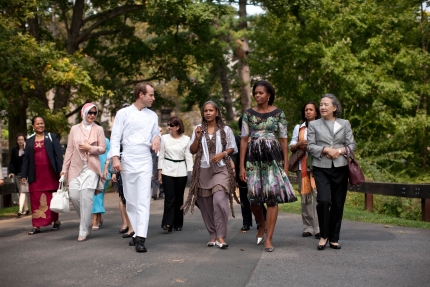
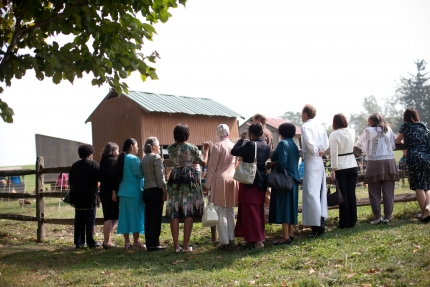
Today, the First Lady hosted a special event for the spouses of Chiefs of State and Heads of Government participating in the United Nations General Assembly at the Stone Barns Center, a non-profit farm and education center north of New York City.

First Lady Michelle Obama and spouses tour Stone Barns Food

First Lady Michelle Obama and spouses of United Nations leaders tour Stone Barns Food and Agricultural Center with Dan Barber, co-owner and executive chef of Blue Hill at Stone Barns, before the UNGA spousal luncheon in Pocantinco, N.Y. September 24, 2010. (Official White House Photo by Lawrence Jackson)

After a tour of the farm, the spouses were introduced to the Center’s children’s education program, where local third graders from Pocantico Hill School and JFK Magnet School demonstrated their experiences in hands-on farming, including harvesting vegetables and collecting eggs from pasture-raised hens.

The White House kitchen garden inspired the day’s event and led to the development of Let’s Move!, the First Lady’s initiate to raise a healthier generation of kids. A key component of the initiative is school education. Stone Barns Center is an example of what can be done when local businesses, local farms, and neighborhood schools work together to educate children. In her remarks, Mrs. Obama discussed the power of hands-on experiences from her own child's experience:

Sasha doesn’t like tomatoes -- or so she says -- not until she took a cooking class at her school and made a tomato-pesto-basil-mozzarella sandwich. 


So she comes home and she says, Mom, have you ever heard of these “hair” potatoes -- tomatoes? And I was like, what are you -- are you talking about heirloom tomatoes? She says, yeah, that's it. She said, now those are good tomatoes. I was like, you eat those everyday. No, these were different, Mom. These were different.

And the point is, is that, yeah, it was different for her because it was her discovery. It wasn’t something that her mother was telling her to do. She had discovered it. She made the sandwich. She made the pesto. And it was good. And now she’s a fan of tomatoes. We can do that with our children.

At an event that brought together the spouses of leaders from around the world, Mrs. Obama noted that childhood obesity is not just an American challenge.

As I talk to these spouses, I’m understanding that we’re seeing -- many of you are seeing these same issues in your own countries. And you’re working very hard on nutrition and education. And my hope is that we can continue to partner and have conversations so that this local campaign becomes a national conversation in so many ways.

So I thank you all for your leadership on this issue. Thank you all for taking the time to spend this afternoon focused on an issue that is near and dear to me. I am always grateful for your friendship and your kindness. It makes these gatherings even more special, to be able to share these ideas and to share in fellowship and toast and all that good stuff.


First Lady Michelle Obama and spouses learn how chickens have been raised

First Lady Michelle Obama and spouses of United Nations leaders learn how chickens have been raised and integrated into the farm food system, during a tour of Stone Barns Food and Agricultural Center, before the UNGA spousal luncheon in Pocantinco, N.Y. September 24, 2010. (Official White House Photo by Lawrence Jackson)