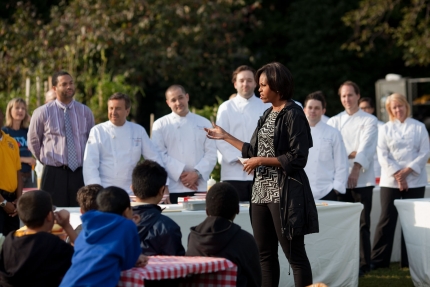
Remarks by the President and the First Lady in Town Hall with Students in Mumbai, India
St. Xavier College
Mumbai, India
11:45 A.M. IST
MRS. OBAMA: Hello, everyone. Namaste. It is a pleasure and an honor to be here in India. Everyone, please sit, who can sit. Rest. It’s warm. We are thrilled to be here and to have a chance to spend time with so many outstanding young people from St. Xavier’s College and so many other schools across Mumbai.
Now, this is my first trip to India, but it is not my first exposure to India’s wonderful culture and people. See, I grew up in Chicago, which is a city with one of the largest Indian-American communities in our country. And of course, last year, as you know, we were proud to host Prime Minister Singh and Mrs. Kaur for our very first state visit and dinner. It was a beautiful evening under a tent on the South Lawn of the White House, and we got to hear some pretty great Bhangra as well. I danced there, too. (Laughter.)
So I have really been looking forward to this trip for a very long time. The time that we spend with young people during our travel is very special to both me and to the President. When I was your age, I never dreamed of traveling to countries like this and meeting with young people like all of you. In fact, there were a lot of things that I had never imagined for myself growing up, including having the honor of serving as my county’s First Lady.
My family didn’t have a lot of money. My parents never went to college. I grew up in a little bitty apartment in a working-class neighborhood on the south side of Chicago. My parents worked hard to pay the bills and to keep a roof over our heads. But even though my parents couldn't give us material things, they gave us something much more precious -- they gave me and my brother strong values. They taught us to treat others with dignity and respect. They taught us to push for excellence in every single thing we did. They taught us to be humble and to be grateful for everything we had. They taught us to put every last bit of effort into our education and to take pride in our work. They taught us that our circumstances didn’t define us, and that if we believed in ourselves, if we made the most of every single opportunity, we could build our own destinies and accomplish anything we put our minds to.
And I try every single day to take those lessons to heart. And the fact that all of you are here today tells me that we all share these same values, that we all learn these same lessons. You're here today because, like me and my husband, you believe in your dreams and you're working hard every single day to fulfill them. More importantly, you’re here because you’ve committed to something greater than yourselves. You're here not just because of your academic and extracurricular activities and achievements, but because of what you’ve done to give back to your schools and to your communities.
Your willingness to serve is critical for all that lies ahead once you finish your education. Because the truth is pretty soon the responsibilities for building our future will fall to all of you. Soon we're going to be looking to your generation to make the discoveries and build the industries that will shape our world for decades to come.
We'll be looking to you to protect our planet. We're going to be looking to you to lift up our most vulnerable citizens. We're going to be looking to you to heal the divisions that too often keep us apart. And I believe that you and your peers around the world are more than up to the challenge, because I've seen it firsthand right here in India.
Just yesterday I had the wonderful opportunity to visit an organization called Make A Difference. It’s an amazing program designed and run by young adults who recruit other young people, outstanding college students like themselves, to mentor and teach children who, as the founder said, haven’t had the same chances in life as many of the mentors have had.
These young volunteers understand and believe in something very simple, that all children, regardless of their circumstances, deserve the same chance to get educated and to build productive and successful lives. And I know that many of you here today are doing equally important work in your communities and your schools -- everything from holding camps for kids in need to teaching computer literacy skills, to finding new ways to conserve energy.
And let me tell you, this work is amazing, and it is vitally important. And that is why, as First Lady, I have tried my best to engage young people not just in the United States but around the world, letting them know that we believe in them, but more importantly, that we need them. We need you. We need you to help solve the great challenges of our time.
And that's also why when my husband travels abroad, he doesn’t just meet with heads of state in parliaments and in palaces. He always meets with young people like all of you. That's why he’s been working to expand educational exchanges and partnerships between the United States, India, and countries around the world.
Right now, more Indian students like you come to study in the United States than from any other country. And I'm proud to see that so many American students are doing the same thing right here in India, building the types of friendships and relationships that will last a lifetime. Our hope is to provide more Indian and American young people with these types of opportunities to continue to connect and share ideas and experiences.
And finally, my husband is also working to encourage young entrepreneurs everywhere to start businesses, to improve the health of our communities and to empower our young women and girls because it is never too late or too early to start changing this world for the better.
So I want to end today by congratulating you all -- congratulating you on everything you do. We are so proud of you. I want to encourage you to keep dreams -- keep dreaming big huge, gigantic dreams -- not just for yourselves, but for your communities and for our world.
And finally, I want to urge you today to ask my husband some tough questions, all right? (Laughter.) Be tough. He loves doing events like this. This brightens his days. But you got to keep him on his toes, all right?
So if you promise me that, without further ado, I would like to introduce my husband, the President of the United States, Barack Obama. (Applause.)
THE PRESIDENT: Thank you, everybody. Thank you so much. Thank you. (Applause.) Thank you very much. Everybody, please have a seat. Have a seat. Namaste.
AUDIENCE: Namaste.
THE PRESIDENT: It is such a pleasure to be here. Now, I have to say, first of all, I don't like speaking after Michelle. (Laughter.) Because she’s very good. Also because she teases me. You notice how she said for you to all ask tough questions. If you want to ask easy questions, that's fine. (Laughter.)
But on behalf of Michelle and me I want to thank St. Xavier’s University. I want to thank Rector DeSouza. I want to thank Principal -- I want to get this right -- Mascarenhas. (Laughter.) But it’s a little smoother than that, when you say it. I want to thank Vice Principal Amonka and all of you for being such gracious hosts.
And I know it’s hot out here today. For you to be so patient with me, I’m very grateful to you. I also want to thank the city of Mumbai and the people of India for giving us such an extraordinary welcome.
In a few minutes, I’ll take some questions. I come here not just to speak, but also to listen. I want to have a dialogue with you. And this is one of the wonderful things that I have a chance to do as President of the United States. When I travel, we always try to set up a town hall meeting where we can interact with the next generation, because I want to hear from you. I want to find out what your dreams are, what your fears are, what your plans are for your country.
But if you will indulge me, I also want to say a few words about why I’m so hopeful about the partnership between our two countries and why I wanted to spend some of my time here in India speaking directly to young people like yourselves.
Now, as Michelle said, we have both looked forward to this visit to India for quite some time. We have an extraordinary amount of respect for the rich and diverse civilization that has thrived here for thousands of years. We’ve drawn strength from India’s 20th century independence struggle, which helped inspire America’s own civil rights movement. We’ve marveled at India’s growing economy and it’s dynamic democracy. And we have personally enjoyed a wonderful friendship with Prime Minister Singh and Mrs. Kaur, over the last two years.
But of course, I’m not just here to visit. I’m here because the partnership between India and the United States I believe has limitless potential to improve the lives of both Americans and Indians, just as it has the potential to be an anchor of security and prosperity and progress for Asia and for the world.
The U.S.-India relationship will be indispensible in shaping the 21st century. And the reason why is simple: As two great powers and as the world’s two largest democracies, the United States and India share common interests and common values -- values of self-determination and equality; values of tolerance and a belief in the dignity of every human being.
Already on this trip, I’ve seen those shared interests and values firsthand. We share a commitment to see that the future belongs to hope, and not fear. And I was honored to stay at the Taj Hotel, the site of the 26/11 attacks, and yesterday, in meetings with some of the survivors, I saw firsthand the resilience of the Indian people in overcoming tragedy, just as I reaffirmed our close cooperation in combating terrorism and violent extremism in all of its forms.
We also share struggles for justice and equality. I was humbled to visit Mani Bhavan, where Gandhi helped move India and the world through the strength and dignity of his leadership.
We share a commitment to see that this era after globalization leads to greater opportunity for all our people. And so yesterday, at a summit of business leaders and entrepreneurs, we discussed the potential for greater economic cooperation between our two countries -- cooperation that could create jobs and opportunity through increased trade and investment, unleashing the potential of individuals in both our countries. And even as we are countries that look to the future with optimism, Americans and Indians draw strength from tradition and from faith.
This morning, Michelle and I enjoyed the chance to join young people here in Mumbai to celebrate Diwali -- a holiday that is observed not just here in India but also in the United States, where millions of Indian-Americans have enriched our country. I have to point out, by the way, those of you who had a chance to see Michelle dance, she was moving. (Laughter.) And it was just an extraordinary gift for these young people to perform and share this wonderful tradition with us.
Tomorrow in New Delhi, I’ll have the opportunity to meet with Prime Minister Singh and many other leaders, and I’ll have the privilege to address your parliament. And there I will discuss in greater detail our efforts to broaden and deepen our cooperation and make some specific announcements on important issues like counterterrorism and regional security, on clean energy and climate change, and on the advance of economic growth and development and democracy around the globe.
Just as the sites I’ve seen and the people I’ve met here in Mumbai speak to our common humanity, the common thread that runs through the different issues that our countries cooperate on is my determination to take the partnership between our two countries to an entirely new level. Because the United States does not just believe, as some people say, that India is a rising power; we believe that India has already risen. India is taking its rightful place in Asia and on the global stage. And we see India’s emergence as good for the United States and good for the world.
But India’s future won’t simply be determined by powerful CEOs and political leaders -- just as I know that the ties among our people aren’t limited to contacts between our corporations and our governments. And that’s why I wanted to speak to all of you today, because India’s future will be determined by you and by young people like you across this country. You are the future leaders. You are the future innovators and the future educators. You’re the future entrepreneurs and the future elected officials.
In this country of more than a billion people, more than half of all Indians are under 30 years old. That’s an extraordinary statistic and it’s one that speaks to a great sense of possibility -- because in a democracy like India’s -- or America’s -- every single child holds within them the promise of greatness. And every child should have the opportunity to achieve that greatness.
Most of you are probably close to 20 years old. Just think how the world has changed in those 20 years. India’s economy has grown at a breathtaking rate. Living standards have improved for hundreds of millions of people. Your democracy has weathered assassination and terrorism. And meanwhile, around the globe, the Cold War is a distant memory and a new order has emerged, one that’s reflected in the 20 members of the G20 that will come together in Seoul next week, as countries like India assume a greater role on the world stage.
So now the future of this country is in your hands. And before I take your questions, I want you to consider three questions I have for you -- questions about what the next 20 years will bring. First, what do you want India to look like in 20 years? Nobody else can answer this question but you. It’s your destiny to write. One of the great blessings of living in a democracy is that you can always improve the democracy. As our Founding Fathers wrote in the United States, you can always forge a more perfect union.
But if you look at India’s last 20 years, it’s hard not to see the future with optimism. You have the chance to lift another several hundreds of millions of people out of poverty, grow even more this enormous middle class that can fuel growth in this country and beyond. You have the chance to take on greater responsibilities on the global stage while playing a leading role in this hugely important part of the world.
And together with the United States, you can also seize the opportunities afforded by our times: the clean energy technologies that can power our lives and save our planet; the chance to reach new frontiers in outer space; the research and development that can lead to new industry and a higher standard of living; the prospect of advancing the cause of peace and pluralism in our own countries but also beyond our borders.
Which brings me to a second question. Twenty years from now, what kind of partnership do you want to have with America? Just before I came to speak to all of you today, I visited two expos right in another courtyard here that underscore the kind of progress we can make together. The first focused on agriculture and food security, and I was able to see innovations in technology and research, which are transforming Indian farming.
A farmer showed me how he can receive crop information on his cell phone. Another showed me how tools appropriately sized and weighted for women are helping her and other female farmers increase their productivity. Many of these innovations are the result of public and private collaborations between the United States and India, the same collaboration that helped produce the first Green Revolution in the 1960s.
And tomorrow, I will be discussing with Prime Minister Singh how we can advance the cooperation in the 21st century -- not only to benefit India, not only to benefit the United States, but to benefit the world. India can become a model for countries around the world that are striving for food security.
The second expo I toured focused on the ways that innovation is empowering Indian citizens to ensure that democracy delivers for them. So I heard directly from citizens in a village hundreds of miles away, through e-panchayat. I saw new technologies and approaches that allow citizens to get information, or to fight corruption, monitor elections, find out whether their elected official is actually going to work, holding government accountable.
And while these innovations are uniquely India’s, their lessons can be applied around the world. So earlier this year, at the U.N., I called for a new focus on open societies that support open government and highlighted their potential to strengthen the foundation of freedoms in our own countries, while living up to the ideals that can light the world. And that's what India is starting do with some of this innovation.
We must remember that in some places the future of democracy is still very much in question. Just to give you an example, there are elections that are being held right now in Burma that will be anything but free and fair based on every report that we’re seeing. And for too long the people of Burma have been denied the right to determine their own destiny.
So even as we do not impose any system of government on other countries, we, especially young people, must always speak out for those human rights that are universal, and the right of people everywhere to make their own decisions about how to shape their future, which will bring me to my final question, and then you guys can start sending questions my way.
How do you -- how do each of you want to make the world a better place? Keep in mind that this is your world to build, your century to shape. And you’ve got a powerful example of those who went before you. Just as America had the words and deeds of our Founding Fathers to help chart a course towards freedom and justice and opportunity, India has this incredible history to draw on, millennia of civilization, the examples of leaders like Gandhi and Nehru.
As I stood in Mani Bhavan, I was reminded that Martin Luther King made his own pilgrimage to that site over 50 years ago. In fact, we saw the book that he had signed. After he returned home, King said that he was struck by how Gandhi embodied in his life certain universal principles that are inherent in the moral structure of the universe, and these principles are as inescapable as the law of gravitation.
You have that power within you. You, too, must embody those principles. For even within this time of great progress, there are great imperfections, the injustice of oppression, the grinding punishment of poverty, the scourge of violent extremism and war. King and Gandhi made it possible for all of us to be here today -- me as a President, you as a citizen of a country that's made remarkable progress. Now you have the opportunity and the responsibility to also make this plant a better place.
And as you do, you’ll have the friendship and partnership of the United States, because we are interested in advancing those same universal principles that are as inescapable as the law of gravitation.
The lives that you lead will determine whether that opportunity is extended to more of the world’s people -- so that a child who yearns for a better life in rural India or a family that's fled from violence in Africa, or a dissident who sits in a Burmese prison, or a community that longs for peace in war-torn Afghanistan -- whether they are able to achieve their dreams.
And sometimes the challenges may be incredibly hard, and in the face of darkness, we may get discouraged. But we can always draw on the light of those who came before us. I hope you keep that light burning within you, because together the United States and India can shape a century in which our own citizens and the people of the world can claim the hope of a better life.
So thank you very much for your patience. And now you can take Michelle’s advice and ask me some tough questions. Thank you very much. (Applause.)
So we have I think people in the audience with microphones, and so when they come up, if you could introduce yourself -- love to know who you are. And we'll start with that young lady right over there.
Q Hi, good day, sir. Hi, my name is Anna and I’m from St. Davis College. My question to you is, what is your take on opinion about jihad, or jihadi? Whatever is your opinion, what do you think of them?
THE PRESIDENT: Well, the phrase jihad has a lot of meanings within Islam and is subject to a lot of different interpretations. But I will say that, first, Islam is one of the world’s great religions. And more than a billion people who practice Islam, the overwhelming majority view their obligations to their religion as ones that reaffirm peace and justice and fairness and tolerance. I think all of us recognize that this great religion in the hands of a few extremists has been distorted to justify violence towards innocent people that is never justified.
And so I think one of the challenges that we face is how do we isolate those who have these distorted notions of religious war and reaffirm those who see faiths of all sorts -- whether you are a Hindu or a Muslim or a Christian or a Jew or any other religion, or your don't practice a religion -- that we can all treat each other with respect and mutual dignity, and that some of the universal principles that Gandhi referred to -- that those are what we’re living up to, as we live in a nation or nations that have very diverse religious beliefs.
And that's a major challenge. It’s a major here in India, but it’s a challenge obviously around the world. And young people like yourselves can make a huge impact in reaffirming that you can be a stronger observer of your faith without putting somebody else down or visiting violence on somebody else.
I think a lot of these ideas form very early. And how you respond to each other is going to be probably as important as any speech that a President makes in encouraging the kinds of religious tolerance that I think is so necessary in a world that's getting smaller and smaller, where more and more people of different backgrounds, different races, different ethnicities are interacting and working and learning from each other.
And those circumstances -- I think all of us have to fundamentally reject the notion that violence is a way to mediate our differences.
All right. Yes, I may not get to every question. I’ll call on this young man right here. Right there, yes.
Q Good morning, sir. My name is Jehan (phonetic). I’m from H.R. College. So my question is more about spirituality and moral values. We see today in today’s world, there more of a materialistic frame of thought when it comes to generations -- budding generations. So what do you believe is a possible methodology which governments, rather yours or any other governments in the world, they can adopt to basically incorporate the human core values, the moral values of selflessness, brotherhood, over the materialistic frame of thought which people work by today?
THE PRESIDENT: It’s a terrific question and I’m glad you’re asking it. India is making enormous progress in part because, like America, it has this incredible entrepreneurial talent, entrepreneurial spirit. And I think we should not underestimate how liberating economic growth can be for a country.
In the United States, I used to work with a lot of churches when I was still a community organizer, before I went to law school. And one of the common phrases among the pastors there was, it’s hard to preach to an empty stomach. It’s hard to preach to an empty stomach. If people have severe, immediate material needs -- shelter, food, clothing -- then that is their focus. And economic growth and development that is self-sustaining can liberate people, allow them -- it forms the basis for folks to get an education and to expand their horizons. And that's all for the good.
So I don't want any person here to be dismissive of a healthy materialism because in a country like India, there’s still a lot of people trapped in poverty. And you should be working to try to lift folks out of poverty, and companies and businesses have a huge role in making that happen.
Now, having said that, if all you’re thinking about is material wealth, then I think that shows a poverty of ambition. When I was visiting Gandhi’s room, here in Mumbai, it was very telling that the only objects in the room were a mat and a spinning wheel and some sandals and a few papers. And this is a man who changed history like probably no one else in the 20th century in terms of the number of lives that he affected. And he had nothing, except an indomitable spirit.
So everyone has a role to play. And those of you who are planning to go into business, I think it’s wonderful that you’re going into business and you should pursue it with all your focus and energy. Those of you, though, who are more inclined to teach or more inclined to public service, you should also feel encouraged that you are playing just as critical a role. And whatever occupation you choose, giving back to the community and making sure that you’re reaching back to help people, lift up people who may have been left behind, that’s a solemn obligation.
And by the way, it’s actually good for you. It’s good for your spirit. It’s good for your own moral development. It will make you a happier person, knowing that you’ve given back and you’ve contributed something.
Last point I would make -- I think this is another thing that India and the United States share, is there’s a healthy skepticism about public servants, particularly electoral politics. In the United States, people generally have -- hold politicians in fairly low esteem -- sometimes for good reason, but some of it is just because the view is that somehow government can’t do anything right. And here in India, one of the big impediments to development is the fact that in some cases the private sector is moving much faster than the public sector is moving.
And I would just suggest that I hope some of you decide to go ahead and get involved in public service -- which can be frustrating. It can be, at times, slow -- you don’t see progress as quickly as you’d like. But India is going to need you not just as businessmen but also as leaders who are helping to reduce bureaucracy and make government more responsive and deliver services more efficiently. That’s going to be just as important in the years to come. Because otherwise you’re going to get a imbalance where some are doing very well but broad-based economic growth is not moving as quickly as it could.
Excellent question.
I’m going to go boy-girl-boy-girl, or girl-boy-girl-boy, just to make sure it’s fair. Let’s see. This young lady right there -- yes.
Q Hello. I actually wanted to ask you -- you mention Mahatma Gandhi a lot usually in your speeches. So I was just wondering how exactly do you implement his principles and his values in your day-to-day life, and how do you expect the people in the U.S. to live in those values? Thank you.
THE PRESIDENT: Well, it’s a terrific question. Let me say, first of all, that he, like Dr. King, like Abraham Lincoln, are people who I’m constantly reading and studying, and I find myself falling woefully short of their example all the time. So I’m often frustrated by how far I fall short of their example.
But I do think that at my best, what I’m trying to do is to apply principles that fundamentally come down to something shared in all the world’s religions, which is to see yourself in other people; to understand the inherent worth and dignity of every individual, regardless of station, regardless of rank, regardless of wealth, and to absolutely value and cherish and respect that individual; and then hopefully, try to take that principle of treating others as you would want to be treated and find ways where that can apply itself in communities and in cities and in states and ultimately in a country and in the world.
As I said, I often find myself falling short of that ideal. But I tend to judge any particular policy based on, is this advancing that spirit; that it’s helping individuals realize their potential; that it’s making sure that all children are getting an education -- so that I’m not just worrying about my children; that I’m thinking, first and foremost, about the United States of America, because that’s my responsibility as President, but I’m also recognizing that we are in an interrelationship with other countries in the world and I can’t ignore an abuse of human rights in another country. I can’t ignore hardships that may be suffering -- that may be suffered by somebody of a different nationality.
That I think more than anything is what I carry with me on a day-to-day basis. But it’s not always apparent that I’m making progress on that front.
One of the other things I draw from all great men and women, like a Gandhi, though, is that on this journey you’re going to experience setbacks and you have to be persistent and stubborn, and you just have to keep on going at it. And you’ll never roll the boulder all the way up the hill but you may get it part of the way up.
This gentleman in the blue shirt. Do we have a microphone? Oh, here we go. Thanks.
Q Good afternoon, Mr. President.
THE PRESIDENT: Good afternoon.
Q It’s an honor to question you. What my question would be is, when you were being elected as President, one of the words you used a lot was “change.” After your midterm election, the midterm -- it seems that the American people have asked for a change. The change that you will make, how exactly is it going to affect young India, people from my generation?
THE PRESIDENT: That’s an interesting question.
Q Thank you.
THE PRESIDENT: The United States has gone through probably the toughest two years economically as we’ve gone through since the 1930s. I mean, this was a profound financial crisis and economic shock, and it spilled over to most of the world. India weathered it better than many countries. But most of the work that I did with Prime Minister Singh in the first two years in the G20, we were focused on making sure that the world’s financial system didn’t collapse.
And although we’ve now stabilized the economy, unemployment in the United States is very high now relative to what it typically has been over the last several decades. And so people are frustrated. And although we’re making progress, we’re not making progress quickly enough.
And one of the wonderful things about democracy is that when the people are not happy, it is their right, obligation, and duty to express their unhappiness, much to the regret sometimes of incumbents. But that’s a good thing. That’s a healthy thing.
And my obligation is to make sure that I stick to the principles and beliefs and ideas that will move America forward -- because I profoundly believe that we have to invest in education, that that will be the primary driver of growth in the future; that we’ve got to invest in a strong infrastructure; that we have to make sure that we are taking advantage of opportunities like clean energy.
But it also requires me to make some midcourse corrections and adjustments. And how those play themselves out over the next several months will be a matter of me being in discussions with the Republican Party, which is now going to be controlling the House of Representatives. And there are going to be areas where we disagree and hopefully there are going to be some areas where we agree.
Now, you asked specifically, how do I think it will affect policy towards India. I actually think that the United States has a enormous fondness for India, partly because there are so many Indian-Americans and because of the shared values that we have. And so there is a strong bipartisan belief that India is going to be a critical partner with the United States in the 21st century. That was true when George Bush was President. That was true when Bill Clinton was President. It was true under Democratic and Republican control of Congress.
So I don’t think that fundamental belief is going to be altered in any significant way. I do think that one of the challenges that we’re going to be facing in the United States is at a time when we’re still recovering from this crisis, how do we respond to some of the challenges of globalization? Because the fact of the matter is, is that for most of my lifetime -- I’ll turn 50 next year -- for most of my lifetime, the United States was such a dominant economic power, we were such a large market, our industry, our technology, our manufacturing was so significant that we always met the rest of the world economically on our terms. And now, because of the incredible rise of India and China and Brazil and other countries, the United States remains the largest economic and the largest market but there’s real competition out there.
And that's potentially healthy. It makes -- Michelle was saying earlier I like tough questions because it keeps me on my toes. Well, this will keep America on its toes. And I'm positive we can compete because we've got the most open, most dynamic entrepreneurial culture; we've got some of the finest universities in the world; incredible research and technology. But it means that we're going to have to compete.
And I think that there’s going to be a tug of war within the United States between those who see globalization as a threat and want to retrench, and those who accept that we live in a open, integrated world which has challenges and opportunities and we've got to manage those challenges and manage those opportunities, but we shouldn’t be afraid of them.
And so what that means, for example, is on issues of trade, part of the reason I'm traveling through Asia this week is I believe that the United States will grow and prosper if we are trading with Asia. It’s the fastest-growing region in the world. We want access to your markets. We think we've got good products to sell; you think that you’ve got good products to sell us. This can be a win-win situation.
So I want to make sure that we're here because this will create jobs in the United States and it can create jobs in India. But that means that we've got to negotiate this changing relationship. Back in the 1960s or ‘70s, the truth is the American economy could be open even if our trading partners’ economies weren’t open. So if India was protecting certain sectors of its economy, it didn’t really have such a big effect on us. We didn’t need necessarily reciprocity because our economy was so much larger.
Well, now, things have changed. So it’s not unfair for the United States to say, look, if our economy is open to everybody, countries that trade with us have to change their practices to open up their markets to us. There has to be reciprocity in our trading relationship. And if we can have those kinds of conversations, fruitful, constructive conversations about how we produce win-win situations, then I think we'll be fine.
If the American people feel that trade is just a one-way street, where everybody is selling to the enormous U.S. market but we can never sell what we make anywhere else, then people in the United States will start thinking, well, this is a bad deal for us. And that could end up leading to a more protectionist instinct in both parties -- not just among Democrats, but also among Republicans. So that's what we have to guard against.
All right, it’s a young lady’s turn. This young lady with the glasses -- yes.
Q A very warm welcome to you to India, sir. ]
THE PRESIDENT: Thank you so much.
Q I'm from H.R. College of Commerce and Economics. We were the privileged college to host Mr. Otis Moss this January. Sir, my question to you is why is Pakistan so important an ally to America, so far as America has never called it a terrorist state?
THE PRESIDENT: Well -- no, no, it’s a good question. And I must admit I was expecting it. (Laughter.) Pakistan is an enormous country. It is a strategically important country not just for the United States but for the world. It is a country whose people have enormous potential, but it is also, right now, a country that within it has some of the extremist elements that we discussed in the first question. That's not unique to Pakistan, but obviously it exists in Pakistan.
The Pakistani government is very aware of that. And what we have tried to do over the last several years, certainly -- I'll just speak to my foreign policy -- has been to engage aggressively with the Pakistani government to communicate that we want nothing more than a stable, prosperous, peaceful Pakistan, and that we will work with the Pakistani government in order to eradicate this extremism that we consider a cancer within the country that can potentially engulf the country.
And I will tell you that I think the Pakistani government understands now the potential threat that exists within their own borders. There are more Pakistanis who’ve been killed by terrorists inside Pakistan than probably anywhere else.
Now, progress is not as quick as we’d like, partly because when you get into, for example, some of the Northwest Territories, these are very -- this is very difficult terrain, very entrenched. The Pakistani army has actually shifted some of its emphasis and focus into those areas. But that's not originally what their armed forces were designed to do, and so they’re having to adapt and adjust to these new dangers and these new realities.
I think there is a growing recognition -- but it’s something that doesn’t happen overnight -- of what a profound problem this is. And so our feeling has been to be honest and forthright with Pakistan, to say we are your friend, this is a problem and we will help you, but the problem has to be addressed.
Now, let me just make this point, because obviously the history between India and Pakistan is incredibly complex and was born of much tragedy and much violence. And so it may be surprising to some of you to hear me say this, but I am absolutely convinced that the country that has the biggest stake in Pakistan’s success is India. I think that if Pakistan is unstable, that's bad for India. If Pakistan is stable and prosperous, that's good.
Because India is on the move. And it is absolutely in your interests, at a time when you're starting to succeed in incredible ways on the global economic stage, that you [don’t] want the distraction of security instability in your region. So my hope is, is that over time trust develops between the two countries, that dialogue begins -- perhaps on less controversial issues, building up to more controversial issues -- and that over time there’s a recognition that India and Pakistan can live side by side in peace and that both countries can prosper.
That will not happen tomorrow. But I think that needs to be our ultimate goal.
And by the way, the United States stands to be a friend and a partner in that process, but we can't impose that on India and Pakistan. Ultimately, India and Pakistan have to arrive at their own understandings in terms of how the relationship evolves.
Okay. I've got time for one more question. It’s a guy’s turn. This young man right here, in the striped shirt.
Q Good afternoon, Mr. President. It’s an absolute honor to hear you, and I must say this, that one day I hope I be half as good as a leader as you are today.
THE PRESIDENT: Well, you're very kind. Thank you.
Q Mr. President, my question relates to your Afghanistan policy. In light of your statements that the troop withdrawal would start in 2011, there have been recent developments that would indicate that USA has been in talks with Taliban so as to strike out a stable government in Afghanistan as when you withdraw. Now, does this point to the acceptance of the inevitability of the U.S. to fulfill the vision which they had, with which they invaded Afghanistan in 2001? Does it point out to their inability to take a military control of all the southern regions so that we can install a stable government? You notice that in Iraq where there’s a lot of instability now. So does it point to a sort of tacit acceptance of U.S. inability to create harmony in Afghanistan?
THE PRESIDENT: First of all, I want to just unpack some of the assumptions inside the question because they were broadly based in fact, but I want to be very precise here.
I have said that starting in the summer of next year, July 2011, we will begin drawing down our troop levels, but we will not be removing all our troops. Keep in mind that we ramped up significantly because the idea was that for seven years we had just been in a holding pattern; we’d had just enough troops to keep Kabul intact but the rest of the countryside was deteriorating in fairly significant ways. There wasn’t a real strategy. And my attitude was, I don't want to, seven years from now, or eight years from now, be in the exact same situation. That's not a sustainable equilibrium.
So I said, let’s put more troops in to see if we can create more space and stability and time for Afghan security forces to develop, and then let’s begin drawing down our troops as we’re able to stand up Afghan security forces.
Now, in fact, it turns out that in Iraq -- you mentioned Iraq as a parallel -- in Iraq, we have been relatively successful in doing that. The government is taking way too long to get formed, and that is a source of frustration to us and I’m sure to the Iraq people. Having said that, though, if you think about it, it’s been seven months since the election, and violence levels are actually lower in Iraq than they’ve been just about any time since the war started -- at a time when we pulled back our forces significantly. So it shows that it is possible to train effective, indigenous security forces so that they can provide their own security. And hopefully politics then resolves differences, as opposed to violence.
Now, Afghan, I think is actually more complicated, more difficult, probably because it’s a much poorer country. It does not have as strong a tradition of a central government. Civil service is very underdeveloped. And so I think that the pace at which we’re drawing down is going to be determined in part by military issues, but it’s also going to be determined by politics. And that is, is it possible for a sizeable portion of the Pashtun population in Afghanistan that may be teetering back and forth between Taliban or a central government, is it possible for them to feel that their ethnicity, their culture, their numerical position in the country is adequately represented, and can they do that within the context of a broader constitutional Afghan government.
And I think that's a worthy conversation to have. So what we’ve said to President Karzai -- because this is being initiated by him -- what we’ve said is if former Taliban members or current Taliban members say that they are willing to disassociate themselves with al Qaeda, renounce violence as a means of achieving their political aims, and are willing to respect the Afghan constitution so that, for example, women are treated with all the right that men are afforded, then, absolutely, we support the idea of a political resolution of some of these differences.
Now, there are going to be some elements that are affiliated to the Taliban that are also affiliated with al Qaeda or LT or these other organizations, these extremists that are irreconcilable. They will be there. And there will need to be a military response to those who would perpetrate the kind of violence that we saw here in Mumbai in a significant ongoing way -- or the kind that we saw on 9/11 in New York City.
But I think a stable Afghanistan is achievable. Will it look exactly as I might design a democracy? Probably not. It will take on an Afghan character.
I do think that there are lessons that India has to show not just countries like Afghanistan but countries in sub-Saharan Africa. I mean, some of the incredible work that I saw being done in the agricultural sector is applicable to widely dispersed rural areas in a place like Afghanistan and could -- I promise you, if we can increase farmers’ yields in Afghanistan by 20 percent or 25 percent, and they can get their crops to market, and they’re cutting out a middleman and they’re ending up seeing a better standard of life for themselves, that goes a long way in encouraging them to affiliate with a modern world.
And so India’s investment in development in Afghanistan is appreciated. Pakistan has to be a partner in this process. In fact, all countries in the region are going to be partners in this process. And the United States welcomes that. We don’t think we can do this alone.
But part of our -- and this is probably a good way to end -- part of my strong belief is that around the world, your generation is poised to solve some of my generation’s mistakes and my parents’ generation’s mistakes. You’ll make your own mistakes, but there’s such incredible potential and promise for you to start pointing in new directions in terms of how economies are organized, in terms of how moral precepts and values and principles are applied, in how nations work together to police each other so that they’re not -- so that when there’s genocide or there is ethnic cleansing, or there are gross violations of human rights, that an international community joins together and speaks with one voice; so that economic integration isn’t a source of fear or anxiety, but rather is seen as enormous promise and potential; where we’re able to tackle problems that we can’t solve by ourselves.
I went to a lower school -- do you call them high schools here? It’s sort of a high school. And Michelle and I saw this wonderful exhibit of global warming and the concerns that these young people have -- they were 14, 15. And their energy and their enthusiasm was infectious. And I asked them, which one of you are going to be scientists who are going to try to solve this problem? And all of them raised their hands. And I said, well, this is hugely important for India. And they said, no, not for India -- for the world.
You see, their ambitions were not just to be great scientists for India. Their ambition was to be a great scientist for the world -- because they understood that something like climate change or clean energy, that’s not an American problem or an Indian problem -- that’s a human problem. And all of us are going to have to be involved in finding solutions to it.
And as I listen to all of you, with your wonderful questions, I am incredibly optimistic and encouraged that you will help find those solutions in the years to come.
So, thank you very much for your hospitality. Thank you, everybody. (Applause.)
END 12:45 P.M. IST