The White House

Office of the First Lady

Remarks by the First Lady at United Nations General Assembly Spousal Luncheon

Blue Hill at Stone Barns
Tarrytown, New York

12:51 P.M. EDT
 
MRS. OBAMA:  Well, good afternoon.  I hope you all enjoyed the tours.  It’s a beautiful, beautiful place. 
    
I want to start by thanking a few people.  Of course I want to thank Jill Isenbarger who is right over there.  Jill, thank you so much for all your hard work.  (Applause.)  And also to the entire Stone Barns Center staff, everyone here who has helped make this morning, this day, a very special one.  Let’s give them a hand.  (Applause.)
 
And we wouldn’t be here if it weren’t for the Rockefeller family.  This is their home, and they have put a lot of love and energy into making this center such a special one.  And we want to thank them, as well.  (Applause.)
 
And of course to Dan Barber and his brother, David.  Dan is the executive chef here.  Is that your title?  Yeah, well, he’s the head cook guy.  (Laughter and applause.)  And I have to say that Dan -- I met Dan before we came to the White House.  And he actually cooked for my husband and I, and he didn’t know why he was being called to Chicago, but it was one of the best dinners, and after that I fell in love with Dan, I knew that we would want to partner with him if we had the opportunity.  He is serving on the President’s Fitness and Nutrition Council, so he’s one of the major players in our efforts to encourage healthier living around the country.  So I want to thank Dan for all you’re doing.  We love you very much.  You’re doing a great job.  (Applause.)
 
And those cute little precious people that were out there, the third graders, they are terrific.  They come from Pocantico Hill School here in the area and JFK Magnet School.  And I know that this facility is known for its educational component.  Having those kids out there wasn’t anything new.  They really rely on young people to keep this facility up, to learn and grow from it, and you can see, by the excitement on their faces, that it’s working.  So we want to thank all those students for just being so eager.  And they also helped to prepare the lunch, so they’re our chefs, as well.
 
And last but not least, I want to thank and introduce you to some of our -- the most important people in the President and my family’s life, are the people who feed us.  We have today with us Cris Comerford, who’s our executive chef at the White House, Bill Yosses, who’s our executive pastry chef, and Sam Kass, who’s a chef, as well, but he also wears a policy hat, and he has been working on the “Let’s Move” initiative.  So let’s give them a round of applause.  They flew here to help cook, as well.  (Applause.)   We love them, we’re very proud of the work that they’re doing.
 
These chefs are among the thousands that are volunteering to work in schools to try to help schools do a better job of figuring out how to make their school lunch meals a little tastier and healthier.  And our chefs have adopted a school, and they’re leading the way, and it’s going to be very exciting to see the work that they do.  Thank you all so much. 
 
This all started -- why we’re here -- many of you probably know me as a gardener because when I first came into the White House, we developed the White House kitchen garden, which was probably one of the first since Eleanor Roosevelt.  And we didn’t know whether we could even grow anything on that plot of land. 
 
But we began to grow some wonderful things, and we worked closely with students in the Washington, D.C. area.  They helped us every step of the way.  They helped us till the soil.  They helped us plant.  They helped us harvest.  They helped us eat.  And what we learned from the mere planting of that garden was that we could use this simple tool to engage children in a conversation about their own health and nutrition.  And that experience led us to develop one of the strongest initiatives that I have, one that I’m very proud of.  It’s called “Let’s Move.”
 
“Let’s Move” is a national-wide campaign -- a nationwide campaign -- to focus our country on the epidemic of childhood obesity.  Our goal is to ensure that children born today grow up at a healthy weight, understanding how to eat and live in a healthy way.  And we’re working with kids because oftentimes it’s easier for them to develop new habits than it is for us to try to change old habits as they get older.
 
And with this initiative, we’re trying to do a number of things.  We’re trying to provide parents with better information.  We want to get family physicians involved in really screening and checking children for obesity, and helping them very early on figuring out ways to prevent it and deal with it.  We’re trying to improve access in communities.  Many communities in this country don't have sufficient access to fresh produce and healthy living.  That's why Stone Barns is so important, because many of these kids may never learn that ketchup comes from a tomato, or that French fries actually come from a potato, because they’re very disconnected from the food that they eat.  So we’re trying to improve that.
 
We’re also trying to -- there’s a physical education component to this, and we’re working to ensure that our kids are more active.  We have become a very sedentary society in so many ways, with computers and the Internet, and sometimes it’s not safe for kids to play in their own communities, so we have to find ways for our kids to actually move.
 
But one of the more important components is the school education piece.  Children are getting a lot of their calories in school and they’re getting most of their information about how to eat from their schools. 
 
And again this is why Stone Barns Center is so important.  It is an example of what can be done with local businesses, local farms, and neighborhood schools, of the kind of energy that comes from children having a hands-on experience on the farm.  And when they grow it and they touch it and they taste it, they believe in it more than anything that we could tell them.
 
And I’ve seen this in my own child.  I told the story to Dan.  Sasha -- now, we have wonderful tomatoes grown on the White House Garden.  Sasha doesn’t like tomatoes -- or so she says -- not until she took a cooking class at her school and made a tomato-pesto-basil-mozzarella sandwich. 
 
So she comes home and she says, Mom, have you ever heard of these “hair” potatoes -- tomatoes?  And I was like, what are you -- are you talking about heirloom tomatoes?  She says, yeah, that's it.  She said, now those are good tomatoes.  (Laughter.)  I was like, you eat those everyday.  No, these were different, Mom.  These were different.  (Laughter.) 
 
And the point is, is that, yeah, it was different for her because it was her discovery.  It wasn’t something that her mother was telling her to do.  She had discovered it.  She made the sandwich.  She made the pesto.  And it was good.  And now she’s a fan of tomatoes.  We can do that with our children.
    
So I want to thank you all not just for coming, but I know many of you here are focused on this issue in your own countries, and that's the thing that it’s important for the media to understand.  Childhood obesity is not just an American challenge.  As I talk to these spouses, I’m understanding that we’re seeing -- many of you are seeing these same issues in your own countries.  And you’re working very hard on nutrition and education.  And my hope is that we can continue to partner and have conversations so that this local campaign becomes a national conversation in so many ways. 
 
So I thank you all for your leadership on this issue.  Thank you all for taking the time to spend this afternoon focused on an issue that is near and dear to me.  I am always grateful for your friendship and your kindness.  It makes these gatherings even more special, to be able to share these ideas and to share in fellowship and toast and all that good stuff.
 
So thank you all.  And it is my pleasure now to introduce you to Dan Barber who will tell you more about the programs here.  And then we get to eat.
 
So thank you so much.  And Dan, you have the floor.  (Applause.)
 
END
1:00 P.M. EDT

First Lady to the Clinton Global Initiative: Harness the Potential of Veterans and Military Families

Yesterday, First Lady Michelle Obama addressed the closing session of the Clinton Global Initiative Annual meeting. She discussed an issue near and dear to her heart as First Lady, and that is the challenges faced by America’s veterans and military families, particularly as they transition to civilian life.

Read the Transcript  |  Download Video: mp4 (315MB) | mp3 (30MB)

Established in 2005 by President Bill Clinton, the Clinton Global Initiative convenes global leaders to devise and implement innovative solutions to some of the world’s most pressing challenges. These CGI members have made commitments valued at $57 billion, bringing hope and opportunity to more than 200 million people around the world.This year, commitments were announced to support the long-term recovery of the Gulf Coast.

Live Stream: The President and First Lady Address the Clinton Global Initiative Meeting

Today, the President and First Lady will join President Bill Clinton to address the 2010 Annual Meeting of the Clinton Global Initiative (CGI). Introduced by the President, Mrs. Obama will discuss an issue near to her heart as First Lady and that is supporting America’s veterans and military families.

Watch the event live at 4:00 p.m. embedded in this blog post or on the CGI 2010 Webcast site.

Related Topics: Veterans

Vice President Biden Hosts Medal of Valor Ceremony

September 22, 2010 | 42:34 | Public Domain

The Vice President hosts a Medal of Valor ceremony with Attorney General Eric Holder. The Medal of Valor is awarded to public safety officers who have exhibited exceptional courage, regardless of personal safety, in the attempt to save or protect others from harm.

Download mp4 (406MB) | mp3 (39MB)

The White House

Office of the First Lady

First Lady Michelle Obama Welcomes Spouses of Leaders Attending UN General Assembly to a Farm-to-Table Luncheon Next Week

Visiting spouses will also tour Stone Barns Center, a New York farm and education center

On Friday, September 24th, First Lady Michelle Obama will host a special event for the spouses of Chiefs of State and Heads of Government participating in the United Nations General Assembly at the Stone Barns Center, a non-profit farm and education center north of New York City. Spouses will take tours of the farm where they will see herbs and other ingredients that will be used in the luncheon that follows at “Blue Hill at Stone Barns,” a world-renowned restaurant at the Center. Spouses will also be introduced to Stone Barns Center’s one of a kind children’s education program, where students from a local school will demonstrate their experiences in hands-on farming such as harvesting vegetables and collecting eggs from pasture-raised hens.

Mrs. Obama will deliver brief remarks at the luncheon and will be followed by Dan Barber, the Executive Chef and Co-Owner of Blue Hill. This event begins at 11:00 AM and will be pooled press by domestic and international media.

Stone Barns Center is part of a national movement to create a sustainable food system that benefits the community’s health and environment. The Center teaches children, farmers, chefs and thousands of annual visitors about a better way of growing food. Located in Pocantico Hills, New York, the Stone Barns Center for Food and Agriculture is a working farm with a mission: To celebrate, teach and advance community-based food production and the enjoyment of fresh, nutritious food. Click here for more information on the Stone Barns Center.

Last fall, Mrs. Obama invited spouses of leaders attending the Pittsburgh Summit to dinner at the home of Teresa Heinz at Rosemont Farm, a working farm that raises livestock and produces fruits and vegetables, some of which were used in the meal. Last spring, Mrs. Obama broke ground on the new White House Kitchen garden with students from a local Washington, DC school. Since then, the garden has yielded 1,600 pounds of vegetables, berries and herbs which have been used in various White House events and donated to local soup kitchens.

Changing the Equation in STEM Education

Download Video: mp4

Today, President Obama announced the launch of Change the Equation, a CEO-led effort to dramatically improve education in science, technology, engineering, and math (STEM), as part of his “Educate to Innovate” campaign.  Change the Equation is a non-profit organization dedicated to mobilizing the business community to improve the quality of STEM education in the United States. 

The United States is falling behind our foreign competitors in STEM subjects.  According to one, study American 15-year-olds ranked 21st in science and 25th in math compared to other countries.  In his remarks to day, the President emphasized the importance of providing American students with a solid foundation in these subjects in order to compete in the global economy:

Related Topics: Innovations, Education

The White House

Office of the First Lady

Remarks by the First Lady at the Congressional Black Caucus Foundation Legislative Conference

Walter E. Washington Convention Center, Washington, D.C.

2:30 P.M. EDT

MRS. OBAMA:  How’s everybody?  (Applause.)  Well, good afternoon!

AUDIENCE:  Good afternoon!

MRS. OBAMA:  How’s everybody doing?

AUDIENCE:  Good!

MRS. OBAMA:  Very good.  It is a true pleasure and an honor to be here to kick off this year’s Legislative Conference.  And I want to thank you so much for having me here today.  It is truly an honor for me.

I want to start by thanking Congressman Donald Payne and Congresswoman Barbara Lee for those wonderful introductions, but also for their extraordinary work and their support on behalf not just of my husband’s administration but of this nation.  And I'd also like to thank Dr. Elsie Scott for her outstanding leadership, as well, so let’s -- (applause) -- Dr. Scott, thank you so much.  (Applause.)

And finally, I want to thank the Congressional Black Caucus, the CBCF, all the panelists here today, and all of you for being here and for what you do every day to lift up families and communities across this country, because time and again, you’ve taken those tough stands and been that lone dissenting voice.

Time and again, you’ve asked those hard questions, and spoken those inconvenient truths, all along refusing to give up on the endlessly difficult task of building that “more perfect union.”

For more than four decades, you have taken a stand on behalf of folks who’ve been forgotten -- folks who too often feel like they’re invisible; not just African Americans, but all Americans who need someone on their side again.

And that’s particularly true when it comes to your work on behalf of our nation’s children.  You’ve helped more students pursue careers in fields like medicine and engineering.  You’ve worked to groom young leaders, and give them the tools to fulfill their God-given potential. You’ve been a voice in Congress on every challenge they face –- from healthcare and education to poverty and crime and so much more.

And that’s one of the reasons why I wanted to be here today, because I want to talk with you about another issue that I believe presents an urgent threat to the health and well-being of our young people -- and that is the epidemic of childhood obesity that affects every community in this country –- but it affects the African American community in particular.

You just heard the statistics.  They’re all too familiar:  how nearly 40 percent of African American kids are overweight or obese.  Nearly one in two –- that is half of our children –- will develop diabetes in some point in their lives.

But I also know how easy it is to rattle off those numbers, and to shake our heads, and move on, because in the black community especially, these persistent health problems can become so routine that we come to expect it, sometimes even tolerate it.

And it’s a lot harder to really feel what those statistics mean, because the truth is that in too many of our communities, childhood obesity has become that kind of slow, quiet, everyday threat that doesn’t always appear to warrant the headline urgency of some of the other issues that we face.

The fact is that many of us, and many of the folks that we know and love, have struggled with our weight.

And often, it becomes the kind of thing that we just sort of accept as part of our daily lives, as something we know we should do something about, but we always push it off until later.  It winds up taking a backburner to more pressing issues like crumbling schools, and neighborhoods that aren’t safe, and families that can’t pay the bills or even put food on the table.

But today, I just want us to step back for a moment and ask ourselves some hard questions about what childhood obesity really means for the prospects of our next generation.

We should ask ourselves what does it mean when we hear stories of doctors seeing obesity-related conditions like type II diabetes in children that they only used to see in adults?

And what does it mean when our kids go through life feeling unwell, not having the energy to run around and play and enjoy their childhood today, and not having the stamina and the strength they will need to build successful careers and keep up with their own kids and grandkids in the future?

And what does it mean when study after study shows that regular exercise and proper nutrition significantly improves academic performance, but that many of our kids aren’t getting enough of either?

What does it mean when, because so many of our kids are struggling with obesity, some experts are now saying that our kids might be the first generation in history on track to lead shorter lives than their parents?

I mean, we’ve got to think about that.  I mean, think about the fact that we may have reached a point where a future generation will be worse, and not better, than the one before.

See, I think it means we’ve got a pretty big problem on our hands, and one that we should be taking just as seriously as all those other hot button, front-burner issues we’ve all been fighting so hard to address.

I think it means that we as a community, and as a nation, need to make solving childhood obesity a top priority for our kids’ future.

I think we need to make a commitment –- not just for a few months, or a few years, but a long-term commitment to do what it takes to solve this problem once and for all, because the truth is that short-term, one-off efforts simply aren’t going to cut it.

Childhood obesity isn’t some simple, discrete issue.  There’s no one cause we can pinpoint.  There’s no one program we can fund to make it go away.  Rather, it’s an issue that touches on every aspect of how we live and how we work.

And we can’t just declare that our kids need to get more exercise when they don’t have parks to play in or safe streets to walk on.  (Applause.)

We can’t just tell folks to put more fruits and vegetables on the dinner table when many a family lives miles from the nearest grocery store.  (Applause.)

And we certainly can’t demand healthier school lunches when our schools don’t have the money, the equipment, or the expertise to make that happen.

And that’s really one of the key principles of “Let’s Move!”  “Let’s Move!” is a nationwide campaign to address childhood obesity all across this country.  It’s the idea that we need to attack this problem from every single angle.

And that’s why, since we launched “Let’s Move!” back in February, we’ve gotten folks all across the country engaged in solving this problem -– from educators and doctors to mayors, food producers, even restaurant owners.

And as we launch the next phase of “Let’s Move!” there’s another key principle that we’ll be focused on –- and that’s getting results, because the last thing our kids need is lip service, or a lot of fancy slogans that aren’t backed up with any action.  (Applause.)

See, we knew we needed to be ambitious, which is why we set a goal of solving the problem within a generation.

And we knew we needed to be rigorous about meeting these goals, which is why we’ve laid out a series of benchmarks that we plan to meet each year, so that we can stay on track to meeting this goal.  That includes everything from getting more doctors to screen kids for obesity, to eliminating those food deserts by getting more grocery stores in our communities and ensuring that all families have access to fresh, healthy food right where they live.

And because it’s important to prevent obesity early, we’re also working to promote breastfeeding, especially in the black community -- (applause) -- where 40 percent of our babies never get breast-fed at all, even in the first weeks of life, and we know that babies that are breast-fed are less likely to be obese as children.

But while government has a role to play here -– in raising awareness, and securing resources and pushing things forward -– when it comes down to it, no one here in Washington knows our communities like we do.  The folks in Washington don’t have the kind of personal relationships or know-how that it takes to get things done on the ground.

So I’m not just here today to talk to you about the problem.  I am also here to enlist each and every one of you in our fight to find a solution.

Now, those solutions, they begin in our own cities, in our own towns, in our own neighborhoods, because we know that if we want healthy kids, we have to have healthy communities, right?

We need folks like all of you, who are leaders in your communities, we need you to start a conversation, to get involved with groups who are already making progress, and to bring folks to the table to attack this issue together.

We need all stakeholders involved, and we need every resource at our disposal.  That includes schools, and faith organizations, businesses, non-profits, you name it.

And together, you can do something as simple as hosting a farmers market in your community, or cleaning up a park so that kids have a safe place to play.  Or you can do something as involved as working to redesign your entire city or overhaul your school’s lunch program.

A group of folks in Detroit offer a wonderful example of the difference that can be made in communities.  With one of the highest obesity rates in the nation, many Detroit residents live at least twice as far from the nearest grocery store as they do to a fast-food restaurant or a convenience store.

And that’s why a group of community leaders and local churches got together and started what they call “Peaches and Greens” -- (laughter) -- where five days a week, they drive a truck, like the “vegetable man” -- you all heard -- remember the truck?  My parents used to talk about it.  They drive a truck through the city, selling fresh, affordable produce.  And they’ve set up a small market.  They’ve planted a community garden.  They’ve even convinced some of the local liquor stores to stock more fruits and vegetables.  (Laughter.)

Now, they didn’t have to pass any new laws, or raise earth-shattering amounts of money to get this done.  They saw a need, they filled up a truck, and they started driving.  And there is really no reason why communities across the country can’t follow this lead.

   And that’s why we’re dedicated to doing everything we can to support these kind of efforts.

And today, I’m proud that the Department of Health and Human Services has announced that they will be investing $31 million in new grants.  These grants are called -- (applause) -- they’re calling these grants Communities Putting Prevention to Work.

And these grants, made possible through the health care reform law, will go to 11 communities and states across the country.  They will help support innovative programs designed to fight childhood obesity and make our communities healthier.

In Pitt County, North Carolina, for example, they’re going to use their grant towards making corner stores healthier and improving access to healthy produce.

In Santa Clara County, California, they’re going to be using their funds to expand the “Rethink Your Drink” campaign to encourage kids to drink more water and milk and fewer high-calorie sodas and fruit drinks.

But let’s also remember that while kids eat plenty of meals and snacks in their homes and in their neighborhoods, with 31 million kids participating in the federal school lunch program, many of our kids are getting up to half their daily calories right at school.

And that’s the second place where all of you can really make a difference.

Through “Let’s Move!” we’re working to get healthier food into those school breakfasts and lunch programs and into vending machines at schools.

And we’ve found that the best way to do that is through the Healthier US Schools Challenge.  Now, this program recognizes schools that are making the health of our children a central part of their mission, and it’s spurring schools all across the country to raise their standards, and teach kids healthy habits that will last a lifetime.

And as an additional incentive, when schools do succeed, they’ll get a cash reward.  And we’ll also be holding a reception at the White House for representatives of the award-winning schools, so hopefully that will make people want to get involved.  (Laughter.)  They can come to my house!  (Laughter and applause.)

Now, we know this program is already having an impact.  We’ve seen it in schools like Burnside Elementary in Columbia, South Carolina.  They’ve built a partnership with nearby Fort Jackson Army Base to pair students with soldiers for a healthy lunch and to discuss the importance of nutrition.  They’ve also started a dance team to help kids stay active in ways that are easy and fun.

I had the pleasure of visiting another school right here in Anacostia -- River Terrace Elementary School -- where they have what they call a “Jammin’ Minute,” where every morning the kids and students, the teachers as well, they get moving and it helps them stay active and fit.

Together at that school, they’ve also planted a garden where they grow their own fruits and vegetables right on the school grounds.  And I’m proud to say that River Terrace is the first school in Washington, D.C., to be named a Healthier US School.  So we’re very proud of them.  (Applause.)

So we need all of you to help promote this program in your communities.  Encourage your local schools to apply for this challenge.  Ask them what you can do to help.  Maybe that means convincing local chefs in your community to participate in our Chefs Move to Schools program, where chefs volunteer in schools across the country, teaching schools new techniques and recipes for healthier meals.  Maybe it’s raising money for a new salad bar or new kitchen equipment in the cafeteria.  Or maybe it means rounding up volunteers to help kids plant a garden.  We need your help in so many ways.

Another effort to get better food into our schools that needs your support is passing the child nutrition legislation that’s before Congress right now.  (Applause.)

Now, just so you all know, this is legislation that makes critical investments to help us provide more children with better-quality school meals.  It’s supported by Democrats and Republicans who agree that here in America, no child should start school hungry each day.  They agree that no child should go without the basic nutrition they need to learn and to grow.

This bill has already passed the Senate, and I hope that the House of Representatives will act by the end of this month so we can get this bill signed into law.  That’s something we can do.  (Applause.)

But in the end, we all know that our childhood obesity crisis will not be solved by a bill in Washington, or even by the best programs in our communities, because, ultimately, the most important decisions about what our kids eat, and how much they exercise, are made at home.

The reality is that we all need to start making some changes to how our families eat.  Now, everyone loves a good Sunday dinner.  (Laughter.)  Me included.  (Laughter.)  And there’s nothing wrong with that.  The problem is when we eat Sunday dinner Monday through Saturday.  (Laughter.)  The problem is when things get out of balance, when portion sizes get out of control, when dessert is practically a food group -- (laughter) -- or kids are drinking sodas with every meal, or having snacks every couple of hours.

So this doesn’t mean going cold turkey and saying goodbye to the foods we love and that mean so much to our families.  Instead, it’s about common sense and moderation. It means thinking hard about the foods we buy and how we prepare them and how much of them we eat.

And through “Let’s Move!” we’re working to provide families with better information to make those decisions easier.

It means getting our kids screened for obesity and asking our doctors for advice on how to prevent and address the issue.

It means making a conscious decision to incorporate physical activity into our daily lives.  That could mean taking longer walks, spending more time as a family in the park.  Maybe it’s just turning on the radio and dancing in the middle of the living room until you break a sweat.  (Laughter.)  Doesn’t have to take that much.

And I know it won’t always be easy, because this kind of stuff never is, for anyone.  It’s going to take discipline and commitment and continuous hard work from families and communities across this country.  But I think all of the folks in this room know a little bit of something about hard work and commitment and discipline.  And tackling big challenge is nothing new to the CBC.

 And being here today, I am reminded of a quote by Shirley Chisholm, the first African American woman elected to Congress -- we all know that -- and she was one of the founders of the CBC.  (Laughter.)  She said -- and this is her quote -- “I don’t measure America by its achievement but by its potential.”

And all of you are here because you believe in that potential.  Some of you have been fighting for that potential longer than I’ve been breathing.  You remember sitting at those lunch counters and marching in those streets.  You remember raising your voices for justice and equality.  So you are all very well aware of what it takes to help make the promise of America real for every single one of our children.

And today, it’s up to all of us to build on that legacy, because you didn’t fight so hard for so long for a future where the greatest threat to our children is their own health.

You didn’t take all those risks and make all those sacrifices only to reach a day when our children’s prospects would be dimmer than our own.

You all fought so that our children and grandchildren would have opportunities that you never even imagined.

And in the end, that’s what we’re fighting for today.  And that’s why we need you all once again.  We’re going to need you to add your energy and your passion to this cause.  We need you to go back home and start the conversation, to roll up your sleeves and get more people involved.  We need you to once again raise your voices on behalf of our children.

And the beauty of this issue is that this is with our control.  We can do this if we all work together.  If we continue to work together as we’ve done, then I am confident that together we can give our children the bright future that they deserve.

Thank you all for giving me the time.  (Applause.)  Thank you all for your prayers, for your hard work, for your intelligence.  And I look forward to working with every single one of you in the months and years to come.  Thank you all so much.  (Applause.)

END           2:52 P.M. EDT

"You Don’t Have to Throw Abuela’s Cookbook Out the Window"

First Lady Michelle Obama delivered remarks to the Congressional Hispanic Caucus Institute (CHCI) today. For more than 30 years, CHCI has been working to develop the next generation of leaders for the future of the Hispanic community and the country as a whole through scholarships, fellowships, and career programs.

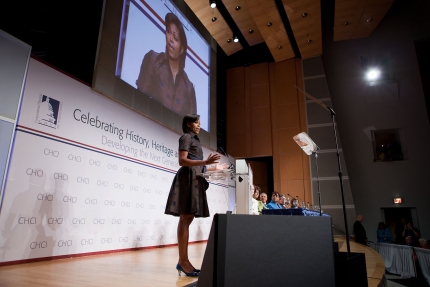
First Lady Michelle Obama delivers remarks before the Congressional Hispanic Caucus Institute

First Lady Michelle Obama delivers remarks before the Congressional Hispanic Caucus Institute Public Policy Conference in Washington. September 14, 2010. (Official White House Photo by Chuck Kennedy)

She discussed the need for forward-looking organizations like CHCI to address the challenges of tomorrow, particularly the challenge of childhood obesity in America. An issue important to Mrs. Obama, not just as First Lady, but as a mother.

Now, we all know this is a serious problem in every single community in this country. But like with so many of the other challenges we face today, communities of colors have been hit especially hard. Nearly two in five Hispanic children are overweight or obese. And this isn’t just teenagers or school-age kids that we’re talking about. Believe it or not, the obesity rate among Hispanic preschoolers is higher than their white or African American peers.

And we all know what this means for their overall health. We all know the links between obesity and cancer, diabetes, high blood pressure, and heart disease.

But we also know that childhood obesity is not a stand-alone problem. We know that it is bound up in just about every other issue that we face. It is about health care. It’s about education, economic opportunity. It’s about how our food is processed, and how our cities are designed, how our children spend each day in school. It’s about the restaurants where we eat, and the grocery stores where we shop, and the decisions we make for our children every single day: decisions about how much time they spend with TV and video games, as opposed to running around outside; decisions about what they eat, how much of it, and how often. So we all have a stake in this problem. And we all have a role in finding a solution.

That’s why the First Lady launched Let’s Move!a nationwide campaign to solve the problem of childhood obesity in a generation and she asked for CHCI's help in solving it. From working to sign up schools for the Healthier US Schools Challenge to encouraging kids to enroll in the 6-week President’s Active Lifestyle Awards program, there are countless ways to make an impact. And one way is by starting at home.

It’s about families making manageable changes that fit with their budgets and schedules, with their needs and with their tastes. And that might be something as simple as going for regular walks with your kids or maybe turning off the TV and turning on the radio and dancing a little bit in the living room until you break a sweat. (Laughter.) That counts.

Small things like cutting back on portion sizes or replacing soda with water or just putting some more fruits and vegetables on the table, all of this can add up over time and make a big difference in the lives of our kids. And, believe me, you don’t have to throw Abuela’s cookbook out the window. (Laughter and applause.)

There is a role for those time-honored family recipes, but it’s about moderation. It’s about doing our best to monitor what our kids are consuming. How many snacks are they eating? How many sodas are they drinking? Has dessert become an all-the-time food instead of just a once-in-a-while treat? It’s about being proactive, about going to the doctor and getting our kids screened for obesity.

But most of all, it’s about doing something. There are countless ways for us to start making a difference. The key is to start now, because when it comes to our children’s health and happiness, when it comes to their future, we don’t have a moment to waste. And if anyone knows what it takes to make real change in this country, it’s all of you. It’s what you’ve been doing for nearly 35 years.

In closing, the First Lady touched on the core mission of the organization and the health of our nation's kids:

Now I remember hearing that when you all started the Hispanic Caucus back in 1976, the Speaker of the House joked that the first meeting could be held in a phone booth, because back then you had just five members. And now, you have 23. (Applause.) CHCI’s first class of fellows was all of four strong. And today, there are more than 5,000 students that have benefited from your educational services and your leadership development programs.

See, now those are results, right? That’s the kind of real impact that you have had, and can have, on this nation and on our children. And that’s the core mission of this organization, to give our children opportunities that we never dreamed of for ourselves. And that’s why all of you have organized. It’s why you’ve marched. It’s why you stood up and spoke out and refused to back down, no matter what kind of odds you faced.

And I don’t think any one in this room -- or any of your parents or grandparents -- fought so hard for so long only to see a future where the greatest threat to our children is their own health.

But the good news is, is that we can do something about this. This is one of those problems that’s in our hand. The solution to this problem is right within our grasp, but only if we reach for it, and only if we work for it and fight for it, only if we once again summon that urgency that has spurred us forward, generation after generation, seeking something better for our children.


The White House

Office of the First Lady

Remarks by the First Lady to the Congressional Hispanic Caucus Institute

10:29 A.M. EDT

MRS. OBAMA:  Thank you so much, truly.  (Applause.)  Everyone, please.  Thank you so much.  Good morning.

AUDIENCE:  Good morning!

MRS. OBAMA:  Let me tell you, I am as thrilled to be here as you all sound.  (Laughter.)  I’m really honored.  And I’d like to thank the Congressional Hispanic Caucus and CHCI for inviting me to come speak at your policy conference today.  I know you’ve had a wonderful discussion, and I’m honored to be here.

Let me begin by first recognizing Secretary Sebelius.  I know she was here, but she has just done a tremendous job for the administration.  I want to recognize and thank all the members of the panel for their work and their contributions today.  And of course Representative Nydia Velasquez for -- yes -- (applause) -- for all that she does for the Hispanic Caucus and all that she’s done on behalf of this President.  Thank you so much.  And of course, CHCI’s Executive Director, Esther Aguilera.  Let’s give her a round of applause for her hard work.  (Applause.)

And finally, I’d like to thank all of you, not just for being here today, but for what you do every day for the Hispanic community and for America as a whole. 

Whether you’re a member of Congress, a local elected official, a CHCI alum, policy expert, or a community leader, I know that because you’re here, you’ve done so much for these communities, you care about the future of not just this community but of this country.   

For more than 30 years, CHCI has been fighting for that future.  With your scholarships, and fellowships, and career programs, you’re grooming the next generation of great American leaders.  I got to meet some of them backstage. 

You’re building a brighter future not just for our young people, but for all of us, because we all benefit from their talent, and their promise, and the contributions that they’re going to make to our nation.  So let’s give them all a round of applause, as well, truly.  (Applause.)  We are so very proud of you all.  (Applause.)  

And now more than ever before, we need forward-looking individuals and organizations just like all of you here in this room, because tomorrow, while it brings such great promise, it also brings a host of new challenges, as well.

And I’m here today because I want to talk about one of those challenges.  It’s an issue that keeps me up at night not just as First Lady, but as a mother –- and that is the health of our children, in particular, the epidemic of childhood obesity in America today. 

Now, we all know this is a serious problem in every single community in this country.  But like with so many of the other challenges we face today, communities of colors have been hit especially hard.  Nearly two in five Hispanic children are overweight or obese.  And this isn’t just teenagers or school-age kids that we’re talking about.  Believe it or not, the obesity rate among Hispanic preschoolers is higher than their white or African American peers. 

And we all know what this means for their overall health.  We all know the links between obesity and cancer, diabetes, high blood pressure, and heart disease. 

But we also know that childhood obesity is not a stand-alone problem.  We know that it is bound up in just about every other issue that we face.  It is about health care.  It’s about education, economic opportunity.  It’s about how our food is processed, and how our cities are designed, how our children spend each day in school.  It’s about the restaurants where we eat, and the grocery stores where we shop, and the decisions we make for our children every single day:  decisions about how much time they spend with TV and video games, as opposed to running around outside; decisions about what they eat, how much of it, and how often.  So we all have a stake in this problem.  And we all have a role in finding a solution. 

And that’s why, earlier this year, we launched “Let’s Move!”  “Let’s Move” is a nationwide campaign with one ambitious goal, and that’s to solve the problem of childhood obesity in a generation, so that kids born today can reach adulthood at a healthy weight.

And we’ve set a series of goals and benchmarks that we need to meet in order to reach our larger goal: everything from getting better food into our schools, to getting more grocery stores into our communities, to getting our kids up and moving, both at home and at school.

But every single one of you here in this room knows that government alone cannot solve this problem. 

See, as you know, here in Washington, we can help a bit.  We can help coordinate efforts, we can marshal resources, we can help raise awareness and get people engaged. 

But at the end of the day, when it comes time to act, when it comes time to actually make the changes that will make our kids healthier, it’s going to take folks like you -- leaders in our community, folks who do the hard work on the ground to actually make the changes that will make a difference in our children’s lives.

So I'm here today not just to talk with you about the problem, but to ask for your help in solving it.  And that starts in our own communities, because we know that if we want to raise healthy kids, we need to build healthy communities first.  And it means asking ourselves some questions, like are there parks and playgrounds where our kids can run around and play?  Are there sidewalks or bike paths that let them walk or ride to school safely?  Are there grocery stores that sell healthy food that is affordable that parents can actually buy?

We need every single one of you to help answer these questions.  And that means bringing all the stakeholders to the table, not just doctors and educators but restaurant owners and policy makers; folks from the park and recreation department -- anyone who might have some role to play in being part of the solution.

And that’s what folks are doing right now out in San Antonio. 

AUDIENCE MEMBER:  Yeah!

MRS. OBAMA:  Yeah, shout-out for San Antonio.  (Laughter and applause.)  You all are doing some good things.  There, the Metropolitan Health District brought together people from all across the community to form a task force to tackle obesity.  And this spring their mayor, Julián Castro, formed a city-wide fitness council that includes everyone from business leaders, to a university professor, to a former Dallas Cowboy.  And they’re giving away bikes to families.  They’re changing their physical education curriculum.  They’re encouraging restaurants to include more healthy options on their menu.  And they are providing free access to fitness facilities.

Now, San Antonio is doing this with the help of a grant from the Recovery Act.  Yay.  (Laughter and applause.)  But you don’t need a grant to take another look at what kids are doing in gym class.  You don’t need a grant to take high-calorie soda out of vending machines, or to tell families to get kids screened for obesity at their checkups. 

It doesn’t cost any money to convince a local chef to join our Chefs Move to Schools program.  Now, this is a program we started to bring chefs into our schools and help schools prepare healthier food for our kids.

In fact, when I think about it, given this organization’s longstanding focus on education, schools may very well be a perfect place for you all to focus your energy.

And I know that many of you have been following the Child Nutrition legislation that is currently before Congress.  This legislation helps make critical investments to provide better-quality meals to more of our children so that they can get the nutrition that they need to succeed.

Now, this is a bipartisan effort supported by folks on both sides of the aisle, and it’s already passed the Senate.  And I hope that the House of Representatives will act on this legislation by the end of this month so that we can get this bill signed into law.

But like always, there is plenty to do outside of Washington as well.  Now, how about working to sign up schools in your community for the Healthier US School Challenge?  This program recognizes schools that are doing the very best work to keep kids healthy -- from providing nutritious school meals to requiring regular physical education classes. 

Hollin Meadows Elementary School is a school right here in Alexandria, Virginia.  It’s a perfect example.  Now, this is a school where multiple languages are spoken and almost 50 percent of the students are eligible for free or reduced-price meals.  Nonetheless, they earned a Silver award in this challenge. 

And I had a chance to visit this school last fall, and the school’s principal and the parents told me about how the steps they took to make kids healthier -- something as simple as extending recess by 10 minutes -- has improved not just their health but their academic performance as well.

Now, we’ve set a goal of doubling the number of schools that participate in this challenge by June of next year.  And now we’re trying to sweeten the pot a bit by adding monetary incentives for award-winning schools.  And I'll be inviting representatives from each school to come to the White House for a reception in their honor.  So hopefully that’s something useful.  (Laughter and applause.)

But we need your help to get even more schools involved.  Now, that might mean raising money to install a salad bar in a lunchroom in your community.  It might mean planting a school garden and getting out there and getting a little dirty.  Or it might mean promoting other efforts to get kids active, like making a commitment to enroll a certain number of kids in the President’s Active Lifestyle Awards program.

Now, this is fun.  To earn this award, students need to engage in 60 minutes of physical activity five days a week for six weeks.  You all could help too -- go out for the awards, not just for kids -- (laughter) -- because if you meet the goal, you get a certificate from the President.  (Laughter.) 

Now, the idea behind this award is pretty straightforward.  We want to get -- make physical activity habit-forming for kids, to show them how good it feels to be active so that they keep it up long after the six weeks are over. 

And that’s a good example of the last point that I want to make today, and that it’s really the small actions, it’s the changes we all can make in our own families that often make all the difference.  See, the fact is many of the most important decisions about what our kids eat and how active they are, are made by all of us, not as policy-makers or educators or medical professionals, but as parents and grandparents. 

Now, I want to be clear right from the start that this isn’t about completely depriving our kids of the foods they love.  It is not about getting rid of those dishes that mean so much in our families and in our cultures.  And it is certainly not about parents becoming drill sergeants and demanding that their kids drop and give them 20 -- (laughter) -- or run five miles every day.  It’d be good, but you don’t have to do that.  (Laughter.) 

Instead, it’s about families making manageable changes that fit with their budgets and schedules, with their needs and with their tastes.  And that might be something as simple as going for regular walks with your kids or maybe turning off the TV and turning on the radio and dancing a little bit in the living room until you break a sweat.  (Laughter.)  That counts.

Small things like cutting back on portion sizes or replacing soda with water or just putting some more fruits and vegetables on the table, all of this can add up over time and make a big difference in the lives of our kids.  And, believe me, you don’t have to throw Abuela’s cookbook out the window.  (Laughter and applause.) 

There is a role for those time-honored family recipes, but it’s about moderation.  It’s about doing our best to monitor what our kids are consuming.  How many snacks are they eating?  How many sodas are they drinking?  Has dessert become an all-the-time food instead of just a once-in-a-while treat?  It’s about being proactive, about going to the doctor and getting our kids screened for obesity. 

But most of all, it’s about doing something.  There are countless ways for us to start making a difference.  The key is to start now, because when it comes to our children’s health and happiness, when it comes to their future, we don’t have a moment to waste.  And if anyone knows what it takes to make real change in this country, it’s all of you.  It’s what you’ve been doing for nearly 35 years. 

Now I remember hearing that when you all started the Hispanic Caucus back in 1976, the Speaker of the House joked that the first meeting could be held in a phone booth, because back then you had just five members.  And now, you have 23.  (Applause.)  CHCI’s first class of fellows was all of four strong.  And today, there are more than 5,000 students that have benefited from your educational services and your leadership development programs.

See, now those are results, right?  That’s the kind of real impact that you have had, and can have, on this nation and on our children.  And that’s the core mission of this organization, to give our children opportunities that we never dreamed of for ourselves.  And that’s why all of you have organized.  It’s why you’ve marched.  It’s why you stood up and spoke out and refused to back down, no matter what kind of odds you faced. 

And I don’t think any one in this room -- or any of your parents or grandparents -- fought so hard for so long only to see a future where the greatest threat to our children is their own health. 

But the good news is, is that we can do something about this.  This is one of those problems that’s in our hand.  The solution to this problem is right within our grasp, but only if we reach for it, and only if we work for it and fight for it, only if we once again summon that urgency that has spurred us forward, generation after generation, seeking something better for our children.

So I’m here because we need you once again.  We need you to go back home.  We need you to drive this conversation in your communities.  We need you to roll up your sleeves and we need you to get more people involved to understand what’s at stake.  Our schools need you, our families need you, and certainly our country needs you. 

And if we come through on this one, which I know we can if we all do our part, then I know that we can give our children the bright future they deserve. 

So I want to thank you all.  I want to thank you for what you’ve done.  I want to thank you for what you continue to do.  And I truly look forward to partnering with each and every one of you in the months and years to come, because we can eliminate this problem for our children and our grandchildren. 

So thank you all so much.  God bless you and congratulations on a wonderful conference.  (Applause.) 

END
10:47 A.M. EDT
 

The First Lady Challenges Restaurants to Offer Healthy Options

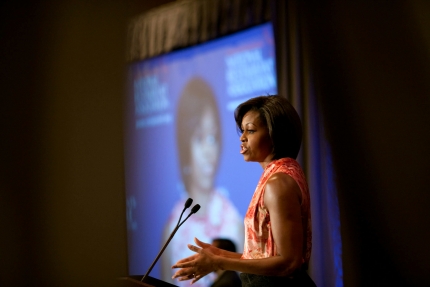
First Lady Michelle Obama delivers remarks to the National Restaurant Association

First Lady Michelle Obama delivers remarks at the National Restaurant Association’s Fall Board Meeting at the Hyatt Regency Washington on Capitol Hill in Washington, DC. September 13, 2010. (Official White House Photo by Lawrence Jackson)

“So today I’m going to talk about food, which is something that all of you here today know a little bit about,” said First Lady Michelle Obama to an audience representing forty percent of the nearly one million restaurants in the United States, from the biggest chains to the smallest diners, at the National Restaurant Association Meeting in Washington, DC.

The First Lady discussed Let’s Move!, her nationwide campaign to solve the problem of childhood obesity in a generation, so that kids born today can reach adulthood at a healthy weight. Let’s Move! is about attacking the problem from all different angles – from giving parents the information and the resources they need to making sure every community has access to fresh and nutritious food. Today, the First Lady called on America’s restaurant owners for their help, challenging them to offer healthy, accessible menu options: