The White House

Office of the First Lady

First Lady Michelle Obama To Harvest The White House Kitchen Garden, Highlight Pollinators

Wednesday, June 3, 2015

Washington, DC * 3:30 PM – The First Lady will welcome students from across the country who participate in the ten Let’s Move! sub-initiative programs to harvest the White House Kitchen Garden. In 2009, Mrs. Obama planted a vegetable garden on the South Lawn to initiate a national conversation around the health and wellbeing of our nation—a conversation that evolved into her Let’s Move! initiative.

This garden harvest will highlight the important role of pollinators in the healthy food that we grow and consume. Last year, Mrs. Obama planted a pollinator garden next to the White House Kitchen Garden to support bees, monarch butterflies, and other pollinators as part of Administration efforts to promote pollinator health. Pollinators play a critical role in supporting agricultural production, and they are responsible for one out of every three bites of food we take. Because pollinators are facing disturbing signs of decline from a variety of causes, important efforts are underway to support pollinator health and habitat.

In addition to strategies and recommendations outlined by the Administration’s Pollinator Health Task Force, outside organizations have stepped up to support pollinators.  This year, W. Atlee Burpee & Co. donated one million pollinator seed packets to the U.S. Department of Agriculture and the Department of Interior to encourage people to plant pollinator gardens in communities across the country. Nearly 30,000 of these seed packets were distributed to families at this year’s Easter Egg Roll.  As well, the newly established National Pollinator Garden Network is launching on Wednesday the Million Pollinator Garden Challenge, a nationwide call to action to preserve and create gardens and landscapes that help revive the health of pollinators. More information on this challenge will be available at Wednesday’s event.

To help her with the harvest, Mrs. Obama invited children from schools and locations that participate in the ten Let’s Move! programs, representing the millions of Americans that have been impacted by the Let’s Move! initiative. Children from each of these programs also joined the First Lady at this year’s garden planting in April. These programs (full list below) were launched in collaboration with federal agencies, businesses, and non-profits to mobilize every sector to work in alignment with the overall goals of Let’s Move! and offer solutions, objectives, and technical assistance to help kids and families lead healthier lives.

The event will be livestreamed at www.whitehouse.gov/live.

Children from the following Let’s Move! programs will participate in the planting:


Let’s Move! Active Schools (LMAS)

Let’s Move! Active Schools is the national solution to ensure 60 minutes of physical activity is the new norm for schools.

  • Seaton Elementary School – Washington, DC
Let’s Move! Child Care (LMCC)

Let’s Move! Child Care is a nationwide call-to-action that empowers child care and early education providers to make positive health changes in children that could last a lifetime.

  • CentroNia Daycare Center – Washington, DC
Let’s Move! Cities, Towns and Counties (LMCTC)

Let's Move! Cities, Towns and Counties assists local elected officials as they implement policy and environmental changes to prevent childhood obesity.

  • Greenbelt Recreation Department – Greenbelt, MD
Let’s Move! Faith and Communities (LMFC)

Let’s Move! Faith and Communities encourages faith-based and neighborhood organizations to initiate, expand, and coordinate activities that make their communities places of wellness for kids and families.

  • Langley Park McCormick – Hyattsville, MD
Let’s Move! in Indian Country (LMIC)

Let's Move! in Indian Country seeks to improve the health of American Indian and Alaska Native children, who are affected by childhood obesity at some of the highest rates in the country.

  • Oglala Sioux Tribe Child Care and Development Program– Pine Ridge, SD
Let’s Move! Museums and Gardens (LMMG)

Through Let’s Move! Museums & Gardens, museums of all types — from children’s museums and public gardens to zoos, science centers, and art and history museums — inspire healthy habits.

  • Lewis Ginter Botanical Garden – Henrico, VA
Let’s Move! Outside (LMO)

Let’s Move! Outside was created to get kids and families to take advantage of America’s great outdoors-which abound in every city, town and community.

  • Frederick Douglas National Historic Site – National Capital Region
Let’s Move! Salad Bars to Schools (LMSB2S)

Let’s Move! Salad Bars to Schools has a simple, yet lofty goal, for every school in the United States to have a salad bar so that every child -- from elementary school, to middle school, to high school -- has daily access to healthy foods.

  • Carrollton Middle School – Carrollton, GA
Let’s Read! Let’s Move! (LRLM)

Let’s Read! Let’s Move! is an initiative that aims to increase awareness about the critical importance of learning, nutrition, and physical activity through reading. 

  • Carlin Springs Elementary School – Arlington, VA
Chefs Move to Schools (CMTS)

Chefs Move to Schools encourages chefs to volunteer in schools and partner with teachers, parents, school nutritionists, food service directors, and administrators.

  • Charles Powell Community Center – Memphis, TN

Mrs. Obama will also be joined in the garden by students from Bancroft Elementary School and Harriet Tubman Elementary School, who have been active participants in the White House Kitchen Garden since the very first planting.

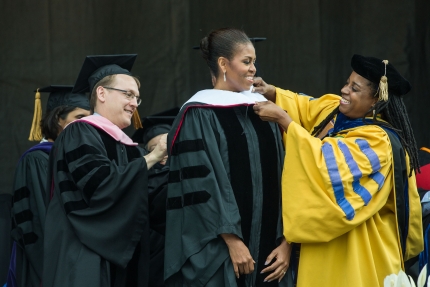
The First Lady Celebrates the 2015 Graduates of Oberlin College

This afternoon, First Lady Michelle Obama addressed the Class of 2015 at Oberlin College in Ohio. 

First Lady Michelle Obama at Oberlin College

First Lady Michelle Obama is presented an honor sash during Oberlin College commencement ceremony in Oberlin, Ohio May 25, 2015. (Official White House Photo by Amanda Lucidon)

The First Lady addressed the graduating Oberlin College class because Oberlin College was selected as part of the First Lady’s Reach Higher initiative’s “Near-Peer Mentoring College” Challenge – a challenge to institutes of higher education urging them to share videos on the ways they are helping high school students take charge of their future.

The White House

Office of the First Lady

Remarks by The First Lady at Elizabeth Dole Foundation Caregiver Summit

Reagan Building
Washington, D.C.

3:39 P.M. EDT

MRS. OBAMA:  Thank you so much.  (Applause.)  Well, hello.  I think Kat is a hard act to follow.  She’s pretty amazing.  (Applause.)  Yes, absolutely. 

But I want to start by thanking Senator Dole for her remarks, but more importantly, for her extraordinary leadership on such an important issue in this country.  And I also have to recognize Secretary McDonald for all of his efforts on behalf of our veterans and their families, as well as everyone from the Elizabeth Dole Foundation, especially all of your tremendous Caregiver Fellows that we have here with us today. 

And again, finally, I have to thank one of those Fellows -- Kat -- for sharing her remarkable story.  I met Kat a couple of weeks ago at the White House, and as you just heard, her story, it exemplifies the dedication and the courage and the resilience that defines our nation’s caregivers.  She blew me away back then.  And I told her, I told Kat -- I said, she’s in.  We're going to suck her up and -- (laughter.)  She didn’t believe me, but I was like, this won't be the last time you see me.  (Laughter.)  She’s pretty amazing.  And she’s been through a lot even today.  And she’s here, and I'm so proud of you.  You’ve got an amazing voice on this issue.   

Although there are just over one million caregivers for our post-9/11 veterans in this country -- they are spouses and parents, siblings, friends, neighbors who serve and sacrifice, hour after hour, day after day, right alongside our wounded warriors. 

While our country has become familiar with the inspiring stories of servicemembers who’ve risked their lives for this country -- we honor these men and women with parades and ceremonies, we have begun to tell their stories in movies and on TV -- the stories of our caregivers too often go untold.  We don’t always hear about the quiet courage of a spouse like Kat, who’s there for her husband almost every hour of every single day.

We don’t always see the sister who quits her job to support her brother as he learns to stand again, and walk again, and run again.  Or the father who retires early so he can drive his daughter to her rehab appointments, and consult with her doctors, and assist with the painstaking work of recovery. 

All of the caregivers here today understand how your life can be flipped upside down in an instant.  You know the feeling that Kat described to me a couple of weeks ago -- this is what she said.  She said:  “Everything from before is gone.  Any dreams you had, any plans,” she said, “it’s burned up.  It’s in a house that’s on fire, and there’s no going back to it.”  Those words hit me deeply.  

But Kat wasn’t angry, and she wasn’t looking for sympathy when she said those words.  It’s simply how she felt.  It was her truth.  It was her reality.  Because she knows she’s lucky to have her husband alive at all.  As she says, as a caregiver, at least “you get to rebuild together.”  That was beautiful.  

And as you all know, the rebuilding process is not easy for your loved one -- or for you.  You love your warrior with all your heart, and you’re proud to help them recover.  But as the days become months, and the months become years, the constant giving, and giving, and giving can become its own heavy weight.  You might have trouble sleeping, or finding some time for yourself.  Your marriage might suffer.  You might worry about your job security because of all the time you need to take off.  Or you might begin to feel distant from friends or family -- folks who mean well, but they don’t quite understand everything you’re going through.

It can be isolating, and physically and emotionally exhausting.  Kat told me she’s never felt worse than those nights she’d go to bed and tell herself that she was just too tired, that she didn’t have anything more to give.  And as we know from the RAND study that Senator Dole commissioned last year, those emotional lows are not uncommon.  Our caregivers are more likely than the general population to face mental health challenges like depression.

But here’s what makes caregivers like you all so inspiring for me.  No matter what you're going through, you always find a way to dig just a little deeper.  You always find more to give.  You always keep moving forward and rebuilding for your families. 
And we are here today because we want to show you that you're not alone in this journey -- because here in America, caring for our wounded warriors cannot be a one-person assignment.  It’s a solemn obligation for our entire country to be there for you.  It’s a crucial part of securing our nation.  (Applause.)

You all are a part of that security that helps keep us all safe.  And it’s a way for the rest of us to fulfill our duty to those who’ve sacrificed so much.  But we can’t just say those things –- we’ve got to do something that makes a real difference in our caregivers’ lives. 

And that’s why, five years ago, my husband signed a groundbreaking law that supports caregivers with financial stipends and travel reimbursements, as well as access to health care, respite care, and so much more.  And it’s why our Joining Forces initiative has been working hand in hand with the Dole Foundation to rally folks across the country to support our caregivers. 

And last April, as many of you know, we hosted an event at the White House to launch the Hidden Heroes coalition -– as you know, a collection of public and private partners who were stepping up to address this issue.  Throughout this day, you’ve heard about all the incredible progress this coalition has made in the time since on issues like employment and education, community support.  And every step of the way, the Dole Foundation and their partners kept asking themselves:  How can we make an even bigger impact?  What gaps are we missing?  Who else can we get involved?

And that’s led to an even deeper focus on the area of mental health because we know that mental health is an issue that’s too often swept under the rug; that in our country, there’s sometimes a reluctance to talk about these issues or to get the help that we need. 

So today I’m proud to announce a series of new commitments from the Dole Foundation and Give an Hour, which is a wonderful  -- yes, Give an Hour.  (Applause.)  Give an Hour is an amazing nonprofit that’s leading a nationwide mental health awareness effort called The Campaign to Change Direction. 

First, they’re teaming up with Easter Seals on a training webinar to educate caregivers on the campaign’s five signs of mental distress –- signs like withdrawal, or agitation, a decline in personal care –- so that caregivers can identify those signs when they see them, and then get their warriors, their families, or themselves the help they need. 

Second, they’re training faith leaders all across the country on those five signs -- because we know that clergy are often the first people caregivers will turn to for help.

And then, third, they’re educating community mental health providers on military culture, so that if a caregiver or a warrior seeks help outside of the VA system, it’s easier to find a provider who understands the unique stresses and demands of military life. 

So this is a wonderful series of commitments, and I’m especially excited about them because they’re not simply focused on caregivers and their families, but on the communities that surround them as well.  Because if we’re going to tell our caregivers that they’re not alone, then we’ve got to enlist others who can be there to support them -- folks who truly understand what they’re going though.  And we know that one of the best ways we can do that is to help you guys connect with those folks.

You might remember a story I told last year about when I visited with a group of caregivers at Fort Belvoir -- how those five women opened up to each other and started troubleshooting, connecting each other with resources, and offering tips and advice on the things they figured out along the way.  It was the first time the folks at Fort Belvoir had convened a group like this, and they immediately saw the value in it and made a commitment to expand the program at their base. 

And today, that group is serving more than 100 caregivers at Fort Belvoir alone.  And building from that success, I'm proud to announce that the Department of Defense has launched peer support groups like that same one at more than 60 military facilities around the world.  (Applause.)

And they’re holding monthly online forums for folks who aren’t able to make it to an in-person meeting.  So this is the thing -- in just a little more than a year, we’ve gone from a single meeting of five women to a worldwide network of in-person groups and online resources that serve caregivers no matter where they live.

And here at the Dole Foundation, you all are facilitating the same kind of connection with your online peer support network.  And many of your fellows are reaching out online and in their own communities as well.  For example, one of your fellows -- Blair Hughes -- facilitates an online community of more than 1,000 members that reviews products and resources online.  It’s kind of like a Yelp for the caregivers.  (Laughter.)  So it’s good stuff.  (Applause.)

So every day we’re seeing more and more resources and programs specifically designed for those who care for our wounded warriors.  And now we’ve got to make sure that our caregivers out there understand that those resources exist.  We got to make sure that they know where to find them, how to connect with folks who want to support them. 

So to all the caregivers out there, I just want to make sure you know that you can go to whitehouse.gov/caregivers where you can get connected to support through the VA, the DOD, and many other resources.  That’s just one place you can go. 

Or if you’re looking for in-person support, you can go to your local VA -- one of your vet centers.  I visited one of those centers -- they’re amazing.  They’re more state of the art.  Or if you’re living on base, I want you to go to your Recovery Care Coordinator -- or anyone on base who can connect you with the resources that you need.

And that’s really what Joining Forces is all about.  We want to connect you to the people, resources, and opportunities that can make a difference in your daily lives so that as you rebuild with your families, you never have to do it alone.  You’ll have employers, and health care providers, and neighbors who better understand your experience and how they can help.  That’s what we’re working toward.  Not just today, and not just for these next couple of years -- but for the long haul. 

Because this isn’t just something I’m doing as First Lady -- it’s something I'm doing as an American.  And I look forward to working with whichever family follows ours in the White House to keep on addressing these caregiver issues and all the issues our veterans and military families are facing.  Because as we see right here in this room today, this is an issue that everyone can get behind, no matter what political party you belong to. 

So to all the caregivers here today, and you’re families, I want you to know that we’re not done yet.  We know that we have more work to do.  And as I said last year, I think if we’re falling short, if there are any gaps that we need to keep filling, we want to know about it and we want to try to keep getting better.  Because we want to serve you as well as you have served us. 

You’re some of the most inspiring people I’ve ever met in my life.  And all of us here in this room, and all across this country, want you to feel all of our love and our support every single day.  Not just when we gather you here in Washington -- but every single day.  This is nice, too, right?  (Laughter.)  It’s not bad. 

So, again, I want to thank you.  Thank you all for your service, your commitment to this country.  And I look forward to continuing our work together in the years ahead. 

God bless you all.  (Applause.)

END 
3:54 P.M. EDT

The First Lady Honors the 2015 National Medal for Museum and Library Service Recipients

May 18, 2015 | 21:56 | Public Domain

First Lady Michelle Obama delivers remarks to honor the 2015 National Medal for Museum and Library Sciences in the East Room of the White House. May 18, 2015.

Download mp4 (810MB) | mp3 (53MB)

The White House

Office of the First Lady

Remarks by the First Lady at Ceremony Honoring at Ceremony Honoring the 2015 National Medal for Museum and Library Service

East Room

11:16 A.M. EDT

MRS. OBAMA:  Good morning, everyone.  Please rest yourselves.  Welcome.  Welcome to the White House.  Yay!  (Laughter.)  We’re thrilled to have you here today as we honor the winners of the 2015 National Medal for Museum and Library [Service].

I want to start by thanking Maura for that wonderful introduction, but for her leadership at the institute -- all the work you've done.  It’s been terrific.  I know that last month, you helped the President launch exciting new initiatives to ensure that every student in this country has a library card.  (Applause.)  Go figure.  It’s good stuff.  But also to provide every student with free e-books -- or free e-books to millions of low-income students.  So terrific work.  Thank you.  We're so grateful for the work that you've done.  So keep it up.  Keep it up.

I also want to recognize Representative Kirkpatrick, who I heard was here.  Where?  Oh, there you are?  How are you?  (Applause.)  Wonderful to have you here.  Thanks for much. 

And, of course, most of all, I want to congratulate all of ours awardees.  With your innovative programming, technological savvy, enthusiastic engagement with your communities, you all are truly setting the standard for libraries and museums all across this country.

And I know that you don’t always get the recognition that you deserve for the important work that you do, which is why this event is so important, why I make it a point to be here every single year.

I know that some folks may view our libraries and museums as “extras,” luxuries, not necessities -- as places we should invest in after we’ve achieved all of our others goals, things like creating jobs or educating our kids or making sure our families live healthy lives.  But we all know better than that, right?  We know that so often our libraries and museums are doing the critical work to help us achieve those goals in the first place. We can't get to our goals without the work that you all do on the ground. 

The institutions that we’re honoring here today are at the heart of so many of our communities, engaging in some of the most urgent issues of our time.  And in just a moment, you’re going to learn more about the amazing work that today’s honorees do.  I want to congratulate the board on another wonderful year of selections -- the diversity, the depth, the breadth.  You guys did it again.

Our honorees are doing everything from preparing young people for college, helping entrepreneurs build their businesses, supporting veterans as they transition from military to civilian life, to providing financial literacy and nutrition workshops for parents.

And whether you’re bringing virtual classes in STEM education to remote areas and inner-city communities, or teaching our children about their Native American and African American heritage, so many of you are working to close the heartbreaking opportunity gaps that limit the horizons of too many people in this country.

And trust me, I know that this work isn’t easy.  I know that you’re always strapped for time and money, always scrambling to meet those fundraising goals and those grant applications.  You can get an “Amen” on that.  (Laughter.)  But the services that you all provide are not luxuries; just the opposite.  Every day, your institutions are keeping so many folks in this country from falling through the cracks. 

In many communities, our libraries and museums are the places that help young people dream bigger and reach higher for their futures; the places that help new immigrants learn English and apply for citizenship; the places where folks access a computer and send a job application so they can get back to work and get back to the important process of supporting their families.  So every day, you all bring so much hope and so many life-changing opportunities to folks across this country.

And today, I want you to know how proud I am, and how grateful I am for all the work that you do.  It’s really good stuff.  So I want to, once again, congratulate you.  I hope this day is special.  One of the reasons we do it is to make you feel as special as the work that you do around the communities.  This isn’t enough, but it’s just a small way to remind the country that we have great resources here.  They are unique to this country.  And it’s up to all of us to support them, encourage them, to finance them, and to keep them alive and growing.

So I hope you enjoy your time here.  We're just proud, and we hope you keep going, year after year after year. 

So, with that, I’m going to thank you guys, and we're going to get to the process of getting our awardees awarded.  (Laughter.)  So let’s go.

(The awards are presented.)  (Applause.) 

MRS. OBAMA:  So let’s give one more round of applause to today’s honorees.  (Applause.)  You can just see from hearing the citations just the tremendous work that you all do.  And to all the community representatives who are here on behalf of the programs -- so proud of you all.  Really.  You are true spokespeople for your communities, for the institutions, and for this country. 

So I just urge you to keep doing the work.  Don’t get tired. That’s what I whispered in many people’s ears -- just don’t get tired.  (Laughter.)  And I can’t say it enough, but we’re so proud.  We’re honored to have you here.  We’re grateful for all that you do.  And I just can’t wait to see all that you continue to do in the years ahead. 

It’s up to us to support you.  So, hopefully, as we shine a light on your work, there will be somebody out there that will think, ah, maybe I’ll check out my library, maybe I’ll write a check -- (laughter) -- maybe I’ll do a little bit more in my museums.  Because in the end, that’s what it’s going to take to keep these programs and these institutions thriving.

And this is just an example of -- 10 of the organizations that are in communities all across this country.  We could be here for days celebrating the institutions.  We just can’t do it all.  So you guys are representing what’s going on out there all across the country.

So that concludes our program today.  But we invite you all to stay.  We have a wonderful reception for you all.  As my husband says, just make sure you keep the house a little neat.  (Laughter.)  You can take the napkins, but not the forks.  (Laughter.)  But I hope you enjoy your time here at the White House.  And, Colin, feel free to sit on anything -- you can touch anything.  (Laughter.)  This house is yours.  (Laughter.)  Have a ball, all right? 

You all, thank you.  And we’ll see you next year.  (Applause.) 

END
11:37 A.M. EDT

Week In Review: A Commencement Address, Discussing Poverty, and a Business Spark

This week, the President traveled to Nike headquarters, welcomed entrepreneurs to the White House, sat down for a discussion on poverty in America, and took important steps to eliminate any ambiguity around the reforms that the Affordable Care Act calls for. The First Lady also had a busy week, which included delivering a powerful commencement address at Tuskegee University--the only university in America to be designated as a National Historic Site. 

Find out more about the past week in our latest weekly wrap-up.


“We’ve Got to Learn the Right Lessons”

Last Friday, the President dropped by Nike headquarters in Oregon to talk about the impact his trade deal -- the Trans-Pacific Partnership (TPP) -- will have on American businesses, large and small. Manufacturing and exports help drive the success of our businesses and the financial security of our workers. Companies that export their goods and services pay their employees up to 18 percent more, and are more able to expand and hire.

Watch on YouTube

In fact, Nike announced that the President's trade deal, if secured, could lead to the creation of up to 10,000 advanced manufacturing and engineering jobs -- and up to 40,000 indirect supply chain and services jobs -- here in the U.S. over the next decade.

Watch the President’s remarks at Nike, and learn more about his trade deal.

Chris Evans is an intern in the White House Office of Digital Strategy.
Related Topics: Grab Bag, Alabama, Ohio, Oregon

Must Watch: 5 of Our Favorite Obama Administration Commencement Addresses

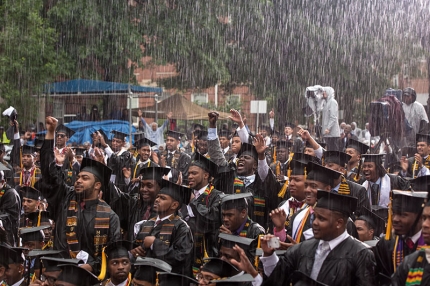
Graduates react as President Barack Obama delivers remarks during the commencement ceremony at Morehouse College

Graduates react as President Barack Obama delivers remarks during the commencement ceremony at Morehouse College in Atlanta, Ga., May 19, 2013. (Official White House Photo by Pete Souza)

It's commencement season.

As the President prepares to head to Connecticut to deliver the address to the United States Coast Guard Academy's graduating class of 2015 next week, we decided to pull together a few of our favorite commencement addresses from Administration officials.

We think you'll find them pretty inspiring. Have another commencement speech you love? Tweet them to me at @Holst44.

In Case You Missed It: The First Lady's Powerful Remarks to Tuskegee University's Class of 2015

Watch on YouTube

This past Saturday, First Lady Michelle Obama delivered the commencement address to the Class of 2015 at Tuskegee University -- a historically black university in Tuskegee, Alabama. Founded by Booker T. Washington in 1881, Tuskegee is the only university in America to be designated as a National Historic Site.

Related Topics: Higher Education, Alabama

The First Lady, Dr. Biden, and Ben Folds Celebrate Military-Connected Moms

To celebrate Military Spouse Appreciation Day and an early Mother's Day, the First Lady and Dr. Biden invited military-connected moms to the White House for their annual Mother’s Day Tea.

These mothers, grandmothers, and their guests enjoyed sandwiches, cupcakes, and shortbreads with a selection of teas and juices. Kids came too to make Mother’s Day gifts of petal potpourri, lace-topped cupcakes, and even potted-flower cakes.

The First Lady and Dr. Biden greeted the spouses, thanked all military-connected moms, and recognized their service.

The White House

Office of the First Lady

Remarks by the First Lady at Tuskegee University Commencement Address

Tuskegee University

Tuskegee, Alabama

12:30 P.M. CDT

MRS. OBAMA:  Thank you all.  (Applause.)  Thank you so much. (Applause.)  Let’s let our graduates rest themselves.  You’ve worked hard for those seats!  (Applause.) 

Let me start by thanking President Johnson for that very gracious introduction, and for awarding me with this honorary degree from an extraordinary institution.  I am proud to have this degree -- very proud.  (Applause.)  Thank you.  Thank you so much.  (Applause.) 

I want to recognize Major General Williams; Congresswoman Sewell; Zachary; Kalauna; to all of the trustees, the faculty, the staff here at Tuskegee University.  Thank you -- thank you so much for this warm welcome, this tremendous hospitality.  And I'm so glad to be here.  (Applause.)   

Before I begin, I just want to say that my heart goes out to everyone who knew and loved Eric Marks, Jr.  I understand he was such a talented young man, a promising aerospace engineer who was well on his way to achieving his dream of following in the footsteps of the Tuskegee Airmen.  And Eric was taken from us far too soon.  And our thoughts and prayers will continue to be with his family, his friends, and this entire community.  (Applause.)   

I also have to recognize the Concert Choir.  Wow, you guys are good!  Well done!  (Applause.)  Beautiful song.  (Applause.) And I have to join in recognizing all the folks up in the stands -- the parents, siblings, friends -- (applause) -- so many others who have poured their love and support into these graduates every step of the way.  Yeah, this is your day.  (Applause.)  Your day. (Applause.)   

Now, on this day before Mother’s Day, I’ve got to give a special shout-out to all the moms here.  (Applause.)  Yay, moms! And I want you to consider this as a public service announcement for anyone who hasn’t bought the flowers or the cards or the gifts yet -- all right?  I’m trying to cover you.  (Laughter.)  But remember that one rule is “keep mom happy.”  (Laughter.)  All right?  (Applause.)   

And finally, most of all, I want to congratulate the men and women of the Tuskegee University Class of 2015!  (Applause.)    T-U!

AUDIENCE:  You know!

MRS. OBAMA:  I love that.  (Applause.)  We can do that all day.  (Laughter.)  I'm so proud of you all.  And you look good.  (Applause.)  Well done!     

You all have come here from all across the country to study, to learn, maybe have a little fun along the way -- from freshman year in Adams or Younge Hall -- (applause) -- to those late night food runs to The Coop.  (Applause.)  I did my research.  (Applause.)  To those mornings you woke up early to get a spot under The Shed to watch the Golden Tigers play.  (Applause.)  Yeah!  I've been watching!  (Laughter.)  At the White House we have all kinds of ways.  (Laughter.)    

And whether you played sports yourself, or sang in the choir, or played in the band, or joined a fraternity or sorority -- after today, all of you will take your spot in the long line of men and women who have come here and distinguished themselves and this university.

You will follow alums like many of your parents and grandparents, aunts and uncles -- leaders like Robert Robinson Taylor, a groundbreaking architect and administrator here who was recently honored on a postage stamp.  (Applause.)  You will follow heroes like Dr. Boynton Robinson -- (applause) -- who survived the billy clubs and the tear gas of Bloody Sunday in Selma.  The story of Tuskegee is full of stories like theirs -- men and women who came to this city, seized their own futures, and wound up shaping the arc of history for African Americans and all Americans.

And I’d like to begin today by reflecting on that history -- starting back at the time when the Army chose Tuskegee as the site of its airfield and flight school for black pilots.  (Applause.)   

Back then, black soldiers faced all kinds of obstacles.  There were the so-called scientific studies that said that black men’s brains were smaller than white men’s.  Official Army reports stated that black soldiers were “childlike,” “shiftless,” “unmoral and untruthful,” and as one quote stated, “if fed, loyal and compliant.” 

So while the Airmen selected for this program were actually highly educated -- many already had college degrees and pilots licenses -- they were presumed to be inferior.  During training, they were often assigned to menial tasks like housekeeping or landscaping.  Many suffered verbal abuse at the hands of their instructors.  When they ventured off base, the white sheriff here in town called them “boy” and ticketed them for the most minor offenses.  And when they finally deployed overseas, white soldiers often wouldn’t even return their salutes.

Just think about what that must have been like for those young men.  Here they were, trained to operate some of the most complicated, high-tech machines of their day -- flying at hundreds of miles an hour, with the tips of their wings just six inches apart.  Yet when they hit the ground, folks treated them like they were nobody -- as if their very existence meant nothing.

Now, those Airmen could easily have let that experience clip their wings.  But as you all know, instead of being defined by the discrimination and the doubts of those around them, they became one of the most successful pursuit squadrons in our military.  (Applause.)  They went on to show the world that if black folks and white folks could fight together, and fly together, then surely -- surely -- they could eat at a lunch counter together.  Surely their kids could go to school together. (Applause.)

You see, those Airmen always understood that they had a “double duty” -- one to their country and another to all the black folks who were counting on them to pave the way forward.  (Applause.)  So for those Airmen, the act of flying itself was a symbol of liberation for themselves and for all African Americans. 

One of those first pilots, a man named Charles DeBow, put it this way.  He said that a takeoff was -- in his words -- “a never-failing miracle” where all “the bumps would smooth off… [you’re] in the air… out of this world… free.” 

And when he was up in the sky, Charles sometimes looked down to see black folks out in the cotton fields not far from here -- the same fields where decades before, their ancestors as slaves. And he knew that he was taking to the skies for them -- to give them and their children something more to hope for, something to aspire to.

And in so many ways, that never-failing miracle -- the constant work to rise above the bumps in our path to greater freedom for our brothers and sisters -- that has always been the story of African Americans here at Tuskegee.  (Applause.)   

Just think about the arc of this university’s history.  Back in the late 1800s, the school needed a new dormitory, but there was no money to pay for it.  So Booker T. Washington pawned his pocket watch to buy a kiln, and students used their bare hands to make bricks to build that dorm -- and a few other buildings along the way.  (Applause.)  

A few years later, when George Washington Carver first came here for his research, there was no laboratory.  So he dug through trash piles and collected old bottles, and tea cups, and fruit jars to use in his first experiments. 

Generation after generation, students here have shown that same grit, that same resilience to soar past obstacles and outrages -- past the threat of countryside lynchings; past the humiliation of Jim Crow; past the turmoil of the Civil Rights era.  And then they went on to become scientists, engineers, nurses and teachers in communities all across the country -- and continued to lift others up along the way.  (Applause.)

And while the history of this campus isn’t perfect, the defining story of Tuskegee is the story of rising hopes and fortunes for all African Americans.  

And now, graduates, it’s your turn to take up that cause.  And let me tell you, you should feel so proud of making it to this day.  And I hope that you’re excited to get started on that next chapter.  But I also imagine that you might think about all that history, all those heroes who came before you -- you might also feel a little pressure, you know -- pressure to live up to the legacy of those who came before you; pressure to meet the expectations of others. 

And believe me, I understand that kind of pressure.  (Applause.)  I’ve experienced a little bit of it myself.  You see, graduates, I didn’t start out as the fully-formed First Lady who stands before you today.  No, no, I had my share of bumps along the way.

Back when my husband first started campaigning for President, folks had all sorts of questions of me:  What kind of First Lady would I be?  What kinds of issues would I take on?  Would I be more like Laura Bush, or Hillary Clinton, or Nancy Reagan?  And the truth is, those same questions would have been posed to any candidate’s spouse.  That’s just the way the process works.  But, as potentially the first African American First Lady, I was also the focus of another set of questions and speculations; conversations sometimes rooted in the fears and misperceptions of others.  Was I too loud, or too angry, or too emasculating?  (Applause.) Or was I too soft, too much of a mom, not enough of a career woman? 

Then there was the first time I was on a magazine cover -- it was a cartoon drawing of me with a huge afro and machine gun. Now, yeah, it was satire, but if I’m really being honest, it knocked me back a bit.  It made me wonder, just how are people seeing me.

Or you might remember the on-stage celebratory fist bump between me and my husband after a primary win that was referred to as a “terrorist fist jab.”  And over the years, folks have used plenty of interesting words to describe me.  One said I exhibited “a little bit of uppity-ism.“  Another noted that I was one of my husband’s “cronies of color.”  Cable news once charmingly referred to me as “Obama’s Baby Mama.”

And of course, Barack has endured his fair share of insults and slights.  Even today, there are still folks questioning his citizenship. 

And all of this used to really get to me.  Back in those days, I had a lot of sleepless nights, worrying about what people thought of me, wondering if I might be hurting my husband’s chances of winning his election, fearing how my girls would feel if they found out what some people were saying about their mom.

But eventually, I realized that if I wanted to keep my sanity and not let others define me, there was only one thing I could do, and that was to have faith in God’s plan for me.  (Applause.)  I had to ignore all of the noise and be true to myself -- and the rest would work itself out.  (Applause.)   

So throughout this journey, I have learned to block everything out and focus on my truth.  I had to answer some basic questions for myself:  Who am I?  No, really, who am I?  What do I care about? 

And the answers to those questions have resulted in the woman who stands before you today.  (Applause.)  A woman who is, first and foremost, a mom.  (Applause.)  Look, I love our daughters more than anything in the world, more than life itself. And while that may not be the first thing that some folks want to hear from an Ivy-league educated lawyer, it is truly who I am.  (Applause.)  So for me, being Mom-in-Chief is, and always will be, job number one. 

Next, I’ve always felt a deep sense of obligation to make the biggest impact possible with this incredible platform.  So I took on issues that were personal to me -- issues like helping families raise healthier kids, honoring the incredible military families I’d met on the campaign trail, inspiring our young people to value their education and finish college.  (Applause.) 

Now, some folks criticized my choices for not being bold enough.  But these were my choices, my issues.  And I decided to tackle them in the way that felt most authentic to me -- in a way that was both substantive and strategic, but also fun and, hopefully, inspiring. 

So I immersed myself in the policy details.  I worked with Congress on legislation, gave speeches to CEOs, military generals and Hollywood executives.  But I also worked to ensure that my efforts would resonate with kids and families -- and that meant doing things in a creative and unconventional way.  So, yeah, I planted a garden, and hula-hooped on the White House Lawn with kids.  I did some Mom Dancing on TV.  I celebrated military kids with Kermit the Frog.  I asked folks across the country to wear their alma mater’s T-shirts for College Signing Day. 

And at the end of the day, by staying true to the me I’ve always known, I found that this journey has been incredibly freeing.  Because no matter what happened, I had the peace of mind of knowing that all of the chatter, the name calling, the doubting -- all of it was just noise.  (Applause.)  It did not define me.  It didn’t change who I was.  And most importantly, it couldn’t hold me back.  I have learned that as long as I hold fast to my beliefs and values -- and follow my own moral compass -- then the only expectations I need to live up to are my own. 

So, graduates, that’s what I want for all of you.  I want you all to stay true to the most real, most sincere, most authentic parts of yourselves.  I want you to ask those basic questions:  Who do you want to be?  What inspires you?  How do you want to give back?  And then I want you to take a deep breath and trust yourselves to chart your own course and make your mark on the world. 

Maybe it feels like you’re supposed to go to law school -- but what you really want to do is to teach little kids.  Maybe your parents are expecting you to come back home after you graduate -- but you’re feeling a pull to travel the world.  I want you to listen to those thoughts.  I want you to act with both your mind, but also your heart.  And no matter what path you choose, I want you to make sure it’s you choosing it, and not someone else.  (Applause.)   

Because here’s the thing -- the road ahead is not going to be easy.  It never is, especially for folks like you and me.  Because while we’ve come so far, the truth is that those age-old problems are stubborn and they haven’t fully gone away.  So there will be times, just like for those Airmen, when you feel like folks look right past you, or they see just a fraction of who you really are. 

The world won’t always see you in those caps and gowns.  They won’t know how hard you worked and how much you sacrificed to make it to this day -- the countless hours you spent studying to get this diploma, the multiple jobs you worked to pay for school, the times you had to drive home and take care of your grandma, the evenings you gave up to volunteer at a food bank or organize a campus fundraiser.  They don't know that part of you.

Instead they will make assumptions about who they think you are based on their limited notion of the world.  And my husband and I know how frustrating that experience can be.  We’ve both felt the sting of those daily slights throughout our entire lives -- the folks who crossed the street in fear of their safety; the clerks who kept a close eye on us in all those department stores; the people at formal events who assumed we were the “help” -- and those who have questioned our intelligence, our honesty, even our love of this country. 

And I know that these little indignities are obviously nothing compared to what folks across the country are dealing with every single day -- those nagging worries that you’re going to get stopped or pulled over for absolutely no reason; the fear that your job application will be overlooked because of the way your name sounds; the agony of sending your kids to schools that may no longer be separate, but are far from equal; the realization that no matter how far you rise in life, how hard you work to be a good person, a good parent, a good citizen -- for some folks, it will never be enough.  (Applause.) 

And all of that is going to be a heavy burden to carry.  It can feel isolating.  It can make you feel like your life somehow doesn’t matter -- that you’re like the invisible man that Tuskegee grad Ralph Ellison wrote about all those years ago.  And as we’ve seen over the past few years, those feelings are real.  They’re rooted in decades of structural challenges that have made too many folks feel frustrated and invisible.  And those feelings are playing out in communities like Baltimore and Ferguson and so many others across this country.  (Applause.)  

But, graduates, today, I want to be very clear that those feelings are not an excuse to just throw up our hands and give up.  (Applause.)  Not an excuse.  They are not an excuse to lose hope.  To succumb to feelings of despair and anger only means that in the end, we lose. 

But here’s the thing -- our history provides us with a better story, a better blueprint for how we can win.  It teaches us that when we pull ourselves out of those lowest emotional depths, and we channel our frustrations into studying and organizing and banding together -- then we can build ourselves and our communities up.  We can take on those deep-rooted problems, and together -- together -- we can overcome anything that stands in our way.

And the first thing we have to do is vote.  (Applause.)    Hey, no, not just once in a while.  Not just when my husband or somebody you like is on the ballot.  But in every election at every level, all of the time.  (Applause.)  Because here is the truth -- if you want to have a say in your community, if you truly want the power to control your own destiny, then you’ve got to be involved.  You got to be at the table.  You’ve got to vote, vote, vote, vote.  That’s it; that's the way we move forward. That’s how we make progress for ourselves and for our country.   

That’s what’s always happened here at Tuskegee.  Think about those students who made bricks with their bare hands.  They did it so that others could follow them and learn on this campus, too.  Think about that brilliant scientist who made his lab from a trash pile.  He did it because he ultimately wanted to help sharecroppers feed their families.  Those Airmen who rose above brutal discrimination -- they did it so the whole world could see just how high black folks could soar.  That’s the spirit we’ve got to summon to take on the challenges we face today.  (Applause.)   

And you don’t have to be President of the United States to start addressing things like poverty, and education, and lack of opportunity.  Graduates, today -- today, you can mentor a young person and make sure he or she takes the right path.  Today, you can volunteer at an after-school program or food pantry.  Today, you can help your younger cousin fill out her college financial aid form so that she could be sitting in those chairs one day.  (Applause.)  But just like all those folks who came before us, you’ve got to do something to lay the groundwork for future generations.

That pilot I mentioned earlier -- Charles DeBow -- he didn’t rest on his laurels after making history.  Instead, after he left the Army, he finished his education.  He became a high school English teacher and a college lecturer.  He kept lifting other folks up through education.  He kept fulfilling his “double duty” long after he hung up his uniform. 

And, graduates, that’s what we need from all of you.  We need you to channel the magic of Tuskegee toward the challenges of today.  And here’s what I really want you to know -- you have got everything you need to do this.  You’ve got it in you. Because even if you’re nervous or unsure about what path to take in the years ahead, I want you to realize that you’ve got everything you need right now to succeed.  You’ve got it. 

You’ve got the knowledge and the skills honed here on this hallowed campus.  You’ve got families up in the stands who will support you every step of the way.  And most of all, you’ve got yourselves -- and all of the heart, and grit, and smarts that got you to this day.

And if you rise above the noise and the pressures that surround you, if you stay true to who you are and where you come from, if you have faith in God’s plan for you, then you will keep fulfilling your duty to people all across this country.  And as the years pass, you’ll feel the same freedom that Charles DeBow did when he was taking off in that airplane.  You will feel the bumps smooth off.  You’ll take part in that “never-failing miracle” of progress.  And you’ll be flying through the air, out of this world -- free.

God bless you, graduates.  (Applause.)  I can’t wait to see how high you soar.  Love you all.  Very proud.  Thank you.  (Applause.)  

END              12:56 P.M. CDT