5 Years of Wall Street Reform, By the Numbers:

Five years ago today, President Obama signed the Wall Street Reform and Consumer Protection Act into law. (It's commonly called "Dodd-Frank," or simply "Wall Street Reform," and you can read more about what it's doing here.)

Here are a couple numbers that help show exactly what the law has done these past years.


$11 billion

The Consumer Financial Protection Bureau (CFPB)—the new cop on the beat created by Wall Street Reform—has provided nearly $11 billion in relief for over 26 million consumers harmed by financial institutions—including a new action announced today.


$141 billion

In all, $141 billion has been paid by 14 of the biggest banks for mortgage-related violations in the lead-up to the crisis, including $50 billion in gross consumer relief to distressed homeowners through the National Mortgage Servicing Settlement.


>$600 billion

Banks have added more than $600 billion of additional capital, which is money they can lend and which increases resiliency. At the same time, banks have reduced their leverage, making them more stable and less reliant on borrowed money.

Meet the Law That’s Been Quietly Protecting You and Strengthening Our Economy for the Past 5 Years:

“Dodd-Frank” is shorthand for the Wall Street Reform and Consumer Protection Act, whose chief co-sponsors on Capitol Hill were Senator Chris Dodd and Representative Barney Frank. These reforms — that the President signed into law exactly five years ago today — and others the Administration has put in place since the crisis represent the most sweeping set of financial reforms since the Great Depression.

Why does it matter and why should you care? Let’s take a walk down memory lane.

(And if you just want a quick breakdown of the numbers behind five years of Wall Street reform, take a look here.)


1. Remember the CFPB? Wall Street reform created it.

“CFPB” stands for the Consumer Financial Protection Bureau: an independent watchdog responsible for writing and enforcing rules to protect you as you borrow and save. And Wall Street reform made it happen.

Here's why that's a big deal:

You’d be surprised at exactly what lenders were able to get away with during the housing bubble — including loading up a mortgage with extra costs to jack up their own compensation in the short term before shuffling that loan over to a third party, making it their problem. With these bad incentives, lenders steered borrowers toward bad products they couldn’t afford (even when they qualified for better, lower-cost options), often burying the terms of made-to-explode mortgages in the fine print.

Dodd-Frank fixed that. Today, lenders have to assess borrowers’ ability to pay a mortgage first. They have to take responsibility for the risks of the loans they make, giving them “skin in the game” to encourage responsible lending. And they will have to present them to the borrowers in clearer, easier-to-understand terms. And the CFPB is keeping all kinds of consumer lenders honest — from credit card companies, to mortgage lenders, to debt collectors, to student loan servicers. Since 2011, the CFPB’s enforcement actions have delivered nearly $11 billion in relief to more than 26 million consumers harmed by illegal practices -- including a new action announced today.

(Those practices include deceptive marketing, unfair billing, and discriminatory practices by big banks and other financial institutions — and a whole lot more. Learn more about them here.)

Charlie Anderson is a Senior Advisor for the National Economic Council.

The 2016 Budget: How We’re Using New Open Government Tools

Each year, after the President's State of the Union address, the Office of Management and Budget releases the Administration's Fiscal Year budget, offering proposals on key priorities and newly announced initiatives. This year, we did things a little differently, from our expanded and enhanced State of the Union coverage to our interview with YouTube creators -- and we wanted to do the same with the budget.

That's why we're releasing all of the data included in this year's budget in an easy, machine-readable format on GitHub, a website for hosting open-source projects. The budget process should be a reflection of our values as a country, and we think it's important that members of the public have as many tools as possible at their disposal to review the President's proposals -- and to have an opportunity to give feedback. And, if you're motivated to create your own visualizations or products from the data, you can do that too.

Behind the Budget: The Budget Methods Specialist

"Behind the Budget" is a series of posts featuring audio stories from staffers from across the Office of Management and Budget, discussing aspects of the budget process that most Americans don't get to see.


Underlying the President's FY 2016 budget is a database holding about 600,000 pieces of information across multiple agencies and accounts. The database keeps track of every dollar appropriated by Congress: when it was appropriated, when it was or is going to be obligated -- whether that means signing a contract or placing an order -- and when the dollar goes out the door. It catalogues what the dollar was used for, and why. It's a lot of information, and right now, Aron Greenberg -- who's worked in OMB's Budget Review Division for about 11 years -- is responsible for helping to make sure it's accurate. Listen to him describe the work of the team responsible for doing the final comb of the budget.

Meet Aron Greenberg, Budget Methods Specialist in OMB's Budget Review Division.

"The examining divisions are responsible for helping develop the policies that accomplish specific goals. That's not our gig. We're here to make sure that the policies of the Administration are accurately reflected in the database…So if the Administration wants to spend $10 million on something, it's our responsibility to make sure that $10 million shows up in the database."

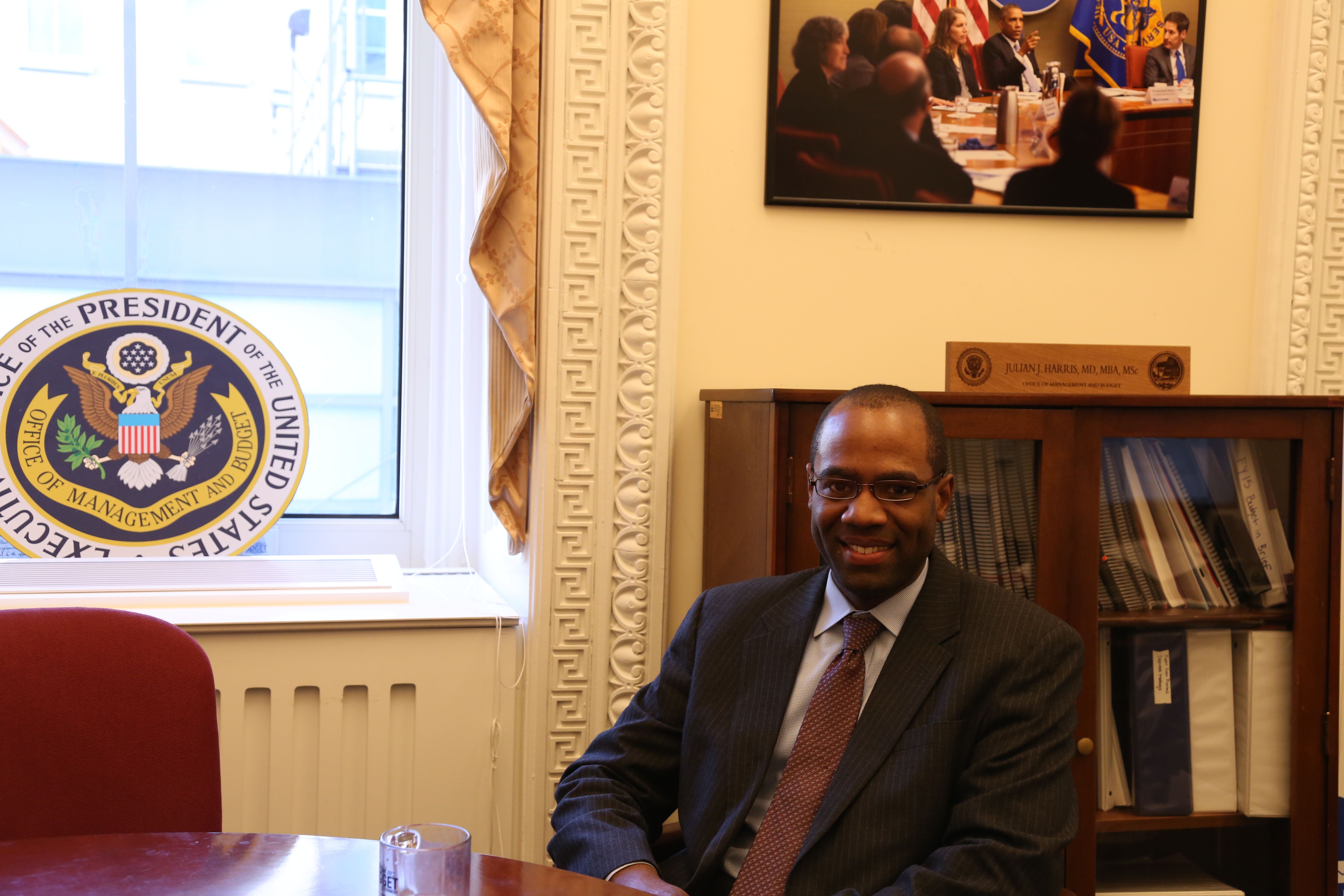
Behind the Budget: Dr. Julian Harris, OMB Associate Director for Health

"Behind the Budget" is a series of posts featuring audio stories from staffers from across the Office of Management and Budget, discussing aspects of the budget process that most Americans don't get to see.


In some ways, it's always budget season for the OMB health policy team: At any point in the year, they're likely to be either developing, negotiating, or implementing two or three fiscal year budgets at a time. This year's budget in particular includes a range of proposals, from those that make efficient improvements to health care acess and quality, to those with broader public health implications. That means, for instance, programs that invest in preparedness and disease prevention, efforts to combat antimicrobial resistance, and the NIH-lead effort to accelerate advances in the field of precision medicine.

Meet Dr. Julian Harris, OMB Associate Director for Health.

Behind the Budget: The Education Program Examiners

"Behind the Budget" is a series of posts featuring audio stories from staffers from across the Office of Management and Budget, discussing aspects of the budget process that most Americans don't get to see.


Tucked away in a series of offices in the New Executive Office Building are a group of program examiners who have been helping to develop the budget for months. That means wrangling and sorting through the many ideas brought to the table -- from agencies, from other White House offices, and from the Office of Management and Budget itself. A key part of this year's budget is the investments in both higher and early education. Listen to two examiners in this area describe their role in the budget process.

Meet Erin O'Brien, Program Examiner for Student Aid Programs.


West Wing Week: 11/14/14 or, "The Future That We See"

November 14, 2014 | 5:52 | Public Domain

This week, the President issued a statement on net neutrality, convened both congressional leaders & his Cabinet to discuss the agenda in the years ahead, dove into an 8-day trip to China, Burma, and Australia to foster deeper relations to countries around the pacific and open up markets and opportunities for businesses here at home.

Download mp4 (95MB)

The White House

Office of the Press Secretary

FACT SHEET: Opportunity for All: Securing a Dignified Retirement for All Americans

Creating the “myRA” – a Simple, Safe, and Affordable Starter Savings Account to Help Millions of Americans Start Saving for Retirement

 * Year of Action: Making Progress Through Executive Action *

To build lasting economic security, the President will act on a set of specific, concrete proposals to expand opportunity for all Americans. In the State of the Union, the President announced that he will use his executive authority to direct the Department of the Treasury to create “myRA” – a new simple, safe and affordable “starter” retirement savings account that will be offered through employers and will ultimately help millions of Americans begin to save for retirement.

  • Starter Savings Account: Making It Easier to Start Saving for Retirement. This new product will be targeted to the many Americans who currently lack access to workplace retirement savings plans, which is usually the most effective way to save for retirement. Starting to save is just the first step towards a secure retirement, and the President wants to help more Americans save for their future.
  • Safe and Secure: Principal Protection So Savers’ Account Balance Will Never Go Down. The product will be offered via a familiar Roth IRA account, and savers will benefit from principal protection, so the account balance will never go down in value. The security in the account, like all savings bonds, will be backed by the U.S. government. Contributions can be withdrawn tax free at any time.
  • User-Friendly for Savers: Portable Account with Contributions that Are Voluntary, Automatic, and Small. Initial investments could be as low as $25 and contributions that are as low as $5 could be made through easy-to-use payroll deductions.  Savers have the option of keeping the same account when they change jobs and can roll the balance into a private-sector retirement account at any time. 
  • Favorable Investment Return: Same Secure Investment Return Available to Federal Employees. Savers will earn interest at the same variable interest rate as the federal employees’ Thrift Savings Plan (TSP) Government Securities Investment Fund. 
  • Widely Available: Available to Millions of Middle Class Americans Through Their Employer. This saving opportunity would be available to the millions of low- and middle-income households earning up to $191,000 a year.  These accounts will be offered through an initial pilot program to employees of employers who choose to participate by the end of 2014.  The accounts are little to no cost and easy for employers to use, since employers will neither administer the accounts nor contribute to them.   Participants could save up to $15,000, or for a maximum of 30 years, in their accounts before transferring their balance to a private sector Roth IRA.

*  Continuing to Work With Congress on the President’s Existing Proposals to

Make Sure That All Americans Can Have a Dignified Retirement  *

The President remains committed to working with Congress to help secure a dignified retirement for all Americans. While Social Security is and must remain a rock-solid, guaranteed progressive benefit that every American can rely on, the most secure retirement requires a three-legged stool that includes savings and pensions. That’s why the President is using his executive authority to create the “myRA” and has already proposed to work with Congress on the following proposals to help Americans save for their retirement:

  • Giving Every Employee Access to Easy, Payroll-Based Savings Through the Auto-IRA. About half of all American workers do not have access to employer-sponsored retirement plans like 401(k)s, which puts the onus on individuals to set up and invest in an Individual Retirement Account (IRA). Up to 9 out of 10 workers automatically enrolled in a 401(k) plan through their employer make contributions, even years later, while fewer than 1 out of 10 workers eligible to contribute to an IRA voluntarily do so. The President’s budget will propose to establish automatic enrollment in IRAs (or “auto-IRAs”) for employees without access to a workplace savings plan, in keeping with a plan that he has proposed in every budget since he took office. Employers that do not provide any employer-sponsored savings plan would be required to connect their employees with a payroll deduction IRA.  This proposal could provide access to one-quarter of all workers, according to a recent study.

-----  Making Sure the Auto-IRA Works for Workers and Small Businesses. Workers would not be required to contribute and are free to opt out. Employers would also not contribute. The plan would also help defray the minimal administrative costs of establishing auto-IRAs for small businesses, including through tax incentives.

  • Removing Inefficient Retirement Tax Breaks for the Wealthiest While Improving Them for the Middle Class.  The Auto-IRA will spread the tax benefits for retirement savings to millions more middle-class Americans.  Current retirement tax subsidies disproportionately benefit higher-income households, many of whom would have saved with or without incentives. An estimated two-thirds of tax benefits for retirement saving go to the top 20% of earners, with one-third going to the top 5 percent of earners. Our tax incentives for retirement can be designed more efficiently.   According to one 2012 study, additional tax expenditures are a comparatively inefficient way to generate additional saving. The President has proposed to limit the benefits of tax breaks, including retirement tax preferences, for high income households to a maximum of 28 percent.  The President has also proposed to limit contributions to tax-preferred savings accounts once balances are about $3.2 million, large enough to fund a reasonable pension in retirement.

* Importance of Securing a Dignified Retirement for All Americans *

  • Many Americans lack access to workplace retirement savings plans – usually the most effective and generous means of saving for retirement.  About half of all workers and 75 percent of part-time workers lack access to employer-sponsored retirement plans.

  • The financial crisis dealt a severe blow to the retirement outlook for many families, wiping out more than $12 trillion dollars in household wealth. While financial markets have returned to their pre-crisis levels, median household wealth has only recovered 45 percent of the losses during the recession.

  • The risk of an insecure retirement is especially great for women, minorities, and low-income Americans. Women continue to be less prepared for retirement than men and comprise 63 percent of the elderly living below the poverty line. White households have six times the wealth, including retirement savings, of African Americans or Hispanics. And low-wage and part-time workers are just one-third as likely as high-wage and full-time workers to participate in an employer-based retirement plan.


The White House

Office of the Press Secretary

Presidential Memorandum -- Retirement Savings Security

MEMORANDUM FOR THE SECRETARY OF THE TREASURY 

SUBJECT: Retirement Savings Security

All Americans deserve the ability to save for retirement. Since taking office, my Administration has committed to strengthening retirement security for all Americans, including by helping workers find ways to save for retirement and to protect those hard earned savings. Unfortunately, too few Americans have enough savings to maintain their standard of living in retirement.

But we know there are proven strategies that can help the average family save. Workplace-based retirement savings that allow workers to automatically take a portion of their pay and put it into a retirement account can increase retirement savings dramatically. Approximately 9 out of 10 workers automatically enrolled in a 401(k) plan continue to make contributions to that account compared to the less than 1 out of 10 eligible workers who voluntarily contribute to Individual Retirement Accounts. The positive effect of automatic contributions is especially pronounced among lower-income households and others with traditionally low savings rates.

Unfortunately, only about half of all American workers have access to employer-sponsored retirement savings accounts. It is clear that we cannot continue on this course.

The Department of the Treasury has worked diligently to develop a new tool that can make long-term savings a reality for more working Americans. A new kind of retirement savings tool could help American families as they start to build for their retirement. In order to make this tool available to working Americans, I hereby direct as follows:

Section 1. Retirement Savings Security. (a) By December 31, 2014, you shall finalize the development of a new retirement savings security that can be made available through employers to their employees. This security shall be focused on reaching new and small-dollar savers and shall have low barriers to entry, including a low minimum opening amount. In developing this security, you shall ensure that it:

(i) protects the principal contributed while earning interest at a rate based on yields on outstanding Treasury securities;2

(ii) offers savers the flexibility to take money out if they have an emergency and keep the same Treasury security if they change jobs; and

(iii) is designed to help savers start on a path to long-term saving and serve as a stepping stone to the broader array of retirement products available in today's marketplace.

(b) Within 90 days of the date of this memorandum, you shall begin work with employers, stakeholders, and, as appropriate, other Federal agencies to develop a pilot project to make the security developed pursuant to subsection (a) of this section available through payroll deduction to facilitate easy and automatic contributions.

Sec. 2. General Provisions. (a) Nothing in this memorandum shall be construed to impair or otherwise affect:

(i) the authority granted by law to a department or agency, or the head thereof; or

(ii) the functions of the Director of the Office of Management and Budget relating to budgetary, administrative, or legislative proposals.

(b) This memorandum shall be implemented consistent with applicable law and subject to the availability of appropriations.

(c) This memorandum is not intended to, and does not, create any right or benefit, substantive or procedural, enforceable at law or in equity by any party against the United States, its departments, agencies, or entities, its officers, employees, or agents, or any other person.

(d) You are authorized and directed to publish this memorandum in the Federal Register.

BARACK OBAMA