
Office of Science and Technology Policy Blog
Nominate Outstanding Math and Science Teachers this Week!
Posted by on March 30, 2011 at 8:10 PM ESTKnow an outstanding math or science teacher whose devotion and skills in the classroom are transforming their students’ lives? Nominate them to receive one of the Presidential Awards for Excellence in Mathematics and Science Teaching (PAEMST), which are the highest recognition that a kindergarten through 12th grade math or science teacher may receive for outstanding teaching in the United States. We know there are exceptional mathematics and science teachers out there deserving of such an award—please consider nominating them at www.paemst.org.
Presidential awardees receive a certificate signed by President Obama, a trip to Washington, D.C., to attend a series of recognition events and professional development opportunities, and a $10,000 award from the National Science Foundation (NSF).
Last year 103 teachers representing 50 states and 4 jurisdictions were recognized for their dedication to teaching and student learning by President Obama; White House Office of Science and Technology Policy Director John Holdren; NSF Director Subra Suresh; Secretary of Education Arne Duncan; and Members of Congress.
Anyone may nominate a teacher by completing the short nomination form at www.paemst.org. Teachers may also initiate the application process themselves at www.paemst.org/apply.
The Nomination Deadline is this Friday, April 1, 2011. Nominees must then complete a more detailed application by May 2, 2011. This year, secondary school teachers (Grades 7-12) will be selected; next year, elementary school teachers (Grades K-6) will be eligible.
Please help recognize our Nation’s outstanding math and science teachers!
Nafeesa Owens manages the PAEMST award for the National Science Foundation
Learn more about EducationMentoring Our Future Generation of STEM Professionals
Posted by on March 30, 2011 at 3:57 PM ESTEd. Note: This was originally posted on the Department of Energy blog.
Yesterday, the Department of Energy unveiled a new mentoring program to pair female undergraduate science, engineering and math students in the Washington, D.C., area with female employees who specialize in those subject areas. The program aims to introduce the students to successful women in science and technology, giving the pairs the opportunity to shape their own activities over the course of the year with guidance from the Department of Energy’s Council on Women and Girls. The program also encourages participating undergraduate students to become mentors to D.C.-area high school and elementary school students.
The new Department of Energy program is just one piece of the Obama Administration’s strong support for mentorship. Today, First Lady Michelle Obama is hosting a series of mentoring events with renowned women, bringing together more than 20 accomplished women to serve as mentors to high school students in the D.C. area. The First Lady has spoken frequently about the importance of mentoring aspiring young students to help them achieve their full potential.
Mentors have proven to be effective teachers for developing our nation’s future leaders. Studies show, for example, that mentored youth have better attendance in school, a better chance of going on to higher education, and better attitudes toward school in general. Mentoring helps reduce the incidence of substance abuse and other harmful behaviors. And, young people who take part in mentoring programs have higher self-esteem. The National Research Council, among others, has documented that mentored female students enjoy a number of improved outcomes later in life compared to women who did not have that benefit.
Additionally, by offering their expertise and encouragement in personalized sessions, mentors can be highly effective in helping prepare the next generation of scientists and engineers. With their focus, in many cases, on groups underrepresented in these fields, mentors help ensure that tomorrow’s innovators reflect the full diversity of the United States.
This attention to diversity is especially critical for women and girls in the science, technology, engineering and mathematics (STEM) fields. Women hold only 27 percent of jobs in science and engineering–sectors that are essential to our nation’s growth in a 21st century economy. This gap starts at an early age. In an American Society for Quality poll of 8-17 year olds, 24 percent of boys but only 5 percent of girls said they were interested in an engineering career.
Female STEM students in the Washington, D.C. metropolitan area are encouraged to apply to our new program, and additional female employees at the Department’s headquarters are encouraged to sign up as mentors. Please visit http://diversity.energy.gov for more information.
Bill Valdez is the Acting Director for the Office of Economic Impact and Diversity at the Department of Energy
Learn more about EducationLate Entry in New York City Science Fair
Posted by on March 30, 2011 at 11:58 AM EST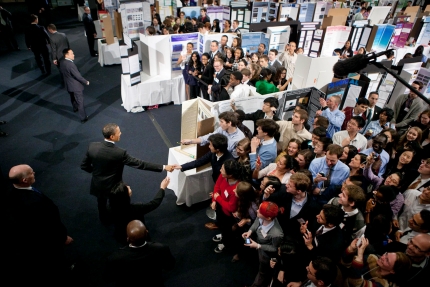
President Barack Obama drops by the New York City Science Fair at the American Museum of Natural History in New York, N.Y., March 29, 2011. (Official White House Photo by Lawrence Jackson)
During his trip to New York City yesterday, and between interviews with three network news anchors and a speech dedicating a new building to late-Secretary of Commerce Ron Brown, President Obama made an unexpected detour. The President dropped in on the New York City Science Fair—a venue that pretty much sums up the meaning of “win the future." And the reason why? “Whenever I get a chance to go to a science fair, I go," the President said.
Science is so critical to our future, to tackling the energy challenge and creating new industries and jobs of the future, that the President often gets personally involved, as he did with Astronomy Night at on the South Lawn and the White House Science Fair. But the President doesn’t deal with science only at fairs. Recognizing the centrality of science and engineering to the Nation’s economic prosperity and national security, he has brought into his Administration a top-notch team of accomplished scientists and technical experts who advise him regularly, including three Nobel prize winners in science (Steven Chu, Harold Varmus, and Carl Wieman) and two more as members of the President’s Council of Advisors on Science and Technology (Mario Molina and Ahmed Zewail). The head of the Environmental Protection Agency is Lisa Jackson, a chemical engineer. Marine ecologist and environmental scientist Jane Lubchenco leads the National Oceanic and Atmospheric Administration, and four-time astronaut Charlie Bolden is the Administrator of NASA. The President’s science and technology advisor in the White House, John Holdren, holds advanced degrees in aerospace engineering and theoretical plasma physics.
By the scientists he has appointed, as well as by the budgets he’s proposed—as reflected by the largest investment in science and innovation in our Nation’s history—and by the policies and processes he has followed to apply science to some of our most challenging problems, including evidence-based decision-making in energy, agriculture, climate, and resource management, the President’s enthusiasm and respect for science as a driver of policy has been unwavering.
As the President has noted, science fairs and other opportunities for scientific tinkering can be wonderful beginnings of adult careers. Speaking to space scientists this morning at a symposium honoring the rocketry pioneer Robert Goddard, Dr. Holdren confessed to “making solid rockets out of my mother’s discarded lipstick tubes at age 10.” Look at the career those lipstick tubes helped launch!
So that left us wondering—what were the most innovative science fair projects you can remember seeing or doing? What ideas would you like to see displayed on a small table or posterboard? Because often times, those ideas translate into real-world solutions to some of the grand challenges that face our world.
Tweet your past science fair projects or future ideas @whitehouseostp or @whitehouse, with the hashtag #WHscifair. And I expect something more than a model of the solar system.
Phil Larson is a Research Assistant in the White House Office of Science and Technology Policy
Learn more about TechnologyStrengthening Our Understanding of a Changing Planet
Posted by on March 29, 2011 at 4:24 PM ESTAppropriately enough, change is underway at the Nation’s primary global change research program. Teams of top scientists and policy makers representing over a dozen different Federal agencies are hard at work drafting a new strategic plan to strengthen not only scientists’ fundamental understanding of our changing planet but also the program itself, known as the U.S. Global Change Research Program or USGCRP.
As part of these changes, the program also has a new leader who will oversee these enhancements at a time of great import for the global-change science community and for society as a whole.
Established by the Global Change Research Act of 1990, USGCRP coordinates and integrates Federal research on changes in the global environment and their implications for society. Thirteen Federal agencies participate in the program, which is also responsible for executing the quadrennial National Climate Assessment, a comprehensive inventory of climate-change-related impacts, vulnerabilities, and efforts across the United States.
Driven by the Obama Administration’s commitment to fortifying the role of science in policy-making, the new strategic plan aims to augment USGCRP’s existing technical research strengths by providing decision-makers with increased access to relevant and sustained science and technology. The result will be an enhanced ability to understand the Earth’s dynamic processes and predict its responses to natural and human-induced stresses, ultimately serving a wide array of users from teachers and students to fishermen and first selectmen.
Taking the helm amidst this sea of change is the newly appointed Director of USGCRP’s National Coordination Office, Dr. Thomas Armstrong. He comes to the position having most recently served as the Senior Advisor for Climate Change at the Department of the Interior, where he was a key figure in the development of the Department’s climate-change-related policies, organizational elements, and budget strategies.
As the Vice Chair for Adaptation Science on the National Science and Technology Council’s Subcommittee on Global Change Research (SGCR), the steering body of the USGCRP, Dr. Armstrong has been an active participant in the program’s restructuring and the drafting of the new strategic plan. He has worked closely with the SGCR’s chair, Dr. Thomas Karl of the National Oceanic and Atmospheric Administration, and its executive committee to identify key priorities in the field of adaptation research and oversee the seamless integration of these goals into the larger evolving vision of the program.
The implications of this critical strategic realignment of the USGCRP, an effort directly overseen by the SGCR’s Vice Chair for Strategic Planning, Dr. Timothy Killeen, of the National Science Foundation, extend beyond the program itself. The involvement of these and other talented leaders, such as the remaining SGCR Vice-Chair, Dr. Michael Freilich of the National Aeronautics and Space Administration, is helping the program maintain strong links between USGCRP activities and broader, related endeavors across the Federal enterprise. Through Dr. Freilich’s leadership, for instance, the Program’s renewed focus on integrated observations will work synergistically with the Obama Administration’s broader strategy for civilian earth observations.
Revitalized by these able leaders and a reinvigorated vision for the future, the USGCRP will be better able than ever to serve its many stakeholders-including Federal officials, local businesses, and community planners—by enriching our understanding of climate change and informing science-based efforts to mitigate and adapt to its impacts.
Shere Abbott is Associate Director for Environment at the Office of Science and Technology Policy
Learn more about Energy and EnvironmentStartUp Britain: Accelerating Entrepreneurship Across the Pond
Posted by on March 28, 2011 at 3:20 PM ESTToday, less than two months after the White House launched the Startup America campaign to accelerate high-growth U.S. entrepreneurs, Prime Minister David Cameron joined with U.K. entrepreneurs to kick off StartUp Britain. We’re excited to celebrate this new initiative and look forward to seeing it take off.
The centerpiece of StartUp Britain is a brand-new Web portal that connects U.K. business owners to relevant resources, including a new package of startup services pledged by over 60 major British and international companies. The package of services being offered includes advertising, office space, access to broadband Internet, financing and mentoring support, and represents a value of over £1500 for each startup. At the same time, the U.K. government is announcing a series of ambitious goals to spread entrepreneurship education throughout the country’s schools, colleges, and universities.
Startup America is also based on collaboration between the public and private sectors. In response to President Obama’s call to action, leaders in the private sector launched the Startup America Partnership, an independent alliance of entrepreneurs, investors, corporations, foundations, non-profits, and universities that has committed to promoting high-growth entrepreneurship across the United States. Meanwhile, the Obama Administration continues to roll out a series of entrepreneur-focused policy initiatives that will increase U.S. entrepreneurs’ access to capital and high-quality mentors, reduce regulatory barriers facing high-growth firms, and accelerate the movement of research breakthroughs from the lab to the marketplace.
High-growth entrepreneurship can fuel job creation, innovation, and economic prosperity in countries willing to cultivate the conditions needed to start new companies. That’s why—in addition the Startup America campaign—the U.S. government is helping grow entrepreneurial ecosystems in Egypt, Indonesia, and many other high-potential countries through the State Department’s Global Entrepreneurship Program.
StartUp Britain is a wholly independent initiative created by resourceful U.K. entrepreneurs like Rajeeb Dey, founder of Enternships. Rajeeb blogged today about his desire for StartUp Britain and Startup America to work together, not only “sharing best practices and fostering collaboration” but also “developing transatlantic entrepreneurial initiatives.” We couldn’t agree more.
Additionally, here are some quick links to learn more about or get involved with Startup America:
- Learn more about the Startup America Partnership, an alliance of entrepreneurs, investors, foundations, and corporations committed to mobilizing private-sector resources for high-growth U.S. startups: http://www.startupamericapartnership.org
- Learn more about the Obama Administration’s policy initiatives to accelerate the success of U.S. entrepreneurs: http://obamawhitehouse.archives.gov/startupamerica
- Submit your own idea for how the U.S. government should reduce barriers facing entrepreneurs trying to start and scale companies: http://reducingbarriers.ideascale.com
And feel free to e-mail us at startup@ostp.gov with any other ideas for the White House to consider as part of the Startup America campaign.
Tom Kalil is Deputy Director for Policy at the Office of Science and Technology Policy
Doug Rand is a Policy Advisor and AAAS/Goldhirsh Fellow at OSTP
Learn more about Economy, Startup AmericaEmerging Technologies Committee Lays Out Principles for Guidance
Posted by on March 16, 2011 at 9:39 AM ESTInnovation with respect to emerging technologies—such as nanotechnology, synthetic biology, and genetic engineering—requires not only coordinated research and development but also appropriate and balanced oversight. To help ensure such balance, the White House Emerging Technologies Interagency Policy Coordination Committee (ETIPC) last week released a memorandum to the heads of executive departments and agencies outlining broad principles to guide the development and implementation of policies for oversight of emerging technologies at the agency level.
The Principles reflect the Committee’s goal of striking a balance in which novel technologies are subject to oversight that is adequate to protect public health and the environment but not so daunting as to unduly slow innovation or the development of those new technologies.
To advance this goal, the ETIPC lays out principles in the following categories:
- Scientific Integrity
- Public Participation
- Communication
- Benefits and costs
- Flexibility
- Risk Assessment and Risk Management
- Coordination
- International Cooperation
- Regulation
For more information on the ETIPC, or the newly released Principles for Regulation and Oversight of Emerging Technologies, read this memo released by the three co-chairs.
Travis Earles is Assistant Director for Nanotechnology in the White House Office of Science and Technology Policy
Learn more about Technology
- &lsaquo previous
- …
- 121
- 122
- 123
- 124
- 125
- 126
- 127
- 128
- 129
- …
- next &rsaquo


White House Blogs
- The White House Blog
- Middle Class Task Force
- Council of Economic Advisers
- Council on Environmental Quality
- Council on Women and Girls
- Office of Intergovernmental Affairs
- Office of Management and Budget
- Office of Public Engagement
- Office of Science & Tech Policy
- Office of Urban Affairs
- Open Government
- Faith and Neighborhood Partnerships
- Social Innovation and Civic Participation
- US Trade Representative
- Office National Drug Control Policy
categories
- AIDS Policy
- Alaska
- Blueprint for an America Built to Last
- Budget
- Civil Rights
- Defense
- Disabilities
- Economy
- Education
- Energy and Environment
- Equal Pay
- Ethics
- Faith Based
- Fiscal Responsibility
- Foreign Policy
- Grab Bag
- Health Care
- Homeland Security
- Immigration
- Innovation Fellows
- Inside the White House
- Middle Class Security
- Open Government
- Poverty
- Rural
- Seniors and Social Security
- Service
- Social Innovation
- State of the Union
- Taxes
- Technology
- Urban Policy
- Veterans
- Violence Prevention
- White House Internships
- Women
- Working Families
- Additional Issues