
Office of Science and Technology Policy Blog
What is Your Strategy for American Innovation?
Posted by on February 4, 2011 at 5:45 PM EDTToday I joined my colleagues Gene Sperling, Director of the National Economic Council, and Austan Goolsbee, Chairman of the Council of Economic Advisors in publishing an op/ed describing President Obama’s Strategy for American Innovation - a framework to secure our economic growth and prosperity. It is built on three key pillars - that our Nation is at its best when we invest in the building blocks of innovation, includingour people, ideas and infrastructure; that we have rules of the road that promote market-based innovation, including strong intellectual property protection, research & experimentation tax credits, and a regulatory system that works; and in the spirit of “all hands on deck”, we catalyze breakthroughs for national priorities, including our race to win in a clean energy economy, a renaissance in American manufacturing through advanced technologies, and a quantum leap in educational technologies.
Now it is your turn. We want to hear your feedback on the Strategy for American Innovation. You can submit your comments, feedback and questions via Slideshare. In the coming days and weeks, we’re looking forward to a lively discussion on the Strategy for American Innovation and we hope you’ll be a part of it.
Sending Health Data Safely and Securely Over the Internet
Posted by on February 3, 2011 at 6:10 PM EDTYesterday marked another milestone on the Nation’s journey to better health care through the use of electronic health records and health information technology. Two pilot projects were launched—one in Minnesota and the other in Rhode Island—for easily and securely transmitting personal health information via the Internet. These efforts—combined with others that will soon be underway in Tennessee to support the Department of Veterans Affairs, and commercial providers in New York, Connecticut, Oklahoma, Texas, and California—mean a very important new tool is on schedule to enable the safe transmission of patient data over the Internet by healthcare providers, instead their having to rely on mail and fax. This is a significant step toward meeting the Administration’s commitment to make health information exchange (HIE) accessible and practical for all the Nation’s clinicians.
HIE is one of the primary benefits that can be derived from adopting health information technology. HIE means your records can be shared securely among your doctors without getting lost or delayed. It means your hospital discharge instructions can be provided instantly to your physician—and to you. It means that if you are in an accident and arrive in the emergency room unconscious, your record can be made available and the care you receive can be that much safer and more effective.
Since last year, the Department of Health and Human Services (HHS) has been supporting a new initiative, the Direct Project, to provide an early, practical option for HIE. The Direct Project aims to rapidly develop a system that providers can use to support the simpler information exchange functions they need the most.
The vision for this project came from a number of key sources, including a lively discussion of the “Health Internet” at Harvard University in September 2009; the testimony of practicing providers to the HIT Standards Committee in October 2009; and thought leadership in a series of blog posts by HIT Standards Committee members Wes Rishel and David McCallie on the strategy of “Simplified Interop," focusing on simple, internet-based methods for secure, directed communication. Their work was reviewed and endorsed by the Nationwide Health Information Network Workgroup of the HIT Policy Committee in January 2010.
On March 1st, 2010, under the direction of Farzad Mostashari and Doug Fridsma from HHS’s Office of the National Coordinator, Arien Malec kicked off the Direct Project. The fact that pilot programs have begun to launch just 10 months later means that safe, Internet-based transfers of most-used health information is on its way to becoming a reality in the United States. That will enable existing electronic exchanges to become more standardized and convenient. And it will enable many more providers, and many more data transactions, to take advantage of the HIE benefit. Already, vendors have announced support for patient access to health records based on the Direct Project, and have committed significant dollars and resources to the effort.
How was this fast-paced development achieved? We set aside the “top down” approach that’s traditional for government and adopted some lessons from the innovative IT sector. We invited private companies (including some well-known businesses that usually compete against one another!) and public sector entities to work together, on a volunteer basis, to respond to the need for a leading-edge HIE option. Here was the challenge: Create an easy-to-use tool, with uniform requirements, that will support HIE for the most common clinical information needs, all while delivering a useable result for providers, in less than two years.
And it’s working. Employing the principles and practices embodied by President Obama’s Open Government directive, these different stakeholders worked together and delivered a product, which is now in its testing phase. These same stakeholders are now encouraged to develop competing products based on the very standards they worked together to assemble!
It’s time for new ways of achieving the public good. The growing national commitment to harnessing health information technology is one way to further this good. And the open government approach that so efficiently delivered an entry-level HIE system, ahead of schedule, is yet another. The launches of these newest pilot projects are milestones worth celebrating.
Aneesh Chopra is U.S. Chief Technology Officer
Dr. Blumenthal is National Coordinator for Health Information Technology
Learn more about Civil Rights, TechnologyAre You Ready To Startup America?
Posted by on January 31, 2011 at 12:11 PM EDTToday at the White House, members of President Obama’s economic team and leading entrepreneurs are launching Startup America. As President Obama put it, Startup America is a “national campaign to help ‘win the future’ by knocking down barriers in the path of men and women in every corner of this country hoping to take a chance, follow a dream, and start a business.”
The White House is focused on entrepreneurship as a core element of the President’s innovation strategy because of the critical role that startups play in job creation in the United States. Startups are also responsible for developing many of the breakthrough products and services that will allow the United States to compete and win in the global economy – such as low-cost solar cells, new life-saving treatments for diseases, or the next breakthrough in wireless technology.
Answering the President’s call to action to invest in job-creating startups, leaders in the private sector launched the Startup America Partnership, an independent alliance to mobilize additional private sector commitments. Steve Case, co-founder of AOL and Chairman of the Case Foundation, will chair the Partnership, and Carl Schramm, President and CEO of the Kauffman Foundation will be a founding board member.
OSTP is incredibly excited about Startup America. Today is just the beginning of a sustained national effort. As the President noted, Startup America is an “historic partnership with business leaders, investors, universities, foundations, and non-profits, and we're urging others to join them in this effort.”
One of our goals in the months ahead is to create what Tim O’Reilly calls “an architecture of participation” that allows more people and organizations to get involved in Startup America.
This could lead to more:
- Creative ideas for new or expanded initiatives to meet the goals of Startup America;
- Fortune 500 companies partnering with and investing in startups, and sharing best practices on how to do this effectively;
- States, regions and cities putting innovation and entrepreneurship at the center of their economic development and job creation strategies;
- Successful entrepreneurs and investors nurturing the innovation ecosystem in regions that currently do not attract much investment for startups; and
- Universities “mainstreaming” entrepreneurship as a career option, and accelerating the transition of ideas from the lab to the marketplace.
What are your ideas? How do you want to answer the President’s call to action? Drop us a line at startup@ostp.gov.
President Honors STEM Mentors
Posted by on January 27, 2011 at 5:29 PM EDTBy recognizing individuals and organizations that have dedicated themselves to nurturing the technical talent of our country, the PAESMEM awards highlight the crucial role that mentoring plays in unlocking the potential of promising young scientists, engineers, and mathematicians. The awards recognize in particular mentoring efforts that have enhanced the participation of individuals who are typically underrepresented in STEM disciplines and fields, including women, minorities, and persons with disabilities.
Through a wide range of initiatives, including undergraduate research programs to provide students with valuable in-lab experience, teacher training programs for high school math and science instructors, and a science education outreach program for low-income families, this year’s awardees are having an impact along the entire STEM pipeline.
The Oval Office meeting was followed by an awards ceremony in the Eisenhower Executive Office Building, where OSTP Director Dr. John Holdren offered keynote remarks and provided the awardees with certificates as well as a personal letter from the President. In his remarks, Dr. Holdren underscored the importance of mentoring in his own education. And he talked about his recent meeting with four young science students who had won national or international awards and had been invited by First Lady Michelle Obama to sit with her during the President’s State of the Union Address. When he asked the four what had most inspired them to pursue work in science and engineering, Dr. Holdren said, “Every one of them talked about a mentor as being crucial.”
PAESMEM awardees receive $10,000 awards from the National Science Foundation, which administers the awards on behalf of the White House, to advance their mentoring efforts. They also receive an expense-paid trip to Washington, D.C.—most arrived on Monday this week—for a series of events including professional development activities and meetings with members of the Administration. This year’s awardees met with key staff from the White House Mentoring Initiative and the White House Council on Women and Girls, as well as Dr. Jim Gates, a member of the President’s Council of Advisors on Science and Technology renowned for his work in STEM education.
Congratulations to the recipients of this award!
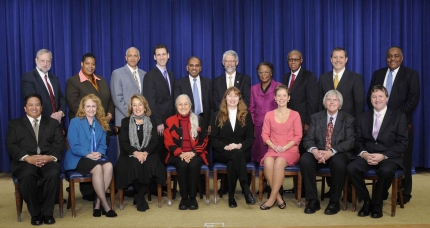
OSTP Director Dr. John P. Holdren (center) poses with the winners of the Presidential Awards for Excellence in Science, Mathematics, and Engineering Mentoring. To Dr. Holdren's right is National Science Foundation Director Dr. Subra Suresh. To his left is Acting Deputy Director of the NSF Dr. Cora Marrett.
Learn more about EducationScience Students Stand Tall at State of the Union
Posted by on January 25, 2011 at 2:08 PM EDTPresident Obama made his commitment to science and technology very clear in the first minutes of his presidency, when he promised in his Inaugural Address that his Administration would “restore science to its rightful place.”
Tonight that rightful place will be the First Lady’s Box in the U.S. Capitol, where four remarkable science students from across the country will join Michelle Obama and other guests during the President’s State of the Union Address.
The extraordinary placement of so many young achievers in science and technology in this prominent location during tonight’s historic Address reflects a core theme for the President, and one expected to be echoed in his remarks tonight—that science and technology, which have been responsible for so much of this Nation’s economic growth in the last century, will be key to America’s global leadership and security in the new century as well.
For a preview of who is likely to be part of that 21st century leadership team, check out these amazing students who will be listening to the President tonight from the best seats in the house:
Learn more about Education, TechnologyNew Job-Training and Education Grants Program Launched
Posted by on January 20, 2011 at 6:59 PM EDTSecretary of Labor Hilda Solis and Secretary of Education Arne Duncan ushered in a new era of hope and opportunity for millions of Americans today when they revealed the innovative application criteria for the first $500 million in grants under the four-year, $2 billion Trade Adjustment Assistance Community College and Career Training Grant Program. Grants will support the development and improvement of a new generation of free, post-secondary educational programs of two years or less that prepare students for successful careers in emerging and expanding industries.
This effort, which was developed and designed in consultation with the White House Office of Science and Technology Policy, sets the stage for what promises to become one of the most significant expansions in access to high-quality education and job training opportunities ever. These new investments will also play a major role in helping the Nation achieve the goal set by President Obama last year that by 2020 the United States will once again have the most highly educated workforce in the world.
But what matters most is what these new freely-available resources will mean to individuals.
By relying on evidence-based approaches and requiring that all materials produced be openly licensed for free use, adaptation, and improvement by others, this groundbreaking federal effort will bring free, high-quality curriculum and employment training opportunities within reach of anyone who has access to the Internet.
Open Educational Resources are learning materials that have been released under an intellectual property license that allows their free use by others. The materials produced as a result of these grants will carry the Creative Commons BY license, which also permits their free derivative use for commercial purposes. That means companies, schools, entrepreneurs, and others will be free to bundle, adapt, or customize the learning materials to create new offerings, products, and services. Schools will be able to affordably offer courses in subject areas and at levels of expertise previously beyond their reach. Students will be able to access free educational materials, including complete courses, and supportive services designed to help them accomplish their educational and job-training goals.
Millions of students around the world have already benefited from Open Educational Resources in the decade since then-Massachusetts Institute of Technology (MIT) President Charles Vest established MIT’s pioneering OpenCourseWare project, the first of its type, based on a proposal from members of his faculty. The goal, Vest explained in 2001, was to make all of the learning materials used by MIT's faculty in the school's 1,800 courses available via the Internet, where they could be used and repurposed as desired by others without charge.
"OpenCourseWare is consistent with what I believe is the best about MIT,” Vest has said. “It expresses our belief in the way education can be advanced -- by constantly widening access to information and by inspiring others to participate."
These new grants will make it possible for community colleges and other two-year degree-granting institutions to play a major role in adapting and improving existing free learning materials and by creating new materials specifically suited to meet the needs of students served by those institutions. The focus will be on the production and improvement of learning materials that lead students to employment in occupations that provide family-sustaining wages.
This program is being run out of the Department of Labor. To learn more, please visit: http://www.doleta.gov/taaccct.
Hal Plotkin is a Senior Policy Advisor in the Office of the Under Secretary of Education
Learn more about Civil Rights, Education
- &lsaquo previous
- …
- 124
- 125
- 126
- 127
- 128
- 129
- 130
- 131
- 132
- …
- next &rsaquo


White House Blogs
- The White House Blog
- Middle Class Task Force
- Council of Economic Advisers
- Council on Environmental Quality
- Council on Women and Girls
- Office of Intergovernmental Affairs
- Office of Management and Budget
- Office of Public Engagement
- Office of Science & Tech Policy
- Office of Urban Affairs
- Open Government
- Faith and Neighborhood Partnerships
- Social Innovation and Civic Participation
- US Trade Representative
- Office National Drug Control Policy
categories
- AIDS Policy
- Alaska
- Blueprint for an America Built to Last
- Budget
- Civil Rights
- Defense
- Disabilities
- Economy
- Education
- Energy and Environment
- Equal Pay
- Ethics
- Faith Based
- Fiscal Responsibility
- Foreign Policy
- Grab Bag
- Health Care
- Homeland Security
- Immigration
- Innovation Fellows
- Inside the White House
- Middle Class Security
- Open Government
- Poverty
- Rural
- Seniors and Social Security
- Service
- Social Innovation
- State of the Union
- Taxes
- Technology
- Urban Policy
- Veterans
- Violence Prevention
- White House Internships
- Women
- Working Families
- Additional Issues