
Office of Science and Technology Policy Blog
DC Science Fair Puts Students, Parents to the Test
Posted by on April 5, 2011 at 10:24 AM EDT
OSTP Associate Director for Science Carl Wieman examines a student's project at the DC Science and Engineering Fair, April 2, 2011. (Photo by Mary Maxon)
Editor's Note: Check out additional photos at the end of the blog.
How fast does grass grow? Does the design of a bridge have an effect on its weight-bearing capacity? What are the health effects of hand washing?
Students competing in the 2011 D.C. Science and Engineering Fair addressed these and many other questions with research projects featured this weekend at the D.C. Armory. A total of 409 students, grades 3-12, representing 48 public, charter, and private schools throughout the District of Columbia competed for cash awards, grants for school equipment, and trophies in categories such as biological science, Earth and environmental science, engineering, math, computer science, physical science, and behavioral and social science.
We had the exciting opportunity on Saturday morning to meet with some of these students while checking out their exhibits, learning about their research, and talking about what inspires them. For example, a young nail-biter whose mother told her that the habit was unhygienic and might pose a health risk decided to examine whether more bacteria were removed during hand washing with soap or hand sanitizer. We also spoke to a team of two young scientists that compared left- and right-handed subjects’ performance on those brain-bending Sudoku puzzles. Their project was inspired by introductory neurobiology school lessons that ascribed different activities to the two hemispheres of the brain.
Many of the budding scientists we met were quick to boast that their hypotheses “were correct,” or at least not disproved by their research. However, one young researcher, who investigated the effects of light on asexual reproduction of planaria (flatworms), described what it was like to learn during the course of his experimentation that his hypothesis was wrong. And, like the best of scientists, he then eagerly explained what actions were required to rethink his hypothesis and complete his work.
It was uplifting to see such pure enthusiasm and curiosity displayed, in particular by the younger entrants. In those lower grades, their projects were aimed at understanding the world around them, much like the motivations of true scientists. They were exploring things like what affects how grass grows, how electricity works, and why bread gets moldy. One thing that we noticed, however, was that as we reached higher grade levels the diversity of the students tended to go down—evidence of a problem that President Obama has noted: that members of groups underrepresented in the sciences in many cases first lose interest in these subjects in middle and high school. That’s why the President’s Educate to Innovate campaign is focused on expanding science, technology, engineering, and math (STEM) education and career opportunities for historically underrepresented groups—including women, girls, and minorities. If we are to succeed in moving America’s STEM students from the middle to the top of the pack, we will need everyone’s minds focused on the prize.
Later, as we were heading home, we were reminded about the importance of parental encouragement and involvement in a child’s interest and participation in science beyond participation in science fairs themselves. We were walking behind a mother and father and their two young sons who had been attending the fair. They were engrossed in a cheerful family discussion about why objects fall at different speeds. The parents continually turned to the children, bringing them into the discussion by asking them questions and their opinions about what they thought would happen under various conditions. And these parents did not need to be experts in science or physics to engage in these discussions with their children. These were parents with a curiosity about the world and were figuring out how information they themselves had learned and observed could help answer their curious kids’ questions—all the while being careful to bring their young children into this analysis to develop their own curiosity about how things work and the capacity to figure out how to answer those questions.
Parents like that deserve prizes too.
Carl Wieman is Associate Director for Science at OSTP
Mary Maxon is Assistant Director for Biological Research at OSTP

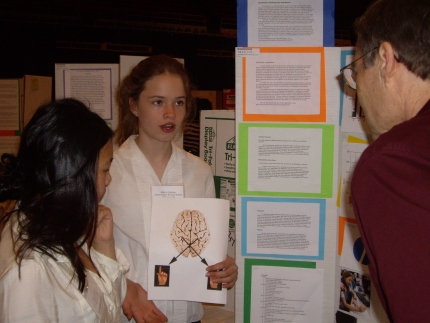
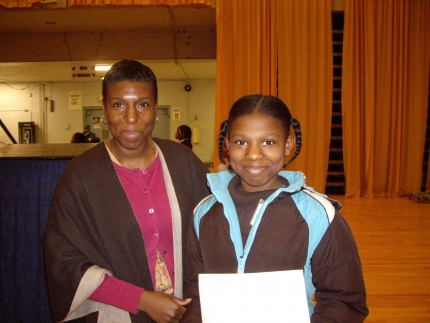
Family support is an important component of STEM education. (Photos by Mary Maxon)
Learn more about EducationDepartment of Transportation’s Wireless Research Ties Intelligent Transport to Clean Fleets
Posted by on April 4, 2011 at 12:46 PM EDTPresident Obama highlighted the National Clean Fleets Partnership last week at the UPS facility in Landover, MD. This public-private partnership, part of the Department of Energy’s “Clean Cities” initiative, will help large fleets reduce diesel and gasoline use by incorporating electric vehicles, alternative fuels, and fuel-saving measures into their daily operations. The President noted that one of the innovative tools that fleets will deploy is mobile applications to enhance fleet efficiency.
The U.S. Department of Transportation (USDOT), through the Research and Innovative Technology Administration’s Intelligent Transportation Systems (ITS) Research Program, in close partnership with the Federal Motor Carrier Safety Administration (FMCSA), has been leading research into mobile applications for fleet management, with an eye to improving transportation safety as well as reducing truck and motor coach fuel consumption and emissions. USDOT is pleased to support critical national priorities in safety, environment and economic competitiveness through our ITS research.
Already, major national trucking fleets have been using mobile wireless applications to stay safe and reduce emissions, delivering goods on time and improving the bottom line, by:
- using real-time routing to find the fastest way to a destination;
- using real-time traffic information to avoid congestion and guide just-in-time delivery;
- using advanced road weather information to avoid hazards and to find the safest route.
Increasingly, firms are working with partners in the states to use wireless transponders to transmit cargo and inspection information ahead; to avoid the stops at truck weigh and inspection stations, keeping freight moving safely and efficiently; and to plan “green routing” that will allow trucks to “stop and start” less, reducing frequent changes to engine throttling that contribute to emissions—minimizing trucking’s carbon footprint.
And, don’t forget transit bus fleets. Transit is already a great way to reduce congestion and emissions, and transit agencies are using wireless systems developed by the ITS Program (in collaboration with our partners at the Federal Transit Administration) to improve routing, to improve performance through transit signal priority, and to let customers know where and when their next transit option will be arriving.
The ITS program continues to accelerate innovation in wireless applications, providing the foundation for connected vehicles that will be able to “talk” to one another to avoid crashes and the congestion (and emissions) that result. We are especially excited about our new Applications for the Environment: Real-Time Information Synthesis (AERIS) program, to facilitate green transportation choices, and “cleaner air through smarter transportation.” We are looking forward to expanding our work in mobile wireless applications for transportation as the President’s Wireless Innovation and Infrastructure Initiative moves forward.
You can help us win the future for transportation and the environment by giving us your ideas through the Connected Vehicle Technology Challenge. As new wireless technology enables connectivity for vehicles of all kinds—cars, trains and even bicycles, vehicles can “talk” to each other, traffic signals, and mobile devices. Tell us: What should they say?
Aneesh Chopra is U.S. Chief Technology Officer
Peter Appel is Research and Innovative Technology Administrator at the U.S. Department of Transportation
Learn more about Energy and Environment, TechnologyWinning the Future With STEM Video Games
Posted by on April 4, 2011 at 11:22 AM EDTLast week I had the honor of announcing the winners of the first annual National STEM Video Game Challenge, in which students and designers prototyped or sketched out games to help folks develop skills in and apply concepts from science, technology, engineering and math (STEM) fields. Sponsored by the Joan Ganz Cooney Center at the Sesame Workshop, E-Line Media, Microsoft, the AMD Foundation, and the Entertainment Software Association, the competition was inspired by the President’s Educate to Innovate Campaign.
First up in the winner’s circle were the students in the 5th-8th grade Youth Prize category. While the kids couldn’t join us in person, the winning dozen (out of a pool of over 500 contestants) shared their stories via home-made videos accessible here.
Next up were the winners of three Developer prizes. In the spirit of collaboration, a trio of graduate students who had never worked together before—Derek Lomas of Carnegie Mellon University, Dixie Ching of New York University, and Jeanine Sun of the University of California at San Diego—took home two prizes, the Collegiate and Impact Prizes. Inspired by the competition, the three came together to build a winning prototype collection of four games that help elementary school students develop number concepts.
Finally, the Grand Prize went to the entrepreneurs at Filament Games, an early-stage company based in Madison, WI. Co-founders Dan Norton and Dan White built “You Make Me Sick!” in which kids deploy viruses and compete to spread them throughout a target body. Yuck and Yea!
These entrepreneurs are part of a growing ecosystem of learning-technology companies we’ve been celebrating and encouraging through the President’s Startup America initiative. Two weeks ago, I met with 30 or so of these companies and considered questions like, “What are the attributes of a school that thoughtfully utilizes technology to improve student performance?” What do you think?
As the President noted earlier this month when announcing the new ARPA for Education, this Administration is committed to harnessing the best ideas from the public, private, academic, and philanthropic sectors to deliver an educational system that ensures we can win the future. Initiatives like the STEM Video Game Challenge inspire all of us to live up to the hopes and dreams of our next generation. Congratulations, again, to all of the participants and winners. We thank you.
Aneesh Chopra is U.S. Chief Technology Officer
Learn more about Education, TechnologyScience Fair + Secret Service = Surprise Visitor
Posted by on April 1, 2011 at 10:31 AM EDTEditor’s Note: Haoxuan Wang, age 17, was a participant in the New York City Science and Engineering Fair this week when President Obama dropped by. You can see him shaking the President’s hand here. Also, part of this week's West Wing Week features the NYCSEF.

On Tuesday, I was at the American Museum of Natural History to exhibit a project I am working on in the Final Round of the New York City Science and Engineering Fair (NYCSEF), the largest high school research competition in New York City. As a high school student, I have experienced firsthand the effects of cancer when I witnessed several members of my family lose devastating battles with it. It made me wish that doctors today had better tools and drugs to fight this terrible disease. This experience is part of what fuels my desire to do this research.
The goal of my science project is to develop a new imaging tool to visualize the interaction between different kinds of cells within the cancer micro-environment, in response to hypoxia (low oxygen). I was able to demonstrate at single cell resolution that hypoxic tumor cells migrate and associate with blood vessels, thereby contributing to their invasion into the blood stream. This project was selected to compete in the Final Round of NYCSEF. My eventual goal is to win a seat to represent NYC at the International Science and Engineering Fair Finals in Los Angeles, California!
But on Tuesday, when I arrived at the museum for the science fair, something felt different. Security was tighter than I thought it would be. Some fellow students and I wondered whether to expect an important visitor. Once some kids mentioned that President Obama was in the city for an event at the United Nations, we started to speculate! Buzz continued to grow that President Obama or the First Lady would be present at the science competition as we saw more and more Secret Service officers on the premises. Our suspicions were further amplified when security increased as the event drew to its closing hour. Finally, President Obama came out to the main floor of the Milstein Hall of Ocean Life with Mayor Bloomberg at his side!
All the student researchers and staff got very excited and started to clap. After making a short speech, the President walked to us and spoke with my classmate, a Bronx Science student, Max Kiss, about a project on the bamboo bicycle he made. I heard Max tell the President that “I've been riding it to school for at least two years.” The President made a joke, “What, they wouldn't let you bring an actual bike?” We were so amazed by his sense of humor. The President then shook hands with us and told us that he’s very proud of what we accomplished.
Taking time from his busy schedule to visit a local science fair, the President clearly showed how critical he thinks science, technology, and engineering are to our future. My friends and I all felt our efforts have been rewarded, and we are inspired to keep working hard and stay focused on our goals. The President's focus on science, technology, engineering, and math education acts as motivation to young students like me to start researching topics they are curious about.
I am studying science in order to tackle the challenges of the future, and the President makes me feel that what we are doing really is important.
Haoxuan Wang is a senior at the Bronx High School of Science and will be attending Cornell University next year
Learn more about Education, TechnologyOSTP Director John Holdren Delivers Keynote at 49th Robert H. Goddard Memorial Space Symposium
Posted by on March 31, 2011 at 6:26 PM EDTOSTP Director John Holdren yesterday delivered a keynote address at the 49th Robert H. Goddard Memorial Symposium, sponsored by the American Astronautical Society and held in Greenbelt, MD. In his remarks, Dr. Holdren described his early attraction to and involvement in rocketry, starting at age 10 with his construction of solid rockets made from his mother’s discarded lipstick tubes, continuing through his studies in aeronautics and astronautics at MIT, and culminating with his recent work with NASA Administrator Charlie Bolden to put NASA’s human spaceflight program on a more sustainable and achievable path.
Dr. Holdren also described the President’s priorities for space, as outlined in the Administration’s most recent budget proposal and the recent string of accomplishments by NASA and the commercial space transportation sector. Finally, he emphasized the great challenges and accomplishments that lie just beyond the horizon but are well within our reach if the space community unites behind the common cause of exploration and discovery.
To read Dr. Holdren's full remarks, click here.
Learn more about TechnologyNOAA-USAID Join Forces for Global Development
Posted by on March 31, 2011 at 5:37 PM EDTEarlier this week I had the pleasure of joining with scientists and development experts at a workshop jointly sponsored by the National Oceanic and Atmospheric Administration (NOAA) and the United States Agency for International Development (USAID). The workshop focused on ways to re-energize scientific collaboration between the two agencies and help developing countries deal with challenges in climate change, biodiversity and human health, and geospatial analysis capacity. It brought together NOAA’s and USAID’s scientific and technical experts in a range of fields including science-based ecosystem management, weather monitoring and forecasting, climate services and analysis, satellite-based and information services, and spatial analysis and geospatial technologies.
The workshop fits within the Administration’s larger efforts to make better use of science, technology, and innovation for global development under President Obama’s Policy Directive on Global Development. OSTP Director John Holdren and USAID Administrator Raj Shah have noted that as a global leader in science, technology, and innovation with $148 billion invested in domestic research and development (R&D), the United States can have a significant impact in developing countries by applying its technical expertise to global challenges.
Past successful collaborations between NOAA and USAID include the Indian Ocean Tsunami Early Warning System that was established after the devastating tsunami of 2004. Current joint efforts between the two agencies include the Famine Early Warning Systems Network (FEWS NET), which uses satellite and ground-based data to provide timely food security information for 25 countries in Africa and other parts of the developing world and the U.S. Coral Triangle Initiative Support Program, which aims to improve the management of millions of hectares of coastal and marine ecosystems to protect food security and strengthen resilience to climate change for the 363 million people who live in this area. At a time when we are all reminded that natural disasters anywhere in the world can have widespread and even global implications, it was inspiring to see NOAA and USAID building their shared capacity to understand and respond to challenges beyond our borders.
This latest collaboration between USAID and NOAA is a great example of how U.S. R&D can be leveraged efficiently to accelerate growth and make societies around the world—including our own—more resilient to environmental changes around the globe.
Kudos to NOAA and USAID for putting on this workshop!
Hillary Chen is a Policy Analyst in the White House Office of Science and Technology Policy
Learn more about , Foreign Policy, Technology
- &lsaquo previous
- …
- 120
- 121
- 122
- 123
- 124
- 125
- 126
- 127
- 128
- …
- next &rsaquo


White House Blogs
- The White House Blog
- Middle Class Task Force
- Council of Economic Advisers
- Council on Environmental Quality
- Council on Women and Girls
- Office of Intergovernmental Affairs
- Office of Management and Budget
- Office of Public Engagement
- Office of Science & Tech Policy
- Office of Urban Affairs
- Open Government
- Faith and Neighborhood Partnerships
- Social Innovation and Civic Participation
- US Trade Representative
- Office National Drug Control Policy
categories
- AIDS Policy
- Alaska
- Blueprint for an America Built to Last
- Budget
- Civil Rights
- Defense
- Disabilities
- Economy
- Education
- Energy and Environment
- Equal Pay
- Ethics
- Faith Based
- Fiscal Responsibility
- Foreign Policy
- Grab Bag
- Health Care
- Homeland Security
- Immigration
- Innovation Fellows
- Inside the White House
- Middle Class Security
- Open Government
- Poverty
- Rural
- Seniors and Social Security
- Service
- Social Innovation
- State of the Union
- Taxes
- Technology
- Urban Policy
- Veterans
- Violence Prevention
- White House Internships
- Women
- Working Families
- Additional Issues